


The first financial traps to avoid are lifestyle inflation and excessive dependence on credit cards or EMIs. Lifestyle inflation happens when spending rises as quickly as income, leaving little room for savings. Credit and EMI trouble begins when repayments become difficult to manage or high interest keeps debt running for months.
You can reduce these risks by saving part of every salary increase, setting spending limits and borrowing only when the repayment comfortably fits your monthly budget. Small decisions made consistently can have a bigger effect than occasional attempts to save a large amount.
Why Small Money Decisions Matter and the First Two Financial Traps to Avoid
Personal finance problems do not always begin with one major mistake. They often develop through small choices repeated every month. An extra subscription, frequent food delivery, an unnecessary phone upgrade or a credit card bill paid only partly may appear manageable at first.
Over time, these choices can reduce your ability to build an emergency fund, invest for long-term goals or handle an unexpected expense. They can also create stress even when your income is reasonably good.
This is why beginners should focus on habits, not just income. Earning more certainly helps, but higher income does not automatically create financial stability. What matters is how much you retain, where you use it and whether your commitments remain affordable.
Trap 1: Allowing Lifestyle Inflation to Absorb Every Income Increase
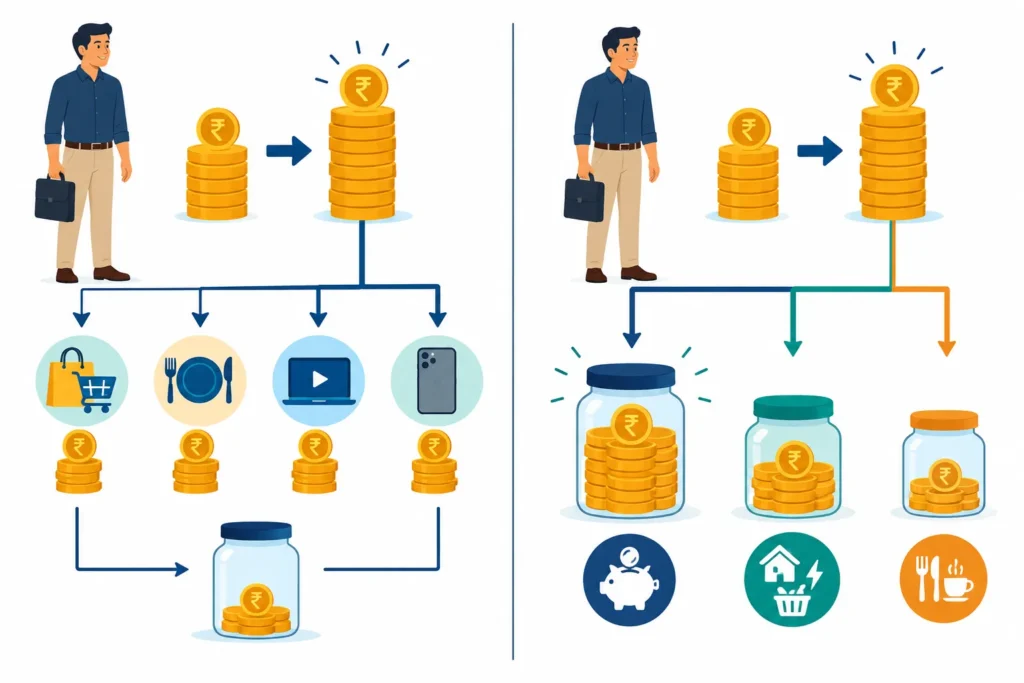
Lifestyle inflation means increasing your regular spending whenever your income rises. Some improvement in lifestyle is natural. The problem begins when every increment, bonus or additional source of income immediately becomes a new expense.
For example, consider an employee earning Rs. 40,000 per month and saving Rs. 5,000. After an increment, the monthly take-home salary rises to Rs. 46,000. If the employee starts spending the entire additional Rs. 6,000 on shopping, dining out and upgraded subscriptions, the monthly saving remains Rs. 5,000.
The person is earning more but is not becoming financially stronger. In fact, the new spending may turn into permanent commitments that are difficult to reduce later.
A more balanced approach would be to divide the increment. The employee could increase monthly savings from Rs. 5,000 to Rs. 8,000, use some money for current needs and keep a small amount for lifestyle improvements. This allows the person to enjoy part of the raise without losing the opportunity to make progress.
Lifestyle inflation is especially easy to miss because each expense may look affordable on its own. A better mobile plan, a gym membership, more cab rides and another streaming service may not appear serious individually. Together, however, they can consume a large part of the monthly surplus.
It can also affect major purchases. A salary increase may encourage someone to rent a more expensive flat, buy a costly vehicle or choose a longer EMI commitment. Unlike an occasional dinner, these decisions may create fixed expenses for several months or years.
How to Control Lifestyle Inflation
- Save part of every increment: Decide in advance that a portion of any salary increase will go towards an emergency fund, investment or important goal.
- Wait before upgrading: Give yourself a cooling-off period before buying a new phone, vehicle or expensive membership.
- Review recurring expenses: Check subscriptions, app payments, memberships and service plans regularly. Cancel those you do not use enough.
- Increase savings automatically: Raise your recurring deposit, systematic investment plan or automated bank transfer soon after your income increases.
- Upgrade selectively: Spend more on things that genuinely improve your health, safety, skills or daily life instead of upgrading everything together.
A written monthly plan makes lifestyle inflation easier to identify. The detailed budgeting guide in this personal finance series explains how to separate needs, wants, savings and debt payments without making the budget unnecessarily complicated.
The aim is not to avoid enjoyment. It is to make sure today’s lifestyle does not prevent tomorrow’s financial security. A sustainable lifestyle should leave room for emergencies, insurance, investments and future goals.
Trap 2: Overusing Credit Cards and EMIs
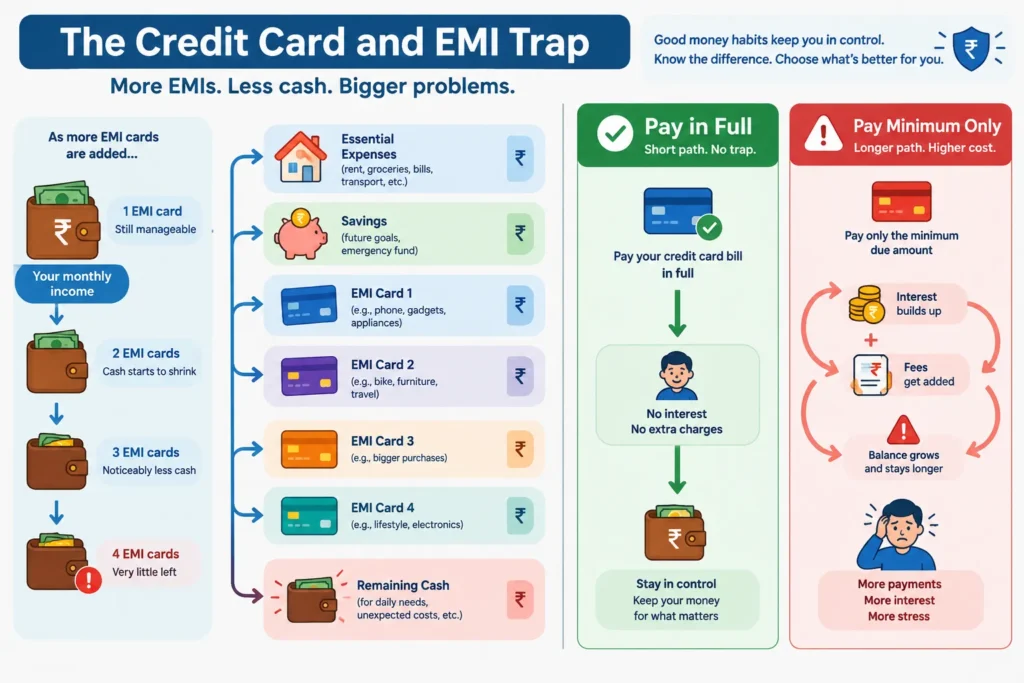
Credit cards and EMIs are financial tools, not free money. They can be useful when used carefully, but they can also make an unaffordable purchase appear manageable.
A price of Rs. 60,000 may feel expensive when seen as one amount. The same purchase may look easier when advertised as a monthly EMI. However, the total obligation has not disappeared. It has only been divided across future months, and interest or processing charges may apply.
The main risk is committing future income before it arrives. One EMI may fit comfortably within your budget. Several EMIs for a phone, laptop, furniture and personal loan can leave very little money for rent, groceries, savings and emergencies.
Credit card overspending creates a similar problem. A card separates the act of buying from the act of paying. This can make it easier to spend more than you would with cash or a direct bank payment.
If you do not pay the full amount due by the payment deadline, interest may be charged according to the card issuer’s terms. Credit card interest can make an outstanding balance grow quickly, particularly when new purchases continue while older dues remain unpaid.
Paying only the minimum amount due generally does not clear the full bill. It may help avoid some immediate consequences under the issuer’s rules, but the remaining balance can continue attracting interest and other applicable charges. Repeated minimum payments can therefore keep a person in debt for much longer than expected.
Missed or delayed payments may also lead to late fees, additional interest and a negative effect on your credit history. A weaker credit profile can make future borrowing more difficult or expensive, although the exact impact depends on the person’s overall repayment record and the lender’s assessment.
Borrowing Beyond Repayment Capacity
Before taking a loan or choosing an EMI, ask whether the repayment would still be manageable during a difficult month. Your budget may change because of a medical expense, delayed salary, job loss or urgent family need.
For example, someone with a take-home income of Rs. 50,000 may believe that a Rs. 7,000 EMI is affordable. But if that person already pays Rs. 12,000 towards other loans and has high essential household expenses, another EMI could create pressure. Affordability should be judged using all existing commitments, not the new EMI alone.
Borrowing to purchase an essential item may sometimes be reasonable. Borrowing repeatedly for short-lived wants, festivals, holidays or routine monthly expenses is a warning sign. It suggests that spending is higher than available income.
How to Avoid the Credit and EMI Trap
- Pay the full credit card bill: Wherever possible, pay the total amount due on time rather than relying on the minimum payment.
- Check the total cost: Look beyond the monthly EMI. Review interest, processing fees, taxes, penalties and the full amount payable.
- Count all repayments: List every loan and EMI before adding another commitment.
- Avoid borrowing for routine expenses: Regular use of credit for groceries, utility bills or rent may indicate a budget shortfall that needs attention.
- Keep card usage within available cash: A useful rule is to charge only what you could pay from your bank account if the bill arrived today.
- Contact the lender early: If repayment trouble appears likely, speak to the lender before missing payments. Available options will depend on the lender and loan terms.
If you already have several debts, prioritise repayment instead of taking fresh credit to maintain the same lifestyle. The detailed loan repayment guide in this series covers how to list debts, compare costs and create a practical repayment order.
A credit limit is not a spending target, and loan approval does not prove that a purchase suits your budget. The safer question is not simply, “Can I get this EMI?” It is, “Can I repay it comfortably while continuing to save and pay for essential needs?”
Emergency Funds, Investment Scams and Delayed Financial Planning
Some financial mistakes do not look dangerous at first. Investing every spare rupee may seem responsible, a scheme promising high returns may appear exciting, and postponing long-term goals may feel harmless when they are years away.
However, these choices can create serious problems later. The next three financial traps to avoid involve investing without a safety cushion, trusting unrealistic return claims, and delaying important financial planning.
Trap 3: Investing Before Building an Emergency Fund
Investing is important, but it should not leave you without money for an immediate emergency. Before putting all your savings into shares, mutual funds, fixed deposits with restrictions, property or other investments, build a basic emergency fund.
An emergency fund is money kept aside for necessary and unexpected expenses. Common examples include:
- A medical bill that is not fully covered by health insurance
- A job loss, salary delay or temporary interruption in income
- An urgent home or vehicle repair
- Essential travel caused by a family emergency
- An unexpected expense for a dependent family member
Suppose a salaried employee invests almost all monthly savings in equity mutual funds. A few months later, the employee loses the job and needs money for rent, groceries and EMIs. Without an emergency fund, the person may have to redeem investments when markets are down, use a credit card or take a costly personal loan.
This does not mean equity or mutual funds are bad. The problem is using long-term investments as emergency money. Market-linked investments can rise or fall, and the value may be low exactly when the money is needed. Some other investments may have lock-in periods, withdrawal penalties or slow sale processes.
An emergency fund should generally be easy to access and should not depend heavily on market movements. Depending on personal circumstances, the money may be divided between a savings account and a suitable low-risk, liquid option. Accessibility and capital safety matter more here than chasing the highest possible return.
The appropriate emergency fund size is different for every household. Consider essential monthly costs, number of earners, job stability, health needs, existing insurance, dependants and loan obligations. A household with one income and several dependants may need a larger cushion than a household with two stable incomes and limited fixed expenses.
If building the full amount feels difficult, begin with a smaller target. Save enough for one month of essential expenses, then increase it gradually. Automating a transfer soon after salary credit can make the process easier. The detailed emergency fund article can help you estimate a suitable target and choose where to keep the money.
Once the basic safety cushion is in place, regular investing can continue according to your goals and risk capacity. The aim is not to delay investing indefinitely. It is to avoid becoming dependent on debt or a badly timed investment sale when life takes an unexpected turn.
Trap 4: Believing Unrealistic Returns and Investment Scams
A common investment trap starts with a simple promise: high returns with little or no risk. The offer may arrive through a messaging group, social media account, phone call, seminar, friend or relative. It may use screenshots of profits, luxury images or testimonials to appear genuine.
Returns and risk are connected. Legitimate market-linked investments cannot guarantee a fixed high return in all conditions. Even well-known investments can deliver weak or negative returns over some periods. Anyone claiming unusually high, certain and quick profits should be treated with caution.
Warning signs may include:
- “Guaranteed” high returns from a market-linked product
- Pressure to invest immediately before an offer closes
- Requests to transfer money to a personal bank account or unknown wallet
- Promises of secret tips, fixed daily profits or risk-free trading
- Extra rewards for bringing friends or family into the scheme
- Unclear documents, missing risk disclosures or unexplained fees
- An intermediary who avoids questions about registration or regulation
- Instructions to share passwords, PINs, OTPs or remote access to a device
Do not rely only on a professional-looking website, app, office or social media profile. Names, logos and registration details can be copied. Testimonials can also be false or selectively presented.
Before investing, understand what the product is, how it is expected to generate returns, what risks apply, how withdrawals work and what charges you will pay. If the explanation is confusing or changes whenever you ask questions, do not rush ahead.
Check whether the product and intermediary fall under an appropriate regulator. Depending on the product, official sources may include the Securities and Exchange Board of India, the Reserve Bank of India, the Insurance Regulatory and Development Authority of India, or the Ministry of Corporate Affairs. Use the relevant official records to verify registration details instead of trusting a screenshot sent by the seller.
Registration itself does not make an investment profitable or suitable for you. It is a basic verification step, not a return guarantee. You must still read the documents, understand the risks and decide whether the product matches your goal, time horizon and ability to handle losses.
Never invest because you are afraid of missing out. A genuine financial decision should allow enough time to review the details. If necessary, discuss the offer with a qualified, appropriately registered professional who is not earning a hidden commission from the transaction.
Trap 5: Delaying Goals, Long-Term Planning and Insurance Reviews
“I will start next year” is one of the most expensive habits in personal finance. People often delay planning because retirement, a child’s education or buying a home seems far away. Others postpone insurance reviews after purchasing a policy once.
Starting earlier does not guarantee a particular result, but it usually gives you more time to save and adjust. When a goal is delayed, the required monthly contribution may become harder to manage. You may also have less flexibility if investment returns are lower than expected or the goal becomes more expensive.
Begin by turning broad wishes into clear financial goals. Write down the purpose, estimated amount, target date and current savings available for it. Examples include:
- Building an emergency fund over the next several months
- Saving for higher education expected in a particular year
- Creating a home down payment without exhausting emergency savings
- Preparing for retirement while meeting present family responsibilities
Choose investments only after identifying the goal and time available. Money needed soon should not usually depend heavily on volatile assets. Longer-term goals may allow some market exposure, but the allocation should still reflect your risk capacity. Returns vary, and past performance does not promise future results.
Review goals periodically and after major life changes such as marriage, childbirth, a home loan, a career break or a significant change in income. The financial goals article provides a useful framework for converting these events into measurable savings targets.
Insurance also needs regular review. Health insurance should be checked for coverage, exclusions, waiting periods, hospital conditions and the needs of family members. Life insurance needs may change when income, dependants or liabilities change. Vehicle and home-related covers may also require updates when assets or circumstances change.
Insurance reduces the financial impact of specified events, but it does not remove every risk. Policies have terms, limits and exclusions. An insurance policy is therefore not a substitute for emergency savings, careful planning or reading the policy document.
A practical approach is to schedule a financial review at least periodically and whenever life changes materially. Check your goals, emergency fund, investments, debts, nominees and insurance coverage together. Small corrections made early are usually easier than major changes made close to a deadline.
A strong financial plan does not depend on perfect forecasts. It combines accessible emergency money, verified investments, realistic expectations and timely reviews. Avoiding these three traps can help protect both your present cash flow and your long-term goals.
Warning Signs, Practical Action Plan and FAQs
Financial problems rarely appear overnight. They usually begin with small habits: paying only the minimum amount due on a credit card, taking another loan to manage existing EMIs, or investing quickly because someone promises unusually high returns.
Recognising these warning signs early can help you avoid bigger difficulties. You do not need a perfect financial plan immediately. Start by identifying the most urgent problem and taking one practical step at a time.
Warning Signs You Should Not Ignore
The following signs may indicate that your finances need attention. One sign alone does not always mean you are in serious trouble, but repeated patterns should not be ignored.
- You regularly carry a credit card balance: If you cannot pay the total amount due each month, interest and other charges can make the outstanding balance grow quickly. Paying only the minimum due keeps the account active, but it does not clear the debt efficiently.
- You use new loans to repay old loans: Debt consolidation may sometimes be useful when it genuinely reduces cost and comes with a clear repayment plan. However, repeatedly borrowing from one source to pay another is a warning sign.
- You have no emergency cash: Without accessible savings, a medical expense, urgent home repair or temporary loss of income may force you to use a credit card or costly personal loan.
- Your total EMIs leave little room for essentials: If rent, groceries, utility bills and insurance premiums become difficult to manage after paying EMIs, your debt commitments may be too high.
- You invest because of pressure: Be cautious if an agent, relative, social-media personality or messaging group tells you to invest immediately. Statements such as “limited opportunity”, “guaranteed high return” or “zero risk” deserve careful verification.
- You do not know where your money goes: A salary may appear sufficient, yet frequent food deliveries, app subscriptions, shopping and small digital payments can gradually weaken your monthly cash flow.
- You lack clear financial goals: Investing without knowing whether the money is for an emergency, house purchase, education or retirement can lead to unsuitable choices.
- You ignore basic protection needs: An investment portfolio may not be enough to handle a large hospital bill or protect dependants after the death of an earning family member.
Another important warning sign is constant financial stress. If you avoid checking bank statements, delay opening loan messages or feel anxious whenever a payment is due, face the numbers early. A clear picture is usually easier to manage than uncertainty.
A Simple Action Plan to Regain Control
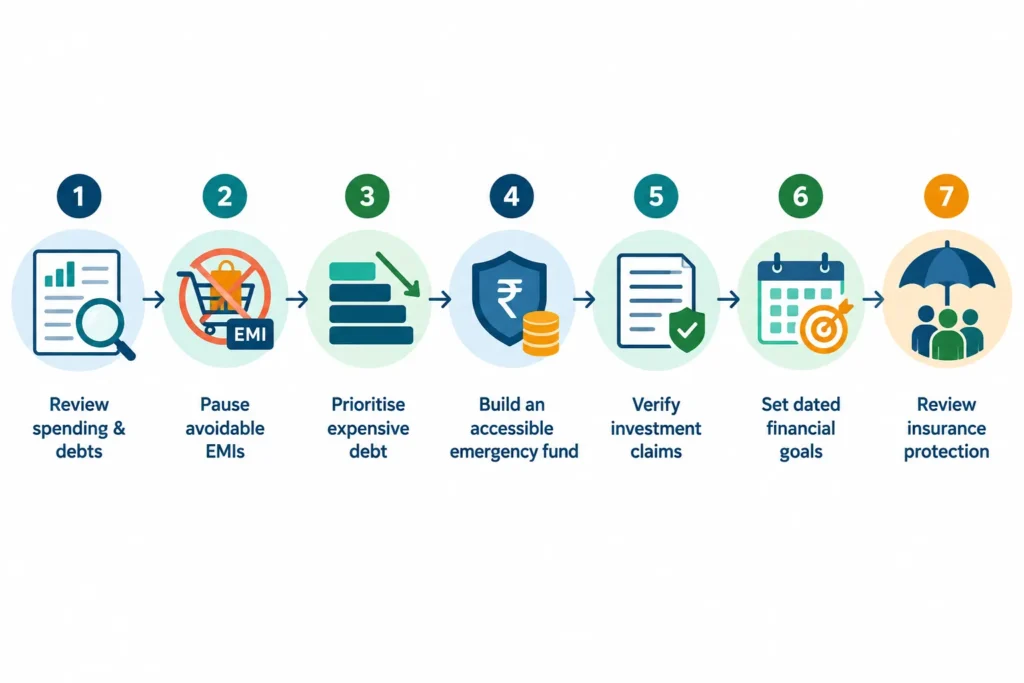
You do not have to correct every issue in the same month. Use the following sequence to deal with immediate risks while building a stronger financial base.
- Review your spending and debt. Note your monthly take-home income, essential expenses, discretionary spending, EMIs and credit card dues. For every debt, record the outstanding amount, interest rate, monthly payment and remaining tenure. Bank statements and card statements can help you find expenses that are easy to miss.
- Stop adding avoidable EMIs. Delay non-essential purchases if you need an EMI simply to make them affordable. Before borrowing, consider the total repayment amount rather than looking only at the monthly instalment. A smaller EMI may continue for longer and cost more overall.
- Prioritise expensive debt. Continue making required payments on all loans, but direct additional money towards high-cost debt where appropriate. Credit card revolving balances and costly short-term loans often need urgent attention. Check applicable charges before making a loan prepayment or transfer.
- Build an appropriate emergency buffer. Begin with a small, achievable amount in an accessible bank account. You can gradually work towards a buffer based on your essential expenses, job stability, dependants, health needs and insurance coverage. Avoid placing the entire emergency fund in volatile or difficult-to-withdraw investments.
- Verify every financial claim. Understand the product, costs, risks, lock-in rules and withdrawal conditions. Check whether the provider and intermediary are appropriately regulated. Never share an OTP, PIN, CVV or remote access to your phone because someone claims to represent a bank or investment company.
- Set specific goals. Give each goal a purpose, target amount and expected date. “Save for a home down payment in five years” is more useful than “invest more”. Clear goals make it easier to select a suitable saving or investment approach.
- Review protection needs. Consider suitable health insurance and, if someone depends on your income, appropriate life insurance. Insurance needs vary by family situation, employer benefits, liabilities and existing savings. Read exclusions, waiting periods and other policy conditions before buying.
If your expenses exceed your income even after reasonable cuts, the solution may require both cost control and higher income. This could mean negotiating compensation, developing employable skills, seeking additional work or selling items you no longer need. Avoid treating another loan as extra income.
Use a Monthly Financial Check-In
Set aside a short time each month to review your finances. A simple check-in can include:
- checking bank and credit card statements for errors or unknown transactions;
- confirming that bills, EMIs and insurance premiums were paid on time;
- tracking progress on emergency savings and debt reduction;
- reviewing whether any new subscription or recurring payment is still useful;
- checking that investments remain connected to clear goals; and
- updating nominees and important financial records when family circumstances change.
Do not react to every short-term market movement during this review. The purpose is to improve your financial behaviour and identify problems, not to make frequent investment changes.
Beginners who want to organise income, budgeting, insurance, debt and investments in one framework can refer to The Ultimate Personal Finance Guide for Beginners in India. More focused RegularStation guides on budgeting, emergency funds, credit cards and insurance can then help with individual decisions.
Frequently Asked Questions
Should I repay debt before I start investing?
It depends on the type and cost of debt. High-cost debt, such as a revolving credit card balance, usually deserves priority because its charges can be substantial. At the same time, continue essential insurance premiums, required loan payments and any basic emergency saving you can manage. Lower-cost debt requires a more balanced decision based on repayment terms, goals and risk tolerance.
Can I build an emergency fund while repaying loans?
Yes. Start with a modest emergency buffer while making all required debt payments. This reduces the chance of taking another loan for a sudden expense. Once the initial buffer is in place, you may direct more surplus towards expensive debt and later expand the emergency fund. The right balance depends on income stability, family responsibilities and the cost of your loans.
How can I identify a possible financial scam?
Common warning signs include guaranteed high returns, pressure to act immediately, requests to transfer money to a personal account, unclear documentation and demands for confidential banking information. Be suspicious of unsolicited messages claiming that your KYC, account or reward points will expire immediately. Verify the organisation independently using official channels rather than contact details supplied in the suspicious message.
How should I handle lifestyle inflation after a salary increase?
Decide in advance how the increase will be divided. You might use part for better living, part for debt repayment and part for savings or investments linked to goals. Increasing an automatic transfer soon after the salary revision can prevent the full raise from disappearing into recurring expenses. Be especially careful about adding several long-term EMIs at once.
When should I begin financial planning?
Begin as soon as you earn, spend or borrow money. You do not need a high salary or a large investment amount. Early planning may simply involve tracking expenses, paying bills on time, avoiding unnecessary debt and building a small emergency fund. Your plan can become more detailed as your income, assets and responsibilities grow.
What should I do if I already have too many EMIs?
List every loan and avoid taking fresh debt for discretionary spending. Contact lenders before missing payments to understand legitimate repayment or restructuring options, but examine the total cost and conditions carefully. Cut non-essential expenses and use available surplus to address costly debt. If the situation is complex, consider guidance from a qualified professional who does not earn by pushing another unsuitable loan.
Summary
The most important financial traps to avoid are often visible through everyday warning signs: persistent credit card balances, repeated borrowing, no emergency cash, pressure-driven investing and a lack of clear goals.
Start by reviewing your spending and debts. Limit new EMIs, create an accessible emergency buffer, verify financial claims, define your goals and review suitable insurance protection. Small, consistent actions are more useful than waiting for the perfect plan. A monthly financial check-in can help you notice problems early and keep your money aligned with your real priorities.

Comments