



Quick Answer
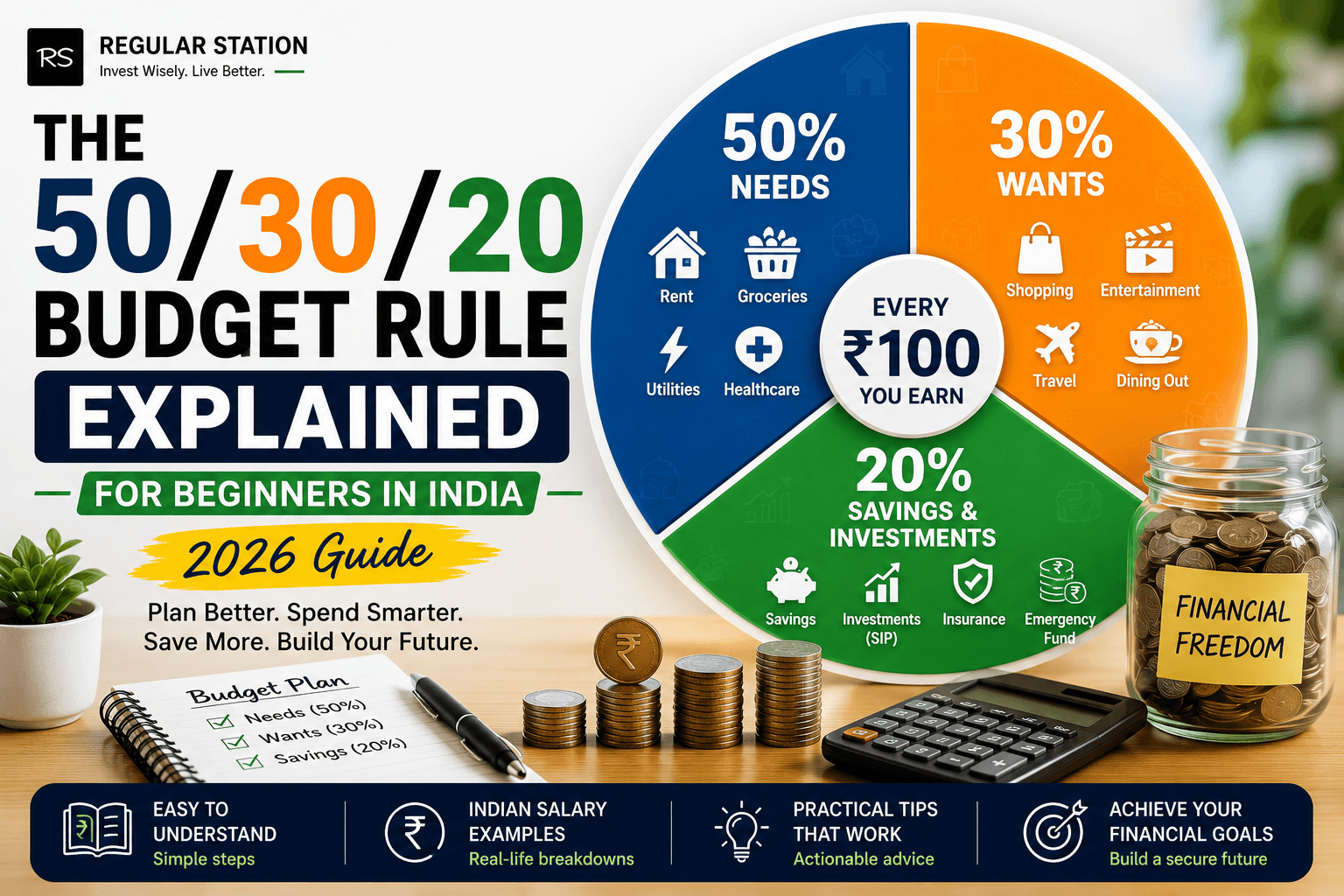
The 50/30/20 Budget Rule is a simple budgeting method that helps you divide your monthly take-home income into three categories: 50% for needs, 30% for wants, and 20% for savings and investments. Instead of tracking every rupee you spend, this rule gives you an easy framework to manage money, avoid overspending, and build long-term financial security.
For Indian households, the rule can be adapted based on factors like city, rent, EMIs, family size, and income level. The goal isn’t to follow the percentages perfectly—it’s to create a balanced budget that supports your financial goals.
Quick Summary:
Spend 50% on essentials, 30% on lifestyle choices, and 20% on your future through savings, investments, or debt repayment.
Key Takeaways
- The 50/30/20 Budget Rule divides your monthly take-home income into Needs (50%), Wants (30%), and Savings & Investments (20%).
- It is one of the easiest budgeting methods for beginners because it focuses on broad spending categories instead of tracking every expense.
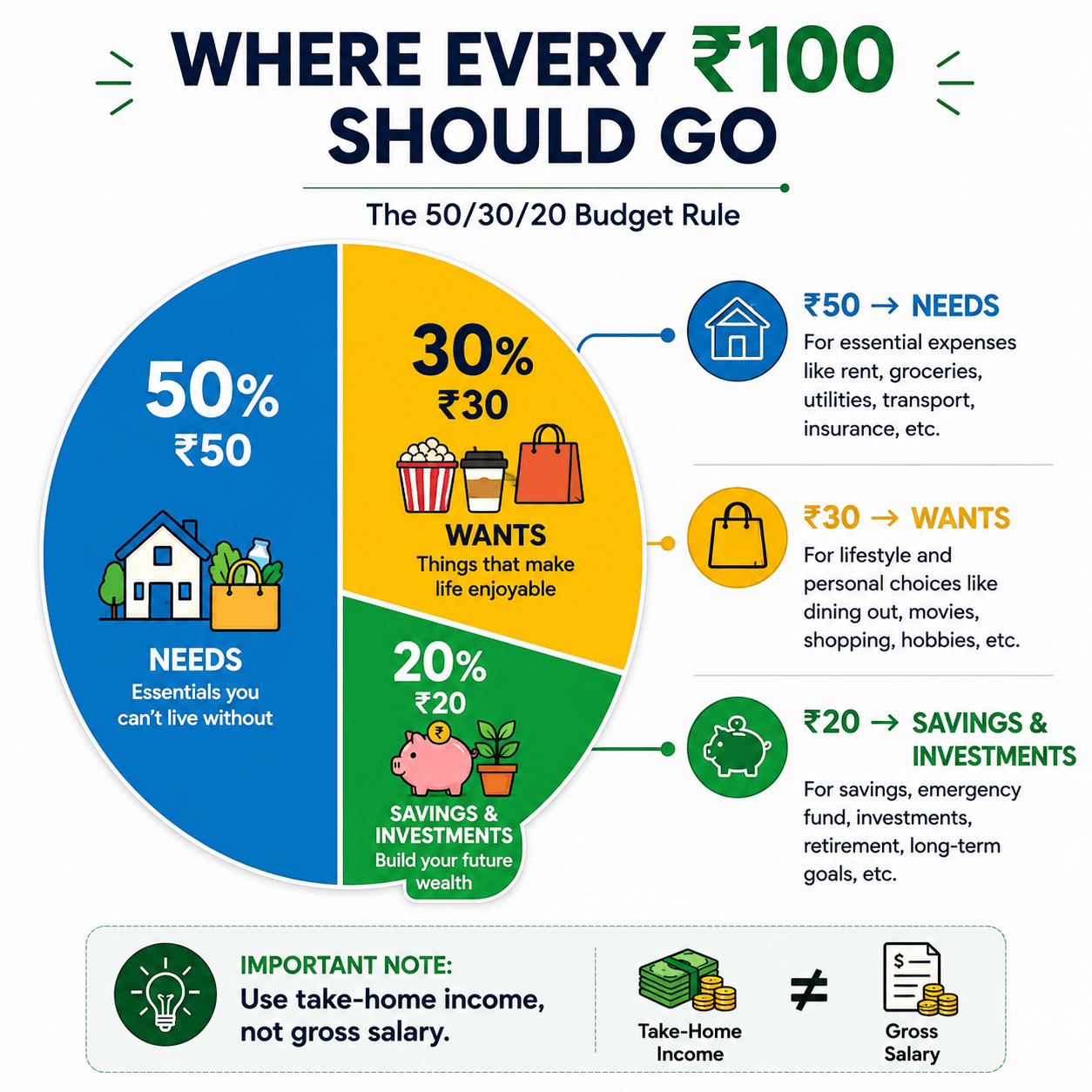
- The rule works best with your net salary (take-home pay), not your gross salary.
- In India, you may need to adjust the percentages depending on rent, EMIs, family responsibilities, and the cost of living.
- The 20% allocation can include an emergency fund, SIPs, PPF, NPS, fixed deposits, or paying off high-interest loans.
- Budgeting is about building better financial habits—not restricting every purchase.
- Reviewing your budget every month helps you stay aligned with your financial goals.
- The 50/30/20 Rule is a starting point, not a rigid formula. Small adjustments can make it work for almost any income level.
If you’re new to budgeting and personal finance, this article is part of our comprehensive Personal Finance Guide for Beginners in India, where you’ll learn everything from saving and investing to emergency funds, insurance, and long-term financial planning.
Introduction
Have you ever wondered where your salary disappears every month?
You receive your paycheck, pay a few bills, shop for groceries, order food a couple of times, maybe buy something online, and before you know it, your bank balance is much lower than expected. Many people experience this cycle without realizing where their money actually goes.
The good news is that managing your money doesn’t have to be complicated.
The 50/30/20 Budget Rule is one of the simplest and most effective budgeting methods for beginners. Instead of creating detailed spreadsheets or tracking hundreds of individual expenses, it helps you organize your monthly income into just three easy categories:
- 50% for your essential needs
- 30% for your personal wants
- 20% for savings and investments
This straightforward approach makes it easier to control spending, build savings, and work toward long-term financial goals without feeling overwhelmed.
Why This Rule Is Popular
Unlike complex budgeting systems that require you to categorize every transaction, the 50/30/20 Rule provides a flexible framework. It encourages mindful spending while leaving room to enjoy life.
Whether you’re:
- Starting your first job,
- Managing household expenses,
- Saving for a home,
- Planning for retirement, or
- Simply trying to stop living paycheck to paycheck,
this budgeting method can help you make smarter financial decisions.
Is the 50/30/20 Budget Rule Suitable in India?
Yes—but with a few practical adjustments.
The original rule was developed in the United States, where living costs, taxes, and financial systems differ from India. For example, housing costs in cities like Mumbai, Bengaluru, or Delhi can consume more than half of a person’s income, while families in smaller cities may have significantly lower living expenses.
Similarly, Indian households often have unique financial commitments such as:
- Home loan EMIs
- Education expenses
- Family support
- Medical costs
- Festival spending
- Insurance premiums
- Long-term investments like PPF, EPF, or NPS
Because of these differences, it’s perfectly acceptable to adapt the percentages to suit your circumstances. What matters most is maintaining a healthy balance between essential expenses, lifestyle spending, and saving for the future.
Regular Station Pro Tip:
Don’t aim for a perfect 50/30/20 split from day one. Start by understanding where your money goes each month, then gradually adjust your spending until you move closer to the ideal balance. Consistency matters far more than perfection.
What You’ll Learn in This Guide
By the end of this article, you’ll understand:
- What the 50/30/20 Budget Rule is and why it works.
- How to calculate your own budget using your monthly take-home income.
- Real-world examples for different salary levels in India.
- Which expenses belong under Needs, Wants, and Savings.
- How to adapt the rule if your expenses don’t fit the standard percentages.
- Common budgeting mistakes and how to avoid them.
- Whether this budgeting method is the right choice for your financial situation.
If you’re new to budgeting, this guide is a great starting point. For a broader understanding of money management—including saving, investing, insurance, debt, and financial planning—don’t miss our Ultimate Personal Finance Guide for Beginners in India, which serves as the cornerstone of our personal finance series.
What Is the 50/30/20 Budget Rule?
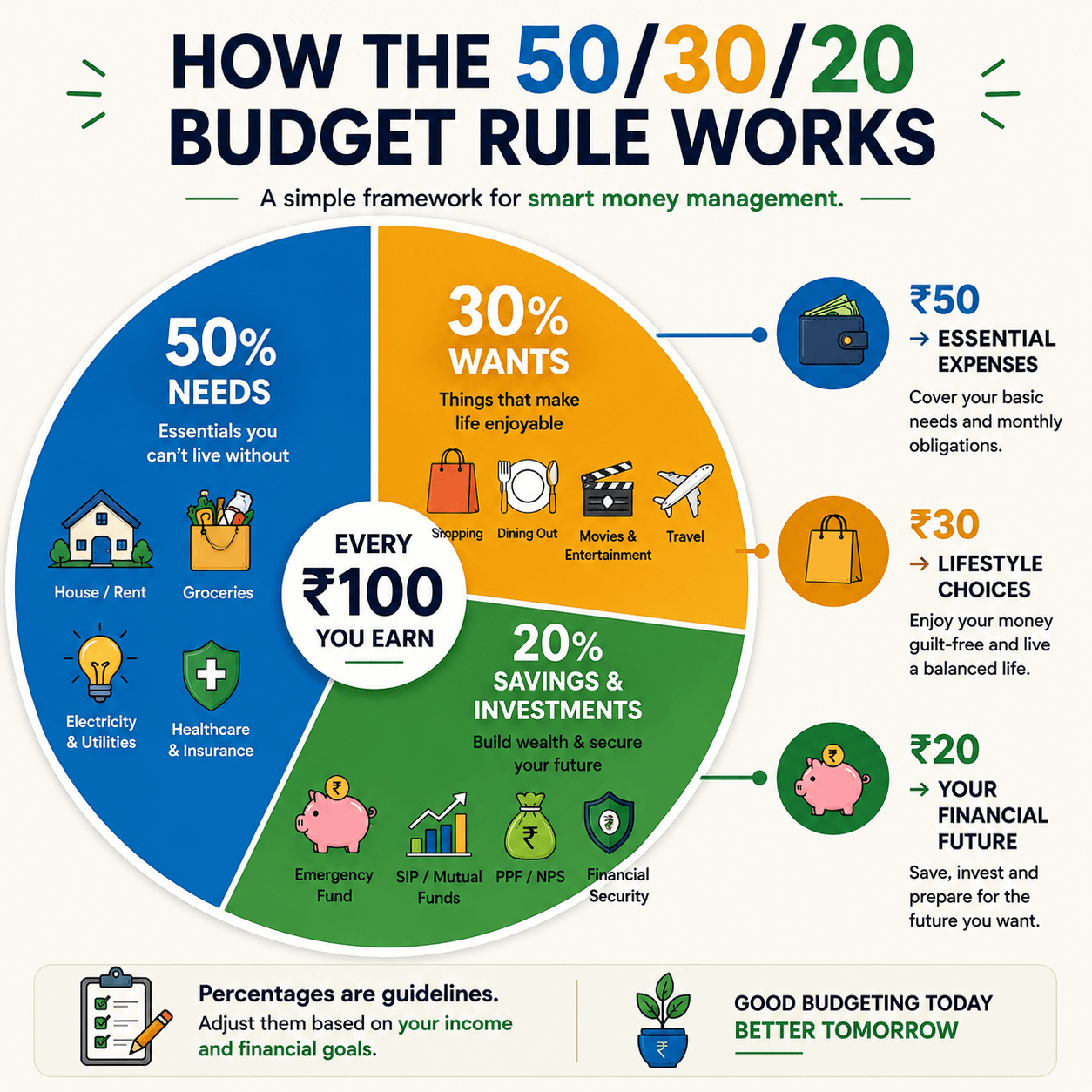
The 50/30/20 Budget Rule is a simple budgeting framework that helps you divide your monthly take-home income into three spending categories:
| Category | Percentage | Purpose |
|---|---|---|
| Needs | 50% | Essential living expenses |
| Wants | 30% | Lifestyle and discretionary spending |
| Savings & Investments | 20% | Building wealth and achieving future financial goals |
Instead of tracking every single expense, this method focuses on maintaining a healthy balance between what you must spend, what you want to spend, and what you should save.
Think of Your Salary Like a Pizza
Imagine your monthly income is a pizza cut into 10 slices.
- 🍕 5 slices (50%) pay for essential expenses like rent, groceries, and electricity.
- 🍕 3 slices (30%) are for things you enjoy, such as dining out, shopping, or streaming subscriptions.
- 🍕 2 slices (20%) are reserved for your future through savings, investments, or debt repayment.
This visual approach makes budgeting much easier to understand, especially if you’re managing your money for the first time.
Regular Station Tip:
The percentages are a guideline, not a strict rule. If your current spending doesn’t match these numbers, don’t worry. Use them as a target to work toward over time.
Who Created the 50/30/20 Budget Rule?
The 50/30/20 Budget Rule became widely known through Elizabeth Warren, a U.S. senator and former bankruptcy law professor, and her daughter Amelia Warren Tyagi. They introduced the concept in their 2005 book, All Your Worth: The Ultimate Lifetime Money Plan.
Their idea was simple: budgeting shouldn’t feel complicated.
Many traditional budgeting methods require people to categorize every expense into dozens of groups, which can quickly become overwhelming. Warren’s approach simplified the process into just three broad categories, making it easier for ordinary households to build healthier financial habits.
Although the rule originated in the United States, its core principle—balancing essential spending, personal enjoyment, and future savings—is universal. That’s why it has been adopted by millions of people around the world, including many in India.
Why Is the 50/30/20 Budget Rule So Popular?
The popularity of this budgeting method comes from its simplicity and flexibility.
Unlike complex budgeting systems, you don’t need advanced financial knowledge or expensive software to get started. You only need to know your monthly take-home income and group your expenses into three broad categories.
1. Easy for Beginners
Many people avoid budgeting because they think it’s difficult or time-consuming.
The 50/30/20 Rule removes that fear by focusing on just three categories instead of dozens of expense types.
2. Encourages Healthy Spending Habits
The rule helps answer three important questions every month:
- Am I spending too much on essentials?
- Am I overspending on lifestyle choices?
- Am I saving enough for the future?
These questions create awareness, which is often the first step toward better financial management.
3. Supports Long-Term Financial Goals
Setting aside at least 20% of your income for savings and investments helps you prepare for goals such as:
- Building an emergency fund
- Buying a home
- Funding your child’s education
- Planning a vacation
- Starting a business
- Preparing for retirement
Even if you begin with a smaller percentage, making saving a regular habit is more important than waiting until you can save a large amount.
4. Reduces Financial Stress
One of the biggest causes of money-related stress is uncertainty.
When you know how much you can safely spend each month, you’re less likely to rely on credit cards or face unexpected financial shortfalls.
A structured budget also helps you avoid guilt after making purchases because you’ve already planned for both essentials and personal spending.
5. Works for Different Income Levels
Whether you earn ₹30,000 or ₹2,00,000 per month, the budgeting framework remains the same.
The actual amounts change, but the underlying principle—balancing spending and saving—does not.
This makes the rule suitable for:
- Salaried employees
- Freelancers
- Newly married couples
- Young families
- Students with part-time income
- Self-employed professionals
Budgeting is just one part of building financial security. To learn how budgeting fits into saving, investing, debt management, insurance, and wealth creation, explore our Ultimate Personal Finance Guide for Beginners in India.
Why the Rule Needs an Indian Perspective
While the budgeting framework is universal, Indian households often have financial priorities that differ from those in other countries.
For example, many families regularly budget for:
- Home loan EMIs
- Education expenses
- Medical insurance
- Financial support for parents
- Festival and wedding expenses
- Gold purchases
- Long-term investments such as EPF, PPF, NPS, and SIPs
In large metropolitan cities, rent alone may consume more than 40–50% of take-home income. On the other hand, households in smaller cities may have lower housing costs, allowing them to save more than 20%.
This is why the 50/30/20 Rule should be viewed as a flexible framework, not a strict formula.
Did You Know?
If your essential expenses currently exceed 50% of your income, you don’t need to abandon the budgeting method. Start by tracking your spending for one or two months, identify areas where you can reduce costs, and gradually move closer to a balanced budget.
Quick Recap
The 50/30/20 Budget Rule is designed to answer one simple question:
“Where should my money go every month?”
Instead of letting your salary disappear without a plan, this budgeting method gives every rupee a purpose.
Remember the three categories:
- 50% for essential living expenses.
- 30% for lifestyle and personal enjoyment.
- 20% for savings, investments, and financial security.
In the next section, we’ll learn how to calculate your own budget step by step, using practical Indian salary examples and common household expenses.
How Does the 50/30/20 Budget Rule Work?
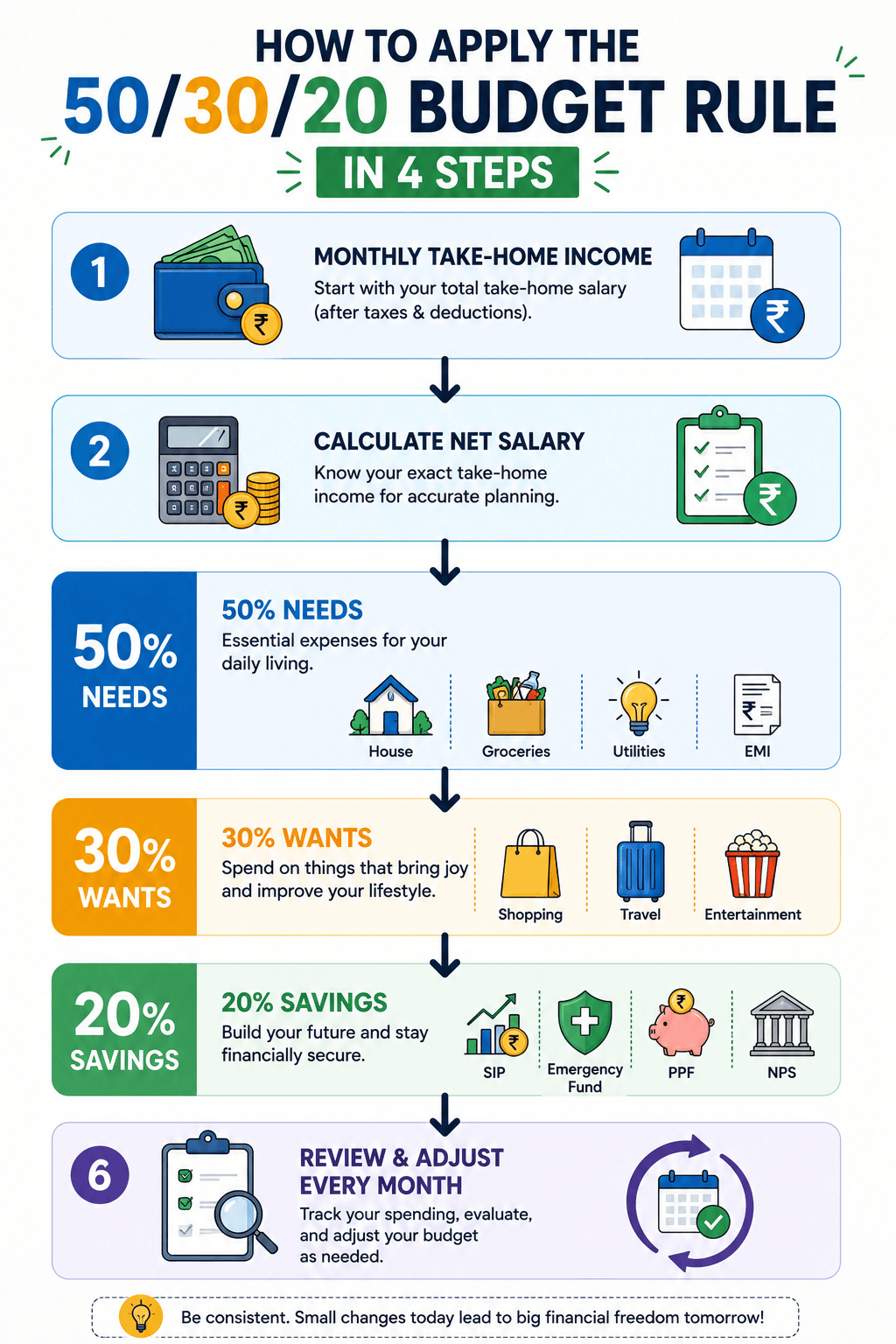
Knowing the theory is one thing, but applying it to your own salary is where the real value lies.
The good news is that you don’t need to be a finance expert or use complicated spreadsheets. All you need is your monthly take-home income and a basic understanding of your expenses.
Follow these four simple steps to create your first budget.
Step 1: Calculate Your Monthly Take-Home Income
The first step is to calculate the amount that actually reaches your bank account every month.
This is called your take-home income or net salary.
It is not your Cost to Company (CTC) or gross salary.
For salaried employees in India, your take-home salary is usually the amount left after deductions such as:
- Employee Provident Fund (EPF)
- Professional Tax (where applicable)
- Income Tax (TDS)
- Other salary deductions
Example
Suppose your salary details look like this:
| Salary Details | Amount |
|---|---|
| Gross Monthly Salary | ₹60,000 |
| EPF Deduction | ₹2,500 |
| Professional Tax | ₹200 |
| Income Tax (TDS) | ₹2,300 |
| Take-home Salary | ₹55,000 |
Your budget should be based on ₹55,000, not ₹60,000.
Regular Station Pro Tip:
If your salary changes because of bonuses, incentives, or commissions, create your monthly budget using your average take-home income over the last 6–12 months instead of your highest-paying month.
What If You’re Self-Employed or a Freelancer?
If your income changes every month:
- Calculate your average monthly income over the last 6–12 months.
- Budget using the lower end of that average if your earnings fluctuate significantly.
- Save extra income during high-earning months instead of increasing lifestyle spending immediately.
This approach helps smooth out income fluctuations and reduces financial stress during slower months.
Step 2: Allocate 50% to Your Needs
Needs are expenses that are essential for your daily life.
These are the bills you must pay regardless of your lifestyle choices.
Ask yourself:
“If I stop spending on this, will it significantly affect my daily living or financial obligations?”
If the answer is yes, it’s probably a need.
Common Needs in India
- House rent
- Home loan EMI
- Electricity bill
- Water bill
- Cooking gas
- Internet (for work or study)
- Mobile recharge
- Groceries
- Public transport
- Fuel for commuting
- Health insurance premium
- Essential medicines
- School fees
- Childcare expenses
- Basic clothing replacement
Example
If your monthly take-home income is ₹50,000:
50% = ₹25,000
A possible allocation could be:
| Essential Expense | Monthly Cost |
|---|---|
| Rent | ₹12,000 |
| Groceries | ₹5,000 |
| Electricity & Gas | ₹2,000 |
| Fuel & Transport | ₹3,000 |
| Internet & Mobile | ₹1,500 |
| Medicines & Essentials | ₹1,500 |
| Total | ₹25,000 |
This doesn’t have to be exact every month, but staying close to the target keeps your budget balanced.
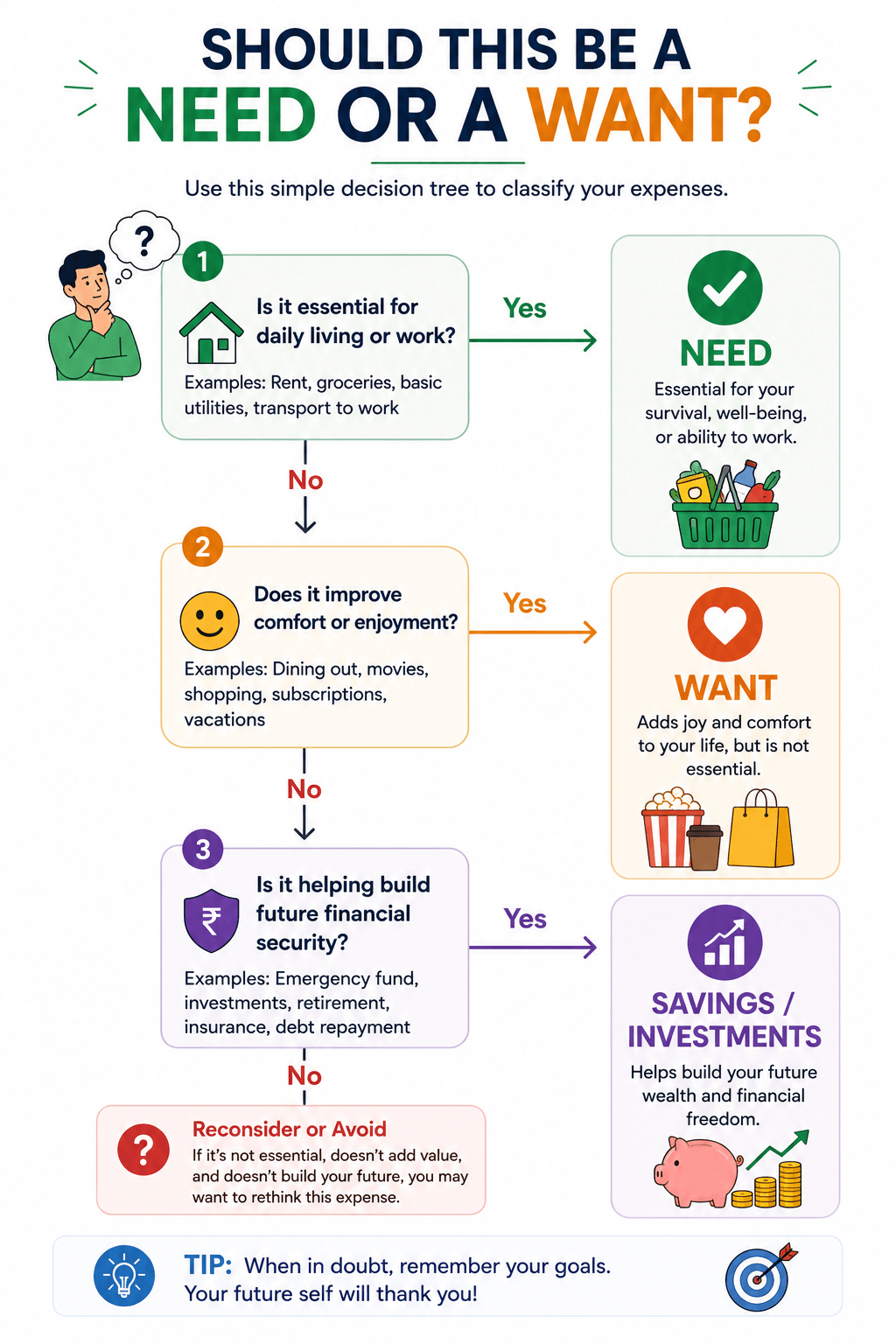
Needs vs. Wants: The Most Common Mistake
Many people accidentally classify wants as needs.
For example:
| Expense | Need or Want? | Why? |
|---|---|---|
| Basic smartphone | ✅ Need | Essential for communication and work |
| Latest flagship phone | ❌ Want | Upgrade, not essential |
| Home-cooked meals | ✅ Need | Daily living |
| Ordering food every weekend | ❌ Want | Lifestyle choice |
| Public transport pass | ✅ Need | Daily commute |
| Premium cab every day | ❌ Want | Convenience, not necessity |
Being honest about this distinction is one of the biggest factors in successful budgeting.
Step 3: Allocate 30% to Your Wants
Wants are the expenses that make life more enjoyable but are not essential for survival or work.
Spending on wants is not wrong. In fact, the 50/30/20 Rule intentionally includes room for enjoyment so that budgeting feels sustainable.
Typical wants include:
- Dining out
- Weekend trips
- OTT subscriptions
- Online shopping
- Coffee shop visits
- Gym membership (optional)
- Gaming
- Concerts and movies
- Fashion purchases
- Gadgets and accessories
- Premium streaming plans
Example
For a take-home salary of ₹50,000:
30% = ₹15,000
Possible spending:
| Lifestyle Expense | Monthly Cost |
|---|---|
| Dining Out | ₹4,000 |
| Shopping | ₹4,000 |
| OTT Platforms | ₹1,000 |
| Weekend Entertainment | ₹3,000 |
| Travel Fund | ₹3,000 |
| Total | ₹15,000 |
Did You Know?
Cutting every “want” often makes budgeting difficult to maintain. A realistic budget includes room for enjoyment while keeping long-term financial goals on track.
Step 4: Allocate 20% to Savings and Investments
This is the category that helps build your future financial security.
Many people make the mistake of saving whatever is left at the end of the month.
Instead, the 50/30/20 Rule encourages you to save first and spend the remaining amount.
Financial experts often call this approach “Pay Yourself First.”
Your 20% Can Include
- Emergency fund
- SIPs in mutual funds
- Public Provident Fund (PPF)
- National Pension System (NPS)
- Fixed Deposits
- Recurring Deposits
- Gold investments (within your financial plan)
- Extra home loan repayments
- Credit card debt repayment (especially high-interest balances)
Example
Take-home salary:
₹50,000
Savings allocation:
20% = ₹10,000
Possible distribution:
| Savings Goal | Amount |
|---|---|
| SIP | ₹5,000 |
| Emergency Fund | ₹3,000 |
| PPF Contribution | ₹2,000 |
| Total | ₹10,000 |
As your income grows, try to increase your savings before increasing your lifestyle expenses. This helps prevent lifestyle inflation, where higher earnings automatically lead to higher spending.
Putting It All Together
Let’s see the complete picture for a monthly take-home salary of ₹50,000.
| Category | Percentage | Amount |
|---|---|---|
| Needs | 50% | ₹25,000 |
| Wants | 30% | ₹15,000 |
| Savings & Investments | 20% | ₹10,000 |
| Total Income | 100% | ₹50,000 |
This simple framework gives every rupee a purpose, making it easier to control spending and build healthy financial habits.
What If You Can’t Follow the Exact Percentages?
Don’t worry if your current budget doesn’t fit the 50/30/20 split.
Many Indian households face challenges such as:
- High rent in metro cities
- Existing loan EMIs
- Medical expenses
- Supporting parents
- School or college fees
- Temporary income loss
If your essential expenses currently take up 60–70% of your income, that’s okay.
The goal isn’t perfection—it’s awareness and gradual improvement.
Start by:
- Tracking expenses for one month.
- Identifying unnecessary spending.
- Reducing one or two discretionary expenses.
- Increasing your savings little by little.
Even saving an additional ₹1,000 each month is progress.
Regular Station Pro Tip:
Review your budget every three to six months or after major life events such as a salary hike, marriage, relocation, or the birth of a child. Your budget should evolve as your financial situation changes.
Action Checklist
Before moving to the next section, complete these four steps:
☐ Calculate your monthly take-home income.
☐ List all your monthly expenses.
☐ Categorize each expense as a Need, Want, or Savings.
☐ Compare your current spending with the 50/30/20 framework and identify one improvement you can make this month.
50/30/20 Budget Rule Examples for Different Salary Levels in India
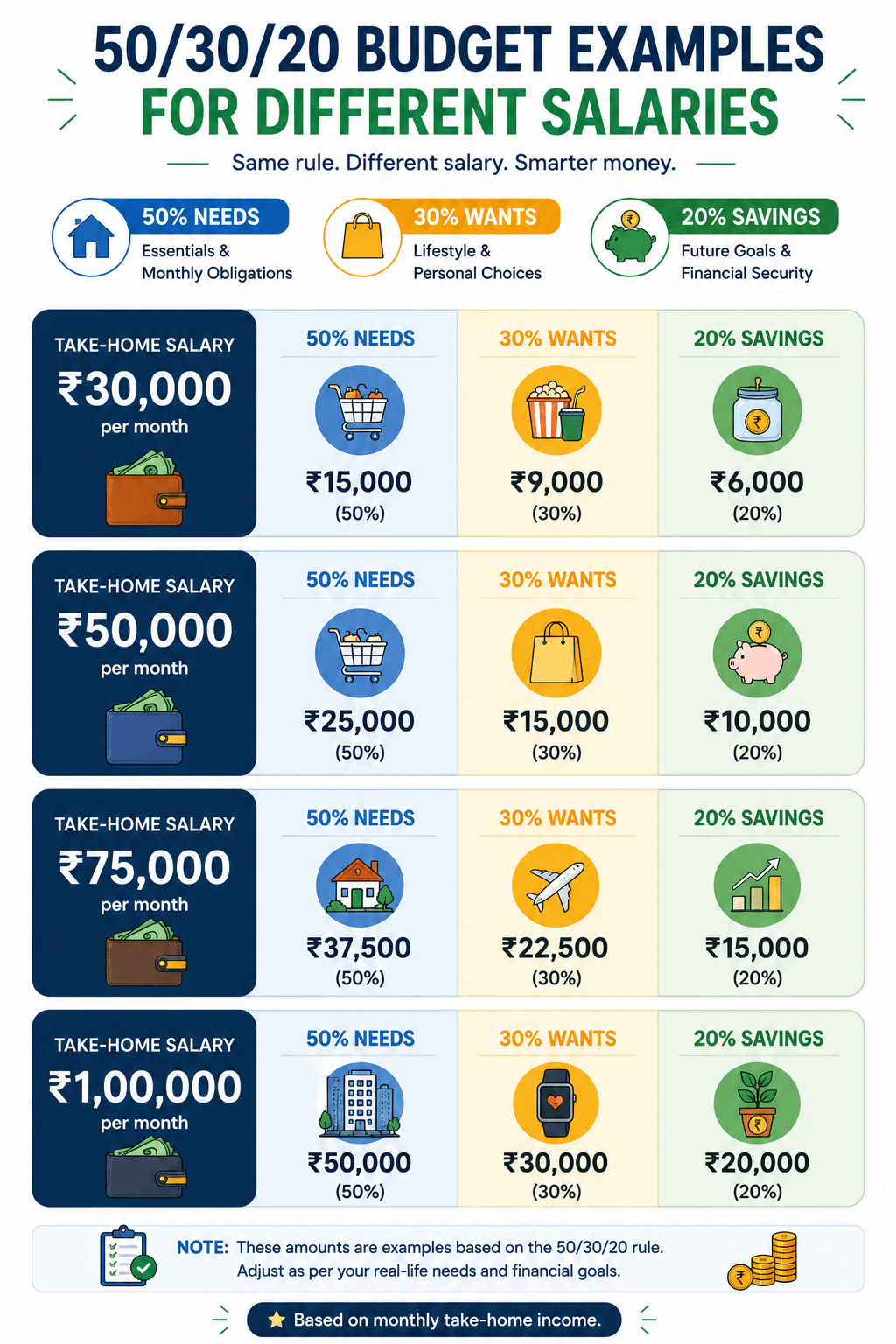
Understanding the percentages is helpful, but seeing how they work with real salary figures makes budgeting much easier.
In this section, we’ll look at practical examples for different monthly take-home incomes. These examples are based on typical expenses for Indian households and are meant to be a starting point. Your actual spending will depend on your city, family size, existing loans, and lifestyle.
Important: All examples below use monthly take-home income, not CTC or gross salary.
Example 1: 50/30/20 Budget for a ₹50,000 Monthly Salary
Let’s assume your monthly take-home salary is ₹50,000.
According to the 50/30/20 Rule:
| Category | Percentage | Amount |
|---|---|---|
| Needs | 50% | ₹25,000 |
| Wants | 30% | ₹15,000 |
| Savings & Investments | 20% | ₹10,000 |
| Total | 100% | ₹50,000 |
Suggested Monthly Budget
Needs (₹25,000)
| Expense | Amount |
|---|---|
| Rent | ₹12,000 |
| Groceries | ₹5,000 |
| Electricity & Gas | ₹2,000 |
| Fuel & Transport | ₹3,000 |
| Internet & Mobile | ₹1,500 |
| Medicines & Essentials | ₹1,500 |
| Total | ₹25,000 |
Wants (₹15,000)
| Expense | Amount |
|---|---|
| Dining Out | ₹4,000 |
| Shopping | ₹4,000 |
| OTT Subscriptions | ₹1,000 |
| Weekend Entertainment | ₹3,000 |
| Vacation Fund | ₹3,000 |
| Total | ₹15,000 |
Savings & Investments (₹10,000)
| Goal | Amount |
|---|---|
| SIP in Mutual Funds | ₹5,000 |
| Emergency Fund | ₹3,000 |
| PPF Contribution | ₹2,000 |
| Total | ₹10,000 |
What This Budget Achieves
Following this plan helps you:
- Cover all essential monthly expenses.
- Enjoy leisure activities without overspending.
- Build wealth through regular investing.
- Create a financial cushion for emergencies.
Example 2: Budget for a ₹30,000 Monthly Salary
A ₹30,000 salary often requires tighter budgeting because essential expenses can consume a larger share of income.
Recommended Allocation
| Category | Percentage | Amount |
|---|---|---|
| Needs | 50% | ₹15,000 |
| Wants | 30% | ₹9,000 |
| Savings | 20% | ₹6,000 |
Sample Budget
| Expense | Amount |
|---|---|
| Shared Rent | ₹7,000 |
| Groceries | ₹3,500 |
| Utilities | ₹1,500 |
| Transport | ₹2,000 |
| Internet & Mobile | ₹1,000 |
| Needs Total | ₹15,000 |
Possible savings:
- SIP: ₹3,000
- Emergency Fund: ₹2,000
- RD or PPF: ₹1,000
Practical Advice
If you’re earning ₹30,000 in a metro city, your rent alone may exceed the suggested allocation. In such cases, consider:
- Sharing accommodation.
- Using public transport.
- Limiting discretionary spending.
- Increasing savings after future salary increments.
The objective is to build the habit of budgeting, even if you can’t follow the percentages perfectly.
Example 3: Budget for a ₹75,000 Monthly Salary
As income increases, it becomes easier to balance expenses and financial goals.
Suggested Allocation
| Category | Percentage | Amount |
|---|---|---|
| Needs | 50% | ₹37,500 |
| Wants | 30% | ₹22,500 |
| Savings | 20% | ₹15,000 |
Possible savings strategy:
- ₹8,000 → SIPs
- ₹3,000 → Emergency Fund
- ₹2,000 → PPF
- ₹2,000 → Extra home loan or personal loan repayment
Financial Opportunity
Many people increase their lifestyle spending after receiving salary hikes. Instead, try increasing your investments first. This simple habit can significantly improve your long-term financial health.
Regular Station Pro Tip:
Whenever your salary increases, consider directing at least 50% of the increment toward savings or investments before increasing discretionary spending.
Example 4: Budget for a ₹1,00,000 Monthly Salary
Higher income provides greater flexibility but also increases the risk of lifestyle inflation.
Suggested Allocation
| Category | Percentage | Amount |
|---|---|---|
| Needs | 50% | ₹50,000 |
| Wants | 30% | ₹30,000 |
| Savings | 20% | ₹20,000 |
Suggested Savings Plan
| Investment | Amount |
|---|---|
| Equity Mutual Fund SIP | ₹10,000 |
| Emergency Fund | ₹5,000 |
| NPS | ₹3,000 |
| Gold or Fixed Deposit | ₹2,000 |
| Total | ₹20,000 |
With a higher income, you can also prioritize goals such as:
- Buying a house
- Children’s education
- International travel
- Early retirement
- Wealth creation through diversified investments
Salary Comparison at a Glance
| Monthly Take-Home Income | Needs (50%) | Wants (30%) | Savings (20%) |
|---|---|---|---|
| ₹30,000 | ₹15,000 | ₹9,000 | ₹6,000 |
| ₹50,000 | ₹25,000 | ₹15,000 | ₹10,000 |
| ₹75,000 | ₹37,500 | ₹22,500 | ₹15,000 |
| ₹1,00,000 | ₹50,000 | ₹30,000 | ₹20,000 |
This table makes it easy to estimate your budget based on your monthly take-home salary.
What If Your Needs Already Exceed 50%?
This is one of the most common questions from readers—and it’s especially relevant in expensive cities.
Imagine this monthly budget:
| Expense | Amount |
|---|---|
| Rent | ₹22,000 |
| Groceries | ₹6,000 |
| Utilities | ₹3,000 |
| Transport | ₹4,000 |
| Insurance | ₹2,500 |
| Total Needs | ₹37,500 |
If your take-home income is ₹50,000, your needs already account for 75% of your income.
Does that mean the 50/30/20 Rule has failed?
Not at all.
Instead, use it as a diagnostic tool to identify where adjustments may be possible.
Consider asking yourself:
- Can I reduce housing costs by sharing accommodation or moving closer to work?
- Are there subscriptions or discretionary expenses I can pause?
- Can I refinance or prepay high-interest loans?
- Can I increase my income through freelancing, a side business, or upskilling?
The purpose of budgeting isn’t to make you feel guilty. It’s to help you make informed financial decisions.
Budgeting Is a Journey, Not a Formula
Very few people follow the 50/30/20 Rule perfectly every month.
Life changes. Expenses fluctuate. Emergencies happen.
What’s important is that you:
- Spend consciously.
- Save consistently.
- Review your budget regularly.
- Adjust your plan as your financial situation evolves.
Even if you start with a 60/25/15 or 70/20/10 split, you’re still making progress compared to having no budget at all.
Remember: A realistic budget that you can follow for years is far more valuable than a perfect budget you abandon after one month.
Is the 50/30/20 Budget Rule Practical in India?
One of the biggest questions readers ask is:
“Does the 50/30/20 Budget Rule actually work in India?”
The short answer is yes—but not always in its original form.
The rule provides an excellent starting point, but every household has different financial responsibilities. Your city, income, family size, loans, and lifestyle all influence how you should allocate your money.
Instead of treating the 50/30/20 Rule as a strict formula, think of it as a flexible framework that helps you make better financial decisions.
Why Indian Households Are Different
The original 50/30/20 Rule was developed in the United States, where income patterns, taxation, healthcare, education, and housing costs differ from those in India.
Indian families often have additional financial responsibilities, such as:
- Supporting parents
- Paying home loan EMIs
- Children’s education
- Festival and wedding expenses
- Medical costs for extended family
- Gold purchases
- Insurance premiums
- Religious and cultural events
These commitments can significantly change how a household spends its income.
Metro Cities vs. Tier-2 and Tier-3 Cities
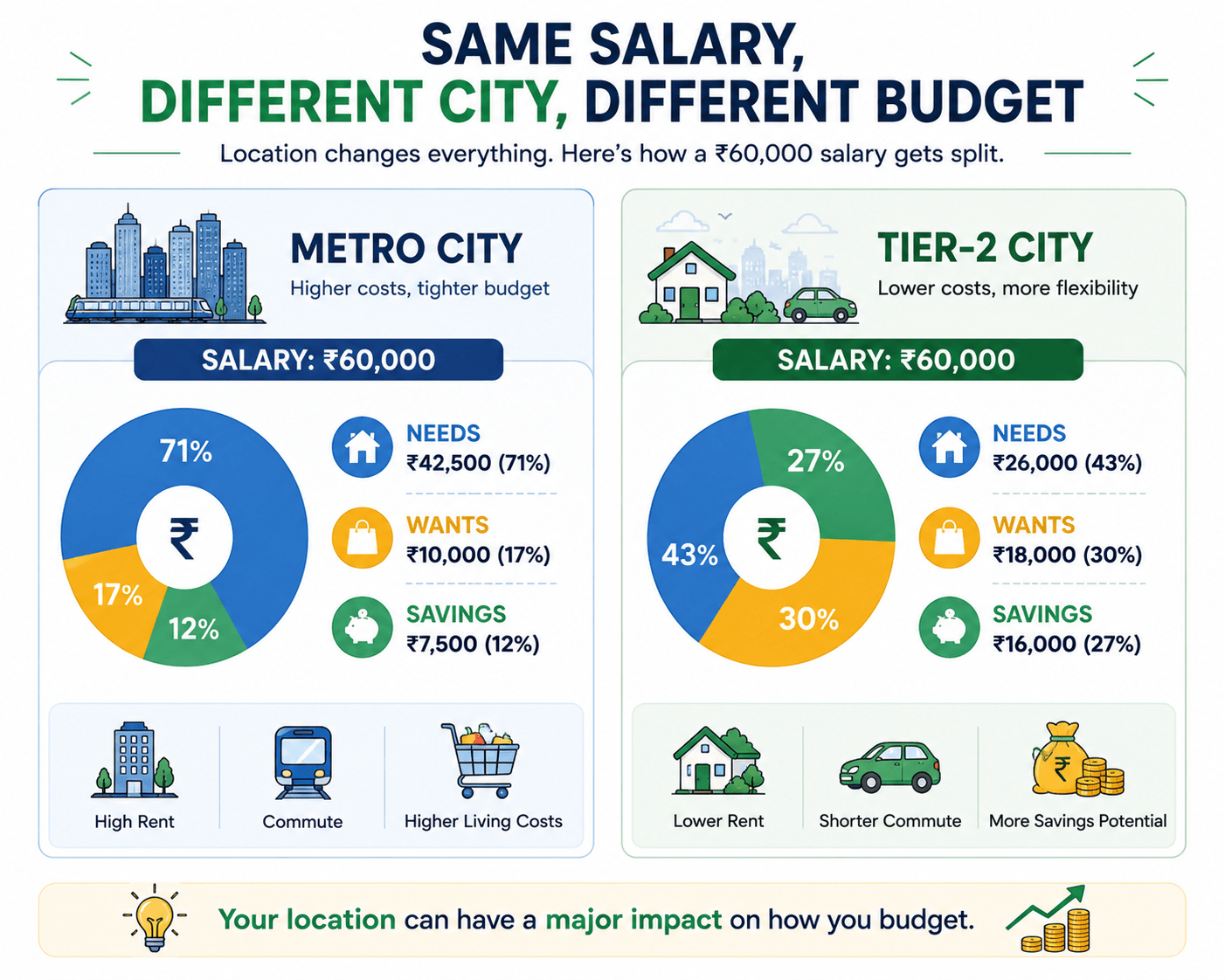
Your location has one of the biggest impacts on your budget.
Let’s compare two households earning the same monthly take-home income of ₹60,000.
Example: Living in Bengaluru or Mumbai
| Expense | Amount |
|---|---|
| Rent | ₹25,000 |
| Groceries | ₹7,000 |
| Transport | ₹5,000 |
| Utilities | ₹3,000 |
| Insurance | ₹2,500 |
| Total Needs | ₹42,500 |
Needs account for approximately 71% of income.
Following the traditional 50/30/20 Rule becomes difficult because housing costs are significantly higher.
Example: Living in Indore or Coimbatore
| Expense | Amount |
|---|---|
| Rent | ₹12,000 |
| Groceries | ₹6,000 |
| Transport | ₹3,000 |
| Utilities | ₹2,500 |
| Insurance | ₹2,500 |
| Total Needs | ₹26,000 |
Needs account for approximately 43% of income.
This household has more flexibility to increase savings or enjoy discretionary spending.
Key Insight:
Your city can influence your budget just as much as your salary.
When Your Needs Exceed 50%
Many Indian professionals believe they are “bad at budgeting” because they cannot fit their expenses into the 50% needs category.
In reality, high essential expenses often reflect circumstances—not poor financial habits.
Common reasons include:
- Expensive rent in metro cities
- Home loan EMIs
- School fees
- Medical expenses
- Caring for elderly parents
- Long commuting costs
If your essential expenses consume 60–70% of your income, don’t abandon the budgeting process.
Instead:
- Track every expense for a month.
- Identify fixed vs. variable costs.
- Reduce discretionary spending where possible.
- Increase savings gradually as your income grows.
Should EMIs Be Included in the 50%?
Yes—in most cases.
If an EMI is for an essential asset, such as your primary home, it generally belongs in the Needs category.
Usually Considered Needs
- Home loan EMI
- Education loan EMI
- Essential vehicle loan (required for work)
Usually Considered Wants
- EMI for luxury gadgets
- EMI for expensive vacations
- EMI for premium electronics bought for convenience
- Lifestyle financing
The guiding question is:
“Is this expense essential for my daily life or long-term financial stability?”
Where Should Insurance Fit?
Insurance is another area that often confuses beginners.
Needs (50%)
Include:
- Health insurance
- Term life insurance
- Essential vehicle insurance
These protect your financial well-being and should be treated as necessary expenses.
Savings (20%)
Some long-term insurance products with an investment component may overlap with savings goals, but avoid treating all insurance policies as investments. Evaluate each product based on its purpose.
What About EPF, PPF, and SIPs?
Many salaried employees ask:
“My EPF is already deducted from my salary. Does it count toward the 20%?”
A practical approach is:
- Mandatory EPF contributions already support long-term retirement savings.
- When calculating your personal budget using take-home income, focus on the money you actively control after salary deductions.
- If you voluntarily invest in SIPs, PPF, NPS, or other savings vehicles from your take-home salary, include those under the 20% Savings & Investments category.
The important principle is to maintain a consistent habit of saving and investing, regardless of the specific products you use.
What If You’re the Sole Breadwinner?
Many Indian households rely on a single income.
This may involve supporting:
- Parents
- Spouse
- Children
- Education expenses
- Healthcare costs
- Household emergencies
In such situations, the ideal 50/30/20 allocation may not be realistic.
A temporary budget such as:
- 60% Needs
- 20% Wants
- 20% Savings
or even
- 65% Needs
- 15% Wants
- 20% Savings
can still be financially responsible.
The goal is to preserve a savings habit while recognizing your current obligations.
How Inflation Changes Your Budget
The cost of living rarely stays the same.
Prices of groceries, fuel, rent, utilities, and healthcare tend to increase over time.
If you continue using the same budget for several years without reviewing it, you may find that your spending no longer reflects reality.
Review Your Budget When:
- You receive a salary hike.
- You change jobs.
- You move to a new city.
- You get married.
- Your family grows.
- You take a home or education loan.
- Your monthly expenses change significantly.
A budget should evolve as your life changes.
Is the 50/30/20 Rule Suitable for Every Income Group?
Students
Yes, but simplify the categories.
Focus on:
- Essential expenses
- Personal spending
- Savings
Even saving a small amount each month helps build financial discipline.
Young Professionals
This is one of the best budgeting methods for people starting their careers because it creates good money habits before lifestyle inflation takes hold.
Families
Families may need to customize the percentages to accommodate education, healthcare, insurance, and long-term goals.
The framework still provides a useful guide for balancing current needs with future planning.
Freelancers and Business Owners
If your income varies from month to month:
- Budget using your average monthly income.
- Maintain a larger emergency fund.
- Save extra during high-income months.
- Avoid increasing fixed lifestyle expenses based on temporary income spikes.
Signs You Should Modify the Rule
Consider adjusting the percentages if:
- Your rent exceeds 40% of your income.
- You have unavoidable medical expenses.
- You’re aggressively paying off high-interest debt.
- You’re saving for a major short-term goal, such as a home down payment.
- You experience temporary income reduction.
- You have multiple financial dependents.
A customized budget is often more sustainable than trying to force a rigid formula.
Common Budget Variations
| Situation | Suggested Split |
|---|---|
| High rent city | 60 / 20 / 20 |
| Paying off debt | 50 / 20 / 30 |
| Early career | 55 / 25 / 20 |
| Aggressive investing | 45 / 25 / 30 |
| Temporary financial pressure | 65 / 15 / 20 |
These are examples, not fixed rules. Choose a split that reflects your financial reality while ensuring you continue saving consistently.
Regular Station Pro Tip:
Don’t compare your budget with someone else’s. Two people earning the same salary can have completely different financial responsibilities. Your budget should reflect your goals, your family, and your circumstances.
Key Takeaway
The 50/30/20 Budget Rule works well in India when used as a guide rather than a rigid formula.
If you can follow it exactly, that’s great.
If you need to adjust it because of housing costs, family responsibilities, or debt, that’s perfectly normal.
The real success of a budget isn’t whether every percentage is perfect—it’s whether you’re spending intentionally, saving consistently, and moving closer to your financial goals every month.
Advantages and Limitations of the 50/30/20 Budget Rule
No budgeting method is perfect.
The 50/30/20 Budget Rule has helped millions of people manage their money more effectively because it is simple and practical. However, like any financial framework, it also has limitations.
Understanding both the strengths and weaknesses will help you decide whether this budgeting method is the right fit for your financial situation.
Advantages of the 50/30/20 Budget Rule
1. Easy to Understand
One of the biggest reasons this budgeting method is so popular is its simplicity.
Instead of tracking dozens of spending categories, you only need to focus on three:
- Needs
- Wants
- Savings & Investments
This makes it much less intimidating for beginners.
Why It Matters
Many people stop budgeting because they feel overwhelmed by complicated spreadsheets and expense tracking.
The 50/30/20 Rule removes that barrier and encourages people to get started quickly.
2. Helps You Build Better Financial Habits
Budgeting isn’t just about numbers.
It’s about creating habits that improve your financial future.
Following this rule encourages you to:
- Think before spending.
- Prioritize essential expenses.
- Save regularly.
- Plan for future goals.
Over time, these habits become automatic.
3. Encourages Consistent Saving
Many people save only when money is left over at the end of the month.
Unfortunately, that often means they save nothing.
The 50/30/20 Rule changes this mindset by treating savings as a planned expense rather than an afterthought.
Even small monthly contributions can grow significantly over time when invested consistently.
4. Reduces Overspending
Without a budget, it’s easy to spend impulsively.
The 30% allocation for discretionary spending creates healthy boundaries while still allowing room to enjoy life.
Instead of asking:
“Can I afford this?”
You’ll begin asking:
“Does this fit within my Wants budget?”
That simple shift encourages more thoughtful spending decisions.
5. Flexible Enough for Most People
Although the percentages provide guidance, they can be adjusted.
Whether you’re:
- Living in a metro city
- Supporting your parents
- Paying off loans
- Building an emergency fund
the framework can be modified to suit your circumstances.
This flexibility is one of its greatest strengths.
6. Supports Long-Term Financial Goals
The dedicated 20% savings category helps you prepare for goals such as:
- Buying a house
- Starting a business
- Funding higher education
- Building an emergency fund
- Retirement planning
- Wealth creation
Rather than reacting to financial emergencies, you’re proactively preparing for the future.
7. Works Across Different Income Levels
The budgeting framework scales naturally.
Whether your monthly take-home income is:
- ₹30,000
- ₹50,000
- ₹75,000
- ₹1,50,000
the percentages remain easy to calculate.
As your income grows, the amount you save can also increase without changing the overall structure.
Limitations of the 50/30/20 Budget Rule
Despite its advantages, the rule isn’t suitable for every situation.
Recognizing its limitations helps you adapt it more effectively.
1. High Housing Costs Can Disrupt the Budget
In cities like:
- Mumbai
- Bengaluru
- Delhi
- Gurugram
- Hyderabad
rent or home loan EMIs may consume well over 50% of take-home income.
This leaves less room for discretionary spending and savings.
In such cases, forcing yourself to stick to the exact percentages can become frustrating.
2. Not Ideal for Very Low Incomes
If most of your income is spent on necessities, saving 20% may not be immediately realistic.
For example:
Take-home income:
₹22,000
If essential expenses already total ₹19,000, there isn’t much flexibility.
The better approach is to:
- Track expenses.
- Reduce unnecessary costs where possible.
- Save whatever amount you reasonably can.
Building the habit matters more than achieving a specific percentage.
3. Doesn’t Account for Irregular Expenses
Many expenses don’t occur every month.
Examples include:
- Annual insurance premiums
- School admissions
- Festival shopping
- Vehicle servicing
- Medical emergencies
- Home repairs
If you budget only for monthly expenses, these costs can disrupt your finances.
A good solution is to create a separate sinking fund for predictable annual expenses.
4. Income Can Be Unpredictable
Freelancers, consultants, and business owners often experience fluctuating monthly income.
Applying fixed percentages every month can be difficult when earnings vary.
Instead, consider:
- Budgeting using your average income.
- Building a larger emergency fund.
- Saving more during high-income months.
5. It Doesn’t Replace Detailed Financial Planning
The 50/30/20 Rule is an excellent budgeting framework, but it doesn’t answer questions like:
- Which mutual funds should you choose?
- How much life insurance do you need?
- What asset allocation is appropriate?
- How should you plan for retirement?
Think of it as the foundation of personal finance—not the complete financial plan.
6. Different Life Stages Need Different Priorities
Your financial priorities evolve over time.
Someone who has just started working has very different goals from someone planning retirement.
Early Career
Focus may be on:
- Building an emergency fund.
- Learning to invest.
- Developing budgeting habits.
Mid-Career
Focus often shifts toward:
- Home ownership.
- Children’s education.
- Increasing investments.
- Insurance coverage.
Pre-Retirement
Priorities may include:
- Reducing debt.
- Preserving wealth.
- Retirement planning.
- Healthcare expenses.
Your budget should reflect these changing priorities.
Common Myths About the 50/30/20 Budget Rule
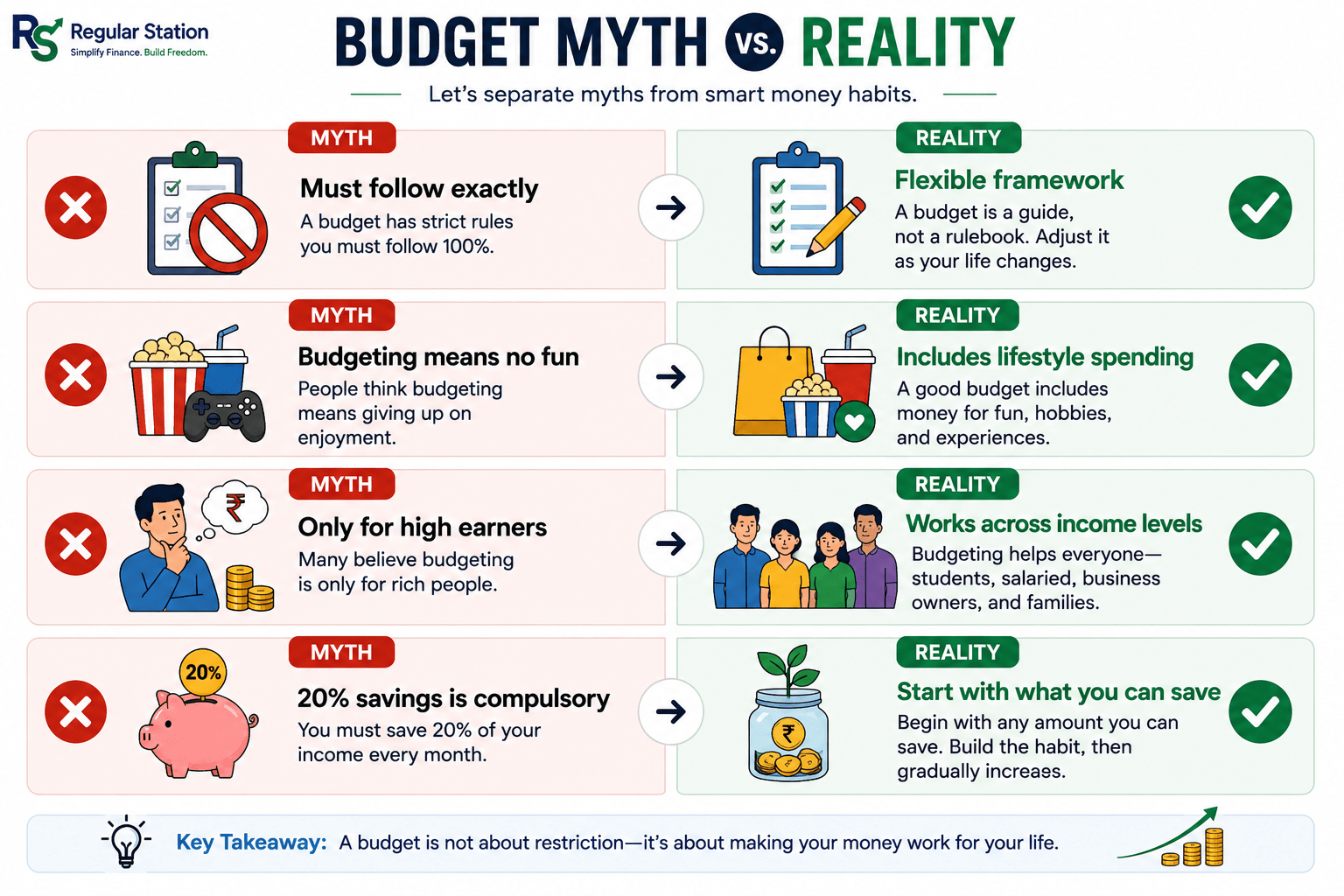
Let’s clear up a few misconceptions.
Myth 1: You Must Follow It Exactly
Reality:
The percentages are guidelines, not rules set in stone.
Myth 2: Budgeting Means You Can’t Enjoy Life
Reality:
The rule intentionally includes a category for discretionary spending.
Enjoying your money responsibly is part of a healthy financial plan.
Myth 3: It Only Works for High Earners
Reality:
People at almost every income level can benefit from budgeting.
The amounts change, but the principle remains the same.
Myth 4: Saving 20% Is Mandatory
Reality:
If you can save 20%, that’s excellent.
If you can only save 5% today, start there and gradually increase it over time.
Consistent progress is more important than perfection.
When Should You Consider Another Budgeting Method?
You may benefit from a different budgeting system if:
- You want to track every rupee in detail.
- You’re aggressively paying off debt.
- Your income changes significantly every month.
- You prefer using cash for spending.
- You’re managing a complex household budget.
Some popular alternatives include:
- Zero-Based Budgeting
- Envelope Budgeting
- Pay Yourself First
- Values-Based Budgeting
We’ll compare these methods in a later section to help you choose the one that best matches your financial style.
Advantages vs. Limitations
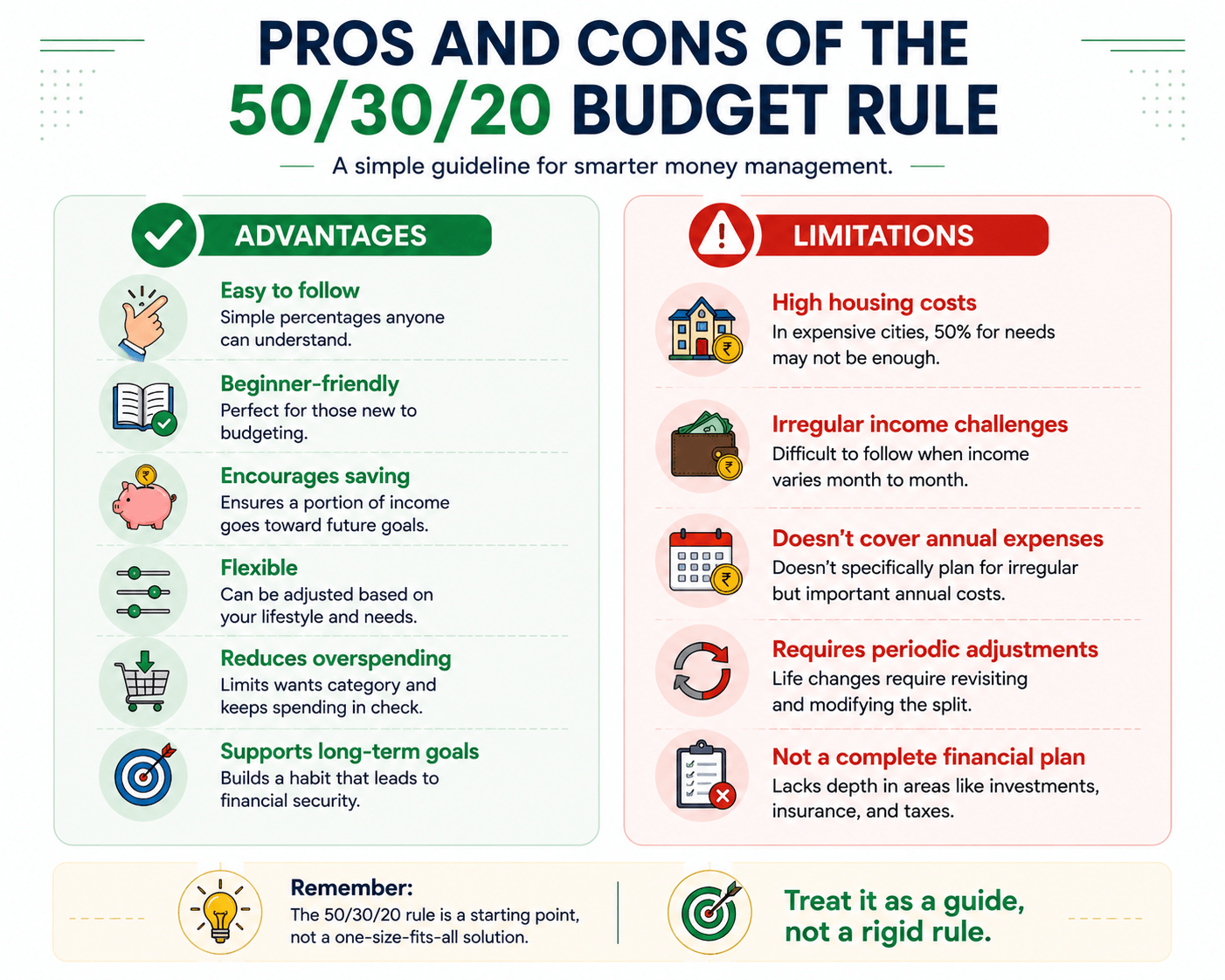
| Advantages | Limitations |
|---|---|
| Easy to learn | May not suit high-rent cities |
| Beginner-friendly | Difficult for very low incomes |
| Encourages regular saving | Doesn’t cover irregular expenses |
| Flexible framework | Less suitable for highly variable income |
| Helps reduce overspending | Doesn’t replace complete financial planning |
| Supports long-term goals | Needs periodic adjustments |
Key Takeaway
The 50/30/20 Budget Rule isn’t perfect—but that’s not its purpose.
Its biggest strength is that it gives you a simple, practical framework for making better financial decisions.
If your current budget doesn’t fit the exact percentages, don’t give up.
Adjust the numbers, stay consistent, and focus on improving your financial habits one month at a time.
Regular Station Pro Tip:
The best budget isn’t the one that looks perfect on paper—it’s the one you can realistically follow year after year.
How to Adjust the 50/30/20 Budget Rule for Your Situation
One of the biggest misconceptions about the 50/30/20 Budget Rule is that everyone must follow the exact percentages.
In reality, personal finance is personal.
Your budget should reflect your income, responsibilities, financial goals, and stage of life—not someone else’s.
The purpose of the 50/30/20 Rule is to give you a direction, not a restriction.
If your current financial situation doesn’t fit the classic split, that’s perfectly normal.
Start With Your Reality, Not the Ideal
Before changing your budget, ask yourself these questions:
- What is my monthly take-home income?
- What percentage goes toward essential expenses?
- How much am I currently saving?
- Do I have outstanding debt?
- Am I supporting family members?
- What are my financial goals over the next 3–5 years?
Your answers will help determine which budgeting approach makes the most sense for you.
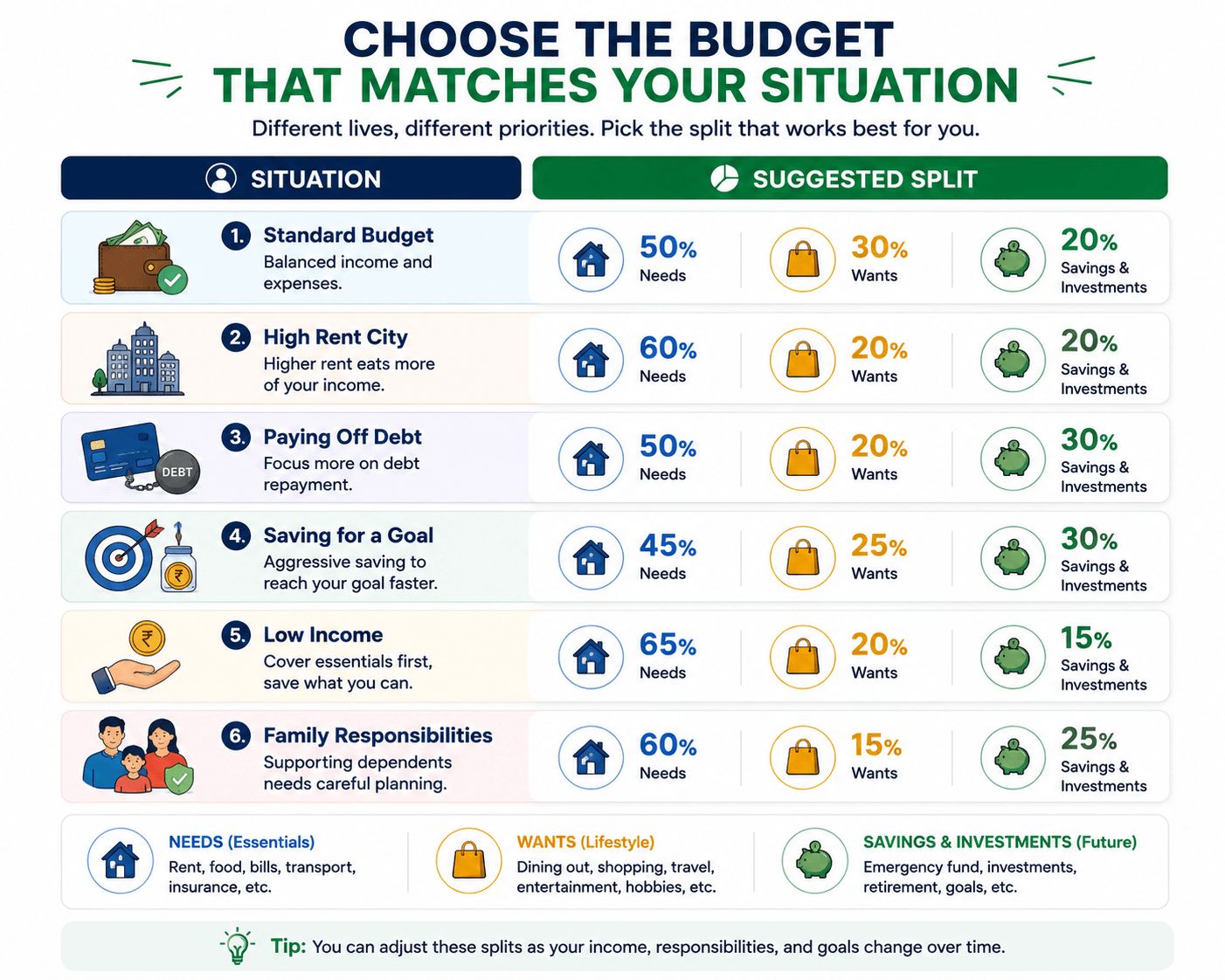
Scenario 1: You Live in a High-Rent Metro City
In cities such as Mumbai, Bengaluru, Delhi, Gurugram, or Pune, housing often takes up a much larger share of income.
A more realistic split may look like this:
| Category | Allocation |
|---|---|
| Needs | 60% |
| Wants | 20% |
| Savings | 20% |
Example
Monthly take-home income: ₹70,000
| Category | Amount |
|---|---|
| Needs | ₹42,000 |
| Wants | ₹14,000 |
| Savings | ₹14,000 |
Focus Areas
- Avoid lifestyle inflation.
- Share accommodation if possible.
- Use public transport where practical.
- Increase savings after future salary hikes.
Scenario 2: You’re Paying Off High-Interest Debt
If you have significant credit card debt or high-interest personal loans, becoming debt-free should be a priority.
Instead of spending 30% on wants, consider directing more money toward repayments.
Suggested allocation:
| Category | Allocation |
|---|---|
| Needs | 50% |
| Wants | 20% |
| Debt Repayment & Savings | 30% |
This approach can help you reduce interest costs faster and improve your long-term financial health.
Regular Station Tip:
Paying off a credit card charging 30–40% annual interest can provide a greater financial benefit than many low-risk investments.
Scenario 3: You’re Saving for a Major Financial Goal
Perhaps you’re planning to:
- Buy a home
- Build an emergency fund
- Pursue higher education
- Start a business
- Plan your wedding
In these situations, temporarily increasing your savings allocation may make sense.
Example split:
| Category | Allocation |
|---|---|
| Needs | 45% |
| Wants | 25% |
| Savings | 30% |
Once you’ve reached your goal, you can adjust your budget again.
Scenario 4: You Have a Low Income
If you’re just starting your career, your essential expenses may consume most of your income.
For example:
Monthly take-home income: ₹25,000
Instead of feeling discouraged because you can’t save 20%, begin with a realistic plan.
Example:
| Category | Allocation |
|---|---|
| Needs | 65% |
| Wants | 20% |
| Savings | 15% |
Even saving ₹2,000–₹3,000 each month creates a positive financial habit.
As your income increases, aim to improve your savings rate.
Scenario 5: You’re a Freelancer or Business Owner
Variable income requires a slightly different approach.
Instead of budgeting based on your highest-earning month:
- Calculate your average monthly income over the past 6–12 months.
- Base your fixed expenses on conservative income estimates.
- Save extra earnings during profitable months.
- Maintain an emergency fund covering at least 6 months of essential expenses.
This strategy helps smooth out income fluctuations.
Scenario 6: You’re Supporting Your Family
Many Indian households rely on a single earning member.
Your responsibilities may include:
- Parents
- Spouse
- Children
- Education expenses
- Medical care
In such cases, the traditional 50/30/20 allocation may not be practical.
A temporary split like 60/15/25 or 65/15/20 may better reflect your current priorities while ensuring you continue saving regularly.
How to Improve Your Budget Over Time
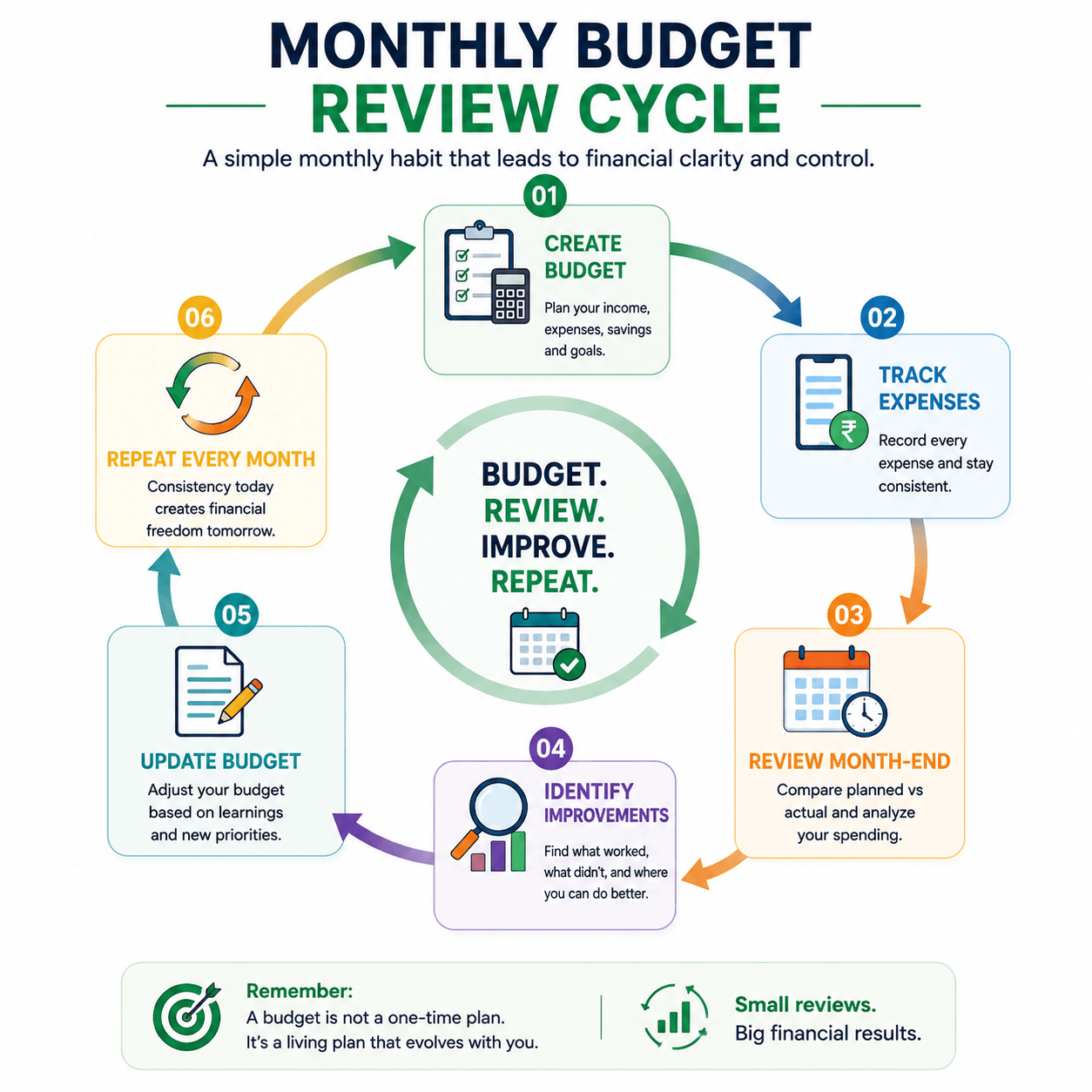
Your budget shouldn’t remain static.
Review it regularly and make adjustments as your financial situation changes.
Increase Savings When:
- You receive a salary increment.
- You finish paying off a loan.
- Your rent decreases.
- Your income becomes more stable.
- Your emergency fund is complete.
Instead of increasing spending every time your salary grows, consider directing part of the additional income toward investments.
The 50% Rule for Salary Hikes
One practical strategy is to split every salary increase.
Example
Current Salary:
₹50,000
New Salary:
₹60,000
Increase:
₹10,000
Instead of spending the entire increase:
- ₹5,000 → Savings & Investments
- ₹5,000 → Lifestyle improvements
This approach allows you to enjoy your higher income while steadily building wealth.
Review Your Budget Every Month
A budget is not something you create once and forget.
At the end of each month, ask yourself:
- Did I stay within my Needs budget?
- Did I overspend on Wants?
- Did I achieve my savings target?
- Which unexpected expenses occurred?
- What can I improve next month?
Even a 15-minute monthly review can make a significant difference over time.
Monthly Budget Review Checklist
Use this quick checklist to evaluate your progress:
| Question | Yes | No |
|---|---|---|
| Did I track all my expenses? | ☐ | ☐ |
| Did I stay close to my budget? | ☐ | ☐ |
| Did I save or invest this month? | ☐ | ☐ |
| Did I avoid unnecessary impulse purchases? | ☐ | ☐ |
| Did I review my subscriptions? | ☐ | ☐ |
| Did I prepare for upcoming annual expenses? | ☐ | ☐ |
Aim to improve one area each month rather than trying to fix everything at once.
Red Flags That Your Budget Needs Attention
Watch out for these warning signs:
- You rely on credit cards to cover basic expenses.
- You have no emergency savings.
- You don’t know where your salary goes each month.
- You frequently miss bill payments.
- Your discretionary spending exceeds your savings.
- You continue increasing your lifestyle expenses after every salary hike.
Recognizing these patterns early gives you the opportunity to make gradual improvements.
Remember: Progress Beats Perfection
The goal isn’t to hit exactly 50%, 30%, and 20% every month.
The real objective is to:
- Spend intentionally.
- Save consistently.
- Reduce financial stress.
- Build long-term wealth.
A budget that fits your life is always better than one that looks perfect on paper but is impossible to maintain.
Regular Station Pro Tip:
Review your budget after every major life event—such as a salary increase, marriage, relocation, or the birth of a child. As your life changes, your budget should change too.
Common Budgeting Mistakes to Avoid
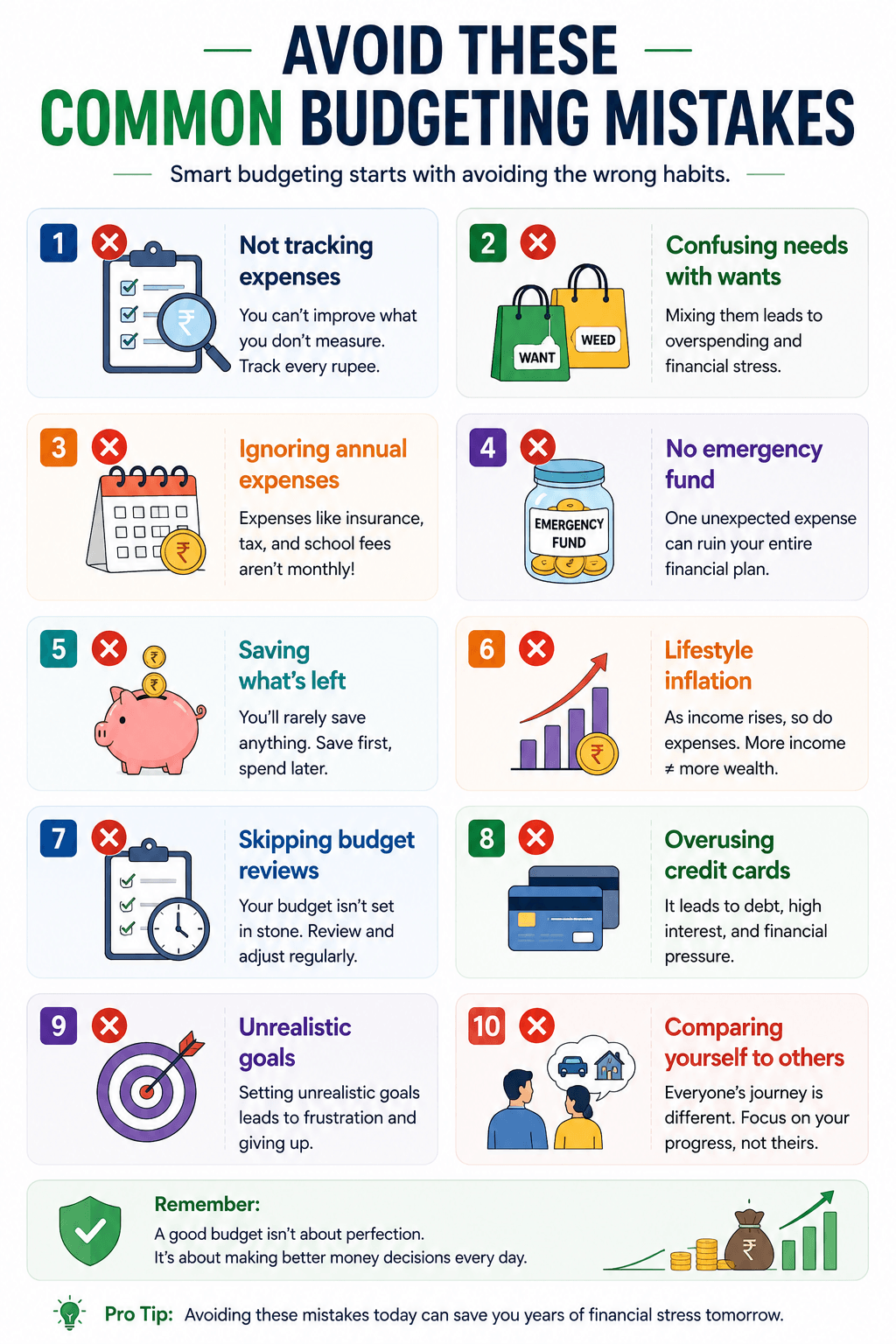
Creating a budget is an important first step—but following it consistently is what leads to long-term financial success.
Many people abandon budgeting within a few months, not because the method doesn’t work, but because of a few avoidable mistakes.
By recognizing these common pitfalls early, you can build a budgeting habit that lasts for years.
1. Not Tracking Your Expenses
One of the biggest budgeting mistakes is assuming you know where your money goes.
Small purchases can quickly add up.
For example:
- Daily coffee
- Food delivery
- Online shopping
- Auto-renewing subscriptions
- Weekend outings
Individually, these expenses may seem insignificant. Together, they can consume a large part of your monthly income.
How to Avoid It
- Track every expense for at least one month.
- Review your bank statements regularly.
- Use a budgeting app or spreadsheet.
- Record expenses daily or weekly.
Regular Station Tip:
You can’t improve what you don’t measure. Tracking your spending is the foundation of every successful budget.
2. Confusing Needs with Wants
This is one of the most common mistakes beginners make.
Many people label discretionary expenses as “essential.”
Examples
| Expense | Correct Category |
|---|---|
| House Rent | Need |
| Groceries | Need |
| Netflix Premium | Want |
| Weekend Trip | Want |
| Basic Mobile Plan | Need |
| Latest Smartphone Upgrade | Want |
Being honest about these categories makes budgeting much more effective.
3. Ignoring Irregular Expenses
Not all expenses occur every month.
Examples include:
- Vehicle servicing
- School admissions
- Insurance renewals
- Festival shopping
- Birthday gifts
- Home maintenance
- Annual subscriptions
When these costs arrive unexpectedly, many people rely on credit cards or loans.
Better Approach: Create a Sinking Fund
A sinking fund is money you save every month for future planned expenses.
Example
If your annual car insurance costs ₹12,000, save:
₹12,000 ÷ 12 = ₹1,000 per month
When the bill arrives, you’ll already have the money set aside.
4. Forgetting About Emergency Savings
Unexpected expenses are inevitable.
Medical emergencies, job loss, home repairs, or vehicle breakdowns can disrupt even the best budget.
Without an emergency fund, people often borrow money or use high-interest credit cards.
Goal
Aim to build an emergency fund covering:
- 3–6 months of essential expenses for salaried employees.
- 6–12 months of essential expenses if you’re self-employed or have variable income.
Start small if necessary—even ₹1,000 a month is a step in the right direction.
5. Saving Whatever Is Left
Many people follow this pattern:
Spend first → Save later
The problem?
There’s often nothing left to save.
Instead, reverse the order:
Save first → Spend what’s left
This principle, often called “Pay Yourself First,” is one of the most effective ways to build long-term wealth.
Set up automatic transfers to your savings or investment account soon after your salary is credited.
6. Lifestyle Inflation
Lifestyle inflation happens when your spending increases every time your income increases.
Example
You receive a ₹10,000 monthly salary hike.
Instead of increasing your investments, you upgrade:
- Your phone
- Your car
- Your apartment
- Your dining budget
- Your subscriptions
Within a few months, your higher income no longer feels like progress because your expenses have grown too.
Better Strategy
Before increasing lifestyle spending:
- Increase your SIP.
- Build your emergency fund.
- Pay off debt.
- Increase retirement savings.
Then enjoy the remaining increase.
7. Not Reviewing Your Budget Regularly
A budget isn’t a one-time exercise.
Life changes.
Your budget should change too.
Review your plan whenever you experience:
- A salary increase
- Marriage
- Relocation
- A new child
- Loan repayment
- Major medical expenses
A monthly review helps identify overspending early and keeps your budget aligned with your goals.
8. Depending Too Much on Credit Cards
Credit cards are convenient payment tools—but they should never become a substitute for income.
Warning signs include:
- Paying only the minimum due.
- Using one credit card to pay another.
- Carrying balances month after month.
- Spending beyond your monthly budget.
If you regularly rely on credit, it may indicate that your budget needs adjustment.
9. Setting Unrealistic Budget Goals
Some people try to change everything overnight.
For example:
- Stop all eating out.
- Save 50% immediately.
- Eliminate all entertainment.
- Track every rupee perfectly.
These drastic changes are difficult to maintain.
Instead, focus on gradual improvements.
Better Goals
- Reduce food delivery by ₹1,000 this month.
- Increase your SIP by ₹500.
- Save one extra day’s salary this year.
- Review subscriptions quarterly.
Small, consistent improvements often produce better long-term results.
10. Comparing Your Budget With Others
Social media can create unrealistic financial expectations.
Someone with:
- A different income
- Lower housing costs
- No dependents
- Different financial goals
may spend money very differently from you.
Your budget should reflect your priorities, not someone else’s lifestyle.
Quick Checklist: Are You Making Any of These Mistakes?
Use this checklist as a monthly self-assessment.
| Question | Yes | No |
|---|---|---|
| Do I know where my money goes each month? | ☐ | ☐ |
| Am I saving before spending? | ☐ | ☐ |
| Do I have an emergency fund? | ☐ | ☐ |
| Have I planned for annual expenses? | ☐ | ☐ |
| Am I living within my means? | ☐ | ☐ |
| Do I review my budget every month? | ☐ | ☐ |
| Have I avoided unnecessary debt? | ☐ | ☐ |
The more “Yes” answers you have, the healthier your budgeting habits are likely to be.
7 Practical Tips to Successfully Follow the 50/30/20 Budget Rule
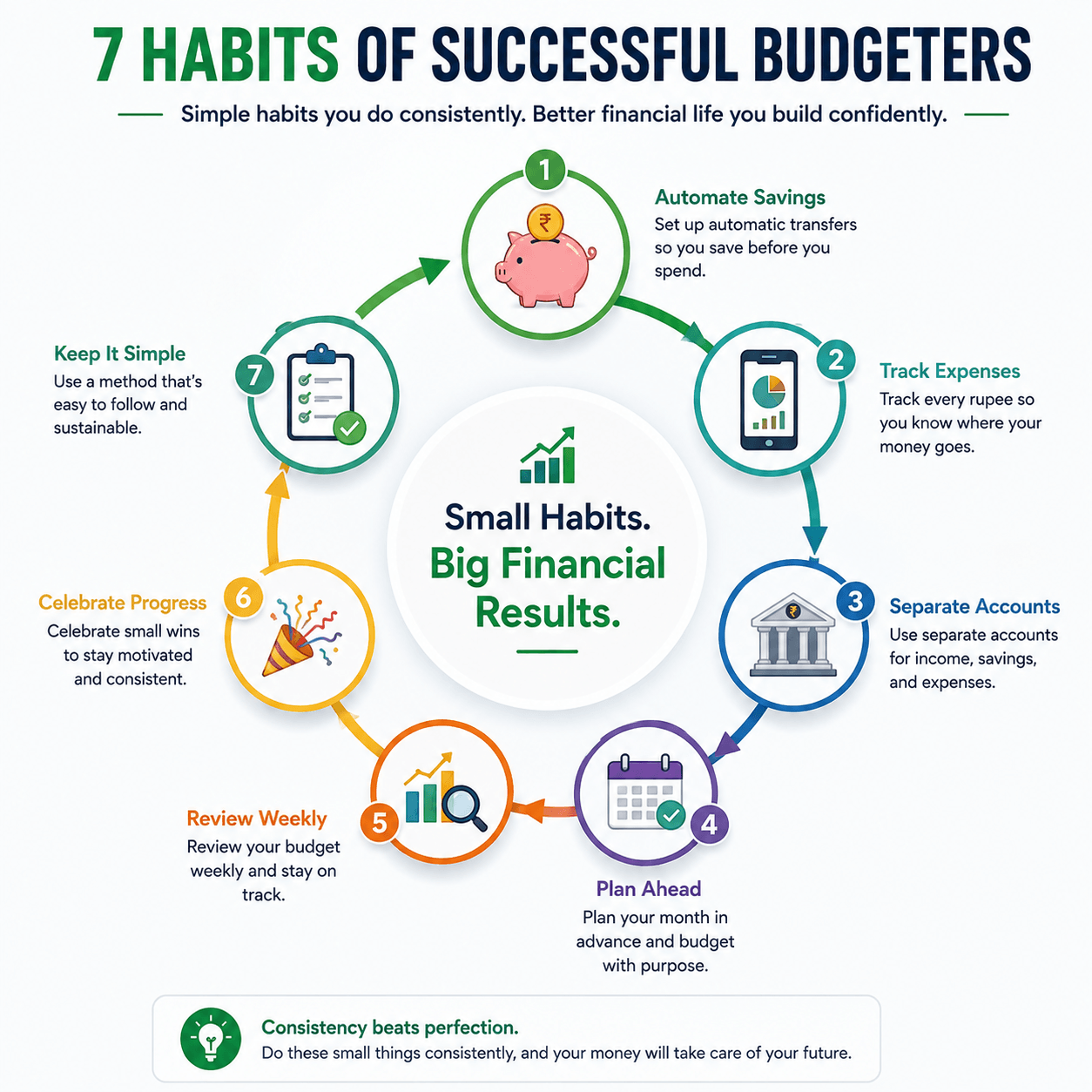
Knowing the rule is one thing—sticking to it is another.
Here are seven practical strategies that can help you stay on track.
1. Automate Your Savings
Set up automatic transfers to your SIP, savings account, or recurring deposit immediately after your salary is credited.
When savings happen automatically, you’re less likely to spend that money elsewhere.
2. Use a Budgeting App or Spreadsheet
Tracking expenses doesn’t have to be complicated.
Whether you use a notebook, spreadsheet, or budgeting app, the important thing is consistency.
Choose a method you’ll actually use.
3. Separate Your Accounts
If possible, maintain separate accounts for:
- Salary
- Monthly spending
- Savings and investments
This makes it easier to avoid accidentally spending money meant for future goals.
4. Plan for Annual Expenses
Estimate annual costs such as:
- Insurance premiums
- School fees
- Festivals
- Travel
- Vehicle maintenance
Divide each expense by 12 and save a small amount every month.
5. Review Weekly, Not Just Monthly
A quick 10-minute review every weekend can help you catch overspending before it becomes a month-end problem.
Ask yourself:
- Am I close to my Wants budget?
- Have any unexpected expenses occurred?
- Do I need to adjust my spending this week?
6. Celebrate Small Wins
Financial progress doesn’t always happen through major milestones.
Celebrate achievements like:
- Completing your first month on budget.
- Building a ₹10,000 emergency fund.
- Paying off a credit card.
- Increasing your SIP.
Recognizing progress helps you stay motivated.
7. Keep Your Budget Simple
Avoid creating dozens of spending categories.
The beauty of the 50/30/20 Rule is its simplicity.
If your budget becomes too complicated, you’re less likely to stick with it.
Regular Station Pro Tip:
A simple budget that you review every month is far more effective than a complex budget you stop using after a few weeks.
Key Takeaway
Budgeting mistakes are normal, especially when you’re just getting started.
The important thing is to learn from them and make gradual improvements.
Remember:
- Track your spending.
- Save before you spend.
- Plan for emergencies.
- Review your budget regularly.
- Focus on progress—not perfection.
Over time, these habits can have a much bigger impact on your financial health than finding the “perfect” budgeting method.
50/30/20 Budget Rule vs Other Budgeting Methods
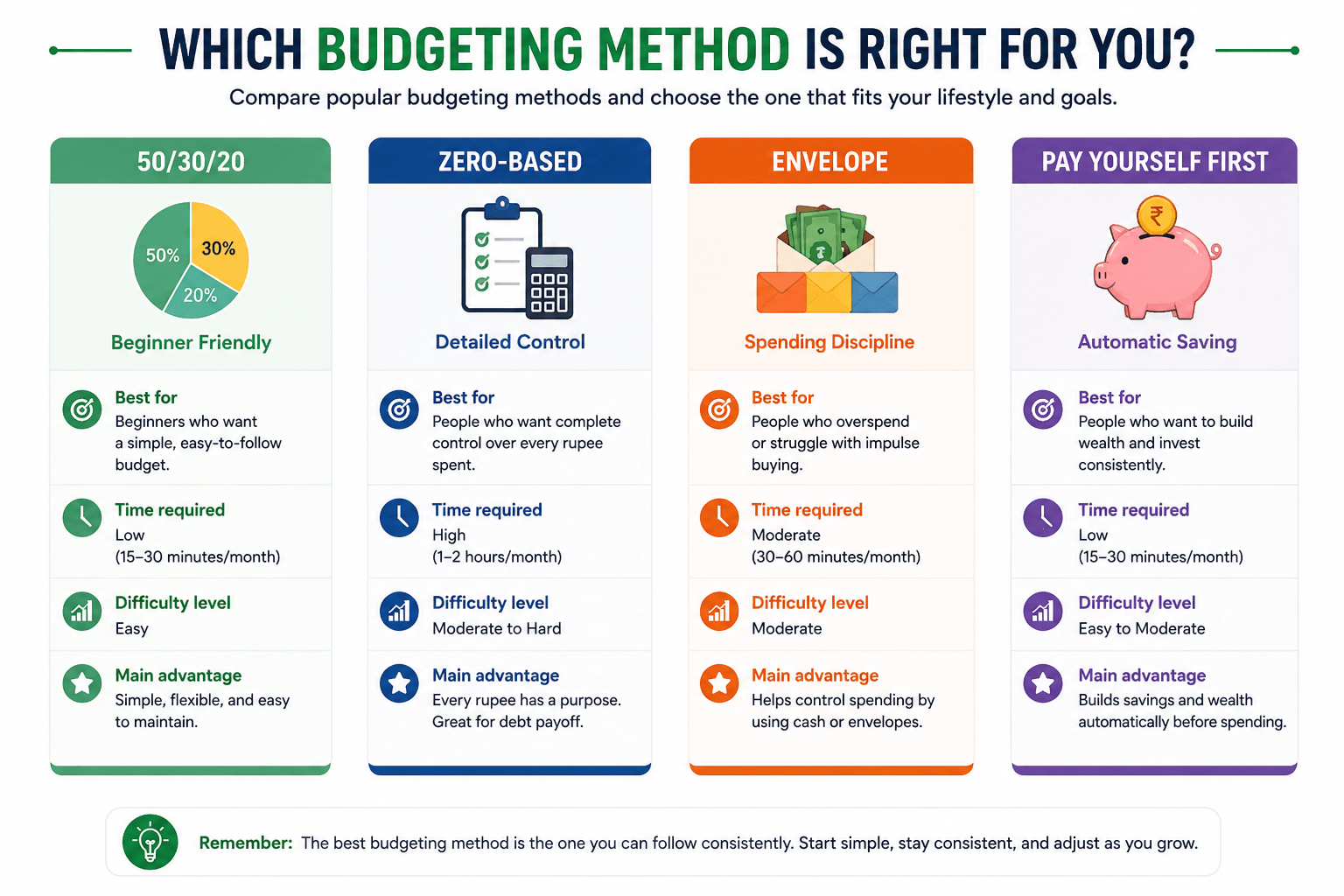
The 50/30/20 Budget Rule is one of the easiest ways to start budgeting, but it’s not the only method available.
Different budgeting systems work better for different people. Some give you more control over every rupee, while others focus on simplicity or cash spending.
The best budgeting method is the one you can follow consistently.
Let’s compare the most popular options.
Quick Comparison Table
| Feature | 50/30/20 Rule | Zero-Based Budgeting | Envelope Budgeting | Pay Yourself First |
|---|---|---|---|---|
| Easy for Beginners | ⭐⭐⭐⭐⭐ | ⭐⭐☆☆☆ | ⭐⭐⭐⭐☆ | ⭐⭐⭐⭐⭐ |
| Time Required | Low | High | Medium | Low |
| Expense Tracking | Basic | Detailed | Moderate | Basic |
| Best for Variable Income | Moderate | Good | Moderate | Good |
| Helps Control Overspending | Good | Excellent | Excellent | Good |
| Savings Focus | High | Medium | Medium | Excellent |
| Cash Friendly | No | Optional | Yes | Optional |
Quick Recommendation:
If you’re new to budgeting, start with the 50/30/20 Rule. As your financial confidence grows, you can combine it with more detailed budgeting techniques if needed.
1. 50/30/20 Budget Rule
How It Works
You divide your monthly take-home income into:
- 50% Needs
- 30% Wants
- 20% Savings & Investments
Best For
- Beginners
- Salaried employees
- Young professionals
- People who want a simple budgeting system
Advantages
- Easy to understand
- Quick to implement
- Flexible
- Encourages regular saving
Limitations
- Doesn’t track every expense.
- May need adjustments in high-cost cities.
- Less suitable if you’re aggressively paying off debt.
2. Zero-Based Budgeting
Zero-Based Budgeting (ZBB) gives every rupee a specific job.
Instead of using percentages, you allocate your entire monthly income until the remaining balance is zero.
For example:
Monthly income: ₹60,000
| Category | Amount |
|---|---|
| Rent | ₹18,000 |
| Groceries | ₹6,000 |
| Utilities | ₹3,000 |
| SIP | ₹8,000 |
| Transport | ₹4,000 |
| Insurance | ₹2,000 |
| Entertainment | ₹4,000 |
| Emergency Fund | ₹5,000 |
| Miscellaneous | ₹10,000 |
| Remaining Balance | ₹0 |
Every rupee has a purpose.
Best For
- Detail-oriented people
- Families with complex budgets
- Individuals focused on eliminating wasteful spending
Advantages
- Maximum control over expenses.
- Helps identify unnecessary spending.
- Excellent for debt repayment and goal-based planning.
Limitations
- Requires more time.
- Needs regular updates.
- Can feel overwhelming for beginners.
Related Article: Zero-Based Budgeting Explained for Beginners (Internal Link)
3. Envelope Budgeting
Envelope Budgeting is one of the oldest budgeting methods.
Traditionally, people placed cash into separate envelopes labeled:
- Groceries
- Transport
- Dining Out
- Entertainment
- Shopping
When an envelope became empty, spending in that category stopped until the next month.
Today, many people recreate this system using separate bank accounts or budgeting apps.
Best For
- People who overspend frequently.
- Cash users.
- Anyone trying to control discretionary spending.
Advantages
- Makes spending limits visible.
- Helps reduce impulse purchases.
- Easy to understand.
Limitations
- Less convenient in a digital payment environment.
- Managing physical cash isn’t practical for everyone.
Related Article: Envelope Budgeting Method Explained (Internal Link)
4. Pay Yourself First
This method focuses on one simple principle:
Save first. Spend the rest.
Instead of saving whatever remains at the end of the month, you automatically transfer money to savings or investments as soon as you receive your salary.
Example
Monthly salary:
₹70,000
Automatic SIP:
₹14,000
Remaining amount available for spending:
₹56,000
The focus is on ensuring your future goals are funded before discretionary spending begins.
Best For
- Busy professionals.
- Long-term investors.
- People building wealth through SIPs or retirement planning.
Advantages
- Encourages consistent investing.
- Requires minimal effort after automation.
- Helps avoid overspending.
Limitations
- Doesn’t provide detailed spending guidance.
- Requires discipline to stay within the remaining budget.
Which Budgeting Method Should You Choose?
There’s no universal answer.
Your ideal budgeting system depends on your goals, personality, and financial situation.
Choose the 50/30/20 Budget Rule if You:
✅ Are new to budgeting.
✅ Prefer a simple framework.
✅ Want to balance spending and saving.
✅ Don’t want to track every transaction.
Choose Zero-Based Budgeting if You:
✅ Enjoy detailed planning.
✅ Want complete control over your money.
✅ Are aggressively paying off debt.
✅ Have multiple financial goals.
Choose Envelope Budgeting if You:
✅ Frequently overspend.
✅ Prefer spending limits for each category.
✅ Want to reduce impulse purchases.
Choose Pay Yourself First if You:
✅ Already manage spending reasonably well.
✅ Want to grow your investments consistently.
✅ Prefer automation over manual budgeting.
Can You Combine Budgeting Methods?
Absolutely.
Many financially successful people don’t rely on just one system.
Here are a few practical combinations.
Example 1
Use the 50/30/20 Rule to decide how much to spend overall.
Then use Envelope Budgeting to control your Wants category.
Example 2
Follow the 50/30/20 Rule for overall planning.
Use Pay Yourself First by automatically investing the entire 20% every month.
Example 3
Use Zero-Based Budgeting for monthly planning while checking that your overall spending still aligns with your long-term financial goals.
The methods complement each other rather than compete.
Which Method Is Best for Different Types of People?
| Person | Recommended Method |
|---|---|
| Student | 50/30/20 Budget Rule |
| First Job | 50/30/20 Budget Rule |
| Salaried Employee | 50/30/20 + Pay Yourself First |
| Freelancer | Zero-Based Budgeting |
| Large Family | Zero-Based Budgeting |
| Frequent Overspender | Envelope Budgeting |
| Long-Term Investor | Pay Yourself First + 50/30/20 |
Remember that these are general recommendations. You can always adapt or combine methods based on your circumstances.
Our Recommendation
For most beginners in India, the 50/30/20 Budget Rule offers the best balance of simplicity, flexibility, and practicality.
Once you’re comfortable managing your monthly budget, you can gradually introduce additional techniques such as:
- Zero-Based Budgeting for more detailed planning.
- Envelope Budgeting to reduce impulse spending.
- Pay Yourself First to automate your investments.
The important thing is to start.
A simple budget you follow consistently will always outperform a perfect budget you never use.
Regular Station Pro Tip:
Don’t spend weeks searching for the “perfect” budgeting method. Choose one, follow it for three months, review the results, and then make improvements if needed.
Continue Learning
If you’re serious about improving your finances, don’t stop with budgeting.
Next, read our complete:
👉 Personal Finance Guide for Beginners in India
You’ll learn:
- Emergency Fund
- SIP
- Mutual Funds
- Credit Score
- Insurance
- Financial Goals
Frequently Asked Questions (FAQs)
These are some of the most common questions people ask about the 50/30/20 Budget Rule. They also target long-tail search queries and can be marked up with FAQPage Schema to improve SEO.
1. What is the 50/30/20 Budget Rule?
The 50/30/20 Budget Rule is a budgeting method that divides your monthly take-home income into three categories:
- 50% for essential expenses (Needs)
- 30% for lifestyle expenses (Wants)
- 20% for savings, investments, or debt repayment
It provides a simple framework to help you manage money without tracking every individual expense.
2. Is the 50/30/20 Budget Rule suitable for beginners?
Yes. It is one of the easiest budgeting methods for beginners because it focuses on only three broad spending categories.
If you’re managing your salary for the first time, this rule can help you develop healthy financial habits without feeling overwhelmed.
3. Should I use my gross salary or take-home salary?
Always use your monthly take-home (net) salary.
Your budget should be based on the amount that actually reaches your bank account after deductions such as EPF, professional tax, and income tax.
4. Is rent included in the 50%?
Yes.
Rent is considered an essential living expense and should be included under the Needs (50%) category.
If your rent alone exceeds 50% of your income, adjust the percentages instead of abandoning your budget.
5. Do EMIs count as Needs or Savings?
It depends on the purpose of the loan.
Generally:
Needs
- Home loan EMI
- Education loan EMI
- Essential vehicle loan
Usually Wants
- Luxury gadget EMI
- Vacation financing
- Premium lifestyle purchases
Always classify the expense based on whether it is essential for your daily life or long-term financial stability.
6. What if my essential expenses are more than 50%?
This is common in expensive cities or for families with multiple financial responsibilities.
Instead of trying to force the traditional split:
- Reduce unnecessary discretionary spending.
- Increase your income where possible.
- Gradually improve your savings rate over time.
Remember, the percentages are guidelines—not fixed rules.
7. Can I save more than 20%?
Absolutely.
In fact, if your income allows, increasing your savings and investments can help you achieve financial goals sooner.
Many people choose to save 25–40% of their income after receiving salary hikes or reducing debt.
8. What counts toward the 20% savings category?
Examples include:
- Emergency Fund
- SIPs in Mutual Funds
- PPF
- NPS
- Fixed Deposits
- Recurring Deposits
- Extra loan repayments
- Long-term investment goals
The focus should be on improving your future financial security.
9. Is the 50/30/20 Rule suitable for freelancers?
Yes, but with one important adjustment.
Because freelance income often varies each month, calculate your average monthly income over the past 6–12 months and build your budget around that figure.
Maintaining a larger emergency fund is also recommended.
10. How often should I review my budget?
Review your budget at least once every month.
You should also update it after major life events, such as:
- Salary increase
- Marriage
- Moving to a new city
- Birth of a child
- Taking a loan
- Significant changes in household expenses
Regular reviews keep your budget aligned with your financial goals.
11. Which budgeting apps work well in India?
You don’t need an expensive app to budget effectively.
You can use:
- Your banking app’s expense tracker (if available)
- Google Sheets or Microsoft Excel
- A notebook
- Personal finance apps that support Indian users
Choose a tool that you’ll use consistently rather than the one with the most features.
12. Can students use the 50/30/20 Budget Rule?
Yes.
Students can simplify the categories based on their income and expenses.
Even if you’re earning through internships or part-time work, budgeting early helps build lifelong money management skills.
13. Is the 50/30/20 Rule better than Zero-Based Budgeting?
It depends on your needs.
If you want a simple and flexible budgeting system, the 50/30/20 Rule is usually the better choice.
If you prefer detailed planning and want to assign every rupee a purpose, Zero-Based Budgeting may be more suitable.
Many people combine both approaches.
14. Can I change the percentages?
Yes.
The 50/30/20 split is only a starting point.
Depending on your situation, a budget like 60/20/20, 55/25/20, or 45/25/30 may be more practical.
The important thing is to maintain a healthy balance between essential spending, lifestyle expenses, and long-term savings.
15. What’s the biggest mistake people make while budgeting?
One of the most common mistakes is not tracking expenses.
Without knowing where your money goes, it’s difficult to improve your financial habits.
Other common mistakes include:
- Lifestyle inflation
- Ignoring emergency savings
- Confusing needs with wants
- Not reviewing the budget regularly
- Saving only what’s left at the end of the month
Final Thoughts
Budgeting isn’t about restricting your life—it’s about giving every rupee a purpose.
The 50/30/20 Budget Rule has remained popular because it is simple, practical, and flexible. Whether you’re managing your first salary, supporting a family, or planning for retirement, it provides a clear framework to balance today’s needs with tomorrow’s goals.
Don’t worry if your budget doesn’t perfectly match the 50/30/20 split from the beginning. Rising living costs, family responsibilities, or loan repayments may require you to adjust the percentages. That’s completely normal.
The most important thing is to build habits that last:
- Spend intentionally.
- Save consistently.
- Invest regularly.
- Review your budget every month.
- Improve gradually as your income and responsibilities change.
Remember, financial success isn’t determined by how much you earn—it’s shaped by how well you manage what you earn.
Even small improvements today can create significant financial stability in the future.
Regular Station Pro Tip:
The best time to start budgeting was when you received your first salary. The second-best time is today.
Your Next Step
Now that you understand the 50/30/20 Budget Rule, continue building your financial knowledge with these beginner-friendly guides on Regular Station:
📚 Recommended Reading
- The Ultimate Personal Finance Guide for Beginners in India (Cornerstone Guide)
- Emergency Fund Guide
- How to Save Money Every Month
- Zero-Based Budgeting Explained
- Envelope Budgeting Method
- SIP for Beginners
- Mutual Funds Explained
- Financial Goals: How to Plan and Achieve Them
These articles will help you create a complete financial roadmap—from budgeting and saving to investing and long-term wealth creation.
