

Ultimate Guide
The Ultimate Personal Finance Guide for Beginners in India
Learn the core personal-finance decisions: budgeting, saving, insurance, investing and retirement planning.
Last updated July 2026 · Regular Station Editorial Team · Beginner level · Designed for Indian readers
Key Takeaways
- Manage your money wisely—not just earn more.
- Set clear financial goals.
- Create a monthly budget.
- Build a 3–6 month emergency fund.
- Protect yourself with insurance.
- Start investing early.
- Avoid unnecessary debt.
- Review your finances regularly.
- Keep learning and improving.
Introduction
Your journey toward financial confidence starts here.
It is the week before payday: rent is due, a credit-card bill is waiting, and an unexpected family expense appears. You may be earning regularly, yet still feel unsure about what your money is meant to do next.
That uncertainty is exactly where personal finance becomes useful. It is not a contest to earn the most; it is a practical way to make clear choices with the income, responsibilities and goals you have today.
This guide follows the order most beginners need: understand your cash flow, build protection, set goals, then invest for the long term. Use it as an educational starting point and adapt the actions to your own circumstances.
Who Should Read This Guide?
This practical guide is for Indian readers who want a clearer, more confident relationship with money.
- Students building their first money habits.
- Working professionals managing income, expenses and early goals.
- Freelancers and business owners handling irregular cash flow.
- Families and homemakers coordinating household priorities and protection.
- Retirees reviewing income, healthcare costs and financial security.
- Anyone seeking financial freedom through steady, informed decisions.
Understanding Personal Finance
Personal finance is the practical system for directing your income, spending, savings, borrowing, protection and investments toward the life you want. This module explains the moving parts, how they connect, and the first decisions a beginner in India should make before acting on any financial product.
Understanding the foundation of managing your money wisely.
Personal finance is the process of managing your money wisely so you can meet your present needs while preparing for your future.
It involves making informed decisions about how you earn, spend, save, invest, borrow, protect, and grow your money throughout different stages of life.
In simple words, personal finance is your personal plan for handling money. For most people, it begins with a savings account and monthly income, but gradually expands to include budgeting, emergency savings, investing, tax planning, insurance, retirement planning, and wealth creation.
Good personal finance isn’t about becoming rich overnight. It’s about developing smart financial habits that help you live comfortably today while building long-term financial security.
Personal Finance Explained in Simple Terms
Imagine receiving your monthly salary. Within a few days, part of it goes toward rent, groceries, electricity, school fees, loan repayments, and daily expenses.
If you don’t have a plan, it’s easy to wonder where the rest of your money went.
Personal finance helps you decide where every rupee should go before you spend it.
Some of it pays for your daily needs, some is saved for emergencies, some is invested for future goals, and some is used to protect your family through insurance.
Without a plan, money often disappears on unnecessary expenses. With a plan, every rupee has a purpose.
The Six Core Areas of Personal Finance
| Area | Purpose |
|---|---|
| Income | Earn and manage money effectively. |
| Spending | Control expenses and prioritize needs. |
| Saving | Prepare for future goals and emergencies. |
| Investing | Grow wealth over the long term. |
| Protection | Safeguard finances through insurance and emergency funds. |
| Future Planning | Prepare for retirement, education, and financial independence. |
A Simple Example
Imagine Rahul, a 28-year-old software engineer in Bengaluru earning ₹60,000 per month.
Instead of spending his entire salary, Rahul follows a simple financial plan:
- Pays household expenses.
- Saves part of his income.
- Builds an emergency fund.
- Invests through a monthly SIP.
- Buys health and term insurance.
- Reviews his finances every six months.
- Reviews his insurance coverage and investment portfolio annually.
Rahul isn’t doing anything extraordinary. He’s simply practicing good personal finance. Over several years, these consistent habits can significantly improve his financial stability and help him achieve long-term goals.
Why Personal Finance Matters
- Reduce financial stress.
- Handle emergencies confidently.
- Avoid unnecessary debt.
- Achieve financial goals faster.
- Build long-term wealth.
- Protect your family’s future.
- Prepare for retirement.
- Make informed financial decisions.
Personal finance gives you greater control over your money instead of letting money control your life.
Common Misconceptions
| Myth | Reality |
|---|---|
| Personal finance is only for wealthy people. | Everyone who earns or spends money benefits from personal finance. |
| Investing is the first step. | Budgeting and saving should come before investing. |
| You need a high salary to become financially secure. | Good financial habits are often more important than a high income. |
| Personal finance is too complicated. | Most concepts become easy once explained in simple language. |
Why Personal Finance Matters
Personal finance matters because ordinary decisions—how much you spend, borrow, save and protect—compound over time. A clear plan helps you absorb setbacks, fund meaningful goals and make trade-offs with less stress, regardless of your present income level.
Discover how smart money habits create long-term financial security and confidence.
Money affects almost every important decision in life. It influences where you live, how you educate your children, when you retire, how you handle emergencies, and whether you can achieve long-term financial independence.
Many people believe that earning more money automatically leads to financial success. In reality, financial stability comes from how you manage your money—not just how much you earn.
Two people earning the same salary can have completely different financial lives. One may build savings, invest regularly, and achieve financial freedom, while the other may struggle with debt and live paycheck to paycheck. The difference is often good personal finance habits—not income alone.
That’s why understanding personal finance is one of the most valuable life skills you can develop.
Learning how to save money every month is one of the most important personal finance skills. Even small, consistent savings can help you build an emergency fund, reduce financial stress, and achieve long-term goals. Explore our How to Save Money Every Month: 25 Practical Money-Saving Tips for Indian Families guide for practical strategies you can start using today.
Before investing or planning for retirement, every beginner should build an emergency fund. Our Emergency Fund Guide for Beginners in India explains how much you should save, where to keep your emergency savings, and practical steps to build a financial safety net.
8 Reasons Why Personal Finance Matters
| Benefit | How It Helps |
|---|---|
| Take Control of Money | Create budgets, track expenses, and spend intentionally. |
| Reduce Financial Stress | Build emergency savings and prepare for unexpected expenses. |
| Achieve Financial Goals | Turn dreams into structured financial plans. |
| Avoid Unnecessary Debt | Use credit responsibly and repay debt efficiently. |
| Grow Your Wealth | Invest consistently and benefit from long-term compounding. |
| Protect Your Family | Use insurance and emergency funds to reduce financial risk. |
| Prepare for Retirement | Build financial independence for later life. |
| Build Financial Confidence | Make better decisions with less financial anxiety. |
Real-Life Example
Consider two friends who earn similar salaries but manage their money differently.
| Rahul’s Habits | Amit’s Habits |
|---|---|
| Creates a monthly budget | Doesn’t track expenses |
| Saves regularly | Spends everything |
| Builds an emergency fund | Has no emergency savings |
| Invests consistently | Delays investing |
| Reviews finances regularly | Never reviews finances |
After ten years, Rahul is financially more secure—not because he earned significantly more, but because he made better financial decisions consistently.
Financial Priorities at Different Life Stages
| Life Stage | Financial Priority |
|---|---|
| First Job | Budgeting & Saving |
| Marriage | Insurance & Joint Financial Planning |
| Family | Children’s Education & Investments |
| Mid-Career | Wealth Creation |
| Pre-Retirement | Debt Reduction & Retirement Corpus |
| Retirement | Income Management |
Financial Foundations
Financial foundations come before wealth-building. Start by mapping cash flow, setting a workable budget, keeping a reserve for shocks and arranging essential protection. These basics make later investment decisions more durable and reduce the chance of selling assets or borrowing under pressure.
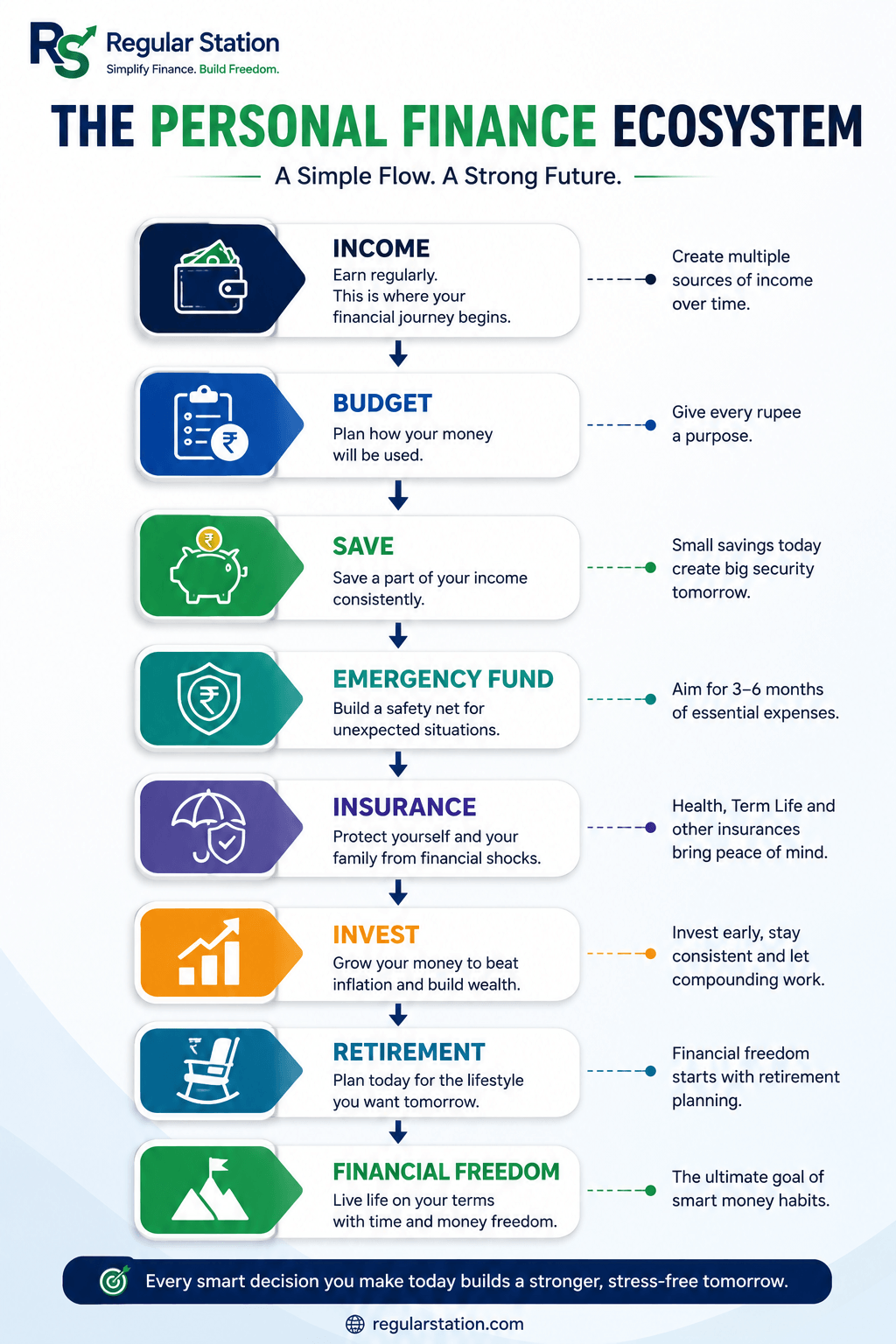
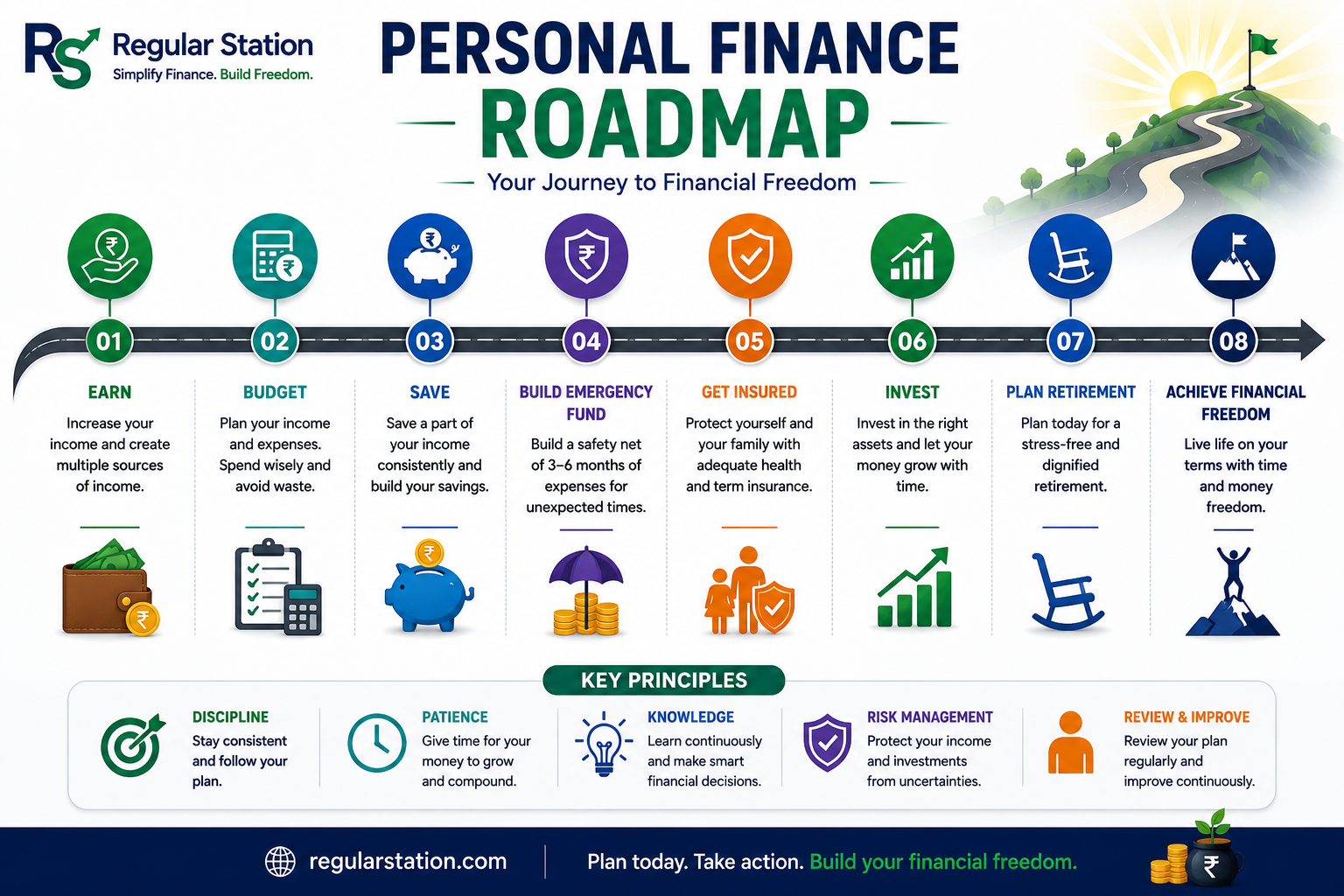
Personal Finance Roadmap
Build one financial habit at a time by following a logical step-by-step journey.
Every successful financial journey follows a logical order. Rather than trying to master everything at once, focus on strengthening one stage before moving to the next.
Income
Budget
Saving
Emergency Fund
Insurance
Investing
Tax Planning
Retirement Planning
Financial Freedom
Each stage builds upon the previous one. Following this step-by-step approach makes personal finance easier to understand and more sustainable over the long term.
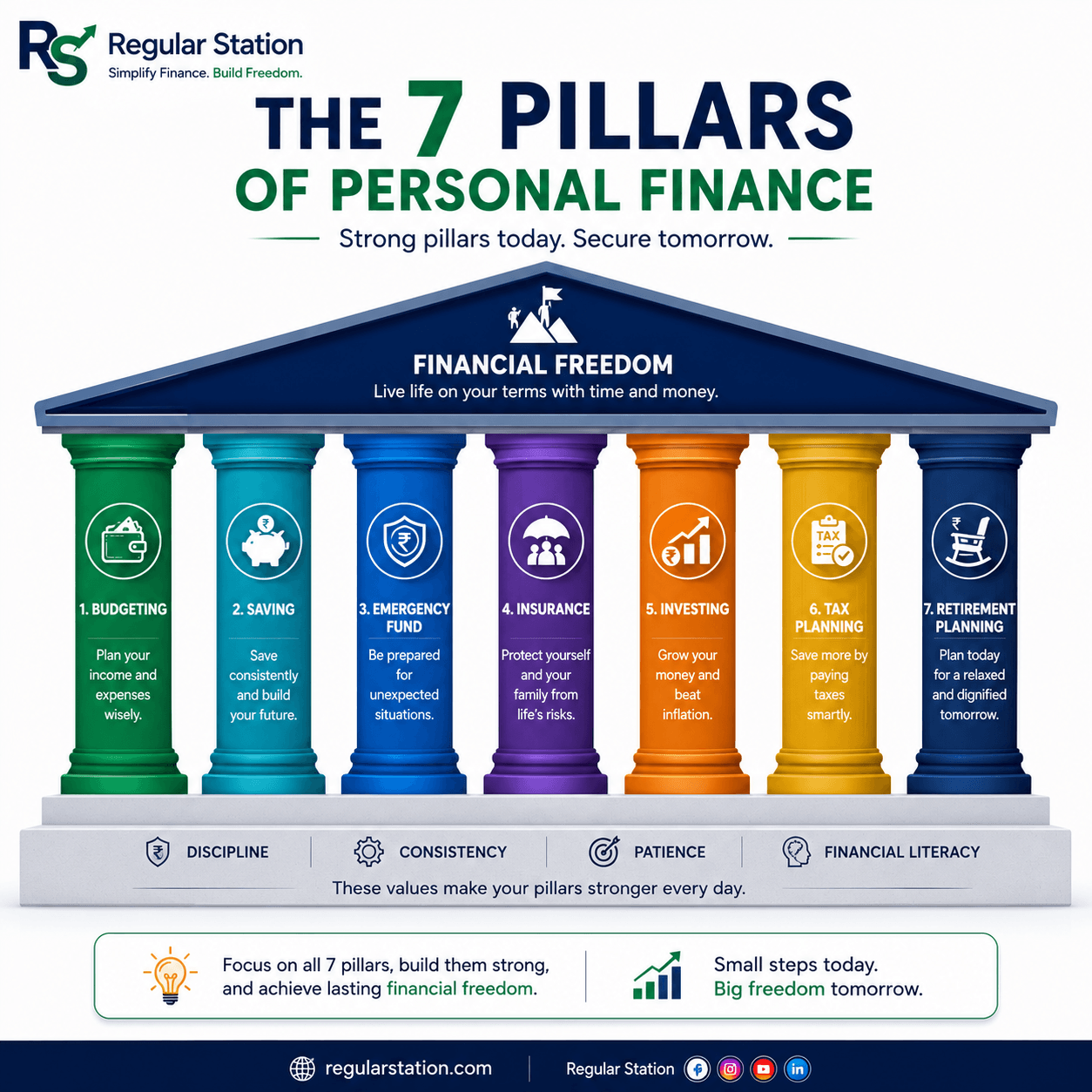
The Financial House Framework
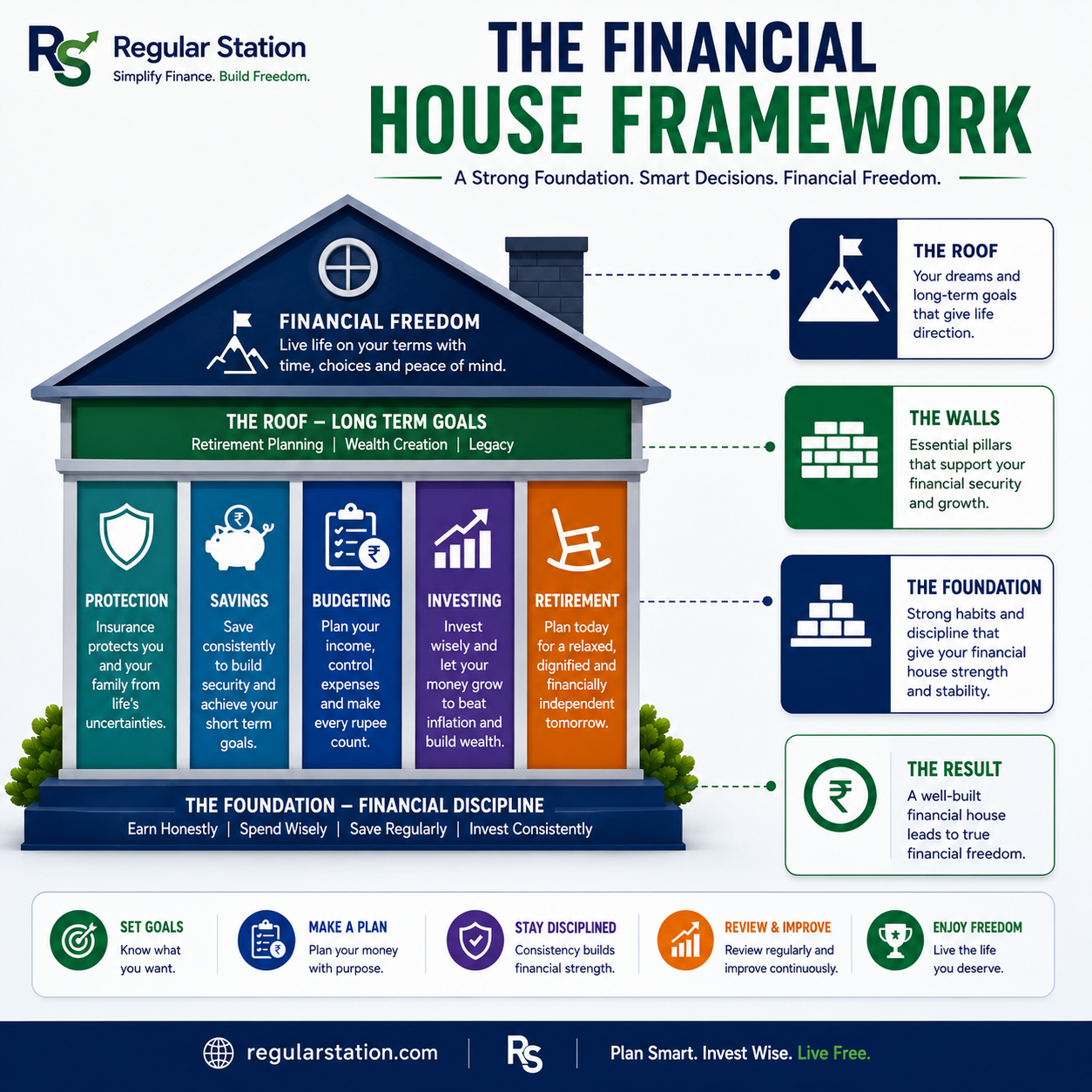
Without a strong base, the upper layers become difficult to sustain. Budgeting supports saving, saving builds an emergency fund, insurance protects your finances, investing creates wealth, tax planning improves efficiency, and retirement planning secures your future.
The Seven Pillars at a Glance
| Pillar | Primary Purpose | Related Guide |
|---|---|---|
| Budgeting | Control your money | Budgeting Guide |
| Saving | Build financial discipline | Saving Guide |
| Emergency Fund | Prepare for emergencies | Emergency Fund Guide |
| Insurance | Protect yourself and your family | Insurance Guide |
| Investing | Grow wealth over time | Investing Guide |
| Tax Planning | Improve tax efficiency | Tax Planning Guide |
| Retirement Planning | Secure your future | Retirement Guide |
Next module
The next chapter explains how to create a Personal Finance Plan that brings all seven pillars together into a roadmap based on your income, goals, and lifestyle.
Putting Your Foundations Into a Personal Finance Plan
Create a practical financial roadmap that helps you spend wisely, save consistently, and achieve your long-term goals.
A personal finance plan is your roadmap for managing money with purpose. Instead of wondering where your income goes every month, you’ll create a simple system that helps you spend wisely, save consistently, prepare for emergencies, and build long-term wealth.
Unlike a one-time budget, a personal finance plan evolves as your income, responsibilities, career, and financial goals change. The objective isn’t to create a perfect plan—it’s to build a financial system you can follow consistently.
A strong financial plan starts with protection. Before focusing on wealth creation, learn how to build an Emergency Fund Guide for Beginners in India and prepare for life’s unexpected situations.
Know Your Income
Every financial plan begins with understanding exactly how much money comes into your household each month.
Calculate your monthly take-home income after taxes and deductions. This is the amount available for budgeting and financial planning.
Include Every Regular Income Source
- Salary
- Freelance Income
- Business Income
- Rental Income
- Interest
- Dividends
- Pension
- Other Recurring Income
Track Your Expenses
Before improving your finances, understand exactly where your money goes.
Track every expense for at least one month. You’ll often discover spending patterns that can be improved without reducing your quality of life.
Categorize Your Spending
| Essential Expenses | Lifestyle Expenses |
|---|---|
| House Rent | Dining Out |
| Groceries | Entertainment |
| Electricity | Shopping |
| Transport | Travel |
| Education | Subscriptions |
Set SMART Financial Goals
For a deeper step-by-step approach, see our guide to Financial Goals for Beginners in India, including practical examples, goal timelines, monthly savings targets, and ways to prioritize multiple goals.
Examples of Financial Goals
| Time Horizon | Example Goals |
|---|---|
| Short-Term (Within 1 Year) | Emergency fund, vacation, repay credit card |
| Medium-Term (1–5 Years) | Buy a car, purchase a home, start a business |
| Long-Term (5+ Years) | Retirement planning, children’s education, financial independence |
Use the SMART Framework
- ✔ Specific
- ✔ Measurable
- ✔ Achievable
- ✔ Relevant
- ✔ Time-bound
Create a Monthly Budget
Now it’s time to give every rupee a purpose. A budget helps you balance your spending, saving, and investing instead of wondering where your money disappeared.
One of the easiest budgeting methods for beginners is the 50/30/20 Rule. Treat it as a flexible guideline rather than a strict formula.
| Category | Suggested Allocation | Purpose |
|---|---|---|
| Needs | 50% | Essential living expenses |
| Wants | 30% | Lifestyle and discretionary spending |
| Savings & Investments | 20% | Build long-term financial security |
Build an Emergency Fund
Before focusing on aggressive investing, create a financial safety net.
Aim to save enough to cover 3–6 months of essential living expenses. Keep this money easily accessible and reserve it only for genuine emergencies.
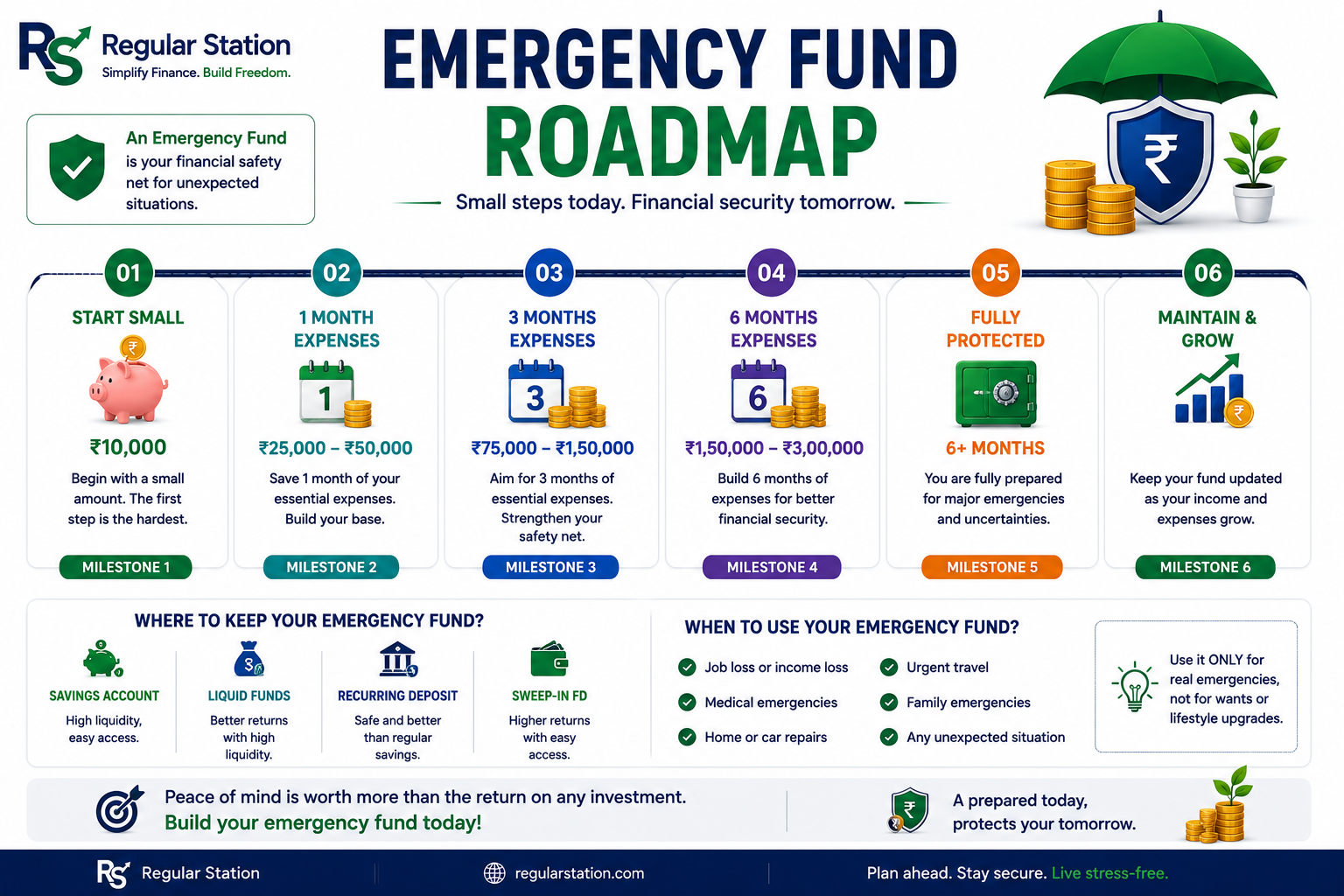
Emergency Fund Checklist
- □ Separate savings account
- □ Covers essential expenses
- □ Easily accessible
- □ Used only for genuine emergencies
Protect Yourself with Insurance
Growing wealth is important—but protecting it is equally important. Insurance helps reduce the financial impact of unexpected events that could otherwise disrupt your financial plan.
Insurance Priorities
| Insurance Type | Who Should Consider It? |
|---|---|
| Health Insurance | Everyone |
| Term Life Insurance | Anyone with financial dependents |
| Motor Insurance | Vehicle owners |
Choose insurance based on your personal circumstances rather than buying every available policy.
Start Investing
Once your budget, emergency fund, and insurance are in place, it’s time to put your money to work. Investing helps your wealth grow over the long term and supports goals such as buying a home, funding higher education, and retirement.
Choose investments based on your financial goals, investment horizon, and risk tolerance—not market trends or social media recommendations.
Popular Investment Options
| Investment | Suitable For |
|---|---|
| Mutual Funds / SIP | Long-term wealth creation |
| Stocks | Experienced investors with higher risk tolerance |
| PPF | Long-term, low-risk investing |
| Fixed Deposits | Capital preservation |
| Gold | Portfolio diversification |
Manage Debt Wisely
Not all debt is harmful. The objective is to avoid borrowing that becomes difficult to repay while using credit responsibly.
Healthy Debt Habits
- Pay EMIs on time.
- Avoid unnecessary borrowing.
- Use credit cards responsibly.
- Prioritize repayment of high-interest debt.
- Pay your credit card bill in full whenever possible.
Review Your Financial Plan Regularly
Your financial plan should evolve with your life. Reviewing it regularly helps ensure your goals, investments, insurance, and budget continue supporting your priorities.
Review Your Plan
- □ Every six months
- □ After a salary increase
- □ After changing jobs
- □ After marriage
- □ After having children
- □ Before major financial decisions
Example Financial Plan
Let’s see how a simple monthly financial plan might look.
| Category | Monthly Allocation |
|---|---|
| Take-Home Income | ₹60,000 |
| Essential Expenses | ₹28,000 |
| Lifestyle Expenses | ₹12,000 |
| Emergency Fund | ₹5,000 |
| SIP Investments | ₹10,000 |
| Insurance | ₹3,000 |
| Learning & Skill Development | ₹2,000 |
Rather than chasing perfection, Rahul follows a simple system that balances spending, saving, protection, and investing every month. Over time, consistency becomes his biggest financial advantage.
Your First 90-Day Financial Action Plan
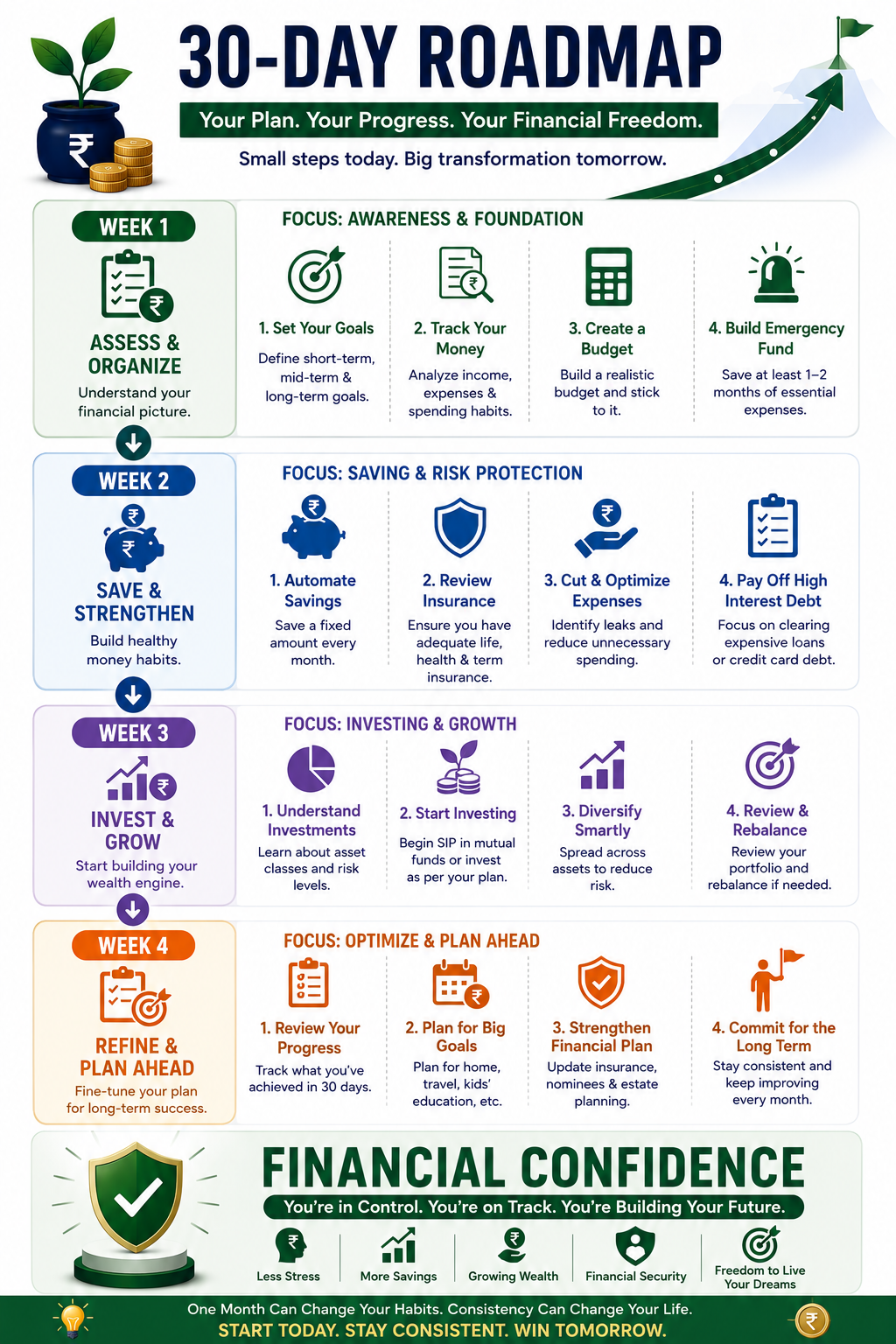
| Timeline | Focus |
|---|---|
| Month 1 | Track income and expenses, create your first budget, identify unnecessary spending. |
| Month 2 | Start building an emergency fund, review insurance needs, and set three financial goals using a clear target amount and deadline. |
| Month 3 | Begin investing regularly, review your progress, and refine your budget. |
Financial Plan Checklist
- ☐ Calculated my monthly take-home income
- ☐ Tracked my monthly expenses
- ☐ Created a monthly budget
- ☐ Set SMART financial goals
- ☐ Started building an emergency fund
- ☐ Reviewed my insurance coverage
- ☐ Began investing regularly
- ☐ Reviewed my debt situation
- ☐ Scheduled my next financial review
Module takeaways
- Create a financial plan before making major financial decisions.
- Know your income and track every expense.
- Set clear financial goals with realistic timelines.
- Budget intentionally instead of spending impulsively.
- Build financial security before focusing on wealth creation.
- Review your plan regularly as your life changes.
Next module
Now that you’ve created your personal finance plan, the next step is deciding what you’re working toward.
In the next chapter, you’ll learn how to set SMART Financial Goals, prioritize multiple objectives, and create a practical roadmap that keeps you motivated and focused throughout your financial journey.
Financial Goals
Financial goals turn broad intentions into decisions you can act on. Define what the money is for, the amount required and the deadline; then rank goals so today’s cash flow supports both near-term needs and longer-term priorities.
Clear financial goals give every rupee a purpose and help turn dreams into achievable plans.
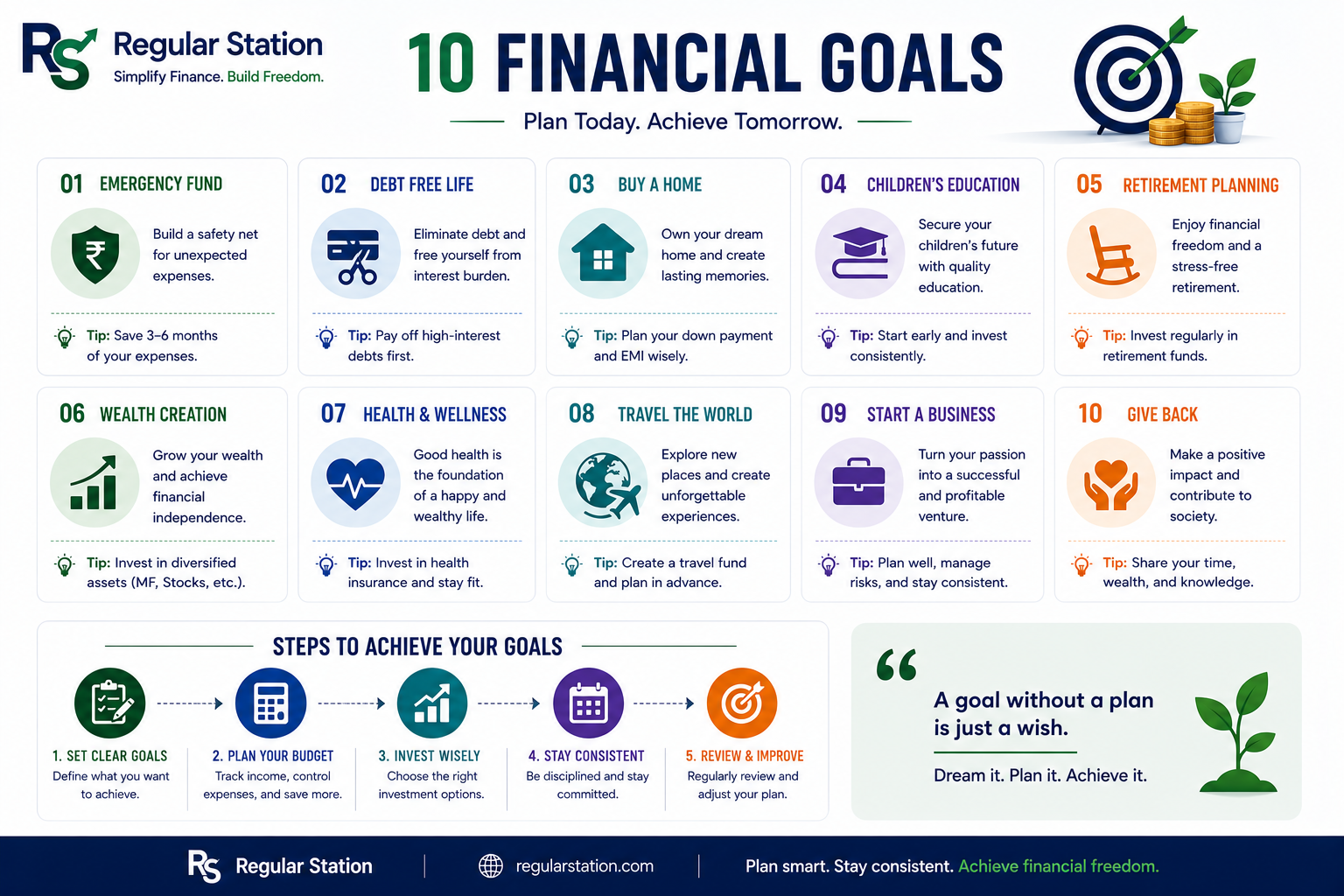
Every successful financial journey begins with a clear destination. Financial goals give your money purpose and help you make confident decisions about spending, saving, and investing. If you’re new to goal setting, learn how to set and achieve financial goals in India with our detailed guide.
You’ve created your personal finance plan. Now it’s time to give that plan a clear direction.
Imagine boarding a train without knowing your destination. No matter how comfortable the journey is, you may never reach the place you actually wanted to go.
Managing money without financial goals works the same way. Many people earn, spend, and save, but they never define what they’re actually working toward.
Whether your dream is buying a home, funding your child’s education, starting a business, or retiring comfortably, every financial achievement begins with a clearly defined goal.
Why Financial Goals Matter
Financial goals help you decide what matters most, stay disciplined, and measure your progress over time.
Clear goals also help you determine how much to save, where to invest, and which financial decisions deserve your attention first.
The Three Types of Financial Goals
Short-Term Goals
Time Frame: Within 1 Year
- Emergency Fund
- Clear Credit Card Debt
- Holiday
- Buy a Laptop
Medium-Term Goals
Time Frame: 1–5 Years
- Buy a Car
- Start a Business
- Higher Education
- Home Down Payment
Long-Term Goals
Time Frame: 5+ Years
- Retirement
- Children’s Education
- Financial Independence
- Wealth Creation
A balanced financial plan usually includes goals from all three categories.
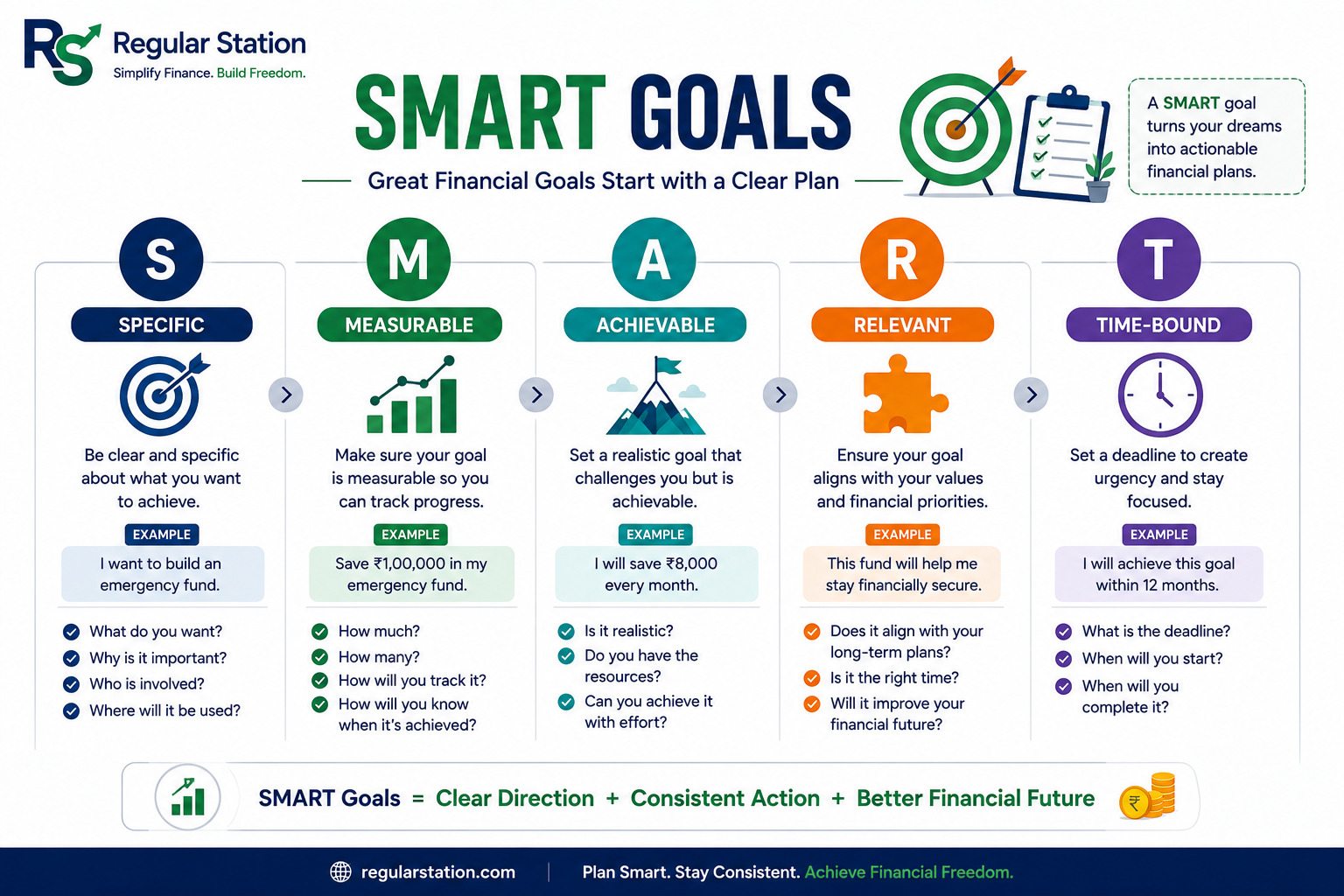
Use the SMART Framework
| SMART Principle | Meaning | Example |
|---|---|---|
| Specific | Clearly define the goal | Save ₹3 lakh |
| Measurable | Track progress | Save ₹25,000 every month |
| Achievable | Realistic based on your income | Fits your budget |
| Relevant | Supports your priorities | Home down payment |
| Time-bound | Set a deadline | Within 12 months |
Typical Financial Priorities by Age
Financial priorities change as your career, income, family responsibilities, and lifestyle evolve. The following roadmap provides general guidance, but your own priorities may differ depending on your circumstances.
| Age Group | Typical Financial Priorities |
|---|---|
| 20–30 Years | Emergency fund, skill development, first investments |
| 30–40 Years | Home purchase, family protection, child education |
| 40–50 Years | Wealth creation, debt reduction, retirement planning |
| 50+ Years | Retirement corpus, healthcare, estate planning |
Example Financial Goal Plan
Let’s see how financial goals can be converted into a practical monthly savings plan.
Priya’s Financial Dashboard
Age: 30 Years
Monthly Income: ₹80,000
| Goal | Time Frame | Monthly Saving |
|---|---|---|
| Emergency Fund | 8 Months | ₹10,000 |
| Europe Trip | 18 Months | ₹8,000 |
| Home Down Payment | 5 Years | ₹20,000 |
| Retirement | 25 Years | ₹15,000 |
By assigning a monthly amount to each goal, Priya transforms her dreams into a structured financial plan. Rather than saving randomly, every rupee now has a clear purpose.
Recommended Goal Priority
When you’re working toward multiple financial goals, it’s helpful to follow a logical order. Building a strong financial foundation first makes long-term wealth creation easier and more sustainable.
| Priority | Focus Area | Why It Comes First |
|---|---|---|
| 1 | Emergency Fund | Protects against unexpected financial setbacks. |
| 2 | Insurance Protection | Reduces financial risk for you and your family. |
| 3 | High-Interest Debt Repayment | Eliminates expensive borrowing. |
| 4 | Monthly Savings Goals | Supports planned purchases and milestones. |
| 5 | Long-Term Investing | Builds wealth through compounding. |
| 6 | Retirement Planning | Creates long-term financial independence. |
Goal Planning Checklist
- ☐ Defined one short-term financial goal
- ☐ Defined one medium-term financial goal
- ☐ Defined one long-term financial goal
- ☐ Assigned a target amount
- ☐ Assigned a realistic deadline
- ☐ Calculated monthly savings required
- ☐ Scheduled an annual goal review
Module takeaways
- Every financial plan should begin with clear goals.
- Balance short-, medium-, and long-term objectives.
- Use the SMART framework to create actionable goals.
- Review your goals regularly as your circumstances change.
- Prioritize financial security before wealth creation.
Module complete
- ✔ Understand why financial goals matter.
- ✔ Categorize goals by time horizon.
- ✔ Apply the SMART goal framework.
- ✔ Prioritize goals effectively.
- ✔ Create your own financial goal plan.
Next module
Now that you’ve identified your financial goals, it’s time to create a budget that supports them.
In the next chapter, you’ll learn how to build a realistic monthly budget, control unnecessary spending, and make every rupee work toward your financial goals.
Continue to: Budgeting Basics →
Budgeting
A monthly budget is a spending plan that assigns each rupee a job before it disappears. It shows what is available for essentials, goals and discretionary purchases, making it easier to adjust early instead of discovering a shortfall at month-end.
A practical budgeting system that helps every rupee support your financial goals.
A budget is more than a list of expenses—it’s a plan that helps every rupee work toward your financial goals. Good budgeting gives you control over your money instead of wondering where it disappeared each month.
Now that you’ve identified your financial goals, the next step is making sure your monthly income supports them. Budgeting helps you decide in advance how much you’ll spend, save, and invest.
Think of a budget as a roadmap for your money. Just as a GPS helps you reach your destination efficiently, a budget helps direct your income toward the things that matter most.
A well-planned budget naturally creates opportunities to save more each month. Once you’ve created your budget, read our How to Save Money Every Month guide to discover practical ways to cut expenses without compromising your lifestyle.
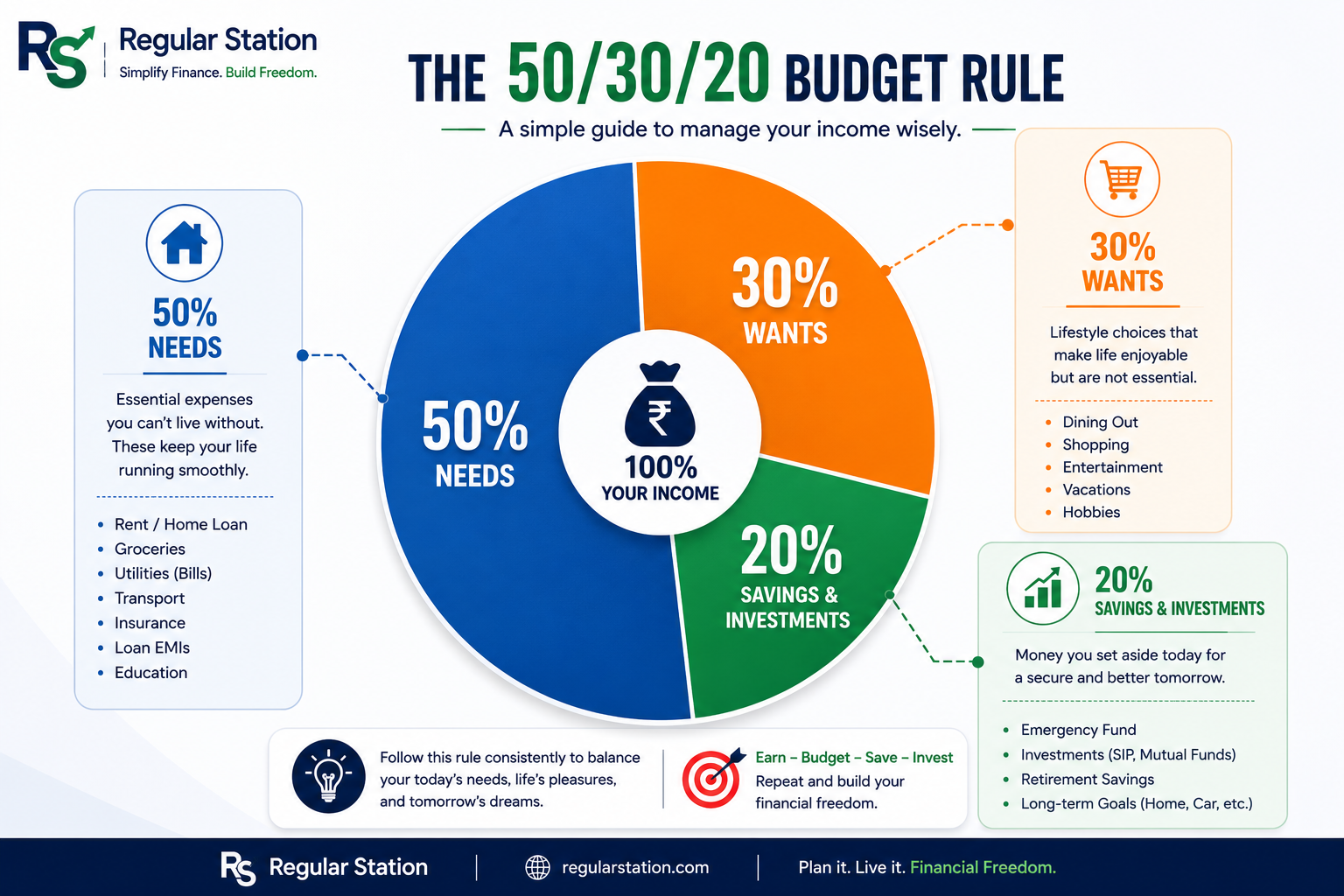
One of the easiest ways to start managing your monthly income is by using the 50/30/20 Budget Rule. This beginner-friendly budgeting framework helps you divide your take-home salary into essential expenses, lifestyle spending, and savings. If you’re looking for a practical step-by-step guide with Indian salary examples, read our 50/30/20 Budget Rule Explained for Beginners in India (2026 Guide).
Why Budgeting Matters
Many people earn a good income but still struggle financially because they don’t know where their money goes.
❌ Without a Budget
- Expenses quietly increase.
- Savings happen only if money remains.
- Impulse purchases become common.
- Financial goals get delayed.
✅ With a Budget
- You know where every rupee goes.
- Saving becomes consistent.
- Spending aligns with priorities.
- Financial goals become achievable.
Calculate Your Monthly Income
Begin by listing every source of take-home income. Always work with the amount that reaches your bank account after taxes and deductions.
Include:
- Salary
- Business Income
- Freelance Earnings
- Rental Income
- Interest
- Dividends
Track Every Expense
Record every expense for at least one month, no matter how small. Small purchases often reveal spending habits that can be improved.
| Examples to Track |
|---|
| House Rent |
| Groceries |
| Electricity |
| Fuel |
| Dining Out |
| Entertainment |
| Shopping |
| Subscriptions |
Categorize Your Expenses
Group your spending into meaningful categories. This makes it easier to identify areas where you can reduce costs without affecting essential needs.
| Essential Expenses | Lifestyle Expenses |
|---|---|
| Rent | Restaurants |
| Groceries | Shopping |
| Electricity | Movies |
| Education | Travel |
| Transportation | Hobbies |
Choose a Budgeting Method
There isn’t a single budgeting method that works for everyone. The best budgeting system is the one you can follow consistently every month.
Below are four of the most popular budgeting methods. Choose the one that best matches your lifestyle, income pattern, and financial goals.
50/30/20 Budget Rule
A simple budgeting framework that’s ideal for beginners.
| Category | Allocation |
|---|---|
| Needs | 50% |
| Wants | 30% |
| Savings & Investments | 20% |
Treat these percentages as a guideline rather than a fixed rule. Adjust them according to your responsibilities and financial goals.
Zero-Based Budgeting
Assign every rupee a purpose before the month begins.
Income
− Expenses
− Savings
− Investments
=
₹0 Left Unplanned
This doesn’t mean you spend everything. It simply means every rupee has a specific job.
Pay Yourself First
Instead of saving what’s left after spending, save first and spend what’s left.
| Saving Last | Pay Yourself First |
|---|---|
| Save whatever remains | Save before spending |
| Often inconsistent | Builds consistent habits |
| Easy to skip | Automatic and disciplined |
| Slower wealth building | Supports long-term financial growth |
Automate your savings or SIPs immediately after receiving your salary so saving becomes a habit rather than an afterthought.
Envelope Budgeting
Allocate a fixed amount for each spending category every month.
- Groceries
- Fuel
- Entertainment
- Dining Out
- Shopping
Once the budget for a category is exhausted, avoid additional spending until the next month.
Which Budgeting Method Is Right for You?
| Method | Best For |
|---|---|
| 50/30/20 Rule | Beginners looking for a simple budgeting framework. |
| Zero-Based Budgeting | People who want complete control over every rupee. |
| Pay Yourself First | Anyone focused on building consistent savings and investments. |
| Envelope Budgeting | People who want tighter control over discretionary spending. |
Sample Monthly Budget
The following example illustrates how a monthly income can be allocated across essential expenses, savings, investments, and lifestyle spending. Treat savings and investments as planned monthly commitments rather than optional expenses.
Example Monthly Budget
Monthly Take-Home Income: ₹75,000
| Category | Monthly Amount | Purpose |
|---|---|---|
| Housing & Utilities | ₹25,000 | Essential living expenses |
| Food & Groceries | ₹10,000 | Daily household needs |
| Transportation | ₹5,000 | Fuel & commuting |
| Insurance | ₹3,000 | Financial protection |
| Emergency Fund | ₹5,000 | Unexpected expenses |
| SIP Investments | ₹12,000 | Long-term wealth creation |
| Lifestyle & Entertainment | ₹10,000 | Personal enjoyment |
| Learning & Skill Development | ₹5,000 | Career and personal growth |
Common Budgeting Mistakes
Even a well-designed budget can fail if common mistakes are ignored. Reviewing your budget regularly helps you stay on track and adapt to changing financial circumstances.
Creating an Unrealistic Budget
Setting spending limits that are impossible to follow often leads to frustration and abandoning the budget.
Ignoring Annual Expenses
School fees, insurance premiums, vehicle servicing, and festivals should be planned in advance instead of becoming financial surprises.
Overlooking Small Expenses
Daily coffee, food delivery, subscriptions, and impulse purchases may seem small but can add up significantly over a year.
Never Reviewing the Budget
Your income, expenses, and goals change over time. Your budget should evolve with them.
Saving Only What’s Left
Treat savings like a monthly bill. Save first, then spend the remaining amount.
Tracking Income but Not Expenses
Knowing how much you earn is only half the picture. Tracking spending is equally important.
Budgeting Tools
You don’t need expensive software to create and maintain a successful budget. The best budgeting tool is simply the one you’ll use consistently.
| Tool | Best For |
|---|---|
| Notebook | People who prefer writing by hand. |
| Spreadsheet (Excel) | Manual tracking and customized budgeting. |
| Google Sheets | Free cloud-based budgeting with easy access. |
| Budgeting Apps | Automatic expense tracking and reminders. |
| Bank / UPI Expense Tracker | Monitoring digital spending and transactions. |
Budget Health Scorecard
Rate yourself before moving to the next chapter.
| Question | Yes | No |
|---|---|---|
| I know my monthly take-home income. | ☐ | ☐ |
| I track all my monthly expenses. | ☐ | ☐ |
| I have categorized my spending. | ☐ | ☐ |
| I follow a budgeting method. | ☐ | ☐ |
| I save before spending. | ☐ | ☐ |
| I review my budget every month. | ☐ | ☐ |
Module takeaways
- Create a budget before the month begins.
- Track every expense, no matter how small.
- Choose a budgeting method you can follow consistently.
- Treat savings and investments as fixed monthly commitments.
- Review and improve your budget every month.
Module complete
You now understand how to build a practical monthly budget that supports your financial goals.
- ✔ Calculated monthly income
- ✔ Tracked expenses
- ✔ Categorized spending
- ✔ Selected a budgeting method
- ✔ Built a monthly budget
- ✔ Learned how to review and improve it
Next module
A budget tells you how much you can save. The next step is learning how to turn those savings into long-term financial security.
In the next chapter, you’ll discover practical strategies for saving money consistently, avoiding common saving mistakes, and building habits that create lasting financial stability.
Continue to: Saving Money →
Saving Money & Emergency Fund
Saving creates options; an emergency fund protects them. Build both by automating a realistic monthly amount, separating short-term reserves from long-term investments and increasing contributions as income or expenses change.
Develop simple saving habits that create financial security and support your future goals.
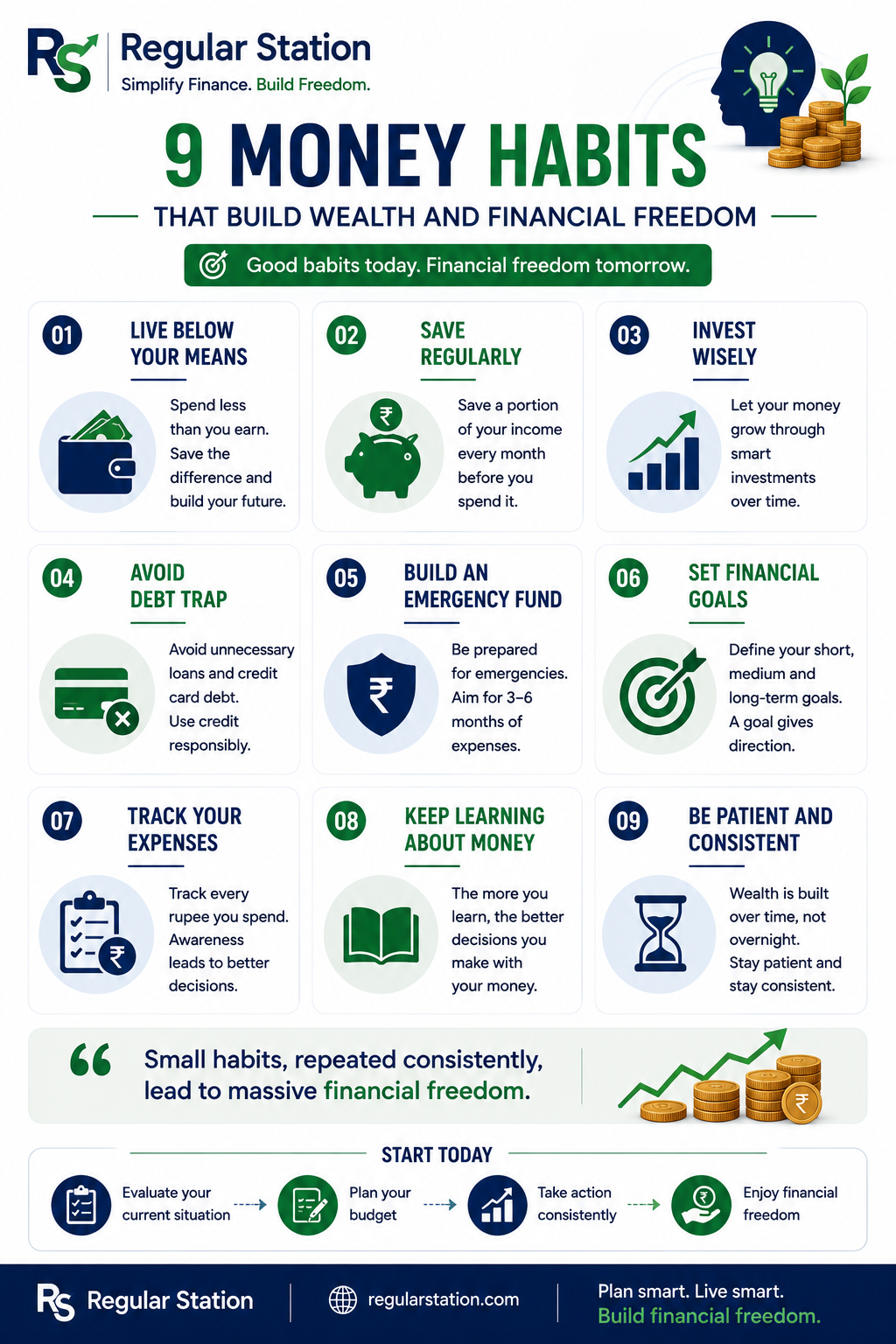
Saving money means setting aside a portion of your income today so you can achieve future goals, handle unexpected situations, and build long-term financial security.
Whether you’re saving for an emergency, a family vacation, a home down payment, your child’s education, or a major purchase, consistent saving gives you the flexibility to make financial decisions without depending heavily on loans or credit.
Saving is one of the simplest financial habits you can develop, yet it has one of the greatest long-term impacts on your financial well-being.
Saving money isn’t about earning a huge salary—it’s about building the right habits. Our detailed guide on How to Save Money Every Month shares 25 practical tips to reduce unnecessary expenses, improve budgeting, and create a sustainable monthly saving routine for Indian families.
Saving money becomes much more meaningful when you have a clear purpose. One of the first goals should be building an Emergency Fund Guide for Beginners in India to protect yourself against unexpected expenses like medical emergencies or job loss.
Why Saving Money Matters
Many people believe they’ll start saving after receiving a higher salary. In reality, successful saving begins with your current income—not your future income.
Every amount you save today gives your future self more financial choices.
Saving vs Investing
Saving and investing are both important, but they serve different purposes. For most beginners, the key is knowing when each approach is appropriate.
| Saving | Investing |
|---|---|
| Focuses on safety | Focuses on long-term growth |
| Lower risk | Risk varies by investment |
| Suitable for short-term goals | Suitable for long-term goals |
| Easily accessible | Value may fluctuate |
| Emergency Fund | Wealth Creation |
Benefits of Saving Money
🛡 Emergency Preparedness
Handle unexpected expenses without relying on loans or credit cards.
🏆 Financial Independence
Reduce dependence on borrowing and gain greater control over your finances.
🎯 Goal Achievement
Save confidently for vacations, education, a home, or other important milestones.
📈 Better Financial Discipline
Develop consistent money habits that support long-term financial success.
😊 Peace of Mind
Knowing you have money set aside helps reduce financial stress and uncertainty.
🚀 Future Investing
Strong saving habits create the foundation for successful long-term investing.
How Much Should You Save?
There isn’t a single savings percentage that works for everyone. A practical starting point is to save around 20% of your monthly income, if your financial situation allows.
If that isn’t possible, start with whatever you can comfortably manage—even 5% or 10%. Building the habit of saving consistently is more important than the amount you save in the beginning.
Seven Practical Ways to Save More
Saving money doesn’t require drastic lifestyle changes. Small, consistent habits can create meaningful financial results over time.
💰 1. Pay Yourself First
Transfer money to your savings account immediately after receiving your salary.
Save first. Spend later.
📊 2. Create a Monthly Budget
A budget helps you identify unnecessary spending and creates room for regular savings.
Budgeting and saving always work together.
🎯 3. Set Specific Savings Goals
Instead of saying:
“I want to save money.”
Create a measurable goal such as:
Save ₹1,20,000 for an emergency fund within 12 months.
📈 4. Reduce Lifestyle Inflation
As your income increases, avoid increasing your spending at the same pace.
Increase your savings before upgrading your lifestyle.
⚙️ 5. Automate Your Savings
Schedule an automatic transfer to your savings or investment account on every payday.
Automation removes the temptation to spend first.
📅 6. Review Your Expenses Regularly
Review subscriptions, food delivery, online shopping, and other recurring expenses every month.
Small recurring expenses often reduce your savings more than you realize.
🚀 7. Increase Your Income
Saving isn’t only about spending less.
You can also improve your financial position by increasing your income through:
- Learning new skills
- Freelancing
- Part-time work
- Starting a small business
- Negotiating a salary increase
Where Should You Keep Your Savings?
Different financial goals require different places to keep your money. Rather than choosing the highest advertised return, select an option that matches your goal, time horizon, and need for easy access.
| Financial Goal | Suitable Option | Why It Works |
|---|---|---|
| Emergency Fund | Savings Account / Liquid Fund | Easy access during emergencies. |
| Vacation | Recurring Deposit (RD) | Suitable for short-term planned savings. |
| Home Down Payment | Short-term investments based on timeline | Matches medium-term financial goals. |
| Child’s Education | Goal-based Investment Plan | Supports long-term education planning. |
| Retirement | Long-term Retirement Investments | Allows wealth to grow over many years. |
Monthly Savings Example
The example below shows how savings and investments can become part of a healthy monthly budget.
Monthly Income Dashboard
Monthly Income: ₹70,000
| Category | Monthly Amount | % of Income |
|---|---|---|
| Essential Expenses | ₹35,000 | 50% |
| Lifestyle Expenses | ₹14,000 | 20% |
| Savings | ₹11,000 | 16% |
| Investments | ₹10,000 | 14% |
Common Challenges While Saving
Everyone faces obstacles while building savings. The important thing is to recognize these challenges early and develop habits to overcome them.
📈 Rising Living Costs
Review your budget regularly and adjust discretionary spending before reducing your savings.
🚑 Unexpected Expenses
An emergency fund helps prevent temporary setbacks from becoming long-term financial problems.
🛒 Impulse Spending
Pause before making non-essential purchases. Giving yourself time can reduce unnecessary spending.
💼 Irregular Income
Save more during high-income months to create stability during lower-income periods.
📝 Lack of Financial Planning
Without clear financial goals, saving often becomes inconsistent.
30-Day Savings Challenge
Complete one action each week to strengthen your saving habits.
| Week | Challenge |
|---|---|
| Week 1 | Track every expense. |
| Week 2 | Cancel one unnecessary subscription. |
| Week 3 | Increase your monthly savings by ₹500. |
| Week 4 | Automate your monthly savings. |
Goal: Build your first ₹5,000 in dedicated savings.
Savings Health Scorecard
Answer these questions honestly before moving to the next chapter.
| Question | Yes | No |
|---|---|---|
| I save money every month. | ☐ | ☐ |
| I save before I spend. | ☐ | ☐ |
| I have a specific savings goal. | ☐ | ☐ |
| My savings are automated. | ☐ | ☐ |
| I review my savings progress regularly. | ☐ | ☐ |
| I increase my savings whenever my income increases. | ☐ | ☐ |
My Savings Progress
| Financial Goal | ____________________________________ |
|---|---|
| Target Amount | ₹________________________ |
| Amount Saved So Far | ₹________________________ |
| Amount Remaining | ₹________________________ |
| Target Completion Date | ________________________ |
Review this tracker every month and update your progress. Small, consistent improvements are the foundation of long-term financial success.
Module takeaways
- Start saving with your current income, not your future income.
- Pay yourself first before spending.
- Saving and investing serve different purposes.
- Automate your savings to build consistency.
- Review and increase your savings rate as your income grows.
Module complete
You’ve completed the Saving Money module and learned how to build lasting saving habits.
- ✔ Understood why saving matters.
- ✔ Learned the difference between saving and investing.
- ✔ Explored seven practical saving strategies.
- ✔ Created a personal savings plan.
- ✔ Evaluated your current saving habits.
Next module
Saving money is the first step toward financial security. The next step is deciding how much of those savings should be reserved for life’s unexpected events.
In the next chapter, you’ll learn how to build an Emergency Fund, calculate how much you need, where to keep it, and when to use it.
Continue to: Emergency Fund →
Emergency Fund: Your Financial Safety Net
Build a financial cushion that protects you from life’s unexpected expenses without disrupting your long-term goals.
An emergency fund is money set aside specifically for unexpected situations. It provides financial breathing space, allowing you to handle life’s surprises without relying on loans, credit cards, or selling long-term investments.
You’ve already learned how to save money. Now it’s time to give those savings an important purpose.
Think of an emergency fund as your personal financial safety net. You hope you’ll never need it—but if life takes an unexpected turn, you’ll be grateful it’s there.
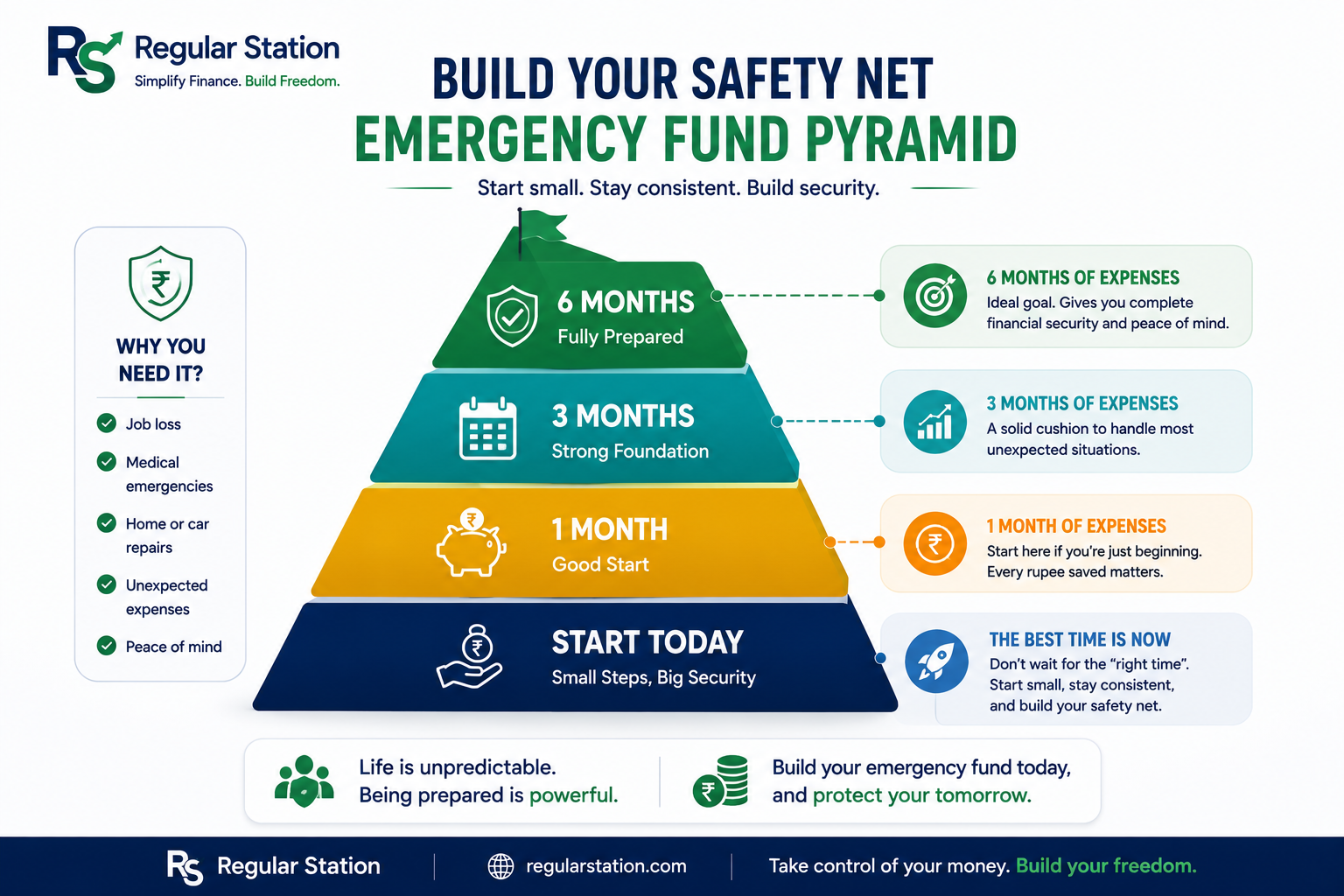
What Is an Emergency Fund?
An emergency fund is money reserved exclusively for genuine financial emergencies. It should remain separate from your everyday spending and long-term investments.
Examples of Genuine Emergencies
🏥 Medical Expenses
Unexpected treatment or hospitalization not fully covered by insurance.
💼 Job Loss
Temporary loss of income while searching for a new opportunity.
🏠 Essential Repairs
Urgent home or vehicle repairs that cannot be postponed.
👨👩👧 Family Emergencies
Critical situations requiring immediate financial support.
📉 Business Slowdown
Temporary income disruption for freelancers or self-employed professionals.
Why Every Family Needs an Emergency Fund
Life rarely goes exactly as planned. A stable income today doesn’t guarantee the same tomorrow. Without emergency savings, unexpected expenses often lead to borrowing, high-interest debt, or selling long-term investments at the wrong time.
Emergency Fund vs Regular Savings
Although both involve saving money, they serve very different purposes. Keeping them separate ensures your emergency fund remains available when you truly need it.
| Emergency Fund | Regular Savings |
|---|---|
| For unexpected situations | For planned expenses |
| Used only during genuine emergencies | Used for vacations, gadgets, or planned purchases |
| Easily accessible | Used according to your goals |
| Financial protection | Goal achievement |
How Much Should You Save?
There is no single emergency fund amount that works for everyone. The right amount depends on your income stability, number of dependents, existing insurance coverage, and financial responsibilities.
As a general guideline, build your emergency fund based on your essential monthly expenses, not your total monthly income.
| Your Situation | Recommended Emergency Fund |
|---|---|
| 👤 Single with a stable income | 3 months of essential expenses |
| 👨👩👧 Married with dependents | 6 months of essential expenses |
| 💼 Self-employed or irregular income | 6–12 months of essential expenses |
Emergency Fund Calculation Example
Let’s calculate an emergency fund using Rahul’s monthly essential expenses.
| Essential Expense | Monthly Amount |
|---|---|
| 🏠 Rent | ₹15,000 |
| 🛒 Groceries | ₹8,000 |
| 💡 Utilities | ₹4,000 |
| 🚗 Transportation | ₹5,000 |
| 🛡️ Insurance Premiums | ₹3,000 |
| Total Essential Expenses | ₹35,000 |
📊 Emergency Fund Target
| Monthly Essential Expenses | ₹35,000 |
|---|---|
| Recommended Coverage | 6 Months |
| Total Emergency Fund Required | ₹2,10,000 |
Where Should You Keep Your Emergency Fund?
Your emergency fund should always be safe, easily accessible, and kept separate from your everyday spending account.
| Option | Why It’s Suitable |
|---|---|
| 🏦 Savings Account | Immediate access during emergencies. |
| 💳 Sweep-in Account | Provides liquidity while potentially earning better returns than a regular savings account. |
| 📈 Liquid Mutual Fund | May be suitable after understanding how it works and its liquidity. |
| 📅 Short-Term Deposits | Useful if funds remain reasonably accessible when required. |
How to Build an Emergency Fund
Building an emergency fund doesn’t happen overnight. The key is to start with a realistic goal and make steady progress through consistent monthly contributions.
Rather than trying to save the entire amount immediately, focus on reaching one milestone at a time. Small, regular contributions can grow into a strong financial safety net.
Calculate Essential Expenses
List only the expenses you must pay every month, such as housing, groceries, utilities, transportation, insurance, and other necessities.
Set Your Target
Multiply your essential monthly expenses by 3, 6, or 12 months, depending on your job stability and financial responsibilities.
Open a Separate Account
Keep your emergency fund separate from your everyday spending account to reduce the temptation to use it for non-essential purchases.
Automate Monthly Savings
Set up an automatic transfer immediately after your salary is credited so saving becomes effortless.
Increase Contributions
Whenever your income increases, gradually raise your monthly contribution until your emergency fund reaches its target.
When Should You Use Your Emergency Fund?
Your emergency fund should only be used for genuine financial emergencies—not for planned purchases or lifestyle expenses.
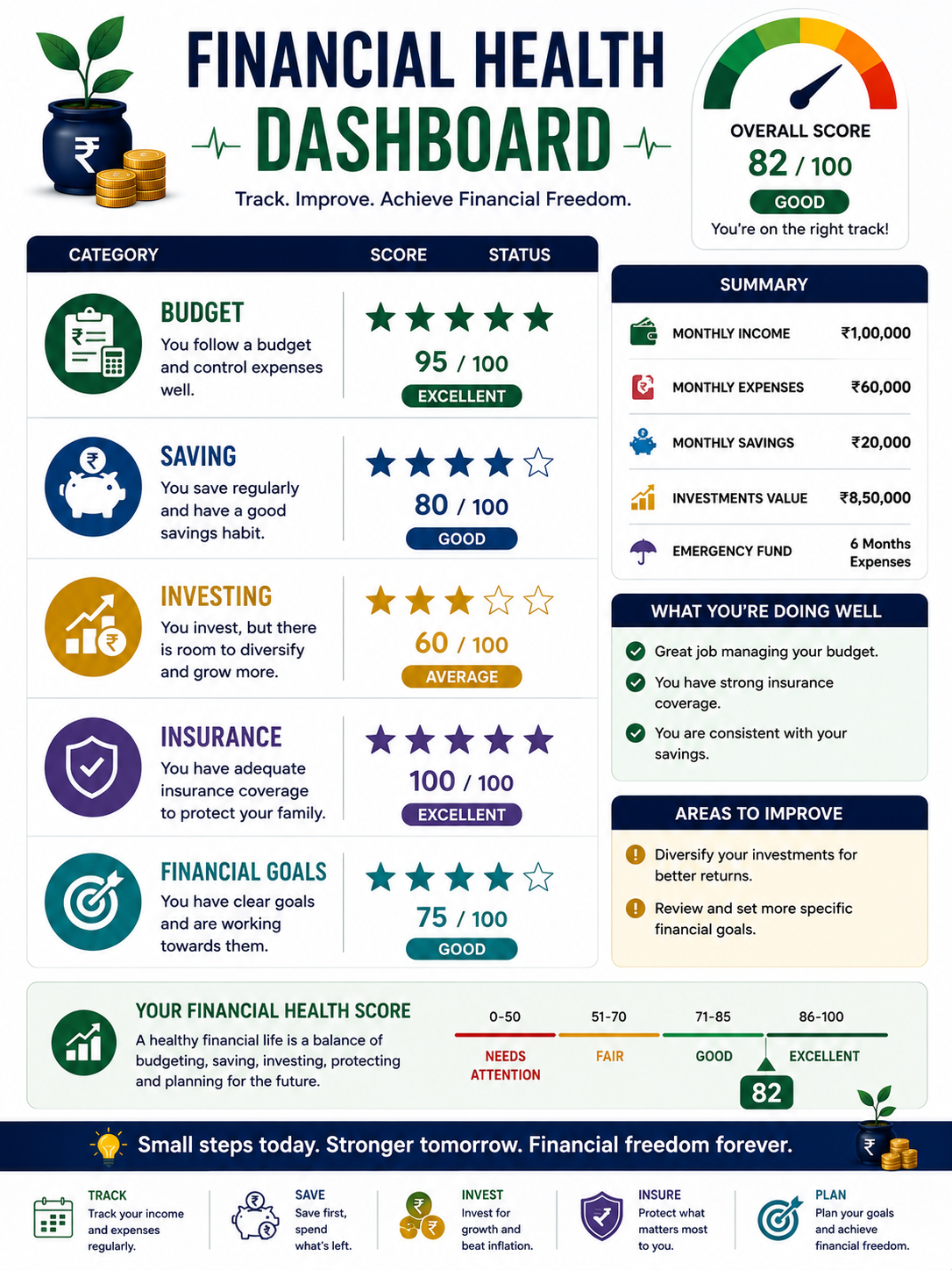
✅ Appropriate Uses
- Medical emergencies
- Temporary job loss
- Essential home repairs
- Critical vehicle repairs
- Urgent family emergencies
❌ Not Appropriate
- Vacations
- Festival shopping
- Latest gadgets
- Luxury purchases
- Home décor upgrades
Real-Life Example
📖 Priya’s Story
Priya earns ₹75,000 per month and has built an emergency fund equal to six months of her essential living expenses.
When her company restructures and she unexpectedly loses her job, she doesn’t panic. Instead of relying on credit cards or borrowing money, she uses her emergency fund to cover her essential expenses while searching for a new opportunity.
Because she planned ahead, Priya has the flexibility to find the right job rather than accepting the first offer out of financial pressure.
Emergency Fund Decision Guide
🚀 I Don’t Have an Emergency Fund
Make building one your highest financial priority before increasing your investments.
🛡 I Already Have 3–6 Months Saved
Maintain your emergency fund while continuing to invest toward your long-term financial goals.
📈 My Income Is Irregular
Consider building an emergency fund covering 6–12 months of essential expenses before taking additional investment risk.
Emergency Fund Readiness Scorecard
Check each statement that applies to you.
| Question | Yes | No |
|---|---|---|
| I know my monthly essential expenses. | ☐ | ☐ |
| I have a separate emergency fund account. | ☐ | ☐ |
| I contribute to my emergency fund every month. | ☐ | ☐ |
| I have at least three months of essential expenses saved. | ☐ | ☐ |
| I only use my emergency fund for genuine emergencies. | ☐ | ☐ |
| I review my emergency fund once a year. | ☐ | ☐ |
Emergency Fund Milestones
Building an emergency fund is a journey. Celebrate each milestone as you move closer to complete financial protection.
| Milestone | Status |
|---|---|
| 1 Month of Expenses Saved | ☐ |
| 2 Months of Expenses Saved | ☐ |
| 3 Months of Expenses Saved (Basic Protection) | ☐ |
| 4 Months of Expenses Saved | ☐ |
| 5 Months of Expenses Saved | ☐ |
| 6 Months of Expenses Saved (Recommended) | ☐ |
| 12 Months of Expenses Saved (Irregular Income) | ☐ |
Module summary
An emergency fund is the foundation of financial security. It helps you manage unexpected situations with confidence, avoid unnecessary debt, and protect your long-term financial goals.
You don’t need to build your emergency fund overnight. Start with one month’s essential expenses, contribute consistently, and increase your savings whenever your income grows. Every contribution strengthens your financial resilience.
Module takeaways
- Build your emergency fund before investing aggressively.
- Base your target on essential monthly expenses—not your income.
- Keep emergency savings safe, liquid, and separate from everyday spending.
- Use the fund only for genuine emergencies.
- Review and replenish your emergency fund after every use.
Module complete
You’ve learned how to build and maintain one of the strongest foundations of personal finance.
- ✔ Understood the purpose of an emergency fund.
- ✔ Calculated your target emergency fund.
- ✔ Learned where to keep emergency savings.
- ✔ Identified when to use the fund.
- ✔ Created your own emergency fund plan.
Next module
A strong emergency fund helps you avoid borrowing during difficult times. The next step is understanding how to use debt wisely—and how to prevent it from becoming a financial burden.
In the next chapter, you’ll learn the difference between good debt and bad debt, how credit works, and practical strategies for borrowing responsibly.
Managing Debt & Insurance
Debt and insurance shape how well a household can withstand disruption. Borrow only when repayments fit the budget, prioritise costly debt, and use suitable insurance to transfer risks that could otherwise derail savings and goals.
Understand the difference between good debt and bad debt, borrow responsibly, and protect your long-term financial future.
Debt is money you borrow today with the promise of repaying it in the future, usually with interest. Used wisely, debt can help you achieve important life goals. Used carelessly, it can become a long-term financial burden.
Not every financial goal can be achieved through savings alone. Buying a home, funding higher education, or expanding a business may require borrowing. The key is understanding when debt supports your financial future—and when it works against it.
Debt is a financial tool, not a financial strategy. Responsible borrowing creates opportunities. Irresponsible borrowing reduces financial freedom.
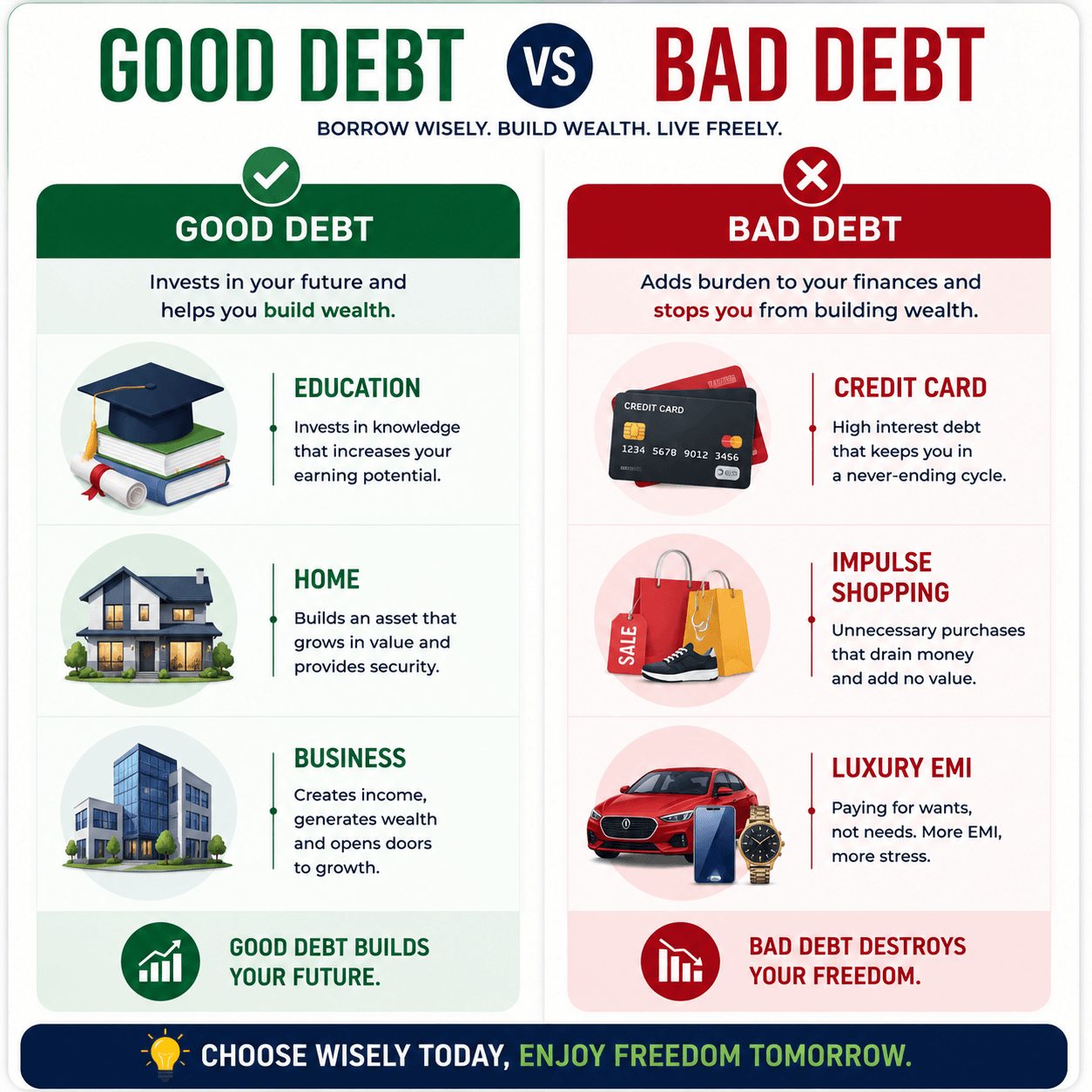
Good Debt vs Bad Debt
One of the biggest misconceptions in personal finance is that all debt is harmful. In reality, the impact of debt depends on why you’re borrowing and whether it creates long-term value.
| ✅ Good Debt | ❌ Bad Debt |
|---|---|
| 🎓 Education Loan | 💳 High-interest Credit Card Debt |
| 🏡 Home Loan | 🛍️ Impulse Shopping on EMI |
| 📈 Business Loan | 📱 Luxury Purchases on EMI |
| Creates future value and earning potential. | Usually finances depreciating assets or lifestyle spending. |
Before You Borrow
Before applying for any loan, pause and answer these three questions honestly.
Is All Debt Bad?
No. Borrowing can be a smart financial decision when it supports important goals and fits comfortably within your budget.
✅ Good Uses of Debt
- Buying a home
- Funding higher education
- Growing a business
- Purchasing productive assets
❌ Poor Uses of Debt
- Impulse shopping
- Luxury lifestyle upgrades
- Repeated credit card borrowing
- Buying things you can’t comfortably afford
“`
Common Types of Debt in India
Different loans are designed for different financial needs. Before borrowing, understand the purpose, repayment terms, interest costs, and whether the loan supports your long-term financial goals.
| Loan Type | Common Purpose | Things to Consider |
|---|---|---|
| 🏠 Home Loan | Purchase or construct a house | Long repayment period with relatively lower interest rates. |
| 🎓 Education Loan | Higher education | Investment in future earning potential. |
| 🚗 Vehicle Loan | Purchase a vehicle | Ensure the EMI comfortably fits your budget. |
| 💰 Personal Loan | General financial needs | Usually carries higher interest rates. |
| 🥇 Gold Loan | Short-term funding | Secured against pledged gold. |
| 🏢 Business Loan | Business expansion or working capital | Borrow only with a clear repayment plan. |
| 💳 Credit Card Outstanding | Short-term borrowing | High interest if dues aren’t paid in full. |
Understanding Your Credit Score
Your credit score is a numerical representation of your borrowing and repayment history. Lenders may use it, along with other factors, to evaluate your creditworthiness when you apply for loans or credit cards.
A healthy credit profile can improve your chances of qualifying for credit and may help you receive more favorable borrowing terms.
Build Healthy Credit Habits
✅ Pay EMIs on Time
Timely repayments help maintain a strong credit history and demonstrate responsible borrowing.
💳 Pay Credit Cards Before the Due Date
Paying your balance on time helps you avoid unnecessary interest charges and late payment fees.
🤝 Borrow Responsibly
Take loans only when they support genuine financial goals—not temporary lifestyle upgrades.
📋 Review Your Credit Report
Check your credit report periodically for errors, fraud, or outdated information.
How Much Debt Can You Afford?
There is no universal borrowing limit. The right amount of debt depends on your income, essential expenses, savings, and overall financial situation.
📊 Debt Affordability Checklist
- ✔ Can I comfortably afford the monthly EMI?
- ✔ Will I still be able to save and invest regularly?
- ✔ Do I already have an emergency fund?
- ✔ Will this loan help me achieve an important financial goal?
- ✔ Could I continue repayments if my income temporarily decreases?
Borrowing Decision Framework
Before signing any loan agreement, take a few minutes to answer these questions honestly.
| Question | If Your Answer Is “Yes” |
|---|---|
| Is this purchase necessary? | Proceed to the next question. |
| Can I comfortably afford the EMI? | Continue evaluating the loan. |
| Will this debt create future value? | The loan may support your long-term financial goals. |
| Do I have a realistic repayment plan? | You’re making a more informed borrowing decision. |
A 5-Step Debt Repayment Plan
Paying off debt becomes much easier when you follow a structured plan instead of making random repayments. Focus on consistency rather than trying to eliminate every loan at once.
List Every Debt
Write down every loan, credit card balance, and outstanding amount you currently owe.
Record the Details
For each loan, note the outstanding balance, interest rate, monthly EMI, and remaining repayment period.
Pay Every EMI on Time
Continue paying at least the required EMI or minimum due on every loan to avoid penalties and protect your credit history.
Focus Extra Payments on One Loan
Direct any extra money toward one loan while continuing minimum payments on the others.
Avoid New Debt
Delay unnecessary borrowing until your existing high-interest debt has been significantly reduced or repaid.
Debt Snowball vs Debt Avalanche
Two popular repayment strategies can help you become debt-free. Neither approach is universally better—the right choice depends on what keeps you motivated.
| 🏆 Debt Snowball | 📉 Debt Avalanche |
|---|---|
| Repay the smallest balance first. | Repay the highest-interest debt first. |
| Provides quick psychological wins. | Reduces the total interest paid. |
| Builds motivation and momentum. | Improves long-term cost efficiency. |
| Ideal if you need encouragement. | Ideal if your priority is minimizing borrowing costs. |
How to Avoid Debt Traps
Most debt problems develop gradually rather than overnight. These practical habits can help you avoid unnecessary financial stress.
💰 Live Within Your Means
Avoid spending more than you earn and prioritize essential expenses.
🛡 Build an Emergency Fund
Emergency savings reduce the need to borrow during unexpected situations.
⏳ Avoid Impulse Borrowing
Give yourself time before financing non-essential purchases.
💳 Use Credit Cards Responsibly
Pay your balance in full whenever possible and avoid carrying expensive debt.
🔍 Compare Loan Options
Review interest rates, fees, repayment terms, and total borrowing costs before signing.
🎯 Borrow Only for Genuine Needs
Use debt to build your future—not to fund temporary lifestyle upgrades.
Real-Life Example
📖 Amit’s Debt Management Plan
Amit earns ₹80,000 per month and has three major financial commitments:
| Debt | Monthly Amount |
|---|---|
| 🏠 Home Loan EMI | ₹22,000 |
| 🚗 Car Loan EMI | ₹8,000 |
| 💳 Credit Card Outstanding | ₹45,000 |
Instead of taking another personal loan, Amit reduced unnecessary spending, continued paying every EMI on time, and directed every extra rupee toward clearing his high-interest credit card balance first.
Within a year, he eliminated his expensive credit card debt while maintaining an excellent repayment record and continuing his home and vehicle loan payments without interruption.
Key Lesson
Debt becomes easier to manage when you borrow responsibly, make repayments consistently, and prioritize eliminating high-interest debt before taking on new financial commitments.
📝 Create Your Debt Repayment Plan
List every loan and credit card balance below. Seeing your complete debt picture is the first step toward becoming debt-free.
| Loan / Debt | Outstanding | Interest Rate | Monthly EMI | Priority |
|---|---|---|---|---|
| ________________ | ₹________ | ______% | ₹________ | 🔴 High / 🟡 Medium / 🟢 Low |
| ________________ | ₹________ | ______% | ₹________ | 🔴 High / 🟡 Medium / 🟢 Low |
| ________________ | ₹________ | ______% | ₹________ | 🔴 High / 🟡 Medium / 🟢 Low |
| ________________ | ₹________ | ______% | ₹________ | 🔴 High / 🟡 Medium / 🟢 Low |
📋 Debt Health Scorecard
Evaluate your current borrowing habits.
| Question | Yes | No |
|---|---|---|
| I know every loan and EMI I currently have. | ☐ | ☐ |
| I pay every EMI before the due date. | ☐ | ☐ |
| I pay my credit card balance in full whenever possible. | ☐ | ☐ |
| I avoid unnecessary borrowing. | ☐ | ☐ |
| I have a repayment strategy for my debt. | ☐ | ☐ |
| I review my loans regularly. | ☐ | ☐ |
📊 My Debt Repayment Dashboard
| Total Outstanding Debt | ₹____________________ |
|---|---|
| Total Monthly EMI | ₹____________________ |
| Highest Interest Debt | ______________________ |
| Target Debt to Repay First | ______________________ |
| Target Debt-Free Date | ______________________ |
💡 Review your repayment progress every month. As one loan is repaid, redirect that EMI toward your next priority debt to accelerate your journey toward becoming debt-free.
📖 Chapter Summary
Debt is neither good nor bad on its own—it depends on how you use it. Borrowing responsibly, understanding repayment obligations, and avoiding unnecessary debt can help you achieve important financial goals without compromising your long-term financial health.
The best debt management strategy is one that fits comfortably within your budget, supports your financial goals, and is followed consistently until every loan is repaid.
🎯 Key Takeaways
- Understand the difference between good debt and bad debt.
- Borrow only for meaningful financial goals.
- Pay every EMI and credit card bill on time.
- Choose a structured repayment strategy and stay consistent.
- Avoid borrowing for unnecessary lifestyle expenses.
Module complete
You’ve completed the Debt Management module and learned how to borrow responsibly while protecting your financial future.
- ✔ Understood different types of debt.
- ✔ Learned the difference between good and bad debt.
- ✔ Built a debt repayment strategy.
- ✔ Identified healthy borrowing habits.
- ✔ Created your own debt repayment plan.
Next module
Managing debt helps protect your financial health, but unexpected events can still affect your finances. The next step is learning how insurance protects your income, your family, and the wealth you’re working hard to build.
In the next chapter, you’ll understand the different types of insurance, how much coverage you may need, and how to choose policies that match your financial goals.
Insurance: Protecting Yourself, Your Family & Your Financial Future
Insurance is your financial safety net. It protects your savings, investments, and loved ones from unexpected financial shocks. Its purpose isn’t to create wealth—it’s to protect the wealth you’re working hard to build.

Insurance in Simple Words
By paying a small premium regularly, you transfer part of your financial risk to an insurance company. If a covered event occurs—such as hospitalization, an accident, or death—the insurer provides financial support according to your policy terms.
Why Insurance Is Important
Imagine spending years building your savings and investments, only to face an unexpected medical emergency costing several lakh rupees.
Without adequate insurance, your financial plan could be disrupted almost overnight.
Use Your Emergency Fund
Savings meant for genuine emergencies may be exhausted much sooner than expected.
Sell Investments
You may be forced to withdraw long-term investments before they’ve had time to grow.
Borrow Money
Loans and credit cards can add unnecessary financial stress during an already difficult period.
Delay Financial Goals
Home ownership, retirement planning, or your children’s education could all be postponed.
Insurance vs Investment
One of the biggest misconceptions in personal finance is treating insurance as an investment. Although both are important, they serve very different purposes.
| Insurance | Investment |
|---|---|
| 🛡️ Protects against financial risk | 📈 Helps grow wealth |
| Provides financial security | Supports long-term financial goals |
| Premium is paid for protection | Money is invested for potential returns |
| Focuses on risk management | Focuses on wealth creation |
📘 Key Message
Insurance isn’t about expecting something bad to happen. It’s about ensuring that if life becomes unpredictable, your family’s financial future doesn’t have to.
Types of Insurance
Different insurance policies protect against different financial risks. You don’t need every type immediately, but understanding their purpose helps you build the right protection as your life and responsibilities evolve.
Health Insurance
Helps cover eligible medical expenses such as hospitalization, surgeries, and specified treatments, subject to policy terms and conditions.
Why It Matters
- Protects against rising medical costs.
- Preserves your emergency fund.
- Provides financial support during health emergencies.
Best For
- Individuals
- Families
- Senior Citizens
Term Life Insurance
Provides financial support to your nominee if you pass away during the policy term, subject to policy conditions.
Why It Matters
- Protects your family’s future.
- Helps replace lost income.
- Supports long-term family goals.
Best For
- Parents
- Married Individuals
- Anyone with Financial Dependents
Motor Insurance
Helps protect against financial losses caused by accidents, theft, or vehicle damage, depending on your policy.
Why It Matters
- Reduces repair costs.
- May include third-party liability cover.
- Mandatory for vehicles on Indian public roads.
Best For
- Car Owners
- Bike Owners
Home Insurance
Helps protect your house and belongings against specified risks such as fire, theft, or certain natural disasters.
Why It Matters
- Protects valuable assets.
- Reduces financial loss after covered events.
- Provides peace of mind.
Best For
- Homeowners
- Property Owners
Personal Accident Insurance
Provides financial support for accidental death or specified accidental disabilities according to the policy terms.
Why It Matters
- Additional financial protection.
- Complements health insurance.
- Helps replace income after serious accidents.
Best For
- Salaried Employees
- Self-Employed Professionals
- Business Owners
Travel Insurance
Helps cover specified travel-related risks such as medical emergencies, trip cancellations, delays, or lost baggage.
Why It Matters
- Protects against travel disruptions.
- May cover overseas medical emergencies.
- Reduces unexpected travel expenses.
Best For
- Domestic Travellers
- International Travellers
- Frequent Business Travellers
Insurance Priority by Life Stage
Your insurance needs change as your responsibilities grow. Start with the most essential protection and expand your coverage as your life evolves.
| Life Stage | Recommended Insurance Priority |
|---|---|
| 🎓 Starting Your Career | Health Insurance |
| 💍 Married with Dependents | Health Insurance + Term Life Insurance |
| 🚗 Own a Vehicle | Motor Insurance |
| 🏠 Own a House | Consider Home Insurance |
| ✈️ Frequent Traveller | Travel Insurance |
Which Insurance Should You Buy First?
There is no single insurance plan that’s right for everyone. The coverage you need depends on your age, income, family responsibilities, assets, and financial commitments.
Start by protecting the financial risks that could have the greatest impact on your life today. As your responsibilities grow, your insurance coverage should grow with them.
| Your Situation | Recommended Priority |
|---|---|
| 🎓 Starting Your Career | Health Insurance |
| 👨👩👧 Married with Dependents | Health Insurance + Term Life Insurance |
| 🚗 Own a Vehicle | Motor Insurance |
| ✈️ Frequent Traveller | Travel Insurance |
| 🏠 Own a House | Consider Home Insurance |
How Much Insurance Do You Need?
There is no one-size-fits-all answer. The right amount of insurance depends on your financial situation and the people who rely on you financially.
Before choosing any policy, consider the following factors.
Family Responsibilities
Do your spouse, children, or parents depend on your income?
Outstanding Loans
Home loans and other liabilities may increase your protection needs.
Monthly Expenses
Estimate how much your family would require to maintain their lifestyle.
Existing Savings
Emergency funds and investments influence your insurance requirements.
Income
Higher income usually brings greater financial responsibilities and protection needs.
Future Goals
Consider children’s education, retirement, and other long-term commitments.
Real-Life Example
👩 Neha’s Financial Protection Plan
Neha is 32 years old, married, and has one child.
Instead of buying multiple complicated policies, she focuses on essential protection.
- ✔ Family Health Insurance
- ✔ Term Life Insurance
- ✔ Motor Insurance
When her husband requires emergency hospitalization, their health insurance helps cover eligible medical expenses according to the policy terms.
Because they planned ahead, their emergency fund remains largely intact, allowing them to continue saving for their child’s education and retirement without major disruption.
Insurance Decision Guide
Not sure where to begin? Use this quick guide to identify your next insurance priority.
I’m Single & Just Started Earning
Start by understanding your health insurance options and ensuring you have appropriate medical coverage.
I Have Dependents
Health Insurance and Term Life Insurance should usually become your highest priorities.
I Own a Vehicle
Keep your motor insurance active and review the coverage whenever you renew it.
I Travel Frequently
Travel insurance may provide valuable protection, particularly for international trips.
🛡️ Protection First
Insurance forms the foundation of financial security. By protecting yourself and your family from major financial risks first, you give your savings and investments a much better chance to grow over the long term.
Insurance Buying Checklist
Before purchasing any insurance policy, take a few minutes to evaluate it carefully. The right policy isn’t necessarily the cheapest—it’s the one that provides suitable protection for your needs.
Before You Buy, Ask Yourself
- ☐ Do I understand what the policy covers?
- ☐ Have I checked the exclusions?
- ☐ Is there a waiting period?
- ☐ Do I understand the claim process?
- ☐ Is the sum insured adequate?
- ☐ Have I compared multiple policies?
- ☐ Have I read the complete policy document?
Review Your Insurance Protection
Use this worksheet to review your current insurance coverage and identify any protection gaps.
| Insurance Type | Current Status | Renewal Date | Review Needed |
|---|---|---|---|
| 🏥 Health Insurance | ____________ | ____________ | ☐ |
| ❤️ Term Insurance | ____________ | ____________ | ☐ |
| 🚗 Motor Insurance | ____________ | ____________ | ☐ |
| 🏠 Home Insurance | ____________ | ____________ | ☐ |
| 🩹 Personal Accident | ____________ | ____________ | ☐ |
| ✈️ Travel Insurance | ____________ | ____________ | ☐ |
Insurance Health Scorecard
Evaluate how well you’re financially protected today.
| Question | Yes | No |
|---|---|---|
| I have health insurance. | ☐ | ☐ |
| My family is financially protected. | ☐ | ☐ |
| I review my insurance every year. | ☐ | ☐ |
| I understand what my policies cover. | ☐ | ☐ |
| I know the exclusions. | ☐ | ☐ |
| My insurance matches my current life stage. | ☐ | ☐ |
My Protection Dashboard
| 🏥 Health Insurance | ☐ Active |
|---|---|
| ❤️ Term Insurance | ☐ Active |
| 🚗 Motor Insurance | ☐ Active |
| 🏠 Home Insurance | ☐ Active |
| 🩹 Personal Accident Cover | ☐ Active |
| ✈️ Travel Insurance | ☐ Active |
| 📅 Next Annual Review | ______________________ |
Review your insurance after major life events such as marriage, the birth of a child, buying a home, changing jobs, or a significant increase in income.
Module summary
Insurance is a cornerstone of sound personal finance because it protects your income, savings, and long-term financial goals from unexpected events. The right protection depends on your life stage, responsibilities, and financial situation.
Before focusing on wealth creation, build a strong layer of financial protection. Good insurance planning helps you recover financially from unexpected setbacks without sacrificing your long-term goals.
Module takeaways
- ✔ Insurance protects wealth—it isn’t designed to create wealth.
- ✔ Health insurance is usually the first priority.
- ✔ Consider term insurance if others depend on your income.
- ✔ Review your insurance whenever your life changes.
- ✔ Always understand the policy before purchasing it.
Module complete
Congratulations! You’ve completed the Insurance module and now understand how to protect yourself, your family, and your financial future.
- ✔ Understood the purpose of insurance.
- ✔ Learned the difference between insurance and investing.
- ✔ Explored major types of insurance.
- ✔ Identified which policies to prioritize.
- ✔ Reviewed your own insurance coverage.
Next module
Now that you’ve built a strong financial safety net, it’s time to focus on growing your wealth.
In the next chapter, you’ll learn the fundamentals of investing, understand different asset classes, evaluate your risk tolerance, and discover how disciplined long-term investing can help you achieve financial independence.
Continue to: Investing Basics →
Investing & Wealth Creation
Investing puts money to work for goals that are years away, accepting measured risk in return for potential growth. Begin only after cash flow, emergency savings and essential protection are in place; choose investments that match the goal horizon and your ability to stay invested.
Investing means putting your money into assets that have the potential to grow in value over time. While saving protects your money for short-term needs, investing helps build wealth for long-term financial goals.
By now you’ve built a strong financial foundation through budgeting, saving, building an emergency fund, managing debt, and protecting yourself with insurance. Now it’s time to make your money work for you.
Successful investing is usually based on patience, consistency, and long-term thinking—not on predicting short-term market movements.
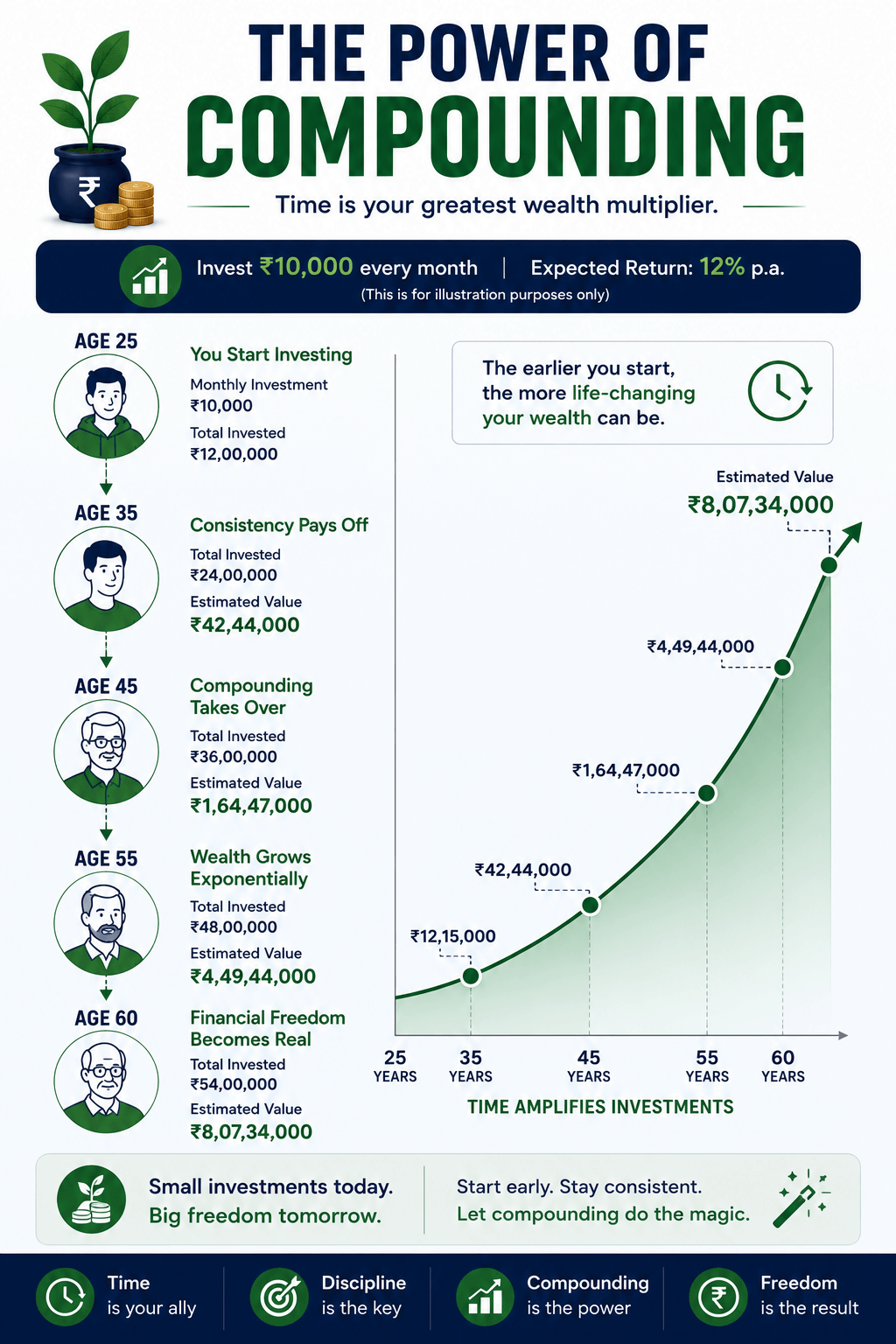
What Is Investing?
Investing means purchasing assets that may increase in value or generate income over time. Depending on the investment, returns may come through price appreciation, interest, dividends, or other forms of income.
Unlike savings, investments involve varying levels of risk. Their value can rise or fall, especially over shorter periods.
Saving vs Investing
Saving and investing work together. They have different purposes, but both are essential for long-term financial success.
| 🛡 Saving | 📈 Investing |
|---|---|
| Protects your money | Helps your money grow |
| Suitable for short-term needs | Suitable for long-term goals |
| Lower risk | Risk varies by investment |
| Easily accessible | Usually requires staying invested longer |
| Emergency Fund | Wealth Creation |
Why Investing Is Important
Simply saving money may not always be enough to achieve long-term financial goals, especially as prices change over time. Investing gives your money the opportunity to grow beyond what saving alone may achieve.
💰 Build Wealth
Grow your money gradually over the long term.
🏖 Plan for Retirement
Create income for the years after you stop working.
🎯 Fund Major Goals
Support goals such as buying a home or funding higher education.
📈 Beat Inflation
Help preserve your purchasing power over long periods.
🚀 Achieve Financial Independence
Build assets that support your future lifestyle.
The Power of Compounding
One of the greatest advantages of investing early is compounding.
Compounding means earning returns not only on your original investment but also on the returns that accumulate over time.
Why Compounding Works
- ✔ Start investing as early as possible.
- ✔ Stay invested for the long term.
- ✔ Invest consistently.
- ✔ Allow time to work in your favour.
Illustrative Example
Rahul starts investing ₹5,000 per month at age 25.
Amit starts investing the same amount at age 35.
Although Rahul contributes for only ten additional years, his investments have more time to benefit from compounding. Over the long term, this extra time can make a significant difference.
Understanding Risk and Return
Every investment carries some level of risk. Generally, investments with the potential for higher returns also experience greater price fluctuations, while lower-risk investments typically offer more modest returns.
There is no perfect investment that offers both high returns and zero risk. The goal is to choose investments that match your financial goals, investment horizon, and comfort with market fluctuations.
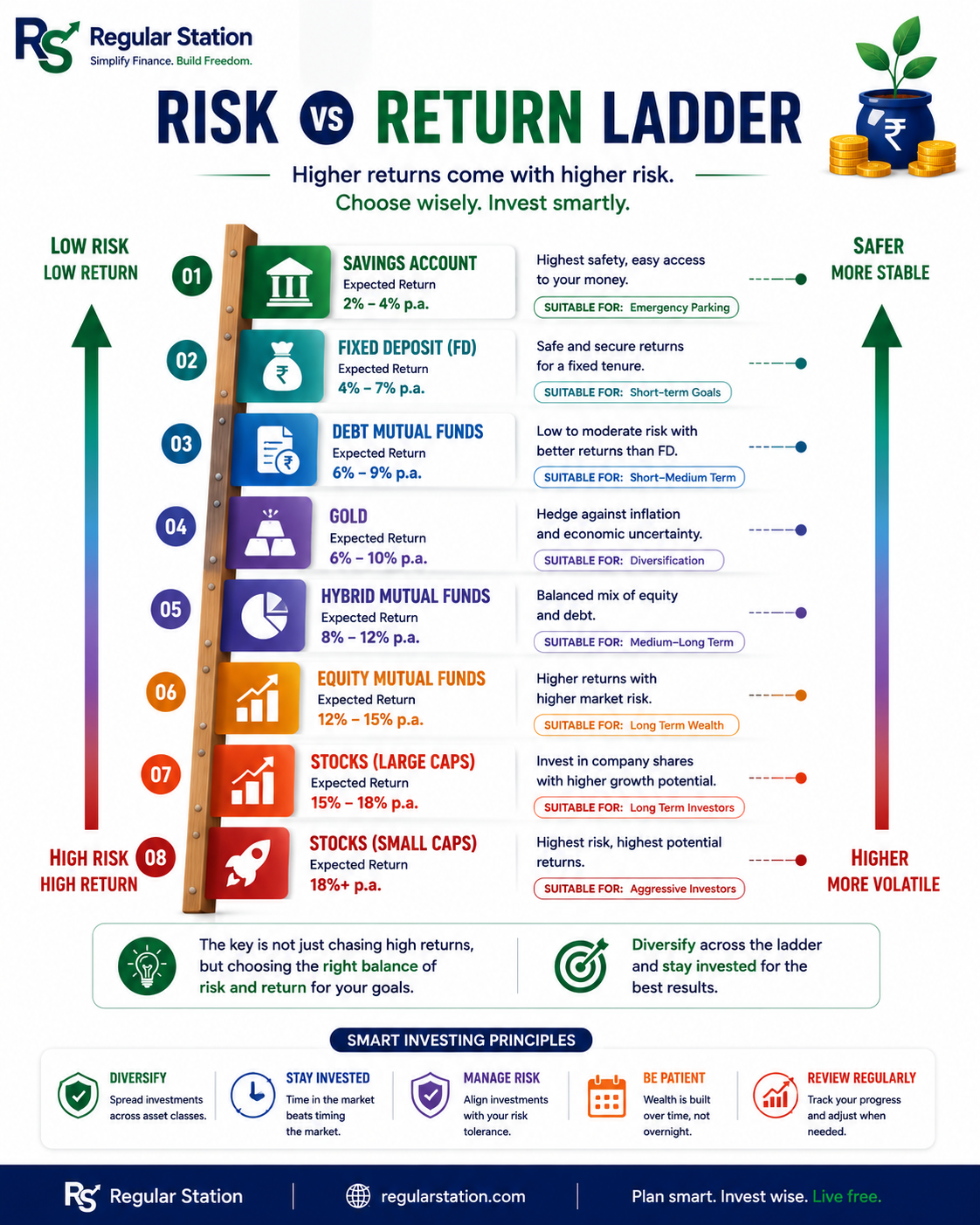
🟢 Lower Risk
Suitable for preserving capital and short-term financial goals. These investments generally experience smaller fluctuations but may offer lower long-term growth.
🟡 Moderate Risk
A balanced option for investors seeking a combination of stability and long-term growth.
🔴 Higher Risk
May offer greater long-term growth potential but usually involves larger short-term market movements.
Common Investment Options in India
Different investment products serve different purposes. Understanding their characteristics helps you choose investments that align with your financial goals.
| Investment | Risk Level | Generally Suitable For |
|---|---|---|
| Savings Account | Very Low | Emergency money and short-term liquidity |
| Fixed Deposit (FD) | Low | Capital preservation |
| Public Provident Fund (PPF) | Low | Long-term savings |
| Gold | Moderate | Diversification |
| Mutual Funds | Varies | Long-term investing |
| Stocks | Higher | Long-term investors willing to accept higher volatility |
| National Pension System (NPS) | Moderate | Retirement planning |
| Bonds | Low to Moderate | Income generation and diversification |
How to Choose the Right Investment
Before investing your money, answer these important questions.
Investment Readiness Checklist
- ☐ What financial goal am I investing for?
- ☐ When will I need this money?
- ☐ How much market risk am I comfortable accepting?
- ☐ Do I already have an emergency fund?
- ☐ Am I adequately insured?
- ☐ Can I stay invested during market ups and downs?
Investment Decision Framework
Use this simple framework before making any investment decision.
| Question | If Your Answer Is “Yes” |
|---|---|
| Do I understand this investment? | Continue evaluating it. |
| Does it match my financial goal? | Move to the next question. |
| Am I comfortable with the risks? | Consider whether it fits your portfolio. |
| Can I stay invested for the required time? | You may be ready to invest. |
Key Takeaway
Good investing is about choosing investments that align with your goals, time horizon, and risk tolerance—not chasing the highest recent returns.
Asset Allocation: Don’t Put All Your Eggs in One Basket
One of the most important principles of investing is diversification. Instead of putting all your money into a single investment, many investors spread their money across different asset classes. This approach is known as asset allocation.
Diversification can help reduce the impact of poor performance in any one investment. While it doesn’t eliminate risk, it helps create a more balanced investment portfolio.
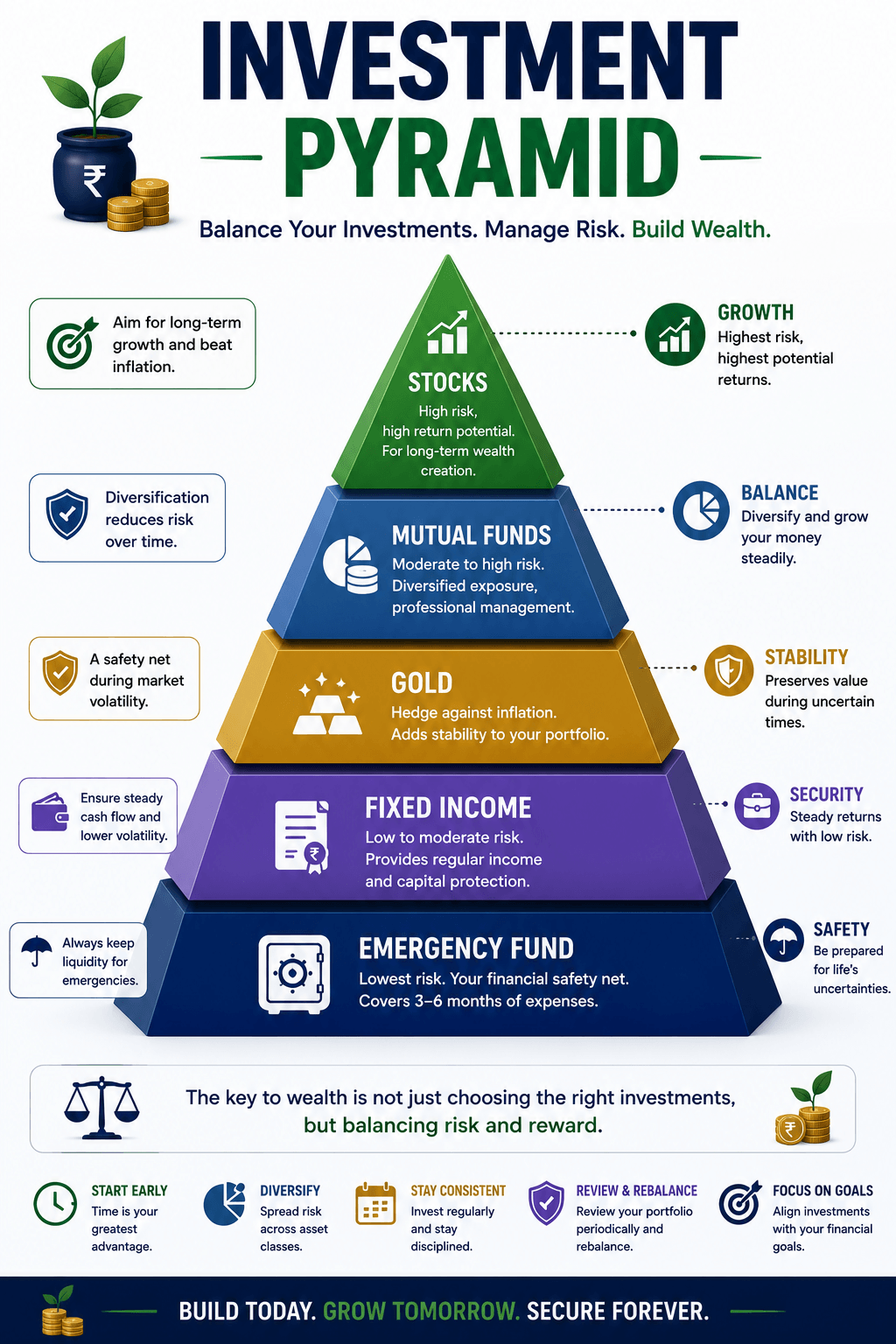
| Asset Class | Illustrative Allocation |
|---|---|
| Equity Mutual Funds | 50% |
| Fixed Income | 25% |
| Public Provident Fund (PPF) | 15% |
| Gold | 10% |
Beginner Investment Roadmap
Successful investing begins long before purchasing your first investment. Follow these steps to build a strong investing foundation.
Step 1
Create a Budget
Know exactly how much you can invest every month after covering essential expenses.
Step 2
Build an Emergency Fund
Create financial security before exposing your money to investment risk.
Step 3
Buy Essential Insurance
Protect yourself and your family before focusing on wealth creation.
Step 4
Set Financial Goals
Invest with a clear purpose rather than simply chasing returns.
Step 5
Learn Before You Invest
Understand how each investment works, including its risks, costs, and expected investment horizon.
Step 6
Start Investing
Begin with investments that align with your financial goals and risk tolerance.
Step 7
Invest Consistently
Regular investing often matters more than trying to predict market movements.
Step 8
Review Periodically
Review your portfolio once or twice a year and adjust it only when your goals or circumstances change.
Illustrative Example
Meera’s Investment Journey
Meera is 27 years old and earns ₹70,000 per month.
Before investing, she has already:
- ✔ Created a monthly budget.
- ✔ Built a six-month emergency fund.
- ✔ Purchased health insurance.
- ✔ Cleared all high-interest debt.
Now she begins investing ₹10,000 every month toward her long-term financial goals.
Rather than trying to predict short-term market movements, Meera invests consistently every month and reviews her investment plan annually.
Common Investing Mistakes
Even experienced investors make mistakes. Being aware of common pitfalls can help you make better long-term decisions.
Starting Too Early
Investing before building an emergency fund can force you to sell investments during emergencies.
Following Social Media Tips
Always understand an investment before investing. Avoid decisions based solely on influencers or online discussions.
Trying to Time the Market
Consistent investing is usually more effective than attempting to predict short-term market movements.
Investing Without Goals
Every investment should support a clearly defined financial objective.
Lack of Diversification
Concentrating all your money in one investment increases risk.
Emotional Decisions
Avoid panic selling during market declines or chasing investments after rapid price increases.
Investment Decision Guide
Use this simple guide to determine whether you’re ready to begin investing.
🚫 I Don’t Have an Emergency Fund
Make building an emergency fund your first priority before increasing your investments.
💳 I Have High-Interest Debt
Focus on repaying expensive debt before investing aggressively.
✅ I Have Emergency Savings & Insurance
You’re in a stronger position to begin long-term investing based on your financial goals.
📚 I Don’t Understand an Investment
Take time to learn how the investment works before putting your money into it.
Am I Ready to Invest?
Check each statement honestly.
- ☐ I follow a monthly budget.
- ☐ I have a 3–6 month emergency fund.
- ☐ I have adequate health insurance.
- ☐ I have no high-interest debt.
- ☐ I know my financial goals.
- ☐ I understand the investments I’m choosing.
- ☐ I can stay invested for the long term.
Create Your Investment Plan
Complete this worksheet before making your first investment.
| Financial Goal | ________________________ |
|---|---|
| Target Amount | ₹______________________ |
| Target Year | ________________________ |
| Monthly Investment | ₹______________________ |
| Investment Time Horizon | ________________________ |
| Risk Comfort Level | Low / Moderate / High |
| Review Date | ________________________ |
Investment Health Dashboard
| Question | Yes | No |
|---|---|---|
| I invest regularly. | ☐ | ☐ |
| I know why I’m investing. | ☐ | ☐ |
| My investments match my goals. | ☐ | ☐ |
| My portfolio is diversified. | ☐ | ☐ |
| I review my portfolio at least once a year. | ☐ | ☐ |
| I avoid emotional investing. | ☐ | ☐ |
Module summary
Investing is one of the most effective ways to build long-term wealth, but it works best when supported by a strong financial foundation. Before investing, create a budget, build an emergency fund, manage debt responsibly, and protect yourself with insurance.
Focus on your financial goals, diversify appropriately, invest consistently, and give your money time to grow. Successful investing is built on discipline and patience—not on chasing quick profits.
Module takeaways
- Invest only after building a strong financial foundation.
- Start early to benefit from the power of compounding.
- Diversify your investments to help manage risk.
- Invest consistently instead of trying to time the market.
- Review your portfolio periodically—not every day.
- Stay focused on long-term goals rather than short-term market movements.
Module complete
You’ve completed the Investing module and learned the core principles of long-term wealth creation.
- ✔ Understood the difference between saving and investing.
- ✔ Learned how compounding builds wealth.
- ✔ Explored common investment options.
- ✔ Understood diversification and asset allocation.
- ✔ Created your own investment plan.
Next module
Investing helps your money grow, but every investment should support a long-term purpose.
The next chapter focuses on retirement planning—how to calculate your retirement needs, choose suitable retirement investments, and build financial independence for life after work.
Continue to: Retirement Planning →
Retirement Planning
Retirement planning estimates the income your future self will need and builds a disciplined path toward it. Starting early allows smaller, consistent contributions to benefit from compounding, while regular reviews keep the plan aligned with inflation, life changes and risk tolerance.
Retirement planning is the process of preparing financially for the time when you stop working full-time or choose to work less. It helps you build enough savings and investments so you can maintain your lifestyle without depending entirely on your salary.
If investing helps your money grow, retirement planning gives that growth a long-term purpose. It focuses on replacing your future income so you can enjoy financial independence throughout retirement.
Retirement isn’t simply about reaching a certain age. It’s about having the financial freedom to live comfortably through your savings, investments, pensions, and other income sources.
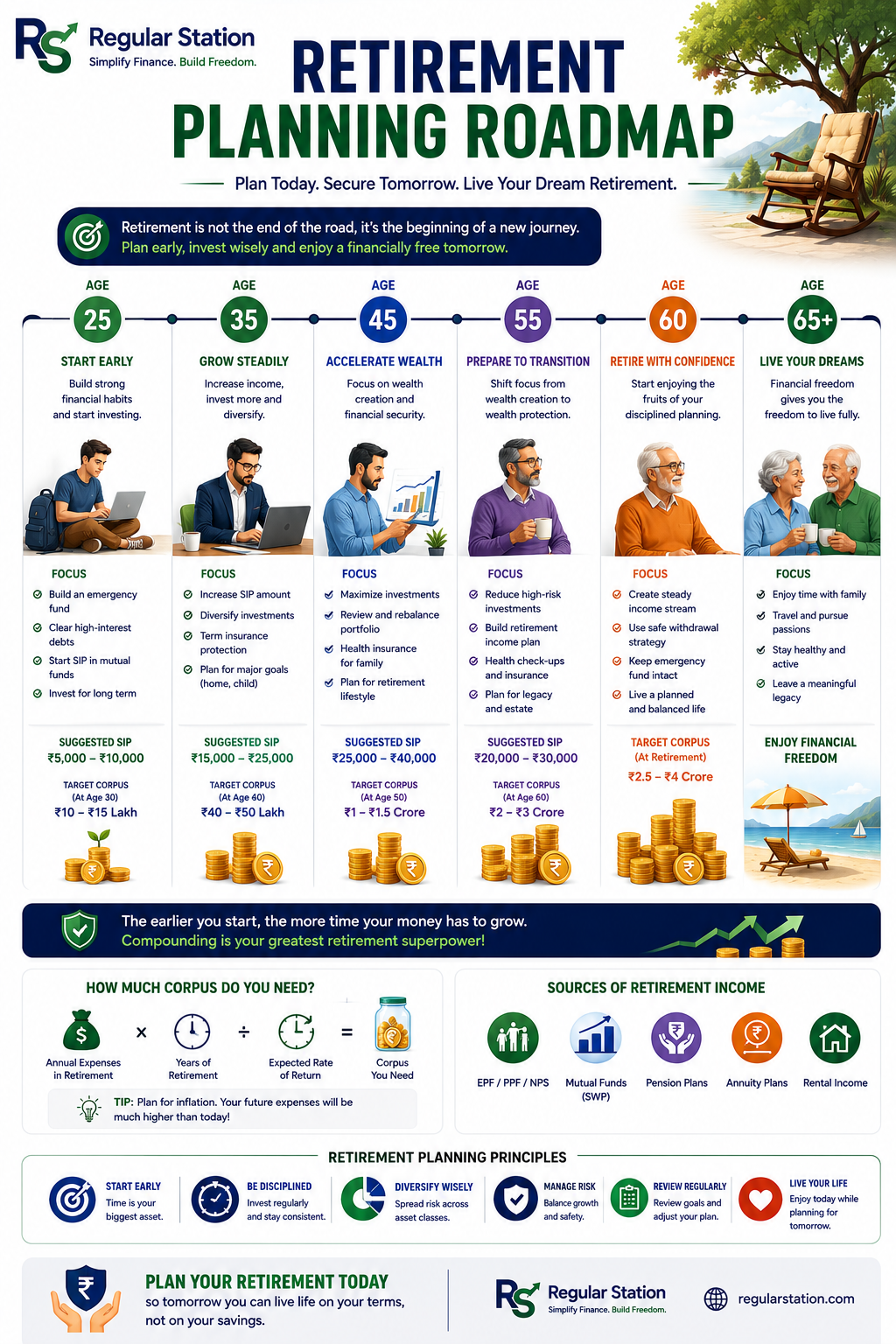
What Is Retirement Planning?
Retirement planning is a lifelong financial habit. Ideally, it begins with your very first salary and continues throughout your working life.
The objective isn’t simply to accumulate a large investment portfolio. The real goal is to create reliable income that supports your lifestyle after your regular salary stops.
Why Should You Start Early?
Time is one of the greatest advantages in retirement planning. Starting early gives your investments more years to grow and allows compounding to work in your favour.
⏳ More Time to Grow
Your investments have a longer period to benefit from long-term growth.
📈 Benefit from Compounding
Returns generated over time can begin earning returns themselves.
💰 Smaller Monthly Contributions
Starting early often means you can invest smaller amounts over a longer period.
🎯 Greater Flexibility
You have more time to adjust your retirement plan if your income or goals change.
The Impact of Inflation
Retirement planning isn’t just about saving money—it’s about preserving your purchasing power over decades.
As prices rise over time, the same amount of money buys less. That’s why retirement planning should focus on disciplined saving and long-term growth rather than simply accumulating cash.
Illustrative Example
If your monthly expenses are ₹50,000 today, you may need significantly more in the future to maintain a similar lifestyle because of inflation.
This is why it’s important to review your retirement assumptions periodically rather than relying on a one-time estimate.
Key Message
Retirement planning is about creating future income—not simply building a large investment portfolio. Start early, stay consistent, and review your plan as your life evolves.
How Much Money Will You Need?
There isn’t a single retirement target that suits everyone. The amount you’ll need depends on your lifestyle, expected expenses, retirement age, life expectancy, inflation, healthcare costs, and other sources of income.
Rather than chasing a fixed retirement corpus, review your retirement plan regularly as your income, responsibilities, and financial goals evolve.
🏠 Lifestyle
The lifestyle you want after retirement will largely determine how much income you’ll need.
💰 Monthly Expenses
Estimate the amount required to comfortably cover your essential and discretionary expenses.
📅 Retirement Age
The earlier you plan to retire, the larger your retirement corpus may need to be.
📈 Inflation
Future living costs are likely to be higher than they are today, reducing purchasing power over time.
🏥 Healthcare
Medical expenses often increase with age and should be included in your retirement planning.
💼 Other Income Sources
Pensions, rental income, investments, and part-time work can all contribute to retirement income.
Sources of Retirement Income
A strong retirement plan is usually built using multiple income sources rather than relying on just one.
| Retirement Income Source | Purpose |
|---|---|
| Employees’ Provident Fund (EPF) | Retirement savings for salaried employees. |
| Public Provident Fund (PPF) | Long-term savings with government backing. |
| National Pension System (NPS) | Retirement-focused investing. |
| Mutual Funds | Long-term wealth creation. |
| Fixed Deposits | Capital preservation and predictable income. |
| Rental Income | Passive income during retirement. |
| Dividend Income | Income from investments in eligible dividend-paying assets. |
| Pension Plans | Regular retirement income, where applicable. |
Popular Retirement Investment Options in India
There is no single “best” retirement investment. The right combination depends on your age, financial goals, investment horizon, and comfort with investment risk.
| Investment Option | Generally Suitable For |
|---|---|
| Employees’ Provident Fund (EPF) | Salaried employees. |
| Public Provident Fund (PPF) | Long-term savings. |
| National Pension System (NPS) | Retirement-focused investing. |
| Mutual Funds | Long-term wealth creation. |
| Fixed Deposits | Capital preservation. |
| Bonds | Income generation and portfolio stability. |
Building a Diversified Retirement Plan
A balanced retirement strategy combines multiple investments to create both long-term growth and stable future income.
Key Takeaway
The most resilient retirement plans combine savings, long-term investments, pensions, and other income sources. Diversification helps improve financial stability throughout retirement.
Retirement Planning by Age
Retirement planning is not a one-time event. Your priorities change as your career, income, family responsibilities, and financial goals evolve. The key is to adjust your strategy as you move through different stages of life.
Remember, it’s never too early—or too late—to begin. Even if you’re starting later than planned, disciplined saving and regular investing can still make a meaningful difference.
In Your 20s
Build Strong Financial Habits
- Start investing early.
- Build consistent saving habits.
- Begin SIPs for long-term goals.
- Avoid lifestyle inflation.
- Learn the basics of investing.
In Your 30s
Increase Retirement Contributions
- Increase retirement savings as your income grows.
- Protect your family with insurance.
- Plan for children’s education.
- Review your long-term financial goals.
In Your 40s
Accelerate Wealth Creation
- Increase retirement investments.
- Reduce unnecessary debt.
- Review asset allocation.
- Prepare for rising healthcare expenses.
In Your 50s
Protect Your Retirement Corpus
- Focus on preserving accumulated wealth.
- Review retirement income sources.
- Plan withdrawal strategies.
- Prepare an estate plan.
Illustrative Example
Amit’s Retirement Roadmap
Amit is 30 years old and earns ₹90,000 per month.
Before increasing his retirement investments, he built a strong financial foundation:
- ✔ Emergency Fund
- ✔ Health Insurance
- ✔ Term Insurance
- ✔ No High-Interest Debt
He now invests ₹15,000 every month specifically for retirement and reviews his portfolio once every year.
Whenever he receives a salary increase, he increases his retirement contribution instead of spending the entire raise.
Common Retirement Planning Mistakes
Many retirement challenges are caused by avoidable mistakes rather than low income. Being aware of these pitfalls can help you stay on track.
Starting Too Late
Delaying retirement planning reduces the time available for compounding to work.
Depending Only on EPF
A single retirement income source may not be enough to support your future lifestyle.
Ignoring Inflation
Future living costs may be significantly higher than today’s expenses.
Withdrawing Retirement Savings Early
Early withdrawals reduce the long-term growth potential of your retirement corpus.
Never Reviewing the Plan
Your retirement strategy should evolve as your income, goals, and family responsibilities change.
Underestimating Healthcare Costs
Medical expenses often become a larger part of household spending during retirement.
Habits of Successful Retirement Planners
| Habit | Benefit |
|---|---|
| Start Early | More years for compounding. |
| Invest Regularly | Builds consistency over time. |
| Increase Contributions | Keeps pace with income growth. |
| Review Annually | Ensures your plan stays aligned with your goals. |
| Stay Invested | Avoids emotional reactions to short-term market movements. |
Retirement Decision Guide
Use this guide to identify your next retirement planning priority.
👨 I’m in My 20s
Start investing now, even if the amount is small. Time is your greatest advantage.
👨💼 I’m in My 30s
Increase retirement contributions whenever your income grows and continue investing consistently.
👨🦳 I’m in My 40s
Review your retirement target, reduce unnecessary debt, and accelerate long-term investing.
👴 I’m Near Retirement
Focus on protecting your retirement corpus, planning withdrawals, and creating reliable retirement income.
Retirement Readiness Checklist
Check each statement honestly.
- ☐ I know the age at which I’d like to retire.
- ☐ I invest regularly for retirement.
- ☐ I increase my retirement investments as my income grows.
- ☐ I understand how inflation affects retirement planning.
- ☐ I have multiple retirement income sources.
- ☐ I review my retirement plan every year.
- ☐ My family is financially protected with appropriate insurance.
Your Score
- 6–7 checks: Excellent retirement planning habits.
- 4–5 checks: You’re making good progress—continue strengthening your plan.
- 0–3 checks: Start building your retirement strategy today.
Create Your Retirement Plan
Complete this worksheet to organize your retirement strategy.
| Current Age | __________ |
|---|---|
| Target Retirement Age | __________ |
| Current Monthly Expenses | ₹________________ |
| Current Retirement Savings | ₹________________ |
| Monthly Retirement Investment | ₹________________ |
| Annual Increase Planned | __________% |
| Next Review Date | ________________ |
Retirement Health Dashboard
| Question | Yes | No |
|---|---|---|
| I have started retirement investing. | ☐ | ☐ |
| I increase my retirement contributions regularly. | ☐ | ☐ |
| I review my retirement investments annually. | ☐ | ☐ |
| I understand my retirement income sources. | ☐ | ☐ |
| I have considered inflation in my planning. | ☐ | ☐ |
| I have a written retirement plan. | ☐ | ☐ |
Core Retirement Planning Principles
| Principle | Beginner Approach |
|---|---|
| Start Early | Even small investments can grow significantly over time. |
| Invest Regularly | Build consistency with SIPs or periodic investing. |
| Diversify | Avoid depending on a single retirement investment. |
| Stay Invested | Focus on long-term goals rather than short-term market movements. |
| Review Periodically | Review your retirement plan annually or after major life changes. |
Module summary
Retirement planning is about creating financial independence for life after work. By starting early, investing consistently, reviewing your progress, and preparing for inflation, you can build a retirement strategy that supports the lifestyle you want throughout your later years.
Retirement planning isn’t about predicting the future perfectly—it’s about preparing for it thoughtfully and reviewing your plan as your life evolves.
Module takeaways
- Start retirement planning as early as possible.
- Time is often more valuable than the amount invested initially.
- Diversify your retirement income sources.
- Review your retirement strategy regularly.
- Account for inflation and healthcare costs.
- Increase retirement contributions whenever your income grows.
Module complete
You’ve completed the Retirement Planning module and learned how to prepare financially for life after work.
- ✔ Understood the purpose of retirement planning.
- ✔ Learned why starting early matters.
- ✔ Explored retirement income sources.
- ✔ Built an age-based retirement roadmap.
- ✔ Created your own retirement planning worksheet.
Next module
You’ve now completed the seven core pillars of personal finance.
The next chapter explains how taxes fit into your financial plan and how smart tax planning can help you legally improve tax efficiency while supporting your long-term financial goals.
Continue to: Financial Mistakes →
Financial Mistakes
A financial health check turns vague concern into a short, practical improvement list. Review cash flow, reserves, debt, protection, goals and investments together, then focus on the weakest area before making more complex financial decisions.
Common Personal Finance Mistakes
Financial success is rarely the result of one perfect financial decision. More often, it’s built through small, consistent habits practiced over many years. Likewise, financial problems usually develop through small mistakes that are repeated over time.
The good news is that every one of these mistakes can be corrected. By recognizing them early, you can avoid unnecessary financial stress and make better financial decisions throughout every stage of life.
Most financial mistakes are behavioral rather than mathematical. Improving your financial habits often has a greater long-term impact than finding the “perfect” investment or budgeting method.
1
Living Without a Budget (or Ignoring It)
Many people know how much they earn but have no idea where their money goes.
Why It’s a Problem
- Spending becomes emotional.
- Savings become irregular.
- Financial goals are delayed.
How to Fix It
Create a realistic monthly budget, track your spending, and review it at least once every month. Even a simple budget is usually more effective than having no budget at all.
2
Not Building an Emergency Fund
Unexpected expenses are inevitable. Without emergency savings, many people rely on credit cards, personal loans, or selling long-term investments.
Why It’s a Problem
Many financial setbacks become long-term problems simply because emergency savings are unavailable.
How to Fix It
Build an emergency fund covering at least 3–6 months of essential expenses.
3
Spending More Than You Earn
This habit often develops gradually through lifestyle inflation, frequent EMI purchases, and impulse spending.
Warning Signs
- Regular credit card balances
- Borrowing before payday
- Frequent EMI purchases
How to Fix It
Reduce discretionary spending, prioritize savings, and avoid increasing your lifestyle every time your income grows.
4
Waiting Too Long to Start Investing
Many people wait for a higher salary, the “right” market, or the perfect investment opportunity.
Unfortunately, months often turn into years—and every year you delay gives compounding less time to work.
How to Fix It
Start with an amount you can comfortably invest today and gradually increase your contributions as your income grows.
5
Ignoring Insurance
A single unexpected medical emergency can affect years of savings.
How to Fix It
Review your insurance needs regularly and ensure your health and term insurance match your current financial responsibilities.
Quick Habit Check
| Mistake | Better Habit |
|---|---|
| No Budget | Track monthly income and expenses |
| No Emergency Fund | Save consistently every month |
| Overspending | Live below your means |
| Delaying Investing | Start early and stay consistent |
| Ignoring Insurance | Protect your financial foundation |
6
Relying on a Single Source of Income
Depending entirely on one salary or business income can increase financial risk. If that income stops unexpectedly, your financial goals may be disrupted.
Why It’s a Problem
Job loss, business slowdowns, or health issues can affect your primary income. Having additional income sources can improve your financial resilience.
How to Fix It
Develop additional income streams gradually based on your skills and available time. Even one extra source of income can strengthen your financial stability.
Ideas to Explore
- Freelancing
- Consulting
- Teaching or Coaching
- Dividend Income
- Rental Income
- Small Side Business
7
Misusing Credit Cards
Credit cards are useful financial tools when used responsibly, but carrying unpaid balances can become expensive because of high interest charges.
Why It’s a Problem
- High interest costs
- Growing debt burden
- Lower financial flexibility
How to Fix It
Pay your credit card bill in full whenever possible, avoid unnecessary purchases, and never spend more than you can comfortably repay.
8
Buying Things to Impress Others
Many purchases are driven by social pressure rather than genuine need. Lifestyle inflation often increases as income grows.
Why It’s a Problem
- Lower savings
- Higher debt
- Delayed financial goals
How to Fix It
Spend according to your own financial goals—not someone else’s lifestyle. Focus on long-term financial security rather than short-term appearances.
9
Investing Without Understanding
Never invest simply because friends recommend it, social media promotes it, or a product is currently trending.
If you cannot clearly explain how an investment works, what risks it carries, and why you’re investing in it, take more time to learn before committing your money.
How to Fix It
Understand the investment, its risks, expected returns, costs, and how it fits your financial goals before investing.
10
Not Setting Financial Goals
Money without direction is easily spent. Financial goals give every rupee a purpose and help you stay motivated.
How to Fix It
Create short-term, medium-term, and long-term financial goals. Review them regularly and adjust them as your life changes.
11
Ignoring Retirement Planning
Many people believe retirement planning starts in their 50s. In reality, the best time to begin is with your first salary.
Why It’s a Problem
- Less time for compounding
- Higher monthly savings required later
- Reduced financial flexibility
How to Fix It
Start contributing toward retirement as early as practical. Even small, consistent investments made over many years can make a meaningful difference.
Quick Self-Check
How many of these habits describe you today?
- ☐ I have more than one source of income.
- ☐ I pay my credit card bill on time.
- ☐ I spend according to my goals—not social pressure.
- ☐ I understand every investment I own.
- ☐ I have written financial goals.
- ☐ I invest regularly for retirement.
12
Not Reviewing Your Finances Regularly
Life changes over time, and your financial plan should change with it. Salary increases, marriage, children, new financial goals, or changing expenses all affect your finances.
Why It’s a Problem
- Your budget may become outdated.
- Your investments may no longer match your goals.
- Your insurance coverage may become insufficient.
How to Fix It
Review your budget, savings, investments, insurance, debt, and financial goals at least once or twice each year—or after any major life event.
13
Ignoring Tax Planning
Many people focus on earning more money but overlook opportunities to improve tax efficiency through proper financial planning.
Why It’s a Problem
- You may pay more tax than necessary.
- Tax-saving opportunities may be missed.
- Financial decisions may become less efficient.
How to Fix It
Understand available deductions, exemptions, and tax-efficient investment options that match your financial goals. Good tax planning is about following the law while making informed financial decisions—not avoiding taxes.
14
Chasing “Get Rich Quick” Schemes
Promises of guaranteed high returns often involve excessive risk—or sometimes outright fraud.
Warning Signs
- Guaranteed returns.
- “Limited time” investment pressure.
- No clear explanation of how returns are generated.
- Pressure to recruit others.
How to Fix It
Research every investment carefully. If something sounds too good to be true, it probably deserves extra caution.
15
Ignoring Inflation
Keeping all of your long-term savings in low-growth investments may reduce your purchasing power over time.
Why It’s a Problem
As prices rise, the same amount of money buys less than it does today.
How to Fix It
Choose investments that match your goals, investment horizon, and risk tolerance so your money has the potential to grow over the long term.
16
Comparing Yourself with Others
Everyone’s financial journey is different. Comparing salaries, homes, cars, vacations, or investment returns often leads to unnecessary spending and poor financial decisions.
How to Fix It
Measure your progress against your own financial goals—not someone else’s lifestyle.
17
Waiting for the “Perfect Time”
There is rarely a perfect time to begin budgeting, saving, investing, or planning for retirement.
Waiting often costs more than starting small today because valuable time is lost.
How to Fix It
Start with one practical financial habit today. Small actions, repeated consistently, usually create bigger long-term results than waiting for perfect conditions.
Replace This Habit with This Habit
| Replace This Habit | Build This Habit |
|---|---|
| Spend first | Create a budget before spending |
| Save what’s left | Pay yourself first every month |
| Chase quick profits | Invest consistently for the long term |
| Ignore insurance | Protect your financial foundation |
| Delay retirement planning | Start early—even with small amounts |
| Ignore taxes | Include tax planning in your financial strategy |
| Compare yourself with others | Measure progress against your own goals |
Key Takeaway
Most financial mistakes are habits—not permanent problems. Replacing one poor habit with one good habit each month can significantly improve your long-term financial health.
Financial Health Self-Assessment
Give yourself 1 point for every statement that is true. This quick assessment will help you understand how strong your financial foundation is today.
| Question | Yes | No |
|---|---|---|
| I follow a monthly budget. | ☐ | ☐ |
| I have an emergency fund. | ☐ | ☐ |
| I save money every month. | ☐ | ☐ |
| I invest regularly. | ☐ | ☐ |
| I have appropriate insurance. | ☐ | ☐ |
| I avoid unnecessary debt. | ☐ | ☐ |
| I review my finances regularly. | ☐ | ☐ |
| I actively save for retirement. | ☐ | ☐ |
| I have written financial goals. | ☐ | ☐ |
| I understand where my money goes every month. | ☐ | ☐ |
Score Interpretation
| Score | Meaning |
|---|---|
| 0–3 | Immediate attention needed. Start with budgeting, saving, and building an emergency fund. |
| 4–7 | You’re making good progress. Focus on strengthening your weaker financial habits. |
| 8–10 | Excellent financial foundation. Continue reviewing and improving your financial plan regularly. |
30-Day Financial Improvement Plan
Choose one financial habit to improve over the next month. Focusing on one change at a time makes new habits easier to maintain.
| Habit I Want to Improve | _____________________________________ |
|---|---|
| Why It Matters | _____________________________________ |
| First Action I’ll Take | _____________________________________ |
| Start Date | ______________ |
| Review Date | ______________ |
Quick action
Set aside just 15 minutes today to complete these steps.
- ☐ Complete your Financial Health Self-Assessment.
- ☐ Identify your three weakest financial habits.
- ☐ Choose one habit to improve this month.
- ☐ Schedule a financial review on your calendar.
Module summary
Financial mistakes are part of every learning journey. The important thing is recognizing them early, correcting them, and continuing to improve.
Long-term financial success isn’t built through perfect decisions. It’s built through consistent habits practiced over many years. Every positive financial habit you develop today strengthens your financial future.
Module takeaways
- Budget before you spend.
- Build an emergency fund before taking investment risk.
- Invest consistently rather than chasing quick profits.
- Protect your finances with appropriate insurance.
- Review your financial plan regularly.
- Start improving one financial habit today.
Module complete
Congratulations! You’ve learned how to recognize and avoid the most common financial mistakes that prevent people from building long-term wealth.
- ✔ Identified 17 common financial mistakes.
- ✔ Learned practical ways to avoid each mistake.
- ✔ Completed your Financial Health Assessment.
- ✔ Created your 30-Day Improvement Plan.
- ✔ Built a roadmap for stronger financial habits.
Next module
Avoiding financial mistakes is only one part of building long-term financial success.
In the next chapter, you’ll complete a comprehensive Personal Financial Health Check to evaluate your budgeting, saving, investing, insurance, debt management, retirement planning, and overall financial well-being.
This practical assessment will help you identify your strengths, uncover areas for improvement, and track your progress over time.
Continue to: Personal Financial Health Check →
Personal Financial Health Check
Financial health is not determined by how much you earn—it’s determined by how consistently you manage your money. This self-assessment will help you evaluate your current financial habits, identify areas for improvement, and create a roadmap toward long-term financial security.
Why Should You Check Your Financial Health?
Most people regularly monitor their physical health by checking their blood pressure, blood sugar, weight, or annual medical reports.
However, very few people regularly assess the health of their finances.
Your financial health influences almost every important decision in life—from handling emergencies and reducing financial stress to buying a home, educating your children, and preparing for retirement.
This Personal Financial Health Check is designed to help you understand where you stand today and identify the areas that deserve your attention next.
Your Financial Health at a Glance
Rate yourself honestly in each area. You’ll calculate your official score later in this chapter.
| Financial Area | Your Rating |
|---|---|
| Budgeting | ☆☆☆☆☆ |
| Saving | ☆☆☆☆☆ |
| Emergency Fund | ☆☆☆☆☆ |
| Insurance | ☆☆☆☆☆ |
| Investing | ☆☆☆☆☆ |
| Debt Management | ☆☆☆☆☆ |
| Financial Goals | ☆☆☆☆☆ |
| Retirement Planning | ☆☆☆☆☆ |
| Financial Knowledge | ☆☆☆☆☆ |
| Financial Discipline | ☆☆☆☆☆ |
How the Financial Health Scorecard Works
This assessment evaluates 10 essential areas of personal finance.
- Each area contains 5 questions.
- Each “Yes” answer earns 1 point.
- Each section has a maximum score of 5 points.
- Your maximum overall score is 50 points.
Answer every question honestly based on your current financial habits—not where you hope to be in the future.
The 10 Financial Health Areas
We’ll evaluate the following ten pillars of financial well-being.
| Area | Maximum Score |
|---|---|
| 1. Budgeting | 5 |
| 2. Saving | 5 |
| 3. Emergency Fund | 5 |
| 4. Insurance | 5 |
| 5. Investing | 5 |
| 6. Debt Management | 5 |
| 7. Financial Goals | 5 |
| 8. Retirement Planning | 5 |
| 9. Financial Knowledge | 5 |
| 10. Financial Discipline | 5 |
| Total Possible Score | 50 |
Before You Begin
Answer every question honestly. A lower score isn’t a failure—it simply highlights where your next financial improvements should begin.
1. Budgeting 5 Points
A budget is the foundation of good financial health. Answer Yes if the statement accurately describes your current financial habits.
| Question | Yes | No |
|---|---|---|
| I follow a monthly budget. | ☐ | ☐ |
| I track my expenses regularly. | ☐ | ☐ |
| I know where my money goes each month. | ☐ | ☐ |
| I review my budget every month. | ☐ | ☐ |
| I stay within my planned budget most months. | ☐ | ☐ |
Your Budgeting Score: ____ / 5
2. Saving 5 Points
Strong saving habits create financial security and prepare you for future goals.
| Question | Yes | No |
|---|---|---|
| I save money every month. | ☐ | ☐ |
| My savings are automated. | ☐ | ☐ |
| I have clear savings goals. | ☐ | ☐ |
| I avoid unnecessary spending. | ☐ | ☐ |
| I increase my savings when my income grows. | ☐ | ☐ |
Your Saving Score: ____ / 5
3. Emergency Fund 5 Points
An emergency fund protects your finances during unexpected situations.
| Question | Yes | No |
|---|---|---|
| I have an emergency fund. | ☐ | ☐ |
| It is separate from my daily spending account. | ☐ | ☐ |
| It covers at least three months of essential expenses. | ☐ | ☐ |
| I contribute to it regularly. | ☐ | ☐ |
| I use it only for genuine emergencies. | ☐ | ☐ |
Your Emergency Fund Score: ____ / 5
4. Insurance 5 Points
Insurance helps protect your finances against unexpected events.
| Question | Yes | No |
|---|---|---|
| I understand the insurance policies I own. | ☐ | ☐ |
| My health insurance meets my family’s needs. | ☐ | ☐ |
| My dependents are financially protected if they rely on my income. | ☐ | ☐ |
| I review my insurance policies periodically. | ☐ | ☐ |
| I know the renewal dates of my policies. | ☐ | ☐ |
Your Insurance Score: ____ / 5
5. Investing 5 Points
Successful investing is based on knowledge, consistency, and long-term planning.
| Question | Yes | No |
|---|---|---|
| I invest regularly. | ☐ | ☐ |
| My investments match my financial goals. | ☐ | ☐ |
| I understand every investment product I own. | ☐ | ☐ |
| I diversify my investments appropriately. | ☐ | ☐ |
| I review my investment portfolio periodically. | ☐ | ☐ |
Your Investing Score: ____ / 5
6. Debt Management 5 Points
Healthy debt management helps you maintain financial flexibility and reduces unnecessary financial stress.
| Question | Yes | No |
|---|---|---|
| I pay all EMIs on time. | ☐ | ☐ |
| I avoid unnecessary borrowing. | ☐ | ☐ |
| I pay my credit card bills by the due date. | ☐ | ☐ |
| I know my total outstanding debt. | ☐ | ☐ |
| I have a clear debt repayment strategy. | ☐ | ☐ |
Your Debt Management Score: ____ / 5
7. Financial Goals 5 Points
Clear financial goals give your money direction and help you stay focused on long-term success.
| Question | Yes | No |
|---|---|---|
| I have written financial goals. | ☐ | ☐ |
| My financial goals have target dates. | ☐ | ☐ |
| I review my goals regularly. | ☐ | ☐ |
| My monthly budget supports my goals. | ☐ | ☐ |
| I measure my financial progress periodically. | ☐ | ☐ |
Your Financial Goals Score: ____ / 5
8. Retirement Planning 5 Points
Retirement planning is about preparing today so you can enjoy financial independence tomorrow.
| Question | Yes | No |
|---|---|---|
| I save regularly for retirement. | ☐ | ☐ |
| I review my retirement progress periodically. | ☐ | ☐ |
| I understand how inflation affects retirement. | ☐ | ☐ |
| I increase my retirement contributions when my income grows. | ☐ | ☐ |
| I have an estimated retirement target. | ☐ | ☐ |
Your Retirement Planning Score: ____ / 5
9. Financial Knowledge 5 Points
Financial knowledge helps you make informed decisions and avoid costly mistakes.
| Question | Yes | No |
|---|---|---|
| I continue learning about personal finance. | ☐ | ☐ |
| I verify financial information before acting on it. | ☐ | ☐ |
| I know how to identify common financial scams. | ☐ | ☐ |
| I understand basic investing concepts. | ☐ | ☐ |
| I regularly improve my financial knowledge. | ☐ | ☐ |
Your Financial Knowledge Score: ____ / 5
10. Financial Discipline 5 Points
Long-term financial success depends more on consistent habits than occasional good decisions.
| Question | Yes | No |
|---|---|---|
| I live within my means. | ☐ | ☐ |
| I avoid impulse purchases. | ☐ | ☐ |
| I review my finances every month. | ☐ | ☐ |
| I make financial decisions based on goals rather than emotions. | ☐ | ☐ |
| I stay consistent with good financial habits. | ☐ | ☐ |
Your Financial Discipline Score: ____ / 5
Ready to Calculate Your Score?
You’ve now completed all ten financial health areas. In the next section, you’ll calculate your total score, understand what it means, identify your highest-priority improvements, and create a practical 90-day action plan to strengthen your financial health.
Calculate Your Financial Health Score
Now that you’ve completed all ten assessment areas, it’s time to calculate your score.
Remember, this scorecard is a self-assessment tool. Its purpose is to help you identify strengths, uncover improvement opportunities, and monitor your financial progress over time—not to compare yourself with others.
Your Score
| Total Score | __________ / 50 |
|---|---|
| Date Completed | __________________ |
| Next Review Date | __________________ |
What Your Score Means
| Score | Your Financial Health | Recommended Next Step |
|---|---|---|
| 0–15 | Getting Started | Begin with budgeting, saving, and tracking expenses. |
| 16–25 | Building Your Foundation | Strengthen your emergency fund and insurance coverage. |
| 26–35 | Making Good Progress | Focus on investing, retirement planning, and financial goals. |
| 36–45 | Financially Healthy | Continue reviewing your finances and refining your strategy. |
| 46–50 | Excellent Financial Health | Maintain your habits and help others improve theirs. |
Priority Improvement Plan
Instead of trying to improve everything at once, focus on your lowest-scoring area first.
| Lowest Scoring Area | Your First Action |
|---|---|
| Budgeting | Create and follow a monthly budget. |
| Saving | Automate your monthly savings. |
| Emergency Fund | Build your first month’s emergency savings. |
| Insurance | Review your existing insurance policies. |
| Investing | Learn the basics before investing. |
| Debt Management | Create a structured repayment plan. |
| Financial Goals | Write down clear SMART financial goals. |
| Retirement Planning | Start a monthly retirement investment. |
| Financial Knowledge | Read about personal finance for 30 minutes each week. |
| Financial Discipline | Review your finances every month. |
Your 90-Day Financial Challenge
Don’t try to change everything overnight. Build one habit at a time.
Month 1
- Create a monthly budget.
- Track every expense.
- Write down three financial goals.
Month 2
- Build emergency savings.
- Review your insurance.
- Reduce unnecessary spending.
Month 3
- Start or review your investments.
- Reduce high-interest debt.
- Complete another Financial Health Check.
Quick action
Take these four steps today:
- ☐ Complete your Financial Health Score.
- ☐ Identify your lowest-scoring area.
- ☐ Choose one financial habit to improve this month.
- ☐ Schedule your next Financial Health Check in six months.
Module summary
Financial health is not determined by how much you earn—it’s determined by how consistently you manage your money.
By reviewing your financial health regularly, strengthening one area at a time, and maintaining good financial habits, you build a strong foundation for long-term financial security and financial freedom.
Module takeaways
- Review your financial health regularly.
- Focus on improving one area at a time.
- Track your progress every 6–12 months.
- Strong financial habits matter more than a high income.
- Consistency creates lasting financial success.
Module complete
Congratulations! You’ve completed your Personal Financial Health Check and now have a clear picture of your financial strengths and the areas that need attention.
- ✔ Assessed all 10 financial health areas.
- ✔ Calculated your Financial Health Score.
- ✔ Identified your top improvement priorities.
- ✔ Created a 90-day action plan.
- ✔ Built a system to track your progress over time.
Next module
You’ve learned the principles of personal finance and assessed your financial health. Now it’s time to put that knowledge into practice using practical tools.
In the next chapter, you’ll discover essential Personal Finance Tools & Calculators, including SIP, EMI, retirement, inflation, goal planning, and budgeting calculators that can help you make more informed financial decisions.
Continue to: Personal Finance Tools & Calculators →
Financial Tools
Managing money becomes much easier when you use the right financial tools. Instead of guessing how much you should save, invest, borrow, or plan for retirement, calculators help you make informed decisions using your own financial information.
Whether you’re creating your first budget, starting a SIP, buying a home, planning retirement, or tracking your financial progress, the right calculator can save time, improve decision-making, and help you stay on track.
Why Financial Tools Matter
Good financial decisions are based on accurate information—not guesswork.
Financial calculators help you:
- Estimate future savings and investments.
- Compare different financial options.
- Understand the cost of borrowing.
- Measure your financial progress.
- Plan for long-term goals.
- Make more confident financial decisions.
Four Categories of Financial Tools
Every calculator serves a different purpose. Choose the tool that matches your current financial goal instead of trying to use every calculator at once.
💰 Daily Money Management
- Budget Calculator
- Emergency Fund Calculator
- Expense Tracker
📈 Investing & Wealth Building
- SIP Calculator
- Goal Planner
- Net Worth Calculator
🏠 Borrowing & Loans
- EMI Calculator
- Loan Affordability Calculator
🎯 Long-Term Planning
- Retirement Calculator
- Inflation Calculator
- Financial Health Score
How to Use Financial Calculators Effectively
For the best results, remember these simple principles before using any financial calculator.
| Best Practice | Why It Matters |
|---|---|
| Use accurate financial information. | Better inputs produce more useful estimates. |
| Review your assumptions. | Interest rates and inflation can change. |
| Treat results as estimates. | Actual outcomes may differ. |
| Update calculations regularly. | Your income, expenses, and goals will change. |
| Combine calculations with financial planning. | Numbers alone should never make financial decisions. |
Coming Up Next
In the next section, we’ll explore the most useful calculators for managing your day-to-day finances and building long-term wealth, including Budget, Emergency Fund, SIP, Goal Planner, and Net Worth calculators.
Category 1: Daily Money Management
These tools help you manage your day-to-day finances and build a strong financial foundation before moving on to investing or long-term planning.
1. Monthly Budget Calculator
📊 Purpose
Helps you understand exactly where your money goes every month by comparing your income, expenses, savings, and investments.
What It Calculates
- Monthly income
- Total expenses
- Monthly savings
- Monthly investments
- Remaining balance
Best For
- First salary
- Salaried employees
- Families
- Freelancers
- Business owners
Use It When
You want better control over your monthly spending and savings.
2. Emergency Fund Calculator
🛡️ Purpose
Calculates the emergency savings you should build based on your essential monthly expenses.
Example
| Essential Monthly Expenses | Recommended Emergency Fund |
|---|---|
| ₹40,000 | 3 Months = ₹1,20,000 |
| ₹40,000 | 6 Months = ₹2,40,000 |
Best For
- Building financial security
- Preparing for emergencies
- Reducing dependence on loans
3. Expense Tracker
📝 Purpose
Helps you record daily expenses so you can identify spending patterns and improve your budgeting habits.
Track Categories Such As
- Housing
- Groceries
- Transportation
- Entertainment
- Shopping
- Utilities
- Subscriptions
Best For
Anyone who wants greater awareness and control over monthly spending.
Category 2: Investing & Wealth Building
Once you’ve established good budgeting and saving habits, these tools help you plan investments and measure long-term financial growth.
4. SIP Calculator
📈 Purpose
Estimates the potential future value of regular investments through a Systematic Investment Plan (SIP).
It Helps Answer Questions Like
- How much should I invest every month?
- How long should I invest?
- What could my investments grow to over time?
Best For
- Mutual fund investors
- Retirement planning
- Long-term wealth creation
5. Goal Planner
🎯 Purpose
Helps estimate how much you need to save or invest each month to achieve a specific financial goal.
Popular Goals
- Buying a home
- Children’s education
- Vacation planning
- New vehicle
- Starting a business
Best For
Anyone saving toward a future financial milestone.
6. Net Worth Calculator
💼 Purpose
Measures your overall financial position by comparing everything you own with everything you owe.
Formula
Net Worth = Total Assets − Total Liabilities
| Assets | Liabilities |
|---|---|
| Savings | Home Loan |
| Investments | Car Loan |
| Gold | Personal Loan |
| Property | Credit Card Balance |
Best Practice
Calculate your net worth once every year to monitor your long-term financial progress.
Category 3: Borrowing & Loan Planning
Before taking any loan, it’s important to understand how borrowing will affect your monthly budget and long-term financial goals. These calculators help you borrow responsibly and avoid unnecessary financial stress.
7. EMI Calculator
🏠 Purpose
Calculates your monthly loan repayment (EMI), total interest payable, and total repayment amount before you borrow.
What It Calculates
- Monthly EMI
- Total Interest Payable
- Total Repayment Amount
- Loan Tenure Comparison
Best For
- Home Loans
- Car Loans
- Education Loans
- Personal Loans
8. Loan Affordability Calculator
💳 Purpose
Helps determine whether a loan comfortably fits within your monthly budget before you apply.
It Helps Answer Questions Like
- Can I comfortably afford this EMI?
- Will I still be able to save every month?
- Will this loan affect my financial goals?
- How much can I safely borrow?
Best For
- Home Buyers
- Vehicle Loans
- Personal Loans
- Business Loans
Category 4: Long-Term Financial Planning
These calculators help you prepare for major financial goals and measure long-term financial progress.
9. Retirement Calculator
👴 Purpose
Estimates how much money you may need for retirement and how much you should invest regularly to work toward that goal.
It Estimates
- Retirement Corpus
- Monthly Retirement Investment
- Years Remaining Until Retirement
- Impact of Inflation
10. Inflation Calculator
📉 Purpose
Shows how rising prices reduce purchasing power over time and helps estimate future costs.
Useful For
- Retirement Planning
- Children’s Education
- Healthcare Planning
- Long-Term Financial Goals
11. Financial Health Score Calculator
📊 Purpose
This will become the interactive version of the Personal Financial Health Check featured in this guide.
It Will Evaluate
- Budgeting
- Saving
- Emergency Fund
- Insurance
- Investing
- Debt Management
- Retirement Planning
- Financial Discipline
Based on your answers, you’ll receive a personalized financial health score along with practical recommendations for improvement.
Which Financial Tool Should You Use?
Choose the calculator that matches your current financial goal instead of trying to use every tool at once.
| Your Goal | Recommended Tool |
|---|---|
| Control monthly spending | Budget Calculator |
| Build emergency savings | Emergency Fund Calculator |
| Start investing | SIP Calculator |
| Save for a specific goal | Goal Planner |
| Buy a home or vehicle | EMI Calculator |
| Check loan affordability | Loan Affordability Calculator |
| Plan retirement | Retirement Calculator |
| Estimate future costs | Inflation Calculator |
| Track wealth | Net Worth Calculator |
| Review overall financial health | Financial Health Score Calculator |
🚀 Coming Soon: Regular Station Financial Toolkit
As Regular Station grows, we’ll launch a complete collection of free financial planning tools and downloadable templates to help readers apply what they’ve learned.
- ✅ Budget Planner
- ✅ Expense Tracker
- ✅ Net Worth Tracker
- ✅ Emergency Fund Calculator
- ✅ SIP Calculator
- ✅ EMI Calculator
- ✅ Retirement Planner
- ✅ Goal Planner
- ✅ Financial Health Score
- ✅ Annual Financial Review Workbook
Choose a Tool by Goal
Not every calculator is relevant at every stage of your financial journey. Start with the tool that matches your most important financial goal today, then gradually explore the others as your needs evolve.
I’m Just Getting Started
Begin with the Budget Calculator and Emergency Fund Calculator.
I Want to Start Investing
Use the SIP Calculator and Goal Planner.
I’m Planning to Take a Loan
Check the EMI Calculator and Loan Affordability Calculator before borrowing.
I Want to Retire Comfortably
Start with the Retirement Calculator and Inflation Calculator.
I Want to Measure My Financial Progress
Use the Net Worth Calculator and Financial Health Score Calculator.
Calculator Usage Checklist
Before relying on any financial calculator, use this checklist to ensure your estimates are as meaningful as possible.
| Before You Use Any Calculator | Status |
|---|---|
| Use accurate income, expense, and investment figures. | ☐ |
| Review the assumptions (interest rate, inflation, returns, etc.). | ☐ |
| Remember that results are estimates—not guarantees. | ☐ |
| Update calculations whenever your financial situation changes. | ☐ |
| Combine calculator results with your financial plan. | ☐ |
Quick action
Complete these four steps today:
- ☐ Write down your three most important financial goals.
- ☐ Match one financial calculator to each goal.
- ☐ Save those calculator links for future reference.
- ☐ Review your calculations every six months or after major life changes.
Module summary
Financial tools and calculators transform financial planning from guesswork into informed decision-making. Whether you’re creating a budget, planning investments, estimating retirement needs, tracking your net worth, or evaluating a loan, these tools help you make smarter financial decisions using real numbers rather than assumptions.
The best calculator isn’t the most advanced one—it’s the one you use consistently as your financial situation evolves.
Module takeaways
- Financial calculators help turn goals into measurable financial plans.
- Different calculators serve different financial purposes.
- Calculator results are estimates, not guarantees.
- Review and update your calculations regularly.
- Combine financial tools with disciplined financial habits for the best long-term results.
Module complete
Congratulations! You’ve completed the Essential Financial Tools & Calculators chapter and learned how practical planning tools can help you budget smarter, save consistently, invest confidently, borrow responsibly, and prepare for long-term financial success.
- ✔ Identified the right calculator for every major financial goal.
- ✔ Learned how to use financial calculators effectively.
- ✔ Understood the importance of reviewing calculations regularly.
- ✔ Discovered upcoming Regular Station financial planning tools.
Next module
You’ve now completed the core Personal Finance Guide and built a strong understanding of budgeting, saving, investing, debt management, insurance, retirement planning, financial health, and practical planning tools.
Continue strengthening your financial knowledge by exploring our in-depth guides, financial calculators, downloadable templates, and regularly updated educational resources designed specifically for Indian readers.
Explore More Personal Finance Resources →
Frequently Asked Questions
Starting your personal finance journey often raises many questions. This section answers some of the most common questions beginners ask about budgeting, saving, investing, debt, insurance, retirement planning, and building long-term financial security.
If your question isn’t covered here, explore the related guides throughout Regular Station for more detailed explanations and practical examples.
Getting Started
If you’re completely new to personal finance, begin with these frequently asked questions.
1. What is personal finance?
Personal finance is the process of managing your income, expenses, savings, investments, insurance, taxes, and financial goals to improve your financial well-being. It helps you make informed decisions about your money throughout every stage of life.
2. Why is personal finance important?
Personal finance helps you control spending, prepare for emergencies, reduce unnecessary debt, build wealth over time, and work toward important goals such as buying a home, educating your children, or retiring comfortably.
3. Who should learn personal finance?
Everyone can benefit from understanding personal finance. Whether you’re a student, salaried employee, freelancer, business owner, homemaker, or retiree, good financial knowledge helps you make better money decisions.
4. Is personal finance only for wealthy people?
No. Personal finance is about managing the money you have—not how much you earn. Good financial habits are valuable at every income level.
5. At what age should I start learning personal finance?
As early as possible. The earlier you begin budgeting, saving, and investing, the more time your money has to benefit from disciplined financial planning and long-term growth.
6. How do I start managing my money?
A simple starting plan includes five steps:
- Track your income.
- Track your expenses.
- Create a monthly budget.
- Build an emergency fund.
- Set clear financial goals.
7. Do I need a financial advisor?
Not always. Many people can build a strong financial foundation by learning the basics of budgeting, saving, investing, and insurance. However, for more complex situations—such as estate planning, advanced tax planning, or business finances—professional advice may be valuable.
8. What is the biggest financial mistake beginners make?
Waiting too long to get started. Many people delay budgeting, saving, or investing because they believe they’ll begin “later.” Starting with small, consistent actions today is usually more valuable than waiting for the perfect time.
Coming Up Next
The next section answers common questions about Budgeting, Saving, Emergency Funds, Debt Management, and Credit—the financial habits that create a strong foundation for long-term success.
Budgeting & Saving
These questions cover some of the most common topics people encounter when they begin managing their money, creating a budget, and building savings.
9. How much should I save every month?
A common starting point is to save around 20% of your monthly income, if it fits your financial circumstances. If that’s not possible, begin with a smaller percentage and increase it gradually as your income grows. Consistency is usually more important than the starting amount.
10. Should I save or invest first?
Start by building an emergency fund and meeting your short-term savings needs. Once you have a financial safety net in place, begin investing for long-term goals such as retirement, wealth creation, or your children’s education.
11. What is the 50/30/20 budget rule?
The 50/30/20 rule is a simple budgeting framework that suggests allocating:
- 50% for essential needs
- 30% for wants and lifestyle expenses
- 20% for savings and investments
These percentages are only a guideline. Adjust them based on your income, family responsibilities, and financial goals.
12. How can I reduce unnecessary expenses?
Review your monthly subscriptions, avoid impulse purchases, compare prices before buying, plan meals, prepare a shopping list, and regularly track your spending. Small savings made consistently often add up over time.
13. How much emergency fund should I have?
Many people aim to build an emergency fund covering 3–6 months of essential living expenses. If your income is irregular, you’re self-employed, or your household depends on a single income, you may decide to maintain a larger emergency fund.
14. Where should I keep my emergency fund?
Your emergency fund should be safe, easily accessible, and separate from your everyday spending money. A savings account or another suitable low-risk option may be appropriate, depending on your needs.
15. Is budgeting difficult?
Not at all. A simple budget that you consistently follow is usually much more effective than a complicated budget that you abandon after a few weeks.
Debt & Credit
Borrowing can help you achieve important financial goals when used responsibly. These questions explain how to manage debt wisely and maintain good credit habits.
16. Is all debt bad?
No. Borrowing for education, a home, or business growth may support your long-term financial goals when managed responsibly. Problems usually arise when debt is used for unnecessary lifestyle spending or becomes difficult to repay.
17. How can I get out of debt?
Create a repayment plan, pay every EMI on time, reduce unnecessary spending, avoid taking on new debt, and prioritize paying off high-interest loans or credit card balances whenever possible.
18. Should I use a credit card?
Yes—if you use it responsibly. Pay your credit card bill in full by the due date whenever possible, avoid unnecessary purchases, and don’t treat your credit limit as additional income.
19. What affects my credit score?
Your credit score may be influenced by factors such as your repayment history, credit utilization, length of credit history, types of credit used, and recent credit applications. Paying on time and borrowing responsibly generally supports a healthy credit profile.
20. How many loans are too many?
There isn’t a fixed number. The important question is whether you can comfortably manage all repayments while continuing to cover your living expenses, save regularly, and invest for future goals.
Coming Up Next
In the next section, we’ll answer frequently asked questions about Insurance and Investing, helping you understand how to protect your finances while growing your wealth over the long term.
Insurance
Insurance helps protect your finances from unexpected events. These frequently asked questions explain the basics of choosing and reviewing insurance as part of a sound financial plan.
21. Why do I need health insurance?
Medical expenses can be significant and often arise unexpectedly. Health insurance helps reduce the financial impact of eligible medical expenses, allowing you to protect your savings and investments while receiving necessary treatment, subject to your policy’s terms and conditions.
22. Who needs term insurance?
Term insurance is generally most appropriate for people whose spouse, children, parents, or other dependents rely on their income. It helps provide financial protection for your family if you pass away during the policy term, subject to the policy conditions.
23. Is insurance an investment?
No. Insurance and investing serve different purposes. Insurance is designed to provide financial protection against specific risks, while investments are intended to help grow your wealth over time. For many beginners, keeping these two goals separate makes financial planning simpler and more effective.
24. How often should I review my insurance?
Review your insurance coverage at least once every year and after major life events such as marriage, the birth of a child, purchasing a home, changing jobs, or experiencing a significant increase in income. Regular reviews help ensure your coverage continues to meet your needs.
Investing
Investing is one of the most effective ways to build long-term wealth. These questions answer some of the most common concerns beginners have before making their first investment.
25. When should I start investing?
Start investing once you have a realistic budget, an emergency fund, and clear financial goals. Having these foundations in place helps you invest with greater confidence and reduces the likelihood of needing to withdraw investments during unexpected emergencies.
26. How much should I invest every month?
Invest an amount that comfortably fits within your monthly budget and aligns with your financial goals. Even small, regular investments can grow over time. As your income increases, consider gradually increasing your investment contributions.
27. Is a SIP better than a Fixed Deposit (FD)?
They serve different purposes. A Systematic Investment Plan (SIP) is commonly used for long-term, market-linked investing, while a Fixed Deposit (FD) is generally chosen for capital preservation and predictable returns. The right choice depends on your financial goals, investment time horizon, and risk tolerance.
28. Should beginners invest directly in stocks?
Beginners should first understand the basics of investing before buying individual stocks. Learning about diversification, risk, and long-term investing can help you make more informed decisions. Many beginners choose diversified investment options before investing directly in individual companies.
29. What is diversification?
Diversification means spreading your investments across different asset classes, sectors, or investment products rather than relying on a single investment. Diversification helps manage risk because different investments may perform differently under changing market conditions.
30. Can I lose money while investing?
Yes. Most investments involve some level of risk, and their value can rise or fall over time. This is why it’s important to invest according to your financial goals, investment time horizon, and risk tolerance rather than focusing only on potential returns.
Coming Up Next
In the next section, we’ll answer frequently asked questions about Retirement Planning and General Money Habits, including financial discipline, reviewing your finances, and achieving long-term financial freedom.
Retirement Planning
Retirement planning is one of the most important long-term financial goals. These questions address common concerns about preparing financially for life after work.
31. When should I start retirement planning?
Ideally, begin retirement planning as soon as you start earning a regular income. Starting early gives your investments more time to benefit from long-term growth and compounding, allowing you to work toward your retirement goals with smaller, consistent contributions.
32. How much money do I need for retirement?
There is no universal retirement target. The amount you’ll need depends on your expected lifestyle, monthly expenses, retirement age, life expectancy, inflation, healthcare costs, and other income sources. Review your retirement plan regularly as these factors change over time.
33. Is EPF enough for retirement?
Employees’ Provident Fund (EPF) can be an important part of your retirement savings, but whether it will be enough depends on your retirement goals, future expenses, and lifestyle. Many people choose to combine EPF with other long-term investments to create a more diversified retirement plan.
34. What is the biggest retirement planning mistake?
Waiting too long to start. Delaying retirement planning reduces the time available for long-term growth and often requires much larger monthly contributions later in life.
General Money Habits
Good financial habits are built through consistent daily actions rather than occasional large decisions. These questions focus on the habits that support long-term financial success.
35. Should I track my expenses?
Yes. Tracking your expenses helps you understand where your money goes, identify unnecessary spending, and make informed budgeting decisions. Even a simple monthly review can reveal opportunities to save more.
36. How often should I review my finances?
Review your budget, spending, and savings every month. In addition, perform a more comprehensive financial review once or twice a year, or after major life events such as changing jobs, marriage, or buying a home.
37. How can I improve my financial discipline?
Create a realistic budget, automate your savings, set clear financial goals, avoid impulse purchases, and review your progress regularly. Small, consistent habits usually produce better long-term results than occasional major changes.
38. Is it okay to enjoy my money?
Absolutely. Good personal finance is about balance. A healthy financial plan allows you to enjoy your income today while continuing to save and invest for tomorrow. The goal is intentional spending—not avoiding enjoyment altogether.
39. What is financial freedom?
Financial freedom means having enough income, savings, and investments to support your desired lifestyle without depending entirely on active employment. For each person, financial freedom may look different depending on their goals and priorities.
40. What’s the first thing I should do after reading this guide?
Choose one practical action today, such as:
- Create your first monthly budget.
- Start building an emergency fund.
- Write down a financial goal.
- Review your insurance coverage.
- Begin learning about investing.
Small actions taken consistently are often more valuable than waiting for the perfect time to begin.
Coming Up Next
The final part of this FAQ chapter includes a practical Quick Action, Chapter Summary, Regular Station Learning Path, and introduces your 30-Day Personal Finance Action Plan to help you turn everything you’ve learned into lasting financial habits.
Quick action
Choose the one question from this FAQ that best matches your current financial challenge, then take one practical step today.
- ☐ Create your first monthly budget.
- ☐ Start building an emergency fund.
- ☐ Set one SMART financial goal.
- ☐ Review your insurance coverage.
- ☐ Begin learning about investing.
- ☐ Review your retirement plan.
Remember, financial progress comes from action—not information alone.
Module summary
Personal finance may seem overwhelming at first, but most financial questions have straightforward answers once you understand the basics.
By focusing on your goals, building good financial habits, reviewing your progress regularly, and continuing to learn, you’ll become more confident in every financial decision you make.
No one manages money perfectly all the time. Long-term financial success comes from making thoughtful decisions consistently—not from avoiding every mistake.
Module takeaways
- Everyone can improve their financial knowledge.
- Start with the basics before moving to advanced topics.
- Build good financial habits one step at a time.
- Review your finances regularly.
- Continue learning throughout your financial journey.
- Small improvements today can create significant long-term results.
Module complete
Congratulations! You’ve completed the Frequently Asked Questions chapter and now have answers to many of the most common questions beginners ask about personal finance.
- ✔ Understood the fundamentals of personal finance.
- ✔ Learned budgeting and saving best practices.
- ✔ Improved your understanding of debt and credit.
- ✔ Learned the basics of insurance and investing.
- ✔ Explored retirement planning concepts.
- ✔ Built stronger everyday money habits.
Regular Station Learning Path
You’ve almost reached the end of the Personal Finance Guide. Here’s the learning journey you’ve completed.
- ✅ Personal Finance Fundamentals
- ✅ Why Personal Finance Matters
- ✅ The 7 Pillars of Personal Finance
- ✅ Creating a Personal Finance Plan
- ✅ Financial Goals
- ✅ Budgeting
- ✅ Saving Money
- ✅ Emergency Fund
- ✅ Debt Management
- ✅ Insurance
- ✅ Investing
- ✅ Retirement Planning
- ✅ Common Financial Mistakes
- ✅ Financial Health Check
- ✅ Financial Tools & Calculators
- ✅ Frequently Asked Questions
You’re now ready to move from learning to implementation.
Next module
You’ve learned the principles of personal finance, explored practical tools, and found answers to the most common financial questions.
Now it’s time to turn knowledge into action.
Final Summary & Your 30-Day Personal Finance Action Plan
The final chapter brings everything together into a practical, step-by-step action plan designed to help you build lasting financial habits over the next 30 days.
Continue to: Final Summary & 30-Day Personal Finance Action Plan →
30-Day Action Plan
Congratulations! You’ve completed the Regular Station Ultimate Personal Finance Guide. Now it’s time to turn everything you’ve learned into practical financial habits that can benefit you for years to come.
Reading about personal finance is only the first step. Real financial progress comes from consistently applying what you’ve learned through small, intentional actions.
Before You Begin
Congratulations! You’ve reached the final chapter of this guide—a milestone that many readers never complete.
By now you’ve learned the foundations of personal finance, including budgeting, saving, emergency funds, debt management, insurance, investing, retirement planning, and financial discipline.
Now it’s time to put that knowledge into action.
How to Use This 30-Day Plan
This action plan is designed to help you build one financial habit at a time.
One Task Per Day
Complete one activity each day instead of trying to change everything at once.
Keep Going
If you miss a day, simply continue where you left off. Progress matters more than perfection.
Stay Consistent
Focus on building sustainable habits rather than short-term motivation.
Review Weekly
Spend a few minutes at the end of each week reviewing your progress and making small improvements.
Week 1 – Understand Your Money
Week Goal
Know exactly where your money comes from and where it goes.
| Day | Task | Status |
|---|---|---|
| Day 1 | Calculate your monthly take-home income. | ☐ |
| Day 2 | Write down every monthly expense. | ☐ |
| Day 3 | Categorize your expenses into Needs, Wants, Savings, and Investments. | ☐ |
| Day 4 | Create your first monthly budget. | ☐ |
| Day 5 | Identify three unnecessary expenses you can reduce. | ☐ |
| Day 6 | Set one short-term, one medium-term, and one long-term financial goal. | ☐ |
| Day 7 | Review your progress and adjust your budget if needed. | ☐ |
Week 1 Success Checklist
- ☐ I know my monthly income.
- ☐ I know exactly where my money goes.
- ☐ I created my first realistic budget.
- ☐ I identified unnecessary spending.
- ☐ I set clear financial goals.
Week 1 Outcome
By the end of this week, you’ll have a clear picture of your financial situation and a realistic budget that supports your goals. This foundation makes every financial decision easier going forward.
Week 2 – Build Your Financial Foundation
Week Goal
Create financial stability by strengthening your financial safety net and understanding your current financial obligations.
| Day | Task | Status |
|---|---|---|
| Day 8 | Calculate your emergency fund target based on your essential monthly expenses. | ☐ |
| Day 9 | Open or designate a separate account for your emergency savings. | ☐ |
| Day 10 | Set up an automatic monthly transfer to your emergency fund. | ☐ |
| Day 11 | List all your loans, EMIs, and outstanding debts. | ☐ |
| Day 12 | Review your existing insurance coverage and identify any protection gaps. | ☐ |
| Day 13 | Create a practical debt repayment plan if you have outstanding debt. | ☐ |
| Day 14 | Complete your Personal Financial Health Check and identify one area to improve. | ☐ |
Week 2 Success Checklist
- ☐ I know how much emergency savings I need.
- ☐ My emergency fund has a dedicated account.
- ☐ My savings are automated.
- ☐ I understand all my debts and EMIs.
- ☐ I’ve reviewed my insurance coverage.
- ☐ I know my next financial priority.
Week 2 Outcome
By the end of Week 2, you’ll have a stronger financial foundation with emergency planning, insurance awareness, and a clear understanding of your debt and overall financial health.
Week 3 – Start Building Wealth
Week Goal
Begin growing your money through thoughtful, goal-based investing and long-term financial planning.
| Day | Task | Status |
|---|---|---|
| Day 15 | Define your investment goals and the purpose of each investment. | ☐ |
| Day 16 | Learn the basics of SIPs, Mutual Funds, PPF, EPF, NPS, and Fixed Deposits. | ☐ |
| Day 17 | Decide the investment time horizon for each financial goal. | ☐ |
| Day 18 | Choose an investment approach that matches your goals and comfort with investment risk. | ☐ |
| Day 19 | Start your first regular investment if your financial foundation is ready. | ☐ |
| Day 20 | Review your retirement plan and long-term financial objectives. | ☐ |
| Day 21 | Review your investments and ensure they continue to align with your goals. | ☐ |
Week 3 Success Checklist
- ☐ I understand my investment goals.
- ☐ I know my investment time horizon.
- ☐ I understand the basics of common investment products.
- ☐ I have a retirement plan.
- ☐ I started investing or created a plan to begin.
Week 3 Outcome
By the end of Week 3, you’ll understand how your investments support your financial goals and have a practical roadmap for building long-term wealth through disciplined investing.
Week 4 – Secure Your Financial Future
Week Goal
Turn your new financial knowledge into lifelong habits by reviewing, improving, and organizing your financial life.
| Day | Task | Status |
|---|---|---|
| Day 22 | Review your financial goals and update them if your priorities have changed. | ☐ |
| Day 23 | Update your monthly budget using everything you’ve learned. | ☐ |
| Day 24 | Increase your monthly savings rate if your budget allows. | ☐ |
| Day 25 | Read one additional personal finance article on Regular Station to continue learning. | ☐ |
| Day 26 | Discuss financial planning with your spouse or family members. | ☐ |
| Day 27 | Organize important financial documents, nominations, insurance records, and account information. | ☐ |
| Day 28 | Review your insurance policies and note upcoming renewal dates. | ☐ |
| Day 29 | Complete your Personal Financial Health Check again and compare your score with Day 14. | ☐ |
| Day 30 | Celebrate your progress, review what you’ve accomplished, and create your next 90-day financial action plan. | ☐ |
Week 4 Success Checklist
- ☐ I reviewed my financial goals.
- ☐ My budget has been updated.
- ☐ I improved my savings habit.
- ☐ My financial documents are organized.
- ☐ My Financial Health Score has improved.
- ☐ I created my next 90-day financial plan.
Week 4 Outcome
By the end of Week 4, you’ll have a complete personal finance system—not just financial knowledge. More importantly, you’ll have established habits that can continue strengthening your financial well-being for years to come.
30-Day Progress Tracker
Take a few minutes to review your progress. Every completed week represents another step toward stronger financial habits and greater financial confidence.
| Week | Goal | Status |
|---|---|---|
| Week 1 | Understand Your Money | ☐ Complete |
| Week 2 | Build Your Financial Foundation | ☐ Complete |
| Week 3 | Start Building Wealth | ☐ Complete |
| Week 4 | Secure Your Financial Future | ☐ Complete |
30-Day Success Checklist
Check each item you’ve completed. If some boxes remain empty, simply continue working on them over the coming weeks. Personal finance is a lifelong journey—not a 30-day race.
- ☐ Created a monthly budget.
- ☐ Tracked monthly expenses.
- ☐ Set clear financial goals.
- ☐ Started building an emergency fund.
- ☐ Reviewed insurance coverage.
- ☐ Created a debt repayment strategy.
- ☐ Started investing (if financially ready).
- ☐ Reviewed retirement planning.
- ☐ Improved financial knowledge.
- ☐ Completed the Personal Financial Health Check.
Month Completed
Completing this 30-day action plan is only the beginning. Continue reviewing your finances, improving your habits, and updating your goals as your life evolves. Long-term financial success is built through consistent action over many years.
Lifetime Financial Habits
Financial success isn’t achieved through one-time actions. It comes from repeating simple financial habits consistently over many years.
| Frequency | Habit |
|---|---|
| Every Month | Review your budget, track expenses, and update your savings. |
| Every Quarter | Review your investments, financial goals, and overall progress. |
| Every Year | Review insurance, retirement planning, tax planning, nominations, and important financial documents. |
| After Major Life Events | Update your financial plan whenever your income, family responsibilities, or financial goals change. |
Your Next Steps
Learning is only valuable when it’s followed by action. Continue strengthening your financial future by making these habits part of your routine.
- Review your finances every month.
- Increase your savings whenever your income increases.
- Continue learning one new personal finance topic every month.
- Retake the Personal Financial Health Check every six months.
- Share your financial knowledge with your family and encourage healthy money habits together.
Educational Disclaimer
This guide is provided for educational and informational purposes only. It does not constitute financial, investment, tax, legal, or insurance advice.
Every individual’s financial situation is different. Before making important financial decisions, consider your personal circumstances, financial goals, risk tolerance, and applicable laws and regulations. Where appropriate, seek advice from a qualified financial, tax, legal, or insurance professional.
References
For current rules, product terms and disclosures, consult the official source directly. Regulations and tax provisions can change.
- Bank of India (RBI) — banking, deposits, borrowing, payments and consumer information.
- and Exchange Board of India (SEBI) — investor education, securities markets and regulated intermediaries.
- of Mutual Funds in India (AMFI) — mutual-fund investor education and scheme disclosures.
- Regulatory and Development Authority of India (IRDAI) — insurance regulation and consumer guidance.
- Tax Department, Government of India — current tax rules, forms and official guidance.
- Fund Regulatory and Development Authority (PFRDA) — National Pension System and retirement information.
“The goal isn’t to become wealthy overnight.
The goal is to become financially stronger every month.
Small decisions.
Repeated consistently.
Can transform your financial future.”
Where Do You Go From Here?
Completing this guide is an important milestone, but personal finance is a lifelong journey. As your income, responsibilities, and goals change, your financial plan should continue evolving too.
Continue building your knowledge by exploring more practical resources on Regular Station. Whether you’re planning your first investment, preparing for retirement, reducing debt, or improving your financial habits, there’s always something new to learn.
📚 In-Depth Guides
Explore detailed articles covering budgeting, investing, taxation, insurance, retirement planning, and wealth creation.
🧮 Financial Calculators
Use practical tools such as SIP, EMI, retirement, inflation, emergency fund, goal planning, and net worth calculators.
📄 Downloadable Templates
Access printable budgeting worksheets, expense trackers, financial review checklists, and planning templates.
🎯 Practical Learning
Apply what you’ve learned through real-life examples, action plans, and step-by-step financial planning resources.
Continue Learning with Regular Station
Financial education doesn’t end with one guide. Continue exploring practical resources designed to help you make smarter financial decisions at every stage of life.
- Budgeting & Money Management
- Saving & Emergency Planning
- Investing & Mutual Funds
- Stock Market Basics
- Tax Planning
- Insurance Guides
- Retirement Planning
- Personal Finance Calculators
- Financial Planning Templates
Explore More Personal Finance Resources →
Conclusion
Conclusion
Your Financial Journey Never Ends
Every budget you follow, every rupee you save, every investment you make, and every financial decision you improve strengthens your financial future.
Keep learning.
Keep reviewing your progress.
Keep improving your financial habits.
Small, consistent actions today can create meaningful financial confidence and long-term security tomorrow.
Continue Building Your Financial Capability
Completing this guide isn’t the end of your financial education—it’s the beginning of a lifelong journey toward better financial decisions.
As your life evolves, your financial priorities will change too. New opportunities, responsibilities, and goals will require new knowledge and new financial strategies.
Regular Station is committed to helping you navigate each of these milestones with practical guides, calculators, templates, and educational resources designed for Indian readers.
If you’re just beginning your financial journey, your next step should be learning how to create an emergency fund. Read our Emergency Fund Guide for Beginners in India for a complete step-by-step walkthrough.
Your Regular Station Learning Roadmap
Think of financial education as a continuous journey. Each level builds upon the previous one, helping you grow your knowledge and confidence over time.
🏁 Level 1
Financial Foundations
Completed
- Personal Finance Basics
- Budgeting
- Saving Money
- Emergency Fund
- Debt Management
- Insurance
- Investing
- Retirement Planning
📘 Level 2
Master Your Money
- Advanced Budgeting
- Saving Strategies
- Emergency Fund Planning
- Insurance Planning
- Debt Reduction Strategies
📈 Level 3
Build Long-Term Wealth
- SIP Investing
- Mutual Funds
- Stock Market Basics
- Gold Investments
- PPF & EPF
- NPS Planning
- Fixed Deposits
🏡 Level 4
Advanced Personal Finance
- Income Tax Planning
- Home Loans
- Credit Cards
- Financial Independence (FIRE)
- Passive Income
- Estate Planning
🌟 Level 5
Financial Freedom
- Advanced Retirement Planning
- Wealth Creation
- Family Financial Planning
- Business Finance
- Legacy Planning
- Wealth Preservation
Your Progress So Far
You’ve already completed the most important stage of your financial journey—building a strong financial foundation. Everything you learn from this point onward becomes easier because you’ll be applying it to a solid framework of good financial habits.
Choose Your Learning Path
Everyone’s financial journey is different. Choose the learning path that best matches your current stage of life and financial priorities. Focus on mastering one area before moving to the next.
👨💼 I’m Just Starting My Career
Recommended Topics
- Budgeting
- Saving Money
- Emergency Fund
- Financial Goal Setting
👨👩👧 I’m Building a Family
Recommended Topics
- Health Insurance
- Term Insurance
- Child Education Planning
- Home Loan Planning
📈 I Want to Start Investing
Recommended Topics
- SIP Investing
- Mutual Funds
- Asset Allocation
- Investment Risk Management
🏖️ I’m Planning for Retirement
Recommended Topics
- Retirement Planning
- National Pension System (NPS)
- Employees’ Provident Fund (EPF)
- Long-Term Investing
💰 I Want Financial Freedom
Recommended Topics
- Passive Income
- Wealth Creation
- Financial Independence (FIRE)
- Advanced Investing
Your Regular Station Financial Toolkit
Financial knowledge becomes even more useful when combined with practical tools. Use these planners and calculators regularly to monitor your progress and make informed financial decisions.
| Tool | Purpose |
|---|---|
| Monthly Budget Planner | Create and manage your monthly budget. |
| Expense Tracker | Monitor daily spending habits. |
| Personal Finance Planner | Organize your complete financial plan. |
| Emergency Fund Calculator | Estimate your recommended emergency savings. |
| SIP Calculator | Estimate the potential value of long-term investments. |
| Goal Planner | Plan monthly savings for specific financial goals. |
| EMI Calculator | Estimate monthly loan repayments. |
| Retirement Calculator | Estimate retirement savings requirements. |
| Net Worth Calculator | Measure your financial progress over time. |
| Financial Health Score | Evaluate your overall financial well-being. |
| Annual Financial Review Worksheet | Review your finances once every year. |
Build One Financial Habit Every Month
Long-term financial success is built through small, consistent improvements. Focus on strengthening one financial habit each month and continue building on your progress throughout the year.
| Month | Financial Habit |
|---|---|
| January | Create or review your monthly budget. |
| February | Increase your monthly savings. |
| March | Review your insurance coverage. |
| April | Review your investment portfolio. |
| May | Reduce unnecessary expenses. |
| June | Review your financial goals. |
| July | Learn one new personal finance topic. |
| August | Increase your retirement savings. |
| September | Strengthen your emergency fund. |
| October | Review your debt repayment progress. |
| November | Calculate and update your net worth. |
| December | Complete your annual financial review. |
Keep Growing
Every new financial concept you learn strengthens your ability to make informed decisions. Continue building your knowledge, reviewing your progress, and improving your financial habits one step at a time.
🌟 The Regular Station Promise
At Regular Station, we believe everyone deserves access to simple, practical, and trustworthy financial education.
Personal finance shouldn’t be confusing or overwhelming. Our mission is to explain financial concepts in clear, easy-to-understand language so you can make informed decisions with confidence.
Our Commitment to You
- ✅ Explain complex financial topics in simple language.
- ✅ Focus on financial education before financial products.
- ✅ Share practical guidance based on sound financial principles.
- ✅ Keep our content accurate, regularly updated, and relevant.
- ✅ Help readers make informed financial decisions—not emotional ones.
Whether you’re saving your first ₹1,000, investing for long-term goals, or preparing for retirement, Regular Station is committed to supporting your financial journey every step of the way.
Next module
Continue building your financial knowledge with these in-depth Regular Station guides and resources.
📘 Beginner’s Guide to Mutual Funds
Learn how mutual funds work, their different categories, and how they may fit into your long-term financial plan.
📈 SIP Investment Guide
Discover how Systematic Investment Plans (SIPs) can help you invest consistently toward your financial goals.
🛡 Emergency Fund Planning Guide
Build a stronger financial safety net and prepare for unexpected expenses with confidence.
🏥 Health Insurance Guide
Understand health insurance, policy features, coverage options, and how to choose suitable protection.
👨👩👧 Term Insurance Guide
Learn how term insurance helps provide financial security for your loved ones.
🏖 Retirement Planning Guide
Prepare for long-term financial independence with practical retirement planning strategies.
💰 Income Tax Basics
Understand the fundamentals of tax planning, deductions, and tax-efficient financial decisions.
🎯 Financial Goal Planning Workbook
Turn your financial goals into practical monthly action plans with worksheets and templates.
✅ Final Action Plan
Before you leave this guide, complete these five simple actions.
- ☐ Bookmark this guide for future reference.
- ☐ Review your monthly budget.
- ☐ Set one financial goal for the next 90 days.
- ☐ Schedule a monthly financial review in your calendar.
- ☐ Continue learning one personal finance topic every month.
These small actions will help turn what you’ve learned into lifelong financial habits.
Explore the supporting guides
- 5 Common Financial Traps to Avoid in India
- How to Maximize Your Savings Account Benefits in India
- What Is a High-Net-Worth Individual (HNI)? Meaning, Criteria and Planning
- How to Calculate Your Net Worth in India: Assets, Liabilities and Examples
- How to Create a Monthly Budget in India: A Step-by-Step Guide
- NPS Explained: Features, Account Types, Contributions and Retirement Planning
- Personal Finance for Women: A Practical Guide to Saving, Investing and Financial Independence
- SWP Explained: How Systematic Withdrawal Plans Work
- Types of Insurance You May Need: Health, Term and Other Covers
- How to Calculate Gratuity in India: Formula, Eligibility and Examples
- What Is a SIP? How Systematic Investment Plans Work in India
- How to Start Investing in India: A Beginner’s Guide
- RD Calculator: Calculate Recurring Deposit Maturity and Interest
- FD Calculator: Calculate Fixed Deposit Maturity and Interest
- PPF Calculator: Calculate Your PPF Maturity Amount, Interest and Returns
- SIP Investment in India: A Beginner’s Guide to Systematic Investment Plans
- PPF vs ELSS: Understanding the Key Differences for Indian Investors
- Financial Goals for Beginners in India: How to Set, Plan & Achieve Your Money Goals
- EMI Calculator – Calculate Your Monthly Loan EMI
- SIP Calculator (2026) – Calculate Mutual Fund Returns Online Free | RegularStation
- Emergency Fund Guide for Beginners in India
- 25 Practical Money-Saving Tips for Indian Families (2026 Guide)
- 50/30/20 Budget Rule Explained for Beginners in India (2026 Guide)