

How to Track Whale Activity in Crypto: Tools & Tips for Smart Investors

Learning how to track whale activity in crypto can help you understand how large holders, exchanges and other major participants move funds on public blockchains. However, a large transfer is not automatically a purchase, sale…

How to Track Whale Activity in Crypto: Tools & Tips for Smart Investors

Cryptocurrency whale activity tracking with blockchain explorers and on-chain analytics tools

Learning how to track whale activity in crypto can help you understand how large holders, exchanges and other major participants move funds on public blockchains. However, a large transfer is not automatically a purchase, sale or reliable price signal.

This beginner-friendly guide explains how to inspect transactions with blockchain explorers, monitor wallet addresses, set alerts and use on-chain analytics platforms. It also shows how to separate useful evidence from assumptions before making an investment or trading decision.

What Is a Crypto Whale?

A crypto whale is a person, company, fund or other entity believed to control a large amount of a cryptocurrency. There is no universal balance that makes an address a whale. The relevant amount depends on the asset’s circulating supply, liquidity and ownership distribution.

Large holders attract attention because their transactions may affect market liquidity or sentiment. A major order placed on an exchange can move the market, particularly in a thinly traded token. Large wallets may also participate in governance, provide liquidity or influence how concentrated a token’s supply is.

One entity can control several addresses, while one address can hold funds for thousands of users. For example, an exchange cold wallet may appear near the top of a cryptocurrency rich list even though the assets belong to the exchange’s customers. A rich list therefore shows address concentration, not necessarily the number of individual owners.

Balance, Transfer and Trade Are Different Events
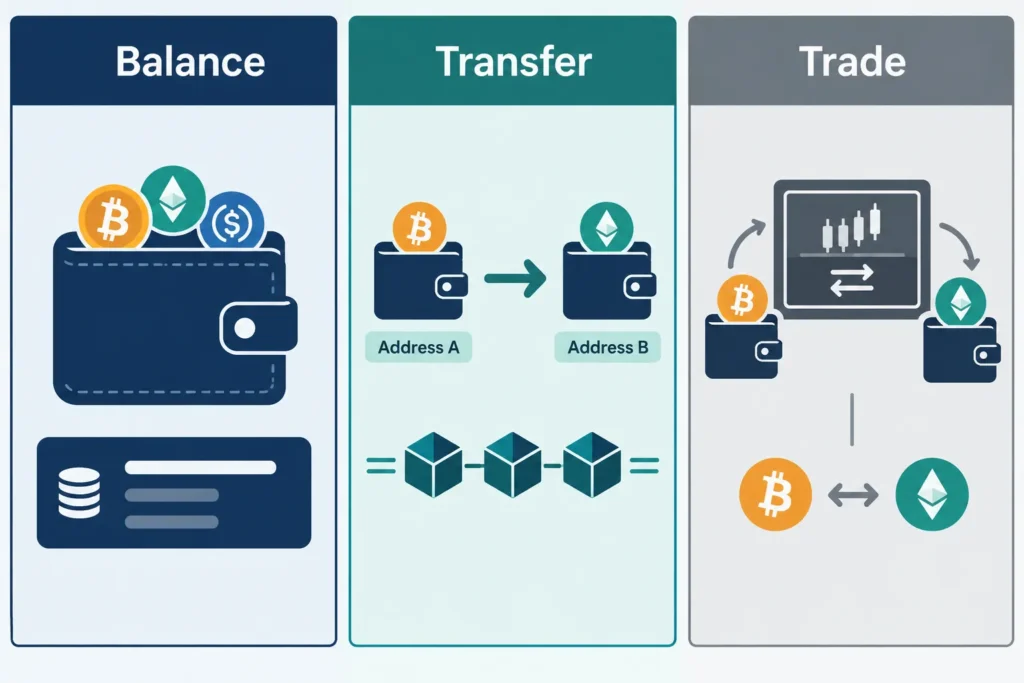
Comparison of a large wallet balance, a crypto transfer, and an actual trade.

Before analysing whale activity, separate these three ideas:

  • Large wallet balance: An address holds many coins or tokens. This does not show when, where or why they were acquired.
  • Large transaction: Funds moved between addresses. The transfer may be an exchange reorganisation, bridge deposit, custody change, collateral movement or transfer between wallets controlled by the same owner.
  • Actual buying or selling: Assets were exchanged through an order book, decentralised exchange, broker or over-the-counter arrangement. A simple blockchain transfer does not prove that a trade occurred.

On-chain data records what happened on a blockchain, but it does not always reveal the real-world purpose or owner. Treat wallet labels and transaction interpretations as evidence with varying levels of confidence rather than established facts.

How Blockchain Explorers Help Track Whales

A blockchain explorer lets you inspect public ledger data. Etherscan is commonly used for Ethereum, while BscScan provides similar information for BNB Smart Chain.

You can search an explorer using a public wallet address, transaction hash, block number or token contract address. A wallet page may show its native-coin balance, token holdings, transaction history and interactions with smart contracts. A transaction page may show the sender, recipient, time, amount, status, network fee and token transfers.

How to Inspect a Wallet Step by Step

  1. Confirm that you are using the correct blockchain explorer for the address and network.
  2. Paste the public address into the explorer’s search field. Never enter a seed phrase or private key.
  3. Review its native cryptocurrency balance and token holdings.
  4. Inspect incoming and outgoing transactions rather than relying only on the current balance.
  5. Open significant transactions to examine the sender, recipient, token transfers and contract interactions.
  6. Check whether the explorer displays a public label for the address, but do not assume that every label is complete or correct.
  7. For a token, open the verified token contract and review the holders section where available. Make sure you have selected the genuine contract, as tokens can share names and symbols.
You May Also Like:Crypto Support and Resistance Levels Explained: A Beginner’s Guide

Explorer access is generally available without payment for ordinary searches. Account-based watchlists, notifications, APIs or higher usage levels may have separate conditions. Explorers display raw and indexed blockchain data, but they usually cannot explain the intention behind a transaction or identify every wallet owner.

Best Tools for Monitoring Crypto Whale Activity

Different tools answer different questions. Explorers are useful for verifying individual transactions, while analytics platforms organise data into wallet labels, dashboards and market-level metrics. Access levels and features can change, so check each provider’s current official information before choosing a plan.

Whale Alert

Whale Alert reports selected large blockchain transfers and may include labels for known services. Its public alerts can help a beginner discover transactions worth investigating, while its platform and data services may provide additional capabilities.

Use an alert as a starting point. Open the underlying transaction in an appropriate explorer, inspect both addresses and check whether it could be an internal exchange or custody transfer. Public access and paid services may both apply. Whale Alert cannot establish that a transfer caused a market move or represented a trade, and labels may not reveal the ultimate owner.

Nansen

Nansen combines on-chain data with wallet labels and analytical dashboards. Depending on current product access, users may study labelled entities, token flows and wallet activity.

A beginner can use it to add context to an otherwise anonymous address and compare activity across wallets. Some information may be accessible without payment, while advanced analysis may require paid access. Its main limitation is that labels and behavioural categories are analytical classifications, not guaranteed identification or proof of future performance.

Glassnode

Glassnode focuses on aggregated on-chain and market metrics. It can help users study exchange flows, supply distribution, holder behaviour and other network-level trends where relevant data is available.

Beginners can use it to compare a large transaction with broader conditions rather than judging one wallet in isolation. Free access and paid features may apply. Aggregated metrics depend on methodology, address clustering and entity labels, so they should not be treated as a complete record of every owner or transaction purpose.

Santiment

Santiment combines on-chain data with market and social information. It may help users examine large-holder balances, token activity and sentiment in one research workflow.

A beginner can compare changes among large-holder groups with transaction volume and market context. Some access may be free, while advanced data or tools may be paid. Social attention can be noisy, holder categories can include different types of entities, and correlation does not establish causation.

You May Also Like:How to Read Crypto Price Charts

Arkham Intelligence

Arkham Intelligence provides blockchain analysis centred on addresses, entities, fund flows and wallet visualisation. It can help a beginner follow transfers between labelled wallets and see how related addresses may connect.

Public access and paid or specialised capabilities may apply. Entity attribution is not infallible, and a labelled address may represent a service, deposit address or cluster rather than a single person. Confirm important findings with the original blockchain records.

Lookonchain

Lookonchain publishes wallet-based observations and transaction breakdowns. It can help beginners discover addresses or transaction patterns that can then be checked independently.

Public posts are available, while any additional products or access conditions should be confirmed through its official channels. The selection of wallets is editorial, and the interpretation attached to a transfer may be incomplete. Never rely on a post without checking the address, transaction and wider context.

Complementary Tools

  • DeBank: Presents wallet portfolios and decentralised finance positions across supported networks. It is useful for understanding a wallet’s visible assets and protocol exposure. Public and additional features may differ. It may not capture every network, asset, hidden liability or off-chain position.
  • DEXTools: Helps users inspect decentralised exchange pairs, liquidity and trading activity. A beginner can use it to check whether a token movement coincided with an on-chain swap. Access levels may vary. Displayed trades do not identify the beneficial owner, and low-liquidity markets can be misleading.
  • Token Sniffer: Provides automated token and smart-contract checks. It may help beginners identify contract risks before focusing on holder activity. Access conditions may vary, and automated scores cannot replace contract review or prove that a token is safe.

Rich lists and holder pages on explorers can also reveal highly concentrated ownership. Exclude known smart contracts, liquidity pools, bridges, burn addresses and exchange wallets where possible before drawing conclusions about individual whales.

How to Recognise Common Address Types

Correct classification can prevent major interpretation errors. Where identification is possible, look for the following clues:

  • Exchange wallet: May carry an explorer or analytics label and interact with many deposit and withdrawal addresses. Labels can be incomplete.
  • Exchange cold wallet: Often stores large balances and moves funds less frequently. A transfer to or from it may be treasury management rather than customer trading.
  • Smart contract: Explorers normally identify contract addresses and may display verified code or contract methods. A contract is software, not an ordinary personal wallet.
  • Liquidity pool: Holds two or more assets used for decentralised trading. Large balances represent pool liquidity, not necessarily one investor’s portfolio.
  • Bridge: Locks, releases, mints or burns assets as value moves between networks. A bridge transfer can look like an inflow or outflow without representing a sale.
  • Individual wallet: May show ordinary transfers and protocol interactions, but an unlabeled address cannot automatically be assigned to one person.

Review the address label, transaction pattern, contract status and counterparties together. No single clue proves ownership.

Understanding Exchange Inflows and Outflows
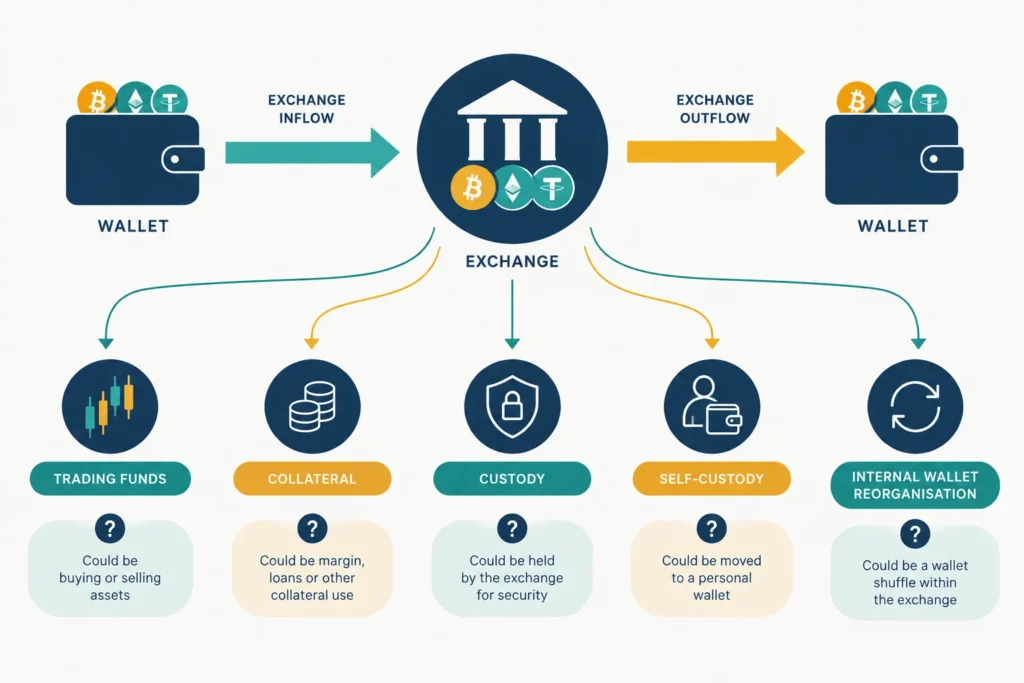
Diagram showing crypto exchange inflows and outflows and their possible interpretations.

An exchange inflow occurs when assets move to an address identified as belonging to an exchange. It can mean that the holder wants to trade, use collateral, lend, transfer funds to another user or simply keep assets with a custodian. It is not guaranteed selling pressure.

An exchange outflow occurs when assets leave a labelled exchange address. It may reflect withdrawal to self-custody, transfer to another platform, institutional custody, an exchange’s internal wallet reorganisation or another operational process. It is not guaranteed accumulation.

For better context, examine net flows over time, repeated movements, the destination address, subsequent transactions and whether the exchange appears to be moving assets between its own hot and cold wallets. Analytics platforms such as Glassnode and Nansen can provide broader context, while an explorer can verify individual transfers.

How to Build and Monitor a Whale Watchlist
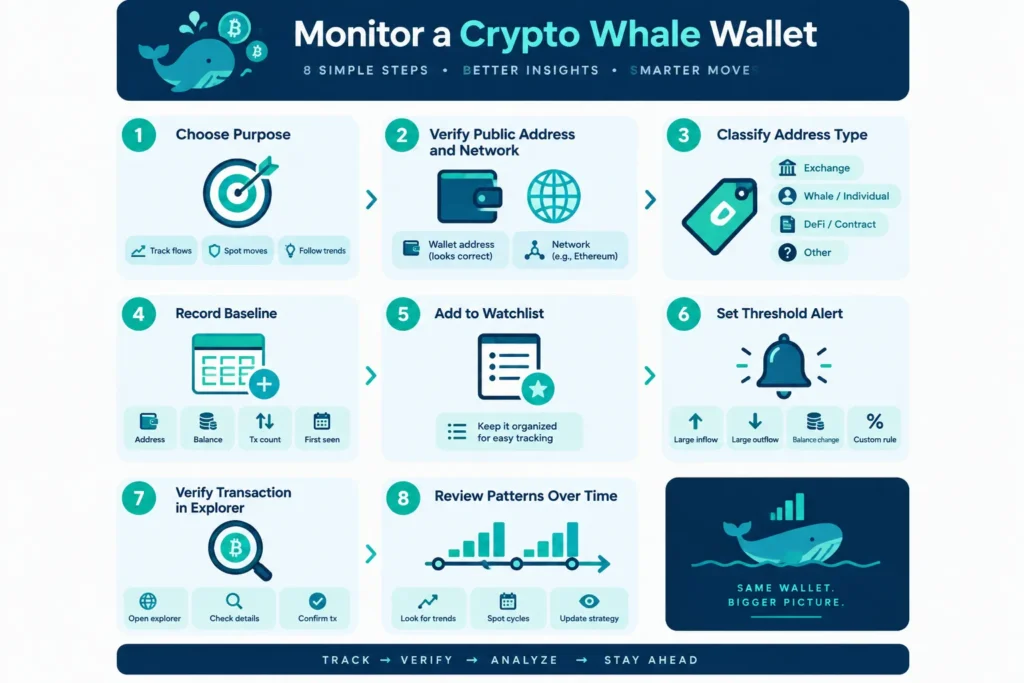
Flowchart showing how to verify, classify, monitor, and review a crypto whale wallet.

  1. Choose a clear purpose. Decide whether you are monitoring a token’s major holders, an exchange wallet, a fund, a protocol treasury or a wallet discussed by an analyst.
  2. Verify the source. Obtain the public address from a reliable label, project disclosure or original transaction. Check the network carefully.
  3. Classify the address. Record whether it appears to be an exchange, contract, pool, bridge, treasury or individual wallet. Mark uncertain classifications as unconfirmed.
  4. Record a baseline. Note the wallet’s balance, major holdings and recent activity. Use dates and transaction links in your private research notes.
  5. Create a watchlist. Use supported explorer watchlists or an analytics platform. A spreadsheet can also record addresses, labels, balance changes and observations.
  6. Set useful thresholds. Avoid alerts for every small transfer. Choose an amount or percentage change that is meaningful for the token’s liquidity and the wallet’s normal behaviour.
  7. Review patterns, not isolated events. Compare multiple transactions, counterparties and balance changes over days or weeks.
  8. Recheck labels periodically. Wallet ownership and service infrastructure can change, while analytical labels may be updated.
You May Also Like:What Are Crypto Candlestick Charts? A Beginner’s Guide

How to Spot Possible Accumulation or Distribution

Possible accumulation may involve repeated incoming transfers, purchases through identifiable decentralised exchange swaps or a rising balance over time. Possible distribution may involve repeated outgoing transfers, identifiable swaps into other assets or a declining balance spread among exchanges and other addresses.

Neither pattern is conclusive on its own. A wallet may be consolidating several addresses, moving funds to custody, supplying liquidity, depositing collateral, claiming vested tokens or transferring assets across chains.

Use this checklist before forming a view:

  • Compare the beginning and ending wallet balances.
  • Check whether the transfers involved swaps or only wallet-to-wallet movements.
  • Identify the counterparties where labels are available.
  • Look for repeated behaviour rather than one transaction.
  • Check token unlocks, treasury distributions, bridge activity and liquidity-pool deposits.
  • Compare the wallet’s activity with market liquidity, trading volume and broader on-chain flows.

How to Set Large-Transaction Alerts

Alerts reduce the need to refresh wallet pages manually. Depending on current access, explorers and analytics services may support address watchlists, transaction notifications or custom signals.

  1. Select the wallet, token or type of transaction you want to monitor.
  2. Choose the correct blockchain and verify the contract address.
  3. Set a threshold that is large relative to the asset’s liquidity, not merely a large rupee or dollar figure.
  4. Select the available notification method offered by the service.
  5. When an alert arrives, open the original transaction in a blockchain explorer.
  6. Check the sender, receiver, token transfers, contract interactions and address labels.
  7. Wait for further evidence before interpreting the event as accumulation, distribution, buying or selling.

Never connect a wallet or sign a transaction merely to receive an alert. Legitimate monitoring of a public address does not require your seed phrase or private key.

Hypothetical Example: Investigating a Large Ethereum Transfer

The following scenario is entirely hypothetical and does not describe a real wallet, transaction or current market event.

Suppose an alert reports that a large amount of ETH moved from an unlabeled address to an address labelled as an exchange.

  1. Open the transaction in Etherscan and confirm that it succeeded.
  2. Check whether the ETH moved directly to the labelled exchange address or passed through an intermediary.
  3. Inspect the sending wallet’s history. A one-off transfer from a long-term holder looks different from frequent exchange deposits by an active service.
  4. Review the recipient. It may be an exchange deposit wallet, hot wallet or another address with an uncertain label.
  5. Check whether the funds later moved into another exchange-controlled wallet. That could indicate internal consolidation rather than a sale.
  6. Look for an on-chain swap. If there is no swap, the blockchain only proves that ETH was transferred.
  7. Compare the event with broader exchange flows and market liquidity. One deposit may be insignificant in the wider market.

A careful conclusion would be: “A large amount of ETH moved to an address labelled as an exchange, which may increase the funds available for trading, but the owner’s intention and any eventual sale are unknown.” It would be inaccurate to state that the whale had sold merely because the deposit occurred.

What Dormant Wallet Activity Means

A dormant wallet is an address that has not made an outgoing transaction for a long period. Its reactivation can attract attention, especially when it holds an old or large balance.

Possible explanations include transferring to a safer wallet, changing custodians, testing access, inheritance or estate administration, preparing collateral, consolidating holdings, splitting funds among addresses or interacting with a newer protocol. The owner may also be preparing to trade, but inactivity followed by movement does not prove an intention to sell.

Check whether the wallet made a small test transaction first, where the funds eventually went and whether they reached a trading venue. Even then, avoid claiming certainty about the owner’s identity or purpose.

Why Copying Smart Money Wallets Is Risky

“Smart Money” is usually a platform or analyst’s label for wallets considered experienced, active or historically successful under a particular methodology. It does not mean every future transaction will be profitable.

  • You may see a transfer without seeing an off-chain hedge or over-the-counter agreement.
  • The wallet may be part of a larger group of addresses.
  • You may enter later and receive a much worse price.
  • A whale can tolerate losses, illiquidity and volatility that a beginner cannot.
  • The transaction may be market making, collateral management or liquidity provision rather than a directional bet.
  • Historical wallet performance does not guarantee future results.
You May Also Like:Crypto Spot Trading vs Futures Trading: Key Differences for Beginners

Use tracked wallets as research inputs, not instructions to copy trades. Also examine the project’s purpose, token supply and actual utility. This overview of crypto coins with real-world use cases provides additional context for evaluating utility, but it should not replace independent research.

Important Limitations of Whale Tracking

  • Unknown ownership: One person can use many addresses, and one custodial address can represent many customers.
  • Internal exchange transfers: Exchanges regularly move assets between operational, hot and cold wallets.
  • OTC transactions: A negotiated trade may settle on-chain without appearing on a public order book, while its full terms remain private.
  • Cross-chain transfers: Bridges can lock assets on one network and issue or release corresponding assets elsewhere.
  • Token unlocks: Team, investor or ecosystem allocations may move according to a vesting schedule rather than a new trading decision.
  • Misleading labels: Explorer and analytics labels can be incomplete, outdated or based on address clustering.
  • Contract and pool balances: Large holdings may belong to protocols, liquidity pools or token contracts rather than individual whales.
  • Missing off-chain context: Centralised exchange trades, private agreements, derivatives and hedges may not be visible from one wallet.

Whale movements do not reliably predict cryptocurrency prices. Combine on-chain research with liquidity, market structure, project fundamentals and your personal risk limits.

Beginner FAQs

Can I track a crypto wallet for free?

Public blockchain explorers generally allow ordinary address and transaction searches without payment. Some analytics, alerts, APIs and advanced dashboards may require an account or paid access.

Can I find the name of a crypto wallet owner?

Usually not. Some addresses are publicly disclosed or labelled as belonging to exchanges, projects and other entities, but many remain pseudonymous. A label should not be treated as legal proof of ownership.

Does a transfer to an exchange mean a whale is selling?

No. It means funds reached an address identified as an exchange address. The assets may be sold, used as collateral, transferred internally or left untouched.

Does an exchange withdrawal mean a whale is accumulating?

No. It may represent self-custody, a custody change, an internal exchange movement or a transfer to another platform. More evidence is needed.

Are top token holders always whales?

No. A holders list may include exchanges, bridges, liquidity pools, treasuries, vesting contracts, burn addresses and smart contracts. Classify addresses before analysing concentration.

How do I know whether a whale actually bought a token?

Look for evidence of a swap or trade and a corresponding balance change. Even then, you may not know the wallet’s wider strategy, other addresses or off-chain positions.

Is following whale activity enough to make a trade?

No. Whale data is only one research input, and transaction intent is often uncertain. Consider liquidity, valuation, token risks and your ability to absorb a loss. There is no guaranteed-profit whale strategy.

Final Thoughts

The safest way to track whale activity is to begin with verifiable blockchain records and then add context from analytics platforms. Use Etherscan or BscScan to inspect original transactions, services such as Whale Alert to discover notable transfers, and platforms such as Nansen, Glassnode, Santiment or Arkham Intelligence to study labels and broader patterns.

Most importantly, distinguish a balance from a transfer and a transfer from a trade. Watch repeated behaviour, verify counterparties and remain open to ordinary explanations such as exchange maintenance, custody changes and bridge activity. Whale tracking can improve market research, but it cannot reveal every owner’s intention or predict prices with certainty.
Share this article
KEEP READING

Related Articles

View all →

How to Track Whale Activity in Crypto: Tools & Tips for Smart Investors

Cryptocurrency whale activity tracking with blockchain explorers and on-chain analytics tools

Learning how to track whale activity in crypto can help you understand how large holders, exchanges and other major participants move funds on public blockchains. However, a large transfer is not automatically a purchase, sale or reliable price signal.

This beginner-friendly guide explains how to inspect transactions with blockchain explorers, monitor wallet addresses, set alerts and use on-chain analytics platforms. It also shows how to separate useful evidence from assumptions before making an investment or trading decision.

What Is a Crypto Whale?

A crypto whale is a person, company, fund or other entity believed to control a large amount of a cryptocurrency. There is no universal balance that makes an address a whale. The relevant amount depends on the asset’s circulating supply, liquidity and ownership distribution.

Large holders attract attention because their transactions may affect market liquidity or sentiment. A major order placed on an exchange can move the market, particularly in a thinly traded token. Large wallets may also participate in governance, provide liquidity or influence how concentrated a token’s supply is.

One entity can control several addresses, while one address can hold funds for thousands of users. For example, an exchange cold wallet may appear near the top of a cryptocurrency rich list even though the assets belong to the exchange’s customers. A rich list therefore shows address concentration, not necessarily the number of individual owners.

Balance, Transfer and Trade Are Different Events

Comparison of a large wallet balance, a crypto transfer, and an actual trade.

Before analysing whale activity, separate these three ideas:

  • Large wallet balance: An address holds many coins or tokens. This does not show when, where or why they were acquired.
  • Large transaction: Funds moved between addresses. The transfer may be an exchange reorganisation, bridge deposit, custody change, collateral movement or transfer between wallets controlled by the same owner.
  • Actual buying or selling: Assets were exchanged through an order book, decentralised exchange, broker or over-the-counter arrangement. A simple blockchain transfer does not prove that a trade occurred.

On-chain data records what happened on a blockchain, but it does not always reveal the real-world purpose or owner. Treat wallet labels and transaction interpretations as evidence with varying levels of confidence rather than established facts.

How Blockchain Explorers Help Track Whales

A blockchain explorer lets you inspect public ledger data. Etherscan is commonly used for Ethereum, while BscScan provides similar information for BNB Smart Chain.

You can search an explorer using a public wallet address, transaction hash, block number or token contract address. A wallet page may show its native-coin balance, token holdings, transaction history and interactions with smart contracts. A transaction page may show the sender, recipient, time, amount, status, network fee and token transfers.

How to Inspect a Wallet Step by Step

  1. Confirm that you are using the correct blockchain explorer for the address and network.
  2. Paste the public address into the explorer’s search field. Never enter a seed phrase or private key.
  3. Review its native cryptocurrency balance and token holdings.
  4. Inspect incoming and outgoing transactions rather than relying only on the current balance.
  5. Open significant transactions to examine the sender, recipient, token transfers and contract interactions.
  6. Check whether the explorer displays a public label for the address, but do not assume that every label is complete or correct.
  7. For a token, open the verified token contract and review the holders section where available. Make sure you have selected the genuine contract, as tokens can share names and symbols.

Explorer access is generally available without payment for ordinary searches. Account-based watchlists, notifications, APIs or higher usage levels may have separate conditions. Explorers display raw and indexed blockchain data, but they usually cannot explain the intention behind a transaction or identify every wallet owner.

Best Tools for Monitoring Crypto Whale Activity

Different tools answer different questions. Explorers are useful for verifying individual transactions, while analytics platforms organise data into wallet labels, dashboards and market-level metrics. Access levels and features can change, so check each provider’s current official information before choosing a plan.

Whale Alert

Whale Alert reports selected large blockchain transfers and may include labels for known services. Its public alerts can help a beginner discover transactions worth investigating, while its platform and data services may provide additional capabilities.

Use an alert as a starting point. Open the underlying transaction in an appropriate explorer, inspect both addresses and check whether it could be an internal exchange or custody transfer. Public access and paid services may both apply. Whale Alert cannot establish that a transfer caused a market move or represented a trade, and labels may not reveal the ultimate owner.

Nansen

Nansen combines on-chain data with wallet labels and analytical dashboards. Depending on current product access, users may study labelled entities, token flows and wallet activity.

A beginner can use it to add context to an otherwise anonymous address and compare activity across wallets. Some information may be accessible without payment, while advanced analysis may require paid access. Its main limitation is that labels and behavioural categories are analytical classifications, not guaranteed identification or proof of future performance.

Glassnode

Glassnode focuses on aggregated on-chain and market metrics. It can help users study exchange flows, supply distribution, holder behaviour and other network-level trends where relevant data is available.

Beginners can use it to compare a large transaction with broader conditions rather than judging one wallet in isolation. Free access and paid features may apply. Aggregated metrics depend on methodology, address clustering and entity labels, so they should not be treated as a complete record of every owner or transaction purpose.

Santiment

Santiment combines on-chain data with market and social information. It may help users examine large-holder balances, token activity and sentiment in one research workflow.

A beginner can compare changes among large-holder groups with transaction volume and market context. Some access may be free, while advanced data or tools may be paid. Social attention can be noisy, holder categories can include different types of entities, and correlation does not establish causation.

Arkham Intelligence

Arkham Intelligence provides blockchain analysis centred on addresses, entities, fund flows and wallet visualisation. It can help a beginner follow transfers between labelled wallets and see how related addresses may connect.

Public access and paid or specialised capabilities may apply. Entity attribution is not infallible, and a labelled address may represent a service, deposit address or cluster rather than a single person. Confirm important findings with the original blockchain records.

Lookonchain

Lookonchain publishes wallet-based observations and transaction breakdowns. It can help beginners discover addresses or transaction patterns that can then be checked independently.

Public posts are available, while any additional products or access conditions should be confirmed through its official channels. The selection of wallets is editorial, and the interpretation attached to a transfer may be incomplete. Never rely on a post without checking the address, transaction and wider context.

Complementary Tools

  • DeBank: Presents wallet portfolios and decentralised finance positions across supported networks. It is useful for understanding a wallet’s visible assets and protocol exposure. Public and additional features may differ. It may not capture every network, asset, hidden liability or off-chain position.
  • DEXTools: Helps users inspect decentralised exchange pairs, liquidity and trading activity. A beginner can use it to check whether a token movement coincided with an on-chain swap. Access levels may vary. Displayed trades do not identify the beneficial owner, and low-liquidity markets can be misleading.
  • Token Sniffer: Provides automated token and smart-contract checks. It may help beginners identify contract risks before focusing on holder activity. Access conditions may vary, and automated scores cannot replace contract review or prove that a token is safe.

Rich lists and holder pages on explorers can also reveal highly concentrated ownership. Exclude known smart contracts, liquidity pools, bridges, burn addresses and exchange wallets where possible before drawing conclusions about individual whales.

How to Recognise Common Address Types

Correct classification can prevent major interpretation errors. Where identification is possible, look for the following clues:

  • Exchange wallet: May carry an explorer or analytics label and interact with many deposit and withdrawal addresses. Labels can be incomplete.
  • Exchange cold wallet: Often stores large balances and moves funds less frequently. A transfer to or from it may be treasury management rather than customer trading.
  • Smart contract: Explorers normally identify contract addresses and may display verified code or contract methods. A contract is software, not an ordinary personal wallet.
  • Liquidity pool: Holds two or more assets used for decentralised trading. Large balances represent pool liquidity, not necessarily one investor’s portfolio.
  • Bridge: Locks, releases, mints or burns assets as value moves between networks. A bridge transfer can look like an inflow or outflow without representing a sale.
  • Individual wallet: May show ordinary transfers and protocol interactions, but an unlabeled address cannot automatically be assigned to one person.

Review the address label, transaction pattern, contract status and counterparties together. No single clue proves ownership.

Understanding Exchange Inflows and Outflows

Diagram showing crypto exchange inflows and outflows and their possible interpretations.

An exchange inflow occurs when assets move to an address identified as belonging to an exchange. It can mean that the holder wants to trade, use collateral, lend, transfer funds to another user or simply keep assets with a custodian. It is not guaranteed selling pressure.

An exchange outflow occurs when assets leave a labelled exchange address. It may reflect withdrawal to self-custody, transfer to another platform, institutional custody, an exchange’s internal wallet reorganisation or another operational process. It is not guaranteed accumulation.

For better context, examine net flows over time, repeated movements, the destination address, subsequent transactions and whether the exchange appears to be moving assets between its own hot and cold wallets. Analytics platforms such as Glassnode and Nansen can provide broader context, while an explorer can verify individual transfers.

How to Build and Monitor a Whale Watchlist

Flowchart showing how to verify, classify, monitor, and review a crypto whale wallet.

  1. Choose a clear purpose. Decide whether you are monitoring a token’s major holders, an exchange wallet, a fund, a protocol treasury or a wallet discussed by an analyst.
  2. Verify the source. Obtain the public address from a reliable label, project disclosure or original transaction. Check the network carefully.
  3. Classify the address. Record whether it appears to be an exchange, contract, pool, bridge, treasury or individual wallet. Mark uncertain classifications as unconfirmed.
  4. Record a baseline. Note the wallet’s balance, major holdings and recent activity. Use dates and transaction links in your private research notes.
  5. Create a watchlist. Use supported explorer watchlists or an analytics platform. A spreadsheet can also record addresses, labels, balance changes and observations.
  6. Set useful thresholds. Avoid alerts for every small transfer. Choose an amount or percentage change that is meaningful for the token’s liquidity and the wallet’s normal behaviour.
  7. Review patterns, not isolated events. Compare multiple transactions, counterparties and balance changes over days or weeks.
  8. Recheck labels periodically. Wallet ownership and service infrastructure can change, while analytical labels may be updated.

How to Spot Possible Accumulation or Distribution

Possible accumulation may involve repeated incoming transfers, purchases through identifiable decentralised exchange swaps or a rising balance over time. Possible distribution may involve repeated outgoing transfers, identifiable swaps into other assets or a declining balance spread among exchanges and other addresses.

Neither pattern is conclusive on its own. A wallet may be consolidating several addresses, moving funds to custody, supplying liquidity, depositing collateral, claiming vested tokens or transferring assets across chains.

Use this checklist before forming a view:

  • Compare the beginning and ending wallet balances.
  • Check whether the transfers involved swaps or only wallet-to-wallet movements.
  • Identify the counterparties where labels are available.
  • Look for repeated behaviour rather than one transaction.
  • Check token unlocks, treasury distributions, bridge activity and liquidity-pool deposits.
  • Compare the wallet’s activity with market liquidity, trading volume and broader on-chain flows.

How to Set Large-Transaction Alerts

Alerts reduce the need to refresh wallet pages manually. Depending on current access, explorers and analytics services may support address watchlists, transaction notifications or custom signals.

  1. Select the wallet, token or type of transaction you want to monitor.
  2. Choose the correct blockchain and verify the contract address.
  3. Set a threshold that is large relative to the asset’s liquidity, not merely a large rupee or dollar figure.
  4. Select the available notification method offered by the service.
  5. When an alert arrives, open the original transaction in a blockchain explorer.
  6. Check the sender, receiver, token transfers, contract interactions and address labels.
  7. Wait for further evidence before interpreting the event as accumulation, distribution, buying or selling.

Never connect a wallet or sign a transaction merely to receive an alert. Legitimate monitoring of a public address does not require your seed phrase or private key.

Hypothetical Example: Investigating a Large Ethereum Transfer

The following scenario is entirely hypothetical and does not describe a real wallet, transaction or current market event.

Suppose an alert reports that a large amount of ETH moved from an unlabeled address to an address labelled as an exchange.

  1. Open the transaction in Etherscan and confirm that it succeeded.
  2. Check whether the ETH moved directly to the labelled exchange address or passed through an intermediary.
  3. Inspect the sending wallet’s history. A one-off transfer from a long-term holder looks different from frequent exchange deposits by an active service.
  4. Review the recipient. It may be an exchange deposit wallet, hot wallet or another address with an uncertain label.
  5. Check whether the funds later moved into another exchange-controlled wallet. That could indicate internal consolidation rather than a sale.
  6. Look for an on-chain swap. If there is no swap, the blockchain only proves that ETH was transferred.
  7. Compare the event with broader exchange flows and market liquidity. One deposit may be insignificant in the wider market.

A careful conclusion would be: “A large amount of ETH moved to an address labelled as an exchange, which may increase the funds available for trading, but the owner’s intention and any eventual sale are unknown.” It would be inaccurate to state that the whale had sold merely because the deposit occurred.

What Dormant Wallet Activity Means

A dormant wallet is an address that has not made an outgoing transaction for a long period. Its reactivation can attract attention, especially when it holds an old or large balance.

Possible explanations include transferring to a safer wallet, changing custodians, testing access, inheritance or estate administration, preparing collateral, consolidating holdings, splitting funds among addresses or interacting with a newer protocol. The owner may also be preparing to trade, but inactivity followed by movement does not prove an intention to sell.

Check whether the wallet made a small test transaction first, where the funds eventually went and whether they reached a trading venue. Even then, avoid claiming certainty about the owner’s identity or purpose.

Why Copying Smart Money Wallets Is Risky

“Smart Money” is usually a platform or analyst’s label for wallets considered experienced, active or historically successful under a particular methodology. It does not mean every future transaction will be profitable.

  • You may see a transfer without seeing an off-chain hedge or over-the-counter agreement.
  • The wallet may be part of a larger group of addresses.
  • You may enter later and receive a much worse price.
  • A whale can tolerate losses, illiquidity and volatility that a beginner cannot.
  • The transaction may be market making, collateral management or liquidity provision rather than a directional bet.
  • Historical wallet performance does not guarantee future results.

Use tracked wallets as research inputs, not instructions to copy trades. Also examine the project’s purpose, token supply and actual utility. This overview of crypto coins with real-world use cases provides additional context for evaluating utility, but it should not replace independent research.

Important Limitations of Whale Tracking

  • Unknown ownership: One person can use many addresses, and one custodial address can represent many customers.
  • Internal exchange transfers: Exchanges regularly move assets between operational, hot and cold wallets.
  • OTC transactions: A negotiated trade may settle on-chain without appearing on a public order book, while its full terms remain private.
  • Cross-chain transfers: Bridges can lock assets on one network and issue or release corresponding assets elsewhere.
  • Token unlocks: Team, investor or ecosystem allocations may move according to a vesting schedule rather than a new trading decision.
  • Misleading labels: Explorer and analytics labels can be incomplete, outdated or based on address clustering.
  • Contract and pool balances: Large holdings may belong to protocols, liquidity pools or token contracts rather than individual whales.
  • Missing off-chain context: Centralised exchange trades, private agreements, derivatives and hedges may not be visible from one wallet.

Whale movements do not reliably predict cryptocurrency prices. Combine on-chain research with liquidity, market structure, project fundamentals and your personal risk limits.

Beginner FAQs

Can I track a crypto wallet for free?

Public blockchain explorers generally allow ordinary address and transaction searches without payment. Some analytics, alerts, APIs and advanced dashboards may require an account or paid access.

Can I find the name of a crypto wallet owner?

Usually not. Some addresses are publicly disclosed or labelled as belonging to exchanges, projects and other entities, but many remain pseudonymous. A label should not be treated as legal proof of ownership.

Does a transfer to an exchange mean a whale is selling?

No. It means funds reached an address identified as an exchange address. The assets may be sold, used as collateral, transferred internally or left untouched.

Does an exchange withdrawal mean a whale is accumulating?

No. It may represent self-custody, a custody change, an internal exchange movement or a transfer to another platform. More evidence is needed.

Are top token holders always whales?

No. A holders list may include exchanges, bridges, liquidity pools, treasuries, vesting contracts, burn addresses and smart contracts. Classify addresses before analysing concentration.

How do I know whether a whale actually bought a token?

Look for evidence of a swap or trade and a corresponding balance change. Even then, you may not know the wallet’s wider strategy, other addresses or off-chain positions.

Is following whale activity enough to make a trade?

No. Whale data is only one research input, and transaction intent is often uncertain. Consider liquidity, valuation, token risks and your ability to absorb a loss. There is no guaranteed-profit whale strategy.

Final Thoughts

The safest way to track whale activity is to begin with verifiable blockchain records and then add context from analytics platforms. Use Etherscan or BscScan to inspect original transactions, services such as Whale Alert to discover notable transfers, and platforms such as Nansen, Glassnode, Santiment or Arkham Intelligence to study labels and broader patterns.

Most importantly, distinguish a balance from a transfer and a transfer from a trade. Watch repeated behaviour, verify counterparties and remain open to ordinary explanations such as exchange maintenance, custody changes and bridge activity. Whale tracking can improve market research, but it cannot reveal every owner’s intention or predict prices with certainty.