



Emergency Fund Guide for Beginners in India (2026): How Much Should You Save?
Unexpected expenses are a part of life.
A sudden medical emergency, an unexpected job loss, a major car repair, or urgent home maintenance can put significant pressure on your finances. If you don’t have money set aside for these situations, you may have to rely on credit cards, personal loans, or borrow from friends and family.
This is where an emergency fund becomes one of the most important building blocks of personal finance.
An emergency fund is more than just money saved in a bank account. It acts as your financial safety net, giving you the confidence to handle life’s uncertainties without disrupting your long-term financial goals.
Unfortunately, many people in India focus on investing before creating an emergency fund. While investing is essential for wealth creation, having no emergency savings may force you to sell investments at the wrong time or take on expensive debt when an unexpected expense arises.
Whether you’re a salaried employee, a freelancer, a business owner, or a student beginning your financial journey, building an emergency fund should be one of your first financial priorities.
New to personal finance?
This guide is part of our comprehensive Personal Finance Guide for Beginners in India, where you’ll learn budgeting, saving, investing, insurance, and practical money management strategies to build long-term financial security.
In this guide, you’ll learn:
- What an emergency fund is
- Why every Indian household should have one
- How much money you should save
- How to calculate your emergency fund
- The best places to keep your emergency savings
- Common mistakes to avoid
- Practical tips to build your emergency fund faster
By the end of this article, you’ll have a clear action plan to create an emergency fund that protects both your finances and your peace of mind.
This article is part of our Personal Finance Guide for Beginners in India, where you’ll learn budgeting, saving, investing, insurance, and retirement planning.
Key Takeaways
- An emergency fund helps you cover unexpected expenses without relying on loans or credit cards.
- Most people should aim to save 3–6 months of essential living expenses.
- Freelancers and business owners should consider a larger emergency fund of 6–12 months.
- Keep your emergency fund in a safe and easily accessible place, such as a savings account, sweep-in fixed deposit, or liquid mutual fund.
- Build your emergency fund before making high-risk investments.
- Review and replenish your emergency fund whenever you use it.
What Is an Emergency Fund?
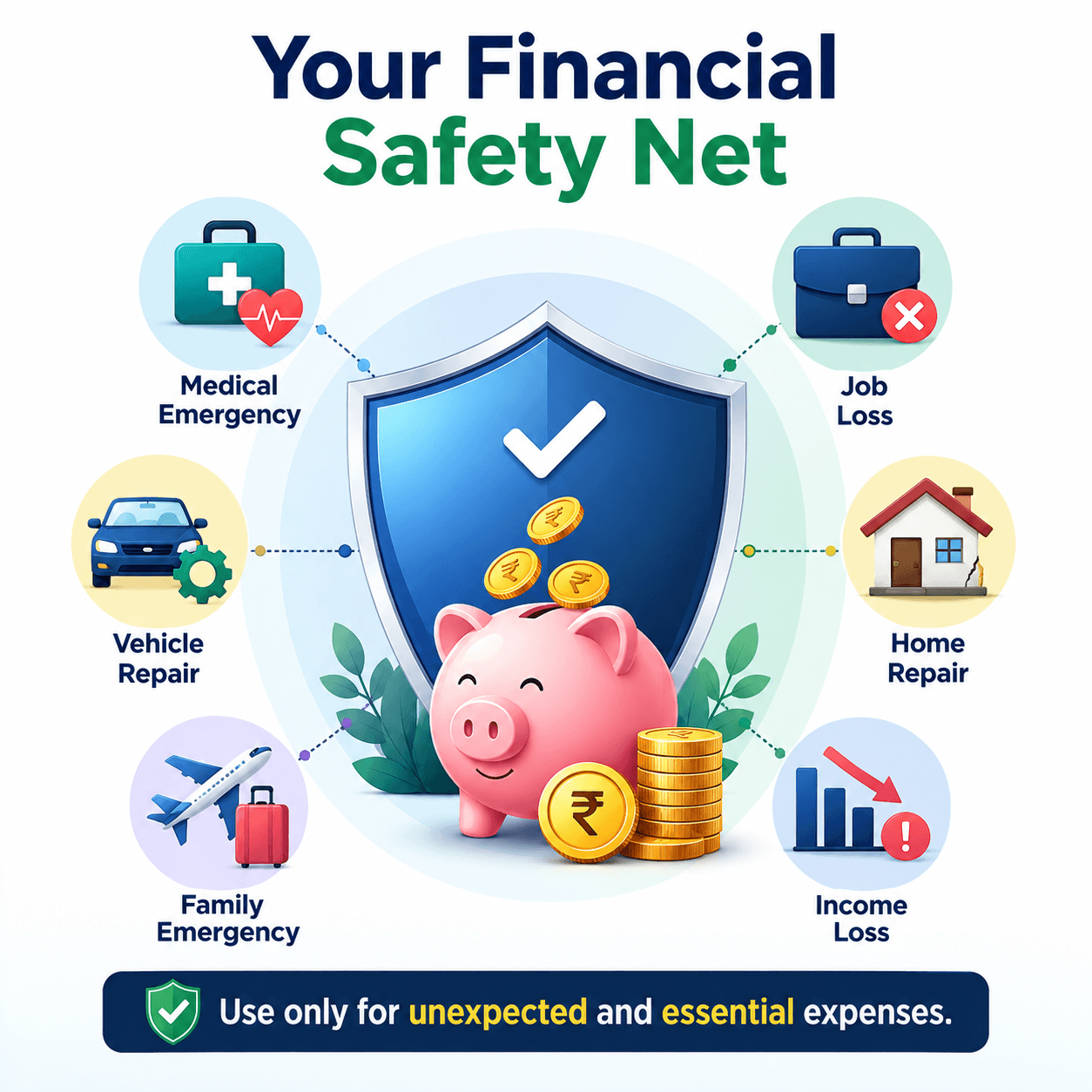
An emergency fund is money that you set aside specifically to pay for unexpected and essential expenses.
Unlike your regular savings, this money is not meant for planned purchases, vacations, shopping, or lifestyle upgrades.
Instead, it is reserved for genuine financial emergencies that could otherwise disrupt your budget or force you into debt.
Think of it as your financial safety net.
When an unexpected expense arises, your emergency fund allows you to deal with the situation immediately without selling investments, breaking long-term savings, or borrowing money at high interest rates.
Common Situations Where an Emergency Fund Can Help
An emergency fund can be used for expenses such as:
- Medical emergencies not fully covered by insurance
- Job loss or temporary unemployment
- Emergency home repairs
- Major vehicle repairs
- Urgent travel due to a family emergency
- Unexpected essential household expenses
- Temporary business or freelance income loss
These situations are difficult to predict, which is why preparing in advance is so important.
What Is Not an Emergency?
Many people use their savings for expenses that are important—but not emergencies.
For example, the following should generally not come from your emergency fund:
- Buying a new smartphone
- Festival shopping
- Planning a vacation
- Upgrading your furniture
- Purchasing luxury items
- Investing in the stock market
These are planned or discretionary expenses. Your emergency fund should remain available for genuine financial crises.
Emergency Fund vs. Regular Savings
People often confuse an emergency fund with a regular savings account, but they serve different purposes.
| Emergency Fund | Regular Savings |
|---|---|
| Reserved for unexpected expenses | Used for planned goals |
| Helps during financial emergencies | Supports short-term purchases |
| Should remain easily accessible | Can be spent according to your plans |
| Protects you from debt | Helps achieve lifestyle goals |
Both are important, but they should not be mixed.
Why Building an Emergency Fund Should Come First
Many beginners ask:
Should I start investing before building an emergency fund?
In most cases, the answer is no.
Imagine investing all your savings in mutual funds and then facing a medical emergency a few months later. If markets are down, you may have to sell your investments at a loss just to cover urgent expenses.
By building an emergency fund first, you create a financial buffer that allows your long-term investments to remain invested during difficult times.
This approach helps you stay focused on your financial goals without making decisions under pressure.
Regular Station Pro Tip:
Before increasing your investments, aim to build an emergency fund covering at least three months of essential living expenses. Once this safety net is in place, you can confidently begin investing for long-term wealth creation.
Quick Example
Let’s assume your family’s essential monthly expenses are:
| Expense | Monthly Cost |
|---|---|
| House Rent | ₹18,000 |
| Groceries | ₹8,000 |
| Utilities | ₹3,000 |
| Transportation | ₹4,000 |
| Insurance | ₹2,000 |
| Other Essentials | ₹5,000 |
| Total Monthly Expenses | ₹40,000 |
If you want an emergency fund covering six months, your target would be:
₹40,000 × 6 = ₹2,40,000
Instead of trying to save the full amount immediately, you can build it gradually through monthly contributions.
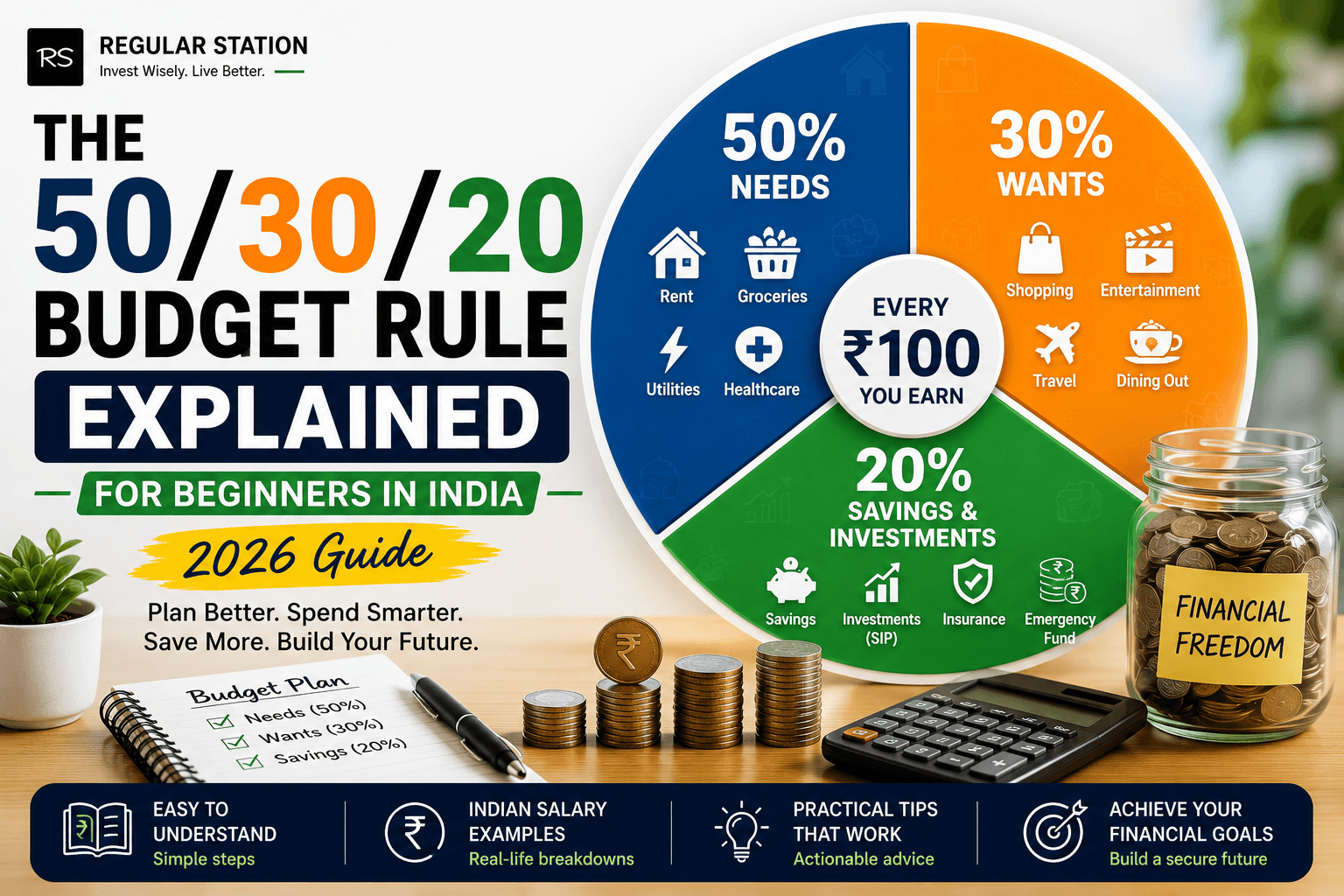
One practical way to save consistently is by following the 50/30/20 Budget Rule Explained for Beginners in India, which recommends allocating 20% of your take-home income toward savings and investments. Until your emergency fund is complete, you can direct most of that savings portion to this goal.
Why Every Indian Household Needs an Emergency Fund
Life is unpredictable.
No matter how carefully you plan your finances, unexpected events can happen without warning. A medical emergency, job loss, sudden business slowdown, or major home repair can put significant pressure on your finances.
If you don’t have an emergency fund, you may be forced to:
- Borrow money from family or friends.
- Use high-interest credit cards.
- Take a personal loan.
- Break your long-term investments.
- Delay important financial goals.
An emergency fund helps you handle these situations with confidence while protecting your long-term financial stability.
An emergency fund is one of the core building blocks of good money management. To understand how it fits into your overall financial journey, read our Personal Finance Guide for Beginners in India.
The Reality of Financial Emergencies
Many people believe emergencies are rare.
In reality, almost every household faces unexpected expenses at some point.
Some emergencies affect your health.
Some affect your income.
Others affect your home or family.
The question isn’t whether an emergency will happen.
It’s whether you’ll be financially prepared when it does.
1. Job Loss or Salary Reduction
For most salaried employees, their monthly salary is their primary source of income.
Imagine receiving an email informing you that your company is downsizing or restructuring.
Even if you receive a severance package, finding another job may take several months.
During this period, your monthly expenses continue:
- House rent or home loan EMI
- Groceries
- Electricity and utility bills
- School fees
- Insurance premiums
- Transportation costs
Without emergency savings, these expenses can quickly lead to debt.
Example
Rahul earns ₹70,000 per month.
His family’s essential monthly expenses total ₹45,000.
After unexpectedly losing his job, he remains unemployed for four months.
Because Rahul had built an emergency fund covering six months of expenses, his family continued paying bills without taking loans or withdrawing long-term investments.
Instead of worrying about finances every day, he could focus on finding the right job.
2. Medical Emergencies
Health insurance is essential—but it doesn’t always cover every expense.
Many medical situations involve:
- Hospital admission deposits
- Medicines not covered by insurance
- Follow-up treatments
- Diagnostic tests
- Home care expenses
- Travel for treatment
These costs often need immediate payment.
An emergency fund provides quick access to cash when timing matters most.
Example
Priya’s father required emergency surgery.
Although the family’s health insurance covered most hospital expenses, they still had to pay nearly ₹60,000 for medicines, travel, and recovery-related costs.
Their emergency fund helped them manage these expenses without borrowing money.
3. Home Repairs
Unexpected home repairs can be expensive.
Examples include:
- Water leakage
- Electrical failures
- Roof damage
- Plumbing issues
- Air conditioner replacement
- Appliance breakdowns
These repairs are often unavoidable and need immediate attention.
Without emergency savings, homeowners may delay repairs, allowing minor problems to become much more expensive.
4. Vehicle Repairs
If your vehicle is essential for commuting or business, unexpected repairs can affect both your income and daily routine.
Common expenses include:
- Engine repairs
- Accident damage
- Tyre replacement
- Battery failure
- Transmission problems
A dedicated emergency fund prevents these costs from disrupting your monthly budget.
5. Family Emergencies
Indian families often support parents, children, and extended relatives.
Unexpected situations may include:
- Emergency travel
- Medical treatment for parents
- Family crises
- Educational emergencies
- Temporary financial support for loved ones
Having emergency savings allows you to respond quickly without compromising your own financial stability.
6. Business Slowdowns and Freelance Income Loss
If you’re self-employed, a freelancer, or a small business owner, your income may fluctuate from month to month.
Projects may be delayed.
Clients may pay late.
Business demand may slow temporarily.
Unlike salaried employees, freelancers usually don’t receive paid leave or severance benefits.
For this reason, experts generally recommend freelancers maintain a larger emergency fund—often covering 6–12 months of essential expenses.
How an Emergency Fund Protects Your Financial Goals
Imagine you’ve spent three years building a mutual fund portfolio for your child’s education.
Suddenly, you face an unexpected medical expense.
Without emergency savings, you may need to redeem your investments earlier than planned.
This could:
- Reduce long-term returns.
- Interrupt compounding.
- Delay your financial goals.
- Force you to sell during a market downturn.
An emergency fund protects your investments by covering short-term financial shocks.
Think of it as a protective barrier between your daily life and your long-term wealth.
Emergency Fund vs. Debt
Let’s compare two families facing the same emergency.
Family A – No Emergency Fund
Medical expense:
₹1,20,000
Solution:
Personal loan at high interest.
Result:
Monthly EMI for several years.
Additional interest payments.
Increased financial stress.
Family B – Emergency Fund Available
Medical expense:
₹1,20,000
Solution:
Used emergency savings.
Result:
No loan.
No interest.
No impact on long-term investments.
Peace of mind.
Comparison Table
| Without an Emergency Fund | With an Emergency Fund |
|---|---|
| Depend on loans | Use your own savings |
| Credit card debt | No debt |
| Interest payments | Zero borrowing cost |
| Financial stress | Greater peace of mind |
| May sell investments | Investments remain untouched |
Peace of Mind Has Value Too
An emergency fund doesn’t just protect your bank balance.
It also protects your mental well-being.
Financial uncertainty often leads to stress, especially when unexpected expenses arise.
Knowing you have money set aside for emergencies can help you:
- Make better financial decisions.
- Avoid panic borrowing.
- Focus on solving the problem instead of worrying about money.
- Sleep better during uncertain times.
Financial security isn’t only about wealth—it’s also about confidence.
Inflation Makes Emergency Funds Even More Important
The cost of living continues to rise.
Expenses such as:
- Groceries
- Fuel
- Healthcare
- Utilities
- Education
become more expensive over time.
Without emergency savings, even a relatively small unexpected expense can place additional pressure on your monthly budget.
This is why it’s important to review your emergency fund every year and adjust it if your monthly living expenses increase.
Every Stage of Life Needs an Emergency Fund
Students
Even students can benefit from setting aside money for:
- Medical expenses
- Emergency travel
- Laptop or phone replacement for studies
Young Professionals
Your first financial priority after starting a job should be building an emergency fund before making high-risk investments.
Married Couples
Couples often share financial responsibilities, making emergency savings even more important for household stability.
Families with Children
Education, healthcare, and household expenses make financial emergencies more challenging.
A larger emergency fund provides greater security.
Retirees
An emergency fund helps retirees avoid withdrawing long-term investments during temporary market downturns or unexpected medical expenses.
The Cost of Waiting
Many people delay building an emergency fund because they believe:
“I’ll start saving when my salary increases.”
Unfortunately, emergencies don’t wait for salary hikes.
Starting with just ₹2,000 or ₹3,000 per month is far better than waiting for the “perfect” time.
Consistency matters more than the initial amount.
Regular Station Pro Tip:
Build your emergency fund before chasing high investment returns. A strong financial foundation gives every future investment a better chance to succeed.
How Much Emergency Fund Should You Have?
One of the most common questions people ask is:
“How much money should I keep in my emergency fund?”
The answer depends on your monthly essential expenses, not your salary.
Many people make the mistake of saving an arbitrary amount like ₹50,000 or ₹1 lakh without calculating whether it’s actually enough to support their household during an emergency.
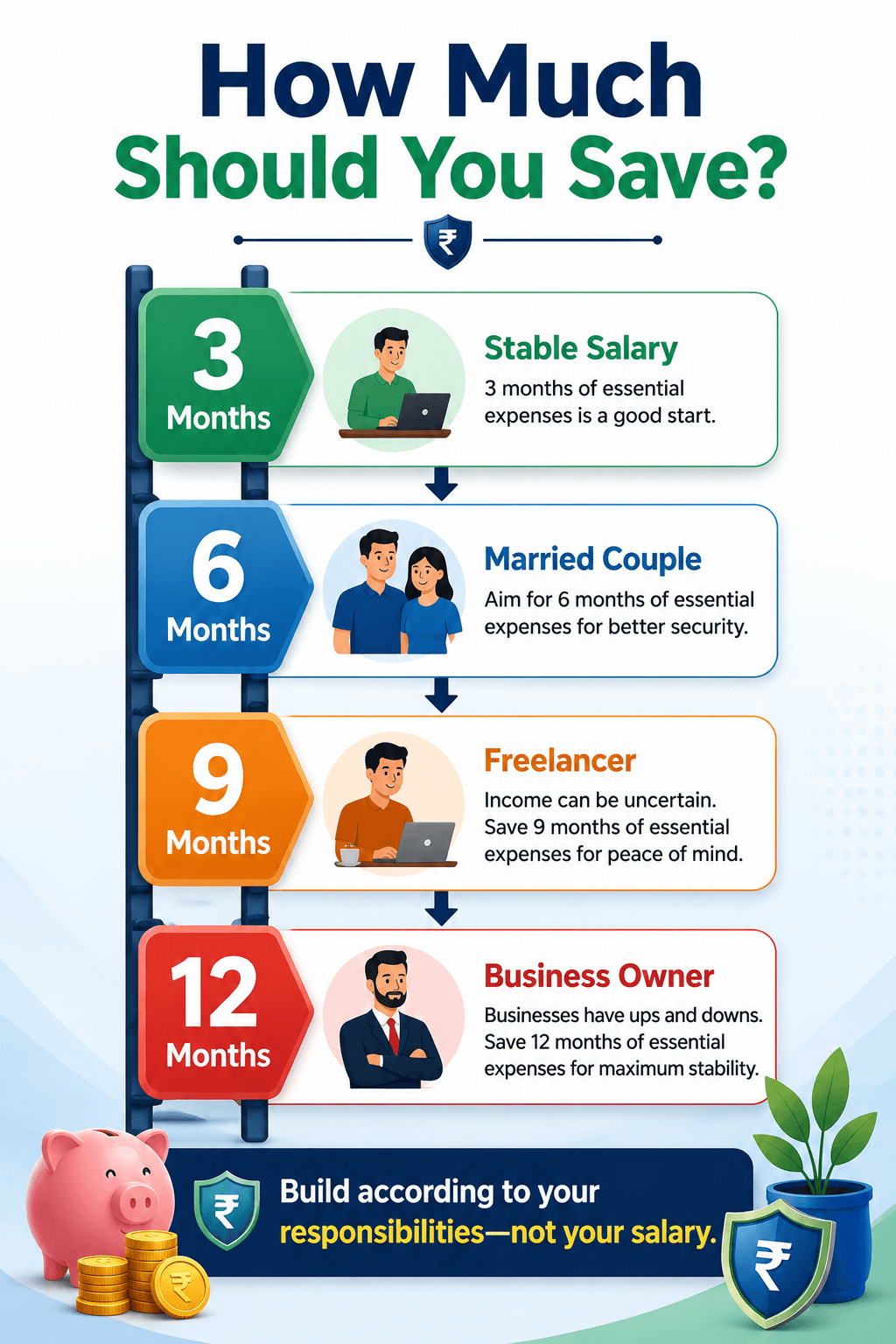
Instead of focusing on a fixed amount, financial experts recommend saving 3–6 months of essential living expenses.
If your income is unpredictable or you have greater financial responsibilities, you may need an even larger emergency fund.
Building an emergency fund is only one part of financial planning. Our Personal Finance Guide for Beginners in India explains how budgeting, investing, insurance, and retirement planning work together.
The Golden Rule
Your emergency fund should cover:
3–6 months of essential living expenses.
For people with variable income or higher financial risk:
6–12 months of essential living expenses.
Notice that the recommendation is based on expenses, not income.
Step 1: Calculate Your Essential Monthly Expenses
Start by listing only the expenses you must pay every month.
Include:
- House rent or home loan EMI
- Groceries
- Electricity
- Water
- Internet (if essential for work)
- Mobile bill
- Insurance premiums
- School fees
- Transportation
- Basic medicines
- Household essentials
Do not include lifestyle expenses such as:
- Shopping
- Dining out
- Entertainment subscriptions
- Vacations
- Luxury purchases
- Premium gadgets
Your emergency fund is designed to help you survive difficult periods—not maintain your normal lifestyle.
Example
| Essential Expense | Monthly Cost |
|---|---|
| Rent | ₹18,000 |
| Groceries | ₹8,000 |
| Utilities | ₹3,000 |
| Transportation | ₹4,000 |
| Insurance | ₹2,000 |
| Medicines | ₹2,000 |
| School Fees | ₹5,000 |
| Total Essential Expenses | ₹42,000 |
This household needs ₹42,000 every month to maintain basic living expenses.
Step 2: Multiply by the Number of Months
Once you’ve calculated your monthly expenses, multiply them by the number of months you want your emergency fund to cover.
| Months | Emergency Fund |
|---|---|
| 3 Months | ₹1,26,000 |
| 6 Months | ₹2,52,000 |
| 12 Months | ₹5,04,000 |
This gives you a realistic emergency savings target.
How Much Should Different People Save?
Your emergency fund should reflect your financial situation.
Salaried Employees
If you have:
- Stable employment
- Reliable monthly income
- Employer-provided benefits
A fund covering 3–6 months of essential expenses is usually sufficient.
Married Couples
Households with shared responsibilities often face higher monthly expenses.
If only one partner earns, consider building an emergency fund covering at least 6 months of expenses.
Families with Children
Families typically have additional commitments such as:
- School fees
- Healthcare
- Childcare
- Household maintenance
A larger emergency fund provides greater financial stability during unexpected situations.
Recommended:
6–9 months
Freelancers
Freelancers often experience:
- Delayed client payments
- Seasonal work
- Irregular income
- Project cancellations
Because income is less predictable, experts generally recommend:
9–12 months
Business Owners
Business income may fluctuate due to:
- Market conditions
- Customer demand
- Cash flow issues
Business owners should consider maintaining an emergency fund covering up to 12 months of personal essential expenses.
Retirees
Retirees often rely on investments or pension income.
A larger emergency fund helps avoid selling investments during temporary market declines.
Recommended:
6–12 months
Recommended Emergency Fund by Situation
| Your Situation | Recommended Fund |
|---|---|
| Student | 2–3 Months |
| First Job | 3 Months |
| Salaried Employee | 3–6 Months |
| Married Couple | 6 Months |
| Family with Children | 6–9 Months |
| Freelancer | 9–12 Months |
| Business Owner | 12 Months |
| Retired | 6–12 Months |
These are general guidelines. Your ideal emergency fund depends on your income stability, monthly commitments, and financial responsibilities.
Salary-Based Examples
While your emergency fund should be based on expenses, many readers find salary examples easier to understand.
Example 1
Monthly Salary:
₹30,000
Essential Expenses:
₹22,000
Recommended Emergency Fund:
| Duration | Amount |
|---|---|
| 3 Months | ₹66,000 |
| 6 Months | ₹1,32,000 |
Example 2
Monthly Salary:
₹50,000
Essential Expenses:
₹35,000
| Duration | Amount |
|---|---|
| 3 Months | ₹1,05,000 |
| 6 Months | ₹2,10,000 |
Example 3
Monthly Salary:
₹75,000
Essential Expenses:
₹50,000
| Duration | Amount |
|---|---|
| 3 Months | ₹1,50,000 |
| 6 Months | ₹3,00,000 |
Example 4
Monthly Salary:
₹1,00,000
Essential Expenses:
₹65,000
| Duration | Amount |
|---|---|
| 3 Months | ₹1,95,000 |
| 6 Months | ₹3,90,000 |
Example 5
Monthly Salary:
₹2,00,000
Essential Expenses:
₹1,20,000
| Duration | Amount |
|---|---|
| 3 Months | ₹3,60,000 |
| 6 Months | ₹7,20,000 |
Should You Build the Entire Fund Immediately?
No.
Many beginners feel discouraged because the final amount seems large.
Remember:
Your emergency fund is built gradually.
For example:
Target:
₹2,40,000
Monthly Savings:
₹10,000
Time Required:
24 months
Even though it takes two years, you’ll become more financially secure with every contribution.
Progress matters more than speed.
Increase Your Emergency Fund Over Time
Your emergency fund should grow as your expenses increase.
Review it whenever:
- Your salary increases.
- You get married.
- You buy a home.
- You have a child.
- Your monthly expenses increase significantly.
- Inflation raises your living costs.
Recalculating your emergency fund once a year is a good habit.
What If You Already Have Investments?
Some people ask:
“I already invest in mutual funds. Do I still need an emergency fund?”
Yes.
Investments are designed to help you achieve long-term financial goals.
An emergency fund is designed to help you handle short-term financial shocks.
Using investments for emergencies may force you to sell them when markets are down.
Keeping these two goals separate helps protect your long-term wealth.
Quick Formula
Calculating your emergency fund is simple:
Emergency Fund = Monthly Essential Expenses × Number of Months
This formula works regardless of your income level.
Focus on your actual monthly expenses rather than your salary.
Regular Station Pro Tip:
Don’t wait until you’ve saved six months of expenses before feeling secure. Celebrate milestones along the way—your first ₹25,000, ₹50,000, and ₹1 lakh all strengthen your financial safety net.
How to Build an Emergency Fund: A Step-by-Step Guide
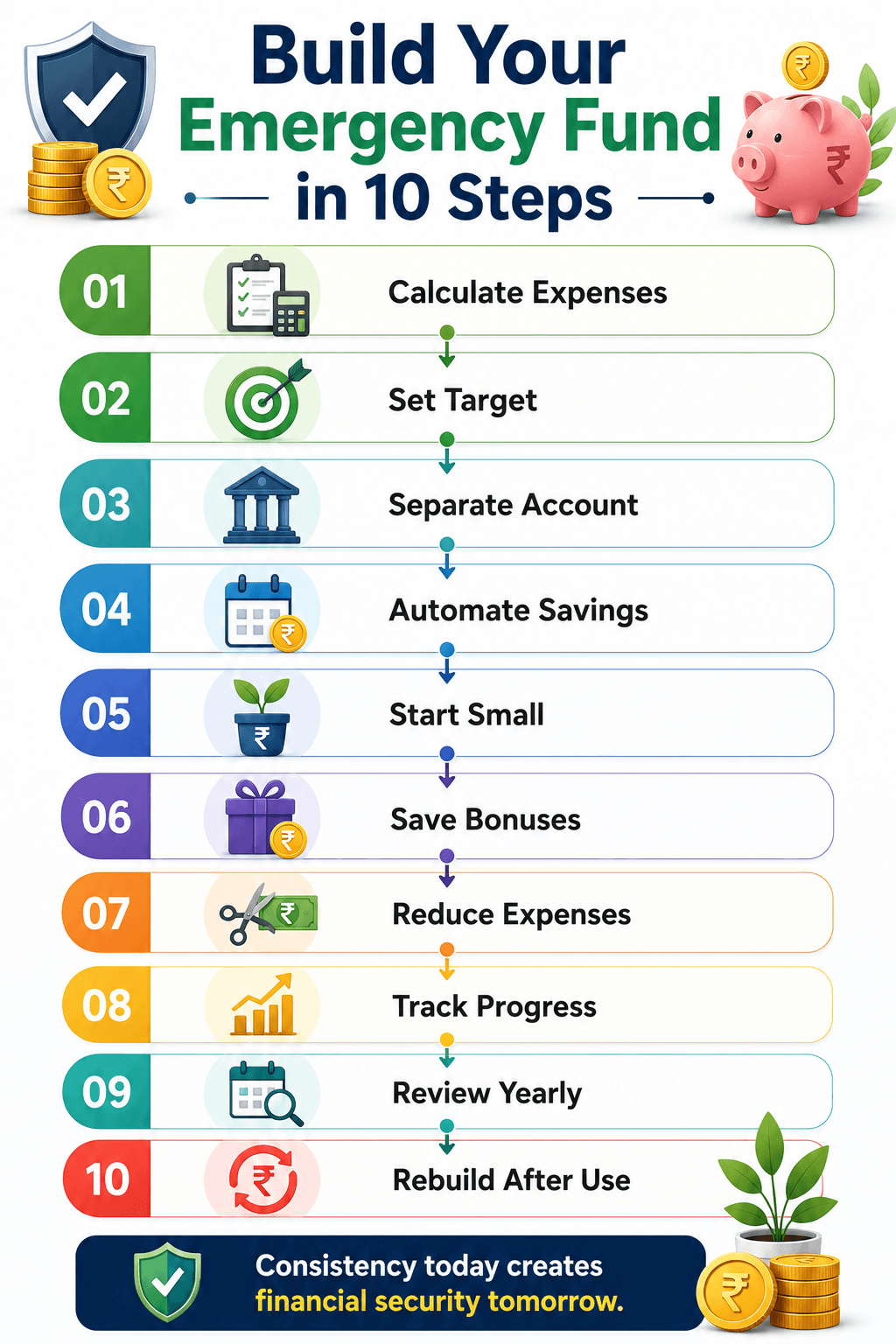
Building an emergency fund may seem overwhelming at first, especially if your target is several lakhs of rupees.
The good news is that you don’t need to save the entire amount overnight.
Like any financial goal, an emergency fund is built gradually through consistent monthly savings.
Whether you can save ₹2,000 or ₹20,000 every month, the important thing is to start today.
Let’s look at a practical step-by-step approach that works for most Indian households.
Step 1: Calculate Your Monthly Essential Expenses
Before you start saving, you need to know how much money your household actually requires every month.
Focus only on essential expenses, including:
- House rent or home loan EMI
- Groceries
- Electricity and water bills
- Internet (if required for work)
- Mobile bills
- Transportation
- Insurance premiums
- School fees
- Medicines
- Basic household expenses
Exclude discretionary spending such as:
- Shopping
- Dining out
- Vacations
- OTT subscriptions
- Entertainment
- Luxury purchases
Example
| Expense | Monthly Cost |
|---|---|
| Rent | ₹20,000 |
| Groceries | ₹9,000 |
| Utilities | ₹4,000 |
| Transport | ₹5,000 |
| Insurance | ₹3,000 |
| School Fees | ₹4,000 |
| Misc. Essentials | ₹5,000 |
| Total Essential Expenses | ₹50,000 |
Now you know your monthly survival budget.
Step 2: Set a Realistic Emergency Fund Goal
Don’t immediately aim for a one-year emergency fund.
Break your goal into smaller milestones.
For example:
Monthly expenses:
₹50,000
Milestone 1
₹50,000
(1 month)
Milestone 2
₹1,50,000
(3 months)
Milestone 3
₹3,00,000
(6 months)
Milestone 4
₹6,00,000
(12 months)
Reaching smaller goals keeps you motivated.
Celebrate each milestone before moving to the next one.
Step 3: Open a Separate Emergency Fund Account
One of the biggest mistakes people make is mixing emergency savings with their regular bank account.
When all your money sits in one account, it’s easier to spend your emergency savings on non-essential purchases.
Instead:
Open a dedicated account for emergency savings.
Good options include:
- Separate savings account
- Sweep-in fixed deposit
- Liquid mutual fund (for a portion of the fund)
- High-liquidity fixed deposit
Keeping your emergency fund separate reduces temptation and makes it easier to track your progress.
Step 4: Automate Your Savings
The easiest way to build an emergency fund is to remove the need for willpower.
Set up an automatic transfer as soon as your salary is credited.
Example
Salary credited:
1st of every month
Automatic transfer:
2nd of every month
Amount:
₹5,000
You save before you have the opportunity to spend.
This approach follows the popular financial principle:
Pay Yourself First
Step 5: Start Small if Necessary
Many people postpone saving because they believe they need to contribute a large amount every month.
That’s not true.
Here are some examples.
| Monthly Saving | One Year Savings |
|---|---|
| ₹2,000 | ₹24,000 |
| ₹3,000 | ₹36,000 |
| ₹5,000 | ₹60,000 |
| ₹10,000 | ₹1,20,000 |
| ₹20,000 | ₹2,40,000 |
Even a modest monthly contribution builds meaningful financial security over time.
Consistency is far more important than perfection.
Step 6: Use Salary Increments Wisely
Whenever your income increases, avoid increasing your lifestyle immediately.
Instead, allocate part of every salary hike to your emergency fund.
Example
Current Salary:
₹60,000
New Salary:
₹70,000
Salary Increase:
₹10,000
Instead of spending the entire increase:
- ₹5,000 → Emergency Fund
- ₹3,000 → Investments
- ₹2,000 → Lifestyle improvements
This strategy allows you to strengthen your finances without feeling deprived.
Step 7: Save Windfall Income
Unexpected income can accelerate your emergency fund significantly.
Examples include:
- Annual bonus
- Performance incentives
- Tax refund
- Freelance income
- Festival bonus
- Gift money
- Cashback rewards
Rather than spending all of it, consider directing a portion toward your emergency savings.
Step 8: Reduce Small Unnecessary Expenses
Building an emergency fund doesn’t always require earning more.
Sometimes it simply requires spending more intentionally.
Examples:
- Reduce food delivery.
- Cancel unused subscriptions.
- Limit impulse shopping.
- Plan grocery purchases.
- Cook more meals at home.
Saving even ₹2,000–₹3,000 each month can make a noticeable difference over time.
Step 9: Track Your Progress
Watching your emergency fund grow is motivating.
Create a simple tracker.
| Goal | Saved | Remaining |
|---|---|---|
| ₹3,00,000 | ₹75,000 | ₹2,25,000 |
Review your progress every month.
Small improvements build long-term confidence.
Step 10: Replenish Your Emergency Fund
If you use your emergency fund, your job isn’t finished.
Start rebuilding it as soon as your financial situation stabilizes.
For example:
Emergency Fund:
₹3,00,000
Medical Expense:
₹80,000
Remaining:
₹2,20,000
Your next goal should be restoring the balance back to ₹3,00,000.
Think of your emergency fund as a rechargeable financial safety net.
A 12-Month Emergency Fund Plan
You don’t have to reach your goal immediately.
Here’s an example.
Target Emergency Fund:
₹2,40,000
Monthly Savings:
₹20,000
| Month | Total Savings |
|---|---|
| 1 | ₹20,000 |
| 2 | ₹40,000 |
| 3 | ₹60,000 |
| 4 | ₹80,000 |
| 5 | ₹1,00,000 |
| 6 | ₹1,20,000 |
| 7 | ₹1,40,000 |
| 8 | ₹1,60,000 |
| 9 | ₹1,80,000 |
| 10 | ₹2,00,000 |
| 11 | ₹2,20,000 |
| 12 | ₹2,40,000 |
Seeing a clear roadmap makes the goal feel much more achievable.
What If You Already Have Debt?
Many beginners wonder whether they should build an emergency fund or pay off debt first.
A practical approach is:
- Build a small starter emergency fund (for example, one month’s essential expenses).
- Continue paying down high-interest debt.
- Gradually increase your emergency fund as your debt decreases.
This helps you avoid taking on new debt when unexpected expenses arise.
Build the Habit Before the Amount
The size of your emergency fund matters.
But the habit of saving matters even more.
Someone who consistently saves ₹3,000 every month is likely to achieve better long-term financial results than someone who plans to save ₹20,000 but never gets started.
Start where you are.
Increase your savings whenever your financial situation improves.
Regular Station Pro Tip:
The first ₹50,000 in your emergency fund often provides the greatest psychological confidence. Don’t underestimate the value of reaching your first milestone—even if your long-term target is much higher.
Where Should You Keep Your Emergency Fund?
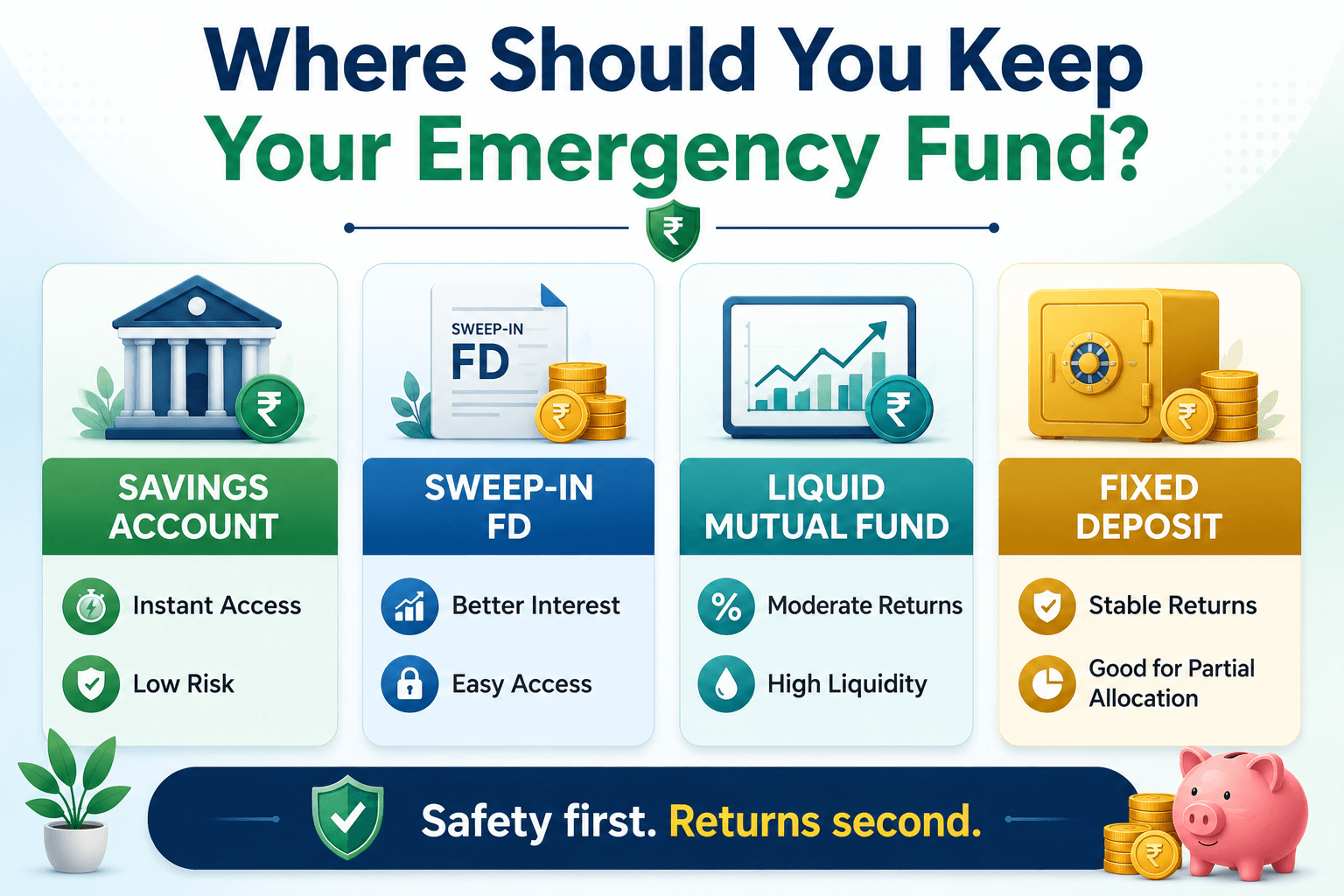
Building an emergency fund is only half the job.
The next important question is:
“Where should I keep my emergency fund?”
The ideal place should allow you to:
- Access your money quickly.
- Keep your capital safe.
- Earn a reasonable return.
- Avoid unnecessary risk.
Remember, an emergency fund is not an investment portfolio.
Its primary purpose is financial security and liquidity, not maximizing returns.
When an emergency happens, you should be able to access your money within minutes or a few hours—not after selling investments or waiting through long lock-in periods.
What Makes a Good Emergency Fund Account?
Before choosing where to keep your emergency fund, evaluate each option using these four criteria.
1. Liquidity
Can you access the money immediately?
During an emergency, speed matters.
2. Safety
Will your money remain relatively stable?
Your emergency fund should not fluctuate significantly in value.
3. Returns
While returns are important, they should never come at the cost of accessibility or safety.
4. Convenience
Can you withdraw the money easily using:
- UPI
- ATM
- Internet Banking
- Mobile Banking
The easier it is to access, the better.
Option 1: Savings Account
For most beginners, a savings account is the simplest place to start.
Advantages
- Instant access
- Very low risk
- UPI and ATM withdrawals
- No lock-in period
- Easy to manage
Limitations
- Lower interest compared to some alternatives
- Returns may not keep pace with inflation
Best For
- Beginners
- First emergency fund
- Immediate access
Option 2: Sweep-in Fixed Deposit
A sweep-in FD combines a savings account with a fixed deposit.
Money above a certain limit is automatically transferred into a fixed deposit while remaining available if required.
Advantages
- Better interest than a standard savings account
- Automatic operation
- High liquidity
- Lower risk
Limitations
- Availability depends on your bank.
- Interest rates vary.
Best For
People who want slightly higher returns without sacrificing easy access.
Option 3: Liquid Mutual Funds
Liquid mutual funds invest in very short-term debt securities and are designed to provide better liquidity than many other investment options.
While they are generally considered lower risk than equity investments, they are not risk-free.
Advantages
- Potentially higher returns than many savings accounts
- Suitable for medium-sized emergency funds
- Easy online investment and redemption
Limitations
- Returns are not guaranteed.
- Redemption may not always be instantaneous.
- Market-linked products carry some level of investment risk.
Best For
People who already have a basic emergency fund in a savings account and want to keep a portion of their emergency savings in a relatively liquid investment.
Option 4: Fixed Deposit (FD)
A fixed deposit offers predictable returns and low risk.
However, traditional FDs may not be ideal for your entire emergency fund because they can reduce flexibility.
Advantages
- Stable returns
- Low risk
- Easy to understand
Limitations
- May involve premature withdrawal conditions or reduced interest if broken early.
- Less flexible than a savings account.
Best For
Keeping a portion of a larger emergency fund.
Quick Comparison
| Option | Liquidity | Risk | Return Potential | Best For |
|---|---|---|---|---|
| Savings Account | ⭐⭐⭐⭐⭐ | Very Low | Low | Immediate access |
| Sweep-in FD | ⭐⭐⭐⭐☆ | Very Low | Moderate | Better returns with liquidity |
| Liquid Mutual Fund | ⭐⭐⭐⭐☆ | Low | Moderate | Larger emergency funds |
| Fixed Deposit | ⭐⭐⭐☆☆ | Very Low | Moderate | Partial emergency savings |
Remember: Liquidity is more important than chasing higher returns.
Should You Keep Your Entire Emergency Fund in One Place?
Not necessarily.
Many financial planners recommend dividing your emergency fund into different layers based on how quickly you may need the money.
Example
Emergency Fund Target:
₹3,00,000
| Location | Amount |
|---|---|
| Savings Account | ₹75,000 |
| Sweep-in FD | ₹1,25,000 |
| Liquid Mutual Fund | ₹1,00,000 |
This approach gives you:
- Immediate cash for urgent expenses.
- Better returns on money that may remain unused for longer.
- Diversification across low-risk options.
Where Should You NOT Keep Your Emergency Fund?
Your emergency fund should not be exposed to significant market risk or long lock-in periods.
Avoid keeping your emergency fund in:
Stocks
Share prices can fluctuate sharply.
Selling during a market decline may result in losses.
Equity Mutual Funds
These are designed for long-term wealth creation—not emergency liquidity.
Cryptocurrency
Cryptocurrencies are highly volatile.
An emergency fund should prioritize stability, not speculation.
Real Estate
Property cannot be sold quickly to cover an emergency.
Gold Jewellery
Selling jewellery during an emergency often involves making charges and price differences.
It is not an ideal emergency savings tool.
Long Lock-in Investments
Avoid products where accessing your money quickly is difficult.
Examples include certain long-term investment products with withdrawal restrictions.
Emergency Fund vs Investment Portfolio
Many beginners ask:
“Why not simply invest everything?”
Because investments and emergency funds serve different purposes.
| Emergency Fund | Investment Portfolio |
|---|---|
| Financial protection | Wealth creation |
| Short-term access | Long-term growth |
| High liquidity | May fluctuate in value |
| Low risk | Risk depends on investment type |
| Used during emergencies | Used for future financial goals |
Think of your emergency fund as your financial seatbelt.
You hope you never need it—but you’ll be glad it’s there when something unexpected happens.
Should You Earn Returns on Your Emergency Fund?
Yes—but only after safety and accessibility.
Trying to maximize returns often means taking more risk.
For an emergency fund, your priorities should always be:
- Safety
- Liquidity
- Reasonable returns
Not the other way around.
Review Your Emergency Fund Every Year
As your financial situation changes, your emergency fund should change too.
Review it annually or after major life events such as:
- Salary increase
- Marriage
- Birth of a child
- Buying a house
- Starting a business
- Retirement
Increase your emergency fund if your essential monthly expenses have grown.
Regular Station Pro Tip:
Your emergency fund isn’t meant to make you rich. Its purpose is to protect your wealth, your investments, and your peace of mind during life’s unexpected challenges.
Common Emergency Fund Mistakes to Avoid
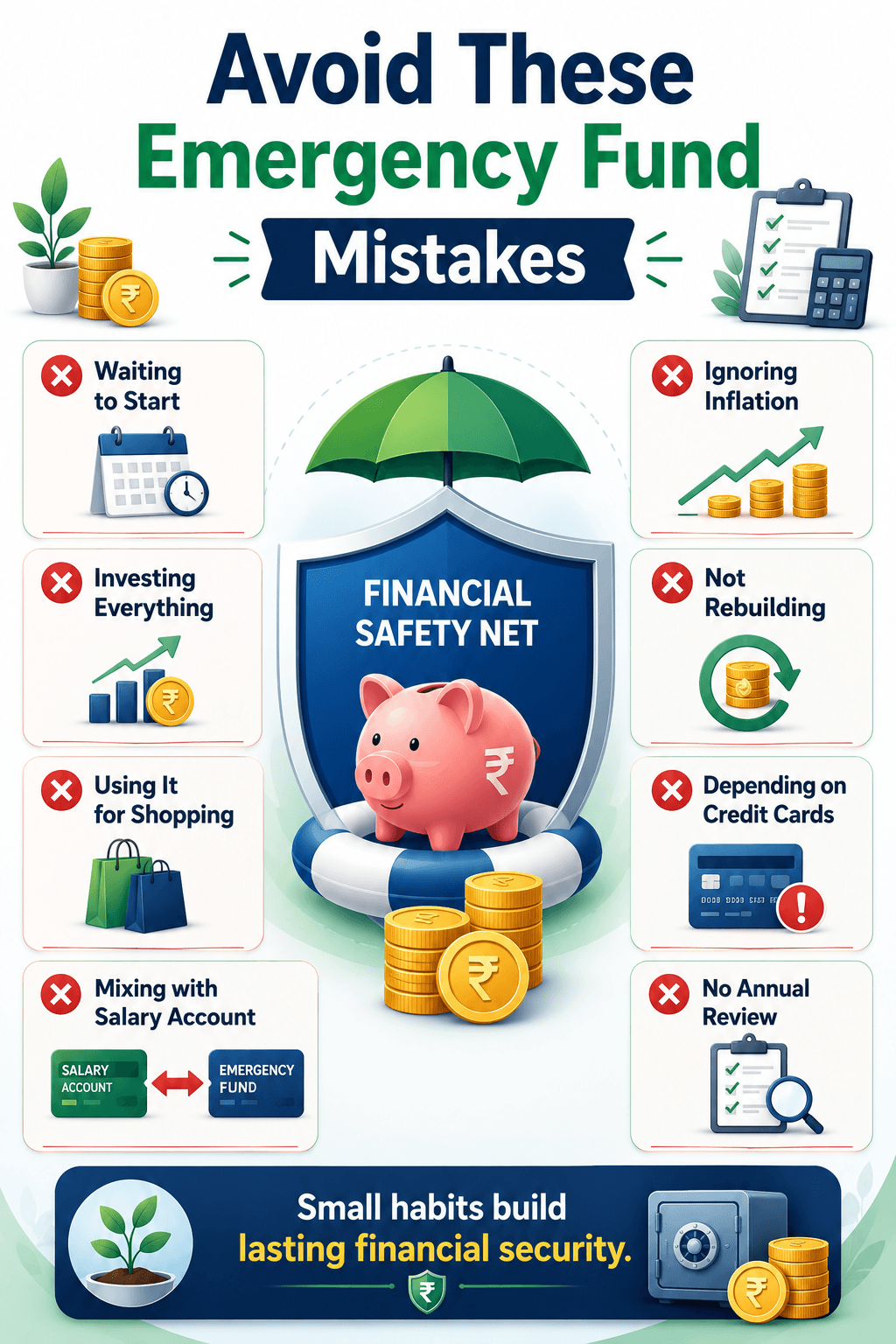
Building an emergency fund is a significant financial achievement.
However, many people make mistakes that reduce its effectiveness or even defeat its purpose.
An emergency fund is not just about saving money—it’s about using and managing it correctly.
By avoiding these common mistakes, you can ensure your emergency fund is always available when you need it most.
1. Waiting for the “Perfect Time” to Start Saving
One of the biggest mistakes is postponing your emergency fund because you believe:
- “I’ll start after my salary increases.”
- “I’ll save once my loan is over.”
- “I’ll begin next year.”
Unfortunately, emergencies don’t wait for the perfect financial situation.
Starting with ₹2,000 or ₹3,000 per month is far better than waiting indefinitely.
Better Approach
Start today—even if it’s a small amount.
Increase your monthly contribution as your income grows.
2. Investing Your Entire Emergency Fund
Many beginners believe:
“Why let the money sit idle when I can earn higher returns?”
While investing is important, your emergency fund serves a different purpose.
If all your emergency savings are invested in:
- Stocks
- Equity mutual funds
- Cryptocurrency
you may be forced to sell them during a market downturn.
This can lead to unnecessary financial losses.
Better Approach
Keep your emergency fund in low-risk, highly liquid options.
Build your investment portfolio separately.
3. Mixing Emergency Savings with Everyday Spending
Keeping your emergency fund in your primary spending account can create temptation.
Over time, small purchases can slowly reduce your emergency savings.
Examples:
- Online shopping
- Dining out
- Weekend trips
- Festival expenses
Eventually, you may discover your emergency fund is no longer available when you truly need it.
Better Approach
Maintain a separate account dedicated exclusively to emergency savings.
4. Using the Emergency Fund for Non-Emergencies
Not every unexpected expense is an emergency.
Examples that do not usually qualify:
- Buying the latest smartphone
- Upgrading furniture
- Festival shopping
- Vacation planning
- Wedding gifts
- Luxury purchases
Your emergency fund should only be used for essential and unavoidable financial situations.
Before withdrawing money, ask yourself:
“Can this expense wait?”
If the answer is yes, it’s probably not an emergency.
5. Ignoring Inflation
Your emergency fund target should not remain the same forever.
As the cost of living increases:
- Groceries become more expensive.
- Healthcare costs rise.
- Rent increases.
- Utility bills go up.
If your monthly expenses increase from ₹40,000 to ₹55,000, your emergency fund should also increase.
Better Approach
Review your emergency fund once every year.
Update your target whenever your essential expenses change significantly.
6. Forgetting to Rebuild After Using It
Many people correctly use their emergency fund—but never replenish it.
Example:
Emergency Fund:
₹3,00,000
Medical Emergency:
₹80,000
Remaining:
₹2,20,000
The job isn’t finished.
Your next financial priority should be restoring the balance to ₹3,00,000.
Think of your emergency fund like a fire extinguisher—you refill it after using it.
7. Saving Too Little Without a Plan
Saving ₹500 a month is a good start.
However, if your goal is ₹3,00,000, relying only on very small contributions may delay your progress unnecessarily.
Better Approach
Review your savings every few months.
Whenever your income increases:
- Increase your monthly contribution.
- Save part of your annual bonus.
- Redirect extra income toward your emergency fund.
8. Depending Only on Credit Cards
Some people believe:
“I’ll just use my credit card if something happens.”
Credit cards can help in emergencies, but they are not a substitute for emergency savings.
Reasons include:
- High interest charges if balances aren’t paid in full.
- Reduced available credit for future emergencies.
- Potential debt accumulation.
An emergency fund helps you avoid relying on borrowed money.
9. Not Considering Family Responsibilities
Your emergency fund should reflect your actual financial responsibilities.
Someone supporting:
- Parents
- Spouse
- Children
will generally need a larger emergency fund than someone living alone.
As your family grows, your emergency savings should grow too.
10. Believing Insurance Replaces an Emergency Fund
Insurance and emergency funds work together—they are not substitutes.
Health insurance may cover hospital expenses, but it often doesn’t cover:
- Travel costs
- Medicines outside the policy
- Temporary income loss
- Household expenses during recovery
Similarly, life insurance helps protect your family’s future but doesn’t replace readily available cash for immediate expenses.
The ideal financial plan includes both insurance and an emergency fund.
Quick Self-Assessment
Ask yourself these questions.
| Question | Yes | No |
|---|---|---|
| Do I have a separate emergency fund account? | ☐ | ☐ |
| Could I cover three months of expenses today? | ☐ | ☐ |
| Have I reviewed my emergency fund this year? | ☐ | ☐ |
| Do I avoid using it for non-emergencies? | ☐ | ☐ |
| Have I replenished it after using it? | ☐ | ☐ |
| Does my family know where it is kept? | ☐ | ☐ |
If you answered “No” to several questions, use this article as your action plan for strengthening your financial safety net.
Expert Tips for Building a Strong Emergency Fund
Here are practical habits followed by financially disciplined individuals.
Automate Every Contribution
Treat emergency savings like a monthly bill.
Schedule automatic transfers immediately after your salary is credited.
Keep It Separate
Avoid mixing emergency savings with daily spending.
A dedicated account reduces unnecessary withdrawals.
Save Salary Increments
Whenever you receive:
- A salary hike
- Bonus
- Incentive
- Freelance payment
consider directing part of it toward your emergency fund.
Review Annually
Recalculate your target every year based on:
- Inflation
- Salary changes
- Family size
- Monthly expenses
Inform Your Family
Ensure your spouse or trusted family members know:
- Where the emergency fund is kept.
- How to access it if necessary.
This becomes especially important during medical emergencies.
Don’t Chase High Returns
Remember:
An emergency fund is about availability, not maximum returns.
Safety should always come first.
Build It Before Aggressive Investing
Once you’ve established an adequate emergency fund, you can confidently begin focusing on long-term investments through SIPs, mutual funds, retirement planning, and other wealth-building strategies.
Regular Station Pro Tip:
An emergency fund isn’t meant to generate wealth—it exists to protect the wealth you work hard to build.
Frequently Asked Questions (FAQs)
These are some of the most common questions readers ask about emergency funds. This section also helps target long-tail search queries and is ideal for FAQ Schema in Rank Math.
1. What is an emergency fund?
An emergency fund is money set aside specifically for unexpected and essential expenses such as medical emergencies, job loss, urgent home repairs, or major vehicle repairs.
Its purpose is to provide financial security during difficult situations without relying on loans or credit cards.
2. How much emergency fund should I have?
Most financial experts recommend keeping an emergency fund equal to 3–6 months of essential living expenses.
However, the ideal amount depends on your financial situation:
- Salaried employees: 3–6 months
- Married couples: Around 6 months
- Families with children: 6–9 months
- Freelancers and business owners: 9–12 months
Focus on your monthly essential expenses, not your salary.
3. How do I calculate my emergency fund?
Use this simple formula:
Emergency Fund = Monthly Essential Expenses × Number of Months
For example:
Monthly essential expenses:
₹40,000
Emergency fund for six months:
₹40,000 × 6 = ₹2,40,000
4. Where should I keep my emergency fund?
Choose a place that offers:
- Easy access
- Low risk
- Reasonable returns
Popular options include:
- Savings Account
- Sweep-in Fixed Deposit
- Liquid Mutual Fund
- Short-term Fixed Deposit
Avoid high-risk investments for emergency savings.
5. Can I keep my emergency fund in a Fixed Deposit?
Yes.
A fixed deposit can be suitable for part of your emergency fund, especially if it allows relatively easy access.
However, it’s usually a good idea to keep at least one month’s essential expenses in a savings account for immediate access.
6. Should I invest my emergency fund in mutual funds?
Not in equity mutual funds.
Emergency funds should remain easily accessible and relatively stable.
If you choose a mutual fund option, consider keeping only a portion of your emergency savings in products designed for liquidity and lower risk, while understanding that investment values can fluctuate.
7. Can I use my emergency fund for vacations or shopping?
No.
Your emergency fund should only be used for genuine financial emergencies.
Vacations, shopping, festivals, and gadget upgrades should be planned through separate savings.
8. Should I build an emergency fund before investing?
In most situations, yes.
Building a basic emergency fund first helps protect your long-term investments from being withdrawn during unexpected financial situations.
Once your emergency fund is established, you can gradually increase your investments through SIPs, mutual funds, or other long-term financial plans.
9. Is an emergency fund the same as insurance?
No.
Insurance helps cover specific risks based on the policy you purchase.
An emergency fund provides readily available cash for expenses that insurance may not fully cover, such as deductibles, household bills during income loss, or urgent costs outside your policy coverage.
The two work together—they are not substitutes.
10. How often should I review my emergency fund?
Review your emergency fund at least once every year.
You should also update it after major life events, including:
- Salary increase
- Marriage
- Birth of a child
- Buying a home
- Starting a business
- Significant increase in monthly expenses
11. Can students build an emergency fund?
Yes.
Even students can benefit from saving for unexpected expenses such as:
- Medical treatment
- Laptop repairs
- Emergency travel
- Educational expenses
Starting early helps develop strong financial habits.
12. What if I already have a credit card?
A credit card should not replace an emergency fund.
Using credit during emergencies can lead to:
- Interest charges
- Debt accumulation
- Financial stress
An emergency fund allows you to handle unexpected expenses using your own money instead of borrowed funds.
13. What should I do if I use my emergency fund?
If you withdraw money from your emergency fund:
- Cover the emergency.
- Stabilize your finances.
- Begin rebuilding the fund as soon as possible.
Always aim to restore your original emergency fund target.
14. Should freelancers have a larger emergency fund?
Yes.
Freelancers and self-employed professionals often experience variable income.
A larger emergency fund—typically covering 6–12 months of essential expenses—can provide greater financial stability during periods of reduced work or delayed client payments.
15. Can I build an emergency fund while paying off debt?
Yes.
A practical approach is to build a small starter emergency fund while continuing to pay down high-interest debt.
Once your debt becomes more manageable, you can gradually increase your emergency savings.
This helps reduce the likelihood of taking on new debt when unexpected expenses occur.
After building your emergency fund, learn how to manage your monthly income effectively with our 50/30/20 Budget Rule Explained for Beginners in India.
Final Thoughts
Financial emergencies are impossible to predict—but you can prepare for them.
An emergency fund is one of the simplest and most powerful financial tools you can build. It protects you from unexpected expenses, reduces dependence on debt, and gives you the confidence to face life’s uncertainties without disrupting your long-term financial goals.
Remember, building an emergency fund doesn’t require a high income.
It requires consistency.
Whether you save ₹2,000 or ₹20,000 each month, every contribution strengthens your financial safety net.
Don’t wait until you earn more, finish paying off every loan, or find the “perfect” time to start.
Begin with what you can afford today and increase your savings gradually.
Over time, your emergency fund will become the foundation that supports every other financial goal—from investing and home ownership to retirement planning.
Regular Station Pro Tip:
Think of your emergency fund as your financial shock absorber. You hope you never need it, but you’ll be grateful it’s there when life takes an unexpected turn.
Once you’ve established your emergency fund, continue learning with our Personal Finance Guide for Beginners in India, where you’ll discover budgeting, investing, insurance, retirement planning, and long-term wealth-building strategies.
