

SIP Investment in India: A Beginner’s Guide to Systematic Investment Plans

A practical beginner’s guide to SIP investment in India, covering how SIPs work, market-linked risks, fund selection, starting steps, compounding, common mistakes, and frequently asked questions.

SIP Investment in India: A Beginner’s Guide to Systematic Investment Plans
A Systematic Investment Plan, or SIP, is a method of investing a fixed amount in a mutual fund at regular intervals. For example, you may invest ₹2,000 every month in a selected mutual fund scheme.Each contribution buys mutual fund units at the applicable Net Asset Value (NAV). A SIP can encourage regular investing and reduce the need to time the market. However, mutual fund returns are market-linked, can fluctuate, and are not guaranteed.

SIP investment in India is popular among beginners because it allows people to invest gradually instead of arranging a large amount at once. It can be useful for long-term goals such as retirement, a child’s education, or building wealth.

However, a SIP is not automatically safe or profitable. Your result depends mainly on the mutual fund you select, market performance, investment duration, costs, and your behaviour during market ups and downs.

Understanding SIP Investment in India

What Is a SIP?

A SIP is a way of investing in a mutual fund. It is not a separate investment product.

When you start a SIP, you choose a mutual fund scheme, an investment amount, and a frequency. The frequency is commonly monthly, although the available options may differ between schemes and platforms.

For example, you could set up a monthly SIP of ₹5,000 in an equity mutual fund. The amount is usually collected through an approved bank mandate and invested in the selected scheme.

You continue to own units of that mutual fund. Therefore, the risks, costs, taxation, and potential returns depend on the chosen scheme, not simply on the fact that you used a SIP.

How Does a SIP Work?
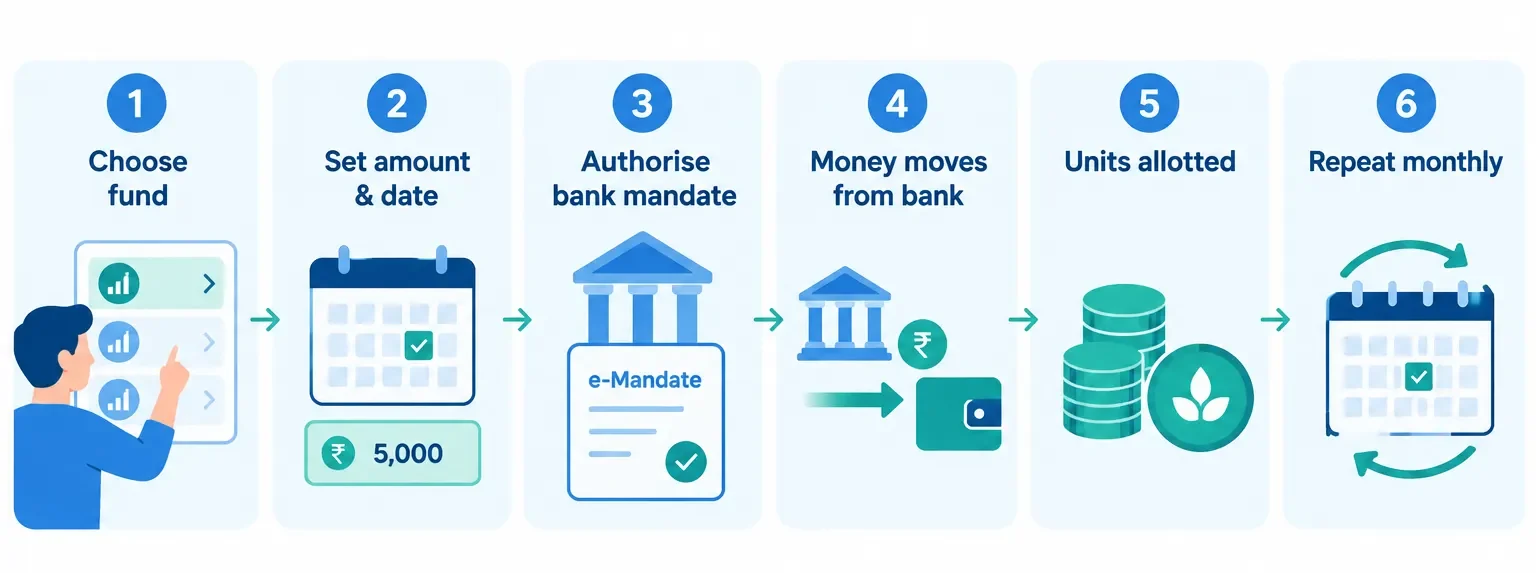
Flowchart showing scheme selection, SIP setup, bank debit, mutual fund unit allotment and recurring monthly investments.

Every mutual fund has a Net Asset Value, commonly called NAV. In simple terms, NAV represents the per-unit value of the fund after accounting for its assets and liabilities.

Each SIP contribution buys units at the applicable NAV. The applicable NAV is determined according to current mutual fund rules, transaction cut-off requirements, and the realisation of funds.

  1. You select a mutual fund scheme.
  2. You choose the SIP amount, frequency, and payment date.
  3. The scheduled amount is collected from your bank account.
  4. The money buys units at the applicable NAV.
  5. The units are added to your mutual fund folio or investment account.
  6. The process repeats until you pause, cancel, or complete the SIP, subject to the scheme and platform rules.
You May Also Like:PPF vs ELSS: Understanding the Key Differences for Indian Investors
SIP process: Regular contribution → Mutual fund investment → Units purchased at the applicable NAV → Units accumulated over time

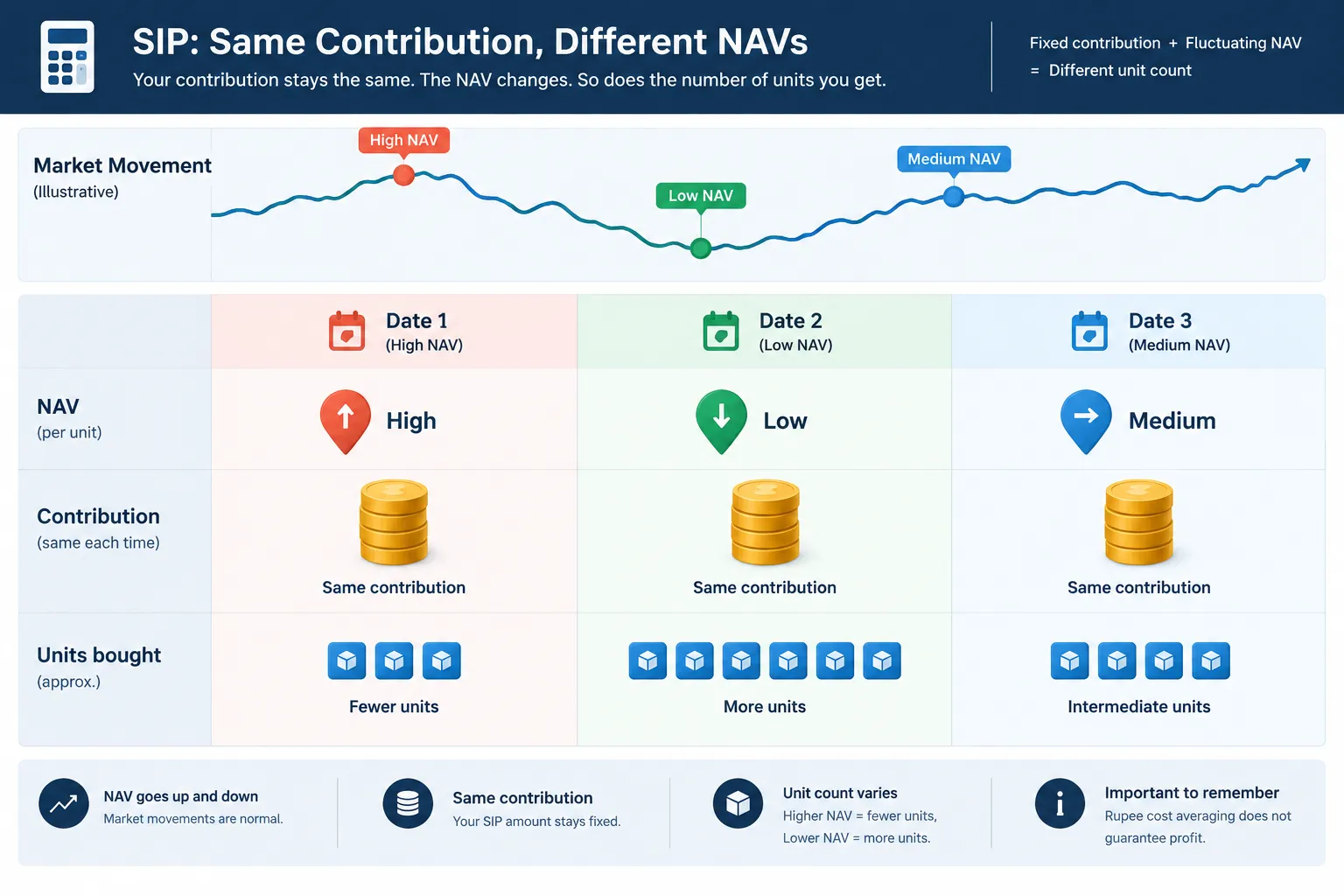
Because NAV changes, the same contribution can buy a different number of units each time. When the NAV is lower, your fixed amount buys more units. When the NAV is higher, it buys fewer units.

This is known as rupee-cost averaging. It spreads purchases across different market levels. However, it does not prevent losses or guarantee that your average cost will always produce a profit.

SIP Example in Indian Rupees

Suppose you invest ₹2,000 per month in a mutual fund. The following example shows how changing NAV affects the number of units purchased.

Month SIP contribution Illustrative NAV Units purchased
Month 1 ₹2,000 ₹20 100 units
Month 2 ₹2,000 ₹16 125 units
Month 3 ₹2,000 ₹25 80 units
Total ₹6,000 — 305 units

In this hypothetical example, the investor contributes ₹6,000 and receives 305 units. More units are purchased in the second month because the NAV is lower.

The approximate average purchase cost is ₹19.67 per unit, calculated by dividing ₹6,000 by 305 units. This does not mean the investment will be profitable. Its value will depend on the NAV when it is valued or redeemed.

The NAV figures are used only to explain the process. Actual mutual fund NAVs and returns can rise or fall, and future values cannot be predicted from this example.

SIP and the Power of Compounding

Compounding means that returns generated by an investment remain invested and may generate further returns in later periods.

For example, if the value of your mutual fund units rises and you stay invested, future growth may apply to both your original contributions and the earlier gains. Regular SIP contributions can gradually increase the amount that remains invested.

However, mutual fund compounding is not the same as receiving guaranteed interest from a fixed-return product. Equity and debt mutual funds can both experience periods of weak or negative returns.

Compounding works best when there is enough time and the investment earns positive returns over the relevant period. Costs, taxes, withdrawals, market declines, and poor fund performance can reduce the final value.

You May Also Like:Financial Goals for Beginners in India: How to Set, Plan & Achieve Your Money Goals

Benefits of SIP

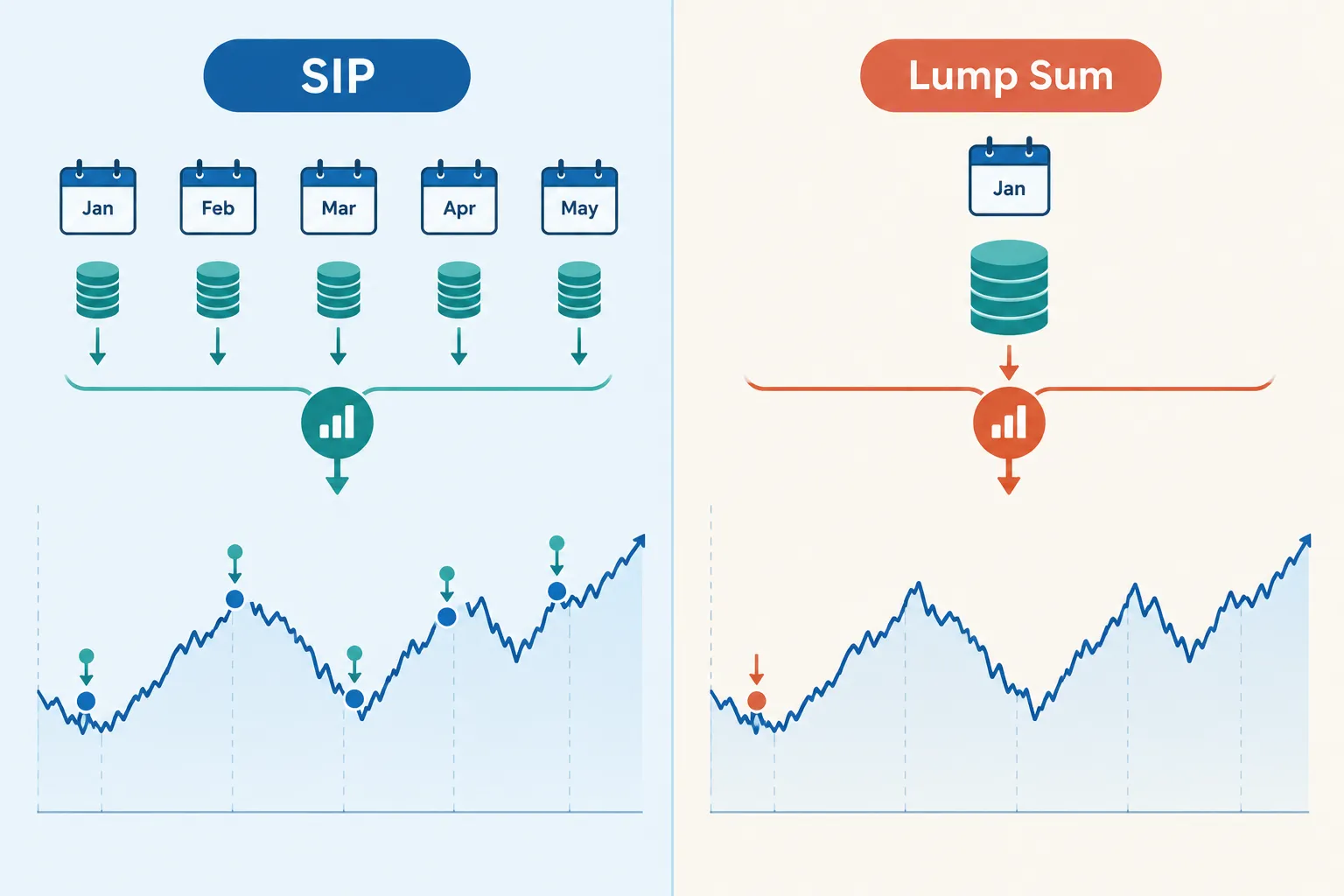
Comparison of SIP investing across several dates with investing a lump sum on one date, both exposed to market movements.

  • Regular investing: A scheduled SIP can help turn investing into a monthly habit.
  • Accessible starting amount: Many schemes allow relatively small contributions, although the minimum differs by scheme.
  • Suitable for monthly income: Salaried individuals may find it easier to invest after receiving their salary instead of waiting to build a large lump sum.

Less dependence on market timing: Contributions are spread across multiple dates instead of being invested on one chosen

Planning and Starting a SIP in India

Starting a SIP is simple, but choosing the right amount and mutual fund requires planning. Your decision should reflect your financial goal, investment period, monthly budget and ability to handle market fluctuations.

You May Also Like:Emergency Fund Guide for Beginners in India

How Much Should You Invest in a SIP?

There is no single SIP amount that suits everyone. A ₹5,000 monthly SIP may be comfortable for one person and difficult for another. Do not copy an amount chosen by a friend, colleague or social media creator.

Consider the following factors before deciding how much to invest:

  • Financial goal: Define what you are investing for, such as retirement, a child’s education or a future home purchase.
  • Time horizon: Estimate when you will need the money. A goal due in three years requires a different approach from one that is 15 years away.
  • Monthly income: Use stable take-home income when preparing your investment budget.
  • Essential expenses: Account for rent, groceries, insurance premiums, utility bills, school fees and other necessary costs.
  • Emergency savings: Maintain accessible money for unexpected expenses rather than depending on mutual fund withdrawals.
  • Existing debt: High-cost debt may need attention before you commit a large amount to market-linked investments.
  • Risk tolerance: Select an amount and fund category that will not cause you to panic during normal market declines.

A simple starting point is to calculate the amount left after essential expenses, debt payments, insurance needs and emergency savings. Invest only the portion you can contribute regularly without affecting important monthly commitments.

Question Why It Matters
Can I continue this amount during a difficult month? An affordable SIP is easier to maintain over time.
Do I have emergency savings? It reduces the need to withdraw investments for sudden expenses.
When will I need the money? The time horizon helps determine a suitable fund category.
Can I accept temporary losses? Market-linked funds can rise or fall, especially over shorter periods.
Do I have expensive debt? Debt repayments and investing must be balanced carefully.

If your budget is limited, begin with an affordable amount and review it when your income changes. Some investors gradually increase their SIP after a salary increase, but this should be based on their budget rather than an automatic assumption that income will always rise.

Online SIP calculators can help estimate the contribution required for a goal. However, their results depend on an assumed rate of return. That rate is only an illustration. Actual mutual fund returns can be higher or lower and are not guaranteed.

How to Choose a Mutual Fund for SIP

A SIP is only the method used to invest regularly. Your results and risk depend mainly on the mutual fund scheme you select.

Begin with your goal and time horizon instead of searching for the fund with the highest recent return.

Understand the Main Fund Categories

Fund Category What It Generally Invests In Important Consideration
Equity funds Mainly shares of companies Can experience significant market fluctuations and are generally considered for longer investment periods.
Debt funds Bonds and other debt instruments May have lower equity-market exposure but still carry interest-rate, credit and liquidity risks.
Hybrid funds A combination of equity and debt Risk varies according to how much the scheme allocates to each asset class.
Index funds A portfolio designed to track a stated market index Returns can differ from the index because of costs and tracking difference.
Solution-oriented funds Portfolios linked to goals such as retirement or children’s needs Check investment strategy, restrictions and any lock-in period before investing.

These categories contain several subcategories with different risk levels. The category name alone is not enough to make a decision.

Check Risk and Investment Horizon

Read the scheme’s Riskometer and related risk disclosures. A higher-risk fund may fluctuate sharply and may not suit money needed soon.

Do not assume that every SIP must be in an equity fund. Short-term goals usually require greater focus on capital stability and access to money. Long-term goals may allow more time to recover from market declines, but losses remain possible.

Compare the Fund With an Appropriate Benchmark

A benchmark provides a reference for understanding a fund’s performance. Compare performance over different market periods rather than focusing on one strong year.

Past performance may help you study consistency and behaviour, but it does not predict future returns. A fund that performed well recently can underperform later.

Understand Costs

Mutual funds charge an expense ratio, which is deducted from the scheme’s assets. A higher cost can reduce the amount that remains invested over time.

Also check whether an exit load applies when units are redeemed within a specified period. The rules can vary by scheme and may change.

Direct and regular plans of the same scheme have different cost structures. A direct plan does not include distributor commission, while a regular plan may include the cost of distribution and assistance. Beginners should understand the service they are receiving and the cost involved before selecting either option.

Review the Portfolio and Fund Strategy

Check what the scheme owns and how concentrated the portfolio is. For an equity fund, look at sectors, company sizes and major holdings. For a debt fund, examine credit quality, maturity profile and interest-rate sensitivity.

A portfolio can change over time, so treat this information as a current snapshot rather than a permanent promise.

Read the Scheme Documents

Review the Scheme Information Document, Key Information Memorandum and latest available factsheet. These documents explain the investment objective, strategy, benchmark, risks, expenses, exit load and other important conditions.

Mutual Fund Selection Checklist

  • Is the scheme suitable for my financial goal?
  • Does its suggested investment horizon match when I need the money?
  • Can I tolerate the risk level shown by the scheme?
  • Do I understand the fund category and investment strategy?
  • Am I comparing it with an appropriate benchmark and similar funds?
  • Have I looked beyond recent returns?
  • Have I checked the expense ratio and exit load?
  • Do I understand the main portfolio holdings and concentration risks?
  • Have I read the scheme documents and current factsheet?
  • Do I understand the difference between direct and regular plans?
  • Will this fund duplicate investments I already own?
You May Also Like:50/30/20 Budget Rule Explained for Beginners in India (2026 Guide)

A beginner usually does not need many schemes serving the same purpose. Adding more funds can create duplication and make the portfolio difficult to monitor.

How to Start a SIP in India

You can start a SIP through a mutual fund house or an intermediary or investment platform with

Using SIPs Wisely

Starting a SIP is only the first step. You also need to manage it sensibly, keep enough money for regular expenses and review whether the investment still suits your goal.

A SIP investment in India does not remove market risk. It simply allows you to invest a chosen amount at regular intervals.

Common SIP Mistakes to Avoid

Mistake Why It Can Be a Problem Better Approach
Expecting guaranteed returns Mutual fund returns depend on market performance and can be negative during some periods. Plan with realistic assumptions and be prepared for fluctuations.
Choosing a fund only because of recent returns A fund that performed well recently may not continue to do so. Check the fund category, risk level, portfolio, costs, benchmark and suitability for your goal.
Ignoring your risk tolerance A highly volatile fund may cause anxiety or force you to sell at the wrong time. Choose a fund category that matches your ability and willingness to handle losses.
Starting too many SIPs Several funds may hold similar investments, making the portfolio difficult to track without adding useful diversification. Use a manageable number of suitable funds and check for portfolio overlap.
Investing without a goal You may not know how much to invest, how long to continue or when to withdraw. Connect each SIP to a goal, expected time horizon and target amount.
Stopping only because markets fall Stopping out of fear can interrupt a long-term plan and may lock in losses if you also redeem. Review the goal, time horizon and fund suitability before taking action.
Investing beyond your monthly budget An unaffordable SIP can lead to missed payments, bank charges or additional borrowing. Maintain emergency savings and choose an amount that fits comfortably within your cash flow.
Reviewing too often or not reviewing at all Frequent checking can encourage emotional decisions, while no review can leave unsuitable investments unnoticed. Review periodically and after major changes in your goal, income, family situation or risk tolerance.

Market declines do not automatically mean you should stop a SIP. However, continuing without checking the fund or your financial position is also unwise. Make the decision based on your goal and circumstances, not only on short-term market movements.

Example showing how the same SIP amount can buy fewer mutual fund units at a higher NAV and more units at a lower NAV.

Frequently Asked Questions

What is the minimum amount required to start a SIP?

The minimum amount depends on the mutual fund scheme and the platform used. Some schemes allow relatively small monthly contributions, while others set a higher minimum. Check the latest scheme information before registering.

Can I lose money in a SIP?

Yes. A SIP invests in a mutual fund, and mutual fund values can rise or fall. SIPs can spread purchases across different market levels, but they do not protect you from losses or guarantee profits.

What happens if I miss a SIP payment?

Usually, no units are purchased for that instalment. The bank, fund house or platform may apply its own rules, and a failed debit could sometimes result in charges. Repeated missed payments may also lead to cancellation of the SIP instruction.

One missed payment does not normally mean that your existing mutual fund units are sold. Check the applicable rules with your fund house and bank.

Can I change my SIP amount or date?

Many fund houses and platforms allow changes, but the process differs. You may need to cancel the existing instruction and register a new SIP. Some platforms may offer options to increase, decrease or pause the amount.

Allow enough processing time before the next scheduled debit.

Can I stop a SIP whenever I want?

In many open-ended mutual fund schemes, you can cancel the future SIP instruction by submitting a request. Cancellation may take time to process.

Stopping a SIP only stops future contributions. It does not automatically withdraw the amount already invested.

Can I withdraw money invested through a SIP?

In an open-ended fund, you can generally request redemption subject to the scheme’s rules. Exit load, taxes and processing time may apply.

Some investments have a lock-in period. For example, each SIP instalment in a tax-saving ELSS fund has its own lock-in period. Always check the latest scheme and tax rules before investing or withdrawing.

How long should I continue a SIP?

There is no single duration suitable for everyone. The period should depend on your financial goal and the type of mutual fund selected.

Equity funds are generally considered for longer periods because their values can fluctuate sharply in the short term. For a goal that is approaching, consider whether reducing market risk is appropriate rather than waiting until the final day to withdraw.

Can I have multiple SIPs?

Yes, you can have SIPs in more than one mutual fund. Multiple SIPs may be useful when they serve different goals or provide suitable diversification.

However, more SIPs do not automatically create a better portfolio. Avoid holding many similar funds with overlapping investments.

Are SIPs suitable for short-term goals?

It depends on the selected mutual fund. An equity fund SIP may not be suitable for money needed in the near future because markets can fall just before the withdrawal date.

Debt mutual funds may be less volatile than equity funds, but they also carry risks such as interest-rate and credit risk. For short-term goals, compare safety, liquidity, costs and tax treatment before choosing any product.

Does a longer SIP always produce a profit?

No. A longer period can give an investment more time to experience different market cycles, but it does not guarantee a profit. Results depend on the fund, market conditions, costs and the timing of contributions and withdrawals.

Should I stop my SIP if the fund performs poorly?

Do not decide only from a few months of returns. Compare the fund with its benchmark and relevant category over suitable periods. Also check whether there have been important changes in the portfolio, risk level, investment strategy or fund management.

If the fund no longer suits your goal, consider seeking advice from a qualified financial professional before switching or redeeming.

Share this article
KEEP READING

Related Articles

View all →

Comments

Leave a Comment

SIP Investment in India: A Beginner’s Guide to Systematic Investment Plans

A Systematic Investment Plan, or SIP, is a method of investing a fixed amount in a mutual fund at regular intervals. For example, you may invest ₹2,000 every month in a selected mutual fund scheme.Each contribution buys mutual fund units at the applicable Net Asset Value (NAV). A SIP can encourage regular investing and reduce the need to time the market. However, mutual fund returns are market-linked, can fluctuate, and are not guaranteed.

SIP investment in India is popular among beginners because it allows people to invest gradually instead of arranging a large amount at once. It can be useful for long-term goals such as retirement, a child’s education, or building wealth.

However, a SIP is not automatically safe or profitable. Your result depends mainly on the mutual fund you select, market performance, investment duration, costs, and your behaviour during market ups and downs.

Understanding SIP Investment in India

What Is a SIP?

A SIP is a way of investing in a mutual fund. It is not a separate investment product.

When you start a SIP, you choose a mutual fund scheme, an investment amount, and a frequency. The frequency is commonly monthly, although the available options may differ between schemes and platforms.

For example, you could set up a monthly SIP of ₹5,000 in an equity mutual fund. The amount is usually collected through an approved bank mandate and invested in the selected scheme.

You continue to own units of that mutual fund. Therefore, the risks, costs, taxation, and potential returns depend on the chosen scheme, not simply on the fact that you used a SIP.

How Does a SIP Work?

Flowchart showing scheme selection, SIP setup, bank debit, mutual fund unit allotment and recurring monthly investments.

Every mutual fund has a Net Asset Value, commonly called NAV. In simple terms, NAV represents the per-unit value of the fund after accounting for its assets and liabilities.

Each SIP contribution buys units at the applicable NAV. The applicable NAV is determined according to current mutual fund rules, transaction cut-off requirements, and the realisation of funds.

  1. You select a mutual fund scheme.
  2. You choose the SIP amount, frequency, and payment date.
  3. The scheduled amount is collected from your bank account.
  4. The money buys units at the applicable NAV.
  5. The units are added to your mutual fund folio or investment account.
  6. The process repeats until you pause, cancel, or complete the SIP, subject to the scheme and platform rules.
SIP process: Regular contribution → Mutual fund investment → Units purchased at the applicable NAV → Units accumulated over time

Because NAV changes, the same contribution can buy a different number of units each time. When the NAV is lower, your fixed amount buys more units. When the NAV is higher, it buys fewer units.

This is known as rupee-cost averaging. It spreads purchases across different market levels. However, it does not prevent losses or guarantee that your average cost will always produce a profit.

SIP Example in Indian Rupees

Suppose you invest ₹2,000 per month in a mutual fund. The following example shows how changing NAV affects the number of units purchased.

Month SIP contribution Illustrative NAV Units purchased
Month 1 ₹2,000 ₹20 100 units
Month 2 ₹2,000 ₹16 125 units
Month 3 ₹2,000 ₹25 80 units
Total ₹6,000 — 305 units

In this hypothetical example, the investor contributes ₹6,000 and receives 305 units. More units are purchased in the second month because the NAV is lower.

The approximate average purchase cost is ₹19.67 per unit, calculated by dividing ₹6,000 by 305 units. This does not mean the investment will be profitable. Its value will depend on the NAV when it is valued or redeemed.

The NAV figures are used only to explain the process. Actual mutual fund NAVs and returns can rise or fall, and future values cannot be predicted from this example.

SIP and the Power of Compounding

Compounding means that returns generated by an investment remain invested and may generate further returns in later periods.

For example, if the value of your mutual fund units rises and you stay invested, future growth may apply to both your original contributions and the earlier gains. Regular SIP contributions can gradually increase the amount that remains invested.

However, mutual fund compounding is not the same as receiving guaranteed interest from a fixed-return product. Equity and debt mutual funds can both experience periods of weak or negative returns.

Compounding works best when there is enough time and the investment earns positive returns over the relevant period. Costs, taxes, withdrawals, market declines, and poor fund performance can reduce the final value.

Benefits of SIP
Comparison of SIP investing across several dates with investing a lump sum on one date, both exposed to market movements.

  • Regular investing: A scheduled SIP can help turn investing into a monthly habit.
  • Accessible starting amount: Many schemes allow relatively small contributions, although the minimum differs by scheme.
  • Suitable for monthly income: Salaried individuals may find it easier to invest after receiving their salary instead of waiting to build a large lump sum.

Less dependence on market timing: Contributions are spread across multiple dates instead of being invested on one chosen

Planning and Starting a SIP in India

Starting a SIP is simple, but choosing the right amount and mutual fund requires planning. Your decision should reflect your financial goal, investment period, monthly budget and ability to handle market fluctuations.

How Much Should You Invest in a SIP?

There is no single SIP amount that suits everyone. A ₹5,000 monthly SIP may be comfortable for one person and difficult for another. Do not copy an amount chosen by a friend, colleague or social media creator.

Consider the following factors before deciding how much to invest:

  • Financial goal: Define what you are investing for, such as retirement, a child’s education or a future home purchase.
  • Time horizon: Estimate when you will need the money. A goal due in three years requires a different approach from one that is 15 years away.
  • Monthly income: Use stable take-home income when preparing your investment budget.
  • Essential expenses: Account for rent, groceries, insurance premiums, utility bills, school fees and other necessary costs.
  • Emergency savings: Maintain accessible money for unexpected expenses rather than depending on mutual fund withdrawals.
  • Existing debt: High-cost debt may need attention before you commit a large amount to market-linked investments.
  • Risk tolerance: Select an amount and fund category that will not cause you to panic during normal market declines.

A simple starting point is to calculate the amount left after essential expenses, debt payments, insurance needs and emergency savings. Invest only the portion you can contribute regularly without affecting important monthly commitments.

Question Why It Matters
Can I continue this amount during a difficult month? An affordable SIP is easier to maintain over time.
Do I have emergency savings? It reduces the need to withdraw investments for sudden expenses.
When will I need the money? The time horizon helps determine a suitable fund category.
Can I accept temporary losses? Market-linked funds can rise or fall, especially over shorter periods.
Do I have expensive debt? Debt repayments and investing must be balanced carefully.

If your budget is limited, begin with an affordable amount and review it when your income changes. Some investors gradually increase their SIP after a salary increase, but this should be based on their budget rather than an automatic assumption that income will always rise.

Online SIP calculators can help estimate the contribution required for a goal. However, their results depend on an assumed rate of return. That rate is only an illustration. Actual mutual fund returns can be higher or lower and are not guaranteed.

How to Choose a Mutual Fund for SIP

A SIP is only the method used to invest regularly. Your results and risk depend mainly on the mutual fund scheme you select.

Begin with your goal and time horizon instead of searching for the fund with the highest recent return.

Understand the Main Fund Categories

Fund Category What It Generally Invests In Important Consideration
Equity funds Mainly shares of companies Can experience significant market fluctuations and are generally considered for longer investment periods.
Debt funds Bonds and other debt instruments May have lower equity-market exposure but still carry interest-rate, credit and liquidity risks.
Hybrid funds A combination of equity and debt Risk varies according to how much the scheme allocates to each asset class.
Index funds A portfolio designed to track a stated market index Returns can differ from the index because of costs and tracking difference.
Solution-oriented funds Portfolios linked to goals such as retirement or children’s needs Check investment strategy, restrictions and any lock-in period before investing.

These categories contain several subcategories with different risk levels. The category name alone is not enough to make a decision.

Check Risk and Investment Horizon

Read the scheme’s Riskometer and related risk disclosures. A higher-risk fund may fluctuate sharply and may not suit money needed soon.

Do not assume that every SIP must be in an equity fund. Short-term goals usually require greater focus on capital stability and access to money. Long-term goals may allow more time to recover from market declines, but losses remain possible.

Compare the Fund With an Appropriate Benchmark

A benchmark provides a reference for understanding a fund’s performance. Compare performance over different market periods rather than focusing on one strong year.

Past performance may help you study consistency and behaviour, but it does not predict future returns. A fund that performed well recently can underperform later.

Understand Costs

Mutual funds charge an expense ratio, which is deducted from the scheme’s assets. A higher cost can reduce the amount that remains invested over time.

Also check whether an exit load applies when units are redeemed within a specified period. The rules can vary by scheme and may change.

Direct and regular plans of the same scheme have different cost structures. A direct plan does not include distributor commission, while a regular plan may include the cost of distribution and assistance. Beginners should understand the service they are receiving and the cost involved before selecting either option.

Review the Portfolio and Fund Strategy

Check what the scheme owns and how concentrated the portfolio is. For an equity fund, look at sectors, company sizes and major holdings. For a debt fund, examine credit quality, maturity profile and interest-rate sensitivity.

A portfolio can change over time, so treat this information as a current snapshot rather than a permanent promise.

Read the Scheme Documents

Review the Scheme Information Document, Key Information Memorandum and latest available factsheet. These documents explain the investment objective, strategy, benchmark, risks, expenses, exit load and other important conditions.

Mutual Fund Selection Checklist

  • Is the scheme suitable for my financial goal?
  • Does its suggested investment horizon match when I need the money?
  • Can I tolerate the risk level shown by the scheme?
  • Do I understand the fund category and investment strategy?
  • Am I comparing it with an appropriate benchmark and similar funds?
  • Have I looked beyond recent returns?
  • Have I checked the expense ratio and exit load?
  • Do I understand the main portfolio holdings and concentration risks?
  • Have I read the scheme documents and current factsheet?
  • Do I understand the difference between direct and regular plans?
  • Will this fund duplicate investments I already own?

A beginner usually does not need many schemes serving the same purpose. Adding more funds can create duplication and make the portfolio difficult to monitor.

How to Start a SIP in India

You can start a SIP through a mutual fund house or an intermediary or investment platform with

Using SIPs Wisely

Starting a SIP is only the first step. You also need to manage it sensibly, keep enough money for regular expenses and review whether the investment still suits your goal.

A SIP investment in India does not remove market risk. It simply allows you to invest a chosen amount at regular intervals.

Common SIP Mistakes to Avoid

Mistake Why It Can Be a Problem Better Approach
Expecting guaranteed returns Mutual fund returns depend on market performance and can be negative during some periods. Plan with realistic assumptions and be prepared for fluctuations.
Choosing a fund only because of recent returns A fund that performed well recently may not continue to do so. Check the fund category, risk level, portfolio, costs, benchmark and suitability for your goal.
Ignoring your risk tolerance A highly volatile fund may cause anxiety or force you to sell at the wrong time. Choose a fund category that matches your ability and willingness to handle losses.
Starting too many SIPs Several funds may hold similar investments, making the portfolio difficult to track without adding useful diversification. Use a manageable number of suitable funds and check for portfolio overlap.
Investing without a goal You may not know how much to invest, how long to continue or when to withdraw. Connect each SIP to a goal, expected time horizon and target amount.
Stopping only because markets fall Stopping out of fear can interrupt a long-term plan and may lock in losses if you also redeem. Review the goal, time horizon and fund suitability before taking action.
Investing beyond your monthly budget An unaffordable SIP can lead to missed payments, bank charges or additional borrowing. Maintain emergency savings and choose an amount that fits comfortably within your cash flow.
Reviewing too often or not reviewing at all Frequent checking can encourage emotional decisions, while no review can leave unsuitable investments unnoticed. Review periodically and after major changes in your goal, income, family situation or risk tolerance.

Market declines do not automatically mean you should stop a SIP. However, continuing without checking the fund or your financial position is also unwise. Make the decision based on your goal and circumstances, not only on short-term market movements.
Example showing how the same SIP amount can buy fewer mutual fund units at a higher NAV and more units at a lower NAV.

Frequently Asked Questions

What is the minimum amount required to start a SIP?

The minimum amount depends on the mutual fund scheme and the platform used. Some schemes allow relatively small monthly contributions, while others set a higher minimum. Check the latest scheme information before registering.

Can I lose money in a SIP?

Yes. A SIP invests in a mutual fund, and mutual fund values can rise or fall. SIPs can spread purchases across different market levels, but they do not protect you from losses or guarantee profits.

What happens if I miss a SIP payment?

Usually, no units are purchased for that instalment. The bank, fund house or platform may apply its own rules, and a failed debit could sometimes result in charges. Repeated missed payments may also lead to cancellation of the SIP instruction.

One missed payment does not normally mean that your existing mutual fund units are sold. Check the applicable rules with your fund house and bank.

Can I change my SIP amount or date?

Many fund houses and platforms allow changes, but the process differs. You may need to cancel the existing instruction and register a new SIP. Some platforms may offer options to increase, decrease or pause the amount.

Allow enough processing time before the next scheduled debit.

Can I stop a SIP whenever I want?

In many open-ended mutual fund schemes, you can cancel the future SIP instruction by submitting a request. Cancellation may take time to process.

Stopping a SIP only stops future contributions. It does not automatically withdraw the amount already invested.

Can I withdraw money invested through a SIP?

In an open-ended fund, you can generally request redemption subject to the scheme’s rules. Exit load, taxes and processing time may apply.

Some investments have a lock-in period. For example, each SIP instalment in a tax-saving ELSS fund has its own lock-in period. Always check the latest scheme and tax rules before investing or withdrawing.

How long should I continue a SIP?

There is no single duration suitable for everyone. The period should depend on your financial goal and the type of mutual fund selected.

Equity funds are generally considered for longer periods because their values can fluctuate sharply in the short term. For a goal that is approaching, consider whether reducing market risk is appropriate rather than waiting until the final day to withdraw.

Can I have multiple SIPs?

Yes, you can have SIPs in more than one mutual fund. Multiple SIPs may be useful when they serve different goals or provide suitable diversification.

However, more SIPs do not automatically create a better portfolio. Avoid holding many similar funds with overlapping investments.

Are SIPs suitable for short-term goals?

It depends on the selected mutual fund. An equity fund SIP may not be suitable for money needed in the near future because markets can fall just before the withdrawal date.

Debt mutual funds may be less volatile than equity funds, but they also carry risks such as interest-rate and credit risk. For short-term goals, compare safety, liquidity, costs and tax treatment before choosing any product.

Does a longer SIP always produce a profit?

No. A longer period can give an investment more time to experience different market cycles, but it does not guarantee a profit. Results depend on the fund, market conditions, costs and the timing of contributions and withdrawals.

Should I stop my SIP if the fund performs poorly?

Do not decide only from a few months of returns. Compare the fund with its benchmark and relevant category over suitable periods. Also check whether there have been important changes in the portfolio, risk level, investment strategy or fund management.

If the fund no longer suits your goal, consider seeking advice from a qualified financial professional before switching or redeeming.


Leave a Comment