


PPF is a government-backed long-term savings scheme that focuses on capital stability and disciplined saving. ELSS is an equity mutual fund category that offers market-linked growth potential but carries the risk of losses and price fluctuations.
Both may qualify for a deduction under Section 80C, subject to the applicable overall limit, prevailing tax rules and your chosen tax regime. PPF may appeal to cautious savers, while ELSS may suit investors who can accept equity-market risk for long-term growth potential.
Indian investors often compare PPF vs ELSS while planning long-term savings and taxes. However, these products work very differently.
PPF is a small-savings scheme backed by the Government of India. ELSS invests mainly in shares through a mutual fund. Therefore, their risk, return characteristics, lock-in rules and suitability are not the same.
Understanding these basics is important before choosing PPF or ELSS. A tax deduction alone should not drive the decision. Your goals, investment period, need for liquidity and ability to handle market volatility matter too.
What Are PPF and ELSS?
What is PPF?
The Public Provident Fund, commonly called PPF, is a government-backed long-term small-savings scheme. It is designed to encourage individuals to save regularly over an extended period.
The government sets the PPF interest rate from time to time. Interest is calculated according to the scheme’s rules and credited to the account. The rate can change during the investment period, so it should not be treated as permanently fixed for the entire term.
PPF is commonly used for goals such as:
- Building a long-term savings corpus
- Creating a relatively stable part of a financial portfolio
- Saving for retirement or other distant goals
- Developing a disciplined saving habit
Because PPF is government-backed, it does not face the daily market fluctuations seen in equity investments. However, it has a long maturity period and limited access to money under scheme rules. Investors should therefore avoid using PPF for funds they may need at short notice.
What is ELSS?
An Equity Linked Savings Scheme, or ELSS, is a category of equity mutual fund. It invests mainly in shares and equity-related instruments.
ELSS returns depend on the performance of the securities held by the fund. The value of an investment can rise or fall with market conditions. Returns are not guaranteed, and investors may experience losses, especially over shorter periods.
ELSS is generally considered by investors who want:
- Exposure to equity markets
- Long-term wealth-creation potential
- A tax-saving investment eligible under Section 80C, where applicable
- The option to invest through a lump sum or systematic investment plan
Although ELSS has a statutory lock-in period, completing that period does not remove market risk. An investor may need to remain invested for longer if market conditions are weak when the lock-in ends.
Eligible ELSS investments may qualify for a deduction under Section 80C within the applicable overall limit. This benefit depends on prevailing tax laws and the investor’s chosen tax regime. For example, most common deductions under Section 80C are generally not available when the investor opts for the new tax regime. Current rules should be checked before investing.
Why investors compare PPF and ELSS
Investors compare PPF vs ELSS for tax saving because both can fall under Section 80C when the relevant conditions are met. However, their shared tax-saving eligibility does not make them similar investments.
| Basic factor | PPF | ELSS |
|---|---|---|
| Product type | Government-backed small-savings scheme | Equity mutual fund category |
| Main focus | Disciplined saving and relative capital stability | Market-linked long-term growth potential |
| Source of returns | Interest rate declared by the government from time to time | Performance of shares and other investments held by the fund |
| Market risk | No direct equity-market exposure | Subject to equity-market fluctuations and possible losses |
| Return guarantee | Returns follow the applicable government-declared rate | Returns are not guaranteed |
In simple terms, PPF prioritises stability and long-term saving discipline. ELSS accepts higher uncertainty in pursuit of potentially higher long-term growth.
Neither option is automatically better for everyone. The right choice depends on how soon you may need the money, how much market volatility you can tolerate and whether the investment supports your financial goal.
PPF vs ELSS—Key Differences in Lock-In, Risk, Returns and Tax
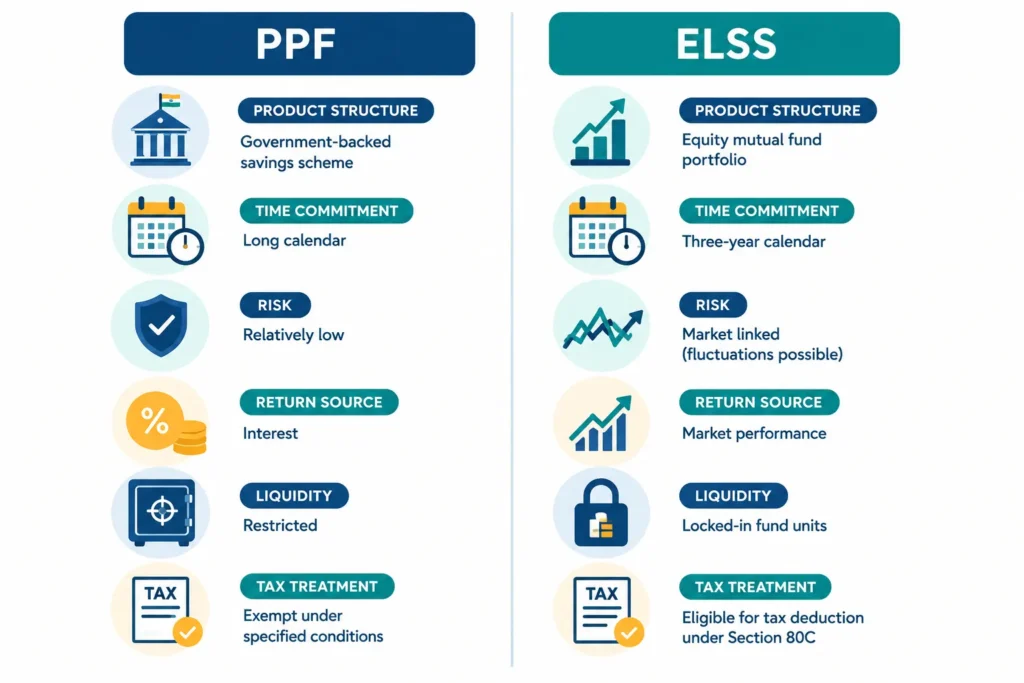
The main PPF and ELSS difference is how each option generates returns. PPF follows a government-declared interest rate, while ELSS invests mainly in equities and is affected by market movements.
They also have different lock-in rules, liquidity conditions and tax treatment. The following comparison provides a quick overview.
| Feature | PPF | ELSS |
|---|---|---|
| Product type | Government-backed small-savings scheme | Equity mutual fund category |
| Lock-in | 15-year maturity period | Three years for each investment |
| Risk | Relatively low credit and market risk | Higher risk because it invests mainly in equities |
| Source of returns | Interest rate declared by the government from time to time | Performance of the fund’s market-linked investments |
| Return certainty | The applicable interest rate is declared by the government, but it can be revised during the investment period | Returns are not fixed or guaranteed |
| Liquidity | Limited access before maturity, subject to withdrawal, loan and premature-closure rules | Units cannot be redeemed during the three-year lock-in |
| Investment method | Deposits can be made during the financial year, subject to scheme limits | Lump-sum investment or SIP |
| Section 80C treatment | Eligible contributions may qualify within the overall Section 80C limit under an eligible tax regime | Eligible investments may qualify within the overall Section 80C limit under an eligible tax regime |
| Tax on returns | Interest and eligible maturity proceeds are tax-exempt under prevailing rules | Capital gains are taxed according to the rules applicable to equity-oriented mutual funds |
Lock-in period and liquidity
A PPF account has a 15-year maturity period, calculated according to the scheme’s rules. It is therefore designed for long-term saving rather than easy access to money.
PPF does allow certain loans, partial withdrawals and premature closure in specified situations. However, these facilities come with eligibility conditions. Investors should not treat PPF like a bank savings account or an emergency fund.
ELSS has a shorter statutory lock-in of three years. However, the lock-in applies separately to every investment.
- A lump-sum investment made on 10 April 2025 completes its three-year lock-in around 10 April 2028, subject to applicable transaction and fund rules.
- An SIP instalment invested in May 2025 has its own three-year lock-in.
- The next SIP instalment invested in June 2025 completes its lock-in one month later.
Therefore, an ELSS SIP does not become fully available three years after the SIP starts. Each instalment becomes eligible for redemption after completing its individual lock-in.
A shorter lock-in also does not mean that three years is always a suitable equity investment horizon. Equity markets can be weak when the lock-in ends, so investors may need to remain invested for longer if that fits their goals and financial position.
Risk level and return potential
PPF offers greater capital stability because it is backed by the Government of India. Its returns are based on the interest rate declared by the government from time to time.
The PPF rate is not necessarily fixed for the entire 15-year period. If the declared rate changes, the return credited to the account can also change according to the scheme rules.
ELSS funds invest mainly in shares. Their value can rise or fall depending on the stock market, the fund’s portfolio and investment decisions.
This gives ELSS higher long-term growth potential, but it also creates the possibility of losses. ELSS returns are market-linked and are never guaranteed.
Practical example
Consider Meena, a salaried employee who wants disciplined long-term savings and is uncomfortable seeing sharp changes in investment value. She may find PPF more suitable for the stable portion of her financial plan.
Now consider Arjun, who has an emergency fund, can tolerate market declines and is investing for a goal more than several years away. He may consider ELSS for equity exposure and long-term growth potential.
This does not mean PPF is automatically right for every cautious investor or ELSS is right for every young investor. The decision should depend on the investor’s goals, time horizon, existing investments and ability to handle losses.
Tax treatment
PPF contributions and ELSS investments can be eligible for a deduction under Section 80C within the applicable overall limit. However, this benefit generally matters only when the investor uses a tax regime that allows the deduction and meets the relevant conditions.
Simply investing in PPF or ELSS does not automatically reduce everyone’s tax. For example, an investor using a tax regime that does not permit Section 80C deductions may not receive an additional deduction from the investment.
- PPF contributions: Eligible deposits may be included in the investor’s Section 80C deduction, subject to the overall limit and prevailing rules.
- PPF interest: Interest credited to the account is tax-exempt under current rules.
- PPF maturity: Eligible maturity proceeds are tax-exempt under current rules.
- ELSS investment: The invested amount may qualify under Section 80C, subject to the overall limit, tax regime and other conditions.
- ELSS redemption: Profits are treated as capital gains and taxed under the rules applicable to equity-oriented mutual funds.
The three-year ELSS lock-in does not make the redemption proceeds tax-free. Tax may apply to the capital gain,
PPF or ELSS—Which May Suit You?
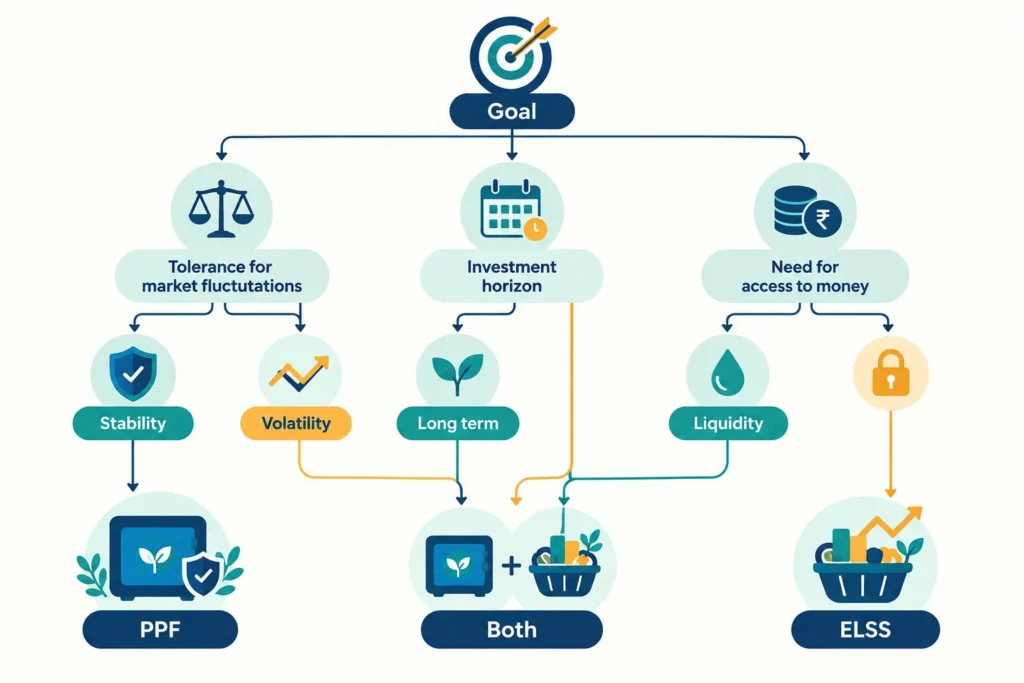
There is no universal winner in the PPF vs ELSS comparison. The suitable choice depends on your goal, investment period, ability to handle market movements and need for liquidity.
Before choosing, make sure you have an emergency fund and can keep the invested money locked in for the required period.
PPF may suit investors who…
- Prefer relative capital stability over market-linked growth.
- Want to build a long-term savings habit through regular contributions.
- Do not want the value of their investment to move with the stock market.
- Can keep money invested for the long PPF maturity period.
- Are comfortable with an interest rate declared by the government from time to time.
- Want to use PPF for a long-term goal rather than a short-term expense.
For example, a cautious salaried employee saving for retirement may prefer PPF because the investment does not directly rise and fall with the equity market. However, the long maturity period means it should not be treated as an emergency fund.
ELSS may suit investors who…
- Can tolerate equity market volatility and temporary losses.
- Want market-linked growth potential over the long term.
- Have an investment horizon longer than the minimum three-year lock-in.
- Understand that returns are not fixed or guaranteed.
- Can remain invested during market falls instead of making emotional decisions.
- Already have adequate emergency savings and suitable insurance cover.
An ELSS fund has a three-year lock-in, but three years should not automatically be treated as the ideal investment horizon. Equity investments can remain volatile over shorter periods. Investors should consider ELSS only when they can accept uncertainty and invest with a longer-term view.
For example, an investor saving for a goal that is several years away may consider ELSS if they have sufficient risk capacity. The final value could be higher or lower than expected because it depends on market performance and fund management.
Investor suitability checklist
| Question | PPF may be considered when… | ELSS may be considered when… |
|---|---|---|
| How much volatility can you accept? | You prefer relative stability and lower market risk. | You can accept significant market movements and possible losses. |
| How long can you invest? | You can commit to a long-term savings period. | You can invest beyond the three-year lock-in and preferably hold for a longer goal. |
| What type of return do you expect? | You prefer interest based on the rate declared by the government. | You want market-linked growth potential and understand that returns are uncertain. |
| Will you need the money soon? | You do not need unrestricted access and understand the withdrawal rules. | You can leave each investment untouched during its separate three-year lock-in. |
| What is your main objective? | Disciplined, relatively stable long-term saving. | Long-term equity participation with eligible tax-saving features. |
Can investors use both?
Yes. PPF and ELSS do not always have to be treated as competing choices. Some investors may use both for different purposes.
For example, an investor may use PPF as the relatively stable part of long-term savings and ELSS for equity exposure. The allocation should depend on the investor’s goals, existing investments, risk capacity and monthly budget.
Using both does not create an unlimited tax deduction. Eligible PPF contributions and ELSS investments fall within the applicable overall Section 80C limit. The deduction also depends on the tax regime selected and the rules in force for that financial year.
Avoid investing in both only to claim a deduction. First check whether the investments fit your overall financial plan and whether the required lock-ins are affordable.
Conclusion
PPF may be more suitable for an investor who prioritises relative stability, disciplined saving and lower exposure to market risk. ELSS may be more suitable for an investor who can tolerate equity volatility and wants market-linked long-term growth potential.
The shorter ELSS lock-in does not make it safer, while the government-backed nature of PPF does not make it liquid. Choose according to the complete combination of risk, investment horizon, access to money, return expectations and tax eligibility.
Common Mistakes to Avoid
Choosing only on the basis of past returns
Past ELSS returns do not guarantee future performance. A fund that performed well in an earlier period may underperform later. Compare its investment approach, portfolio, risk and consistency rather than relying on one return figure.
Treating the ELSS lock-in as the ideal holding period
Three years is the statutory lock-in, not a promise that the investment will deliver gains within three years. Equity markets may be weak when the lock-in ends. Your holding period should be linked to your goal and risk capacity.
Forgetting that every ELSS SIP has a separate lock-in
Each SIP instalment in an ELSS fund is treated as a separate investment. Every instalment remains locked in for three years from its own investment date.
Investing in PPF without planning for liquidity
PPF is intended for long-term saving. Although certain withdrawal and loan facilities may be available under prevailing rules, access is restricted. Do not invest money that may be needed for rent, medical costs or other near-term expenses.
Assuming tax savings are automatic
An investment does not automatically reduce your tax. Section 80C eligibility depends on the tax regime you use, the applicable overall limit and current tax rules. Check your existing eligible expenses and investments before adding more.
Investing at the last minute
Rushed tax planning can lead to unsuitable products, cash-flow pressure and poor fund selection. Review your needs earlier in the financial year and invest according to a planned budget.
Ignoring the rest of the portfolio
ELSS adds equity exposure, while PPF can form part of the relatively stable portion of long-term savings. Review existing mutual funds, provident fund balances, deposits and other assets before deciding the allocation.
Stopping or redeeming because of short-term market falls
ELSS values can fall during weak markets. After the lock-in ends, redeeming only because of a temporary decline may harm a long-term plan. Review the goal, fund suitability and portfolio before taking action.
Frequently Asked Questions
Is PPF better than ELSS?
Not for every investor. PPF offers relative stability and government-declared interest, while ELSS provides market-linked equity exposure with higher risk and uncertain returns. The better fit depends on your goal, time horizon and risk capacity.
Which has the shorter lock-in: PPF or ELSS?
ELSS has a three-year lock-in for each investment. Each SIP instalment has its own three-year lock-in. PPF has a much longer maturity period, subject to the scheme’s prevailing withdrawal and extension rules.
Can ELSS give negative returns?
Yes.





Comments