The Complete Guide to Loans and EMIs in India

A practical guide to understanding loans, EMIs, interest rates, tenure, eligibility, charges and repayment decisions in India.

The Complete Guide to Loans and EMIs in India
A loan lets you borrow money from a bank, non-banking financial company or another lender. You repay the borrowed amount, called the principal, along with interest and applicable charges.EMI means Equated Monthly Instalment. It is the amount generally paid each month until the loan is repaid. Your loan amount, interest rate and tenure determine the EMI and total repayment. A longer tenure can reduce the monthly EMI, but it usually increases the total interest paid.

Introduction to Loans and EMI in India

Loans can help pay for large expenses such as a house, vehicle, education or business requirement. They can also be used for short-term personal needs.

However, a loan is a financial commitment. A low monthly EMI does not always mean that the loan is inexpensive. You must also check the interest rate, repayment period, fees and total amount payable.

Understanding these basic terms makes it easier to compare loan offers and decide whether the repayment will fit your budget.

Understanding Loans, Interest and EMIs

What Is a Loan?

A loan is money borrowed under an agreement to repay it within a specified period. The lender may charge interest and other fees for providing the money.

For example, suppose you borrow ₹5 lakh to buy a car. You may repay the amount through monthly instalments over three, five or another agreed number of years.

The loan agreement sets out important conditions such as:

  • The amount sanctioned and disbursed
  • The applicable interest rate
  • The repayment tenure
  • The EMI amount and due date
  • Applicable fees and penalties
  • Prepayment or foreclosure conditions
  • Security or collateral, where required

Principal and Loan Amount

The principal is the amount borrowed or the outstanding amount on which interest is calculated.

The loan amount usually refers to the amount sanctioned by the lender. The amount that reaches your bank account may be lower if the lender deducts processing fees or other charges before disbursal.

As you repay the loan, the outstanding principal gradually reduces. Interest is generally calculated on this outstanding amount in a reducing-balance loan.

What Is a Loan Interest Rate?

The loan interest rate is the cost charged for borrowing money. It is usually stated as an annual percentage.

For example, a loan may have an interest rate of 10% per year. This does not mean that you simply pay 10% of the original amount every year. For most EMI-based loans, interest is calculated periodically on the outstanding principal.

A higher interest rate generally results in a higher EMI, a higher total repayment amount, or both.

You May Also Like:SIP Investment in India: A Beginner’s Guide to Systematic Investment Plans

What Is Loan Tenure?

Loan tenure is the period allowed for repayment. It may be expressed in months or years.

For example, a three-year loan has a tenure of 36 months, while a five-year loan has a tenure of 60 months.

Tenure affects both monthly affordability and total borrowing cost:

  • A shorter tenure generally results in a higher EMI but lower total interest.
  • A longer tenure generally results in a lower EMI but higher total interest.

The longer option may feel more affordable each month, but the borrower remains in debt for a longer period and usually pays interest for more months.

EMI Meaning
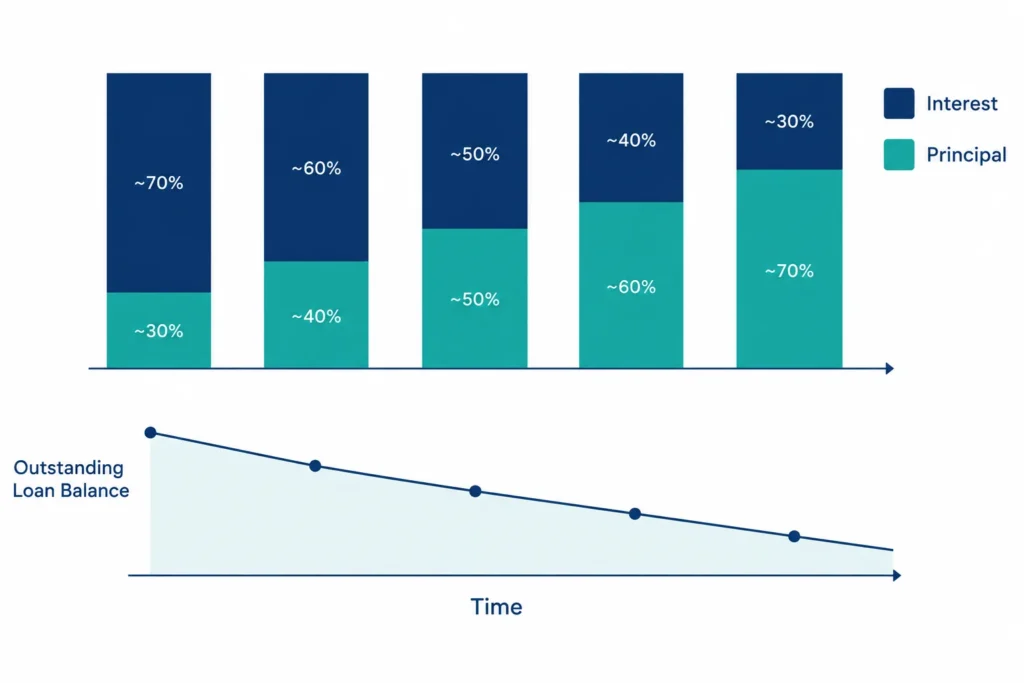
Diagram showing the interest portion of an EMI decreasing as principal repayment increases over time
EMI stands for Equated Monthly Instalment. It is the scheduled monthly payment made towards a loan.

Each EMI usually contains two parts:

  1. Interest: The lender’s charge on the outstanding principal.
  2. Principal repayment: The portion that reduces the amount still owed.

The EMI may remain the same in many loan structures, but the split between principal and interest changes over time. With floating-rate loans, the EMI or tenure may change when the applicable rate changes, depending on the loan terms.

Total Interest and Total Repayment

Total interest is the combined interest paid over the full loan tenure, assuming the loan follows the original repayment schedule.

Total repayment is the total of all scheduled EMIs. It can be expressed as:

Total repayment = Principal repaid + Total interest

Processing fees, insurance premiums, legal charges, late fees and other costs may not be included in this figure. These costs must be checked separately.

How the Main Loan Components Work Together

Effect of major loan components
Component If It Increases Likely Effect
Loan amount You borrow more money The EMI and total repayment generally increase
Interest rate Borrowing becomes more expensive The EMI or tenure may increase, along with total interest
Loan tenure You get more months to repay The EMI generally decreases, but total interest usually increases

Types of Loans and Interest Rate Options in India

Loans are designed for different purposes. A home loan may run for many years, while a gold loan or personal loan may have a much shorter repayment period.

Before comparing loans and EMI in India, first understand whether the loan is secured or unsecured. Then check how the interest rate can change during the tenure.

You May Also Like:How to Choose the Best Term Insurance Plan in India: Complete 2026 Guide

Secured Loans and Unsecured Loans

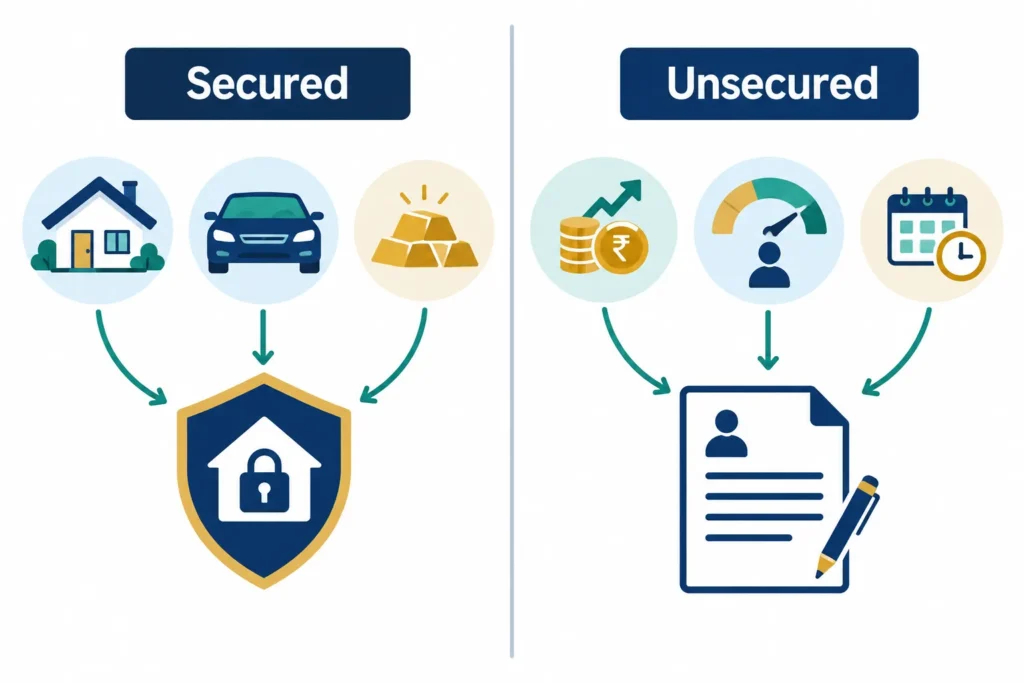
Visual comparison of secured loans backed by collateral and unsecured loans assessed without a specific asset
A secured loan is backed by an asset or collateral. The asset could be a house, vehicle, property, gold or another acceptable security.

If the borrower does not repay the loan, the lender may have the right to take and sell the secured asset after following the applicable process and loan terms.

An unsecured loan does not require a specific asset as collateral. The lender usually gives greater importance to the borrower’s income, credit history, existing EMIs and repayment capacity.

Feature Secured Loan Unsecured Loan
Collateral An asset or security is required No specific collateral is usually required
Common examples Home loan, vehicle loan, gold loan and loan against property Personal loan and some business loans
Lender’s assessment Repayment capacity, credit profile and collateral value Income, credit profile and repayment capacity
General cost pattern May cost less because the lender has security, but this is not guaranteed May cost more because the lender does not have specific collateral
Main borrower risk The secured asset may be at risk after repayment default Late or missed payments can lead to charges, recovery action and damage to the credit profile

Security alone does not decide whether a loan is suitable. A secured loan can still be expensive after fees, a long tenure and total interest are considered.

Home Loans

A home loan is generally used to buy, construct or renovate a residential property. The property normally acts as security for the loan.

Home loans often have longer tenures than many other loan products. A longer tenure can make the loan EMI more manageable, but it may also increase the total interest paid.

Check the required down payment, interest-rate type, rate-reset conditions, processing charges and prepayment rules. Also understand when EMI payments begin if the property is under construction.

Personal Loans

A personal loan is usually unsecured. It may be used for medical expenses, family events, travel, home repairs or other personal needs permitted by the lender.

Because there is no specific collateral, eligibility may depend heavily on income, credit history, employment stability and existing debt.

Personal loans may offer quick access to funds, but convenience should not replace a cost comparison. Review the total repayment, processing fee, late-payment terms and foreclosure conditions.

Vehicle Loans

A vehicle loan helps finance a car, two-wheeler or commercial vehicle. The financed vehicle generally acts as security until the loan is repaid and the lender’s charge is removed.

Borrowers commonly pay part of the vehicle’s price as a down payment. The lender finances the remaining eligible amount.

Compare the loan using the actual amount financed, not only the advertised EMI. Check the down payment, tenure, processing charges, prepayment conditions and steps for removing hypothecation after repayment.

Education Loans

An education loan can help pay eligible costs for higher education in India or abroad. Depending on the product and loan amount, the lender may ask for a co-borrower, collateral or both.

Repayment may begin after a specified study period or moratorium. However, interest may still build up during this period according to the loan terms.

Check which expenses are covered, whether collateral is required, how interest is treated during the study period and when regular repayment starts. Students and families should also understand the consequences if the course or employment plan changes.

You May Also Like:Financial Goals for Beginners in India: How to Set, Plan & Achieve Your Money Goals

Loans Against Property

A loan against property allows an eligible borrower to raise money by offering residential, commercial or another acceptable property as collateral.

The loan amount is generally linked to factors such as the property’s assessed value, legal acceptability and the borrower’s repayment capacity. The property remains at risk if repayments are not made as agreed.

Check valuation and legal charges, permitted use of funds, tenure, interest-rate terms and the lender’s process for releasing the property documents after repayment.

Gold Loans

A gold loan is secured against eligible gold jewellery or other gold items accepted by the lender. The amount offered depends on the lender’s valuation and applicable rules.

Repayment structures can differ. Some loans may use regular EMIs, while others may require periodic interest payments or repayment at the end of the agreed period.

Ask how the gold will be valued and stored. Also review the repayment schedule, renewal conditions and the procedure the lender may follow if dues remain unpaid.

Business Loans

Business loans can be used for working capital, equipment, expansion, inventory or other approved business needs. They may be secured or unsecured.

Lenders may review business turnover, cash flow, profitability, tax records, bank statements, time in business and the owner’s credit profile.

Businesses should match repayment dates with expected cash flow. A loan with an affordable monthly EMI during strong sales periods may become difficult to manage during a seasonal slowdown.

Credit Card Borrowing and EMI Conversion

A credit card is a revolving credit facility rather than a standard term loan. If the full bill is not paid by the due date, interest and other charges may apply according to the card terms.

Some card issuers allow eligible purchases or outstanding amounts to be converted into EMIs. This can spread the payment over several months, but it does not make the purchase free.

Check the interest charged, processing fee, taxes on eligible charges, early-closure terms and whether any discount or reward benefit changes after EMI conversion. Also confirm how the transaction affects the available credit limit.

Paying only the minimum amount due is different from repaying the full card bill. It can leave a large balance outstanding and may extend the repayment period.

Comparison of Common Loan Types

Loan Type Usual Purpose Security Broad Repayment Characteristics Important Points to Check
Home loan Purchase, construction or renovation of a home Property Usually a longer tenure with monthly EMIs Down payment, rate resets, property checks, fees and prepayment rules
Personal loan Eligible personal expenses Usually unsecured Generally repaid through fixed monthly instalments over a stated tenure Total cost, processing fee, late charges and foreclosure conditions
Vehicle loan Purchase of a car, two-wheeler or commercial vehicle Financed vehicle Monthly EMIs, commonly with an upfront down payment Amount financed, hypothecation removal and prepayment terms
Education loan Eligible higher-education expenses May be secured or unsecured May include a study period or repayment moratorium Eligible expenses, collateral requirements, interest treatment and repayment start date
You May Also Like:Emergency Fund Guide for Beginners in India

Eligibility, Charges and Responsible Repayment

Understanding the EMI is only one part of borrowing. You must also check whether you are eligible, what the loan will cost and whether you can repay it comfortably.

Loan approval is never guaranteed. The approved amount, interest rate, tenure and charges can differ across lenders and borrowers.

How Lenders Assess Loan Eligibility

Lenders examine your ability and willingness to repay. Their eligibility rules depend on the loan product and internal policies.

  • Credit score and credit history: A lender may review your repayment record, active credit accounts, overdue amounts and recent credit applications.
  • Income: Salaried applicants may need salary slips and bank statements. Self-employed applicants may need income-tax returns, financial statements and business bank records.
  • Employment or business stability: A stable income history can help the lender assess repayment capacity.
  • Existing EMIs: Home loan, vehicle loan, personal loan and credit card payments reduce the income available for a new EMI.
  • Repayment capacity: Lenders compare your income with existing obligations and regular expenses.
  • Age: Minimum and maximum age rules may apply at application or at the end of the loan tenure.
  • Purpose of the loan: Eligibility requirements can change depending on whether the loan is for a house, vehicle, education, business or personal expense.
  • Collateral value: For a secured loan, the lender may assess the property, vehicle, gold or other asset offered as security.
  • Documents: Identity, address, income, employment, business and property documents must satisfy the lender’s requirements.

Meeting basic eligibility conditions does not ensure approval. A lender may approve a lower amount, offer different pricing, request a co-applicant or reject the application.

Common Loan Charges to Check

The interest rate is not the only cost of a loan. Ask for a complete list of charges before accepting an offer.

Cost What It Means What to Check
Processing fee A fee for processing the loan application Whether it is fixed or percentage-based, refundable or non-refundable
Documentation charges Charges related to paperwork or agreements Whether they are included in the processing fee
Valuation or legal charges Costs for checking an asset or its legal documents Commonly relevant to property-backed and other secured loans
Insurance premium Cost of insurance linked to the borrower, asset or loan Whether it is compulsory, optional or added to the loan amount
Late-payment fee A charge for paying an EMI after the due date The fee, additional interest and applicable tax treatment
Cheque or auto-debit return charge A charge when the scheduled payment fails How much is charged for each failed payment attempt
Prepayment charge A possible charge for repaying part of the principal early Minimum amount, frequency, timing and product-specific conditions
Foreclosure charge A possible charge for closing the entire loan before schedule Rate type, borrower category and conditions stated in the agreement
Taxes Applicable taxes on eligible fees and services Whether quoted charges include or exclude taxes

Charges and conditions vary by lender and product. Read the sanction letter, key fact statement where applicable, repayment schedule and loan agreement. Do not rely only on a sales conversation.

Also check whether any fee is deducted from the sanctioned amount. For example, a loan may be sanctioned for ₹2 lakh, but the amount credited to your bank account could be lower after permitted upfront deductions.

How Loan Tenure Changes EMI and Total Interest

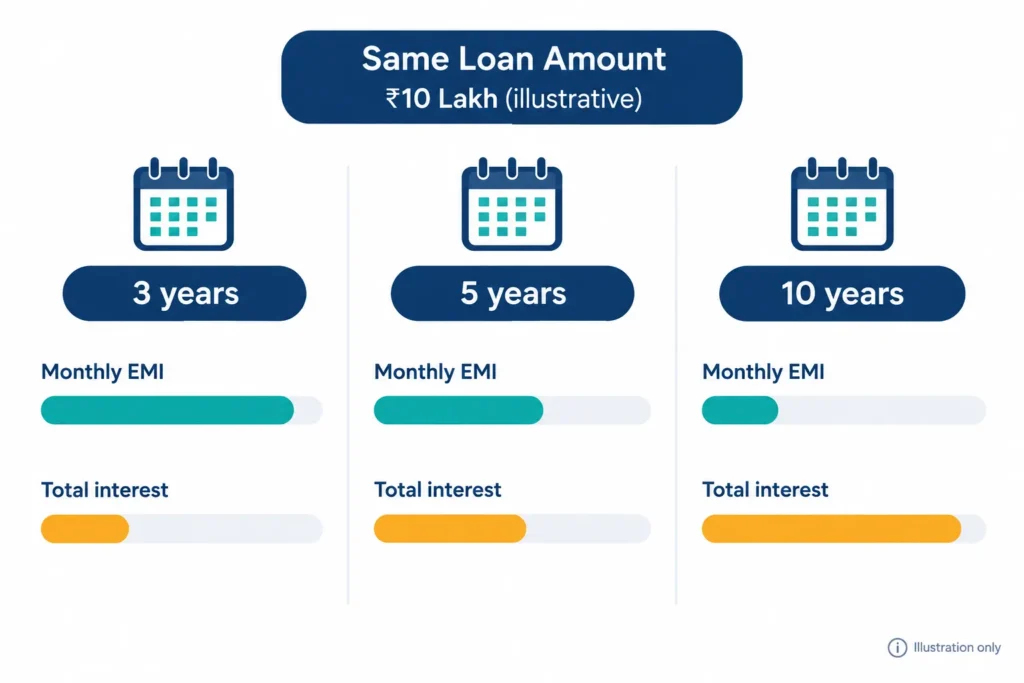
Comparison showing that longer loan tenure can lower monthly EMI while increasing total interest
A longer tenure generally reduces the monthly EMI. However, interest is charged for a longer period, so the total borrowing cost usually increases.

The following example assumes a ₹10 lakh loan at 10% annual interest on a monthly reducing balance. Figures are rounded and are only for illustration.

Loan Tenure Approximate Monthly EMI Approximate Total Repayment Approximate Total Interest
3 years ₹32,267 ₹11,61,600 ₹1,61,600
5 years ₹21,247 ₹12,74,800 ₹2,74,800
10 years ₹13,215 ₹15,85,800 ₹5,85,800

In this example, extending the tenure from 3 years to 10 years makes the EMI much lower, but the total interest becomes much higher.

Actual calculations can differ because of interest-rate changes, disbursement dates, rounding methods, broken-period interest and lender terms. With a floating-rate loan, changes in the rate may affect the EMI, tenure or both.

Choosing an Affordable EMI

An EMI should leave enough money for household expenses, insurance premiums, emergency savings and other financial goals.

Do not decide affordability only by looking at your current salary. Consider whether you could continue paying during a job change, business slowdown, medical expense or temporary income loss.

  • List all existing EMIs and credit card dues.
  • Estimate essential monthly household expenses.
  • Keep room for irregular costs such as school fees, repairs and annual insurance premiums.
  • Maintain an emergency fund instead of using all available savings as a down payment.
  • Test whether the EMI remains manageable if a floating interest rate rises.
  • Avoid assuming that future salary increases will solve an unaffordable EMI.

Part-Prepayment and Full Foreclosure

Part-prepayment means paying an additional amount towards the loan principal while keeping the loan active. It may reduce the remaining tenure, the EMI or both, depending on the lender’s process.

Full foreclosure means repaying the entire outstanding loan before the scheduled end date.

Early repayment can reduce future interest, especially when it is made during the earlier part of a reducing-balance loan. However, the actual benefit depends on the outstanding principal, remaining tenure and any applicable charges.

Before making a prepayment, ask the lender:

  • Is there a prepayment or foreclosure charge?
  • Is there a minimum prepayment amount?
  • How often can part-prepayments be made?
  • Will the EMI reduce or will the tenure become shorter?
Share this article
KEEP READING

Related Articles

View all →

Comments

Leave a Comment

The Complete Guide to Loans and EMIs in India

A loan lets you borrow money from a bank, non-banking financial company or another lender. You repay the borrowed amount, called the principal, along with interest and applicable charges.EMI means Equated Monthly Instalment. It is the amount generally paid each month until the loan is repaid. Your loan amount, interest rate and tenure determine the EMI and total repayment. A longer tenure can reduce the monthly EMI, but it usually increases the total interest paid.

Introduction to Loans and EMI in India

Loans can help pay for large expenses such as a house, vehicle, education or business requirement. They can also be used for short-term personal needs.

However, a loan is a financial commitment. A low monthly EMI does not always mean that the loan is inexpensive. You must also check the interest rate, repayment period, fees and total amount payable.

Understanding these basic terms makes it easier to compare loan offers and decide whether the repayment will fit your budget.

Understanding Loans, Interest and EMIs

What Is a Loan?

A loan is money borrowed under an agreement to repay it within a specified period. The lender may charge interest and other fees for providing the money.

For example, suppose you borrow ₹5 lakh to buy a car. You may repay the amount through monthly instalments over three, five or another agreed number of years.

The loan agreement sets out important conditions such as:

  • The amount sanctioned and disbursed
  • The applicable interest rate
  • The repayment tenure
  • The EMI amount and due date
  • Applicable fees and penalties
  • Prepayment or foreclosure conditions
  • Security or collateral, where required

Principal and Loan Amount

The principal is the amount borrowed or the outstanding amount on which interest is calculated.

The loan amount usually refers to the amount sanctioned by the lender. The amount that reaches your bank account may be lower if the lender deducts processing fees or other charges before disbursal.

As you repay the loan, the outstanding principal gradually reduces. Interest is generally calculated on this outstanding amount in a reducing-balance loan.

What Is a Loan Interest Rate?

The loan interest rate is the cost charged for borrowing money. It is usually stated as an annual percentage.

For example, a loan may have an interest rate of 10% per year. This does not mean that you simply pay 10% of the original amount every year. For most EMI-based loans, interest is calculated periodically on the outstanding principal.

A higher interest rate generally results in a higher EMI, a higher total repayment amount, or both.

What Is Loan Tenure?

Loan tenure is the period allowed for repayment. It may be expressed in months or years.

For example, a three-year loan has a tenure of 36 months, while a five-year loan has a tenure of 60 months.

Tenure affects both monthly affordability and total borrowing cost:

  • A shorter tenure generally results in a higher EMI but lower total interest.
  • A longer tenure generally results in a lower EMI but higher total interest.

The longer option may feel more affordable each month, but the borrower remains in debt for a longer period and usually pays interest for more months.

EMI Meaning

Diagram showing the interest portion of an EMI decreasing as principal repayment increases over time
EMI stands for Equated Monthly Instalment. It is the scheduled monthly payment made towards a loan.

Each EMI usually contains two parts:

  1. Interest: The lender’s charge on the outstanding principal.
  2. Principal repayment: The portion that reduces the amount still owed.

The EMI may remain the same in many loan structures, but the split between principal and interest changes over time. With floating-rate loans, the EMI or tenure may change when the applicable rate changes, depending on the loan terms.

Total Interest and Total Repayment

Total interest is the combined interest paid over the full loan tenure, assuming the loan follows the original repayment schedule.

Total repayment is the total of all scheduled EMIs. It can be expressed as:

Total repayment = Principal repaid + Total interest

Processing fees, insurance premiums, legal charges, late fees and other costs may not be included in this figure. These costs must be checked separately.

How the Main Loan Components Work Together

Effect of major loan components
Component If It Increases Likely Effect
Loan amount You borrow more money The EMI and total repayment generally increase
Interest rate Borrowing becomes more expensive The EMI or tenure may increase, along with total interest
Loan tenure You get more months to repay The EMI generally decreases, but total interest usually increases

Types of Loans and Interest Rate Options in India

Loans are designed for different purposes. A home loan may run for many years, while a gold loan or personal loan may have a much shorter repayment period.

Before comparing loans and EMI in India, first understand whether the loan is secured or unsecured. Then check how the interest rate can change during the tenure.

Secured Loans and Unsecured Loans
Visual comparison of secured loans backed by collateral and unsecured loans assessed without a specific asset
A secured loan is backed by an asset or collateral. The asset could be a house, vehicle, property, gold or another acceptable security.

If the borrower does not repay the loan, the lender may have the right to take and sell the secured asset after following the applicable process and loan terms.

An unsecured loan does not require a specific asset as collateral. The lender usually gives greater importance to the borrower’s income, credit history, existing EMIs and repayment capacity.

Feature Secured Loan Unsecured Loan
Collateral An asset or security is required No specific collateral is usually required
Common examples Home loan, vehicle loan, gold loan and loan against property Personal loan and some business loans
Lender’s assessment Repayment capacity, credit profile and collateral value Income, credit profile and repayment capacity
General cost pattern May cost less because the lender has security, but this is not guaranteed May cost more because the lender does not have specific collateral
Main borrower risk The secured asset may be at risk after repayment default Late or missed payments can lead to charges, recovery action and damage to the credit profile

Security alone does not decide whether a loan is suitable. A secured loan can still be expensive after fees, a long tenure and total interest are considered.

Home Loans

A home loan is generally used to buy, construct or renovate a residential property. The property normally acts as security for the loan.

Home loans often have longer tenures than many other loan products. A longer tenure can make the loan EMI more manageable, but it may also increase the total interest paid.

Check the required down payment, interest-rate type, rate-reset conditions, processing charges and prepayment rules. Also understand when EMI payments begin if the property is under construction.

Personal Loans

A personal loan is usually unsecured. It may be used for medical expenses, family events, travel, home repairs or other personal needs permitted by the lender.

Because there is no specific collateral, eligibility may depend heavily on income, credit history, employment stability and existing debt.

Personal loans may offer quick access to funds, but convenience should not replace a cost comparison. Review the total repayment, processing fee, late-payment terms and foreclosure conditions.

Vehicle Loans

A vehicle loan helps finance a car, two-wheeler or commercial vehicle. The financed vehicle generally acts as security until the loan is repaid and the lender’s charge is removed.

Borrowers commonly pay part of the vehicle’s price as a down payment. The lender finances the remaining eligible amount.

Compare the loan using the actual amount financed, not only the advertised EMI. Check the down payment, tenure, processing charges, prepayment conditions and steps for removing hypothecation after repayment.

Education Loans

An education loan can help pay eligible costs for higher education in India or abroad. Depending on the product and loan amount, the lender may ask for a co-borrower, collateral or both.

Repayment may begin after a specified study period or moratorium. However, interest may still build up during this period according to the loan terms.

Check which expenses are covered, whether collateral is required, how interest is treated during the study period and when regular repayment starts. Students and families should also understand the consequences if the course or employment plan changes.

Loans Against Property

A loan against property allows an eligible borrower to raise money by offering residential, commercial or another acceptable property as collateral.

The loan amount is generally linked to factors such as the property’s assessed value, legal acceptability and the borrower’s repayment capacity. The property remains at risk if repayments are not made as agreed.

Check valuation and legal charges, permitted use of funds, tenure, interest-rate terms and the lender’s process for releasing the property documents after repayment.

Gold Loans

A gold loan is secured against eligible gold jewellery or other gold items accepted by the lender. The amount offered depends on the lender’s valuation and applicable rules.

Repayment structures can differ. Some loans may use regular EMIs, while others may require periodic interest payments or repayment at the end of the agreed period.

Ask how the gold will be valued and stored. Also review the repayment schedule, renewal conditions and the procedure the lender may follow if dues remain unpaid.

Business Loans

Business loans can be used for working capital, equipment, expansion, inventory or other approved business needs. They may be secured or unsecured.

Lenders may review business turnover, cash flow, profitability, tax records, bank statements, time in business and the owner’s credit profile.

Businesses should match repayment dates with expected cash flow. A loan with an affordable monthly EMI during strong sales periods may become difficult to manage during a seasonal slowdown.

Credit Card Borrowing and EMI Conversion

A credit card is a revolving credit facility rather than a standard term loan. If the full bill is not paid by the due date, interest and other charges may apply according to the card terms.

Some card issuers allow eligible purchases or outstanding amounts to be converted into EMIs. This can spread the payment over several months, but it does not make the purchase free.

Check the interest charged, processing fee, taxes on eligible charges, early-closure terms and whether any discount or reward benefit changes after EMI conversion. Also confirm how the transaction affects the available credit limit.

Paying only the minimum amount due is different from repaying the full card bill. It can leave a large balance outstanding and may extend the repayment period.

Comparison of Common Loan Types

Loan Type Usual Purpose Security Broad Repayment Characteristics Important Points to Check
Home loan Purchase, construction or renovation of a home Property Usually a longer tenure with monthly EMIs Down payment, rate resets, property checks, fees and prepayment rules
Personal loan Eligible personal expenses Usually unsecured Generally repaid through fixed monthly instalments over a stated tenure Total cost, processing fee, late charges and foreclosure conditions
Vehicle loan Purchase of a car, two-wheeler or commercial vehicle Financed vehicle Monthly EMIs, commonly with an upfront down payment Amount financed, hypothecation removal and prepayment terms
Education loan Eligible higher-education expenses May be secured or unsecured May include a study period or repayment moratorium Eligible expenses, collateral requirements, interest treatment and repayment start date

Eligibility, Charges and Responsible Repayment

Understanding the EMI is only one part of borrowing. You must also check whether you are eligible, what the loan will cost and whether you can repay it comfortably.

Loan approval is never guaranteed. The approved amount, interest rate, tenure and charges can differ across lenders and borrowers.

How Lenders Assess Loan Eligibility

Lenders examine your ability and willingness to repay. Their eligibility rules depend on the loan product and internal policies.

  • Credit score and credit history: A lender may review your repayment record, active credit accounts, overdue amounts and recent credit applications.
  • Income: Salaried applicants may need salary slips and bank statements. Self-employed applicants may need income-tax returns, financial statements and business bank records.
  • Employment or business stability: A stable income history can help the lender assess repayment capacity.
  • Existing EMIs: Home loan, vehicle loan, personal loan and credit card payments reduce the income available for a new EMI.
  • Repayment capacity: Lenders compare your income with existing obligations and regular expenses.
  • Age: Minimum and maximum age rules may apply at application or at the end of the loan tenure.
  • Purpose of the loan: Eligibility requirements can change depending on whether the loan is for a house, vehicle, education, business or personal expense.
  • Collateral value: For a secured loan, the lender may assess the property, vehicle, gold or other asset offered as security.
  • Documents: Identity, address, income, employment, business and property documents must satisfy the lender’s requirements.

Meeting basic eligibility conditions does not ensure approval. A lender may approve a lower amount, offer different pricing, request a co-applicant or reject the application.

Common Loan Charges to Check

The interest rate is not the only cost of a loan. Ask for a complete list of charges before accepting an offer.

Cost What It Means What to Check
Processing fee A fee for processing the loan application Whether it is fixed or percentage-based, refundable or non-refundable
Documentation charges Charges related to paperwork or agreements Whether they are included in the processing fee
Valuation or legal charges Costs for checking an asset or its legal documents Commonly relevant to property-backed and other secured loans
Insurance premium Cost of insurance linked to the borrower, asset or loan Whether it is compulsory, optional or added to the loan amount
Late-payment fee A charge for paying an EMI after the due date The fee, additional interest and applicable tax treatment
Cheque or auto-debit return charge A charge when the scheduled payment fails How much is charged for each failed payment attempt
Prepayment charge A possible charge for repaying part of the principal early Minimum amount, frequency, timing and product-specific conditions
Foreclosure charge A possible charge for closing the entire loan before schedule Rate type, borrower category and conditions stated in the agreement
Taxes Applicable taxes on eligible fees and services Whether quoted charges include or exclude taxes

Charges and conditions vary by lender and product. Read the sanction letter, key fact statement where applicable, repayment schedule and loan agreement. Do not rely only on a sales conversation.

Also check whether any fee is deducted from the sanctioned amount. For example, a loan may be sanctioned for ₹2 lakh, but the amount credited to your bank account could be lower after permitted upfront deductions.

How Loan Tenure Changes EMI and Total Interest
Comparison showing that longer loan tenure can lower monthly EMI while increasing total interest
A longer tenure generally reduces the monthly EMI. However, interest is charged for a longer period, so the total borrowing cost usually increases.

The following example assumes a ₹10 lakh loan at 10% annual interest on a monthly reducing balance. Figures are rounded and are only for illustration.

Loan Tenure Approximate Monthly EMI Approximate Total Repayment Approximate Total Interest
3 years ₹32,267 ₹11,61,600 ₹1,61,600
5 years ₹21,247 ₹12,74,800 ₹2,74,800
10 years ₹13,215 ₹15,85,800 ₹5,85,800

In this example, extending the tenure from 3 years to 10 years makes the EMI much lower, but the total interest becomes much higher.

Actual calculations can differ because of interest-rate changes, disbursement dates, rounding methods, broken-period interest and lender terms. With a floating-rate loan, changes in the rate may affect the EMI, tenure or both.

Choosing an Affordable EMI

An EMI should leave enough money for household expenses, insurance premiums, emergency savings and other financial goals.

Do not decide affordability only by looking at your current salary. Consider whether you could continue paying during a job change, business slowdown, medical expense or temporary income loss.

  • List all existing EMIs and credit card dues.
  • Estimate essential monthly household expenses.
  • Keep room for irregular costs such as school fees, repairs and annual insurance premiums.
  • Maintain an emergency fund instead of using all available savings as a down payment.
  • Test whether the EMI remains manageable if a floating interest rate rises.
  • Avoid assuming that future salary increases will solve an unaffordable EMI.

Part-Prepayment and Full Foreclosure

Part-prepayment means paying an additional amount towards the loan principal while keeping the loan active. It may reduce the remaining tenure, the EMI or both, depending on the lender’s process.

Full foreclosure means repaying the entire outstanding loan before the scheduled end date.

Early repayment can reduce future interest, especially when it is made during the earlier part of a reducing-balance loan. However, the actual benefit depends on the outstanding principal, remaining tenure and any applicable charges.

Before making a prepayment, ask the lender:

  • Is there a prepayment or foreclosure charge?
  • Is there a minimum prepayment amount?
  • How often can part-prepayments be made?
  • Will the EMI reduce or will the tenure become shorter?

Leave a Comment