

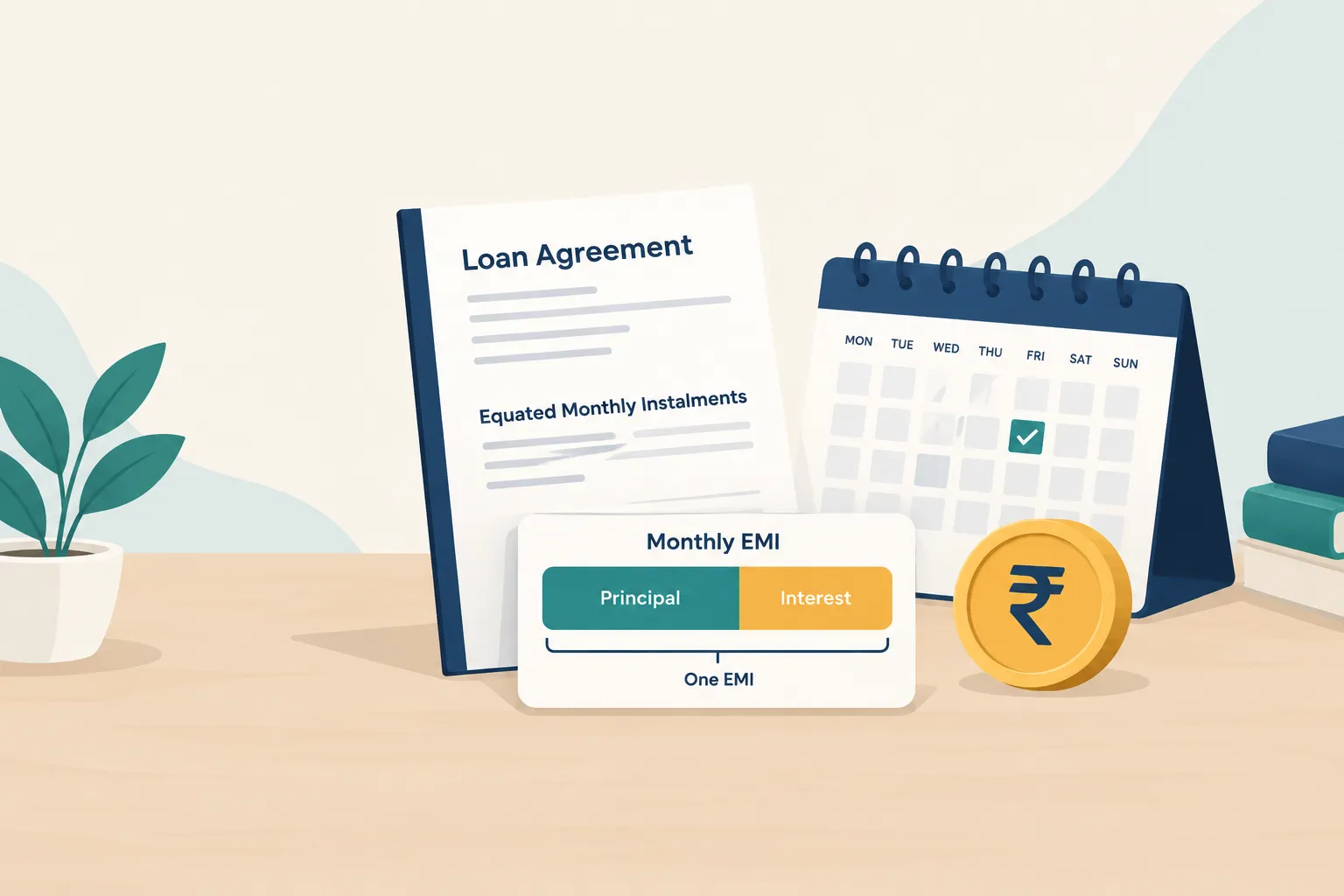
Quick answer: EMI stands for Equated Monthly Instalment. It is the amount you generally pay every month to repay a loan over an agreed period. Each EMI usually includes two parts: repayment of the borrowed amount, called the principal, and the interest charged by the lender.
EMIs make it possible to repay a large expense in smaller monthly payments. In India, they are commonly used for home loans, car loans, personal loans, education loans and consumer durable loans.
For example, instead of repaying an entire car loan at once, you may repay it through monthly instalments over several years. The lender sets the EMI based mainly on the loan amount, interest rate and repayment tenure.
However, the EMI is not the same as the total cost of the loan. Your total repayment normally includes the principal and interest paid across all instalments. Processing fees, insurance, taxes, late-payment charges and other costs may apply separately, depending on the lender’s terms.
What Is EMI and How Does It Work?
When someone asks, “what is EMI in a loan?”, the simplest answer is that it is a scheduled monthly loan payment.
In a standard loan arrangement, the borrower agrees to pay an EMI on a fixed date every month. Payments may be collected through auto-debit, a standing instruction, NACH or another method accepted by the lender.
The word equated generally means that the scheduled monthly instalment remains the same during the agreed period. However, the payment or tenure can change in some loan arrangements, particularly when the interest rate is floating or the borrower makes a prepayment.
Loan Amount or Principal
The principal is the amount borrowed from the lender. It forms the starting point for the EMI calculation.
Suppose you take a personal loan of ₹3 lakh. The ₹3 lakh is the original principal. As you pay your EMIs, part of each payment reduces the outstanding principal.
A larger loan amount will generally result in a higher EMI if the interest rate and tenure remain unchanged.
Interest Rate
The interest rate represents the cost of borrowing money. Lenders generally quote loan interest rates on an annual basis, although the EMI calculation uses a periodic rate based on the repayment schedule.
For a standard reducing-balance loan, interest is calculated on the outstanding principal. As the outstanding balance falls, the interest charged for each period generally falls as well.
The applicable rate may be fixed or floating. It may also depend on the loan type, lender policies, borrower profile and agreed loan terms.
Loan Tenure
The loan tenure is the period available to repay the loan. It may be stated in months or years.
For example, a three-year personal loan normally has 36 monthly instalments. A 20-year home loan normally has 240 monthly instalments, subject to the lender’s schedule and terms.
A longer tenure can reduce the monthly EMI because repayment is spread across more months. However, paying interest for a longer period can increase the total interest cost.
Principal Repaid Through an EMI
The principal component is the part of an EMI that reduces the outstanding loan balance.
If your EMI is ₹10,000, the entire ₹10,000 does not necessarily reduce the amount borrowed. One part is used to pay interest, while the remaining part is applied towards principal repayment.
As more principal is repaid, the outstanding balance becomes smaller. The loan is closed when the required principal, interest and any applicable charges have been paid according to the loan agreement.
Interest Charged Through an EMI
The interest component is the part of the EMI paid to the lender as the cost of the loan.
In a standard reducing-balance loan, the interest portion is generally larger during the early instalments because the outstanding principal is still high. As the balance reduces, the interest portion usually becomes smaller.
If the EMI stays unchanged, a smaller interest component allows a larger part of the later EMI to go towards principal repayment.
How Principal and Interest Change Over Time
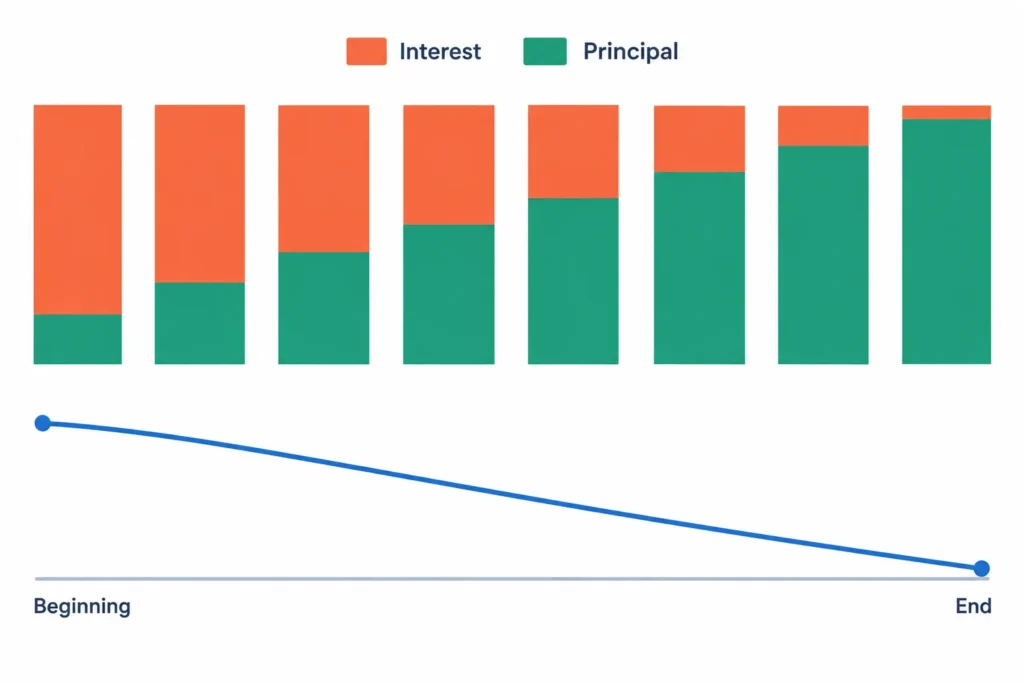
The following table shows the usual pattern in a standard reducing-balance loan. It is a conceptual illustration, not a lender quote or repayment schedule.
| Stage of the Loan | Interest Portion | Principal Portion | Outstanding Balance |
|---|---|---|---|
| Beginning | Generally higher | Generally lower | Close to the original loan amount |
| Middle | Gradually reducing | Gradually increasing | Lower than at the beginning |
| End | Generally lower | Generally higher | Close to zero |
This gradual change in the principal and interest portions is known as loan amortisation. Your lender’s repayment schedule, sometimes called an amortisation schedule, shows how each EMI is divided.
EMI Amount Versus Total Repayment Amount
The EMI amount is what you are scheduled to pay each month. The total repayment amount is the combined amount paid across the full loan tenure.
- Monthly EMI: The scheduled payment for one month.
- Total of EMIs: The EMI multiplied by the number of scheduled instalments, subject to changes in the loan.
- Total interest: The total of EMIs minus the original principal in a basic calculation.
- Overall borrowing cost: Interest plus any applicable processing fees, insurance, taxes, penalties or other charges.
For example, two loans may have a similar monthly EMI but different tenures. The loan with the longer tenure may involve a higher total interest outgo, even though its monthly payment looks manageable.
Therefore, borrowers should compare both the monthly EMI and the total repayment obligation before accepting a loan.
How Is EMI Calculated?
Most lenders calculate a loan EMI using the reducing-balance method. Under this method, interest is charged on the outstanding loan balance, not on the original loan amount throughout the tenure.
Every monthly payment has two parts:
- Interest component: The interest charged on the outstanding balance for that period.
- Principal component: The amount used to reduce the outstanding loan balance.
At the beginning of the repayment schedule, the outstanding balance is high. Therefore, the interest component is generally larger. As the balance falls, the interest component reduces and more of the EMI goes towards principal repayment.
The Standard EMI Formula
The commonly used formula for a reducing-balance loan is:
EMI = P × r × (1 + r)n ÷ [(1 + r)n − 1]
In this formula:
- P is the principal, or the amount borrowed.
- r is the periodic interest rate. For monthly EMIs, this is generally the annual interest rate divided by 12 and then by 100.
- n is the total number of monthly instalments.
For example, an annual interest rate of 12% gives a monthly rate of 1%:
12 ÷ 12 ÷ 100 = 0.01
The formula uses the loan amount, monthly interest rate and number of instalments to work out a broadly equal monthly payment.
Simple EMI Calculation Example
Consider an assumed loan with the following details:
- Loan amount: ₹1,00,000
- Annual interest rate: 12%
- Loan tenure: 12 months
- Monthly interest rate: 1%
Using the standard formula, the EMI is approximately ₹8,884.88 per month.
The approximate total repayment is:
₹8,884.88 × 12 = ₹1,06,618.56
The approximate total interest is:
₹1,06,618.56 − ₹1,00,000 = ₹6,618.56
These figures are only an illustration. They are not a loan offer or lender quote. Minor differences may arise because lenders can use different rounding rules, repayment dates and calculation practices.
Principal and Interest in the First Few EMIs
The table below shows how the EMI may be divided during the first three months of this example.
| Month | Opening balance | EMI | Interest component | Principal component | Closing balance |
|---|---|---|---|---|---|
| 1 | ₹1,00,000.00 | ₹8,884.88 | ₹1,000.00 | ₹7,884.88 | ₹92,115.12 |
| 2 | ₹92,115.12 | ₹8,884.88 | ₹921.15 | ₹7,963.73 | ₹84,151.39 |
| 3 | ₹84,151.39 | ₹8,884.88 | ₹841.51 | ₹8,043.37 | ₹76,108.02 |
The EMI stays approximately the same, but its composition changes. In this example, the interest component becomes smaller each month, while the principal component becomes larger.
How an EMI Calculator Helps
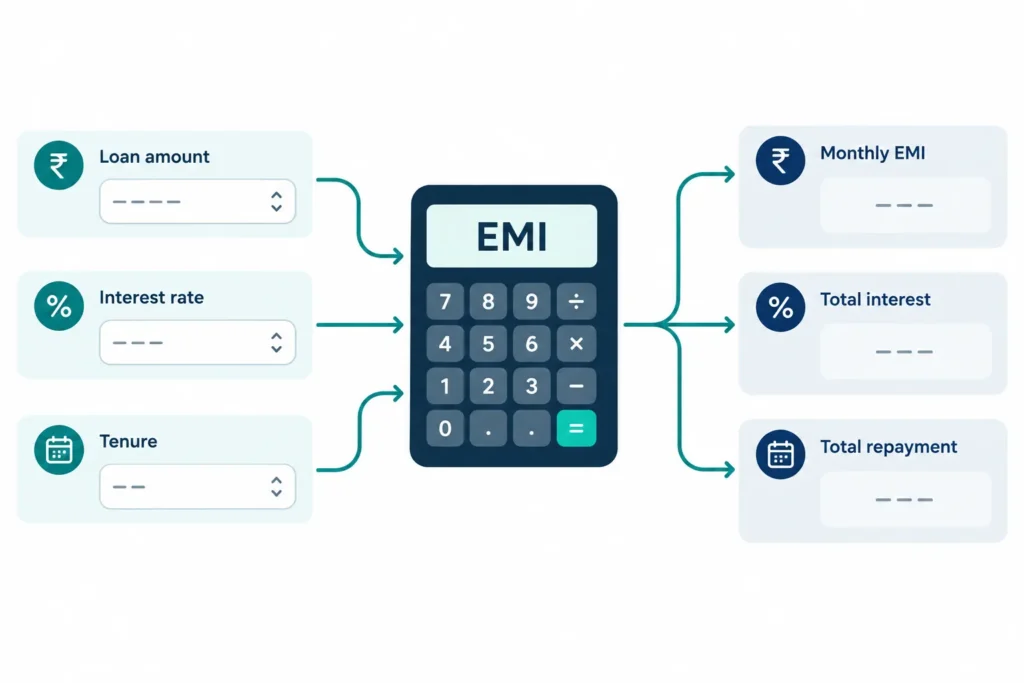
An EMI calculator can quickly estimate your monthly payment. You normally need to enter three details:
- The loan amount
- The annual interest rate
- The loan tenure
The calculator may also show the estimated total interest and total repayment amount. This can help you compare different loan amounts, rates and tenures before applying.
However, an EMI calculation is only an estimate unless it comes from the lender’s final repayment schedule. The result may not include processing fees, insurance premiums, taxes, late-payment charges or other lender-specific costs.
The actual loan EMI may also differ if the interest rate changes, the loan is disbursed in stages, a prepayment is made, or the lender follows a different repayment method. Always check the sanction letter and repayment schedule before accepting a loan.
What Affects Your EMI and Total Repayment?
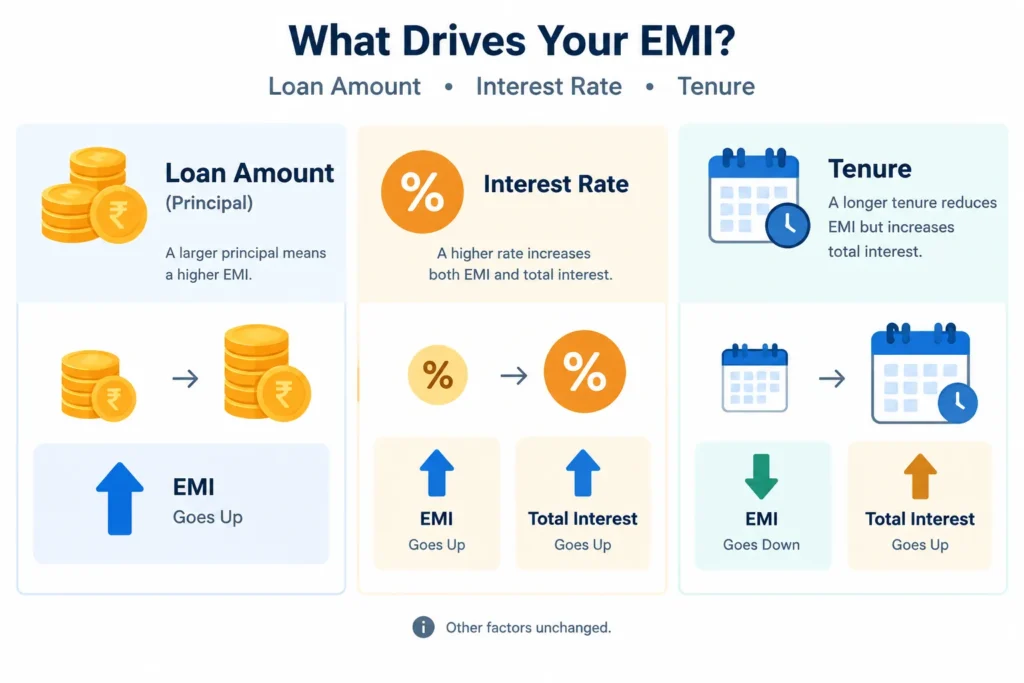
Your loan EMI mainly depends on three factors: the loan amount, the interest rate and the loan tenure. A change in any one of these can affect your monthly payment, total interest or both.
Other details also matter. These include the type of interest rate, repayment method, fees, prepayments and the lender’s terms.
1. Loan Amount
The loan amount is the principal borrowed from the lender. If the interest rate and tenure remain unchanged, a larger loan amount generally results in a higher EMI.
For example, a borrower taking a ₹10 lakh home loan will usually have a higher EMI than someone taking a ₹7 lakh loan on the same rate and tenure.
A larger loan also normally means paying more total interest because interest is calculated on a higher outstanding balance.
2. Interest Rate
The interest rate is the cost charged by the lender for providing the loan. If the loan amount and tenure stay the same, a higher interest rate leads to a higher EMI and greater total interest.
Even when the EMI appears affordable, compare the total repayment amount. A small difference in the interest rate can have a noticeable effect over a long loan tenure.
The rate shown in a loan offer may not represent every borrowing cost. Processing fees, insurance, taxes, documentation charges and other applicable costs may be separate.
3. Loan Tenure
Loan tenure is the period over which you repay the loan. It may be stated in months or years.
A longer tenure usually reduces the monthly EMI because repayment is spread across more instalments. However, the outstanding loan remains for longer, so the total interest can increase.
A shorter tenure usually creates a higher EMI but may reduce the total interest paid. The right tenure should balance monthly affordability with the overall borrowing cost.
How the Main Loan Factors Affect EMI
| Change | Likely Effect on EMI | Likely Effect on Total Interest |
|---|---|---|
| Higher loan amount | EMI generally increases | Total interest generally increases |
| Lower loan amount | EMI generally decreases | Total interest generally decreases |
| Higher interest rate | EMI generally increases | Total interest generally increases |
| Lower interest rate | EMI generally decreases | Total interest generally decreases |
| Longer tenure | EMI generally decreases | Total interest generally increases |
| Shorter tenure | EMI generally increases | Total interest generally decreases |
These are general relationships. Each row assumes that other loan factors remain unchanged.
Fixed EMI and Changing EMI Arrangements
In many loans, the EMI is set when the repayment schedule is created. You pay the stated amount on the agreed due date each month.
However, an EMI does not always remain unchanged for the entire tenure.
Fixed-Rate Loans
In a fixed-rate loan, the interest rate normally remains fixed for the period specified in the loan agreement. This can make repayments more predictable.
Check whether the rate is fixed for the full tenure or only for an initial period. Some loans may later move to another rate structure according to their terms.
Floating-Rate Loans
In a floating-rate loan, the interest rate can change based on the lender’s benchmark and the terms of the agreement. Home loans in India commonly offer floating-rate options.
When the rate changes, the lender may:
- change the EMI while keeping the tenure broadly similar;
- change the tenure while keeping the EMI similar;
- change both the EMI and the tenure; or
- offer choices subject to the loan terms and applicable requirements.
For example, if the rate rises, the lender may extend the loan tenure instead of immediately increasing the EMI. This can make the monthly payment appear unchanged while increasing the total interest and repayment period.
Review revised repayment schedules whenever the interest rate changes. Do not look only at the current EMI.
Effect of Prepayments
A prepayment is an additional amount paid towards the outstanding principal before it becomes due under the regular schedule.
Reducing the principal can lower future interest. Depending on the lender’s process and your chosen option, a prepayment may reduce the EMI, shorten the tenure or do both.
Check the loan agreement for minimum prepayment amounts, procedures and any applicable charges. The rules can differ by loan type, lender and rate structure.
Fees and Other Costs
Your EMI may not include every cost connected with the loan. Additional costs can include:
- processing fees;
- documentation or administrative charges;
- loan-related insurance premiums;
- applicable taxes;
- late payment charges;
- penal charges under the loan terms; and
- prepayment or foreclosure charges where applicable.
Ask for the repayment schedule and a clear list of charges before accepting a loan. Compare the total cost, not only the EMI displayed in an advertisement or loan offer.
Why Your Actual Repayment Schedule May Differ
The actual EMI and total repayment can vary because of:
- the lender’s calculation and rounding method;
- the loan disbursal date and first EMI date;
- fixed or floating interest rates;
- changes in benchmark rates;
- part-prepayments or foreclosure;
- missed or delayed payments;
- step-up, step-down or flexible repayment structures;
- moratorium or pre-EMI arrangements;
- fees, insurance and applicable taxes; and
- loan-specific terms and conditions.
An EMI calculator provides an estimate. The lender’s sanction letter, loan agreement and repayment schedule contain the applicable figures and terms.
Common EMI Mistakes to Avoid
Choosing a Loan Only Because the EMI Is Low
A low EMI may be the result of a longer tenure. While this can improve monthly affordability, it may also increase the total interest paid.
Compare the EMI, tenure, total interest and total repayment together.
Borrowing the Maximum Amount Offered
Loan eligibility does not automatically mean the EMI is comfortable for your budget. Consider regular expenses, existing debts and possible changes in income before deciding how much to borrow.
Ignoring Fees and Insurance
The EMI estimate may not include processing fees




Comments