

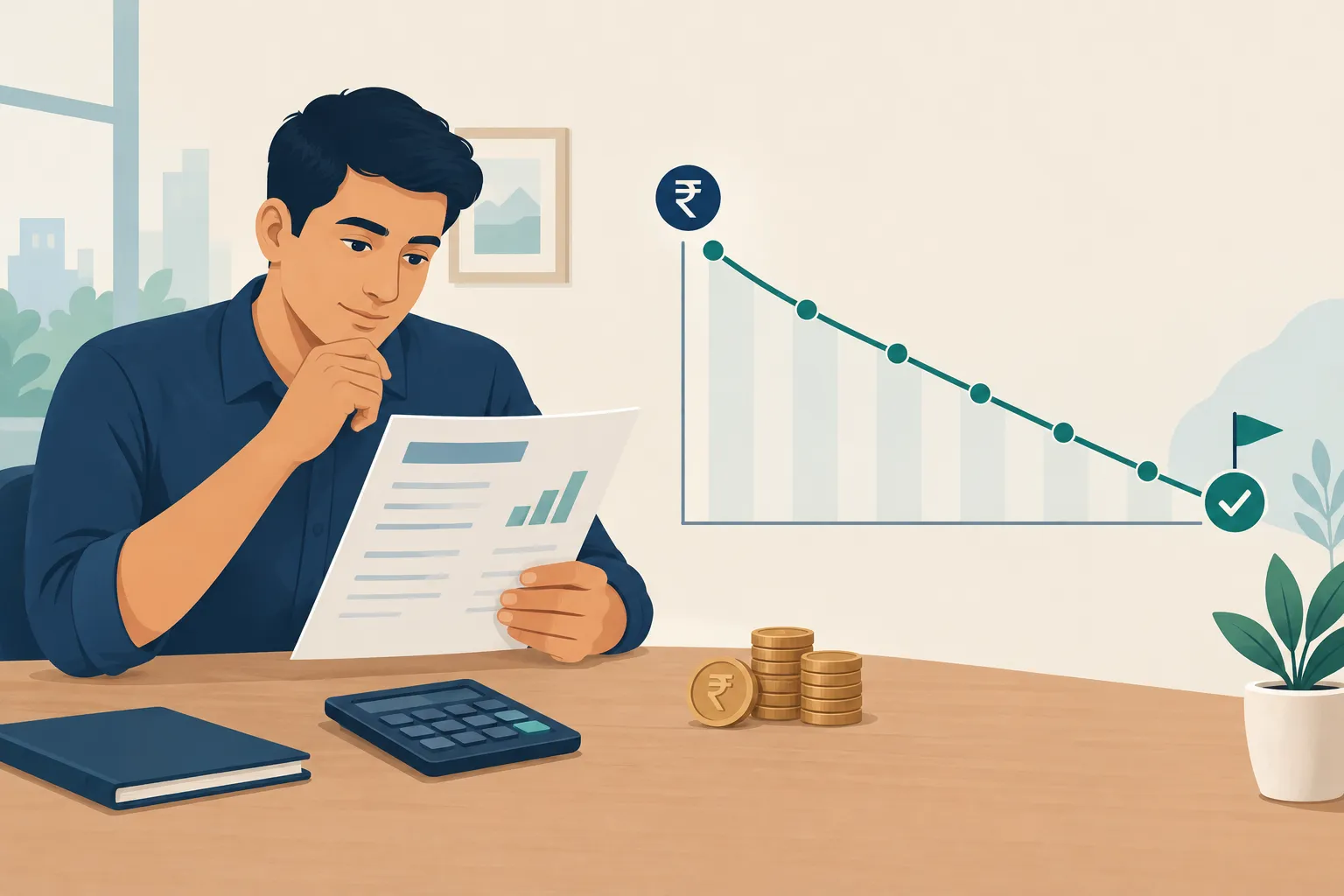
A longer tenure usually lowers the monthly EMI but may increase total interest. Choosing an affordable tenure, rather than simply selecting the lowest EMI, can help control the overall cost.
Introduction
When comparing loans, many borrowers focus mainly on the EMI. This is understandable because the EMI directly affects the monthly household budget.
However, the smallest EMI is not necessarily the least expensive option. A lender can reduce the EMI by spreading repayment over more months. You may get more monthly flexibility but could pay interest for longer.
Before choosing a loan, compare the EMI, tenure, total repayment, total interest and applicable charges together.
Why EMI and Total Loan Interest Are Different
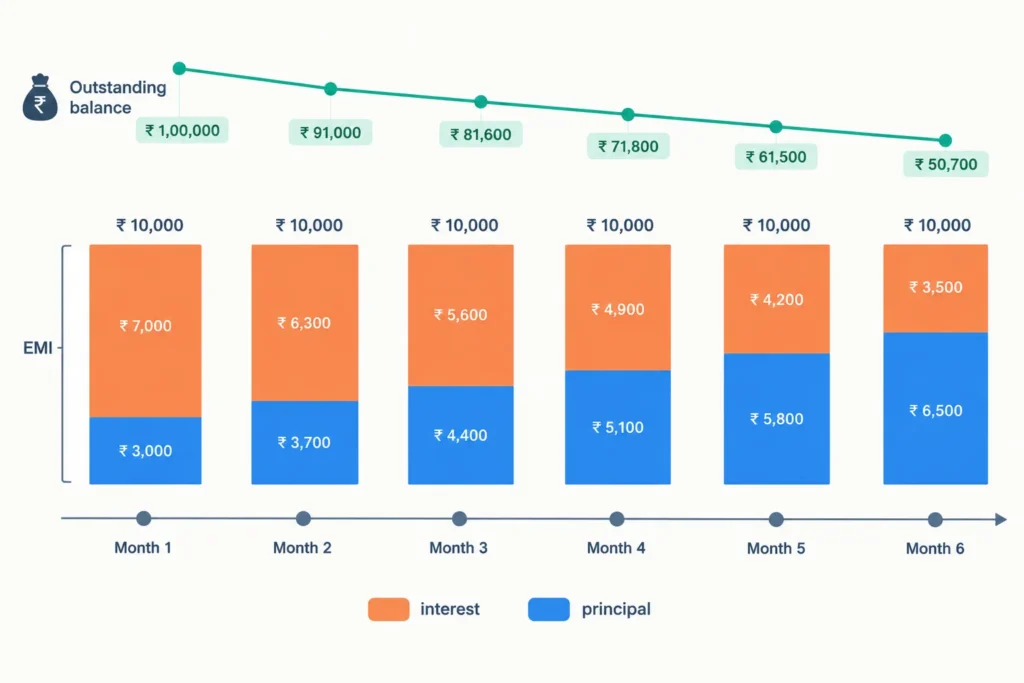
An EMI is one regular payment. Total loan interest is the interest accumulated across all scheduled payments during the loan period.
Each EMI generally contains two parts:
- Principal repayment: The portion that reduces the outstanding loan amount.
- Interest payment: The amount charged by the lender for the borrowed money.
In many reducing-balance loans, a larger part of the initial EMIs may go towards interest. As the outstanding principal falls, the interest portion generally reduces and the principal portion increases.
Important Loan Terms in Simple English
- Loan principal
- The amount borrowed from the lender. For example, if a bank approves a loan of ₹10,00,000, that amount is the principal.
- Interest rate
- The rate charged for borrowing the money. It is usually stated as an annual percentage, although interest may be calculated monthly on the outstanding balance.
- Loan tenure
- The period allowed for repaying the loan, such as 5 years, 10 years or 20 years.
- EMI
- EMI stands for Equated Monthly Instalment. It is the scheduled amount paid each month towards principal and interest.
- Total repayment
- The total amount paid over the loan tenure. For a basic loan calculation, it is the principal plus total interest. The borrower’s overall outflow may also include processing fees, insurance, taxes and other applicable charges.
- Total interest
- The cumulative interest paid over the full loan period. In a simple illustration, it can be estimated by subtracting the principal from the total of all EMIs.
How Loan Amount, Rate and Tenure Affect Cost
- A higher loan amount generally increases the EMI and total interest.
- A higher interest rate generally increases the EMI, total interest or both.
- A longer tenure generally lowers the EMI but can increase total interest.
- A shorter tenure generally increases the EMI but can reduce total interest.
This is why loan affordability should not be judged by EMI alone. The EMI must fit your budget, but the total repayment also deserves attention.
Illustrative Tenure Comparison
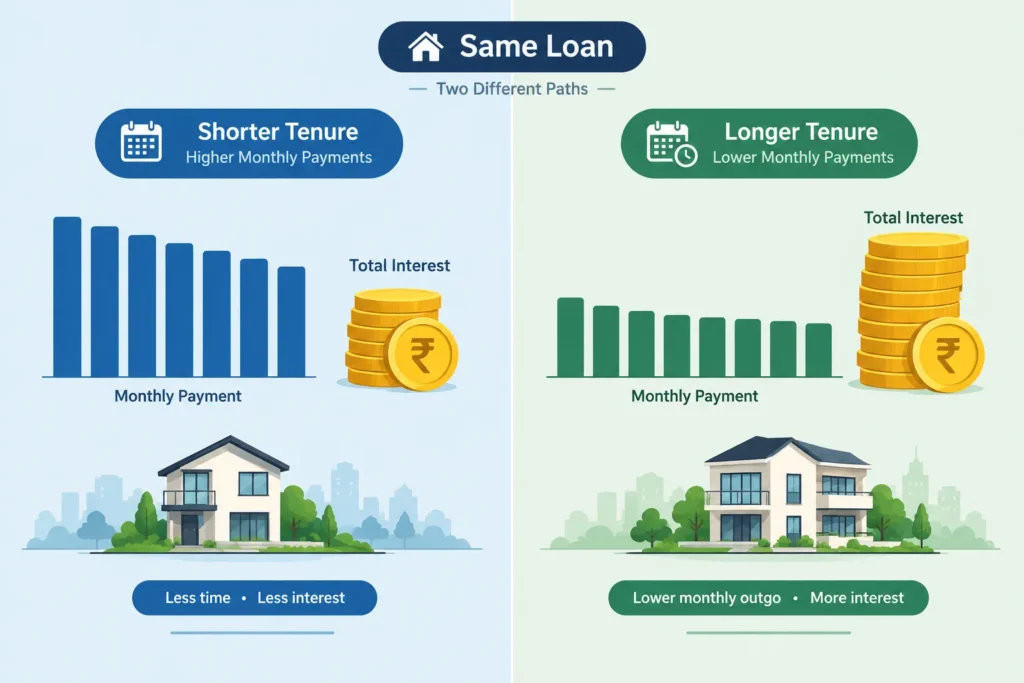
Consider a loan of ₹10,00,000 at an interest rate of 10% per year. The following example compares a 5-year tenure with a 10-year tenure.
| Loan detail | 5-year tenure | 10-year tenure |
|---|---|---|
| Principal | ₹10,00,000 | ₹10,00,000 |
| Interest rate | 10% per year | 10% per year |
| Approximate EMI | ₹21,247 | ₹13,215 |
| Approximate total repayment | ₹12,74,822 | ₹15,85,808 |
| Approximate total interest | ₹2,74,822 | ₹5,85,808 |
Assumptions: These figures are illustrative and rounded. They assume monthly payments, a reducing balance and an unchanged interest rate. Processing fees, insurance, taxes, late-payment charges and other costs are excluded. Actual lender calculations may differ.
In this example, the 10-year loan has a lower EMI. However, the borrower remains in debt for longer and pays more total interest.
The 5-year option reduces total interest, but its higher EMI may not suit every household. Choosing an unaffordable EMI can place pressure on essential spending, emergency savings and other financial goals.
The suitable tenure is therefore not automatically the shortest one. It is a tenure that balances monthly affordability with a reasonable overall borrowing cost.
Why the Interest Rate Type Also Matters
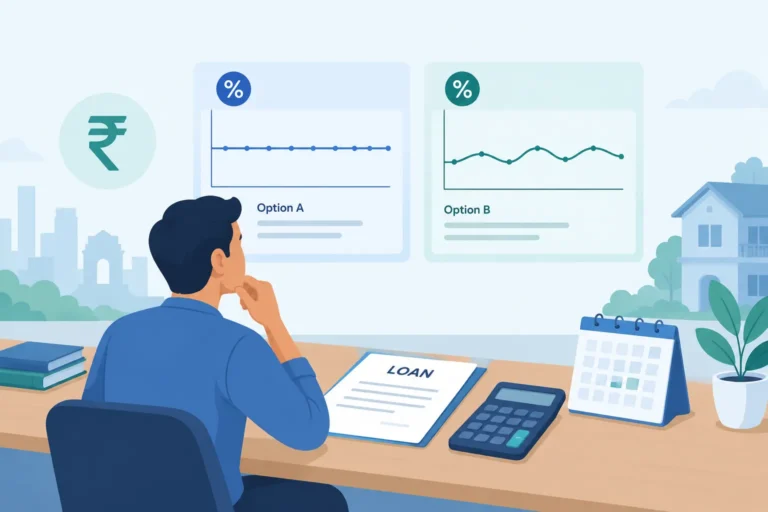
With a fixed-rate loan, the applicable rate generally remains fixed for the agreed period, subject to the loan terms. This can make scheduled repayments more predictable.
With a floating-rate loan, the rate can change based on the lender’s benchmark and reset rules. A
Practical Ways to Potentially Reduce Loan Interest
If you are exploring how to reduce loan interest, focus on the outstanding principal, interest rate and remaining tenure. Reducing the principal earlier can lower the amount on which future interest is calculated.
However, the right approach must remain affordable. Do not choose a very high EMI or use all your savings only to reduce total interest on a loan.
Choose the Shortest Tenure You Can Comfortably Afford
A shorter tenure usually means a higher EMI but potentially lower total loan interest. A longer tenure reduces the monthly EMI, but interest continues for more months or years.
Choose an EMI that leaves room for household expenses, insurance premiums, emergency savings and other important goals. The shortest available tenure is not automatically the right tenure for every borrower.
- Check whether the EMI is manageable on your regular income.
- Allow for possible increases in essential expenses.
- Do not depend on uncertain bonuses or incentives to pay the normal EMI.
- Keep some flexibility for medical costs, job changes or family needs.
Compare the Total Loan Cost, Not Only the Interest Rate
A lower advertised interest rate does not always mean the loan will be cheaper overall. Compare the rate along with applicable fees, charges and loan conditions.
| Item to compare | Why it matters |
|---|---|
| Interest rate | It directly affects the interest charged on the outstanding principal. |
| Fixed or floating rate | A floating rate may change during the tenure, while fixed-rate terms can also vary by lender and agreement. |
| Processing and administrative fees | These increase the initial cost of taking the loan. |
| Prepayment and foreclosure terms | Restrictions or charges may affect your ability to repay early. |
| Insurance or bundled products | Optional or required products can add to the amount you pay. |
| Late-payment and other charges | These can increase costs if repayment problems occur. |
Ask the lender for the repayment schedule and a clear list of applicable charges. Compare similar loan amounts and tenures rather than comparing loans with different structures.
Make an Eligible Part-Prepayment
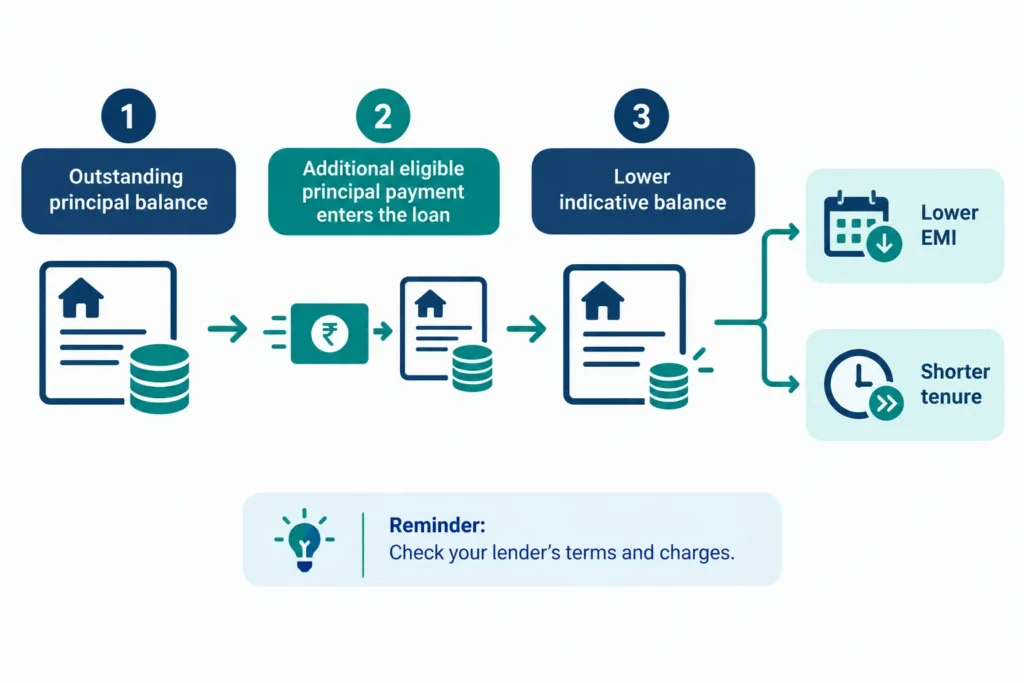
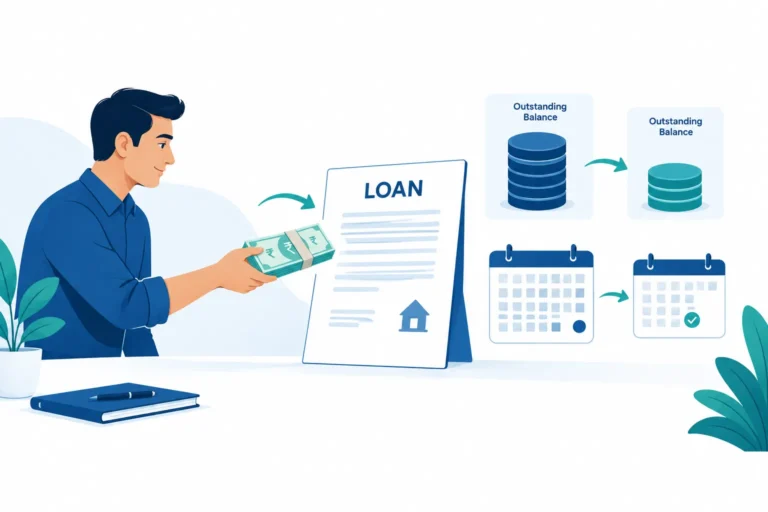
A part-prepayment is an additional payment made towards the outstanding loan principal, subject to the lender’s terms. Because the principal becomes lower, future interest may be calculated on a smaller amount.
Timing matters. An eligible prepayment made earlier in the tenure may have a greater effect than the same payment made near the end. The actual benefit depends on the loan rate, remaining tenure, payment date, charges and the lender’s calculation method.
Illustrative Effect of Additional Principal Repayment
This example is only for understanding the concept. It is not a loan quote or a guaranteed saving.
| Position | Illustrative amount | Possible effect |
|---|---|---|
| Before part-prepayment | Outstanding principal: ₹8,00,000 | Future interest is calculated according to the loan terms on the outstanding balance. |
| Additional principal payment | ₹1,00,000 | The lender applies the eligible payment towards principal after considering its rules and any applicable charges. |
| After part-prepayment | Indicative principal: ₹7,00,000 | Future interest may be charged on a lower balance. The lender may reduce the EMI, shorten the tenure or provide a choice. |
Actual results depend on when the payment is credited, accrued interest, lender calculations, minimum prepayment requirements, charges and the loan agreement. Obtain a revised repayment schedule after making the payment.
The detailed process, possible charges and documents are covered separately in the Loan Prepayment guide.
Choose Between a Lower EMI and a Shorter Tenure
After a part-prepayment, some lenders may allow you to choose how the repayment schedule changes.
- Reduce the EMI: This can improve monthly cash flow and make repayments easier to manage.
- Reduce the tenure: Continuing with a similar EMI may close the loan earlier and could reduce total interest more.
The shorter-tenure option may offer greater interest savings, but it is not always the best choice. A lower EMI may be more useful if your income is uncertain or your essential expenses have increased.
Ask the lender how each option changes the remaining tenure, future EMIs and estimated total interest. The available choice depends on the loan agreement and lender policy.
Increase the EMI When Your Finances Allow
If your income rises, you may ask the lender whether the EMI can be increased. A higher EMI can reduce the principal faster and may shorten the remaining tenure.
Before increasing the EMI, confirm that the higher amount will remain comfortable even during months with extra expenses. Also check whether the lender requires a formal request or imposes conditions on EMI changes.
A practical approach is to review the EMI after a salary increase. Use only a sustainable part of the increase instead of committing the entire amount.
Make Additional Principal Payments Where Permitted
Some borrowers use annual bonuses, incentives or other surplus funds to make extra principal payments. Even occasional payments may help reduce the outstanding balance.
Before paying, confirm that the amount will be treated as principal prepayment rather than as an advance EMI. An advance EMI may simply cover future instalments without producing the same effect on the principal.
Always request a receipt and check the updated loan statement. It should clearly show how the payment has been allocated.
Review Floating-Rate Loan Changes
With a floating-rate loan, the interest rate can change during the loan tenure. When the rate rises, the lender may increase the EMI, extend the tenure or adjust both, depending on the agreement and applicable process.
A tenure extension can increase total loan interest even when the EMI appears unchanged. Review your loan statement and repayment schedule whenever the rate changes.
- Check the revised interest rate.
- Check whether the EMI, tenure or both have changed.
- Ask for the updated total repayment estimate.
- Find out whether you can increase the EMI or make a part-prepayment.
- Understand any terms before considering a transfer to another lender.
A loan transfer should be evaluated after including processing fees, legal or valuation costs, administrative expenses and any applicable charges. A small rate difference may not produce a meaningful benefit when the outstanding balance or remaining tenure is low.
Maintain a Healthy Credit Profile
A consistent repayment record and responsible use of credit may help you access competitive loan terms in the future. It does not guarantee approval or a particular interest rate.
- Pay EMIs and credit card bills on time.
- Avoid repeatedly applying for credit within a short period.
- Keep overall borrowing at a manageable level.
- Review your credit report and raise a correction request if information is inaccurate.
- Do not miss payments while
You May Also Like:PPF vs ELSS: Understanding the Key Differences for Indian Investors →Check the Trade-Offs Before You Repay Extra
Paying extra towards a loan can reduce future interest, but it also uses money that may be needed elsewhere. A part-prepayment, higher EMI or foreclosure is not automatically the best choice for every borrower.
The right decision depends on your loan terms, available savings, income stability and financial goals.
Use This Checklist Before Making an Extra Payment
What to check Why it matters Action to consider Emergency fund Once cash is used for prepayment, it may not be easily available for medical bills, job loss or urgent repairs. Keep an adequate emergency reserve before paying a large amount towards the loan. Prepayment or foreclosure charges Charges can reduce the expected savings from early repayment. Ask the lender for a written calculation of applicable charges and taxes. Minimum prepayment requirement Some lenders accept part-prepayments only above a specified amount or in multiples of an EMI. Check the lender’s current process and minimum amount. Loan agreement The agreement may specify when and how extra payments can be made. Review the prepayment, foreclosure and interest-reset clauses. Other expensive debt Credit card dues or another high-cost loan may deserve attention first. Compare interest rates, charges and repayment flexibility across all debts. Income stability A permanently higher EMI can become difficult if income falls. Increase the EMI only when the higher payment remains affordable. Other financial goals Using all available cash for a loan may delay insurance needs, education funding or retirement savings. Balance debt reduction with essential goals. Effect on EMI or tenure The lender may reduce the EMI, the tenure or apply another method after prepayment. Confirm the revised repayment schedule before proceeding. Do Not Empty Your Savings to Close a Loan
Suppose a borrower has ₹3 lakh in savings and wants to use the entire amount for a home loan prepayment. The outstanding principal may fall, but the borrower could be left without money for an emergency.
A more balanced approach may be to retain an emergency fund and use only the genuine surplus for prepayment. The suitable amount will vary by household.
Loan prepayment usually cannot be reversed easily. If money is needed later, taking a new loan may involve fresh eligibility checks, documentation, interest and fees.
Understand Prepayment and Foreclosure Charges
Prepayment rules depend on the type of loan, interest-rate structure, borrower category and lender terms. Some loans may allow early repayment without a charge, while others may have conditions or fees.
Do not assume that a rule applying to one home loan also applies to a personal loan, vehicle loan or business loan. Check the latest loan agreement and obtain the lender’s foreclosure or prepayment statement.
The statement should ideally show:
- Outstanding principal
- Interest due up to the payment date
- Prepayment or foreclosure charges, if applicable
- Applicable taxes or administrative costs
- Total amount required
- How the payment will affect EMI and tenure
Consider the Opportunity Cost of Your Cash
Opportunity cost means the benefit you give up by using money for one purpose instead of another.
For example, money used for loan prepayment cannot simultaneously remain available for an emergency, an essential insurance premium or another financial goal. This does not make prepayment a bad choice. It means the decision should consider more than interest savings alone.
Compare the loan’s effective cost with your alternatives, but avoid relying on uncertain investment returns. A market-linked investment does not provide the same certainty as reducing an outstanding loan balance.
Tax treatment may also affect the comparison for some loans. Tax rules and individual eligibility can change, so consider professional advice where the amount is significant.
When Increasing the EMI May Not Be Suitable
An increase EMI instruction creates a larger regular commitment. It may not suit borrowers with irregular income, upcoming major expenses or limited savings.
In such cases, occasional part-prepayments may offer more flexibility, provided the loan permits them. A salaried borrower with stable surplus cash may find a planned EMI increase easier to manage.
Before increasing the EMI, test whether the new amount remains affordable during months with higher household expenses.
You May Also Like:EMI Calculator – Calculate Your Monthly Loan EMI →How an EMI Calculator Can Help
An EMI calculator can compare different loan amounts, interest rates and tenures. It can also help estimate how a higher EMI or additional principal payment may affect the repayment period and total loan interest.
Use it to test questions such as:
- What happens if the tenure is reduced?
- Can the budget support a higher EMI?
- How much interest may be saved through a part-prepayment?
- Is reducing the EMI or reducing the tenure more useful for the current goal?
- How would a floating-rate change affect the repayment plan?
Calculator results are estimates. A lender may use a specific daily or monthly interest method, payment date, reset date, rounding process and fee structure. Ask for a revised amortisation schedule to understand the actual impact.
Common Mistakes to Avoid
Using the Entire Emergency Fund
Interest savings should not come at the cost of basic financial security. Keep enough accessible money for emergencies and near-term commitments.
Looking Only at the EMI
A lower EMI may simply result from a longer tenure. Compare total repayment, total interest, fees and the time required to become debt-free.
Ignoring Charges and Loan Conditions
A prepayment decision based only on the outstanding principal can be incomplete. Check charges, minimum payment rules and documentation requirements first.
Assuming Every Extra Payment Reduces Principal Immediately
Confirm how the lender will allocate the payment. Ask whether it will be treated as principal prepayment, advance EMI or payment of outstanding dues.
Reducing EMI Without Checking the Interest Impact
After a part-prepayment, a lower EMI can improve monthly cash flow. However, retaining a longer tenure may result in more interest than choosing a shorter tenure, subject to the lender’s calculations.
Increasing the EMI Too Aggressively
A high EMI may look manageable today but become difficult after an income change or major household expense. Keep a reasonable buffer in the monthly budget.
Ignoring Floating-Rate Changes

Comments