

Personal Loan vs Home Loan: Key Differences Explained

Understand how personal loans and home loans differ in purpose, collateral, tenure, borrowing cost, eligibility and repayment before choosing based on your financial need.

Personal Loan vs Home Loan: Key Differences Explained

The main difference between a personal loan and a home loan is how the money can be used and whether security is required.

A personal loan is generally unsecured and can be used for eligible personal expenses. A home loan is generally secured against the residential property being purchased, constructed or financed. Home loans usually offer longer repayment periods, while personal loans generally have shorter tenures.

Introduction

Choosing between a personal loan vs home loan is not simply about finding the lower EMI. These loans serve different purposes and involve different eligibility checks, documents, costs and repayment periods.

For example, a salaried employee may consider a personal loan for an urgent medical expense. A family planning to buy a flat may apply for a home loan because the borrowing is linked to an eligible residential property.

Neither loan is automatically better. The right option depends first on why you need the money. You should then compare affordability, total borrowing cost, loan tenure and lender conditions.

Understanding Personal Loans and Home Loans

What Is a Personal Loan?

A personal loan is generally an unsecured loan offered for legitimate personal financial needs, subject to the lender’s rules. “Unsecured” means that you usually do not need to pledge a house, vehicle or other asset as collateral.

Because there is normally no asset securing the loan, the lender assesses your ability and willingness to repay. The assessment may include your income, employment or business stability, existing EMIs, credit history and credit score.

Common eligible uses of a personal loan may include:

  • Medical or family emergencies
  • Planned household expenses
  • Education-related costs
  • Home repairs or purchases for the household
  • Weddings or other major personal events
  • Consolidating eligible existing debts

The lender may restrict certain uses. Borrowers should check the loan agreement and confirm that their intended purpose is permitted.

What Is a Home Loan?

A home loan is financing mainly connected with an eligible residential property. It may be used for purchasing a house or flat, constructing a home, or another property-related purpose accepted by the lender.

A home loan is generally a secured loan. The property being financed acts as security for the lender until the loan is repaid and the lender’s charge is released.

The lender therefore examines both the borrower and the property. Along with checking income and credit history, it may review the property’s ownership records, approvals, valuation and other legal or technical documents.

If the borrower fails to repay, the lender may take recovery action against the secured property according to the loan agreement and applicable law. This makes timely repayment especially important.

Secured vs Unsecured Loan
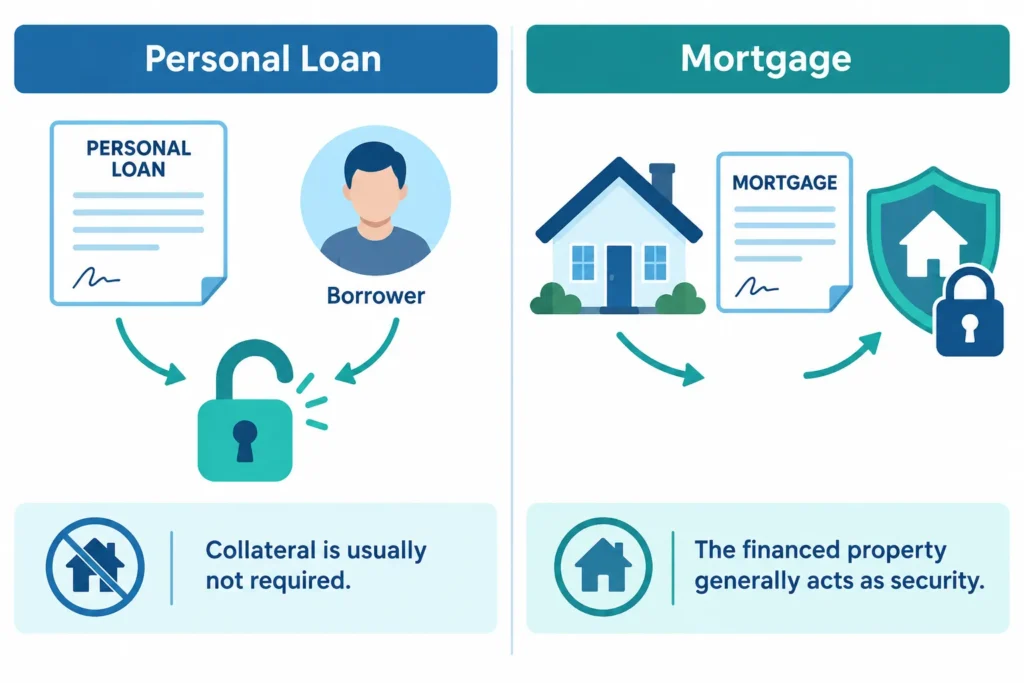
Visual comparison showing a personal loan as generally unsecured and a home loan as secured by the financed property.

Point Personal Loan Home Loan
Basic category Generally unsecured Generally secured
Collateral Usually not required The financed property generally acts as security
Main purpose Eligible personal financial needs Eligible residential property purchase, construction or related purpose
Key assessment Income, existing obligations and credit profile Borrower profile plus legal, technical and valuation checks for the property

These are general differences. Exact product features, permitted uses and approval requirements vary by lender and borrower profile.

You May Also Like:Loan Prepayment: Benefits, Charges and Things to Consider

How EMI Applies to Both Loans

Both personal loans and home loans are commonly repaid through equated monthly instalments, or EMIs. An EMI usually contains a portion of the principal borrowed and a portion of the interest charged.

The EMI depends mainly on the loan amount, interest rate and repayment tenure. A longer tenure may reduce the monthly EMI, but it can also increase the total interest paid over the full loan period.

Beginners can understand this calculation further through the separate What Is an EMI? guide. Property buyers can also refer to the Home Loan EMI article for home-loan-specific repayment concepts.

Personal Loan vs Home Loan: Detailed Comparison

The main difference between a personal loan and a home loan lies in their purpose and security. A personal loan is generally unsecured and can be used for eligible personal expenses. A home loan is generally secured against the residential property being financed.

The table below provides a practical comparison. Exact interest rates, fees, loan amounts, tenure options and approval conditions vary by lender and borrower profile.

Comparison point Personal loan Home loan
Primary purpose Eligible personal needs such as medical expenses, education-related costs, household expenses or planned purchases Purchase, construction or other eligible residential property purposes under the lender’s rules
Loan type Generally unsecured Generally secured
Collateral Usually no property or asset is pledged The financed property is generally offered as security
Typical tenure Usually shorter, ranging from a few months to several years depending on the lender Usually much longer because the loan finances a high-value property purchase
Interest rate Generally higher because the lender does not have property as security Generally lower than an unsecured personal loan, subject to the borrower and property assessment
Rate structure May be offered at a fixed or lender-defined rate structure May be offered with a fixed, floating or mixed rate structure
Loan amount Based mainly on income, existing obligations, credit profile and lender policy Linked to income, repayment capacity, property value, eligible property cost and lender policy
Eligibility assessment Focuses mainly on age, income, employment or business stability, existing EMIs and credit history Includes income and credit assessment along with detailed property-related checks
Property verification Not normally required Legal and technical verification of the property is generally required
Documentation Usually includes identity, address, income, employment or business, and bank-related documents Includes personal and income documents as well as property papers, approvals and related records
Processing time May be quicker because property verification is not involved May take longer due to legal, technical and valuation checks
Fees and charges May include processing fees, taxes, late payment charges and prepayment-related charges May include processing, legal, technical, valuation, administrative and property-related charges
Repayment Usually repaid through EMIs over a shorter period Usually repaid through EMIs over a longer period
Prepayment or foreclosure Conditions and charges depend on the lender, rate structure and loan agreement Conditions depend on the lender, borrower category, rate structure and applicable rules
Risk to the borrower Default can harm the credit profile and lead to recovery action Default can harm the credit profile and may also put the mortgaged property at risk

Secured vs Unsecured Loan

A personal loan is generally an unsecured loan. The lender does not usually hold a property or another physical asset as collateral. Approval therefore depends heavily on the borrower’s income, credit profile, repayment record and existing debt.

A home loan is generally secured against the property being purchased or constructed. The lender has a legal interest in the property until the loan is repaid and the security is released.

Security reduces the lender’s risk, but it creates an important responsibility for the borrower. If home loan repayments are not made as agreed, the lender may begin recovery proceedings involving the property, subject to the loan agreement and applicable law.

Difference in Loan Purpose

A personal loan can generally be used for different legitimate personal needs permitted by the lender. For example, a salaried employee may consider one for an urgent medical expense or a planned household requirement.

A home loan has a restricted property-related purpose. The money is generally approved for an eligible home purchase, residential construction or another housing purpose accepted by the lender. Disbursement may be made directly to the seller, builder or other eligible recipient.

A borrower should not select a loan only because it appears easier to obtain. The intended use of the funds should match the loan product and its terms.

You May Also Like:Fixed vs Floating Interest Rate: What Borrowers Should Know

Personal Loan Tenure vs Home Loan Tenure

Personal loan tenure is generally shorter. As the loan is unsecured, lenders usually expect it to be repaid within a more limited period.

Home loan tenure is generally longer because residential property requires a much larger amount. A longer repayment period can make the monthly EMI more manageable, but it can also increase the total interest paid over the full loan term.

Tenure should therefore be selected according to repayment capacity, not simply to obtain the lowest possible EMI.

Personal Loan Interest vs Home Loan Interest

Personal loan interest is generally higher than home loan interest because no property is offered as security. However, the final rate depends on factors such as income, employer or business profile, credit history, existing debt and lender policy.

A home loan may carry a lower rate because it is secured, but the interest cost can continue for many years. The borrower should consider both the rate and the repayment period when comparing total borrowing cost.

Home loans may have fixed, floating or mixed interest structures. In a floating-rate loan, the rate and related EMI or tenure may change according to the loan terms and the lender’s benchmark. Borrowers should understand how rate revisions will affect repayment.

Loan Amount and Repayment Capacity

For a personal loan, the approved amount is commonly based on income, existing EMIs, regular expenses and creditworthiness. A higher requested amount does not mean the lender will approve it.

For a home loan, the lender considers both the borrower’s repayment capacity and the eligible value or cost of the property. The lender may finance only part of the property cost, requiring the buyer to arrange the remaining amount as a down payment.

Expenses such as registration, stamp duty, taxes, interiors or other property costs may not always be fully covered. Borrowers should check which expenses are eligible before planning their contribution.

Personal Loan Eligibility

Personal loan eligibility commonly depends on:

  • Age and lender-defined eligibility limits
  • Monthly or annual income
  • Employment or business stability
  • Bank account and income records
  • Existing EMIs and other financial obligations
  • Credit history and repayment behaviour
  • Internal lender policies

Meeting basic eligibility conditions does not guarantee approval. The lender may approve a lower amount, offer different terms or reject the application after completing its assessment.

Home Loan Eligibility and Property Checks

Home loan eligibility includes many of the

Which Loan Type May Suit Your Need?

There is no universally better choice in the personal loan vs home loan comparison. The right option depends mainly on why you need the money.

A personal loan may suit an eligible short-term personal expense when you do not want to offer collateral. A home loan is designed for eligible residential property purposes and is generally secured against the property being financed.

You May Also Like:How to Reduce the Total Interest Paid on a Loan

When a Personal Loan May Be Suitable

Consider the example of Neha, who needs funds for an urgent medical expense and related household costs. She has a stable income but does not want to pledge an asset.

Subject to the lender’s approval and permitted use, an unsecured personal loan may be suitable because:

  • No property collateral is generally required.
  • Documentation may be simpler than for a property-backed loan.
  • The loan can cover eligible personal expenses.
  • A shorter repayment period may match a temporary funding need.

However, Neha must check whether the EMI fits comfortably within her monthly budget. She should also compare the interest cost, processing fee, late-payment charges and prepayment conditions.

When a Home Loan May Be Suitable

Consider a household planning to purchase or construct an eligible residential property. A home loan will usually be the relevant borrowing category because it is specifically structured for property financing.

A home loan may be suitable because:

  • It is intended for an eligible residential property purpose.
  • It may provide a longer repayment tenure.
  • The loan amount is assessed with reference to income, repayment capacity and the property.
  • The property being financed generally acts as security for the loan.

The household must be prepared for property documents, legal and technical checks, valuation requirements and its own contribution towards the property cost. Loan approval is not based only on income or credit score.

Failing to repay a secured home loan can place the financed property at risk. This makes long-term repayment planning especially important.

Do Not Choose Only by Looking at the EMI
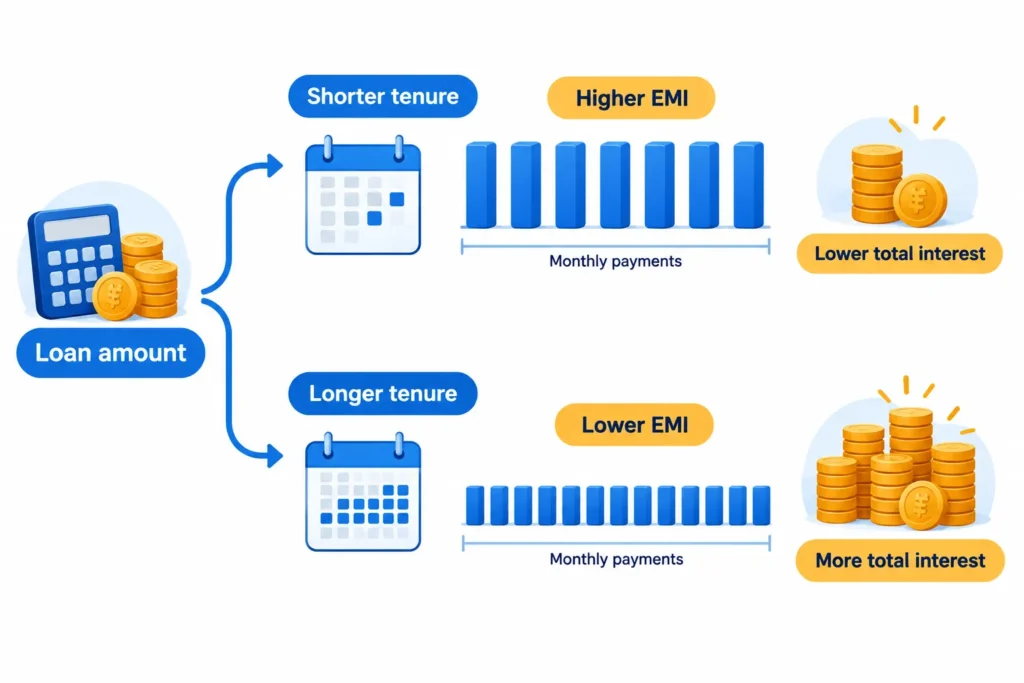
Diagram showing that a longer loan tenure can lower the monthly EMI while increasing total interest paid.
A lower EMI does not always mean a cheaper loan. A longer tenure can reduce the monthly instalment but increase the total interest paid over the full loan period.

The following example is hypothetical and is meant only to explain the effect of tenure.

Loan detail Three-year tenure Five-year tenure
Illustrative loan amount ₹5,00,000 ₹5,00,000
Illustrative annual interest rate 12% 12%
Approximate monthly EMI ₹16,607 ₹11,122
Approximate total repayment ₹5,97,852 ₹6,67,320
Approximate total interest ₹97,852 ₹1,67,320

In this example, the five-year option has a lower EMI. However, its total interest cost is higher because repayment continues for longer.

Actual EMIs may differ because of the interest rate, calculation method, disbursement date, rate changes, charges and lender rules. For a fair comparison, review both monthly affordability and total repayment.

Compare the Total Borrowing Cost

Do not compare a home loan or personal loan using only the advertised interest rate. Ask for a complete cost breakdown.

Depending on the lender and loan type, the overall cost may include:

  • Interest over the full tenure
  • Processing fees
  • Documentation or administrative charges
  • Property valuation and legal assessment charges
  • Applicable taxes on fees and services
  • Insurance costs, if separately selected or required under the terms
  • Late-payment or EMI bounce charges
  • Prepayment or foreclosure charges, where applicable
You May Also Like:How Credit Score Affects Your Loan Eligibility and Interest Rate

Also check whether the interest rate is fixed, floating or a combination. Understand when the rate can change and whether a change will affect the EMI, tenure or both.

Quick Decision Checklist
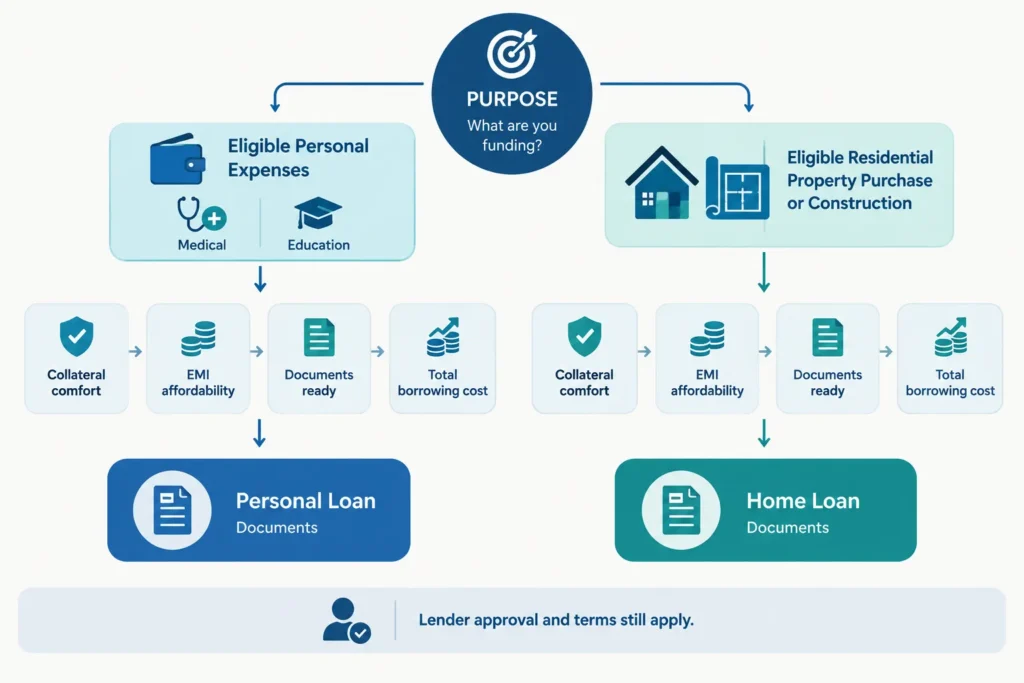
Decision flowchart comparing personal expenses with residential property financing and highlighting affordability, collateral and documentation checks.

Question What to consider
What is the borrowing purpose? Use a loan category designed for that purpose. A home loan is generally meant for an eligible property transaction, while a personal loan covers permitted personal needs.
Can I afford the EMI? Allow room for rent, household expenses, insurance, savings and emergencies.
Is my income stable? Consider whether you can continue repayment if income falls or expenses rise.
What is my credit profile? Your repayment history, existing debt and recent credit applications may affect approval and terms.
Can I provide the documents? Personal loans usually focus on identity, income and credit documents. Home loans also require property-related documents and checks.
Am I comfortable providing collateral? A home loan is generally secured against the property. A personal loan is generally unsecured.
What is the total repayment? Compare interest and all applicable fees, not only the EMI.
Do I plan to repay early? Review part-prepayment and foreclosure rules before accepting the loan.

Common Mistakes to Avoid

Choosing the Lowest EMI Without Checking the Tenure

A low EMI may appear affordable, but it can come with a longer repayment period and a higher total interest outgo. Compare the total amount payable under each option.

Using the Wrong Loan for the Purpose

A personal loan should not automatically replace a home loan simply because the application appears simpler. Loan usage must follow the lender’s terms, and property financing usually involves specific legal, technical and documentation requirements.

Ignoring Fees and Other Charges

Processing fees and other costs can affect the real cost of borrowing. Ask for a written schedule of charges and read the loan agreement before accepting an offer.

Borrowing the Maximum Eligible Amount

Eligibility is not the same as affordability. A lender may approve an amount that leaves little room in your monthly budget. Choose an EMI that you can manage along with existing commitments and essential expenses.

Not Checking Fixed and Floating Rate Terms

The interest structure can affect future repayments. A floating rate may change during the tenure, while fixed-rate terms can contain specific reset conditions. Read the exact definition in the loan documents.

Assuming Approval Is Guaranteed

Income alone does not guarantee approval. Lenders may assess employment or business stability, credit history, existing EMIs and documents. For a home loan, they also examine the property and transaction.

Overlooking Prepayment Conditions

Early repayment may reduce future interest, but conditions vary. Check the minimum part-payment amount, permitted frequency, procedure and applicable charges before planning
Share this article
KEEP READING

Related Articles

View all →

Comments

Leave a Comment

Personal Loan vs Home Loan: Key Differences Explained

The main difference between a personal loan and a home loan is how the money can be used and whether security is required.

A personal loan is generally unsecured and can be used for eligible personal expenses. A home loan is generally secured against the residential property being purchased, constructed or financed. Home loans usually offer longer repayment periods, while personal loans generally have shorter tenures.

Introduction

Choosing between a personal loan vs home loan is not simply about finding the lower EMI. These loans serve different purposes and involve different eligibility checks, documents, costs and repayment periods.

For example, a salaried employee may consider a personal loan for an urgent medical expense. A family planning to buy a flat may apply for a home loan because the borrowing is linked to an eligible residential property.

Neither loan is automatically better. The right option depends first on why you need the money. You should then compare affordability, total borrowing cost, loan tenure and lender conditions.

Understanding Personal Loans and Home Loans

What Is a Personal Loan?

A personal loan is generally an unsecured loan offered for legitimate personal financial needs, subject to the lender’s rules. “Unsecured” means that you usually do not need to pledge a house, vehicle or other asset as collateral.

Because there is normally no asset securing the loan, the lender assesses your ability and willingness to repay. The assessment may include your income, employment or business stability, existing EMIs, credit history and credit score.

Common eligible uses of a personal loan may include:

  • Medical or family emergencies
  • Planned household expenses
  • Education-related costs
  • Home repairs or purchases for the household
  • Weddings or other major personal events
  • Consolidating eligible existing debts

The lender may restrict certain uses. Borrowers should check the loan agreement and confirm that their intended purpose is permitted.

What Is a Home Loan?

A home loan is financing mainly connected with an eligible residential property. It may be used for purchasing a house or flat, constructing a home, or another property-related purpose accepted by the lender.

A home loan is generally a secured loan. The property being financed acts as security for the lender until the loan is repaid and the lender’s charge is released.

The lender therefore examines both the borrower and the property. Along with checking income and credit history, it may review the property’s ownership records, approvals, valuation and other legal or technical documents.

If the borrower fails to repay, the lender may take recovery action against the secured property according to the loan agreement and applicable law. This makes timely repayment especially important.

Secured vs Unsecured Loan

Visual comparison showing a personal loan as generally unsecured and a home loan as secured by the financed property.

Point Personal Loan Home Loan
Basic category Generally unsecured Generally secured
Collateral Usually not required The financed property generally acts as security
Main purpose Eligible personal financial needs Eligible residential property purchase, construction or related purpose
Key assessment Income, existing obligations and credit profile Borrower profile plus legal, technical and valuation checks for the property

These are general differences. Exact product features, permitted uses and approval requirements vary by lender and borrower profile.

How EMI Applies to Both Loans

Both personal loans and home loans are commonly repaid through equated monthly instalments, or EMIs. An EMI usually contains a portion of the principal borrowed and a portion of the interest charged.

The EMI depends mainly on the loan amount, interest rate and repayment tenure. A longer tenure may reduce the monthly EMI, but it can also increase the total interest paid over the full loan period.

Beginners can understand this calculation further through the separate What Is an EMI? guide. Property buyers can also refer to the Home Loan EMI article for home-loan-specific repayment concepts.

Personal Loan vs Home Loan: Detailed Comparison

The main difference between a personal loan and a home loan lies in their purpose and security. A personal loan is generally unsecured and can be used for eligible personal expenses. A home loan is generally secured against the residential property being financed.

The table below provides a practical comparison. Exact interest rates, fees, loan amounts, tenure options and approval conditions vary by lender and borrower profile.

Comparison point Personal loan Home loan
Primary purpose Eligible personal needs such as medical expenses, education-related costs, household expenses or planned purchases Purchase, construction or other eligible residential property purposes under the lender’s rules
Loan type Generally unsecured Generally secured
Collateral Usually no property or asset is pledged The financed property is generally offered as security
Typical tenure Usually shorter, ranging from a few months to several years depending on the lender Usually much longer because the loan finances a high-value property purchase
Interest rate Generally higher because the lender does not have property as security Generally lower than an unsecured personal loan, subject to the borrower and property assessment
Rate structure May be offered at a fixed or lender-defined rate structure May be offered with a fixed, floating or mixed rate structure
Loan amount Based mainly on income, existing obligations, credit profile and lender policy Linked to income, repayment capacity, property value, eligible property cost and lender policy
Eligibility assessment Focuses mainly on age, income, employment or business stability, existing EMIs and credit history Includes income and credit assessment along with detailed property-related checks
Property verification Not normally required Legal and technical verification of the property is generally required
Documentation Usually includes identity, address, income, employment or business, and bank-related documents Includes personal and income documents as well as property papers, approvals and related records
Processing time May be quicker because property verification is not involved May take longer due to legal, technical and valuation checks
Fees and charges May include processing fees, taxes, late payment charges and prepayment-related charges May include processing, legal, technical, valuation, administrative and property-related charges
Repayment Usually repaid through EMIs over a shorter period Usually repaid through EMIs over a longer period
Prepayment or foreclosure Conditions and charges depend on the lender, rate structure and loan agreement Conditions depend on the lender, borrower category, rate structure and applicable rules
Risk to the borrower Default can harm the credit profile and lead to recovery action Default can harm the credit profile and may also put the mortgaged property at risk

Secured vs Unsecured Loan

A personal loan is generally an unsecured loan. The lender does not usually hold a property or another physical asset as collateral. Approval therefore depends heavily on the borrower’s income, credit profile, repayment record and existing debt.

A home loan is generally secured against the property being purchased or constructed. The lender has a legal interest in the property until the loan is repaid and the security is released.

Security reduces the lender’s risk, but it creates an important responsibility for the borrower. If home loan repayments are not made as agreed, the lender may begin recovery proceedings involving the property, subject to the loan agreement and applicable law.

Difference in Loan Purpose

A personal loan can generally be used for different legitimate personal needs permitted by the lender. For example, a salaried employee may consider one for an urgent medical expense or a planned household requirement.

A home loan has a restricted property-related purpose. The money is generally approved for an eligible home purchase, residential construction or another housing purpose accepted by the lender. Disbursement may be made directly to the seller, builder or other eligible recipient.

A borrower should not select a loan only because it appears easier to obtain. The intended use of the funds should match the loan product and its terms.

Personal Loan Tenure vs Home Loan Tenure

Personal loan tenure is generally shorter. As the loan is unsecured, lenders usually expect it to be repaid within a more limited period.

Home loan tenure is generally longer because residential property requires a much larger amount. A longer repayment period can make the monthly EMI more manageable, but it can also increase the total interest paid over the full loan term.

Tenure should therefore be selected according to repayment capacity, not simply to obtain the lowest possible EMI.

Personal Loan Interest vs Home Loan Interest

Personal loan interest is generally higher than home loan interest because no property is offered as security. However, the final rate depends on factors such as income, employer or business profile, credit history, existing debt and lender policy.

A home loan may carry a lower rate because it is secured, but the interest cost can continue for many years. The borrower should consider both the rate and the repayment period when comparing total borrowing cost.

Home loans may have fixed, floating or mixed interest structures. In a floating-rate loan, the rate and related EMI or tenure may change according to the loan terms and the lender’s benchmark. Borrowers should understand how rate revisions will affect repayment.

Loan Amount and Repayment Capacity

For a personal loan, the approved amount is commonly based on income, existing EMIs, regular expenses and creditworthiness. A higher requested amount does not mean the lender will approve it.

For a home loan, the lender considers both the borrower’s repayment capacity and the eligible value or cost of the property. The lender may finance only part of the property cost, requiring the buyer to arrange the remaining amount as a down payment.

Expenses such as registration, stamp duty, taxes, interiors or other property costs may not always be fully covered. Borrowers should check which expenses are eligible before planning their contribution.

Personal Loan Eligibility

Personal loan eligibility commonly depends on:

  • Age and lender-defined eligibility limits
  • Monthly or annual income
  • Employment or business stability
  • Bank account and income records
  • Existing EMIs and other financial obligations
  • Credit history and repayment behaviour
  • Internal lender policies

Meeting basic eligibility conditions does not guarantee approval. The lender may approve a lower amount, offer different terms or reject the application after completing its assessment.

Home Loan Eligibility and Property Checks

Home loan eligibility includes many of the

Which Loan Type May Suit Your Need?

There is no universally better choice in the personal loan vs home loan comparison. The right option depends mainly on why you need the money.

A personal loan may suit an eligible short-term personal expense when you do not want to offer collateral. A home loan is designed for eligible residential property purposes and is generally secured against the property being financed.

When a Personal Loan May Be Suitable

Consider the example of Neha, who needs funds for an urgent medical expense and related household costs. She has a stable income but does not want to pledge an asset.

Subject to the lender’s approval and permitted use, an unsecured personal loan may be suitable because:

  • No property collateral is generally required.
  • Documentation may be simpler than for a property-backed loan.
  • The loan can cover eligible personal expenses.
  • A shorter repayment period may match a temporary funding need.

However, Neha must check whether the EMI fits comfortably within her monthly budget. She should also compare the interest cost, processing fee, late-payment charges and prepayment conditions.

When a Home Loan May Be Suitable

Consider a household planning to purchase or construct an eligible residential property. A home loan will usually be the relevant borrowing category because it is specifically structured for property financing.

A home loan may be suitable because:

  • It is intended for an eligible residential property purpose.
  • It may provide a longer repayment tenure.
  • The loan amount is assessed with reference to income, repayment capacity and the property.
  • The property being financed generally acts as security for the loan.

The household must be prepared for property documents, legal and technical checks, valuation requirements and its own contribution towards the property cost. Loan approval is not based only on income or credit score.

Failing to repay a secured home loan can place the financed property at risk. This makes long-term repayment planning especially important.

Do Not Choose Only by Looking at the EMI

Diagram showing that a longer loan tenure can lower the monthly EMI while increasing total interest paid.
A lower EMI does not always mean a cheaper loan. A longer tenure can reduce the monthly instalment but increase the total interest paid over the full loan period.

The following example is hypothetical and is meant only to explain the effect of tenure.

Loan detail Three-year tenure Five-year tenure
Illustrative loan amount ₹5,00,000 ₹5,00,000
Illustrative annual interest rate 12% 12%
Approximate monthly EMI ₹16,607 ₹11,122
Approximate total repayment ₹5,97,852 ₹6,67,320
Approximate total interest ₹97,852 ₹1,67,320

In this example, the five-year option has a lower EMI. However, its total interest cost is higher because repayment continues for longer.

Actual EMIs may differ because of the interest rate, calculation method, disbursement date, rate changes, charges and lender rules. For a fair comparison, review both monthly affordability and total repayment.

Compare the Total Borrowing Cost

Do not compare a home loan or personal loan using only the advertised interest rate. Ask for a complete cost breakdown.

Depending on the lender and loan type, the overall cost may include:

  • Interest over the full tenure
  • Processing fees
  • Documentation or administrative charges
  • Property valuation and legal assessment charges
  • Applicable taxes on fees and services
  • Insurance costs, if separately selected or required under the terms
  • Late-payment or EMI bounce charges
  • Prepayment or foreclosure charges, where applicable

Also check whether the interest rate is fixed, floating or a combination. Understand when the rate can change and whether a change will affect the EMI, tenure or both.

Quick Decision Checklist

Decision flowchart comparing personal expenses with residential property financing and highlighting affordability, collateral and documentation checks.

Question What to consider
What is the borrowing purpose? Use a loan category designed for that purpose. A home loan is generally meant for an eligible property transaction, while a personal loan covers permitted personal needs.
Can I afford the EMI? Allow room for rent, household expenses, insurance, savings and emergencies.
Is my income stable? Consider whether you can continue repayment if income falls or expenses rise.
What is my credit profile? Your repayment history, existing debt and recent credit applications may affect approval and terms.
Can I provide the documents? Personal loans usually focus on identity, income and credit documents. Home loans also require property-related documents and checks.
Am I comfortable providing collateral? A home loan is generally secured against the property. A personal loan is generally unsecured.
What is the total repayment? Compare interest and all applicable fees, not only the EMI.
Do I plan to repay early? Review part-prepayment and foreclosure rules before accepting the loan.

Common Mistakes to Avoid

Choosing the Lowest EMI Without Checking the Tenure

A low EMI may appear affordable, but it can come with a longer repayment period and a higher total interest outgo. Compare the total amount payable under each option.

Using the Wrong Loan for the Purpose

A personal loan should not automatically replace a home loan simply because the application appears simpler. Loan usage must follow the lender’s terms, and property financing usually involves specific legal, technical and documentation requirements.

Ignoring Fees and Other Charges

Processing fees and other costs can affect the real cost of borrowing. Ask for a written schedule of charges and read the loan agreement before accepting an offer.

Borrowing the Maximum Eligible Amount

Eligibility is not the same as affordability. A lender may approve an amount that leaves little room in your monthly budget. Choose an EMI that you can manage along with existing commitments and essential expenses.

Not Checking Fixed and Floating Rate Terms

The interest structure can affect future repayments. A floating rate may change during the tenure, while fixed-rate terms can contain specific reset conditions. Read the exact definition in the loan documents.

Assuming Approval Is Guaranteed

Income alone does not guarantee approval. Lenders may assess employment or business stability, credit history, existing EMIs and documents. For a home loan, they also examine the property and transaction.

Overlooking Prepayment Conditions

Early repayment may reduce future interest, but conditions vary. Check the minimum part-payment amount, permitted frequency, procedure and applicable charges before planning
Leave a Comment