

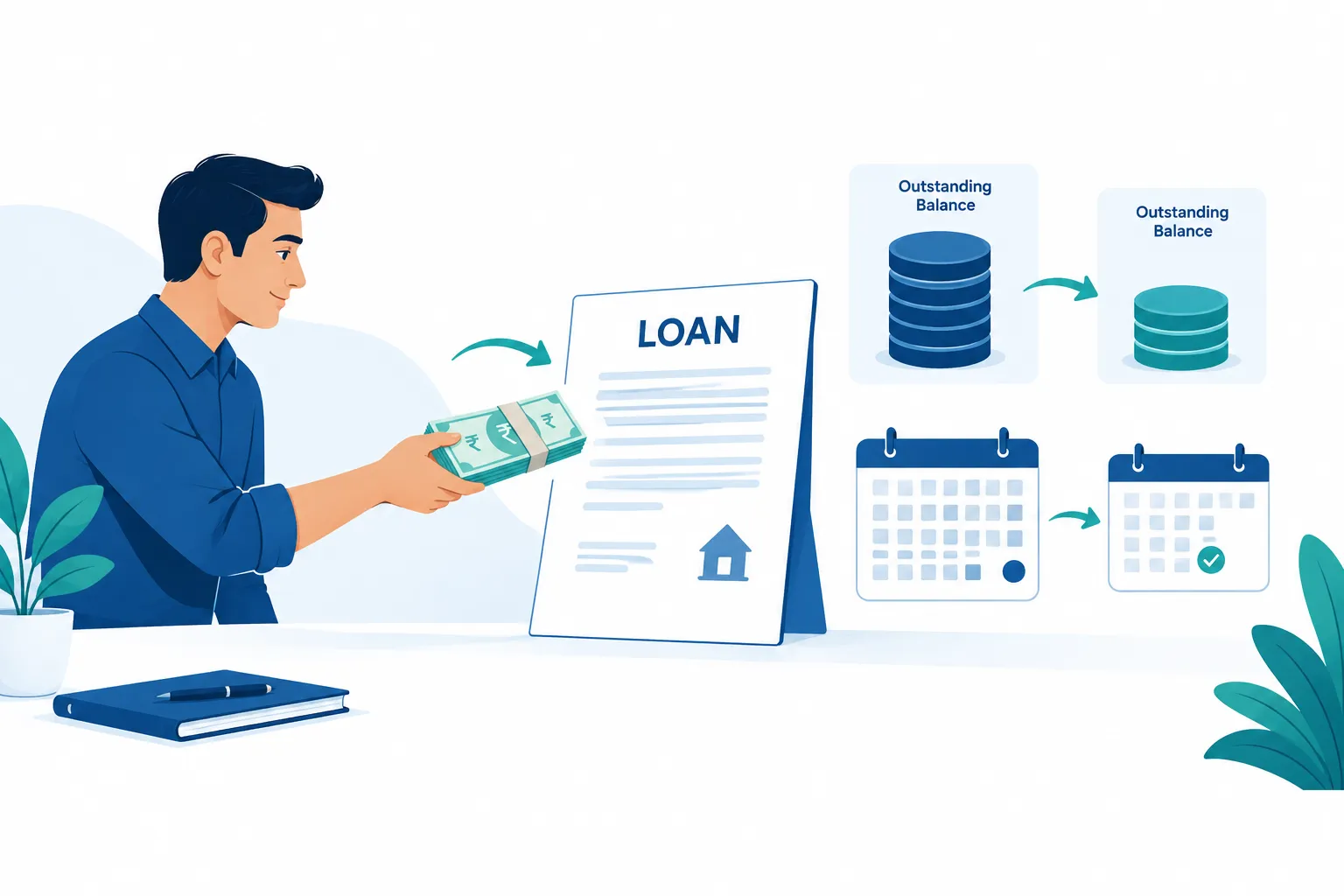
Quick answer: Loan prepayment means repaying some or all of a loan before the scheduled end date. A part-prepayment reduces the outstanding principal while the loan continues. Full prepayment, commonly called loan foreclosure, closes the loan. Prepayment may reduce future interest, lower the EMI or shorten the tenure, but the actual benefit depends on lender rules, applicable charges and the remaining loan period.
A loan is normally repaid through monthly EMIs over an agreed tenure. However, you may receive a bonus, business income, maturity proceeds or other surplus money that you want to use for faster repayment.
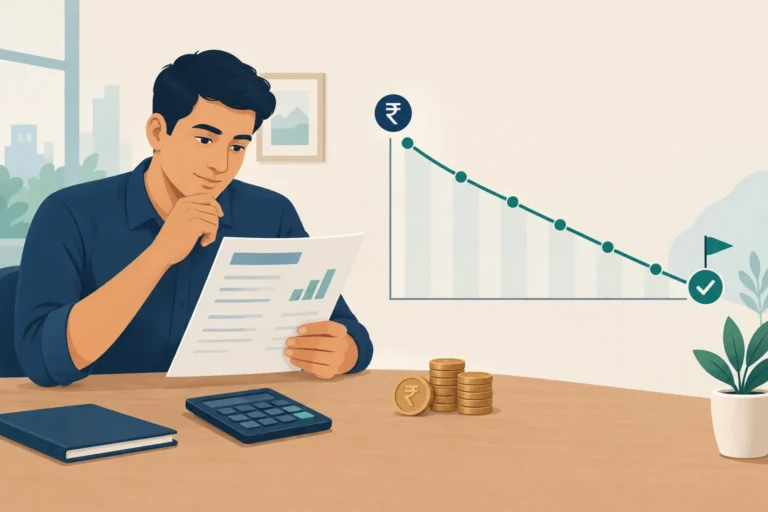
This is where loan prepayment can help. By paying an extra amount towards the principal, you may reduce the interest payable in the future and become debt-free sooner.
However, prepayment is not automatically the best choice in every situation. A lender may impose conditions, minimum payment requirements or prepayment charges. Using all your available cash can also leave you without enough money for emergencies.
This guide explains how loan prepayment works, how it affects your EMI and tenure, and what you should check before proceeding.
What Loan Prepayment Means and How It Affects Your Loan
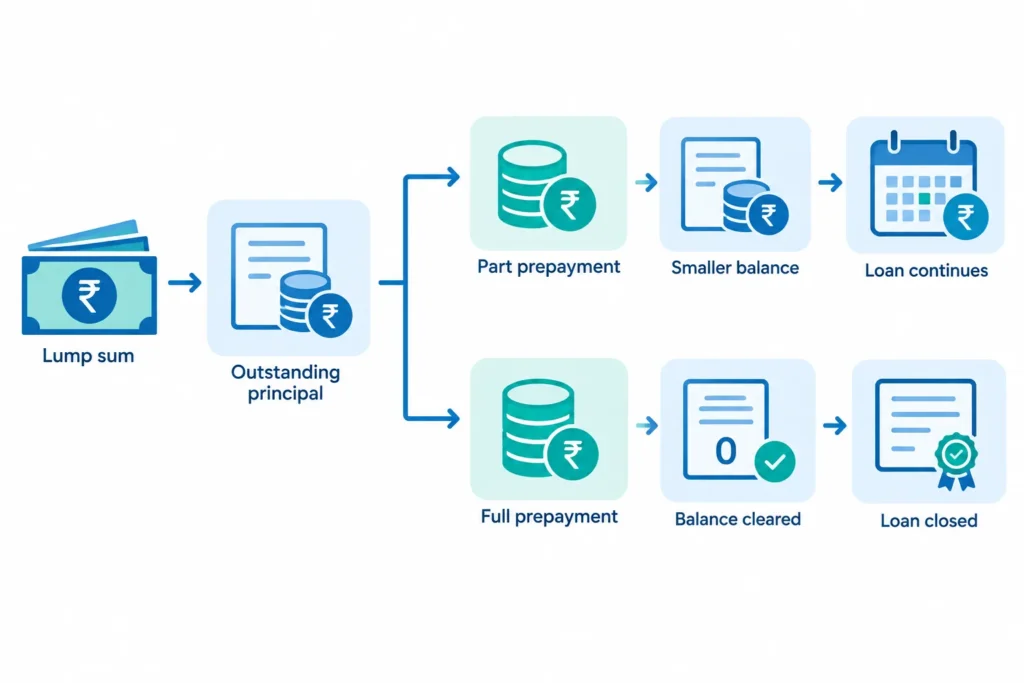
Loan prepayment is an additional repayment made before it becomes due under the original EMI schedule. The payment is adjusted against the outstanding loan principal, subject to the lender’s terms.
There are two main forms of prepayment:
- Part-prepayment: You repay a portion of the outstanding principal, but the loan continues.
- Full prepayment or foreclosure: You repay the entire amount required by the lender and close the loan before the scheduled end date.
For example, suppose your outstanding principal is ₹8 lakh and you make a permitted part-prepayment of ₹1 lakh. The principal may reduce to ₹7 lakh after adjustment. Future repayment calculations would then be based on the revised outstanding amount and the applicable loan terms.
Part-Prepayment vs Full Prepayment or Foreclosure
| Point | Part-prepayment | Full prepayment or foreclosure |
|---|---|---|
| Meaning | You repay a portion of the loan before it is due. | You repay the full amount required to close the loan early. |
| Effect on principal | The outstanding principal reduces, but a balance remains. | The outstanding loan balance is cleared, subject to final settlement. |
| Effect on the loan | The loan continues with a revised repayment schedule. | The loan account is closed after the lender completes its process. |
| EMI or tenure | The lender may reduce the EMI, shorten the tenure or offer a choice between the two. | No future EMI remains after successful closure. |
| Possible charges | Part-prepayment charges or conditions may apply. | Foreclosure charges or other closure-related amounts may apply. |
| Suitable situation | You have surplus money but do not want or cannot afford to close the entire loan. | You have enough funds to clear the loan and have considered liquidity needs. |
How Prepayment Changes the Outstanding Principal
Each EMI usually contains two components:
- Interest component: The cost charged by the lender for the outstanding loan.
- Principal component: The portion that reduces the amount borrowed.
For many reducing-balance loans, interest is calculated on the outstanding principal according to the loan agreement. As the principal falls, the interest component generally reduces over time.
A part-prepayment directly reduces the principal earlier than planned. This can reduce the amount on which future interest is calculated. The final saving, however, depends on factors such as:
- the amount prepaid;
- the remaining tenure;
- the applicable interest rate;
- the timing of the prepayment;
- how the lender recalculates the repayment schedule; and
- any prepayment charges or related costs.
Prepaying earlier in the loan tenure may have a greater effect because more repayment months remain. This is not a guaranteed rule for every product, so borrowers should request a revised repayment schedule or calculation from the lender.
Lower EMI or Shorter Tenure: What Changes After Part-Prepayment?
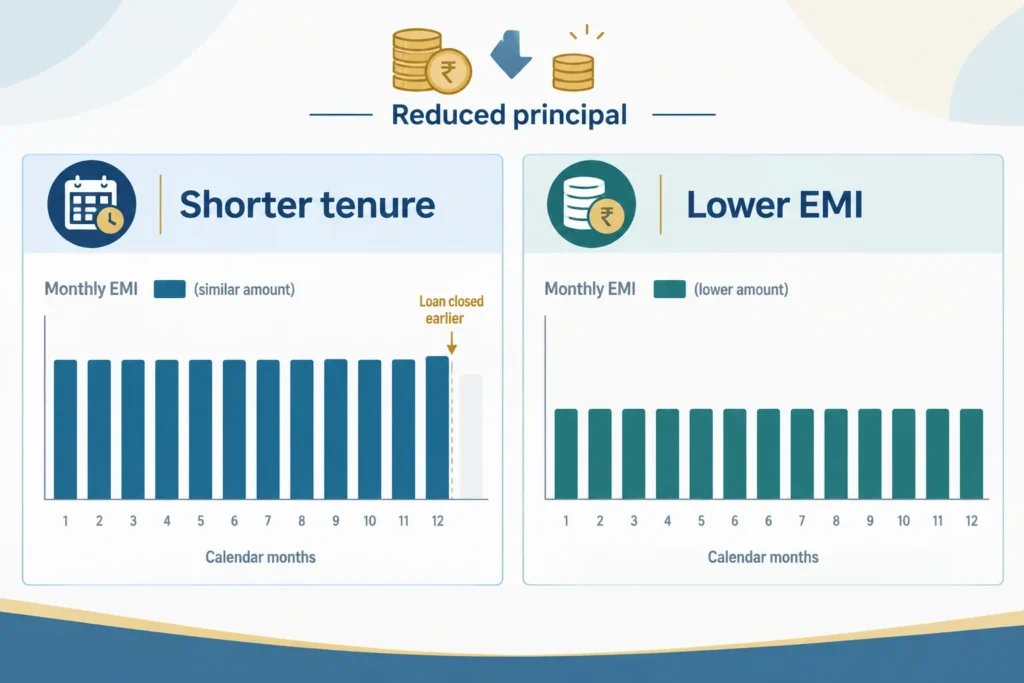
After a part-prepayment, the lender may revise the loan in one of two common ways.
Option 1: Keep the EMI Similar and Reduce the Tenure
Under this option, your monthly EMI remains the same or broadly similar, but the loan ends earlier.
A shorter tenure will generally produce greater interest savings than simply lowering the EMI, assuming the interest rate and other terms remain unchanged. It may suit borrowers who can comfortably continue paying the existing EMI and want to become debt-free sooner.
Option 2: Reduce the EMI and Keep a Similar Tenure
Under this option, the lower principal is used to reduce the monthly EMI while the remaining tenure stays broadly similar.
This can improve monthly cash flow. It may be useful if your household expenses have increased or you want more room in your budget. However, because the loan continues for longer than it would under the shorter-tenure option, the interest saving may be lower.
| Choice after part-prepayment | Possible advantage | Important consideration |
|---|---|---|
| Keep EMI similar and shorten tenure | Earlier loan closure and potentially higher interest savings | The existing monthly repayment burden continues |
| Lower EMI and keep a similar tenure | More monthly cash flow | The loan may continue for longer and interest savings may be lower |
Not every lender allows borrowers to choose freely between these options. Some lenders may apply a standard method, while others may require a written request. Check the loan agreement and obtain the revised EMI or tenure details before making the payment.
Connection With EMI Calculations
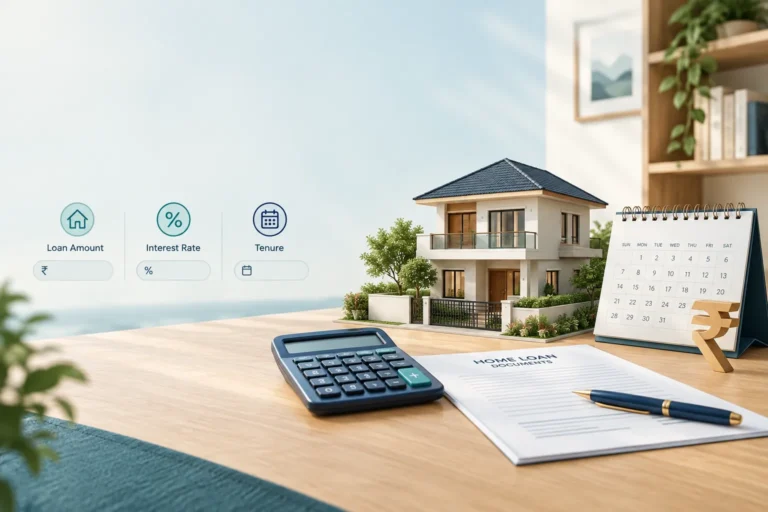
A standard EMI calculation considers the principal, interest rate and loan tenure. When one of these
Potential Benefits of Loan Prepayment
Loan prepayment reduces the principal amount on which future interest may be calculated. The actual benefit depends on the loan’s interest rate, remaining tenure, repayment schedule and lender terms.
Lower future interest cost
When the outstanding principal comes down, the interest payable over the remaining loan period may also reduce. Prepaying earlier in the tenure can have a greater impact because more repayment months are still left.
However, calculate the likely interest saving after including any loan prepayment charges, taxes or administrative costs.
Shorter repayment tenure
After a part-prepayment, some lenders may allow you to continue with the existing EMI and reduce the remaining tenure. This can help you become debt-free sooner and may produce greater interest savings than simply lowering the EMI.
The available option depends on the loan agreement and the lender’s process.
Lower EMI, where permitted
You may be able to retain the original tenure and request a lower EMI. This can improve monthly cash flow, especially if your household expenses have increased.
A lower EMI can provide immediate relief, but it may not reduce the total interest as much as keeping the EMI unchanged and shortening the tenure.
Lower outstanding debt
A smaller loan balance can make your finances easier to manage. It may also reduce the stress of carrying a large liability for many years.
Full loan foreclosure removes the EMI completely once the lender confirms closure and all applicable dues have been paid.
Better use of a genuine surplus
A bonus, business surplus, maturity amount or other lump-sum receipt can be used for part prepayment of a loan. This may be useful when the money is not required for emergencies or important near-term goals.
Loan Prepayment Charges and Other Conditions
Prepayment is not always free. Charges and conditions can differ based on the loan type, lender, borrower category, interest-rate structure and applicable regulations.
Do not assume that the terms for a home loan, personal loan, vehicle loan and business loan will be the same.
| Cost or condition | What it means | What to check |
|---|---|---|
| Part-prepayment charge | A fee may apply when you repay only a portion of the outstanding principal early. | Check the applicable rate, calculation basis and taxes. |
| Foreclosure charge | A lender may charge a fee when you repay and close the entire loan before its scheduled end date. | Ask for a dated foreclosure statement showing the total amount payable. |
| Minimum prepayment amount | The lender may require each part-prepayment to be above a specified amount. | Confirm whether the minimum is a fixed amount or linked to the EMI. |
| Frequency restriction | The number of part-prepayments allowed during a period may be limited. | Check how often you can prepay and whether a waiting period applies. |
| Timing condition | Some loan terms may not allow prepayment immediately after disbursal. | Review the lock-in or minimum-EMI condition, if any. |
| Payment process | Prepayment may require a specific request, payment method or branch process. | Confirm the accepted process and obtain a receipt. |
| EMI or tenure revision | The lender may reduce the EMI, shorten the tenure or offer a choice. | Request the revised repayment schedule in writing. |
Applicable rules can also differ between fixed-rate and floating-rate loans. Certain borrower categories or loan structures may receive different treatment under prevailing regulations. Check the latest terms directly in your loan agreement and with the lender before making a payment.
Illustrative Part-Prepayment Example
Consider a borrower with an outstanding loan principal of ₹8,00,000. The borrower receives a bonus and makes a part-prepayment of ₹2,00,000.
| Particular | Illustrative amount |
|---|---|
| Outstanding principal before prepayment | ₹8,00,000 |
| Lump-sum part-prepayment | ₹2,00,000 |
| Outstanding principal after prepayment | ₹6,00,000 |
After the payment is applied to the principal, future interest may be calculated on the reduced outstanding balance according to the loan terms. The borrower may then have two possible outcomes:
- Keep the EMI similar and shorten the tenure: The loan may end earlier, which can reduce future interest more substantially.
- Keep the tenure similar and lower the EMI: Monthly cash flow may improve, but the interest reduction could be lower than under a shorter-tenure option.
This example is only for explanation. It does not include the interest rate, remaining tenure, prepayment fee, taxes or lender-specific calculation method. Therefore, it does not represent a guaranteed saving.
Before paying, the borrower should ask the lender for an estimate of the revised EMI or tenure and compare the expected interest saving with all applicable charges.
Possible Disadvantages of Prepaying a Loan
Reduction in emergency savings
Using most of your bank balance for loan prepayment can leave you unprepared for a medical expense, job loss, urgent repair or family need. Borrowing again during an emergency may be difficult or expensive.
It is generally sensible to protect an adequate emergency fund before using surplus cash for prepayment.
Loss of liquidity
Once money is paid towards the loan principal, it may not be easy to access again. This is especially important when prepaying a home loan, where a large amount can become tied up in the property.
Prepayment and foreclosure costs
Charges can reduce the financial benefit. If a loan has little tenure left or a relatively low interest cost, the saving after charges may be limited.
Opportunity cost
The same money could be used for another purpose, such as building an emergency fund, paying a higher-cost debt, meeting an education expense or investing for a long-term goal.
This does not mean investing is automatically better than prepayment. Investment returns are generally uncertain, while reducing debt provides a more predictable reduction in future loan obligations, subject to charges and loan terms.
Neglecting more expensive debt
A borrower may focus on home loan prepayment while continuing to carry costly credit card dues or another high-interest loan. In such a situation, reviewing the more expensive debt first may be more useful.
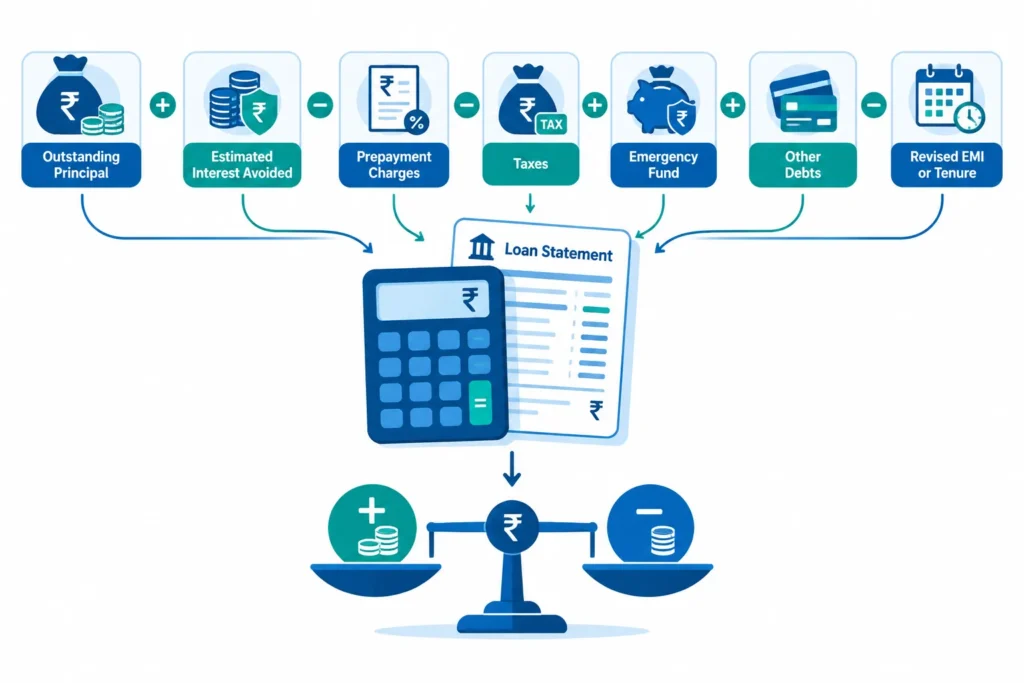
Measure the Net Benefit, Not Just the Prepayment Amount
The right comparison is not simply “prepay or do not prepay”. Consider the complete financial effect:
-
- Estimated future interest saved
- Part-prepayment or foreclosure charges
- Applicable taxes and processing costs
- Effect on EMI and remaining tenure
- Emergency fund left after payment
- Other debts and near-term expenses
What to Check Before Loan Prepayment
Do not make a loan prepayment only because you have received a bonus or built up some savings. First check the financial benefit, the lender’s conditions and your need for cash.
The following checklist can help you make a more informed decision.
Loan Prepayment Decision Checklist
| Check | Why It Matters | What to Ask the Lender |
|---|---|---|
| Outstanding principal | Prepayment reduces the principal, not simply the total of all remaining EMIs. | What is my current principal outstanding as of the payment date? |
| Prepayment or foreclosure charges | Charges can reduce the financial benefit of prepayment. | What charges and taxes apply to my loan and borrower category? |
| Minimum payment requirement | Some lenders may require a minimum part-prepayment amount or a specified number of EMIs. | Is there a minimum amount, waiting period or frequency limit? |
| Payment process | The lender may require a request form, identity proof or payment from a specified bank account. | Can I pay online, or must I visit a branch? |
| EMI or tenure revision | A part-prepayment may reduce the EMI, shorten the tenure or offer a choice between the two. | Which option is available, and when will the revised schedule be issued? |
| Loan agreement terms | Conditions differ across lenders, loan types and interest-rate structures. | Which agreement clause applies to prepayment? |
| Emergency fund | Using all available cash can leave you unprepared for medical costs, job loss or repairs. | How much cash will remain after prepayment? |
| Other debts | A higher-cost debt may deserve priority over a lower-cost loan. | Which debt has the highest effective cost and strictest terms? |
| Foreclosure documents | Full repayment is not complete until the lender confirms closure and releases applicable security. | Which closure, release and original documents will I receive? |
Request a Written Prepayment Statement
Ask the lender for a statement showing the outstanding principal, accrued interest up to the proposed payment date, applicable charges and the final amount payable.
For part-prepayment, request a revised repayment schedule. It should show the new EMI, remaining tenure or both, depending on the option selected and the lender’s policy.
Do not rely only on a verbal estimate from a branch employee or customer support representative. Written figures make it easier to compare the cost and benefit.
Check Whether to Reduce EMI or Tenure
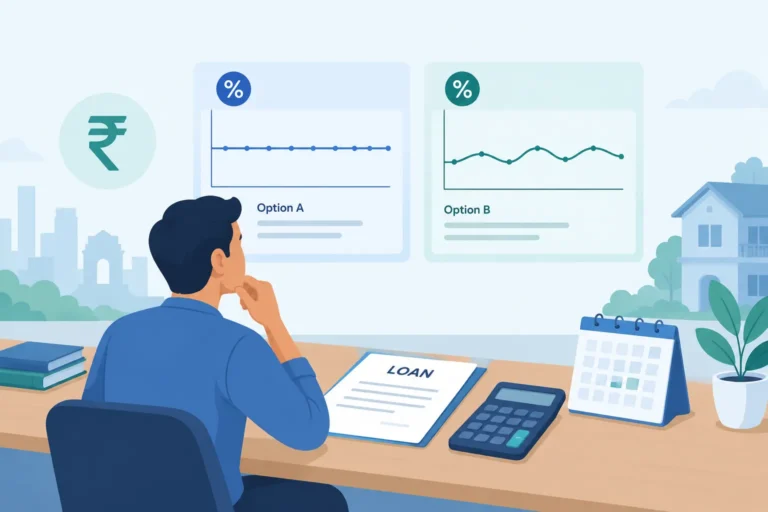
If the lender allows a choice after part-prepayment, you may be able to reduce the EMI or shorten the loan tenure.
-
-
- Reducing the tenure may lower future interest more because the loan ends earlier, assuming other terms remain unchanged.
- Reducing the EMI can improve monthly cash flow and may suit borrowers with irregular income or upcoming expenses.
-
The suitable option depends on your budget. A shorter tenure may be attractive if the existing EMI is comfortable. A lower EMI may be more useful if monthly affordability is your main concern.
Ask for both revised repayment schedules before choosing, if the lender offers both options.
Protect Your Emergency Fund
Loan prepayment reduces debt, but it also converts liquid cash into money that may not be easy to access again.
Before paying a lump sum, keep enough money for essential expenses and unexpected events. Consider upcoming school fees, insurance premiums, medical needs, home repairs and periods of uncertain income.
Borrowing again during an emergency could be more expensive than continuing with the existing loan. Therefore, using every rupee of savings for prepayment may not be sensible.
Compare Other Debts First
List all your loans and credit balances before deciding where to use extra money. Compare their interest rates, charges, remaining tenures and repayment flexibility.
For example, a borrower may have a home loan along with an expensive credit card balance or personal loan. Paying the higher-cost debt first may provide greater relief, subject to applicable charges and terms.
Also check whether any debt has overdue amounts. Clearing overdue payments may be more urgent than making an optional prepayment on a regularly serviced loan.
Home Loan Prepayment and Personal Loan Prepayment
The basic idea is the same: an early payment reduces the amount owed. However, home loan and personal loan terms should not be assumed to be identical.
Home Loan Prepayment
Home loans usually have long tenures. As a result, a part-prepayment made relatively early in the repayment period may have a meaningful effect on the remaining tenure or future interest.
Check whether the loan has a fixed, floating or mixed interest structure. Applicable rules, lender conditions and charges can depend on the loan structure, borrower category and current regulations.
Also consider any tax treatment available for your home loan. Eligibility depends on factors such as the property’s use, the applicable tax regime and current tax rules. A tax deduction does not make interest free, but it can affect the net comparison. Seek qualified tax advice where necessary.
If you fully foreclose a secured home loan, confirm the process for:
-
-
- Obtaining the no-dues or loan closure certificate
- Collecting original property documents held by the lender
- Releasing the mortgage, lien or charge, where applicable
- Completing any required registration or record updates
- Receiving confirmation that standing instructions have been cancelled
-
Personal Loan Prepayment
Personal loans often have shorter tenures and may include a waiting period, foreclosure charge or restrictions on part-prepayment. These conditions vary, so check the sanction letter and loan agreement.
Because personal loans are generally unsecured, there may be no property papers to collect. However, you should still obtain a loan closure certificate or no-dues confirmation after foreclosure.
Check that future auto-debits are stopped only after all dues are settled. Keep payment receipts and closure records in case an incorrect debit or reporting issue appears later.
Should You Prepay, Invest or Keep the Cash?
Loan prepayment is not automatically better than investing, and investing is not automatically better than repaying debt.
Prepayment can reduce future interest according to the loan terms. Investment returns, on the other hand
Comments