
Fixed vs Floating Interest Rate: What Borrowers Should Know

Learn how fixed and floating interest rates work, how they can affect your EMI, repayment period and total borrowing cost, and which loan terms to compare before making a decision.

Fixed vs Floating Interest Rate: What Borrowers Should Know
The main difference between a fixed vs floating interest rate is how the loan rate behaves over time.

  • Fixed interest rate: The applicable rate generally remains unchanged for the period specified in the loan agreement.
  • Floating interest rate: The applicable rate can increase or decrease when its linked benchmark or other contractual components change.

A fixed rate can make repayment planning more predictable. A floating rate exposes the borrower to rate changes, which may affect the EMI, loan tenure or both. However, the exact treatment depends on the lender’s terms.

Neither option is automatically better for every borrower. The right comparison includes the rate structure, repayment period, reset rules, charges and conditions written in the loan agreement.

Introduction

When taking a home loan, vehicle loan or another long-term loan in India, borrowers often focus on the advertised interest rate. But the way that rate is structured can be just as important as the rate itself.

A loan may have a fixed interest rate, a floating interest rate or a combination of both. This choice can influence how predictable your EMI is and how easily you can plan future household expenses.

For example, a salaried borrower with limited monthly flexibility may value predictable payments. Another borrower may be comfortable with possible EMI or tenure changes. The suitable structure depends on the borrower’s finances and the complete loan terms.

Understanding Loan Interest Rates, Fixed Rates and Floating Rates

What Is a Loan Interest Rate?

A loan interest rate represents the cost charged by a lender for providing money to a borrower. It is generally expressed as an annual percentage.

Interest is calculated according to the method stated in the loan agreement. For many EMI-based loans, interest is charged on the outstanding loan balance. As the borrower repays the principal, the interest component may change over the repayment period.

The interest rate works together with three important factors:

How loan interest affects repayment
  • Principal: The amount borrowed.
  • Interest rate: The rate used to calculate the lender’s interest charge.
  • Loan repayment period: The time allowed to repay the loan.

These factors, along with the lender’s calculation method and repayment terms, help determine the EMI and total interest payable.

A higher rate generally increases the interest cost when other loan details remain the same. A longer repayment period may reduce the monthly EMI, but it can increase the total interest paid because the loan remains outstanding for longer.

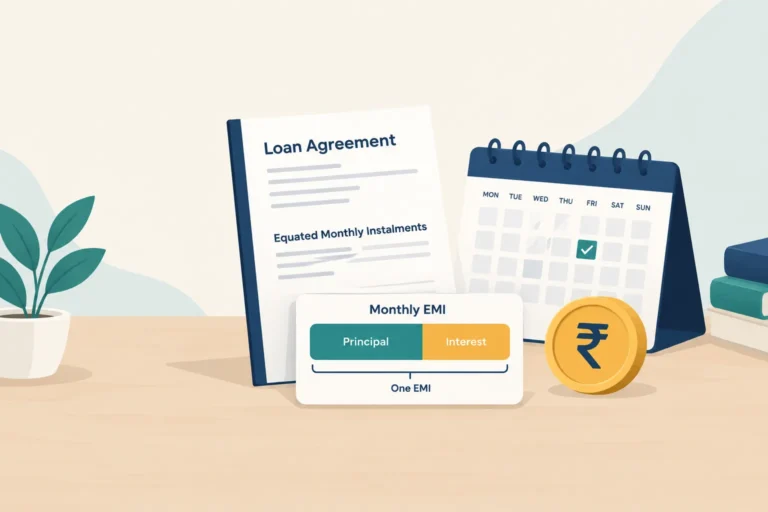
As explained in the concepts covered under “What Is an EMI?”, an EMI normally contains both principal and interest. The proportion of each can change during repayment. Home Loan EMI calculations also depend heavily on the loan amount, interest rate and tenure.

You May Also Like:Loan Prepayment: Benefits, Charges and Things to Consider

Fixed Interest Rate Meaning

A fixed rate loan generally has an interest rate that stays unchanged for the period agreed with the lender. This can make the scheduled EMI easier to estimate during that period.

However, “fixed” does not always mean that the rate is locked for the loan’s entire tenure. A lender may offer:

  • A rate fixed for the full repayment period
  • A rate fixed only for an initial period
  • A loan that later moves from a fixed rate to a floating rate
  • A structure under which the rate can be revised in specific situations mentioned in the agreement

Suppose a home loan has a 20-year tenure but the interest rate is fixed only for the first three years. At the end of that period, the lender may apply a floating rate or offer another rate according to the agreed terms. It should not be treated as a 20-year fully fixed loan merely because it begins with a fixed rate.

Borrowers should therefore check how long the rate remains fixed, what happens after that period and whether any conversion or revision conditions apply.

Floating Interest Rate Meaning

A floating rate loan carries an interest rate that can change over time. The rate is usually connected to a benchmark and may include a spread or margin determined under the lender’s terms.

A simplified structure may look like this:

Applicable floating rate = benchmark rate + lender’s spread

The benchmark is a reference rate identified in the loan agreement. Depending on the product, it may be an external benchmark or a lender-linked benchmark. The spread is the additional component applied by the lender under the agreed pricing structure.

If the benchmark changes, the applicable loan interest rate may change on the next reset date. The lender may then adjust the EMI, the remaining tenure or another repayment parameter, depending on the agreement.

A floating rate does not necessarily change immediately whenever the benchmark moves. The loan may have a monthly, quarterly or another reset schedule. Borrowers should check both the benchmark and the reset frequency.

Fixed and Floating Rates at a Glance
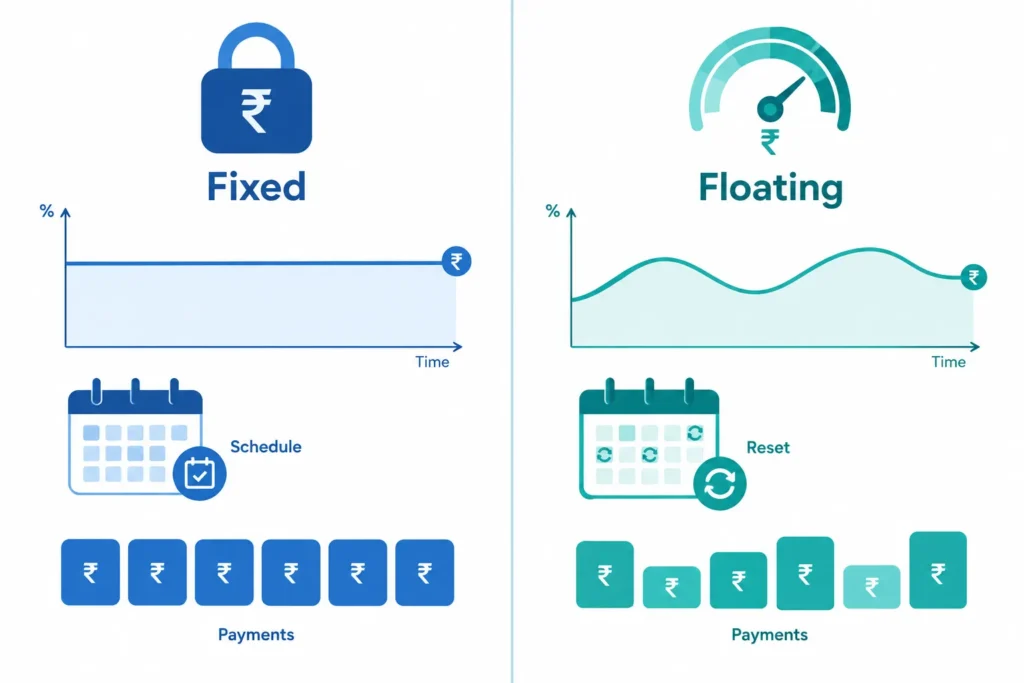
Visual comparison of fixed-rate stability and floating-rate variability

Feature Fixed interest rate Floating interest rate
Basic meaning The applicable rate generally stays unchanged for the agreed fixed period. The applicable rate can change according to the linked benchmark and contractual terms.
Rate movement Usually protected from market-linked rate changes during the fixed period. May increase or decrease at scheduled resets.
Planning Can offer greater repayment predictability during the fixed period. Requires room for possible changes in EMI or loan tenure.
Important detail to verify Whether the rate is fixed for the full tenure or only an initial period. The benchmark, spread, reset frequency and method of adjusting repayment.
You May Also Like:How Credit Score Affects Your Loan Eligibility and Interest Rate

The Loan Agreement Determines the Actual Structure

Two loans described as “fixed” may have different fixed-rate periods, conversion rules or charges. Similarly, two floating-rate loans may use different benchmarks,

Fixed vs Floating Interest Rate: Effect on EMI, Tenure and Total Cost

The choice between a fixed vs floating interest rate affects more than the rate shown in the loan offer. It can also affect your EMI, loan repayment period and total interest cost.

With a fixed rate loan, the applicable rate generally remains unchanged for the agreed fixed-rate period. This makes the EMI easier to predict during that period. However, borrowers should check whether the rate is fixed for the entire loan tenure or only for a few years.

With a floating rate loan, the rate may change when the linked benchmark or applicable spread changes according to the loan agreement. As a result, your repayment schedule may also change.

What Happens When a Floating Rate Changes?
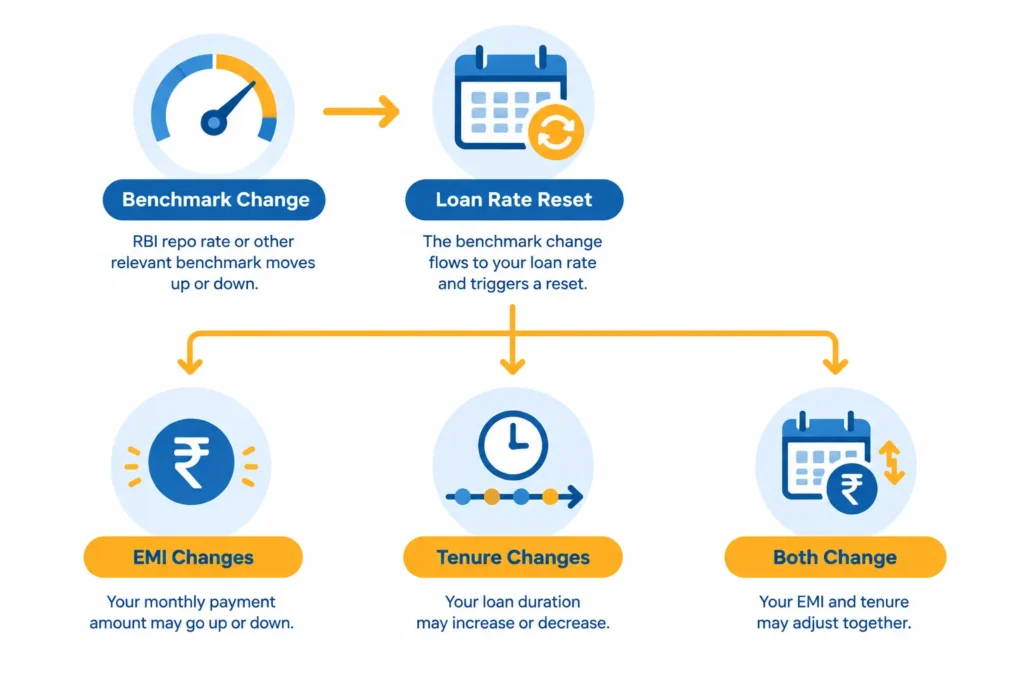
Flowchart showing how a floating-rate reset may change EMI, loan tenure or both
When the rate on a floating loan increases or decreases, the lender may adjust one or more repayment terms. Depending on the loan agreement, the lender may:

  • increase or decrease the EMI;
  • extend or reduce the remaining loan tenure;
  • change both the EMI and tenure; or
  • offer repayment or conversion options under its applicable terms.

For example, if the rate rises but the EMI remains unchanged, a larger share of each EMI may go towards interest. The principal may then reduce more slowly, leading to a longer repayment period.

If the rate falls, the reverse may happen. The EMI could decrease, the tenure could become shorter, or both could change, depending on the lender’s method and the borrower’s instructions.

Illustrative Floating-Rate Reset Example

Consider a borrower with an outstanding home loan balance of ₹20 lakh and a remaining tenure of 15 years. Assume the rate changes from 8% a year to 9% a year.

These are assumed figures for explanation only. They are not current market rates or a loan offer.

Repayment detail At 8% assumed rate At 9% assumed rate
Outstanding principal ₹20 lakh ₹20 lakh
Remaining tenure 15 years 15 years
Approximate monthly EMI ₹19,113 ₹20,285
Approximate interest over the remaining tenure ₹14.40 lakh ₹16.51 lakh

In this illustration, keeping the 15-year tenure would increase the EMI by approximately ₹1,172 per month. The total interest over the remaining period would also be higher if the 9% rate continued throughout that period.

Alternatively, if the lender kept the EMI near ₹19,113 after the rate increased to 9%, the remaining tenure could extend to approximately 206 months instead of 180 months. This would also increase the total interest because the principal would remain outstanding for longer.

Actual calculations may differ because of the reset date, outstanding balance, remaining tenure, compounding method, rounding rules and the lender’s adjustment policy. Future rate changes could also alter the result again.

How Fixed and Floating Rates Compare

Comparison point Fixed rate loan Floating rate loan
Rate stability The rate generally remains unchanged for the agreed fixed-rate period. The rate can change according to the linked benchmark, spread and reset terms.
EMI predictability EMIs are usually easier to predict during the fixed-rate period. EMIs may change if the lender adjusts them after a rate reset.
Exposure to changing rates The borrower is generally protected from rate changes during the fixed period but may not benefit if market-linked rates fall. The borrower may face higher repayments when rates rise and may benefit when rates fall.
Ease of loan planning Can make monthly budgeting simpler when the EMI and rate are fixed. Requires room in the budget for possible EMI or tenure changes.
Possible impact on total interest Total interest is more predictable if the rate is fixed for the full tenure. A limited fixed period may still be followed by a reset. Total interest may rise or fall over time as the rate and repayment schedule change.
May suit borrowers who Prefer predictable payments and are comfortable with the complete fixed-rate terms. Can manage repayment changes and accept uncertainty linked to future rate resets.

Why the Lowest Starting Rate May Not Mean the Lowest Cost

A loan with a lower initial rate is not automatically the cheaper option over its full tenure. A floating rate may change several times, while a fixed rate may apply only for a limited period.

Borrowers should compare the estimated total repayment, not just the first EMI. They should also check how the lender handles rate resets, whether the EMI or tenure changes first, and what happens after any fixed-rate period ends.

Neither structure is universally better. The practical effect depends on the loan terms, repayment horizon, future rate movements and the borrower’s ability to manage changes in EMI or tenure.

You May Also Like:How to Reduce the Total Interest Paid on a Loan

How Borrowers Can Compare Fixed and Floating Loan Terms

Checklist for comparing fixed and floating loan terms, fees and reset rules
Choosing between a fixed vs floating interest rate should not depend only on which rate looks lower today. Compare how the loan may affect your monthly budget throughout the repayment period.

Your income stability, emergency savings, repayment horizon and comfort with changing EMIs or tenure are all important.

Start With Your Repayment Comfort

Ask these questions before selecting a fixed rate loan or floating rate loan:

  • Do I need the EMI to remain predictable for budgeting?
  • Can my monthly budget handle an increase in EMI?
  • Would I be comfortable if the lender extended the loan tenure?
  • How long do I expect to keep the loan?
  • Do I plan to make part-prepayments when I have surplus money?
  • Is my income stable, or does it change from month to month?
  • Do I have an emergency fund for unexpected expenses?

A borrower with limited monthly flexibility may place greater value on predictable repayments. Someone with more budget flexibility may be better able to manage changes under a floating rate loan. This does not make either option automatically better.

Compare the Important Loan Terms

The interest-rate label does not explain the entire loan. Read the sanction letter, repayment schedule and loan agreement carefully.

Term to check What it means for the borrower Question to ask the lender
Interest-rate structure Shows whether the loan is fixed, floating or fixed only for an initial period. Will this rate remain fixed for the full loan tenure?
Benchmark A floating rate may be linked to an external or internal reference rate specified in the agreement. Which benchmark is used, and where can I see its current value?
Spread or margin This is the amount added to the benchmark to arrive at the applicable loan interest rate. Can the spread change, and under what conditions?
Reset frequency This determines how often a floating rate may be reviewed and revised. When will a rate change affect my loan?
EMI adjustment method The lender may change the EMI, tenure or both, depending on the contract. If the rate changes, what will be adjusted first?
Tenure limit A higher rate may extend the loan repayment period, but the lender may apply a maximum permitted tenure. What happens if the tenure cannot be extended further?
Conversion option Some loans allow a switch between fixed and floating structures, subject to conditions. Is conversion available, and what charges apply?
Prepayment terms These determine whether and how you can repay part or all of the loan early. Are there conditions or charges for part-prepayment or foreclosure?
Other charges Processing, administrative, legal, valuation, conversion and other charges may increase the borrowing cost. Which charges apply now and which may apply later?

Check Whether the Fixed Rate Is Fixed for the Full Tenure

A loan described as fixed may not necessarily remain fixed until the final EMI. Some products have a fixed rate for a specified period and move to a floating rate later.

Check the following:

  • The exact period for which the rate is fixed
  • The rate structure after the fixed period ends
  • The benchmark and spread used after conversion
  • Whether you can continue with another fixed-rate period
  • Any charges or conditions for changing the rate structure
You May Also Like:SIP Investment in India: A Beginner’s Guide to Systematic Investment Plans

Do not rely only on terms such as “fixed”, “semi-fixed” or “hybrid”. The loan agreement should explain how the rate actually works.

Understand the Floating-Rate Formula

A floating interest rate is commonly based on a benchmark plus a spread. For example, the agreement may describe the applicable rate in this form:

Applicable loan rate = Benchmark rate + Contractual spread

The benchmark can move according to its stated method. The spread may remain unchanged or may be revised under conditions mentioned in the loan documents.

Ask the lender for a written explanation of:

  • The name of the benchmark
  • The benchmark value used when the loan is sanctioned
  • The spread added to it
  • The reset date and reset frequency
  • How you will be informed about a change
  • How the revised rate will affect EMI and tenure

Compare the Total Repayment, Not Only the Starting EMI

A lower starting EMI does not always mean a lower overall cost. It may result from a longer repayment period, a different rate structure or other loan conditions.

When comparing offers, request calculations using the same:

  • Loan amount
  • Repayment period
  • EMI payment frequency
  • Down payment, where relevant
  • Assumed disbursement date
  • Treatment of fees and other charges

For a floating rate loan, the future total interest cannot be known with certainty because the applicable rate may change. You can still ask the lender to explain what would happen if the rate increased or decreased by an assumed amount. Such a scenario is an illustration, not a prediction.

Review Prepayment and Switching Conditions

Part-prepayment can reduce the outstanding principal. Depending on the lender’s method, this may reduce the EMI, shorten the tenure or both.

However, prepayment and foreclosure conditions can differ by loan type, borrower category, rate structure and agreement. Switching from fixed to floating, or from floating to fixed, may also involve a conversion charge or a revised rate.

Before signing, confirm:

  • The minimum amount accepted as a part-prepayment
  • How often part-prepayments are allowed
  • Whether the EMI or tenure will change afterward
  • Any applicable prepayment or foreclosure conditions
  • The process and cost of switching the rate structure
  • Whether a fresh credit assessment or documentation is required

A Simple Decision Checklist

Your situation Point to consider
You need stable monthly payments Examine whether a fixed rate is available for the full required period and whether any reset clause applies.
You can manage EMI changes A floating structure may be manageable, but check the reset and adjustment rules.
Your monthly budget is tight Test whether you could handle a higher EMI or longer tenure without affecting essential expenses.
You expect to repay early Compare prepayment, foreclosure and conversion conditions carefully.
You are taking a long-tenure loan Consider how repeated rate resets could affect the repayment period and total interest.
You prefer simple financial planning Give greater weight to payment predictability, but verify how long the quoted rate remains fixed.

This checklist helps organise the decision

Share this article
KEEP READING

Related Articles

View all →

Comments

Leave a Comment

Fixed vs Floating Interest Rate: What Borrowers Should Know

The main difference between a fixed vs floating interest rate is how the loan rate behaves over time.

  • Fixed interest rate: The applicable rate generally remains unchanged for the period specified in the loan agreement.
  • Floating interest rate: The applicable rate can increase or decrease when its linked benchmark or other contractual components change.

A fixed rate can make repayment planning more predictable. A floating rate exposes the borrower to rate changes, which may affect the EMI, loan tenure or both. However, the exact treatment depends on the lender’s terms.

Neither option is automatically better for every borrower. The right comparison includes the rate structure, repayment period, reset rules, charges and conditions written in the loan agreement.

Introduction

When taking a home loan, vehicle loan or another long-term loan in India, borrowers often focus on the advertised interest rate. But the way that rate is structured can be just as important as the rate itself.

A loan may have a fixed interest rate, a floating interest rate or a combination of both. This choice can influence how predictable your EMI is and how easily you can plan future household expenses.

For example, a salaried borrower with limited monthly flexibility may value predictable payments. Another borrower may be comfortable with possible EMI or tenure changes. The suitable structure depends on the borrower’s finances and the complete loan terms.

Understanding Loan Interest Rates, Fixed Rates and Floating Rates

What Is a Loan Interest Rate?

A loan interest rate represents the cost charged by a lender for providing money to a borrower. It is generally expressed as an annual percentage.

Interest is calculated according to the method stated in the loan agreement. For many EMI-based loans, interest is charged on the outstanding loan balance. As the borrower repays the principal, the interest component may change over the repayment period.

The interest rate works together with three important factors:

How loan interest affects repayment
  • Principal: The amount borrowed.
  • Interest rate: The rate used to calculate the lender’s interest charge.
  • Loan repayment period: The time allowed to repay the loan.

These factors, along with the lender’s calculation method and repayment terms, help determine the EMI and total interest payable.

A higher rate generally increases the interest cost when other loan details remain the same. A longer repayment period may reduce the monthly EMI, but it can increase the total interest paid because the loan remains outstanding for longer.

As explained in the concepts covered under “What Is an EMI?”, an EMI normally contains both principal and interest. The proportion of each can change during repayment. Home Loan EMI calculations also depend heavily on the loan amount, interest rate and tenure.

Fixed Interest Rate Meaning

A fixed rate loan generally has an interest rate that stays unchanged for the period agreed with the lender. This can make the scheduled EMI easier to estimate during that period.

However, “fixed” does not always mean that the rate is locked for the loan’s entire tenure. A lender may offer:

  • A rate fixed for the full repayment period
  • A rate fixed only for an initial period
  • A loan that later moves from a fixed rate to a floating rate
  • A structure under which the rate can be revised in specific situations mentioned in the agreement

Suppose a home loan has a 20-year tenure but the interest rate is fixed only for the first three years. At the end of that period, the lender may apply a floating rate or offer another rate according to the agreed terms. It should not be treated as a 20-year fully fixed loan merely because it begins with a fixed rate.

Borrowers should therefore check how long the rate remains fixed, what happens after that period and whether any conversion or revision conditions apply.

Floating Interest Rate Meaning

A floating rate loan carries an interest rate that can change over time. The rate is usually connected to a benchmark and may include a spread or margin determined under the lender’s terms.

A simplified structure may look like this:

Applicable floating rate = benchmark rate + lender’s spread

The benchmark is a reference rate identified in the loan agreement. Depending on the product, it may be an external benchmark or a lender-linked benchmark. The spread is the additional component applied by the lender under the agreed pricing structure.

If the benchmark changes, the applicable loan interest rate may change on the next reset date. The lender may then adjust the EMI, the remaining tenure or another repayment parameter, depending on the agreement.

A floating rate does not necessarily change immediately whenever the benchmark moves. The loan may have a monthly, quarterly or another reset schedule. Borrowers should check both the benchmark and the reset frequency.

Fixed and Floating Rates at a Glance

Visual comparison of fixed-rate stability and floating-rate variability

Feature Fixed interest rate Floating interest rate
Basic meaning The applicable rate generally stays unchanged for the agreed fixed period. The applicable rate can change according to the linked benchmark and contractual terms.
Rate movement Usually protected from market-linked rate changes during the fixed period. May increase or decrease at scheduled resets.
Planning Can offer greater repayment predictability during the fixed period. Requires room for possible changes in EMI or loan tenure.
Important detail to verify Whether the rate is fixed for the full tenure or only an initial period. The benchmark, spread, reset frequency and method of adjusting repayment.

The Loan Agreement Determines the Actual Structure

Two loans described as “fixed” may have different fixed-rate periods, conversion rules or charges. Similarly, two floating-rate loans may use different benchmarks,

Fixed vs Floating Interest Rate: Effect on EMI, Tenure and Total Cost

The choice between a fixed vs floating interest rate affects more than the rate shown in the loan offer. It can also affect your EMI, loan repayment period and total interest cost.

With a fixed rate loan, the applicable rate generally remains unchanged for the agreed fixed-rate period. This makes the EMI easier to predict during that period. However, borrowers should check whether the rate is fixed for the entire loan tenure or only for a few years.

With a floating rate loan, the rate may change when the linked benchmark or applicable spread changes according to the loan agreement. As a result, your repayment schedule may also change.

What Happens When a Floating Rate Changes?

Flowchart showing how a floating-rate reset may change EMI, loan tenure or both
When the rate on a floating loan increases or decreases, the lender may adjust one or more repayment terms. Depending on the loan agreement, the lender may:

  • increase or decrease the EMI;
  • extend or reduce the remaining loan tenure;
  • change both the EMI and tenure; or
  • offer repayment or conversion options under its applicable terms.

For example, if the rate rises but the EMI remains unchanged, a larger share of each EMI may go towards interest. The principal may then reduce more slowly, leading to a longer repayment period.

If the rate falls, the reverse may happen. The EMI could decrease, the tenure could become shorter, or both could change, depending on the lender’s method and the borrower’s instructions.

Illustrative Floating-Rate Reset Example

Consider a borrower with an outstanding home loan balance of ₹20 lakh and a remaining tenure of 15 years. Assume the rate changes from 8% a year to 9% a year.

These are assumed figures for explanation only. They are not current market rates or a loan offer.

Repayment detail At 8% assumed rate At 9% assumed rate
Outstanding principal ₹20 lakh ₹20 lakh
Remaining tenure 15 years 15 years
Approximate monthly EMI ₹19,113 ₹20,285
Approximate interest over the remaining tenure ₹14.40 lakh ₹16.51 lakh

In this illustration, keeping the 15-year tenure would increase the EMI by approximately ₹1,172 per month. The total interest over the remaining period would also be higher if the 9% rate continued throughout that period.

Alternatively, if the lender kept the EMI near ₹19,113 after the rate increased to 9%, the remaining tenure could extend to approximately 206 months instead of 180 months. This would also increase the total interest because the principal would remain outstanding for longer.

Actual calculations may differ because of the reset date, outstanding balance, remaining tenure, compounding method, rounding rules and the lender’s adjustment policy. Future rate changes could also alter the result again.

How Fixed and Floating Rates Compare

Comparison point Fixed rate loan Floating rate loan
Rate stability The rate generally remains unchanged for the agreed fixed-rate period. The rate can change according to the linked benchmark, spread and reset terms.
EMI predictability EMIs are usually easier to predict during the fixed-rate period. EMIs may change if the lender adjusts them after a rate reset.
Exposure to changing rates The borrower is generally protected from rate changes during the fixed period but may not benefit if market-linked rates fall. The borrower may face higher repayments when rates rise and may benefit when rates fall.
Ease of loan planning Can make monthly budgeting simpler when the EMI and rate are fixed. Requires room in the budget for possible EMI or tenure changes.
Possible impact on total interest Total interest is more predictable if the rate is fixed for the full tenure. A limited fixed period may still be followed by a reset. Total interest may rise or fall over time as the rate and repayment schedule change.
May suit borrowers who Prefer predictable payments and are comfortable with the complete fixed-rate terms. Can manage repayment changes and accept uncertainty linked to future rate resets.

Why the Lowest Starting Rate May Not Mean the Lowest Cost

A loan with a lower initial rate is not automatically the cheaper option over its full tenure. A floating rate may change several times, while a fixed rate may apply only for a limited period.

Borrowers should compare the estimated total repayment, not just the first EMI. They should also check how the lender handles rate resets, whether the EMI or tenure changes first, and what happens after any fixed-rate period ends.

Neither structure is universally better. The practical effect depends on the loan terms, repayment horizon, future rate movements and the borrower’s ability to manage changes in EMI or tenure.

How Borrowers Can Compare Fixed and Floating Loan Terms
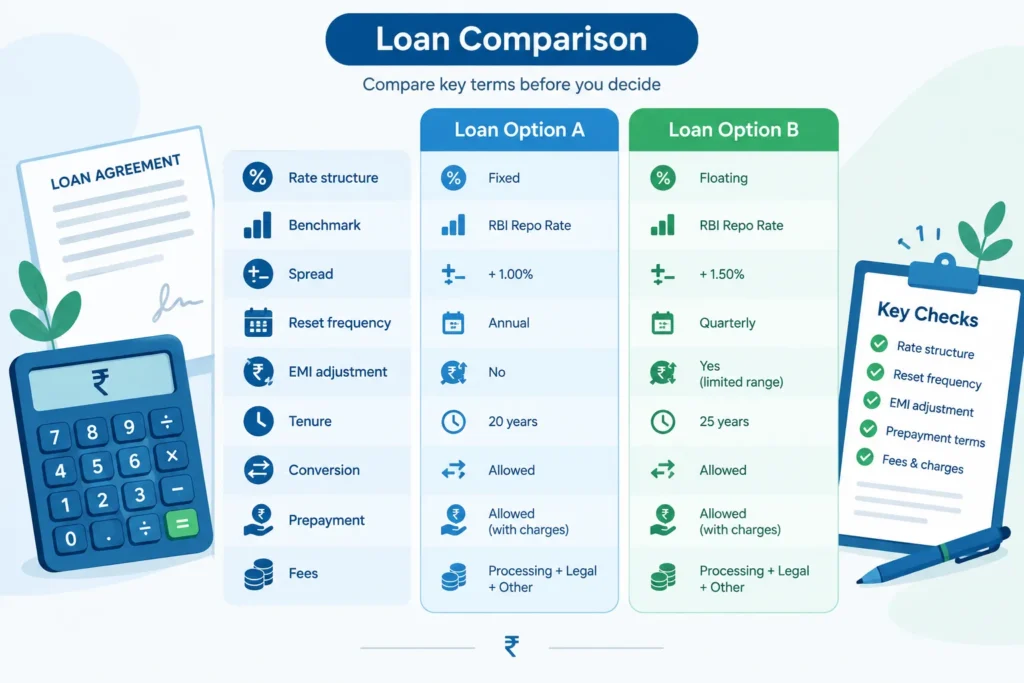
Checklist for comparing fixed and floating loan terms, fees and reset rules
Choosing between a fixed vs floating interest rate should not depend only on which rate looks lower today. Compare how the loan may affect your monthly budget throughout the repayment period.

Your income stability, emergency savings, repayment horizon and comfort with changing EMIs or tenure are all important.

Start With Your Repayment Comfort

Ask these questions before selecting a fixed rate loan or floating rate loan:

  • Do I need the EMI to remain predictable for budgeting?
  • Can my monthly budget handle an increase in EMI?
  • Would I be comfortable if the lender extended the loan tenure?
  • How long do I expect to keep the loan?
  • Do I plan to make part-prepayments when I have surplus money?
  • Is my income stable, or does it change from month to month?
  • Do I have an emergency fund for unexpected expenses?

A borrower with limited monthly flexibility may place greater value on predictable repayments. Someone with more budget flexibility may be better able to manage changes under a floating rate loan. This does not make either option automatically better.

Compare the Important Loan Terms

The interest-rate label does not explain the entire loan. Read the sanction letter, repayment schedule and loan agreement carefully.

Term to check What it means for the borrower Question to ask the lender
Interest-rate structure Shows whether the loan is fixed, floating or fixed only for an initial period. Will this rate remain fixed for the full loan tenure?
Benchmark A floating rate may be linked to an external or internal reference rate specified in the agreement. Which benchmark is used, and where can I see its current value?
Spread or margin This is the amount added to the benchmark to arrive at the applicable loan interest rate. Can the spread change, and under what conditions?
Reset frequency This determines how often a floating rate may be reviewed and revised. When will a rate change affect my loan?
EMI adjustment method The lender may change the EMI, tenure or both, depending on the contract. If the rate changes, what will be adjusted first?
Tenure limit A higher rate may extend the loan repayment period, but the lender may apply a maximum permitted tenure. What happens if the tenure cannot be extended further?
Conversion option Some loans allow a switch between fixed and floating structures, subject to conditions. Is conversion available, and what charges apply?
Prepayment terms These determine whether and how you can repay part or all of the loan early. Are there conditions or charges for part-prepayment or foreclosure?
Other charges Processing, administrative, legal, valuation, conversion and other charges may increase the borrowing cost. Which charges apply now and which may apply later?

Check Whether the Fixed Rate Is Fixed for the Full Tenure

A loan described as fixed may not necessarily remain fixed until the final EMI. Some products have a fixed rate for a specified period and move to a floating rate later.

Check the following:

  • The exact period for which the rate is fixed
  • The rate structure after the fixed period ends
  • The benchmark and spread used after conversion
  • Whether you can continue with another fixed-rate period
  • Any charges or conditions for changing the rate structure

Do not rely only on terms such as “fixed”, “semi-fixed” or “hybrid”. The loan agreement should explain how the rate actually works.

Understand the Floating-Rate Formula

A floating interest rate is commonly based on a benchmark plus a spread. For example, the agreement may describe the applicable rate in this form:

Applicable loan rate = Benchmark rate + Contractual spread

The benchmark can move according to its stated method. The spread may remain unchanged or may be revised under conditions mentioned in the loan documents.

Ask the lender for a written explanation of:

  • The name of the benchmark
  • The benchmark value used when the loan is sanctioned
  • The spread added to it
  • The reset date and reset frequency
  • How you will be informed about a change
  • How the revised rate will affect EMI and tenure

Compare the Total Repayment, Not Only the Starting EMI

A lower starting EMI does not always mean a lower overall cost. It may result from a longer repayment period, a different rate structure or other loan conditions.

When comparing offers, request calculations using the same:

  • Loan amount
  • Repayment period
  • EMI payment frequency
  • Down payment, where relevant
  • Assumed disbursement date
  • Treatment of fees and other charges

For a floating rate loan, the future total interest cannot be known with certainty because the applicable rate may change. You can still ask the lender to explain what would happen if the rate increased or decreased by an assumed amount. Such a scenario is an illustration, not a prediction.

Review Prepayment and Switching Conditions

Part-prepayment can reduce the outstanding principal. Depending on the lender’s method, this may reduce the EMI, shorten the tenure or both.

However, prepayment and foreclosure conditions can differ by loan type, borrower category, rate structure and agreement. Switching from fixed to floating, or from floating to fixed, may also involve a conversion charge or a revised rate.

Before signing, confirm:

  • The minimum amount accepted as a part-prepayment
  • How often part-prepayments are allowed
  • Whether the EMI or tenure will change afterward
  • Any applicable prepayment or foreclosure conditions
  • The process and cost of switching the rate structure
  • Whether a fresh credit assessment or documentation is required

A Simple Decision Checklist

Your situation Point to consider
You need stable monthly payments Examine whether a fixed rate is available for the full required period and whether any reset clause applies.
You can manage EMI changes A floating structure may be manageable, but check the reset and adjustment rules.
Your monthly budget is tight Test whether you could handle a higher EMI or longer tenure without affecting essential expenses.
You expect to repay early Compare prepayment, foreclosure and conversion conditions carefully.
You are taking a long-tenure loan Consider how repeated rate resets could affect the repayment period and total interest.
You prefer simple financial planning Give greater weight to payment predictability, but verify how long the quoted rate remains fixed.

This checklist helps organise the decision

Leave a Comment