


- The home loan amount
- The applicable interest rate
- The repayment tenure
A larger loan or a higher interest rate generally increases the monthly EMI. A longer tenure can reduce the EMI, but it usually increases the total interest paid over the life of the loan.
Introduction
Buying a home often involves a long-term financial commitment. Before taking a loan, it is important to understand not only the monthly home loan EMI but also the total amount you may repay.
An EMI that looks affordable today may continue for 15, 20 or even 30 years. Small differences in the home loan interest rate or tenure can therefore make a meaningful difference to the total interest cost.
This guide begins with the basics of how home loan EMI is calculated. It also explains why the interest and principal portions of your payment change over time.
What a Home Loan EMI Means and How It Is Calculated
What Is a Home Loan EMI?
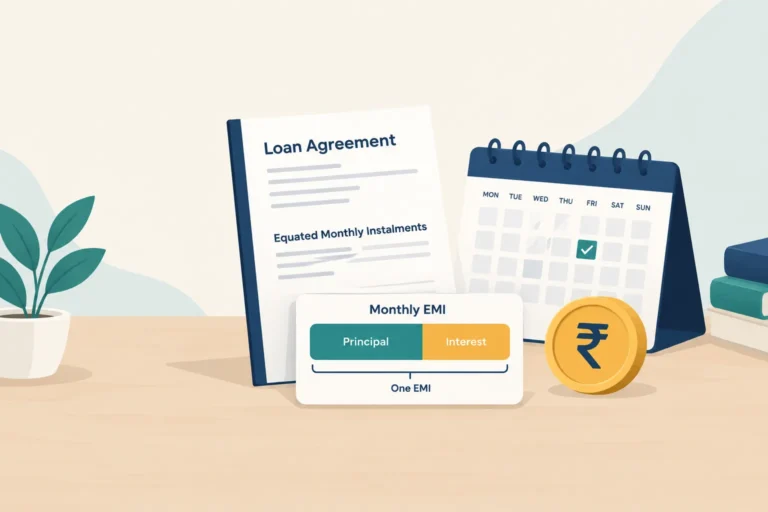
EMI stands for Equated Monthly Instalment. It is the amount you pay to your lender every month as part of your home loan repayment.
Each EMI normally contains two parts:
- Principal: The portion that reduces the outstanding loan amount.
- Interest: The cost charged by the lender for providing the loan.
The EMI may remain fixed when the interest rate and other loan terms do not change. In a floating-rate home loan, the lender may periodically revise the EMI, tenure or both, depending on the loan agreement and changes in the applicable rate.
Monthly EMI Is Not the Same as Total Repayment
The monthly home loan EMI tells you how much you need to pay each month. It does not tell you the full cost of the loan.
Your total repayment is broadly calculated as:
Total repayment = Monthly EMI × Total number of monthly instalments
The difference between total repayment and the original principal is broadly the total interest paid, assuming the rate and EMI schedule do not change and excluding charges.
For example, an EMI of about ₹26,035 may appear manageable. However, if it continues for 240 months, the total repayment would be approximately ₹62.48 lakh. This is why borrowers should compare both the monthly EMI and the total interest cost.
How the Reducing-Balance Method Works
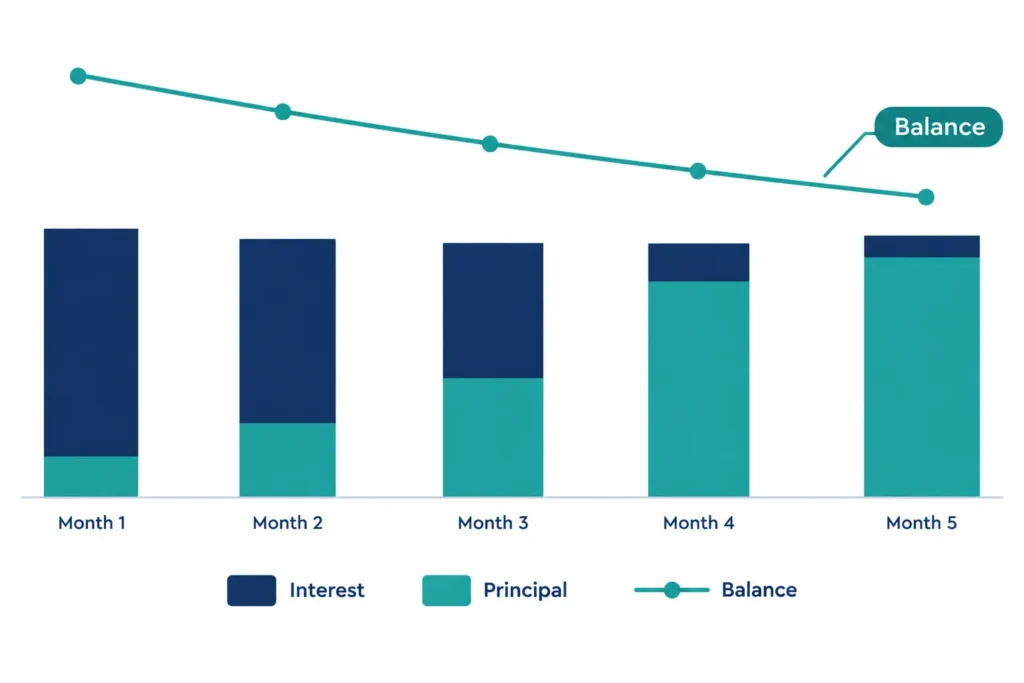
Home loans in India are generally explained using the reducing-balance method. Under this method, interest is calculated on the outstanding principal rather than on the original loan amount for the entire tenure.
When you pay an EMI, one part covers the interest due for that period. The remaining part reduces the principal. The next period’s interest is then calculated on the lower outstanding principal.
This usually creates the following repayment pattern:
- During the early years, a larger part of the EMI generally goes towards interest.
- As the outstanding principal falls, the interest portion generally becomes smaller.
- During the later years, a larger part of the EMI generally goes towards principal repayment.
Your EMI may remain the same even though the split between principal and interest changes every month.
The Home Loan EMI Formula
The standard mathematical formula used for home loan EMI calculation is:
EMI = P × r × (1 + r)n ÷ [(1 + r)n − 1]
The formula uses three main inputs:
| Input | Meaning | How It Is Used |
|---|---|---|
| P | Principal | The home loan amount borrowed from the lender |
| r | Monthly interest rate | The annual interest rate converted into a monthly rate |
| n | Number of instalments | The repayment tenure expressed in months |
For a simple estimate, the monthly interest rate is commonly calculated by dividing the annual rate by 12. The annual percentage rate must first be converted into decimal form.
For example, an annual interest rate of 8.5% becomes:
Monthly rate = 8.5% ÷ 12 = approximately 0.7083% per month
In decimal form, the monthly rate used in the formula is approximately 0.007083.
A tenure of 20 years becomes:
20 × 12 = 240 monthly instalments
Home Loan EMI Calculation Example
Consider the following illustrative home loan:
| Loan amount | ₹30,00,000 |
|---|---|
| Annual interest rate | 8.5% |
| Monthly interest rate | Approximately 0.7083% |
| Loan tenure | 20 years |
| Number of EMIs | 240 |
| Estimated monthly EMI | Approximately ₹26,035 |
Using the estimated EMI:
- Estimated total repayment: Approximately ₹62.48 lakh
- Estimated total interest:</strong
What Affects Home Loan EMI and Total Repayment
Your home loan EMI mainly depends on three inputs: the amount borrowed, the interest rate and the repayment tenure. A change in any of these can affect both your monthly payment and the total interest paid.
The lender’s repayment rules also matter. These may include how the interest rate is reset, how part-prepayments are treated and whether a rate change leads to a revised EMI or tenure.
1. Home Loan Amount
The loan amount is the principal borrowed from the lender. A larger principal generally results in a higher monthly home loan EMI and a higher total interest cost.
For example, suppose a home costs ₹60 lakh. If you make a down payment of ₹15 lakh, the required loan may be ₹45 lakh, excluding other costs. A larger down payment can reduce the amount borrowed and therefore reduce the EMI.
However, avoid using all your savings for the down payment. You may also need money for registration, moving expenses, repairs, emergencies and regular household costs.
2. Home Loan Interest Rate
A higher home loan interest rate increases the interest charged on the outstanding principal. If the loan amount and tenure remain unchanged, a higher rate usually means a higher EMI and higher total repayment.
Even a relatively small rate difference can matter because home loans normally continue for many years. When comparing lenders, consider the applicable rate as well as processing charges, rate-reset conditions and other loan terms.
3. Home Loan Tenure
The home loan tenure is the period allowed for repayment. A longer tenure spreads the principal and interest across more monthly instalments. This can reduce the EMI, but interest is charged for a longer period.
As a result, the option with the lowest EMI may not have the lowest total cost.
Same Home Loan at Different Tenures
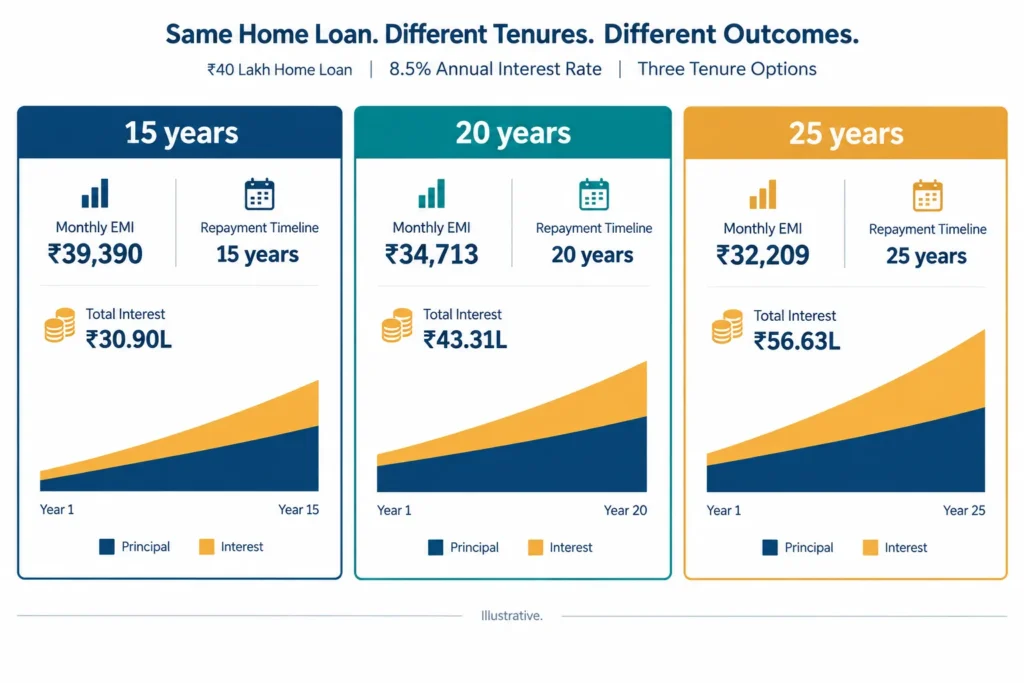
The following example uses a loan of ₹40 lakh at an annual interest rate of 8.5%. The figures are illustrative and assume that the rate remains unchanged throughout the tenure.Illustrative comparison of a ₹40 lakh home loan at 8.5% per year Tenure Estimated Monthly EMI Estimated Total Repayment Estimated Total Interest 15 years ₹39,390 ₹70.90 lakh ₹30.90 lakh 20 years ₹34,713 ₹83.31 lakh ₹43.31 lakh 25 years ₹32,209 ₹96.63 lakh ₹56.63 lakh In this example, extending the tenure from 15 years to 25 years reduces the estimated monthly EMI. However, it substantially increases the estimated total interest because the loan remains outstanding for longer.
Actual lender calculations may differ slightly because of rounding, disbursement dates, rate changes and specific repayment terms.
You May Also Like:Personal Loan vs Home Loan: Key Differences Explained →How Each Variable Usually Affects the Loan
General effect of changes in home loan variables Change Likely Effect on EMI Likely Effect on Total Interest Loan amount increases Increases Increases Loan amount decreases Decreases Decreases Interest rate increases Usually increases Usually increases Interest rate decreases Usually decreases Usually decreases Tenure increases Decreases Usually increases Tenure decreases Increases Usually decreases Is a Shorter Tenure Always Better?
A shorter tenure can reduce the total interest paid, but it also creates a higher monthly EMI. The higher payment should remain manageable alongside groceries, rent or maintenance, school fees, insurance premiums and emergency savings.
Choosing an EMI that leaves no room for unexpected expenses can put pressure on the household budget. A suitable tenure
How to Use a Home Loan EMI Calculator
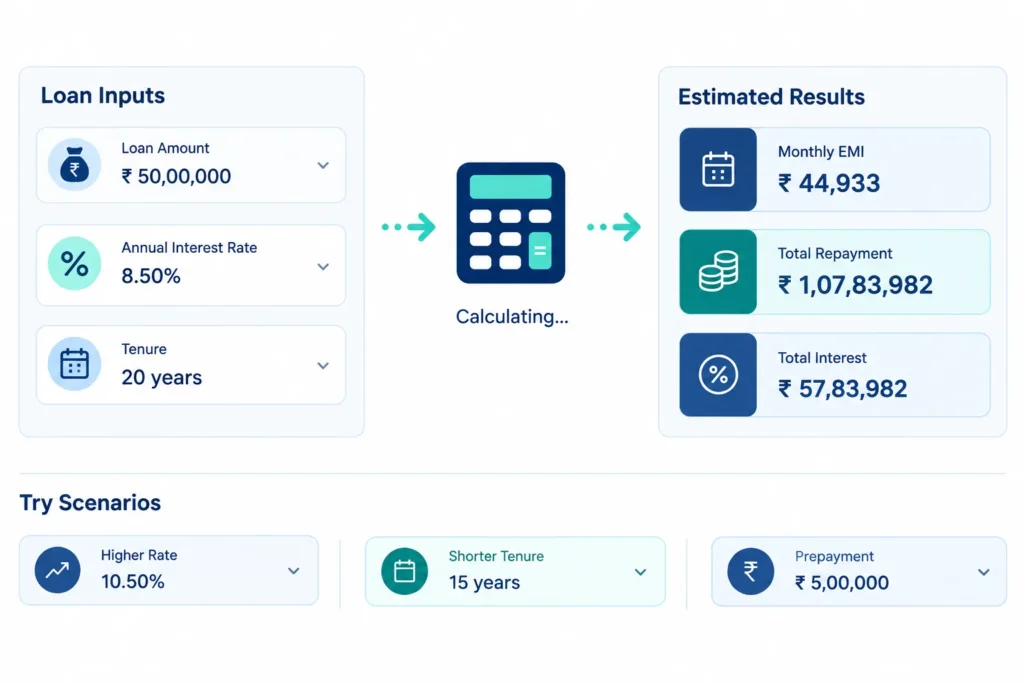
A home loan EMI calculator helps you estimate the monthly payment before applying for a loan. It can also show the approximate total repayment and total interest over the chosen tenure.You generally need to enter three details:
- Loan amount: The amount you plan to borrow after paying the down payment.
- Interest rate: The annual rate offered or indicated by the lender.
- Loan tenure: The repayment period, usually entered in years or months.
The calculator converts the annual interest rate into a monthly rate and applies it across the number of monthly instalments. This gives you an estimated monthly home loan EMI.
Test More Than One Scenario
Do not use a home loan EMI calculator only to find the lowest possible EMI. A low monthly payment may look comfortable, but it can result in a higher total interest cost when it comes from a longer tenure.
Try several combinations before choosing a repayment plan:
Scenario to Test What It Helps You Understand Higher down payment How a smaller loan amount affects the EMI and total interest Shorter tenure Whether you can manage a higher EMI to reduce the repayment period Longer tenure How much the EMI falls and how the total interest may rise Higher interest rate Whether your budget can handle an increase in borrowing cost Occasional prepayment How reducing the outstanding principal may affect future repayment For example, a borrower may compare 15-year, 20-year and 25-year options for the same loan amount. The shortest tenure may have the highest monthly EMI, while the longest tenure may have the highest total interest. The right option depends on affordability, financial stability and the loan terms.
Why Calculator Results May Differ from the Lender’s Schedule
A home loan EMI calculator provides an estimate. The final repayment schedule issued by the lender may be slightly different.
Differences can arise because of:
- Rounding of the monthly interest rate or EMI
- The actual loan disbursement date
- Stage-wise disbursement for an under-construction property
- Pre-EMI interest before the full loan is disbursed
- Changes in a floating home loan interest rate
- The lender’s rate-reset method and frequency
- Part-payments, prepayments or delayed payments
- Specific conditions in the loan agreement
You May Also Like:How to Reduce the Total Interest Paid on a Loan →Use the lender’s official repayment schedule for final planning. Also check whether processing fees, insurance premiums or other charges are being paid separately or added to the loan amount.
How to Choose a Manageable Home Loan Repayment Plan
A manageable EMI is not simply the highest amount for which a lender considers you eligible. It should leave enough room for your regular expenses, savings and unexpected costs.
Prepare a Practical Monthly Budget
List your essential household expenses before deciding the EMI amount. For an Indian household, these may include rent during construction, groceries, school fees, utility bills, insurance premiums, transport costs and support for parents.
Also consider irregular expenses such as annual insurance renewals, medical bills, home repairs and festival spending. An EMI that appears manageable in a normal month may become difficult when several expenses occur together.
Keep Room for Other Financial Goals
A home is an important goal, but it may not be your only one. Avoid choosing an EMI that prevents you from maintaining an emergency fund, paying essential insurance premiums or saving for retirement and children’s education.
If two repayment options are available, compare both the monthly burden and the long-term interest cost. The shortest tenure is not automatically suitable if its EMI leaves your monthly budget too tight.
Check the Interest-Rate Terms
Find out whether the loan has a fixed, floating or mixed interest rate. Read how and when the rate may be revised.
For a floating-rate loan, a rate change may lead to:
- A higher or lower EMI
- A longer or shorter remaining tenure
- A combination of EMI and tenure changes
- Another adjustment permitted under the loan agreement
Ask the lender how rate resets are handled. Do not assume that the EMI will always remain unchanged.
Review Prepayment Conditions
A part-prepayment reduces the outstanding principal. Depending on the lender’s process, it may reduce the remaining tenure, reduce the EMI, or allow a choice between the two.
Check the applicable rules, minimum payment conditions and documentation. Charges and restrictions can vary based on the lender, loan type, interest-rate structure and current regulations.
Use a Repayment Checklist
- Compare at least two or three tenure options.
- Test the EMI at a slightly higher interest rate.
- Include existing EMIs and credit-card dues in your budget.
- Keep money available for property-related costs beyond the down payment.
- Check whether the rate is fixed or floating.
- Understand the rate-reset and prepayment conditions.
- Read the sanction letter and loan agreement carefully.
- Use the lender’s repayment schedule for final figures.
You May Also Like:Loan Prepayment: Benefits, Charges and Things to Consider →Common Home Loan EMI Mistakes to Avoid
Choosing Only the Lowest EMI
A lower EMI is often achieved by extending the home loan tenure. This may improve monthly affordability, but it usually keeps the loan outstanding for longer and increases the total interest paid.
Using the Advertised Rate Without Checking Eligibility
The rate shown in an advertisement may not be the final rate offered to every applicant. The actual rate can depend on the borrower’s credit profile, income, loan amount, property and lender policies.
Ignoring the Effect of a Floating Rate
A floating-rate home loan can change during the repayment period. Planning on the assumption that the original EMI and tenure will remain unchanged may create a budget problem later.
Borrowing the Maximum Eligible Amount
Loan eligibility does not automatically mean affordability. A lender’s assessment may not fully reflect your family responsibilities, future expenses or personal savings goals.
Forgetting Other Home-Buying Costs
The property price is not the only expense. Stamp duty, registration, legal checks, brokerage, interiors, maintenance deposits and moving costs may also require money. Using all available savings for the down payment can leave little financial cushion.
Relying on One Calculator Result
Different calculators may use slightly different assumptions or rounding. Treat the result as an estimate and verify the final EMI, total interest and repayment schedule with the lender.
Not Reading the Loan Agreement
The agreement explains important matters such as interest-rate resets, payment dates, late-payment consequences, prepayment procedures and other charges. Read these terms before accepting the loan.
Frequently Asked Questions About Home Loan EMI
What details are needed for a home loan EMI calculator?
You usually need the loan amount, annual interest rate and repayment tenure. Some calculators may also allow you to include proposed prepayments or compare different rate scenarios.
Is the EMI shown by an online calculator final?
No. It is an estimate based on the information entered. The lender’s figure may differ because of rounding, disbursement dates, rate changes, pre-EMI interest or specific loan conditions.
Does a longer home loan tenure always mean a better option?
No. A longer tenure generally lowers the monthly EMI, but it can increase the total interest



Comments