


A PPF Calculator estimates how much your Public Provident Fund balance may grow over time. Enter your contribution, deposit frequency, assumed interest rate and investment period to see your total investment, estimated interest and projected maturity amount.
PPF is a long-term savings scheme backed by the Government of India. The calculator can help you plan contributions and understand possible returns before you invest. However, its results are estimates because the notified PPF interest rate and scheme rules may change.
PPF Calculator
Estimate your Public Provident Fund maturity value, total investment and interest earned using the PPF interest-crediting method.
Monthly contribution is limited to ₹12,500 so annual deposits do not exceed the ₹1.5 lakh PPF limit.
Investment vs Interest
Estimated maturity value split between your contributions and interest credited.
PPF Balance Growth
Estimated closing balance at the end of each year.
Year-wise PPF Schedule
Illustrative schedule based on the selected contribution timing, rate and period.
| Year | Opening Balance | Investment | Interest | Closing Balance |
|---|
Disclaimer: This calculator is for educational and planning purposes only. PPF interest rates, account rules, contribution limits and applicable Government notifications may change. Actual interest credited by a bank or post office may differ based on the account's transaction dates and applicable rules.
Use the PPF Calculator and Understand the Results
What Is a PPF Calculator?
A PPF Calculator is a planning tool that estimates the future value of contributions made to a Public Provident Fund account.
It combines your deposits with an assumed PPF interest rate. It then shows how the balance may grow during the selected period.
You can use it to answer practical questions such as:
- How much could I accumulate by investing a fixed amount every year?
- What may happen if I contribute monthly instead?
- How much of the projected balance comes from my deposits?
- How much estimated interest could be earned?
- How may an existing PPF balance grow?
The result is not a guaranteed return or an official account statement. Your actual PPF maturity amount will depend on your deposit dates, the interest rates notified during the account period, applicable rounding rules and prevailing PPF scheme conditions.
How to Use the PPF Calculator
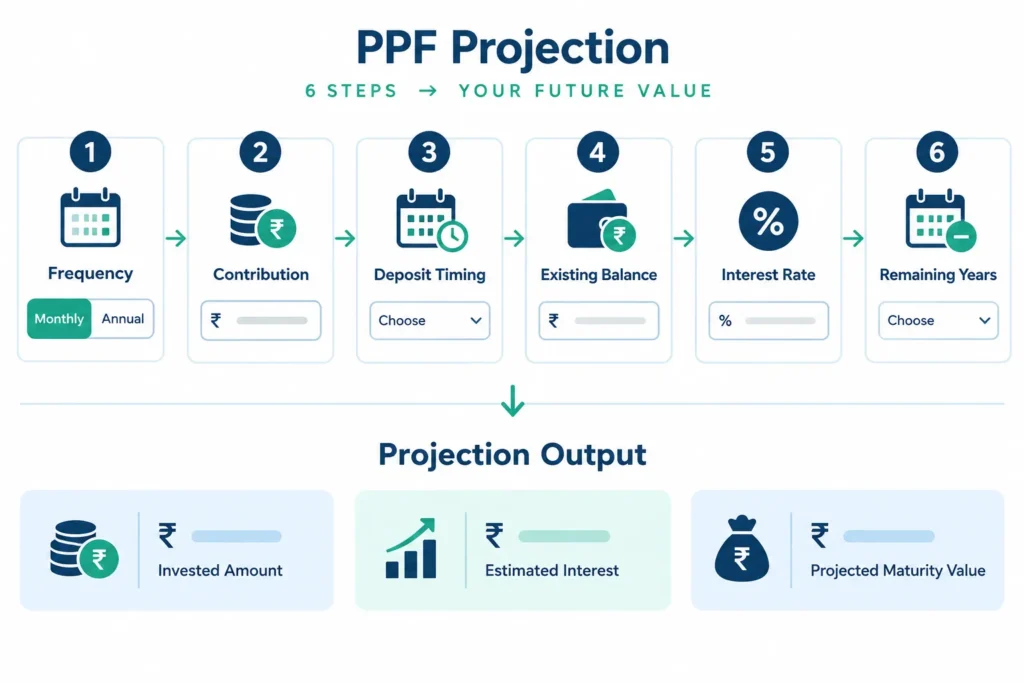
Follow these steps to prepare a projection.
- Choose annual or monthly investment: Select how often you plan to contribute.
- Enter the contribution amount: Add the amount you expect to deposit at the selected frequency.
- Select the contribution timing: Choose when you expect to make the deposit. Timing can affect the balance considered for interest calculation.
- Add your existing PPF balance: If you already have an account, enter its current balance where the calculator provides this option.
- Check the interest rate: Use the currently notified PPF rate or another rate only for illustration.
- Enter the investment period: Select the remaining period for which you want to project the account balance.
- Review the estimate: Compare the projected deposits, interest and final value.
Annual Investment Input
Use the annual investment option if you plan to make one main contribution during each financial year.
For example, an investor may decide to deposit a fixed amount near the beginning of every financial year. The calculator will apply the entered annual contribution across the selected period.
Do not assume that the date of an annual deposit has no effect. An eligible deposit made earlier can remain in the account for more monthly interest calculations than the same deposit made later.
Monthly Investment Input
Choose the monthly investment option if you prefer to contribute smaller amounts throughout the year.
This may suit a salaried person who wants to set aside money from each month’s income. Enter the amount you expect to deposit every month, not the total annual amount.
For example, if you intend to contribute separately every month, use the monthly amount as the input. Do not enter the full year’s contribution in the monthly field, as this would produce an incorrect projection.
Contribution Timing
The deposit date matters because PPF interest is based on scheme-specific monthly balance rules. The calculator may ask whether a contribution is made near the beginning or later in a month or financial year.
Select the timing that most closely matches your plan. If your deposits are irregular, the result will be a simplified estimate rather than an exact account-level calculation.
Deposit timing will be explained in more detail in the next section of this guide.
Existing PPF Balance
If you already have a PPF account, enter the current balance shown in your latest account statement or official banking or post office record.
The opening balance gives the calculator a starting point. Future contributions and estimated interest are then added to it.
Remember that an existing balance is not a new contribution. Check how the calculator labels opening balance and fresh investment when you read the final results.
You should also use the remaining account period rather than automatically starting a fresh 15-year projection. The actual maturity date depends on when the PPF account was opened and the applicable scheme rules.
Interest Rate Input
PPF is a small-savings scheme. Its interest rate is notified by the Government of India and may be revised periodically.
Before using the PPF interest calculator, check the rate applicable to the period you are estimating. Do not rely on an old rate quoted in an article, video or social media post.
If you use one rate for the entire projection, the calculation assumes that the rate remains unchanged. In reality, different notified rates may apply during different periods. Your actual interest and maturity value can therefore be higher or lower than the estimate.
Investment Period
Enter the number of years for which you want to estimate growth.
A standard PPF account has an initial maturity period governed by the PPF scheme. It should not be treated like a simple fixed 15-year period beginning from any date entered into a calculator.
If you already have an account, use its remaining period for a more relevant estimate. If you are considering an extension after maturity, calculate that period separately and check the current extension rules.
How to Read the PPF Calculator Results
The PPF Calculator separates your own deposits from the estimated growth generated by interest.
How PPF Interest, Contributions and Account Rules WorkA PPF Calculator uses your contribution amount, deposit timing, selected interest rate and investment period to estimate how your balance may grow. To understand the result, it helps to know how PPF interest is calculated.How PPF interest is calculatedPPF interest is calculated for each calendar month on the lowest account balance between the close of the fifth day of that month and the end of the month.However, the interest is not normally added to your account every month. It is calculated monthly and credited annually at the end of the financial year.
- A deposit reflected in the account on or before the relevant monthly cut-off may be considered for that month’s interest calculation.
- A deposit made after the cut-off generally starts affecting the interest calculation from the following month.
- The transaction date, processing time and fund realisation may matter, especially for online transfers or cheque deposits.
For practical planning, many investors try to complete a monthly contribution by the fifth day of the month. If making one annual contribution, depositing near the beginning of the financial year can generally give that money more time to earn interest.
How contribution timing affects monthly interest
| Result | What it means |
|---|---|
| Total amount invested | The deposits included in the projection. Review whether an entered opening balance is shown separately or included in this figure. |
| Interest earned | The estimated interest generated using the entered rate, deposit timing and calculation |
| Deposit timing | Likely treatment for that month |
|---|---|
| Amount is credited on or before the fifth day | It may form part of the eligible balance used for that month’s interest calculation. |
| Amount is credited after the fifth day | It will generally affect interest from the next month. |
Check the transaction status instead of relying only on the date on which you initiated the transfer. Bank holidays, cheque clearing or processing delays can change the date on which the deposit reaches the PPF account.Illustrative example of deposit timingSuppose Meera plans to invest ₹5,000 every month in her PPF account. This is only an illustration and not a maturity-value promise.
- If her April deposit is credited by the relevant cut-off, it may be included while calculating interest for April.
- If the same deposit is credited after the cut-off, it will generally begin earning interest from May.
- If this timing difference continues across several months or years, the estimated maturity value can change.
In the PPF Calculator, Meera can enter ₹5,000 as her monthly contribution and choose a timing assumption that reflects when she expects deposits to reach the account. The calculator will then estimate the investment, interest and maturity value using those inputs.The live calculator should be used for the actual estimate. A manually stated maturity figure may become misleading if the notified interest rate, contribution timing or account rules change.Monthly investment versus yearly investmentPPF does not require everyone to follow the same deposit pattern. You can choose a contribution schedule that suits your cash flow, subject to the applicable annual limits and other scheme conditions.FactorMonthly contributionsYearly contributionCash-flow managementSpreads the contribution across the year.Requires a larger amount at one time.ConvenienceStanding instructions can make regular deposits easier.Involves fewer transactions.Interest timingEach instalment starts affecting interest according to when it is credited.An early financial-year deposit may remain eligible for more monthly interest calculations.Income suitabilityMay suit salaried investors with monthly income.May suit people who receive a bonus or have seasonal or irregular income.Risk of delayA missed instruction can delay an instalment.Waiting until the year-end can create a last-minute funding or processing risk.Neither method is automatically right for everyone. A yearly deposit made early may have a timing advantage, while monthly deposits may be easier to manage without affecting emergency savings or essential expenses.Current annual PPF deposit limitsUnder the prevailing PPF framework, the commonly applicable contribution limits are:RuleAmount or conditionMinimum annual deposit₹500 in a financial yearMaximum eligible annual deposit₹1.5 lakh in a financial yearDeposit methodLump sum or instalments, subject to the current scheme and account-provider processFinancial year1 April to 31 MarchThese limits can be changed through official notifications. Confirm the current rules with the relevant post office, authorised bank or official government publication before depositing.The maximum limit applies to the total eligible contribution for the financial year under the applicable scheme rules. This can be important when a person contributes to their own account and also deposits in a minor’s PPF account in the capacity permitted by the scheme.What happens if you deposit more than the annual ceiling?A contribution above the eligible annual ceiling does not receive the intended PPF treatment under the scheme. The excess amount is generally not eligible for PPF interest or the related tax benefit and may need to be returned or regularised according to the provider’s process and prevailing rules.Do not enter an amount above the eligible ceiling in the PPF Calculator merely to model unrestricted investment growth. PPF is a regulated small-savings scheme, not an account with unlimited eligible deposits.Can you make any number of PPF deposits?PPF contributions may be made as a lump sum or in instalments under the prevailing scheme. Older explanations may refer to historical restrictions on the number of instalments, so check the latest rules and your bank or post office’s operating process.Even when multiple deposits are permitted, the following points remain important:
- The total eligible contribution must stay within the annual ceiling.
- The minimum annual contribution must be met to keep the account regular under prevailing rules.
- Every deposit should be completed early enough to be credited before the relevant cut-off if you want it considered for that month’s interest.
- Maintain receipts or account statements and verify that each deposit has been posted correctly.
What if you do not make the minimum contribution?If the required minimum is not deposited during a financial year, the account may become discontinued under the PPF rules. Revival may require payment of the prescribed fee and minimum contribution arrears, subject to the current procedure.PPF Maturity: When Does the Account Complete 15 Years?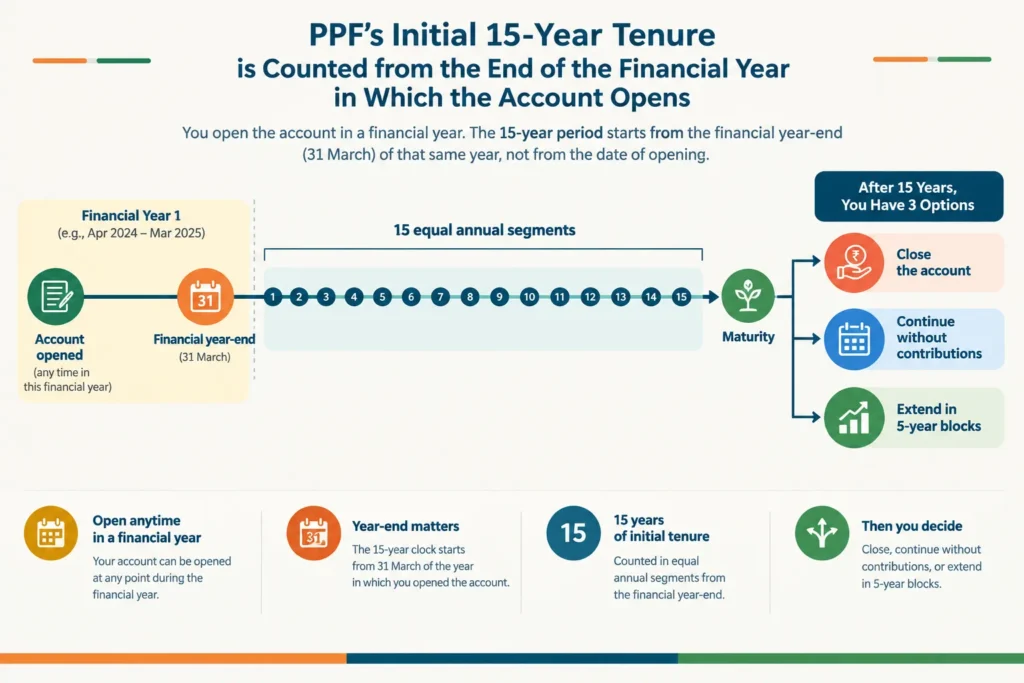 A PPF account has an initial tenure of 15 years. However, the maturity date is not simply 15 years from the account opening date.The period is counted from the end of the financial year in which the account was opened. This can make the effective holding period slightly longer than 15 calendar years.Illustrative maturity timelineSuppose you open a PPF account during the financial year 2024–25. The 15-year period is counted from the end of that financial year. The account would ordinarily mature after completing 15 full financial years from that point, subject to the prevailing PPF rules.Your PPF maturity amount generally consists of:
- Eligible contributions made to the account
- Interest credited over the account tenure
- Interest earned on earlier interest credits
The value shown by a PPF Calculator is an estimate. Your actual maturity value may differ if the notified interest rate changes, deposits are delayed or skipped, or the contribution amount varies.What Can You Do After PPF Maturity?At maturity, you do not always have to close the account immediately. Depending on the applicable rules and the procedure you follow, you may close the account, continue it without fresh contributions, or extend it with contributions.OptionFresh contributionsImportant pointClose the accountNot applicableYou can apply for closure and receive the eligible maturity proceeds.Continue without contributionsNoThe existing balance may continue to earn interest under prevailing rules. Withdrawal conditions apply.Extend with contributionsYesExtension is generally available in blocks of five years, subject to the required application and deadline.Extension without further contributionsYou may retain the matured balance without making new deposits. The balance may continue earning interest at the applicable PPF rate.Withdrawals are allowed subject to the rules for accounts continued after maturity. Check the current withdrawal frequency and documentation requirements with the bank or post office holding your account.Extension with further contributionsA PPF account can generally be extended with contributions in blocks of five years. The prescribed option must normally be submitted within the specified period after maturity.If you continue depositing without completing the required procedure, those deposits may not receive the intended treatment. Confirm the applicable form, deadline and account status before making fresh contributions after maturity.Withdrawals during an extension with contributions are also restricted. Under prevailing scheme provisions, limits can be linked to the balance at the beginning of the extension block, along with a limit on withdrawal frequency.Loans, Partial Withdrawals and Premature ClosurePPF is designed for long-term saving, but limited access to funds may be available before maturity. Each facility has separate eligibility conditions.FacilityGeneral purposeKey restrictionLoanTemporary borrowing against the PPF balance during eligible yearsAvailable only during the period permitted by the scheme, with limits linked to an earlier account balance.Partial withdrawalAccessing part of the accumulated balance after the required holding periodAmount and frequency are restricted and depend on specified historical balances.Premature closureClosing the account before normal maturity in permitted situationsAllowed only after the prescribed period and for specified reasons. An interest adjustment may apply.Loan facilityA loan may be available during specified years in the earlier part of the PPF tenure. The maximum loan amount is calculated using the balance from an earlier financial year, not necessarily the current balance.The loan has its own interest and repayment rules. Taking a loan does not permanently withdraw the same amount from the account, but failure to follow repayment conditions can have financial consequences.Partial withdrawalPartial withdrawals are generally available only after completing the minimum period prescribed under the scheme. The permitted amount is linked to a percentage of specified earlier balances.A PPF maturity calculator usually does not include withdrawals unless the tool provides a separate input for them. If you withdraw money, the actual future balance and interest will be lower than a projection that assumes no withdrawals.Premature closurePremature closure is not available simply because you want to move the money to another investment. It is generally permitted only after the required number of years and for specified reasons, such as qualifying medical treatment, higher education or a change in residential status, subject to documentary proof.An interest reduction may apply when an account is closed prematurely. Review the latest scheme notification before submitting a closure request.PPF Tax TreatmentPPF scheme rules and income-tax rules are separate. A deposit may be valid under the PPF scheme but may not provide an additional tax deduction if you have already used your available deduction limit.PPF componentGeneral tax treatment under current lawWhat to checkContributionMay qualify for deduction under Section 80C within the combined statutory limit.Your tax regime, eligibility and the amount of Section 80C limit already used by other investments or expenses.InterestPPF interest is generally exempt from income tax under current provisions.Any future change in tax law or scheme treatment.Maturity proceedsEligible maturity proceeds are generally exempt under current provisions.Check the applicable tax rules and current PPF provisions.
Related Articles
- The Ultimate Personal Finance Guide for Beginners in India
- SIP Investment in India: A Beginner’s Guide to Systematic Investment Plans
- PPF vs ELSS: Understanding the Key Differences for Indian Investors
- Financial Goals for Beginners in India: How to Set, Plan & Achieve Your Money Goals
- Emergency Fund Guide for Beginners in India



Comments