

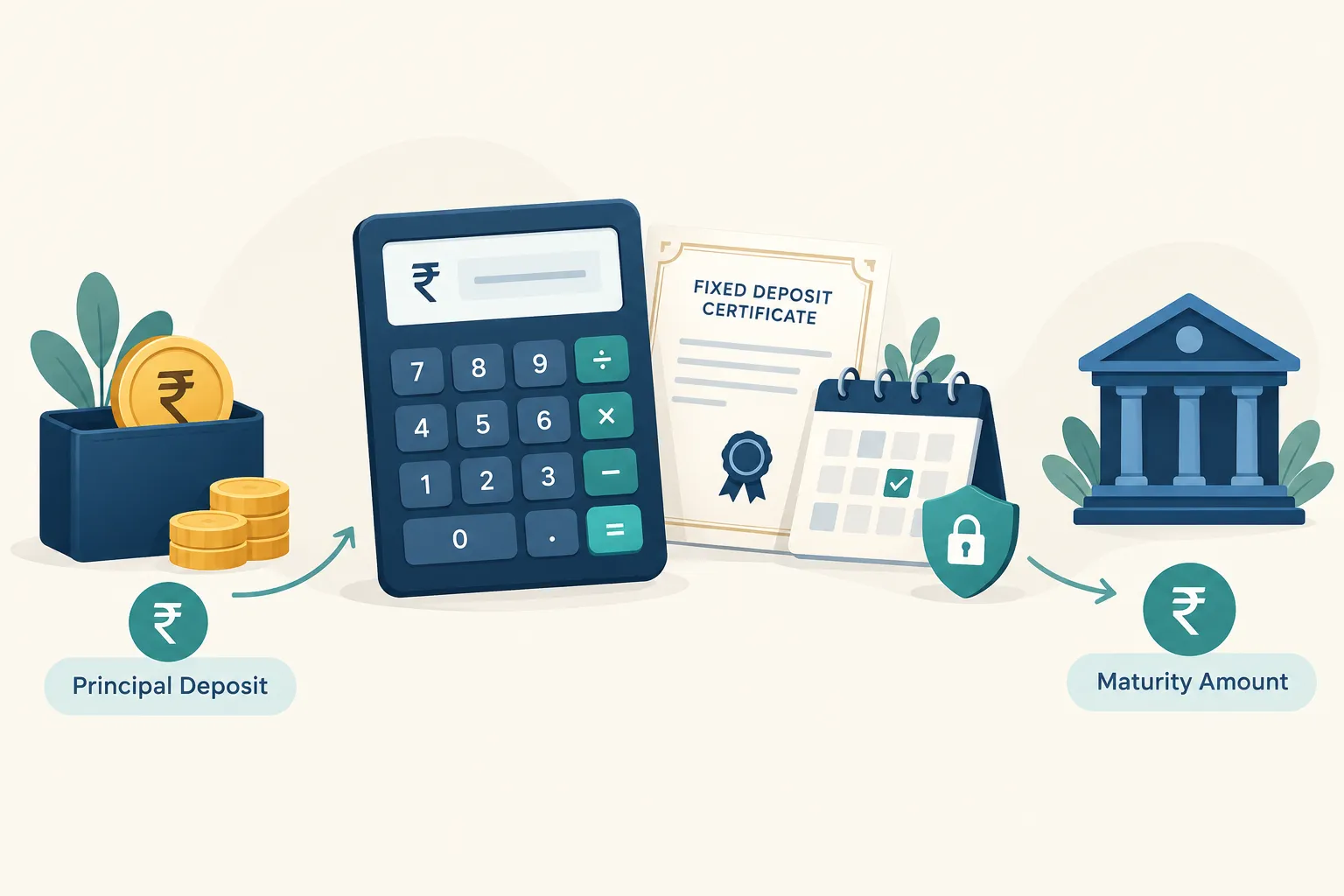
FD Calculator: Calculate Fixed Deposit Maturity and Interest

Estimate your fixed deposit maturity amount and interest, then understand how tenure, compounding, payout choices and premature withdrawal can affect an FD.

FD Calculator: Calculate Fixed Deposit Maturity and Interest

An FD Calculator estimates how much your fixed deposit may be worth at maturity. Enter the deposit amount, annual interest rate, FD tenure and compounding frequency. The calculator will show your estimated total interest and maturity amount.

The result is an estimate. Actual returns may differ because FD rates, calculation methods and terms vary across banks and deposit products.

Introduction

A fixed deposit allows you to deposit a lump sum for a chosen period at an agreed interest rate. It is commonly used in India for short-term savings, planned expenses and capital preservation.

Calculating FD returns manually can be difficult when interest is compounded. The FD Calculator makes this easier by estimating the interest earned and the amount you may receive when the deposit matures.

Fixed Deposit Calculator

FD Calculator

Estimate your fixed deposit interest, maturity amount and total returns using the selected rate, tenure and compounding option.

₹5,00,000
₹1,000₹5 Cr
7.00%
0%20%
5 Years
3 Months10 Years

For reinvestment FDs, the selected frequency is used to estimate compounding. Banks may use their own product-specific calculation and day-count rules.

FD rates, compounding conventions, payout options and premature-withdrawal rules vary by bank and deposit product. This calculator provides an indicative estimate.
Principal Amount₹5,00,000
Total Interest₹2,07,508
Estimated Maturity Amount₹7,07,508At 7.00% assumed rate
Effective Annual Yield7.19%

Principal vs. Interest

Estimated split between your original deposit and interest earned.

Principal₹5,00,000Interest₹2,07,508
FD Insight

FD Growth Over Time

Estimated balance at the end of each year, assuming the selected rate remains unchanged.

Year-wise FD Schedule

Illustrative figures based on the selected amount, rate, tenure and interest option.

YearOpening BalanceInterestClosing Balance

Disclaimer: This calculator is for educational and planning purposes only. Actual FD maturity values can differ because banks may apply product-specific rates, day-count methods, compounding conventions, payout discounts, taxes, and premature-withdrawal rules. The final amount is the amount stated by the bank on the deposit receipt.

Use the FD Calculator
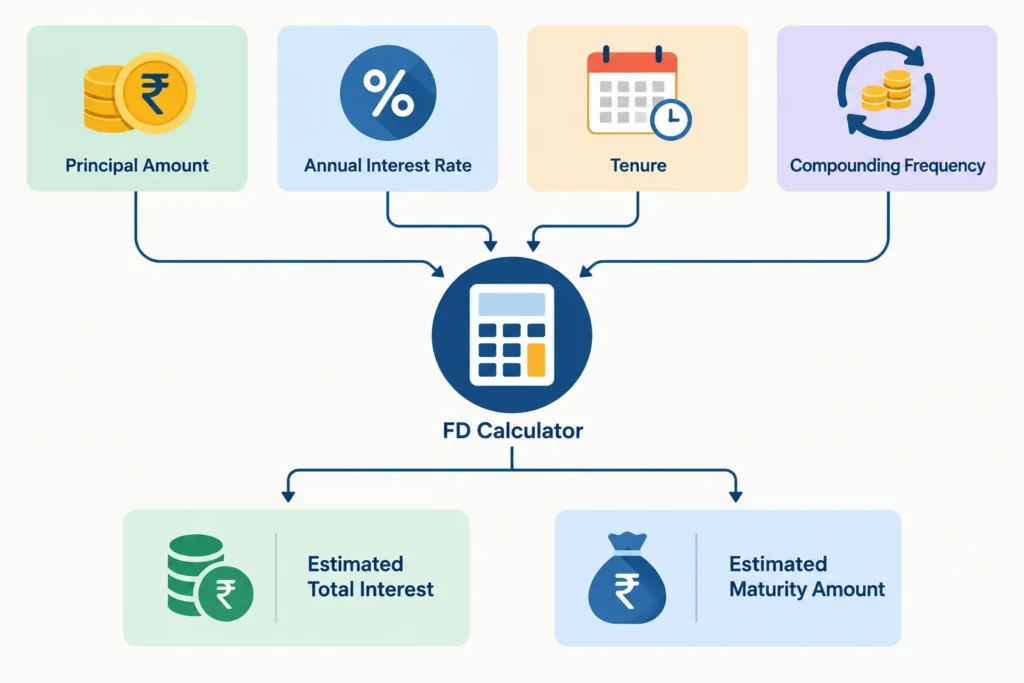
Flowchart showing principal, interest rate, tenure and compounding frequency producing estimated FD interest and maturity amount

To calculate your estimated FD maturity value, keep your deposit details ready. You will normally need the principal amount, annual interest rate, tenure and compounding frequency.

1. Enter the Principal Amount

The principal is the amount you plan to place in the fixed deposit. For example, if you book an FD of ₹1,00,000, your principal amount is ₹1,00,000.

Enter only the amount being deposited. Do not add expected interest to this figure.

2. Enter the Annual Interest Rate

Enter the annual FD interest rate offered for your chosen deposit. For example, if the offered rate is 7% per year, enter 7 in the interest rate field.

Use the rate stated by the bank for your exact FD. Rates can vary based on the bank, tenure, deposit type, deposit amount and customer category.

3. Select the FD Tenure

FD tenure is the period for which your money remains deposited. Depending on the calculator, you may be able to enter the tenure in months or years.

  • A tenure of 6 months means the deposit remains invested for half a year.
  • A tenure of 12 months means the deposit remains invested for one year.
  • A tenure of 24 months means the deposit remains invested for two years.
You May Also Like:RD Calculator: Calculate Recurring Deposit Maturity and Interest

Enter the tenure carefully. An FD for 18 months should not be entered as 18 years or as one year.

4. Choose the Compounding Frequency
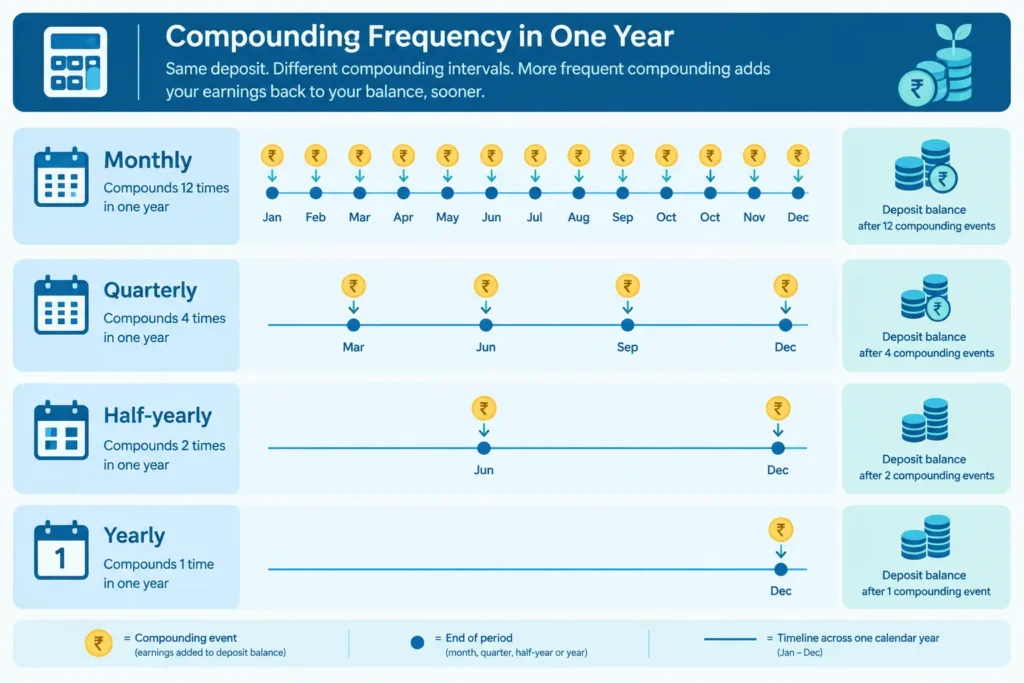
Timeline comparing monthly, quarterly, half-yearly and yearly FD compounding frequencies

Compounding frequency tells you how often interest is calculated and added back to the deposit for further interest calculation.

  • Monthly compounding: Interest is compounded 12 times a year.
  • Quarterly compounding: Interest is compounded four times a year.
  • Half-yearly compounding: Interest is compounded twice a year.
  • Yearly compounding: Interest is compounded once a year.

Select the frequency mentioned in the FD terms. Do not assume that every bank or FD uses the same compounding schedule.

FD Input and Output Summary

Item What It Means Example
Principal The amount placed in the FD ₹1,00,000
Annual interest rate The yearly rate offered on the deposit 7% per year
Tenure The period for which the FD is booked 2 years
Compounding frequency How often interest is added for further calculation Quarterly
Estimated total interest The approximate interest earned during the tenure ₹14,888
Estimated maturity amount The approximate principal plus accumulated interest ₹1,14,888

Important: The figures above use a hypothetical annual interest rate of 7% with quarterly compounding. This is only an illustration. It is not a current or universal FD rate offered by every bank.

What Is the Estimated Maturity Amount?

The estimated maturity amount is the approximate total value of a cumulative FD at the end of its tenure. It generally includes the original principal and the interest accumulated according to the selected compounding schedule.

In the illustrative example, the ₹1,00,000 principal grows to approximately ₹1,14,888 after two years. This assumes a hypothetical rate of 7% per year and quarterly compounding.

What Is Total Interest?

Total interest is the estimated gain on the deposit before considering any applicable deductions or product-specific adjustments.

It can be understood using this simple relationship:

Total interest = Estimated maturity amount − Principal amount

Using the same illustration:

  • Estimated maturity amount: ₹1,14,888
  • Principal amount: ₹1,00,000
  • Estimated total interest: ₹14,888

Check the Details Before Relying on the Result

An FD Calculator provides an estimate based on the information you enter. Before booking a fixed deposit, check the exact rate, tenure and compounding terms shown by the bank.

FD rates and conditions may differ by bank, tenure, deposit type, deposit amount and customer category. Entering the correct product details will make your estimate more useful.

How FD Interest, Compounding and Payout Options Work

An FD earns interest on the amount deposited for a chosen period. The final result depends on four main factors: principal, interest rate, tenure and how the interest is handled.

Principal Amount

The principal is the amount you place in the fixed deposit. For example, if you book an FD for ₹1,00,000, that amount is your principal.

A higher principal generally earns more interest when the rate, tenure and other terms remain the same.

Annual Interest Rate

The FD interest rate is usually shown as an annual percentage. It tells you the rate at which the deposit will earn interest under the bank’s terms.

For example, a hypothetical rate of 7% per year does not always mean you receive exactly 7% of the principal every year as cash. The result can depend on compounding, payout frequency and the product’s calculation method.

The offered rate may vary according to the bank, deposit amount, FD tenure, deposit type and customer category. Always use the rate offered for the specific FD you are considering.

You May Also Like:EMI Calculator – Calculate Your Monthly Loan EMI

FD Tenure

FD tenure is the period for which the money remains deposited. It may be expressed in days, months or years.

  • Shorter tenure: Your money is committed for a shorter period, so it has less time to earn interest.
  • Longer tenure: Your money has more time to earn interest, but it may also remain unavailable for longer unless premature withdrawal is allowed.
  • Renewed FD: A renewed deposit may receive the rate available at the time of renewal rather than the rate on the original FD.

A longer tenure does not automatically mean that every bank will offer a higher interest rate. Rate structures can differ across tenure ranges and products.

Compounding Frequency

Compounding means that interest is added to the deposit balance, and future interest is then calculated on the increased balance. This is often described as earning interest on interest.

Depending on the FD terms, compounding may happen annually, half-yearly, quarterly or at another stated frequency. More frequent compounding can produce a slightly higher maturity value when the principal, annual rate and tenure are otherwise identical.

For a cumulative FD, a simplified compound-interest calculation is:

Maturity amount = Principal × (1 + annual rate ÷ compounding frequency)number of compounding periods

The formula is useful for understanding an estimate. A bank may use its own day-count rules, rounding process and product conditions when calculating the actual amount.

Illustrative Compounding Example

Suppose ₹1,00,000 is deposited for two years at a hypothetical annual rate of 7%, with quarterly compounding. The interest is assumed to remain invested throughout the tenure.

  • Principal: ₹1,00,000
  • Hypothetical annual rate: 7%
  • Tenure: 2 years
  • Compounding: Quarterly
  • Estimated maturity amount: Approximately ₹1,14,888
  • Estimated total interest: Approximately ₹14,888

This example is only for explanation. It is not a current or universal FD rate, and the actual maturity value may differ under a bank’s calculation rules.

Cumulative FD and Regular Interest Payouts
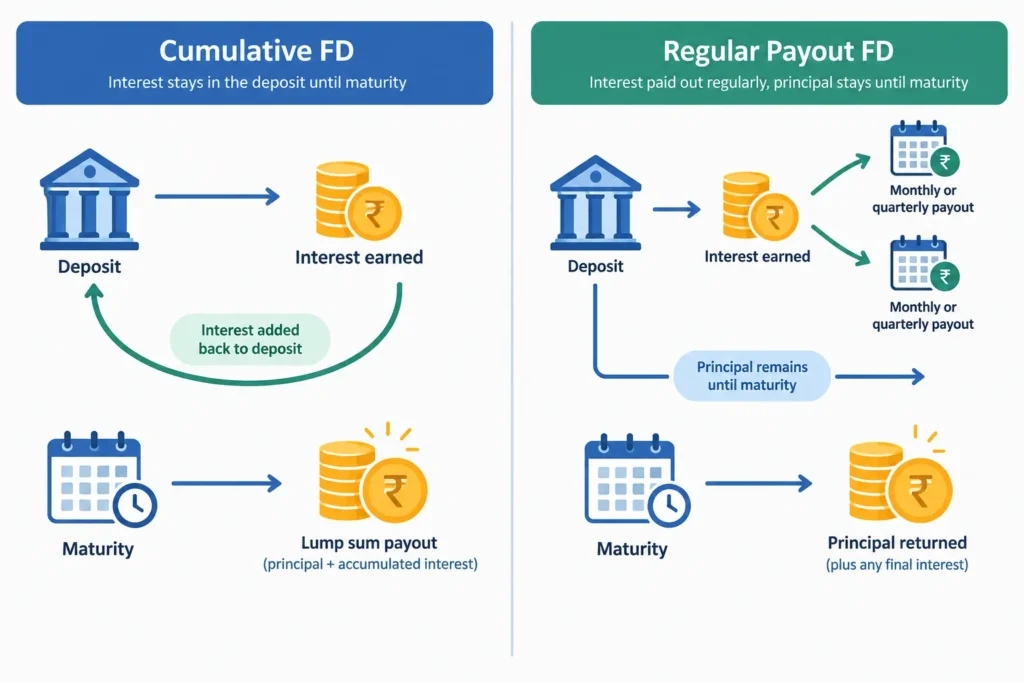
Comparison of cumulative FD reinvestment and regular interest payout cash flows

The payout option decides what happens to the interest earned by your FD. The two broad choices are reinvesting the interest or receiving it at regular intervals.

In a cumulative or reinvestment FD, interest is generally added back to the deposit according to the product terms. This allows compounding to work over the tenure.

In a regular payout FD, interest may be paid monthly, quarterly or yearly. These payments can provide periodic income, but the paid-out interest is not left in the FD to compound in the same way.

Comparison of common FD payout options
Payout option How interest is handled Cash flow during the tenure Typical maturity payment
Cumulative or reinvestment Interest is generally added back according to the stated compounding terms. Usually no regular interest payout. The principal and accumulated interest are generally paid at maturity.
Monthly payout Interest is paid at monthly intervals under the product’s calculation method. Frequent periodic income. The principal is generally returned at maturity, subject to the FD terms.
Quarterly payout Interest is paid at quarterly intervals. Income is received four times during a full year. The principal is generally returned at maturity, subject to the FD terms.
Yearly payout Interest is paid once a year. One periodic payment for each completed annual payout cycle. The principal is generally returned at maturity, subject to the FD terms.

Compounding Frequency Is Not the Same as Payout Frequency

These two terms may sound similar, but they describe different things.

  • Compounding frequency tells you how often interest is added to the balance for calculating future interest.
  • Payout frequency tells you how often interest is paid to you.

For example, an FD described as having a monthly payout does not necessarily calculate the payment by simply dividing the annual interest by 12. The bank may follow a specific calculation method stated in the deposit terms.

Which Payout Option May Suit Your Goal?

A cumulative FD may be considered when you do not need regular income and want the interest to remain invested until maturity.

A monthly or quarterly payout option may be considered when periodic cash flow is important, such as for routine household expenses. A yearly payout may suit someone who wants less frequent payments.

Do not compare these options only by looking at the payout interval. Check the offered rate, calculation method, expected payouts and maturity amount for each option before deciding.

Understanding Your Estimate and Important FD Conditions

An FD Calculator gives you an estimate based on the details you enter. It does not confirm the final amount that a bank will pay.

The actual fixed deposit maturity amount may be slightly different. Banks may use product-specific calculation methods, compounding rules, payout schedules and rounding practices.

Why the Actual Maturity Amount May Differ

Factor How It Can Affect Your FD
Offered interest rate The applicable rate may depend on the bank, deposit amount, FD tenure, deposit type and customer category.
Compounding frequency Interest may be compounded at intervals specified by the bank. A different interval can change the maturity amount.
Interest payout option A cumulative FD usually reinvests interest, while a payout FD may pay interest at regular intervals.
Tenure calculation Banks may offer tenures in days, months or years. The exact start and maturity dates can affect the calculation.
Rounding method Small differences may arise because the calculator and the bank can round interest differently.
Premature withdrawal Closing the FD before maturity may change the applicable interest and may involve a penalty under the product terms.

For example, suppose the FD Calculator shows an estimated maturity amount of ₹1,10,000. The amount shown in the bank’s deposit advice may be slightly higher or lower if its compounding method, exact tenure or rounding rules differ.

You May Also Like:SIP Calculator (2026) – Calculate Mutual Fund Returns Online Free | RegularStation

Check the Exact Tenure and Dates

An FD tenure of one year may appear simple, but it is still important to verify the booking date and maturity date. This becomes more important when the tenure is entered as a combination of months and days.

If the bank displays the tenure in days, enter the same tenure in the calculator where possible. Avoid treating every month as having an identical number of days.

Understand the Maturity Instructions

When you open an FD, the bank may ask what should happen on the maturity date. The available choices depend on the bank and deposit product.

  • Credit the maturity amount: The principal and applicable interest are credited to the linked account.
  • Renew the principal: The original deposit is renewed, while interest may be credited separately.
  • Renew principal and interest: The complete maturity amount is placed into a new FD.

A renewed FD may receive the rate available on the renewal date, subject to the bank’s terms. Do not assume that the original FD interest rate will continue automatically.

What Happens If You Withdraw the FD Early?

Premature withdrawal means closing an FD before its scheduled maturity date. Some FDs allow it, while others may restrict or exclude it.

If premature withdrawal is permitted, the bank may calculate interest for the period the money actually remained deposited. A penalty or reduced applicable rate may also apply. The exact treatment varies by bank and FD product.

For example, if you book a three-year FD but close it after one year, you should not assume that you will receive the original three-year rate for that one-year period. The bank will apply its premature-withdrawal rules.

Before breaking an FD, ask the bank for the estimated closure value. Compare that amount with your immediate need for funds and any available alternatives. Do not rely only on the original maturity estimate.

Checklist Before Booking an FD

  • Confirm the deposit amount and exact FD tenure.
  • Check the interest rate offered for that specific tenure.
  • Verify whether any special rate applies to your customer category.
  • Confirm whether the FD is cumulative or pays interest periodically.
  • Check the compounding frequency or interest payout schedule.
  • Review the booking date and maturity date.
  • Select suitable maturity and renewal instructions.
  • Read the premature-withdrawal availability, conditions and penalties.
  • Check nomination and account details before completing the deposit.
  • Compare the bank’s maturity amount with the FD Calculator estimate.

Common FD Calculator Mistakes

Entering the Interest Rate for the Wrong Tenure

FD rates can vary across tenures. Enter the rate offered for your chosen tenure rather than a rate shown for another deposit period.

Confusing Months and Years

Entering 18 years instead of 18 months can produce a highly misleading result. Always review the tenure unit before calculating.

Using the Wrong Compounding Frequency

Do not select quarterly compounding only because it produces a higher estimate. Use the frequency stated in the bank’s FD terms.

Treating a Payout FD Like a Cumulative FD

In a cumulative FD, interest is generally added back according to the product terms. In a payout FD, interest is paid periodically and is not usually left to compound in the same way.

If you use cumulative settings for a monthly payout FD, the estimated maturity amount may be overstated.

Assuming the Calculator Result Is Guaranteed

An FD interest calculator is a planning tool. The deposit advice or official confirmation issued by the bank contains the applicable terms and maturity details.

Ignoring Premature-Withdrawal Conditions

The original maturity estimate assumes that the FD remains invested for the selected tenure. Closing it early can change the interest calculation and final amount received.

You May Also Like:Fixed vs Floating Interest Rate: What Borrowers Should Know

Forgetting to Review Renewal Instructions

Automatic renewal may place your money into a new FD under the terms applicable at that time. Review your instructions before maturity if you need the money or want to compare other options.

Frequently Asked Questions

What does an FD Calculator calculate?

An FD Calculator estimates the interest earned and maturity amount using the deposit amount, annual interest rate, tenure and selected compounding frequency.

Is the FD Calculator result exact?

No. It is an estimate. The bank’s result may differ because of its calculation method, exact dates, compounding rules, payout schedule and rounding practices.

What is the maturity amount of an FD?

The maturity amount is the amount payable at the end of the FD tenure under the deposit terms. For a cumulative FD, it generally includes the original principal and accumulated interest.

What is the difference between interest earned and maturity amount?

Interest earned is the estimated return on the deposit. The maturity amount is generally the principal plus accumulated interest for a cumulative FD.

For example, if the principal is ₹2,00,000 and the estimated accumulated interest is ₹24,000, the estimated maturity amount is ₹2,24,000.

Does a higher compounding frequency increase the maturity amount?

When the rate, tenure and other conditions remain the same, more frequent compounding can increase the maturity amount because interest is added to the balance sooner. However, you should calculate using the frequency actually offered by the FD.

Can I use the FD Calculator for a monthly interest payout FD?

You can use it only if the calculator supports the relevant payout option. A standard cumulative FD calculation may not accurately represent monthly payouts because the paid interest is not retained in the deposit for further compounding.

Can I calculate an FD for a tenure in months?

Yes, if the calculator provides a months option. Select the correct unit and enter the tenure exactly. For a deposit with additional days, compare the result with the bank’s official calculation.

Will I receive the calculated amount if I close the FD early?

Not necessarily. The bank may recalculate interest for the completed deposit period and apply its premature-withdrawal terms. Ask the bank for the closure value before proceeding.

Does an FD automatically renew at the same interest rate?

Not necessarily. Renewal depends on your maturity instructions and the bank’s terms. A renewed deposit may receive the rate applicable on the renewal date.

Can two banks show different maturity amounts for the same deposit?

Yes. Their offered rates, compounding rules, deposit tenures, product conditions and rounding methods may differ. Compare the complete FD terms rather than only the headline rate.

Should I choose a cumulative FD or an interest payout FD?

The suitable option depends on your need. A cumulative FD may be useful when you want the interest to remain invested until maturity. A payout FD may be more suitable when you need periodic income.

Compare the payout schedule, maturity value, liquidity conditions and product terms before deciding.

Summary

The FD Calculator helps you estimate the interest and maturity amount of a fixed deposit. Its output depends on the principal, FD interest rate, tenure, compounding frequency and payout option entered.

Treat the result as an estimate, not a guaranteed bank quote. Confirm the offered rate, exact tenure, compounding or payout schedule, maturity instructions and premature-withdrawal conditions before booking the FD.

Use the calculator to compare suitable scenarios, then verify the final maturity amount and deposit terms with the bank.

Share this article
KEEP READING

Related Articles

View all →

Comments

Leave a Comment

FD Calculator: Calculate Fixed Deposit Maturity and Interest

An FD Calculator estimates how much your fixed deposit may be worth at maturity. Enter the deposit amount, annual interest rate, FD tenure and compounding frequency. The calculator will show your estimated total interest and maturity amount.

The result is an estimate. Actual returns may differ because FD rates, calculation methods and terms vary across banks and deposit products.

Introduction

A fixed deposit allows you to deposit a lump sum for a chosen period at an agreed interest rate. It is commonly used in India for short-term savings, planned expenses and capital preservation.

Calculating FD returns manually can be difficult when interest is compounded. The FD Calculator makes this easier by estimating the interest earned and the amount you may receive when the deposit matures.

Fixed Deposit Calculator

FD Calculator

Estimate your fixed deposit interest, maturity amount and total returns using the selected rate, tenure and compounding option.

₹5,00,000
₹1,000₹5 Cr
7.00%
0%20%
5 Years
3 Months10 Years

For reinvestment FDs, the selected frequency is used to estimate compounding. Banks may use their own product-specific calculation and day-count rules.

FD rates, compounding conventions, payout options and premature-withdrawal rules vary by bank and deposit product. This calculator provides an indicative estimate.
Principal Amount₹5,00,000
Total Interest₹2,07,508
Estimated Maturity Amount₹7,07,508At 7.00% assumed rate
Effective Annual Yield7.19%

Principal vs. Interest

Estimated split between your original deposit and interest earned.

Principal₹5,00,000Interest₹2,07,508
FD Insight

FD Growth Over Time

Estimated balance at the end of each year, assuming the selected rate remains unchanged.

Year-wise FD Schedule

Illustrative figures based on the selected amount, rate, tenure and interest option.

YearOpening BalanceInterestClosing Balance

Disclaimer: This calculator is for educational and planning purposes only. Actual FD maturity values can differ because banks may apply product-specific rates, day-count methods, compounding conventions, payout discounts, taxes, and premature-withdrawal rules. The final amount is the amount stated by the bank on the deposit receipt.

Use the FD Calculator

Flowchart showing principal, interest rate, tenure and compounding frequency producing estimated FD interest and maturity amount

To calculate your estimated FD maturity value, keep your deposit details ready. You will normally need the principal amount, annual interest rate, tenure and compounding frequency.

1. Enter the Principal Amount

The principal is the amount you plan to place in the fixed deposit. For example, if you book an FD of ₹1,00,000, your principal amount is ₹1,00,000.

Enter only the amount being deposited. Do not add expected interest to this figure.

2. Enter the Annual Interest Rate

Enter the annual FD interest rate offered for your chosen deposit. For example, if the offered rate is 7% per year, enter 7 in the interest rate field.

Use the rate stated by the bank for your exact FD. Rates can vary based on the bank, tenure, deposit type, deposit amount and customer category.

3. Select the FD Tenure

FD tenure is the period for which your money remains deposited. Depending on the calculator, you may be able to enter the tenure in months or years.

  • A tenure of 6 months means the deposit remains invested for half a year.
  • A tenure of 12 months means the deposit remains invested for one year.
  • A tenure of 24 months means the deposit remains invested for two years.

Enter the tenure carefully. An FD for 18 months should not be entered as 18 years or as one year.

4. Choose the Compounding Frequency

Timeline comparing monthly, quarterly, half-yearly and yearly FD compounding frequencies

Compounding frequency tells you how often interest is calculated and added back to the deposit for further interest calculation.

  • Monthly compounding: Interest is compounded 12 times a year.
  • Quarterly compounding: Interest is compounded four times a year.
  • Half-yearly compounding: Interest is compounded twice a year.
  • Yearly compounding: Interest is compounded once a year.

Select the frequency mentioned in the FD terms. Do not assume that every bank or FD uses the same compounding schedule.

FD Input and Output Summary

Item What It Means Example
Principal The amount placed in the FD ₹1,00,000
Annual interest rate The yearly rate offered on the deposit 7% per year
Tenure The period for which the FD is booked 2 years
Compounding frequency How often interest is added for further calculation Quarterly
Estimated total interest The approximate interest earned during the tenure ₹14,888
Estimated maturity amount The approximate principal plus accumulated interest ₹1,14,888

Important: The figures above use a hypothetical annual interest rate of 7% with quarterly compounding. This is only an illustration. It is not a current or universal FD rate offered by every bank.

What Is the Estimated Maturity Amount?

The estimated maturity amount is the approximate total value of a cumulative FD at the end of its tenure. It generally includes the original principal and the interest accumulated according to the selected compounding schedule.

In the illustrative example, the ₹1,00,000 principal grows to approximately ₹1,14,888 after two years. This assumes a hypothetical rate of 7% per year and quarterly compounding.

What Is Total Interest?

Total interest is the estimated gain on the deposit before considering any applicable deductions or product-specific adjustments.

It can be understood using this simple relationship:

Total interest = Estimated maturity amount − Principal amount

Using the same illustration:

  • Estimated maturity amount: ₹1,14,888
  • Principal amount: ₹1,00,000
  • Estimated total interest: ₹14,888

Check the Details Before Relying on the Result

An FD Calculator provides an estimate based on the information you enter. Before booking a fixed deposit, check the exact rate, tenure and compounding terms shown by the bank.

FD rates and conditions may differ by bank, tenure, deposit type, deposit amount and customer category. Entering the correct product details will make your estimate more useful.

How FD Interest, Compounding and Payout Options Work

An FD earns interest on the amount deposited for a chosen period. The final result depends on four main factors: principal, interest rate, tenure and how the interest is handled.

Principal Amount

The principal is the amount you place in the fixed deposit. For example, if you book an FD for ₹1,00,000, that amount is your principal.

A higher principal generally earns more interest when the rate, tenure and other terms remain the same.

Annual Interest Rate

The FD interest rate is usually shown as an annual percentage. It tells you the rate at which the deposit will earn interest under the bank’s terms.

For example, a hypothetical rate of 7% per year does not always mean you receive exactly 7% of the principal every year as cash. The result can depend on compounding, payout frequency and the product’s calculation method.

The offered rate may vary according to the bank, deposit amount, FD tenure, deposit type and customer category. Always use the rate offered for the specific FD you are considering.

FD Tenure

FD tenure is the period for which the money remains deposited. It may be expressed in days, months or years.

  • Shorter tenure: Your money is committed for a shorter period, so it has less time to earn interest.
  • Longer tenure: Your money has more time to earn interest, but it may also remain unavailable for longer unless premature withdrawal is allowed.
  • Renewed FD: A renewed deposit may receive the rate available at the time of renewal rather than the rate on the original FD.

A longer tenure does not automatically mean that every bank will offer a higher interest rate. Rate structures can differ across tenure ranges and products.

Compounding Frequency

Compounding means that interest is added to the deposit balance, and future interest is then calculated on the increased balance. This is often described as earning interest on interest.

Depending on the FD terms, compounding may happen annually, half-yearly, quarterly or at another stated frequency. More frequent compounding can produce a slightly higher maturity value when the principal, annual rate and tenure are otherwise identical.

For a cumulative FD, a simplified compound-interest calculation is:

Maturity amount = Principal × (1 + annual rate ÷ compounding frequency)number of compounding periods

The formula is useful for understanding an estimate. A bank may use its own day-count rules, rounding process and product conditions when calculating the actual amount.

Illustrative Compounding Example

Suppose ₹1,00,000 is deposited for two years at a hypothetical annual rate of 7%, with quarterly compounding. The interest is assumed to remain invested throughout the tenure.

  • Principal: ₹1,00,000
  • Hypothetical annual rate: 7%
  • Tenure: 2 years
  • Compounding: Quarterly
  • Estimated maturity amount: Approximately ₹1,14,888
  • Estimated total interest: Approximately ₹14,888

This example is only for explanation. It is not a current or universal FD rate, and the actual maturity value may differ under a bank’s calculation rules.

Cumulative FD and Regular Interest Payouts

Comparison of cumulative FD reinvestment and regular interest payout cash flows

The payout option decides what happens to the interest earned by your FD. The two broad choices are reinvesting the interest or receiving it at regular intervals.

In a cumulative or reinvestment FD, interest is generally added back to the deposit according to the product terms. This allows compounding to work over the tenure.

In a regular payout FD, interest may be paid monthly, quarterly or yearly. These payments can provide periodic income, but the paid-out interest is not left in the FD to compound in the same way.

Comparison of common FD payout options
Payout option How interest is handled Cash flow during the tenure Typical maturity payment
Cumulative or reinvestment Interest is generally added back according to the stated compounding terms. Usually no regular interest payout. The principal and accumulated interest are generally paid at maturity.
Monthly payout Interest is paid at monthly intervals under the product’s calculation method. Frequent periodic income. The principal is generally returned at maturity, subject to the FD terms.
Quarterly payout Interest is paid at quarterly intervals. Income is received four times during a full year. The principal is generally returned at maturity, subject to the FD terms.
Yearly payout Interest is paid once a year. One periodic payment for each completed annual payout cycle. The principal is generally returned at maturity, subject to the FD terms.

Compounding Frequency Is Not the Same as Payout Frequency

These two terms may sound similar, but they describe different things.

  • Compounding frequency tells you how often interest is added to the balance for calculating future interest.
  • Payout frequency tells you how often interest is paid to you.

For example, an FD described as having a monthly payout does not necessarily calculate the payment by simply dividing the annual interest by 12. The bank may follow a specific calculation method stated in the deposit terms.

Which Payout Option May Suit Your Goal?

A cumulative FD may be considered when you do not need regular income and want the interest to remain invested until maturity.

A monthly or quarterly payout option may be considered when periodic cash flow is important, such as for routine household expenses. A yearly payout may suit someone who wants less frequent payments.

Do not compare these options only by looking at the payout interval. Check the offered rate, calculation method, expected payouts and maturity amount for each option before deciding.

Understanding Your Estimate and Important FD Conditions

An FD Calculator gives you an estimate based on the details you enter. It does not confirm the final amount that a bank will pay.

The actual fixed deposit maturity amount may be slightly different. Banks may use product-specific calculation methods, compounding rules, payout schedules and rounding practices.

Why the Actual Maturity Amount May Differ

Factor How It Can Affect Your FD
Offered interest rate The applicable rate may depend on the bank, deposit amount, FD tenure, deposit type and customer category.
Compounding frequency Interest may be compounded at intervals specified by the bank. A different interval can change the maturity amount.
Interest payout option A cumulative FD usually reinvests interest, while a payout FD may pay interest at regular intervals.
Tenure calculation Banks may offer tenures in days, months or years. The exact start and maturity dates can affect the calculation.
Rounding method Small differences may arise because the calculator and the bank can round interest differently.
Premature withdrawal Closing the FD before maturity may change the applicable interest and may involve a penalty under the product terms.

For example, suppose the FD Calculator shows an estimated maturity amount of ₹1,10,000. The amount shown in the bank’s deposit advice may be slightly higher or lower if its compounding method, exact tenure or rounding rules differ.

Check the Exact Tenure and Dates

An FD tenure of one year may appear simple, but it is still important to verify the booking date and maturity date. This becomes more important when the tenure is entered as a combination of months and days.

If the bank displays the tenure in days, enter the same tenure in the calculator where possible. Avoid treating every month as having an identical number of days.

Understand the Maturity Instructions

When you open an FD, the bank may ask what should happen on the maturity date. The available choices depend on the bank and deposit product.

  • Credit the maturity amount: The principal and applicable interest are credited to the linked account.
  • Renew the principal: The original deposit is renewed, while interest may be credited separately.
  • Renew principal and interest: The complete maturity amount is placed into a new FD.

A renewed FD may receive the rate available on the renewal date, subject to the bank’s terms. Do not assume that the original FD interest rate will continue automatically.

What Happens If You Withdraw the FD Early?

Premature withdrawal means closing an FD before its scheduled maturity date. Some FDs allow it, while others may restrict or exclude it.

If premature withdrawal is permitted, the bank may calculate interest for the period the money actually remained deposited. A penalty or reduced applicable rate may also apply. The exact treatment varies by bank and FD product.

For example, if you book a three-year FD but close it after one year, you should not assume that you will receive the original three-year rate for that one-year period. The bank will apply its premature-withdrawal rules.

Before breaking an FD, ask the bank for the estimated closure value. Compare that amount with your immediate need for funds and any available alternatives. Do not rely only on the original maturity estimate.

Checklist Before Booking an FD

  • Confirm the deposit amount and exact FD tenure.
  • Check the interest rate offered for that specific tenure.
  • Verify whether any special rate applies to your customer category.
  • Confirm whether the FD is cumulative or pays interest periodically.
  • Check the compounding frequency or interest payout schedule.
  • Review the booking date and maturity date.
  • Select suitable maturity and renewal instructions.
  • Read the premature-withdrawal availability, conditions and penalties.
  • Check nomination and account details before completing the deposit.
  • Compare the bank’s maturity amount with the FD Calculator estimate.

Common FD Calculator Mistakes

Entering the Interest Rate for the Wrong Tenure

FD rates can vary across tenures. Enter the rate offered for your chosen tenure rather than a rate shown for another deposit period.

Confusing Months and Years

Entering 18 years instead of 18 months can produce a highly misleading result. Always review the tenure unit before calculating.

Using the Wrong Compounding Frequency

Do not select quarterly compounding only because it produces a higher estimate. Use the frequency stated in the bank’s FD terms.

Treating a Payout FD Like a Cumulative FD

In a cumulative FD, interest is generally added back according to the product terms. In a payout FD, interest is paid periodically and is not usually left to compound in the same way.

If you use cumulative settings for a monthly payout FD, the estimated maturity amount may be overstated.

Assuming the Calculator Result Is Guaranteed

An FD interest calculator is a planning tool. The deposit advice or official confirmation issued by the bank contains the applicable terms and maturity details.

Ignoring Premature-Withdrawal Conditions

The original maturity estimate assumes that the FD remains invested for the selected tenure. Closing it early can change the interest calculation and final amount received.

Forgetting to Review Renewal Instructions

Automatic renewal may place your money into a new FD under the terms applicable at that time. Review your instructions before maturity if you need the money or want to compare other options.

Frequently Asked Questions

What does an FD Calculator calculate?

An FD Calculator estimates the interest earned and maturity amount using the deposit amount, annual interest rate, tenure and selected compounding frequency.

Is the FD Calculator result exact?

No. It is an estimate. The bank’s result may differ because of its calculation method, exact dates, compounding rules, payout schedule and rounding practices.

What is the maturity amount of an FD?

The maturity amount is the amount payable at the end of the FD tenure under the deposit terms. For a cumulative FD, it generally includes the original principal and accumulated interest.

What is the difference between interest earned and maturity amount?

Interest earned is the estimated return on the deposit. The maturity amount is generally the principal plus accumulated interest for a cumulative FD.

For example, if the principal is ₹2,00,000 and the estimated accumulated interest is ₹24,000, the estimated maturity amount is ₹2,24,000.

Does a higher compounding frequency increase the maturity amount?

When the rate, tenure and other conditions remain the same, more frequent compounding can increase the maturity amount because interest is added to the balance sooner. However, you should calculate using the frequency actually offered by the FD.

Can I use the FD Calculator for a monthly interest payout FD?

You can use it only if the calculator supports the relevant payout option. A standard cumulative FD calculation may not accurately represent monthly payouts because the paid interest is not retained in the deposit for further compounding.

Can I calculate an FD for a tenure in months?

Yes, if the calculator provides a months option. Select the correct unit and enter the tenure exactly. For a deposit with additional days, compare the result with the bank’s official calculation.

Will I receive the calculated amount if I close the FD early?

Not necessarily. The bank may recalculate interest for the completed deposit period and apply its premature-withdrawal terms. Ask the bank for the closure value before proceeding.

Does an FD automatically renew at the same interest rate?

Not necessarily. Renewal depends on your maturity instructions and the bank’s terms. A renewed deposit may receive the rate applicable on the renewal date.

Can two banks show different maturity amounts for the same deposit?

Yes. Their offered rates, compounding rules, deposit tenures, product conditions and rounding methods may differ. Compare the complete FD terms rather than only the headline rate.

Should I choose a cumulative FD or an interest payout FD?

The suitable option depends on your need. A cumulative FD may be useful when you want the interest to remain invested until maturity. A payout FD may be more suitable when you need periodic income.

Compare the payout schedule, maturity value, liquidity conditions and product terms before deciding.

Summary

The FD Calculator helps you estimate the interest and maturity amount of a fixed deposit. Its output depends on the principal, FD interest rate, tenure, compounding frequency and payout option entered.

Treat the result as an estimate, not a guaranteed bank quote. Confirm the offered rate, exact tenure, compounding or payout schedule, maturity instructions and premature-withdrawal conditions before booking the FD.

Use the calculator to compare suitable scenarios, then verify the final maturity amount and deposit terms with the bank.
Leave a Comment