


RD Calculator: Calculate Recurring Deposit Maturity and Interest

Estimate your recurring deposit maturity amount and interest earned using the monthly deposit, annual interest rate, tenure and deposit timing.

RD Calculator: Calculate Recurring Deposit Maturity and Interest

An RD Calculator estimates how much your fixed monthly deposits may grow during a recurring deposit tenure. Enter the monthly deposit, annual interest rate, tenure and deposit timing to see your total deposits, estimated interest earned and estimated maturity amount.

A recurring deposit, commonly called an RD, helps you save a fixed amount every month. The calculator below gives you a quick estimate before you compare an RD offered by a bank, post office or another eligible deposit provider.

RD Calculator: Estimate Your Maturity Amount

Enter your planned deposit details below. You can change the inputs to compare different monthly contributions, rates and tenures.

Recurring Deposit Calculator

RD Calculator

Estimate your recurring deposit maturity amount, total interest and returns from a fixed monthly contribution.

₹5,000
₹100₹10 Lakh
6.50%
0%20%
5 Years
6 Months10 Years

The calculator uses an indicative quarterly-compounding model. Actual bank or post-office RD calculations may follow product-specific rules.

RD interest rates, compounding conventions, minimum deposits, tenure options and premature-closure rules vary by bank or deposit scheme. This calculator provides an estimate.
Total Deposits₹3,00,000
Total Interest₹54,954
Estimated Maturity Amount₹3,54,954At 6.50% assumed rate
Estimated Return18.32%

Deposits vs. Interest

Estimated split between your total monthly contributions and interest earned.

Total Deposits₹3,00,000Interest₹54,954
RD Insight

RD Growth Over Time

Estimated cumulative value as monthly deposits are made and interest accrues.

Year-wise RD Schedule

Illustrative figures based on the selected monthly contribution, rate and tenure.

YearTotal DepositsInterestEstimated Value

Disclaimer: This calculator is for educational and planning purposes only. Actual RD maturity values can differ because banks and deposit schemes may apply their own interest calculation, compounding, rounding, deposit-timing, tax and premature-closure rules. Verify the final maturity amount and applicable terms with the relevant institution.

Important: This RD Calculator uses an indicative quarterly-compounding model. Its results are estimates, not a quotation or maturity promise from a bank, post office or other institution.

How to Use the RD Calculator

You need four main details to calculate an estimated recurring deposit maturity amount.

Input What It Means What to Enter
Monthly deposit The fixed amount you plan to contribute every month. Enter an amount in rupees, such as ₹1,000 or ₹5,000.
Annual interest rate The yearly rate used to estimate interest on each monthly instalment. Enter the rate stated for the RD product you are checking.
RD tenure The period for which you plan to make monthly deposits. Select or enter the applicable number of months or years.
Deposit timing Whether each monthly instalment is treated as deposited at the beginning or end of the month. Choose the option that best matches the calculator assumption you want to use.

Monthly Deposit

The monthly deposit is the amount you plan to save in the RD every month. For example, if you enter ₹2,000, the calculator assumes that the same amount is deposited each month throughout the selected tenure.

A higher monthly deposit increases the total amount contributed. It may also increase the interest earned because more money is placed in the deposit, but the actual outcome still depends on the interest rate, tenure and product rules.

You May Also Like:EMI Calculator – Calculate Your Monthly Loan EMI

Annual Interest Rate

The RD interest rate is the annual rate used by the calculator to estimate growth. Enter the rate applicable to the specific deposit product you are considering.

The displayed 6.50% rate is only an editable example. It is not a current, recommended or universal RD rate. Actual rates can differ across institutions, products, tenures and customer categories.

Always verify the applicable rate directly with the relevant institution before opening an RD.

RD Tenure

RD tenure means the total period for which you make monthly contributions. Depending on the calculator fields, you may enter the tenure in months or years.

A longer tenure gives earlier instalments more time to earn interest. However, every instalment does not earn interest for the full RD tenure because the money is deposited gradually each month.

Beginning-of-Month and End-of-Month Deposits

Deposit timing affects how long each instalment remains invested.

  • Beginning of the month: The calculator assumes that each instalment is deposited near the start of the month. It therefore receives slightly more time to earn interest.
  • End of the month: The calculator assumes that each instalment is deposited near the end of the month. It receives less time to earn interest than a beginning-of-month deposit.

Because of this timing difference, the estimated maturity amount may change even when the monthly deposit, rate and tenure remain the same. An institution may use its own due dates and interest-calculation rules, so select this input only as an estimation assumption.

Understanding the Calculator Results
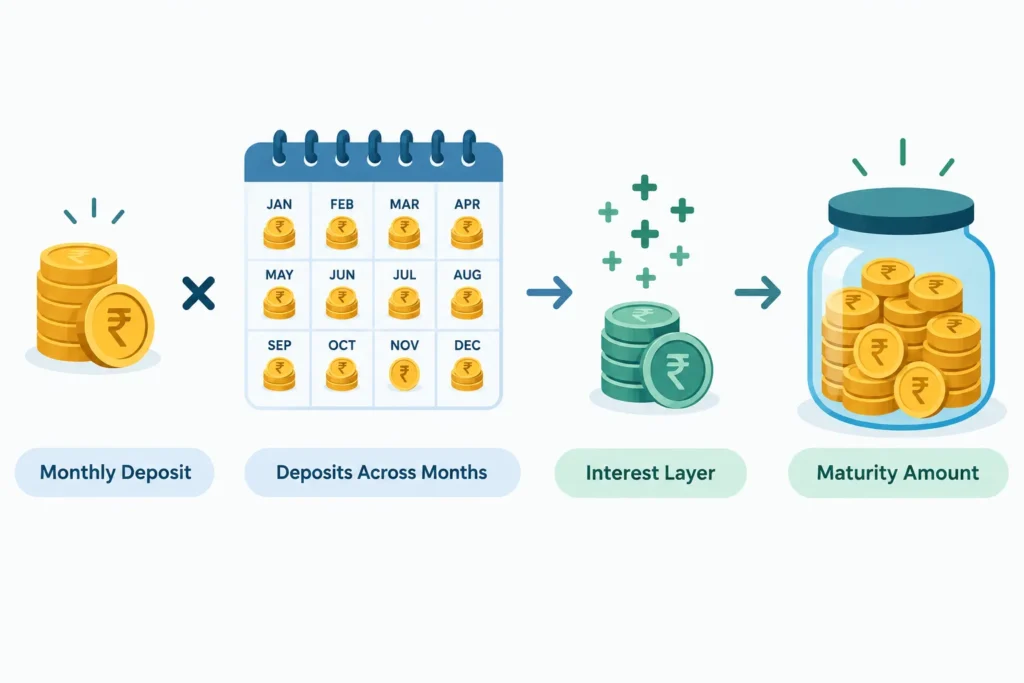
Diagram showing total deposits and estimated interest combining into an estimated RD maturity amount.
After entering the details, the recurring deposit calculator shows the main figures needed to understand your estimate.

Result Meaning
Total deposits The sum of all monthly contributions made during the selected tenure.
Estimated interest earned The estimated growth above your total deposits under the calculator’s assumptions.
Estimated maturity amount The estimated total value at the end of the tenure, including deposits and interest.

The basic relationship is simple:

Estimated maturity amount = Total deposits + Estimated interest earned

Total deposits are generally calculated by multiplying the monthly deposit by the number of monthly instalments. Interest is estimated separately because each instalment remains invested for a different length of time.

Why the Result Is Only an Estimate

The calculator applies one indicative quarterly-compounding method to provide a useful planning estimate. An actual RD may use product-specific rules for interest calculation, deposit due dates, compounding, rounding and delayed instalments.

For this reason, the result should not be treated as a guaranteed return or an official bank or post-office quotation. Use it to plan and compare scenarios, then confirm the applicable rate, tenure and expected maturity amount with the institution offering the RD.

How a Recurring Deposit Works

A recurring deposit, or RD, helps you save a fixed amount every month for a chosen period. Instead of investing a large lump sum at once, you build the deposit through regular monthly contributions.

Each monthly instalment earns interest for a different length of time. Your first instalment usually earns interest for longer than your final instalment. At the end of the RD tenure, your deposits and the interest earned together form the maturity amount.

Important RD Terms

Term Simple meaning
Monthly contribution The fixed amount you deposit into the RD every month.
RD interest rate The annual interest rate applicable to the deposit. The actual rate depends on the institution and product.
RD tenure The period for which you agree to make monthly deposits.
Total deposits The monthly contribution multiplied by the total number of monthly instalments.
Interest earned The estimated amount added to your deposits through interest.
Maturity amount The estimated total you may receive at maturity, including your deposits and interest.
You May Also Like:SIP Calculator (2026) – Calculate Mutual Fund Returns Online Free | RegularStation

How Monthly Deposits Build the Maturity Amount
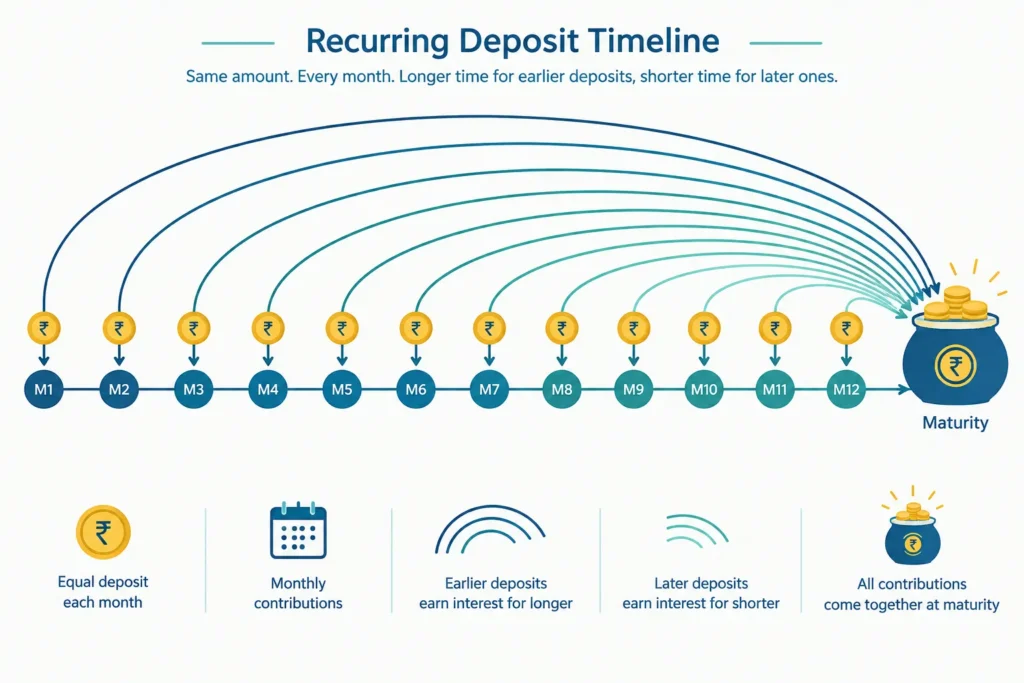
Timeline showing that earlier recurring deposit instalments earn interest for longer than later instalments.
Suppose you deposit ₹5,000 every month for 24 months. Your total deposits would be:

₹5,000 × 24 = ₹1,20,000

The recurring deposit maturity amount can be higher than ₹1,20,000 because each instalment may earn interest. However, all instalments do not earn the same amount of interest.

  • The first instalment remains invested for almost the full tenure.
  • An instalment made halfway through the tenure earns interest for a shorter period.
  • The final instalment earns interest for the shortest period.

This is why an RD interest calculator considers each monthly contribution and the time available for it to earn interest.

Beginning-of-Month and End-of-Month Deposits

Deposit timing can change the estimate. A contribution made at the beginning of a month gets slightly more time to earn interest than one made at the end of the same month.

Deposit timing How it affects the estimate
Beginning of the month Each instalment gets approximately one additional month to earn interest compared with an end-of-month deposit.
End of the month Each instalment starts earning later, so the estimated maturity amount may be slightly lower.

The institution’s actual due date and interest calculation method may not match these simplified timing assumptions. Use the timing option in the RD Calculator for estimation, and check the product terms for the actual calculation.

Illustrative RD Calculation

The following example uses assumed inputs. It is not a quotation or a statement of current RD rates.

Illustrative calculator inputs and results
Item Assumed value
Monthly deposit ₹5,000
Annual interest rate 6.50%
Tenure 24 months
Deposit timing Beginning of each month
Total deposits ₹1,20,000
Estimated maturity amount Approximately ₹1,28,425
Estimated interest earned Approximately ₹8,425

These results use the calculator’s indicative quarterly-compounding model and are rounded. If the same assumed deposits are treated as end-of-month contributions, the estimate will be lower because each instalment earns interest for a slightly shorter period.

The actual maturity value may differ because a bank, post office or other deposit provider can use product-specific rules for deposit dates, compounding, completed periods and rounding.

RD Versus FD
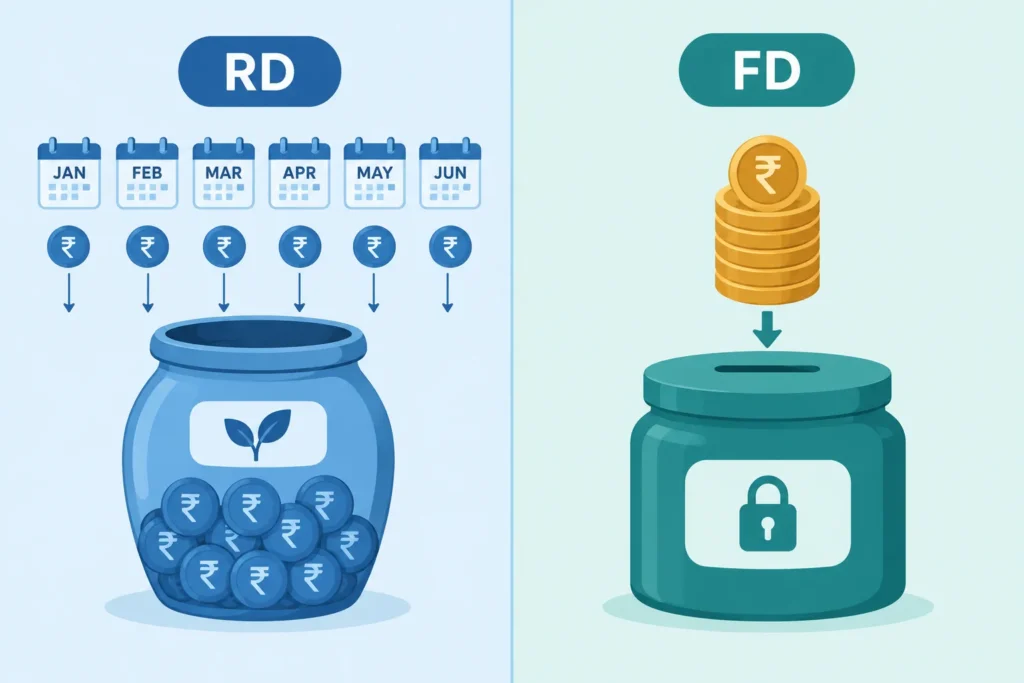
Comparison of an RD funded through monthly deposits and an FD funded with one lump sum.
An RD and a fixed deposit, or FD, are both deposit products, but they use different contribution patterns. An RD is designed around regular monthly deposits, while an FD generally begins with one lump-sum deposit.

Feature Recurring deposit Fixed deposit
Deposit pattern A fixed amount is deposited regularly, usually every month. One lump-sum amount is generally deposited at

Rates, Product Rules and Important Limitations

An RD Calculator gives an estimate based on the information you enter. Your actual recurring deposit maturity amount may be different because each bank, post office or deposit scheme can apply its own rules.

Do not treat the calculator result as an official quotation. Check the deposit terms before opening an RD.

RD Interest Rates Can Vary

The RD interest rate may vary by institution, scheme, deposit tenure and customer category. Rates can also change over time.

The rate shown by default in an RD Calculator is only an editable example. It is not a current or universal rate. Enter the rate offered for the specific RD you are considering.

Product Rules That May Affect Maturity

Product rule Why it matters
Compounding method The institution may use a particular compounding convention or calculation method. This can change the final interest amount.
Minimum monthly deposit Some products require deposits above a specified minimum or in fixed multiples.
Available tenure The institution may offer only selected deposit periods. Your preferred number of months may not be available.
Monthly due date Deposits may need to be paid by a specified date each month. The treatment of late payments depends on the product.
Missed instalments A missed contribution may attract a charge, affect interest or require regularisation, depending on the scheme.
Deposit timing An instalment paid earlier may earn interest for longer than one paid later, subject to the institution’s calculation rules.
Rounding Interest may be rounded at different stages, creating a small difference between the estimate and actual maturity value.
Tax treatment Applicable tax rules can affect the amount ultimately available to you. Tax treatment depends on current law and individual circumstances.

Premature Closure of an RD

Premature closure means closing the recurring deposit before its scheduled maturity date. Whether this is allowed depends on the institution and the specific product.

If early closure is permitted, the institution may recalculate interest using a lower applicable rate. It may also charge a penalty or apply other conditions. As a result, the amount received can be lower than the maturity estimate shown by an RD maturity calculator.

Before opening an RD, check the following:

  • Whether premature closure is permitted
  • How interest will be recalculated
  • Whether a penalty or charge applies
  • Whether partial withdrawal is available
  • How quickly the closure amount will be paid
You May Also Like:How to Reduce the Total Interest Paid on a Loan

Why the Actual Maturity Amount May Differ

The calculator uses an indicative quarterly-compounding model. The actual product may follow a different method.

Differences can arise because of:

  • The actual dates on which monthly instalments are credited
  • The institution’s interest calculation and compounding convention
  • Changes in deposit timing or missed instalments
  • Product-specific rounding rules
  • Late-payment charges or other applicable fees
  • Premature closure or changes to the agreed deposit schedule
  • Applicable tax treatment

Use the result for planning and comparison, not as a guaranteed maturity amount.

Common RD Calculator Mistakes

Using an Unverified Interest Rate

Do not assume that the example rate displayed in the calculator applies to your RD. Enter the rate stated in the latest product information provided by the institution.

Entering Years Instead of Months

Check the unit used for RD tenure. If the calculator asks for months, a three-year tenure must be entered as 36 months, not 3.

Ignoring Deposit Timing

Beginning-of-month and end-of-month deposits do not remain invested for exactly the same period. Select the option that most closely matches when your instalment is expected to be credited.

Confusing Total Deposits With Maturity Amount

Total deposits are the monthly contribution multiplied by the number of instalments. The estimated maturity amount includes both your deposits and the estimated interest earned.

Assuming Every Instalment Earns Interest for the Full Tenure

Each monthly contribution is invested for a different length of time. The first instalment generally earns interest for longer than the final instalment.

Planning With an Unaffordable Monthly Deposit

A higher monthly contribution can increase the estimated maturity amount, but it also creates a larger monthly commitment. Choose an amount that fits your regular budget.

Treating the Estimate as a Guarantee

The displayed result does not account for every institution-specific rule. Always refer to the official deposit details and maturity illustration, where available.

Frequently Asked Questions

What Is an RD Calculator?

An RD Calculator estimates how much a recurring deposit may be worth at maturity. It uses inputs such as the monthly deposit, annual interest rate, tenure and deposit timing.

What Is the Recurring Deposit Maturity Amount?

The recurring deposit maturity amount is the amount payable at the end of the agreed tenure, subject to the product terms. It generally consists of your total deposits plus the interest credited under the applicable rules.

How Is RD Interest Calculated?

Each monthly instalment earns interest for the period it remains deposited. Because instalments are made at different times, they do not all earn the same amount of interest.

The exact calculation and compounding convention can vary by institution. The calculator provides an indicative estimate rather than an official calculation.

You May Also Like:Home Loan EMI: How It Is Calculated and What Affects It

Does the RD Interest Rate Stay the Same?

This depends on the terms of the chosen product. Check whether the quoted rate is fixed for the deposit tenure and whether any special conditions apply.

Can I Change My Monthly RD Amount?

Many traditional recurring deposits are opened with a fixed monthly instalment. Whether the amount can be changed depends on the product. Confirm the contribution rules before opening the account.

What Happens If I Miss an RD Instalment?

The treatment of a missed instalment varies. The institution may apply a charge, require the instalment to be paid later or follow another process stated in the product terms.

Can I Close an RD Before Maturity?

Premature closure may be available, but it is not automatic for every product. Reduced interest, penalties or other conditions may apply.

Is RD Interest Tax-Free?

Do not assume that RD interest is tax-free. Tax treatment depends on applicable law and your individual circumstances. Use official tax guidance or consult a qualified tax professional when necessary.

Is an RD Better Than an FD?

Neither option is automatically better. An RD may suit someone who wants to deposit a fixed amount every month. An FD may suit someone who already has a lump sum available. Compare liquidity, tenure, interest terms, penalties and cash-flow needs before deciding.

Is an RD the Same as a SIP?

No. An RD is a deposit product governed by its stated interest and product rules. A SIP is a method of investing a fixed amount regularly, commonly into a mutual fund. Market-linked investments can rise or fall in value, while an RD follows the terms of the deposit product.

How Accurate Is the RD Calculator?

The calculator can provide a useful planning estimate when the inputs are correct. However, actual maturity can differ because of compounding methods, instalment dates, rounding, missed payments, tax treatment and other product-specific rules.

Summary

An RD Calculator helps you estimate the maturity amount and interest earned from regular monthly deposits. It can also help you compare different contribution amounts, interest rates and tenures.

  • Enter the verified annual RD interest rate instead of relying on the default example.
  • Use the correct tenure and deposit-timing option.
  • Remember that each monthly instalment earns interest for a different period.
  • Treat the result as an estimate, not a guaranteed return or official quotation.
  • Choose a monthly deposit that you can manage consistently.

Before investing, verify the applicable RD rate, available tenure, minimum deposit, monthly due date, expected maturity amount and premature-closure terms with the relevant bank, post office or deposit provider.


Share this article
KEEP READING

Related Articles

View all →

Comments

Leave a Comment

RD Calculator: Calculate Recurring Deposit Maturity and Interest

An RD Calculator estimates how much your fixed monthly deposits may grow during a recurring deposit tenure. Enter the monthly deposit, annual interest rate, tenure and deposit timing to see your total deposits, estimated interest earned and estimated maturity amount.

A recurring deposit, commonly called an RD, helps you save a fixed amount every month. The calculator below gives you a quick estimate before you compare an RD offered by a bank, post office or another eligible deposit provider.

RD Calculator: Estimate Your Maturity Amount

Enter your planned deposit details below. You can change the inputs to compare different monthly contributions, rates and tenures.

Recurring Deposit Calculator

RD Calculator

Estimate your recurring deposit maturity amount, total interest and returns from a fixed monthly contribution.

₹5,000
₹100₹10 Lakh
6.50%
0%20%
5 Years
6 Months10 Years

The calculator uses an indicative quarterly-compounding model. Actual bank or post-office RD calculations may follow product-specific rules.

RD interest rates, compounding conventions, minimum deposits, tenure options and premature-closure rules vary by bank or deposit scheme. This calculator provides an estimate.
Total Deposits₹3,00,000
Total Interest₹54,954
Estimated Maturity Amount₹3,54,954At 6.50% assumed rate
Estimated Return18.32%

Deposits vs. Interest

Estimated split between your total monthly contributions and interest earned.

Total Deposits₹3,00,000Interest₹54,954
RD Insight

RD Growth Over Time

Estimated cumulative value as monthly deposits are made and interest accrues.

Year-wise RD Schedule

Illustrative figures based on the selected monthly contribution, rate and tenure.

YearTotal DepositsInterestEstimated Value

Disclaimer: This calculator is for educational and planning purposes only. Actual RD maturity values can differ because banks and deposit schemes may apply their own interest calculation, compounding, rounding, deposit-timing, tax and premature-closure rules. Verify the final maturity amount and applicable terms with the relevant institution.

Important: This RD Calculator uses an indicative quarterly-compounding model. Its results are estimates, not a quotation or maturity promise from a bank, post office or other institution.

How to Use the RD Calculator

You need four main details to calculate an estimated recurring deposit maturity amount.

Input What It Means What to Enter
Monthly deposit The fixed amount you plan to contribute every month. Enter an amount in rupees, such as ₹1,000 or ₹5,000.
Annual interest rate The yearly rate used to estimate interest on each monthly instalment. Enter the rate stated for the RD product you are checking.
RD tenure The period for which you plan to make monthly deposits. Select or enter the applicable number of months or years.
Deposit timing Whether each monthly instalment is treated as deposited at the beginning or end of the month. Choose the option that best matches the calculator assumption you want to use.

Monthly Deposit

The monthly deposit is the amount you plan to save in the RD every month. For example, if you enter ₹2,000, the calculator assumes that the same amount is deposited each month throughout the selected tenure.

A higher monthly deposit increases the total amount contributed. It may also increase the interest earned because more money is placed in the deposit, but the actual outcome still depends on the interest rate, tenure and product rules.

Annual Interest Rate

The RD interest rate is the annual rate used by the calculator to estimate growth. Enter the rate applicable to the specific deposit product you are considering.

The displayed 6.50% rate is only an editable example. It is not a current, recommended or universal RD rate. Actual rates can differ across institutions, products, tenures and customer categories.

Always verify the applicable rate directly with the relevant institution before opening an RD.

RD Tenure

RD tenure means the total period for which you make monthly contributions. Depending on the calculator fields, you may enter the tenure in months or years.

A longer tenure gives earlier instalments more time to earn interest. However, every instalment does not earn interest for the full RD tenure because the money is deposited gradually each month.

Beginning-of-Month and End-of-Month Deposits

Deposit timing affects how long each instalment remains invested.

  • Beginning of the month: The calculator assumes that each instalment is deposited near the start of the month. It therefore receives slightly more time to earn interest.
  • End of the month: The calculator assumes that each instalment is deposited near the end of the month. It receives less time to earn interest than a beginning-of-month deposit.

Because of this timing difference, the estimated maturity amount may change even when the monthly deposit, rate and tenure remain the same. An institution may use its own due dates and interest-calculation rules, so select this input only as an estimation assumption.

Understanding the Calculator Results

Diagram showing total deposits and estimated interest combining into an estimated RD maturity amount.
After entering the details, the recurring deposit calculator shows the main figures needed to understand your estimate.

Result Meaning
Total deposits The sum of all monthly contributions made during the selected tenure.
Estimated interest earned The estimated growth above your total deposits under the calculator’s assumptions.
Estimated maturity amount The estimated total value at the end of the tenure, including deposits and interest.

The basic relationship is simple:

Estimated maturity amount = Total deposits + Estimated interest earned

Total deposits are generally calculated by multiplying the monthly deposit by the number of monthly instalments. Interest is estimated separately because each instalment remains invested for a different length of time.

Why the Result Is Only an Estimate

The calculator applies one indicative quarterly-compounding method to provide a useful planning estimate. An actual RD may use product-specific rules for interest calculation, deposit due dates, compounding, rounding and delayed instalments.

For this reason, the result should not be treated as a guaranteed return or an official bank or post-office quotation. Use it to plan and compare scenarios, then confirm the applicable rate, tenure and expected maturity amount with the institution offering the RD.

How a Recurring Deposit Works

A recurring deposit, or RD, helps you save a fixed amount every month for a chosen period. Instead of investing a large lump sum at once, you build the deposit through regular monthly contributions.

Each monthly instalment earns interest for a different length of time. Your first instalment usually earns interest for longer than your final instalment. At the end of the RD tenure, your deposits and the interest earned together form the maturity amount.

Important RD Terms

Term Simple meaning
Monthly contribution The fixed amount you deposit into the RD every month.
RD interest rate The annual interest rate applicable to the deposit. The actual rate depends on the institution and product.
RD tenure The period for which you agree to make monthly deposits.
Total deposits The monthly contribution multiplied by the total number of monthly instalments.
Interest earned The estimated amount added to your deposits through interest.
Maturity amount The estimated total you may receive at maturity, including your deposits and interest.

How Monthly Deposits Build the Maturity Amount

Timeline showing that earlier recurring deposit instalments earn interest for longer than later instalments.
Suppose you deposit ₹5,000 every month for 24 months. Your total deposits would be:

₹5,000 × 24 = ₹1,20,000

The recurring deposit maturity amount can be higher than ₹1,20,000 because each instalment may earn interest. However, all instalments do not earn the same amount of interest.

  • The first instalment remains invested for almost the full tenure.
  • An instalment made halfway through the tenure earns interest for a shorter period.
  • The final instalment earns interest for the shortest period.

This is why an RD interest calculator considers each monthly contribution and the time available for it to earn interest.

Beginning-of-Month and End-of-Month Deposits

Deposit timing can change the estimate. A contribution made at the beginning of a month gets slightly more time to earn interest than one made at the end of the same month.

Deposit timing How it affects the estimate
Beginning of the month Each instalment gets approximately one additional month to earn interest compared with an end-of-month deposit.
End of the month Each instalment starts earning later, so the estimated maturity amount may be slightly lower.

The institution’s actual due date and interest calculation method may not match these simplified timing assumptions. Use the timing option in the RD Calculator for estimation, and check the product terms for the actual calculation.

Illustrative RD Calculation

The following example uses assumed inputs. It is not a quotation or a statement of current RD rates.

Illustrative calculator inputs and results
Item Assumed value
Monthly deposit ₹5,000
Annual interest rate 6.50%
Tenure 24 months
Deposit timing Beginning of each month
Total deposits ₹1,20,000
Estimated maturity amount Approximately ₹1,28,425
Estimated interest earned Approximately ₹8,425

These results use the calculator’s indicative quarterly-compounding model and are rounded. If the same assumed deposits are treated as end-of-month contributions, the estimate will be lower because each instalment earns interest for a slightly shorter period.

The actual maturity value may differ because a bank, post office or other deposit provider can use product-specific rules for deposit dates, compounding, completed periods and rounding.

RD Versus FD

Comparison of an RD funded through monthly deposits and an FD funded with one lump sum.
An RD and a fixed deposit, or FD, are both deposit products, but they use different contribution patterns. An RD is designed around regular monthly deposits, while an FD generally begins with one lump-sum deposit.

Feature Recurring deposit Fixed deposit
Deposit pattern A fixed amount is deposited regularly, usually every month. One lump-sum amount is generally deposited at

Rates, Product Rules and Important Limitations

An RD Calculator gives an estimate based on the information you enter. Your actual recurring deposit maturity amount may be different because each bank, post office or deposit scheme can apply its own rules.

Do not treat the calculator result as an official quotation. Check the deposit terms before opening an RD.

RD Interest Rates Can Vary

The RD interest rate may vary by institution, scheme, deposit tenure and customer category. Rates can also change over time.

The rate shown by default in an RD Calculator is only an editable example. It is not a current or universal rate. Enter the rate offered for the specific RD you are considering.

Product Rules That May Affect Maturity

Product rule Why it matters
Compounding method The institution may use a particular compounding convention or calculation method. This can change the final interest amount.
Minimum monthly deposit Some products require deposits above a specified minimum or in fixed multiples.
Available tenure The institution may offer only selected deposit periods. Your preferred number of months may not be available.
Monthly due date Deposits may need to be paid by a specified date each month. The treatment of late payments depends on the product.
Missed instalments A missed contribution may attract a charge, affect interest or require regularisation, depending on the scheme.
Deposit timing An instalment paid earlier may earn interest for longer than one paid later, subject to the institution’s calculation rules.
Rounding Interest may be rounded at different stages, creating a small difference between the estimate and actual maturity value.
Tax treatment Applicable tax rules can affect the amount ultimately available to you. Tax treatment depends on current law and individual circumstances.

Premature Closure of an RD

Premature closure means closing the recurring deposit before its scheduled maturity date. Whether this is allowed depends on the institution and the specific product.

If early closure is permitted, the institution may recalculate interest using a lower applicable rate. It may also charge a penalty or apply other conditions. As a result, the amount received can be lower than the maturity estimate shown by an RD maturity calculator.

Before opening an RD, check the following:

  • Whether premature closure is permitted
  • How interest will be recalculated
  • Whether a penalty or charge applies
  • Whether partial withdrawal is available
  • How quickly the closure amount will be paid

Why the Actual Maturity Amount May Differ

The calculator uses an indicative quarterly-compounding model. The actual product may follow a different method.

Differences can arise because of:

  • The actual dates on which monthly instalments are credited
  • The institution’s interest calculation and compounding convention
  • Changes in deposit timing or missed instalments
  • Product-specific rounding rules
  • Late-payment charges or other applicable fees
  • Premature closure or changes to the agreed deposit schedule
  • Applicable tax treatment

Use the result for planning and comparison, not as a guaranteed maturity amount.

Common RD Calculator Mistakes

Using an Unverified Interest Rate

Do not assume that the example rate displayed in the calculator applies to your RD. Enter the rate stated in the latest product information provided by the institution.

Entering Years Instead of Months

Check the unit used for RD tenure. If the calculator asks for months, a three-year tenure must be entered as 36 months, not 3.

Ignoring Deposit Timing

Beginning-of-month and end-of-month deposits do not remain invested for exactly the same period. Select the option that most closely matches when your instalment is expected to be credited.

Confusing Total Deposits With Maturity Amount

Total deposits are the monthly contribution multiplied by the number of instalments. The estimated maturity amount includes both your deposits and the estimated interest earned.

Assuming Every Instalment Earns Interest for the Full Tenure

Each monthly contribution is invested for a different length of time. The first instalment generally earns interest for longer than the final instalment.

Planning With an Unaffordable Monthly Deposit

A higher monthly contribution can increase the estimated maturity amount, but it also creates a larger monthly commitment. Choose an amount that fits your regular budget.

Treating the Estimate as a Guarantee

The displayed result does not account for every institution-specific rule. Always refer to the official deposit details and maturity illustration, where available.

Frequently Asked Questions

What Is an RD Calculator?

An RD Calculator estimates how much a recurring deposit may be worth at maturity. It uses inputs such as the monthly deposit, annual interest rate, tenure and deposit timing.

What Is the Recurring Deposit Maturity Amount?

The recurring deposit maturity amount is the amount payable at the end of the agreed tenure, subject to the product terms. It generally consists of your total deposits plus the interest credited under the applicable rules.

How Is RD Interest Calculated?

Each monthly instalment earns interest for the period it remains deposited. Because instalments are made at different times, they do not all earn the same amount of interest.

The exact calculation and compounding convention can vary by institution. The calculator provides an indicative estimate rather than an official calculation.

Does the RD Interest Rate Stay the Same?

This depends on the terms of the chosen product. Check whether the quoted rate is fixed for the deposit tenure and whether any special conditions apply.

Can I Change My Monthly RD Amount?

Many traditional recurring deposits are opened with a fixed monthly instalment. Whether the amount can be changed depends on the product. Confirm the contribution rules before opening the account.

What Happens If I Miss an RD Instalment?

The treatment of a missed instalment varies. The institution may apply a charge, require the instalment to be paid later or follow another process stated in the product terms.

Can I Close an RD Before Maturity?

Premature closure may be available, but it is not automatic for every product. Reduced interest, penalties or other conditions may apply.

Is RD Interest Tax-Free?

Do not assume that RD interest is tax-free. Tax treatment depends on applicable law and your individual circumstances. Use official tax guidance or consult a qualified tax professional when necessary.

Is an RD Better Than an FD?

Neither option is automatically better. An RD may suit someone who wants to deposit a fixed amount every month. An FD may suit someone who already has a lump sum available. Compare liquidity, tenure, interest terms, penalties and cash-flow needs before deciding.

Is an RD the Same as a SIP?

No. An RD is a deposit product governed by its stated interest and product rules. A SIP is a method of investing a fixed amount regularly, commonly into a mutual fund. Market-linked investments can rise or fall in value, while an RD follows the terms of the deposit product.

How Accurate Is the RD Calculator?

The calculator can provide a useful planning estimate when the inputs are correct. However, actual maturity can differ because of compounding methods, instalment dates, rounding, missed payments, tax treatment and other product-specific rules.

Summary

An RD Calculator helps you estimate the maturity amount and interest earned from regular monthly deposits. It can also help you compare different contribution amounts, interest rates and tenures.

  • Enter the verified annual RD interest rate instead of relying on the default example.
  • Use the correct tenure and deposit-timing option.
  • Remember that each monthly instalment earns interest for a different period.
  • Treat the result as an estimate, not a guaranteed return or official quotation.
  • Choose a monthly deposit that you can manage consistently.

Before investing, verify the applicable RD rate, available tenure, minimum deposit, monthly due date, expected maturity amount and premature-closure terms with the relevant bank, post office or deposit provider.
Leave a Comment