
Cryptocurrency in India: A Complete Beginner’s Guide to Crypto

A practical beginner’s guide to cryptocurrency in India, covering how crypto works, how people buy and store it, major risks, taxation, legal status and essential safety steps.

Cryptocurrency in India: A Complete Beginner’s Guide to Crypto

Cryptocurrency is a digital asset that can be transferred over a computer network without relying on a bank to maintain the main transaction record. Most cryptocurrencies use blockchain technology, cryptography and network participants to verify transfers.

For beginners exploring cryptocurrency in India, the most important point is that crypto is not the same as money in a bank account, a share in a company or a UPI payment. Prices can change sharply, transfers may be irreversible, and users are responsible for protecting their wallets and private keys. Understanding these foundations should come before buying or transferring any crypto asset.

Introduction

Cryptocurrency can appear simple on an app: deposit rupees, select an asset and tap “buy”. However, the technology and risks behind that button are very different from ordinary banking.

A UPI payment usually moves rupees between regulated bank accounts. A share represents an ownership interest in a company. A bank deposit is an amount held with a bank under the applicable banking framework. A crypto asset does not automatically provide any of these features.

Instead, crypto usually exists as records on a distributed network. Its value may depend on demand, supply, utility, market sentiment and confidence in the project. Some crypto assets have defined uses, while others are mainly speculative.

Indian beginners should therefore understand how wallets, blockchains, keys and confirmations work. They should also recognise the responsibility involved. Sending an asset to the wrong address, using the wrong network or revealing a private key can result in a permanent loss.

Cryptocurrency Foundations and How Crypto Works

What Is Cryptocurrency?

Cryptocurrency is a type of digital asset secured using cryptography. It can generally be stored and transferred through a blockchain or another distributed ledger network.

Bitcoin is the best-known example. It was designed as a digital asset that could be transferred directly between users without a central bank processing every transaction. Many later cryptocurrencies were created for different purposes, such as running applications, settling payments, governing online protocols or tracking another asset’s value.

The word “currency” can be misleading. Not every cryptocurrency is widely used for buying goods and services. In India, crypto should not be casually treated as equivalent to the rupee or as an ordinary bank balance.

Key Crypto Terms in Simple English

  • Crypto asset: A digital asset recorded on a blockchain or similar network.
  • Blockchain: A shared digital record containing batches of verified transactions.
  • Wallet: Software or hardware used to manage the keys that control crypto assets.
  • Wallet address: A public destination to which someone can send crypto.
  • Public key: Cryptographic information used to identify or verify activity associated with a wallet.
  • Private key: Secret information that allows the holder to authorise transactions. It must never be shared.
  • Seed phrase: A set of recovery words that may restore access to a wallet. Anyone who gets it may be able to control the assets.
  • Network fee: An amount paid to process a blockchain transaction. It is sometimes called a gas fee.
  • Exchange: A platform through which users may buy, sell or trade crypto assets.
  • Confirmation: Evidence that a transaction has been accepted and added to the blockchain.

Each term has additional technical detail. Separate beginner guides to Bitcoin, blockchain, stablecoins, mining and crypto wallets can explore them more deeply.

How Does Cryptocurrency Work?

Most cryptocurrencies operate through a network of computers. These computers follow agreed rules for checking transactions and updating a shared ledger.

When a person sends crypto, the wallet creates a transaction request. The sender authorises it using the private key associated with the wallet. The network checks whether the authorisation is valid and whether the relevant assets are available to transfer.

Valid transactions are then added to the network’s transaction history. The exact process depends on the cryptocurrency. Bitcoin uses a system called proof of work, while many other networks use proof of stake or another method.

No physical coin moves between people. The network updates its records to show that control of a particular amount has moved from one blockchain address to another.

A blockchain is a digital ledger shared across a network. Transactions are grouped into blocks, and each new block is linked to earlier blocks using cryptography. This creates a history that is difficult to alter without the network detecting the change.

Blockchain and cryptocurrency are related but not identical. Blockchain is the record-keeping technology. Cryptocurrency is one type of digital asset that can operate on it.

For example, the Bitcoin blockchain records Bitcoin transactions. Other blockchains may support many assets and applications. A single blockchain can have its own native coin as well as numerous tokens created by developers.

A blockchain is also not automatically safe merely because it is decentralised. Software bugs, fraudulent projects, stolen keys, misleading promotions and poorly designed tokens can still cause losses.

How Transactions, Keys and Confirmations Work
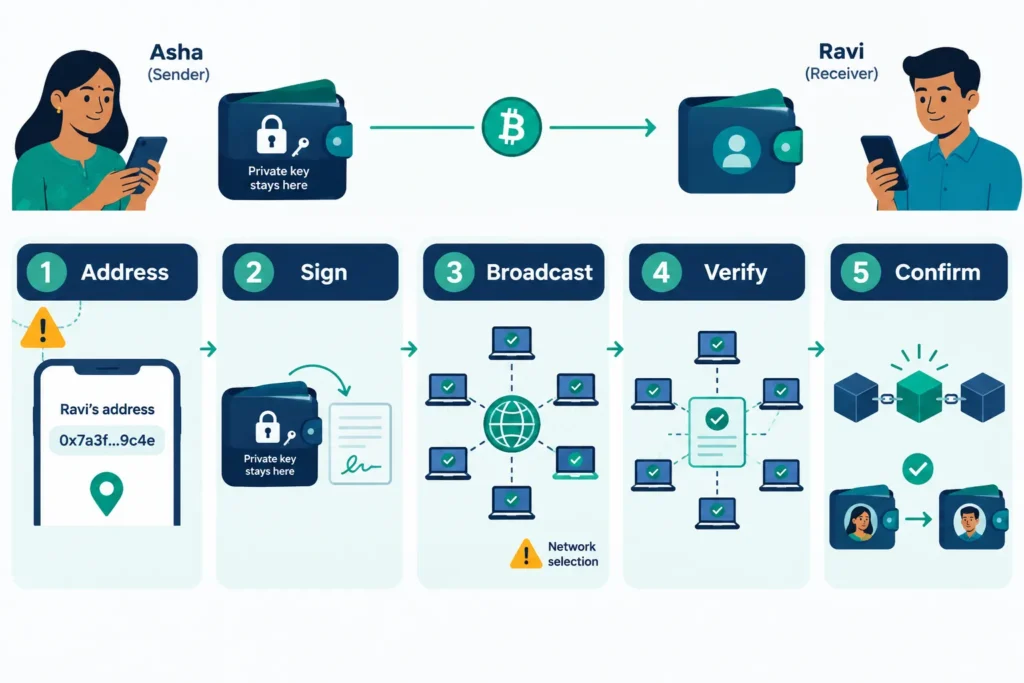
Flowchart showing a crypto transaction being addressed, signed, broadcast, verified and confirmed on a blockchain.

Suppose Asha wants to send a small amount of crypto to Ravi. Ravi gives Asha his public wallet address. Asha enters that address in her wallet, selects the amount and reviews the network fee.

Her wallet uses her private key to create a digital signature. This proves to the network that the transaction was authorised by the person controlling Asha’s wallet. The private key itself should not be sent to Ravi or revealed to the network.

After Asha submits the transfer, network participants check it. Once it is included in a block, it receives its first confirmation. Additional blocks may provide further confirmations. Ravi’s wallet or exchange may wait for a particular number of confirmations before showing the amount as fully available.

Asha must check the destination address and network carefully. If she sends the crypto to the wrong address, the wrong network or an incompatible wallet, the transaction may be difficult or impossible to reverse. There may be no bank helpline that can simply cancel it.

Public addresses can be shared for receiving assets. Private keys and seed phrases must remain secret. A genuine support representative should not need a user’s private key or recovery phrase.

Bitcoin vs Other Cryptocurrencies

Bitcoin is the original and most widely recognised cryptocurrency. Its rules limit how new bitcoin is issued, and its main use is as a transferable digital asset on the Bitcoin network.

Other cryptocurrencies may work differently. Some networks support smart contracts, which are programs that run when specified conditions are met. These networks can host tokens, lending protocols, games and other blockchain applications.

Bitcoin should not be used as a shorthand for the entire crypto market. Different assets have different purposes, supply rules, governance systems, security assumptions and risks. A project being described as the “next Bitcoin” is not evidence that it has similar qualities.

You May Also Like:Home Loan Documents Required in India: Complete Checklist

Types of Cryptocurrency

  • Coins: Native assets of their own blockchains. Bitcoin is the native coin of the Bitcoin network.
  • Tokens: Assets created on an existing blockchain rather than operating their own independent blockchain.
  • Altcoins: A broad term for cryptocurrencies other than Bitcoin. The category includes many unrelated projects.
  • Stablecoins: Tokens designed to maintain a value linked to another asset, often a national currency. Their stability depends on their structure, reserves, issuer and market conditions; the label does not remove risk.
  • Utility tokens: Tokens intended to provide access to a product, service or feature within a project.
  • Governance tokens: Tokens that may let holders vote on changes to a blockchain-based protocol.
  • Meme coins: Assets commonly built around internet jokes, communities or trends. Their prices can be driven heavily by attention and speculation.

These categories can overlap. A token may provide both utility and governance rights, for example. Investors should examine what an asset actually does instead of relying only on its label.

Cryptocurrency Mining, Proof of Work and Proof of Stake

Mining is the process used by proof-of-work networks to verify transactions and create new blocks. Miners operate specialised computing equipment that competes to solve a cryptographic challenge. The successful miner can add a block and receive rewards under the network’s rules.

Bitcoin uses proof of work. Mining helps make it expensive to manipulate the transaction history, but it also requires computing power and electricity. Buying mining equipment does not guarantee a profit because costs, competition, rewards and crypto prices can change.

Proof of stake takes a different approach. Instead of competing mainly through computing work, participants lock or “stake” crypto assets to help validate transactions. The network selects validators according to its rules. Dishonest behaviour may lead to penalties in some systems.

Neither method eliminates every risk. Proof of work and proof of stake use different incentives and security models, which a dedicated cryptocurrency mining guide can explain in greater detail.

Core Concepts to Remember

Cryptocurrency is a digital asset, while blockchain is the shared technology that records its transfers. Wallets manage cryptographic keys, and the private key or seed phrase controls access. Transactions require network verification and may not be reversible.

Bitcoin is only one cryptocurrency, and coins, tokens, stablecoins, governance tokens and meme coins can have very different purposes and risks. Before using cryptocurrency in India, beginners should understand the asset, network, wallet and transfer process rather than treating crypto like a bank deposit, company share or routine UPI payment.

Buying, Storing and Using Cryptocurrency in India

Buying cryptocurrency in India involves more than downloading an app and selecting a coin. You need to choose a suitable platform, understand its fees, complete identity checks where applicable, decide how to store the asset and maintain records for tax purposes.

Crypto prices can change sharply within minutes. Platforms, wallets and blockchain transactions also work differently from bank accounts. Beginners should therefore start slowly and use only money they can afford to lose.

How to Buy Cryptocurrency in India
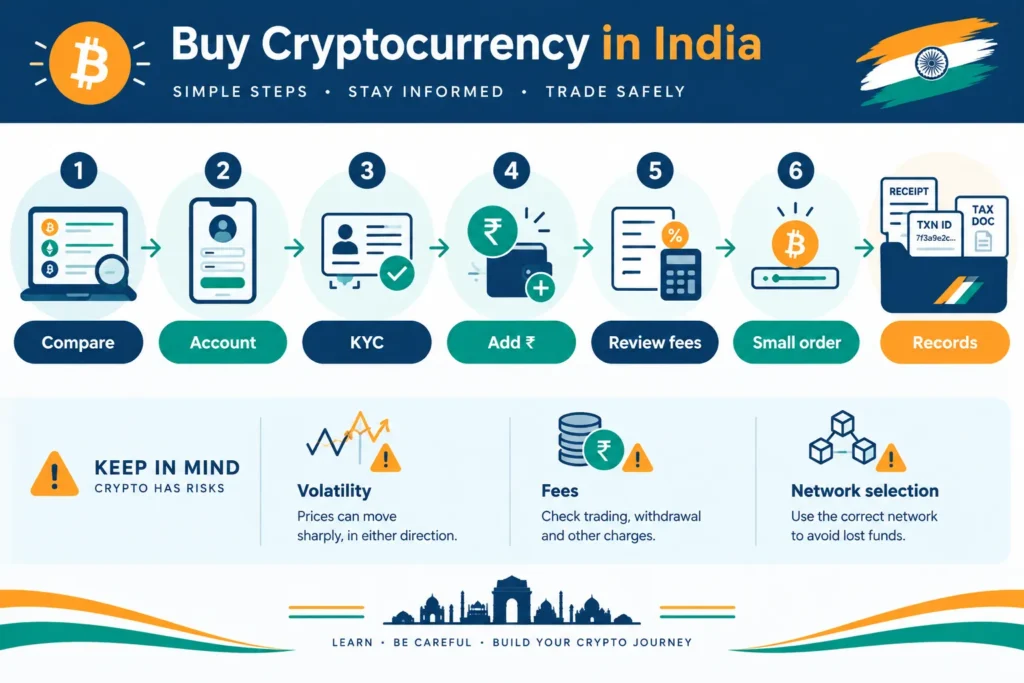
Six-step illustration for buying cryptocurrency in India, from comparing platforms and completing KYC to reviewing fees and keeping records.

The exact process varies by platform, but a typical purchase follows these steps:

  1. Choose a platform: Compare its security controls, fees, supported crypto assets, rupee deposit options and withdrawal facilities. Do not choose only because an app is popular or offers a joining reward.
  2. Create an account: Provide accurate personal details and use a unique password. Enable two-factor authentication if it is available.
  3. Complete applicable identity checks: A platform may ask for documents and information as part of its Know Your Customer, or KYC, process. Check why the information is required and how the platform says it will protect it.
  4. Add funds: Depending on the platform, you may be able to deposit rupees using a bank transfer or another supported payment method. Confirm the account name, minimum deposit and possible charges.
  5. Review the order: Check the crypto asset, quantity, quoted price, fees and total rupee amount. The final execution price may differ from the price first displayed.
  6. Place a small order: A modest first purchase helps you understand how orders, balances and withdrawals work without exposing a large amount.
  7. Keep records: Save order confirmations, deposit records, wallet addresses, transaction IDs, fees and relevant tax documents.

For example, suppose an Indian buyer wants to use ₹5,000. The full ₹5,000 may not become crypto. A platform could charge a trading fee, and the difference between the buying and selling price—called the spread—can also affect the result. Moving the asset to a personal wallet may involve a network fee. Selling or transferring it may have tax consequences under the rules applicable at that time.

Always inspect the final order screen rather than relying on the headline price. A separate beginner guide to completing crypto KYC can explain common document checks, while a guide to choosing an exchange can provide a more detailed comparison framework.

Cryptocurrency Exchanges Explained

A cryptocurrency exchange is a service or protocol through which users buy, sell or exchange crypto assets. The main routes are centralised exchanges, decentralised exchanges and direct peer-to-peer transactions.

  • Centralised exchanges: A company operates the platform, maintains user accounts and helps match or execute orders. It may hold crypto on behalf of customers. These platforms are often easier for beginners, but users depend on the operator’s security, withdrawal systems and business practices.
  • Decentralised exchanges: Often called DEXs, these blockchain-based applications use smart contracts to exchange compatible tokens. Users generally connect their own wallets instead of creating a conventional exchange account. DEXs can be complex and may expose users to smart-contract, token and network risks.
  • Peer-to-peer transactions: A buyer and seller transact more directly. A platform may help match them or provide an escrow arrangement. Payment disputes, fake confirmations, identity concerns and fraud make careful verification essential.

Using a decentralised or peer-to-peer route does not automatically remove legal, reporting or tax obligations. It also does not guarantee privacy or safety.

When assessing an exchange, consider the following:

  • Security controls: Look for two-factor authentication, withdrawal confirmations, address allowlisting, login alerts and clear account-recovery procedures.
  • Fee disclosure: Check trading fees, spreads, deposit or withdrawal charges and any fee that varies with volume.
  • Liquidity: Higher liquidity can make it easier to execute an order near the displayed market price. Low liquidity can cause greater price slippage.
  • Withdrawal methods: Confirm whether you can withdraw rupees, crypto, or both. Check limits, processing times and supported blockchain networks.
  • Customer support: Look for clear support channels and procedures for locked accounts, failed deposits and unauthorised activity.
  • Compliance information: Review the operator’s legal identity, terms, risk disclosures and information about applicable Indian requirements. Registration or compliance information should not be mistaken for a guarantee against losses.
You May Also Like:How to Start Investing in India: A Beginner’s Guide

Crypto Wallets: Custodial and Non-Custodial

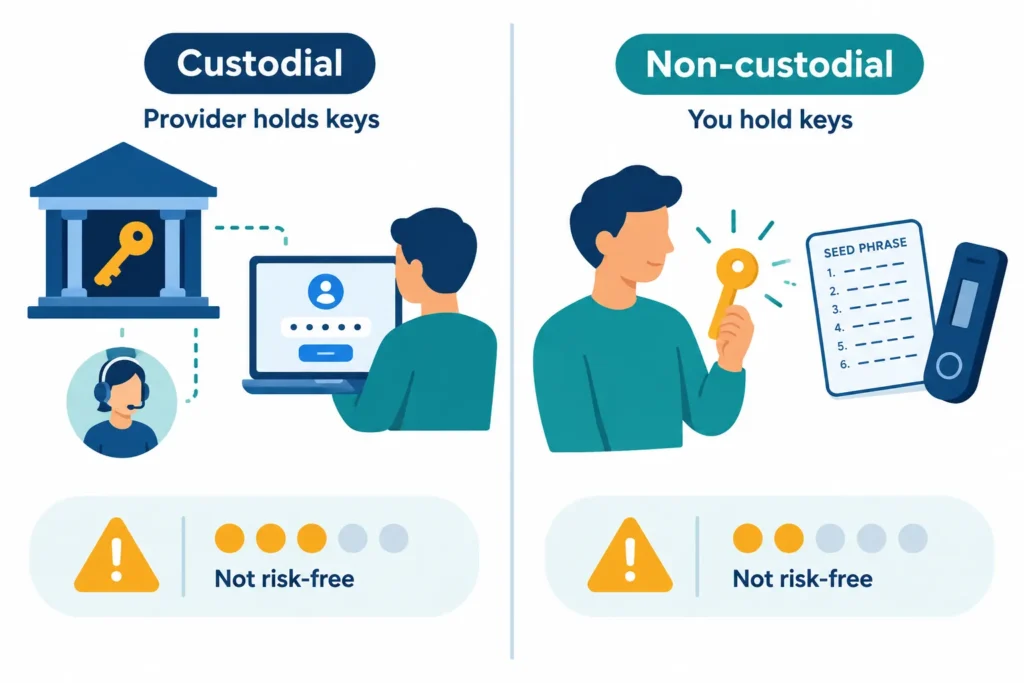
Comparison of custodial wallets, where a provider controls keys, and non-custodial wallets, where the user controls keys.

A crypto wallet does not usually store coins in the same way that a physical wallet stores cash. It manages the cryptographic keys used to access and authorise transactions involving assets recorded on a blockchain.

With a custodial wallet, an exchange or another provider controls the private keys for you. Login and recovery may feel familiar, but access depends on the provider. A platform failure, account restriction or security breach could affect your ability to use the assets.

With a non-custodial wallet, you control the keys. This gives you greater control, but also full responsibility. If you lose the recovery information or approve a malicious transaction, there may be no customer service team capable of reversing the loss.

A dedicated crypto wallets guide can help beginners compare custody arrangements before moving funds away from an exchange.

Hot Wallets vs Cold Wallets

A hot wallet operates on an internet-connected device, such as a phone or computer. It is convenient for regular transactions and interacting with blockchain applications. However, malware, phishing, fake wallet apps and unsafe browser extensions can create risks.

A cold wallet keeps key material offline or in a dedicated hardware device. It may reduce exposure to online attacks, but it is not risk-free. A user can still lose the device, mishandle the backup, buy a tampered device or send funds to the wrong address.

Before transferring crypto, confirm the wallet supports the exact asset and blockchain network. Sending an asset through an incompatible network can result in permanent loss. A small test transfer can help verify the address and network, although it will usually incur an additional network fee.

Seed Phrases and Wallet Recovery

A seed phrase, also called a recovery phrase, is a sequence of words that can restore access to many non-custodial wallets. Anyone who obtains it may be able to control the associated assets.

  • Write it down accurately and store it somewhere secure.
  • Do not share it with customer support, friends or online contacts.
  • Do not enter it into an unknown website, form or app.
  • Avoid keeping an unprotected screenshot or cloud copy.
  • Understand the recovery process before depositing a significant amount.

Legitimate support staff should not need your seed phrase. A message asking for it is a major scam warning.

How to Invest in Cryptocurrency Carefully

Crypto investing means accepting the possibility of substantial or complete loss. It should not replace emergency savings, insurance or essential financial goals.

Set a risk limit before buying. This can be a fixed rupee amount that would not disrupt rent, loan payments, education costs or other needs if lost. Avoid using credit cards, personal loans or money borrowed from family to purchase crypto.

Research the asset rather than relying on social-media excitement. Understand its purpose, supply rules, network, governance, custody requirements and major risks. Check whether activity and adoption claims can be independently verified.

Diversification has limits in crypto. Holding several tokens does not necessarily provide meaningful protection because many crypto prices can decline together. A future Bitcoin investing guide or guide to systematic purchase approaches can explain research and purchase methods without assuming that prices will rise.

Cryptocurrency Trading vs Investing

Investing generally involves holding an asset for a longer period based on a view about its potential use or value. Trading involves more frequent buying and selling to respond to short-term price movements.

Trading requires close monitoring, strict risk controls and detailed records. Frequent transactions can multiply trading fees, spreads and tax-reporting work. A profitable-looking price move may produce a much smaller net result after these costs.

Neither approach guarantees returns. Beginners should not confuse rapid activity with skill, especially in a market that operates around the clock and can move sharply.

A Brief Introduction to DeFi, Web3 and NFTs

Decentralised finance, or DeFi, refers to blockchain applications that offer activities such as exchanging tokens, lending or borrowing through smart contracts. Users may face contract bugs, liquidation, unstable token prices, misleading yields and loss of wallet access. A detailed DeFi guide should be read before connecting a wallet or approving a transaction.

Web3 is a broad term for internet services that use blockchains, tokens or user-controlled wallets. It may support digital ownership and access to applications, but it also creates custody, privacy, phishing and smart-contract risks. A beginner Web3 guide can explain wallet connections and permissions in more detail.

Non-fungible tokens, or NFTs, are blockchain records commonly used to represent distinct digital items or rights. Owning an NFT does not automatically provide copyright or guaranteed resale value. NFT markets can be illiquid, prices can be difficult to assess, and fake collections are common. Beginners should review an NFT guide and verify what is actually being purchased.

Completing the Buying and Storage Journey

Before considering the process complete, confirm that you understand where the crypto is held, who controls the keys and how recovery works. Secure the exchange account, save transaction records and test any personal-wallet withdrawal with a small amount first.

Also record the rupee value, date, fees, wallet addresses and transaction IDs. Trading fees, spreads, blockchain network fees and applicable taxes can all change the final outcome. A careful buying and storage process will not remove market risk, but it can reduce avoidable mistakes.

Section 3: Risks, Indian Rules, Safety, Mistakes and FAQs

Important financial risk and disclaimer: Cryptocurrency is volatile, speculative and high-risk. Prices can fall sharply, and you may lose part or all of your money. This guide is for education only. It is not personalised investment, legal or tax advice. Consider your financial position, risk tolerance and essential goals before taking any action.

Cryptocurrency Investing Risks

Cryptocurrency in India carries the same market and technology risks found globally, along with changing domestic rules. Understanding these risks is more important than chasing possible returns.

Price Volatility and Liquidity Risk

Crypto prices can rise or fall within minutes. A coin trading at ₹10,000 today may be worth much less tomorrow. Smaller cryptocurrencies can be particularly unstable.

Liquidity is the ability to buy or sell without greatly affecting the price. If a token has few buyers, you may not be able to sell it quickly at the displayed price.

You May Also Like:The Complete Guide to Loans and EMIs in India

Custody, Exchange and Hacking Risk

Custody means control over the private keys that allow crypto to be transferred. If you keep crypto on an exchange, the exchange generally controls those keys. Your access may be affected by an account freeze, technical problem, cyberattack or business failure.

A private wallet gives you more control, but it also gives you more responsibility. Losing the seed phrase or exposing it to another person can result in permanent loss.

Technology and Stablecoin Risk

Smart contracts are programs that run on a blockchain. Errors in their code can be exploited, potentially causing users to lose funds. Connecting a wallet to an unknown website may also grant harmful permissions.

Stablecoins aim to maintain a stable value, often against a currency such as the US dollar. However, stability is not guaranteed. A stablecoin may fail if its reserves, design, issuer or supporting system becomes unreliable.

Manipulation and Regulatory Risk

Thinly traded tokens can be manipulated through coordinated buying, misleading promotions or pump-and-dump groups. People who join late may face heavy losses when early participants sell.

Indian laws, tax provisions and compliance requirements can also change. A platform or activity available today may face different rules later. Always check current official information rather than relying only on an old video or social-media post.

Irreversible Transfer Risk

Most blockchain transfers cannot be cancelled. If you enter the wrong wallet address, select the wrong network or send funds to a scammer, a bank or exchange may not be able to reverse the transaction.

Cryptocurrency Taxation in India

India generally treats crypto assets covered by the law as virtual digital assets, or VDAs, for tax purposes. The rules below describe the broad position at the time of publication. They are not permanent and may be amended through legislation, notifications or court decisions.

Income from transferring a VDA is generally taxed at 30%, plus applicable surcharge and cess. Broadly, only the cost of acquisition is allowed as a deduction when calculating such income. Loss from transferring one VDA generally cannot be set off against other income or carried forward under these provisions.

Section 194S also provides for 1% tax deducted at source, or TDS, on consideration paid for a VDA transfer when the applicable conditions and thresholds are met. TDS is not necessarily your final tax liability. It is a withholding amount that may appear in your tax records.

Receiving crypto as a gift can also have tax consequences, subject to the relevant provisions and exemptions. Activities such as mining, staking, business trading or receiving crypto for services may require separate analysis based on the facts.

Keep clear records of:

  • Purchase and sale dates
  • Quantities and rupee values
  • Exchange and blockchain transaction details
  • Trading, withdrawal and network fees
  • Wallet-to-wallet transfers
  • TDS deducted and tax statements
  • Gifts, rewards, staking receipts or other crypto income

Moving crypto between your own wallets may look similar to a sale in incomplete exchange records. Good record keeping helps explain such transfers and calculate the correct cost. A detailed Indian crypto taxation and record-keeping guide can help with the process, but personal cases should be reviewed by a qualified tax professional.

Verify current rules through the Income Tax Department, relevant legislation and official government notifications before filing a return.

Legal status, taxation and regulatory oversight are three different issues. The fact that an activity is taxed does not mean the government officially approves it or guarantees its safety.

At the time of publication, holding or trading cryptocurrency is not subject to a general nationwide ban in India. However, cryptocurrency is not legal tender. A shop or individual is not required to accept Bitcoin or another crypto asset as payment in the way that Indian rupees are accepted.

Crypto-related service providers may have obligations under anti-money-laundering rules, including registration and reporting requirements connected with the Financial Intelligence Unit-India. The regulatory position continues to develop, and different activities may be treated differently.

For the latest position, review relevant legislation, government notifications, Financial Intelligence Unit communications and Reserve Bank of India communications. A current guide to Indian crypto regulations can provide context, but it should not replace authoritative sources or legal advice.

How to Protect Cryptocurrency and Avoid Scams

No security method removes every risk. However, basic precautions can reduce avoidable losses.

  • Use strong account security: Create a unique password and enable app-based two-factor authentication where available.
  • Check apps and websites carefully: Fake exchange and wallet apps may copy logos and names. Do not use links received through unknown messages.
  • Protect the seed phrase: Never share it with support staff, friends or online forms. A genuine wallet service does not need it to “verify” your account.
  • Test transfers: Confirm the address and network, then consider sending a small test amount before a larger transfer.
  • Review wallet approvals: Malicious websites may request permission to spend tokens. Avoid unknown applications and remove permissions you no longer need.
  • Ignore guaranteed returns: Crypto investments cannot honestly guarantee high or risk-free profits.
  • Distrust urgency: Fake giveaways, impersonators and phishing messages often demand immediate payment or account action.

Scams can also appear as romance relationships, remote job offers, recovery services or investment groups. A fraudster may build trust before asking for crypto, taxes, account-unlocking fees or wallet access.

Pump-and-dump groups encourage members to buy a token after organisers have already accumulated it. The organisers then sell, leaving other participants with falling prices. A separate crypto scam-prevention and wallet-security checklist can be useful before using a new platform.

You May Also Like:SIP Investment in India: A Beginner’s Guide to Systematic Investment Plans

Common Mistakes Beginners Should Avoid

  • Buying a token without understanding its purpose, supply and risks
  • Sending funds through a network that the receiving wallet or exchange does not support
  • Using weak passwords or failing to activate two-factor authentication
  • Losing the seed phrase or storing it openly in email, cloud storage or screenshots
  • Trading too often because of fear, excitement or short-term price movements
  • Using leverage, which can magnify losses and trigger rapid liquidation
  • Ignoring trading fees, spreads, withdrawal charges and blockchain fees
  • Failing to maintain records or consider Indian tax obligations
  • Acting on influencer claims, anonymous tips or social-media hype

A written risk-management plan can set limits on how much you allocate, where you store assets and when you review a decision. Never borrow for speculative crypto trading.

Frequently Asked Questions

What is the minimum amount needed to buy cryptocurrency?

Many platforms allow fractional purchases, so you may not need to buy one whole coin. The minimum depends on the platform, payment method and applicable fees.

There is no general nationwide ban on holding or trading crypto at the time of publication, but crypto is not legal tender. Rules can change, so check current official sources.

Is cryptocurrency taxed in India?

Yes. Transfers of qualifying virtual digital assets are subject to specific tax and TDS provisions. Your treatment depends on the transaction and personal circumstances.

Do I need a crypto wallet?

You need a way to control or access crypto. An exchange account may provide custodial storage, while a self-custody wallet gives you control of the keys and responsibility for their security.

Are crypto exchanges completely safe?

No. Exchanges can face hacking, operational, liquidity, compliance or business-failure risks. Review security controls and avoid keeping more on a platform than necessary for your intended use.

What happens if I lose my seed phrase?

If you lose both wallet access and the seed phrase, recovery may be impossible. If another person obtains the phrase, they may transfer the assets without permission.

Can a crypto transaction be reversed?

Usually not. A recipient may voluntarily return funds, but the blockchain transfer itself is generally irreversible.

Mining is not generally subject to a specific nationwide prohibition, but electricity rules, business requirements, taxation and local laws may apply. Its tax treatment can be complex.

Are stablecoins risk-free?

No. They can lose their intended value because of reserve problems, issuer failure, technical flaws, regulation or loss of market confidence.

Can cryptocurrency lose all its value?

Yes. A cryptocurrency can become nearly or completely worthless because of failure, fraud, weak demand, technical problems or regulatory developments.

Summary

Cryptocurrency in India involves market, custody, technology, fraud, tax and regulatory risks. Learn how transfers and wallets work, protect recovery details, keep complete records and avoid promises of guaranteed returns. Verify current rules through authoritative Indian sources and seek qualified advice where needed. Most importantly, never risk money required for rent, emergencies, education, healthcare or other essential goals.

RELATED GUIDES

Explore the supporting guides

Share this article
KEEP READING

Related Articles

View all →

Comments

Leave a Comment

Cryptocurrency in India: A Complete Beginner’s Guide to Crypto

Cryptocurrency is a digital asset that can be transferred over a computer network without relying on a bank to maintain the main transaction record. Most cryptocurrencies use blockchain technology, cryptography and network participants to verify transfers.

For beginners exploring cryptocurrency in India, the most important point is that crypto is not the same as money in a bank account, a share in a company or a UPI payment. Prices can change sharply, transfers may be irreversible, and users are responsible for protecting their wallets and private keys. Understanding these foundations should come before buying or transferring any crypto asset.

Introduction

Cryptocurrency can appear simple on an app: deposit rupees, select an asset and tap “buy”. However, the technology and risks behind that button are very different from ordinary banking.

A UPI payment usually moves rupees between regulated bank accounts. A share represents an ownership interest in a company. A bank deposit is an amount held with a bank under the applicable banking framework. A crypto asset does not automatically provide any of these features.

Instead, crypto usually exists as records on a distributed network. Its value may depend on demand, supply, utility, market sentiment and confidence in the project. Some crypto assets have defined uses, while others are mainly speculative.

Indian beginners should therefore understand how wallets, blockchains, keys and confirmations work. They should also recognise the responsibility involved. Sending an asset to the wrong address, using the wrong network or revealing a private key can result in a permanent loss.

Cryptocurrency Foundations and How Crypto Works

What Is Cryptocurrency?

Cryptocurrency is a type of digital asset secured using cryptography. It can generally be stored and transferred through a blockchain or another distributed ledger network.

Bitcoin is the best-known example. It was designed as a digital asset that could be transferred directly between users without a central bank processing every transaction. Many later cryptocurrencies were created for different purposes, such as running applications, settling payments, governing online protocols or tracking another asset’s value.

The word “currency” can be misleading. Not every cryptocurrency is widely used for buying goods and services. In India, crypto should not be casually treated as equivalent to the rupee or as an ordinary bank balance.

Key Crypto Terms in Simple English

  • Crypto asset: A digital asset recorded on a blockchain or similar network.
  • Blockchain: A shared digital record containing batches of verified transactions.
  • Wallet: Software or hardware used to manage the keys that control crypto assets.
  • Wallet address: A public destination to which someone can send crypto.
  • Public key: Cryptographic information used to identify or verify activity associated with a wallet.
  • Private key: Secret information that allows the holder to authorise transactions. It must never be shared.
  • Seed phrase: A set of recovery words that may restore access to a wallet. Anyone who gets it may be able to control the assets.
  • Network fee: An amount paid to process a blockchain transaction. It is sometimes called a gas fee.
  • Exchange: A platform through which users may buy, sell or trade crypto assets.
  • Confirmation: Evidence that a transaction has been accepted and added to the blockchain.

Each term has additional technical detail. Separate beginner guides to Bitcoin, blockchain, stablecoins, mining and crypto wallets can explore them more deeply.

How Does Cryptocurrency Work?

Most cryptocurrencies operate through a network of computers. These computers follow agreed rules for checking transactions and updating a shared ledger.

When a person sends crypto, the wallet creates a transaction request. The sender authorises it using the private key associated with the wallet. The network checks whether the authorisation is valid and whether the relevant assets are available to transfer.

Valid transactions are then added to the network’s transaction history. The exact process depends on the cryptocurrency. Bitcoin uses a system called proof of work, while many other networks use proof of stake or another method.

No physical coin moves between people. The network updates its records to show that control of a particular amount has moved from one blockchain address to another.

What Is Blockchain and How Is It Related to Cryptocurrency?

A blockchain is a digital ledger shared across a network. Transactions are grouped into blocks, and each new block is linked to earlier blocks using cryptography. This creates a history that is difficult to alter without the network detecting the change.

Blockchain and cryptocurrency are related but not identical. Blockchain is the record-keeping technology. Cryptocurrency is one type of digital asset that can operate on it.

For example, the Bitcoin blockchain records Bitcoin transactions. Other blockchains may support many assets and applications. A single blockchain can have its own native coin as well as numerous tokens created by developers.

A blockchain is also not automatically safe merely because it is decentralised. Software bugs, fraudulent projects, stolen keys, misleading promotions and poorly designed tokens can still cause losses.

How Transactions, Keys and Confirmations Work

Flowchart showing a crypto transaction being addressed, signed, broadcast, verified and confirmed on a blockchain.

Suppose Asha wants to send a small amount of crypto to Ravi. Ravi gives Asha his public wallet address. Asha enters that address in her wallet, selects the amount and reviews the network fee.

Her wallet uses her private key to create a digital signature. This proves to the network that the transaction was authorised by the person controlling Asha’s wallet. The private key itself should not be sent to Ravi or revealed to the network.

After Asha submits the transfer, network participants check it. Once it is included in a block, it receives its first confirmation. Additional blocks may provide further confirmations. Ravi’s wallet or exchange may wait for a particular number of confirmations before showing the amount as fully available.

Asha must check the destination address and network carefully. If she sends the crypto to the wrong address, the wrong network or an incompatible wallet, the transaction may be difficult or impossible to reverse. There may be no bank helpline that can simply cancel it.

Public addresses can be shared for receiving assets. Private keys and seed phrases must remain secret. A genuine support representative should not need a user’s private key or recovery phrase.

Bitcoin vs Other Cryptocurrencies

Bitcoin is the original and most widely recognised cryptocurrency. Its rules limit how new bitcoin is issued, and its main use is as a transferable digital asset on the Bitcoin network.

Other cryptocurrencies may work differently. Some networks support smart contracts, which are programs that run when specified conditions are met. These networks can host tokens, lending protocols, games and other blockchain applications.

Bitcoin should not be used as a shorthand for the entire crypto market. Different assets have different purposes, supply rules, governance systems, security assumptions and risks. A project being described as the “next Bitcoin” is not evidence that it has similar qualities.

Types of Cryptocurrency

  • Coins: Native assets of their own blockchains. Bitcoin is the native coin of the Bitcoin network.
  • Tokens: Assets created on an existing blockchain rather than operating their own independent blockchain.
  • Altcoins: A broad term for cryptocurrencies other than Bitcoin. The category includes many unrelated projects.
  • Stablecoins: Tokens designed to maintain a value linked to another asset, often a national currency. Their stability depends on their structure, reserves, issuer and market conditions; the label does not remove risk.
  • Utility tokens: Tokens intended to provide access to a product, service or feature within a project.
  • Governance tokens: Tokens that may let holders vote on changes to a blockchain-based protocol.
  • Meme coins: Assets commonly built around internet jokes, communities or trends. Their prices can be driven heavily by attention and speculation.

These categories can overlap. A token may provide both utility and governance rights, for example. Investors should examine what an asset actually does instead of relying only on its label.

Cryptocurrency Mining, Proof of Work and Proof of Stake

Mining is the process used by proof-of-work networks to verify transactions and create new blocks. Miners operate specialised computing equipment that competes to solve a cryptographic challenge. The successful miner can add a block and receive rewards under the network’s rules.

Bitcoin uses proof of work. Mining helps make it expensive to manipulate the transaction history, but it also requires computing power and electricity. Buying mining equipment does not guarantee a profit because costs, competition, rewards and crypto prices can change.

Proof of stake takes a different approach. Instead of competing mainly through computing work, participants lock or “stake” crypto assets to help validate transactions. The network selects validators according to its rules. Dishonest behaviour may lead to penalties in some systems.

Neither method eliminates every risk. Proof of work and proof of stake use different incentives and security models, which a dedicated cryptocurrency mining guide can explain in greater detail.

Core Concepts to Remember

Cryptocurrency is a digital asset, while blockchain is the shared technology that records its transfers. Wallets manage cryptographic keys, and the private key or seed phrase controls access. Transactions require network verification and may not be reversible.

Bitcoin is only one cryptocurrency, and coins, tokens, stablecoins, governance tokens and meme coins can have very different purposes and risks. Before using cryptocurrency in India, beginners should understand the asset, network, wallet and transfer process rather than treating crypto like a bank deposit, company share or routine UPI payment.

Buying, Storing and Using Cryptocurrency in India

Buying cryptocurrency in India involves more than downloading an app and selecting a coin. You need to choose a suitable platform, understand its fees, complete identity checks where applicable, decide how to store the asset and maintain records for tax purposes.

Crypto prices can change sharply within minutes. Platforms, wallets and blockchain transactions also work differently from bank accounts. Beginners should therefore start slowly and use only money they can afford to lose.

How to Buy Cryptocurrency in India

Six-step illustration for buying cryptocurrency in India, from comparing platforms and completing KYC to reviewing fees and keeping records.

The exact process varies by platform, but a typical purchase follows these steps:

  1. Choose a platform: Compare its security controls, fees, supported crypto assets, rupee deposit options and withdrawal facilities. Do not choose only because an app is popular or offers a joining reward.
  2. Create an account: Provide accurate personal details and use a unique password. Enable two-factor authentication if it is available.
  3. Complete applicable identity checks: A platform may ask for documents and information as part of its Know Your Customer, or KYC, process. Check why the information is required and how the platform says it will protect it.
  4. Add funds: Depending on the platform, you may be able to deposit rupees using a bank transfer or another supported payment method. Confirm the account name, minimum deposit and possible charges.
  5. Review the order: Check the crypto asset, quantity, quoted price, fees and total rupee amount. The final execution price may differ from the price first displayed.
  6. Place a small order: A modest first purchase helps you understand how orders, balances and withdrawals work without exposing a large amount.
  7. Keep records: Save order confirmations, deposit records, wallet addresses, transaction IDs, fees and relevant tax documents.

For example, suppose an Indian buyer wants to use ₹5,000. The full ₹5,000 may not become crypto. A platform could charge a trading fee, and the difference between the buying and selling price—called the spread—can also affect the result. Moving the asset to a personal wallet may involve a network fee. Selling or transferring it may have tax consequences under the rules applicable at that time.

Always inspect the final order screen rather than relying on the headline price. A separate beginner guide to completing crypto KYC can explain common document checks, while a guide to choosing an exchange can provide a more detailed comparison framework.

Cryptocurrency Exchanges Explained

A cryptocurrency exchange is a service or protocol through which users buy, sell or exchange crypto assets. The main routes are centralised exchanges, decentralised exchanges and direct peer-to-peer transactions.

  • Centralised exchanges: A company operates the platform, maintains user accounts and helps match or execute orders. It may hold crypto on behalf of customers. These platforms are often easier for beginners, but users depend on the operator’s security, withdrawal systems and business practices.
  • Decentralised exchanges: Often called DEXs, these blockchain-based applications use smart contracts to exchange compatible tokens. Users generally connect their own wallets instead of creating a conventional exchange account. DEXs can be complex and may expose users to smart-contract, token and network risks.
  • Peer-to-peer transactions: A buyer and seller transact more directly. A platform may help match them or provide an escrow arrangement. Payment disputes, fake confirmations, identity concerns and fraud make careful verification essential.

Using a decentralised or peer-to-peer route does not automatically remove legal, reporting or tax obligations. It also does not guarantee privacy or safety.

When assessing an exchange, consider the following:

  • Security controls: Look for two-factor authentication, withdrawal confirmations, address allowlisting, login alerts and clear account-recovery procedures.
  • Fee disclosure: Check trading fees, spreads, deposit or withdrawal charges and any fee that varies with volume.
  • Liquidity: Higher liquidity can make it easier to execute an order near the displayed market price. Low liquidity can cause greater price slippage.
  • Withdrawal methods: Confirm whether you can withdraw rupees, crypto, or both. Check limits, processing times and supported blockchain networks.
  • Customer support: Look for clear support channels and procedures for locked accounts, failed deposits and unauthorised activity.
  • Compliance information: Review the operator’s legal identity, terms, risk disclosures and information about applicable Indian requirements. Registration or compliance information should not be mistaken for a guarantee against losses.

Crypto Wallets: Custodial and Non-Custodial
Comparison of custodial wallets, where a provider controls keys, and non-custodial wallets, where the user controls keys.

A crypto wallet does not usually store coins in the same way that a physical wallet stores cash. It manages the cryptographic keys used to access and authorise transactions involving assets recorded on a blockchain.

With a custodial wallet, an exchange or another provider controls the private keys for you. Login and recovery may feel familiar, but access depends on the provider. A platform failure, account restriction or security breach could affect your ability to use the assets.

With a non-custodial wallet, you control the keys. This gives you greater control, but also full responsibility. If you lose the recovery information or approve a malicious transaction, there may be no customer service team capable of reversing the loss.

A dedicated crypto wallets guide can help beginners compare custody arrangements before moving funds away from an exchange.

Hot Wallets vs Cold Wallets

A hot wallet operates on an internet-connected device, such as a phone or computer. It is convenient for regular transactions and interacting with blockchain applications. However, malware, phishing, fake wallet apps and unsafe browser extensions can create risks.

A cold wallet keeps key material offline or in a dedicated hardware device. It may reduce exposure to online attacks, but it is not risk-free. A user can still lose the device, mishandle the backup, buy a tampered device or send funds to the wrong address.

Before transferring crypto, confirm the wallet supports the exact asset and blockchain network. Sending an asset through an incompatible network can result in permanent loss. A small test transfer can help verify the address and network, although it will usually incur an additional network fee.

Seed Phrases and Wallet Recovery

A seed phrase, also called a recovery phrase, is a sequence of words that can restore access to many non-custodial wallets. Anyone who obtains it may be able to control the associated assets.

  • Write it down accurately and store it somewhere secure.
  • Do not share it with customer support, friends or online contacts.
  • Do not enter it into an unknown website, form or app.
  • Avoid keeping an unprotected screenshot or cloud copy.
  • Understand the recovery process before depositing a significant amount.

Legitimate support staff should not need your seed phrase. A message asking for it is a major scam warning.

How to Invest in Cryptocurrency Carefully

Crypto investing means accepting the possibility of substantial or complete loss. It should not replace emergency savings, insurance or essential financial goals.

Set a risk limit before buying. This can be a fixed rupee amount that would not disrupt rent, loan payments, education costs or other needs if lost. Avoid using credit cards, personal loans or money borrowed from family to purchase crypto.

Research the asset rather than relying on social-media excitement. Understand its purpose, supply rules, network, governance, custody requirements and major risks. Check whether activity and adoption claims can be independently verified.

Diversification has limits in crypto. Holding several tokens does not necessarily provide meaningful protection because many crypto prices can decline together. A future Bitcoin investing guide or guide to systematic purchase approaches can explain research and purchase methods without assuming that prices will rise.

Cryptocurrency Trading vs Investing

Investing generally involves holding an asset for a longer period based on a view about its potential use or value. Trading involves more frequent buying and selling to respond to short-term price movements.

Trading requires close monitoring, strict risk controls and detailed records. Frequent transactions can multiply trading fees, spreads and tax-reporting work. A profitable-looking price move may produce a much smaller net result after these costs.

Neither approach guarantees returns. Beginners should not confuse rapid activity with skill, especially in a market that operates around the clock and can move sharply.

A Brief Introduction to DeFi, Web3 and NFTs

Decentralised finance, or DeFi, refers to blockchain applications that offer activities such as exchanging tokens, lending or borrowing through smart contracts. Users may face contract bugs, liquidation, unstable token prices, misleading yields and loss of wallet access. A detailed DeFi guide should be read before connecting a wallet or approving a transaction.

Web3 is a broad term for internet services that use blockchains, tokens or user-controlled wallets. It may support digital ownership and access to applications, but it also creates custody, privacy, phishing and smart-contract risks. A beginner Web3 guide can explain wallet connections and permissions in more detail.

Non-fungible tokens, or NFTs, are blockchain records commonly used to represent distinct digital items or rights. Owning an NFT does not automatically provide copyright or guaranteed resale value. NFT markets can be illiquid, prices can be difficult to assess, and fake collections are common. Beginners should review an NFT guide and verify what is actually being purchased.

Completing the Buying and Storage Journey

Before considering the process complete, confirm that you understand where the crypto is held, who controls the keys and how recovery works. Secure the exchange account, save transaction records and test any personal-wallet withdrawal with a small amount first.

Also record the rupee value, date, fees, wallet addresses and transaction IDs. Trading fees, spreads, blockchain network fees and applicable taxes can all change the final outcome. A careful buying and storage process will not remove market risk, but it can reduce avoidable mistakes.

Section 3: Risks, Indian Rules, Safety, Mistakes and FAQs

Important financial risk and disclaimer: Cryptocurrency is volatile, speculative and high-risk. Prices can fall sharply, and you may lose part or all of your money. This guide is for education only. It is not personalised investment, legal or tax advice. Consider your financial position, risk tolerance and essential goals before taking any action.

Cryptocurrency Investing Risks

Cryptocurrency in India carries the same market and technology risks found globally, along with changing domestic rules. Understanding these risks is more important than chasing possible returns.

Price Volatility and Liquidity Risk

Crypto prices can rise or fall within minutes. A coin trading at ₹10,000 today may be worth much less tomorrow. Smaller cryptocurrencies can be particularly unstable.

Liquidity is the ability to buy or sell without greatly affecting the price. If a token has few buyers, you may not be able to sell it quickly at the displayed price.

Custody, Exchange and Hacking Risk

Custody means control over the private keys that allow crypto to be transferred. If you keep crypto on an exchange, the exchange generally controls those keys. Your access may be affected by an account freeze, technical problem, cyberattack or business failure.

A private wallet gives you more control, but it also gives you more responsibility. Losing the seed phrase or exposing it to another person can result in permanent loss.

Technology and Stablecoin Risk

Smart contracts are programs that run on a blockchain. Errors in their code can be exploited, potentially causing users to lose funds. Connecting a wallet to an unknown website may also grant harmful permissions.

Stablecoins aim to maintain a stable value, often against a currency such as the US dollar. However, stability is not guaranteed. A stablecoin may fail if its reserves, design, issuer or supporting system becomes unreliable.

Manipulation and Regulatory Risk

Thinly traded tokens can be manipulated through coordinated buying, misleading promotions or pump-and-dump groups. People who join late may face heavy losses when early participants sell.

Indian laws, tax provisions and compliance requirements can also change. A platform or activity available today may face different rules later. Always check current official information rather than relying only on an old video or social-media post.

Irreversible Transfer Risk

Most blockchain transfers cannot be cancelled. If you enter the wrong wallet address, select the wrong network or send funds to a scammer, a bank or exchange may not be able to reverse the transaction.

Cryptocurrency Taxation in India

India generally treats crypto assets covered by the law as virtual digital assets, or VDAs, for tax purposes. The rules below describe the broad position at the time of publication. They are not permanent and may be amended through legislation, notifications or court decisions.

Income from transferring a VDA is generally taxed at 30%, plus applicable surcharge and cess. Broadly, only the cost of acquisition is allowed as a deduction when calculating such income. Loss from transferring one VDA generally cannot be set off against other income or carried forward under these provisions.

Section 194S also provides for 1% tax deducted at source, or TDS, on consideration paid for a VDA transfer when the applicable conditions and thresholds are met. TDS is not necessarily your final tax liability. It is a withholding amount that may appear in your tax records.

Receiving crypto as a gift can also have tax consequences, subject to the relevant provisions and exemptions. Activities such as mining, staking, business trading or receiving crypto for services may require separate analysis based on the facts.

Keep clear records of:

  • Purchase and sale dates
  • Quantities and rupee values
  • Exchange and blockchain transaction details
  • Trading, withdrawal and network fees
  • Wallet-to-wallet transfers
  • TDS deducted and tax statements
  • Gifts, rewards, staking receipts or other crypto income

Moving crypto between your own wallets may look similar to a sale in incomplete exchange records. Good record keeping helps explain such transfers and calculate the correct cost. A detailed Indian crypto taxation and record-keeping guide can help with the process, but personal cases should be reviewed by a qualified tax professional.

Verify current rules through the Income Tax Department, relevant legislation and official government notifications before filing a return.

Is Cryptocurrency Legal in India?

Legal status, taxation and regulatory oversight are three different issues. The fact that an activity is taxed does not mean the government officially approves it or guarantees its safety.

At the time of publication, holding or trading cryptocurrency is not subject to a general nationwide ban in India. However, cryptocurrency is not legal tender. A shop or individual is not required to accept Bitcoin or another crypto asset as payment in the way that Indian rupees are accepted.

Crypto-related service providers may have obligations under anti-money-laundering rules, including registration and reporting requirements connected with the Financial Intelligence Unit-India. The regulatory position continues to develop, and different activities may be treated differently.

For the latest position, review relevant legislation, government notifications, Financial Intelligence Unit communications and Reserve Bank of India communications. A current guide to Indian crypto regulations can provide context, but it should not replace authoritative sources or legal advice.

How to Protect Cryptocurrency and Avoid Scams

No security method removes every risk. However, basic precautions can reduce avoidable losses.

  • Use strong account security: Create a unique password and enable app-based two-factor authentication where available.
  • Check apps and websites carefully: Fake exchange and wallet apps may copy logos and names. Do not use links received through unknown messages.
  • Protect the seed phrase: Never share it with support staff, friends or online forms. A genuine wallet service does not need it to “verify” your account.
  • Test transfers: Confirm the address and network, then consider sending a small test amount before a larger transfer.
  • Review wallet approvals: Malicious websites may request permission to spend tokens. Avoid unknown applications and remove permissions you no longer need.
  • Ignore guaranteed returns: Crypto investments cannot honestly guarantee high or risk-free profits.
  • Distrust urgency: Fake giveaways, impersonators and phishing messages often demand immediate payment or account action.

Scams can also appear as romance relationships, remote job offers, recovery services or investment groups. A fraudster may build trust before asking for crypto, taxes, account-unlocking fees or wallet access.

Pump-and-dump groups encourage members to buy a token after organisers have already accumulated it. The organisers then sell, leaving other participants with falling prices. A separate crypto scam-prevention and wallet-security checklist can be useful before using a new platform.

Common Mistakes Beginners Should Avoid

  • Buying a token without understanding its purpose, supply and risks
  • Sending funds through a network that the receiving wallet or exchange does not support
  • Using weak passwords or failing to activate two-factor authentication
  • Losing the seed phrase or storing it openly in email, cloud storage or screenshots
  • Trading too often because of fear, excitement or short-term price movements
  • Using leverage, which can magnify losses and trigger rapid liquidation
  • Ignoring trading fees, spreads, withdrawal charges and blockchain fees
  • Failing to maintain records or consider Indian tax obligations
  • Acting on influencer claims, anonymous tips or social-media hype

A written risk-management plan can set limits on how much you allocate, where you store assets and when you review a decision. Never borrow for speculative crypto trading.

Frequently Asked Questions

What is the minimum amount needed to buy cryptocurrency?

Many platforms allow fractional purchases, so you may not need to buy one whole coin. The minimum depends on the platform, payment method and applicable fees.

Is cryptocurrency legal in India?

There is no general nationwide ban on holding or trading crypto at the time of publication, but crypto is not legal tender. Rules can change, so check current official sources.

Is cryptocurrency taxed in India?

Yes. Transfers of qualifying virtual digital assets are subject to specific tax and TDS provisions. Your treatment depends on the transaction and personal circumstances.

Do I need a crypto wallet?

You need a way to control or access crypto. An exchange account may provide custodial storage, while a self-custody wallet gives you control of the keys and responsibility for their security.

Are crypto exchanges completely safe?

No. Exchanges can face hacking, operational, liquidity, compliance or business-failure risks. Review security controls and avoid keeping more on a platform than necessary for your intended use.

What happens if I lose my seed phrase?

If you lose both wallet access and the seed phrase, recovery may be impossible. If another person obtains the phrase, they may transfer the assets without permission.

Can a crypto transaction be reversed?

Usually not. A recipient may voluntarily return funds, but the blockchain transfer itself is generally irreversible.

Is crypto mining legal in India?

Mining is not generally subject to a specific nationwide prohibition, but electricity rules, business requirements, taxation and local laws may apply. Its tax treatment can be complex.

Are stablecoins risk-free?

No. They can lose their intended value because of reserve problems, issuer failure, technical flaws, regulation or loss of market confidence.

Can cryptocurrency lose all its value?

Yes. A cryptocurrency can become nearly or completely worthless because of failure, fraud, weak demand, technical problems or regulatory developments.

Summary

Cryptocurrency in India involves market, custody, technology, fraud, tax and regulatory risks. Learn how transfers and wallets work, protect recovery details, keep complete records and avoid promises of guaranteed returns. Verify current rules through authoritative Indian sources and seek qualified advice where needed. Most importantly, never risk money required for rent, emergencies, education, healthcare or other essential goals.

Leave a Comment