
Personal Loan Eligibility: Factors Lenders Consider in India

A practical beginner-friendly guide to personal loan eligibility in India, explaining the factors lenders consider, the documents usually required and steps that may strengthen an application.

Personal Loan Eligibility: Factors Lenders Consider in India

Personal loan eligibility is a lender’s assessment of whether you meet its basic conditions and are likely to repay the loan on time. Lenders commonly review your income, employment or business stability, existing EMIs, regular expenses, credit score, credit report, bank activity and submitted documents. Meeting the stated eligibility conditions allows you to apply, but it does not guarantee approval, a particular loan amount or a specific interest rate.

A personal loan is usually unsecured, which means you generally do not provide a house, vehicle or other asset as security. As a result, the lender relies heavily on your financial profile and repayment record while making its decision.

Understanding this process can help you judge whether a loan is affordable before applying. It can also help you avoid unrealistic applications that may result in rejection or unnecessary credit enquiries.

What Is Personal Loan Eligibility?

Personal loan eligibility refers to the conditions and financial checks used by a bank, non-banking financial company or other regulated lender to assess a loan applicant. In simple terms, the lender wants to answer two questions: does the applicant meet its basic lending rules, and does the applicant appear able to repay the proposed EMI?

Basic conditions may relate to age, income, occupation, employment or business continuity, place of residence and availability of valid documents. The lender may also require the applicant to be an Indian citizen or resident, depending on the product.

These conditions are only the starting point. A person may satisfy the age and income requirements shown by a lender but still receive a lower loan offer or have the application declined after the complete assessment.

Eligibility rules are not identical across lenders. One bank may be comfortable lending to a particular type of salaried employee, while another may prefer applicants employed by organisations on its approved list. Similarly, lenders may use different methods to assess professionals, traders, small business owners and other self-employed applicants.

The eligible loan amount and interest rate can differ too. A lender may offer one applicant a larger amount because of stable income and low existing debt, while offering another applicant a smaller amount because a significant part of monthly income is already committed to EMIs.

Therefore, “eligible” should not be understood as “guaranteed approval.” It also does not mean that the applicant will automatically receive the amount requested or the lowest advertised interest rate. Final approval remains subject to document verification, credit checks, affordability assessment and the lender’s internal policies.

How Do Lenders Assess Personal Loan Applications?
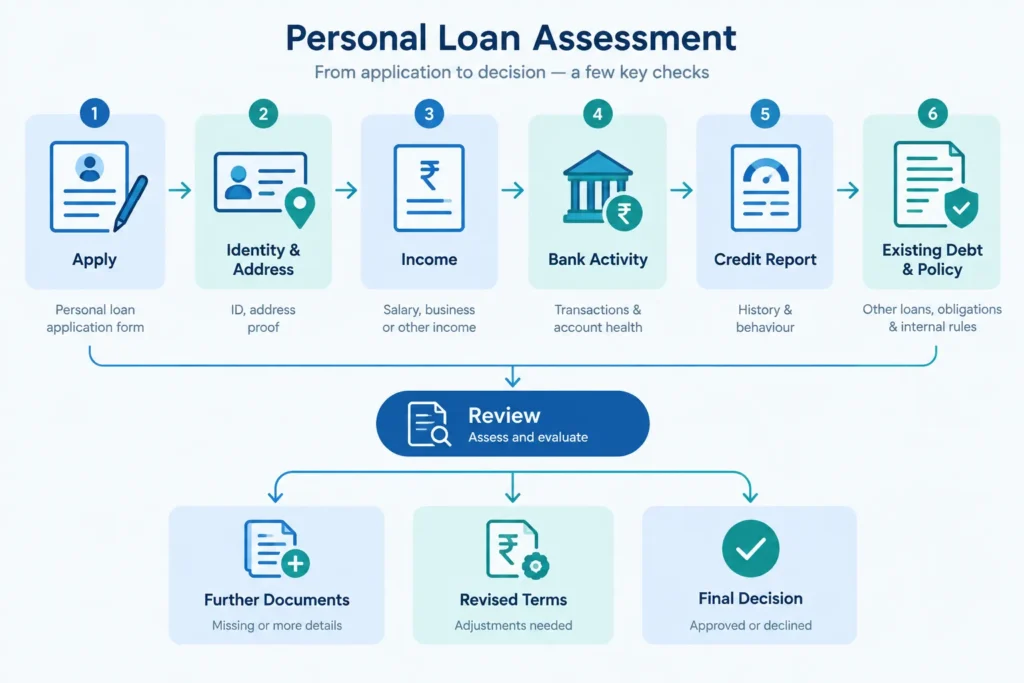
Flowchart showing how lenders assess identity, income, bank activity, credit history, existing debt and policy criteria.

Lenders usually assess several pieces of information together rather than relying on one number. A high income may help, for example, but it may not be enough if the applicant already has large repayment obligations or a history of missed payments.

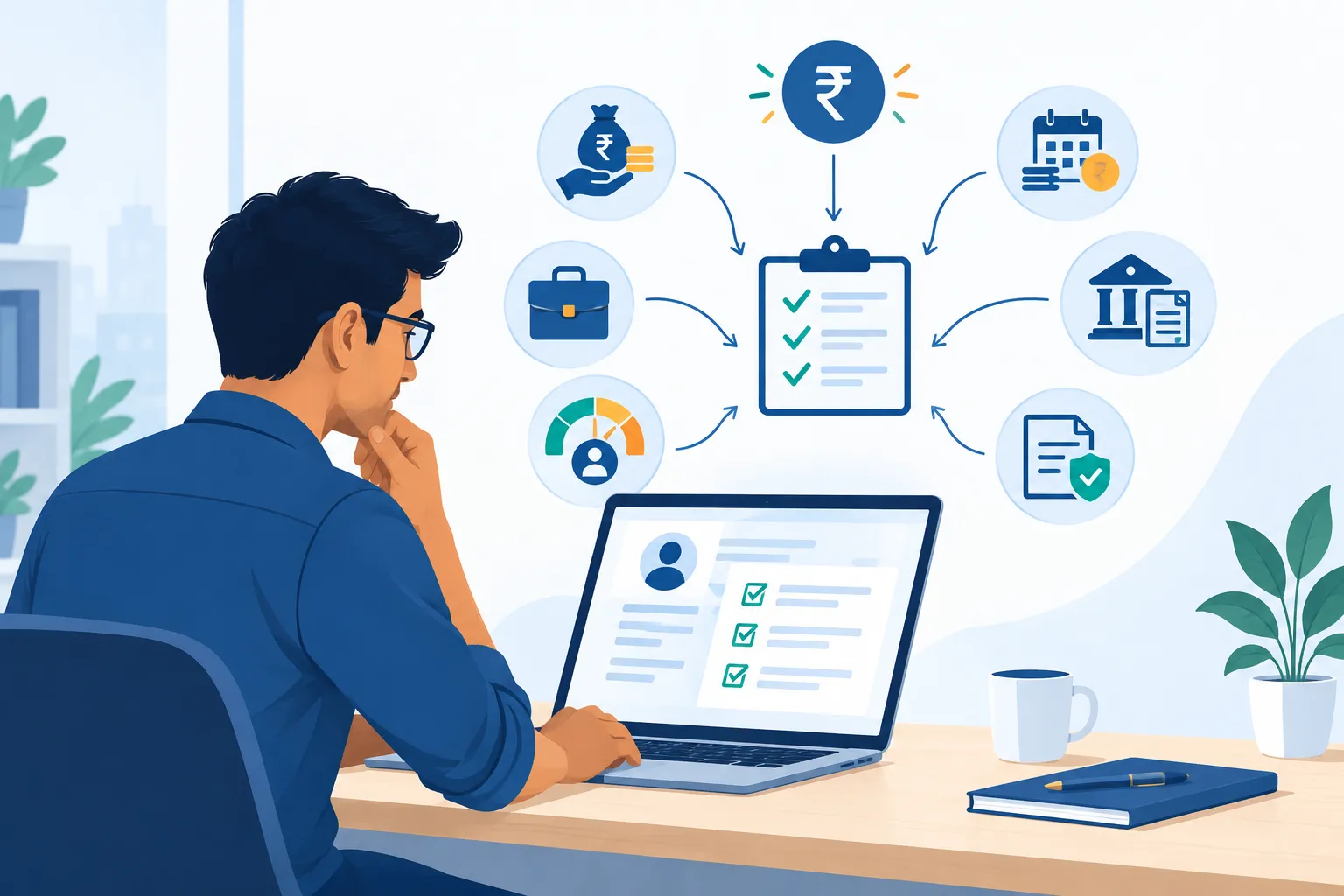
The review commonly includes the following:

  • Application details: The lender checks information such as age, address, occupation, employer or business details, requested amount and preferred tenure.
  • Identity and address documents: Documents may be used to verify the applicant’s name, date of birth, identity and current address.
  • Income evidence: Salary slips, bank statements, income-tax documents or business financial records may be requested, depending on the applicant’s work profile.
  • Bank account activity: The lender may examine salary or business credits, average balances, EMI debits, returned payments and other account patterns.
  • Credit information: Credit bureau data helps the lender review existing loans, credit cards, repayment behaviour, recent applications and overdue accounts.
  • Existing obligations: Current EMIs and other recurring debt payments are considered when estimating how much additional repayment the applicant may be able to manage.
  • Internal lending policies: Each lender has its own risk rules. These may consider factors such as location, employer category, occupation, customer relationship and previous experience with similar borrowers.

The lender may compare details across documents and databases. For example, the income stated in the application should generally be supported by salary credits, salary slips or relevant financial records. Differences may require clarification and can delay the application.

Some lenders use automated systems to provide an initial decision, especially for existing customers or digitally submitted applications. However, an instant or pre-approved offer may still be subject to final checks. If important details have changed, the lender can revise or withdraw the offer.

Income and Employment

Income is important because the personal loan EMI must be paid from the applicant’s available monthly cash flow. However, lenders do not look only at gross salary or annual business turnover. They also consider how regular the income is and how much remains after existing commitments.

Regularity and Consistency of Income

A predictable monthly income can make repayment capacity easier to assess. For a salaried applicant, lenders may look at salary credits over recent months, time with the current employer and overall employment continuity.

Frequent job changes do not automatically lead to rejection, but a recent change, probation period or gap in employment may require closer review. The lender may want to confirm that the current income is stable before approving a new EMI obligation.

For a self-employed applicant, income may vary from month to month. The lender may therefore examine bank statements, income-tax returns, profit and loss information, business vintage and the consistency of cash flows over a longer period. A strong month alone may not represent the applicant’s normal repayment capacity.

Salaried and Self-Employed Assessment

Salaried applicants can often show income through salary slips and regular bank credits. Their employer, job type and length of service may also form part of the assessment.

Self-employed applicants may need to provide different evidence because drawings from a business account or business turnover are not the same as personal disposable income. The lender may consider business expenses, taxable income, existing business debt and fluctuations in receipts.

Neither employment category is automatically better in every case. A lender is mainly looking for credible, continuing income that is sufficient for the proposed EMI after considering other obligations.

Why Gross Salary Is Not Enough

Gross salary is the amount before deductions. It does not show exactly how much money reaches the bank account or how much is available after household expenses and debt repayments.

Consider a simple example. Neha receives a monthly take-home salary of Rs. 60,000. She already pays a two-wheeler loan EMI of Rs. 6,000 and contributes Rs. 22,000 towards rent, utilities and household costs. She also has regular insurance and family expenses.

A lender will not assume that the entire Rs. 60,000 is available for a personal loan EMI. It will assess the existing EMI and other relevant commitments before deciding whether another monthly payment appears manageable. If Neha requests a large amount over a short tenure, the resulting EMI may be considered too high. A smaller amount or a different tenure may produce a different assessment, subject to the lender’s rules.

This example does not establish a universal minimum-income requirement. Lenders set their own thresholds, and actual decisions depend on the applicant’s complete profile. Borrowers should also apply their own affordability test because a lender’s approval does not mean that the EMI will be comfortable within every household budget.

You May Also Like:Personal Loan vs Home Loan: Key Differences Explained

Credit Score and Credit History

A credit score is a numerical summary derived from information in a person’s credit report. It gives lenders a quick indication of past credit behaviour, but it is not the same as the complete report.

The credit report contains more detailed information. It may show active and closed loans, credit card accounts, repayment records, outstanding balances, overdue amounts and enquiries made by lenders. A lender can use these details to understand the reasons behind the score and assess recent behaviour.

Regular, on-time repayments generally support the application because they indicate responsible handling of credit. In contrast, missed EMIs, unpaid card dues, settled accounts or continuing overdue balances may raise concerns. The age, amount and frequency of such issues can also matter.

Recent credit enquiries may be reviewed as well. Several loan or card applications made within a short period can suggest that the applicant is actively seeking substantial credit. This does not automatically result in rejection, but lenders may ask whether additional obligations have recently been taken on.

Having little or no credit history creates a different situation. It does not necessarily mean the applicant is financially unreliable. It means the lender has less past repayment data on which to base its decision. In such cases, income stability, bank activity, documents and internal lender policies may carry greater importance.

There is no single credit score that guarantees personal loan approval across all lenders. A stronger score and clean repayment history can improve the overall profile, but approval, loan amount and pricing still depend on income, existing debt, documentation and the lender’s risk rules.

Existing Loans and Debt Obligations

Your salary is not the only factor that decides personal loan eligibility. A lender also checks how much of your monthly income is already committed to debt payments. Existing obligations leave less money available for a new personal loan EMI.

Common debt obligations include:

  • Home loan EMIs
  • Vehicle loan EMIs
  • Education loan EMIs
  • Consumer durable or other personal loan EMIs
  • Credit card dues and converted EMIs
  • Buy now, pay later obligations
  • Loans taken against securities, deposits or property

For example, suppose your monthly take-home income is Rs. 70,000. You already pay a home loan EMI of Rs. 22,000 and a vehicle loan EMI of Rs. 9,000. Before considering a new personal loan, the lender can see that Rs. 31,000 of your income is already going towards debt.

This does not automatically mean that your application will be rejected. However, the lender may approve a smaller amount, offer a different tenure, or decide that another EMI would put too much pressure on your finances.

Credit card dues also matter

Credit cards may not have a fixed EMI if you use them for regular purchases. Even so, lenders can consider outstanding balances, minimum amounts due, card-based loans and recent repayment patterns. A large unpaid balance may reduce your apparent repayment capacity.

Paying only the minimum amount due does not clear the full card balance. It may also indicate that your monthly budget is under pressure. Clearing unnecessary card dues before applying can improve your financial position, though it does not guarantee loan approval.

Co-borrower and guarantor obligations

A lender may also ask whether you are a co-borrower on another loan. As a co-borrower, you generally share responsibility for repayment. The lender may therefore include some or all of that EMI while assessing your eligibility, even if another person normally makes the payment.

A guarantee can matter too. If you are a guarantor for someone else’s loan, you may become responsible if the main borrower fails to repay. Different lenders treat guarantee obligations differently. Some may examine them closely, especially if the guaranteed account has repayment problems.

Declare existing obligations accurately. Undisclosed loans can often be identified through credit reports, bank statements and account activity. A mismatch between your application and financial records may weaken the lender’s confidence in the application.

Age and Repayment Tenure

Lenders set their own minimum and maximum age rules for personal loans. They may check your age when you apply as well as your age when the loan is scheduled to end.

This can directly affect the repayment tenure available to you. For instance, if a lender requires a loan to be fully repaid before a specified age, an older applicant may receive a shorter maximum tenure than a younger applicant with a similar income.

A shorter tenure usually means a higher monthly EMI for the same loan amount and interest rate. If that EMI is too high compared with your income and existing obligations, the lender may reduce the possible loan amount.

Consider two applicants seeking the same amount. One may qualify for a five-year tenure, while the other may be offered only three years because of the lender’s age rules. The second applicant would have to manage a higher EMI. If the higher EMI does not fit the lender’s repayment-capacity assessment, the approved amount could be lower.

Age rules are not identical across banks and non-banking financial companies. They may also differ for salaried employees, self-employed applicants, pensioners and professionals. Always check the specific lender’s conditions rather than relying on a general age range.

Debt-to-Income and Repayment Capacity
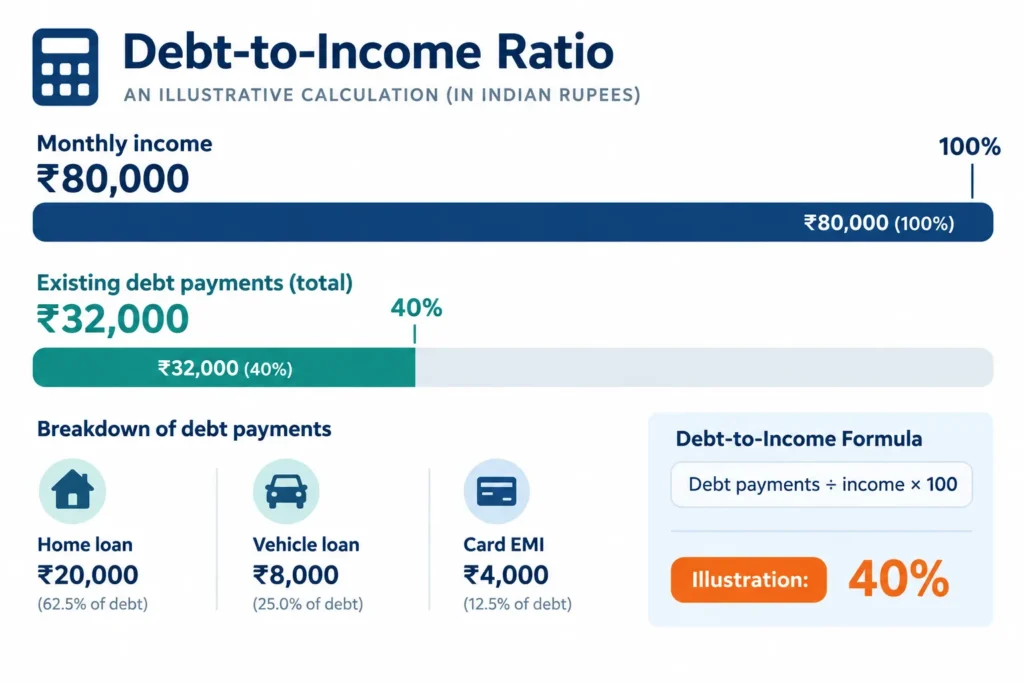
Illustrative debt-to-income calculation showing ₹32,000 of debt payments against ₹80,000 monthly income, equal to 40%.

Debt-to-income ratio is a simple way to compare your monthly debt payments with your monthly income. It helps a lender estimate how much of your income is already being used to repay loans.

An illustrative calculation is:

Debt-to-income ratio = Total monthly debt payments ÷ Monthly income × 100

Suppose an applicant has a monthly income of Rs. 80,000. The applicant pays a home loan EMI of Rs. 20,000, a vehicle loan EMI of Rs. 8,000 and a credit card EMI of Rs. 4,000.

Item Monthly amount
Home loan EMI Rs. 20,000
Vehicle loan EMI Rs. 8,000
Credit card EMI Rs. 4,000
Total monthly debt payments Rs. 32,000
Monthly income Rs. 80,000

In this example, the ratio is Rs. 32,000 divided by Rs. 80,000, multiplied by 100. The result is 40%. In simple terms, 40% of the applicant’s monthly income is already committed to debt payments before adding the proposed personal loan EMI.

This calculation is only an illustration. Lenders may use different names, formulas and internal limits. One lender may use net monthly income, while another may consider eligible or verified income after making adjustments. Certain obligations may be included differently. A lender may also add the EMI of the proposed personal loan before deciding whether the total burden is acceptable.

Repayment capacity is broader than one ratio. The lender may review bank statements, salary credits, household cash flow, existing loan conduct and the amount left after regular commitments. A ratio that appears manageable does not create a right to approval, and a higher ratio does not always lead to automatic rejection. It remains part of the lender’s overall assessment.

You May Also Like:Fixed vs Floating Interest Rate: What Borrowers Should Know

Work Experience and Employment Stability

Personal loans are generally unsecured, which means they are not usually backed by an asset such as a house or car. Lenders therefore pay close attention to the continuity and reliability of your income.

For a salaried applicant, the lender may consider total work experience, time with the current employer and the regularity of salary credits. A stable employment record can make future income appear more predictable.

Frequent job changes are not always negative. People often change jobs for better roles or salaries. However, several changes within short periods may lead to additional questions, particularly if there are gaps between jobs or large unexplained changes in income.

Being on probation can also affect personal loan eligibility. Some lenders prefer applicants who have completed probation or worked with the current employer for a minimum period. Others may consider the application but ask for more documents or apply stricter conditions.

Variable earnings require careful assessment. Bonuses, incentives, overtime and sales commissions may not be treated in the same way as fixed salary. A lender may consider an average based on past records, include only a portion, or exclude irregular payments from eligible income.

For self-employed applicants, continuity of business and consistency of profits can be important. Lenders may examine income tax returns, bank statements, business vintage, cash flow and recent financial performance. A high turnover does not necessarily mean high repayment capacity if profits are low or income is highly uneven.

How Much Personal Loan Can You Be Eligible For?

There is no single loan amount that applies to everyone earning the same salary. The possible amount depends on several connected factors:

  • Verified net monthly income
  • Existing EMIs and other debt obligations
  • Available repayment tenure
  • Applicable interest rate
  • Credit profile and repayment history
  • Age at application and at loan maturity
  • Employment or business stability
  • The lender’s internal policy

Consider Meera and Rohan, who each receive a net monthly salary of Rs. 75,000. Their salaries are similar, but their financial positions are different.

Factor Meera Rohan
Net monthly salary Rs. 75,000 Rs. 75,000
Existing EMIs Rs. 8,000 Rs. 27,000
Employment Three years in the current job Recently joined and on probation
Credit position Regular repayment record Recent delayed card payments

Meera has more income left after her existing EMI and has a longer record with her employer. Rohan already has larger monthly commitments, is on probation and has recent delayed payments. A lender may therefore offer Meera a higher amount, a more suitable tenure or different pricing, even though both applicants earn the same salary.

The reverse is also possible if other facts differ. For example, one applicant may qualify for only a short tenure because of age, making the EMI less affordable. Another may receive a higher interest rate based on the lender’s risk assessment, which can reduce the loan amount that fits within the permitted monthly repayment.

Online eligibility calculators can provide an estimate, but they cannot account for every internal rule or verification result. Treat any displayed amount, pre-approved message or initial offer as indicative until the lender checks your documents, income, obligations and credit profile and issues final approval.

Documents Usually Required for a Personal Loan

Lenders ask for documents to verify your identity, address, income and repayment capacity. The exact list depends on the lender, your occupation and your applicant profile.

For example, a salaried employee may need salary slips, while a self-employed applicant may need income tax returns and business records. Existing customers may face less paperwork if the bank already has updated information.

Identity and address documents

Commonly requested documents include:

  • PAN card for tax and identity verification.
  • Aadhaar card, passport, voter ID or driving licence, depending on the lender’s accepted documents.
  • Recent utility bill, rent agreement or another accepted address proof if your current address differs from your identity document.
  • Recent passport-size photograph, where required.

The name, date of birth and address entered in your application should match the supporting documents. If there is a genuine difference, ask the lender what additional proof is acceptable.

Income and bank documents for salaried applicants

A salaried applicant may be asked for:

  • Recent salary slips.
  • Bank statements showing salary credits and regular expenses.
  • Form 16 or income tax return, if required.
  • Employee ID card, appointment letter or employment confirmation.
You May Also Like:What Is an EMI? A Complete Guide to Equated Monthly Instalments

Regular salary credits help a lender assess income stability. Large unexplained transfers or frequent payment failures in the bank account may lead to further questions.

Documents for self-employed applicants

A self-employed person or business owner may need to provide:

  • Recent income tax returns.
  • Business bank statements and personal bank statements.
  • Profit and loss statement and balance sheet, where applicable.
  • GST registration, business registration or professional practice proof, depending on the nature of work.
  • Proof showing how long the business or practice has been operating.

Requirements vary widely. A freelancer, shop owner and practising professional may each be assessed differently. Some lenders also require financial statements certified by a chartered accountant.

Submit clear, current and complete documents. Do not alter salary slips, bank statements or business records. Incorrect documents can result in rejection and may affect future dealings with the lender.

How to Improve Your Personal Loan Eligibility

Improving personal loan eligibility usually takes time. Focus on financial habits that make your repayment capacity easier to understand and verify.

Check your credit report

Review your credit report before applying. Look for incorrect late-payment entries, loans that do not belong to you, duplicate accounts or closed loans still shown as active. Raise a correction request with the relevant credit bureau or lender if you find an error.

A genuine missed payment cannot normally be removed simply because it lowers your score. However, correcting inaccurate information can help lenders assess you using the right data.

Pay dues on time

Pay loan EMIs and credit card bills by their due dates. Setting reminders or automatic payments may help, but you should still keep enough money in the account to avoid a failed debit.

Timely payments do not guarantee approval. They do, however, demonstrate responsible repayment behaviour over time.

Reduce avoidable debt

High existing EMIs can reduce the income available for a new loan. Where practical, repay small outstanding debts or reduce credit card balances before applying. Do not use emergency savings only to make an application appear stronger.

Avoid repeated applications

Applying to many lenders within a short period can result in several credit enquiries. This may suggest urgent borrowing or increase a lender’s caution.

Compare basic eligibility conditions first. Use lender tools that clearly state whether the check affects your credit report. Submit a full application only after reviewing the likely EMI, fees and terms.

Maintain stable and clear income records

Regular salary credits, properly filed tax returns and organised business accounts make income easier to verify. Self-employed applicants should avoid mixing every personal and business transaction where separate records are practical.

Choose a realistic loan amount

A smaller request may be easier to support than an amount that creates an unaffordable EMI. Estimate the EMI and consider rent, household costs, insurance, school fees, existing EMIs and emergency needs.

Do not select a longer tenure only to make the EMI look comfortable. A longer tenure can increase the total interest paid.

Provide accurate information

Enter your income, employer, address, existing obligations and contact details correctly. If income varies, disclose it honestly instead of presenting the best month as regular income. Inconsistencies between the form, documents and credit report can delay or weaken the application.

Common Reasons Personal Loan Applications Are Rejected

A rejection does not always mean that the applicant has a poor credit score. Lenders consider several factors together and apply their own internal policies.

  • Insufficient repayment capacity: The proposed EMI may be too high compared with the income available after regular expenses.
  • High existing obligations: Home loan, vehicle loan, credit card and other EMIs may leave limited room for another payment.
  • Recent missed payments: Late EMIs, unpaid card bills or settled accounts can raise concerns about repayment behaviour.
  • Inconsistent information: Differences in income, employment, address or existing loan details may require clarification or lead to rejection.
  • Unstable income: Irregular earnings, a very recent job change or limited business history may not meet the lender’s rules.
  • Incomplete documents: Missing pages, unclear copies, outdated statements or unavailable income proof can stop verification.
  • Excessive recent enquiries: Many applications in a short period may indicate increased borrowing risk.
  • Lender-specific policy: An applicant may fall outside the lender’s permitted age, location, employer, occupation, income or credit criteria.
You May Also Like:Personal Finance for Women: A Practical Guide to Saving, Investing and Financial Independence

If an application is rejected, avoid applying immediately to several more lenders. First review the stated reason, if provided, and check your credit report and documents. Addressing the issue may be more useful than making repeated applications.

Personal Loan Eligibility vs Loan Approval
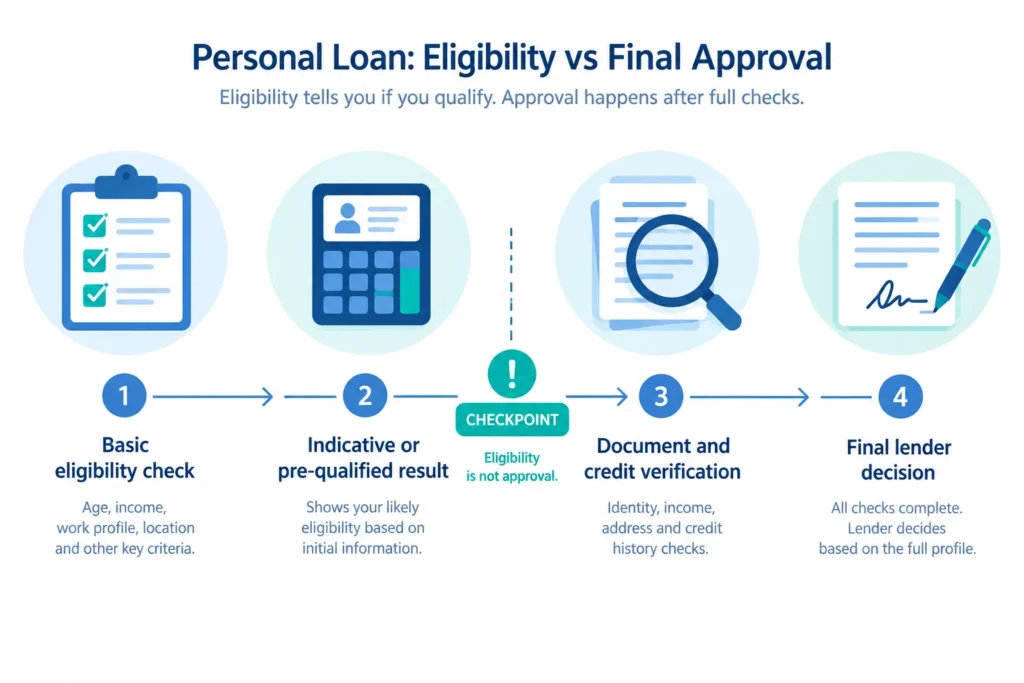
Timeline distinguishing an initial personal loan eligibility check from verification and the lender's final approval decision.

Personal loan eligibility means that you appear to meet some initial conditions, such as age, income, occupation or location. An online eligibility result is generally an estimate based on the details entered.

A pre-qualified or pre-approved offer is also not always a final approval. It may be based on limited information already available to the lender, such as account activity or an initial credit assessment.

Final approval normally comes only after the lender completes verification and underwriting. This may include checking documents, income, employment or business details, bank statements, credit history and existing obligations.

The lender may approve a lower amount, offer a different interest rate or tenure, request more documents, or reject the application. The offer becomes meaningful only when you receive the final terms and review the loan agreement.

Never treat an eligibility calculator result, marketing message or pre-qualified offer as guaranteed money. Avoid making purchases or commitments until the loan has received final approval and the disbursement conditions are clear.

Frequently Asked Questions About Personal Loan Eligibility

Can I qualify with a low or limited credit history?

It may be possible, but options can be limited. The lender may place more weight on income stability, bank transactions, employer profile or business records. The offered amount and pricing may also differ. Avoid taking an expensive loan only to build credit.

Can I apply if I already have multiple EMIs?

Yes, but the lender will assess your total monthly obligations against your income. Multiple EMIs do not automatically cause rejection. The key question is whether you have enough repayment capacity after existing commitments and normal expenses.

Does changing jobs affect eligibility?

It can. A lender may require a minimum period with the current employer or evidence of continuous work experience. Applying during probation or immediately after joining may make income stability harder to establish. Policies differ across lenders.

Can self-employed people get personal loans?

Yes. Self-employed applicants may qualify if they meet the lender’s income, business vintage, credit and documentation rules. Income tax returns, bank statements and business financial records are commonly used for assessment.

Can I make a joint personal loan application?

Some lenders allow a co-applicant, while others offer personal loans only to an individual borrower. A joint application does not automatically improve approval chances. The lender may examine the income, credit record and liabilities of both applicants.

Can I check eligibility with multiple lenders?

You can compare lenders, but understand how each check is performed. An indicative or soft check may not affect your credit report, while a full application can create a hard enquiry. Avoid submitting several full applications at once.

Does a high credit score guarantee approval?

No. A high credit score can support an application, but it does not guarantee approval. The lender may still reject the application because of inadequate income, high obligations, unstable employment, document issues or internal policy.

Summary

Prepare complete identity, address, income, bank and employment or business documents before applying. To improve personal loan eligibility, pay dues on time, correct credit report errors, limit unnecessary debt and applications, maintain clear income records, request a realistic amount and provide accurate information.

Eligibility is only an initial assessment, not final approval. Every lender uses its own criteria, verification process and risk policy. No single factor, including income or credit score, can ensure that a personal loan will be approved.
Share this article
KEEP READING

Related Articles

View all →

Comments

Leave a Comment

Personal Loan Eligibility: Factors Lenders Consider in India

Personal loan eligibility is a lender’s assessment of whether you meet its basic conditions and are likely to repay the loan on time. Lenders commonly review your income, employment or business stability, existing EMIs, regular expenses, credit score, credit report, bank activity and submitted documents. Meeting the stated eligibility conditions allows you to apply, but it does not guarantee approval, a particular loan amount or a specific interest rate.

A personal loan is usually unsecured, which means you generally do not provide a house, vehicle or other asset as security. As a result, the lender relies heavily on your financial profile and repayment record while making its decision.

Understanding this process can help you judge whether a loan is affordable before applying. It can also help you avoid unrealistic applications that may result in rejection or unnecessary credit enquiries.

What Is Personal Loan Eligibility?

Personal loan eligibility refers to the conditions and financial checks used by a bank, non-banking financial company or other regulated lender to assess a loan applicant. In simple terms, the lender wants to answer two questions: does the applicant meet its basic lending rules, and does the applicant appear able to repay the proposed EMI?

Basic conditions may relate to age, income, occupation, employment or business continuity, place of residence and availability of valid documents. The lender may also require the applicant to be an Indian citizen or resident, depending on the product.

These conditions are only the starting point. A person may satisfy the age and income requirements shown by a lender but still receive a lower loan offer or have the application declined after the complete assessment.

Eligibility rules are not identical across lenders. One bank may be comfortable lending to a particular type of salaried employee, while another may prefer applicants employed by organisations on its approved list. Similarly, lenders may use different methods to assess professionals, traders, small business owners and other self-employed applicants.

The eligible loan amount and interest rate can differ too. A lender may offer one applicant a larger amount because of stable income and low existing debt, while offering another applicant a smaller amount because a significant part of monthly income is already committed to EMIs.

Therefore, “eligible” should not be understood as “guaranteed approval.” It also does not mean that the applicant will automatically receive the amount requested or the lowest advertised interest rate. Final approval remains subject to document verification, credit checks, affordability assessment and the lender’s internal policies.

How Do Lenders Assess Personal Loan Applications?

Flowchart showing how lenders assess identity, income, bank activity, credit history, existing debt and policy criteria.

Lenders usually assess several pieces of information together rather than relying on one number. A high income may help, for example, but it may not be enough if the applicant already has large repayment obligations or a history of missed payments.

The review commonly includes the following:

  • Application details: The lender checks information such as age, address, occupation, employer or business details, requested amount and preferred tenure.
  • Identity and address documents: Documents may be used to verify the applicant’s name, date of birth, identity and current address.
  • Income evidence: Salary slips, bank statements, income-tax documents or business financial records may be requested, depending on the applicant’s work profile.
  • Bank account activity: The lender may examine salary or business credits, average balances, EMI debits, returned payments and other account patterns.
  • Credit information: Credit bureau data helps the lender review existing loans, credit cards, repayment behaviour, recent applications and overdue accounts.
  • Existing obligations: Current EMIs and other recurring debt payments are considered when estimating how much additional repayment the applicant may be able to manage.
  • Internal lending policies: Each lender has its own risk rules. These may consider factors such as location, employer category, occupation, customer relationship and previous experience with similar borrowers.

The lender may compare details across documents and databases. For example, the income stated in the application should generally be supported by salary credits, salary slips or relevant financial records. Differences may require clarification and can delay the application.

Some lenders use automated systems to provide an initial decision, especially for existing customers or digitally submitted applications. However, an instant or pre-approved offer may still be subject to final checks. If important details have changed, the lender can revise or withdraw the offer.

Income and Employment

Income is important because the personal loan EMI must be paid from the applicant’s available monthly cash flow. However, lenders do not look only at gross salary or annual business turnover. They also consider how regular the income is and how much remains after existing commitments.

Regularity and Consistency of Income

A predictable monthly income can make repayment capacity easier to assess. For a salaried applicant, lenders may look at salary credits over recent months, time with the current employer and overall employment continuity.

Frequent job changes do not automatically lead to rejection, but a recent change, probation period or gap in employment may require closer review. The lender may want to confirm that the current income is stable before approving a new EMI obligation.

For a self-employed applicant, income may vary from month to month. The lender may therefore examine bank statements, income-tax returns, profit and loss information, business vintage and the consistency of cash flows over a longer period. A strong month alone may not represent the applicant’s normal repayment capacity.

Salaried and Self-Employed Assessment

Salaried applicants can often show income through salary slips and regular bank credits. Their employer, job type and length of service may also form part of the assessment.

Self-employed applicants may need to provide different evidence because drawings from a business account or business turnover are not the same as personal disposable income. The lender may consider business expenses, taxable income, existing business debt and fluctuations in receipts.

Neither employment category is automatically better in every case. A lender is mainly looking for credible, continuing income that is sufficient for the proposed EMI after considering other obligations.

Why Gross Salary Is Not Enough

Gross salary is the amount before deductions. It does not show exactly how much money reaches the bank account or how much is available after household expenses and debt repayments.

Consider a simple example. Neha receives a monthly take-home salary of Rs. 60,000. She already pays a two-wheeler loan EMI of Rs. 6,000 and contributes Rs. 22,000 towards rent, utilities and household costs. She also has regular insurance and family expenses.

A lender will not assume that the entire Rs. 60,000 is available for a personal loan EMI. It will assess the existing EMI and other relevant commitments before deciding whether another monthly payment appears manageable. If Neha requests a large amount over a short tenure, the resulting EMI may be considered too high. A smaller amount or a different tenure may produce a different assessment, subject to the lender’s rules.

This example does not establish a universal minimum-income requirement. Lenders set their own thresholds, and actual decisions depend on the applicant’s complete profile. Borrowers should also apply their own affordability test because a lender’s approval does not mean that the EMI will be comfortable within every household budget.

Credit Score and Credit History

A credit score is a numerical summary derived from information in a person’s credit report. It gives lenders a quick indication of past credit behaviour, but it is not the same as the complete report.

The credit report contains more detailed information. It may show active and closed loans, credit card accounts, repayment records, outstanding balances, overdue amounts and enquiries made by lenders. A lender can use these details to understand the reasons behind the score and assess recent behaviour.

Regular, on-time repayments generally support the application because they indicate responsible handling of credit. In contrast, missed EMIs, unpaid card dues, settled accounts or continuing overdue balances may raise concerns. The age, amount and frequency of such issues can also matter.

Recent credit enquiries may be reviewed as well. Several loan or card applications made within a short period can suggest that the applicant is actively seeking substantial credit. This does not automatically result in rejection, but lenders may ask whether additional obligations have recently been taken on.

Having little or no credit history creates a different situation. It does not necessarily mean the applicant is financially unreliable. It means the lender has less past repayment data on which to base its decision. In such cases, income stability, bank activity, documents and internal lender policies may carry greater importance.

There is no single credit score that guarantees personal loan approval across all lenders. A stronger score and clean repayment history can improve the overall profile, but approval, loan amount and pricing still depend on income, existing debt, documentation and the lender’s risk rules.

Existing Loans and Debt Obligations

Your salary is not the only factor that decides personal loan eligibility. A lender also checks how much of your monthly income is already committed to debt payments. Existing obligations leave less money available for a new personal loan EMI.

Common debt obligations include:

  • Home loan EMIs
  • Vehicle loan EMIs
  • Education loan EMIs
  • Consumer durable or other personal loan EMIs
  • Credit card dues and converted EMIs
  • Buy now, pay later obligations
  • Loans taken against securities, deposits or property

For example, suppose your monthly take-home income is Rs. 70,000. You already pay a home loan EMI of Rs. 22,000 and a vehicle loan EMI of Rs. 9,000. Before considering a new personal loan, the lender can see that Rs. 31,000 of your income is already going towards debt.

This does not automatically mean that your application will be rejected. However, the lender may approve a smaller amount, offer a different tenure, or decide that another EMI would put too much pressure on your finances.

Credit card dues also matter

Credit cards may not have a fixed EMI if you use them for regular purchases. Even so, lenders can consider outstanding balances, minimum amounts due, card-based loans and recent repayment patterns. A large unpaid balance may reduce your apparent repayment capacity.

Paying only the minimum amount due does not clear the full card balance. It may also indicate that your monthly budget is under pressure. Clearing unnecessary card dues before applying can improve your financial position, though it does not guarantee loan approval.

Co-borrower and guarantor obligations

A lender may also ask whether you are a co-borrower on another loan. As a co-borrower, you generally share responsibility for repayment. The lender may therefore include some or all of that EMI while assessing your eligibility, even if another person normally makes the payment.

A guarantee can matter too. If you are a guarantor for someone else’s loan, you may become responsible if the main borrower fails to repay. Different lenders treat guarantee obligations differently. Some may examine them closely, especially if the guaranteed account has repayment problems.

Declare existing obligations accurately. Undisclosed loans can often be identified through credit reports, bank statements and account activity. A mismatch between your application and financial records may weaken the lender’s confidence in the application.

Age and Repayment Tenure

Lenders set their own minimum and maximum age rules for personal loans. They may check your age when you apply as well as your age when the loan is scheduled to end.

This can directly affect the repayment tenure available to you. For instance, if a lender requires a loan to be fully repaid before a specified age, an older applicant may receive a shorter maximum tenure than a younger applicant with a similar income.

A shorter tenure usually means a higher monthly EMI for the same loan amount and interest rate. If that EMI is too high compared with your income and existing obligations, the lender may reduce the possible loan amount.

Consider two applicants seeking the same amount. One may qualify for a five-year tenure, while the other may be offered only three years because of the lender’s age rules. The second applicant would have to manage a higher EMI. If the higher EMI does not fit the lender’s repayment-capacity assessment, the approved amount could be lower.

Age rules are not identical across banks and non-banking financial companies. They may also differ for salaried employees, self-employed applicants, pensioners and professionals. Always check the specific lender’s conditions rather than relying on a general age range.

Debt-to-Income and Repayment Capacity

Illustrative debt-to-income calculation showing ₹32,000 of debt payments against ₹80,000 monthly income, equal to 40%.

Debt-to-income ratio is a simple way to compare your monthly debt payments with your monthly income. It helps a lender estimate how much of your income is already being used to repay loans.

An illustrative calculation is:

Debt-to-income ratio = Total monthly debt payments ÷ Monthly income × 100

Suppose an applicant has a monthly income of Rs. 80,000. The applicant pays a home loan EMI of Rs. 20,000, a vehicle loan EMI of Rs. 8,000 and a credit card EMI of Rs. 4,000.

Item Monthly amount
Home loan EMI Rs. 20,000
Vehicle loan EMI Rs. 8,000
Credit card EMI Rs. 4,000
Total monthly debt payments Rs. 32,000
Monthly income Rs. 80,000

In this example, the ratio is Rs. 32,000 divided by Rs. 80,000, multiplied by 100. The result is 40%. In simple terms, 40% of the applicant’s monthly income is already committed to debt payments before adding the proposed personal loan EMI.

This calculation is only an illustration. Lenders may use different names, formulas and internal limits. One lender may use net monthly income, while another may consider eligible or verified income after making adjustments. Certain obligations may be included differently. A lender may also add the EMI of the proposed personal loan before deciding whether the total burden is acceptable.

Repayment capacity is broader than one ratio. The lender may review bank statements, salary credits, household cash flow, existing loan conduct and the amount left after regular commitments. A ratio that appears manageable does not create a right to approval, and a higher ratio does not always lead to automatic rejection. It remains part of the lender’s overall assessment.

Work Experience and Employment Stability

Personal loans are generally unsecured, which means they are not usually backed by an asset such as a house or car. Lenders therefore pay close attention to the continuity and reliability of your income.

For a salaried applicant, the lender may consider total work experience, time with the current employer and the regularity of salary credits. A stable employment record can make future income appear more predictable.

Frequent job changes are not always negative. People often change jobs for better roles or salaries. However, several changes within short periods may lead to additional questions, particularly if there are gaps between jobs or large unexplained changes in income.

Being on probation can also affect personal loan eligibility. Some lenders prefer applicants who have completed probation or worked with the current employer for a minimum period. Others may consider the application but ask for more documents or apply stricter conditions.

Variable earnings require careful assessment. Bonuses, incentives, overtime and sales commissions may not be treated in the same way as fixed salary. A lender may consider an average based on past records, include only a portion, or exclude irregular payments from eligible income.

For self-employed applicants, continuity of business and consistency of profits can be important. Lenders may examine income tax returns, bank statements, business vintage, cash flow and recent financial performance. A high turnover does not necessarily mean high repayment capacity if profits are low or income is highly uneven.

How Much Personal Loan Can You Be Eligible For?

There is no single loan amount that applies to everyone earning the same salary. The possible amount depends on several connected factors:

  • Verified net monthly income
  • Existing EMIs and other debt obligations
  • Available repayment tenure
  • Applicable interest rate
  • Credit profile and repayment history
  • Age at application and at loan maturity
  • Employment or business stability
  • The lender’s internal policy

Consider Meera and Rohan, who each receive a net monthly salary of Rs. 75,000. Their salaries are similar, but their financial positions are different.

Factor Meera Rohan
Net monthly salary Rs. 75,000 Rs. 75,000
Existing EMIs Rs. 8,000 Rs. 27,000
Employment Three years in the current job Recently joined and on probation
Credit position Regular repayment record Recent delayed card payments

Meera has more income left after her existing EMI and has a longer record with her employer. Rohan already has larger monthly commitments, is on probation and has recent delayed payments. A lender may therefore offer Meera a higher amount, a more suitable tenure or different pricing, even though both applicants earn the same salary.

The reverse is also possible if other facts differ. For example, one applicant may qualify for only a short tenure because of age, making the EMI less affordable. Another may receive a higher interest rate based on the lender’s risk assessment, which can reduce the loan amount that fits within the permitted monthly repayment.

Online eligibility calculators can provide an estimate, but they cannot account for every internal rule or verification result. Treat any displayed amount, pre-approved message or initial offer as indicative until the lender checks your documents, income, obligations and credit profile and issues final approval.

Documents Usually Required for a Personal Loan

Lenders ask for documents to verify your identity, address, income and repayment capacity. The exact list depends on the lender, your occupation and your applicant profile.

For example, a salaried employee may need salary slips, while a self-employed applicant may need income tax returns and business records. Existing customers may face less paperwork if the bank already has updated information.

Identity and address documents

Commonly requested documents include:

  • PAN card for tax and identity verification.
  • Aadhaar card, passport, voter ID or driving licence, depending on the lender’s accepted documents.
  • Recent utility bill, rent agreement or another accepted address proof if your current address differs from your identity document.
  • Recent passport-size photograph, where required.

The name, date of birth and address entered in your application should match the supporting documents. If there is a genuine difference, ask the lender what additional proof is acceptable.

Income and bank documents for salaried applicants

A salaried applicant may be asked for:

  • Recent salary slips.
  • Bank statements showing salary credits and regular expenses.
  • Form 16 or income tax return, if required.
  • Employee ID card, appointment letter or employment confirmation.

Regular salary credits help a lender assess income stability. Large unexplained transfers or frequent payment failures in the bank account may lead to further questions.

Documents for self-employed applicants

A self-employed person or business owner may need to provide:

  • Recent income tax returns.
  • Business bank statements and personal bank statements.
  • Profit and loss statement and balance sheet, where applicable.
  • GST registration, business registration or professional practice proof, depending on the nature of work.
  • Proof showing how long the business or practice has been operating.

Requirements vary widely. A freelancer, shop owner and practising professional may each be assessed differently. Some lenders also require financial statements certified by a chartered accountant.

Submit clear, current and complete documents. Do not alter salary slips, bank statements or business records. Incorrect documents can result in rejection and may affect future dealings with the lender.

How to Improve Your Personal Loan Eligibility

Improving personal loan eligibility usually takes time. Focus on financial habits that make your repayment capacity easier to understand and verify.

Check your credit report

Review your credit report before applying. Look for incorrect late-payment entries, loans that do not belong to you, duplicate accounts or closed loans still shown as active. Raise a correction request with the relevant credit bureau or lender if you find an error.

A genuine missed payment cannot normally be removed simply because it lowers your score. However, correcting inaccurate information can help lenders assess you using the right data.

Pay dues on time

Pay loan EMIs and credit card bills by their due dates. Setting reminders or automatic payments may help, but you should still keep enough money in the account to avoid a failed debit.

Timely payments do not guarantee approval. They do, however, demonstrate responsible repayment behaviour over time.

Reduce avoidable debt

High existing EMIs can reduce the income available for a new loan. Where practical, repay small outstanding debts or reduce credit card balances before applying. Do not use emergency savings only to make an application appear stronger.

Avoid repeated applications

Applying to many lenders within a short period can result in several credit enquiries. This may suggest urgent borrowing or increase a lender’s caution.

Compare basic eligibility conditions first. Use lender tools that clearly state whether the check affects your credit report. Submit a full application only after reviewing the likely EMI, fees and terms.

Maintain stable and clear income records

Regular salary credits, properly filed tax returns and organised business accounts make income easier to verify. Self-employed applicants should avoid mixing every personal and business transaction where separate records are practical.

Choose a realistic loan amount

A smaller request may be easier to support than an amount that creates an unaffordable EMI. Estimate the EMI and consider rent, household costs, insurance, school fees, existing EMIs and emergency needs.

Do not select a longer tenure only to make the EMI look comfortable. A longer tenure can increase the total interest paid.

Provide accurate information

Enter your income, employer, address, existing obligations and contact details correctly. If income varies, disclose it honestly instead of presenting the best month as regular income. Inconsistencies between the form, documents and credit report can delay or weaken the application.

Common Reasons Personal Loan Applications Are Rejected

A rejection does not always mean that the applicant has a poor credit score. Lenders consider several factors together and apply their own internal policies.

  • Insufficient repayment capacity: The proposed EMI may be too high compared with the income available after regular expenses.
  • High existing obligations: Home loan, vehicle loan, credit card and other EMIs may leave limited room for another payment.
  • Recent missed payments: Late EMIs, unpaid card bills or settled accounts can raise concerns about repayment behaviour.
  • Inconsistent information: Differences in income, employment, address or existing loan details may require clarification or lead to rejection.
  • Unstable income: Irregular earnings, a very recent job change or limited business history may not meet the lender’s rules.
  • Incomplete documents: Missing pages, unclear copies, outdated statements or unavailable income proof can stop verification.
  • Excessive recent enquiries: Many applications in a short period may indicate increased borrowing risk.
  • Lender-specific policy: An applicant may fall outside the lender’s permitted age, location, employer, occupation, income or credit criteria.

If an application is rejected, avoid applying immediately to several more lenders. First review the stated reason, if provided, and check your credit report and documents. Addressing the issue may be more useful than making repeated applications.

Personal Loan Eligibility vs Loan Approval

Timeline distinguishing an initial personal loan eligibility check from verification and the lender's final approval decision.

Personal loan eligibility means that you appear to meet some initial conditions, such as age, income, occupation or location. An online eligibility result is generally an estimate based on the details entered.

A pre-qualified or pre-approved offer is also not always a final approval. It may be based on limited information already available to the lender, such as account activity or an initial credit assessment.

Final approval normally comes only after the lender completes verification and underwriting. This may include checking documents, income, employment or business details, bank statements, credit history and existing obligations.

The lender may approve a lower amount, offer a different interest rate or tenure, request more documents, or reject the application. The offer becomes meaningful only when you receive the final terms and review the loan agreement.

Never treat an eligibility calculator result, marketing message or pre-qualified offer as guaranteed money. Avoid making purchases or commitments until the loan has received final approval and the disbursement conditions are clear.

Frequently Asked Questions About Personal Loan Eligibility

Can I qualify with a low or limited credit history?

It may be possible, but options can be limited. The lender may place more weight on income stability, bank transactions, employer profile or business records. The offered amount and pricing may also differ. Avoid taking an expensive loan only to build credit.

Can I apply if I already have multiple EMIs?

Yes, but the lender will assess your total monthly obligations against your income. Multiple EMIs do not automatically cause rejection. The key question is whether you have enough repayment capacity after existing commitments and normal expenses.

Does changing jobs affect eligibility?

It can. A lender may require a minimum period with the current employer or evidence of continuous work experience. Applying during probation or immediately after joining may make income stability harder to establish. Policies differ across lenders.

Can self-employed people get personal loans?

Yes. Self-employed applicants may qualify if they meet the lender’s income, business vintage, credit and documentation rules. Income tax returns, bank statements and business financial records are commonly used for assessment.

Can I make a joint personal loan application?

Some lenders allow a co-applicant, while others offer personal loans only to an individual borrower. A joint application does not automatically improve approval chances. The lender may examine the income, credit record and liabilities of both applicants.

Can I check eligibility with multiple lenders?

You can compare lenders, but understand how each check is performed. An indicative or soft check may not affect your credit report, while a full application can create a hard enquiry. Avoid submitting several full applications at once.

Does a high credit score guarantee approval?

No. A high credit score can support an application, but it does not guarantee approval. The lender may still reject the application because of inadequate income, high obligations, unstable employment, document issues or internal policy.

Summary

Prepare complete identity, address, income, bank and employment or business documents before applying. To improve personal loan eligibility, pay dues on time, correct credit report errors, limit unnecessary debt and applications, maintain clear income records, request a realistic amount and provide accurate information.

Eligibility is only an initial assessment, not final approval. Every lender uses its own criteria, verification process and risk policy. No single factor, including income or credit score, can ensure that a personal loan will be approved.
Leave a Comment