


An SWP, or Systematic Withdrawal Plan, is an instruction to redeem units from a mutual fund at regular intervals and transfer the proceeds to your bank account. You can usually choose the withdrawal amount, frequency and start date. However, an SWP is not guaranteed income. Each payment comes from selling some of your mutual fund units, so returns, withdrawals and market movements all affect how long the investment may last.
Introduction
Many investors use mutual funds to build wealth through lump-sum investments or SIPs. But mutual funds can also be used to create a regular cash flow. This is where an SWP can be useful.
For example, a retired investor may want a monthly amount for household expenses. Another investor may need regular withdrawals to pay rent, education costs or other planned expenses. Instead of redeeming the entire mutual fund investment at once, the investor can set up an SWP for periodic withdrawals.
An SWP may look similar to monthly interest from a bank deposit, but the two are fundamentally different. Bank interest is paid according to the deposit terms. In an SWP, the mutual fund sells units to provide the selected amount. The fund’s value can rise or fall with the market, and the investment may reduce over time.
Understanding this distinction is essential before using an SWP. The amount credited to your bank account is not necessarily the return earned by the mutual fund. Part of it may come from your original invested capital.
What Is SWP?
SWP stands for Systematic Withdrawal Plan. It is a facility offered by mutual funds that allows an investor to redeem units periodically. The redemption proceeds are then transferred to the investor’s registered bank account.
Depending on the mutual fund’s rules, an investor may be able to choose:
- The amount to withdraw
- The frequency, such as monthly, quarterly or annually
- The date on which withdrawals should begin
- The number of withdrawals or an end date
Suppose Meera has money invested in a mutual fund and wants ₹8,000 each month. She can submit an SWP instruction for ₹8,000 per month. On each scheduled date, the fund house redeems enough units to meet that instruction and sends the proceeds to her bank account.
This does not mean the mutual fund is earning exactly ₹8,000 for Meera every month. If the investment’s growth is lower than her withdrawals, units will continue to be sold and the value of her holding can decline. If withdrawals continue for long enough, the units may eventually be exhausted.
An SWP should therefore be viewed as a structured redemption method, not as a promise of interest, pension or fixed returns.
How Does a Systematic Withdrawal Plan Work?
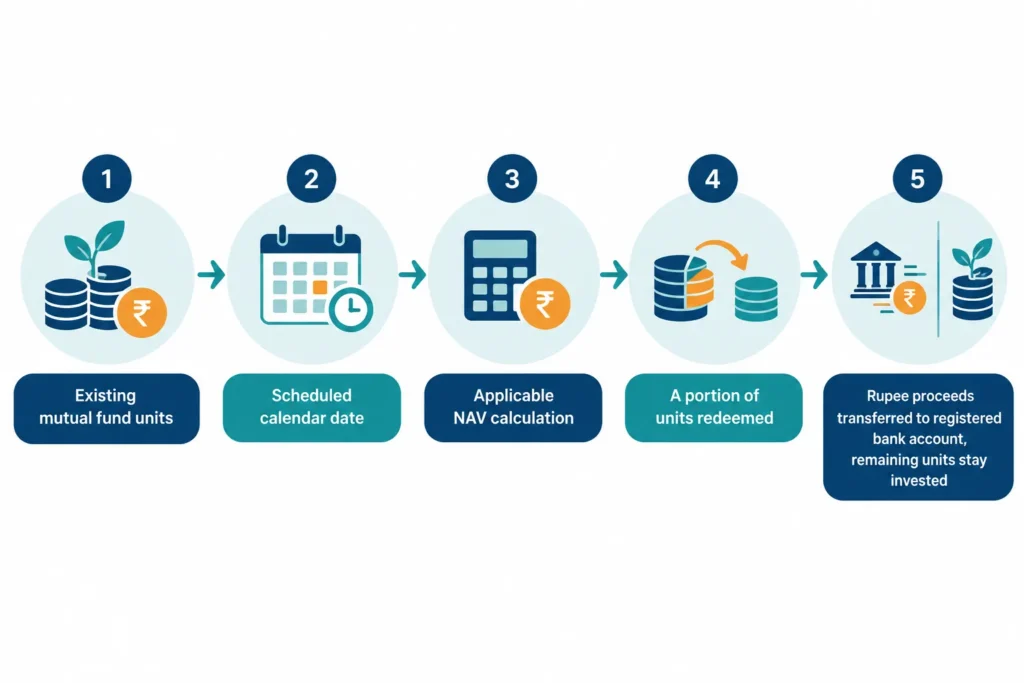
To start an SWP, the investor must first hold units in an eligible mutual fund scheme. The investor then gives the asset management company, or AMC, an instruction specifying the withdrawal amount and schedule.
On each SWP date, the following process generally takes place:
- The applicable net asset value, or NAV, is determined according to mutual fund rules.
- The fund calculates how many units must be redeemed for the selected withdrawal.
- Those units are removed from the investor’s holding.
- The redemption proceeds are sent to the registered bank account.
- The investor continues to hold the remaining units.
NAV is the per-unit value of a mutual fund scheme. It changes based on the value of the securities and other assets held by the scheme, after accounting for applicable liabilities and expenses.
Because the NAV can change, the number of units sold through an SWP can also change. A lower NAV means more units must be redeemed to generate the same withdrawal amount. A higher NAV means fewer units need to be redeemed.
Scheme-specific conditions may apply. These can include minimum withdrawal amounts, minimum remaining balances, permitted frequencies and processing rules. Exit load may also apply if units are redeemed within a specified period. Investors should check the scheme documents and current transaction rules before setting up an SWP.
How SWP Withdrawals Are Calculated
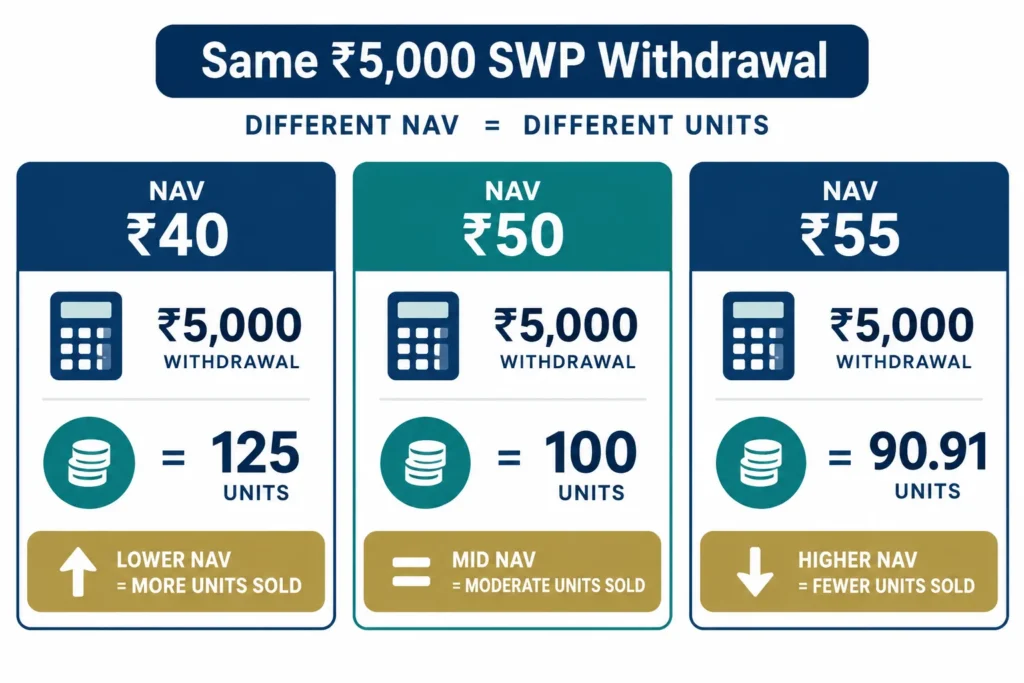
The basic calculation is:
Units redeemed = SWP withdrawal amount ÷ Applicable NAV
For example, if the withdrawal amount is ₹5,000 and the applicable NAV is ₹50, the mutual fund will redeem:
₹5,000 ÷ ₹50 = 100 units
If the applicable NAV falls to ₹40, the same ₹5,000 withdrawal will require:
₹5,000 ÷ ₹40 = 125 units
If the NAV rises to ₹55, the ₹5,000 withdrawal will require approximately:
₹5,000 ÷ ₹55 = 90.91 units
This shows the central feature of an SWP: the cash amount may remain fixed, but the number of units redeemed varies with the NAV.
The calculation above is simplified. Actual transactions are subject to the scheme’s applicable NAV rules, unit-rounding practices, exit load and other conditions. Tax may also arise on the capital gain portion of redeemed units. The amount and treatment depend on factors such as the type of mutual fund, purchase date, holding period and prevailing tax rules.
SWP Example With Numbers
Consider a hypothetical investor, Arjun, who invests ₹5 lakh in a mutual fund. Assume the NAV at the time of investment is ₹50.
Arjun initially receives:
₹5,00,000 ÷ ₹50 = 10,000 units
He then starts an SWP of ₹5,000 per month. The following example uses different NAVs to show how the calculation works. It ignores taxes and exit load for simplicity.
| Month | Applicable NAV | Withdrawal | Units Redeemed | Units Remaining | Value After Withdrawal |
|---|---|---|---|---|---|
| Month 1 | ₹50 | ₹5,000 | 100.00 | 9,900.00 | ₹4,95,000 |
| Month 2 | ₹40 | ₹5,000 | 125.00 | 9,775.00 | ₹3,91,000 |
| Month 3 | ₹55 | ₹5,000 | 90.91 | 9,684.09 | Approximately ₹5,32,625 |
In Month 1, the NAV is ₹50, so 100 units are sold. Arjun is left with 9,900 units.
Before the Month 2 withdrawal, the NAV has fallen to ₹40. The 9,900 units are then worth ₹3,96,000. To withdraw ₹5,000, the fund must redeem 125 units. Arjun is left with 9,775 units worth ₹3,91,000 at that NAV.
In Month 3, the assumed NAV is ₹55. Before withdrawal, the 9,775 units are worth ₹5,37,625. Only about 90.91 units need to be sold for the ₹5,000 withdrawal. The remaining 9,684.09 units are worth approximately ₹5,32,625 at the same NAV.
The sharp NAV changes in this example are used only to make the calculation easy to see. They are not a forecast of mutual fund performance.
The example also shows why an SWP payment should not be confused with profit. Arjun receives ₹15,000 over three months, but his remaining investment value depends on both the units sold and changes in NAV. A rising NAV can increase the value of the remaining units, while a falling NAV can reduce it. Regular withdrawals reduce the number of units in either case.
If the NAV stays low for an extended period, a fixed SWP will redeem more units. This can make the investment run down faster. If the NAV is higher, fewer units are sold for the same withdrawal, but future returns and the life of the investment are still not guaranteed.
SWP vs SIP
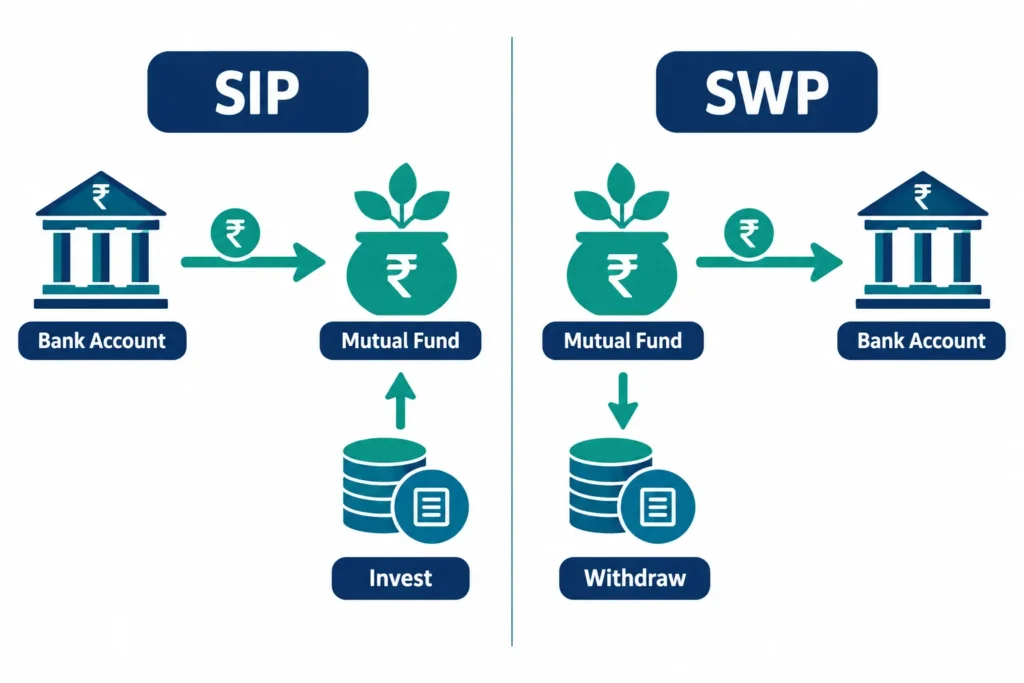
A Systematic Withdrawal Plan, or SWP, allows you to withdraw a chosen amount from a mutual fund at regular intervals. A Systematic Investment Plan, or SIP, works in the opposite direction: it lets you invest a chosen amount regularly.
With an SIP, money moves from your bank account into a mutual fund. The fund allocates units based on the applicable Net Asset Value, or NAV. With an SWP, the mutual fund redeems enough units to pay the scheduled amount into your bank account.
| Point | SIP | SWP |
|---|---|---|
| Purpose | Build an investment corpus | Draw money from an existing corpus |
| Direction of money | Bank account to mutual fund | Mutual fund to bank account |
| Effect on units | New units are purchased | Existing units are redeemed |
| Common use | Long-term wealth creation | Scheduled cash flow or planned withdrawals |
| Main risk | Investment value can fluctuate | Investment value can fluctuate and may run down |
SIP and SWP are not competing products. The same investor may use them at different financial stages. For example, a salaried person may invest through SIPs during working years. After retirement, that person may use an SWP from the accumulated corpus to support regular expenses.
However, moving from SIP to SWP requires planning. During the investment phase, market declines may allow an SIP to purchase more units. During the withdrawal phase, a market decline can be more difficult because more units may need to be redeemed to provide the same cash amount.
SWP vs Dividend Income
Mutual fund “dividend” options are now generally called Income Distribution cum Capital Withdrawal, or IDCW, options. An SWP and an IDCW payout can both put money into your bank account, but they work differently.
Under an SWP, you select the amount and frequency, subject to the mutual fund’s available facilities and conditions. Each payment is made by redeeming some of your units.
Under an IDCW option, the payout depends on the scheme having distributable surplus and the fund house deciding to distribute it. The amount and timing are not controlled by the investor in the same way as an SWP. An IDCW payout is not an assured return.
| Point | SWP | IDCW payout |
|---|---|---|
| Who initiates the cash flow? | The investor sets withdrawal instructions | The fund house declares a distribution |
| Predictability | Scheduled, subject to sufficient units and scheme rules | Amount and timing may vary |
| How value is affected | Units are redeemed | The scheme’s NAV falls to reflect the distribution and applicable adjustments |
| Investor control | Generally higher | Generally lower |
Neither option creates free income. An SWP reduces the number of units you hold. An IDCW payout comes from the scheme’s distributable surplus and reduces the investment value through the corresponding NAV adjustment. Investors should therefore consider total returns and the remaining corpus, not just the cash received.
How Much Can You Withdraw Through SWP?
There is no withdrawal amount that is universally safe. A suitable SWP for one investor may be too high or too low for another.
Suppose a retiree has a mutual fund corpus of ₹30 lakh and needs ₹20,000 per month. The important question is not merely whether the platform permits that withdrawal. The investor must consider whether the portfolio can support it for the required period after market movements, inflation, taxes and expenses.
Factors to consider before choosing the amount
- Essential expenses: Separate unavoidable costs, such as groceries, rent, medicines and insurance, from optional spending.
- Time horizon: A corpus expected to last five years may support a different withdrawal level from one expected to last thirty years.
- Asset mix: Equity funds, debt funds and hybrid funds carry different risks. The mix should suit the withdrawal period and the investor’s risk capacity.
- Market returns: Returns are uneven. Strong past performance does not ensure that future withdrawals will be sustainable.
- Inflation: A fixed monthly amount may buy less over time. Increasing withdrawals can place extra pressure on the corpus.
- Taxes and charges: Tax on gains and any applicable exit load can reduce the amount effectively available.
- Capital preservation: Investors who want to leave money for a spouse, children or emergencies may need a more conservative withdrawal plan.
Withdrawal timing also matters. If markets fall early in the SWP period, the fund may have to redeem more units to pay the chosen amount. Those redeemed units cannot participate in a later recovery. This is one reason to review the withdrawal rate and portfolio regularly rather than setting an amount and forgetting it.
A practical approach is to prepare a household budget, identify income from pensions or rent, and use an SWP only for the remaining need. Keeping a separate emergency reserve may help avoid increasing withdrawals during an unexpected expense.
Is SWP Suitable for Regular Income?
An SWP can provide scheduled cash flow. Depending on the scheme’s available options, an investor may choose monthly, quarterly or another permitted frequency. This can be useful for retirees, people taking a career break, or anyone funding a planned expense from an accumulated corpus.
But an SWP is not the same as guaranteed income. Mutual fund returns are market-linked, and the value of the remaining units can rise or fall. If withdrawals are greater than the portfolio’s growth over time, the corpus will shrink. Even when average returns appear adequate, poor returns in the early years can increase the risk of depletion.
SWP suitability depends on both the fund and the investor. A volatile equity fund may be unsuitable for near-term essential expenses. At the same time, holding the entire long-term corpus in low-growth assets may make it harder to manage inflation. The appropriate balance depends on the investor’s horizon, risk capacity and other income sources.
Questions to ask before starting an SWP
- Are these withdrawals for essential or optional expenses?
- How long must the corpus last?
- Do I have other dependable sources of income?
- Can I reduce withdrawals after a weak market period?
- Is there an emergency fund outside this investment?
- Does the selected scheme have an exit load or minimum withdrawal condition?
An annual review can help. Check whether expenses have changed, whether the asset allocation still fits the goal, and whether the corpus remains capable of supporting future withdrawals. A review does not remove market risk, but it can reveal the need to adjust spending or the portfolio.
Taxation of SWP in India
Each SWP instalment is treated as a redemption of mutual fund units. The entire amount withdrawn is not automatically treated as a capital gain. Tax generally applies to the gain portion associated with the units redeemed.
For example, if units redeemed for an instalment originally cost ₹8,000 and are redeemed for ₹10,000, the capital gain for those units is generally ₹2,000, subject to the applicable calculation rules. The original ₹8,000 represents invested capital rather than gain.
The actual tax treatment depends on the fund’s classification and the holding period of the units being redeemed. Equity-oriented funds and funds in other categories may follow different rules. Certain fund structures can also have specific tax treatment based on their portfolio composition and the date of investment.
When units were purchased through multiple investments, the units redeemed may be identified under the applicable accounting method, commonly first-in, first-out. This can affect the holding period and gain calculation for each SWP instalment.
Investors should also check exit loads. An exit load is not a tax; it is a scheme-level charge that may apply when units are redeemed within a specified period. Because every SWP payment involves redemption, different instalments can have different tax or exit-load outcomes.
Indian mutual fund tax rules can change through Finance Acts, notifications and regulatory updates. Before starting or modifying an SWP, verify the current fund classification, capital gains rules, holding-period requirements, exit load and scheme documents. For a significant corpus or complex transactions, consult a qualified tax professional rather than relying on old or unsupported tax rates.
Advantages of SWP
A Systematic Withdrawal Plan, or SWP, allows you to withdraw a chosen amount from an existing mutual fund investment at regular intervals. The fund house redeems enough units to make each payment, while the remaining units stay invested.
Scheduled cash flow
An SWP can create a predictable withdrawal schedule. Depending on the scheme’s rules, payments may be available monthly, quarterly or at another permitted frequency. This can help retirees and other investors meet regular expenses without placing a fresh redemption request every time.
Flexible amount and frequency
You can generally choose the withdrawal amount and frequency within the options offered by the mutual fund. Some platforms also allow you to change or stop the instruction later. Minimum amounts, available dates and modification procedures differ across schemes.
Remaining money stays invested
Only the units needed for each payment are redeemed. The remaining units continue to participate in the fund’s performance. Their value can rise or fall with the scheme’s Net Asset Value, or NAV.
This is different from withdrawing the entire investment and keeping all the money in a bank account. However, continued investment also means continued exposure to market risk.
Easier cash-flow planning
A planned withdrawal can make household budgeting simpler. For example, a retiree may use an SWP for selected monthly expenses while keeping pension income and emergency savings separate.
An SWP may also reduce the temptation to make random withdrawals. It creates a process, but it does not make the withdrawal rate sustainable automatically.
Risks and Limitations of SWP
An SWP is a redemption facility, not a guaranteed income product. Each payment comes from selling mutual fund units. Understanding this distinction is essential before setting one up.
Market and sequence-of-returns risk
If the scheme’s NAV falls, more units may need to be redeemed to provide the same withdrawal amount. This can reduce the number of units left for a future recovery.
The order of market returns also matters. Heavy losses during the early years of an SWP can be especially damaging when withdrawals continue at the same time. This is known as sequence-of-returns risk.
For example, two investors may earn similar average returns over several years. The investor who faces large losses near the start of withdrawals may run out of units sooner because more units were sold at lower NAVs.
Excessive withdrawals can deplete capital
If withdrawals regularly exceed the investment’s growth, the capital will decline. Even when the fund earns positive returns, those returns may not be enough to cover the withdrawal amount, fund expenses and taxes.
There is no single safe withdrawal rate for every person. Sustainability depends on factors such as the starting corpus, asset mix, market performance, withdrawal period, inflation and future expenses.
Inflation can reduce purchasing power
A fixed monthly amount may cover fewer expenses over time. Increasing the SWP amount to match rising costs may be necessary, but larger withdrawals can make the corpus run down faster.
Your plan should therefore consider both current spending and possible future increases in expenses, especially healthcare and essential household costs.
Exit loads and taxes may apply
Each SWP instalment is treated as a redemption of mutual fund units. An exit load may apply if units are redeemed within the period specified by the scheme.
Tax is not generally charged on the entire withdrawal. It is based on the capital gain, if any, associated with the units redeemed. The tax treatment can depend on the fund category, holding period and tax rules applicable at that time.
Mutual fund tax rules can change. Check current tax provisions and consider professional advice if the amount is significant or your situation is complex.
The balance may become insufficient
An SWP can continue only while enough eligible units remain. A request may fail or the facility may stop if the balance falls below the scheme’s requirements. Minimum balance, withdrawal amount and instalment rules vary by scheme.
When Should You Consider an SWP?
An SWP may be considered when you already have an invested corpus and need planned withdrawals from it. It is commonly associated with retirement, but it can also support other time-bound cash-flow needs.
An SWP may be suitable when:
- You are retired and want regular withdrawals from a mutual fund corpus.
- You need a planned contribution towards monthly household expenses.
- You want to redeem gradually instead of withdrawing the whole investment at once.
- You can tolerate changes in the value of the remaining investment.
- You have separate emergency savings for unexpected costs.
- You are willing to review and adjust withdrawals when circumstances change.
An SWP may not be suitable when:
- You need the full money within a short period.
- You expect guaranteed income or guaranteed protection of capital.
- Your emergency fund is inadequate.
- You cannot tolerate market fluctuations in the chosen scheme.
- The planned withdrawal is too high compared with the available corpus.
- You may need to exit during an applicable exit-load period.
The type of mutual fund also matters. A volatile equity-oriented scheme may produce larger changes in NAV, while a debt-oriented scheme has risks such as interest-rate and credit risk. A lower-volatility fund is not risk-free.
How to Start an SWP
1. Define the goal and budget
Decide why you need the withdrawals, how much you require and for how long. Separate essential spending from optional spending. Also check whether other income sources, such as a pension or rent, already cover part of the requirement.
2. Review the investment and scheme rules
Confirm that the scheme offers an SWP. Read the current scheme documents and transaction rules for minimum investment, minimum withdrawal, permitted frequency, available dates, exit load and required remaining balance.
Also consider whether the scheme’s risk level matches your withdrawal period and ability to handle losses.
3. Choose the amount and frequency
Select an amount based on your budget rather than simply choosing the highest available withdrawal. Monthly withdrawals may suit regular household expenses, while quarterly withdrawals may suit less frequent payments.
Keep a buffer for inflation and irregular expenses, but avoid assuming that future fund returns will cover every withdrawal.
4. Check registration and bank details
Verify that your folio information, bank account and contact details are correct. The registered bank account is generally used to receive the redemption proceeds. Complete any required verification or mandate process.
5. Submit the SWP instruction
You may be able to register through the mutual fund’s website or app, its registrar, an authorised platform or an offline form. Processing times, cut-off rules and the date of the first instalment can vary.
6. Review the plan periodically
Check the remaining corpus, units redeemed, fund performance, taxes and upcoming expenses. A review does not mean reacting to every market movement. It means checking whether the withdrawal plan still supports your goal.
You may need to reduce the withdrawal, change its frequency, pause it or use another source of money during difficult market conditions.
Common SWP Mistakes to Avoid
- Treating every withdrawal as a return: An SWP payment can include your own invested capital. It is not necessarily profit or interest.
- Choosing an unsustainable amount: A large regular withdrawal can rapidly reduce the corpus, particularly during weak markets.
- Ignoring taxes: Redemptions may create taxable capital gains. Keep transaction and capital-gain statements for tax reporting.
- Ignoring exit loads: Early redemptions may attract an exit load according to the scheme’s rules.
- Withdrawing heavily during market falls: Maintaining the same high withdrawal during a sharp decline may force the sale of more units at lower NAVs.
- Depending on SWP for emergencies: Market-linked investments may not be the right first source for sudden expenses. Maintain a separate emergency fund.
- Never reviewing the corpus: Withdrawals, inflation and market performance can make an old plan unsuitable.
- Expecting guaranteed payments forever: The facility can operate only while sufficient units and value remain.
Frequently Asked Questions About SWP
Is there a minimum investment or withdrawal amount?
Usually, yes. The minimum investment, minimum SWP amount, number of instalments and required balance depend on the mutual fund and scheme. Verify the current scheme documents before registering.
Can I change or stop an SWP?
Many fund houses allow investors to modify or cancel an SWP by submitting a request. Advance notice and processing timelines may apply. The exact procedure depends on the scheme and platform.
Which NAV applies to an SWP redemption?
The applicable NAV depends on mutual fund transaction rules, the scheduled date, cut-off requirements and whether the day is a valid business day. If the scheduled date is a holiday, the fund house’s operational rules determine processing. Check the latest scheme instructions rather than assuming a particular NAV.
Can the capital run out?
Yes. The corpus can be exhausted if withdrawals and market losses reduce it faster than returns can rebuild it. A longer withdrawal period, higher inflation and a larger withdrawal amount can increase this risk.
Is SWP income guaranteed?
No. An SWP is a facility for redeeming mutual fund units at intervals. Mutual fund returns, NAV and capital are not guaranteed, and payments cannot continue after the usable investment balance is exhausted.
Can SIP and SWP be used at different stages?
Yes. An investor may use a Systematic Investment Plan during the accumulation stage and consider an SWP later for withdrawals. They are separate facilities. Using an SIP earlier does not guarantee that the final corpus will be enough for the desired SWP.
Summary
An SWP can provide scheduled and flexible withdrawals while the remaining mutual fund units stay invested. It can help with retirement or other planned cash-flow needs, but it carries market risk, sequence-of-returns risk, inflation risk and the possibility of capital depletion.
Choose the withdrawal amount carefully, account for taxes and exit loads, maintain emergency savings and review the plan periodically. Minimum amounts, eligible dates, NAV processing, modification procedures and other operational rules vary by scheme, so verify them in the current mutual fund documents before acting.



Comments