


What Is a SIP? How Systematic Investment Plans Work in India

A practical beginner’s guide to SIPs in India, covering how installments work, how mutual fund units are purchased, potential benefits, market risks and steps to get started.

What Is a SIP? How Systematic Investment Plans Work in India

Quick Answer: What Is SIP?

A Systematic Investment Plan, or SIP, is a method of investing a fixed amount at regular intervals, usually in a mutual fund. For example, you may invest ₹2,000 every month in an equity mutual fund through an automatic bank debit.

If you are planning a loan alongside your savings goals, you can use our EMI Calculator to estimate monthly repayments and total interest.

A SIP is not a separate investment product. It is simply a way to invest in a mutual fund gradually instead of investing a large amount at one time. After every instalment, you receive mutual fund units based on the fund’s current Net Asset Value, or NAV.

Your investment value can rise or fall because mutual funds are linked to financial markets. Investing regularly may reduce the problem of trying to choose the perfect time to invest, but it does not remove risk or guarantee profits.

Introduction

Many beginners believe they need a large amount of money to start investing. A SIP makes it possible to begin with a smaller amount and continue investing regularly from monthly income.

This is one reason SIPs are popular among salaried people in India. An investor can select a mutual fund, choose an instalment amount and set a monthly date. The amount is then usually deducted automatically from the investor’s bank account.

However, convenience should not be confused with safety. A SIP only changes how and when you invest. The risk still depends on the mutual fund you select. For example, an equity fund can experience significant market fluctuations, while a debt fund has a different set of risks.

To understand whether this approach is suitable, you first need to know what happens to your money after each instalment and how the investment may grow over time.

SIP Basics and How the Investment Works

What Is a SIP?

SIP stands for Systematic Investment Plan. It is an arrangement through which you invest money at fixed intervals in a mutual fund scheme. Monthly SIPs are common, although some mutual funds may also offer weekly, quarterly or other available frequencies.

The key word is “systematic”. Instead of investing only when you remember or when the market looks attractive, you follow a planned schedule. This can help create a regular investing habit.

A basic SIP has three main elements:

  • Investment amount: The sum you decide to invest in each instalment, such as ₹2,000 per month.
  • Investment frequency: How often the instalment is made, such as monthly or quarterly.
  • Mutual fund scheme: The specific fund in which your money is invested.

The mutual fund is the actual investment product. The SIP is only the method used to purchase units of that fund. You can usually invest in the same scheme through a lump sum as well, subject to the scheme’s rules.

This distinction matters because there is no single “SIP return”. Returns depend on the underlying mutual fund. Two people investing the same monthly amount through SIPs can have very different results if they select different funds.

How Does a SIP Work?
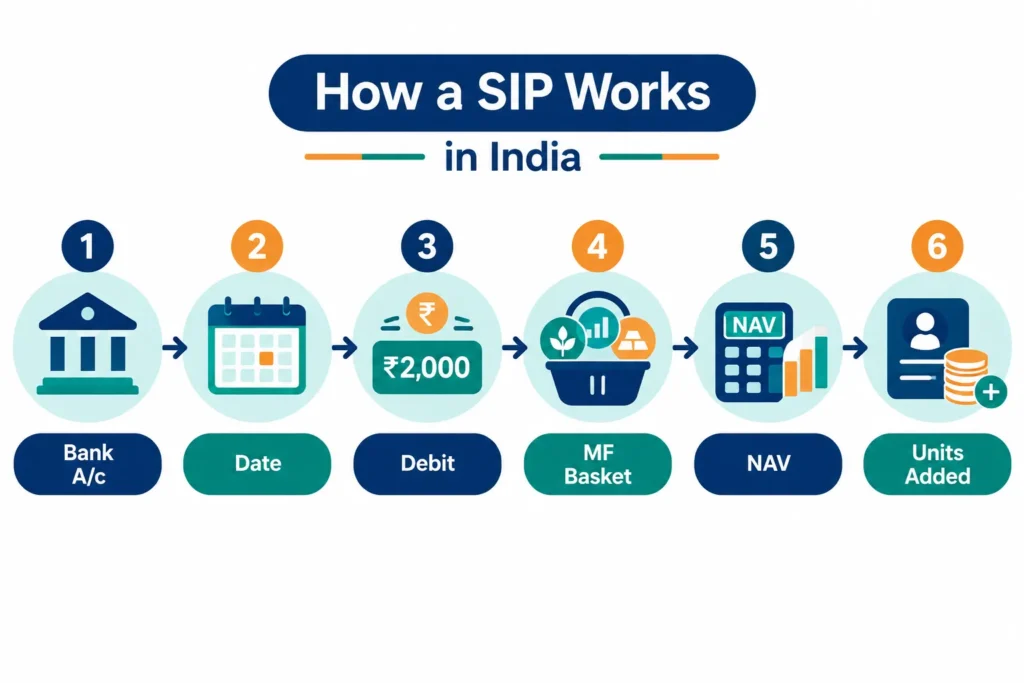
Flowchart showing a scheduled bank debit being invested in a mutual fund and converted into units at the applicable NAV.

You first choose a mutual fund scheme and complete the required investment and verification process. You then select the SIP amount, frequency and instalment date. A bank mandate is generally set up so that the amount can be debited automatically.

Suppose you start a monthly SIP of ₹2,000. On the scheduled date, ₹2,000 is debited from your registered bank account and invested in the selected mutual fund. The fund allocates units to you according to the applicable NAV.

NAV means Net Asset Value. In simple terms, it is the per-unit value of a mutual fund scheme. NAV changes as the value of the fund’s investments changes, after accounting for applicable liabilities and expenses.

The number of units purchased can be understood with a simple calculation:

Units purchased = Amount invested ÷ Applicable NAV

For example, consider three monthly instalments of ₹2,000. The following figures are simplified illustrations and do not account for matters such as applicable charges or taxes.

Month SIP instalment Illustrative NAV Units purchased
Month 1 ₹2,000 ₹20 100 units
Month 2 ₹2,000 ₹16 125 units
Month 3 ₹2,000 ₹25 80 units

When the NAV is lower, the same ₹2,000 buys more units. When the NAV is higher, it buys fewer units. In this example, you invest a total of ₹6,000 and receive 305 units over three months.

After every successful instalment, the new units are added to your mutual fund holding. Your total investment value at any later point is broadly calculated by multiplying the units you hold by the scheme’s current NAV.

The debit date and unit-allotment process are governed by the mutual fund’s applicable rules and cut-off timings. An automatic debit also requires enough money in the bank account. If the balance is insufficient, an instalment may fail, and the bank or platform may apply charges depending on its terms.

How a SIP Investment Grows Over Time
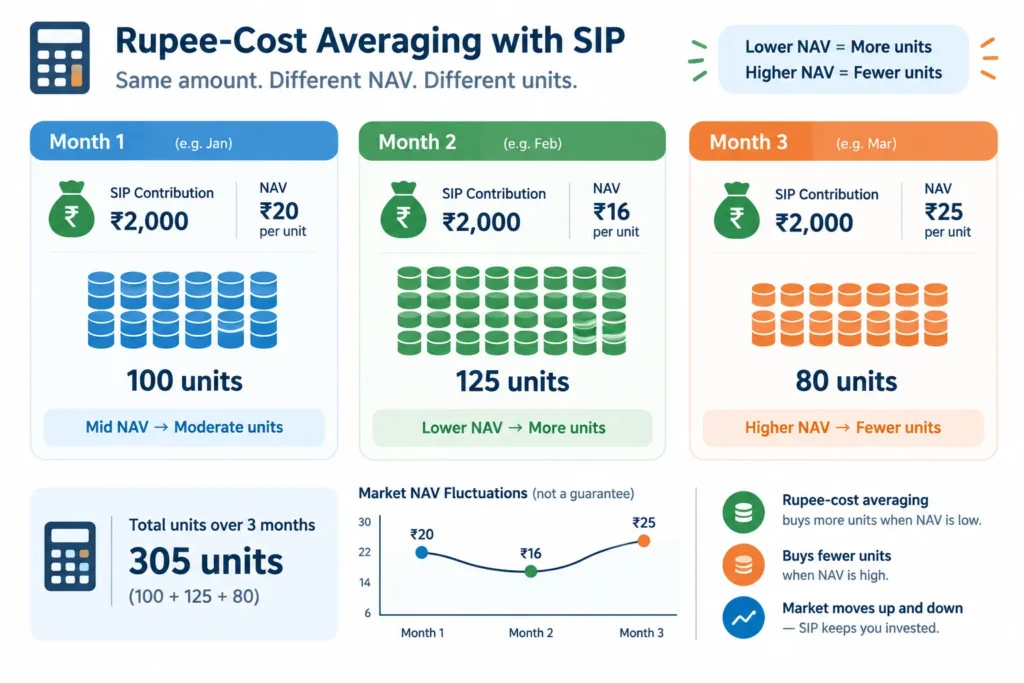
Example showing how equal ₹2,000 SIP instalments buy different numbers of mutual fund units as NAV changes.

A SIP does not grow merely because money is invested every month. Its value changes because the underlying mutual fund earns gains or suffers losses from the securities it holds. These may include shares, bonds or other permitted assets, depending on the fund category.

Regular investing can provide a benefit commonly called rupee-cost averaging. As the example shows, a fixed instalment buys more units when NAV is lower and fewer units when NAV is higher. Over many instalments, this spreads your purchases across different market levels.

Rupee-cost averaging can help manage purchase timing because you do not invest your entire amount on a single day. It may also reduce the temptation to stop investing simply because markets look uncertain.

However, it does not remove market risk or ensure a profit. A fund’s NAV can remain weak for an extended period, and the value of your units may be below the amount invested. Regular purchases cannot protect you from losses if the underlying fund performs poorly.

Compounding is another important part of long-term investing. If your mutual fund earns returns, those gains remain invested in the scheme. Future returns may then be earned on both your invested money and the gains already accumulated.

For instance, returns generated in the early years can remain invested for later years. The longer they stay invested, the more opportunity they have to participate in future growth. At the same time, negative returns can also reduce the investment value, especially over shorter periods.

This is why the investment horizon matters. Equity-oriented mutual funds generally need a longer horizon because share prices can move sharply in the short term. A longer period gives the investment more time to experience different market cycles, but it still cannot guarantee a positive result.

The eventual value of a SIP depends on several connected factors:

  • Fund performance: The returns generated by the underlying portfolio have the biggest influence on growth.
  • Investment period: Continuing for longer gives each instalment a different amount of time to grow.
  • Market conditions: Interest rates, company performance, economic events and investor sentiment can affect returns.
  • Costs: The mutual fund’s expense ratio and other applicable costs reduce the return received by investors.
  • SIP amount and consistency: The amount invested and the number of completed instalments affect the final corpus.

It is also important to understand that not every SIP instalment gets the same time to grow. In a ten-year SIP, the first instalment remains invested for almost the full period, while the final instalment may be invested for only a short time. This is why a simple calculation of total contributions does not show the complete picture.

You can use the RegularStation SIP Calculator to estimate how a monthly investment may grow under an assumed annual return rate and investment period. It can also help you compare different SIP amounts or time horizons.

Calculator results are only illustrations. Mutual fund returns are not fixed, and actual performance will not follow the same rate every year. Your final value may be higher or lower depending on fund performance, costs, market movements and the timing of each instalment.

Benefits of Investing Through a SIP

Once you understand what is SIP, the next step is to examine why many Indian investors use it. A Systematic Investment Plan allows you to invest a fixed amount in a mutual fund at regular intervals, usually every month. It is an investment method, not a separate investment product.

It encourages investing discipline

A SIP can turn investing into a regular financial habit. Instead of waiting to invest whatever remains at the end of the month, you can schedule the investment soon after receiving your salary or business income.

For example, an employee may set up a monthly SIP debit for a few days after salary day. This approach can reduce the temptation to spend the money elsewhere. However, the bank account must have enough balance on the debit date.

You May Also Like:SIP Investment in India: A Beginner’s Guide to Systematic Investment Plans

You can begin with smaller regular contributions

You do not need to wait until you have accumulated a large amount. A SIP lets you invest smaller sums over time, subject to the minimum amount accepted by the chosen mutual fund scheme.

This can be useful for beginners and people whose monthly investible surplus is limited. Smaller contributions also make it easier to include investing within a household budget.

The process can be convenient

After you register a SIP and approve the payment instruction, investments can happen automatically on the selected dates. This reduces the need to place a fresh transaction every month.

Convenience should not mean ignoring the investment. You should still review whether the mutual fund continues to match your goal, time horizon and ability to tolerate risk. You should also update the SIP if your financial situation changes.

It reduces dependence on selecting one entry date

With a SIP, your money enters the market across several dates rather than all at once. When the mutual fund’s unit price is lower, the fixed SIP amount generally buys more units. When the unit price is higher, it generally buys fewer units. This effect is often called rupee-cost averaging.

Spreading purchases can reduce your dependence on correctly choosing one market entry date. It does not remove market risk, prevent losses or guarantee better returns than a lump-sum investment.

It can support goal-based investing

You can connect a SIP to a specific financial goal, such as a child’s higher education, a home down payment or retirement. A defined goal makes it easier to decide how much to invest and how long to continue.

The final value will still depend on actual mutual fund performance. Returns are market-linked and can vary significantly. A SIP calculator may help with planning, but its projected return is only an assumption, not a promise.

Is SIP Suitable for Every Investor?

A SIP can be a practical method, but it is not automatically suitable for every person or every goal. Suitability depends on when you need the money, how much risk you can take and whether you can maintain regular contributions.

Consider the time horizon

A market-linked mutual fund can rise or fall in value. If you need the money in the very near future, you may not have enough time to recover from a market decline. A SIP into such an investment may therefore be unsuitable for an urgent or very short-term need.

For example, money required for next semester’s college fees or an insurance premium due in a few months should not be exposed to avoidable volatility merely because it can be invested through a SIP.

Match the fund with your risk tolerance

The SIP method does not make a risky mutual fund safe. It only changes how and when you invest. The underlying mutual fund may still hold equity, debt or a combination of assets, each with its own risks.

A suitable choice should reflect your goal, investment period and comfort with temporary losses. If a fall in value is likely to make you stop investing or withdraw in panic, you may need to reconsider the level of risk.

Check whether your cash flow is dependable

A regular SIP creates a recurring commitment. This may be difficult for someone with highly irregular income, uncertain employment or little room in the monthly budget.

Freelancers and business owners can still use SIPs, but they may need a more cautious amount and a sufficient cash buffer. Setting an aggressive SIP that regularly causes bank-balance problems can create stress and may lead to missed instalments.

Before committing to a SIP, ask:

  • Do I know the goal for this investment?
  • Can I leave the money invested for the required period?
  • Can I tolerate changes in its market value?
  • Can I make the contribution without missing essential expenses or debt payments?
  • Do I have emergency savings for unexpected costs?

How Much Should You Invest Through a SIP?

There is no universal SIP amount or percentage that is correct for everyone. Two people with the same salary may have very different rent, family responsibilities, loans and financial goals. Your SIP amount should come from your actual budget rather than a popular rule.

Start with monthly cash flow

Calculate your normal take-home income and subtract essential expenses. These may include rent, groceries, utility bills, school fees, transport, insurance premiums and basic healthcare costs.

Next, account for loan repayments and other compulsory commitments. Do not set a SIP amount that depends on using a credit card or taking a loan to meet routine expenses later in the month.

You May Also Like:PPF vs ELSS: Understanding the Key Differences for Indian Investors

Protect emergency savings first

An emergency fund is meant for events such as a medical bill, job loss or urgent home repair. Without an adequate buffer, you may be forced to redeem mutual fund units during a market decline or stop the SIP when an emergency occurs.

Building emergency savings and investing need not always happen in a rigid sequence. However, the SIP should not leave you without accessible money for genuine emergencies.

Work backwards from financial goals

Write down the goal amount, target date and current savings available for that goal. You can then estimate the monthly investment needed using a reasonable return assumption. Because future returns are uncertain, review the calculation periodically.

If the estimated SIP is unaffordable, do not strain your budget. You may need to extend the timeline, revise the goal amount, use future income increases or combine regular contributions with occasional additional investments.

Choose a sustainable starting amount

A smaller SIP that you can maintain may be more practical than a large amount that you frequently pause. You can increase the contribution when your salary rises or a loan ends. You can also reduce it if essential responsibilities increase.

A simple decision order is:

  1. Cover essential household expenses.
  2. Make required loan and insurance payments.
  3. Maintain appropriate emergency savings.
  4. List and prioritise financial goals.
  5. Allocate an affordable amount to each goal.
  6. Review the amount after major income or life changes.

SIP vs Lump-Sum Investment
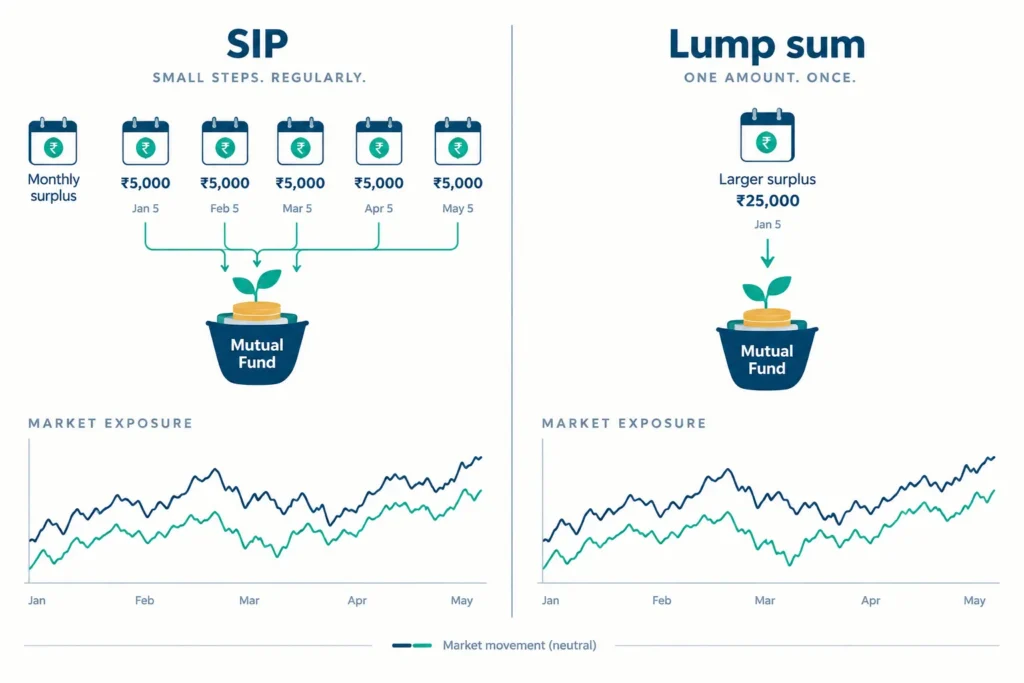
Comparison of a SIP investing smaller amounts across multiple dates with a lump sum invested on one date.

A SIP invests money over multiple dates, while a lump-sum investment puts a larger available amount to work in one transaction. Neither method is always superior. The appropriate choice depends on cash availability, market exposure and behavioural comfort.

Factor SIP Lump sum
Cash availability Suited to money available gradually, such as monthly salary surplus Suited to money already available, such as accumulated savings
Entry timing Spreads purchases across several dates Invests at one market level and on one date
Market timing exposure Reduces dependence on selecting one entry point Outcome can be more sensitive to the initial entry date
Volatility experience Later instalments may buy more units after a market fall The full invested amount experiences market movements immediately
Behavioural comfort May feel easier for investors who prefer gradual investing May suit investors comfortable deploying available money at once

A lump sum invested before a market rise may benefit because the entire amount is invested earlier. It can also experience a larger immediate decline if the market falls soon after investment. A SIP spreads the entry points, but it cannot guarantee protection from losses.

Keeping a large sum uninvested only because you are waiting for the “perfect” date also carries a cost: the money may remain idle while markets move. On the other hand, investing the entire amount immediately may be uncomfortable for someone worried about short-term volatility.

The choice should therefore be based on when the money becomes available, the purpose of the investment and how you are likely to behave during market movements. In either case, the mutual fund itself must match your goal, time horizon and risk tolerance. The payment method cannot compensate for choosing an unsuitable investment.

Common SIP Mistakes Beginners Should Avoid

Understanding what is SIP is only the first step. A Systematic Investment Plan can help you invest regularly, but the outcome also depends on the mutual fund you select, your investment period and your behaviour during market movements.

Starting Without a Clear Goal

A SIP should ideally be linked to a goal. Examples include building an emergency reserve, funding a child’s higher education, making a home down payment or preparing for retirement.

Without a goal, it becomes difficult to decide how much to invest, how long to continue and how much risk may be suitable. You may also stop the SIP for non-essential spending because the money has no defined purpose.

Ignoring Your Risk Tolerance

Different mutual fund categories carry different levels of risk. An equity-oriented fund may fluctuate sharply in the short term, while some debt-oriented funds may be relatively less volatile but still carry risks.

Do not choose a high-risk fund simply because another investor earned good returns from it. Consider your financial position, investment horizon and ability to remain invested when the value falls.

Selecting a Fund Only From Recent Returns

A fund that performed well recently may not continue delivering the same results. Recent returns can be influenced by market conditions, a particular sector’s performance or the investment style followed by the fund.

Before investing, understand the fund’s objective, portfolio, risk level, benchmark, expenses and suitability for your goal. Past performance may provide context, but it is not a promise of future returns.

You May Also Like:The Complete Guide to Loans and EMIs in India

Stopping the SIP During Every Market Fall

Market declines can feel uncomfortable, especially for a new investor. However, stopping every time prices fall can work against the discipline that a SIP is designed to create.

When the applicable purchase price is lower, the same SIP amount can buy more units. This does not guarantee a profit, but it may help average the purchase cost over time. A temporary fall alone is not always a reason to stop. Review whether your goal, time horizon, risk tolerance or the fund’s fundamentals have changed.

Expecting Fixed or Guaranteed Returns

A SIP is only a method of investing. It is not a fixed deposit and does not create a guaranteed return. The value of your units moves according to the performance of the underlying mutual fund portfolio.

Return calculators may help with planning, but their results are illustrations based on assumed rates. Your actual return can be higher or lower, and you may also face a loss.

Investing More Than Your Budget Allows

An unrealistically high SIP can strain your monthly cash flow. If rent, loan repayments or essential expenses become difficult to manage, you may be forced to stop the investment or withdraw at an unsuitable time.

Choose an amount that you can continue through ordinary financial ups and downs. You can consider increasing it later if your income rises and your budget permits.

Never Reviewing the Investment

A SIP should not be checked every day, but it should not be forgotten completely either. Review it periodically to see whether the fund remains suitable, the goal is on track and your personal circumstances have changed.

A review does not mean switching funds whenever another scheme reports a better recent return. Frequent changes can encourage performance chasing and may have cost or tax implications.

How to Start a SIP in India

The exact process can differ across mutual fund companies and investment platforms. However, most beginners can use the following steps as a practical starting framework.

1. Define the Goal and Time Horizon

Write down what you are investing for and when the money may be needed. For example, a holiday planned next year has a very different horizon from retirement planned decades later.

The time horizon helps you consider how much volatility you may be able to accept. Avoid using a long-term, high-risk investment for money that may be required soon.

2. Assess Your Risk Tolerance

Think about both your willingness and your financial ability to accept losses. A person may say they are comfortable with risk but panic after seeing a sharp fall. Another investor may have a stable income and a long horizon but still prefer moderate fluctuations.

Also consider existing loans, emergency savings, dependants and other investments. If you are unsure about fund suitability, consider obtaining guidance from an appropriately qualified professional.

3. Understand the Mutual Fund

Read the available scheme information before making the selection. Check what the fund aims to do, where it invests, the main risks, applicable expenses and whether any exit-related conditions apply.

Do not assume that all SIPs are identical. Your experience will depend on the mutual fund scheme into which the instalments are invested.

4. Complete the Required KYC Process

Investors generally need to complete the applicable Know Your Customer process before investing. This commonly involves submitting identity, address and other required information through the permitted process.

Follow the instructions provided by the mutual fund company or investment platform. Requirements and verification methods can change, so rely on current official documentation rather than old social media posts.

5. Select an Affordable Amount and Date

Choose an instalment amount that fits comfortably within your monthly budget. Some schemes allow relatively small SIPs, although the minimum amount can vary.

Select a date that works with your cash flow. For a salaried investor, a date after salary credit may be convenient. Keep enough money in the linked bank account before each scheduled debit.

You May Also Like:How Credit Score Affects Your Loan Eligibility and Interest Rate

6. Set Up the Payment Instruction

Complete the payment mandate or other supported instruction through your chosen platform. Check the bank account details, SIP frequency, instalment amount, start date and scheme name before confirming.

A payment instruction makes investing convenient, but it does not remove your responsibility to maintain sufficient funds or monitor failed transactions.

7. Check the First Unit Allotment

After the first payment is processed, check the transaction statement or account record. Confirm that the money was invested in the intended scheme and that units were allotted according to the applicable process.

If the payment was debited but the transaction is not reflected after the expected processing period, contact the relevant mutual fund company or platform.

8. Review Progress Without Reacting to Every Movement

Review the SIP periodically against its goal. Ask whether the required amount or deadline has changed, whether your income supports an increase and whether the selected fund remains suitable.

Avoid taking action based on every news headline or daily market fall. For long-term goals, disciplined investing and occasional structured reviews are generally more useful than constant portfolio changes.

Frequently Asked Questions

Are SIP returns guaranteed?

No. A SIP does not guarantee returns. It invests money in a mutual fund, and the value can rise or fall depending on the underlying investments and market conditions.

Can I start a SIP with ₹500?

Some mutual fund schemes may allow a SIP of ₹500 or another small amount. The minimum instalment depends on the scheme and the platform’s supported process. Check the current scheme details before registering.

Can I change or pause my SIP instalments?

Many platforms and schemes provide processes for changing, pausing or cancelling SIP instructions. The options, notice periods and procedures can vary. A pause stops scheduled investments temporarily; it does not automatically redeem units already purchased.

What happens to my SIP when markets fall?

Your existing investment value may decline. At the same time, a fixed instalment may purchase more units when the applicable unit price is lower. This can support cost averaging, but it cannot eliminate risk or guarantee recovery.

Can a SIP make a loss?

Yes. A SIP can show a temporary or permanent loss, particularly if markets decline, the selected investment performs poorly or you redeem at an unfavourable time. Investing regularly reduces the risk of putting all your money into the market on one date, but it does not remove investment risk.

Is SIP better than lump-sum investing?

Neither method is automatically better for everyone. A SIP may suit people who receive regular income, want to build investing discipline or prefer to spread purchases over time. A lump-sum investment may be considered when money is already available and the investor is comfortable investing it at once.

The appropriate choice depends on cash availability, risk tolerance, market exposure, the selected fund and the goal’s time horizon. Some investors may also use a combination of both methods.

Summary

A SIP is a structured way to invest a chosen amount in a mutual fund at regular intervals. Beginners should connect it to a goal, select a suitable fund, invest an affordable amount and continue with discipline rather than chasing recent returns.

Complete the required KYC process, verify the first transaction and review progress periodically. Remember that a SIP is an investment method, not a return-guaranteeing product. Mutual fund investments are subject to market risk, and returns can vary.


Share this article
KEEP READING

Related Articles

View all →

Comments

Leave a Comment

What Is a SIP? How Systematic Investment Plans Work in India

Quick Answer: What Is SIP?

A Systematic Investment Plan, or SIP, is a method of investing a fixed amount at regular intervals, usually in a mutual fund. For example, you may invest ₹2,000 every month in an equity mutual fund through an automatic bank debit.

If you are planning a loan alongside your savings goals, you can use our EMI Calculator to estimate monthly repayments and total interest.

A SIP is not a separate investment product. It is simply a way to invest in a mutual fund gradually instead of investing a large amount at one time. After every instalment, you receive mutual fund units based on the fund’s current Net Asset Value, or NAV.

Your investment value can rise or fall because mutual funds are linked to financial markets. Investing regularly may reduce the problem of trying to choose the perfect time to invest, but it does not remove risk or guarantee profits.

Introduction

Many beginners believe they need a large amount of money to start investing. A SIP makes it possible to begin with a smaller amount and continue investing regularly from monthly income.

This is one reason SIPs are popular among salaried people in India. An investor can select a mutual fund, choose an instalment amount and set a monthly date. The amount is then usually deducted automatically from the investor’s bank account.

However, convenience should not be confused with safety. A SIP only changes how and when you invest. The risk still depends on the mutual fund you select. For example, an equity fund can experience significant market fluctuations, while a debt fund has a different set of risks.

To understand whether this approach is suitable, you first need to know what happens to your money after each instalment and how the investment may grow over time.

SIP Basics and How the Investment Works

What Is a SIP?

SIP stands for Systematic Investment Plan. It is an arrangement through which you invest money at fixed intervals in a mutual fund scheme. Monthly SIPs are common, although some mutual funds may also offer weekly, quarterly or other available frequencies.

The key word is “systematic”. Instead of investing only when you remember or when the market looks attractive, you follow a planned schedule. This can help create a regular investing habit.

A basic SIP has three main elements:

  • Investment amount: The sum you decide to invest in each instalment, such as ₹2,000 per month.
  • Investment frequency: How often the instalment is made, such as monthly or quarterly.
  • Mutual fund scheme: The specific fund in which your money is invested.

The mutual fund is the actual investment product. The SIP is only the method used to purchase units of that fund. You can usually invest in the same scheme through a lump sum as well, subject to the scheme’s rules.

This distinction matters because there is no single “SIP return”. Returns depend on the underlying mutual fund. Two people investing the same monthly amount through SIPs can have very different results if they select different funds.

How Does a SIP Work?

Flowchart showing a scheduled bank debit being invested in a mutual fund and converted into units at the applicable NAV.

You first choose a mutual fund scheme and complete the required investment and verification process. You then select the SIP amount, frequency and instalment date. A bank mandate is generally set up so that the amount can be debited automatically.

Suppose you start a monthly SIP of ₹2,000. On the scheduled date, ₹2,000 is debited from your registered bank account and invested in the selected mutual fund. The fund allocates units to you according to the applicable NAV.

NAV means Net Asset Value. In simple terms, it is the per-unit value of a mutual fund scheme. NAV changes as the value of the fund’s investments changes, after accounting for applicable liabilities and expenses.

The number of units purchased can be understood with a simple calculation:

Units purchased = Amount invested ÷ Applicable NAV

For example, consider three monthly instalments of ₹2,000. The following figures are simplified illustrations and do not account for matters such as applicable charges or taxes.

Month SIP instalment Illustrative NAV Units purchased
Month 1 ₹2,000 ₹20 100 units
Month 2 ₹2,000 ₹16 125 units
Month 3 ₹2,000 ₹25 80 units

When the NAV is lower, the same ₹2,000 buys more units. When the NAV is higher, it buys fewer units. In this example, you invest a total of ₹6,000 and receive 305 units over three months.

After every successful instalment, the new units are added to your mutual fund holding. Your total investment value at any later point is broadly calculated by multiplying the units you hold by the scheme’s current NAV.

The debit date and unit-allotment process are governed by the mutual fund’s applicable rules and cut-off timings. An automatic debit also requires enough money in the bank account. If the balance is insufficient, an instalment may fail, and the bank or platform may apply charges depending on its terms.

How a SIP Investment Grows Over Time

Example showing how equal ₹2,000 SIP instalments buy different numbers of mutual fund units as NAV changes.

A SIP does not grow merely because money is invested every month. Its value changes because the underlying mutual fund earns gains or suffers losses from the securities it holds. These may include shares, bonds or other permitted assets, depending on the fund category.

Regular investing can provide a benefit commonly called rupee-cost averaging. As the example shows, a fixed instalment buys more units when NAV is lower and fewer units when NAV is higher. Over many instalments, this spreads your purchases across different market levels.

Rupee-cost averaging can help manage purchase timing because you do not invest your entire amount on a single day. It may also reduce the temptation to stop investing simply because markets look uncertain.

However, it does not remove market risk or ensure a profit. A fund’s NAV can remain weak for an extended period, and the value of your units may be below the amount invested. Regular purchases cannot protect you from losses if the underlying fund performs poorly.

Compounding is another important part of long-term investing. If your mutual fund earns returns, those gains remain invested in the scheme. Future returns may then be earned on both your invested money and the gains already accumulated.

For instance, returns generated in the early years can remain invested for later years. The longer they stay invested, the more opportunity they have to participate in future growth. At the same time, negative returns can also reduce the investment value, especially over shorter periods.

This is why the investment horizon matters. Equity-oriented mutual funds generally need a longer horizon because share prices can move sharply in the short term. A longer period gives the investment more time to experience different market cycles, but it still cannot guarantee a positive result.

The eventual value of a SIP depends on several connected factors:

  • Fund performance: The returns generated by the underlying portfolio have the biggest influence on growth.
  • Investment period: Continuing for longer gives each instalment a different amount of time to grow.
  • Market conditions: Interest rates, company performance, economic events and investor sentiment can affect returns.
  • Costs: The mutual fund’s expense ratio and other applicable costs reduce the return received by investors.
  • SIP amount and consistency: The amount invested and the number of completed instalments affect the final corpus.

It is also important to understand that not every SIP instalment gets the same time to grow. In a ten-year SIP, the first instalment remains invested for almost the full period, while the final instalment may be invested for only a short time. This is why a simple calculation of total contributions does not show the complete picture.

You can use the RegularStation SIP Calculator to estimate how a monthly investment may grow under an assumed annual return rate and investment period. It can also help you compare different SIP amounts or time horizons.

Calculator results are only illustrations. Mutual fund returns are not fixed, and actual performance will not follow the same rate every year. Your final value may be higher or lower depending on fund performance, costs, market movements and the timing of each instalment.

Benefits of Investing Through a SIP

Once you understand what is SIP, the next step is to examine why many Indian investors use it. A Systematic Investment Plan allows you to invest a fixed amount in a mutual fund at regular intervals, usually every month. It is an investment method, not a separate investment product.

It encourages investing discipline

A SIP can turn investing into a regular financial habit. Instead of waiting to invest whatever remains at the end of the month, you can schedule the investment soon after receiving your salary or business income.

For example, an employee may set up a monthly SIP debit for a few days after salary day. This approach can reduce the temptation to spend the money elsewhere. However, the bank account must have enough balance on the debit date.

You can begin with smaller regular contributions

You do not need to wait until you have accumulated a large amount. A SIP lets you invest smaller sums over time, subject to the minimum amount accepted by the chosen mutual fund scheme.

This can be useful for beginners and people whose monthly investible surplus is limited. Smaller contributions also make it easier to include investing within a household budget.

The process can be convenient

After you register a SIP and approve the payment instruction, investments can happen automatically on the selected dates. This reduces the need to place a fresh transaction every month.

Convenience should not mean ignoring the investment. You should still review whether the mutual fund continues to match your goal, time horizon and ability to tolerate risk. You should also update the SIP if your financial situation changes.

It reduces dependence on selecting one entry date

With a SIP, your money enters the market across several dates rather than all at once. When the mutual fund’s unit price is lower, the fixed SIP amount generally buys more units. When the unit price is higher, it generally buys fewer units. This effect is often called rupee-cost averaging.

Spreading purchases can reduce your dependence on correctly choosing one market entry date. It does not remove market risk, prevent losses or guarantee better returns than a lump-sum investment.

It can support goal-based investing

You can connect a SIP to a specific financial goal, such as a child’s higher education, a home down payment or retirement. A defined goal makes it easier to decide how much to invest and how long to continue.

The final value will still depend on actual mutual fund performance. Returns are market-linked and can vary significantly. A SIP calculator may help with planning, but its projected return is only an assumption, not a promise.

Is SIP Suitable for Every Investor?

A SIP can be a practical method, but it is not automatically suitable for every person or every goal. Suitability depends on when you need the money, how much risk you can take and whether you can maintain regular contributions.

Consider the time horizon

A market-linked mutual fund can rise or fall in value. If you need the money in the very near future, you may not have enough time to recover from a market decline. A SIP into such an investment may therefore be unsuitable for an urgent or very short-term need.

For example, money required for next semester’s college fees or an insurance premium due in a few months should not be exposed to avoidable volatility merely because it can be invested through a SIP.

Match the fund with your risk tolerance

The SIP method does not make a risky mutual fund safe. It only changes how and when you invest. The underlying mutual fund may still hold equity, debt or a combination of assets, each with its own risks.

A suitable choice should reflect your goal, investment period and comfort with temporary losses. If a fall in value is likely to make you stop investing or withdraw in panic, you may need to reconsider the level of risk.

Check whether your cash flow is dependable

A regular SIP creates a recurring commitment. This may be difficult for someone with highly irregular income, uncertain employment or little room in the monthly budget.

Freelancers and business owners can still use SIPs, but they may need a more cautious amount and a sufficient cash buffer. Setting an aggressive SIP that regularly causes bank-balance problems can create stress and may lead to missed instalments.

Before committing to a SIP, ask:

  • Do I know the goal for this investment?
  • Can I leave the money invested for the required period?
  • Can I tolerate changes in its market value?
  • Can I make the contribution without missing essential expenses or debt payments?
  • Do I have emergency savings for unexpected costs?

How Much Should You Invest Through a SIP?

There is no universal SIP amount or percentage that is correct for everyone. Two people with the same salary may have very different rent, family responsibilities, loans and financial goals. Your SIP amount should come from your actual budget rather than a popular rule.

Start with monthly cash flow

Calculate your normal take-home income and subtract essential expenses. These may include rent, groceries, utility bills, school fees, transport, insurance premiums and basic healthcare costs.

Next, account for loan repayments and other compulsory commitments. Do not set a SIP amount that depends on using a credit card or taking a loan to meet routine expenses later in the month.

Protect emergency savings first

An emergency fund is meant for events such as a medical bill, job loss or urgent home repair. Without an adequate buffer, you may be forced to redeem mutual fund units during a market decline or stop the SIP when an emergency occurs.

Building emergency savings and investing need not always happen in a rigid sequence. However, the SIP should not leave you without accessible money for genuine emergencies.

Work backwards from financial goals

Write down the goal amount, target date and current savings available for that goal. You can then estimate the monthly investment needed using a reasonable return assumption. Because future returns are uncertain, review the calculation periodically.

If the estimated SIP is unaffordable, do not strain your budget. You may need to extend the timeline, revise the goal amount, use future income increases or combine regular contributions with occasional additional investments.

Choose a sustainable starting amount

A smaller SIP that you can maintain may be more practical than a large amount that you frequently pause. You can increase the contribution when your salary rises or a loan ends. You can also reduce it if essential responsibilities increase.

A simple decision order is:

  1. Cover essential household expenses.
  2. Make required loan and insurance payments.
  3. Maintain appropriate emergency savings.
  4. List and prioritise financial goals.
  5. Allocate an affordable amount to each goal.
  6. Review the amount after major income or life changes.

SIP vs Lump-Sum Investment

Comparison of a SIP investing smaller amounts across multiple dates with a lump sum invested on one date.

A SIP invests money over multiple dates, while a lump-sum investment puts a larger available amount to work in one transaction. Neither method is always superior. The appropriate choice depends on cash availability, market exposure and behavioural comfort.

Factor SIP Lump sum
Cash availability Suited to money available gradually, such as monthly salary surplus Suited to money already available, such as accumulated savings
Entry timing Spreads purchases across several dates Invests at one market level and on one date
Market timing exposure Reduces dependence on selecting one entry point Outcome can be more sensitive to the initial entry date
Volatility experience Later instalments may buy more units after a market fall The full invested amount experiences market movements immediately
Behavioural comfort May feel easier for investors who prefer gradual investing May suit investors comfortable deploying available money at once

A lump sum invested before a market rise may benefit because the entire amount is invested earlier. It can also experience a larger immediate decline if the market falls soon after investment. A SIP spreads the entry points, but it cannot guarantee protection from losses.

Keeping a large sum uninvested only because you are waiting for the “perfect” date also carries a cost: the money may remain idle while markets move. On the other hand, investing the entire amount immediately may be uncomfortable for someone worried about short-term volatility.

The choice should therefore be based on when the money becomes available, the purpose of the investment and how you are likely to behave during market movements. In either case, the mutual fund itself must match your goal, time horizon and risk tolerance. The payment method cannot compensate for choosing an unsuitable investment.

Common SIP Mistakes Beginners Should Avoid

Understanding what is SIP is only the first step. A Systematic Investment Plan can help you invest regularly, but the outcome also depends on the mutual fund you select, your investment period and your behaviour during market movements.

Starting Without a Clear Goal

A SIP should ideally be linked to a goal. Examples include building an emergency reserve, funding a child’s higher education, making a home down payment or preparing for retirement.

Without a goal, it becomes difficult to decide how much to invest, how long to continue and how much risk may be suitable. You may also stop the SIP for non-essential spending because the money has no defined purpose.

Ignoring Your Risk Tolerance

Different mutual fund categories carry different levels of risk. An equity-oriented fund may fluctuate sharply in the short term, while some debt-oriented funds may be relatively less volatile but still carry risks.

Do not choose a high-risk fund simply because another investor earned good returns from it. Consider your financial position, investment horizon and ability to remain invested when the value falls.

Selecting a Fund Only From Recent Returns

A fund that performed well recently may not continue delivering the same results. Recent returns can be influenced by market conditions, a particular sector’s performance or the investment style followed by the fund.

Before investing, understand the fund’s objective, portfolio, risk level, benchmark, expenses and suitability for your goal. Past performance may provide context, but it is not a promise of future returns.

Stopping the SIP During Every Market Fall

Market declines can feel uncomfortable, especially for a new investor. However, stopping every time prices fall can work against the discipline that a SIP is designed to create.

When the applicable purchase price is lower, the same SIP amount can buy more units. This does not guarantee a profit, but it may help average the purchase cost over time. A temporary fall alone is not always a reason to stop. Review whether your goal, time horizon, risk tolerance or the fund’s fundamentals have changed.

Expecting Fixed or Guaranteed Returns

A SIP is only a method of investing. It is not a fixed deposit and does not create a guaranteed return. The value of your units moves according to the performance of the underlying mutual fund portfolio.

Return calculators may help with planning, but their results are illustrations based on assumed rates. Your actual return can be higher or lower, and you may also face a loss.

Investing More Than Your Budget Allows

An unrealistically high SIP can strain your monthly cash flow. If rent, loan repayments or essential expenses become difficult to manage, you may be forced to stop the investment or withdraw at an unsuitable time.

Choose an amount that you can continue through ordinary financial ups and downs. You can consider increasing it later if your income rises and your budget permits.

Never Reviewing the Investment

A SIP should not be checked every day, but it should not be forgotten completely either. Review it periodically to see whether the fund remains suitable, the goal is on track and your personal circumstances have changed.

A review does not mean switching funds whenever another scheme reports a better recent return. Frequent changes can encourage performance chasing and may have cost or tax implications.

How to Start a SIP in India

The exact process can differ across mutual fund companies and investment platforms. However, most beginners can use the following steps as a practical starting framework.

1. Define the Goal and Time Horizon

Write down what you are investing for and when the money may be needed. For example, a holiday planned next year has a very different horizon from retirement planned decades later.

The time horizon helps you consider how much volatility you may be able to accept. Avoid using a long-term, high-risk investment for money that may be required soon.

2. Assess Your Risk Tolerance

Think about both your willingness and your financial ability to accept losses. A person may say they are comfortable with risk but panic after seeing a sharp fall. Another investor may have a stable income and a long horizon but still prefer moderate fluctuations.

Also consider existing loans, emergency savings, dependants and other investments. If you are unsure about fund suitability, consider obtaining guidance from an appropriately qualified professional.

3. Understand the Mutual Fund

Read the available scheme information before making the selection. Check what the fund aims to do, where it invests, the main risks, applicable expenses and whether any exit-related conditions apply.

Do not assume that all SIPs are identical. Your experience will depend on the mutual fund scheme into which the instalments are invested.

4. Complete the Required KYC Process

Investors generally need to complete the applicable Know Your Customer process before investing. This commonly involves submitting identity, address and other required information through the permitted process.

Follow the instructions provided by the mutual fund company or investment platform. Requirements and verification methods can change, so rely on current official documentation rather than old social media posts.

5. Select an Affordable Amount and Date

Choose an instalment amount that fits comfortably within your monthly budget. Some schemes allow relatively small SIPs, although the minimum amount can vary.

Select a date that works with your cash flow. For a salaried investor, a date after salary credit may be convenient. Keep enough money in the linked bank account before each scheduled debit.

6. Set Up the Payment Instruction

Complete the payment mandate or other supported instruction through your chosen platform. Check the bank account details, SIP frequency, instalment amount, start date and scheme name before confirming.

A payment instruction makes investing convenient, but it does not remove your responsibility to maintain sufficient funds or monitor failed transactions.

7. Check the First Unit Allotment

After the first payment is processed, check the transaction statement or account record. Confirm that the money was invested in the intended scheme and that units were allotted according to the applicable process.

If the payment was debited but the transaction is not reflected after the expected processing period, contact the relevant mutual fund company or platform.

8. Review Progress Without Reacting to Every Movement

Review the SIP periodically against its goal. Ask whether the required amount or deadline has changed, whether your income supports an increase and whether the selected fund remains suitable.

Avoid taking action based on every news headline or daily market fall. For long-term goals, disciplined investing and occasional structured reviews are generally more useful than constant portfolio changes.

Frequently Asked Questions

Are SIP returns guaranteed?

No. A SIP does not guarantee returns. It invests money in a mutual fund, and the value can rise or fall depending on the underlying investments and market conditions.

Can I start a SIP with ₹500?

Some mutual fund schemes may allow a SIP of ₹500 or another small amount. The minimum instalment depends on the scheme and the platform’s supported process. Check the current scheme details before registering.

Can I change or pause my SIP instalments?

Many platforms and schemes provide processes for changing, pausing or cancelling SIP instructions. The options, notice periods and procedures can vary. A pause stops scheduled investments temporarily; it does not automatically redeem units already purchased.

What happens to my SIP when markets fall?

Your existing investment value may decline. At the same time, a fixed instalment may purchase more units when the applicable unit price is lower. This can support cost averaging, but it cannot eliminate risk or guarantee recovery.

Can a SIP make a loss?

Yes. A SIP can show a temporary or permanent loss, particularly if markets decline, the selected investment performs poorly or you redeem at an unfavourable time. Investing regularly reduces the risk of putting all your money into the market on one date, but it does not remove investment risk.

Is SIP better than lump-sum investing?

Neither method is automatically better for everyone. A SIP may suit people who receive regular income, want to build investing discipline or prefer to spread purchases over time. A lump-sum investment may be considered when money is already available and the investor is comfortable investing it at once.

The appropriate choice depends on cash availability, risk tolerance, market exposure, the selected fund and the goal’s time horizon. Some investors may also use a combination of both methods.

Summary

A SIP is a structured way to invest a chosen amount in a mutual fund at regular intervals. Beginners should connect it to a goal, select a suitable fund, invest an affordable amount and continue with discipline rather than chasing recent returns.

Complete the required KYC process, verify the first transaction and review progress periodically. Remember that a SIP is an investment method, not a return-guaranteeing product. Mutual fund investments are subject to market risk, and returns can vary.

Leave a Comment