

Cryptocurrency risks include sudden price falls, difficulty selling some tokens, misleading promotions and the possibility of losing most or all of your investment. Crypto is considered high risk because prices can change rapidly, many tokens have little practical use, and trading often depends on market sentiment rather than established business performance.
Risk also varies widely. Bitcoin is not exposed to exactly the same risks as a newly launched meme coin. Buying crypto through a large platform is different from trading an obscure token on a small exchange. Beginners should invest only money they can afford to lose, research every asset independently and keep funds needed for rent, bills, emergencies and short-term goals out of crypto.
Introduction
Cryptocurrency can appear exciting. Prices sometimes rise quickly, trading is available around the clock, and social media is full of stories about people making large profits. However, the same market can also produce sudden and severe losses.
Understanding cryptocurrency risks is therefore an essential first step. It should come before choosing a token, opening an account or deciding how much to invest.
Crypto is not inherently fraudulent. Well-known cryptocurrencies, blockchain networks and legitimate trading platforms serve real users. However, the market is fast-moving, partly decentralised and filled with assets of very different quality. These features create risks that may not be obvious to a beginner.
This article focuses on the common dangers and the basic decisions that can help you approach crypto more carefully. Readers who are still learning the fundamentals can first refer to Cryptocurrency in India: A Complete Beginner’s Guide to Crypto. For a practical overview of the purchase process, asset selection and basic precautions, see How to Invest in Cryptocurrency in India: A Beginner’s Guide.
Understanding Cryptocurrency Risks and Why Crypto Is High Risk
What Are Cryptocurrency Risks?
Cryptocurrency risk is the possibility that a crypto-related decision will lead to a financial loss or an outcome different from what you expected. For example, the price of a token may fall after you buy it. You may also discover that there are not enough buyers when you want to sell.
There is no single risk level for the entire crypto market. The danger depends on several factors, including:
- The cryptocurrency or token you choose
- How widely it is traded
- Whether it has a genuine use
- How ownership is distributed
- The platform and type of transaction involved
- How long you plan to hold it
- How much of your savings you invest
A well-established cryptocurrency with active global trading may have lower liquidity risk than an unknown token that was launched recently. However, being established does not make any cryptocurrency safe or prevent its price from falling sharply.
Risk also depends on the investor. A ₹10,000 loss may be manageable for one person but financially damaging for another. Your income, savings, debts, dependants, upcoming expenses and emotional response to losses all matter.
Why Is Cryptocurrency Considered a High-Risk Asset?
Crypto is considered a high-risk asset class mainly because prices can be extremely volatile. Volatility means that prices move up or down, sometimes by a large amount within a short period.
A token can rise rapidly because of positive news, market excitement or online attention. It can fall just as quickly when sentiment changes. Unlike a fixed deposit, crypto does not offer an assured rate of return. Unlike money in a savings account, its market value is not stable.
Suppose an Indian beginner invests ₹25,000 after seeing a cryptocurrency rise for several days. If the market suddenly falls, the holding may lose a substantial part of its value before the investor has time to react. Waiting does not guarantee recovery. Some crypto assets never return to their previous prices.
This means significant loss and even total loss are possible. A token can become nearly worthless if users lose interest, development stops, trading platforms remove it or its underlying project fails. Investors should not assume that every fall is temporary.
Market Risk: The Entire Market Can Move Against You
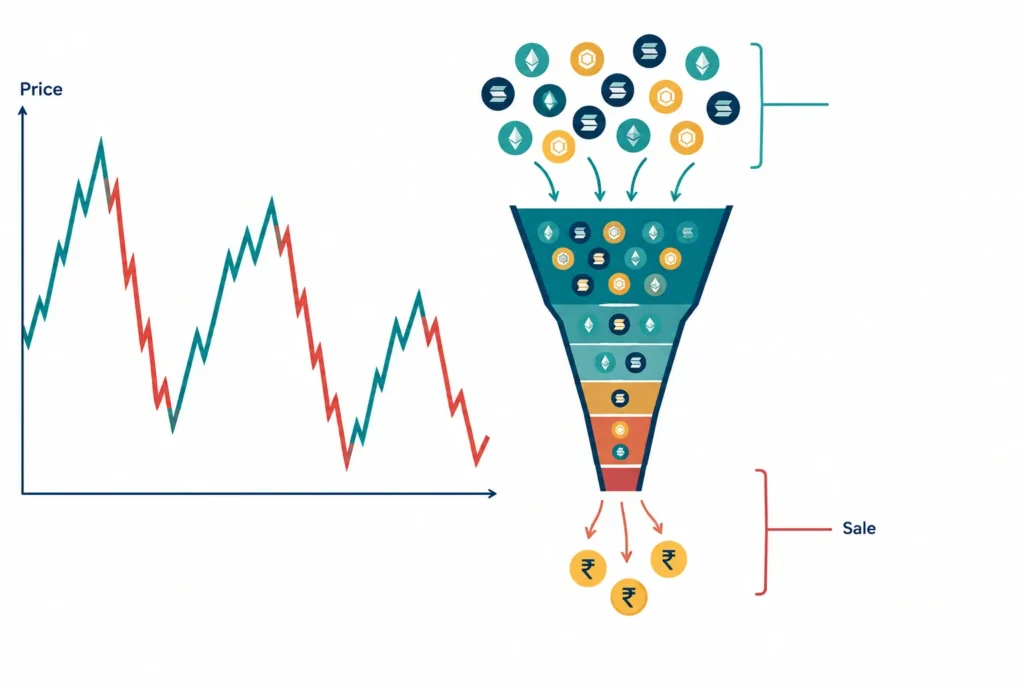
Market risk is the possibility of losing money because crypto prices broadly move in an unfavourable direction. Even a project that appears useful can decline during a wider market sell-off.
Crypto prices may react to changes in investor confidence, economic conditions, major industry events or developments affecting large cryptocurrencies. Assets can also move together. Owning several different tokens does not necessarily provide effective diversification if all of them fall at the same time.
Beginners may be tempted to buy after a strong rally because they fear missing out. This is commonly called FOMO, or fear of missing out. Buying only because prices are rising can result in entering near a short-term peak.
The opposite problem occurs during a fall. An investor may panic and sell after a steep decline, turning a temporary paper loss into an actual loss. A basic plan made before investing can reduce impulsive decisions, but it cannot remove market risk.
Liquidity Risk: The Displayed Price May Not Be Your Selling Price
Liquidity describes how easily an asset can be bought or sold without causing a major change in its price. A cryptocurrency with many active buyers and sellers is generally more liquid than a thinly traded token.
Liquidity matters because the price shown on an app is not always the price you will receive. It may represent the most recent trade or the best available order for only a small quantity.
Imagine that a beginner buys an obscure token at a displayed price of ₹10. Negative news then causes a sudden fall. The app may briefly show a price near ₹7, but there may be very few buyers willing to purchase at that level. To sell the full holding immediately, the investor might have to accept ₹6, ₹5 or less.
The gap between the expected trading price and the actual execution price is known as slippage. Slippage can become worse when trading activity is low or markets are moving quickly.
This is why a token’s quoted price alone does not show whether it can be sold easily. Before buying, investors should look at trading activity, available buy and sell orders, and whether the token is supported by established platforms. High reported trading volume should also be viewed carefully rather than accepted without question.
Why Meme Coins and Speculative Tokens Need Extra Caution
Meme coins are cryptocurrencies built around internet jokes, characters, trends or online communities. Some develop active communities, but many have weak utility and prices driven mainly by attention.
A speculative token may rise because users expect other people to buy it at a higher price. If interest disappears, demand can fall quickly. There may be no established business, cash flow or widely used product to support the valuation.
Concentrated ownership is another concern. If a small number of wallets hold a large share of a token, those holders may have significant influence over the market. A large sale by one holder can put heavy pressure on the price.
Common warning signs include:
- Promises of unusually fast or guaranteed returns
- Heavy promotion with little explanation of practical use
- Anonymous or unclear project leadership
- A very small number of wallets controlling much of the supply
- Pressure to buy immediately before a supposed price surge
- Claims that the token can only rise
A low token price does not automatically mean the asset is cheap. A token priced below ₹1 can still be overvalued if an enormous number of tokens exist. Investors should consider the total supply, ownership pattern, purpose and actual adoption rather than focusing only on the price of one unit.
Do Not Treat Social-Media Tips as Research
Crypto ideas spread rapidly through messaging groups, short videos, online forums and influencer accounts. A confident presentation can make a speculative claim sound reliable, but popularity is not proof.
The person promoting a token may already own it and benefit if followers buy. A celebrity appearance or influencer endorsement does not confirm that the project is useful, fairly valued or suitable for your finances. Promotional content may also fail to explain conflicts of interest or the risk of loss.
Before acting on a tip, independently check what the token does, who controls the project, how the supply is distributed and where genuine demand comes from. Read more than one source and look for evidence that challenges the positive claims.
If you cannot explain in simple words why an asset may have lasting value, avoid buying it only because someone online expects the price to rise.
Match Crypto Investing With Your Financial Position
No cryptocurrency is important enough to risk essential household money. Do not invest funds needed for rent, loan payments, school fees, insurance premiums, medical costs, utility bills or regular living expenses.
Emergency savings should also remain accessible and relatively stable. Crypto may fall exactly when you need money, forcing you to sell at a loss. Funds intended for a near-term goal, such as an upcoming wedding, course fee or home deposit, are generally unsuitable for a highly volatile asset.
Before investing, ask how much loss you can absorb without borrowing, missing a payment or disturbing an important goal. Also consider whether a sharp fall would cause you to panic, lose sleep or make rushed decisions.
Being able to afford a purchase is not the same as being able to afford the risk. A cautious beginner should first build a financial foundation, understand the asset and decide on a strict limit. Crypto should never depend on money that your household cannot comfortably lose.
Scams, Wallet Threats, Exchange Failures and Technology Risks
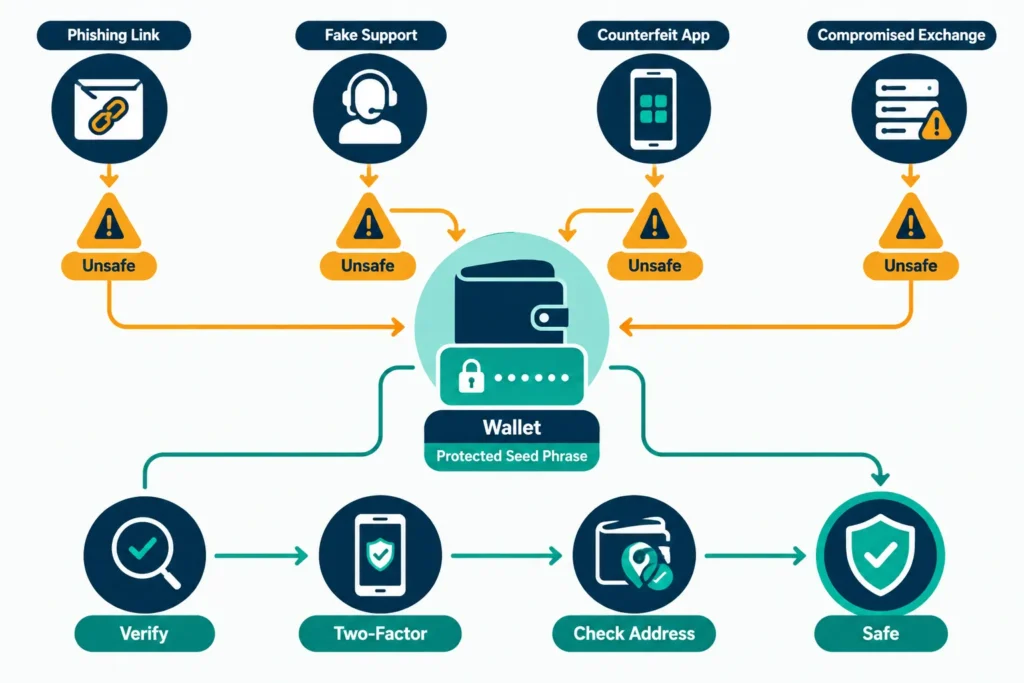
Some of the most serious cryptocurrency risks come from scams, stolen wallet access, platform failures and technical mistakes. Unlike many bank payments, a crypto transaction may be difficult or impossible to reverse. If coins are sent to a fraudster or the wrong wallet address, there may be no bank or central authority that can cancel the transfer.
This does not mean every crypto service is unsafe. It means investors must check who they are dealing with, protect account credentials and understand where their assets are stored.
Common Cryptocurrency Scams
Crypto scams often use familiar tricks rather than advanced technology. Fraudsters may create urgency, promise unusually high profits or pretend to be someone trustworthy.
Common examples include:
- Fake investment plans: A website, social media group or messaging-channel administrator may ask you to deposit crypto into a scheme. The dashboard may show false profits, but withdrawals are blocked unless you pay additional “taxes” or “fees”.
- Guaranteed-return promises: A person may claim that a crypto trading system will double your money or provide a fixed daily return. Crypto prices are unpredictable, so guaranteed high profits are a major warning sign.
- Impersonation scams: Fraudsters may pose as celebrities, government officials, financial experts, exchange employees or well-known business leaders. They may use copied photographs, fake profiles or edited videos.
- Romance and trust-building scams: A stranger may spend weeks building a friendship or romantic relationship before recommending a crypto platform. The platform may be controlled by the scammer.
- Pump-and-dump schemes: A group may promote a little-known token to push up its price. Early holders then sell their tokens, causing the price to collapse and leaving later buyers with losses.
- Fake giveaways: A post may ask you to send a small amount of crypto to receive a larger amount in return. Genuine giveaways do not require you to transfer funds first to “verify” your wallet.
Do not rely on screenshots of profits, follower counts, celebrity images or positive comments as proof. These can be purchased, copied or fabricated. Search for independent information and verify claims through official sources.
Phishing, Fake Support and Counterfeit Apps
Phishing messages try to make you reveal a password, one-time password, private key or seed phrase. A message may say that your exchange account will be frozen unless you act immediately. It may include a link to a fake login page that looks similar to the real website.
Social engineering is a related threat. Instead of breaking the technology, the scammer manipulates the user. For example, someone claiming to be from customer support may ask you to install a screen-sharing app, disclose an OTP or approve a wallet transaction.
Fake customer-support accounts are especially common on social media. A user posts about a withdrawal problem, and a fraudster quickly replies while pretending to represent the exchange. Genuine support staff should not ask for your wallet seed phrase or demand payment to unlock your account.
Counterfeit apps, websites and wallets can also steal funds. A fake app may copy the name, colours and logo of a genuine service. Before installing an app, check the publisher’s name, download history, permissions and listing details. Reach the download page through the company’s official communication channels rather than an advertisement or an unknown message.
When visiting a familiar crypto service, type the known address carefully or use a trusted bookmark. Small spelling changes can lead to an imitation website. Avoid clicking urgent account links received through email, SMS, messaging apps or social media.
A few simple rules can reduce scam risk:
- Reject promises of guaranteed profits or risk-free returns.
- Do not send crypto because a stranger creates urgency or fear.
- Verify support contacts through the platform’s official app or website.
- Never disclose passwords, OTPs, private keys or seed phrases.
- Test an unfamiliar withdrawal process with a small amount first.
- Read every wallet approval request before confirming it.
- Stop if someone asks you to install remote-access or screen-sharing software.
Private Keys and Seed Phrases
A private key is secret information that allows crypto in a wallet to be controlled and transferred. A seed phrase, sometimes called a recovery phrase, is a set of words that can restore access to a wallet and its associated private keys.
Anyone who obtains a seed phrase may be able to recreate the wallet on another device and move the funds. Changing an exchange password may not stop them because control of a self-managed wallet depends on the private keys, not on an ordinary customer account.
Never share a seed phrase with support staff, friends, online forms or websites. Do not enter it after following a link in an unexpected message. Genuine wallet support should not need it to investigate a problem.
Store the phrase privately in a form that is protected from theft, fire, water damage and accidental disposal. Saving it in email, cloud notes or an unprotected photograph may expose it if the account or device is compromised. However, using a personal wallet also creates responsibility: if the seed phrase is lost and no working backup exists, recovery may be impossible.
Beginners who need a fuller explanation of custody, recovery phrases and wallet choices can refer to Crypto Wallets in India: Types, How They Work and How to Choose One. Bitcoin holders should also understand Bitcoin security practices before moving meaningful amounts into self-custody.
Exchange and Platform Risks
Keeping crypto on an exchange is convenient for buying, selling and tracking holdings. However, the platform generally controls the wallets used to hold customer assets. Your balance is therefore dependent on the exchange’s security, operations and financial condition.
An exchange may experience a cyberattack, technical outage or account compromise. It may temporarily restrict withdrawals because of maintenance, liquidity problems, compliance checks or unusual market activity. In a severe case, an insolvent platform may not hold enough accessible assets to meet customer withdrawal requests.
Recovery options can be limited. Crypto platforms do not automatically provide the same protections that people may associate with regulated bank deposits. Terms, safeguards and legal rights differ across providers and jurisdictions.
Users also face account-level risks. A reused password, compromised email account or stolen SIM could help an attacker access an exchange account. Use a unique password, enable strong two-factor authentication where available and secure the linked email account. Review withdrawal alerts and account activity regularly.
Crypto Exchanges in India: How They Work and How to Choose One explains how to compare platforms, fees, security controls and withdrawal processes. Choosing carefully reduces some risks, but it cannot remove platform risk completely.
Custody: Platform or Personal Wallet?
Custody refers to who controls the private keys. Leaving assets on a platform gives the platform custody. Moving them to a personal wallet usually gives the user direct control.
| Storage choice | Main advantage | Main risk |
|---|---|---|
| Exchange or custodial platform | Convenient trading and account-based access | Platform failure, withdrawal restrictions or account compromise |
| Personal wallet | Direct control of private keys | Loss, theft or misuse of the seed phrase and signing mistakes |
Neither option removes risk. A beginner may find platform custody easier, while an experienced user may prefer personal control. The choice should reflect the amount held, the purpose of holding it and the investor’s ability to secure backups. Do not move funds into self-custody until you understand wallet addresses, network selection, transaction fees and recovery.
Smart Contracts, DeFi and Bridge Risks
Smart contracts are programs that perform actions on a blockchain. They are used by decentralised finance, or DeFi, services for activities such as swapping tokens, lending and borrowing. These services can fail because of coding flaws, poor design, manipulated price data or malicious developers.
A wallet may also request permission to spend tokens. Some permissions are broad and remain active after the immediate transaction. A malicious website or compromised protocol could use such permission to remove assets. Investors should check what they are approving and avoid signing transactions they do not understand.
Crypto bridges move assets or information between blockchain networks. They add another technical layer and can become targets for attacks. A failure may affect the bridge itself or the tokens that represent bridged assets.
Complex DeFi products may combine borrowing, leverage, token rewards and automated liquidations. A user can lose money even if the service is not an outright scam. Protocol failure, sharp price movements, changing collateral values or an incorrect transaction can all cause losses. A detailed guide to DeFi risks is useful before using these products.
The practical rule is simple: do not connect your wallet, approve permissions or transfer funds merely because a product offers attractive rewards. Start with small amounts, understand each step and confirm the network and recipient address. Technical transactions can be final, so careful checking before approval is far more effective than trying to recover funds afterwards.
Due Diligence, Safety Checklist, Indian Rules and Beginner FAQs
Understanding cryptocurrency risks is not enough. Beginners also need a practical process for checking an asset, protecting accounts and avoiding preventable mistakes. These steps cannot remove every risk, but they can reduce the chance of losing money through fraud, poor decisions or security failures.
Common Cryptocurrency Mistakes Beginners Make
Many losses begin with simple mistakes rather than complex technical problems. Watch out for the following behaviours:
- Investing because of fear of missing out: A rapidly rising price can create pressure to buy immediately. This often leads to buying without research or entering after a large price increase.
- Buying unknown tokens: A low price per token does not mean that a token is cheap or undervalued. Supply, utility, ownership concentration and trading liquidity also matter.
- Putting too much money into one asset: Concentration increases the impact if that cryptocurrency fails, loses demand or faces a technical problem.
- Using borrowed funds: Crypto prices can fall sharply while loan repayments continue. Leverage and borrowing can turn a market loss into a wider financial problem.
- Ignoring fees and liquidity: Trading, withdrawal and network fees may reduce returns. Low liquidity can make it difficult to sell at the expected price.
- Reusing passwords: If another website suffers a data breach, attackers may try the same password on a crypto account.
- Skipping two-factor authentication: A password alone may not provide sufficient account protection.
- Storing a seed phrase carelessly: Screenshots, cloud notes and unencrypted digital files can be exposed through hacking, malware or account compromise.
- Using the wrong blockchain network: Sending an asset to an unsupported address or network can result in a difficult recovery process or permanent loss.
Avoid making decisions only because an influencer, friend or online group expects a token to rise. Genuine research should examine both the potential use of an asset and the ways in which the investment could fail.
A Basic Due-Diligence Process
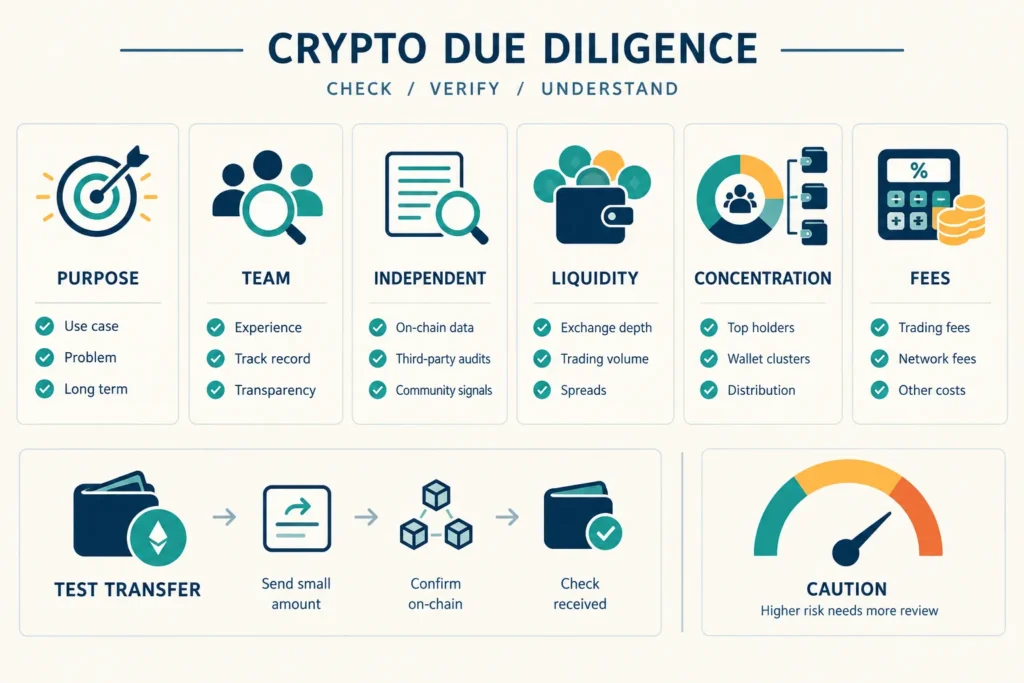
Crypto projects vary widely. Some support established blockchain networks, while others may have limited use, weak governance or misleading promotion. Before buying, work through a basic review.
- Understand the purpose: Identify what the cryptocurrency or token is designed to do. Be cautious if its purpose cannot be explained clearly without marketing language.
- Review who controls or develops it: Check whether the development team, foundation, company or community can be identified. Anonymous developers are not automatic proof of fraud, but anonymity can make accountability more difficult.
- Verify important claims: Look for independent evidence supporting claims about users, partnerships, audits or technology. A project’s own website and social media posts are not independent verification.
- Examine liquidity: Check whether the asset has meaningful trading activity on reputable platforms. Thinly traded tokens may have large price differences between buyers and sellers.
- Consider token concentration: Where reliable blockchain or project information is available, look at whether a few wallets or insiders hold a large share. Concentrated ownership can create selling and manipulation risks.
- Understand all charges: Review trading fees, withdrawal fees, network charges, minimum withdrawal limits and any restrictions on withdrawing assets.
- Plan storage before buying: Decide whether the asset will remain with a platform or move to a personal wallet. Understand the responsibilities and risks of each option.
- Use a small test transaction: When transferring to a new wallet or address, consider sending a small amount first. Confirm that the network, asset and destination are compatible before moving a larger amount.
Due diligence is not a guarantee. Even a project that appears genuine can suffer from coding errors, weak management, falling demand or changing regulation. The purpose of research is to make risks more visible before money is committed.
Protect Your Accounts and Wallets
Crypto transactions are often difficult or impossible to reverse. Strong security habits are therefore essential.
- Use a long, unique password for every exchange, email account and financial service.
- Enable app-based two-factor authentication where it is available. Save recovery codes securely and separately.
- Turn on login, withdrawal and address-change alerts.
- Keep phones, computers, browsers and wallet applications updated.
- Download wallet software only from verified official sources. Fake applications can copy passwords or seed phrases.
- Check the complete receiving address and selected network before confirming a transfer. Malware can replace copied addresses.
- Never share a private key, seed phrase or one-time password with support staff, friends or online contacts.
- Keep seed-phrase backups offline in a secure location protected from theft, fire, water damage and unauthorised access.
- Avoid entering account details through links received in unexpected messages.
- Use public Wi-Fi cautiously, especially when accessing an exchange or approving a transaction.
A seed phrase normally provides control over the assets in the associated wallet. No genuine support agent needs it to solve a transaction problem. Anyone asking for it should be treated as a potential scammer.
Concise Cryptocurrency Safety Checklist
- Affordability: Can you handle a substantial or complete loss without affecting rent, EMIs, emergency savings or essential goals?
- Independent research: Do you understand the asset’s purpose, risks and ownership structure rather than relying on promotional claims?
- Scam checks: Have you looked for fake endorsements, guaranteed returns, pressure tactics and requests for secret credentials?
- Platform checks: Have you reviewed the operator, security features, withdrawal process, fees and customer-support channels?
- Custody plan: Do you know who controls the private keys and how backups will be protected?
- Transaction checks: Have you confirmed the asset, address and blockchain network?
- Record keeping: Can you document purchases, sales, transfers, fees and wallet addresses for tracking and possible tax reporting?
Indian Regulation, Taxation and Legal Uncertainty
Cryptocurrency users in India should account for regulatory, taxation and legal uncertainty. Requirements may apply to trading platforms, customer identification, transaction reporting, taxation and record keeping. These requirements can change, and the legal treatment of one type of crypto activity may differ from another.
Do not assume that an asset is government-approved merely because an Indian platform lists it or accepts rupees. Platform availability does not remove price, fraud, custody or legal risk.
Tax rules can also affect the actual result of a trade. Investors may need records of acquisition costs, sale values, dates, fees and transfers between platforms or wallets. A separate beginner’s guide to cryptocurrency taxation can explain the main record-keeping and tax concepts in more detail.
Before acting, verify current information through authoritative Indian government, regulatory and tax sources. For questions involving tax filings, business activity, inheritance, overseas platforms or large transactions, consider consulting a qualified tax or legal professional. Avoid relying on old articles, social media summaries or screenshots of rules.
Frequently Asked Questions
Is cryptocurrency safe?
Cryptocurrency is not completely safe. It carries market, technology, fraud, platform, custody and regulatory risks. Established assets and stronger security practices may reduce some dangers, but they cannot prevent price losses or every technical failure. Safety also depends on how an asset is researched, purchased and stored.
Why is crypto so volatile?
Crypto prices can move sharply because of changing demand, speculation, leverage, limited liquidity, major holders selling, security incidents, project developments and regulatory news. Many crypto assets do not have long operating histories or widely accepted valuation methods, which can make prices especially sensitive to sentiment.
How can beginners identify crypto scams?
Warning signs include guaranteed returns, pressure to act quickly, fake celebrity endorsements, requests for a seed phrase, unexpected investment messages and demands for an extra payment to release funds. Beginners should verify identities and claims independently. A professional-looking website or active social media account does not prove legitimacy.
Is an exchange or personal wallet safer?
Neither option is always safer. An exchange may be easier to use, but the user depends on the platform’s security, solvency and withdrawal controls. A personal wallet gives the user greater control, but losing or exposing the private key or seed phrase can result in permanent loss. The appropriate choice depends on technical ability, security practices and the amount involved.
What should someone do if a seed phrase is exposed?
Treat the wallet as compromised. Using a secure device and verified wallet software, create a new wallet with a new seed phrase and transfer remaining assets to it as soon as safely possible. Check addresses and networks carefully, and do not reuse the exposed phrase. Be alert for scammers offering recovery services.
Is cryptocurrency suitable for beginners?
Crypto can be difficult for beginners because it combines high price volatility with unfamiliar technology and personal security responsibilities. Anyone considering it should first understand the risks, avoid borrowing, start cautiously if they proceed, and protect essential savings. Suitability depends on the individual’s financial circumstances, knowledge, goals and tolerance for loss.
Summary
The most important cryptocurrency risks cannot be eliminated, but careful habits can limit avoidable mistakes. Research what an asset does, verify claims, examine liquidity and fees, plan custody and test unfamiliar transfers with a small amount. Protect accounts with unique passwords, two-factor authentication, alerts, updated software and secure offline seed-phrase backups.
In India, keep accurate transaction records and verify current legal and tax requirements through authoritative sources. Most importantly, never invest because of urgency or promised returns. Consider your financial circumstances and risk tolerance, and use only money whose loss would not disrupt essential needs or important goals.

Comments