

Crypto exchanges in India are digital platforms where users can buy, sell or exchange cryptocurrencies such as Bitcoin and Ether. Some exchanges support deposits and withdrawals in Indian rupees, while others allow only crypto-to-crypto transactions.
A centralised exchange creates an account for you and may hold your crypto on your behalf. A decentralised exchange usually connects directly to your personal crypto wallet and uses smart contracts to process trades.
Beginners should understand KYC requirements, rupee banking options, trading fees, withdrawal rules, order types and custody arrangements before choosing an exchange. These details can change, so always check the platform’s current terms and features.
Introduction
A cryptocurrency exchange plays a role similar to an online marketplace. It brings together people who want to buy crypto and people who want to sell it. Depending on the platform, the exchange may directly manage the trading process, maintain customer accounts and hold users’ assets.
However, not every exchange works in the same way. Some offer simple rupee purchases designed for beginners. Others provide detailed trading screens, multiple order types and crypto-to-crypto markets. Decentralised platforms work differently again because users trade through their own wallets rather than a conventional exchange account.
Understanding these differences is important before depositing money. A convenient app is not automatically the right platform for every user. You also need to consider how your money and crypto move through the exchange, who controls the assets, and what could happen if deposits or withdrawals are temporarily unavailable.
This section explains the basic mechanics in simple terms. For wider context on crypto assets, wallets, risks, taxation and regulation, refer to our pillar guide, Cryptocurrency in India: A Complete Beginner’s Guide to Crypto.
Understanding Crypto Exchanges and How Trading Works
What Is a Cryptocurrency Exchange?
A cryptocurrency exchange is a platform that provides a market for crypto transactions. It may match buy orders with sell orders, or use another source of liquidity to complete transactions.
Suppose one user wants to buy Bitcoin for rupees and another wants to sell Bitcoin. An exchange can provide the systems needed to quote prices, place orders and record the completed trade. The exact process depends on the exchange and the type of service being used.
Prices can differ slightly between exchanges. Each platform has its own buyers, sellers, available liquidity, fees and operating arrangements. Crypto prices also move continuously, so the amount shown on one screen may change before an order is completed.
Centralised Exchanges
A centralised exchange, often called a CEX, is operated by a company or organisation. You normally create an account using your email address or mobile number. The platform may ask for identity documents and other information before enabling deposits, trading or withdrawals.
When you deposit rupees, the amount generally appears as a balance in your exchange account. When you buy crypto, the platform records the crypto against that account. In many cases, the exchange controls the private keys for assets held within its system.
This arrangement is known as custody. The exchange is acting as the custodian of the crypto until you withdraw it to a wallet that you control. Custody can make trading more convenient, but it also means you depend on the exchange’s security, systems and withdrawal processes.
Centralised exchanges commonly provide:
- Customer accounts and login systems
- KYC and identity verification processes
- Trading screens and order books
- Transaction records and account statements
- Crypto deposits and withdrawals
- INR deposit or withdrawal facilities, where available
Using KYC does not remove investment or platform risk. It is an identity-verification process, not a guarantee that an exchange or crypto asset is safe.
Decentralised Exchanges
A decentralised exchange, or DEX, generally does not use a conventional customer account to hold your assets. Instead, you connect a compatible personal crypto wallet and approve transactions from that wallet.
Trades are carried out using smart contracts. A smart contract is code running on a blockchain that follows programmed instructions. Depending on the DEX, the trade may use liquidity supplied by other users rather than matching buyers and sellers through a traditional order book.
A DEX can give users more direct control over their crypto, but it also places more responsibility on them. You must protect your wallet’s recovery phrase, check the correct blockchain network, understand transaction fees and carefully review what the wallet is being asked to approve.
Sending assets on the wrong network, interacting with a fraudulent token or losing a recovery phrase can result in permanent loss. Blockchain transactions are generally difficult or impossible to reverse. For this reason, a DEX is not automatically easier or safer for a beginner simply because it does not hold customer funds in the same way as a centralised exchange.
How a Typical Exchange Transaction Works
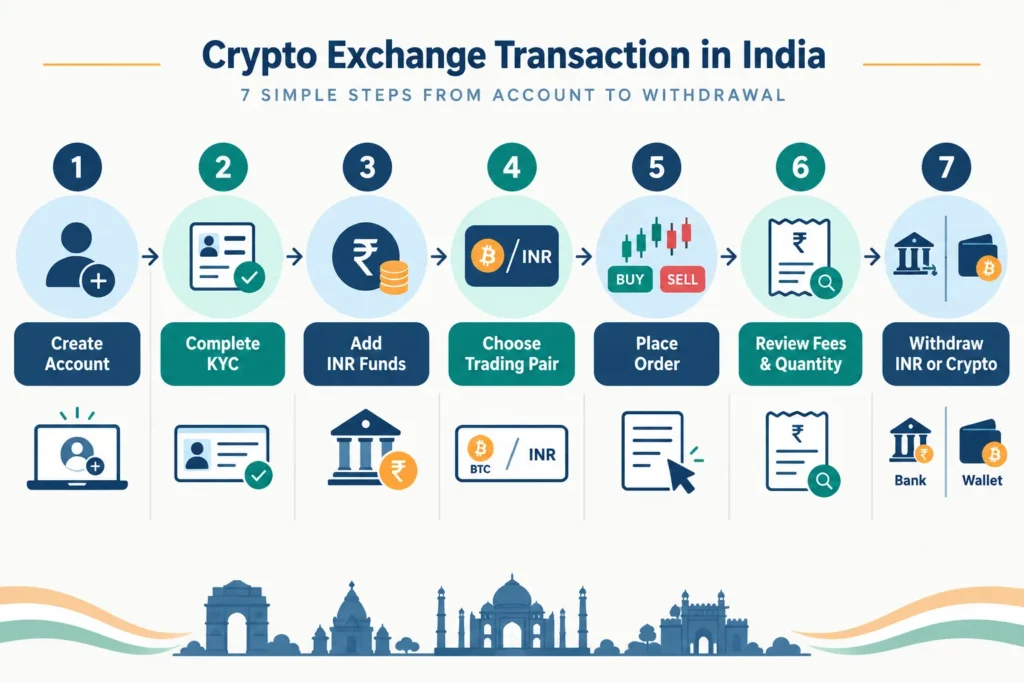
The journey on a centralised exchange may involve the following steps:
- Create an account: Register with the details requested by the platform and set a strong, unique password.
- Complete KYC: Submit the required identity and address information. The documents and checks can vary by platform.
- Add funds: Deposit INR using a supported banking or payment method, where rupee deposits are available. Alternatively, transfer crypto from an external wallet.
- Select a trading pair: Choose the two assets involved in the trade, such as BTC/INR or ETH/INR.
- Place an order: Enter how much you want to buy or sell and select an available order type.
- Review the result: After execution, check the quantity received, trading price, fees and updated balance.
- Withdraw if required: Request an INR withdrawal to a supported bank account or send crypto to a compatible external wallet.
A trading pair shows what you are buying and what you are paying with. In the BTC/INR pair, Bitcoin is traded against Indian rupees. In an ETH/USDT pair, Ether is traded against the crypto asset USDT rather than directly against rupees.
Before confirming a crypto withdrawal, check the wallet address and blockchain network carefully. Some exchanges also require additional verification or impose minimum withdrawal amounts and fees.
What Is Spot Trading?
Spot trading means buying or selling a crypto asset at its current market price or at a price you specify. After the trade is completed, the purchased quantity is credited to your exchange balance. It is different from using a derivative contract to speculate on price movements without making an ordinary spot purchase.
For example, assume Bitcoin is trading at ₹50 lakh per Bitcoin. You do not need to buy one whole Bitcoin. If the exchange permits small purchases, you could place an order worth ₹5,000.
Ignoring fees and price movement for simplicity, ₹5,000 at a price of ₹50 lakh per Bitcoin would buy 0.001 Bitcoin. In a real trade, the quantity may be slightly lower because of trading fees or because the available price changes while the order is being filled.
Owning a fraction does not reduce the normal risks of the asset. If Bitcoin’s market price falls, the rupee value of that fraction also falls. A small purchase limits the amount invested, but it does not make the investment predictable.
Market Orders and Limit Orders
A market order tells the exchange to buy or sell immediately at the best prices currently available. It prioritises execution, not an exact price.
Suppose Bitcoin is displayed at ₹50 lakh and you place a market buy order. Some of your order might execute near that price, but the final average could be higher if prices move quickly or there are not enough sellers at the displayed level.
This difference between the expected price and the actual execution price is commonly called slippage. Slippage can be more noticeable when the market is volatile, the order is large, or the trading pair has low liquidity.
A limit order lets you specify the maximum price you are willing to pay when buying, or the minimum price you are willing to accept when selling.
For example, if Bitcoin is trading at ₹50 lakh, you could place a limit buy order at ₹49 lakh. The order will execute only if sellers are available at ₹49 lakh or below. If the market price continues rising and never reaches your limit, the order may remain open or expire without being completed.
A limit order provides more control over price, but it does not guarantee execution. A market order is more likely to execute promptly, but it does not guarantee the final price.
Exchange Access and Features Can Change
The availability of crypto exchanges in India is not fixed. A platform may change its KYC process, supported coins, fees, bank transfer methods, withdrawal limits or other features. INR deposits and withdrawals may also be added, paused or restricted because of operational, banking or compliance requirements.
Do not rely only on an old review, video or screenshot. Before transferring money or crypto, check the exchange’s current account requirements, supported networks, deposit methods, withdrawal rules and fee schedule. Start cautiously, confirm that essential functions work as expected, and never assume that access available today will remain unchanged.
Fees, Liquidity, Custody and Security Features
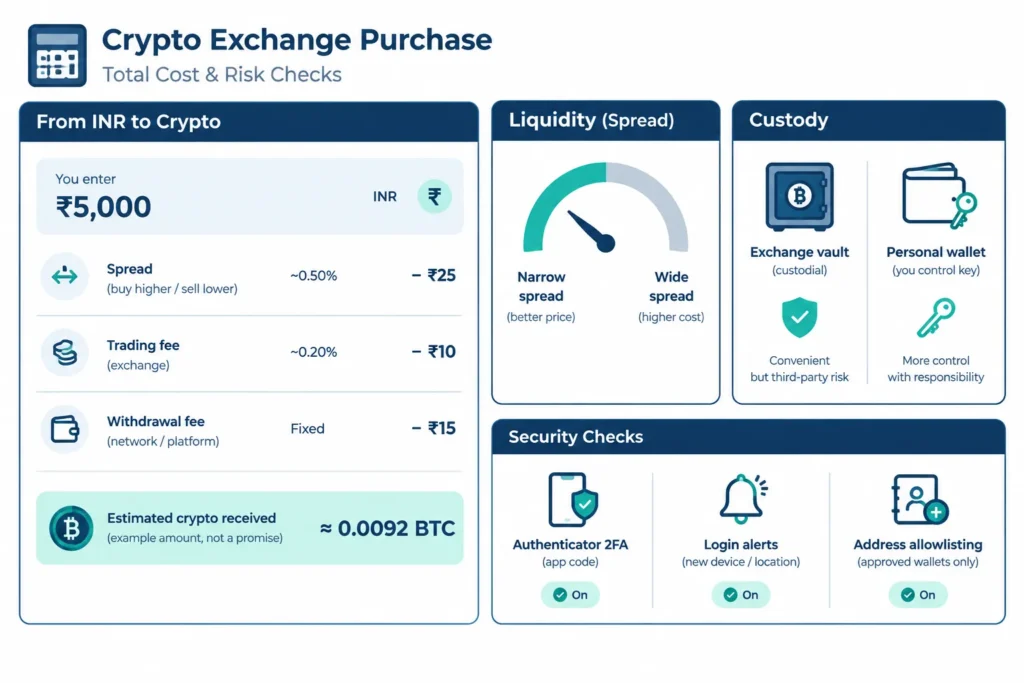
When comparing crypto exchanges in India, do not look only at the number of coins available or the design of the app. Fees, liquidity, custody arrangements and security controls can directly affect your costs and the safety of your assets.
These factors are especially important for beginners. A platform may appear inexpensive but recover costs through spreads, conversion charges or withdrawal fees. Similarly, an easy-to-use exchange wallet may be convenient, but it does not always give you direct control over the cryptocurrency’s private keys.
Understand the Different Types of Fees
Crypto exchanges can charge at several stages. Before depositing money, read the platform’s current fee schedule and check the final order screen. Charges can change based on the payment method, coin, blockchain network, order type or trading volume.
- Trading fee: This is charged when you buy or sell cryptocurrency through the exchange’s order book. Some platforms use different fee structures for orders that add liquidity and orders that immediately match an existing order.
- Crypto withdrawal or network fee: You may pay a fee when sending cryptocurrency from the exchange to another wallet. Part of this cost may relate to processing the transaction on the relevant blockchain. It can vary by asset and network conditions.
- INR deposit fee: An exchange may charge for certain deposit methods, while other methods may have no direct platform fee. Your bank or payment provider could also apply its own charge.
- INR withdrawal fee: A charge may apply when transferring rupees from your exchange account to your linked bank account.
- Spread: The spread is the difference between the displayed buying price and selling price. A simple instant-buy feature may include a wider spread than an order-book trade, making the effective cost higher even if the visible trading fee looks low.
- Conversion charge: Some platforms charge for converting one cryptocurrency into another or for using a simplified “swap” feature.
- Other possible costs: These may include fees for recurring purchases, dormant accounts, failed transactions or specialised products. Check the terms rather than assuming every feature is free.
For example, suppose an investor wants to buy Bitcoin with ₹5,000. The amount of Bitcoin received can be affected by the trading fee and the price spread. If the investor later moves it to a personal wallet, a crypto withdrawal fee may apply. Looking only at the first advertised fee would not show the full cost.
Compare the total amount paid with the cryptocurrency actually received. Also check the final INR amount when selling and withdrawing to a bank account. This gives a more practical comparison than focusing on one fee in isolation.
What Liquidity Means
Liquidity describes how easily an asset can be bought or sold without causing a large change in its price. On an exchange, liquidity usually depends on the number and size of active buy and sell orders for a particular trading pair.
A highly traded pair may have many buyers and sellers offering prices close to each other. An order can therefore be matched quickly and near the price shown on the screen. A less active pair may have fewer orders and larger gaps between prices.
Low liquidity can create three common problems:
- Wider spreads: The gap between the best available buying and selling prices may be larger.
- Slower execution: A limit order may remain open because there is no matching buyer or seller at the selected price.
- Unexpected execution prices: A large market order may be filled across several available prices. The average trade price can be worse than the first price displayed. This effect is often called slippage.
Liquidity can differ between exchanges and between trading pairs on the same exchange. A platform may have active Bitcoin-INR trading but limited activity in a smaller token. Beginners should therefore inspect the order screen, spread and estimated execution value instead of assuming that all listed coins are equally easy to trade.
Exchange Wallets and Personal Wallets
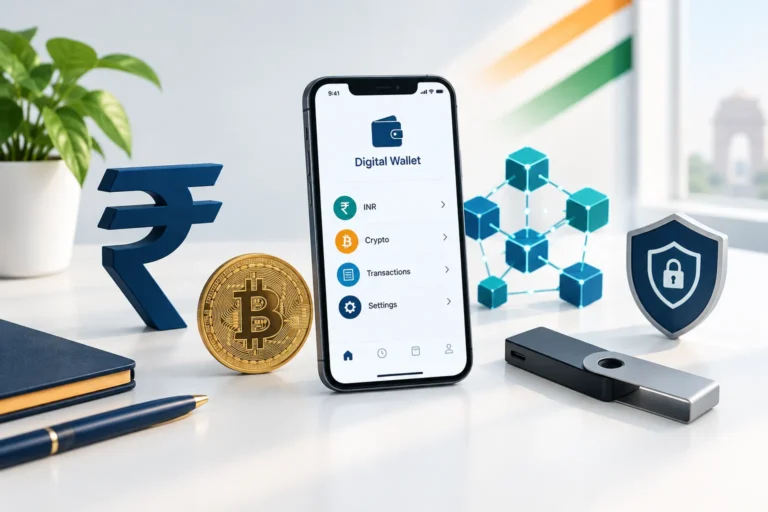
An exchange is primarily a platform for buying, selling and transferring cryptocurrency. A crypto wallet is a tool or arrangement used to manage the keys that authorise blockchain transactions.
When cryptocurrency is held in an exchange wallet, the exchange generally controls the private keys on the user’s behalf. The customer signs in with an email address, mobile number or password, but the platform manages the underlying blockchain access. This is a custodial arrangement.
A separate custodial wallet works in a similar way: a service provider holds the private keys and helps manage access. It may be convenient, but the user depends on that provider’s systems, policies and continued operation.
With a self-custody wallet, the user controls the private keys. The wallet may provide a recovery phrase, usually a sequence of words that can restore access. Anyone who obtains that phrase may be able to control the assets. If it is lost and no backup exists, there may be no company or help desk capable of restoring the wallet.
Private keys and recovery phrases should never be shared with an exchange representative, customer-care caller, social media account or unknown website. A legitimate support process should not require a user to disclose a complete recovery phrase.
Readers who need a fuller explanation can refer to the separate guide, Crypto Wallets in India: Types, How They Work and How to Choose One.
Security Features to Check
No security feature can remove every risk, but strong account controls can make unauthorised access more difficult. When comparing crypto exchanges in India, check whether the following protections are available and whether they are easy to activate:
- Authenticator-based two-factor authentication: An authenticator app generates a temporary login code. It is generally more resistant to SIM-related attacks than relying only on SMS codes.
- Login alerts: Email or app notifications can warn you when someone signs in from a new device or location.
- Anti-phishing code: A user-selected code shown in genuine exchange emails can help identify some fake messages.
- Withdrawal address allowlist: This restricts crypto withdrawals to wallet addresses approved in advance.
- Withdrawal locks: A temporary lock after a password reset, security change or new address addition can reduce the chance of immediate theft.
- Device management: Users should be able to review active sessions and remove devices they do not recognise.
- Clear account recovery: The exchange should explain how identity is verified if a user loses a phone, password or authentication device. Recovery should be secure without being confusing.
Users should also create a unique password, protect the linked email account and avoid signing in through links received in unsolicited messages. These practical steps can be covered in greater depth in a dedicated guide to crypto security.
Risks of Keeping Large Amounts on an Exchange
Leaving cryptocurrency on an exchange can be convenient for regular trading. However, it also creates dependence on the platform and the security of the user’s account.
An exchange may be hacked, while an individual account can be compromised through phishing, malware, a stolen password or unauthorised access to the linked email or phone number. A platform could also face operational failure, financial trouble or liquidity problems.
Withdrawals may sometimes be delayed, frozen or restricted because of maintenance, security reviews, legal requirements, banking issues or platform-level problems. In a serious failure, customers may not recover all their funds. Holding assets on an exchange should not be treated as the same as holding money in a bank account.
When to Consider a Personal Wallet
A user may consider moving cryptocurrency to a personal wallet when planning to hold it for an extended period, when the amount has become significant for their financial situation, or when direct control over the keys is important. The choice depends on the person’s knowledge, transaction needs and ability to secure backups.
Self-custody is not automatically safer for everyone. A user can permanently lose access by misplacing the recovery phrase, damaging all backups, sending assets to an incorrect address or selecting an incompatible blockchain network. Crypto transfers are generally difficult or impossible to reverse.
Before moving a large amount, learn how the wallet works, verify the receiving address and network, and consider making a small test transfer. Keep recovery information offline in a secure place, and do not store it casually in screenshots, email drafts or cloud notes.
The decision is a balance between platform risk and personal responsibility. An exchange requires trust in the operator, while self-custody requires the user to protect the keys correctly. Both choices carry risks, which should be understood alongside the wider Bitcoin and cryptocurrency investing risks before committing substantial money.
How to Evaluate a Crypto Exchange and Avoid Scams
Choosing among crypto exchanges in India requires more than checking ratings or downloading a popular app. An exchange may look professional but still have weak security, unclear fees, poor customer support or restrictive withdrawal rules.
Availability and compliance details can also change. Before depositing money, verify the latest information on the exchange’s official website and, where applicable, relevant Indian authority sources. Do not rely only on old articles, social media posts or screenshots.
Check the Exchange’s Identity and Current Status
Start by finding out who owns and operates the platform. Look for the legal entity’s name, registered office details, terms of use, privacy policy and customer grievance process. Check whether the company provides clear contact information rather than only a social media account or chat group.
If an exchange claims a particular registration or compliance status, independently verify that claim using the relevant official source where possible. For example, users may check current information published by authorities such as the Financial Intelligence Unit–India and review public warnings issued by Indian agencies.
A registration claim should not be confused with a government guarantee. Similarly, an app-store listing, functioning website or well-known brand name does not automatically mean that a platform is approved, safe or risk-free.
Review INR Deposit and Withdrawal Methods
Confirm how you can add and withdraw Indian rupees. Available methods may include bank transfer, UPI or other payment channels, but these options can change because of banking arrangements, compliance requirements or operational issues.
Check the following before transferring money:
- Whether deposits must come from a bank account in your own name.
- Which payment methods are currently available.
- Minimum and maximum deposit or withdrawal amounts.
- Processing times and possible delays.
- Fees charged for INR deposits and withdrawals.
- Whether withdrawals can be paused under the platform’s terms.
Do not assume that a successful INR deposit guarantees a quick withdrawal later. Read recent official notices and test the withdrawal process with a small amount first.
Understand the Complete Fee Schedule
A low advertised trading fee may not show the full cost. Beginners should examine maker and taker fees, the spread between buying and selling prices, INR transaction charges, crypto withdrawal fees and any additional platform charges.
Crypto withdrawal fees can vary by asset and blockchain network. Some platforms may also set minimum withdrawal quantities. Compare the final amount you will receive, not just the headline trading fee.
Taxes are separate from exchange fees. Indian tax treatment and transaction-level obligations can affect the actual cost of trading. Readers should refer to a current guide on cryptocurrency taxation in India and consult a qualified tax professional where necessary.
Examine Liquidity and Order Execution
Liquidity describes how easily an asset can be bought or sold without causing a large price change. A platform may list many coins but have very little trading activity in some of them.
Low liquidity can create a wide gap between the displayed buying and selling prices. It can also cause an order to be completed at several different prices. This effect is often called slippage.
Check the order book, recent trading activity and the difference between bid and ask prices for the specific INR or crypto pair you plan to use. Displayed trading volume should not be treated as proof on its own because figures can be inaccurate or manipulated.
Ask How Crypto Is Stored and Protected
Understand the exchange’s custody arrangement. Some platforms control the private keys for customer crypto, while others may use outside custody providers. Look for a clear explanation of how customer assets are held and whether company assets are kept separately.
Useful security controls can include:
- Two-factor authentication for account access.
- Separate confirmation for withdrawals.
- Alerts for logins, password changes and transactions.
- Address allowlisting or a withdrawal lock.
- Cold storage for at least part of the platform’s crypto holdings.
- Controls for adding new devices or changing account details.
These measures may reduce risk, but they cannot eliminate it. Claims about audits, reserves or insurance should be examined carefully. Check what was reviewed, when it was reviewed, who performed the review and what protection, if any, actually applies to customers.
Read the Withdrawal and Account Rules
An exchange may restrict withdrawals during maintenance, security reviews, unusual market activity or compliance checks. Read the terms covering account freezes, transaction monitoring, document requests and service suspension.
Also check whether the platform permits crypto withdrawals to a personal wallet. Some services support only buying and selling within the platform. Others may support withdrawals for selected assets or networks.
Sending crypto through the wrong blockchain network or to an incorrect address can result in permanent loss. Beginners should confirm the asset, network and address, then make a small test transfer before sending a larger amount.
Review Support and Incident History
Check whether support is available through email, in-app tickets, telephone or live chat. Look for published escalation steps and grievance officer details where applicable. Slow support can become a serious problem if an account is locked or a withdrawal is delayed.
Search for credible information about past security breaches, withdrawal suspensions, prolonged outages and customer disputes. Focus on how the exchange responded, whether it communicated clearly and whether affected users received a practical resolution.
A past incident does not by itself answer whether a platform is suitable today. However, hidden incidents, vague explanations or repeated operational failures are warning signs.
Recognise Common Crypto Exchange Scams
Scammers often copy the name, logo and design of a genuine exchange. A fake website may use a lookalike domain with one changed letter. Fake apps and advertisements may also lead users to phishing pages that steal login details.
Other common warning signs include:
- Messages claiming to be from customer support and asking for remote access to your phone.
- Social media accounts offering to unlock an exchange account for a fee.
- Links sent through unsolicited SMS, email, Telegram or WhatsApp messages.
- Guaranteed profits, fixed daily returns or “risk-free” trading schemes.
- Pressure to deposit immediately to receive a bonus.
- Manipulated account screenshots showing fake profits or withdrawals.
- Requests to pay tax, verification charges or release fees to withdraw supposed earnings.
A legitimate support representative should not ask for your password, OTP, private key or wallet recovery phrase. Never share these details. Anyone who has a recovery phrase may be able to take full control of the related wallet.
Type the exchange address yourself or use a verified bookmark. Do not trust the first search advertisement automatically. Confirm support handles and contact details through the platform’s official app or website rather than through an account that contacted you first.
Understand the Main Risks
Using a crypto exchange involves several risks. The exchange may be hacked, or an attacker may take over your individual account. A platform can face financial failure, operational disruption, legal restrictions or problems with its banking partners.
Withdrawals may be delayed or restricted. Poor liquidity can make it difficult to sell at the expected price. Fraudulent platforms and impersonation scams can cause direct loss. Crypto prices can also fall sharply, independently of the exchange’s quality.
There is no guarantee that money or crypto held on an exchange will always be recoverable. Beginners should avoid depositing funds they cannot afford to lose.
Compact Pre-Deposit Checklist
- Verify the official website, app publisher and legal entity.
- Check current availability and relevant compliance disclosures.
- Read the fee schedule, terms and withdrawal rules.
- Confirm working INR deposit and withdrawal options.
- Review liquidity for the asset you want to trade.
- Understand custody arrangements and security controls.
- Enable strong two-factor authentication and account alerts.
- Check support channels and incident history.
- Ignore guaranteed-return offers and unsolicited support messages.
- Test deposits, trades and withdrawals with a small amount.
This checklist is a risk-control step, not an investment recommendation. No exchange is permanently the “best” choice because services, ownership, fees, compliance status and availability can change.
Frequently Asked Questions
What is a crypto exchange?
A crypto exchange is a platform that allows users to buy, sell or trade cryptocurrencies. Some exchanges also let users deposit or withdraw INR and transfer crypto to an external wallet.
How do crypto exchanges in India work?
Users generally create an account, complete identity verification, add INR or crypto, and place an order. The exchange matches orders or provides a quoted price. Available payment methods, trading pairs and withdrawal features differ by platform.
Are crypto exchanges safe?
No crypto exchange is completely safe. Security controls can reduce risk, but hacking, account takeover, platform failure, fraud and withdrawal restrictions remain possible. Users should verify a platform carefully and protect their accounts.
How does KYC work?
KYC usually requires personal details and identity documents such as PAN information and an accepted proof of identity or address. The platform may also request a photograph, video verification, bank proof or additional information. Exact requirements can change.
What is the difference between an exchange and a wallet?
An exchange mainly provides buying, selling and trading services. A crypto wallet manages the keys needed to control blockchain assets. With a self-custody wallet, the user controls the private keys and is responsible for securing the recovery phrase.
Should cryptocurrency be kept on an exchange?
Keeping crypto on an exchange may be convenient for trading, but it creates custody and platform risk. A personal wallet gives more control but also places full security responsibility on the user. Beginners should understand wallet backups and transfers before moving funds.
How can users verify an exchange’s current status?
Check the exchange’s official disclosures and independently review relevant Indian authority sources where applicable. Confirm the legal entity, support details and current INR services. Do not rely solely on an app-store listing, advertisement, registration claim or old news report.
What fees should beginners check?
Check maker and taker fees, spreads, INR deposit and withdrawal charges, crypto withdrawal fees, network costs and minimum transaction limits. Also consider applicable taxes separately from platform fees.
Summary
Evaluating crypto exchanges in India means checking much more than popularity. Verify the operator, current status, fees, INR services, liquidity, custody practices, security controls, withdrawal rules, support quality and incident history.
Stay alert to fake websites, phishing links, impersonation accounts and guaranteed-return schemes. Never disclose passwords, OTPs, private keys or recovery phrases. Before committing more funds, use a small amount to test the complete process from deposit and trade execution to withdrawal.


Comments