


The National Pension System, or NPS, is a regulated retirement investment system in India. You contribute money to an individual pension account, and professional pension fund managers invest it in assets such as equity, corporate debt and government securities. Returns are market-linked, not guaranteed. Tier I is the main retirement account with withdrawal restrictions, while Tier II is an optional account offering easier access to money.
Introduction
Retirement may feel far away when you are dealing with rent, home loan EMIs, school fees or other monthly expenses. However, starting early can make retirement planning more manageable because your investments get more time to grow.
NPS is one option for building a retirement corpus. It is designed to encourage regular, long-term investing, but it is not a traditional pension that promises a fixed monthly amount. The final value depends on your contributions, investment choices, market performance, charges and the time for which you remain invested.
Before contributing heavily to NPS, build an emergency fund and deal with expensive debt such as unpaid credit card balances. NPS Tier I has withdrawal restrictions, so it should not normally hold money that you may need for next month’s bills or an unexpected medical expense.
What Is NPS?
NPS stands for the National Pension System. It is a voluntary, defined-contribution retirement system regulated by the Pension Fund Regulatory and Development Authority, or PFRDA.
“Defined contribution” means you know how much money is being contributed, but you do not know the final pension amount in advance. This is different from a defined-benefit arrangement in which retirement benefits are calculated using a predetermined formula.
NPS is market-linked. Depending on the investment option selected, your money may be allocated across asset classes such as:
- Equity: Shares of companies, which may offer higher long-term growth potential but can fluctuate significantly.
- Corporate debt: Debt instruments issued by companies, carrying interest-rate and credit risks.
- Government securities: Bonds issued by the Central or State Governments, whose market values can still move when interest rates change.
- Alternative assets: A limited allocation to eligible alternative investments, where permitted under NPS rules.
NPS should therefore not be treated like a bank fixed deposit. There is no fixed interest rate, and investment returns are not guaranteed. The account value can rise or fall over shorter periods.
NPS is regulated, but regulation does not remove market risk. It establishes the operating framework, participant responsibilities, investment limits and other safeguards under which the system functions.
How Does NPS Work?
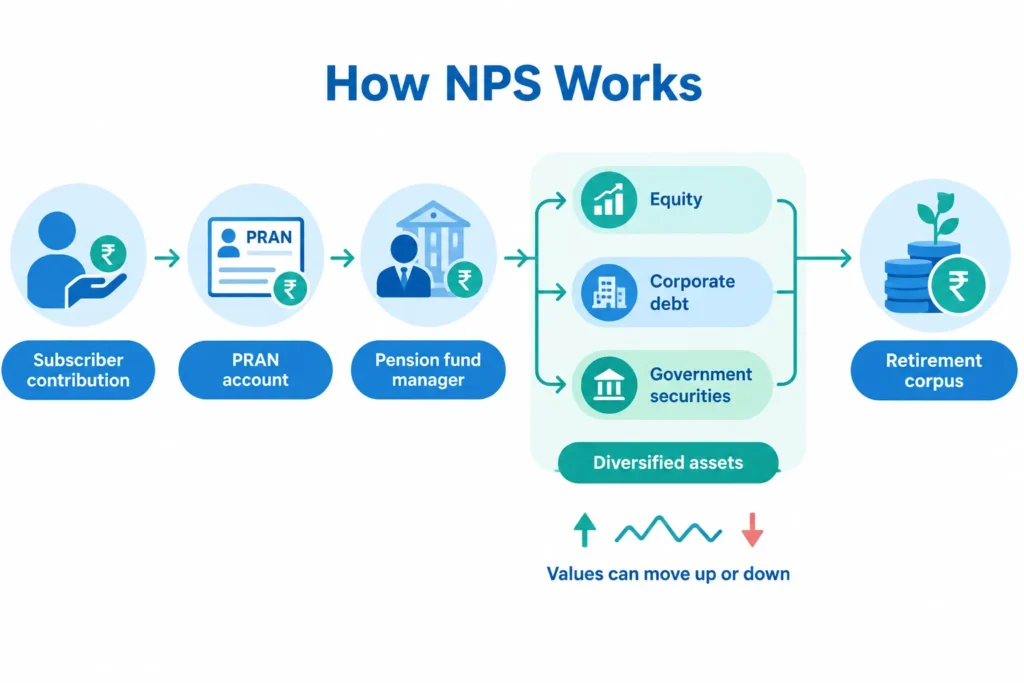
When you join NPS, you are known as a subscriber. You receive a Permanent Retirement Account Number, commonly called a PRAN. This number identifies your pension account and generally remains portable if you change your job, city or service channel.
You can make contributions yourself. In an employer-linked arrangement, your employer may also contribute, subject to the applicable employment terms and NPS rules.
The main participants in the NPS system perform different roles:
- Subscriber: You open the account, contribute money and choose the available investment settings.
- Pension account: Your contributions and accumulated investment value are recorded against your PRAN.
- Points of Presence and digital channels: These authorised service channels help with account opening, contributions and certain service requests.
- Central recordkeeping agency: It maintains subscriber records and processes account-related instructions.
- Trustee bank and custodian: These entities support the movement and safekeeping of scheme assets under the NPS structure.
- Pension fund manager: It invests contributions according to the selected scheme and regulatory limits.
- PFRDA: It regulates and supervises the pension system.
You generally select an investment approach within the choices permitted for your subscriber category. Under an active choice, you decide the allocation among available asset classes, subject to applicable limits. Under an auto choice, the allocation follows a life-cycle approach and usually becomes more conservative as you grow older.
Contributions purchase units in the selected pension funds. The value of these units changes with the performance of the underlying investments. Your NPS corpus is broadly the number of units held multiplied by their prevailing net asset values.
At retirement or another permitted exit, the treatment of the corpus depends on the exit rules applicable at that time. Under the normal NPS framework, part of the money may be available as a lump sum, while the required portion is used to buy an annuity that provides periodic income. Premature exit and partial withdrawal have separate conditions.
A Simple Contribution Example
Suppose Meena, a 30-year-old salaried employee in Pune, decides to contribute Rs. 3,000 every month to NPS Tier I. Over a year, her own contributions total Rs. 36,000. If her employer also contributes under its employment policy, that amount is added separately to her pension account.
Meena’s account does not earn a fixed NPS interest rate. Its value changes according to contributions, charges and the performance of her chosen investment mix. Increasing the monthly contribution later could improve her retirement corpus, but no particular final amount can be guaranteed.
A self-employed person can follow a similar approach without employer contributions. For example, a consultant may contribute quarterly when client payments arrive rather than committing to a monthly amount. The schedule should suit cash flow while meeting the applicable minimum requirements.
Who Can Invest in NPS?
Under the general NPS framework, an individual Indian citizen can ordinarily open an account from age 18 up to age 70, subject to PFRDA rules, identity verification and completion of know-your-customer requirements. Resident Indians and eligible non-resident Indians can participate. Overseas Citizens of India may also be eligible under the applicable regulations.
NPS is available to different groups, including salaried private-sector employees, government employees and self-employed people. The account features or service process may vary by subscriber category, especially where an employer or government department is involved.
A Hindu Undivided Family cannot open NPS as the subscriber because the account is held by an eligible individual. A person opening NPS must provide the required personal, bank, tax and nomination details.
Eligibility and onboarding rules can change. Non-residents and overseas applicants should also consider foreign-exchange, banking and tax rules that apply to their status. Check the latest official PFRDA and NPS documentation before opening or funding an account.
NPS Account Types: Tier I and Tier II
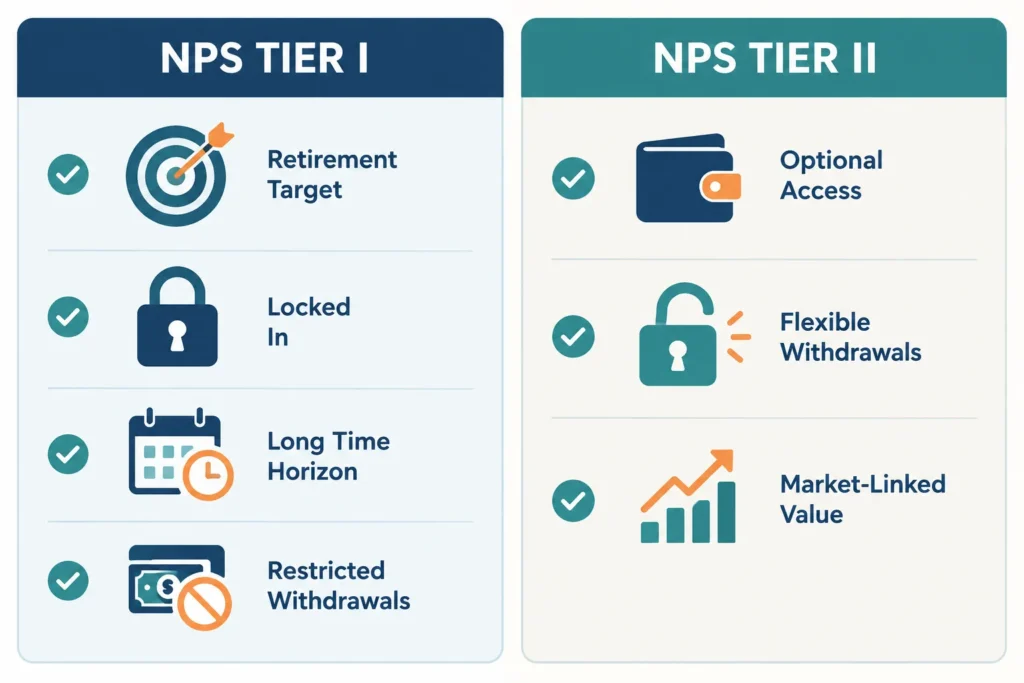
NPS offers two account types, but they serve different purposes. Tier I is the core retirement account. Tier II is an optional investment account linked to an active Tier I account.
| Feature | Tier I | Tier II |
|---|---|---|
| Main purpose | Long-term retirement accumulation | Optional investment with greater withdrawal flexibility |
| Withdrawal access | Restricted and governed by exit and partial-withdrawal rules | Generally allows withdrawals without the retirement restrictions of Tier I |
| Essential for NPS membership | Yes | No |
| General tax treatment | May qualify for available NPS tax provisions, subject to conditions | Does not generally receive the same tax benefits for most individual subscribers |
| Best viewed as | A retirement account | A voluntary, market-linked companion account |
Tier I’s restricted access can encourage retirement discipline, but it also reduces liquidity. It is not a substitute for an emergency fund.
Tier II offers easier access, but this does not make it risk-free or equivalent to a savings account. Its value remains market-linked. Tax treatment may also differ for specific subscriber groups, so do not assume that every Tier II contribution provides a deduction.
How Much Can You Contribute to NPS?
You may make contributions periodically according to your budget, subject to the applicable minimums and transaction rules. There is generally no need to contribute the same amount every month.
Under the commonly applicable All Citizen NPS rules, a Tier I contribution is generally subject to a minimum of Rs. 500 per transaction, with at least Rs. 1,000 required in a financial year. Tier II generally has a minimum contribution of Rs. 1,000 when the account is activated and a minimum of Rs. 250 for a subsequent contribution. Tier II generally does not require a minimum annual contribution.
These operational minimums can be revised, and different subscriber categories or account-opening channels may have additional conditions. Verify the latest official rules before making a decision.
The regulatory minimum should not decide your personal contribution. First calculate what you can invest without missing essential expenses, insurance premiums, loan repayments or emergency savings. A smaller sustainable contribution is usually more practical than a large contribution that creates a cash shortage.
For example, someone earning Rs. 45,000 a month should not automatically lock Rs. 10,000 into Tier I merely to invest more. If that person has no emergency fund, irregular medical costs and expensive debt, improving those areas may need to come first. NPS works best as one part of a broader retirement plan built around affordability, liquidity and long-term consistency.
NPS Investment Choices and Asset Allocation
NPS invests your retirement money in a mix of market-linked assets. Unlike a bank fixed deposit, it does not offer a fixed interest rate. The value of your account changes according to the performance of the investments held under your chosen pension fund and asset allocation.
Subscribers generally choose between two allocation methods: Active Choice and Auto Choice.
Active Choice
Under Active Choice, you decide how your contribution should be divided among the available asset classes. The main NPS asset classes are:
- Asset Class E: Equity and equity-related investments. It offers higher long-term growth potential but can fluctuate sharply.
- Asset Class C: Corporate debt securities. These are generally less volatile than equity, but they still carry interest-rate and credit risks.
- Asset Class G: Central and state government securities. These have low credit risk, but their market value can rise or fall when interest rates change.
- Asset Class A: Alternative investments, such as permitted alternative investment funds and similar instruments. This category may carry additional complexity and is subject to a lower allocation limit.
For a regular NPS subscriber using Active Choice, equity allocation can generally be as high as 75% of the contribution. Allocation to Asset Class A is capped at 5%. The remaining amount can be divided among corporate debt and government securities, subject to the applicable NPS scheme rules.
A high equity allocation may suit a young investor with several decades before retirement and the ability to tolerate market falls. Someone close to retirement may prefer more debt exposure to reduce the effect of a major equity decline shortly before exit.
However, age alone should not determine the allocation. Your income stability, existing savings, pension benefits, family responsibilities and comfort with market fluctuations also matter.
Auto Choice
Auto Choice is designed for subscribers who do not want to manage the allocation themselves. NPS automatically divides the money among equity, corporate debt and government securities according to the subscriber’s age and selected life-cycle fund.
The commonly available life-cycle choices include:
- Aggressive Life Cycle Fund, or LC75: Starts with a relatively high equity allocation, which can be up to 75% at younger ages, and gradually reduces it as the subscriber gets older.
- Moderate Life Cycle Fund, or LC50: Starts with a maximum equity allocation of 50% and follows a more balanced reduction path.
- Conservative Life Cycle Fund, or LC25: Starts with a maximum equity allocation of 25% and gives greater importance to debt assets.
The allocation under these life-cycle options begins changing from the prescribed ages and becomes more conservative over time. This can reduce the need for manual rebalancing, but it does not make the investment risk-free.
Subscribers can also select a pension fund manager from the choices available under NPS. Asset allocation and pension fund changes are permitted within the frequency and conditions prescribed by the regulator and the relevant NPS sector.
NPS Returns: What Should Investors Understand?
NPS returns are market-linked. There is no guaranteed annual return under the regular market-linked NPS schemes. Your final corpus depends on contributions, investment period, asset allocation, pension fund performance, costs and market conditions.
Equity may provide stronger growth over a long period, but returns can be negative in some years. Debt investments are usually less volatile, but they can also lose value temporarily. Government bonds, for example, may fall in market value when interest rates rise.
Diversification is one of the important features of NPS. Instead of putting the entire contribution into one type of investment, a subscriber can spread it across equity, corporate debt and government securities. Diversification can reduce dependence on a single asset class, but it cannot eliminate losses.
NPS is generally considered a low-cost retirement product because its regulated charges are relatively modest. Lower costs allow a larger part of the contribution to remain invested. However, subscribers should still review applicable pension fund management fees, central recordkeeping charges and transaction-related charges.
The time horizon is especially important. A 28-year-old contributing for three decades has more time to recover from short-term market falls than someone retiring in two years. As retirement approaches, reviewing the equity allocation may help manage sequencing risk, which is the risk of a large market fall just before withdrawals begin.
Past returns should be used only as one input while comparing pension funds. A pension fund that performed well in the previous year may not remain the best performer. Past performance does not guarantee future returns.
NPS Withdrawal and Exit Rules
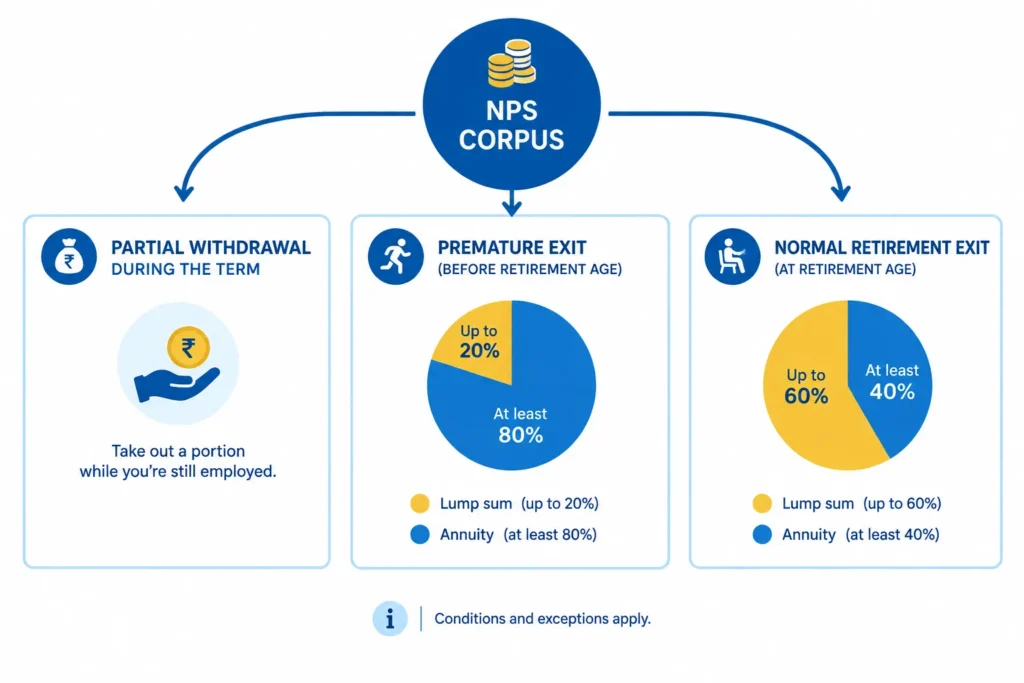
NPS is meant for retirement, so access to money is restricted. Partial withdrawal, premature exit and normal retirement exit are different transactions and have different conditions.
Partial Withdrawal During the NPS Term
A subscriber can generally request a partial withdrawal after completing at least three years in NPS. The withdrawal can be up to 25% of the subscriber’s own contributions. Employer contributions and investment gains are not included while calculating this 25% limit.
Partial withdrawals are allowed only for specified purposes, such as:
- Higher education or marriage of children
- Purchase or construction of a residential house, subject to the applicable ownership conditions
- Treatment of specified serious illnesses
- Expenses connected with disability or incapacitation
- Skill development or re-skilling
- Starting an eligible business or venture
Normally, up to three partial withdrawals are permitted during the NPS tenure. Additional timing and documentary conditions may apply depending on the purpose and current regulations. A partial withdrawal does not close the NPS account.
Premature Exit
For a regular non-government subscriber, leaving NPS before reaching age 60 is generally treated as a premature exit. At least 80% of the accumulated pension wealth must normally be used to purchase an annuity. The remaining amount, up to 20%, can be taken as a lump sum.
If the total corpus at premature exit is not more than ₹2.5 lakh, the subscriber can generally withdraw the entire amount without purchasing an annuity.
This high compulsory annuity requirement makes NPS less liquid than a mutual fund or bank deposit. Investors should therefore maintain a separate emergency fund instead of depending on NPS for short-term needs.
Normal Exit and Small Balances
At age 60 or the applicable age of superannuation, a normal exit generally allows up to 60% of the corpus as a lump sum. At least 40% must be used to buy an annuity from an empanelled annuity service provider.
If the total corpus at normal exit is not more than ₹5 lakh, the subscriber can generally withdraw the full amount. An annuity purchase is not compulsory in that case.
These thresholds and conditions are regulatory rules and may be revised. Subscribers should check the latest PFRDA, NPS Trust or central recordkeeping agency guidance before submitting an exit request.
NPS at Retirement
At retirement, the NPS corpus is divided between the permitted lump-sum withdrawal and the amount used for an annuity. A subscriber may annuitise more than the compulsory minimum, including the entire corpus, if regular pension income is the priority.
The lump-sum portion can support major retirement needs, such as repaying a housing loan, creating a medical reserve or building a separate investment portfolio. It should not be treated as spare money. Spending too much in the first few years can weaken long-term retirement security.
The permitted lump-sum amount need not always be taken immediately in one transaction. Subject to prevailing NPS rules, subscribers may defer withdrawal or use phased withdrawal facilities up to the prescribed age, currently 75. Continuation of the NPS account and deferment of annuity purchase are also subject to the applicable conditions.
How the Annuity Affects Retirement Income
An annuity converts the selected part of the corpus into periodic pension income. The actual pension depends on the amount used, the subscriber’s age, prevailing annuity rates and the option selected.
For example, a pension payable only for the subscriber’s lifetime may provide a different income from a joint-life pension covering a spouse. An option that returns the purchase price to the nominee after death will usually offer a lower periodic pension than a comparable option without return of purchase price.
Annuity income is generally taxable in the year it is received according to the retiree’s applicable income-tax slab. The money used to buy the annuity is also largely locked with the insurer, so it does not provide the same flexibility as a bank account or mutual fund.
Before retirement, compare annuity providers and options rather than selecting only on the basis of the first quoted pension. Consider spouse protection, return of purchase price, payment frequency, inflation, other income sources and the need for liquidity. NPS can form an important part of retirement planning, but the lump sum and annuity should work alongside emergency savings, insurance and other retirement investments.
NPS Tax Benefits and Taxation
NPS taxation depends on who makes the contribution, the tax regime you choose, and how money is withdrawn. The following treatment applies under current Income Tax rules, but tax provisions and NPS exit rules can change. Check the rules for the relevant financial year before investing or withdrawing.
Your Own Contributions
Under the old tax regime, your contribution to Tier I NPS may qualify for deduction under Section 80CCD(1). This deduction is included within the combined Section 80C limit of Rs. 1.5 lakh.
An additional deduction of up to Rs. 50,000 may be claimed under Section 80CCD(1B). This is over and above the Rs. 1.5 lakh limit, subject to the contribution actually made.
Under the new tax regime, deductions under Sections 80CCD(1) and 80CCD(1B) are generally not available. Therefore, making a personal NPS contribution does not automatically reduce your taxable income under the new regime.
Employer Contributions
An eligible employer contribution to your Tier I account may be deductible under Section 80CCD(2). This benefit is separate from the Section 80C limit.
Under the old regime, the permitted deduction is generally linked to salary and the category of employer. Government employees can have a different percentage limit from many private-sector employees.
Under the new tax regime, Section 80CCD(2) remains available. Current provisions allow a deduction of up to 14% of specified salary for eligible employer contributions under the new regime. Here, salary generally means basic salary plus dearness allowance where it forms part of retirement benefits, not total cost to company.
Employer contributions to NPS, recognised provident fund and approved superannuation fund are also covered by a combined annual tax limit. Contributions above the applicable combined limit, and specified annual accretions on the excess, can become taxable.
Withdrawals and Annuity Taxation
On a normal NPS exit, up to 60% of the accumulated pension wealth can generally be taken as a lump sum. This eligible lump-sum withdrawal is exempt from income tax under current rules.
At least 40% generally has to be used to buy an annuity, unless an exemption under the applicable small-corpus or exit rules applies. The amount used to purchase the required annuity is not taxed at the time of purchase.
However, pension received from the annuity is taxable in the year of receipt. It is normally added to your income and taxed according to your applicable slab rate.
Premature exits generally require a larger portion of the corpus to be used for an annuity. Partial withdrawals may be tax-exempt when they meet the permitted purpose, amount and eligibility conditions.
Tier II is a voluntary investment account and usually does not receive the main tax benefits available to Tier I. Do not assume that every NPS deposit qualifies for a deduction.
NPS vs Other Retirement Investments
No retirement product is best for everyone. NPS can provide market-linked growth and retirement discipline, while other options may offer better liquidity, guarantees or investment control.
| Option | Liquidity | Risk and control | Retirement treatment |
|---|---|---|---|
| NPS | Restricted until exit, with conditional partial withdrawals | Market-linked; asset allocation choices are available within NPS rules | Part may be withdrawn, while annuity purchase is generally required |
| EPF | Restricted, but permitted withdrawals and transfers are available | Returns are declared under EPF rules; limited investment control for members | Designed for salaried employees and may support lump-sum and pension benefits |
| PPF | Long lock-in with limited withdrawal and loan facilities | Government-backed and interest-based; no equity exposure | Maturity amount is generally tax-exempt under current rules |
| Mutual funds | Usually more liquid, subject to scheme conditions and exit loads | Market-linked with wide investor control over schemes and withdrawals | No compulsory annuity; capital gains taxation applies |
| Fixed-income options | Varies by deposit, bond or scheme | May offer greater predictability, but inflation and credit risk can matter | Interest is often taxable; maturity and income rules vary |
For example, a young employee may use NPS for disciplined retirement investing, EPF as an employment-linked foundation, and mutual funds for goals requiring more flexibility. A retiree may prefer a mix of pension income, deposits and market-linked investments instead of depending on one product.
Advantages of NPS
- Retirement discipline: Restricted access can prevent retirement savings from being spent on short-term wants.
- Low-cost structure: NPS is designed as a regulated retirement system with comparatively controlled charges.
- Diversification: Contributions can be divided among equity, corporate debt, government securities and other permitted assets.
- Portability: The account can continue when you change your employer, occupation or city.
- Tax benefits: Eligible personal and employer contributions may receive deductions, depending on the tax regime.
- Flexible contributions: Investors can contribute periodically rather than committing to a fixed monthly premium.
Limitations and Risks of NPS
- Reduced access to money: NPS is not suitable for funds that may be needed soon.
- Market risk: Equity and debt values can fluctuate. Returns are not guaranteed.
- Annuity dependence: Part of the corpus generally has to buy an annuity, and annuity rates available at retirement may be modest.
- Taxable pension: Annuity income is taxable, even though the amount used to purchase the annuity is not taxed at purchase.
- Rule-change risk: Contribution limits, tax provisions, withdrawal conditions and investment rules may change.
- Inflation risk: A fixed annuity may lose purchasing power over a long retirement.
- Limited investment choice: NPS offers allocation choices, but not the unrestricted scheme selection available through direct mutual fund investing.
Who Should Consider NPS?
NPS may be useful if most of the following statements apply to you:
- You are investing specifically for retirement.
- You can leave the money invested for many years.
- You understand that returns are market-linked.
- You want a structured mix of equity and debt.
- Your employer contributes to NPS, or you can use an available tax deduction.
- You are comfortable using part of the final corpus to purchase an annuity.
- You already have an emergency fund and suitable health insurance.
NPS may be less suitable for a near-term goal such as a house down payment or education fees due in a few years. It may also be unsuitable if you require complete control over withdrawals at retirement.
Common NPS Mistakes to Avoid
- Investing only for tax saving: First check whether NPS fits your retirement plan and chosen tax regime.
- Ignoring asset allocation: An allocation that is too aggressive or too conservative can affect the retirement outcome.
- Never reviewing the account: Review contributions, allocation and retirement goals periodically without reacting to every market movement.
- Forgetting inflation: Estimate future expenses rather than using today’s monthly budget as the retirement target.
- Depending only on NPS: Emergency savings, insurance and other retirement assets may still be necessary.
- Ignoring nominees: Add and update nominee details, especially after marriage or other major family changes.
- Overlooking annuity choices: Compare annuity options carefully because income, spouse benefits and return-of-purchase-price features differ.
- Confusing Tier I and Tier II: They have different withdrawal restrictions and tax treatment.
Frequently Asked Questions About NPS
Is NPS safe?
NPS is regulated by the Pension Fund Regulatory and Development Authority. However, regulation does not guarantee returns. The value of market-linked investments can rise or fall.
What return does NPS provide?
NPS does not offer a fixed return. Performance depends on asset allocation, pension fund performance, market conditions, charges and the investment period.
Can one person have multiple NPS accounts?
A subscriber should normally have one NPS account linked to a unique Permanent Retirement Account Number. The same account can continue across employers and locations.
Can I withdraw money before retirement?
Permitted partial withdrawals are available subject to conditions such as minimum membership, eligible purposes and withdrawal limits. A premature full exit follows separate rules and generally requires substantial annuitisation.
What happens to NPS when I change jobs?
The account remains with you. You can update employment details and continue contributing through the new employer or independently, as applicable.
Is NPS enough for retirement?
Not necessarily. The required corpus depends on expenses, inflation, retirement age, life expectancy, healthcare needs and other income. NPS is usually one part of a wider retirement plan.
Should I choose the old regime only for the NPS deduction?
No. Compare total tax under both regimes after considering all eligible deductions, exemptions and income. One NPS deduction alone should not decide the tax regime.
Summary
NPS is a long-term, market-linked retirement product that combines disciplined investing, asset allocation choices and possible tax benefits. Its strengths include portability and retirement focus, while its limitations include restricted liquidity, market risk and compulsory annuity requirements in many exit situations.
Before contributing, compare NPS with EPF, PPF, mutual funds and fixed-income options. Choose an allocation suited to your time horizon, keep nominees updated, and review whether the old or new tax regime makes the available deductions useful. Most importantly, treat NPS as part of a diversified retirement plan rather than as a guaranteed or complete retirement solution.




Comments