

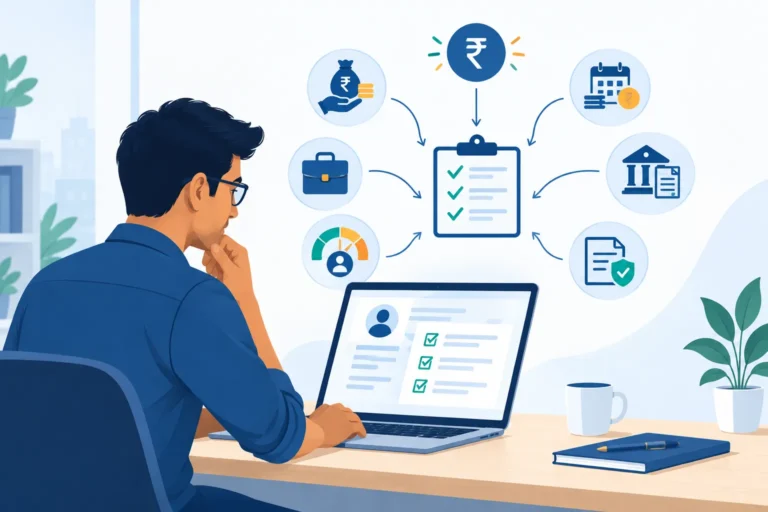
The main documents required for home loan in India include proof of identity, proof of address, PAN, photographs and income records. Salaried applicants usually submit salary slips, bank statements, Form 16 and employment proof. Self-employed applicants generally provide income-tax returns, business proof, financial statements and business bank statements. The exact checklist varies by lender, applicant profile, loan purpose and property status.
A home loan involves a large amount and a long repayment period. Before approving it, a bank or housing finance company needs to confirm who you are, where you live, how you earn and whether the proposed EMI appears affordable.
There is no single checklist that applies to every borrower. Requirements may change depending on whether you are salaried, a professional, a business owner, an NRI, a joint applicant or an existing customer of the lender. A lender may also ask for additional records when details do not match or income is irregular.
This first part covers applicant identity, address and income documents. Property-related documents and other stages of the home loan process are outside the scope of this section.
Why Are Documents Required for a Home Loan?
Home loan documents help a lender assess the application using information that can be checked. They are not merely a formality. Each set of records serves a specific purpose in identity verification, credit assessment and regulatory compliance.
To verify your identity
The lender must confirm that the person applying for the loan is genuine. Identity records help match your name, photograph, date of birth and other personal details with the information given in the application.
To confirm your current and permanent address
Address proof allows the lender to verify your residence and send official communication. If your current address is different from your permanent address, you may need to provide proof for both.
To understand your income
Income records show how much you earn and whether that income appears regular. For example, a salaried employee may demonstrate income through salary slips and salary credits. A business owner may need financial statements, tax returns and bank transactions.
To assess repayment capacity
The lender compares your income with existing financial commitments, such as personal loan EMIs, vehicle loan EMIs and credit card dues. This helps it assess whether the proposed home loan EMI may be manageable.
Submitting all requested documents does not guarantee loan approval. The lender may also consider your credit history, age, employment or business stability, existing debts, property details and its internal lending policy.
To check employment or business activity
Employment proof helps establish where a salaried applicant works and, in some cases, how long the applicant has been employed. Business records help show that a self-employed applicant is carrying on a genuine profession or business.
To validate application details
The information in your documents should support what you declare in the application. Differences in names, addresses, income figures or employment details may lead to questions or requests for clarification.
Identity and Address Proof
Identity and address records form the basic Know Your Customer, or KYC, part of a home loan application. The applicant and every co-applicant usually need to complete the lender’s KYC requirements.
The following are commonly requested or accepted records. However, acceptance depends on the lender’s policy and applicable KYC rules. Do not assume that every document below will be accepted in every case.
Common identity documents
- PAN card: Commonly required for tax identification and financial verification.
- Aadhaar: May be accepted as identity or address proof, subject to the lender’s permitted process and applicable rules.
- Passport: May serve as identity proof and, where accepted, address proof.
- Voter ID: Commonly used as an officially recognised identity record.
- Driving licence: May be accepted if it is valid and contains the required details.
- Recent passport-size photographs: The lender may request one or more photographs for the application and its records.
Keep the original documents available if the lender needs to verify copies. If you are asked to self-attest a copy, sign it in the manner specified by the lender. Avoid signing blank forms or leaving important fields incomplete.
Common address documents
- Aadhaar, where accepted for the relevant process
- Valid passport
- Voter ID
- Valid driving licence
- Recent utility bill, if accepted by the lender
- Registered rent agreement or another residence record, if accepted
May be requested in certain cases: If your current residence does not match the address on your main KYC document, the lender may ask for separate current-address proof. A rented-home applicant, for example, may be asked for a rent agreement, utility bill or another acceptable record.
May be requested in certain cases: If your name has changed after marriage or for another reason, you may need supporting evidence such as a marriage certificate, gazette notification or another accepted name-change document.
Check that your name is written consistently across PAN, identity records, bank accounts, salary records and the loan application. Minor differences, such as initials in one document and a full middle name in another, can require clarification.
Income Documents for Salaried Applicants
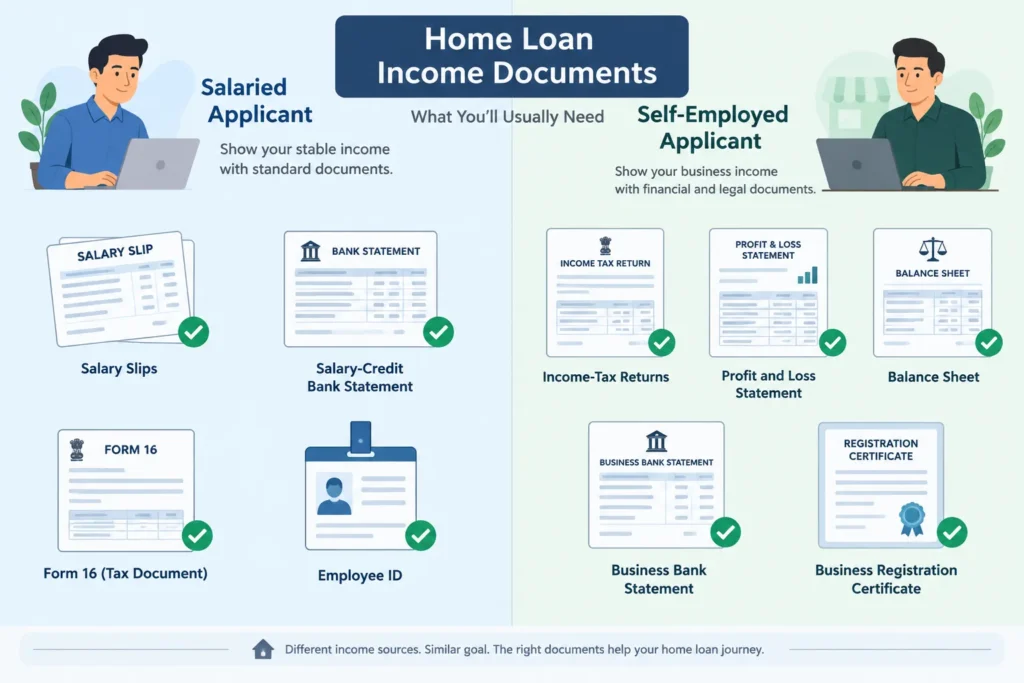
A salaried applicant needs to show present income, salary credits and employment details. Lenders may ask for records covering different periods, so follow the checklist issued for your application rather than relying only on a general list.
Commonly requested salary and banking records
- Recent salary slips: These show basic salary, allowances, deductions and net pay.
- Bank statements: Statements for the account receiving salary help the lender verify regular salary credits and review existing EMI payments.
- Form 16: This gives salary and tax deduction information issued by the employer.
- Income-tax return records: These may be requested to support declared income, particularly where income comes from more than one source.
- Employment proof: An employee identity card, appointment letter, employment certificate or another accepted record may be required.
Salary slips should generally match the credits visible in the bank account. If there is a difference due to reimbursement, bonus, arrears or a recent salary revision, keep the supporting explanation or document ready.
Documents that may be requested in certain cases
- Increment or appraisal letter: The lender may ask for this if your salary has recently increased.
- Joining or confirmation letter: This may be relevant if you recently changed jobs or completed probation.
- Employment continuity records: These may be requested when you have had several job changes.
- Variable-pay evidence: Bonus, incentive or commission records may be needed if you want such earnings considered.
- Records for other income: Supporting documents may be required for rent, professional work or another declared income source.
Not every part of your compensation is necessarily treated as stable income. A lender may assess fixed salary differently from irregular incentives, reimbursements or one-time bonuses. It may also seek clarification if salary is paid in cash or if credits do not clearly identify the employer.
Income Documents for Self-Employed Applicants
Self-employed applicants include business owners, partners, proprietors, company directors and independent professionals such as doctors, architects or chartered accountants. Their income may vary from month to month, so lenders commonly examine business history, tax records, banking activity and financial statements together.
Common business and professional records
- Business existence proof: This could include a registration certificate, licence, partnership deed, incorporation record or another document appropriate to the business structure.
- Professional qualification proof: A practising professional may be asked for a degree, membership certificate or professional registration.
- Office or business address proof: The lender may seek evidence showing where the business operates.
- GST-related records: Registration or returns may be requested where applicable to the business.
Common financial and tax records
- Income-tax returns: The lender may request returns for the specified assessment years, along with supporting computation details.
- Profit and loss account: This shows business income and expenses for the relevant period.
- Balance sheet: This provides information on business assets, liabilities and capital.
- Business bank statements: These help show receipts, expenses, cash flow and existing loan obligations.
- Personal bank statements: These may also be requested to understand personal transactions and repayment commitments.
Financial statements may need to be audited or certified where applicable. The lender may compare turnover, profit, taxable income and bank credits. Significant differences may require an explanation.
Documents that may be requested in certain cases
- Partnership deed and partner authorisation for a partnership firm
- Company incorporation documents and ownership details
- Board resolution or authorisation where the business structure requires it
- Contracts, invoices or work orders to support business continuity
- Details of existing business loans and their repayment statements
- Additional records for cash-heavy, seasonal or recently established businesses
Before submitting the file, check that the business name, applicant name, PAN details and financial figures are consistent across records. Clear and complete documents can reduce avoidable follow-up queries, although the lender may still request further information during assessment.
Bank Statements and Existing Loan Details
Bank statements help a lender understand how money moves through your accounts. They may show regular salary or business receipts, household spending, existing EMI deductions, cheque returns, large transfers and the balance usually maintained in the account.
This review is not limited to checking your income. The lender also uses it to assess whether the proposed home loan EMI appears manageable alongside your current financial commitments.
Commonly requested banking records
- Bank statements for the period specified by the lender, often covering recent months
- Statements of the account in which salary, professional fees or business income is received
- Statements of other accounts used for major transactions, if requested
- Cancelled cheque showing the applicant’s name, account number and IFSC
- Bank passbook copy, where accepted instead of or along with statements
- Explanation or supporting proof for unusual credits, frequent cash deposits or large transfers, if the lender asks for it
Statements may need to be downloaded directly from internet banking, stamped by the bank or submitted through an authorised digital process. Screenshots or edited files may not be accepted. Follow the lender’s instructions on the required period and format.
Details of existing loans and EMIs
Declare all active financial obligations accurately. These may include a car loan, personal loan, education loan, consumer loan, credit card EMI, loan against property or another home loan. A lender may compare these details with bank statements and credit records.
Commonly requested documents include:
- Latest loan account statements
- Sanction letters for existing loans
- Repayment schedules showing the EMI and remaining tenure
- Recent EMI payment records
- Foreclosure or closure letters for loans that have recently been repaid
- No-dues certificates, where an account is shown as closed
- Credit card statements if there are significant outstanding balances or EMI conversions
If an existing loan will be closed before the home loan is disbursed, the lender may ask for proof of repayment. Do not assume that a small EMI can be omitted. Complete disclosure reduces the risk of delays during verification.
Property Documents Required for a Home Loan
The property itself is an important part of the lender’s assessment. The lender generally checks whether the property records are acceptable, whether required approvals are available and whether the transaction documents match the loan application.
The exact property file depends on whether the home is new, under construction, ready to move, resale, self-constructed or being renovated. Requirements also vary by state, local authority, lender and project. The following are common categories, not a universal legal checklist.
Ownership and title-related records
- Current title deed or ownership document
- Previous title deeds or chain of ownership documents, where required
- Sale deed, conveyance deed, lease deed or allotment document, as applicable
- Land records, property card or revenue records applicable to the location
- Encumbrance-related record or search report, if requested
- Latest property tax receipts
- Mutation or transfer record, where applicable
For a resale home, the lender may examine how ownership moved from one owner to another. Keep readable copies of earlier sale deeds and related transfer papers if they are available.
Sale and purchase documents
- Agreement to sell or agreement for sale
- Registered sale deed, when registration has been completed
- Booking form or allotment letter for a builder property
- Demand letters issued by the builder or seller
- Receipts for booking amount, advance payment and other amounts already paid
- Payment schedule and cost sheet
- Stamp duty and registration payment records, where completed
The buyer’s name, property description and transaction value should be consistent across the application and property papers. If there is a difference, ask the seller, builder or lender what clarification or correction is needed.
Approvals, plans and completion records
- Approved building plan or sanctioned plan, where applicable
- Layout approval or development permission, where applicable
- Commencement certificate or construction permission
- Completion certificate for a completed property, where applicable
- Occupancy certificate for a ready property, where applicable
- Other local authority approvals requested for the specific property
Not every document has the same name or applies in every location. For example, the records for an apartment in Bengaluru may differ from those for an independent house in Jaipur. Use the lender’s property checklist for the relevant city and project.
Builder and housing society records
- Builder-buyer agreement
- Builder’s no-objection certificate, if required
- Project approval details requested by the lender
- Possession letter for a completed unit
- Housing society share certificate, where applicable
- Society no-objection certificate for a resale transaction, if requested
- Society maintenance or other dues clearance proof, where required
Documents for different property situations
| Property situation | Common additional papers |
|---|---|
| Under-construction home | Allotment letter, builder-buyer agreement, payment schedule, demand letters, payment receipts and applicable project approvals |
| Ready-to-move home | Sale papers, possession record, completion or occupancy document where applicable, and proof of payments |
| Resale home | Seller’s ownership papers, chain documents, agreement to sell, tax receipts, society records and existing loan closure papers if the property is mortgaged |
| Self-construction | Land ownership papers, approved construction plan, cost estimate, construction schedule and stage-wise progress records |
| Renovation or extension | Ownership papers, renovation estimate, contractor quotation, proposed work details and permissions where required |
A lender may arrange legal and technical verification of the property. This does not replace the buyer’s own due diligence. Submit complete, clear copies and keep the originals ready for inspection when requested.
Documents for Joint Home Loan Applicants
In a joint home loan, each applicant generally has to complete identity, address, income and credit verification. This applies even if one person will pay most of the EMI.
Each joint applicant may need to provide:
- PAN and accepted identity proof
- Current and permanent address proof
- Photographs and completed application forms
- Bank statements
- Salary documents or self-employed income records, as relevant
- Details of existing loans and other repayment obligations
- Relationship proof, if requested by the lender
- Signatures on declarations, loan agreements and property-related forms
If a joint applicant has no independent income, the lender may not ask for the same income documents as it would from an earning applicant. However, identity, address, ownership and consent-related records may still be required.
Property ownership and loan participation are related but separate matters. Confirm with the lender who will be a co-applicant, who will be a co-owner and who must sign each document. Requirements can differ depending on the lender and the proposed ownership structure.
Additional Documents for Special Cases
Non-resident Indian applicants
NRIs may be asked for passport copies, visa or residence permit, overseas address proof, employment records, overseas bank statements and Indian bank account statements. The lender may also request foreign salary slips, employment contracts or tax and income records accepted in the applicant’s country of residence.
Documents issued abroad may need a specified form of certification, attestation or translation. Ask the lender for country-specific instructions before sending originals or arranging certification.
Applications using a power of attorney
If another person will sign or act for the applicant, the lender may require a power of attorney in its prescribed or accepted format. Identity and address documents of both the applicant and the attorney holder may also be needed.
The signing, witnessing, stamping, registration or attestation requirements can depend on where the document is executed and how it will be used. Obtain the lender’s instructions before preparing the document.
Home loan balance transfers
For a balance transfer, common additional records include the existing lender’s sanction letter, loan account statement, repayment track, outstanding balance letter and list of original property documents held by that lender. A foreclosure statement and consent or transfer-related letter may also be requested.
Construction and renovation loans
These applications may require an architect’s or engineer’s estimate, detailed cost sheet, approved plan, contractor quotations, construction schedule and proof of the applicant’s contribution. Since disbursement may be linked to work progress, the lender can also ask for photographs, bills, receipts or stage-completion records.
Rental or variable income
An applicant using rental income may need to submit a rent agreement, bank entries showing rent receipts and property ownership records. The lender may ask for additional income records depending on its assessment process.
Applicants with commissions, incentives, professional fees or other variable income may need a longer income trail than applicants with a fixed salary. Relevant records can include salary statements, bank statements, income-tax documents, invoices, contracts or employer confirmation. Submit only genuine records that clearly explain the source and regularity of the income.
Home Loan Document Checklist Before Applying
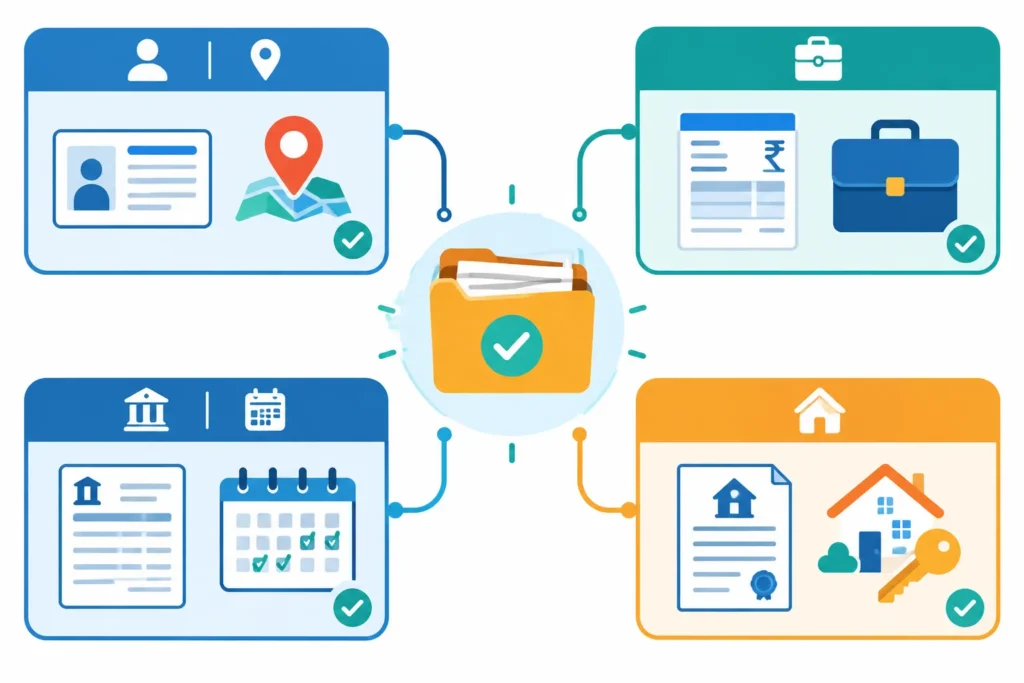
Before submitting your application, review all the documents required for home loan processing. A final check can reduce avoidable delays and repeated requests from the lender.
Keep separate folders for personal, income and property documents. If there is a co-applicant, create a separate set for that person as well.
Personal details and identity checks
- Check your name: Your name should be consistent across the application form, PAN, Aadhaar or other identity proof, bank records and income documents. If there is a genuine variation, ask the lender what supporting proof is needed.
- Check your address: Make sure the current and permanent addresses entered in the application match the relevant address proofs.
- Check dates: Verify your date of birth, employment dates, bank statement periods and dates mentioned in property papers.
- Check validity: Documents such as passports, driving licences or professional registrations should be valid where the lender requires a current document.
- Check signatures: Sign the application form, declarations and consent forms in all required places. Joint applicants may need to sign separately.
Income and bank record checks
- Provide complete statement periods: If the lender asks for six months of bank statements, provide all pages covering the full six-month period. Do not submit only selected months or transaction pages.
- Match income details: Salary, business income and other earnings stated in the application should be supported by the documents submitted.
- Include all requested pages: Income tax returns, salary slips, Form 16, financial statements and account statements should be complete where applicable.
- Explain unusual entries if asked: Large deposits, frequent transfers or irregular credits may lead to clarification requests. Keep genuine supporting records available.
- Use recent records: Submit documents for the periods requested by the lender rather than older records that no longer reflect your finances.
Property document checks
- Check the property description: The project name, flat or plot number, area and seller details should be consistent across the available records.
- Include every requested page: Do not leave out schedules, annexures, registration pages, payment details or pages containing signatures and stamps.
- Keep payment records: Preserve receipts for booking amounts, instalments or other payments made to the builder or seller.
- Check for readable stamps and seals: Registration details, approval references and official markings should be visible in the copies.
Final submission checks
- Compare the application form with your identity, income and bank documents.
- Make clear scans or photocopies without cutting off corners, page numbers, photographs or signatures.
- Arrange pages in the correct order and label files clearly for online submission.
- Confirm that password-protected electronic statements can be opened as instructed by the lender.
- Keep originals available for verification if requested, but submit or hand over originals only through the lender’s stated process.
- Retain a copy of everything submitted, including forms and declarations.
Common Documentation Mistakes to Avoid
Small documentation mistakes can slow down an otherwise complete application. The lender may pause the review until corrected papers or explanations are received.
Submitting blurred or cropped copies
A scan may look clear on a mobile screen but become unreadable when enlarged. Check whether names, identification numbers, transaction entries, stamps and signatures can be read. Avoid dark shadows, glare and cropped edges.
Providing incomplete statements
Applicants sometimes submit the first page of a bank statement or skip months with few transactions. Lenders generally ask for a continuous period so that they can assess income credits, existing EMI payments and account activity. Provide all pages for the requested period.
Using inconsistent names
Initials, spelling differences, name changes after marriage or different surname formats can create a mismatch. Do not alter a document yourself. Inform the lender and provide the appropriate supporting document or declaration requested.
Leaving forms unsigned
An unsigned application, declaration or photograph can be treated as incomplete. Check every signature box. The signature should also be reasonably consistent with the signature in your banking or identity records where relevant.
Submitting outdated records
Old salary slips, expired identity documents or earlier bank statements may not meet current requirements. Check the lender’s requested period before preparing the file.
Missing property pages
A sale agreement or title document may contain schedules and annexures that identify the property and explain rights attached to it. Missing pages can prevent a proper legal or technical review. Submit the complete document set requested, even if some pages appear routine.
Entering details that do not match the evidence
Employment history, monthly income, existing loans and property cost should be entered carefully. An accidental mismatch may lead to further questions. Review the form instead of estimating figures from memory.
What Happens After You Submit Your Documents?
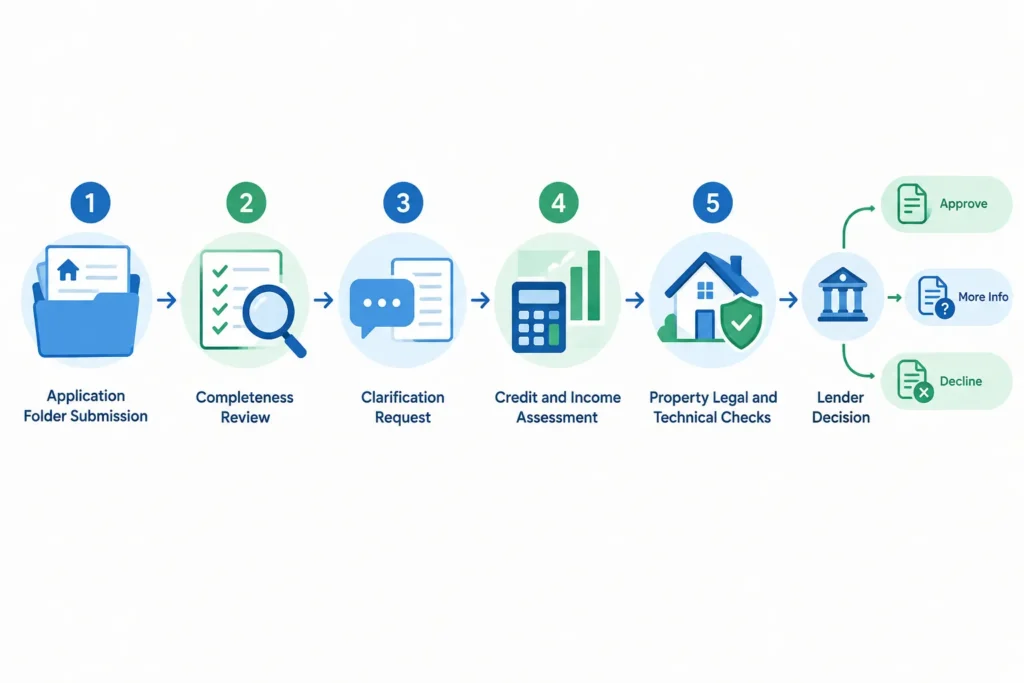
The exact process varies by bank, housing finance company, applicant profile and property type. However, the following stages are common.
1. Document review
The lender checks whether the application and supporting documents are complete, readable and current. Basic details such as name, age, address, employment, income and property information may be compared across records.
2. Clarification or additional document requests
If something is missing or inconsistent, the lender may request another statement, a clearer copy, an explanation or an updated record. This does not automatically mean that the application will be rejected. Respond accurately and keep a record of the additional submission.
3. Credit and income assessment
The lender may review your credit history, current obligations, income stability and repayment capacity. For a salaried applicant, this can include salary credits and employment records. For a self-employed applicant, the review may include tax returns, business bank statements and financial statements.
The documents are assessed together. Providing one particular document does not by itself establish eligibility.
4. Property checks
Where relevant, the lender may conduct legal and technical checks on the property. A legal review generally examines the submitted title and transaction records. A technical review may consider matters such as the property’s identity, construction status or valuation.
The lender may ask for further property papers depending on whether the home is under construction, ready to move into, being purchased from an existing owner or being constructed on a plot.
5. Lender’s decision
After completing its checks, the lender decides whether to approve, decline or seek further information. It may also determine the eligible loan amount and applicable terms based on its policies and assessment.
Submitting all requested documents does not guarantee approval. It only enables the lender to evaluate the application. Approval remains subject to credit assessment, income eligibility, property checks and the lender’s internal rules.
Frequently Asked Questions About Home Loan Documents
Do I need to submit original documents?
Lenders commonly accept copies or digital uploads for initial processing but may ask to see originals for verification. Property-related originals may be required at a later stage under the lender’s process. Ask for a clear acknowledgement if any original is formally handed over.
What should I do if a document is missing?
Inform the lender instead of submitting an incomplete or altered record. Depending on the document, the lender may accept a replacement, certified copy, declaration or another form of evidence. The available option will depend on the lender and the type of document.
Does a joint applicant need a separate document set?
Usually, each joint applicant must provide identity and address documents. Income records may also be required if that person’s income is being considered. All required applicants should sign the relevant forms and declarations.
How many months of bank statements are required?
There is no single period that applies to every lender or applicant. Submit the exact number of months requested and include every page for that continuous period. Self-employed applicants may be asked for statements from personal and business accounts.
Are property papers necessary before applying?
You may be able to begin an enquiry or financial assessment before the complete property file is available. However, the lender will generally need the required property papers before completing legal and technical checks and proceeding with the loan.
What documents do self-employed applicants need?
They are commonly asked for identity and address proof, income tax returns, business bank statements, financial statements and business-related records. The exact list depends on the business structure, income pattern and lender policy.
Can one lender ask for documents that another lender does not?
Yes. Requirements can differ based on internal policy, applicant profile, property type, location and loan structure. Treat any general checklist as preparation guidance and confirm the final list directly with the chosen lender.
Summary
A careful final review is an important part of preparing the documents required for home loan processing. Check names, addresses, dates, signatures, validity, statement periods and property details. Submit complete, readable copies and keep originals ready for verification when requested.
Avoid blurred scans, missing pages, outdated records and details that do not match the application. After submission, the lender may review the file, request clarifications, assess income and credit, examine the property and then make its decision. Complete documentation can support smoother processing, but it does not guarantee home loan approval.


Comments