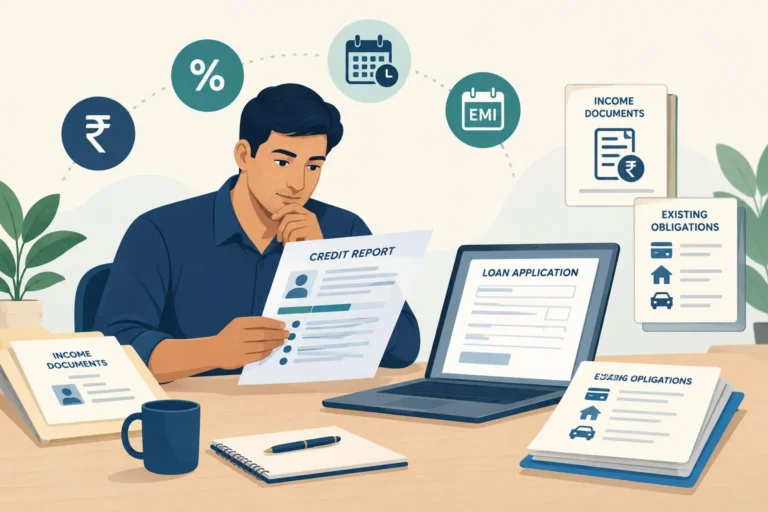


How to Improve Home Loan Eligibility in India

A practical guide for Indian homebuyers on how lenders assess home loan eligibility and what you can do before applying to strengthen your application.

How to Improve Home Loan Eligibility in India

You can improve your home loan eligibility by showing stable and verifiable income, reducing existing EMIs, maintaining a healthy credit history, and demonstrating continuity in your job or business. However, eligibility is only a lender’s initial assessment. It does not guarantee final approval, as the lender will also verify your documents, property, repayment capacity and overall risk profile.

Introduction

Buying a home is one of the biggest financial decisions for an Indian household. Before you shortlist a property or pay a large booking amount, it helps to understand how much a bank or housing finance company may be willing to lend.

This possible loan amount depends on your home loan eligibility. Lenders estimate whether your income is sufficient and reliable enough to support the proposed equated monthly instalment, or EMI, along with your regular expenses and existing debts.

First-time homebuyers often assume that a higher salary automatically means a larger loan. Income is important, but it is not the only factor. Your existing EMIs, credit history, age, job stability, business track record and the number of earning applicants can also influence the assessment.

Existing borrowers should understand eligibility as well. It matters when applying for a home loan balance transfer, a top-up loan or another large loan. A rise in income may help, but new debts or missed payments can weaken the application.

What Is Home Loan Eligibility?

Home loan eligibility is an estimate of whether you qualify for a housing loan and how much a lender may be prepared to offer. It is mainly based on your ability and willingness to repay the loan over the selected tenure.

The lender usually begins by examining your monthly income and current financial obligations. It estimates how much of your income can reasonably be used for all debt repayments, including the proposed home loan EMI.

For example, suppose your household receives regular income each month but already pays EMIs for a car loan and a personal loan. The lender will generally deduct or account for these commitments before estimating the affordable home loan EMI. A household with the same income but no existing loans may qualify for a higher amount.

Eligibility is not the same as loan approval. An online calculator, branch representative or preliminary lender assessment may indicate that you are eligible for a certain amount. The final sanction can still be lower or the application can be rejected after detailed checks.

Final approval may depend on factors such as:

  • Your income and identity documents
  • Your credit report and recent repayment record
  • The legal and technical assessment of the property
  • The property’s market value and the lender’s permitted loan-to-value level
  • Your employment or business stability
  • The source of your down payment
  • The lender’s internal policies at the time of application

The eligible amount may also be different from the amount required to buy the property. Lenders usually finance only an accepted portion of the property cost or assessed value. You must arrange the remaining down payment and transaction expenses, such as stamp duty and registration charges, according to the applicable rules and lender policy.

Factors That Affect Home Loan Eligibility
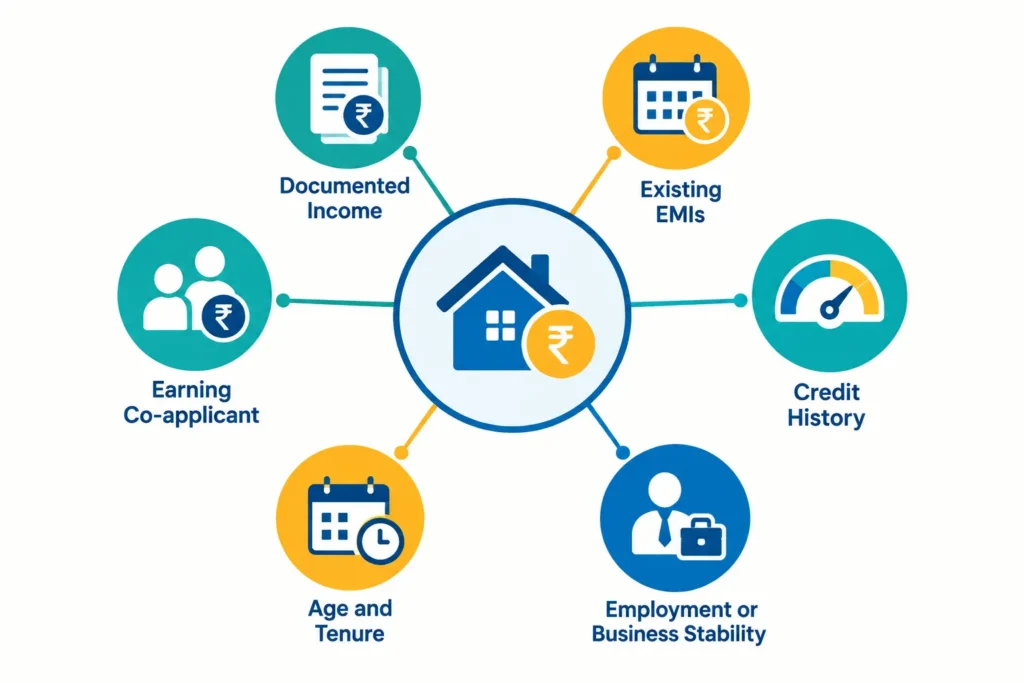
Diagram showing income, existing EMIs, credit history, stability, age and co-applicant as home loan eligibility factors.

Every lender uses its own assessment process. Nevertheless, most banks and housing finance companies examine a similar set of borrower-related factors.

Income stability and verification

Lenders prefer income that is regular, sufficient and supported by documents. Salary slips, bank statements, Form 16, income tax returns and audited business records can help establish income. Large cash earnings or irregular credits may not receive the same consideration if they cannot be properly verified.

Existing debt obligations

Car loans, personal loans, education loans, consumer durable loans and credit card dues can reduce your repayment capacity. Even if every EMI is paid on time, a high monthly debt burden may leave less room for a home loan EMI.

Employment or business continuity

A stable employment record can give a lender more confidence that income will continue. Frequent job changes, a recent career break or employment during probation may lead to additional checks.

For self-employed applicants, lenders may review how long the business has operated, the consistency of profits, bank account activity, tax returns and the nature of the industry. A profitable year alone may not be enough if earlier earnings were weak or highly irregular.

Age and available loan tenure

Age can affect the maximum repayment period available. A longer tenure can reduce the monthly EMI and may increase the eligible loan amount, although it generally increases total interest paid over the life of the loan. Applicants closer to retirement may be offered a shorter tenure unless another eligible earning applicant is included.

Credit profile and repayment behaviour

Your credit report shows how you have managed past and current borrowing. Timely EMI and credit card payments generally support the application. Missed payments, settlements, write-offs or heavy dependence on unsecured credit can create concerns.

Co-applicant income

Applying with an eligible earning co-applicant may improve home loan eligibility because the lender can consider combined repayment capacity. However, the co-applicant becomes responsible for repayment too. The lender will assess that person’s income, age, credit history and existing debts.

Simply adding a family member does not always increase eligibility. The benefit usually depends on whether the lender accepts that relationship and can include the co-applicant’s documented income under its policy.

You May Also Like:Home Loan Down Payment in India: How Much Do You Need?

How Income Affects Your Eligible Loan Amount

Income is central to the eligibility calculation because the home loan must be repaid through future cash flow. But lenders do not normally treat your entire monthly income as available for EMI payments.

They allow for household expenses, existing debts and a reasonable financial buffer. Many lenders use an income-to-obligation or fixed-obligation calculation, but the permitted ratio and method vary. There is no single percentage that applies to every borrower or lender.

Consider an illustrative Indian household. Rohan earns Rs. 75,000 per month and Meera earns Rs. 45,000. Their combined monthly income is Rs. 1,20,000. They also pay a car loan EMI of Rs. 12,000 and have an ongoing personal loan EMI of Rs. 8,000.

A lender will not simply multiply their annual income and approve a loan. It will first consider the Rs. 20,000 of existing monthly obligations. It may then decide how much additional EMI the household can manage under its internal rules.

If the personal loan is fully repaid before the home loan application, their monthly obligations may fall. This could improve their assessed repayment capacity. However, the actual increase in eligibility would depend on the lender’s interest rate, approved tenure, income assessment and underwriting policy.

Salaried and self-employed applicants may also be assessed differently.

For salaried applicants

A lender may review basic salary, regular allowances, incentives, bonuses and deductions. Fixed monthly earnings are generally easier to assess than variable income. Bonuses or incentives may be averaged, partially considered or excluded if they are inconsistent.

Recent salary increases can help, but lenders may check whether the new income is reflected in salary credits and supporting documents. They may also review the employer’s profile and the applicant’s length of service.

For self-employed applicants

Lenders commonly examine income tax returns, profit and loss statements, balance sheets, bank statements and business continuity. They may calculate eligible income differently from the profit shown in a single document.

Maintaining clean records, filing tax returns on time and separating personal and business transactions can make income easier to verify. Sudden unexplained deposits are unlikely to be treated as stable income merely because they appear in a bank account.

Credit Score and Home Loan Eligibility

A credit score is a numerical summary based on information in your credit report. It helps lenders evaluate your past borrowing and repayment behaviour. A stronger score can support home loan eligibility, but the score is not the only consideration.

Each lender can set its own score expectations and approval rules. There is no universal cut-off that guarantees a home loan. A lender may approve one applicant and decline another with a similar score because their incomes, debt levels, repayment records or property details differ.

Lenders may look beyond the headline score and examine:

  • Whether EMIs and credit card bills were paid on time
  • How recently any delay or default occurred
  • The amount outstanding on credit cards and loans
  • The number of recent credit applications or enquiries
  • Whether any account was settled or written off
  • The length and mix of the applicant’s credit history

Payment behaviour is particularly important. A single old delay with a reasonable explanation may be viewed differently from repeated recent missed payments. Similarly, paying only the minimum due on credit cards may avoid an immediate default, but consistently high balances can suggest financial pressure.

Before applying, review your credit report for incorrect personal details, unfamiliar accounts or wrongly reported late payments. If you find an error, raise a dispute with the relevant credit bureau or lender. Genuine negative information cannot be removed simply because it reduces eligibility, but reporting mistakes should be corrected through the proper process.

Do not take several new loans or submit many credit applications only to create a credit history before applying for a home loan. New debt can increase your obligations, while numerous recent enquiries may cause a lender to examine your finances more closely. The safer approach is to borrow only when needed and repay every obligation on time.

How Existing EMIs Affect Eligibility
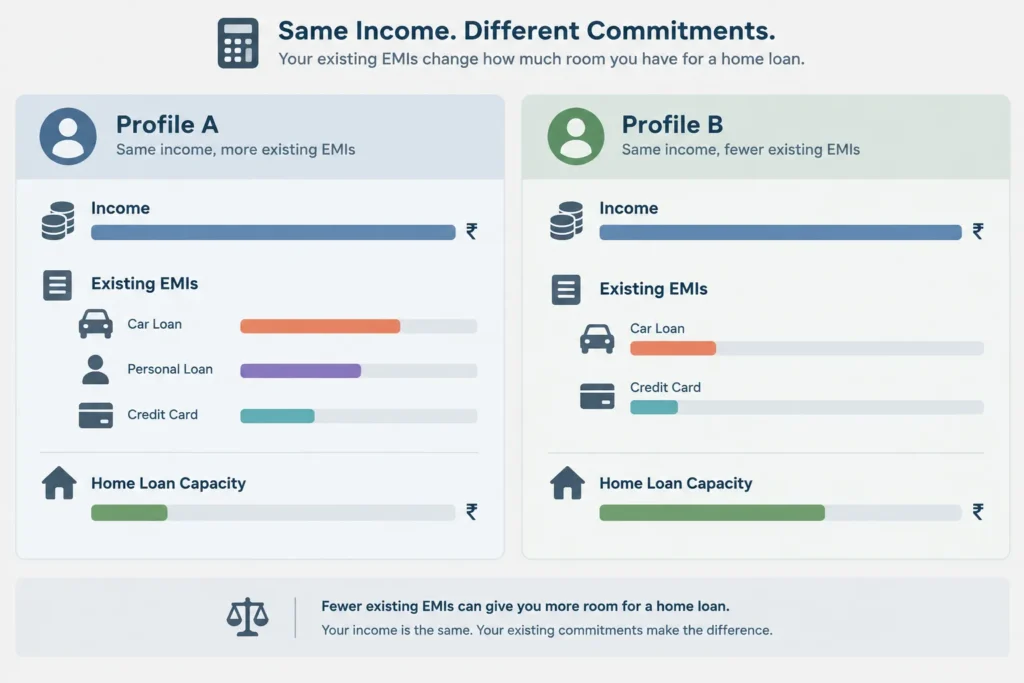
Comparison showing how higher existing EMIs can leave less capacity for a home loan EMI.

Your income is not the only factor that decides home loan eligibility. Lenders also check how much of that income is already committed to existing loans and other regular obligations.

For example, suppose you are paying EMIs for a car loan and a personal loan. These payments reduce the amount available for a new home loan EMI. Even if your salary is reasonably high, large existing EMIs can reduce the loan amount a lender is willing to offer.

Lenders generally assess your fixed monthly obligations against your regular monthly income. The exact calculation and acceptable level vary by lender, borrower profile and loan product. Obligations may include:

  • Personal loan EMIs
  • Car or two-wheeler loan EMIs
  • Education loan EMIs
  • Existing home loan EMIs
  • Regular payments on other secured or unsecured loans
  • Credit card dues or card-based EMIs

Consider a salaried applicant earning Rs. 90,000 per month. If the applicant already pays Rs. 30,000 towards other loans, the lender will assess the new home loan after accounting for those commitments. An applicant with the same income but no existing EMI may qualify for a higher amount, subject to other checks.

Before applying, review your smaller debts. If a manageable personal loan or consumer loan is close to completion, clearing it may improve your available repayment capacity. However, do not use all your savings just to close debt. Keep enough money for emergencies, registration expenses, moving costs and home-related repairs.

Credit card usage also deserves attention. Paying only the minimum amount due can lead to a growing balance and may indicate financial stress. Clearing outstanding card dues and avoiding new card-based EMIs before a home loan application can make your finances easier to assess.

Age, Employment and Loan Tenure

Age can influence both the available loan tenure and the size of the EMI. Lenders usually consider your current age, expected retirement age, income continuity and remaining working years. Their rules differ, so there is no single age or tenure formula that applies to every applicant.

A younger applicant may have more working years available and may therefore be considered for a longer tenure. An applicant closer to retirement may receive a shorter tenure unless the lender accepts reliable post-retirement income, a suitable co-applicant or another arrangement permitted under its policy.

Employment stability is also important. For salaried applicants, lenders may examine work experience, continuity of employment, employer profile and recent job changes. A recent job change does not automatically cause rejection, but the lender may ask for additional documents or wait until the applicant has completed a required employment period.

For self-employed applicants, lenders commonly review the stability of the business or profession, income-tax returns, bank statements and financial records. Large variations in reported income may require further explanation.

How tenure changes the EMI

A longer loan tenure spreads repayment over more months. This generally lowers the monthly EMI for the same loan amount and interest rate. A lower EMI may improve home loan eligibility because it reduces the immediate monthly burden considered by the lender.

However, a longer tenure usually increases the total interest paid over the life of the loan. A shorter tenure results in a higher EMI but may reduce total interest if the interest rate and other conditions remain the same.

The right tenure should not be chosen only to obtain the largest possible loan. Select an EMI that leaves room for household expenses, insurance, investments, emergencies and future goals such as children’s education. A home loan EMI that looks affordable today may become difficult if income falls or expenses rise.

You May Also Like:How Credit Score Affects Your Loan Eligibility and Interest Rate

How Property Value and Down Payment Affect Eligibility

Home loan approval depends on both the borrower and the property. Even if your income supports the requested loan, the lender will independently assess the property before deciding how much it is willing to finance.

The lender may appoint a valuer to estimate the property’s acceptable market value. This valuation may differ from the price agreed between the buyer and seller. If you agree to buy a flat for Rs. 70 lakh but the lender values it at a lower amount, the loan may be calculated with reference to the lender’s accepted value rather than the full purchase price.

Lenders normally finance only a portion of the acceptable property value. The borrower must contribute the remaining amount as the down payment or margin. The required contribution depends on the lender’s policy, the loan size, the property and applicable regulatory requirements.

A larger down payment can help in several ways:

  • It reduces the amount you need to borrow.
  • It can lower the EMI for the same tenure.
  • It may make repayment more comfortable.
  • It provides a buffer if the lender’s valuation is below the purchase price.

Remember that the down payment is not the only upfront expense. Stamp duty, registration charges, legal checks, brokerage, interiors and other purchase costs may not be fully covered by the loan. Keep separate funds for these expenses instead of putting every rupee into the down payment.

The property must also meet the lender’s legal and technical requirements. Clear ownership records, required approvals and acceptable construction status can affect approval. Strong personal income cannot compensate for a property that fails the lender’s checks.

How to Improve Home Loan Eligibility

Improving home loan eligibility usually requires better repayment capacity, cleaner credit behaviour and realistic borrowing. The following steps can help before you submit an application.

Reduce manageable debt

Clear smaller loans or credit card balances where practical. This reduces monthly commitments and may increase the income available for the proposed EMI. Obtain closure documents and check that the lender reports the account correctly.

Avoid repeated loan applications

Submitting applications to many lenders within a short period can lead to multiple credit enquiries. Instead, compare basic eligibility conditions first and apply selectively. An initial estimate or lender discussion is not the same as final approval.

Check your credit report

Review your credit report for incorrect overdue amounts, unfamiliar accounts, duplicate loans or accounts that remain marked open after closure. Raise a correction request with the relevant lender or credit bureau if you find an error. Genuine missed payments cannot simply be removed, but factual errors should be disputed with supporting documents.

Build a larger down payment

Saving a larger down payment reduces the required loan amount. It may also protect you against a valuation gap. Build this fund gradually and keep an emergency reserve separate.

Show stable and documented income

Maintain clear salary credits, bank statements, tax records and business accounts. Avoid unexplained cash deposits just before applying. If you are self-employed, accurate and timely financial reporting can help the lender understand your actual income.

Choose a realistic property budget

Do not treat the maximum eligible amount as your ideal budget. A less expensive property, larger down payment or longer saving period may produce a safer EMI. Include maintenance charges and other ownership costs when testing affordability.

Can a Co-Applicant Increase Home Loan Eligibility?

An eligible earning co-applicant may increase home loan eligibility because the lender can consider combined income. For example, spouses applying together may qualify for a higher amount than one spouse applying alone, provided both meet the lender’s conditions.

However, merely adding a person’s name does not guarantee that their income will be counted. The lender may have rules about eligible relationships, income type, age, credit history, property ownership and repayment responsibility. A non-earning co-applicant may not increase the eligible loan amount.

The lender will also assess the co-applicant’s existing EMIs and credit record. If the co-applicant has heavy debt or poor repayment history, adding them may not improve the application.

Co-applicants can share legal responsibility for repayment. If one borrower stops paying, the lender may seek payment from the other borrower according to the loan agreement. Both applicants should understand the EMI arrangement, ownership structure and documentation before signing.

Use a co-applicant to reflect genuine joint finances, not simply to stretch the loan beyond a comfortable level. Combined income can support a higher loan, but the household must still be able to manage the EMI during job changes, illness or other financial disruptions.

Documents Required for a Home Loan Application

A complete and consistent document set can make the home loan process smoother. Exact requirements differ by lender, applicant profile, property type and loan amount. Ask the lender for its current checklist before submitting your application.

Basic identity and address documents

Most applicants need to provide proof of identity, address and age. Commonly accepted documents include:

  • PAN card
  • Aadhaar card
  • Passport
  • Voter ID
  • Driving licence
  • Recent passport-size photographs

The name, date of birth and address should be consistent across the application and supporting documents. If there is a difference, such as a changed surname or an old address, provide suitable supporting proof and explain it clearly.

Documents for salaried applicants

A salaried applicant may generally be asked for:

  • Recent salary slips, usually covering the period requested by the lender
  • Salary bank account statements
  • Form 16 or income tax returns, where required
  • Employment ID card or employment certificate
  • Appointment letter, confirmation letter or latest increment letter
  • Details of existing loans, EMIs and credit card obligations
You May Also Like:Personal Loan vs Home Loan: Key Differences Explained

Lenders use these records to check salary continuity, monthly deductions, employment stability and repayment capacity. If incentives, bonuses or variable pay form a large part of your income, the lender may consider only the portion it regards as regular and reliable.

Documents for self-employed applicants

Self-employed professionals and business owners usually need a wider set of financial records. These may include:

  • Income tax returns for the period specified by the lender
  • Computation of income
  • Audited balance sheets and profit and loss statements, where applicable
  • Business and personal bank account statements
  • GST returns, if applicable
  • Business registration, partnership deed or incorporation documents
  • Professional qualification or practice certificate, where relevant
  • Details of current business loans and other liabilities

The lender may compare reported income with bank credits, tax filings and business performance. Large unexplained cash deposits, falling profits or irregular filings can lead to additional questions.

Banking and own-contribution documents

Bank statements help the lender assess income credits, spending patterns, cheque returns and existing EMI payments. They may also be used to confirm that you can fund the down payment and other purchase costs.

Keep records showing the source of your own contribution. For example, this may include savings account balances, fixed deposit receipts, mutual fund redemption records or documented gifts from close family members. Avoid borrowing the down payment through an undisclosed personal loan, as this increases your obligations and may affect eligibility.

Property documents

Income eligibility alone is not enough. The property must also meet the lender’s legal and technical standards. Depending on whether the property is under construction, ready to move or being resold, documents may include:

  • Agreement for sale or allotment letter
  • Sale deed or chain of title documents
  • Approved building plan and relevant permissions
  • Completion or occupancy certificate, where applicable
  • Property tax receipts
  • Encumbrance-related records
  • Builder demand letter and payment schedule
  • No-objection certificates required for the transaction
  • Society, association or development authority documents, where applicable

The lender may request additional documents after its legal or technical review. A property being approved by one lender does not automatically mean every other lender will accept it.

Common Reasons for Home Loan Rejection

A rejection does not always mean that the applicant has no repayment capacity. It may result from the applicant’s finances, the submitted information or the property itself.

Unstable or difficult-to-verify income

Frequent job changes, long employment gaps, irregular salary credits or a recently started business can make income appear less stable. Self-employed applicants may face difficulty if tax returns do not reflect the income claimed in the application.

High existing obligations

Personal loan EMIs, vehicle loans, credit card dues and other commitments reduce the income available for a home loan EMI. Even if each obligation appears manageable separately, their combined effect can lower home loan eligibility.

Weak or limited credit history

Late payments, loan settlements, written-off accounts, heavy use of credit limits or many recent credit enquiries may concern a lender. Having no credit history can also make assessment harder, although it does not automatically lead to rejection.

Inconsistent application details

Differences in salary, employer name, residential address, loan obligations or property price can delay verification. Never hide an existing loan or provide estimated figures as confirmed facts. Lenders may compare the application with bank statements, credit reports and employer or business records.

Insufficient own contribution

A lender generally finances only an eligible portion of the property value. The buyer must arrange the remaining amount, along with costs that the loan may not cover. If you cannot show adequate funds for this contribution, the application may not proceed.

Incomplete documents

Missing bank statement pages, unsigned financial statements, expired identity proof or unclear property papers can hold up processing. Submitting documents in an organised set reduces avoidable follow-ups.

A lender can reject the property even when the borrower has strong income. Common concerns include unclear ownership, missing approvals, disputed title, unauthorised construction or poor marketability.

The lender’s valuation may also be lower than the purchase price. In that case, the eligible loan may be calculated using the lender’s accepted value, leaving the buyer to arrange a larger contribution.

Home Loan Eligibility vs Loan Approval
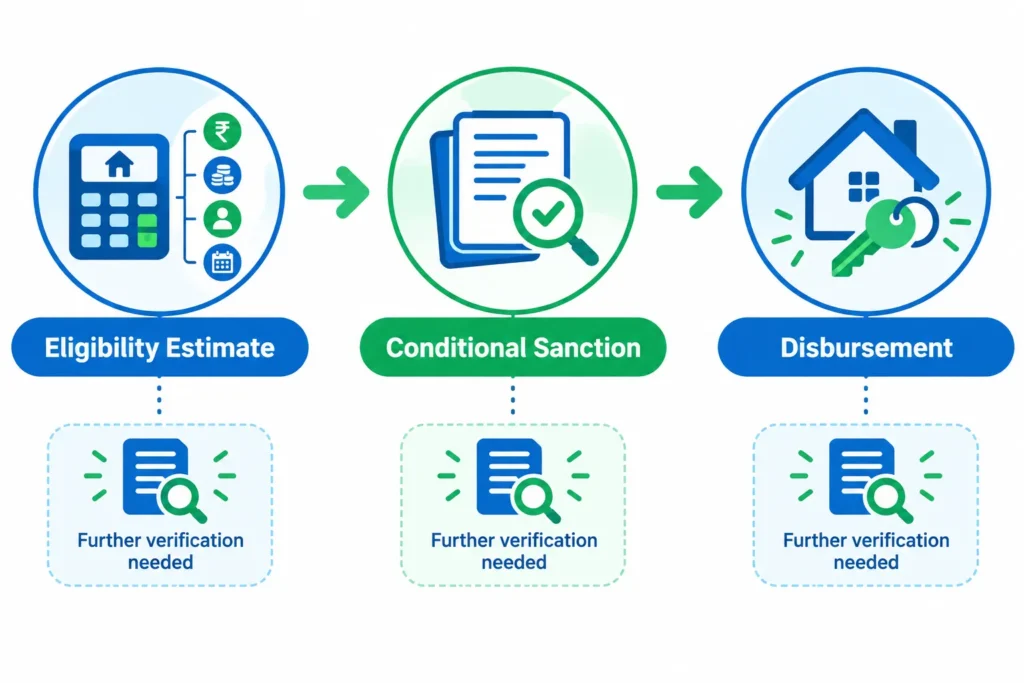
Three-stage flow from home loan eligibility estimate to sanction and final disbursement checks.

Home loan eligibility is an estimate of how much you may be able to borrow based on factors such as income, age, existing obligations, credit profile and preferred tenure. An online calculator or initial lender discussion provides an indication, not a commitment.

You May Also Like:Home Loan EMI: How It Is Calculated and What Affects It

Eligibility estimate

This is a preliminary calculation. It may be based on limited information and may not include full credit checks, income verification or property review.

Sanction

A sanction is the lender’s conditional approval after assessing the application and supporting records. The sanction letter normally mentions the approved amount, interest rate structure, tenure, conditions and validity period.

Sanction does not always mean that money will be released immediately. You must still satisfy the stated conditions.

Final disbursement

Disbursement happens after the lender completes required legal, technical and financial checks. It may also depend on execution of loan documents, creation of security, payment of your own contribution and submission of property papers.

For an under-construction property, the lender may release funds in stages based on construction progress and the payment schedule. Therefore, eligibility, sanction and disbursement are three different steps.

Frequently Asked Questions About Home Loan Eligibility

How can I check my home loan eligibility?

Start with your net monthly income, existing EMIs, age, expected retirement age and preferred tenure. A lender’s calculator can provide an initial estimate. Confirm it directly with the lender because assessment methods and eligible income components differ.

How can I improve eligibility before applying?

Reduce costly debts, pay credit card balances on time, avoid unnecessary loan applications and build a clear record of income. Save enough for the down payment and purchase costs. Check documents for errors before applying.

Does a high credit score guarantee eligibility?

No. A stronger credit profile can support the application, but the lender also considers income, obligations, employment or business stability, age and property acceptability. Credit score requirements also vary by lender.

Can a joint application increase eligibility?

It may increase eligibility if the co-applicant has stable income and an acceptable credit profile, and the lender agrees to include that income. Co-applicants are jointly responsible for repayment. Ownership and tax implications should also be understood before proceeding.

Should I apply immediately after changing jobs?

A recent job change does not automatically prevent approval. However, a lender may ask for proof of continuity, confirmation of employment or completion of a probation period. If possible, check the lender’s policy before paying non-refundable property-related amounts.

Do prepayments on existing loans improve eligibility?

Reducing or closing an existing loan can lower monthly obligations and may improve repayment capacity. Obtain a closure letter or updated statement, and allow time for the repayment to appear in relevant records. Do not use all your emergency savings solely to close debt.

Does a larger down payment help?

A larger own contribution reduces the required loan amount and EMI. This can make the application easier to manage. However, retain funds for registration costs, moving expenses, repairs and emergencies.

Does an eligibility estimate guarantee approval?

No. Final approval depends on document verification, credit assessment, lender policy and legal and technical review of the property. The lender may approve a lower amount, add conditions or decline the application.

Final Home Loan Application Checklist

  • Estimate an affordable EMI after including existing obligations.
  • Review your credit report and correct genuine errors.
  • Reduce avoidable debt and unnecessary credit enquiries.
  • Keep identity, address, income and bank records consistent.
  • Arrange the down payment and additional purchase costs from documented sources.
  • Collect the complete property document set.
  • Compare the eligibility estimate with the sanction terms.
  • Read all conditions that must be completed before disbursement.

Good preparation can improve home loan eligibility and reduce processing delays, but it cannot remove every approval risk. Verify the lender’s latest document list, credit policy, charges and property requirements. Also confirm current regulatory and tax rules with the appropriate lender or qualified professional before making a financial commitment.


Share this article
KEEP READING

Related Articles

View all →

Comments

Leave a Comment

How to Improve Home Loan Eligibility in India

You can improve your home loan eligibility by showing stable and verifiable income, reducing existing EMIs, maintaining a healthy credit history, and demonstrating continuity in your job or business. However, eligibility is only a lender’s initial assessment. It does not guarantee final approval, as the lender will also verify your documents, property, repayment capacity and overall risk profile.

Introduction

Buying a home is one of the biggest financial decisions for an Indian household. Before you shortlist a property or pay a large booking amount, it helps to understand how much a bank or housing finance company may be willing to lend.

This possible loan amount depends on your home loan eligibility. Lenders estimate whether your income is sufficient and reliable enough to support the proposed equated monthly instalment, or EMI, along with your regular expenses and existing debts.

First-time homebuyers often assume that a higher salary automatically means a larger loan. Income is important, but it is not the only factor. Your existing EMIs, credit history, age, job stability, business track record and the number of earning applicants can also influence the assessment.

Existing borrowers should understand eligibility as well. It matters when applying for a home loan balance transfer, a top-up loan or another large loan. A rise in income may help, but new debts or missed payments can weaken the application.

What Is Home Loan Eligibility?

Home loan eligibility is an estimate of whether you qualify for a housing loan and how much a lender may be prepared to offer. It is mainly based on your ability and willingness to repay the loan over the selected tenure.

The lender usually begins by examining your monthly income and current financial obligations. It estimates how much of your income can reasonably be used for all debt repayments, including the proposed home loan EMI.

For example, suppose your household receives regular income each month but already pays EMIs for a car loan and a personal loan. The lender will generally deduct or account for these commitments before estimating the affordable home loan EMI. A household with the same income but no existing loans may qualify for a higher amount.

Eligibility is not the same as loan approval. An online calculator, branch representative or preliminary lender assessment may indicate that you are eligible for a certain amount. The final sanction can still be lower or the application can be rejected after detailed checks.

Final approval may depend on factors such as:

  • Your income and identity documents
  • Your credit report and recent repayment record
  • The legal and technical assessment of the property
  • The property’s market value and the lender’s permitted loan-to-value level
  • Your employment or business stability
  • The source of your down payment
  • The lender’s internal policies at the time of application

The eligible amount may also be different from the amount required to buy the property. Lenders usually finance only an accepted portion of the property cost or assessed value. You must arrange the remaining down payment and transaction expenses, such as stamp duty and registration charges, according to the applicable rules and lender policy.

Factors That Affect Home Loan Eligibility

Diagram showing income, existing EMIs, credit history, stability, age and co-applicant as home loan eligibility factors.

Every lender uses its own assessment process. Nevertheless, most banks and housing finance companies examine a similar set of borrower-related factors.

Income stability and verification

Lenders prefer income that is regular, sufficient and supported by documents. Salary slips, bank statements, Form 16, income tax returns and audited business records can help establish income. Large cash earnings or irregular credits may not receive the same consideration if they cannot be properly verified.

Existing debt obligations

Car loans, personal loans, education loans, consumer durable loans and credit card dues can reduce your repayment capacity. Even if every EMI is paid on time, a high monthly debt burden may leave less room for a home loan EMI.

Employment or business continuity

A stable employment record can give a lender more confidence that income will continue. Frequent job changes, a recent career break or employment during probation may lead to additional checks.

For self-employed applicants, lenders may review how long the business has operated, the consistency of profits, bank account activity, tax returns and the nature of the industry. A profitable year alone may not be enough if earlier earnings were weak or highly irregular.

Age and available loan tenure

Age can affect the maximum repayment period available. A longer tenure can reduce the monthly EMI and may increase the eligible loan amount, although it generally increases total interest paid over the life of the loan. Applicants closer to retirement may be offered a shorter tenure unless another eligible earning applicant is included.

Credit profile and repayment behaviour

Your credit report shows how you have managed past and current borrowing. Timely EMI and credit card payments generally support the application. Missed payments, settlements, write-offs or heavy dependence on unsecured credit can create concerns.

Co-applicant income

Applying with an eligible earning co-applicant may improve home loan eligibility because the lender can consider combined repayment capacity. However, the co-applicant becomes responsible for repayment too. The lender will assess that person’s income, age, credit history and existing debts.

Simply adding a family member does not always increase eligibility. The benefit usually depends on whether the lender accepts that relationship and can include the co-applicant’s documented income under its policy.

How Income Affects Your Eligible Loan Amount

Income is central to the eligibility calculation because the home loan must be repaid through future cash flow. But lenders do not normally treat your entire monthly income as available for EMI payments.

They allow for household expenses, existing debts and a reasonable financial buffer. Many lenders use an income-to-obligation or fixed-obligation calculation, but the permitted ratio and method vary. There is no single percentage that applies to every borrower or lender.

Consider an illustrative Indian household. Rohan earns Rs. 75,000 per month and Meera earns Rs. 45,000. Their combined monthly income is Rs. 1,20,000. They also pay a car loan EMI of Rs. 12,000 and have an ongoing personal loan EMI of Rs. 8,000.

A lender will not simply multiply their annual income and approve a loan. It will first consider the Rs. 20,000 of existing monthly obligations. It may then decide how much additional EMI the household can manage under its internal rules.

If the personal loan is fully repaid before the home loan application, their monthly obligations may fall. This could improve their assessed repayment capacity. However, the actual increase in eligibility would depend on the lender’s interest rate, approved tenure, income assessment and underwriting policy.

Salaried and self-employed applicants may also be assessed differently.

For salaried applicants

A lender may review basic salary, regular allowances, incentives, bonuses and deductions. Fixed monthly earnings are generally easier to assess than variable income. Bonuses or incentives may be averaged, partially considered or excluded if they are inconsistent.

Recent salary increases can help, but lenders may check whether the new income is reflected in salary credits and supporting documents. They may also review the employer’s profile and the applicant’s length of service.

For self-employed applicants

Lenders commonly examine income tax returns, profit and loss statements, balance sheets, bank statements and business continuity. They may calculate eligible income differently from the profit shown in a single document.

Maintaining clean records, filing tax returns on time and separating personal and business transactions can make income easier to verify. Sudden unexplained deposits are unlikely to be treated as stable income merely because they appear in a bank account.

Credit Score and Home Loan Eligibility

A credit score is a numerical summary based on information in your credit report. It helps lenders evaluate your past borrowing and repayment behaviour. A stronger score can support home loan eligibility, but the score is not the only consideration.

Each lender can set its own score expectations and approval rules. There is no universal cut-off that guarantees a home loan. A lender may approve one applicant and decline another with a similar score because their incomes, debt levels, repayment records or property details differ.

Lenders may look beyond the headline score and examine:

  • Whether EMIs and credit card bills were paid on time
  • How recently any delay or default occurred
  • The amount outstanding on credit cards and loans
  • The number of recent credit applications or enquiries
  • Whether any account was settled or written off
  • The length and mix of the applicant’s credit history

Payment behaviour is particularly important. A single old delay with a reasonable explanation may be viewed differently from repeated recent missed payments. Similarly, paying only the minimum due on credit cards may avoid an immediate default, but consistently high balances can suggest financial pressure.

Before applying, review your credit report for incorrect personal details, unfamiliar accounts or wrongly reported late payments. If you find an error, raise a dispute with the relevant credit bureau or lender. Genuine negative information cannot be removed simply because it reduces eligibility, but reporting mistakes should be corrected through the proper process.

Do not take several new loans or submit many credit applications only to create a credit history before applying for a home loan. New debt can increase your obligations, while numerous recent enquiries may cause a lender to examine your finances more closely. The safer approach is to borrow only when needed and repay every obligation on time.

How Existing EMIs Affect Eligibility

Comparison showing how higher existing EMIs can leave less capacity for a home loan EMI.

Your income is not the only factor that decides home loan eligibility. Lenders also check how much of that income is already committed to existing loans and other regular obligations.

For example, suppose you are paying EMIs for a car loan and a personal loan. These payments reduce the amount available for a new home loan EMI. Even if your salary is reasonably high, large existing EMIs can reduce the loan amount a lender is willing to offer.

Lenders generally assess your fixed monthly obligations against your regular monthly income. The exact calculation and acceptable level vary by lender, borrower profile and loan product. Obligations may include:

  • Personal loan EMIs
  • Car or two-wheeler loan EMIs
  • Education loan EMIs
  • Existing home loan EMIs
  • Regular payments on other secured or unsecured loans
  • Credit card dues or card-based EMIs

Consider a salaried applicant earning Rs. 90,000 per month. If the applicant already pays Rs. 30,000 towards other loans, the lender will assess the new home loan after accounting for those commitments. An applicant with the same income but no existing EMI may qualify for a higher amount, subject to other checks.

Before applying, review your smaller debts. If a manageable personal loan or consumer loan is close to completion, clearing it may improve your available repayment capacity. However, do not use all your savings just to close debt. Keep enough money for emergencies, registration expenses, moving costs and home-related repairs.

Credit card usage also deserves attention. Paying only the minimum amount due can lead to a growing balance and may indicate financial stress. Clearing outstanding card dues and avoiding new card-based EMIs before a home loan application can make your finances easier to assess.

Age, Employment and Loan Tenure

Age can influence both the available loan tenure and the size of the EMI. Lenders usually consider your current age, expected retirement age, income continuity and remaining working years. Their rules differ, so there is no single age or tenure formula that applies to every applicant.

A younger applicant may have more working years available and may therefore be considered for a longer tenure. An applicant closer to retirement may receive a shorter tenure unless the lender accepts reliable post-retirement income, a suitable co-applicant or another arrangement permitted under its policy.

Employment stability is also important. For salaried applicants, lenders may examine work experience, continuity of employment, employer profile and recent job changes. A recent job change does not automatically cause rejection, but the lender may ask for additional documents or wait until the applicant has completed a required employment period.

For self-employed applicants, lenders commonly review the stability of the business or profession, income-tax returns, bank statements and financial records. Large variations in reported income may require further explanation.

How tenure changes the EMI

A longer loan tenure spreads repayment over more months. This generally lowers the monthly EMI for the same loan amount and interest rate. A lower EMI may improve home loan eligibility because it reduces the immediate monthly burden considered by the lender.

However, a longer tenure usually increases the total interest paid over the life of the loan. A shorter tenure results in a higher EMI but may reduce total interest if the interest rate and other conditions remain the same.

The right tenure should not be chosen only to obtain the largest possible loan. Select an EMI that leaves room for household expenses, insurance, investments, emergencies and future goals such as children’s education. A home loan EMI that looks affordable today may become difficult if income falls or expenses rise.

How Property Value and Down Payment Affect Eligibility

Home loan approval depends on both the borrower and the property. Even if your income supports the requested loan, the lender will independently assess the property before deciding how much it is willing to finance.

The lender may appoint a valuer to estimate the property’s acceptable market value. This valuation may differ from the price agreed between the buyer and seller. If you agree to buy a flat for Rs. 70 lakh but the lender values it at a lower amount, the loan may be calculated with reference to the lender’s accepted value rather than the full purchase price.

Lenders normally finance only a portion of the acceptable property value. The borrower must contribute the remaining amount as the down payment or margin. The required contribution depends on the lender’s policy, the loan size, the property and applicable regulatory requirements.

A larger down payment can help in several ways:

  • It reduces the amount you need to borrow.
  • It can lower the EMI for the same tenure.
  • It may make repayment more comfortable.
  • It provides a buffer if the lender’s valuation is below the purchase price.

Remember that the down payment is not the only upfront expense. Stamp duty, registration charges, legal checks, brokerage, interiors and other purchase costs may not be fully covered by the loan. Keep separate funds for these expenses instead of putting every rupee into the down payment.

The property must also meet the lender’s legal and technical requirements. Clear ownership records, required approvals and acceptable construction status can affect approval. Strong personal income cannot compensate for a property that fails the lender’s checks.

How to Improve Home Loan Eligibility

Improving home loan eligibility usually requires better repayment capacity, cleaner credit behaviour and realistic borrowing. The following steps can help before you submit an application.

Reduce manageable debt

Clear smaller loans or credit card balances where practical. This reduces monthly commitments and may increase the income available for the proposed EMI. Obtain closure documents and check that the lender reports the account correctly.

Avoid repeated loan applications

Submitting applications to many lenders within a short period can lead to multiple credit enquiries. Instead, compare basic eligibility conditions first and apply selectively. An initial estimate or lender discussion is not the same as final approval.

Check your credit report

Review your credit report for incorrect overdue amounts, unfamiliar accounts, duplicate loans or accounts that remain marked open after closure. Raise a correction request with the relevant lender or credit bureau if you find an error. Genuine missed payments cannot simply be removed, but factual errors should be disputed with supporting documents.

Build a larger down payment

Saving a larger down payment reduces the required loan amount. It may also protect you against a valuation gap. Build this fund gradually and keep an emergency reserve separate.

Show stable and documented income

Maintain clear salary credits, bank statements, tax records and business accounts. Avoid unexplained cash deposits just before applying. If you are self-employed, accurate and timely financial reporting can help the lender understand your actual income.

Choose a realistic property budget

Do not treat the maximum eligible amount as your ideal budget. A less expensive property, larger down payment or longer saving period may produce a safer EMI. Include maintenance charges and other ownership costs when testing affordability.

Can a Co-Applicant Increase Home Loan Eligibility?

An eligible earning co-applicant may increase home loan eligibility because the lender can consider combined income. For example, spouses applying together may qualify for a higher amount than one spouse applying alone, provided both meet the lender’s conditions.

However, merely adding a person’s name does not guarantee that their income will be counted. The lender may have rules about eligible relationships, income type, age, credit history, property ownership and repayment responsibility. A non-earning co-applicant may not increase the eligible loan amount.

The lender will also assess the co-applicant’s existing EMIs and credit record. If the co-applicant has heavy debt or poor repayment history, adding them may not improve the application.

Co-applicants can share legal responsibility for repayment. If one borrower stops paying, the lender may seek payment from the other borrower according to the loan agreement. Both applicants should understand the EMI arrangement, ownership structure and documentation before signing.

Use a co-applicant to reflect genuine joint finances, not simply to stretch the loan beyond a comfortable level. Combined income can support a higher loan, but the household must still be able to manage the EMI during job changes, illness or other financial disruptions.

Documents Required for a Home Loan Application

A complete and consistent document set can make the home loan process smoother. Exact requirements differ by lender, applicant profile, property type and loan amount. Ask the lender for its current checklist before submitting your application.

Basic identity and address documents

Most applicants need to provide proof of identity, address and age. Commonly accepted documents include:

  • PAN card
  • Aadhaar card
  • Passport
  • Voter ID
  • Driving licence
  • Recent passport-size photographs

The name, date of birth and address should be consistent across the application and supporting documents. If there is a difference, such as a changed surname or an old address, provide suitable supporting proof and explain it clearly.

Documents for salaried applicants

A salaried applicant may generally be asked for:

  • Recent salary slips, usually covering the period requested by the lender
  • Salary bank account statements
  • Form 16 or income tax returns, where required
  • Employment ID card or employment certificate
  • Appointment letter, confirmation letter or latest increment letter
  • Details of existing loans, EMIs and credit card obligations

Lenders use these records to check salary continuity, monthly deductions, employment stability and repayment capacity. If incentives, bonuses or variable pay form a large part of your income, the lender may consider only the portion it regards as regular and reliable.

Documents for self-employed applicants

Self-employed professionals and business owners usually need a wider set of financial records. These may include:

  • Income tax returns for the period specified by the lender
  • Computation of income
  • Audited balance sheets and profit and loss statements, where applicable
  • Business and personal bank account statements
  • GST returns, if applicable
  • Business registration, partnership deed or incorporation documents
  • Professional qualification or practice certificate, where relevant
  • Details of current business loans and other liabilities

The lender may compare reported income with bank credits, tax filings and business performance. Large unexplained cash deposits, falling profits or irregular filings can lead to additional questions.

Banking and own-contribution documents

Bank statements help the lender assess income credits, spending patterns, cheque returns and existing EMI payments. They may also be used to confirm that you can fund the down payment and other purchase costs.

Keep records showing the source of your own contribution. For example, this may include savings account balances, fixed deposit receipts, mutual fund redemption records or documented gifts from close family members. Avoid borrowing the down payment through an undisclosed personal loan, as this increases your obligations and may affect eligibility.

Property documents

Income eligibility alone is not enough. The property must also meet the lender’s legal and technical standards. Depending on whether the property is under construction, ready to move or being resold, documents may include:

  • Agreement for sale or allotment letter
  • Sale deed or chain of title documents
  • Approved building plan and relevant permissions
  • Completion or occupancy certificate, where applicable
  • Property tax receipts
  • Encumbrance-related records
  • Builder demand letter and payment schedule
  • No-objection certificates required for the transaction
  • Society, association or development authority documents, where applicable

The lender may request additional documents after its legal or technical review. A property being approved by one lender does not automatically mean every other lender will accept it.

Common Reasons for Home Loan Rejection

A rejection does not always mean that the applicant has no repayment capacity. It may result from the applicant’s finances, the submitted information or the property itself.

Unstable or difficult-to-verify income

Frequent job changes, long employment gaps, irregular salary credits or a recently started business can make income appear less stable. Self-employed applicants may face difficulty if tax returns do not reflect the income claimed in the application.

High existing obligations

Personal loan EMIs, vehicle loans, credit card dues and other commitments reduce the income available for a home loan EMI. Even if each obligation appears manageable separately, their combined effect can lower home loan eligibility.

Weak or limited credit history

Late payments, loan settlements, written-off accounts, heavy use of credit limits or many recent credit enquiries may concern a lender. Having no credit history can also make assessment harder, although it does not automatically lead to rejection.

Inconsistent application details

Differences in salary, employer name, residential address, loan obligations or property price can delay verification. Never hide an existing loan or provide estimated figures as confirmed facts. Lenders may compare the application with bank statements, credit reports and employer or business records.

Insufficient own contribution

A lender generally finances only an eligible portion of the property value. The buyer must arrange the remaining amount, along with costs that the loan may not cover. If you cannot show adequate funds for this contribution, the application may not proceed.

Incomplete documents

Missing bank statement pages, unsigned financial statements, expired identity proof or unclear property papers can hold up processing. Submitting documents in an organised set reduces avoidable follow-ups.

Property legal or valuation concerns

A lender can reject the property even when the borrower has strong income. Common concerns include unclear ownership, missing approvals, disputed title, unauthorised construction or poor marketability.

The lender’s valuation may also be lower than the purchase price. In that case, the eligible loan may be calculated using the lender’s accepted value, leaving the buyer to arrange a larger contribution.

Home Loan Eligibility vs Loan Approval

Three-stage flow from home loan eligibility estimate to sanction and final disbursement checks.

Home loan eligibility is an estimate of how much you may be able to borrow based on factors such as income, age, existing obligations, credit profile and preferred tenure. An online calculator or initial lender discussion provides an indication, not a commitment.

Eligibility estimate

This is a preliminary calculation. It may be based on limited information and may not include full credit checks, income verification or property review.

Sanction

A sanction is the lender’s conditional approval after assessing the application and supporting records. The sanction letter normally mentions the approved amount, interest rate structure, tenure, conditions and validity period.

Sanction does not always mean that money will be released immediately. You must still satisfy the stated conditions.

Final disbursement

Disbursement happens after the lender completes required legal, technical and financial checks. It may also depend on execution of loan documents, creation of security, payment of your own contribution and submission of property papers.

For an under-construction property, the lender may release funds in stages based on construction progress and the payment schedule. Therefore, eligibility, sanction and disbursement are three different steps.

Frequently Asked Questions About Home Loan Eligibility

How can I check my home loan eligibility?

Start with your net monthly income, existing EMIs, age, expected retirement age and preferred tenure. A lender’s calculator can provide an initial estimate. Confirm it directly with the lender because assessment methods and eligible income components differ.

How can I improve eligibility before applying?

Reduce costly debts, pay credit card balances on time, avoid unnecessary loan applications and build a clear record of income. Save enough for the down payment and purchase costs. Check documents for errors before applying.

Does a high credit score guarantee eligibility?

No. A stronger credit profile can support the application, but the lender also considers income, obligations, employment or business stability, age and property acceptability. Credit score requirements also vary by lender.

Can a joint application increase eligibility?

It may increase eligibility if the co-applicant has stable income and an acceptable credit profile, and the lender agrees to include that income. Co-applicants are jointly responsible for repayment. Ownership and tax implications should also be understood before proceeding.

Should I apply immediately after changing jobs?

A recent job change does not automatically prevent approval. However, a lender may ask for proof of continuity, confirmation of employment or completion of a probation period. If possible, check the lender’s policy before paying non-refundable property-related amounts.

Do prepayments on existing loans improve eligibility?

Reducing or closing an existing loan can lower monthly obligations and may improve repayment capacity. Obtain a closure letter or updated statement, and allow time for the repayment to appear in relevant records. Do not use all your emergency savings solely to close debt.

Does a larger down payment help?

A larger own contribution reduces the required loan amount and EMI. This can make the application easier to manage. However, retain funds for registration costs, moving expenses, repairs and emergencies.

Does an eligibility estimate guarantee approval?

No. Final approval depends on document verification, credit assessment, lender policy and legal and technical review of the property. The lender may approve a lower amount, add conditions or decline the application.

Final Home Loan Application Checklist

  • Estimate an affordable EMI after including existing obligations.
  • Review your credit report and correct genuine errors.
  • Reduce avoidable debt and unnecessary credit enquiries.
  • Keep identity, address, income and bank records consistent.
  • Arrange the down payment and additional purchase costs from documented sources.
  • Collect the complete property document set.
  • Compare the eligibility estimate with the sanction terms.
  • Read all conditions that must be completed before disbursement.

Good preparation can improve home loan eligibility and reduce processing delays, but it cannot remove every approval risk. Verify the lender’s latest document list, credit policy, charges and property requirements. Also confirm current regulatory and tax rules with the appropriate lender or qualified professional before making a financial commitment.

Leave a Comment