


A home loan down payment is the part of a property’s cost that you pay from your own funds. The lender finances the remaining eligible amount. In India, the required contribution commonly rises with the loan size because regulatory loan-to-value limits generally allow a lower percentage of funding for larger housing loans. Your actual down payment can also be higher due to the lender’s policy, property valuation, eligibility assessment and charges not covered by the loan.
Buying a home usually requires more cash than borrowers first expect. Even if a bank approves a substantial loan, it will normally not finance the entire purchase price. You must arrange the home loan down payment and may also need separate money for stamp duty, registration, brokerage, legal checks, interiors and other costs.
Understanding how the down payment and loan-to-value ratio work can help you set a realistic property budget. It also reduces the risk of paying a booking amount before knowing whether the lender will finance the property and how much it is willing to lend.
What Is a Home Loan Down Payment?
A home loan down payment is the portion of the property cost that the buyer pays from personal funds. It is also called the buyer’s contribution, own contribution or margin money.
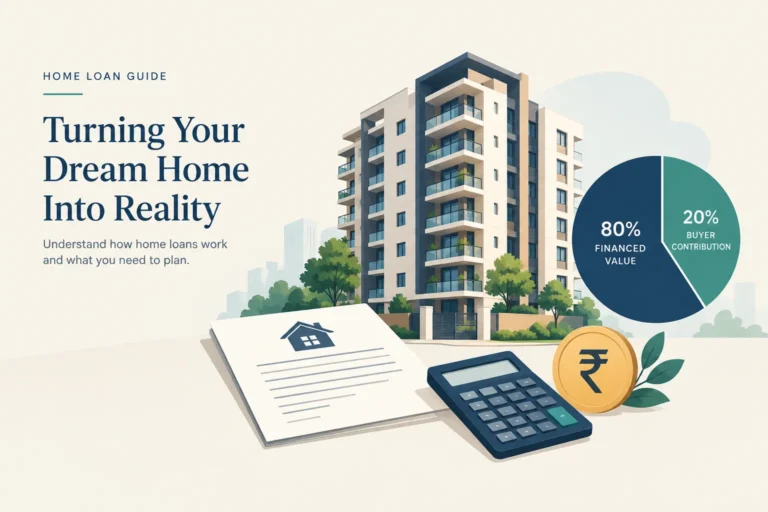
Suppose you plan to purchase a flat for Rs. 50 lakh. If the lender agrees to finance Rs. 40 lakh, you must contribute at least Rs. 10 lakh towards the purchase price. That Rs. 10 lakh is your down payment.
Four terms are important here:
- Property value: The value of the house or flat considered for loan purposes. This may be based on the purchase price, the lender’s independent valuation or another value accepted under its policy.
- Buyer contribution: The amount you pay from savings or other acceptable personal sources. This is the home loan down payment.
- Sanctioned loan amount: The maximum amount the lender approves after checking your income, repayment capacity, credit profile, property and documents.
- Loan-to-value ratio: The percentage of the property value that the lender finances through the home loan.
The down payment is not necessarily your entire upfront cost. Stamp duty, registration charges and other purchase expenses are generally paid separately from your own funds. Regulatory and lender rules may allow limited exceptions in specific small-ticket cases, but buyers should not assume that these charges will be financed.
For example, a lender may ask you to contribute Rs. 10 lakh towards a Rs. 50 lakh property. You could still need additional cash for registration, stamp duty, legal fees, moving expenses and basic repairs. These amounts should be included in your savings plan.
How Does a Home Loan Down Payment Work?
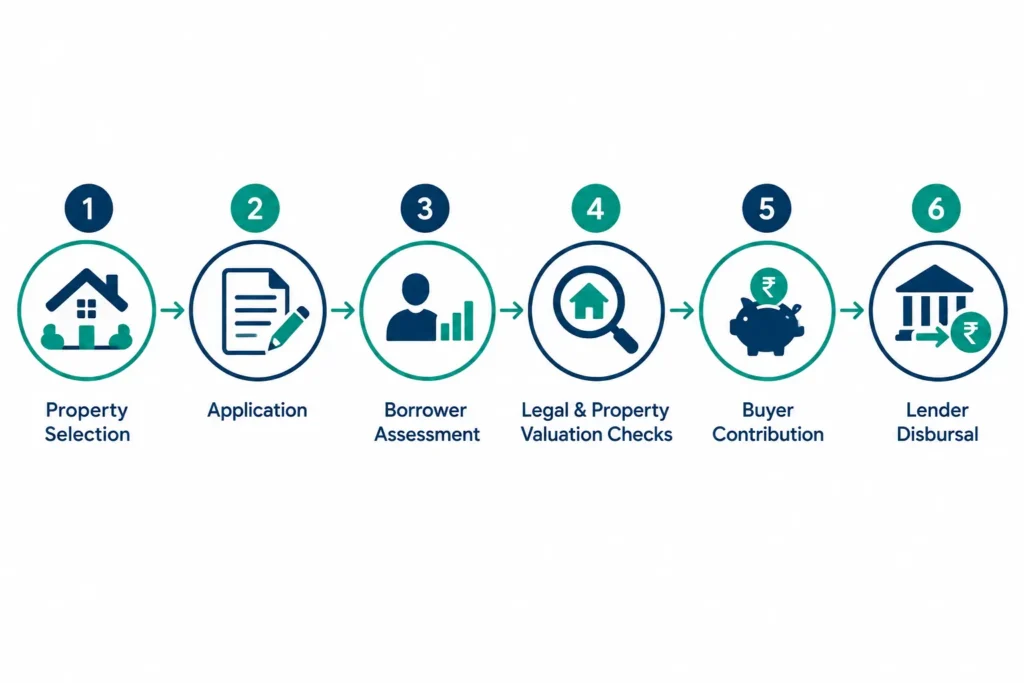
The lender first assesses both the borrower and the property. It does not simply subtract your preferred down payment from the sale price and approve the balance.
A typical process works like this:
- You select a property and submit a home loan application.
- The lender checks your income, existing EMIs, credit history, age, employment or business stability and repayment capacity.
- It reviews the property’s title, approvals, location, construction status and other documents.
- It conducts or arranges an independent property valuation.
- It calculates the eligible loan using both your repayment capacity and the applicable loan-to-value limit.
- You pay the required buyer contribution, often in stages depending on the transaction.
- The lender disburses the approved amount after its conditions are met.
The sanctioned amount is usually limited by whichever eligibility test produces the lower figure.
For example, assume a property is being sold for Rs. 60 lakh. Based on the applicable LTV framework and its policy, a lender may be permitted to consider funding up to a certain proportion of the accepted property value. However, your income assessment may show that you can comfortably support only a Rs. 38 lakh loan. In that case, the loan may be restricted to Rs. 38 lakh even if the LTV ceiling would have allowed more.
You would then need to arrange at least Rs. 22 lakh towards the purchase price, plus expenses that are not financed. This is why the minimum contribution suggested by an LTV percentage should not be treated as the final down payment for every buyer.
The lender’s accepted property value also matters. Suppose you agree to pay Rs. 70 lakh, but the lender values the property at Rs. 64 lakh. It may calculate loan eligibility using Rs. 64 lakh rather than your negotiated price. You must then cover the gap between the sale price and the lender-funded amount.
How Much Down Payment Is Required in India?
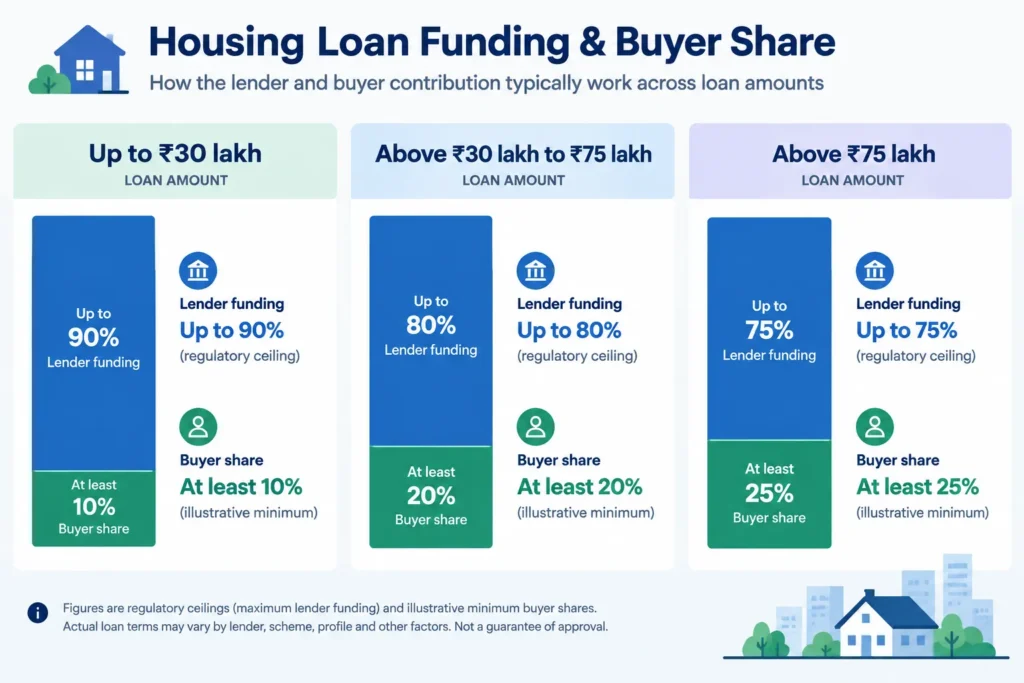
There is no single home loan down payment percentage that applies to every borrower and property in India. The minimum depends on applicable regulatory limits, the loan amount, the lender’s internal policy, the accepted property value and your individual eligibility.
Under the Reserve Bank of India’s housing finance framework, commonly applied maximum LTV ceilings for individual housing loans are linked to the size of the loan. Broadly, loans up to Rs. 30 lakh may have an LTV of up to 90%, loans above Rs. 30 lakh and up to Rs. 75 lakh may have an LTV of up to 80%, and loans above Rs. 75 lakh may have an LTV of up to 75%.
| Housing loan amount | Common regulatory maximum LTV | Minimum buyer share implied by the ceiling |
|---|---|---|
| Up to Rs. 30 lakh | Up to 90% | At least 10% |
| Above Rs. 30 lakh and up to Rs. 75 lakh | Up to 80% | At least 20% |
| Above Rs. 75 lakh | Up to 75% | At least 25% |
These figures are regulatory ceilings, not a promise that every lender will finance the maximum percentage. The precise framework can depend on the type of regulated lender, the loan and the rules in force when the application is processed. Lenders may follow stricter internal limits or ask for a larger contribution.
For instance, a borrower seeking a Rs. 25 lakh loan may fall within a category where an LTV of up to 90% is permitted. The lender could still restrict the LTV to 85% because of the property type, valuation, location, borrower profile or internal policy. The buyer would then need a larger down payment.
Your contribution may also increase if:
- the lender’s valuation is lower than the agreed purchase price;
- your income supports a smaller EMI and loan amount;
- you already have large EMIs or other financial obligations;
- the property has eligibility, approval or documentation concerns;
- the lender applies a lower LTV to that property category or location;
- some components of the builder’s price are not accepted for financing; or
- your credit profile leads the lender to take a more cautious view.
Before paying a large, non-refundable booking amount, ask the lender for an initial eligibility assessment and confirm whether the property is acceptable. Final approval will still depend on complete verification.
How Down Payment Relates to Loan-to-Value Ratio
The loan-to-value ratio shows how much of the accepted property value is funded by the loan. It is calculated as follows:
LTV ratio = Loan amount divided by accepted property value multiplied by 100
If a lender accepts a property value of Rs. 50 lakh and provides a Rs. 40 lakh loan, the LTV is 80%. The buyer must contribute the remaining Rs. 10 lakh towards the property price, which is 20% of the accepted value.
A higher LTV generally means a smaller initial contribution but a larger loan. A lower LTV means a larger down payment and a smaller loan. A smaller loan can reduce the EMI and total interest outgo, but using too much of your savings for the down payment may leave you without an emergency fund.
Down payment and LTV alone do not decide approval. The lender must also be satisfied with your income, credit record, existing obligations, repayment capacity, property documents, legal title, technical valuation and required paperwork. Even a buyer offering a large contribution can be declined if the repayment assessment or property checks are not satisfactory.
It is therefore sensible to treat the regulatory LTV ceiling as an outer limit, not as your confirmed loan eligibility. Plan for the buyer contribution, purchase charges and a reasonable cash buffer before committing to the transaction.
Home Loan Down Payment Calculation With Examples
Your home loan down payment is the portion of the property cost that you pay from your own funds. The lender finances the remaining eligible amount through a home loan.
A basic calculation is:
Down payment = Property value − Home loan amount
You can also estimate it using the lender’s assumed loan-to-value ratio, or LTV:
Home loan amount = Eligible property value × LTV
Down payment = Eligible property value × (100% − LTV)
LTV shows what percentage of the eligible property value may be financed. For example, an 80% LTV means the loan may cover up to 80% and the buyer must arrange at least the remaining 20%.
| Property value | Assumed LTV | Estimated loan amount | Estimated down payment |
|---|---|---|---|
| ₹40 lakh | 80% | ₹32 lakh | ₹8 lakh |
| ₹50 lakh | 80% | ₹40 lakh | ₹10 lakh |
| ₹75 lakh | 75% | ₹56.25 lakh | ₹18.75 lakh |
| ₹1.20 crore | 75% | ₹90 lakh | ₹30 lakh |
These are simplified examples, not promises of loan eligibility. The final amount depends on the lender’s policy, property assessment, your income, existing EMIs, credit profile and repayment capacity.
Example: Buying a ₹50 Lakh House
Suppose the property value accepted by the lender is ₹50 lakh and the lender offers an 80% LTV.
- Eligible property value: ₹50 lakh
- Assumed LTV: 80%
- Estimated home loan: ₹50 lakh × 80% = ₹40 lakh
- Estimated down payment: ₹50 lakh − ₹40 lakh = ₹10 lakh
However, ₹10 lakh is not necessarily the complete cash requirement. The buyer may also need funds for stamp duty, registration and other purchase-related expenses.
When the Lender’s Valuation Is Lower
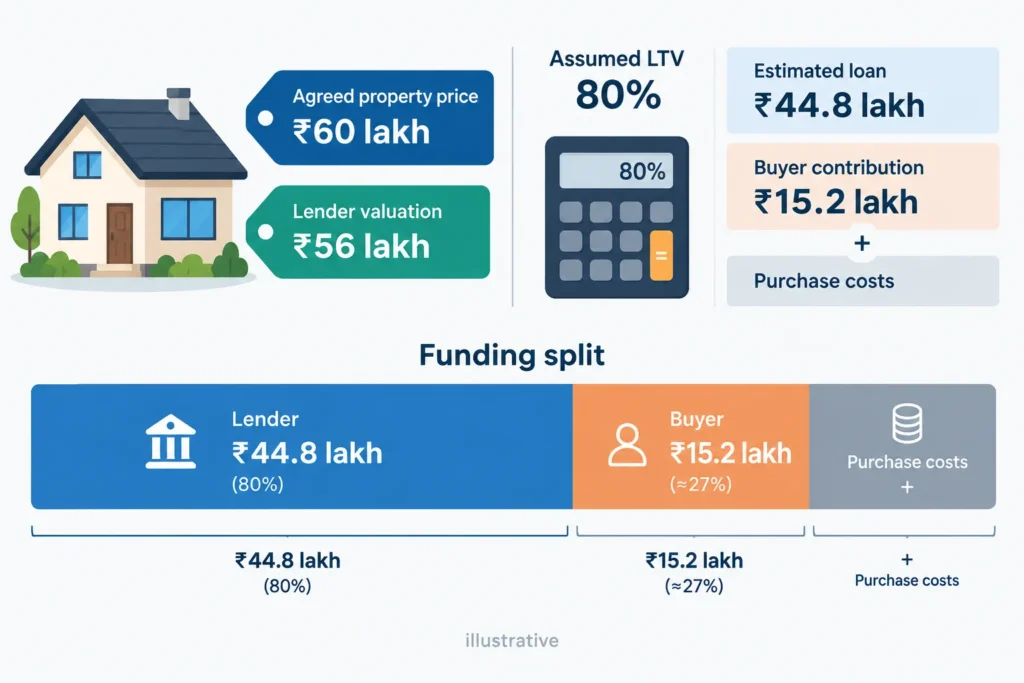
A lender may not use the agreed purchase price as the sole basis for financing. It may conduct its own legal and technical checks and assign an eligible value to the property.
For example, assume you agree to buy a flat for ₹60 lakh, but the lender values it at ₹56 lakh. At an assumed 80% LTV, the estimated loan would be:
₹56 lakh × 80% = ₹44.80 lakh
You would then need to arrange ₹15.20 lakh towards the purchase price, apart from other expenses. This is higher than the ₹12 lakh contribution you might have expected by simply taking 20% of the agreed price.
Down Payment vs Home Loan Amount
The down payment and home loan amount together usually meet the basic property purchase price. They come from different sources:
- Down payment: Paid by you from savings or other acceptable own funds.
- Home loan amount: Borrowed from the lender and repaid through EMIs with interest.
For a fixed eligible property value, increasing one reduces the other. If a ₹70 lakh property is financed with a ₹56 lakh loan, your basic contribution is ₹14 lakh. If you choose to borrow only ₹49 lakh, your contribution rises to ₹21 lakh.
| Buyer’s contribution | Loan required on a ₹70 lakh property |
|---|---|
| ₹14 lakh | ₹56 lakh |
| ₹17.50 lakh | ₹52.50 lakh |
| ₹21 lakh | ₹49 lakh |
A larger contribution does not guarantee approval or the lowest interest rate. The lender will still assess your income, employment or business stability, age, credit history, existing debt and the property documents.
You should also avoid using every rupee of savings for the down payment. Keep a separate emergency fund for medical costs, job changes, urgent repairs and regular household expenses.
Other Expenses to Budget for When Buying a House
The home loan down payment is only one part of your buying budget. Several additional charges may have to be paid from your own funds because lenders may not finance every expense.
Government and Transaction Charges
- Stamp duty: A state-level charge on the property transaction. The amount varies by state, property details and buyer category.
- Registration fee: Paid to register the property documents with the relevant authority.
- Taxes, where applicable: Certain transactions may involve taxes depending on whether the property is under construction, ready to move in or purchased from a previous owner.
Loan and Verification Costs
- Processing fee: Charged by the lender for handling the loan application.
- Legal verification fee: May be charged for checking title documents, approvals and ownership records.
- Technical or valuation fee: May apply when the lender assesses the property’s condition, construction and value.
Property and Moving Costs
- Brokerage: Payable if a property broker or agent is involved.
- Repairs and maintenance: A resale home may require painting, plumbing, electrical work or other repairs.
- Furnishing and appliances: Modular furniture, fans, lights, curtains and appliances can add significantly to the initial cost.
- Moving expenses: Include packers, transport and temporary storage, if required.
- Initial society or utility payments: Deposits, maintenance advances and connection-related charges may apply.
Prepare separate estimates for the property contribution and these additional expenses. For instance, if your calculated down payment is ₹10 lakh and other expected costs are ₹4 lakh, your initial buying budget is approximately ₹14 lakh, not ₹10 lakh.
Keep a buffer because final charges can change after document verification, valuation or the selection of furnishings. Ask for written cost details from the lender, builder, seller and broker before committing your full savings.
How a Larger Down Payment Affects Your EMI and Interest Cost
A larger home loan down payment reduces the principal you need to borrow. When the interest rate and tenure remain the same, a smaller principal generally results in a lower EMI and lower total interest.
Consider a ₹60 lakh home with a 20-year loan at an assumed fixed rate of 9% a year for illustration.
| Buyer contribution | Loan amount | Approximate monthly EMI | Approximate total interest over 20 years |
|---|---|---|---|
| ₹12 lakh | ₹48 lakh | ₹43,187 | ₹55.65 lakh |
| ₹18 lakh | ₹42 lakh | ₹37,789 | ₹48.69 lakh |
By contributing an additional ₹6 lakh, the borrower reduces the loan by ₹6 lakh. In this illustration, the EMI falls by about ₹5,398 and the total interest falls by about ₹6.96 lakh over 20 years.
Actual results can differ because interest rates may change, especially for floating-rate loans. Loan tenure, disbursement timing, prepayments, fees and rate revisions can also affect the final cost.
A larger down payment can improve affordability, but it should not leave you without emergency savings. Compare the EMI benefit with your need for cash after possession. A practical contribution is one that reduces borrowing while preserving enough money for additional buying costs and unexpected household needs.
How to Save for a Home Loan Down Payment
Saving for a home loan down payment becomes easier when you treat it as a planned financial goal rather than saving whatever remains at the end of each month.
Set a target amount and purchase date
Start with the expected property price and your likely contribution. Also budget separately for stamp duty, registration charges, legal checks, brokerage, moving expenses and basic repairs or furnishing. These costs may not be covered by the home loan.
For example, if you plan to buy a home costing ₹50 lakh, do not set your savings target only according to the expected down payment. Add estimated purchase expenses and an emergency reserve before deciding whether the property is affordable.
Next, choose a realistic purchase date. Divide the required amount by the number of months available. This gives you a basic monthly savings target. Review it periodically because property prices, income and family responsibilities can change.
Create a separate savings bucket
Keep the down payment fund separate from your regular bank balance. You may use a dedicated savings account, recurring deposit or another suitable product. A separate bucket reduces the temptation to spend this money on holidays, gadgets or routine expenses.
Consider setting an automatic transfer soon after your salary is credited. Saving first is generally more reliable than waiting to see what remains at the end of the month.
Match investments to the time horizon
The right place for your money depends on when you expect to buy the property.
- Short horizon: If the purchase is close, focus on capital protection and easy access to money. Avoid depending heavily on volatile investments.
- Medium horizon: You may consider a mix of relatively stable products based on your risk tolerance, tax position and need for liquidity.
- Long horizon: Some market-linked exposure may be considered if you understand the risks and can tolerate fluctuations. As the purchase date approaches, gradually move the required amount towards less volatile options.
Do not assume that shares or equity mutual funds will deliver a particular return by your purchase date. A market fall at the wrong time could force you to postpone the purchase or arrange money elsewhere.
Improve affordability before applying
Your savings target should work alongside your EMI capacity. Review existing personal loans, credit card balances and other EMIs. Reducing expensive debt can improve monthly cash flow and may also help your home loan assessment.
Check whether the planned EMI leaves enough room for household expenses, insurance premiums, school fees, retirement savings and unexpected costs. A home that requires every available rupee may be too expensive even if a lender is willing to consider the application.
Should You Use Your Entire Savings for a Down Payment?
Using all your savings can reduce the loan amount, but it can also leave you financially vulnerable. Home ownership brings costs beyond the purchase price. Repairs, maintenance deposits, society charges, property tax, interiors and shifting expenses may arise soon after possession.
Keep an emergency reserve even after making the home loan down payment. The suitable amount depends on job stability, family responsibilities, health needs and the number of earning members. The reserve should be readily accessible rather than locked into the property.
Also protect money already assigned to near-term essential goals. For example, using a child’s upcoming education fund or money needed for medical treatment can create a larger problem later.
A bigger contribution can reduce the principal and EMI, but it should not come at the cost of basic financial security. Compare these two situations:
- A borrower makes the largest possible down payment but has no cash available for emergencies.
- A borrower makes a reasonable down payment, keeps an emergency reserve and chooses an EMI that fits comfortably within the household budget.
The second approach may provide better resilience, even though the loan amount is slightly higher. The right balance is more important than simply maximising the contribution.
Common Down Payment Mistakes to Avoid
Exhausting all available savings
Do not empty every bank account, fixed deposit and investment merely to reduce the loan. Keep money for emergencies, purchase-related expenses and the first few months of EMI payments.
Ignoring expenses outside the property price
Buyers sometimes calculate affordability using only the agreement value. Stamp duty, registration, legal review, brokerage, parking, maintenance deposits and interiors can materially increase the cash required. Obtain a written cost breakup wherever possible.
Borrowing the contribution without checking repayment pressure
Using a personal loan, credit card or informal borrowing for the down payment adds another repayment obligation. The combined home loan EMI and short-term debt EMI can strain the household budget.
Borrowed funds may also affect eligibility because lenders assess existing obligations and the source of the buyer’s contribution. Disclose relevant liabilities and avoid presenting borrowed money as personal savings.
Assuming pre-approval guarantees disbursal
A pre-approved or in-principle offer is not the same as final loan disbursal. The lender may still verify income, credit history, documents, property title, approvals and valuation. Changes in employment, new debt or problems with the property can affect the final decision.
Do not make non-refundable commitments solely because you have received a pre-approval message or letter.
Paying before completing legal and property checks
A large token amount should not be paid only because a seller or broker says other buyers are waiting. Verify ownership, title documents, approvals, existing loans, tax dues and other relevant records with suitable professionals.
Read the cancellation and refund terms before paying. Keep receipts and use traceable payment methods. Loan approval does not replace independent legal and technical due diligence.
Stretching the budget to buy a more expensive home
A lender’s maximum eligible amount is not necessarily your comfortable borrowing limit. Consider future rate changes, maintenance costs and possible income interruptions. Choose a property and EMI that leave room for other goals.
Frequently Asked Questions About Home Loan Down Payments
What is the minimum contribution required from a homebuyer?
The minimum contribution depends on the property value, lender policy, loan-to-value limit and the applicant’s profile. The lender usually finances only an eligible percentage of the assessed property value, so the buyer must arrange the balance and applicable purchase expenses.
What does LTV mean in a home loan?
LTV means loan-to-value ratio. It compares the loan amount with the property value accepted by the lender. If a lender accepts a property value of ₹40 lakh and sanctions ₹30 lakh, the LTV is 75%. The remaining amount must generally come from the buyer, along with costs not financed by the loan.
Will a larger down payment reduce my EMI?
Yes, if the interest rate and tenure remain the same, a larger contribution reduces the loan principal and therefore lowers the EMI. Alternatively, you may choose a shorter tenure. However, do not use your emergency reserve only to achieve a lower EMI.
Are stamp duty and registration charges included in the home loan?
These expenses are often paid by the buyer from personal funds and may not be included in the financed property value. Treatment can vary, so ask the lender for a clear written explanation of what is and is not covered.
Can I use investments for the down payment?
Yes, you may use proceeds from investments, subject to liquidity, taxes, exit charges and documentation. Avoid redeeming long-term investments without checking the impact on retirement or other essential goals. Keep bank statements and transaction records to explain the source of funds if required.
Can parents or relatives gift money for the contribution?
A genuine gift may be used, but the lender may ask for bank records, a gift declaration or other proof. Tax treatment can depend on the relationship and circumstances. Maintain proper documentation and consult a qualified tax professional where necessary.
What happens if the lender values the property below the agreed price?
The lender normally calculates the eligible loan using its accepted valuation and applicable LTV rules, not merely the price negotiated with the seller. If you agree to pay ₹60 lakh but the lender values the property at ₹55 lakh, the loan may be based on ₹55 lakh. You may then need a larger contribution or may have to renegotiate or reconsider the purchase.
Summary
Plan your home loan down payment by setting a target amount and date, separating the savings, choosing products suitable for the time horizon and checking the EMI against your full household budget. Include purchase expenses and keep an emergency reserve.
A larger contribution can reduce the loan and EMI, but using every rupee of savings may create unnecessary risk. Avoid funding the contribution with expensive debt, relying on pre-approval as a guarantee, or paying large amounts before legal and property checks. The safest down payment is one that supports the purchase without weakening your wider financial position.

Comments