
Bitcoin Explained: How It Works, Its Uses and Risks for Beginners

A simple guide to Bitcoin, including how its blockchain and mining work, common uses, wallets, security basics and key risks for beginners in India.

Bitcoin Explained: How It Works, Its Uses and Risks for Beginners

What Is Bitcoin?

Bitcoin is a digital asset that people can hold and transfer over the internet without relying on a central bank or a single company to process every transaction. It operates through a decentralised network of computers, and its transaction history is recorded on a public digital ledger called a blockchain.

Bitcoin was designed as a peer-to-peer electronic cash system. In simple terms, one person can send Bitcoin directly to another person using the network. Bitcoin is also the first widely adopted cryptocurrency and is commonly identified by the abbreviation BTC.

Unlike the Indian rupee, Bitcoin is not issued or guaranteed by the Reserve Bank of India. Its market price can change sharply, so it should not be treated as a stable replacement for money in your bank account. You also do not need to buy one whole Bitcoin. Each Bitcoin can be divided into 100 million smaller units called satoshis.

Introduction

If you are new to cryptocurrency, Bitcoin can appear confusing. You may hear it described as digital money, an investment, a payment network, digital gold or a speculative asset. Each description highlights a different feature, but none explains the complete picture on its own.

The simplest way to understand Bitcoin is to separate the asset from the system. “Bitcoin” can refer to the digital asset that users own and transfer. It can also refer to the network and rules that allow those transfers to happen without one central operator.

This distinction matters for Indian beginners. When you use UPI, IMPS or NEFT, banks and regulated payment systems maintain account records and process instructions. A Bitcoin transfer follows a different model. A distributed network checks transactions according to shared software rules, while the blockchain provides a public record of confirmed activity.

This first part explains what Bitcoin is, why it was created and how it differs from rupees, bank transfers and other cryptocurrencies. For a wider introduction to digital assets, wallets, exchanges and Indian considerations, you can also read our pillar guide, Cryptocurrency in India: A Complete Beginner’s Guide to Crypto.

What Bitcoin Is and Why It Exists

Bitcoin Is a Decentralised Digital Asset

Bitcoin is entirely digital. There are no official Bitcoin notes or coins that you can keep in a physical wallet. Ownership is instead represented through records on the Bitcoin blockchain and controlled using cryptographic keys.

Bitcoin is described as decentralised because no single bank, government department or private company runs the entire network. Computers in many locations can participate in checking and sharing transaction data. The network follows a common set of rules contained in open-source software.

Decentralisation does not mean that every Bitcoin-related service is decentralised. For example, a cryptocurrency exchange may be a private company that holds assets for customers. The Bitcoin network and a company that provides access to Bitcoin are not the same thing.

This is similar to the difference between the internet and an app operating on the internet. The wider network is not owned by the app, even though many people may use that app to access online services.

Why Bitcoin Was Created

Bitcoin was proposed as a peer-to-peer electronic cash system. Its aim was to make it possible for two parties to transfer value online without needing a financial institution to act as the trusted middleman for that particular transaction.

Traditional digital payments usually depend on intermediaries. If you send ₹2,000 through a bank transfer, your bank and the recipient’s bank update their records. The payment system helps communicate and settle the instruction. You trust these institutions to maintain the correct balances, secure accounts and follow applicable rules.

With Bitcoin, the shared network maintains the transaction record. Participants use software rules and cryptography to check whether a transaction is valid. Confirmed transactions are grouped into blocks and added to the blockchain. This creates a transaction history that can be independently checked.

Bitcoin did not remove the need for trust in every situation. Users still need to trust their own understanding, protect their access credentials and carefully evaluate exchanges, wallet providers and other services. What Bitcoin changed was the way its underlying ledger could operate without one central authority controlling it.

A Brief History of Bitcoin

The Bitcoin idea was published in 2008 in a document commonly called the Bitcoin white paper. It was released under the name Satoshi Nakamoto. The Bitcoin network began operating in January 2009 when its first block was created.

Satoshi Nakamoto is a pseudonym. It may represent one person or a group of people, but the creator’s real identity has never been conclusively confirmed. Claims about who created Bitcoin should therefore be treated carefully unless supported by strong, verifiable evidence.

Bitcoin was not the first attempt to create digital money. Earlier projects and research had explored cryptography, digital payments and ways to prevent the same digital unit from being spent twice. Bitcoin combined several existing ideas into a working decentralised system and became the first cryptocurrency to achieve widespread adoption.

Bitcoin Compared with Rupees and Bank Transfers
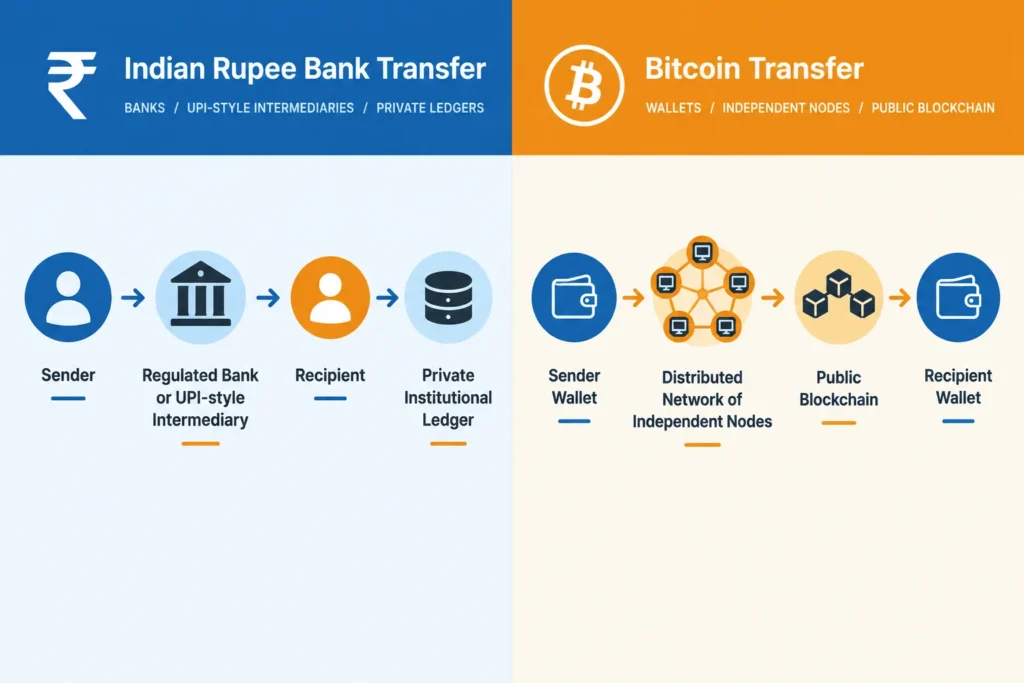
Comparison of a rupee bank transfer through financial intermediaries and a Bitcoin transfer through a distributed network

Bitcoin and the Indian rupee are different types of assets. The rupee is India’s official currency and is issued under the country’s monetary system. It is used to quote prices, pay salaries, settle taxes and make everyday purchases.

Bitcoin is not official Indian currency. It has no central issuer, and its value is determined largely by supply and demand in global markets. A shopkeeper who accepts rupees is not automatically required to accept Bitcoin.

Feature Indian rupee Bitcoin
Issuer Issued within India’s official monetary framework No central issuer
Transaction record Maintained by banks and payment institutions Recorded on a public blockchain
Typical use in India Everyday payments, savings, salaries and taxes Digital asset holding and permitted transfers
Price stability Used as the standard unit for domestic prices Market price can be highly volatile
Supply model Managed through monetary policy Governed by programmed network rules

A Bitcoin transfer also differs from a bank transfer. Bitcoin addresses are used to send and receive the asset, while bank transfers generally use details such as an account number, IFSC code, mobile number or UPI ID. Bitcoin transactions are broadcast to the network and, once sufficiently confirmed, are generally difficult to reverse.

This does not mean Bitcoin is better for every payment. Bank and UPI transfers are familiar, generally quick and denominated in rupees. They also operate within systems that provide defined customer-support and dispute processes. Bitcoin transfers can involve network fees, price movements and serious consequences if funds are sent to the wrong address.

You May Also Like:Bitcoin Security: How to Protect Your Bitcoin from Theft and Scams

Bitcoin Compared with Other Cryptocurrencies

Bitcoin is one cryptocurrency, not another name for all crypto assets. Thousands of other digital assets have been created, and they may use different networks, supply rules and governance models.

Some cryptocurrencies focus on programmable applications, faster settlement, privacy or price stability. Others may be experimental, lightly used or controlled by a small development team. A token’s purpose and risk cannot be understood merely by comparing its market price with Bitcoin.

Bitcoin is distinct because it was the first widely adopted cryptocurrency, has no confirmed founder controlling it and follows a relatively narrow core purpose: transferring and holding a scarce digital asset through a decentralised network. These features do not guarantee that its price will rise or that it is suitable for every person.

Programmed Issuance and the 21 Million Limit

New Bitcoin enters circulation through a process connected to mining. Miners use computing equipment to compete for the right to add valid blocks of transactions to the blockchain. A successful miner can receive newly issued Bitcoin, along with eligible transaction fees, under the network’s rules.

The amount of new Bitcoin issued per block reduces periodically through events called halvings. Bitcoin’s rules set a maximum supply of 21 million BTC. The issuance rate is therefore programmed rather than decided by a central bank committee.

The supply limit is one reason some people describe Bitcoin as scarce. However, scarcity alone does not ensure investment returns. Demand can change, market prices can fall, technology can evolve and regulations can affect how people access or use the asset.

You Can Buy a Fraction of a Bitcoin

One Bitcoin is divisible into 100 million units. The smallest standard unit is called a satoshi, often shortened to “sat.” This is similar to the way one rupee can be divided into paise, although Bitcoin has far more decimal places.

You therefore do not need enough money to purchase one full BTC. Subject to a platform’s minimum order and fees, a user may buy a small fraction. For example, an exchange might display a holding as 0.001 BTC rather than one whole Bitcoin.

Divisibility makes small transfers possible, but it does not make Bitcoin automatically affordable or low-risk. What matters is the rupee amount you commit, the fees you pay, the security of your chosen method and whether you can accept substantial price fluctuations.

How Bitcoin, Transactions and Mining Work

To understand what is Bitcoin, it helps to think of it as both digital money and a system for recording transfers. Bitcoin does not depend on one bank, company or government database. Instead, many computers around the world follow the same rules and maintain copies of its transaction history.

The Bitcoin Blockchain

The blockchain is Bitcoin’s public, shared transaction record. It contains groups of transactions called blocks. Each new block is connected to earlier blocks, creating a chronological chain.

Thousands of independently operated computers, known as nodes, can check this record. They use Bitcoin’s software rules to reject invalid transactions and blocks. For example, the rules prevent someone from spending Bitcoin they do not control or spending the same Bitcoin twice.

No single participant can simply edit an old transaction in its favour. Changing past records would require enormous computing work, and the altered version would still need to overcome the valid chain accepted by the network. This structure makes confirmed Bitcoin transactions difficult to reverse.

The blockchain is public. Anyone can use suitable software or a blockchain explorer to view addresses, transaction amounts, fees and confirmation status. However, the record generally does not display a person’s name, PAN or bank account number.

How a Bitcoin Transaction Happens
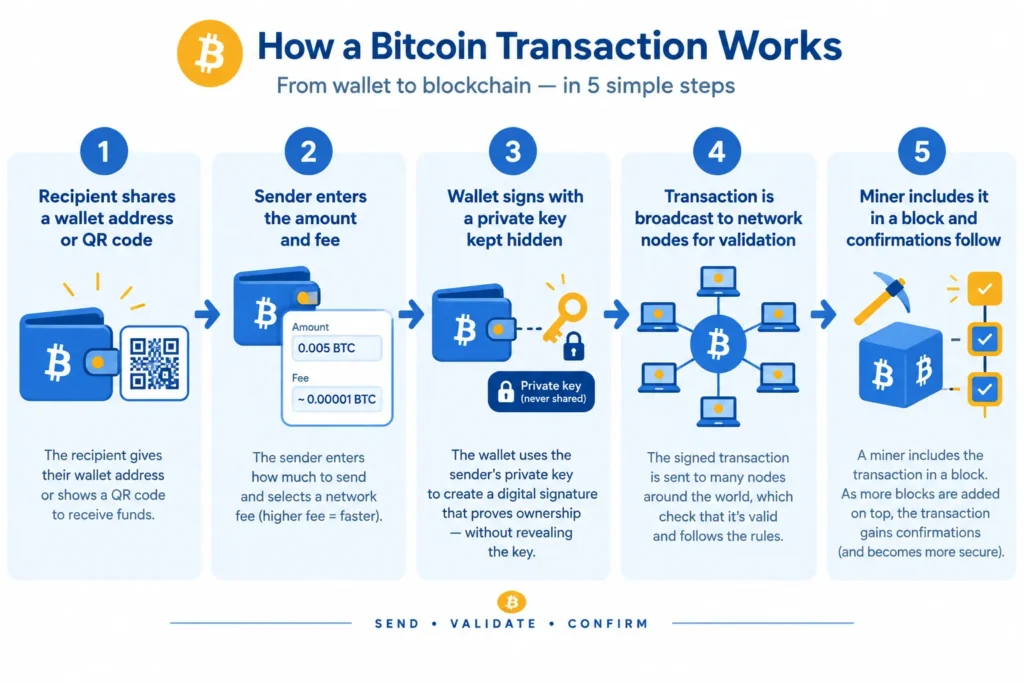
Five-step flowchart showing how a Bitcoin transaction is addressed, signed, broadcast, validated and confirmed

Consider a simple Indian example. Meera wants to send a small amount of Bitcoin to Arjun. Both use Bitcoin wallets, which may be mobile apps, desktop programs or dedicated hardware devices.

  1. Arjun provides an address: Arjun’s wallet generates or displays a Bitcoin address. This is the destination to which Meera will send the Bitcoin. An address is usually shown as a string of letters and numbers, often with a QR code.
  2. Meera enters the details: Meera pastes or scans Arjun’s address, enters the amount and reviews the network fee shown by her wallet.
  3. Her wallet signs the transaction: Meera’s wallet uses her private key to create a digital signature. This signature proves that the transaction was authorised by the person controlling the relevant Bitcoin, without revealing the private key itself.
  4. The transaction is broadcast: The signed transaction is sent to the Bitcoin network. Nodes check whether it follows the protocol rules, including whether the signature is valid and whether the Bitcoin is available to spend.
  5. A miner includes it in a block: The transaction may then be selected by a miner and added to a block. Once that block is accepted by the network, the transaction receives its first confirmation.

This process does not require Arjun to share his private key or give Meera access to his wallet. He only needs to provide a suitable receiving address.

Addresses, Public Keys and Private Keys

These terms are related, but they do different jobs.

  • Bitcoin address: An address identifies a destination for receiving Bitcoin. It is safe to share when someone needs to pay you, although reusing addresses can reduce privacy.
  • Public key: A public key is mathematically connected to a private key. The network can use the relevant public-key information to verify that a digital signature is valid.
  • Private key: A private key is secret information that authorises spending. Whoever controls it can usually control the Bitcoin associated with it.
You May Also Like:How to Invest in Cryptocurrency in India: A Beginner’s Guide

A private key must never be shared with a friend, caller, social-media account, exchange “support agent” or investment adviser. A legitimate recipient does not need your private key to send you Bitcoin.

Many wallets provide a recovery phrase, sometimes called a seed phrase, consisting of a sequence of words. This phrase can recreate the wallet’s private keys. It therefore needs the same level of protection. If another person obtains it, they may be able to move the Bitcoin. If it is lost and no usable backup exists, access may be permanently lost.

Before sending, users should check the destination address carefully. Bitcoin transfers generally do not offer a bank-style chargeback process. Malware, typing mistakes or scams can result in funds being sent to the wrong destination.

Bitcoin Is Pseudonymous, Not Anonymous

Bitcoin addresses do not automatically reveal the owner’s real name, so Bitcoin is often described as pseudonymous. This is different from being fully anonymous.

Transactions remain visible on the public blockchain. Observers can examine how Bitcoin moves between addresses. If an address becomes connected to a person’s identity, other activity associated with that address may also become easier to analyse.

For example, an Indian user may buy Bitcoin through an exchange that completes identity verification. Records held by the exchange may connect the customer with a withdrawal address. A person may also reveal ownership by posting an address publicly, using it for business payments or reusing it repeatedly.

Users should therefore not assume that Bitcoin activity is private simply because a name is absent from the blockchain.

Confirmations, Fees and Waiting Times

A newly broadcast transaction may first remain unconfirmed while waiting to enter a block. After a miner includes it in a valid block, it has one confirmation. Each later block built on top of that block adds another confirmation.

Confirmations increase confidence that the transaction is settled in the accepted transaction history. The number considered appropriate depends on the situation. A merchant accepting a small payment may make a different decision from an exchange processing a large deposit.

Bitcoin transaction fees are not fixed in rupees or as a percentage of the amount transferred. The fee mainly reflects the transaction’s data size and the fee rate selected by the sender. A larger payment does not automatically require a larger fee.

When many users are competing for limited block space, miners generally prioritise transactions offering higher fee rates. Wallets usually estimate an appropriate fee, but estimates can change as network demand changes.

Confirmation times are therefore variable. A transaction offering a competitive fee may be included relatively quickly, while one with a low fee can wait much longer during busy periods. Bitcoin aims for an average interval between blocks, but an individual block can arrive sooner or later. There is no guaranteed confirmation time.

How Proof-of-Work Mining Secures Bitcoin

Mining is the process through which specialised participants compete to add new blocks to Bitcoin’s blockchain. Miners collect valid transactions, form candidate blocks and repeatedly perform calculations to find a result that satisfies the network’s proof-of-work requirement.

Finding a valid result is difficult, but other nodes can verify it quickly. If the proposed block and its transactions follow the rules, nodes can accept it and build on it. This proof-of-work system makes it costly to rewrite transaction history and helps the distributed network agree on the valid chain.

The successful miner can receive two forms of compensation. The first is a protocol-defined block subsidy that creates new Bitcoin according to Bitcoin’s issuance schedule. The second is the transaction fees included in that block. The subsidy reduces at predetermined intervals, while fees depend on the transactions selected.

Mining does not mean that miners can invent unlimited Bitcoin, approve invalid spending or change the rules at will. Full nodes independently check blocks. A block that breaks the agreed protocol rules can be rejected even if a miner spent energy producing it.

Mining Is Not Staking

Bitcoin uses proof of work, not proof of stake. Mining relies on computing equipment and electricity to compete for block production. Staking, used by some other cryptocurrency networks, generally involves locking or committing crypto assets to participate in validation. Owning Bitcoin does not allow someone to earn Bitcoin staking rewards through the native Bitcoin protocol.

Modern Bitcoin mining commonly uses specialised machines called ASICs. They are designed to perform Bitcoin’s mining calculations efficiently. Ordinary laptops and home desktop computers are generally not competitive for profitable Bitcoin mining because specialised operators have far greater computing power and may have access to lower operating costs.

Profitability also depends on equipment prices, electricity charges, cooling, downtime, mining difficulty, Bitcoin’s market price and applicable taxes or regulations. A person should not treat advertisements for mining plans or “guaranteed daily mining income” as proof of genuine activity or assured returns.

Bitcoin Mining and Energy Use

Proof-of-work mining consumes substantial electricity because miners worldwide run specialised equipment continuously. Critics argue that this energy demand can increase emissions where electricity comes from fossil fuels and may place pressure on local power systems. Electronic waste from outdated equipment is another concern.

Supporters respond that mining can use renewable, surplus or otherwise curtailed energy in some locations, and that energy expenditure is part of what protects Bitcoin against attacks and manipulation. However, the electricity source and environmental effect vary by region and operator.

The debate is not captured by saying that all mining is clean or that all mining has the same environmental impact. A balanced assessment should consider total electricity use, the local energy mix, demand on the grid, equipment life and whether mining changes the development or use of energy resources.

You May Also Like:PPF Calculator: Calculate Your PPF Maturity Amount, Interest and Returns

Bitcoin Uses, Limitations, Risks and Beginner FAQs

Understanding what is Bitcoin is different from deciding whether to buy it. Bitcoin is a digital asset and payment network with some practical uses, but it also carries serious financial and security risks. It is not suitable for everyone.

What Is Bitcoin Used For?

People use Bitcoin for different reasons. Some transfer value directly to another person without relying on a traditional bank transfer. Because Bitcoin operates on a global network, a user can send it to a compatible wallet in another country. However, local laws, fees and service restrictions may still apply.

Some people prefer self-custody. This means they control Bitcoin through their own wallet and private keys rather than leaving it with a crypto exchange or another service. Self-custody can provide more direct control, but it also makes the user responsible for security and backups.

Others buy Bitcoin as a speculative asset. They hope its market price will rise, but there is no guarantee that this will happen. Bitcoin can move sharply in either direction, and buyers may lose some or all of their money.

Bitcoin is divisible, so a person does not need to buy one whole Bitcoin. Each Bitcoin can be divided into much smaller units. This allows someone to buy or transfer a small amount, subject to platform limits and transaction fees.

Possible Advantages and Important Limitations

Bitcoin has features that attract users, but each feature comes with a practical limitation.

Feature Possible benefit Limitation
Global network Bitcoin can be transferred between compatible wallets across borders. Access may depend on local rules, internet availability and service support.
Divisibility Users can buy or send a fraction of one Bitcoin. Exchange minimums and network fees can make very small transactions impractical.
Direct transfers A user can send Bitcoin without using a conventional bank payment system. Transactions are normally irreversible, so mistakes can be costly.
Self-custody The owner can control the private keys. Losing the keys or recovery phrase can mean permanently losing access.

Bitcoin is not accepted everywhere. A shop, landlord or service provider is not required to accept it. Even where it is accepted, the price of a product may still be calculated in rupees or another conventional currency.

Transactions are not always free or instant. Users generally pay a network fee, and the suitable fee can vary with network demand. A transaction may appear quickly but still need multiple confirmations before the recipient treats it as final. Busy periods can lead to higher fees or longer waits.

Price volatility is another major limitation. The value of Bitcoin can rise or fall substantially within a short time. A person who needs the money for rent, school fees, medical costs or an emergency fund should not assume that the same rupee value will be available later.

Bitcoin Wallets and Key Safety
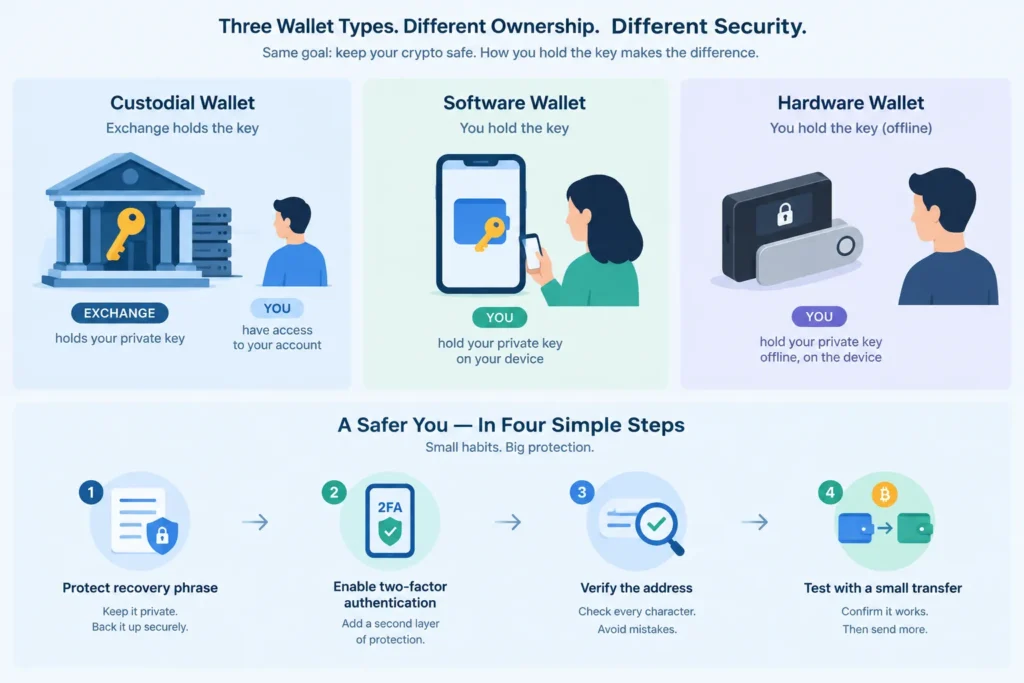
Comparison of custodial, software and hardware Bitcoin wallets with key safety steps

A Bitcoin wallet helps a user manage the keys needed to access and transfer Bitcoin. It does not store physical coins. The balance is recorded on the blockchain, while the wallet provides the tools needed to control it.

Common wallet categories include:

  • Custodial wallets: A platform controls the private keys on the user’s behalf. They may be easier for beginners, but the user depends on the platform’s security, access policies and continued operation.
  • Software wallets: These are applications installed on a phone or computer. They offer direct control but can be exposed to malware, theft or unsafe backups.
  • Hardware wallets: These are dedicated physical devices designed to keep keys away from an internet-connected environment. They still require careful setup and safe recovery-phrase storage.

Our separate article on crypto wallets explains these options in more detail. Beginners should understand the difference between custody and self-custody before moving Bitcoin away from an exchange.

A recovery phrase or private key must remain secret. Anyone who obtains it may be able to control the associated Bitcoin. Do not share it with customer support, friends, social-media accounts or people claiming they can recover or multiply funds.

  • Use a strong, unique password for each crypto-related account.
  • Enable two-factor authentication where it is available.
  • Check the full wallet address and selected network before sending.
  • Never rely only on a copied address without verifying it.
  • Test an unfamiliar transfer with a small amount first.
  • Keep wallet software and devices updated through official sources.
  • Be suspicious of urgent messages, fake giveaways and guaranteed-return schemes.

A Bitcoin transfer generally cannot be cancelled merely because the sender entered the wrong address or was tricked by a scammer. Careful verification is therefore essential.

Buying or Accessing Bitcoin in India

People in India may be able to access Bitcoin through crypto exchanges or other services, depending on current availability, identity-verification requirements and applicable rules. A platform may ask for know-your-customer documents and banking information before allowing transactions.

Platform availability does not by itself mean that Bitcoin is risk-free, officially guaranteed or suitable as an investment. Before choosing a service, read our articles on crypto exchanges and investing in cryptocurrency. Also check current guidance from official Indian authorities because requirements can change.

Tax treatment is a separate issue from how Bitcoin works. For an explanation of reporting and tax considerations, refer to our article “Cryptocurrency Tax in India” rather than relying on old social-media posts or assumptions. Consider taking advice from a qualified tax professional for your circumstances.

Common Bitcoin Myths

“Bitcoin is fully anonymous.” Bitcoin is better described as pseudonymous. Transactions are publicly recorded against wallet addresses. If an address becomes linked to a person, their transaction history may be analysed.

“You must buy one whole Bitcoin.” This is false. Bitcoin is divisible, and users can buy fractions, subject to the chosen service’s minimum amount and fees.

“Bitcoin transactions are always free and instant.” Network fees usually apply, and confirmation time can vary. A wallet may show an unconfirmed transaction quickly, but that is not the same as final settlement.

“Mining and staking are the same.” They are different methods. Bitcoin mining uses computing equipment and electricity to support its proof-of-work system. Staking is associated with proof-of-stake networks, not Bitcoin’s core consensus process.

“Bitcoin returns are guaranteed.” No return is guaranteed. The market price may increase, fall or remain below a buyer’s purchase price for a long period. Claims of fixed or guaranteed crypto profits are a warning sign.

You May Also Like:50/30/20 Budget Rule Explained for Beginners in India (2026 Guide)

A Safer-Learning Checklist

  • Learn how transactions, confirmations, fees and wallets work before transferring money.
  • Read about cryptocurrency risks, including volatility, scams, platform failure and key loss.
  • Practise with a small amount that you can afford to lose.
  • Do not use borrowed money or funds needed for essential expenses.
  • Verify platforms, apps, wallet addresses and messages independently.
  • Check current Indian regulatory and tax guidance from official sources.
  • Separate education from investment decisions. Learning about Bitcoin does not require buying it.

Frequently Asked Questions

What is Bitcoin?

Bitcoin is a digital asset and decentralised payment network. It allows value to be transferred between Bitcoin addresses, while transactions are recorded on a shared public blockchain. It is not a physical coin and is not backed by a promise of guaranteed returns.

How does Bitcoin work?

Users create and sign transactions with cryptographic keys. Transactions are shared with the network, checked under Bitcoin’s rules and added to blocks. Confirmed blocks form the blockchain, which provides a public transaction history.

Is Bitcoin a cryptocurrency?

Yes. Bitcoin is a cryptocurrency because it uses cryptography and a distributed network to record ownership and transfers. It was the first widely adopted cryptocurrency, but it is not the only one.

Is Bitcoin anonymous?

No, not fully. Bitcoin addresses do not automatically display a person’s name, but all transactions are public. Exchanges may also collect identity information, and blockchain activity can sometimes be connected to real people or organisations.

How does Bitcoin mining work?

Bitcoin miners use specialised computing equipment to compete in solving a proof-of-work challenge. The successful miner can propose a block of valid transactions. Mining helps secure the network, and miners may receive newly issued Bitcoin and transaction fees under the protocol’s rules.

Should beginners consider the risks before investing?

Yes. Beginners should consider price volatility, scams, irreversible transactions, wallet security, exchange risk, fees and changing rules. Bitcoin may not suit every person’s finances or risk tolerance. Buyers can lose some or all of their money.

Summary

Bitcoin can be used to transfer value, hold a speculative asset or maintain funds through self-custody. Its global access, divisibility and direct-transfer design may be useful, but they do not remove its limitations.

Bitcoin prices can move sharply, acceptance remains limited, fees and confirmation times vary, and transaction mistakes may be irreversible. Secure key management is essential. Beginners should learn first, use cautious security practices, check current Indian guidance and never treat returns as guaranteed.
Share this article
KEEP READING

Related Articles

View all →

Comments

Leave a Comment

Bitcoin Explained: How It Works, Its Uses and Risks for Beginners

What Is Bitcoin?

Bitcoin is a digital asset that people can hold and transfer over the internet without relying on a central bank or a single company to process every transaction. It operates through a decentralised network of computers, and its transaction history is recorded on a public digital ledger called a blockchain.

Bitcoin was designed as a peer-to-peer electronic cash system. In simple terms, one person can send Bitcoin directly to another person using the network. Bitcoin is also the first widely adopted cryptocurrency and is commonly identified by the abbreviation BTC.

Unlike the Indian rupee, Bitcoin is not issued or guaranteed by the Reserve Bank of India. Its market price can change sharply, so it should not be treated as a stable replacement for money in your bank account. You also do not need to buy one whole Bitcoin. Each Bitcoin can be divided into 100 million smaller units called satoshis.

Introduction

If you are new to cryptocurrency, Bitcoin can appear confusing. You may hear it described as digital money, an investment, a payment network, digital gold or a speculative asset. Each description highlights a different feature, but none explains the complete picture on its own.

The simplest way to understand Bitcoin is to separate the asset from the system. “Bitcoin” can refer to the digital asset that users own and transfer. It can also refer to the network and rules that allow those transfers to happen without one central operator.

This distinction matters for Indian beginners. When you use UPI, IMPS or NEFT, banks and regulated payment systems maintain account records and process instructions. A Bitcoin transfer follows a different model. A distributed network checks transactions according to shared software rules, while the blockchain provides a public record of confirmed activity.

This first part explains what Bitcoin is, why it was created and how it differs from rupees, bank transfers and other cryptocurrencies. For a wider introduction to digital assets, wallets, exchanges and Indian considerations, you can also read our pillar guide, Cryptocurrency in India: A Complete Beginner’s Guide to Crypto.

What Bitcoin Is and Why It Exists

Bitcoin Is a Decentralised Digital Asset

Bitcoin is entirely digital. There are no official Bitcoin notes or coins that you can keep in a physical wallet. Ownership is instead represented through records on the Bitcoin blockchain and controlled using cryptographic keys.

Bitcoin is described as decentralised because no single bank, government department or private company runs the entire network. Computers in many locations can participate in checking and sharing transaction data. The network follows a common set of rules contained in open-source software.

Decentralisation does not mean that every Bitcoin-related service is decentralised. For example, a cryptocurrency exchange may be a private company that holds assets for customers. The Bitcoin network and a company that provides access to Bitcoin are not the same thing.

This is similar to the difference between the internet and an app operating on the internet. The wider network is not owned by the app, even though many people may use that app to access online services.

Why Bitcoin Was Created

Bitcoin was proposed as a peer-to-peer electronic cash system. Its aim was to make it possible for two parties to transfer value online without needing a financial institution to act as the trusted middleman for that particular transaction.

Traditional digital payments usually depend on intermediaries. If you send ₹2,000 through a bank transfer, your bank and the recipient’s bank update their records. The payment system helps communicate and settle the instruction. You trust these institutions to maintain the correct balances, secure accounts and follow applicable rules.

With Bitcoin, the shared network maintains the transaction record. Participants use software rules and cryptography to check whether a transaction is valid. Confirmed transactions are grouped into blocks and added to the blockchain. This creates a transaction history that can be independently checked.

Bitcoin did not remove the need for trust in every situation. Users still need to trust their own understanding, protect their access credentials and carefully evaluate exchanges, wallet providers and other services. What Bitcoin changed was the way its underlying ledger could operate without one central authority controlling it.

A Brief History of Bitcoin

The Bitcoin idea was published in 2008 in a document commonly called the Bitcoin white paper. It was released under the name Satoshi Nakamoto. The Bitcoin network began operating in January 2009 when its first block was created.

Satoshi Nakamoto is a pseudonym. It may represent one person or a group of people, but the creator’s real identity has never been conclusively confirmed. Claims about who created Bitcoin should therefore be treated carefully unless supported by strong, verifiable evidence.

Bitcoin was not the first attempt to create digital money. Earlier projects and research had explored cryptography, digital payments and ways to prevent the same digital unit from being spent twice. Bitcoin combined several existing ideas into a working decentralised system and became the first cryptocurrency to achieve widespread adoption.

Bitcoin Compared with Rupees and Bank Transfers

Comparison of a rupee bank transfer through financial intermediaries and a Bitcoin transfer through a distributed network

Bitcoin and the Indian rupee are different types of assets. The rupee is India’s official currency and is issued under the country’s monetary system. It is used to quote prices, pay salaries, settle taxes and make everyday purchases.

Bitcoin is not official Indian currency. It has no central issuer, and its value is determined largely by supply and demand in global markets. A shopkeeper who accepts rupees is not automatically required to accept Bitcoin.

Feature Indian rupee Bitcoin
Issuer Issued within India’s official monetary framework No central issuer
Transaction record Maintained by banks and payment institutions Recorded on a public blockchain
Typical use in India Everyday payments, savings, salaries and taxes Digital asset holding and permitted transfers
Price stability Used as the standard unit for domestic prices Market price can be highly volatile
Supply model Managed through monetary policy Governed by programmed network rules

A Bitcoin transfer also differs from a bank transfer. Bitcoin addresses are used to send and receive the asset, while bank transfers generally use details such as an account number, IFSC code, mobile number or UPI ID. Bitcoin transactions are broadcast to the network and, once sufficiently confirmed, are generally difficult to reverse.

This does not mean Bitcoin is better for every payment. Bank and UPI transfers are familiar, generally quick and denominated in rupees. They also operate within systems that provide defined customer-support and dispute processes. Bitcoin transfers can involve network fees, price movements and serious consequences if funds are sent to the wrong address.

Bitcoin Compared with Other Cryptocurrencies

Bitcoin is one cryptocurrency, not another name for all crypto assets. Thousands of other digital assets have been created, and they may use different networks, supply rules and governance models.

Some cryptocurrencies focus on programmable applications, faster settlement, privacy or price stability. Others may be experimental, lightly used or controlled by a small development team. A token’s purpose and risk cannot be understood merely by comparing its market price with Bitcoin.

Bitcoin is distinct because it was the first widely adopted cryptocurrency, has no confirmed founder controlling it and follows a relatively narrow core purpose: transferring and holding a scarce digital asset through a decentralised network. These features do not guarantee that its price will rise or that it is suitable for every person.

Programmed Issuance and the 21 Million Limit

New Bitcoin enters circulation through a process connected to mining. Miners use computing equipment to compete for the right to add valid blocks of transactions to the blockchain. A successful miner can receive newly issued Bitcoin, along with eligible transaction fees, under the network’s rules.

The amount of new Bitcoin issued per block reduces periodically through events called halvings. Bitcoin’s rules set a maximum supply of 21 million BTC. The issuance rate is therefore programmed rather than decided by a central bank committee.

The supply limit is one reason some people describe Bitcoin as scarce. However, scarcity alone does not ensure investment returns. Demand can change, market prices can fall, technology can evolve and regulations can affect how people access or use the asset.

You Can Buy a Fraction of a Bitcoin

One Bitcoin is divisible into 100 million units. The smallest standard unit is called a satoshi, often shortened to “sat.” This is similar to the way one rupee can be divided into paise, although Bitcoin has far more decimal places.

You therefore do not need enough money to purchase one full BTC. Subject to a platform’s minimum order and fees, a user may buy a small fraction. For example, an exchange might display a holding as 0.001 BTC rather than one whole Bitcoin.

Divisibility makes small transfers possible, but it does not make Bitcoin automatically affordable or low-risk. What matters is the rupee amount you commit, the fees you pay, the security of your chosen method and whether you can accept substantial price fluctuations.

How Bitcoin, Transactions and Mining Work

To understand what is Bitcoin, it helps to think of it as both digital money and a system for recording transfers. Bitcoin does not depend on one bank, company or government database. Instead, many computers around the world follow the same rules and maintain copies of its transaction history.

The Bitcoin Blockchain

The blockchain is Bitcoin’s public, shared transaction record. It contains groups of transactions called blocks. Each new block is connected to earlier blocks, creating a chronological chain.

Thousands of independently operated computers, known as nodes, can check this record. They use Bitcoin’s software rules to reject invalid transactions and blocks. For example, the rules prevent someone from spending Bitcoin they do not control or spending the same Bitcoin twice.

No single participant can simply edit an old transaction in its favour. Changing past records would require enormous computing work, and the altered version would still need to overcome the valid chain accepted by the network. This structure makes confirmed Bitcoin transactions difficult to reverse.

The blockchain is public. Anyone can use suitable software or a blockchain explorer to view addresses, transaction amounts, fees and confirmation status. However, the record generally does not display a person’s name, PAN or bank account number.

How a Bitcoin Transaction Happens

Five-step flowchart showing how a Bitcoin transaction is addressed, signed, broadcast, validated and confirmed

Consider a simple Indian example. Meera wants to send a small amount of Bitcoin to Arjun. Both use Bitcoin wallets, which may be mobile apps, desktop programs or dedicated hardware devices.

  1. Arjun provides an address: Arjun’s wallet generates or displays a Bitcoin address. This is the destination to which Meera will send the Bitcoin. An address is usually shown as a string of letters and numbers, often with a QR code.
  2. Meera enters the details: Meera pastes or scans Arjun’s address, enters the amount and reviews the network fee shown by her wallet.
  3. Her wallet signs the transaction: Meera’s wallet uses her private key to create a digital signature. This signature proves that the transaction was authorised by the person controlling the relevant Bitcoin, without revealing the private key itself.
  4. The transaction is broadcast: The signed transaction is sent to the Bitcoin network. Nodes check whether it follows the protocol rules, including whether the signature is valid and whether the Bitcoin is available to spend.
  5. A miner includes it in a block: The transaction may then be selected by a miner and added to a block. Once that block is accepted by the network, the transaction receives its first confirmation.

This process does not require Arjun to share his private key or give Meera access to his wallet. He only needs to provide a suitable receiving address.

Addresses, Public Keys and Private Keys

These terms are related, but they do different jobs.

  • Bitcoin address: An address identifies a destination for receiving Bitcoin. It is safe to share when someone needs to pay you, although reusing addresses can reduce privacy.
  • Public key: A public key is mathematically connected to a private key. The network can use the relevant public-key information to verify that a digital signature is valid.
  • Private key: A private key is secret information that authorises spending. Whoever controls it can usually control the Bitcoin associated with it.

A private key must never be shared with a friend, caller, social-media account, exchange “support agent” or investment adviser. A legitimate recipient does not need your private key to send you Bitcoin.

Many wallets provide a recovery phrase, sometimes called a seed phrase, consisting of a sequence of words. This phrase can recreate the wallet’s private keys. It therefore needs the same level of protection. If another person obtains it, they may be able to move the Bitcoin. If it is lost and no usable backup exists, access may be permanently lost.

Before sending, users should check the destination address carefully. Bitcoin transfers generally do not offer a bank-style chargeback process. Malware, typing mistakes or scams can result in funds being sent to the wrong destination.

Bitcoin Is Pseudonymous, Not Anonymous

Bitcoin addresses do not automatically reveal the owner’s real name, so Bitcoin is often described as pseudonymous. This is different from being fully anonymous.

Transactions remain visible on the public blockchain. Observers can examine how Bitcoin moves between addresses. If an address becomes connected to a person’s identity, other activity associated with that address may also become easier to analyse.

For example, an Indian user may buy Bitcoin through an exchange that completes identity verification. Records held by the exchange may connect the customer with a withdrawal address. A person may also reveal ownership by posting an address publicly, using it for business payments or reusing it repeatedly.

Users should therefore not assume that Bitcoin activity is private simply because a name is absent from the blockchain.

Confirmations, Fees and Waiting Times

A newly broadcast transaction may first remain unconfirmed while waiting to enter a block. After a miner includes it in a valid block, it has one confirmation. Each later block built on top of that block adds another confirmation.

Confirmations increase confidence that the transaction is settled in the accepted transaction history. The number considered appropriate depends on the situation. A merchant accepting a small payment may make a different decision from an exchange processing a large deposit.

Bitcoin transaction fees are not fixed in rupees or as a percentage of the amount transferred. The fee mainly reflects the transaction’s data size and the fee rate selected by the sender. A larger payment does not automatically require a larger fee.

When many users are competing for limited block space, miners generally prioritise transactions offering higher fee rates. Wallets usually estimate an appropriate fee, but estimates can change as network demand changes.

Confirmation times are therefore variable. A transaction offering a competitive fee may be included relatively quickly, while one with a low fee can wait much longer during busy periods. Bitcoin aims for an average interval between blocks, but an individual block can arrive sooner or later. There is no guaranteed confirmation time.

How Proof-of-Work Mining Secures Bitcoin

Mining is the process through which specialised participants compete to add new blocks to Bitcoin’s blockchain. Miners collect valid transactions, form candidate blocks and repeatedly perform calculations to find a result that satisfies the network’s proof-of-work requirement.

Finding a valid result is difficult, but other nodes can verify it quickly. If the proposed block and its transactions follow the rules, nodes can accept it and build on it. This proof-of-work system makes it costly to rewrite transaction history and helps the distributed network agree on the valid chain.

The successful miner can receive two forms of compensation. The first is a protocol-defined block subsidy that creates new Bitcoin according to Bitcoin’s issuance schedule. The second is the transaction fees included in that block. The subsidy reduces at predetermined intervals, while fees depend on the transactions selected.

Mining does not mean that miners can invent unlimited Bitcoin, approve invalid spending or change the rules at will. Full nodes independently check blocks. A block that breaks the agreed protocol rules can be rejected even if a miner spent energy producing it.

Mining Is Not Staking

Bitcoin uses proof of work, not proof of stake. Mining relies on computing equipment and electricity to compete for block production. Staking, used by some other cryptocurrency networks, generally involves locking or committing crypto assets to participate in validation. Owning Bitcoin does not allow someone to earn Bitcoin staking rewards through the native Bitcoin protocol.

Modern Bitcoin mining commonly uses specialised machines called ASICs. They are designed to perform Bitcoin’s mining calculations efficiently. Ordinary laptops and home desktop computers are generally not competitive for profitable Bitcoin mining because specialised operators have far greater computing power and may have access to lower operating costs.

Profitability also depends on equipment prices, electricity charges, cooling, downtime, mining difficulty, Bitcoin’s market price and applicable taxes or regulations. A person should not treat advertisements for mining plans or “guaranteed daily mining income” as proof of genuine activity or assured returns.

Bitcoin Mining and Energy Use

Proof-of-work mining consumes substantial electricity because miners worldwide run specialised equipment continuously. Critics argue that this energy demand can increase emissions where electricity comes from fossil fuels and may place pressure on local power systems. Electronic waste from outdated equipment is another concern.

Supporters respond that mining can use renewable, surplus or otherwise curtailed energy in some locations, and that energy expenditure is part of what protects Bitcoin against attacks and manipulation. However, the electricity source and environmental effect vary by region and operator.

The debate is not captured by saying that all mining is clean or that all mining has the same environmental impact. A balanced assessment should consider total electricity use, the local energy mix, demand on the grid, equipment life and whether mining changes the development or use of energy resources.

Bitcoin Uses, Limitations, Risks and Beginner FAQs

Understanding what is Bitcoin is different from deciding whether to buy it. Bitcoin is a digital asset and payment network with some practical uses, but it also carries serious financial and security risks. It is not suitable for everyone.

What Is Bitcoin Used For?

People use Bitcoin for different reasons. Some transfer value directly to another person without relying on a traditional bank transfer. Because Bitcoin operates on a global network, a user can send it to a compatible wallet in another country. However, local laws, fees and service restrictions may still apply.

Some people prefer self-custody. This means they control Bitcoin through their own wallet and private keys rather than leaving it with a crypto exchange or another service. Self-custody can provide more direct control, but it also makes the user responsible for security and backups.

Others buy Bitcoin as a speculative asset. They hope its market price will rise, but there is no guarantee that this will happen. Bitcoin can move sharply in either direction, and buyers may lose some or all of their money.

Bitcoin is divisible, so a person does not need to buy one whole Bitcoin. Each Bitcoin can be divided into much smaller units. This allows someone to buy or transfer a small amount, subject to platform limits and transaction fees.

Possible Advantages and Important Limitations

Bitcoin has features that attract users, but each feature comes with a practical limitation.

Feature Possible benefit Limitation
Global network Bitcoin can be transferred between compatible wallets across borders. Access may depend on local rules, internet availability and service support.
Divisibility Users can buy or send a fraction of one Bitcoin. Exchange minimums and network fees can make very small transactions impractical.
Direct transfers A user can send Bitcoin without using a conventional bank payment system. Transactions are normally irreversible, so mistakes can be costly.
Self-custody The owner can control the private keys. Losing the keys or recovery phrase can mean permanently losing access.

Bitcoin is not accepted everywhere. A shop, landlord or service provider is not required to accept it. Even where it is accepted, the price of a product may still be calculated in rupees or another conventional currency.

Transactions are not always free or instant. Users generally pay a network fee, and the suitable fee can vary with network demand. A transaction may appear quickly but still need multiple confirmations before the recipient treats it as final. Busy periods can lead to higher fees or longer waits.

Price volatility is another major limitation. The value of Bitcoin can rise or fall substantially within a short time. A person who needs the money for rent, school fees, medical costs or an emergency fund should not assume that the same rupee value will be available later.

Bitcoin Wallets and Key Safety

Comparison of custodial, software and hardware Bitcoin wallets with key safety steps

A Bitcoin wallet helps a user manage the keys needed to access and transfer Bitcoin. It does not store physical coins. The balance is recorded on the blockchain, while the wallet provides the tools needed to control it.

Common wallet categories include:

  • Custodial wallets: A platform controls the private keys on the user’s behalf. They may be easier for beginners, but the user depends on the platform’s security, access policies and continued operation.
  • Software wallets: These are applications installed on a phone or computer. They offer direct control but can be exposed to malware, theft or unsafe backups.
  • Hardware wallets: These are dedicated physical devices designed to keep keys away from an internet-connected environment. They still require careful setup and safe recovery-phrase storage.

Our separate article on crypto wallets explains these options in more detail. Beginners should understand the difference between custody and self-custody before moving Bitcoin away from an exchange.

A recovery phrase or private key must remain secret. Anyone who obtains it may be able to control the associated Bitcoin. Do not share it with customer support, friends, social-media accounts or people claiming they can recover or multiply funds.

  • Use a strong, unique password for each crypto-related account.
  • Enable two-factor authentication where it is available.
  • Check the full wallet address and selected network before sending.
  • Never rely only on a copied address without verifying it.
  • Test an unfamiliar transfer with a small amount first.
  • Keep wallet software and devices updated through official sources.
  • Be suspicious of urgent messages, fake giveaways and guaranteed-return schemes.

A Bitcoin transfer generally cannot be cancelled merely because the sender entered the wrong address or was tricked by a scammer. Careful verification is therefore essential.

Buying or Accessing Bitcoin in India

People in India may be able to access Bitcoin through crypto exchanges or other services, depending on current availability, identity-verification requirements and applicable rules. A platform may ask for know-your-customer documents and banking information before allowing transactions.

Platform availability does not by itself mean that Bitcoin is risk-free, officially guaranteed or suitable as an investment. Before choosing a service, read our articles on crypto exchanges and investing in cryptocurrency. Also check current guidance from official Indian authorities because requirements can change.

Tax treatment is a separate issue from how Bitcoin works. For an explanation of reporting and tax considerations, refer to our article “Cryptocurrency Tax in India” rather than relying on old social-media posts or assumptions. Consider taking advice from a qualified tax professional for your circumstances.

Common Bitcoin Myths

“Bitcoin is fully anonymous.” Bitcoin is better described as pseudonymous. Transactions are publicly recorded against wallet addresses. If an address becomes linked to a person, their transaction history may be analysed.

“You must buy one whole Bitcoin.” This is false. Bitcoin is divisible, and users can buy fractions, subject to the chosen service’s minimum amount and fees.

“Bitcoin transactions are always free and instant.” Network fees usually apply, and confirmation time can vary. A wallet may show an unconfirmed transaction quickly, but that is not the same as final settlement.

“Mining and staking are the same.” They are different methods. Bitcoin mining uses computing equipment and electricity to support its proof-of-work system. Staking is associated with proof-of-stake networks, not Bitcoin’s core consensus process.

“Bitcoin returns are guaranteed.” No return is guaranteed. The market price may increase, fall or remain below a buyer’s purchase price for a long period. Claims of fixed or guaranteed crypto profits are a warning sign.

A Safer-Learning Checklist

  • Learn how transactions, confirmations, fees and wallets work before transferring money.
  • Read about cryptocurrency risks, including volatility, scams, platform failure and key loss.
  • Practise with a small amount that you can afford to lose.
  • Do not use borrowed money or funds needed for essential expenses.
  • Verify platforms, apps, wallet addresses and messages independently.
  • Check current Indian regulatory and tax guidance from official sources.
  • Separate education from investment decisions. Learning about Bitcoin does not require buying it.

Frequently Asked Questions

What is Bitcoin?

Bitcoin is a digital asset and decentralised payment network. It allows value to be transferred between Bitcoin addresses, while transactions are recorded on a shared public blockchain. It is not a physical coin and is not backed by a promise of guaranteed returns.

How does Bitcoin work?

Users create and sign transactions with cryptographic keys. Transactions are shared with the network, checked under Bitcoin’s rules and added to blocks. Confirmed blocks form the blockchain, which provides a public transaction history.

Is Bitcoin a cryptocurrency?

Yes. Bitcoin is a cryptocurrency because it uses cryptography and a distributed network to record ownership and transfers. It was the first widely adopted cryptocurrency, but it is not the only one.

Is Bitcoin anonymous?

No, not fully. Bitcoin addresses do not automatically display a person’s name, but all transactions are public. Exchanges may also collect identity information, and blockchain activity can sometimes be connected to real people or organisations.

How does Bitcoin mining work?

Bitcoin miners use specialised computing equipment to compete in solving a proof-of-work challenge. The successful miner can propose a block of valid transactions. Mining helps secure the network, and miners may receive newly issued Bitcoin and transaction fees under the protocol’s rules.

Should beginners consider the risks before investing?

Yes. Beginners should consider price volatility, scams, irreversible transactions, wallet security, exchange risk, fees and changing rules. Bitcoin may not suit every person’s finances or risk tolerance. Buyers can lose some or all of their money.

Summary

Bitcoin can be used to transfer value, hold a speculative asset or maintain funds through self-custody. Its global access, divisibility and direct-transfer design may be useful, but they do not remove its limitations.

Bitcoin prices can move sharply, acceptance remains limited, fees and confirmation times vary, and transaction mistakes may be irreversible. Secure key management is essential. Beginners should learn first, use cautious security practices, check current Indian guidance and never treat returns as guaranteed.
Leave a Comment