

How to Invest in Cryptocurrency in India: A Beginner’s Guide

A practical beginner’s guide to buying, holding, and selling cryptocurrency in India while managing risk, improving security, and checking current tax and regulatory requirements.

How to Invest in Cryptocurrency in India: A Beginner’s Guide

To learn how to invest in cryptocurrency in India, first decide whether this high-risk asset class suits your financial situation. Build emergency savings, repay expensive debt, protect essential goals, and understand that crypto prices can fall sharply. Invest only money you can afford to lose completely, never borrow to invest, and research the cryptocurrency rather than relying on tips or hype.

This article provides general educational information. It is not personalised investment, legal, or tax advice. Cryptocurrency involves substantial risk, and you may lose some or all of the money invested.

Introduction

Cryptocurrency has become easier to access in India, but easy access does not make it a simple or safe investment. A person can open an account and place an order quickly, yet understanding what they are buying takes much longer.

Beginners should therefore start with financial readiness and risk, not with a list of popular coins. Before putting in even a small amount, you need to know how crypto investing differs from trading, what can go wrong, and whether a loss would affect your daily life.

If terms such as blockchain, coin, token, wallet, and decentralised network are unfamiliar, begin with our pillar guide, Cryptocurrency in India: A Complete Beginner’s Guide to Crypto. Those basic concepts will help you understand the decisions discussed below.

Understand Cryptocurrency Investing and Decide Whether It Fits

Investing Is Different From Trading

Cryptocurrency investing generally means buying a crypto asset with the intention of holding it based on a researched, long-term view. For example, an investor may study a network’s purpose, adoption, security, and token supply before deciding whether its long-term prospects justify the risk.

Cryptocurrency trading usually involves more frequent buying and selling based on short-term price movements. Traders may try to benefit from changes over hours, days, or weeks. This requires time, discipline, risk controls, and an understanding that frequent decisions do not guarantee better results.

The line between investing and trading is not always clear. Someone may call a purchase a long-term investment only after its price falls. Before buying, write down why you are buying, how much you can lose, and what developments would prove your original view wrong.

Understand the Major Risks

Crypto is not simply a faster-moving version of a fixed deposit, gold, or an equity mutual fund. It has risks that can be difficult for a beginner to assess.

  • Sharp price changes: A cryptocurrency can rise or fall substantially within a short period. A falling price may not recover.
  • Limited investor protection: The protections and complaint mechanisms available may differ from those associated with regulated mainstream financial products.
  • Scams and manipulation: Fraudsters may create fake platforms, impersonate support teams, promote worthless tokens, or promise unusually high returns.
  • Technology risk: Software bugs, smart-contract failures, network attacks, and technical mistakes can cause losses.
  • Liquidity risk: Some crypto assets have few genuine buyers and sellers. You may be unable to sell at the displayed price, especially during market stress.
  • Exchange failure: A crypto platform may suffer a security breach, freeze withdrawals, experience financial trouble, or stop operating.
  • Wallet responsibility: If you control your own wallet, losing the recovery phrase or sending assets to the wrong address can result in permanent loss.
  • Regulatory uncertainty: Indian rules, taxation, reporting requirements, and access to services can change. Legal treatment in other countries can also affect prices and platforms.

These risks can overlap. For instance, a sudden market fall may reduce liquidity at the same time that an exchange experiences heavy withdrawal demand. A detailed guide to cryptocurrency risks can help beginners examine each risk separately before investing.

Check Whether Your Finances Are Ready
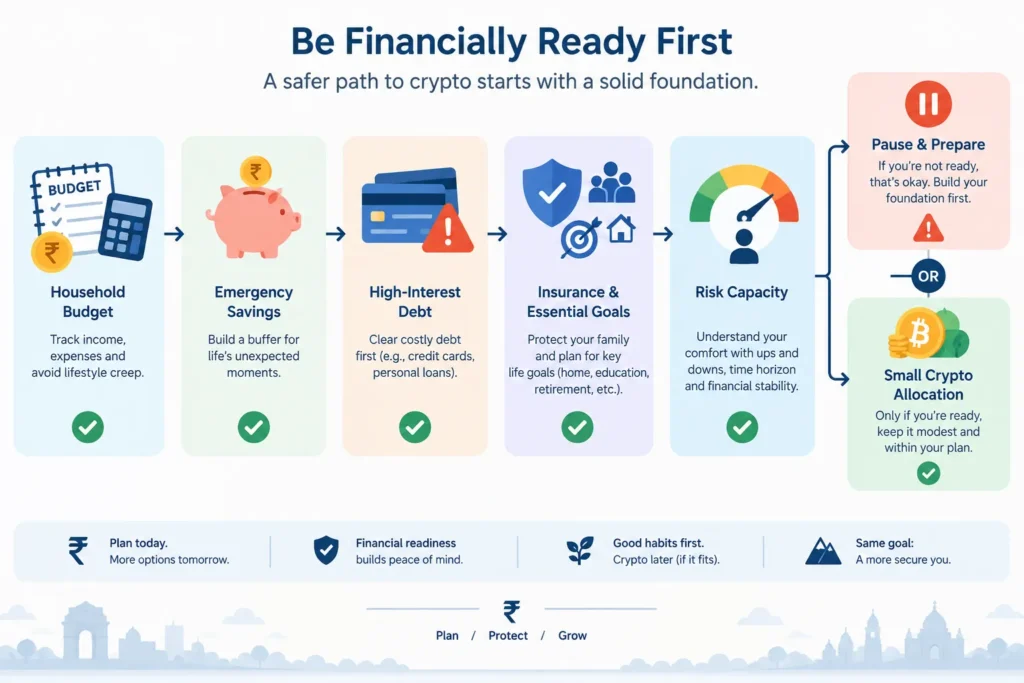
Flowchart for checking emergency savings, debt, insurance, goals, and risk capacity before investing in crypto

Crypto should not come before basic financial stability. Use the following checklist before deciding how much, if anything, to invest.

  • Emergency savings: Do you have accessible money for unexpected expenses such as a job loss, urgent travel, or home repairs?
  • High-interest debt: Are you carrying expensive credit card debt, app-based loans, or other high-cost borrowing?
  • Essential expenses: Is the investment money needed for rent, groceries, utility bills, or loan repayments?
  • Insurance needs: Do you have suitable health insurance and, where others depend on your income, adequate life cover?
  • Risk tolerance: Could you remain financially and emotionally stable if the investment lost most or all of its value?
  • Near-term goals: Will you need the money soon for education fees, a home deposit, medical costs, a wedding, or another important goal?

Crypto may be inappropriate if the money is needed soon or if a loss would disrupt your daily life. For example, money set aside for next semester’s college fees should not depend on whether Bitcoin or another cryptocurrency rises before the payment date.

Risk tolerance is also different from risk capacity. You may feel comfortable watching prices move sharply, but that does not mean your finances can absorb the loss. Your ability to take risk depends on income stability, savings, debt, dependants, insurance, and the timing of your goals.

You May Also Like:Cryptocurrency Risks: Common Dangers and How to Invest More Safely

Choose an Amount You Can Afford to Lose

There is no universally suitable percentage that every Indian investor should allocate to cryptocurrency. A percentage that is manageable for a financially secure person may be harmful for someone with irregular income, limited savings, or upcoming expenses.

Start by deciding the maximum loss your finances can tolerate. Treat a complete loss as a real possibility, not merely a warning printed on a screen. If losing the amount would force you to borrow, delay an essential goal, or cut daily necessities, the amount is too high.

Do not use a personal loan, credit card, education fund, emergency fund, or borrowed money to buy crypto. Borrowing adds interest and repayment obligations even if the cryptocurrency falls to a fraction of its purchase price.

This decision is known as position sizing. It means limiting the amount placed in a risky asset so that a bad outcome does not damage the rest of your financial plan. A beginner may choose to invest nothing while learning, or begin with a small amount that has no effect on essential goals.

Diversification Requires More Than Owning Several Coins

Diversification means spreading risk across investments that do not all respond in the same way. Buying five or ten cryptocurrencies does not automatically create meaningful diversification. Many crypto assets are highly correlated and may fall together when sentiment turns negative.

A portfolio containing Bitcoin and several smaller tokens remains heavily exposed to the crypto market. Real diversification should be considered across the broader financial plan, including appropriate cash reserves and other asset classes suited to the investor’s goals and risk capacity.

Bitcoin may have different characteristics from smaller crypto assets, but it is still volatile and high risk. Beginners who want to understand its specific purpose, supply rules, and risks should study Bitcoin separately rather than assuming that the largest cryptocurrency is automatically safe.

Research the Cryptocurrency Before Buying

A low unit price does not mean that a token is cheap, and a recent price rise does not prove that a project is useful. Assess the asset itself before looking at potential returns.

  • Purpose: What problem is the project trying to solve, and does it genuinely need a cryptocurrency?
  • Network usage: Are people using the network for a clear purpose, or is attention driven mainly by speculation?
  • Development activity: Is the technology being maintained and improved by capable developers?
  • Governance: Who can change the network’s rules, and how are important decisions made?
  • Supply and distribution: How many tokens exist, how are new tokens created, and do insiders control a large share?
  • Security history: Has the network or its software suffered hacks, outages, or serious vulnerabilities?
  • Liquidity: Is there enough genuine trading activity to enter or exit without a large price difference?
  • Documentation: Are the technical documents, risks, team information, and token rules clear and consistent?
  • Major risks: What could cause the project to fail, lose users, face restrictions, or become technically outdated?

Look for evidence that could challenge your view, not only information that supports it. Project websites and community channels may highlight benefits while giving less attention to weaknesses.

Avoid Hype and “Guaranteed Winners”

Do not invest because an influencer, celebrity, colleague, or anonymous message says a coin will “go to the moon”. Price predictions are opinions, not facts. Claims of guaranteed returns, secret opportunities, fixed daily profits, or risk-free crypto income are major warning signs.

Fear of missing out can make a rapidly rising price feel like proof of quality. It is not. If you cannot explain in simple words what the cryptocurrency does, why it may retain value, and what could make it fail, pause rather than buying under pressure.

A suitable first decision may be to wait. Learning how the asset works, strengthening your finances, and accepting that no opportunity is guaranteed are all valid parts of responsible cryptocurrency investing.

Choose an Exchange, Complete KYC, and Buy Cryptocurrency
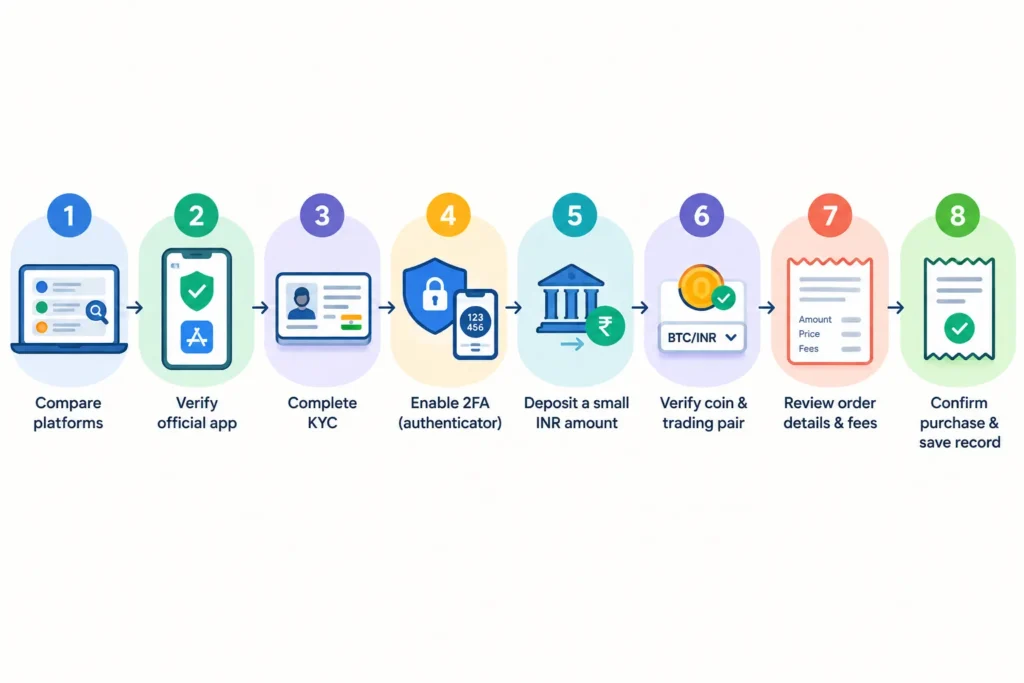
Visual steps for choosing an exchange, completing KYC, securing an account, and buying crypto with INR

The next step in learning how to invest in cryptocurrency in India is choosing a platform that allows Indian users to open an account, complete identity checks, add money and place an order.

A crypto exchange is a business platform where buyers and sellers trade cryptocurrencies. It may also hold your rupees or crypto assets on your behalf. This makes exchange selection an important decision, not just a comparison of app design or advertised fees.

How to Evaluate a Crypto Exchange in India

Do not select an exchange only because it is popular, offers a joining bonus or lists many coins. Compare the following factors before transferring money.

  • Legal entity and operating location: Check which company operates the platform, where it is incorporated and whether its Indian contact and business details are clearly disclosed. Understand which legal entity will hold your account.
  • Compliance approach: Review how the exchange describes its compliance with applicable Indian requirements. Look for clear policies on identity checks, transaction monitoring, taxes and user records. Compliance claims do not automatically make an exchange safe.
  • KYC requirements: A platform serving Indian users may ask for details such as your name, date of birth, address, PAN, identity documents, photograph or bank account information. Check why each detail is required and how it will be handled.
  • Security controls: Look for app-based two-factor authentication, withdrawal confirmations, login alerts, device management and options to restrict withdrawals. Strong user controls reduce some risks but cannot eliminate a platform-level security breach.
  • Crypto and rupee withdrawals: Confirm whether you can withdraw supported crypto assets to an external wallet and whether rupee withdrawals are available. Check limits, processing times and charges. Some platforms may restrict certain assets or withdrawal routes.
  • Asset custody: Find out who controls the private keys when crypto remains on the exchange. Check whether customer assets are described as separate from the company’s own funds and what may happen if the business fails.
  • Reserve disclosures: Some exchanges publish proof-of-reserves reports or other asset disclosures. Review what the report covers, when it was prepared and whether liabilities are also addressed. A reserves snapshot is not the same as a complete financial audit.
  • Liquidity: Higher liquidity generally makes it easier to buy or sell near the displayed market price. A thinly traded coin may have a wide gap between available buying and selling prices.
  • Fees and spreads: Compare deposit charges, trading fees, withdrawal fees and any network charges. Also check the spread, which is the difference between buying and selling prices. A platform advertising “zero fees” may still have a meaningful spread.
  • INR payment methods: Check which bank transfer or other supported payment methods are currently available. Limits, processing periods and banking support can differ between exchanges and may change.
  • Customer service: Review the available support channels and complaint process. It should be possible to report unauthorised activity, a locked account or a delayed withdrawal without relying on social media messages.
  • Incident history: Search for earlier security breaches, withdrawal suspensions, service disruptions or regulatory disputes. Consider how the company communicated with users and resolved the issue.
  • Terms and conditions: Read the rules on account suspension, withdrawals, custody, dormant accounts, disputes and service termination. Avoid assuming that money held on an exchange has the same protection as a bank deposit.

No single exchange or payment method is universally best. Features that suit an occasional buyer may not suit someone who needs external-wallet withdrawals or advanced order controls. A future detailed guide on choosing crypto exchanges in India can help readers make a more structured comparison.

Registration, KYC completion or compliance with a reporting requirement does not remove investment risk. It also does not guarantee that the exchange cannot be hacked, mismanaged, affected by fraud or forced to stop operations. Cryptocurrency prices can fall sharply, and a business holding customer assets can fail.

You May Also Like:Crypto Wallets in India: Types, How They Work and How to Choose One

Set Up and Secure Your Account

Use only the exchange’s official website or mobile app. Fake apps, advertisements and lookalike login pages may try to steal passwords, identity documents or one-time passwords.

  1. Create a unique password: Use a long password that you do not use for email, banking or any other financial account.
  2. Enable app-based two-factor authentication: An authenticator app is generally safer than relying only on SMS. Store recovery codes securely and never share them with support callers or online contacts.
  3. Complete identity checks accurately: Enter your name, PAN and other details exactly as required. Mismatched information may delay verification, deposits or withdrawals.
  4. Secure your email: Your linked email account may be used for password resets and withdrawal approvals. Give it a unique password and two-factor authentication as well.
  5. Verify payment information: Check that the bank account or payment source is in the permitted name and that the displayed beneficiary details are correct before sending money.

Never allow a stranger to create the account for you or remotely control your phone. Legitimate support staff should not ask for your password, authenticator code, screen-sharing access or crypto wallet recovery phrase.

How to Buy Cryptocurrency

After KYC and payment verification, start with a small amount that you can afford to expose to price and platform risk. The exact screens differ, but a typical purchase follows these steps.

  1. Deposit or transfer a small rupee amount using a payment method currently supported by the exchange.
  2. Wait until the money appears in the available INR balance. Do not send a second transfer merely because the first one is taking time.
  3. Search for the intended cryptocurrency and select the correct INR trading pair, if available. Coin names and symbols can look similar, so verify both.
  4. Choose an order type, enter the amount and review the order summary.
  5. Check the quantity of crypto, quoted price, spread, trading fee, applicable charges and total rupee cost.
  6. Confirm the order only after checking all details.

A market order aims to buy immediately at the best prices currently available. It is simple, but the final average price may differ from the price first shown, especially in a fast or illiquid market.

A limit order lets you state the highest price you are willing to pay. The order executes only if matching sellers are available at that price or lower. It may remain pending or may be filled only partly.

Example of a Small INR Purchase

Suppose Riya transfers ₹1,000 to her exchange account and wants to buy a selected cryptocurrency using its INR pair. Before placing the order, she checks how much of the ₹1,000 will be used, the estimated crypto quantity, the trading fee and the final total.

If Riya uses a market order, the purchase may execute quickly across one or more available sell orders. If she uses a limit order, she enters her maximum purchase price and waits for a match. She does not assume that the order will execute or that the cryptocurrency will rise after purchase.

The ₹1,000 figure only demonstrates the order process. It is not a recommended investment amount, and it does not include any prediction of profit or loss.

Verify the Completed Transaction

After confirmation, check the order history rather than relying only on a pop-up message. The status may show completed, partially filled, pending, cancelled or failed. Compare the final crypto quantity, average execution price and fee with the order details.

Balance updates can sometimes be delayed. Refresh the order history and check notifications before placing another order. Repeatedly tapping “Buy” may create duplicate purchases if the original instruction was already accepted.

Download or save the trade confirmation, transaction history and fee details. These records can help with portfolio tracking, tax calculations and complaints. If crypto is later withdrawn to a personal wallet, separately verify the asset, network, address and withdrawal status before sending a large amount.

How Selling Generally Works

To sell, select the relevant crypto and the correct trading pair, then choose a market or limit sell order. Enter the quantity, review the expected price, spread, fees and estimated final rupee amount, and confirm only after checking the details.

Once the sale is completed, the proceeds generally appear in the exchange balance. You can then request withdrawal through a supported route, subject to current limits, verification checks, charges and processing periods. Confirm the bank details before submitting the request.

Save the sell order, fee record and withdrawal confirmation. Exchange access, banking arrangements, withdrawal support and Indian regulatory requirements can change, so recheck the latest platform terms before every important transaction.

You May Also Like:Cryptocurrency Tax in India: Tax Rules, TDS and ITR Filing Guide

Store Crypto Safely, Manage Risk, Keep Records, and Answer FAQs

Buying cryptocurrency is only the first step. You must also decide where to store it, how to protect access, when to review the investment, and what records to maintain.

Crypto transactions can be difficult or impossible to reverse. A simple mistake, such as selecting the wrong network or sharing a seed phrase, may cause a permanent loss. Beginners should therefore move slowly and understand each step before transferring assets.

Custodial Storage Versus Self-Custody
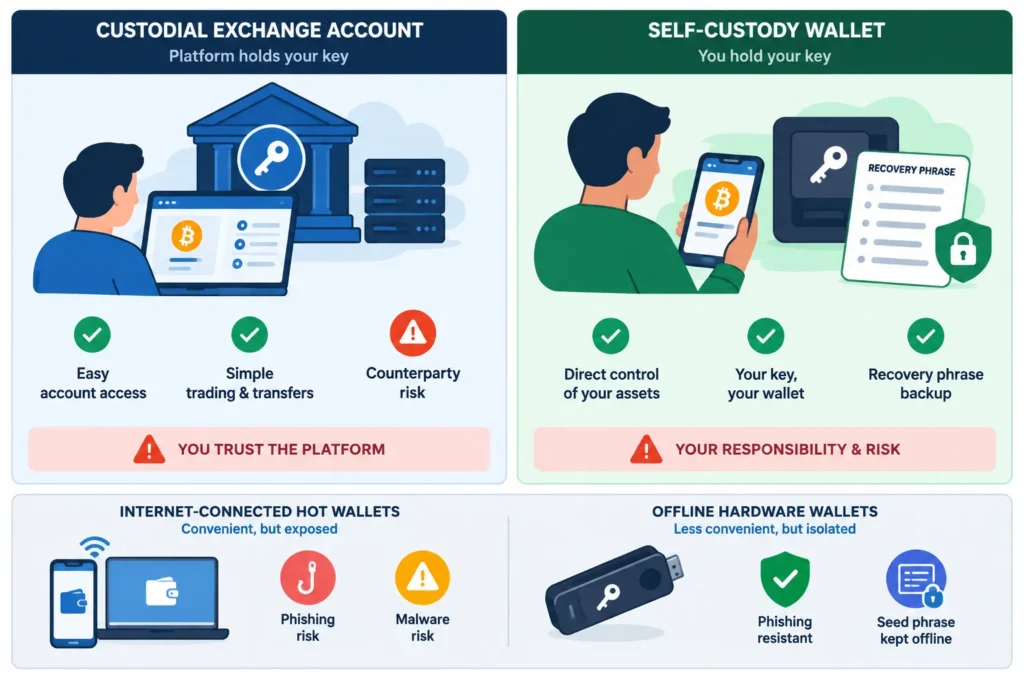
Comparison of custodial exchange storage, self-custody wallets, hot wallets, and hardware wallets

With custodial storage, a crypto platform controls the private keys on your behalf. You access your holdings through your platform account. This is usually more convenient for beginners because the platform manages the technical details.

However, custodial storage creates counterparty risk. Your access may be affected if the platform suffers a security breach, freezes withdrawals, faces financial trouble, changes its policies, or becomes unavailable in India.

With self-custody, you control the wallet and its private keys. You are not relying on a platform to approve withdrawals. However, you become fully responsible for security, backups, wallet recovery, network selection, and every transaction you authorise.

Storage method Main advantage Main risk
Custodial platform Convenient access and account-based recovery options Dependence on the platform and its security
Self-custody wallet Direct control of private keys Mistakes or lost recovery details may cause permanent loss

Self-custody is not automatically safer. It may be less safe for someone who does not know how to protect a seed phrase, verify wallet software, or select the correct blockchain network. Choose the method whose responsibilities you can handle properly.

Hot Wallets and Hardware Wallets

A hot wallet is connected to the internet, often through a mobile app, browser extension, or desktop program. It can be convenient for regular transactions, but it has greater exposure to phishing, malware, and harmful browser extensions.

A hardware wallet is a separate physical device designed to keep private keys away from internet-connected devices. It may reduce certain online risks, but it is not mistake-proof. You can still lose money by revealing the seed phrase, approving a fraudulent transaction, or sending assets to the wrong address or network.

Beginners do not need to move crypto immediately. Before making a withdrawal, learn how wallet addresses, supported networks, fees, and confirmations work. If you decide to transfer, first send a small test amount and confirm that it arrives correctly.

A separate wallets and crypto security guide can help you compare wallet types and understand test transfers in greater detail.

Essential Crypto Security Practices

  • Use a unique, strong password for every crypto account. A reputable password manager can help you create and store passwords securely.
  • Enable app-based two-factor authentication where available. Avoid relying only on SMS if the platform offers a stronger option.
  • Keep your phone, computer, browser, wallet software, and security apps updated.
  • Install apps only after checking the official developer, spelling, reviews, and requested permissions.
  • Turn on login and withdrawal alerts. Review unexpected notifications immediately.
  • Check the complete wallet address before confirming a transfer. Malware can sometimes replace copied addresses.
  • Confirm that the sending platform and receiving wallet support the same asset on the same network.
  • Use a small test transfer before sending a large amount to a new address.
  • Be suspicious of urgent messages, fake support accounts, giveaway claims, and guaranteed-return offers.
  • Never allow an unknown person to view your screen or remotely control your phone or computer.

Your private key and seed phrase provide access to your crypto. Never share them with a platform employee, customer-support agent, friend, influencer, or investment manager. Genuine support staff should not need them.

Do not enter a seed phrase into an untrusted website. Do not photograph it, email it, send it through a messaging app, or store it openly in online notes or cloud storage. If another person obtains it, they may be able to move the assets without your permission.

If you lose the seed phrase and cannot access the wallet through another authorised method, you may permanently lose access. Similarly, crypto sent to the wrong address or through an incompatible network may not be recoverable.

Manage Risk After You Invest

Decide your maximum crypto allocation before market excitement influences you. The limit should reflect your income stability, financial goals, emergency fund, existing investments, and ability to accept a total loss.

Review the portfolio periodically rather than reacting to every price movement. Check whether crypto has grown beyond your chosen limit and whether the original reason for buying still makes sense.

Do not automatically buy more only because the price has fallen. Averaging down can increase losses when the asset’s technology, liquidity, governance, security, or regulatory position has weakened. Reassess the investment case before adding money.

Common mistakes include:

  • Investing rent, school fees, emergency savings, or other essential money.
  • Borrowing through loans or credit cards to buy crypto.
  • Chasing an asset after a sudden price rise.
  • Concentrating most of the portfolio in one speculative token.
  • Trading too often without a clear plan.
  • Ignoring trading, withdrawal, network, and conversion fees.
  • Trusting influencers without independent research.
  • Using weak passwords or skipping two-factor authentication.
  • Failing to maintain transaction and tax records.

Keep Complete Transaction Records

Do not depend entirely on an exchange to preserve your history. Platforms can change formats, restrict access, or stop operating. Download statements regularly and keep a secure backup.

Record purchases, sales, swaps between crypto assets, transfers between your accounts or wallets, deposits, withdrawals, and fees. For each activity, retain the date, asset, quantity, INR value, platform or wallet, wallet address where relevant, and transaction ID.

Transfers between your own wallets should also be documented. Clear records can help show that a movement was a transfer rather than a sale or unexplained receipt. Keep supporting bank statements, order confirmations, and fee details where available.

You May Also Like:Crypto Exchanges in India: How They Work and How to Choose One

Indian Tax and Regulatory Considerations

Crypto rules, tax treatment, reporting requirements, and access to particular platforms can change. A transaction may have tax or reporting consequences even when no INR is withdrawn. Sales, swaps, receipts, rewards, transfers, or other activities may be treated differently depending on the facts and the rules in force.

Do not rely on an old social-media post or assume that every type of transaction is treated in the same way. Check current information from authoritative Indian government, tax, and regulatory sources. Consult a qualified tax professional when the amounts or transactions are significant or the treatment is unclear.

A dedicated cryptocurrency taxation in India guide can provide a more detailed explanation of transaction categories, documentation, and filing considerations.

Frequently Asked Questions

Crypto investing may be permitted under the rules currently applicable, but it does not necessarily have the status of legal tender or the protections of a regulated bank deposit. Rules and platform access can change, so check current official guidance before investing.

How much should a beginner invest?

Start only with an amount you can afford to lose completely. Essential expenses, emergency savings, insurance needs, and high-cost debt should generally take priority.

Is KYC required to buy cryptocurrency?

Indian-facing platforms commonly require identity verification, but requirements differ by provider and may change. Check the platform’s current KYC, banking, and withdrawal rules.

Can cryptocurrency be bought with INR?

Some platforms allow eligible users to deposit INR and buy supported crypto assets. Available payment methods, limits, fees, and banking access vary by platform.

Is an exchange or personal wallet safer?

Neither is always safer. An exchange is convenient but creates platform risk. A personal wallet gives you control but makes you responsible for keys, backups, and transactions.

Should all crypto transactions be recorded?

Yes. Keep records of purchases, sales, swaps, transfers, receipts, withdrawals, and fees, including dates, INR values, wallet addresses, and transaction IDs where available.

Can crypto profits or transactions create tax obligations?

Yes, depending on the transaction and current Indian rules. Check authoritative guidance and seek professional tax advice when necessary.

Can I lose my full investment?

Yes. Prices can collapse, projects can fail, platforms can become unavailable, and security mistakes can cause permanent loss. Never treat crypto returns as guaranteed.

Summary

Learning how to invest in cryptocurrency in India also means learning how to store it responsibly. Compare custodial storage with self-custody, understand wallet and network risks, strengthen account security, and use small test transfers before moving larger amounts.

Set a predetermined position limit, review the investment case periodically, and avoid decisions driven by fear or excitement. Maintain complete transaction records and check current Indian tax and regulatory guidance. Most importantly, invest only money you can afford to lose without harming essential goals.
Share this article
KEEP READING

Related Articles

View all →

Comments

Leave a Comment

How to Invest in Cryptocurrency in India: A Beginner’s Guide

To learn how to invest in cryptocurrency in India, first decide whether this high-risk asset class suits your financial situation. Build emergency savings, repay expensive debt, protect essential goals, and understand that crypto prices can fall sharply. Invest only money you can afford to lose completely, never borrow to invest, and research the cryptocurrency rather than relying on tips or hype.

This article provides general educational information. It is not personalised investment, legal, or tax advice. Cryptocurrency involves substantial risk, and you may lose some or all of the money invested.

Introduction

Cryptocurrency has become easier to access in India, but easy access does not make it a simple or safe investment. A person can open an account and place an order quickly, yet understanding what they are buying takes much longer.

Beginners should therefore start with financial readiness and risk, not with a list of popular coins. Before putting in even a small amount, you need to know how crypto investing differs from trading, what can go wrong, and whether a loss would affect your daily life.

If terms such as blockchain, coin, token, wallet, and decentralised network are unfamiliar, begin with our pillar guide, Cryptocurrency in India: A Complete Beginner’s Guide to Crypto. Those basic concepts will help you understand the decisions discussed below.

Understand Cryptocurrency Investing and Decide Whether It Fits

Investing Is Different From Trading

Cryptocurrency investing generally means buying a crypto asset with the intention of holding it based on a researched, long-term view. For example, an investor may study a network’s purpose, adoption, security, and token supply before deciding whether its long-term prospects justify the risk.

Cryptocurrency trading usually involves more frequent buying and selling based on short-term price movements. Traders may try to benefit from changes over hours, days, or weeks. This requires time, discipline, risk controls, and an understanding that frequent decisions do not guarantee better results.

The line between investing and trading is not always clear. Someone may call a purchase a long-term investment only after its price falls. Before buying, write down why you are buying, how much you can lose, and what developments would prove your original view wrong.

Understand the Major Risks

Crypto is not simply a faster-moving version of a fixed deposit, gold, or an equity mutual fund. It has risks that can be difficult for a beginner to assess.

  • Sharp price changes: A cryptocurrency can rise or fall substantially within a short period. A falling price may not recover.
  • Limited investor protection: The protections and complaint mechanisms available may differ from those associated with regulated mainstream financial products.
  • Scams and manipulation: Fraudsters may create fake platforms, impersonate support teams, promote worthless tokens, or promise unusually high returns.
  • Technology risk: Software bugs, smart-contract failures, network attacks, and technical mistakes can cause losses.
  • Liquidity risk: Some crypto assets have few genuine buyers and sellers. You may be unable to sell at the displayed price, especially during market stress.
  • Exchange failure: A crypto platform may suffer a security breach, freeze withdrawals, experience financial trouble, or stop operating.
  • Wallet responsibility: If you control your own wallet, losing the recovery phrase or sending assets to the wrong address can result in permanent loss.
  • Regulatory uncertainty: Indian rules, taxation, reporting requirements, and access to services can change. Legal treatment in other countries can also affect prices and platforms.

These risks can overlap. For instance, a sudden market fall may reduce liquidity at the same time that an exchange experiences heavy withdrawal demand. A detailed guide to cryptocurrency risks can help beginners examine each risk separately before investing.

Check Whether Your Finances Are Ready

Flowchart for checking emergency savings, debt, insurance, goals, and risk capacity before investing in crypto

Crypto should not come before basic financial stability. Use the following checklist before deciding how much, if anything, to invest.

  • Emergency savings: Do you have accessible money for unexpected expenses such as a job loss, urgent travel, or home repairs?
  • High-interest debt: Are you carrying expensive credit card debt, app-based loans, or other high-cost borrowing?
  • Essential expenses: Is the investment money needed for rent, groceries, utility bills, or loan repayments?
  • Insurance needs: Do you have suitable health insurance and, where others depend on your income, adequate life cover?
  • Risk tolerance: Could you remain financially and emotionally stable if the investment lost most or all of its value?
  • Near-term goals: Will you need the money soon for education fees, a home deposit, medical costs, a wedding, or another important goal?

Crypto may be inappropriate if the money is needed soon or if a loss would disrupt your daily life. For example, money set aside for next semester’s college fees should not depend on whether Bitcoin or another cryptocurrency rises before the payment date.

Risk tolerance is also different from risk capacity. You may feel comfortable watching prices move sharply, but that does not mean your finances can absorb the loss. Your ability to take risk depends on income stability, savings, debt, dependants, insurance, and the timing of your goals.

Choose an Amount You Can Afford to Lose

There is no universally suitable percentage that every Indian investor should allocate to cryptocurrency. A percentage that is manageable for a financially secure person may be harmful for someone with irregular income, limited savings, or upcoming expenses.

Start by deciding the maximum loss your finances can tolerate. Treat a complete loss as a real possibility, not merely a warning printed on a screen. If losing the amount would force you to borrow, delay an essential goal, or cut daily necessities, the amount is too high.

Do not use a personal loan, credit card, education fund, emergency fund, or borrowed money to buy crypto. Borrowing adds interest and repayment obligations even if the cryptocurrency falls to a fraction of its purchase price.

This decision is known as position sizing. It means limiting the amount placed in a risky asset so that a bad outcome does not damage the rest of your financial plan. A beginner may choose to invest nothing while learning, or begin with a small amount that has no effect on essential goals.

Diversification Requires More Than Owning Several Coins

Diversification means spreading risk across investments that do not all respond in the same way. Buying five or ten cryptocurrencies does not automatically create meaningful diversification. Many crypto assets are highly correlated and may fall together when sentiment turns negative.

A portfolio containing Bitcoin and several smaller tokens remains heavily exposed to the crypto market. Real diversification should be considered across the broader financial plan, including appropriate cash reserves and other asset classes suited to the investor’s goals and risk capacity.

Bitcoin may have different characteristics from smaller crypto assets, but it is still volatile and high risk. Beginners who want to understand its specific purpose, supply rules, and risks should study Bitcoin separately rather than assuming that the largest cryptocurrency is automatically safe.

Research the Cryptocurrency Before Buying

A low unit price does not mean that a token is cheap, and a recent price rise does not prove that a project is useful. Assess the asset itself before looking at potential returns.

  • Purpose: What problem is the project trying to solve, and does it genuinely need a cryptocurrency?
  • Network usage: Are people using the network for a clear purpose, or is attention driven mainly by speculation?
  • Development activity: Is the technology being maintained and improved by capable developers?
  • Governance: Who can change the network’s rules, and how are important decisions made?
  • Supply and distribution: How many tokens exist, how are new tokens created, and do insiders control a large share?
  • Security history: Has the network or its software suffered hacks, outages, or serious vulnerabilities?
  • Liquidity: Is there enough genuine trading activity to enter or exit without a large price difference?
  • Documentation: Are the technical documents, risks, team information, and token rules clear and consistent?
  • Major risks: What could cause the project to fail, lose users, face restrictions, or become technically outdated?

Look for evidence that could challenge your view, not only information that supports it. Project websites and community channels may highlight benefits while giving less attention to weaknesses.

Avoid Hype and “Guaranteed Winners”

Do not invest because an influencer, celebrity, colleague, or anonymous message says a coin will “go to the moon”. Price predictions are opinions, not facts. Claims of guaranteed returns, secret opportunities, fixed daily profits, or risk-free crypto income are major warning signs.

Fear of missing out can make a rapidly rising price feel like proof of quality. It is not. If you cannot explain in simple words what the cryptocurrency does, why it may retain value, and what could make it fail, pause rather than buying under pressure.

A suitable first decision may be to wait. Learning how the asset works, strengthening your finances, and accepting that no opportunity is guaranteed are all valid parts of responsible cryptocurrency investing.

Choose an Exchange, Complete KYC, and Buy Cryptocurrency

Visual steps for choosing an exchange, completing KYC, securing an account, and buying crypto with INR

The next step in learning how to invest in cryptocurrency in India is choosing a platform that allows Indian users to open an account, complete identity checks, add money and place an order.

A crypto exchange is a business platform where buyers and sellers trade cryptocurrencies. It may also hold your rupees or crypto assets on your behalf. This makes exchange selection an important decision, not just a comparison of app design or advertised fees.

How to Evaluate a Crypto Exchange in India

Do not select an exchange only because it is popular, offers a joining bonus or lists many coins. Compare the following factors before transferring money.

  • Legal entity and operating location: Check which company operates the platform, where it is incorporated and whether its Indian contact and business details are clearly disclosed. Understand which legal entity will hold your account.
  • Compliance approach: Review how the exchange describes its compliance with applicable Indian requirements. Look for clear policies on identity checks, transaction monitoring, taxes and user records. Compliance claims do not automatically make an exchange safe.
  • KYC requirements: A platform serving Indian users may ask for details such as your name, date of birth, address, PAN, identity documents, photograph or bank account information. Check why each detail is required and how it will be handled.
  • Security controls: Look for app-based two-factor authentication, withdrawal confirmations, login alerts, device management and options to restrict withdrawals. Strong user controls reduce some risks but cannot eliminate a platform-level security breach.
  • Crypto and rupee withdrawals: Confirm whether you can withdraw supported crypto assets to an external wallet and whether rupee withdrawals are available. Check limits, processing times and charges. Some platforms may restrict certain assets or withdrawal routes.
  • Asset custody: Find out who controls the private keys when crypto remains on the exchange. Check whether customer assets are described as separate from the company’s own funds and what may happen if the business fails.
  • Reserve disclosures: Some exchanges publish proof-of-reserves reports or other asset disclosures. Review what the report covers, when it was prepared and whether liabilities are also addressed. A reserves snapshot is not the same as a complete financial audit.
  • Liquidity: Higher liquidity generally makes it easier to buy or sell near the displayed market price. A thinly traded coin may have a wide gap between available buying and selling prices.
  • Fees and spreads: Compare deposit charges, trading fees, withdrawal fees and any network charges. Also check the spread, which is the difference between buying and selling prices. A platform advertising “zero fees” may still have a meaningful spread.
  • INR payment methods: Check which bank transfer or other supported payment methods are currently available. Limits, processing periods and banking support can differ between exchanges and may change.
  • Customer service: Review the available support channels and complaint process. It should be possible to report unauthorised activity, a locked account or a delayed withdrawal without relying on social media messages.
  • Incident history: Search for earlier security breaches, withdrawal suspensions, service disruptions or regulatory disputes. Consider how the company communicated with users and resolved the issue.
  • Terms and conditions: Read the rules on account suspension, withdrawals, custody, dormant accounts, disputes and service termination. Avoid assuming that money held on an exchange has the same protection as a bank deposit.

No single exchange or payment method is universally best. Features that suit an occasional buyer may not suit someone who needs external-wallet withdrawals or advanced order controls. A future detailed guide on choosing crypto exchanges in India can help readers make a more structured comparison.

Registration, KYC completion or compliance with a reporting requirement does not remove investment risk. It also does not guarantee that the exchange cannot be hacked, mismanaged, affected by fraud or forced to stop operations. Cryptocurrency prices can fall sharply, and a business holding customer assets can fail.

Set Up and Secure Your Account

Use only the exchange’s official website or mobile app. Fake apps, advertisements and lookalike login pages may try to steal passwords, identity documents or one-time passwords.

  1. Create a unique password: Use a long password that you do not use for email, banking or any other financial account.
  2. Enable app-based two-factor authentication: An authenticator app is generally safer than relying only on SMS. Store recovery codes securely and never share them with support callers or online contacts.
  3. Complete identity checks accurately: Enter your name, PAN and other details exactly as required. Mismatched information may delay verification, deposits or withdrawals.
  4. Secure your email: Your linked email account may be used for password resets and withdrawal approvals. Give it a unique password and two-factor authentication as well.
  5. Verify payment information: Check that the bank account or payment source is in the permitted name and that the displayed beneficiary details are correct before sending money.

Never allow a stranger to create the account for you or remotely control your phone. Legitimate support staff should not ask for your password, authenticator code, screen-sharing access or crypto wallet recovery phrase.

How to Buy Cryptocurrency

After KYC and payment verification, start with a small amount that you can afford to expose to price and platform risk. The exact screens differ, but a typical purchase follows these steps.

  1. Deposit or transfer a small rupee amount using a payment method currently supported by the exchange.
  2. Wait until the money appears in the available INR balance. Do not send a second transfer merely because the first one is taking time.
  3. Search for the intended cryptocurrency and select the correct INR trading pair, if available. Coin names and symbols can look similar, so verify both.
  4. Choose an order type, enter the amount and review the order summary.
  5. Check the quantity of crypto, quoted price, spread, trading fee, applicable charges and total rupee cost.
  6. Confirm the order only after checking all details.

A market order aims to buy immediately at the best prices currently available. It is simple, but the final average price may differ from the price first shown, especially in a fast or illiquid market.

A limit order lets you state the highest price you are willing to pay. The order executes only if matching sellers are available at that price or lower. It may remain pending or may be filled only partly.

Example of a Small INR Purchase

Suppose Riya transfers ₹1,000 to her exchange account and wants to buy a selected cryptocurrency using its INR pair. Before placing the order, she checks how much of the ₹1,000 will be used, the estimated crypto quantity, the trading fee and the final total.

If Riya uses a market order, the purchase may execute quickly across one or more available sell orders. If she uses a limit order, she enters her maximum purchase price and waits for a match. She does not assume that the order will execute or that the cryptocurrency will rise after purchase.

The ₹1,000 figure only demonstrates the order process. It is not a recommended investment amount, and it does not include any prediction of profit or loss.

Verify the Completed Transaction

After confirmation, check the order history rather than relying only on a pop-up message. The status may show completed, partially filled, pending, cancelled or failed. Compare the final crypto quantity, average execution price and fee with the order details.

Balance updates can sometimes be delayed. Refresh the order history and check notifications before placing another order. Repeatedly tapping “Buy” may create duplicate purchases if the original instruction was already accepted.

Download or save the trade confirmation, transaction history and fee details. These records can help with portfolio tracking, tax calculations and complaints. If crypto is later withdrawn to a personal wallet, separately verify the asset, network, address and withdrawal status before sending a large amount.

How Selling Generally Works

To sell, select the relevant crypto and the correct trading pair, then choose a market or limit sell order. Enter the quantity, review the expected price, spread, fees and estimated final rupee amount, and confirm only after checking the details.

Once the sale is completed, the proceeds generally appear in the exchange balance. You can then request withdrawal through a supported route, subject to current limits, verification checks, charges and processing periods. Confirm the bank details before submitting the request.

Save the sell order, fee record and withdrawal confirmation. Exchange access, banking arrangements, withdrawal support and Indian regulatory requirements can change, so recheck the latest platform terms before every important transaction.

Store Crypto Safely, Manage Risk, Keep Records, and Answer FAQs

Buying cryptocurrency is only the first step. You must also decide where to store it, how to protect access, when to review the investment, and what records to maintain.

Crypto transactions can be difficult or impossible to reverse. A simple mistake, such as selecting the wrong network or sharing a seed phrase, may cause a permanent loss. Beginners should therefore move slowly and understand each step before transferring assets.

Custodial Storage Versus Self-Custody

Comparison of custodial exchange storage, self-custody wallets, hot wallets, and hardware wallets

With custodial storage, a crypto platform controls the private keys on your behalf. You access your holdings through your platform account. This is usually more convenient for beginners because the platform manages the technical details.

However, custodial storage creates counterparty risk. Your access may be affected if the platform suffers a security breach, freezes withdrawals, faces financial trouble, changes its policies, or becomes unavailable in India.

With self-custody, you control the wallet and its private keys. You are not relying on a platform to approve withdrawals. However, you become fully responsible for security, backups, wallet recovery, network selection, and every transaction you authorise.

Storage method Main advantage Main risk
Custodial platform Convenient access and account-based recovery options Dependence on the platform and its security
Self-custody wallet Direct control of private keys Mistakes or lost recovery details may cause permanent loss

Self-custody is not automatically safer. It may be less safe for someone who does not know how to protect a seed phrase, verify wallet software, or select the correct blockchain network. Choose the method whose responsibilities you can handle properly.

Hot Wallets and Hardware Wallets

A hot wallet is connected to the internet, often through a mobile app, browser extension, or desktop program. It can be convenient for regular transactions, but it has greater exposure to phishing, malware, and harmful browser extensions.

A hardware wallet is a separate physical device designed to keep private keys away from internet-connected devices. It may reduce certain online risks, but it is not mistake-proof. You can still lose money by revealing the seed phrase, approving a fraudulent transaction, or sending assets to the wrong address or network.

Beginners do not need to move crypto immediately. Before making a withdrawal, learn how wallet addresses, supported networks, fees, and confirmations work. If you decide to transfer, first send a small test amount and confirm that it arrives correctly.

A separate wallets and crypto security guide can help you compare wallet types and understand test transfers in greater detail.

Essential Crypto Security Practices

  • Use a unique, strong password for every crypto account. A reputable password manager can help you create and store passwords securely.
  • Enable app-based two-factor authentication where available. Avoid relying only on SMS if the platform offers a stronger option.
  • Keep your phone, computer, browser, wallet software, and security apps updated.
  • Install apps only after checking the official developer, spelling, reviews, and requested permissions.
  • Turn on login and withdrawal alerts. Review unexpected notifications immediately.
  • Check the complete wallet address before confirming a transfer. Malware can sometimes replace copied addresses.
  • Confirm that the sending platform and receiving wallet support the same asset on the same network.
  • Use a small test transfer before sending a large amount to a new address.
  • Be suspicious of urgent messages, fake support accounts, giveaway claims, and guaranteed-return offers.
  • Never allow an unknown person to view your screen or remotely control your phone or computer.

Your private key and seed phrase provide access to your crypto. Never share them with a platform employee, customer-support agent, friend, influencer, or investment manager. Genuine support staff should not need them.

Do not enter a seed phrase into an untrusted website. Do not photograph it, email it, send it through a messaging app, or store it openly in online notes or cloud storage. If another person obtains it, they may be able to move the assets without your permission.

If you lose the seed phrase and cannot access the wallet through another authorised method, you may permanently lose access. Similarly, crypto sent to the wrong address or through an incompatible network may not be recoverable.

Manage Risk After You Invest

Decide your maximum crypto allocation before market excitement influences you. The limit should reflect your income stability, financial goals, emergency fund, existing investments, and ability to accept a total loss.

Review the portfolio periodically rather than reacting to every price movement. Check whether crypto has grown beyond your chosen limit and whether the original reason for buying still makes sense.

Do not automatically buy more only because the price has fallen. Averaging down can increase losses when the asset’s technology, liquidity, governance, security, or regulatory position has weakened. Reassess the investment case before adding money.

Common mistakes include:

  • Investing rent, school fees, emergency savings, or other essential money.
  • Borrowing through loans or credit cards to buy crypto.
  • Chasing an asset after a sudden price rise.
  • Concentrating most of the portfolio in one speculative token.
  • Trading too often without a clear plan.
  • Ignoring trading, withdrawal, network, and conversion fees.
  • Trusting influencers without independent research.
  • Using weak passwords or skipping two-factor authentication.
  • Failing to maintain transaction and tax records.

Keep Complete Transaction Records

Do not depend entirely on an exchange to preserve your history. Platforms can change formats, restrict access, or stop operating. Download statements regularly and keep a secure backup.

Record purchases, sales, swaps between crypto assets, transfers between your accounts or wallets, deposits, withdrawals, and fees. For each activity, retain the date, asset, quantity, INR value, platform or wallet, wallet address where relevant, and transaction ID.

Transfers between your own wallets should also be documented. Clear records can help show that a movement was a transfer rather than a sale or unexplained receipt. Keep supporting bank statements, order confirmations, and fee details where available.

Indian Tax and Regulatory Considerations

Crypto rules, tax treatment, reporting requirements, and access to particular platforms can change. A transaction may have tax or reporting consequences even when no INR is withdrawn. Sales, swaps, receipts, rewards, transfers, or other activities may be treated differently depending on the facts and the rules in force.

Do not rely on an old social-media post or assume that every type of transaction is treated in the same way. Check current information from authoritative Indian government, tax, and regulatory sources. Consult a qualified tax professional when the amounts or transactions are significant or the treatment is unclear.

A dedicated cryptocurrency taxation in India guide can provide a more detailed explanation of transaction categories, documentation, and filing considerations.

Frequently Asked Questions

Is cryptocurrency investing legal or permitted in India?

Crypto investing may be permitted under the rules currently applicable, but it does not necessarily have the status of legal tender or the protections of a regulated bank deposit. Rules and platform access can change, so check current official guidance before investing.

How much should a beginner invest?

Start only with an amount you can afford to lose completely. Essential expenses, emergency savings, insurance needs, and high-cost debt should generally take priority.

Is KYC required to buy cryptocurrency?

Indian-facing platforms commonly require identity verification, but requirements differ by provider and may change. Check the platform’s current KYC, banking, and withdrawal rules.

Can cryptocurrency be bought with INR?

Some platforms allow eligible users to deposit INR and buy supported crypto assets. Available payment methods, limits, fees, and banking access vary by platform.

Is an exchange or personal wallet safer?

Neither is always safer. An exchange is convenient but creates platform risk. A personal wallet gives you control but makes you responsible for keys, backups, and transactions.

Should all crypto transactions be recorded?

Yes. Keep records of purchases, sales, swaps, transfers, receipts, withdrawals, and fees, including dates, INR values, wallet addresses, and transaction IDs where available.

Can crypto profits or transactions create tax obligations?

Yes, depending on the transaction and current Indian rules. Check authoritative guidance and seek professional tax advice when necessary.

Can I lose my full investment?

Yes. Prices can collapse, projects can fail, platforms can become unavailable, and security mistakes can cause permanent loss. Never treat crypto returns as guaranteed.

Summary

Learning how to invest in cryptocurrency in India also means learning how to store it responsibly. Compare custodial storage with self-custody, understand wallet and network risks, strengthen account security, and use small test transfers before moving larger amounts.

Set a predetermined position limit, review the investment case periodically, and avoid decisions driven by fear or excitement. Maintain complete transaction records and check current Indian tax and regulatory guidance. Most importantly, invest only money you can afford to lose without harming essential goals.
Leave a Comment