
Cryptocurrency Tax in India: Tax Rules, TDS and ITR Filing Guide

A beginner-friendly guide to cryptocurrency tax in India, covering VDA transfers, tax rates, TDS, loss restrictions, record-keeping and ITR reporting.

Cryptocurrency Tax in India: Tax Rules, TDS and ITR Filing Guide

Educational disclaimer: This article explains general Indian income-tax rules for beginners. It is not tax, legal or investment advice. Cryptocurrency tax in India depends on the transaction, the taxpayer’s circumstances and the law applicable to the relevant financial year. Check the latest Income Tax Department guidance and consult a qualified tax professional where necessary.

Quick Answer

In India, cryptocurrencies are generally covered by the income-tax rules for Virtual Digital Assets, or VDAs. Simply buying and holding crypto does not normally create taxable income merely because its market price increases.

Tax review is generally required when you sell, exchange, spend or otherwise transfer a VDA. Section 115BBH of the Income-tax Act applies from Assessment Year 2023-24, corresponding to Financial Year 2022-23. It provides a 30% tax rate on income from the transfer of a VDA. Applicable surcharge and 4% health and education cess can increase the final tax amount.

Only the cost of acquisition is expressly permitted as a deduction when calculating such income. Other expenses are generally not deductible under Section 115BBH. A loss from one VDA transfer cannot be set off against income from another VDA transfer or against other income, and it cannot be carried forward to a later year.

Introduction

Crypto tax can appear confusing because everyday actions such as swapping one token for another or paying for a product with crypto may be relevant for tax purposes. You do not necessarily need to convert the crypto into Indian rupees before a transaction requires examination.

It is also important to separate investment activity from tax treatment. The legal status, investment risks and basic working of crypto are broader subjects covered in Cryptocurrency in India: A Complete Beginner’s Guide to Crypto. Practical matters such as selecting a platform, completing KYC and placing an order are discussed in How to Invest in Cryptocurrency in India: A Beginner’s Guide.

This guide focuses on the income-tax side. The starting point is to understand what a VDA is and the difference between buying, holding and transferring one.

Understanding Cryptocurrency Tax and VDA Transfers in India

Financial Year and Assessment Year Matter

Indian tax rules are applied with reference to a particular period. The financial year is the year in which you earn income or complete a transaction. The assessment year is the following year, when that income is assessed and the relevant return is generally filed.

For example, a taxable crypto transfer completed between 1 April 2024 and 31 March 2025 falls in Financial Year 2024-25 and is generally reported for Assessment Year 2025-26.

The special VDA tax provision in Section 115BBH was introduced with effect from Assessment Year 2023-24. Therefore, it applies to relevant income arising from Financial Year 2022-23 onwards. The 30% rate and the deduction and loss restrictions explained below continue under the Income-tax Act for subsequent years, including Financial Year 2025-26, subject to any amendment applicable to the taxpayer’s year.

What Is a Virtual Digital Asset?

Section 2(47A) of the Income-tax Act contains the statutory definition of a Virtual Digital Asset. Broadly, it covers certain information, codes, numbers or tokens generated through cryptographic or other means that provide a digital representation of value and have specified features under the law.

The definition is intentionally wider than the everyday word “cryptocurrency”. Depending on the asset and applicable government notifications, it can include:

  • Cryptocurrencies and crypto tokens that satisfy the statutory conditions.
  • Non-fungible tokens, or NFTs, covered by the notified rules.
  • Other digital assets notified by the Central Government.

Indian currency and foreign currency are excluded from the VDA definition. The government may also notify other assets that are excluded. A digital record is not automatically a VDA merely because it exists online; its legal characteristics and applicable notifications must be checked.

Buying, Holding, Selling and Transferring Crypto
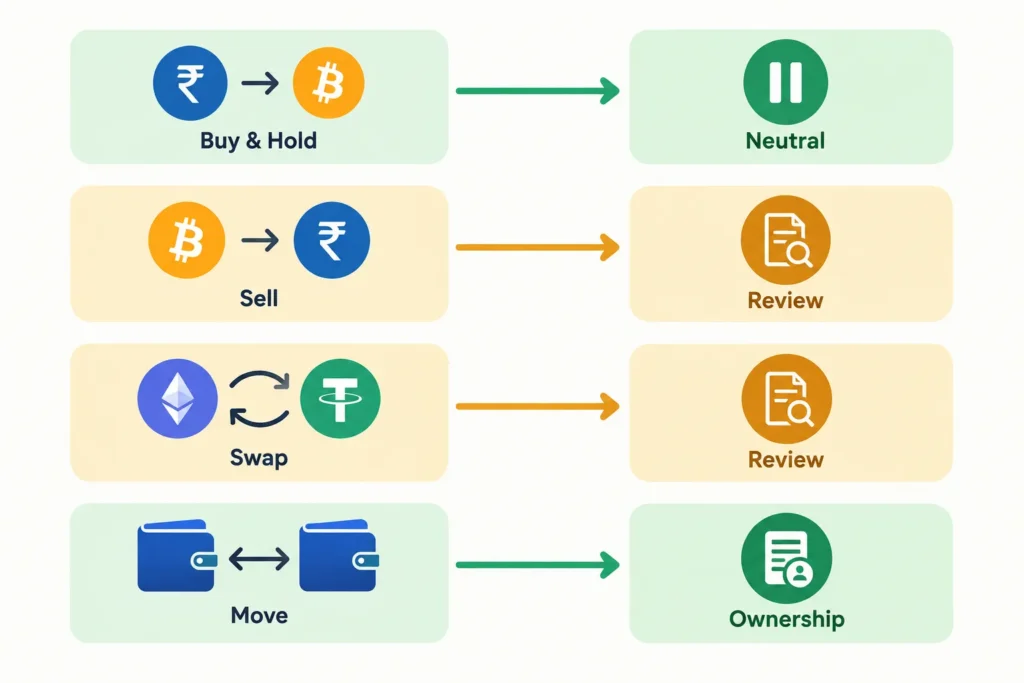
Flowchart showing that buying, holding and self-wallet transfers generally differ from sales, swaps and crypto spending that may require tax review.

The tax result depends on what you do with the asset. The following distinctions are important.

Activity General income-tax position
Buying crypto with rupees The purchase itself does not normally create income for the buyer. Keep records of the purchase price and related transaction details.
Holding crypto An increase in market value does not automatically create taxable income when there is no transfer. The unrealised increase is not taxed merely because the price shown by an exchange has risen.
Selling crypto for rupees The sale is a transfer and any resulting income must be examined under Section 115BBH.
Swapping one crypto asset for another A crypto-to-crypto exchange may amount to a transfer. The value and acquisition cost of the assets must be determined using supportable records.
Paying for goods or services with crypto Using crypto as payment can involve a transfer of the VDA. The transaction may therefore require a tax calculation even when no rupees are received.
Moving crypto between your own wallets A genuine transfer between wallets beneficially owned by the same person may not by itself represent a sale or exchange, but ownership, wallet and transaction records should be retained.

The term “transfer” must be read with the Income-tax Act and the facts of the transaction. It can cover more than a straightforward cash sale. A sale, exchange, relinquishment or other disposal may require review.

Transactions involving gifts, mining, staking, airdrops, business activity or compensation for services may raise additional questions about when income first arises and what cost is available on a later transfer. They should not be treated as ordinary purchases without checking the applicable law.

You May Also Like:Bitcoin Security: How to Protect Your Bitcoin from Theft and Scams

Tax Rate Under Section 115BBH

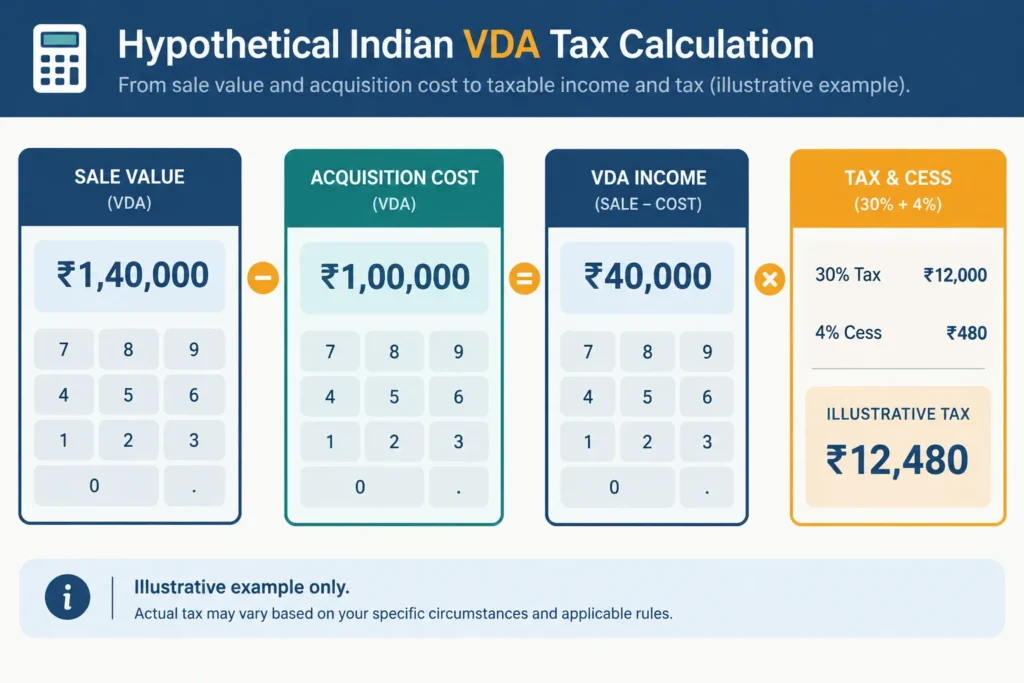
Illustrative calculation showing ₹40,000 of VDA income, 30% tax and 4% cess resulting in ₹12,480 tax before other applicable adjustments.

For Assessment Year 2023-24 onwards, Section 115BBH provides a tax rate of 30% on income from the transfer of a VDA. This is a statutory rate on the relevant VDA income, not a promise that the taxpayer’s complete liability will be exactly 30% of the profit.

Applicable surcharge may be added based on factors such as the taxpayer’s status and total income. Health and education cess is then charged at 4% on the income tax plus applicable surcharge for the relevant periods discussed here. Other income remains taxable under the rules that apply to that income.

Simple Illustrative Calculation

Assume an individual bought a crypto asset for ₹1,00,000 and later sold the same asset for ₹1,40,000. For simplicity, assume the full ₹1,00,000 qualifies as its cost of acquisition and no surcharge applies.

Sale proceeds ₹1,40,000
Less: cost of acquisition ₹1,00,000
Income from VDA transfer ₹40,000
Tax at 30% ₹12,000
Health and education cess at 4% ₹480
Illustrative tax on the VDA income ₹12,480

This is only an educational illustration. It does not account for surcharge, other income, tax credits, withholding, advance tax, valuation disputes or special facts. The final liability must be calculated for the relevant taxpayer and year.

Restricted Deductions and Treatment of Losses

Section 115BBH expressly permits a deduction for the cost of acquisition when computing income from a VDA transfer. It does not allow deductions for other expenditure or allowances against that income. Investors should therefore not assume that exchange fees, internet costs, advisory charges or similar expenses can be deducted in the same way as ordinary business expenses.

The provision also imposes strict loss restrictions. A loss from the transfer of a VDA cannot be set off against income computed under another provision. It also cannot be carried forward to a future assessment year.

Importantly, the restriction applies across VDA transfers as well. A loss on one crypto transaction should not be assumed to reduce the taxable income from a profitable transaction involving another VDA. For example, a ₹30,000 loss on one token does not automatically cancel a ₹50,000 taxable income from the transfer of another token under Section 115BBH.

These rules have applied from Assessment Year 2023-24 and should always be verified against the Income-tax Act, current Income Tax Department material and amendments relevant to the financial year being reported. Maintaining exchange statements, wallet records, dates, quantities, rupee values and proof of acquisition cost can make that review substantially easier.

TDS Under Section 194S, Special Transactions and Records to Keep

Tax deducted at source, or TDS, is an important part of cryptocurrency tax in India. However, TDS is not the same as your final tax bill.

Section 194S of the Income-tax Act requires TDS on the transfer of a virtual digital asset, or VDA, when the legal conditions are met. Crypto assets such as Bitcoin and Ether generally fall within the VDA definition.

The person responsible for paying the consideration normally has to deduct TDS. In exchange-based transactions, the exchange or broker may handle the deduction under arrangements covered by CBDT guidance. The exact responsibility depends on how the trade is executed and which parties are involved.

TDS Rate, Effective Date and Annual Thresholds

Section 194S applies to qualifying payments made on or after 1 July 2022. The TDS rate is 1% of the consideration paid for transferring the VDA.

No TDS is required under this section if the total consideration during the financial year does not exceed the applicable threshold:

  • ₹50,000 for a specified person.
  • ₹10,000 for any other person.

These are annual thresholds, not limits for each individual transaction. You must therefore consider the aggregate value of relevant transactions during the financial year.

A “specified person” generally includes an individual or Hindu Undivided Family whose business turnover did not exceed ₹1 crore, or whose professional receipts did not exceed ₹50 lakh, in the financial year immediately before the year of the transaction. It also includes an individual or HUF who did not have income under the head “Profits and gains of business or profession” in that preceding year.

For example, a salaried individual who does not run a business or profession will generally fall within the specified-person category. A taxpayer with larger business or professional receipts may fall under the ₹10,000 threshold instead. Classification should be checked using the facts of the relevant year.

You May Also Like:Bitcoin Explained: How It Works, Its Uses and Risks for Beginners

TDS Is Not the Final Crypto Tax

TDS is mainly a collection and reporting mechanism. It creates a tax credit that should appear in the seller’s tax records, subject to correct deduction and reporting. The final income-tax liability must still be calculated while filing the income tax return.

This distinction matters because 1% TDS may apply to the transaction value even when the investor earns only a small profit or makes no taxable profit. It is not calculated only on the gain.

Suppose you sell crypto worth ₹1,00,000 through an Indian exchange. The exchange may deduct ₹1,000 as TDS, subject to the applicable rules. This does not mean your final tax is ₹1,000. Your final liability depends on the taxable income calculated under the VDA provisions, while eligible TDS can be claimed as credit.

You should check Form 26AS and the Annual Information Statement before filing your return. If an exchange shows TDS in its own transaction statement but the amount does not appear correctly in your tax records, contact the exchange and seek a correction.

Who Deducts TDS in Different Types of Transactions?

The person paying for the VDA is generally responsible for deducting TDS. In practice, CBDT guidance provides operational rules for transactions conducted through exchanges and brokers.

  • Trade through an Indian exchange: The exchange or broker may deduct and report TDS under the applicable arrangement. Review the exchange’s contract note, ledger or tax statement.
  • Direct peer-to-peer sale: The buyer may have to deduct TDS from the payment and complete the required compliance.
  • Transaction involving a specified person: A specified person who must deduct tax may use the prescribed simplified payment and reporting process, where applicable.
  • Payment in kind: If the consideration is wholly or partly in kind, the law requires arrangements to ensure that the tax has been paid before the asset is released.

Do not assume that using an exchange automatically settles every tax obligation. The platform may facilitate TDS, but the taxpayer remains responsible for checking transaction data, TDS credit and income reporting. Our guide, Crypto Exchanges in India: How They Work and How to Choose One, explains the role exchanges play in trade execution, custody and reporting.

Crypto-to-Crypto Swaps and Spending Crypto

A crypto-to-crypto swap can be a transfer of one VDA even though no rupees enter your bank account. For example, exchanging Bitcoin for Ether may require separate analysis for the Bitcoin transferred and the Ether received.

CBDT guidance treats barter-style VDA transactions carefully because each party may be both a buyer and a seller. An exchange may handle TDS under a written operational arrangement, but direct swaps can create compliance responsibilities for the participants. Valuation in rupees at the time of the transaction is essential.

Spending crypto can also involve a transfer. If you use crypto to purchase a laptop, pay for a service or settle a debt, you have given up the crypto in exchange for something of value. The transaction may therefore need to be valued and reported even though it does not look like a normal sale.

Off-Exchange Transfers and Your Own Wallets

A transfer to another person’s wallet may represent a sale, gift, payment or other disposal. The wallet movement alone does not explain the legal nature of the transaction. You need supporting records showing why the transfer occurred and what, if anything, you received in return.

By contrast, moving crypto between wallets that you own is generally not the same as transferring ownership to another person. For example, withdrawing Bitcoin from your exchange account to your own hardware wallet is usually a custody movement rather than a sale.

Still, keep proof that both addresses or accounts belonged to you. Without this evidence, an old wallet transfer may later be mistaken for a sale or gift. Network fees paid during a self-transfer should also be recorded separately rather than treating the full outgoing quantity as consideration received.

Mining, Staking, Airdrops, Gifts and Rewards

Mining rewards, staking income, airdrops, referral rewards and gifted crypto do not all receive identical tax treatment. The initial receipt and the later transfer may be two separate tax events.

The treatment at receipt can depend on the nature of the activity, the relationship between the parties, whether the receipt is a gift, and the relevant charging and valuation provisions. Gifts may also be affected by exemptions for specified relatives or particular occasions.

When the asset is later sold, swapped or spent, the VDA transfer rules may apply separately. Questions about cost, valuation and available deductions can be especially difficult where the asset was received without a normal purchase price.

Keep evidence showing the date, quantity, rupee value and reason for each receipt. For a gift, retain a gift deed or written confirmation and details of the relationship with the donor. For mining or staking, retain platform statements, wallet records and documents showing how the reward was generated.

Records Every Crypto Investor Should Keep

Good records are essential because one transaction can appear in several places: an exchange order history, a wallet, a bank account and a blockchain explorer. Maintain a transaction register with at least the following details:

  • Date and time of each purchase, sale, swap, receipt and transfer.
  • Name and quantity of the crypto asset.
  • Rupee value at the relevant time and the source used for valuation.
  • Purchase price, sale consideration and available supporting evidence.
  • Exchange fees, network fees and other charges, recorded separately.
  • Exchange name, wallet addresses and blockchain transaction ID.
  • Bank deposits, withdrawals and payment references.
  • TDS deducted, TDS certificate or statement, and the related transaction.
  • Documents for gifts, airdrops, mining, staking and other rewards.
  • Notes identifying transfers between your own exchanges or wallets.
You May Also Like:Home Loan Down Payment in India: How Much Do You Need?

How to Reconcile Exchanges, Wallets and TDS

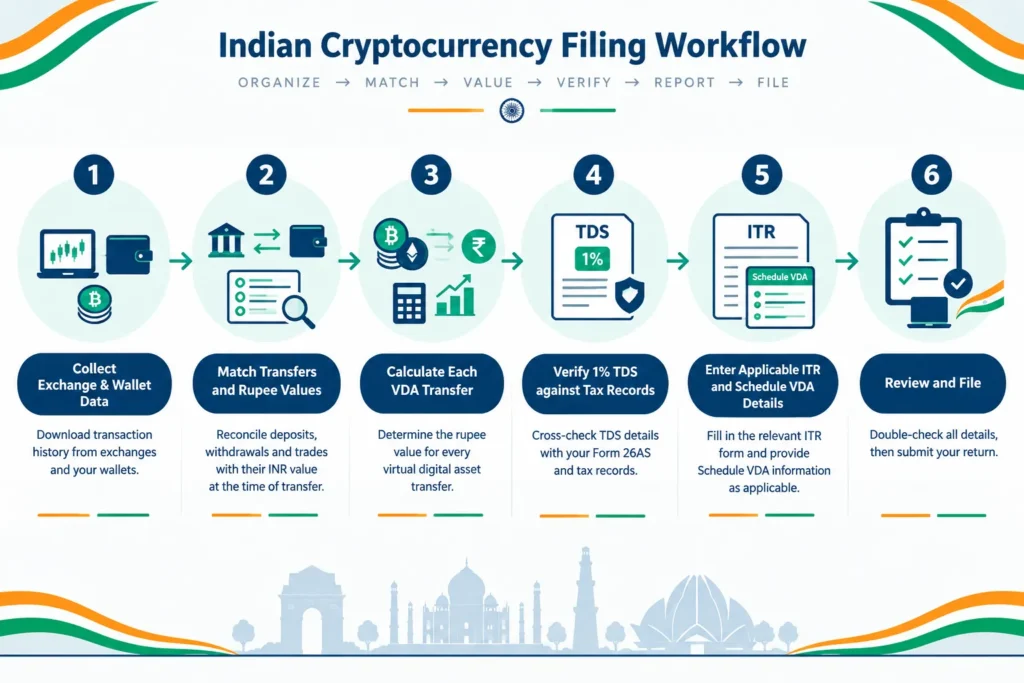
Download full trade histories from every exchange, preferably at regular intervals. Do not rely only on the dashboard balance because exchanges may limit old downloads, change formats or stop operating in India.

Next, list all wallet deposits and withdrawals. Match each withdrawal from one platform with the corresponding deposit into another exchange or self-owned wallet. Use transaction IDs, quantities and timestamps to confirm the connection. Differences caused by network fees should be explained.

Then match sales and purchases with bank entries wherever rupees were paid or received. Finally, compare exchange TDS reports with Form 26AS and the Annual Information Statement. Investigate missing entries, duplicate transactions and incorrect PAN details before filing the return.

Keep original CSV files, PDF statements, screenshots where necessary, wallet exports and transaction confirmations. If an exchange no longer displays an old trade, preserve emails, bank records and blockchain evidence that support your calculation. A detailed crypto transaction record-keeping guide can provide a step-by-step reconciliation format, but the key principle is simple: every asset movement should have a clear source, destination, purpose and rupee value.

Reporting Crypto in the ITR, Common Mistakes and Beginner FAQ

Six-step workflow for collecting crypto records, reconciling transfers, calculating VDA income, checking TDS and reporting details in the applicable ITR.

Paying cryptocurrency tax in India is not only about calculating tax. You must also report transactions correctly in your Income Tax Return, or ITR. Exchanges, wallets and tax records may show different pieces of information, so organise your data before starting the return.

Organise Your Crypto Transactions Before Filing

First, identify the correct financial year. A financial year runs from 1 April to 31 March. The assessment year is the following year, when income for that financial year is assessed and the ITR is filed.

For example, a crypto asset sold on 10 January 2025 belongs to financial year 2024-25 and assessment year 2025-26. Use the transaction date, not the date on which you later withdrew money to your bank account.

Collect records from every Indian exchange, foreign platform, private wallet and decentralised application used during the year. Do not rely only on bank statements because many taxable transfers do not involve a bank account.

Your transaction file should ideally contain:

  • The date and time of each transaction.
  • The type of transaction, such as purchase, sale, swap, gift, staking reward or airdrop.
  • The name and quantity of the crypto asset.
  • The value in Indian rupees at the time of the transaction.
  • The sale proceeds or other consideration received.
  • The acquisition cost supported by records.
  • Exchange transaction IDs, wallet addresses and blockchain references.
  • Fees, taxes and TDS details shown by the platform.

Reconcile purchases, sales and transfers carefully. Moving your own crypto from an exchange to your personal wallet is generally not a sale by itself. Label such wallet-to-wallet movements so that the same asset is not incorrectly recorded as income or as a new purchase.

For each taxable transfer, calculate the proceeds and the permitted acquisition cost. Do not simply subtract total annual purchases from total annual sales. The tax treatment of virtual digital assets can restrict deductions and the adjustment of losses, so transaction-wise working papers are important.

Separate different types of receipts. A normal sale, crypto-to-crypto exchange, gift, mining receipt, staking reward and airdrop may not all have the same timing or tax classification. If an asset was received without payment and later sold, preserve evidence showing how and when it was received.

Using Schedule VDA and the Correct ITR Form

Notified ITR forms may include Schedule VDA for reporting income from the transfer of virtual digital assets. This schedule generally asks for transaction-level information such as the date of acquisition, date of transfer, sale consideration and acquisition cost.

Schedule VDA does not automatically decide which ITR form you should use. The correct form can depend on your other income, residential status, business activity, capital gains and other circumstances. Crypto activity classified as business income may also affect the relevant schedules and form.

Always check the ITR form, instructions and filing utility notified by the Income Tax Department for the applicable assessment year. Forms and reporting fields can change. Do not copy the reporting method used for an earlier year without checking the current requirements.

Also review whether any related amount must be disclosed elsewhere in the return. For example, business income, foreign assets, exempt receipts or tax deducted at source may have separate reporting requirements depending on the facts.

Check Your TDS Credit

TDS under Section 194S is generally deducted at 1% of the consideration on a transfer of a virtual digital asset when the applicable conditions and thresholds are met. The threshold is generally Rs 50,000 in a financial year for a specified person and Rs 10,000 for other persons. The legal meaning of “specified person” is narrower than simply being an individual investor, so check whether you qualify.

Compare exchange statements with official tax records, including Form 26AS and the Annual Information Statement where relevant. Confirm that the deductor’s details, amount and financial year are correct. If credit is missing or incorrect, contact the exchange or other deductor for correction.

TDS is not the final cryptocurrency tax in India. It is only a tax credit collected during the transaction. You must still calculate and report the correct taxable income. Depending on the final liability, you may need to pay additional tax or may be eligible to claim a refund of excess credit.

You May Also Like:Personal Loan Eligibility: Factors Lenders Consider in India

Common Crypto Tax Filing Mistakes

  • Taxing unrealised price increases: A rise in the market value of crypto that you continue to hold is generally not a taxable transfer by itself. However, a sale, swap or other transfer may trigger tax.
  • Ignoring crypto-to-crypto trades: Exchanging Bitcoin for Ether can be a transfer even when no rupees enter your bank account.
  • Reporting only bank withdrawals: Tax is linked to taxable transactions, not merely the amount withdrawn from an exchange.
  • Treating TDS as the final tax: A 1% deduction does not replace the separate calculation of income taxable under Section 115BBH.
  • Adjusting restricted VDA losses: A loss from one VDA transfer cannot generally be set off against income from another VDA transfer or other income. Such a loss also cannot generally be carried forward under Section 115BBH.
  • Missing wallets or platforms: Include transactions from Indian exchanges, foreign platforms, self-custody wallets and decentralised services.
  • Using unsupported rupee values: Keep a consistent and reasonable valuation source for transactions that did not directly involve rupees.
  • Counting internal transfers as sales: Reconcile wallet addresses and transaction IDs before treating a movement as a disposal.
  • Failing to preserve evidence: Download statements regularly. An exchange account can become inaccessible, and wallet histories may be difficult to interpret years later.

Good records also help you identify suspicious transfers and unauthorised withdrawals. For broader safety practices, read RegularStation’s guide, Cryptocurrency Risks: Common Dangers and How to Invest Safely. A separate supporting guide on crypto scams can further explain how fraud-related records may affect complaints and tax documentation.

Frequently Asked Questions

What is the current tax rate on crypto gains in India?

Income from the transfer of a VDA is generally taxed at 30% under Section 115BBH, plus applicable surcharge and 4% health and education cess. Generally, only the permitted cost of acquisition can be deducted when calculating such income. Check the law applicable to the relevant year.

Is holding cryptocurrency taxable?

Simply holding crypto that increases in market value is generally not taxable until there is a transfer. Selling it, swapping it for another token or using it in another transfer can create a tax event. Income received through gifts, mining, staking or airdrops may require separate analysis.

How does Section 194S TDS work?

Section 194S generally requires 1% TDS on consideration paid for the transfer of a VDA when the applicable threshold and other conditions are met. The compliance process can differ for exchange transactions, peer-to-peer deals and consideration paid partly or fully in kind.

Can a VDA loss be adjusted against another gain?

Generally, no. A loss from the transfer of one VDA cannot be set off against income from another VDA or against other income under Section 115BBH. It also generally cannot be carried forward. This is why calculating each transfer separately matters.

Must crypto transactions be reported in the ITR?

Taxable VDA transfers and related income should be reported in the applicable ITR and schedules. Even where TDS has already been deducted, the underlying transaction and correct income may still need to be reported.

Why are detailed transaction records necessary?

Records support your acquisition cost, sale value, transaction date, asset ownership and TDS claim. They also help distinguish taxable trades from transfers between your own wallets. Without evidence, it may be difficult to defend the figures reported in your return.

Summary

To report cryptocurrency tax in India correctly, identify the relevant financial year and assessment year, reconcile every exchange and wallet, calculate each taxable transfer, separate different kinds of receipts and check TDS against official tax records. Use the ITR form and Schedule VDA instructions notified for the applicable assessment year rather than assuming one form suits every taxpayer.

Seek help from a qualified chartered accountant or tax professional if you have high transaction volumes, multiple wallets, foreign platforms, gifts, mining, staking, airdrops, business activity, missing records or uncertainty about classification. Separate RegularStation articles can address specific cryptocurrency tax questions as filing rules and practical issues develop.

This article is for general educational purposes and is not tax, legal or investment advice. Cryptocurrency rules, ITR forms and reporting requirements can change. Verify the current law and official Income Tax Department instructions, and obtain professional advice based on your circumstances before filing.

Share this article
KEEP READING

Related Articles

View all →

Comments

Leave a Comment

Cryptocurrency Tax in India: Tax Rules, TDS and ITR Filing Guide

Educational disclaimer: This article explains general Indian income-tax rules for beginners. It is not tax, legal or investment advice. Cryptocurrency tax in India depends on the transaction, the taxpayer’s circumstances and the law applicable to the relevant financial year. Check the latest Income Tax Department guidance and consult a qualified tax professional where necessary.

Quick Answer

In India, cryptocurrencies are generally covered by the income-tax rules for Virtual Digital Assets, or VDAs. Simply buying and holding crypto does not normally create taxable income merely because its market price increases.

Tax review is generally required when you sell, exchange, spend or otherwise transfer a VDA. Section 115BBH of the Income-tax Act applies from Assessment Year 2023-24, corresponding to Financial Year 2022-23. It provides a 30% tax rate on income from the transfer of a VDA. Applicable surcharge and 4% health and education cess can increase the final tax amount.

Only the cost of acquisition is expressly permitted as a deduction when calculating such income. Other expenses are generally not deductible under Section 115BBH. A loss from one VDA transfer cannot be set off against income from another VDA transfer or against other income, and it cannot be carried forward to a later year.

Introduction

Crypto tax can appear confusing because everyday actions such as swapping one token for another or paying for a product with crypto may be relevant for tax purposes. You do not necessarily need to convert the crypto into Indian rupees before a transaction requires examination.

It is also important to separate investment activity from tax treatment. The legal status, investment risks and basic working of crypto are broader subjects covered in Cryptocurrency in India: A Complete Beginner’s Guide to Crypto. Practical matters such as selecting a platform, completing KYC and placing an order are discussed in How to Invest in Cryptocurrency in India: A Beginner’s Guide.

This guide focuses on the income-tax side. The starting point is to understand what a VDA is and the difference between buying, holding and transferring one.

Understanding Cryptocurrency Tax and VDA Transfers in India

Financial Year and Assessment Year Matter

Indian tax rules are applied with reference to a particular period. The financial year is the year in which you earn income or complete a transaction. The assessment year is the following year, when that income is assessed and the relevant return is generally filed.

For example, a taxable crypto transfer completed between 1 April 2024 and 31 March 2025 falls in Financial Year 2024-25 and is generally reported for Assessment Year 2025-26.

The special VDA tax provision in Section 115BBH was introduced with effect from Assessment Year 2023-24. Therefore, it applies to relevant income arising from Financial Year 2022-23 onwards. The 30% rate and the deduction and loss restrictions explained below continue under the Income-tax Act for subsequent years, including Financial Year 2025-26, subject to any amendment applicable to the taxpayer’s year.

What Is a Virtual Digital Asset?

Section 2(47A) of the Income-tax Act contains the statutory definition of a Virtual Digital Asset. Broadly, it covers certain information, codes, numbers or tokens generated through cryptographic or other means that provide a digital representation of value and have specified features under the law.

The definition is intentionally wider than the everyday word “cryptocurrency”. Depending on the asset and applicable government notifications, it can include:

  • Cryptocurrencies and crypto tokens that satisfy the statutory conditions.
  • Non-fungible tokens, or NFTs, covered by the notified rules.
  • Other digital assets notified by the Central Government.

Indian currency and foreign currency are excluded from the VDA definition. The government may also notify other assets that are excluded. A digital record is not automatically a VDA merely because it exists online; its legal characteristics and applicable notifications must be checked.

Buying, Holding, Selling and Transferring Crypto

Flowchart showing that buying, holding and self-wallet transfers generally differ from sales, swaps and crypto spending that may require tax review.

The tax result depends on what you do with the asset. The following distinctions are important.

Activity General income-tax position
Buying crypto with rupees The purchase itself does not normally create income for the buyer. Keep records of the purchase price and related transaction details.
Holding crypto An increase in market value does not automatically create taxable income when there is no transfer. The unrealised increase is not taxed merely because the price shown by an exchange has risen.
Selling crypto for rupees The sale is a transfer and any resulting income must be examined under Section 115BBH.
Swapping one crypto asset for another A crypto-to-crypto exchange may amount to a transfer. The value and acquisition cost of the assets must be determined using supportable records.
Paying for goods or services with crypto Using crypto as payment can involve a transfer of the VDA. The transaction may therefore require a tax calculation even when no rupees are received.
Moving crypto between your own wallets A genuine transfer between wallets beneficially owned by the same person may not by itself represent a sale or exchange, but ownership, wallet and transaction records should be retained.

The term “transfer” must be read with the Income-tax Act and the facts of the transaction. It can cover more than a straightforward cash sale. A sale, exchange, relinquishment or other disposal may require review.

Transactions involving gifts, mining, staking, airdrops, business activity or compensation for services may raise additional questions about when income first arises and what cost is available on a later transfer. They should not be treated as ordinary purchases without checking the applicable law.

Tax Rate Under Section 115BBH
Illustrative calculation showing ₹40,000 of VDA income, 30% tax and 4% cess resulting in ₹12,480 tax before other applicable adjustments.

For Assessment Year 2023-24 onwards, Section 115BBH provides a tax rate of 30% on income from the transfer of a VDA. This is a statutory rate on the relevant VDA income, not a promise that the taxpayer’s complete liability will be exactly 30% of the profit.

Applicable surcharge may be added based on factors such as the taxpayer’s status and total income. Health and education cess is then charged at 4% on the income tax plus applicable surcharge for the relevant periods discussed here. Other income remains taxable under the rules that apply to that income.

Simple Illustrative Calculation

Assume an individual bought a crypto asset for ₹1,00,000 and later sold the same asset for ₹1,40,000. For simplicity, assume the full ₹1,00,000 qualifies as its cost of acquisition and no surcharge applies.

Sale proceeds ₹1,40,000
Less: cost of acquisition ₹1,00,000
Income from VDA transfer ₹40,000
Tax at 30% ₹12,000
Health and education cess at 4% ₹480
Illustrative tax on the VDA income ₹12,480

This is only an educational illustration. It does not account for surcharge, other income, tax credits, withholding, advance tax, valuation disputes or special facts. The final liability must be calculated for the relevant taxpayer and year.

Restricted Deductions and Treatment of Losses

Section 115BBH expressly permits a deduction for the cost of acquisition when computing income from a VDA transfer. It does not allow deductions for other expenditure or allowances against that income. Investors should therefore not assume that exchange fees, internet costs, advisory charges or similar expenses can be deducted in the same way as ordinary business expenses.

The provision also imposes strict loss restrictions. A loss from the transfer of a VDA cannot be set off against income computed under another provision. It also cannot be carried forward to a future assessment year.

Importantly, the restriction applies across VDA transfers as well. A loss on one crypto transaction should not be assumed to reduce the taxable income from a profitable transaction involving another VDA. For example, a ₹30,000 loss on one token does not automatically cancel a ₹50,000 taxable income from the transfer of another token under Section 115BBH.

These rules have applied from Assessment Year 2023-24 and should always be verified against the Income-tax Act, current Income Tax Department material and amendments relevant to the financial year being reported. Maintaining exchange statements, wallet records, dates, quantities, rupee values and proof of acquisition cost can make that review substantially easier.

TDS Under Section 194S, Special Transactions and Records to Keep

Tax deducted at source, or TDS, is an important part of cryptocurrency tax in India. However, TDS is not the same as your final tax bill.

Section 194S of the Income-tax Act requires TDS on the transfer of a virtual digital asset, or VDA, when the legal conditions are met. Crypto assets such as Bitcoin and Ether generally fall within the VDA definition.

The person responsible for paying the consideration normally has to deduct TDS. In exchange-based transactions, the exchange or broker may handle the deduction under arrangements covered by CBDT guidance. The exact responsibility depends on how the trade is executed and which parties are involved.

TDS Rate, Effective Date and Annual Thresholds

Section 194S applies to qualifying payments made on or after 1 July 2022. The TDS rate is 1% of the consideration paid for transferring the VDA.

No TDS is required under this section if the total consideration during the financial year does not exceed the applicable threshold:

  • ₹50,000 for a specified person.
  • ₹10,000 for any other person.

These are annual thresholds, not limits for each individual transaction. You must therefore consider the aggregate value of relevant transactions during the financial year.

A “specified person” generally includes an individual or Hindu Undivided Family whose business turnover did not exceed ₹1 crore, or whose professional receipts did not exceed ₹50 lakh, in the financial year immediately before the year of the transaction. It also includes an individual or HUF who did not have income under the head “Profits and gains of business or profession” in that preceding year.

For example, a salaried individual who does not run a business or profession will generally fall within the specified-person category. A taxpayer with larger business or professional receipts may fall under the ₹10,000 threshold instead. Classification should be checked using the facts of the relevant year.

TDS Is Not the Final Crypto Tax

TDS is mainly a collection and reporting mechanism. It creates a tax credit that should appear in the seller’s tax records, subject to correct deduction and reporting. The final income-tax liability must still be calculated while filing the income tax return.

This distinction matters because 1% TDS may apply to the transaction value even when the investor earns only a small profit or makes no taxable profit. It is not calculated only on the gain.

Suppose you sell crypto worth ₹1,00,000 through an Indian exchange. The exchange may deduct ₹1,000 as TDS, subject to the applicable rules. This does not mean your final tax is ₹1,000. Your final liability depends on the taxable income calculated under the VDA provisions, while eligible TDS can be claimed as credit.

You should check Form 26AS and the Annual Information Statement before filing your return. If an exchange shows TDS in its own transaction statement but the amount does not appear correctly in your tax records, contact the exchange and seek a correction.

Who Deducts TDS in Different Types of Transactions?

The person paying for the VDA is generally responsible for deducting TDS. In practice, CBDT guidance provides operational rules for transactions conducted through exchanges and brokers.

  • Trade through an Indian exchange: The exchange or broker may deduct and report TDS under the applicable arrangement. Review the exchange’s contract note, ledger or tax statement.
  • Direct peer-to-peer sale: The buyer may have to deduct TDS from the payment and complete the required compliance.
  • Transaction involving a specified person: A specified person who must deduct tax may use the prescribed simplified payment and reporting process, where applicable.
  • Payment in kind: If the consideration is wholly or partly in kind, the law requires arrangements to ensure that the tax has been paid before the asset is released.

Do not assume that using an exchange automatically settles every tax obligation. The platform may facilitate TDS, but the taxpayer remains responsible for checking transaction data, TDS credit and income reporting. Our guide, Crypto Exchanges in India: How They Work and How to Choose One, explains the role exchanges play in trade execution, custody and reporting.

Crypto-to-Crypto Swaps and Spending Crypto

A crypto-to-crypto swap can be a transfer of one VDA even though no rupees enter your bank account. For example, exchanging Bitcoin for Ether may require separate analysis for the Bitcoin transferred and the Ether received.

CBDT guidance treats barter-style VDA transactions carefully because each party may be both a buyer and a seller. An exchange may handle TDS under a written operational arrangement, but direct swaps can create compliance responsibilities for the participants. Valuation in rupees at the time of the transaction is essential.

Spending crypto can also involve a transfer. If you use crypto to purchase a laptop, pay for a service or settle a debt, you have given up the crypto in exchange for something of value. The transaction may therefore need to be valued and reported even though it does not look like a normal sale.

Off-Exchange Transfers and Your Own Wallets

A transfer to another person’s wallet may represent a sale, gift, payment or other disposal. The wallet movement alone does not explain the legal nature of the transaction. You need supporting records showing why the transfer occurred and what, if anything, you received in return.

By contrast, moving crypto between wallets that you own is generally not the same as transferring ownership to another person. For example, withdrawing Bitcoin from your exchange account to your own hardware wallet is usually a custody movement rather than a sale.

Still, keep proof that both addresses or accounts belonged to you. Without this evidence, an old wallet transfer may later be mistaken for a sale or gift. Network fees paid during a self-transfer should also be recorded separately rather than treating the full outgoing quantity as consideration received.

Mining, Staking, Airdrops, Gifts and Rewards

Mining rewards, staking income, airdrops, referral rewards and gifted crypto do not all receive identical tax treatment. The initial receipt and the later transfer may be two separate tax events.

The treatment at receipt can depend on the nature of the activity, the relationship between the parties, whether the receipt is a gift, and the relevant charging and valuation provisions. Gifts may also be affected by exemptions for specified relatives or particular occasions.

When the asset is later sold, swapped or spent, the VDA transfer rules may apply separately. Questions about cost, valuation and available deductions can be especially difficult where the asset was received without a normal purchase price.

Keep evidence showing the date, quantity, rupee value and reason for each receipt. For a gift, retain a gift deed or written confirmation and details of the relationship with the donor. For mining or staking, retain platform statements, wallet records and documents showing how the reward was generated.

Records Every Crypto Investor Should Keep

Good records are essential because one transaction can appear in several places: an exchange order history, a wallet, a bank account and a blockchain explorer. Maintain a transaction register with at least the following details:

  • Date and time of each purchase, sale, swap, receipt and transfer.
  • Name and quantity of the crypto asset.
  • Rupee value at the relevant time and the source used for valuation.
  • Purchase price, sale consideration and available supporting evidence.
  • Exchange fees, network fees and other charges, recorded separately.
  • Exchange name, wallet addresses and blockchain transaction ID.
  • Bank deposits, withdrawals and payment references.
  • TDS deducted, TDS certificate or statement, and the related transaction.
  • Documents for gifts, airdrops, mining, staking and other rewards.
  • Notes identifying transfers between your own exchanges or wallets.

How to Reconcile Exchanges, Wallets and TDS

Download full trade histories from every exchange, preferably at regular intervals. Do not rely only on the dashboard balance because exchanges may limit old downloads, change formats or stop operating in India.

Next, list all wallet deposits and withdrawals. Match each withdrawal from one platform with the corresponding deposit into another exchange or self-owned wallet. Use transaction IDs, quantities and timestamps to confirm the connection. Differences caused by network fees should be explained.

Then match sales and purchases with bank entries wherever rupees were paid or received. Finally, compare exchange TDS reports with Form 26AS and the Annual Information Statement. Investigate missing entries, duplicate transactions and incorrect PAN details before filing the return.

Keep original CSV files, PDF statements, screenshots where necessary, wallet exports and transaction confirmations. If an exchange no longer displays an old trade, preserve emails, bank records and blockchain evidence that support your calculation. A detailed crypto transaction record-keeping guide can provide a step-by-step reconciliation format, but the key principle is simple: every asset movement should have a clear source, destination, purpose and rupee value.

Reporting Crypto in the ITR, Common Mistakes and Beginner FAQ
Six-step workflow for collecting crypto records, reconciling transfers, calculating VDA income, checking TDS and reporting details in the applicable ITR.

Paying cryptocurrency tax in India is not only about calculating tax. You must also report transactions correctly in your Income Tax Return, or ITR. Exchanges, wallets and tax records may show different pieces of information, so organise your data before starting the return.

Organise Your Crypto Transactions Before Filing

First, identify the correct financial year. A financial year runs from 1 April to 31 March. The assessment year is the following year, when income for that financial year is assessed and the ITR is filed.

For example, a crypto asset sold on 10 January 2025 belongs to financial year 2024-25 and assessment year 2025-26. Use the transaction date, not the date on which you later withdrew money to your bank account.

Collect records from every Indian exchange, foreign platform, private wallet and decentralised application used during the year. Do not rely only on bank statements because many taxable transfers do not involve a bank account.

Your transaction file should ideally contain:

  • The date and time of each transaction.
  • The type of transaction, such as purchase, sale, swap, gift, staking reward or airdrop.
  • The name and quantity of the crypto asset.
  • The value in Indian rupees at the time of the transaction.
  • The sale proceeds or other consideration received.
  • The acquisition cost supported by records.
  • Exchange transaction IDs, wallet addresses and blockchain references.
  • Fees, taxes and TDS details shown by the platform.

Reconcile purchases, sales and transfers carefully. Moving your own crypto from an exchange to your personal wallet is generally not a sale by itself. Label such wallet-to-wallet movements so that the same asset is not incorrectly recorded as income or as a new purchase.

For each taxable transfer, calculate the proceeds and the permitted acquisition cost. Do not simply subtract total annual purchases from total annual sales. The tax treatment of virtual digital assets can restrict deductions and the adjustment of losses, so transaction-wise working papers are important.

Separate different types of receipts. A normal sale, crypto-to-crypto exchange, gift, mining receipt, staking reward and airdrop may not all have the same timing or tax classification. If an asset was received without payment and later sold, preserve evidence showing how and when it was received.

Using Schedule VDA and the Correct ITR Form

Notified ITR forms may include Schedule VDA for reporting income from the transfer of virtual digital assets. This schedule generally asks for transaction-level information such as the date of acquisition, date of transfer, sale consideration and acquisition cost.

Schedule VDA does not automatically decide which ITR form you should use. The correct form can depend on your other income, residential status, business activity, capital gains and other circumstances. Crypto activity classified as business income may also affect the relevant schedules and form.

Always check the ITR form, instructions and filing utility notified by the Income Tax Department for the applicable assessment year. Forms and reporting fields can change. Do not copy the reporting method used for an earlier year without checking the current requirements.

Also review whether any related amount must be disclosed elsewhere in the return. For example, business income, foreign assets, exempt receipts or tax deducted at source may have separate reporting requirements depending on the facts.

Check Your TDS Credit

TDS under Section 194S is generally deducted at 1% of the consideration on a transfer of a virtual digital asset when the applicable conditions and thresholds are met. The threshold is generally Rs 50,000 in a financial year for a specified person and Rs 10,000 for other persons. The legal meaning of “specified person” is narrower than simply being an individual investor, so check whether you qualify.

Compare exchange statements with official tax records, including Form 26AS and the Annual Information Statement where relevant. Confirm that the deductor’s details, amount and financial year are correct. If credit is missing or incorrect, contact the exchange or other deductor for correction.

TDS is not the final cryptocurrency tax in India. It is only a tax credit collected during the transaction. You must still calculate and report the correct taxable income. Depending on the final liability, you may need to pay additional tax or may be eligible to claim a refund of excess credit.

Common Crypto Tax Filing Mistakes

  • Taxing unrealised price increases: A rise in the market value of crypto that you continue to hold is generally not a taxable transfer by itself. However, a sale, swap or other transfer may trigger tax.
  • Ignoring crypto-to-crypto trades: Exchanging Bitcoin for Ether can be a transfer even when no rupees enter your bank account.
  • Reporting only bank withdrawals: Tax is linked to taxable transactions, not merely the amount withdrawn from an exchange.
  • Treating TDS as the final tax: A 1% deduction does not replace the separate calculation of income taxable under Section 115BBH.
  • Adjusting restricted VDA losses: A loss from one VDA transfer cannot generally be set off against income from another VDA transfer or other income. Such a loss also cannot generally be carried forward under Section 115BBH.
  • Missing wallets or platforms: Include transactions from Indian exchanges, foreign platforms, self-custody wallets and decentralised services.
  • Using unsupported rupee values: Keep a consistent and reasonable valuation source for transactions that did not directly involve rupees.
  • Counting internal transfers as sales: Reconcile wallet addresses and transaction IDs before treating a movement as a disposal.
  • Failing to preserve evidence: Download statements regularly. An exchange account can become inaccessible, and wallet histories may be difficult to interpret years later.

Good records also help you identify suspicious transfers and unauthorised withdrawals. For broader safety practices, read RegularStation’s guide, Cryptocurrency Risks: Common Dangers and How to Invest Safely. A separate supporting guide on crypto scams can further explain how fraud-related records may affect complaints and tax documentation.

Frequently Asked Questions

What is the current tax rate on crypto gains in India?

Income from the transfer of a VDA is generally taxed at 30% under Section 115BBH, plus applicable surcharge and 4% health and education cess. Generally, only the permitted cost of acquisition can be deducted when calculating such income. Check the law applicable to the relevant year.

Is holding cryptocurrency taxable?

Simply holding crypto that increases in market value is generally not taxable until there is a transfer. Selling it, swapping it for another token or using it in another transfer can create a tax event. Income received through gifts, mining, staking or airdrops may require separate analysis.

How does Section 194S TDS work?

Section 194S generally requires 1% TDS on consideration paid for the transfer of a VDA when the applicable threshold and other conditions are met. The compliance process can differ for exchange transactions, peer-to-peer deals and consideration paid partly or fully in kind.

Can a VDA loss be adjusted against another gain?

Generally, no. A loss from the transfer of one VDA cannot be set off against income from another VDA or against other income under Section 115BBH. It also generally cannot be carried forward. This is why calculating each transfer separately matters.

Must crypto transactions be reported in the ITR?

Taxable VDA transfers and related income should be reported in the applicable ITR and schedules. Even where TDS has already been deducted, the underlying transaction and correct income may still need to be reported.

Why are detailed transaction records necessary?

Records support your acquisition cost, sale value, transaction date, asset ownership and TDS claim. They also help distinguish taxable trades from transfers between your own wallets. Without evidence, it may be difficult to defend the figures reported in your return.

Summary

To report cryptocurrency tax in India correctly, identify the relevant financial year and assessment year, reconcile every exchange and wallet, calculate each taxable transfer, separate different kinds of receipts and check TDS against official tax records. Use the ITR form and Schedule VDA instructions notified for the applicable assessment year rather than assuming one form suits every taxpayer.

Seek help from a qualified chartered accountant or tax professional if you have high transaction volumes, multiple wallets, foreign platforms, gifts, mining, staking, airdrops, business activity, missing records or uncertainty about classification. Separate RegularStation articles can address specific cryptocurrency tax questions as filing rules and practical issues develop.

This article is for general educational purposes and is not tax, legal or investment advice. Cryptocurrency rules, ITR forms and reporting requirements can change. Verify the current law and official Income Tax Department instructions, and obtain professional advice based on your circumstances before filing.


Leave a Comment