

How to Calculate Loan Interest and Total Repayment

Understand how lenders calculate loan interest, EMI, total interest and total repayment using clear formulas and practical Indian examples.

How to Calculate Loan Interest and Total Repayment

Loan interest is the amount a lender charges you for using borrowed money. For a simple-interest loan, you can calculate it as Principal × Annual Interest Rate × Loan Tenure. However, most home loans, car loans and personal loans in India use monthly EMIs and a reducing balance. Their interest must be calculated through an amortisation method because the outstanding principal changes after every EMI.

Understanding loan interest calculation helps you compare loan offers, estimate your monthly burden and avoid focusing only on the advertised interest rate. You should look at the EMI, total interest, total repayment and additional charges before accepting a loan.

What Is Loan Interest?

Loan interest is the cost of borrowing money from a bank, non-banking financial company or another lender. When you take a loan, you agree to repay the amount borrowed along with interest over a fixed period.

For example, suppose you borrow Rs. 1,00,000. If the lender charges Rs. 10,000 as interest over the agreed tenure, you will repay Rs. 1,10,000, excluding fees and other charges.

These basic terms are important for any loan interest calculation:

  • Principal amount: The original amount borrowed. If a bank approves and disburses a loan of Rs. 5 lakh, the principal is Rs. 5 lakh.
  • Annual interest rate: The percentage charged on the loan per year. It is usually written as “per annum” or “p.a.” A rate of 10% p.a. means the annual rate is 10%, though the exact interest charged depends on the calculation method.
  • Loan tenure: The time allowed for repayment. It may be stated in months or years. A three-year loan has a tenure of 36 months.
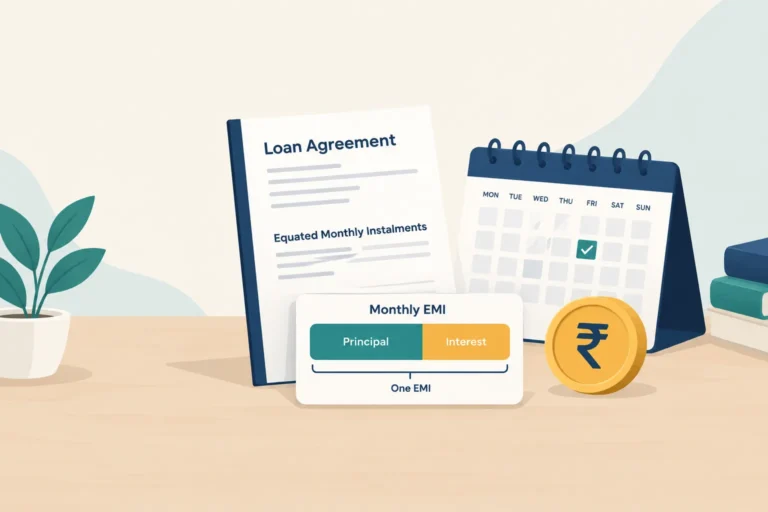
  • EMI: EMI means equated monthly instalment. It is the amount generally payable every month and normally includes both principal and interest.
  • Total interest: The combined interest paid over the full loan tenure, assuming payments are made as scheduled.
  • Total repayment: The total amount repaid towards principal and interest. In basic calculations, it equals the principal plus total interest.

These terms are connected, but they do not mean the same thing. A low EMI, for instance, does not automatically mean a low-cost loan. Extending the tenure can reduce the monthly EMI while increasing the total interest paid.

What Determines the Total Cost of a Loan?

The interest rate is a major factor, but it is not the only factor that determines what a loan costs. The principal, tenure, repayment structure and extra charges can all affect the final amount.

Principal amount

A larger loan generally results in a higher rupee amount of interest when the rate and tenure remain unchanged. Borrowing only what you need can reduce both the EMI and the total repayment.

Interest rate

A higher rate increases the borrowing cost. When comparing rates, check whether the rate is fixed or floating. A fixed rate generally remains unchanged for the specified period, subject to the loan terms. A floating rate can change when the lender revises its benchmark or applicable spread.

Loan tenure

A longer tenure usually lowers the EMI because repayment is spread over more months. However, interest may be charged for longer, which can increase the total interest. A shorter tenure may save interest but requires a higher monthly EMI.

Interest calculation method

A lender may calculate interest using simple interest, a reducing balance, or another method stated in the loan agreement. Two loans carrying the same stated annual rate can have different total costs if their repayment and interest-calculation methods differ.

Repayment behaviour

Late or missed payments may lead to penal charges and other consequences under the loan terms. On the other hand, making a part-prepayment can reduce the outstanding principal and may lower future interest. A lender may impose conditions or charges on foreclosure or prepayment, so check the agreement first.

Fees and other charges

The basic total repayment figure of principal plus interest may not represent the complete borrowing cost. Depending on the loan and lender, you may also pay processing fees, documentation charges, insurance premiums, valuation or legal charges, applicable taxes, late-payment charges and foreclosure or prepayment charges.

These amounts are not included in the examples below unless specifically stated. Always review the sanction letter, key fact statement and loan agreement to understand the actual cost.

How to Calculate Loan Interest

The correct loan interest calculation depends on how the lender charges interest. A simple-interest formula can be used when interest is calculated only on the original principal for the full period.

The formula is:

Simple Interest = Principal × Annual Interest Rate × Time

The interest rate must be converted from a percentage to a decimal. The time must normally be expressed in years when an annual rate is used.

You May Also Like:Fixed vs Floating Interest Rate: What Borrowers Should Know

Simple-interest example

Assume you borrow Rs. 1,00,000 for two years at 10% simple interest per annum.

  • Principal: Rs. 1,00,000
  • Annual interest rate: 10%, or 0.10
  • Time: 2 years

Simple Interest = Rs. 1,00,000 × 0.10 × 2 = Rs. 20,000

The total repayment is:

Total Repayment = Principal + Total Interest

Total Repayment = Rs. 1,00,000 + Rs. 20,000 = Rs. 1,20,000

This example assumes that the loan uses simple interest, the rate does not change, no early or late payments occur, and there are no fees, insurance premiums, taxes, penalties or other charges.

If the tenure is given in months, convert it into years. For example, six months is 6 ÷ 12, or 0.5 years. On Rs. 1,00,000 at 10% simple interest for six months, the interest would be Rs. 1,00,000 × 0.10 × 0.5, which equals Rs. 5,000.

This formula is useful for understanding the basic relationship between principal, rate and time. It should not be used blindly for a regular EMI loan because EMI loans generally do not charge interest on the full original principal throughout the entire tenure.

Simple Interest vs Compound Interest in Borrowing
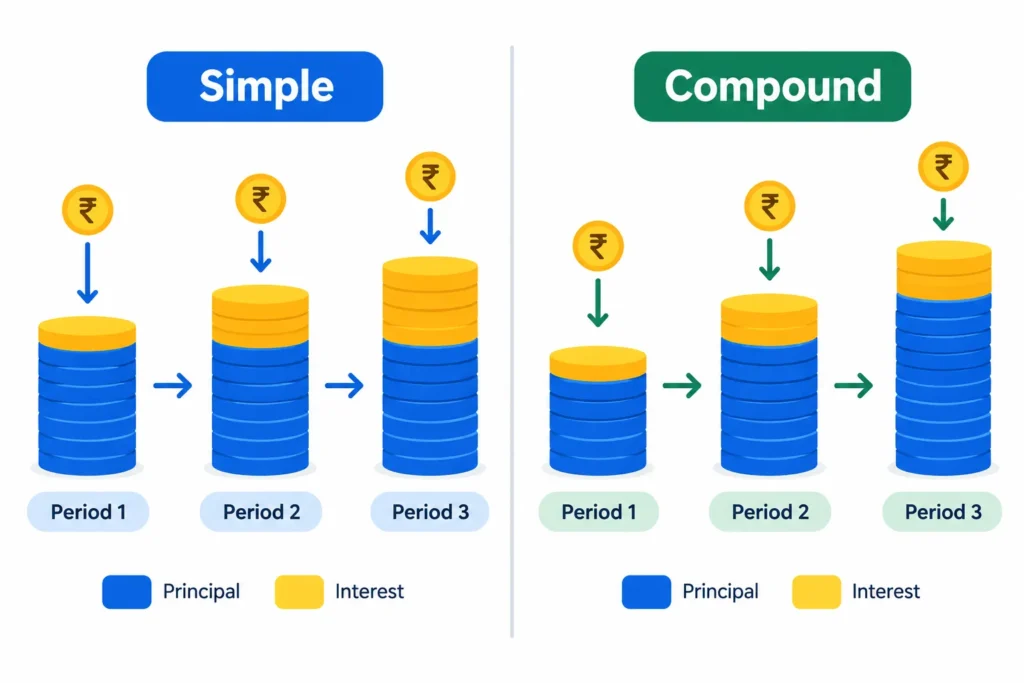
Visual comparison showing simple interest added to the original principal and compound interest calculated on a growing balance.

Under simple interest, interest is calculated only on the original principal. The interest amount does not itself become part of the base for calculating future interest.

Compound interest works differently. Interest is added at set intervals, and future interest may then be calculated on the principal plus accumulated interest. The interval may be monthly, quarterly, half-yearly or yearly, depending on the product and agreement. More frequent compounding can produce a higher amount when the principal, stated rate and period are otherwise the same.

However, a standard EMI loan needs a more careful explanation. Home loans, car loans and many personal loans in India commonly follow a reducing-balance structure. Each EMI includes an interest component and a principal component. Interest for a period is calculated on the outstanding loan balance, not usually on the full original principal for every year.

At the start of an EMI loan, the outstanding balance is high, so a larger part of the EMI may go towards interest. As principal is repaid, the outstanding balance falls. The interest component generally decreases, while the principal component increases, assuming the rate and EMI remain unchanged.

This month-by-month division is shown in an amortisation schedule. It normally lists the opening balance, EMI, interest charged, principal repaid and closing balance for each month.

Therefore, multiplying the full principal by the annual rate and the complete tenure can give a misleading result for a reducing-balance EMI loan. An EMI formula, lender calculator or amortisation schedule is required to account for the changing outstanding principal and monthly interest rate.

The exact result may also change if the loan has a floating rate, an initial moratorium, irregular disbursements, part-prepayments, overdue amounts or revised EMIs. Rounding practices can create small differences as well. Treat a manual calculation as an estimate and confirm the repayment schedule and all charges with the lender before borrowing.

Reducing Balance vs Flat Interest Rate
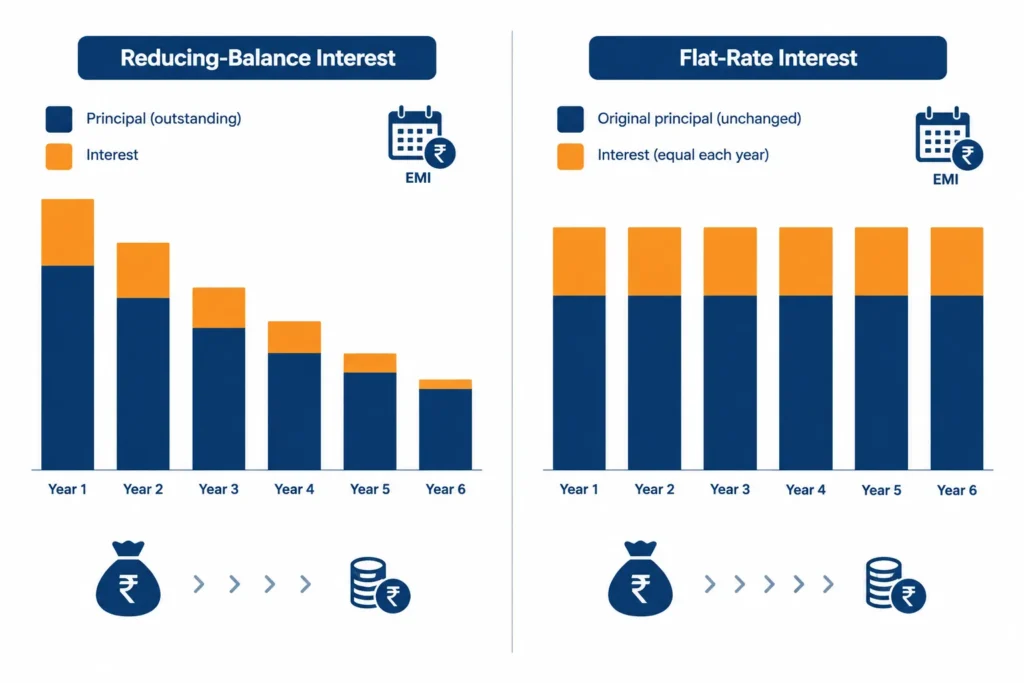
Comparison of reducing-balance interest on a falling principal and flat interest on the original principal throughout the tenure.

A lender can calculate interest using different methods. The two common methods are the reducing balance method and the flat interest rate method. Understanding the difference is essential because identical quoted rates may not produce identical repayment amounts.

Reducing balance method

Under the reducing balance method, interest is calculated on the outstanding loan principal. Each EMI generally contains a principal portion and an interest portion. As you repay the principal, the outstanding balance falls. Interest for the next period is then charged on this lower balance.

In the early months, a larger part of the EMI usually goes towards interest. As the outstanding principal decreases, the interest portion becomes smaller and more of the EMI goes towards principal repayment.

For example, suppose you borrow ₹5,00,000 at an annual reducing interest rate of 10%. The first month’s interest is calculated on ₹5,00,000. After the first EMI reduces the principal, the next month’s interest is calculated on the new outstanding amount, not on the original ₹5,00,000.

Flat interest rate method

Under the flat-rate method, interest is calculated on the original loan amount for the entire tenure. The calculation does not reduce the interest base as you repay the principal.

The basic flat-interest formula is:

Flat interest = Principal × Annual interest rate × Tenure in years

If ₹5,00,000 is borrowed at a flat rate of 10% per year for five years, the interest is calculated on the full ₹5,00,000 for all five years.

Flat interest = ₹5,00,000 × 10% × 5 = ₹2,50,000

The total repayment would be ₹7,50,000. Dividing this amount by 60 months gives a monthly payment of ₹12,500.

A 10% flat rate is therefore not the same as a 10% reducing rate. The flat-rate loan generally produces a higher interest cost in this example because interest continues to be based on the original principal.

Feature Reducing balance rate Flat interest rate
Interest is calculated on Outstanding principal Original principal
Interest base during the tenure Falls as principal is repaid Remains unchanged
Quoted rate comparison Must be compared with the same calculation method Cannot be directly compared with an identical reducing rate
Illustrative payment on the assumed loan Approximately ₹10,624 per month ₹12,500 per month

Before comparing offers, check whether the lender is quoting a flat rate or a reducing balance rate. Also confirm whether the reducing balance is calculated monthly, daily or using another frequency. Looking only at the headline rate can lead to the wrong conclusion.

How to Calculate Total Interest on an EMI Loan

For a standard reducing balance loan with fixed monthly instalments, the EMI can be estimated using the following formula:

EMI = P × r × (1 + r)n ÷ [(1 + r)n − 1]

The variables mean:

  • P is the principal, or the original amount borrowed.
  • r is the monthly interest rate written as a decimal.
  • n is the total number of monthly instalments.
  • EMI is the fixed monthly instalment based on these assumptions.
You May Also Like:What Is an EMI? A Complete Guide to Equated Monthly Instalments

To convert an annual interest rate into a monthly rate, divide it by 12. You must also convert the percentage into decimal form before using it in the formula.

For a 10% annual rate:

Monthly rate = 10% ÷ 12 = 0.8333% per month, or approximately 0.008333 in decimal form

A five-year loan with monthly instalments has:

Number of instalments = 5 × 12 = 60

After finding the EMI, total interest can be calculated in two steps:

  1. Multiply the EMI by the total number of instalments to estimate total repayment.
  2. Subtract the original principal from total repayment.

The formula is:

Total interest = Total of all EMIs − Principal

This method assumes that all scheduled EMIs are paid on time and that the rate and tenure do not change. It also excludes processing fees, insurance, taxes, late-payment charges and other costs.

Loan Interest Calculation Example

Consider an assumed loan of ₹5,00,000 with a 10% annual reducing interest rate, a five-year tenure and monthly instalments.

  • Principal: ₹5,00,000
  • Annual interest rate: 10%
  • Monthly interest rate: 10% ÷ 12
  • Tenure: Five years
  • Number of instalments: 60

Using the reducing balance EMI formula, the monthly EMI is approximately ₹10,624. The unrounded EMI used for the complete calculation is slightly lower than the displayed rounded amount.

The approximate total repayment is:

₹6,37,411

The approximate total interest is:

₹6,37,411 − ₹5,00,000 = ₹1,37,411

The figures are approximate because the monthly rate and EMI may be rounded for display. A lender’s system may use more decimal places and may also follow its own instalment-date and interest-accrual rules.

Now compare this with a purely illustrative 10% flat-rate calculation on the same principal and tenure:

Flat interest = ₹5,00,000 × 10% × 5 = ₹2,50,000

Total repayment = ₹5,00,000 + ₹2,50,000 = ₹7,50,000

Monthly payment = ₹7,50,000 ÷ 60 = ₹12,500

Calculation 10% reducing rate 10% flat rate
Loan amount ₹5,00,000 ₹5,00,000
Tenure 60 months 60 months
Approximate monthly payment ₹10,624 ₹12,500
Approximate total interest ₹1,37,411 ₹2,50,000
Approximate total repayment ₹6,37,411 ₹7,50,000

This comparison shows why the calculation method matters. Both examples mention a rate of 10%, but their interest amounts and monthly payments are very different. A borrower should not treat the two quoted rates as directly comparable.

How to Calculate Total Loan Repayment

For a regular fixed-EMI loan, total repayment can be estimated by multiplying the EMI by the number of instalments:

Total repayment = EMI × Number of instalments

Using the precise EMI before display rounding, the assumed reducing balance loan has an approximate total repayment of ₹6,37,411 over 60 months. Subtracting the ₹5,00,000 principal gives approximate interest of ₹1,37,411.

Do not simply multiply the displayed EMI of ₹10,624 by 60 and expect it to match the total exactly. The displayed EMI has been rounded to the nearest rupee, while the total may be calculated using an EMI that includes paise. Small differences can therefore appear.

For a flat-rate loan, total repayment can be calculated by adding the flat interest to the principal:

Total repayment = Principal + Flat interest

In the illustrative flat-rate example, this is ₹5,00,000 plus ₹2,50,000, resulting in total repayment of ₹7,50,000.

These totals cover principal and interest only. They exclude processing fees, documentation charges, insurance premiums, taxes, penalties and other lender charges. Such costs may be collected upfront or added to the loan. Therefore, check the repayment schedule and charge details supplied by the lender before accepting an offer.

How Loan Tenure Affects Total Interest
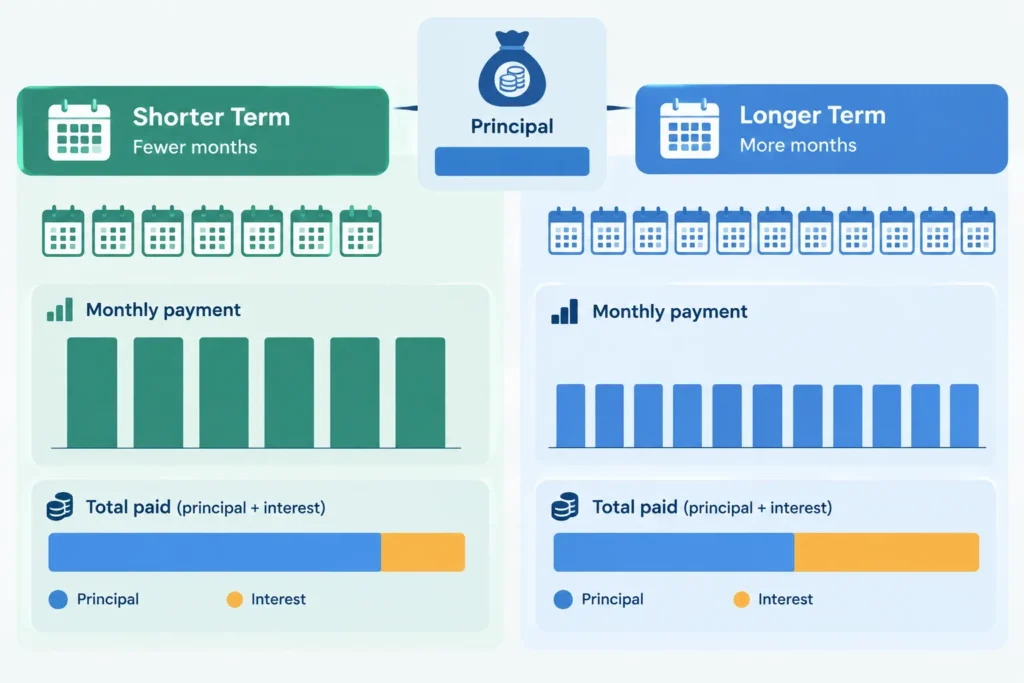
Comparison showing that a shorter loan tenure generally has higher monthly payments but lower total interest than a longer tenure.

Loan tenure is the period over which you repay a loan. It directly affects both your monthly EMI and the total interest paid.

When the loan amount and interest rate remain the same, a longer tenure usually gives you a lower EMI. However, the lender charges interest for more months. This generally increases the total interest and total repayment.

A shorter tenure usually has the opposite effect. Your EMI is higher, but the loan is cleared sooner and the total interest is normally lower.

Example of short and long tenures

Suppose you borrow Rs. 5 lakh at an annual reducing interest rate of 10%.

Tenure Approximate EMI Approximate Total Interest Approximate Total Repayment
3 years Rs. 16,134 Rs. 80,800 Rs. 5,80,800
5 years Rs. 10,624 Rs. 1,37,400 Rs. 6,37,400

The five-year loan has a more affordable EMI, but its total interest is substantially higher. This happens because interest is charged on the outstanding principal over a longer period.

These figures are approximate. Actual lender calculations may differ because of EMI rounding, the repayment date, the interest calculation method and other loan terms.

How to choose a suitable tenure

Do not automatically select the shortest or longest available tenure. Choose an EMI that you can pay comfortably without affecting essential expenses, insurance premiums, emergency savings and other financial commitments.

A very high EMI can create cash-flow pressure. A very long tenure can make the loan more expensive. Compare at least these three figures for each tenure:

  • The monthly EMI
  • The total interest payable
  • The total repayment amount
You May Also Like:Personal Loan vs Home Loan: Key Differences Explained

If you are considering a floating-rate loan, remember that the tenure or EMI may change when the interest rate changes. The loan agreement should explain how the lender handles such revisions.

How Prepayments Can Reduce Loan Interest

A prepayment is an extra payment made towards the loan before it becomes due under the regular EMI schedule. It may be a part-prepayment, where you repay a portion of the outstanding principal, or a full prepayment, where you close the loan completely.

On a reducing-balance loan, interest is calculated on the outstanding principal. If an early prepayment reduces that principal, future interest is calculated on a smaller balance. This can reduce the total interest paid over the life of the loan.

Why early prepayments may save more

During the early part of many EMI loans, a relatively larger portion of each EMI goes towards interest. The principal reduces gradually. A principal prepayment made early in the tenure can therefore affect more future instalments than the same prepayment made close to the end of the loan.

For example, suppose you have a five-year personal loan and receive a bonus after the first year. If you use part of the bonus to reduce the outstanding principal, the lender can recalculate the remaining loan based on the lower balance.

Depending on the lender’s rules, you may be offered one of two outcomes:

  • Keep the EMI unchanged and reduce the tenure: This often produces greater interest savings because the loan ends earlier.
  • Keep the tenure unchanged and reduce the EMI: This improves monthly cash flow, although the interest saving may be lower than under a tenure reduction.

Do not assume that every extra payment is automatically adjusted against principal. Confirm how the lender will allocate it. An amount treated as an advance EMI may not provide the same benefit as a principal prepayment.

Checks to make before prepaying

  • Ask for the current principal outstanding, not merely the sum of the remaining EMIs.
  • Check whether a minimum prepayment amount applies.
  • Check the permitted frequency and timing of part-prepayments.
  • Review any prepayment, foreclosure or administrative charges.
  • Confirm whether the EMI or the tenure will change.
  • Request an updated repayment schedule after the payment is processed.

Charges and restrictions can depend on the loan type, lender, borrower category and whether the rate is fixed or floating. Read the applicable terms before deciding whether prepayment is worthwhile.

Common Mistakes When Comparing Loan Costs

Comparing only the EMI

A low EMI does not necessarily mean a low-cost loan. The EMI may be lower simply because the tenure is longer. Compare the total interest and total repayment as well.

Treating flat and reducing rates as equivalent

Under a flat-rate method, interest is generally calculated on the original principal for the full tenure. Under a reducing-balance method, interest is calculated on the outstanding principal as it falls.

A flat rate and a reducing rate with the same stated percentage do not normally produce the same cost. Always identify the calculation method before comparing offers.

Ignoring processing fees and other charges

Interest is not the only borrowing cost. A loan may also include a processing fee, documentation charges, valuation costs, insurance costs, taxes on applicable fees, late-payment charges or other expenses.

Some charges may be deducted from the disbursed amount. For example, a sanctioned loan of Rs. 2 lakh may result in a lower amount reaching your bank account after deductions, even though repayment is based on the sanctioned principal as specified by the lender.

You May Also Like:Home Loan EMI: How It Is Calculated and What Affects It

Mixing annual and monthly rates

EMI calculations usually require a monthly interest rate. If the quoted annual nominal rate is 12%, the monthly rate is commonly taken as 1%, or 12% divided by 12, where the lender uses that convention.

Do not enter 12 as the monthly rate in a calculator. Also, do not assume that every annual percentage shown in a loan document has the same meaning. Check whether it is a nominal rate, an effective rate or another disclosed measure.

Overlooking rounding and payment dates

Calculators often round the EMI, interest or outstanding balance. Even small monthly differences can create an adjustment in the final instalment.

The date of disbursement and the date of the first EMI may also matter. A lender may charge broken-period interest or pre-EMI interest for the period before the regular EMI cycle starts.

Assuming every lender follows the same method

Lenders may differ in how they calculate daily or monthly interest, reset floating rates, apply prepayments, round instalments and recover charges. A general loan interest calculation is useful for comparison, but the lender’s agreement and repayment schedule determine the actual payment obligation.

Frequently Asked Questions About Loan Interest Calculation

What is an EMI?

EMI means equated monthly instalment. It normally contains both principal and interest. Although the EMI may remain the same, the principal and interest portions can change each month on a reducing-balance loan.

How do I calculate total interest?

For a standard EMI loan, first multiply the EMI by the total number of instalments. Then subtract the original principal. The result is the approximate total interest, excluding fees and other charges.

What is total repayment?

Total repayment is the sum of all scheduled loan payments. For a basic EMI loan, it can be estimated as EMI multiplied by the number of instalments. Fees, penalties, insurance and prepayment charges may need to be added separately.

Is a fixed interest rate always unchanged?

Not necessarily. The meaning of “fixed” depends on the agreement. A rate may be fixed for the entire tenure or only for an initial period. Check whether and when the lender can revise it.

What happens when a floating rate changes?

The lender may revise the EMI, extend or shorten the tenure, or use another method stated in the agreement. Ask how rate changes will affect your repayment schedule.

Does prepayment always reduce interest?

A principal prepayment on a reducing-balance loan generally reduces future interest. However, the actual benefit depends on timing, charges, allocation rules and whether the lender reduces the EMI or tenure.

Why does my calculator result differ from the lender’s schedule?

The difference may arise from rounding, payment dates, broken-period interest, daily versus monthly calculations, rate-reset rules, fees or the treatment of the final instalment. Use the lender’s schedule to verify the exact figures.

Summary

A longer tenure can reduce the EMI but usually increases total interest when other assumptions remain unchanged. Early principal prepayments may reduce future interest, especially on reducing-balance loans, but lender rules and charges must be checked.

Compare loans using the interest method, tenure, total interest, total repayment and all applicable charges rather than the EMI alone. Before borrowing, request the detailed repayment schedule and carefully review the loan agreement.


Share this article
KEEP READING

Related Articles

View all →

Comments

Leave a Comment

How to Calculate Loan Interest and Total Repayment

Loan interest is the amount a lender charges you for using borrowed money. For a simple-interest loan, you can calculate it as Principal × Annual Interest Rate × Loan Tenure. However, most home loans, car loans and personal loans in India use monthly EMIs and a reducing balance. Their interest must be calculated through an amortisation method because the outstanding principal changes after every EMI.

Understanding loan interest calculation helps you compare loan offers, estimate your monthly burden and avoid focusing only on the advertised interest rate. You should look at the EMI, total interest, total repayment and additional charges before accepting a loan.

What Is Loan Interest?

Loan interest is the cost of borrowing money from a bank, non-banking financial company or another lender. When you take a loan, you agree to repay the amount borrowed along with interest over a fixed period.

For example, suppose you borrow Rs. 1,00,000. If the lender charges Rs. 10,000 as interest over the agreed tenure, you will repay Rs. 1,10,000, excluding fees and other charges.

These basic terms are important for any loan interest calculation:

  • Principal amount: The original amount borrowed. If a bank approves and disburses a loan of Rs. 5 lakh, the principal is Rs. 5 lakh.
  • Annual interest rate: The percentage charged on the loan per year. It is usually written as “per annum” or “p.a.” A rate of 10% p.a. means the annual rate is 10%, though the exact interest charged depends on the calculation method.
  • Loan tenure: The time allowed for repayment. It may be stated in months or years. A three-year loan has a tenure of 36 months.
  • EMI: EMI means equated monthly instalment. It is the amount generally payable every month and normally includes both principal and interest.
  • Total interest: The combined interest paid over the full loan tenure, assuming payments are made as scheduled.
  • Total repayment: The total amount repaid towards principal and interest. In basic calculations, it equals the principal plus total interest.

These terms are connected, but they do not mean the same thing. A low EMI, for instance, does not automatically mean a low-cost loan. Extending the tenure can reduce the monthly EMI while increasing the total interest paid.

What Determines the Total Cost of a Loan?

The interest rate is a major factor, but it is not the only factor that determines what a loan costs. The principal, tenure, repayment structure and extra charges can all affect the final amount.

Principal amount

A larger loan generally results in a higher rupee amount of interest when the rate and tenure remain unchanged. Borrowing only what you need can reduce both the EMI and the total repayment.

Interest rate

A higher rate increases the borrowing cost. When comparing rates, check whether the rate is fixed or floating. A fixed rate generally remains unchanged for the specified period, subject to the loan terms. A floating rate can change when the lender revises its benchmark or applicable spread.

Loan tenure

A longer tenure usually lowers the EMI because repayment is spread over more months. However, interest may be charged for longer, which can increase the total interest. A shorter tenure may save interest but requires a higher monthly EMI.

Interest calculation method

A lender may calculate interest using simple interest, a reducing balance, or another method stated in the loan agreement. Two loans carrying the same stated annual rate can have different total costs if their repayment and interest-calculation methods differ.

Repayment behaviour

Late or missed payments may lead to penal charges and other consequences under the loan terms. On the other hand, making a part-prepayment can reduce the outstanding principal and may lower future interest. A lender may impose conditions or charges on foreclosure or prepayment, so check the agreement first.

Fees and other charges

The basic total repayment figure of principal plus interest may not represent the complete borrowing cost. Depending on the loan and lender, you may also pay processing fees, documentation charges, insurance premiums, valuation or legal charges, applicable taxes, late-payment charges and foreclosure or prepayment charges.

These amounts are not included in the examples below unless specifically stated. Always review the sanction letter, key fact statement and loan agreement to understand the actual cost.

How to Calculate Loan Interest

The correct loan interest calculation depends on how the lender charges interest. A simple-interest formula can be used when interest is calculated only on the original principal for the full period.

The formula is:

Simple Interest = Principal × Annual Interest Rate × Time

The interest rate must be converted from a percentage to a decimal. The time must normally be expressed in years when an annual rate is used.

Simple-interest example

Assume you borrow Rs. 1,00,000 for two years at 10% simple interest per annum.

  • Principal: Rs. 1,00,000
  • Annual interest rate: 10%, or 0.10
  • Time: 2 years

Simple Interest = Rs. 1,00,000 × 0.10 × 2 = Rs. 20,000

The total repayment is:

Total Repayment = Principal + Total Interest

Total Repayment = Rs. 1,00,000 + Rs. 20,000 = Rs. 1,20,000

This example assumes that the loan uses simple interest, the rate does not change, no early or late payments occur, and there are no fees, insurance premiums, taxes, penalties or other charges.

If the tenure is given in months, convert it into years. For example, six months is 6 ÷ 12, or 0.5 years. On Rs. 1,00,000 at 10% simple interest for six months, the interest would be Rs. 1,00,000 × 0.10 × 0.5, which equals Rs. 5,000.

This formula is useful for understanding the basic relationship between principal, rate and time. It should not be used blindly for a regular EMI loan because EMI loans generally do not charge interest on the full original principal throughout the entire tenure.

Simple Interest vs Compound Interest in Borrowing

Visual comparison showing simple interest added to the original principal and compound interest calculated on a growing balance.

Under simple interest, interest is calculated only on the original principal. The interest amount does not itself become part of the base for calculating future interest.

Compound interest works differently. Interest is added at set intervals, and future interest may then be calculated on the principal plus accumulated interest. The interval may be monthly, quarterly, half-yearly or yearly, depending on the product and agreement. More frequent compounding can produce a higher amount when the principal, stated rate and period are otherwise the same.

However, a standard EMI loan needs a more careful explanation. Home loans, car loans and many personal loans in India commonly follow a reducing-balance structure. Each EMI includes an interest component and a principal component. Interest for a period is calculated on the outstanding loan balance, not usually on the full original principal for every year.

At the start of an EMI loan, the outstanding balance is high, so a larger part of the EMI may go towards interest. As principal is repaid, the outstanding balance falls. The interest component generally decreases, while the principal component increases, assuming the rate and EMI remain unchanged.

This month-by-month division is shown in an amortisation schedule. It normally lists the opening balance, EMI, interest charged, principal repaid and closing balance for each month.

Therefore, multiplying the full principal by the annual rate and the complete tenure can give a misleading result for a reducing-balance EMI loan. An EMI formula, lender calculator or amortisation schedule is required to account for the changing outstanding principal and monthly interest rate.

The exact result may also change if the loan has a floating rate, an initial moratorium, irregular disbursements, part-prepayments, overdue amounts or revised EMIs. Rounding practices can create small differences as well. Treat a manual calculation as an estimate and confirm the repayment schedule and all charges with the lender before borrowing.

Reducing Balance vs Flat Interest Rate

Comparison of reducing-balance interest on a falling principal and flat interest on the original principal throughout the tenure.

A lender can calculate interest using different methods. The two common methods are the reducing balance method and the flat interest rate method. Understanding the difference is essential because identical quoted rates may not produce identical repayment amounts.

Reducing balance method

Under the reducing balance method, interest is calculated on the outstanding loan principal. Each EMI generally contains a principal portion and an interest portion. As you repay the principal, the outstanding balance falls. Interest for the next period is then charged on this lower balance.

In the early months, a larger part of the EMI usually goes towards interest. As the outstanding principal decreases, the interest portion becomes smaller and more of the EMI goes towards principal repayment.

For example, suppose you borrow ₹5,00,000 at an annual reducing interest rate of 10%. The first month’s interest is calculated on ₹5,00,000. After the first EMI reduces the principal, the next month’s interest is calculated on the new outstanding amount, not on the original ₹5,00,000.

Flat interest rate method

Under the flat-rate method, interest is calculated on the original loan amount for the entire tenure. The calculation does not reduce the interest base as you repay the principal.

The basic flat-interest formula is:

Flat interest = Principal × Annual interest rate × Tenure in years

If ₹5,00,000 is borrowed at a flat rate of 10% per year for five years, the interest is calculated on the full ₹5,00,000 for all five years.

Flat interest = ₹5,00,000 × 10% × 5 = ₹2,50,000

The total repayment would be ₹7,50,000. Dividing this amount by 60 months gives a monthly payment of ₹12,500.

A 10% flat rate is therefore not the same as a 10% reducing rate. The flat-rate loan generally produces a higher interest cost in this example because interest continues to be based on the original principal.

Feature Reducing balance rate Flat interest rate
Interest is calculated on Outstanding principal Original principal
Interest base during the tenure Falls as principal is repaid Remains unchanged
Quoted rate comparison Must be compared with the same calculation method Cannot be directly compared with an identical reducing rate
Illustrative payment on the assumed loan Approximately ₹10,624 per month ₹12,500 per month

Before comparing offers, check whether the lender is quoting a flat rate or a reducing balance rate. Also confirm whether the reducing balance is calculated monthly, daily or using another frequency. Looking only at the headline rate can lead to the wrong conclusion.

How to Calculate Total Interest on an EMI Loan

For a standard reducing balance loan with fixed monthly instalments, the EMI can be estimated using the following formula:

EMI = P × r × (1 + r)n ÷ [(1 + r)n − 1]

The variables mean:

  • P is the principal, or the original amount borrowed.
  • r is the monthly interest rate written as a decimal.
  • n is the total number of monthly instalments.
  • EMI is the fixed monthly instalment based on these assumptions.

To convert an annual interest rate into a monthly rate, divide it by 12. You must also convert the percentage into decimal form before using it in the formula.

For a 10% annual rate:

Monthly rate = 10% ÷ 12 = 0.8333% per month, or approximately 0.008333 in decimal form

A five-year loan with monthly instalments has:

Number of instalments = 5 × 12 = 60

After finding the EMI, total interest can be calculated in two steps:

  1. Multiply the EMI by the total number of instalments to estimate total repayment.
  2. Subtract the original principal from total repayment.

The formula is:

Total interest = Total of all EMIs − Principal

This method assumes that all scheduled EMIs are paid on time and that the rate and tenure do not change. It also excludes processing fees, insurance, taxes, late-payment charges and other costs.

Loan Interest Calculation Example

Consider an assumed loan of ₹5,00,000 with a 10% annual reducing interest rate, a five-year tenure and monthly instalments.

  • Principal: ₹5,00,000
  • Annual interest rate: 10%
  • Monthly interest rate: 10% ÷ 12
  • Tenure: Five years
  • Number of instalments: 60

Using the reducing balance EMI formula, the monthly EMI is approximately ₹10,624. The unrounded EMI used for the complete calculation is slightly lower than the displayed rounded amount.

The approximate total repayment is:

₹6,37,411

The approximate total interest is:

₹6,37,411 − ₹5,00,000 = ₹1,37,411

The figures are approximate because the monthly rate and EMI may be rounded for display. A lender’s system may use more decimal places and may also follow its own instalment-date and interest-accrual rules.

Now compare this with a purely illustrative 10% flat-rate calculation on the same principal and tenure:

Flat interest = ₹5,00,000 × 10% × 5 = ₹2,50,000

Total repayment = ₹5,00,000 + ₹2,50,000 = ₹7,50,000

Monthly payment = ₹7,50,000 ÷ 60 = ₹12,500

Calculation 10% reducing rate 10% flat rate
Loan amount ₹5,00,000 ₹5,00,000
Tenure 60 months 60 months
Approximate monthly payment ₹10,624 ₹12,500
Approximate total interest ₹1,37,411 ₹2,50,000
Approximate total repayment ₹6,37,411 ₹7,50,000

This comparison shows why the calculation method matters. Both examples mention a rate of 10%, but their interest amounts and monthly payments are very different. A borrower should not treat the two quoted rates as directly comparable.

How to Calculate Total Loan Repayment

For a regular fixed-EMI loan, total repayment can be estimated by multiplying the EMI by the number of instalments:

Total repayment = EMI × Number of instalments

Using the precise EMI before display rounding, the assumed reducing balance loan has an approximate total repayment of ₹6,37,411 over 60 months. Subtracting the ₹5,00,000 principal gives approximate interest of ₹1,37,411.

Do not simply multiply the displayed EMI of ₹10,624 by 60 and expect it to match the total exactly. The displayed EMI has been rounded to the nearest rupee, while the total may be calculated using an EMI that includes paise. Small differences can therefore appear.

For a flat-rate loan, total repayment can be calculated by adding the flat interest to the principal:

Total repayment = Principal + Flat interest

In the illustrative flat-rate example, this is ₹5,00,000 plus ₹2,50,000, resulting in total repayment of ₹7,50,000.

These totals cover principal and interest only. They exclude processing fees, documentation charges, insurance premiums, taxes, penalties and other lender charges. Such costs may be collected upfront or added to the loan. Therefore, check the repayment schedule and charge details supplied by the lender before accepting an offer.

How Loan Tenure Affects Total Interest

Comparison showing that a shorter loan tenure generally has higher monthly payments but lower total interest than a longer tenure.

Loan tenure is the period over which you repay a loan. It directly affects both your monthly EMI and the total interest paid.

When the loan amount and interest rate remain the same, a longer tenure usually gives you a lower EMI. However, the lender charges interest for more months. This generally increases the total interest and total repayment.

A shorter tenure usually has the opposite effect. Your EMI is higher, but the loan is cleared sooner and the total interest is normally lower.

Example of short and long tenures

Suppose you borrow Rs. 5 lakh at an annual reducing interest rate of 10%.

Tenure Approximate EMI Approximate Total Interest Approximate Total Repayment
3 years Rs. 16,134 Rs. 80,800 Rs. 5,80,800
5 years Rs. 10,624 Rs. 1,37,400 Rs. 6,37,400

The five-year loan has a more affordable EMI, but its total interest is substantially higher. This happens because interest is charged on the outstanding principal over a longer period.

These figures are approximate. Actual lender calculations may differ because of EMI rounding, the repayment date, the interest calculation method and other loan terms.

How to choose a suitable tenure

Do not automatically select the shortest or longest available tenure. Choose an EMI that you can pay comfortably without affecting essential expenses, insurance premiums, emergency savings and other financial commitments.

A very high EMI can create cash-flow pressure. A very long tenure can make the loan more expensive. Compare at least these three figures for each tenure:

  • The monthly EMI
  • The total interest payable
  • The total repayment amount

If you are considering a floating-rate loan, remember that the tenure or EMI may change when the interest rate changes. The loan agreement should explain how the lender handles such revisions.

How Prepayments Can Reduce Loan Interest

A prepayment is an extra payment made towards the loan before it becomes due under the regular EMI schedule. It may be a part-prepayment, where you repay a portion of the outstanding principal, or a full prepayment, where you close the loan completely.

On a reducing-balance loan, interest is calculated on the outstanding principal. If an early prepayment reduces that principal, future interest is calculated on a smaller balance. This can reduce the total interest paid over the life of the loan.

Why early prepayments may save more

During the early part of many EMI loans, a relatively larger portion of each EMI goes towards interest. The principal reduces gradually. A principal prepayment made early in the tenure can therefore affect more future instalments than the same prepayment made close to the end of the loan.

For example, suppose you have a five-year personal loan and receive a bonus after the first year. If you use part of the bonus to reduce the outstanding principal, the lender can recalculate the remaining loan based on the lower balance.

Depending on the lender’s rules, you may be offered one of two outcomes:

  • Keep the EMI unchanged and reduce the tenure: This often produces greater interest savings because the loan ends earlier.
  • Keep the tenure unchanged and reduce the EMI: This improves monthly cash flow, although the interest saving may be lower than under a tenure reduction.

Do not assume that every extra payment is automatically adjusted against principal. Confirm how the lender will allocate it. An amount treated as an advance EMI may not provide the same benefit as a principal prepayment.

Checks to make before prepaying

  • Ask for the current principal outstanding, not merely the sum of the remaining EMIs.
  • Check whether a minimum prepayment amount applies.
  • Check the permitted frequency and timing of part-prepayments.
  • Review any prepayment, foreclosure or administrative charges.
  • Confirm whether the EMI or the tenure will change.
  • Request an updated repayment schedule after the payment is processed.

Charges and restrictions can depend on the loan type, lender, borrower category and whether the rate is fixed or floating. Read the applicable terms before deciding whether prepayment is worthwhile.

Common Mistakes When Comparing Loan Costs

Comparing only the EMI

A low EMI does not necessarily mean a low-cost loan. The EMI may be lower simply because the tenure is longer. Compare the total interest and total repayment as well.

Treating flat and reducing rates as equivalent

Under a flat-rate method, interest is generally calculated on the original principal for the full tenure. Under a reducing-balance method, interest is calculated on the outstanding principal as it falls.

A flat rate and a reducing rate with the same stated percentage do not normally produce the same cost. Always identify the calculation method before comparing offers.

Ignoring processing fees and other charges

Interest is not the only borrowing cost. A loan may also include a processing fee, documentation charges, valuation costs, insurance costs, taxes on applicable fees, late-payment charges or other expenses.

Some charges may be deducted from the disbursed amount. For example, a sanctioned loan of Rs. 2 lakh may result in a lower amount reaching your bank account after deductions, even though repayment is based on the sanctioned principal as specified by the lender.

Mixing annual and monthly rates

EMI calculations usually require a monthly interest rate. If the quoted annual nominal rate is 12%, the monthly rate is commonly taken as 1%, or 12% divided by 12, where the lender uses that convention.

Do not enter 12 as the monthly rate in a calculator. Also, do not assume that every annual percentage shown in a loan document has the same meaning. Check whether it is a nominal rate, an effective rate or another disclosed measure.

Overlooking rounding and payment dates

Calculators often round the EMI, interest or outstanding balance. Even small monthly differences can create an adjustment in the final instalment.

The date of disbursement and the date of the first EMI may also matter. A lender may charge broken-period interest or pre-EMI interest for the period before the regular EMI cycle starts.

Assuming every lender follows the same method

Lenders may differ in how they calculate daily or monthly interest, reset floating rates, apply prepayments, round instalments and recover charges. A general loan interest calculation is useful for comparison, but the lender’s agreement and repayment schedule determine the actual payment obligation.

Frequently Asked Questions About Loan Interest Calculation

What is an EMI?

EMI means equated monthly instalment. It normally contains both principal and interest. Although the EMI may remain the same, the principal and interest portions can change each month on a reducing-balance loan.

How do I calculate total interest?

For a standard EMI loan, first multiply the EMI by the total number of instalments. Then subtract the original principal. The result is the approximate total interest, excluding fees and other charges.

What is total repayment?

Total repayment is the sum of all scheduled loan payments. For a basic EMI loan, it can be estimated as EMI multiplied by the number of instalments. Fees, penalties, insurance and prepayment charges may need to be added separately.

Is a fixed interest rate always unchanged?

Not necessarily. The meaning of “fixed” depends on the agreement. A rate may be fixed for the entire tenure or only for an initial period. Check whether and when the lender can revise it.

What happens when a floating rate changes?

The lender may revise the EMI, extend or shorten the tenure, or use another method stated in the agreement. Ask how rate changes will affect your repayment schedule.

Does prepayment always reduce interest?

A principal prepayment on a reducing-balance loan generally reduces future interest. However, the actual benefit depends on timing, charges, allocation rules and whether the lender reduces the EMI or tenure.

Why does my calculator result differ from the lender’s schedule?

The difference may arise from rounding, payment dates, broken-period interest, daily versus monthly calculations, rate-reset rules, fees or the treatment of the final instalment. Use the lender’s schedule to verify the exact figures.

Summary

A longer tenure can reduce the EMI but usually increases total interest when other assumptions remain unchanged. Early principal prepayments may reduce future interest, especially on reducing-balance loans, but lender rules and charges must be checked.

Compare loans using the interest method, tenure, total interest, total repayment and all applicable charges rather than the EMI alone. Before borrowing, request the detailed repayment schedule and carefully review the loan agreement.
Leave a Comment