


What Are Mutual Funds? How They Work in India

A beginner-friendly explanation of mutual funds in India, covering how money is invested, NAV and units, fund categories, SIPs, costs, risks, and basic research steps.

What Are Mutual Funds? How They Work in India

Learn what are mutual funds, Mutual funds are investment vehicles that collect money from many investors and invest it in shares, bonds, money-market instruments or a mix of assets. Each scheme follows a stated investment objective and is managed by a professional fund manager.

When you invest, you receive units of the scheme. The value of those units changes with the scheme’s Net Asset Value, or NAV. Mutual funds are regulated in India, but their returns are not guaranteed and their value can rise or fall.

Introduction

If you want to invest but do not have the time or knowledge to select individual shares and bonds, a mutual fund can provide a structured alternative. It gives you access to a portfolio managed by professionals, often with a relatively small starting amount.

However, a mutual fund is not the same as a bank deposit. Your money is invested in market-linked assets. The result depends on the securities held by the scheme, its costs, the decisions of the fund manager and wider market conditions.

Understanding what mutual funds are also requires understanding how the Indian mutual fund system works. Several entities are involved in managing the portfolio, safeguarding its assets, maintaining investor records and supervising compliance.

What Mutual Funds Are and How the Indian Mutual Fund System Works

A mutual fund is a pool of investors’ money

A mutual fund scheme combines money collected from many investors. It then invests that pool according to an objective stated in the scheme documents.

For example, imagine that 1,000 Indian households each contribute money to a common investment pool. Instead of every household separately researching and buying shares or bonds, a professional manager invests the combined amount in a portfolio.

If it is an equity scheme, most of the money may be invested in company shares. A debt scheme may invest mainly in government securities, corporate bonds and other debt instruments. A hybrid scheme may hold both equity and debt.

Each investor owns units representing a proportionate interest in the scheme’s assets. The investor does not directly own a specific share or bond from the portfolio. For instance, you cannot ask the mutual fund to give you only its holdings in one bank or one government security.

How pooling can support diversification

Pooling allows a scheme to spread money across several investments. This is called diversification.

Consider a household with ₹5,000 to invest. Buying a properly diversified selection of individual securities with this amount may be difficult. By investing in a mutual fund, the household can gain exposure to the scheme’s wider portfolio.

Diversification can reduce the damage caused by poor performance in one investment. It does not eliminate risk. If an entire market segment falls, a diversified scheme investing in that segment can also lose value.

Who does what in an Indian mutual fund?
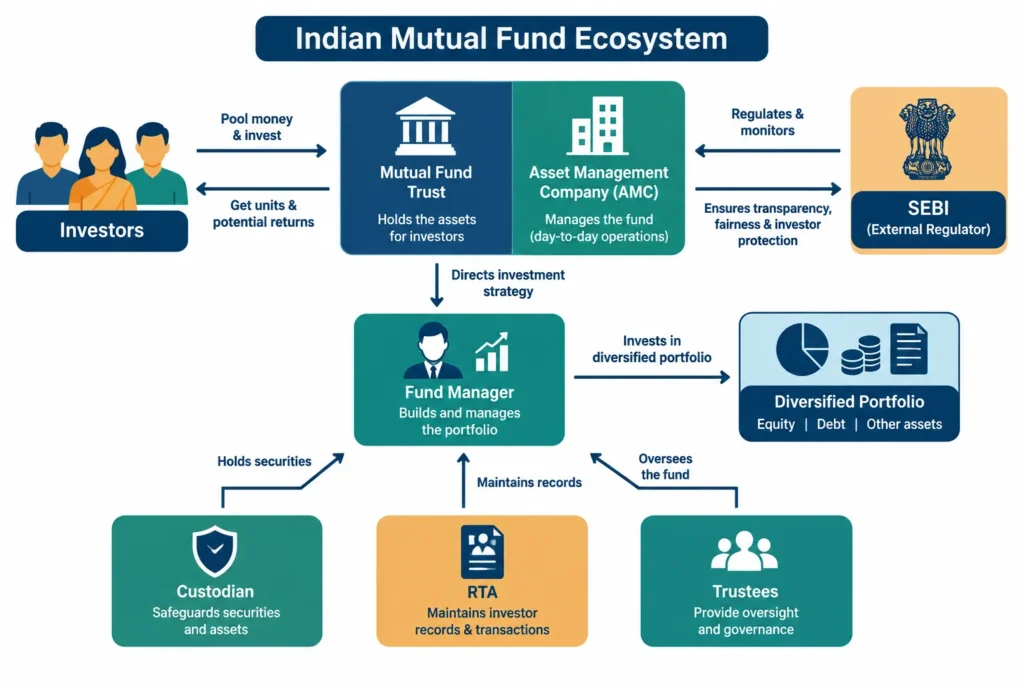
Flowchart showing the roles of investors, the AMC, fund manager, trustees, custodian, RTA and SEBI in an Indian mutual fund.

The Indian mutual fund system separates important responsibilities among different entities. This structure is intended to provide oversight and protect scheme assets, but it cannot prevent normal market losses.

  • Fund house or Asset Management Company: The AMC operates the mutual fund’s schemes. It handles investment management, administration, compliance and investor services. Investors commonly recognise the AMC through the fund house’s brand name.
  • Fund manager: The fund manager decides which securities to buy, hold or sell within the scheme’s objective and investment rules. Some schemes may have more than one fund manager.
  • Trustees: Trustees supervise the AMC and check whether the mutual fund is being managed in accordance with applicable rules and the interests of unit holders. They provide a layer of oversight rather than making every day-to-day investment decision.
  • Custodian: The custodian holds and safeguards the scheme’s securities and other assets. Keeping custody separate from portfolio management helps create operational checks.
  • Registrar and Transfer Agent: The RTA maintains investor and transaction records. It supports functions such as processing purchases and redemptions, updating account details and issuing account statements. An AMC may use an external RTA or permitted in-house arrangements.
  • SEBI: The Securities and Exchange Board of India regulates mutual funds in India. It sets rules covering areas such as scheme operations, disclosures, valuation, expenses, investor protection and oversight.

SEBI regulation does not mean that the government, SEBI or the AMC guarantees your principal or returns. Regulation aims to establish operating standards, disclosures and accountability. It cannot remove equity risk, interest-rate risk, credit risk, liquidity risk or other investment risks.

What are mutual fund units?

When you invest in a scheme, your investment is represented by units. The number of units allotted generally depends on the amount available for investment and the applicable NAV.

NAV means Net Asset Value. In simple terms, it is the per-unit value of the scheme after considering the value of its assets, liabilities and units outstanding. Scheme expenses are reflected in NAV as they are charged.

NAV is not a fixed price. It changes as the market value of the scheme’s investments changes. Mutual fund schemes disclose NAV according to the valuation and disclosure rules applicable to them, generally for each business day.

How a mutual fund purchase works

Suppose you submit a valid purchase request for a mutual fund scheme. The request must satisfy requirements such as Know Your Customer compliance, payment verification and the scheme’s transaction rules.

The units are allotted using the applicable NAV. This is not always simply the NAV visible when you press the invest button. The applicable NAV can depend on factors such as the scheme category, the time the valid application is received and when the investment money becomes available for use by the mutual fund.

SEBI’s rules prescribe cut-off timings and fund-realisation requirements. Liquid and overnight funds can have different timing rules from many other schemes. A request placed after the relevant cut-off may receive the NAV of a later business day. Weekends, holidays, incomplete applications and delayed receipt of funds can also affect processing.

Investors should check the current scheme documents and transaction instructions rather than assuming a particular day’s NAV will apply.

You May Also Like:How Does the Stock Market Work in India? A Beginner’s Guide

A simple NAV and unit calculation

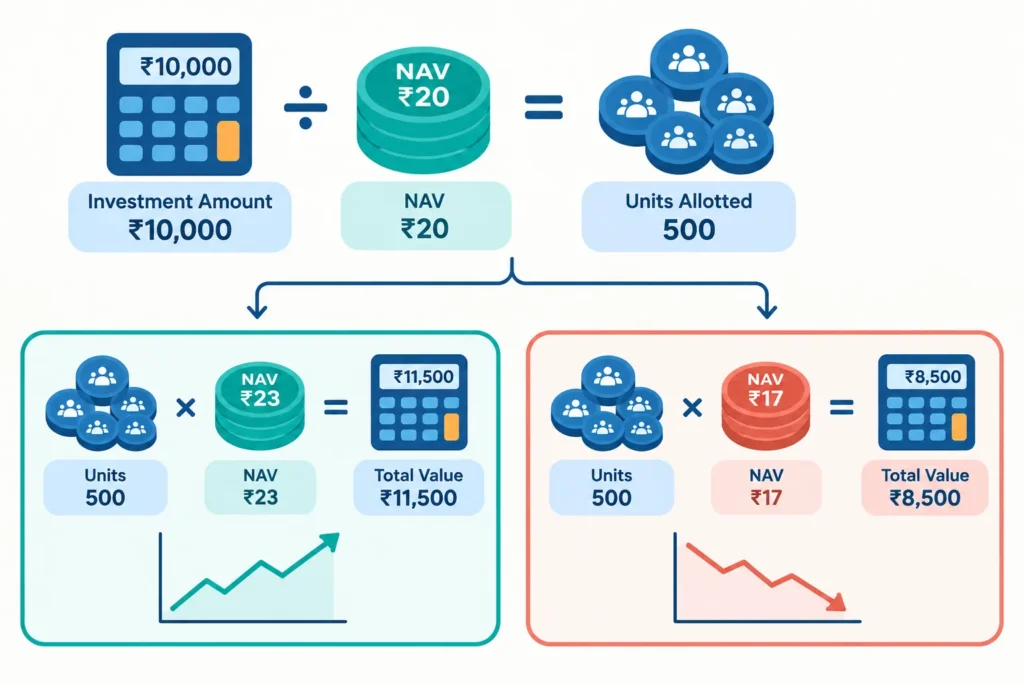
Example showing how ₹10,000 at an NAV of ₹20 buys 500 units and how the holding value changes when NAV rises or falls.

Assume a scheme’s applicable NAV is ₹20 per unit. For a simplified illustration, suppose the full ₹10,000 is available for unit allotment.

Units allotted = ₹10,000 ÷ ₹20 = 500 units

If the NAV later rises to ₹23, the value of the holding would be:

500 units × ₹23 = ₹11,500

If the NAV instead falls to ₹17, the value would be:

500 units × ₹17 = ₹8,500

This is only a hypothetical example. It does not represent the performance of any real scheme. It also ignores items such as stamp duty on unit purchases and any other applicable transaction adjustments. Actual redemption proceeds may be further affected by exit load and taxes.

A lower NAV does not mean a fund is cheaper

Beginners sometimes compare two schemes and assume that the one with a NAV of ₹10 is cheaper than one with a NAV of ₹100. This comparison is misleading.

A lower NAV simply gives you more units for the same investment amount. A higher NAV gives you fewer units. What matters is the percentage change in the value of the portfolio, not the number of units alone.

For example, ₹10,000 invested at an NAV of ₹10 gives 1,000 units, while ₹10,000 invested at an NAV of ₹100 gives 100 units, ignoring adjustments. If both NAVs rise by 10%, both holdings become worth ₹11,000. A low NAV does not make a scheme better, safer or more likely to deliver higher returns.

How redemption works

Redemption means selling some or all of your mutual fund units back to the scheme. You submit a redemption request stating the amount or number of units you want to redeem.

The scheme processes the request using the applicable redemption NAV under its rules. The proceeds are normally paid to the registered bank account after processing and within the timeline applicable to the scheme and transaction.

The amount received can differ from the value you first invested. It may be affected by:

  • the applicable NAV on redemption;
  • the number of units redeemed;
  • any exit load charged under the scheme’s rules;
  • other permitted charges or transaction adjustments;
  • processing requirements and exceptional market circumstances; and
  • taxes that apply to the investor’s capital gain or other taxable amount.

An exit load is a charge that may apply when units are redeemed within a specified period. It is not the same as an expense ratio. The expense ratio covers recurring scheme expenses and is reflected in NAV, while an exit load is linked to redemption under stated conditions.

Once you understand this basic operating structure, the next step is to examine the different types of mutual funds available in India and the distinct risks and purposes they carry.

Types of Mutual Funds, Investment Methods, and Plan Choices

Once you understand what mutual funds are, the next step is to learn how they differ. Mutual funds in India can be grouped by what they invest in, how the portfolio is managed, how you buy the fund, and how you contribute money.

These distinctions matter because two mutual funds may have very different objectives and risks. A fund investing mainly in company shares will not behave like one holding short-term debt instruments.

Main Types of Mutual Funds in India

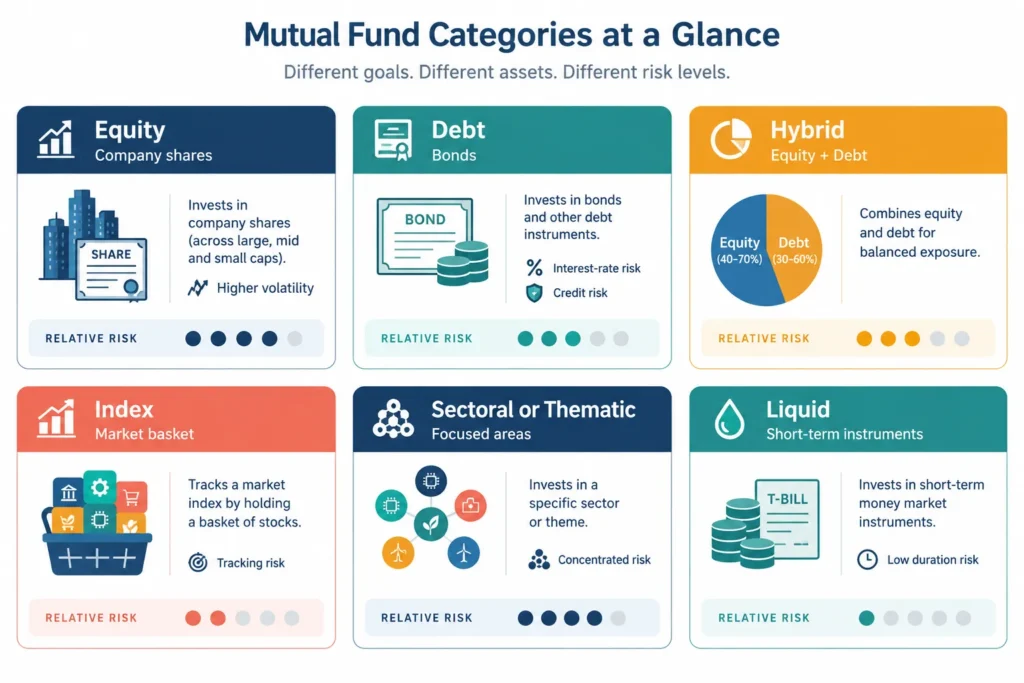
Comparison of equity, debt, hybrid, index, sectoral or thematic, and liquid mutual funds by assets and broad risk.

The broad categories below offer a useful starting point. Each category may contain several subcategories, so the fund’s scheme documents and portfolio still need to be checked before investing.

Fund type Main investments Broad objective Important risk
Equity fund Shares of listed companies Long-term capital growth Stock market volatility
Debt fund Bonds and money market instruments Income or relatively lower volatility than equity Interest-rate and credit risk
Hybrid fund A mix of equity, debt, and sometimes other assets Combine growth and stability objectives Risks of all underlying asset classes
Index fund Securities represented in a chosen index Track the index as closely as possible Market and tracking risk
Sectoral or thematic fund Companies linked to one sector or theme Capture opportunities in a focused area High concentration risk
Liquid fund Very short-term debt and money market instruments Manage money for short periods Credit, interest-rate, and liquidity risk

Equity Funds

Equity mutual funds invest primarily in company shares. Their value can rise or fall sharply as share prices change. They are generally associated with long-term wealth creation, but they do not provide assured returns.

Equity funds may invest in large companies, smaller companies, businesses of different sizes, or stocks selected according to a particular strategy. The risk can vary significantly within the equity category. For example, a portfolio focused on smaller companies may behave differently from one focused on established large companies.

Investors commonly consider equity funds for goals that are several years away, such as retirement or a child’s higher education. However, the appropriate choice depends on the investor’s time horizon, financial position, and ability to tolerate market falls.

You May Also Like:Stock Market & Investing in India: A Complete Beginner’s Guide

Debt Funds

Debt mutual funds invest in instruments such as government securities, treasury bills, corporate bonds, and certificates of deposit. The borrower agrees to pay interest and repay the principal according to the instrument’s terms.

Debt funds may be less volatile than equity funds, but they are not risk-free. Bond prices can fall when interest rates change. A borrower may also delay or fail to make payments, creating credit risk. Funds holding securities that are difficult to sell may face liquidity risk.

Different debt funds hold instruments with different maturity periods and credit profiles. Therefore, investors should not select a debt fund only because it appears safer than an equity fund.

Hybrid Funds

Hybrid funds invest across more than one asset class, usually equity and debt. Some may also hold gold-related instruments or other permitted assets. Their purpose is to combine different sources of risk and return within one portfolio.

The balance can vary widely. An equity-oriented hybrid fund may still experience substantial market swings, while a debt-oriented hybrid fund may have lower equity exposure. Hybrid does not automatically mean low risk. The actual asset allocation and the fund’s rules matter.

Index Funds

An index fund aims to follow a market index, such as one made up of selected large Indian companies. Instead of trying to identify stocks that will outperform, the fund generally holds the securities represented in its chosen index, usually in similar proportions.

The return may differ slightly from the index because of expenses, cash holdings, portfolio changes, and execution costs. This difference is related to tracking error or tracking difference. An index fund also carries the market risk of the index it follows.

Sectoral and Thematic Funds

A sectoral fund concentrates on one industry, such as banking, technology, or pharmaceuticals. A thematic fund invests around a broader idea, such as infrastructure, consumption, or manufacturing, which may include companies from several industries.

These funds can be more volatile than diversified funds because their performance depends heavily on a limited part of the economy. If that sector or theme struggles, the portfolio may have fewer opportunities to offset the decline. They should not be treated as automatically suitable simply because a sector is currently popular.

Liquid Funds

Liquid funds invest in debt and money market instruments with very short maturities. They may be considered for managing money over short periods, but they are not the same as a bank savings account or fixed deposit.

Their returns are market-linked and not guaranteed. Although their price movements are usually smaller than those of equity funds, they still carry risks relating to issuers, interest rates, and market liquidity.

Active and Passive Management

Mutual funds can also be classified by how investment decisions are made.

In an actively managed fund, a fund manager and research team select securities based on the scheme’s objective and investment process. They may decide which securities to buy, how much to hold, and when to sell. The aim may be to outperform a stated benchmark, but outperformance is not assured.

Active management involves research, portfolio decisions, and trading. These activities can contribute to higher expenses. Results also depend partly on the investment process and the manager’s decisions.

In a passively managed fund, the portfolio seeks to track an index rather than beat it through regular security selection. Index funds are a common example. Passive funds often have lower management costs, but low cost does not remove market risk or guarantee accurate index tracking.

Neither style is automatically better in every situation. Investors need to consider the fund’s objective, benchmark, costs, portfolio, tracking record where relevant, and the role it may play in their finances.

You May Also Like:Home Loan Balance Transfer in India: Benefits, Charges and When to Switch

Direct Plans and Regular Plans

Many Indian mutual fund schemes offer both direct and regular plans. The underlying portfolio and fund manager are generally the same, but the route used to invest and the expenses charged are different.

Feature Direct plan Regular plan
Purchase route Investor buys without a distributor Investor buys through a distributor or intermediary
Expense ratio Usually lower Usually higher because distribution costs are included
Investor support Investor largely handles research and decisions Intermediary may provide guidance and service
Portfolio Generally the same scheme portfolio Generally the same scheme portfolio

A direct plan may appeal to someone who can evaluate funds, complete transactions, monitor the portfolio, and make decisions independently. Its lower expense ratio can result in a different net asset value from the regular plan over time.

A regular plan includes distributor compensation within its expenses. An intermediary may help with paperwork, scheme explanations, transactions, and ongoing service. However, the quality and depth of this support can vary. Paying a higher expense does not guarantee better advice or better investment results.

Investors should understand what service they are receiving, how the intermediary is compensated, and whether any conflicts of interest may exist.

Lump-Sum Investing and SIPs

A lump-sum investment means contributing a larger amount at one time. For example, an investor may put ₹60,000 into a mutual fund after receiving a bonus. The entire amount becomes exposed to the fund’s market movements from the date units are allotted.

A systematic investment plan, or SIP, means investing a chosen amount at regular intervals, commonly every month. A SIP is an investment method, not a separate type of mutual fund. The same eligible scheme may accept both lump-sum investments and SIP contributions.

Suppose Meera sets up a monthly SIP of ₹3,000 in an equity mutual fund. Each month, ₹3,000 is invested at the applicable net asset value. When the NAV is lower, the amount generally buys more units. When the NAV is higher, it generally buys fewer units.

After 12 successful instalments, Meera would have contributed ₹36,000. Her investment value could be above or below ₹36,000 because unit prices change with the market. A SIP does not prevent losses, assure returns, or guarantee that a goal will be achieved.

SIPs can support regular investing and reduce the need to decide each month when to invest. Detailed questions such as the best SIP date, fund-to-fund comparisons, or estimated future values require separate evaluation. A SIP calculator can illustrate possible outcomes using assumed rates, but its output is not a promise of actual returns.

SIP and SWP Are Different

A SIP is generally used to put money into a mutual fund regularly. A systematic withdrawal plan, or SWP, is used to withdraw a chosen amount from an existing mutual fund investment at scheduled intervals.

SWP payments are made by redeeming units. They are not guaranteed interest payments, and frequent withdrawals can reduce the investment balance, especially during weak markets. Tax may also apply depending on the fund, holding period, and prevailing rules.

In simple terms, a SIP is a contribution method, while an SWP is a withdrawal method. Both are transaction facilities connected to mutual funds, not separate fund categories.

Benefits, Risks, Costs, and a Checklist Before Investing

Understanding what are mutual funds also means understanding their benefits, limitations, risks, and costs. A mutual fund can make investing easier, but it cannot remove market uncertainty or guarantee returns.

Potential Benefits of Mutual Funds

Mutual funds offer several practical advantages, especially for beginners who may not have the time or knowledge to select and monitor individual securities.

  • Diversification: A fund may invest across several companies, sectors, bonds, or other assets. This reduces dependence on a single investment. However, diversification cannot prevent losses when the overall market falls.
  • Professional management: A fund manager and research team make investment decisions according to the scheme’s stated objective. Professional management does not guarantee good performance.
  • Convenience: Investors can access a managed portfolio without buying every security separately. Transactions, portfolio reporting, and account statements are generally organised through the mutual fund system.
  • Accessibility: Many schemes allow investment through relatively small lump sums or Systematic Investment Plans. The minimum amount varies by scheme and platform.
  • Choice: Indian investors can choose from equity, debt, hybrid, index, and other fund categories. This makes it possible to select a category suited to a specific goal and time horizon.
  • Regulated disclosures: Mutual funds in India must provide prescribed information about their objectives, risks, portfolios, costs, and performance. Investors must still read and understand these disclosures before investing.

Main Risks You Should Understand

Mutual funds are market-linked products. Their Net Asset Value can rise or fall, and investors may lose part or all of the money invested. The level and type of risk depend on what the scheme owns and how it is managed.

  • Market risk: Equity prices can fall because of economic conditions, company performance, interest rates, global events, or investor sentiment. Equity-oriented funds can be volatile, particularly over short periods.
  • Credit risk: A debt fund may hold bonds issued by companies or other entities. If an issuer’s financial position weakens, the bond’s value may fall. In serious cases, the issuer may delay or fail to make payments.
  • Interest-rate risk: Bond prices generally move in the opposite direction to interest rates. Debt funds holding longer-maturity securities can be more sensitive to interest-rate changes.
  • Concentration risk: Sectoral and thematic funds focus on a limited area, such as banking, technology, infrastructure, or healthcare. They may fall sharply when that sector or theme performs poorly.
  • Liquidity risk: A fund may find it difficult to sell certain securities quickly at a reasonable price. This is particularly relevant for less-traded bonds or securities during periods of market stress.
  • Strategy and tracking risk: An actively managed fund may underperform its benchmark. An index fund may also differ from index returns because of costs, cash holdings, or tracking error.

A category name alone does not reveal every risk. Two funds in the same category may hold different securities, follow different strategies, and carry different levels of concentration or credit exposure.

Read the Riskometer

The Riskometer is a standard visual indicator used in Indian mutual fund disclosures. It places a scheme within a risk level ranging from low to very high. The indicated level reflects factors related to the scheme’s portfolio and can change over time.

Use the Riskometer as a starting point, not as the only basis for selection. Compare the scheme’s risk level with your ability and willingness to tolerate losses. Also check the Riskometer of the benchmark where it is disclosed.

For example, a person saving for a house down payment needed in two years may not be comfortable with a very high-risk equity fund. A person investing for retirement several decades away may have more time to tolerate market fluctuations, but must still consider income stability, emergency savings, and emotional comfort with losses.

Costs That Can Reduce Your Returns

Mutual fund returns are affected by costs. Even when two schemes earn similar returns before expenses, the one with higher costs may leave less money for investors over time.

  • Expense ratio: This is the recurring cost charged to the scheme for management and operating expenses. It is reflected in the NAV rather than usually appearing as a separate bill. Direct and regular plans of the same scheme have different expense structures.
  • Exit load: Some schemes charge an exit load when units are redeemed within a specified period. The amount and applicable period vary by scheme.
  • Transaction-related costs: Certain transactions may involve permitted charges, taxes, duties, or other costs. These can depend on the transaction and prevailing rules.
  • Portfolio trading costs: Buying and selling securities within a scheme can create transaction costs. Frequent portfolio turnover may increase such costs.
You May Also Like:What Happens When You Miss an EMI in India?

Do not choose a fund only because its expense ratio is low. Cost matters, but the scheme must first match your goal, time horizon, risk profile, and required investment strategy.

Official Documents and Disclosures to Review

Before investing, read the latest official scheme documents rather than relying only on advertisements, social media posts, ratings, or recent return charts.

  • Scheme Information Document: Explains the investment objective, strategy, asset allocation, risks, fees, and operational terms.
  • Key Information Memorandum: Provides a shorter summary of important scheme details.
  • Investment objective: States what the scheme aims to achieve. It is an objective, not a promise.
  • Benchmark: Provides a reference for assessing the scheme’s performance and risk in context.
  • Portfolio disclosure: Shows the securities and sectors held by the fund. Look for concentration, credit quality, maturity profile where relevant, and whether the holdings match the stated strategy.
  • Expense ratio and exit load: Check the latest figures and conditions because they may change.
  • Performance disclosure: Review returns across different periods and market conditions. Past performance does not guarantee future results.

Match the Fund to Your Financial Situation

Fund selection should begin with your needs, not with a list of top-performing schemes. Define the goal, amount required, likely investment period, and flexibility of the deadline.

Risk tolerance is your emotional willingness to see the investment fluctuate. Risk capacity is your financial ability to absorb a loss without affecting essential goals. A person may feel comfortable taking risk but have low capacity because the money is needed soon.

Before taking market risk, consider maintaining emergency savings and dealing with expensive debt. Avoid investing money that may be needed for rent, medical expenses, school fees, or another near-term essential payment.

Practical Pre-Investment Checklist

  • Have I written down the specific goal for this investment?
  • When will I need the money, and can that date be delayed?
  • Can I tolerate a temporary fall without stopping the investment in panic?
  • Can I financially absorb a loss without affecting essential expenses?
  • Does the fund category suit my goal and investment horizon?
  • Have I read the investment objective, asset allocation, Riskometer, and benchmark?
  • Have I checked the latest portfolio for sector, issuer, or security concentration?
  • For a debt fund, have I reviewed credit quality, maturity, and interest-rate sensitivity?
  • Do I understand the expense ratio, plan type, exit load, and other applicable costs?
  • Am I choosing the fund for a clear reason rather than recent high returns?
  • Do I understand how and when I can redeem the units?
  • Have I completed the required KYC and nomination or chosen the applicable nomination option?
  • Will I review the investment periodically without reacting to every market movement?

Taxation Requires a Current Check

Tax treatment can depend on the fund type, asset composition, holding period, transaction, and the Indian tax rules applicable at that time. Rules and classifications may change. Verify the latest official guidance or consult a qualified tax professional before investing, redeeming, switching, or planning gains. Do not assume that all mutual funds receive the same tax treatment.

Frequently Asked Questions

Can mutual funds guarantee returns?

No. Mutual fund returns depend on the performance of the underlying investments after costs. Even relatively low-risk funds can experience changes in value. A scheme objective, past return, or rating is not a return guarantee.

Are mutual funds safer than shares?

A diversified mutual fund can reduce the risk associated with owning only one or two shares. However, an equity mutual fund still carries market risk and can lose money. Safety depends on the fund’s assets, strategy, concentration, and your holding period.

Is a SIP free from market risk?

No. A SIP is a method of investing fixed amounts periodically. It can encourage discipline and spread purchases across different market levels, but it does not prevent losses or assure profits.

Should beginners select the fund with the highest recent return?

No. Recent performance may reflect favourable conditions for a particular sector, style, or asset class. Beginners should first consider the goal, horizon, risk, portfolio, costs, and consistency with the scheme’s stated objective.

How often should I review a mutual fund?

Review it periodically and when there is a major change in your goal, financial position, scheme objective, risk level, cost, or fund strategy. Frequent changes based only on short-term performance can lead to poor decisions and additional costs or taxes.

Summary and Next Steps

Mutual funds offer diversification, professional management, convenience, and access to different asset classes. These benefits come with market-linked risks, recurring expenses, possible exit loads, and no assurance of positive returns.

As a next step, write down one financial goal and its deadline. Identify a suitable broad fund category, read the official scheme documents, compare the Riskometer and costs, and check whether potential losses would be manageable. Start only after you understand what the scheme owns and why it fits your plan.

This article provides general educational information only. It is not personalised investment, tax, or legal advice. Consider consulting a registered investment adviser, qualified tax professional, or legal professional for guidance based on your circumstances.

Share this article
KEEP READING

Related Articles

View all →

Comments

Leave a Comment

What Are Mutual Funds? How They Work in India

Learn what are mutual funds, Mutual funds are investment vehicles that collect money from many investors and invest it in shares, bonds, money-market instruments or a mix of assets. Each scheme follows a stated investment objective and is managed by a professional fund manager.

When you invest, you receive units of the scheme. The value of those units changes with the scheme’s Net Asset Value, or NAV. Mutual funds are regulated in India, but their returns are not guaranteed and their value can rise or fall.

Introduction

If you want to invest but do not have the time or knowledge to select individual shares and bonds, a mutual fund can provide a structured alternative. It gives you access to a portfolio managed by professionals, often with a relatively small starting amount.

However, a mutual fund is not the same as a bank deposit. Your money is invested in market-linked assets. The result depends on the securities held by the scheme, its costs, the decisions of the fund manager and wider market conditions.

Understanding what mutual funds are also requires understanding how the Indian mutual fund system works. Several entities are involved in managing the portfolio, safeguarding its assets, maintaining investor records and supervising compliance.

What Mutual Funds Are and How the Indian Mutual Fund System Works

A mutual fund is a pool of investors’ money

A mutual fund scheme combines money collected from many investors. It then invests that pool according to an objective stated in the scheme documents.

For example, imagine that 1,000 Indian households each contribute money to a common investment pool. Instead of every household separately researching and buying shares or bonds, a professional manager invests the combined amount in a portfolio.

If it is an equity scheme, most of the money may be invested in company shares. A debt scheme may invest mainly in government securities, corporate bonds and other debt instruments. A hybrid scheme may hold both equity and debt.

Each investor owns units representing a proportionate interest in the scheme’s assets. The investor does not directly own a specific share or bond from the portfolio. For instance, you cannot ask the mutual fund to give you only its holdings in one bank or one government security.

How pooling can support diversification

Pooling allows a scheme to spread money across several investments. This is called diversification.

Consider a household with ₹5,000 to invest. Buying a properly diversified selection of individual securities with this amount may be difficult. By investing in a mutual fund, the household can gain exposure to the scheme’s wider portfolio.

Diversification can reduce the damage caused by poor performance in one investment. It does not eliminate risk. If an entire market segment falls, a diversified scheme investing in that segment can also lose value.

Who does what in an Indian mutual fund?

Flowchart showing the roles of investors, the AMC, fund manager, trustees, custodian, RTA and SEBI in an Indian mutual fund.

The Indian mutual fund system separates important responsibilities among different entities. This structure is intended to provide oversight and protect scheme assets, but it cannot prevent normal market losses.

  • Fund house or Asset Management Company: The AMC operates the mutual fund’s schemes. It handles investment management, administration, compliance and investor services. Investors commonly recognise the AMC through the fund house’s brand name.
  • Fund manager: The fund manager decides which securities to buy, hold or sell within the scheme’s objective and investment rules. Some schemes may have more than one fund manager.
  • Trustees: Trustees supervise the AMC and check whether the mutual fund is being managed in accordance with applicable rules and the interests of unit holders. They provide a layer of oversight rather than making every day-to-day investment decision.
  • Custodian: The custodian holds and safeguards the scheme’s securities and other assets. Keeping custody separate from portfolio management helps create operational checks.
  • Registrar and Transfer Agent: The RTA maintains investor and transaction records. It supports functions such as processing purchases and redemptions, updating account details and issuing account statements. An AMC may use an external RTA or permitted in-house arrangements.
  • SEBI: The Securities and Exchange Board of India regulates mutual funds in India. It sets rules covering areas such as scheme operations, disclosures, valuation, expenses, investor protection and oversight.

SEBI regulation does not mean that the government, SEBI or the AMC guarantees your principal or returns. Regulation aims to establish operating standards, disclosures and accountability. It cannot remove equity risk, interest-rate risk, credit risk, liquidity risk or other investment risks.

What are mutual fund units?

When you invest in a scheme, your investment is represented by units. The number of units allotted generally depends on the amount available for investment and the applicable NAV.

NAV means Net Asset Value. In simple terms, it is the per-unit value of the scheme after considering the value of its assets, liabilities and units outstanding. Scheme expenses are reflected in NAV as they are charged.

NAV is not a fixed price. It changes as the market value of the scheme’s investments changes. Mutual fund schemes disclose NAV according to the valuation and disclosure rules applicable to them, generally for each business day.

How a mutual fund purchase works

Suppose you submit a valid purchase request for a mutual fund scheme. The request must satisfy requirements such as Know Your Customer compliance, payment verification and the scheme’s transaction rules.

The units are allotted using the applicable NAV. This is not always simply the NAV visible when you press the invest button. The applicable NAV can depend on factors such as the scheme category, the time the valid application is received and when the investment money becomes available for use by the mutual fund.

SEBI’s rules prescribe cut-off timings and fund-realisation requirements. Liquid and overnight funds can have different timing rules from many other schemes. A request placed after the relevant cut-off may receive the NAV of a later business day. Weekends, holidays, incomplete applications and delayed receipt of funds can also affect processing.

Investors should check the current scheme documents and transaction instructions rather than assuming a particular day’s NAV will apply.

A simple NAV and unit calculation
Example showing how ₹10,000 at an NAV of ₹20 buys 500 units and how the holding value changes when NAV rises or falls.

Assume a scheme’s applicable NAV is ₹20 per unit. For a simplified illustration, suppose the full ₹10,000 is available for unit allotment.

Units allotted = ₹10,000 ÷ ₹20 = 500 units

If the NAV later rises to ₹23, the value of the holding would be:

500 units × ₹23 = ₹11,500

If the NAV instead falls to ₹17, the value would be:

500 units × ₹17 = ₹8,500

This is only a hypothetical example. It does not represent the performance of any real scheme. It also ignores items such as stamp duty on unit purchases and any other applicable transaction adjustments. Actual redemption proceeds may be further affected by exit load and taxes.

A lower NAV does not mean a fund is cheaper

Beginners sometimes compare two schemes and assume that the one with a NAV of ₹10 is cheaper than one with a NAV of ₹100. This comparison is misleading.

A lower NAV simply gives you more units for the same investment amount. A higher NAV gives you fewer units. What matters is the percentage change in the value of the portfolio, not the number of units alone.

For example, ₹10,000 invested at an NAV of ₹10 gives 1,000 units, while ₹10,000 invested at an NAV of ₹100 gives 100 units, ignoring adjustments. If both NAVs rise by 10%, both holdings become worth ₹11,000. A low NAV does not make a scheme better, safer or more likely to deliver higher returns.

How redemption works

Redemption means selling some or all of your mutual fund units back to the scheme. You submit a redemption request stating the amount or number of units you want to redeem.

The scheme processes the request using the applicable redemption NAV under its rules. The proceeds are normally paid to the registered bank account after processing and within the timeline applicable to the scheme and transaction.

The amount received can differ from the value you first invested. It may be affected by:

  • the applicable NAV on redemption;
  • the number of units redeemed;
  • any exit load charged under the scheme’s rules;
  • other permitted charges or transaction adjustments;
  • processing requirements and exceptional market circumstances; and
  • taxes that apply to the investor’s capital gain or other taxable amount.

An exit load is a charge that may apply when units are redeemed within a specified period. It is not the same as an expense ratio. The expense ratio covers recurring scheme expenses and is reflected in NAV, while an exit load is linked to redemption under stated conditions.

Once you understand this basic operating structure, the next step is to examine the different types of mutual funds available in India and the distinct risks and purposes they carry.

Types of Mutual Funds, Investment Methods, and Plan Choices

Once you understand what mutual funds are, the next step is to learn how they differ. Mutual funds in India can be grouped by what they invest in, how the portfolio is managed, how you buy the fund, and how you contribute money.

These distinctions matter because two mutual funds may have very different objectives and risks. A fund investing mainly in company shares will not behave like one holding short-term debt instruments.

Main Types of Mutual Funds in India
Comparison of equity, debt, hybrid, index, sectoral or thematic, and liquid mutual funds by assets and broad risk.

The broad categories below offer a useful starting point. Each category may contain several subcategories, so the fund’s scheme documents and portfolio still need to be checked before investing.

Fund type Main investments Broad objective Important risk
Equity fund Shares of listed companies Long-term capital growth Stock market volatility
Debt fund Bonds and money market instruments Income or relatively lower volatility than equity Interest-rate and credit risk
Hybrid fund A mix of equity, debt, and sometimes other assets Combine growth and stability objectives Risks of all underlying asset classes
Index fund Securities represented in a chosen index Track the index as closely as possible Market and tracking risk
Sectoral or thematic fund Companies linked to one sector or theme Capture opportunities in a focused area High concentration risk
Liquid fund Very short-term debt and money market instruments Manage money for short periods Credit, interest-rate, and liquidity risk

Equity Funds

Equity mutual funds invest primarily in company shares. Their value can rise or fall sharply as share prices change. They are generally associated with long-term wealth creation, but they do not provide assured returns.

Equity funds may invest in large companies, smaller companies, businesses of different sizes, or stocks selected according to a particular strategy. The risk can vary significantly within the equity category. For example, a portfolio focused on smaller companies may behave differently from one focused on established large companies.

Investors commonly consider equity funds for goals that are several years away, such as retirement or a child’s higher education. However, the appropriate choice depends on the investor’s time horizon, financial position, and ability to tolerate market falls.

Debt Funds

Debt mutual funds invest in instruments such as government securities, treasury bills, corporate bonds, and certificates of deposit. The borrower agrees to pay interest and repay the principal according to the instrument’s terms.

Debt funds may be less volatile than equity funds, but they are not risk-free. Bond prices can fall when interest rates change. A borrower may also delay or fail to make payments, creating credit risk. Funds holding securities that are difficult to sell may face liquidity risk.

Different debt funds hold instruments with different maturity periods and credit profiles. Therefore, investors should not select a debt fund only because it appears safer than an equity fund.

Hybrid Funds

Hybrid funds invest across more than one asset class, usually equity and debt. Some may also hold gold-related instruments or other permitted assets. Their purpose is to combine different sources of risk and return within one portfolio.

The balance can vary widely. An equity-oriented hybrid fund may still experience substantial market swings, while a debt-oriented hybrid fund may have lower equity exposure. Hybrid does not automatically mean low risk. The actual asset allocation and the fund’s rules matter.

Index Funds

An index fund aims to follow a market index, such as one made up of selected large Indian companies. Instead of trying to identify stocks that will outperform, the fund generally holds the securities represented in its chosen index, usually in similar proportions.

The return may differ slightly from the index because of expenses, cash holdings, portfolio changes, and execution costs. This difference is related to tracking error or tracking difference. An index fund also carries the market risk of the index it follows.

Sectoral and Thematic Funds

A sectoral fund concentrates on one industry, such as banking, technology, or pharmaceuticals. A thematic fund invests around a broader idea, such as infrastructure, consumption, or manufacturing, which may include companies from several industries.

These funds can be more volatile than diversified funds because their performance depends heavily on a limited part of the economy. If that sector or theme struggles, the portfolio may have fewer opportunities to offset the decline. They should not be treated as automatically suitable simply because a sector is currently popular.

Liquid Funds

Liquid funds invest in debt and money market instruments with very short maturities. They may be considered for managing money over short periods, but they are not the same as a bank savings account or fixed deposit.

Their returns are market-linked and not guaranteed. Although their price movements are usually smaller than those of equity funds, they still carry risks relating to issuers, interest rates, and market liquidity.

Active and Passive Management

Mutual funds can also be classified by how investment decisions are made.

In an actively managed fund, a fund manager and research team select securities based on the scheme’s objective and investment process. They may decide which securities to buy, how much to hold, and when to sell. The aim may be to outperform a stated benchmark, but outperformance is not assured.

Active management involves research, portfolio decisions, and trading. These activities can contribute to higher expenses. Results also depend partly on the investment process and the manager’s decisions.

In a passively managed fund, the portfolio seeks to track an index rather than beat it through regular security selection. Index funds are a common example. Passive funds often have lower management costs, but low cost does not remove market risk or guarantee accurate index tracking.

Neither style is automatically better in every situation. Investors need to consider the fund’s objective, benchmark, costs, portfolio, tracking record where relevant, and the role it may play in their finances.

Direct Plans and Regular Plans

Many Indian mutual fund schemes offer both direct and regular plans. The underlying portfolio and fund manager are generally the same, but the route used to invest and the expenses charged are different.

Feature Direct plan Regular plan
Purchase route Investor buys without a distributor Investor buys through a distributor or intermediary
Expense ratio Usually lower Usually higher because distribution costs are included
Investor support Investor largely handles research and decisions Intermediary may provide guidance and service
Portfolio Generally the same scheme portfolio Generally the same scheme portfolio

A direct plan may appeal to someone who can evaluate funds, complete transactions, monitor the portfolio, and make decisions independently. Its lower expense ratio can result in a different net asset value from the regular plan over time.

A regular plan includes distributor compensation within its expenses. An intermediary may help with paperwork, scheme explanations, transactions, and ongoing service. However, the quality and depth of this support can vary. Paying a higher expense does not guarantee better advice or better investment results.

Investors should understand what service they are receiving, how the intermediary is compensated, and whether any conflicts of interest may exist.

Lump-Sum Investing and SIPs

A lump-sum investment means contributing a larger amount at one time. For example, an investor may put ₹60,000 into a mutual fund after receiving a bonus. The entire amount becomes exposed to the fund’s market movements from the date units are allotted.

A systematic investment plan, or SIP, means investing a chosen amount at regular intervals, commonly every month. A SIP is an investment method, not a separate type of mutual fund. The same eligible scheme may accept both lump-sum investments and SIP contributions.

Suppose Meera sets up a monthly SIP of ₹3,000 in an equity mutual fund. Each month, ₹3,000 is invested at the applicable net asset value. When the NAV is lower, the amount generally buys more units. When the NAV is higher, it generally buys fewer units.

After 12 successful instalments, Meera would have contributed ₹36,000. Her investment value could be above or below ₹36,000 because unit prices change with the market. A SIP does not prevent losses, assure returns, or guarantee that a goal will be achieved.

SIPs can support regular investing and reduce the need to decide each month when to invest. Detailed questions such as the best SIP date, fund-to-fund comparisons, or estimated future values require separate evaluation. A SIP calculator can illustrate possible outcomes using assumed rates, but its output is not a promise of actual returns.

SIP and SWP Are Different

A SIP is generally used to put money into a mutual fund regularly. A systematic withdrawal plan, or SWP, is used to withdraw a chosen amount from an existing mutual fund investment at scheduled intervals.

SWP payments are made by redeeming units. They are not guaranteed interest payments, and frequent withdrawals can reduce the investment balance, especially during weak markets. Tax may also apply depending on the fund, holding period, and prevailing rules.

In simple terms, a SIP is a contribution method, while an SWP is a withdrawal method. Both are transaction facilities connected to mutual funds, not separate fund categories.

Benefits, Risks, Costs, and a Checklist Before Investing

Understanding what are mutual funds also means understanding their benefits, limitations, risks, and costs. A mutual fund can make investing easier, but it cannot remove market uncertainty or guarantee returns.

Potential Benefits of Mutual Funds

Mutual funds offer several practical advantages, especially for beginners who may not have the time or knowledge to select and monitor individual securities.

  • Diversification: A fund may invest across several companies, sectors, bonds, or other assets. This reduces dependence on a single investment. However, diversification cannot prevent losses when the overall market falls.
  • Professional management: A fund manager and research team make investment decisions according to the scheme’s stated objective. Professional management does not guarantee good performance.
  • Convenience: Investors can access a managed portfolio without buying every security separately. Transactions, portfolio reporting, and account statements are generally organised through the mutual fund system.
  • Accessibility: Many schemes allow investment through relatively small lump sums or Systematic Investment Plans. The minimum amount varies by scheme and platform.
  • Choice: Indian investors can choose from equity, debt, hybrid, index, and other fund categories. This makes it possible to select a category suited to a specific goal and time horizon.
  • Regulated disclosures: Mutual funds in India must provide prescribed information about their objectives, risks, portfolios, costs, and performance. Investors must still read and understand these disclosures before investing.

Main Risks You Should Understand

Mutual funds are market-linked products. Their Net Asset Value can rise or fall, and investors may lose part or all of the money invested. The level and type of risk depend on what the scheme owns and how it is managed.

  • Market risk: Equity prices can fall because of economic conditions, company performance, interest rates, global events, or investor sentiment. Equity-oriented funds can be volatile, particularly over short periods.
  • Credit risk: A debt fund may hold bonds issued by companies or other entities. If an issuer’s financial position weakens, the bond’s value may fall. In serious cases, the issuer may delay or fail to make payments.
  • Interest-rate risk: Bond prices generally move in the opposite direction to interest rates. Debt funds holding longer-maturity securities can be more sensitive to interest-rate changes.
  • Concentration risk: Sectoral and thematic funds focus on a limited area, such as banking, technology, infrastructure, or healthcare. They may fall sharply when that sector or theme performs poorly.
  • Liquidity risk: A fund may find it difficult to sell certain securities quickly at a reasonable price. This is particularly relevant for less-traded bonds or securities during periods of market stress.
  • Strategy and tracking risk: An actively managed fund may underperform its benchmark. An index fund may also differ from index returns because of costs, cash holdings, or tracking error.

A category name alone does not reveal every risk. Two funds in the same category may hold different securities, follow different strategies, and carry different levels of concentration or credit exposure.

Read the Riskometer

The Riskometer is a standard visual indicator used in Indian mutual fund disclosures. It places a scheme within a risk level ranging from low to very high. The indicated level reflects factors related to the scheme’s portfolio and can change over time.

Use the Riskometer as a starting point, not as the only basis for selection. Compare the scheme’s risk level with your ability and willingness to tolerate losses. Also check the Riskometer of the benchmark where it is disclosed.

For example, a person saving for a house down payment needed in two years may not be comfortable with a very high-risk equity fund. A person investing for retirement several decades away may have more time to tolerate market fluctuations, but must still consider income stability, emergency savings, and emotional comfort with losses.

Costs That Can Reduce Your Returns

Mutual fund returns are affected by costs. Even when two schemes earn similar returns before expenses, the one with higher costs may leave less money for investors over time.

  • Expense ratio: This is the recurring cost charged to the scheme for management and operating expenses. It is reflected in the NAV rather than usually appearing as a separate bill. Direct and regular plans of the same scheme have different expense structures.
  • Exit load: Some schemes charge an exit load when units are redeemed within a specified period. The amount and applicable period vary by scheme.
  • Transaction-related costs: Certain transactions may involve permitted charges, taxes, duties, or other costs. These can depend on the transaction and prevailing rules.
  • Portfolio trading costs: Buying and selling securities within a scheme can create transaction costs. Frequent portfolio turnover may increase such costs.

Do not choose a fund only because its expense ratio is low. Cost matters, but the scheme must first match your goal, time horizon, risk profile, and required investment strategy.

Official Documents and Disclosures to Review

Before investing, read the latest official scheme documents rather than relying only on advertisements, social media posts, ratings, or recent return charts.

  • Scheme Information Document: Explains the investment objective, strategy, asset allocation, risks, fees, and operational terms.
  • Key Information Memorandum: Provides a shorter summary of important scheme details.
  • Investment objective: States what the scheme aims to achieve. It is an objective, not a promise.
  • Benchmark: Provides a reference for assessing the scheme’s performance and risk in context.
  • Portfolio disclosure: Shows the securities and sectors held by the fund. Look for concentration, credit quality, maturity profile where relevant, and whether the holdings match the stated strategy.
  • Expense ratio and exit load: Check the latest figures and conditions because they may change.
  • Performance disclosure: Review returns across different periods and market conditions. Past performance does not guarantee future results.

Match the Fund to Your Financial Situation

Fund selection should begin with your needs, not with a list of top-performing schemes. Define the goal, amount required, likely investment period, and flexibility of the deadline.

Risk tolerance is your emotional willingness to see the investment fluctuate. Risk capacity is your financial ability to absorb a loss without affecting essential goals. A person may feel comfortable taking risk but have low capacity because the money is needed soon.

Before taking market risk, consider maintaining emergency savings and dealing with expensive debt. Avoid investing money that may be needed for rent, medical expenses, school fees, or another near-term essential payment.

Practical Pre-Investment Checklist

  • Have I written down the specific goal for this investment?
  • When will I need the money, and can that date be delayed?
  • Can I tolerate a temporary fall without stopping the investment in panic?
  • Can I financially absorb a loss without affecting essential expenses?
  • Does the fund category suit my goal and investment horizon?
  • Have I read the investment objective, asset allocation, Riskometer, and benchmark?
  • Have I checked the latest portfolio for sector, issuer, or security concentration?
  • For a debt fund, have I reviewed credit quality, maturity, and interest-rate sensitivity?
  • Do I understand the expense ratio, plan type, exit load, and other applicable costs?
  • Am I choosing the fund for a clear reason rather than recent high returns?
  • Do I understand how and when I can redeem the units?
  • Have I completed the required KYC and nomination or chosen the applicable nomination option?
  • Will I review the investment periodically without reacting to every market movement?

Taxation Requires a Current Check

Tax treatment can depend on the fund type, asset composition, holding period, transaction, and the Indian tax rules applicable at that time. Rules and classifications may change. Verify the latest official guidance or consult a qualified tax professional before investing, redeeming, switching, or planning gains. Do not assume that all mutual funds receive the same tax treatment.

Frequently Asked Questions

Can mutual funds guarantee returns?

No. Mutual fund returns depend on the performance of the underlying investments after costs. Even relatively low-risk funds can experience changes in value. A scheme objective, past return, or rating is not a return guarantee.

Are mutual funds safer than shares?

A diversified mutual fund can reduce the risk associated with owning only one or two shares. However, an equity mutual fund still carries market risk and can lose money. Safety depends on the fund’s assets, strategy, concentration, and your holding period.

Is a SIP free from market risk?

No. A SIP is a method of investing fixed amounts periodically. It can encourage discipline and spread purchases across different market levels, but it does not prevent losses or assure profits.

Should beginners select the fund with the highest recent return?

No. Recent performance may reflect favourable conditions for a particular sector, style, or asset class. Beginners should first consider the goal, horizon, risk, portfolio, costs, and consistency with the scheme’s stated objective.

How often should I review a mutual fund?

Review it periodically and when there is a major change in your goal, financial position, scheme objective, risk level, cost, or fund strategy. Frequent changes based only on short-term performance can lead to poor decisions and additional costs or taxes.

Summary and Next Steps

Mutual funds offer diversification, professional management, convenience, and access to different asset classes. These benefits come with market-linked risks, recurring expenses, possible exit loads, and no assurance of positive returns.

As a next step, write down one financial goal and its deadline. Identify a suitable broad fund category, read the official scheme documents, compare the Riskometer and costs, and check whether potential losses would be manageable. Start only after you understand what the scheme owns and why it fits your plan.

This article provides general educational information only. It is not personalised investment, tax, or legal advice. Consider consulting a registered investment adviser, qualified tax professional, or legal professional for guidance based on your circumstances.


Leave a Comment