

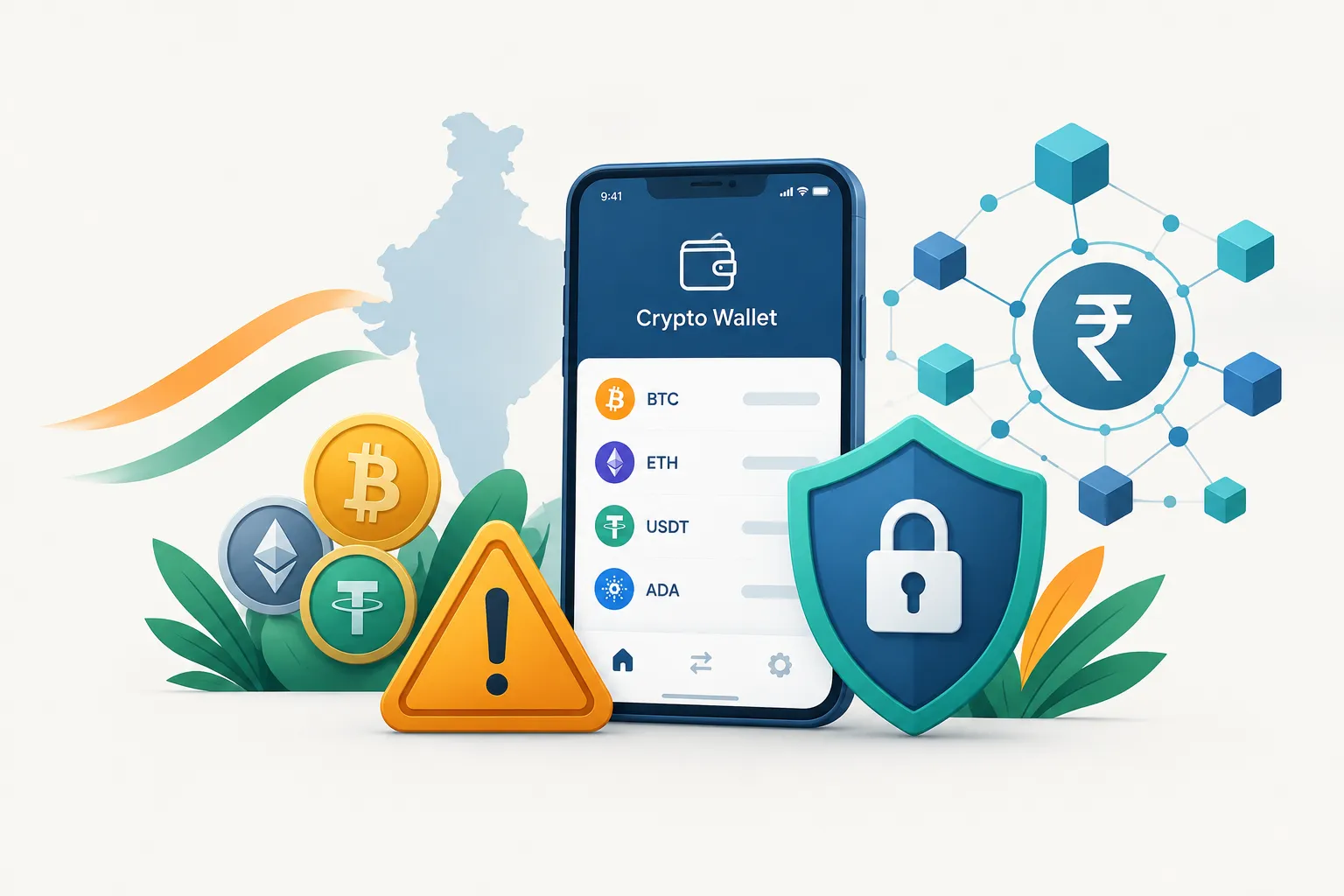
Crypto scams in India are frauds designed to steal money, cryptocurrency, account details or wallet access. Common warning signs include guaranteed returns, pressure to deposit quickly, unknown trading apps, fake celebrity endorsements, requests for wallet recovery phrases and demands for extra fees before a withdrawal.
A professional-looking website, active social-media account or claim of registration does not prove that a crypto business is genuine. Before sending money, verify the platform independently, check the exact website address and never share your password, private key, one-time password or wallet recovery phrase.
Introduction
Cryptocurrency transactions can be fast and difficult to reverse. This makes crypto attractive to scammers. They may hide behind fake apps, social-media profiles, messaging groups or websites that look like real exchanges.
Beginners can be especially vulnerable because crypto uses unfamiliar terms such as wallets, tokens, staking, airdrops and blockchain addresses. A fraudster may use this technical language to appear knowledgeable. Some also show fake account balances or small early profits to gain trust.
It is important to separate fraud from the normal risks of investing. A fall in the price of Bitcoin is not automatically a scam. Losing money because you bought at a high price may be a poor investment outcome rather than fraud. Similarly, a genuine crypto project can fail because of weak technology, hacking, poor management or low demand.
A scam involves deliberate deception. For example, a fake platform may display profits that do not exist, accept deposits and then block withdrawals. Readers who are new to the subject should first understand wallets, exchanges and crypto transactions through Cryptocurrency in India: A Complete Beginner’s Guide to Crypto. The broader Cryptocurrency Risks Guide explains market, technology, custody and regulatory risks beyond fraud.
Understanding Crypto Scams and Recognising Common Warning Signs
Fake Investment Platforms and Trading Apps
A fake investment platform may copy the design of a genuine exchange or create a polished app showing imaginary profits. The victim is asked to deposit rupees or transfer crypto to a wallet address. The dashboard then shows the investment growing rapidly.
When the victim tries to withdraw, the platform may demand a “tax”, “security deposit”, “verification charge” or “liquidity fee”. Paying this amount usually leads to another demand rather than a withdrawal.
Be cautious if someone sends an app installation file through a messaging service or asks you to install software from outside an official app store. Even an app available through a recognised store is not automatically safe. Check the developer, permissions, reviews, website domain and independent information.
Guaranteed Profits and Ponzi-Style Offers
No genuine crypto investment can guarantee a fixed daily profit without risk. Crypto prices can rise or fall sharply, and trading results cannot be known in advance.
Ponzi-style schemes may promise daily income, “risk-free staking” or unusually high referral rewards. Money from newer participants may be used to make limited payments to earlier participants. These early payments create confidence and encourage people to invest more or invite relatives and friends.
For example, a person may be told that a ₹10,000 deposit will produce a certain return every day. The group administrator may share screenshots of payments and praise members who recruit others. Such screenshots can be edited, and payments to a few people do not prove that the underlying business is genuine.
Fake Giveaways and Celebrity Impersonation
Fake giveaway posts often impersonate business leaders, actors, influencers, exchanges or government officials. They may claim that anyone who sends crypto to a displayed address will receive twice the amount back.
Legitimate individuals and organisations do not need you to send cryptocurrency first to receive a giveaway. Look carefully at account names, spelling, verification details and posting history. A copied profile photo or video is not proof of identity. Edited clips and artificial intelligence can also make a false endorsement look convincing.
Social-Media, Messaging-App and Dating Scams
Scammers frequently approach people through social networks and messaging apps. They may add users to an investment group without permission, offer private trading tips or claim to have access to an expert analyst.
In dating-related investment scams, a person first builds an emotional relationship. After gaining trust, they introduce a “special” crypto opportunity and guide the victim to a fake website. The conversation may continue for weeks, making the recommendation feel personal and credible.
Do not treat trust in a person as proof that an investment platform is legitimate. Refusing video calls, providing inconsistent personal details or repeatedly steering conversations towards deposits are warning signs.
Fake Exchanges, Phishing and Support Accounts
A fake exchange website may use a domain that differs from the genuine address by one letter, an extra hyphen or an unusual ending. Phishing emails and messages may claim that an account has been suspended and ask the user to sign in through a provided button.
The false login page captures the password and possibly a one-time password. Fake customer-support accounts use a similar method. They may reply to a public complaint and ask the user to continue the conversation privately.
Real support staff should never need your wallet recovery phrase or private key. Anyone with this information may be able to control the wallet and transfer its assets. Type a known website address yourself or use a trusted bookmark rather than opening an unexpected sign-in link.
Fake Airdrops, Token Sales and Presales
An airdrop usually refers to the distribution of tokens, often for promotion or community participation. Fraudsters exploit this idea by offering free tokens through a malicious website. The site may ask users to connect a wallet and approve a transaction that gives the scammer permission to move assets.
Token launches and presales can also be fabricated. Warning signs include an anonymous or unverifiable team, copied project documents, vague explanations of how the product works and aggressive claims that the token will certainly rise after launch.
A large online following does not prove legitimacy. Followers, comments and engagement can be purchased or automated. A claimed company registration may only show that an entity exists; it does not prove that its token is safe, that its claims are true or that investors will be able to withdraw money.
Pump-and-Dump Groups, Influencer Promotions and Rug Pulls
A pump-and-dump group encourages members to buy a low-volume token at a chosen time. Organisers may buy earlier and then sell after other members push up the price. Late buyers can be left with tokens they cannot sell without a major loss.
Influencer promotions can also be misleading if payment or token ownership is not clearly disclosed. Statements such as “the next Bitcoin” or “guaranteed to rise” are promotional claims, not financial evidence.
A rug pull occurs when project insiders abandon a token or remove assets from its liquidity pool, leaving buyers with tokens that have little or no practical value. Unverifiable developers, concentrated token ownership, unclear control over project funds and restrictions on selling deserve careful scrutiny.
Fake Jobs and Task Schemes
Fake job or task scams may offer easy online work such as rating products, liking videos or processing crypto orders. A small initial payment may be provided to build confidence. The victim is then told to deposit money or crypto to unlock higher-value tasks.
The displayed earnings are usually not withdrawable. The platform may demand repeated deposits to complete a task set, correct a negative balance or upgrade the account. A genuine employer should not require an employee to send cryptocurrency to receive wages.
Address-Poisoning Attempts
Crypto wallet addresses are long and difficult to recognise. In an address-poisoning attempt, a scammer sends a tiny transaction from an address that resembles one the victim has used before. The aim is to place the lookalike address in the victim’s transaction history.
If the victim later copies an address from that history and checks only the first and last few characters, funds may be sent to the scammer. Always verify the complete address using a trusted source. For a large transfer, consider sending a small test amount first while accounting for network fees.
Warning Signs to Remember
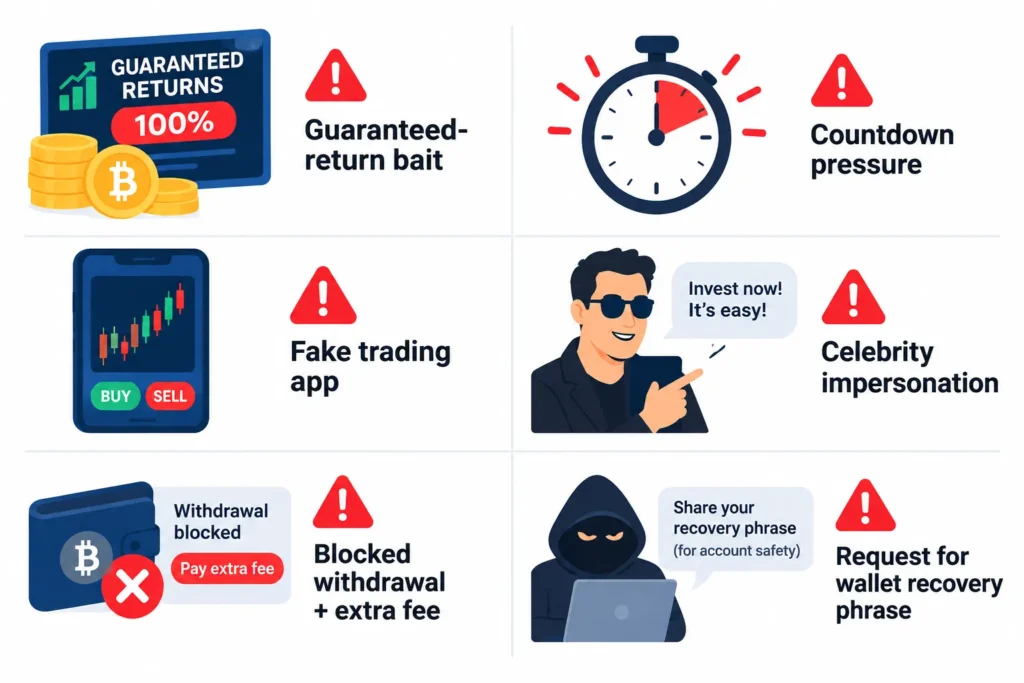
- Returns are described as fixed, certain, risk-free or guaranteed.
- You are pressured to act immediately because an offer is supposedly about to expire.
- A stranger asks for a crypto deposit, wallet connection or advance payment.
- You are told to install an unknown app or remote-access software.
- The website domain differs from the expected address or keeps changing.
- The team, office, business model or trading activity cannot be independently verified.
- Project documents appear copied, vague or inconsistent.
- Withdrawals are blocked despite a visible account balance.
- Extra tax, activation or verification fees are demanded before withdrawal.
- Support staff ask for a password, private key, recovery phrase or one-time password.
Do not rely on appearance alone. A scam can have a professional application, customer-support chat, legal language, fabricated testimonials and an active online community. Pause before transferring funds, verify every claim independently and remember that urgency is often used to prevent careful checking.
How to Check an Offer and Protect Your Wallet Before Paying or Signing
Many crypto scams in India succeed because people act before checking the website, app, message or wallet request. A professional logo or polished advertisement does not prove that an offer is genuine. Before sending money, connecting a wallet or approving a transaction, pause and verify each detail independently.
Check the Exact Website Domain
Fake exchanges and wallet websites often copy the design of well-known platforms. The fraudulent domain may differ from the real one by only one letter, an extra hyphen or a different ending. For example, a scammer may replace a letter with a similar-looking number.
Do not trust a website merely because it appears in a sponsored search result or social media advertisement. Scammers can pay to promote impersonation pages. Instead, confirm the correct domain through multiple trusted sources and type it carefully into the browser. Saving the verified website as a bookmark can reduce the risk of visiting a copied page later.
Before entering a password or connecting a wallet, check:
- The complete domain name, including its spelling and ending.
- Whether the browser has redirected you to a different domain.
- Whether the page creates urgency, such as claiming that your account will be blocked immediately.
- Whether it asks for a recovery phrase, private key or unusual wallet approval.
A padlock symbol or an “https” address does not prove that a website is legitimate. Scam websites can also use encrypted connections.
Verify the App Publisher and Download Source
Fake crypto apps may imitate exchanges, wallets, trading services or investment platforms. Before installing an app, check the publisher’s exact name, developer information, update history and the official platform details.
Do not install an app from a file sent through WhatsApp, Telegram, email or a direct message. Avoid downloading an application simply because a social media account claims it is the “new version” of a popular exchange or wallet.
Even an app-store listing should not be treated as an automatic guarantee of safety. Fraudulent applications may temporarily appear in official stores. Compare the listing with information published through the platform’s verified channels. The supporting guides on crypto exchanges and crypto wallets explain the broader checks beginners should make when choosing these services.
Confirm Social Profiles and Ignore Unsolicited Messages
Scammers create accounts that look almost identical to the profiles of exchanges, token projects, founders and influencers. They may copy profile photographs, usernames, past posts and verification-style symbols.
Be especially careful if someone contacts you first and offers account support, an investment opportunity, a giveaway or help recovering lost crypto. A genuine-looking account can still be an impersonator.
Do not rely on the profile’s follower count or comments. These can be manipulated. Find the project’s official profiles independently and compare the complete username, account history and announcements. If a message claims to come from an exchange, open the exchange through your saved app or verified website rather than using the message link.
Examine the Project and Team Claims
Before buying a token or joining a scheme, ask what the project actually does and whether its claims can be checked. Complicated language is not evidence of a genuine business.
Review the names and professional backgrounds of the team members. Search independently for evidence that these people are connected with the project. Stolen photographs, invented biographies and copied documents are common warning signs.
Also look for independent warnings, complaints and regulatory notices. Do not limit your search to positive reviews supplied by the seller. Reviews, screenshots of profits and celebrity videos can be fabricated or produced using edited media.
Check whether important information is clear, including:
- Who operates the platform or project.
- What product or service it provides.
- How customer funds are handled.
- Which fees, withdrawal limits and lock-in conditions apply.
- Whether the platform’s contact and business details can be verified.
- Whether token supply, ownership and control are explained.
No exchange, wallet, token, investment platform or recovery service should be treated as guaranteed safe. Verification lowers risk, but it cannot remove every technical, business or fraud risk.
Never Share Secret Wallet Credentials
Your private key and wallet recovery phrase can provide full control over your crypto. Anyone who receives them may be able to move the assets without your permission. Transactions generally cannot be reversed merely because the credentials were obtained through deception.
Never enter a recovery phrase into a website opened through an advertisement, email or direct message. Do not send it to a person claiming to be customer support. Legitimate support staff should not ask for your private key, recovery phrase or secret wallet credentials.
Store recovery information securely and away from casual access. Avoid keeping an unprotected photograph or screenshot that could be exposed through a compromised phone or cloud account. For a fuller explanation of storage choices and backups, refer to the crypto wallets supporting guide.
Understand What You Are Signing
A wallet connection is not always harmless. Wallet-draining websites may imitate token claims, airdrops, NFT pages, staking services or exchange login screens. They try to persuade users to sign approvals that allow a malicious address or smart contract to control tokens.
Before confirming any request, check the destination address, blockchain network, amount, token and requested permission. Read the wallet warning carefully. If the request is unclear, unusually broad or unrelated to the action you intended, reject it.
For example, a website offering a small free token should not need unlimited permission to spend valuable assets already in your wallet. An approval can be dangerous even when no payment appears to leave immediately. The approved contract may attempt to move tokens later.
Disconnecting a wallet from a website may not automatically cancel permissions already granted on the blockchain. Review token approvals periodically and revoke permissions that are no longer required. Use established tools appropriate to the relevant network, and verify those tools as carefully as any other crypto website.
Check Addresses in Full and Use Test Transfers
Crypto addresses are long, which makes them difficult to compare. Some attacks place a similar-looking address in your transaction history. This is known as address poisoning. The scammer hopes you will later copy that address from the history and send funds to it.
Do not copy a destination address only from a previous transaction. Obtain it again from a trusted source. Compare the complete address, not only the first and last few characters. Also confirm that the address belongs to the correct blockchain network.
Where fees and platform rules make it practical, send a small test transfer first. Confirm that it reaches the intended recipient before sending a larger amount. A test transfer is not a guarantee, so repeat the address and network checks for the main transfer rather than assuming that every later detail remains unchanged.
Secure the Device and Account Used for Crypto
Wallet checks are less effective if the phone, computer, email account or exchange login is compromised. Keep the operating system, browser, wallet and security software updated. Use a strong, unique password for each important account and enable suitable two-factor authentication where available.
Protect the email account connected to an exchange because it may be used for password resets and withdrawal notices. Review logged-in devices, active sessions and withdrawal addresses regularly. Avoid approving sensitive transactions through public computers or unknown Wi-Fi networks.
Consider separating everyday browsing from higher-value crypto activity. Installing many browser extensions, unofficial trading tools or cracked software increases exposure to malicious programs. The Bitcoin security supporting guide provides additional security practices that can also be useful for other crypto assets.
Use a Final Pause Before You Pay
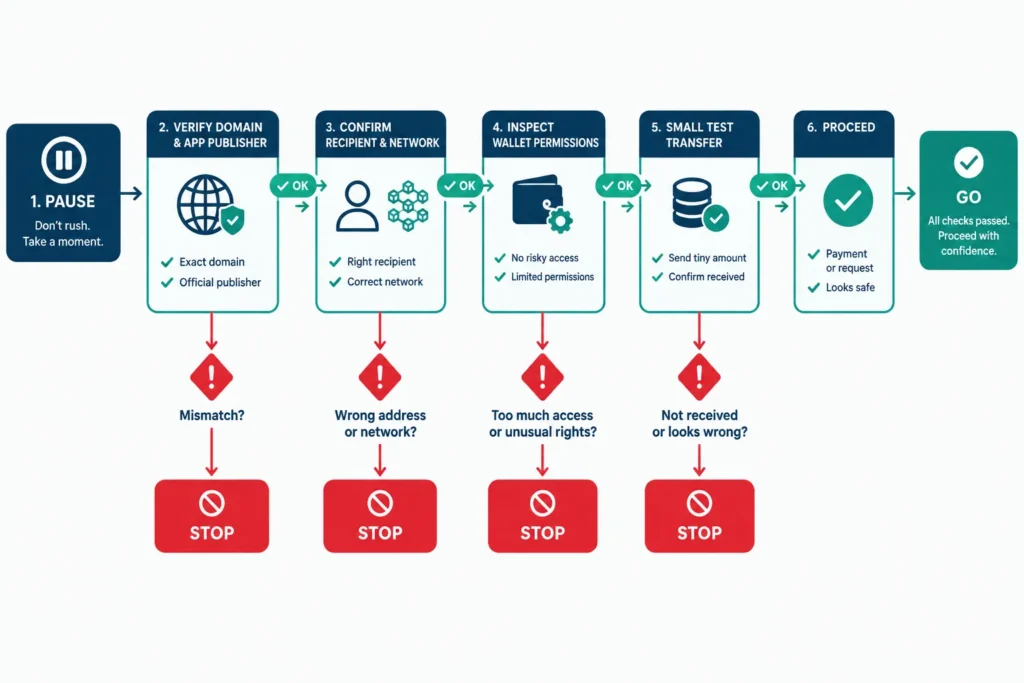
Before sending crypto or signing a wallet request, ask whether you independently verified the platform, domain, recipient and transaction details. Stop if the other person is rushing you, requesting secrecy, promising guaranteed returns or discouraging basic checks.
Crypto scams in India often depend on urgency and confusion rather than advanced technology. A short pause, an independent confirmation and a careful review of every permission can prevent a costly mistake. If any important detail remains unclear, do not pay or sign until it has been properly verified.
What to Do If You Suspect a Crypto Scam
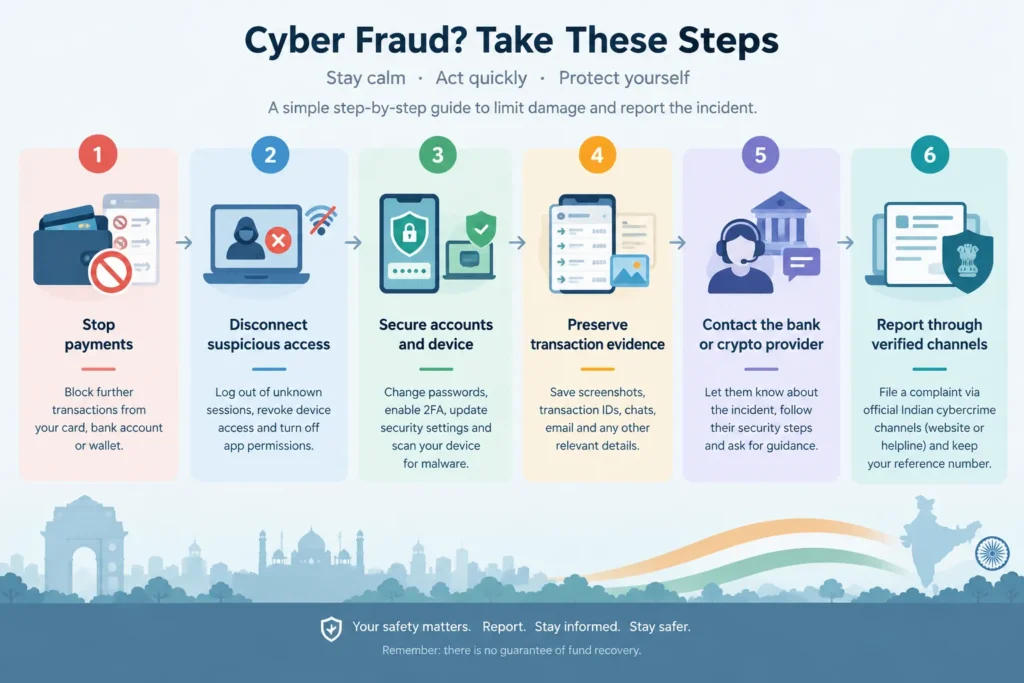
If you think you are dealing with a scam, act quickly but calmly. Do not let the scammer pressure you into making another payment. A request for an extra “verification fee”, “tax payment”, “unlocking charge” or “security deposit” is often an attempt to take more money.
Immediate Action Checklist
- Stop all further payments. Do not send more rupees, cryptocurrency, gift cards or security deposits. Do not borrow money to meet the scammer’s demands.
- Do not trust alleged recovery agents. A person claiming that they can recover your crypto may be the original scammer using a different identity. Never pay an advance fee or send additional cryptocurrency for recovery.
- Disconnect your wallet from suspicious websites. Close the website and remove its connection through your wallet’s connected-sites or authorised-apps settings, where available.
- Revoke risky permissions where safely possible. Some malicious decentralised applications obtain permission to access or spend tokens. Use the wallet’s official tools or a reputable permission-management method. If you are unsure, contact the wallet provider through its verified support channel before taking technical steps.
- Secure unaffected accounts. Protect your email, banking apps, exchange accounts, cloud storage and social media. A scammer may use information from one compromised account to attack another.
- Change exposed passwords. Use a trusted device and create a different, strong password for each account. Change your email password first if your email account may have been compromised.
- Enable stronger authentication. Turn on two-factor authentication where available. An authenticator app or security key may offer better protection than relying only on SMS, depending on the service.
- Check your device. Remove unknown apps, browser extensions and remote-access software. Run security updates and a trusted security scan. If the scammer controlled your screen, assume they may have seen passwords or financial details.
- Contact the relevant provider. Inform your bank, card issuer, UPI or payment provider, crypto exchange, or wallet provider. Use contact details from the provider’s official app or website, not details sent by the suspected scammer.
- Preserve evidence. Save records before deleting messages, blocking accounts or uninstalling suspicious apps. Evidence may help providers, police or cybercrime investigators understand how the fraud occurred.
If you shared a wallet recovery phrase or private key, changing the wallet password alone does not remove the danger. Anyone with the recovery phrase may be able to control the wallet. Seek guidance from the wallet provider’s verified support resources about moving any remaining assets to a newly created secure wallet. Never disclose the new recovery phrase to support staff or anyone offering help.
Do not experiment if doing so could expose more funds. For example, reconnecting a wallet to a suspicious website to “cancel” a transaction may create another opportunity for theft.
Evidence You Should Preserve
Keep copies of as much information as possible. Useful evidence can include:
- Blockchain transaction IDs or transaction hashes
- Sending and receiving wallet addresses
- Exchange account details and order records
- Bank, card, UPI or other payment records
- Screenshots and screen recordings
- Chat messages, SMS messages and social media profiles
- Emails, including full email headers where available
- Phone numbers used by the suspected scammer
- Names and details of apps that were installed
- Website domain names and copied page details
- Advertisements, promotional posts or group invitations
- Dates, times, amounts and a simple sequence of events
- Complaint numbers and replies from banks, exchanges or payment providers
Keep the original files where possible instead of relying only on edited screenshots. Write down what happened while the details are fresh. Do not publicly post recovery phrases, private keys, passwords, identity documents or full financial account details as “proof”. Share sensitive information only through an appropriate official reporting channel.
How to Report Suspected Crypto Fraud in India
Suspected crypto scams in India can be reported through the National Cyber Crime Reporting Portal. India’s official cybercrime helpline, 1930, may also be used for reporting financial cyber fraud. Depending on the circumstances, you may also approach the relevant local police station or cybercrime police channel.
Publication check: Contact details, service availability, reporting categories and procedures can change. The portal name, helpline number, operating arrangements and local reporting process should be checked against current official Indian government or law-enforcement sources immediately before publication. Victims should also confirm current instructions through official sources before sharing personal or financial information.
When making a report, provide clear facts rather than guesses. State how you first contacted the person or platform, what promises were made, how much was sent, which payment method was used, and where the funds went. Include transaction IDs, wallet addresses and payment references where available.
Contact the relevant bank, card issuer or payment provider promptly if rupees were transferred. If cryptocurrency moved through an exchange, report the receiving details to the exchange through its verified support process. A provider may request identity verification, transaction records or a formal complaint reference before reviewing the case.
Prompt reporting can be important, but it does not guarantee that money or cryptocurrency will be returned. The possible response depends on factors such as how the payment was made, whether funds remain with an identifiable provider, how quickly the report was submitted and what action providers or authorities can lawfully take.
Can a Crypto Transaction Be Reversed?
A confirmed blockchain transaction is generally difficult or impossible for an individual to reverse. There is usually no central authority that can simply cancel a transfer because the sender was deceived.
However, this does not mean reporting is pointless. A bank, payment provider, crypto exchange or authority may sometimes be able to act if funds passed through an identifiable account or a centralised platform. They may be able to examine records, restrict an account where legally permitted or assist an investigation. None of these outcomes should be treated as certain.
Beware of Fake Crypto Recovery Services
Scam victims are often targeted again. Fake recovery agents may claim to be lawyers, investigators, exchange employees, government officers, blockchain experts or ethical hackers. Some may already know details of the original loss because the information was shared or sold by scammers.
Be suspicious if a recovery service asks for:
- An advance fee before any action is taken
- More cryptocurrency to “trace” or “unlock” the lost funds
- A wallet recovery phrase, private key or one-time password
- Remote access to your phone or computer
- A payment described as tax, insurance, gas or court clearance
- Secrecy or immediate action without time to verify the claim
- A guaranteed refund or a guaranteed recovery percentage
Do not rely on identity cards, certificates, screenshots or official-looking documents sent by the person offering recovery. Verify organisations independently through current official sources. Genuine authorities and service providers will not need your wallet recovery phrase.
Frequently Asked Questions
How can I recognise a crypto scam?
Common warning signs include guaranteed returns, pressure to act quickly, demands for secrecy, unexpected contact, fake celebrity endorsements, requests for recovery phrases, and repeated fees to release profits or withdrawals. Treat any request to send crypto before receiving a prize, job income, investment return or account release with caution.
Can cryptocurrency transactions be reversed?
Confirmed blockchain transactions are generally not reversible by the sender. A provider or authority may sometimes be able to act if funds move through an identifiable exchange, bank or payment account, but recovery is not guaranteed.
What should I do after sending funds to a scammer?
Stop sending money, save evidence, secure your accounts and devices, and contact the relevant bank, payment provider, exchange or wallet provider. Report the incident promptly through the appropriate official cybercrime and law-enforcement channels.
How do I report suspected crypto fraud in India?
You can use the National Cyber Crime Reporting Portal and the official cybercrime helpline 1930, subject to current official availability and procedures. You may also contact the relevant local police or cybercrime police channel. Verify all details through current official government or law-enforcement sources before reporting.
How can I avoid fake recovery services?
Reject guaranteed recovery claims and do not pay advance fees, send extra crypto, install remote-access software or disclose a recovery phrase. Verify any organisation independently. Remember that someone knowing details of your loss does not prove that they are genuine.
Summary
If you suspect a crypto scam, stop all payments and secure your wallet, accounts and devices. Preserve transaction records, messages and other evidence. Contact the relevant financial or crypto provider and report the incident through verified official channels in India. Act promptly, but remain realistic: blockchain transfers are usually hard to reverse, and nobody can honestly guarantee recovery. Be especially careful of recovery agents who demand fees, remote access or secret wallet information.
Comments