


Bitcoin and Ethereum are separate blockchain networks built for different original purposes. Bitcoin mainly focuses on peer-to-peer value transfer through its native asset, bitcoin or BTC. Ethereum is a programmable blockchain designed to run smart contracts and decentralized applications. Its native asset is Ether, commonly written as ETH.
Bitcoin uses proof of work, where miners use computing power to propose valid blocks and protect the network. Ethereum’s main network uses proof of stake, where validators lock ETH to participate in block creation and verification. Both networks can process digital asset transfers, but Ethereum supports a broader range of programmable activity. Neither system offers instant or risk-free settlement in every situation.
Introduction
Bitcoin and Ethereum are the two best-known public blockchain networks, but comparing them only by their market prices can be misleading. They were created with different priorities, use different methods to secure their networks, and support different types of activity.
Bitcoin was designed as a peer-to-peer electronic cash system that does not require a bank or another central operator to approve every transfer. Over time, many users also began treating BTC as a scarce monetary asset and a long-term store-of-value candidate. That treatment is a market belief, not a guarantee that its price will remain stable or rise.
Ethereum was designed as a more general programmable network. Along with sending ETH, users can interact with smart contracts that power tokens, exchanges, lending applications, games and other blockchain-based services.
This difference is central to any beginner-level Bitcoin vs Ethereum comparison. They overlap in some areas, but they are not direct substitutes in every use case. Someone transferring BTC, for example, is not necessarily trying to perform the same task as someone using ETH to interact with a decentralized application.
Readers who need the wider context can first refer to Cryptocurrency in India: A Complete Beginner’s Guide to Crypto. For deeper background on the first network, see Bitcoin Explained: How It Works, Its Uses and Risks for Beginners. The basic record-keeping concept is covered separately in What Is Blockchain Technology? How It Works and Its Real-World Uses.
Bitcoin and Ethereum: Purpose, Assets and Core Technology
What Is Bitcoin?
Bitcoin is a public, decentralised network for recording and transferring value. It began operating in 2009 based on the design published under the name Satoshi Nakamoto. No single bank, company or government maintains Bitcoin’s central ledger. Instead, computers running Bitcoin software independently check transactions and maintain compatible copies of the blockchain.
The network’s native asset is bitcoin, represented by the ticker BTC. In everyday writing, “Bitcoin” with a capital B often refers to the network or protocol, while “bitcoin” may refer to the asset. The distinction is useful, although people do not always follow it consistently.
BTC can be sent from one Bitcoin address to another without relying on a conventional bank-transfer system. A valid transfer must follow the protocol’s rules, including the requirement for an appropriate digital signature showing that the spender controls the relevant private key.
Bitcoin’s design gives particular importance to predictable issuance, transaction verification and resistance to unauthorised changes. Its maximum supply is governed by protocol rules, although that feature alone does not make BTC safe or ensure demand for it.
Many people describe BTC as “digital gold” because of its limited issuance and its use as a monetary asset. Others use it for cross-border transfers or as a high-risk investment. In India, an investor might buy a small fraction of BTC through a crypto platform rather than purchasing one whole bitcoin. BTC is divisible, so ownership does not require buying a full unit.
What Are Ethereum and Ether?
Ethereum is a public blockchain network built to support programmable smart contracts. It started operating in 2015. Its native asset is Ether, with the ticker ETH.
People commonly say that they have “bought Ethereum.” In most cases, they mean that they have bought ETH. Ethereum is the network and technology, while Ether is the asset used within that network. The distinction is similar to separating a payment network from the unit transferred over it, although Ethereum performs more functions than a standard payment system.
ETH is used to pay transaction fees on Ethereum. It may also be transferred as an asset, used within blockchain applications, or staked to help secure the network. The amount of ETH required for a transaction depends partly on the computation involved and current demand for block space.
Ethereum’s main feature is programmability. Developers can publish smart contracts, which are programs stored and executed on the blockchain. Once deployed, these contracts can perform actions according to their code, such as exchanging tokens or managing digital ownership.
The word “smart” does not mean that a contract understands legal intent or can judge whether an outcome is fair. It follows its code. A programming error, unsafe design or malicious feature can therefore cause financial loss.
Different Original Goals
Bitcoin’s original goal centred on peer-to-peer electronic value transfer. Its design generally favours a narrower and more conservative base layer, with changes considered carefully because the network is expected to protect a monetary asset.
Ethereum’s original goal was broader: to provide a general-purpose platform on which developers could build decentralised applications. It records ETH transfers, but it can also process instructions sent to smart contracts.
| Feature | Bitcoin | Ethereum |
|---|---|---|
| Native asset | Bitcoin or BTC | Ether or ETH |
| Original emphasis | Peer-to-peer value transfer | Programmable smart contracts and applications |
| Current consensus method | Proof of work | Proof of stake |
| Block participants | Miners | Validators |
| Typical on-chain activity | BTC transfers and related data | ETH transfers, token activity and smart-contract execution |
This comparison describes their main design emphasis, not a strict boundary. Bitcoin can support additional functionality through scripts and systems built around it. Ethereum can also be used for straightforward value transfers. The networks simply make different trade-offs about flexibility, complexity and how their base layers should operate.
How Their Network Architecture Differs
Both networks group valid transactions into blocks and link those blocks to earlier records. Independent computers called nodes use protocol rules to check the chain. A node does not need to trust every message it receives; it can reject data that fails the rules enforced by its software.
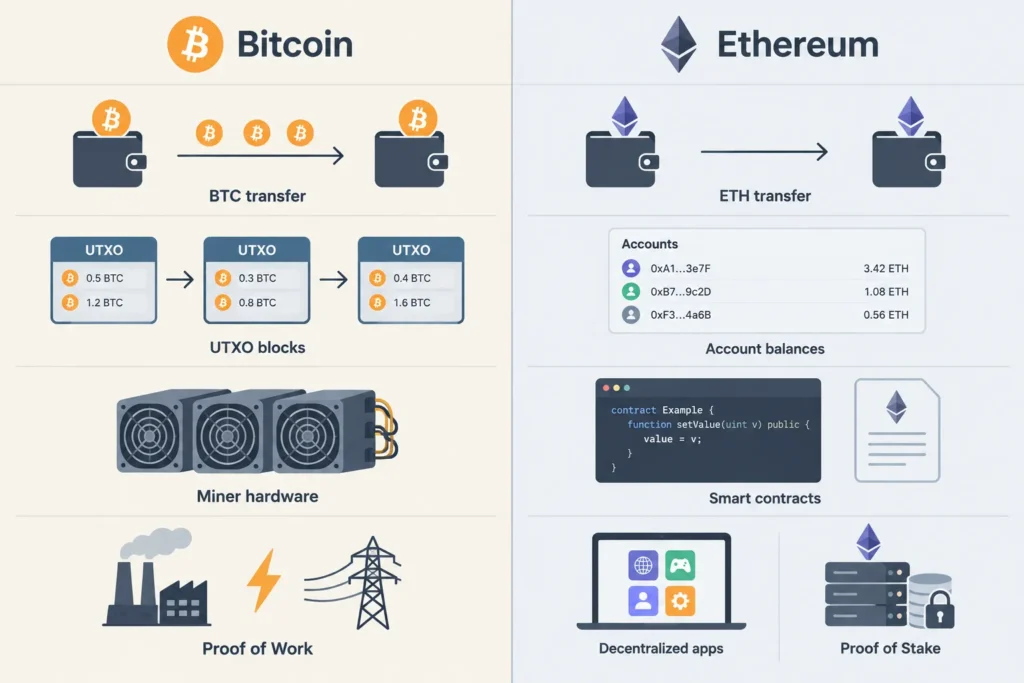
Bitcoin mainly tracks spendable transaction outputs. When BTC is transferred, a transaction uses earlier outputs as inputs and creates new outputs. This model is commonly called the unspent transaction output, or UTXO, model.
Ethereum uses an account-based model. It tracks accounts, balances and the current condition, or “state,” of smart contracts. A transaction can transfer ETH or ask a smart contract to execute instructions. The network then updates its shared state if the transaction is valid.
For a beginner, the practical point is simple: Bitcoin is structured primarily around securely tracking BTC ownership and spending, while Ethereum also maintains the changing state of programs running on its network.
Bitcoin Mining and Proof of Work
Bitcoin uses proof of work to decide how new blocks are proposed and to make rewriting confirmed history difficult. Miners collect transactions, build candidate blocks and repeatedly perform calculations in an attempt to find a valid proof.
The miner that finds a valid proof can broadcast its block. Other nodes verify the block rather than accepting it blindly. If it follows Bitcoin’s rules, it may become part of the chain. The successful miner can receive newly issued BTC and transaction fees, subject to the protocol’s conditions.
Mining requires specialised equipment and electricity. It should not be confused with simply running a Bitcoin node. A node checks the rules, while a miner competes to add blocks under proof of work.
Ethereum Validators and Proof of Stake
Ethereum’s current mainnet uses proof of stake, not mining. The network made this transition in 2022. Validators deposit ETH into the protocol and use validator software to participate in proposing and attesting to blocks.
A validator may be selected to propose a block, while other validators attest that the block is valid according to the network rules. Honest participation can earn protocol rewards. Failing to perform required duties may result in missed rewards or penalties, while certain seriously dishonest actions can lead to a portion of the staked ETH being removed through a process known as slashing.
Proof of stake does not require miners to compete through the same energy-intensive calculations used in Bitcoin’s proof of work. However, it introduces its own technical structure, staking requirements and operational risks.
Confirmations and Finality
A transaction appearing in a block is an important step, but users should not automatically treat every new transaction as instantly irreversible. Networks can experience temporary competing blocks, software issues, congestion or other disruptions.
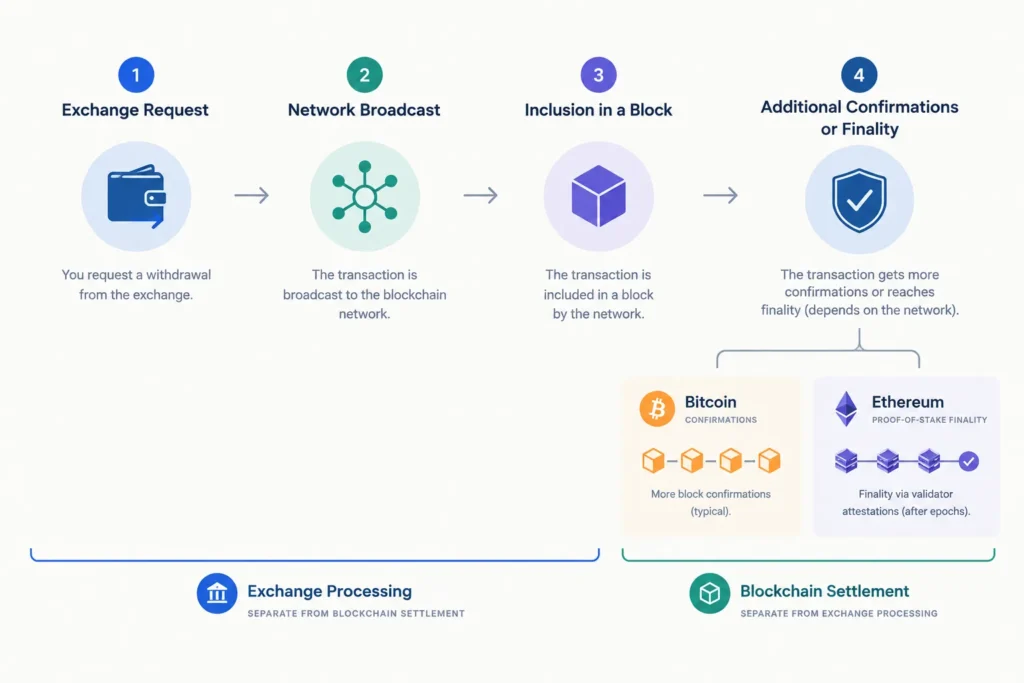
On Bitcoin, each block added after the block containing a transaction is commonly described as another confirmation. More confirmations generally make a transaction harder to reverse through a competing chain, but the appropriate waiting period depends on the amount, context and risk tolerance.
Ethereum also gives transactions confirmations as additional blocks are added. Its proof-of-stake system includes protocol checkpoints that can become finalised after sufficient validator agreement. Finality provides stronger assurance that the included history will not be changed under normal protocol operation, but users still need to consider wallet errors, smart-contract failures and service-level delays.
An Indian buyer withdrawing BTC or ETH from an exchange may therefore see several stages: the platform processes the request, the transaction reaches the network, it is included in a block, and additional confirmations or finality follow. The exchange or receiving service may apply its own waiting rules. Blockchain settlement is not the same as an instant or guaranteed bank credit.
Uses, Fees, Supply Policies, Wallets and Practical Differences
The practical differences between Bitcoin and Ethereum become clearer when you look at what each network is designed to do. Bitcoin mainly focuses on transferring and holding its native asset, bitcoin. Ethereum is a programmable network that supports ether as well as smart contracts, tokens and applications.
This does not mean that one network is better for every user. The right choice depends on what you want to do, what risks you can accept and whether you understand the network you are using.
Bitcoin vs Ethereum: Main Comparison
| Feature | Bitcoin | Ethereum |
|---|---|---|
| Main purpose | A peer-to-peer system for transferring bitcoin, with a strong focus on security and predictable issuance rules | A programmable blockchain for transferring value and running smart contracts and applications |
| Native asset | Bitcoin, commonly shown as BTC | Ether, commonly shown as ETH |
| Consensus | Proof of Work, where miners use computing power to secure the network | Proof of Stake, where validators lock ETH to help secure the network |
| Smart-contract capabilities | Limited scripting designed mainly around secure bitcoin transactions | Broad smart-contract functionality for tokens and decentralized applications |
| Typical uses | Sending BTC, receiving BTC and holding a scarce digital asset | Sending ETH, paying network fees, using applications, issuing tokens, trading NFTs and accessing decentralized finance |
| Transaction fees | Depend on network demand, transaction size and the urgency selected by the sender | Depend on network demand, the computation required and the fee settings chosen by the user |
| Supply policy | Issuance reduces over time, with a protocol maximum of 21 million BTC | No fixed maximum supply; new ETH may be issued while part of transaction fees may be burned |
| Major risks | Price volatility, loss of private keys, transfer mistakes, exchange risk and changing regulation | Price volatility, wallet and transfer mistakes, smart-contract failures, scams, application risk and changing regulation |
What Is Bitcoin Commonly Used For?
Bitcoin is commonly used to transfer value without relying on a bank to record the transaction. For example, one person can send BTC from a personal wallet to another person’s Bitcoin address. The network verifies and records the transfer.
Some people also buy and hold bitcoin because its issuance follows a limited schedule. They may view it as a scarce digital asset. However, scarcity does not guarantee that bitcoin will preserve its value. Its market price can rise or fall sharply, and demand can change.
Bitcoin’s design is relatively focused. It can support certain additional functions, but its main use remains the ownership and transfer of BTC. This narrower focus is one reason many beginners describe Bitcoin as a digital asset network rather than a general application platform.
What Is Ethereum Commonly Used For?
Ethereum supports transfers of ETH, but it also allows developers to create smart contracts. A smart contract is code stored on a blockchain that can carry out defined actions when its conditions are met.
Smart contracts allow Ethereum to support a wider programmable ecosystem. Common uses include:
- Tokens: Developers can create digital assets that operate on Ethereum rather than building a separate blockchain.
- Decentralized applications: Users can interact with blockchain-based services through an Ethereum-compatible wallet.
- NFTs: Non-fungible tokens can represent distinct digital items or records, although ownership of an NFT does not automatically provide copyright or legal ownership of related content.
- Decentralized finance: DeFi applications may allow activities such as exchanging tokens, lending assets or providing liquidity without a traditional financial intermediary.
These uses can be technically and financially risky. A smart contract may contain faulty code, an application may be poorly designed, and a token may have little practical value. Beginners should understand approvals, fees and contract risks before connecting a wallet or depositing funds. These concepts are covered in more detail in Smart Contracts Explained: How They Work, Uses and Risks.
DeFi is more directly associated with Ethereum and networks that use similar smart-contract technology. Bitcoin itself is not usually used in the same way within these applications. Some DeFi systems use tokens that represent bitcoin held elsewhere, often called wrapped or tokenised bitcoin.
Such representations introduce additional risks. Users may depend on a custodian, bridge, smart contract or redemption process. A token representing bitcoin is not necessarily the same as holding native BTC directly on the Bitcoin network.
Why Ethereum’s Wider Ecosystem Does Not Make It Universally Better
Ethereum’s programmability supports more types of activity, but greater flexibility also creates more complexity. Users may face malicious tokens, unsafe smart contracts, confusing wallet approvals and applications that fail or disappear.
Bitcoin has fewer application features, but some users prefer its narrower purpose and established monetary rules. Ethereum may be more suitable for someone who wants to use blockchain applications, while Bitcoin may be more suitable for someone who only wants to transfer or hold BTC.
Neither conclusion is automatic. Both assets are volatile, and both require careful handling of wallets, recovery phrases and transfer details.
How Bitcoin and Ethereum Fees Differ
Bitcoin transaction fees are generally influenced by network demand and the amount of transaction data. A transaction using several previous payments as inputs may require more data and can cost more than a simpler transfer. Users may also choose a higher fee when they want miners to prioritise the transaction.
Ethereum fees are often called gas fees. The amount depends on network demand and the complexity of the action. Sending ETH is usually simpler than exchanging tokens through a decentralized application. A complex smart-contract transaction can therefore cost more than a basic ETH transfer.
Neither network has one permanent fee or guaranteed processing time. Costs and confirmation times can change with congestion, transaction design and fee settings. An exchange may also charge its own withdrawal fee, which is separate from the underlying blockchain fee.
For an Indian user, the amount shown in rupees can also change with the market price of BTC or ETH. Always check the final withdrawal screen rather than assuming that the fee will match a previous transaction.
Supply Policies: Fixed Limit Versus Issuance and Burning
Bitcoin’s protocol sets a maximum limit of 21 million BTC. New bitcoin is issued to miners, and the amount issued per block reduces at scheduled intervals. The limit is an important part of Bitcoin’s design, but it does not guarantee a higher future price.
Ethereum follows a different model. Validators may receive newly issued ETH for helping secure the network. At the same time, part of the transaction fee paid by users is burned, meaning that it is removed from circulation.
The relationship between new issuance and fee burning can vary with network activity. Ethereum does not have Bitcoin’s fixed maximum supply. Its supply may grow or shrink over a period depending on issuance and burning.
Protocol rules can also develop through community and software changes. Investors should not assume that current rules guarantee a specific future supply, price or return.
Bitcoin Wallets and Ethereum-Compatible Wallets
A Bitcoin wallet manages keys and addresses used on the Bitcoin network. An Ethereum-compatible wallet manages an Ethereum address and can often display ETH, tokens and interactions with smart contracts.
An address that looks valid is not enough to make a transfer safe. The asset, withdrawal network and destination wallet must all be compatible. This is especially important when withdrawing from an Indian crypto exchange, because an exchange may offer more than one network for the same asset.
For example, suppose Priya wants to withdraw ETH from an exchange to her personal wallet. Before confirming, she should:
- Check that the selected asset is ETH.
- Confirm which withdrawal network the exchange will use.
- Make sure her destination wallet supports ETH on that exact network.
- Copy the address carefully and compare its first and last characters.
- Review the fee and the final amount she will receive.
- Consider sending a small test amount first, if the fees and exchange limits make this practical.
If Priya selects an incompatible network, the funds may not appear where expected and recovery may be difficult or impossible. The same caution applies when sending BTC: use a supported Bitcoin address and verify that the withdrawal is taking place on the intended Bitcoin network.
Blockchain transfers are generally not reversible through a bank-style complaint process. Careful checks before pressing “Confirm” are therefore more useful than trying to correct a transfer afterwards.
Benefits, Risks, India Considerations and Beginner FAQ
Bitcoin and Ethereum are established crypto networks, but neither is risk-free. They have different purposes, technologies and trade-offs. A beginner should compare them based on how they work rather than assuming that one must be “better” than the other.
Potential Benefits of Bitcoin
Bitcoin is mainly designed to transfer and hold a scarce digital asset without requiring a central bank or payment company to maintain the network.
- Clear primary purpose: Bitcoin mainly focuses on peer-to-peer value transfer and digital scarcity.
- Predictable supply rules: Its protocol sets a maximum supply of 21 million bitcoin, although the release of new coins continues gradually through mining.
- Large and distributed network: Independent miners and node operators participate across different countries.
- Relatively simple base layer: Bitcoin supports programmable transactions, but its base network is less focused on complex applications than Ethereum.
These features do not guarantee that BTC will maintain or increase its price. A scarce asset can still experience falling demand, regulatory pressure, technical problems or severe market volatility.
Potential Benefits of Ethereum
Ethereum is a programmable blockchain. It allows developers to create smart contracts, tokens and decentralised applications. ETH is the network’s native crypto asset and is used to pay transaction fees and support its proof-of-stake system.
- Broad range of uses: Ethereum can support payments, decentralised finance, digital collectibles, stablecoins and other blockchain applications.
- Smart-contract functionality: Programs can automatically execute defined actions when their conditions are met.
- Developer ecosystem: Developers can build applications and token systems on top of the network.
- Proof-of-stake consensus: Validators stake ETH to help process transactions and secure the network.
Greater programmability also introduces more complexity. An Ethereum-based application may have smart-contract bugs, unsafe token designs, malicious administrators or risky links with other protocols. The Ethereum network functioning correctly does not make every application or token built on it safe.
Understand the Different Layers of Risk

Crypto losses are often described as a “Bitcoin hack” or an “Ethereum hack” even when the underlying network was not compromised. Beginners should separate network security from the security of exchanges, wallets, applications and personal accounts.
- Network-level risk: This includes failures or attacks affecting the blockchain’s consensus rules, transaction processing or core software. A widely distributed network may be difficult to attack, but no software-based system should be treated as infallible.
- Exchange failure: An exchange can be hacked, become insolvent, freeze withdrawals or misuse customer assets. This can happen even while Bitcoin and Ethereum continue operating normally.
- Custodial risk: When a platform controls the private keys, the customer depends on that platform to protect and return the crypto.
- Wallet loss: Losing a recovery phrase or private key can make self-custodied crypto permanently inaccessible. There is usually no central help desk that can restore it.
- Phishing and scams: Fake websites, support messages, giveaways and investment schemes may trick users into revealing credentials or sending crypto.
- Malicious approvals: An Ethereum user may unknowingly permit a smart contract to access tokens in a wallet. That approval can later be used to remove assets.
- Smart-contract bugs: Coding errors or flawed economic designs can lead to losses in decentralised applications.
- Software vulnerabilities: Wallets, browser extensions, mobile devices and applications may contain security weaknesses.
- User mistakes: Sending funds to the wrong address or using the wrong network may lead to an irreversible loss.
Transaction finality is useful because payments cannot be casually reversed. However, the same feature can be dangerous when a user makes a mistake or is deceived. Crypto should never be treated like a bank deposit with automatic recovery or guaranteed protection.
Price, Regulatory and Permanent-Loss Risks
BTC and ETH prices can rise or fall sharply within a short period. Their prices depend on market demand, liquidity, investor sentiment, technology developments, macroeconomic conditions and regulatory events. Past returns do not prove that similar returns will occur in the future.
Regulatory uncertainty is another important risk. Governments can change how crypto trading, custody, advertising, taxation or transfers are treated. Rules may also differ between countries, affecting access and market prices.
Permanent loss is possible. It may result from a price collapse, an exchange failure, a forgotten recovery phrase, a scam, a faulty smart contract or a transfer to an incorrect address. A buyer should consider this possibility before committing money.
Common Misconceptions to Avoid
- “Bitcoin is fully anonymous.” Bitcoin addresses do not normally display a person’s name, but transactions are recorded on a public blockchain. Address activity may sometimes be linked to a person through exchange records or blockchain analysis.
- “Ethereum still uses proof of work.” Ethereum’s main network moved to proof of stake in 2022. It is no longer secured through proof-of-work mining.
- “ETH and Ethereum mean exactly the same thing.” Ethereum is the network and technology platform. ETH, also called ether, is its native crypto asset.
- “Every Ethereum token is safe.” Anyone with suitable technical knowledge may create a token. Its presence on Ethereum does not mean that Ethereum developers have verified or approved it.
- “A major blockchain has no risk.” Both networks have technical, economic, custody and user-level risks.
- “Strong past performance guarantees future profit.” Historical price gains provide no assurance about future demand or returns.
A Beginner Framework for Comparing Crypto Projects
The same basic checklist can be used for Bitcoin, Ethereum or another crypto project. It helps shift attention away from price predictions and promotional claims.
- Purpose: What problem is the project intended to solve? Is the use case clear?
- Users: Who uses the network, and why do they need its native asset?
- Technology: What can the network do, and what are its important technical limits?
- Consensus: Does it use proof of work, proof of stake or another method? Who validates transactions?
- Decentralisation trade-offs: How easy is it to run a node or become a validator? Is power concentrated among a few operators, developers or service providers?
- Security assumptions: What must remain honest or operational for the system to work as intended?
- Development activity: Is the software actively maintained? Are upgrades, vulnerabilities and disagreements handled transparently?
- Custody requirements: Will the asset be held on an exchange or in a personal wallet? Who controls the private keys?
- Fees: How are transaction charges calculated, and can they become expensive during busy periods?
- Risks: Consider volatility, scams, software bugs, regulation, liquidity and the possibility of permanent loss.
No single metric provides a complete answer. For example, a network may offer more functions but also create more complexity. Another may have a narrower purpose but still face price, custody and regulatory risks.
India-Specific Tax and Regulatory Note
Indian residents should not assume that crypto transactions are unreported or tax-free. Buying, selling, exchanging, transferring or earning crypto may create tax, tax deducted at source, record-keeping and income-tax return considerations, depending on the transaction and the rules in force.
Crypto tax, TDS, reporting requirements and regulatory treatment in India can change. At publication time and whenever this article is updated, the applicable position should be verified against current material from the Income Tax Department, the Ministry of Finance and other relevant government or regulatory sources. Platform summaries should not replace official guidance or professional advice for a person’s specific circumstances.
For detailed tax coverage, read Cryptocurrency Tax in India: Tax Rules, TDS and ITR Filing Guide. For wallet safety, scam prevention and wider risk controls, read Cryptocurrency Risks: Common Dangers and How to Invest Safely.
Frequently Asked Questions
What is the main difference between Bitcoin and Ethereum?
Bitcoin primarily operates as a network for transferring and holding BTC, a scarce digital asset. Ethereum is a programmable network designed to run smart contracts and decentralised applications as well as transfer value.
What is the difference between BTC and ETH?
BTC is the native asset of the Bitcoin network. ETH is the native asset of the Ethereum network. BTC is used mainly for value transfer and network transaction fees. ETH is used for transaction fees, smart-contract activity and staking within Ethereum’s proof-of-stake system.
Is Ethereum a cryptocurrency?
Ethereum is the blockchain network, not technically the name of its native asset. The cryptocurrency is ether, commonly identified by the ticker ETH. In everyday conversation, however, people often use “Ethereum” when referring to ETH.
Do both networks use mining?
No. Bitcoin uses proof of work, in which miners use computing equipment and electricity to compete to add blocks. Ethereum uses proof of stake, in which validators stake ETH and participate in transaction validation. Ethereum ended proof-of-work mining on its main network in 2022.
How do their uses differ?
Bitcoin is mainly used to transfer and hold BTC. Ethereum supports ETH transfers but also runs smart contracts, tokens and decentralised applications. These wider functions can enable more use cases while introducing additional application and smart-contract risks.
Summary
The Bitcoin vs Ethereum comparison is not simply a choice between two coins. Bitcoin focuses on digital scarcity and value transfer through proof-of-work mining. Ethereum provides a programmable platform secured through proof of stake, while ETH pays fees and supports staking.
Both networks may offer useful features, but both involve volatility, regulation, custody, software and user risks. Network security does not protect users from every exchange failure, scam, lost key or unsafe application. Beginners should compare purpose, technology, consensus, custody, fees and risks, verify current Indian rules, and avoid treating past price performance as a promise of future returns.


Comments