


What Is Blockchain Technology? How It Works and Its Real-World Uses

A simple guide to blockchain technology for Indian beginners, covering how it works, how networks verify transactions, key blockchain types, real-world uses, benefits and limitations.

What Is Blockchain Technology? How It Works and Its Real-World Uses

What Is Blockchain Technology?

Blockchain technology is a way of keeping shared digital records. Instead of one organisation holding the only official copy, multiple computers can store and check copies of the same record.

Transactions are collected into groups called blocks. Each block contains a cryptographic reference to an earlier block, creating an ordered chain of records. If someone later changes an old record, the cryptographic references may no longer match, making the alteration detectable.

A blockchain is therefore often described as a distributed, tamper-evident ledger. However, it is not automatically private, error-free or impossible to attack. Its security depends on its design, network participants, governance rules and how people use it.

Introduction

Most financial records are maintained by a central authority. A bank records account balances, a stock exchange records trades, and a company records payments to suppliers. Customers and business partners generally depend on that organisation to maintain the correct information.

Blockchain uses a different approach. It allows a network of computers to maintain a shared transaction history according to agreed rules. Participants may not need to rely on one central record-keeper, although some blockchains still have an organisation or a small group controlling important decisions.

Blockchain became widely known because it supports cryptocurrencies such as Bitcoin. But blockchain and cryptocurrency are not the same thing. Cryptocurrency is one possible application, while blockchain is the underlying record-keeping approach. Readers who want the wider crypto context can refer to Cryptocurrency in India: A Complete Beginner’s Guide to Crypto.

To understand what blockchain technology is, it helps to begin with five basic ideas: transactions, blocks, cryptographic hashes, nodes and distributed networks.

Blockchain Basics: Blocks, Transactions and Distributed Records

What Is a Transaction?

A transaction is a proposed change to the shared record. Depending on the blockchain, it might represent the transfer of a cryptocurrency, the movement of a digital asset, or an update to information managed by the network.

For example, imagine an Indian business transfers a digital asset to a supplier. The transaction may state that a particular digital asset is moving from the business’s blockchain address to the supplier’s address.

The business normally authorises the transaction using a private cryptographic key. This key works somewhat like a highly sensitive digital signing tool. It should not be confused with an ATM PIN or password, and it must be protected carefully. If another person gains control of the key, they may be able to authorise transactions.

Creating a transaction does not necessarily mean it is immediately final. It must first be sent to the network and checked under that blockchain’s rules.

What Is a Block?

A block is a bundle of transaction data and related information. Instead of adding each transaction independently to the permanent history, many blockchain systems organise confirmed transactions into blocks.

A block commonly contains:

  • Details or references for the transactions included in it.
  • A time-related marker or other ordering information.
  • A cryptographic reference connected to an earlier block.
  • Additional information required by the network’s rules.

The exact contents vary. Bitcoin blocks are not identical to blocks used by Ethereum or a private business network. Some systems also use structures that do not fit the simplest block-and-chain description.

What Is a Cryptographic Hash?

A cryptographic hash is a digital fingerprint produced from data. A hash function takes information as input and creates an output of a fixed format.

Even a small change to the original information usually produces a very different hash. This feature helps a network identify whether recorded data has been altered.

A hash is not the same as encryption. Encryption is generally designed so authorised users can recover the original information with the correct key. A cryptographic hash is generally intended to be a one-way result rather than a reversible copy of the data.

In a blockchain, each new block usually includes a reference derived from an earlier block’s data. This connection creates the chain. If an old block is changed, its hash may change too. The reference stored in the next block would then fail to match, revealing an inconsistency.

What Are Nodes and a Distributed Network?

A node is a computer or device participating in a blockchain network. Depending on the system, a node may receive transactions, check them, store blockchain data, help create blocks or perform only some of these tasks.

A distributed network has participants operating from multiple computers or locations. Rather than keeping the only copy of the ledger on one company server, the network can maintain several copies.

This does not mean every participant always stores every piece of information. Some nodes keep the full history, while lighter participants may store less data and request information when needed. The arrangement depends on the blockchain’s architecture.

Blockchains can also differ in who is allowed to participate. A public blockchain may permit broad participation. A private or permissioned blockchain can restrict access to approved companies, banks, government bodies or other identified members.

How a Blockchain Transaction May Work
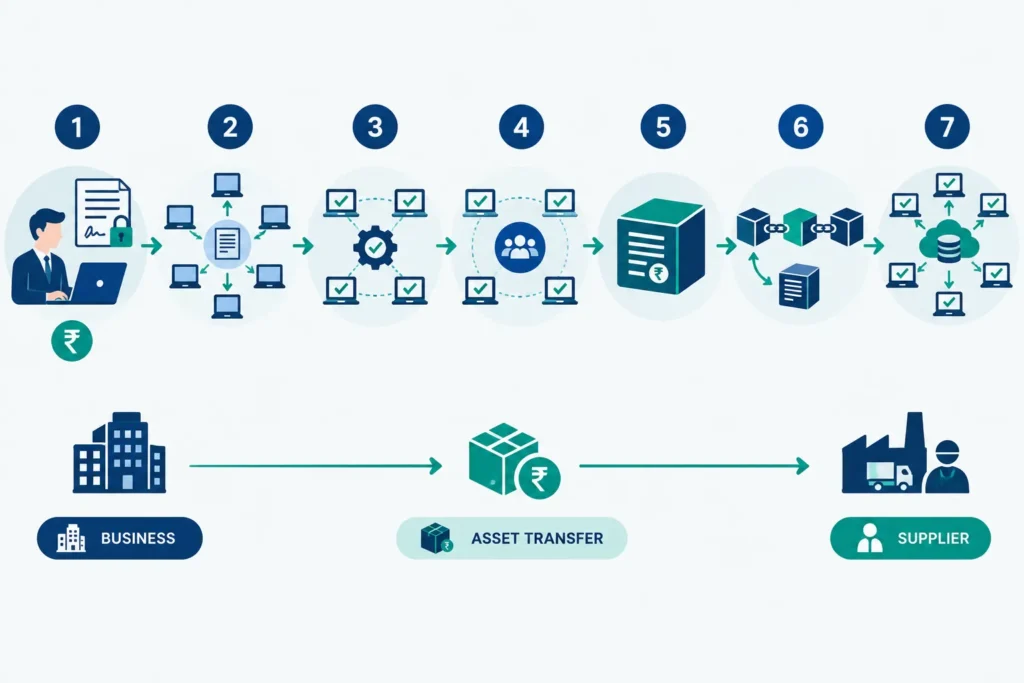
Flowchart showing a transaction being signed, verified, added to a block and shared across nodes

Consider the earlier example of an Indian business transferring a digital asset to a supplier. A simplified process could look like this:

  1. The transaction is created: The business enters the supplier’s blockchain address, selects the digital asset and authorises the transfer.
  2. The transaction is shared: The transaction request is broadcast or submitted to nodes on the network.
  3. Network rules are checked: Participating nodes may verify the digital signature, confirm that the sender can transfer the asset and check that the transaction follows the protocol.
  4. The transaction is confirmed: The blockchain’s consensus process determines which valid transactions are accepted and in what order.
  5. The transaction enters a block: The accepted transaction is included with other transactions in a new block.
  6. The block is connected: The new block contains a cryptographic reference to an earlier block and becomes part of the shared history.
  7. Records are updated: Relevant nodes update their copies of the ledger according to the accepted block.
You May Also Like:Smart Contracts Explained: How They Work, Uses and Risks

This is an illustration, not a universal sequence. Confirmation methods, waiting times, transaction fees and finality rules can vary significantly between networks.

Why Old Changes Can Be Detected

Suppose someone tries to edit the old record and show that the Indian business transferred the asset to a different recipient. Altering that data would generally change the block’s cryptographic fingerprint.

Because later blocks refer to earlier blocks, the alteration could break the chain of matching references. Other nodes may still hold the accepted version and reject the changed record because it does not follow the network’s history or consensus rules.

The more records added after a transaction, the more work an attacker may need to do to replace the accepted history in some blockchain designs. But the practical level of protection depends on factors such as the consensus method, the number and independence of participants, software quality and the concentration of control.

Tamper-Evident Does Not Mean Impossible to Hack

Blockchain records are commonly called immutable, but beginners should interpret that word carefully. In practice, blockchain data may be difficult to alter without detection rather than literally impossible to change.

A network can still face software bugs, stolen private keys, dishonest participants, governance disputes or attacks on applications connected to it. If a user sends an asset to the wrong address, the blockchain may accurately preserve that mistaken transaction.

Some networks can also reverse or reorganise records under particular conditions. Administrators of a permissioned blockchain may have powers that do not exist on a decentralised public network. Security claims must therefore be evaluated for the specific system.

Blockchain Versus a Traditional Database
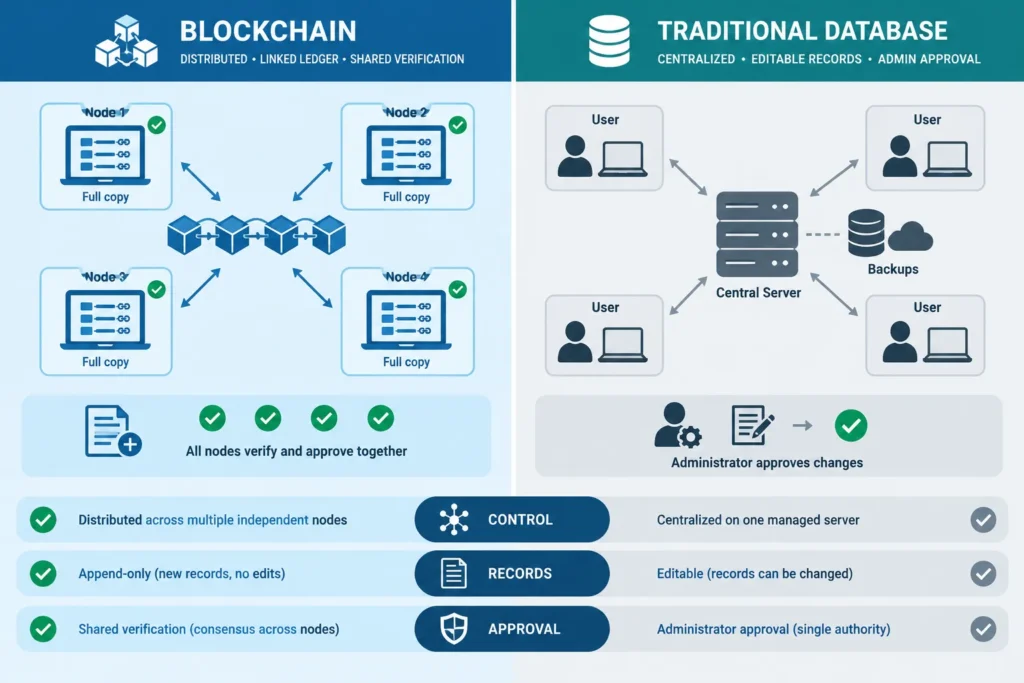
Comparison of a distributed blockchain ledger and a centrally controlled traditional database

Point Blockchain Traditional database
Control Updates may be governed by shared network rules or approved participants. One organisation usually controls the database and its administrators.
Copies of records Multiple nodes may store and check copies of the ledger. The organisation may use central servers, backups and replicas under its control.
Updating data Accepted transactions are added according to a consensus process. Authorised administrators or applications can usually add, edit or delete data directly.
Transparency Records may be publicly visible or limited to approved members. Access is normally decided by the database owner.
Performance and cost Shared verification can add delay, complexity and expense. Central control can make processing faster, cheaper and simpler.

A blockchain is not automatically better than a normal database. If one trusted company controls a service, needs to correct records regularly and must keep customer information private, a traditional database may be more practical.

For example, a small Indian retailer managing its employee attendance may not benefit from distributing the same records across many independent nodes. A central database could be faster, less expensive and easier to maintain.

Blockchain may be considered when several parties need a shared record, no single participant should have complete control, and changes need to be traceable. Even then, businesses must compare it with simpler alternatives.

There is also no single standard blockchain model. Networks differ in governance, participation, transparency, privacy and security assumptions. Understanding those differences is essential before deciding whether a blockchain is suitable for a financial or business use.

How Blockchain Networks Reach Agreement

A blockchain is shared across many computers, often called nodes. These nodes may receive transactions at different times, and some participants may be unknown to one another. The network therefore needs a way to agree on which transactions are valid and in what order they should be recorded.

This agreement process is known as consensus. It helps the network maintain a consistent transaction history without relying on one bank, company or government office to update the records.

How Nodes Verify Transactions

When someone proposes a transaction, nodes check it against the blockchain’s rules. The exact checks depend on the network, but they commonly include:

  • Whether the transaction follows the required format.
  • Whether the sender has provided a valid digital signature.
  • Whether the sender has the assets needed for the transfer.
  • Whether the same cryptocurrency units have already been spent.
  • Whether the transaction meets any network fee or technical requirements.

Consider a simple example. Asha wants to send some cryptocurrency to Ravi. She creates a transaction using her crypto wallet and authorises it with her private key. The wallet sends the signed transaction to the network.

Nodes can use Asha’s digital signature to check that the transaction was authorised by the holder of the relevant private key. They do not need to see or know the private key itself. Nodes also examine the existing records to confirm that the funds are available.

A valid transaction does not necessarily become final immediately. It must still be included in the blockchain according to the network’s consensus rules. Those rules also help participants decide which proposed block should be accepted if they receive competing versions of events.

Why Consensus Is Necessary

A centralised payment system usually has a central authority that maintains the official ledger. For example, if you transfer money through a bank, the bank’s systems determine whether the payment is valid and update the relevant accounts.

A distributed blockchain may not have one organisation controlling the master record. Independent nodes need a common method for reaching agreement. Without it, different groups could maintain conflicting histories, and a dishonest participant might attempt to spend the same asset more than once.

A consensus mechanism combines technical rules with economic incentives. Honest participants may receive rewards, while dishonest or careless behaviour can be costly. The design differs from one blockchain to another, so no single explanation applies to every network.

You May Also Like:Crypto Wallets in India: Types, How They Work and How to Choose One

Proof of Work

Proof of work is the consensus approach most closely associated with Bitcoin. In this system, specialised participants called miners use computing equipment to perform repeated calculations. They compete for the opportunity to propose the next block of transactions.

A miner takes valid pending transactions, forms a proposed block and searches for a result that satisfies the protocol’s requirements. Finding this result requires computational work. Other nodes can then verify the result relatively quickly and check whether the proposed block and its transactions follow Bitcoin’s rules.

The successful miner may receive newly issued bitcoin and transaction fees, subject to the protocol’s rules. This reward encourages miners to spend money on equipment and electricity to support the network.

Proof of work helps secure Bitcoin because changing old records would require an attacker to redo substantial computational work and compete with the honest network. However, security is not absolute. It depends on factors such as the amount and distribution of mining power, participant behaviour and the strength of the protocol.

The major practical concern is resource use. Mining can consume significant electricity because many machines compete continuously. The environmental effect depends partly on the amount of energy used and the sources from which that energy is generated. Not every proof-of-work blockchain has the same energy profile.

Proof of Stake

Proof of stake uses committed crypto assets, called stake, rather than mining computations as the main basis for participating in consensus. Validators lock or commit assets under the protocol’s rules. The network then selects validators to propose or confirm blocks according to its design.

Ethereum’s current mainnet uses proof of stake. It no longer uses proof of work. This distinction is important because older articles may still describe Ethereum as a mining-based network.

Ethereum validators help check transactions and confirm blocks. Validators who perform their duties correctly may earn rewards. Those who break certain rules can face penalties. In serious cases, some of their stake may be taken away through a process commonly known as slashing.

Stake creates an economic incentive to follow the protocol. A validator who attacks the network or behaves improperly may put committed assets at risk. However, the details of selection, rewards, penalties and finality vary across proof-of-stake networks. Some systems impose slashing, while others use different penalty structures.

Proof of stake generally requires far less computational work than proof of work because validators are not running the same type of energy-intensive mining competition. This can reduce electricity use substantially. It does not mean that every proof-of-stake network is equally decentralised, secure or efficient.

Proof of Work and Proof of Stake Compared
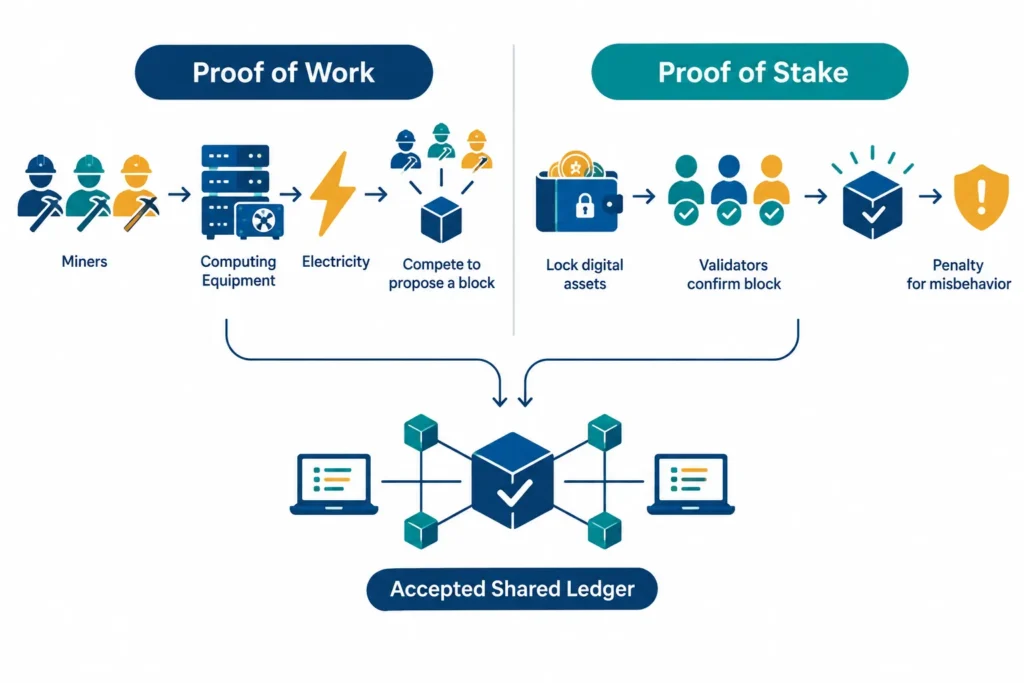
Visual comparison of miners in proof of work and validators in proof of stake

Point Proof of work Proof of stake
Main participants Miners Validators
What participants commit Computing power, equipment and electricity Crypto assets as stake, plus suitable hardware and connectivity
Main example Bitcoin Ethereum’s current mainnet
Security incentive Rewards can compensate miners for valid work; attacks may require substantial resources Rewards encourage correct validation; misconduct may lead to lost rewards or stake
Energy consideration Competitive mining can require substantial electricity Usually requires much less computational work than mining
Possible cost of bad behaviour Wasted electricity, equipment costs and missed rewards Missed rewards, penalties or loss of some stake, depending on the network

Neither label is a complete measure of quality. A blockchain’s security also depends on its software, governance, concentration of participants, economic value, network activity and ability to respond to technical problems.

Public, Private, Permissionless and Permissioned Blockchains

Blockchain networks are also described by who can view them and who can participate in maintaining them. These terms are related, but they do not mean exactly the same thing.

A public blockchain generally allows anyone to view its ledger and submitted transactions. Bitcoin and Ethereum are well-known examples. Public visibility does not mean that every user’s real name is displayed. Addresses are usually visible, while connecting an address to a person may require other information.

A private blockchain restricts access to a particular organisation or group. For example, a consortium of Indian businesses might use a shared ledger to track invoices or goods while limiting access to approved members.

Permissionless participation means people can generally use the network or join its validation process without approval from one central administrator, provided they meet the protocol’s requirements. Permissioned participation requires approval or verified credentials.

These categories can overlap. A ledger might be visible to several organisations but allow only selected members to validate transactions. Similarly, a public blockchain can still have concentrated development, mining, validation or governance influence. Public does not always mean fully decentralised. Private also does not automatically mean insecure; its security depends on access controls, system design, operations and the trustworthiness of participating organisations.

How Blockchain Supports Cryptocurrency Transfers

Cryptocurrency is one application of blockchain technology. The blockchain records transfers between addresses, while consensus helps the network agree on which transfers are valid and their order.

When Asha sends cryptocurrency to Ravi, she is not emailing a digital coin to him. She is authorising an update to the network’s shared record. Once the transaction receives the required confirmations or reaches finality under that network’s rules, Ravi’s wallet can show that his address controls the received amount.

The transfer process can involve network fees, confirmation delays and irreversible mistakes. Sending assets to the wrong address or using an incompatible network may result in a loss that no bank can automatically reverse. Beginners who want to understand the best-known example can next read Bitcoin Explained: How It Works, Its Uses and Risks for Beginners.

Blockchain, Cryptocurrency, Bitcoin and Web3 Are Not the Same

  • Blockchain is a method of maintaining shared records using linked blocks, cryptography and network rules.
  • Cryptocurrency is a digital asset that uses a blockchain or another distributed ledger for recording and transferring value.
  • Bitcoin is a specific cryptocurrency and network. It was the first widely adopted example of a blockchain-based digital currency.
  • Web3 is a broad term for internet services and applications built around blockchains, digital assets, smart contracts or decentralised ownership concepts.

In simple terms, blockchain is the underlying record-keeping approach, cryptocurrency is one of its major uses, Bitcoin is one particular cryptocurrency, and Web3 describes a wider set of blockchain-related ideas and applications.

Smart Contracts, Real-World Uses, Benefits and Limits

Blockchain technology is not limited to sending cryptocurrency. Some blockchain networks can also run programs, maintain shared records and help different organisations coordinate transactions.

However, blockchain is not automatically the best solution for every problem. Its usefulness depends on who participates, what information is recorded and whether a conventional database could do the job more simply.

You May Also Like:Crypto Exchanges in India: How They Work and How to Choose One

What Are Smart Contracts?

A smart contract is a program stored or executed through a blockchain. It applies predefined rules when a person, application or another contract calls it.

For example, a simple smart contract might release a digital asset only after a specified payment is received. Another contract might record votes from authorised members of an online organisation.

The term “smart contract” can be misleading. It does not necessarily mean the program is intelligent, legally binding or capable of understanding real-world intentions. It usually follows coded instructions such as “if this condition is met, perform this action”.

On networks such as Ethereum, users generally pay a transaction fee to interact with smart contracts. Network participants then process the instructions according to the blockchain’s rules.

Smart contracts can reduce manual steps, but they also introduce risks:

  • Code errors: A programming mistake may lock funds, allow unintended transactions or create other losses.
  • External data problems: A contract may depend on an outside data provider, sometimes called an oracle. Incorrect or manipulated data can lead to the wrong outcome.
  • Access-control failures: Poorly managed administrator permissions or stolen keys may allow unauthorised changes.
  • Interface risks: A contract may be sound while the website or wallet used to access it is compromised.
  • Unexpected interactions: Several contracts can connect with one another. A weakness in one component may affect the wider system.

Users should not assume that a smart contract is safe merely because its code is publicly visible or its transactions appear on a blockchain. A separate detailed guide to smart contracts can explain audits, permissions, upgrade mechanisms and oracle risks in greater depth.

Uses of Blockchain Outside Cryptocurrency

When asking what is blockchain technology used for, it helps to separate practical applications from promotional claims. Blockchain may be useful where several parties need a shared record but do not want one participant to have complete control over it.

Supply-Chain Event Tracking

A blockchain can record events such as when goods leave a warehouse, pass through customs or reach a distributor. Participating businesses may use the shared history to compare records and investigate delays.

For example, an Indian exporter, a shipping company and an overseas buyer might record agreed shipment events in a shared system. This could reduce repeated reconciliation between separate databases.

Blockchain does not prove that a physical shipment actually contains the stated goods. If someone enters false information at the start, the blockchain may preserve that false information. Reliable inspections, sensors, documentation and access controls are still necessary.

Shared Record Management

Banks, insurers, hospitals or government departments may need to coordinate records across multiple systems. A permissioned blockchain can provide an agreed transaction history for approved participants.

This approach may help track who submitted or updated a record. Sensitive personal or commercial information should not necessarily be placed directly on the blockchain. A system may instead store a reference or cryptographic fingerprint while keeping confidential information elsewhere.

Digital Identity Credentials

Blockchain-based systems can help issue and verify digital credentials. A university, for instance, could issue a credential that a graduate shares with an employer for verification.

Such a system still requires a trusted issuer. A blockchain may show that a particular institution issued a credential, but it cannot independently decide whether the institution followed proper checks.

Identity systems also require careful privacy design. Publishing personal details on a permanent public ledger can create serious risks, especially because blockchain records may be difficult to remove later.

Settlement and Reconciliation

Financial institutions and businesses often maintain separate records of the same transaction. They then compare those records through reconciliation.

A shared ledger may reduce duplication by giving authorised participants a common transaction history. It could support the settlement of certain assets or obligations, subject to legal, operational and regulatory requirements.

Related areas include decentralised finance, commonly called DeFi, and Web3 applications. These fields use blockchains and smart contracts in different ways, but they also involve technical, market, custody and regulatory risks. Beginners should understand cryptocurrency risks before committing money to such products.

Potential Benefits of Blockchain

The possible benefits depend on the design of the network and the needs of its users.

  • Shared records: Multiple participants can work from a common transaction history.
  • Easier coordination: Agreed network rules may reduce repeated checking between separate systems.
  • Tamper-evident history: Cryptographic links between blocks can make unauthorised historical changes easier to detect.
  • Programmable transactions: Smart contracts can apply predefined rules without requiring every step to be handled manually.
  • Auditability: Authorised users may be able to trace when transactions occurred and which addresses or accounts were involved.
You May Also Like:How to Invest in Cryptocurrency in India: A Beginner’s Guide

These benefits do not mean that every stored record is accurate or trustworthy. Blockchain can help protect the history of submitted information, but it cannot guarantee that the original input was honest, complete or legally valid.

Limitations and Practical Challenges

Blockchain systems involve trade-offs. A design that prioritises decentralisation and resistance to changes may be slower or more expensive than a centralised service.

  • Scalability: Some networks can process only a limited number of transactions within a period. Heavy demand may cause delays.
  • Transaction costs: Fees may change according to network activity. Small transactions can become uneconomical when fees rise.
  • Privacy: Public blockchains can expose transaction details and address histories. Pseudonymous addresses are not the same as complete anonymity.
  • Governance disputes: Participants may disagree about software upgrades, transaction reversals or network rules.
  • Integration challenges: Businesses must connect blockchain systems with existing software, legal processes and internal controls.
  • Energy use: Energy consumption varies by consensus mechanism. Proof-of-work networks may use substantial computing resources, while other designs work differently.
  • Difficult corrections: A mistaken transfer or incorrect record may be hard to reverse. A later transaction can sometimes correct the practical outcome, but the original entry may remain visible.

When Is a Conventional Database Better?

A regular database is often more suitable when one trusted organisation controls the system. It can usually provide faster processing, simpler updates and clearer responsibility.

A conventional database may be the better choice when:

  • only one organisation needs to write or approve records;
  • information must remain highly confidential;
  • records need frequent correction or deletion;
  • very high speed and low processing cost are priorities;
  • participants already trust a central administrator; or
  • there is no clear need for a shared, tamper-evident history.

Blockchain adds complexity. It should solve a specific coordination or trust problem rather than being added simply because the technology is popular.

Common Blockchain Myths

Myth: Every blockchain is decentralised.
Some public blockchains distribute control among many participants. Other networks are operated by a small group of companies or by one organisation.

Myth: Blockchain transactions are always anonymous.
Many networks use addresses rather than names, but transaction histories may be public. Addresses can sometimes be connected to individuals through exchanges, payment records or other information.

Myth: A blockchain cannot be attacked.
Networks, smart contracts, wallets, bridges and exchanges can all face attacks. The type of risk depends on the system’s design and how users access it.

Myth: Information on a blockchain must be true.
A blockchain can preserve submitted data without confirming that the data accurately represents the real world.

Frequently Asked Questions

What is blockchain?

A blockchain is a shared digital ledger in which transactions or records are grouped and connected using cryptography. Copies of the ledger may be maintained by multiple computers according to agreed network rules.

How does blockchain work?

Users submit transactions to a network. The network checks them according to its protocol and consensus method. Valid transactions are recorded in blocks or a similar ledger structure, and cryptographic links help make later alterations detectable.

Are blockchain and Bitcoin the same?

No. Bitcoin is a cryptocurrency and payment network that uses blockchain technology. Blockchain is the broader type of record-keeping technology. Other cryptocurrencies and non-crypto systems can use different blockchain designs.

Can a blockchain be changed or hacked?

Blockchain records are designed to resist unauthorised changes, but no system is completely immune to attack. A network may be affected by concentrated control, software bugs or governance decisions. Wallets, exchanges and smart contracts can also be compromised. In some systems, authorised participants can update rules or reverse outcomes through agreed procedures.

How can blockchain be used outside cryptocurrency?

Possible uses include supply-chain event tracking, shared record management, digital credential verification, and settlement or reconciliation between organisations. Whether blockchain is appropriate depends on privacy, cost, performance, governance and the need for a shared ledger.

Summary

Blockchain is a way to maintain a shared, tamper-evident transaction history. Smart contracts add programs that apply predefined rules, while non-crypto applications may support supply chains, credentials, shared records and settlement processes.

Its strengths can include coordination, auditability and programmable transactions. Its limitations include fees, privacy concerns, scalability, governance disputes, integration work and difficult corrections. Blockchain does not automatically make data true, systems decentralised or investments safe. A conventional database is often better when a trusted organisation needs speed, confidentiality and simple control.

Share this article
KEEP READING

Related Articles

View all →

Comments

Leave a Comment

What Is Blockchain Technology? How It Works and Its Real-World Uses

What Is Blockchain Technology?

Blockchain technology is a way of keeping shared digital records. Instead of one organisation holding the only official copy, multiple computers can store and check copies of the same record.

Transactions are collected into groups called blocks. Each block contains a cryptographic reference to an earlier block, creating an ordered chain of records. If someone later changes an old record, the cryptographic references may no longer match, making the alteration detectable.

A blockchain is therefore often described as a distributed, tamper-evident ledger. However, it is not automatically private, error-free or impossible to attack. Its security depends on its design, network participants, governance rules and how people use it.

Introduction

Most financial records are maintained by a central authority. A bank records account balances, a stock exchange records trades, and a company records payments to suppliers. Customers and business partners generally depend on that organisation to maintain the correct information.

Blockchain uses a different approach. It allows a network of computers to maintain a shared transaction history according to agreed rules. Participants may not need to rely on one central record-keeper, although some blockchains still have an organisation or a small group controlling important decisions.

Blockchain became widely known because it supports cryptocurrencies such as Bitcoin. But blockchain and cryptocurrency are not the same thing. Cryptocurrency is one possible application, while blockchain is the underlying record-keeping approach. Readers who want the wider crypto context can refer to Cryptocurrency in India: A Complete Beginner’s Guide to Crypto.

To understand what blockchain technology is, it helps to begin with five basic ideas: transactions, blocks, cryptographic hashes, nodes and distributed networks.

Blockchain Basics: Blocks, Transactions and Distributed Records

What Is a Transaction?

A transaction is a proposed change to the shared record. Depending on the blockchain, it might represent the transfer of a cryptocurrency, the movement of a digital asset, or an update to information managed by the network.

For example, imagine an Indian business transfers a digital asset to a supplier. The transaction may state that a particular digital asset is moving from the business’s blockchain address to the supplier’s address.

The business normally authorises the transaction using a private cryptographic key. This key works somewhat like a highly sensitive digital signing tool. It should not be confused with an ATM PIN or password, and it must be protected carefully. If another person gains control of the key, they may be able to authorise transactions.

Creating a transaction does not necessarily mean it is immediately final. It must first be sent to the network and checked under that blockchain’s rules.

What Is a Block?

A block is a bundle of transaction data and related information. Instead of adding each transaction independently to the permanent history, many blockchain systems organise confirmed transactions into blocks.

A block commonly contains:

  • Details or references for the transactions included in it.
  • A time-related marker or other ordering information.
  • A cryptographic reference connected to an earlier block.
  • Additional information required by the network’s rules.

The exact contents vary. Bitcoin blocks are not identical to blocks used by Ethereum or a private business network. Some systems also use structures that do not fit the simplest block-and-chain description.

What Is a Cryptographic Hash?

A cryptographic hash is a digital fingerprint produced from data. A hash function takes information as input and creates an output of a fixed format.

Even a small change to the original information usually produces a very different hash. This feature helps a network identify whether recorded data has been altered.

A hash is not the same as encryption. Encryption is generally designed so authorised users can recover the original information with the correct key. A cryptographic hash is generally intended to be a one-way result rather than a reversible copy of the data.

In a blockchain, each new block usually includes a reference derived from an earlier block’s data. This connection creates the chain. If an old block is changed, its hash may change too. The reference stored in the next block would then fail to match, revealing an inconsistency.

What Are Nodes and a Distributed Network?

A node is a computer or device participating in a blockchain network. Depending on the system, a node may receive transactions, check them, store blockchain data, help create blocks or perform only some of these tasks.

A distributed network has participants operating from multiple computers or locations. Rather than keeping the only copy of the ledger on one company server, the network can maintain several copies.

This does not mean every participant always stores every piece of information. Some nodes keep the full history, while lighter participants may store less data and request information when needed. The arrangement depends on the blockchain’s architecture.

Blockchains can also differ in who is allowed to participate. A public blockchain may permit broad participation. A private or permissioned blockchain can restrict access to approved companies, banks, government bodies or other identified members.

How a Blockchain Transaction May Work

Flowchart showing a transaction being signed, verified, added to a block and shared across nodes

Consider the earlier example of an Indian business transferring a digital asset to a supplier. A simplified process could look like this:

  1. The transaction is created: The business enters the supplier’s blockchain address, selects the digital asset and authorises the transfer.
  2. The transaction is shared: The transaction request is broadcast or submitted to nodes on the network.
  3. Network rules are checked: Participating nodes may verify the digital signature, confirm that the sender can transfer the asset and check that the transaction follows the protocol.
  4. The transaction is confirmed: The blockchain’s consensus process determines which valid transactions are accepted and in what order.
  5. The transaction enters a block: The accepted transaction is included with other transactions in a new block.
  6. The block is connected: The new block contains a cryptographic reference to an earlier block and becomes part of the shared history.
  7. Records are updated: Relevant nodes update their copies of the ledger according to the accepted block.

This is an illustration, not a universal sequence. Confirmation methods, waiting times, transaction fees and finality rules can vary significantly between networks.

Why Old Changes Can Be Detected

Suppose someone tries to edit the old record and show that the Indian business transferred the asset to a different recipient. Altering that data would generally change the block’s cryptographic fingerprint.

Because later blocks refer to earlier blocks, the alteration could break the chain of matching references. Other nodes may still hold the accepted version and reject the changed record because it does not follow the network’s history or consensus rules.

The more records added after a transaction, the more work an attacker may need to do to replace the accepted history in some blockchain designs. But the practical level of protection depends on factors such as the consensus method, the number and independence of participants, software quality and the concentration of control.

Tamper-Evident Does Not Mean Impossible to Hack

Blockchain records are commonly called immutable, but beginners should interpret that word carefully. In practice, blockchain data may be difficult to alter without detection rather than literally impossible to change.

A network can still face software bugs, stolen private keys, dishonest participants, governance disputes or attacks on applications connected to it. If a user sends an asset to the wrong address, the blockchain may accurately preserve that mistaken transaction.

Some networks can also reverse or reorganise records under particular conditions. Administrators of a permissioned blockchain may have powers that do not exist on a decentralised public network. Security claims must therefore be evaluated for the specific system.

Blockchain Versus a Traditional Database

Comparison of a distributed blockchain ledger and a centrally controlled traditional database

Point Blockchain Traditional database
Control Updates may be governed by shared network rules or approved participants. One organisation usually controls the database and its administrators.
Copies of records Multiple nodes may store and check copies of the ledger. The organisation may use central servers, backups and replicas under its control.
Updating data Accepted transactions are added according to a consensus process. Authorised administrators or applications can usually add, edit or delete data directly.
Transparency Records may be publicly visible or limited to approved members. Access is normally decided by the database owner.
Performance and cost Shared verification can add delay, complexity and expense. Central control can make processing faster, cheaper and simpler.

A blockchain is not automatically better than a normal database. If one trusted company controls a service, needs to correct records regularly and must keep customer information private, a traditional database may be more practical.

For example, a small Indian retailer managing its employee attendance may not benefit from distributing the same records across many independent nodes. A central database could be faster, less expensive and easier to maintain.

Blockchain may be considered when several parties need a shared record, no single participant should have complete control, and changes need to be traceable. Even then, businesses must compare it with simpler alternatives.

There is also no single standard blockchain model. Networks differ in governance, participation, transparency, privacy and security assumptions. Understanding those differences is essential before deciding whether a blockchain is suitable for a financial or business use.

How Blockchain Networks Reach Agreement

A blockchain is shared across many computers, often called nodes. These nodes may receive transactions at different times, and some participants may be unknown to one another. The network therefore needs a way to agree on which transactions are valid and in what order they should be recorded.

This agreement process is known as consensus. It helps the network maintain a consistent transaction history without relying on one bank, company or government office to update the records.

How Nodes Verify Transactions

When someone proposes a transaction, nodes check it against the blockchain’s rules. The exact checks depend on the network, but they commonly include:

  • Whether the transaction follows the required format.
  • Whether the sender has provided a valid digital signature.
  • Whether the sender has the assets needed for the transfer.
  • Whether the same cryptocurrency units have already been spent.
  • Whether the transaction meets any network fee or technical requirements.

Consider a simple example. Asha wants to send some cryptocurrency to Ravi. She creates a transaction using her crypto wallet and authorises it with her private key. The wallet sends the signed transaction to the network.

Nodes can use Asha’s digital signature to check that the transaction was authorised by the holder of the relevant private key. They do not need to see or know the private key itself. Nodes also examine the existing records to confirm that the funds are available.

A valid transaction does not necessarily become final immediately. It must still be included in the blockchain according to the network’s consensus rules. Those rules also help participants decide which proposed block should be accepted if they receive competing versions of events.

Why Consensus Is Necessary

A centralised payment system usually has a central authority that maintains the official ledger. For example, if you transfer money through a bank, the bank’s systems determine whether the payment is valid and update the relevant accounts.

A distributed blockchain may not have one organisation controlling the master record. Independent nodes need a common method for reaching agreement. Without it, different groups could maintain conflicting histories, and a dishonest participant might attempt to spend the same asset more than once.

A consensus mechanism combines technical rules with economic incentives. Honest participants may receive rewards, while dishonest or careless behaviour can be costly. The design differs from one blockchain to another, so no single explanation applies to every network.

Proof of Work

Proof of work is the consensus approach most closely associated with Bitcoin. In this system, specialised participants called miners use computing equipment to perform repeated calculations. They compete for the opportunity to propose the next block of transactions.

A miner takes valid pending transactions, forms a proposed block and searches for a result that satisfies the protocol’s requirements. Finding this result requires computational work. Other nodes can then verify the result relatively quickly and check whether the proposed block and its transactions follow Bitcoin’s rules.

The successful miner may receive newly issued bitcoin and transaction fees, subject to the protocol’s rules. This reward encourages miners to spend money on equipment and electricity to support the network.

Proof of work helps secure Bitcoin because changing old records would require an attacker to redo substantial computational work and compete with the honest network. However, security is not absolute. It depends on factors such as the amount and distribution of mining power, participant behaviour and the strength of the protocol.

The major practical concern is resource use. Mining can consume significant electricity because many machines compete continuously. The environmental effect depends partly on the amount of energy used and the sources from which that energy is generated. Not every proof-of-work blockchain has the same energy profile.

Proof of Stake

Proof of stake uses committed crypto assets, called stake, rather than mining computations as the main basis for participating in consensus. Validators lock or commit assets under the protocol’s rules. The network then selects validators to propose or confirm blocks according to its design.

Ethereum’s current mainnet uses proof of stake. It no longer uses proof of work. This distinction is important because older articles may still describe Ethereum as a mining-based network.

Ethereum validators help check transactions and confirm blocks. Validators who perform their duties correctly may earn rewards. Those who break certain rules can face penalties. In serious cases, some of their stake may be taken away through a process commonly known as slashing.

Stake creates an economic incentive to follow the protocol. A validator who attacks the network or behaves improperly may put committed assets at risk. However, the details of selection, rewards, penalties and finality vary across proof-of-stake networks. Some systems impose slashing, while others use different penalty structures.

Proof of stake generally requires far less computational work than proof of work because validators are not running the same type of energy-intensive mining competition. This can reduce electricity use substantially. It does not mean that every proof-of-stake network is equally decentralised, secure or efficient.

Proof of Work and Proof of Stake Compared

Visual comparison of miners in proof of work and validators in proof of stake

Point Proof of work Proof of stake
Main participants Miners Validators
What participants commit Computing power, equipment and electricity Crypto assets as stake, plus suitable hardware and connectivity
Main example Bitcoin Ethereum’s current mainnet
Security incentive Rewards can compensate miners for valid work; attacks may require substantial resources Rewards encourage correct validation; misconduct may lead to lost rewards or stake
Energy consideration Competitive mining can require substantial electricity Usually requires much less computational work than mining
Possible cost of bad behaviour Wasted electricity, equipment costs and missed rewards Missed rewards, penalties or loss of some stake, depending on the network

Neither label is a complete measure of quality. A blockchain’s security also depends on its software, governance, concentration of participants, economic value, network activity and ability to respond to technical problems.

Public, Private, Permissionless and Permissioned Blockchains

Blockchain networks are also described by who can view them and who can participate in maintaining them. These terms are related, but they do not mean exactly the same thing.

A public blockchain generally allows anyone to view its ledger and submitted transactions. Bitcoin and Ethereum are well-known examples. Public visibility does not mean that every user’s real name is displayed. Addresses are usually visible, while connecting an address to a person may require other information.

A private blockchain restricts access to a particular organisation or group. For example, a consortium of Indian businesses might use a shared ledger to track invoices or goods while limiting access to approved members.

Permissionless participation means people can generally use the network or join its validation process without approval from one central administrator, provided they meet the protocol’s requirements. Permissioned participation requires approval or verified credentials.

These categories can overlap. A ledger might be visible to several organisations but allow only selected members to validate transactions. Similarly, a public blockchain can still have concentrated development, mining, validation or governance influence. Public does not always mean fully decentralised. Private also does not automatically mean insecure; its security depends on access controls, system design, operations and the trustworthiness of participating organisations.

How Blockchain Supports Cryptocurrency Transfers

Cryptocurrency is one application of blockchain technology. The blockchain records transfers between addresses, while consensus helps the network agree on which transfers are valid and their order.

When Asha sends cryptocurrency to Ravi, she is not emailing a digital coin to him. She is authorising an update to the network’s shared record. Once the transaction receives the required confirmations or reaches finality under that network’s rules, Ravi’s wallet can show that his address controls the received amount.

The transfer process can involve network fees, confirmation delays and irreversible mistakes. Sending assets to the wrong address or using an incompatible network may result in a loss that no bank can automatically reverse. Beginners who want to understand the best-known example can next read Bitcoin Explained: How It Works, Its Uses and Risks for Beginners.

Blockchain, Cryptocurrency, Bitcoin and Web3 Are Not the Same

  • Blockchain is a method of maintaining shared records using linked blocks, cryptography and network rules.
  • Cryptocurrency is a digital asset that uses a blockchain or another distributed ledger for recording and transferring value.
  • Bitcoin is a specific cryptocurrency and network. It was the first widely adopted example of a blockchain-based digital currency.
  • Web3 is a broad term for internet services and applications built around blockchains, digital assets, smart contracts or decentralised ownership concepts.

In simple terms, blockchain is the underlying record-keeping approach, cryptocurrency is one of its major uses, Bitcoin is one particular cryptocurrency, and Web3 describes a wider set of blockchain-related ideas and applications.

Smart Contracts, Real-World Uses, Benefits and Limits

Blockchain technology is not limited to sending cryptocurrency. Some blockchain networks can also run programs, maintain shared records and help different organisations coordinate transactions.

However, blockchain is not automatically the best solution for every problem. Its usefulness depends on who participates, what information is recorded and whether a conventional database could do the job more simply.

What Are Smart Contracts?

A smart contract is a program stored or executed through a blockchain. It applies predefined rules when a person, application or another contract calls it.

For example, a simple smart contract might release a digital asset only after a specified payment is received. Another contract might record votes from authorised members of an online organisation.

The term “smart contract” can be misleading. It does not necessarily mean the program is intelligent, legally binding or capable of understanding real-world intentions. It usually follows coded instructions such as “if this condition is met, perform this action”.

On networks such as Ethereum, users generally pay a transaction fee to interact with smart contracts. Network participants then process the instructions according to the blockchain’s rules.

Smart contracts can reduce manual steps, but they also introduce risks:

  • Code errors: A programming mistake may lock funds, allow unintended transactions or create other losses.
  • External data problems: A contract may depend on an outside data provider, sometimes called an oracle. Incorrect or manipulated data can lead to the wrong outcome.
  • Access-control failures: Poorly managed administrator permissions or stolen keys may allow unauthorised changes.
  • Interface risks: A contract may be sound while the website or wallet used to access it is compromised.
  • Unexpected interactions: Several contracts can connect with one another. A weakness in one component may affect the wider system.

Users should not assume that a smart contract is safe merely because its code is publicly visible or its transactions appear on a blockchain. A separate detailed guide to smart contracts can explain audits, permissions, upgrade mechanisms and oracle risks in greater depth.

Uses of Blockchain Outside Cryptocurrency

When asking what is blockchain technology used for, it helps to separate practical applications from promotional claims. Blockchain may be useful where several parties need a shared record but do not want one participant to have complete control over it.

Supply-Chain Event Tracking

A blockchain can record events such as when goods leave a warehouse, pass through customs or reach a distributor. Participating businesses may use the shared history to compare records and investigate delays.

For example, an Indian exporter, a shipping company and an overseas buyer might record agreed shipment events in a shared system. This could reduce repeated reconciliation between separate databases.

Blockchain does not prove that a physical shipment actually contains the stated goods. If someone enters false information at the start, the blockchain may preserve that false information. Reliable inspections, sensors, documentation and access controls are still necessary.

Shared Record Management

Banks, insurers, hospitals or government departments may need to coordinate records across multiple systems. A permissioned blockchain can provide an agreed transaction history for approved participants.

This approach may help track who submitted or updated a record. Sensitive personal or commercial information should not necessarily be placed directly on the blockchain. A system may instead store a reference or cryptographic fingerprint while keeping confidential information elsewhere.

Digital Identity Credentials

Blockchain-based systems can help issue and verify digital credentials. A university, for instance, could issue a credential that a graduate shares with an employer for verification.

Such a system still requires a trusted issuer. A blockchain may show that a particular institution issued a credential, but it cannot independently decide whether the institution followed proper checks.

Identity systems also require careful privacy design. Publishing personal details on a permanent public ledger can create serious risks, especially because blockchain records may be difficult to remove later.

Settlement and Reconciliation

Financial institutions and businesses often maintain separate records of the same transaction. They then compare those records through reconciliation.

A shared ledger may reduce duplication by giving authorised participants a common transaction history. It could support the settlement of certain assets or obligations, subject to legal, operational and regulatory requirements.

Related areas include decentralised finance, commonly called DeFi, and Web3 applications. These fields use blockchains and smart contracts in different ways, but they also involve technical, market, custody and regulatory risks. Beginners should understand cryptocurrency risks before committing money to such products.

Potential Benefits of Blockchain

The possible benefits depend on the design of the network and the needs of its users.

  • Shared records: Multiple participants can work from a common transaction history.
  • Easier coordination: Agreed network rules may reduce repeated checking between separate systems.
  • Tamper-evident history: Cryptographic links between blocks can make unauthorised historical changes easier to detect.
  • Programmable transactions: Smart contracts can apply predefined rules without requiring every step to be handled manually.
  • Auditability: Authorised users may be able to trace when transactions occurred and which addresses or accounts were involved.

These benefits do not mean that every stored record is accurate or trustworthy. Blockchain can help protect the history of submitted information, but it cannot guarantee that the original input was honest, complete or legally valid.

Limitations and Practical Challenges

Blockchain systems involve trade-offs. A design that prioritises decentralisation and resistance to changes may be slower or more expensive than a centralised service.

  • Scalability: Some networks can process only a limited number of transactions within a period. Heavy demand may cause delays.
  • Transaction costs: Fees may change according to network activity. Small transactions can become uneconomical when fees rise.
  • Privacy: Public blockchains can expose transaction details and address histories. Pseudonymous addresses are not the same as complete anonymity.
  • Governance disputes: Participants may disagree about software upgrades, transaction reversals or network rules.
  • Integration challenges: Businesses must connect blockchain systems with existing software, legal processes and internal controls.
  • Energy use: Energy consumption varies by consensus mechanism. Proof-of-work networks may use substantial computing resources, while other designs work differently.
  • Difficult corrections: A mistaken transfer or incorrect record may be hard to reverse. A later transaction can sometimes correct the practical outcome, but the original entry may remain visible.

When Is a Conventional Database Better?

A regular database is often more suitable when one trusted organisation controls the system. It can usually provide faster processing, simpler updates and clearer responsibility.

A conventional database may be the better choice when:

  • only one organisation needs to write or approve records;
  • information must remain highly confidential;
  • records need frequent correction or deletion;
  • very high speed and low processing cost are priorities;
  • participants already trust a central administrator; or
  • there is no clear need for a shared, tamper-evident history.

Blockchain adds complexity. It should solve a specific coordination or trust problem rather than being added simply because the technology is popular.

Common Blockchain Myths

Myth: Every blockchain is decentralised.
Some public blockchains distribute control among many participants. Other networks are operated by a small group of companies or by one organisation.

Myth: Blockchain transactions are always anonymous.
Many networks use addresses rather than names, but transaction histories may be public. Addresses can sometimes be connected to individuals through exchanges, payment records or other information.

Myth: A blockchain cannot be attacked.
Networks, smart contracts, wallets, bridges and exchanges can all face attacks. The type of risk depends on the system’s design and how users access it.

Myth: Information on a blockchain must be true.
A blockchain can preserve submitted data without confirming that the data accurately represents the real world.

Frequently Asked Questions

What is blockchain?

A blockchain is a shared digital ledger in which transactions or records are grouped and connected using cryptography. Copies of the ledger may be maintained by multiple computers according to agreed network rules.

How does blockchain work?

Users submit transactions to a network. The network checks them according to its protocol and consensus method. Valid transactions are recorded in blocks or a similar ledger structure, and cryptographic links help make later alterations detectable.

Are blockchain and Bitcoin the same?

No. Bitcoin is a cryptocurrency and payment network that uses blockchain technology. Blockchain is the broader type of record-keeping technology. Other cryptocurrencies and non-crypto systems can use different blockchain designs.

Can a blockchain be changed or hacked?

Blockchain records are designed to resist unauthorised changes, but no system is completely immune to attack. A network may be affected by concentrated control, software bugs or governance decisions. Wallets, exchanges and smart contracts can also be compromised. In some systems, authorised participants can update rules or reverse outcomes through agreed procedures.

How can blockchain be used outside cryptocurrency?

Possible uses include supply-chain event tracking, shared record management, digital credential verification, and settlement or reconciliation between organisations. Whether blockchain is appropriate depends on privacy, cost, performance, governance and the need for a shared ledger.

Summary

Blockchain is a way to maintain a shared, tamper-evident transaction history. Smart contracts add programs that apply predefined rules, while non-crypto applications may support supply chains, credentials, shared records and settlement processes.

Its strengths can include coordination, auditability and programmable transactions. Its limitations include fees, privacy concerns, scalability, governance disputes, integration work and difficult corrections. Blockchain does not automatically make data true, systems decentralised or investments safe. A conventional database is often better when a trusted organisation needs speed, confidentiality and simple control.
Leave a Comment