
Personal Loan Documents Required in India: Complete Checklist

A practical checklist of personal loan documents for salaried and self-employed applicants in India, including proofs needed and mistakes to avoid.

Personal Loan Documents Required in India: Complete Checklist

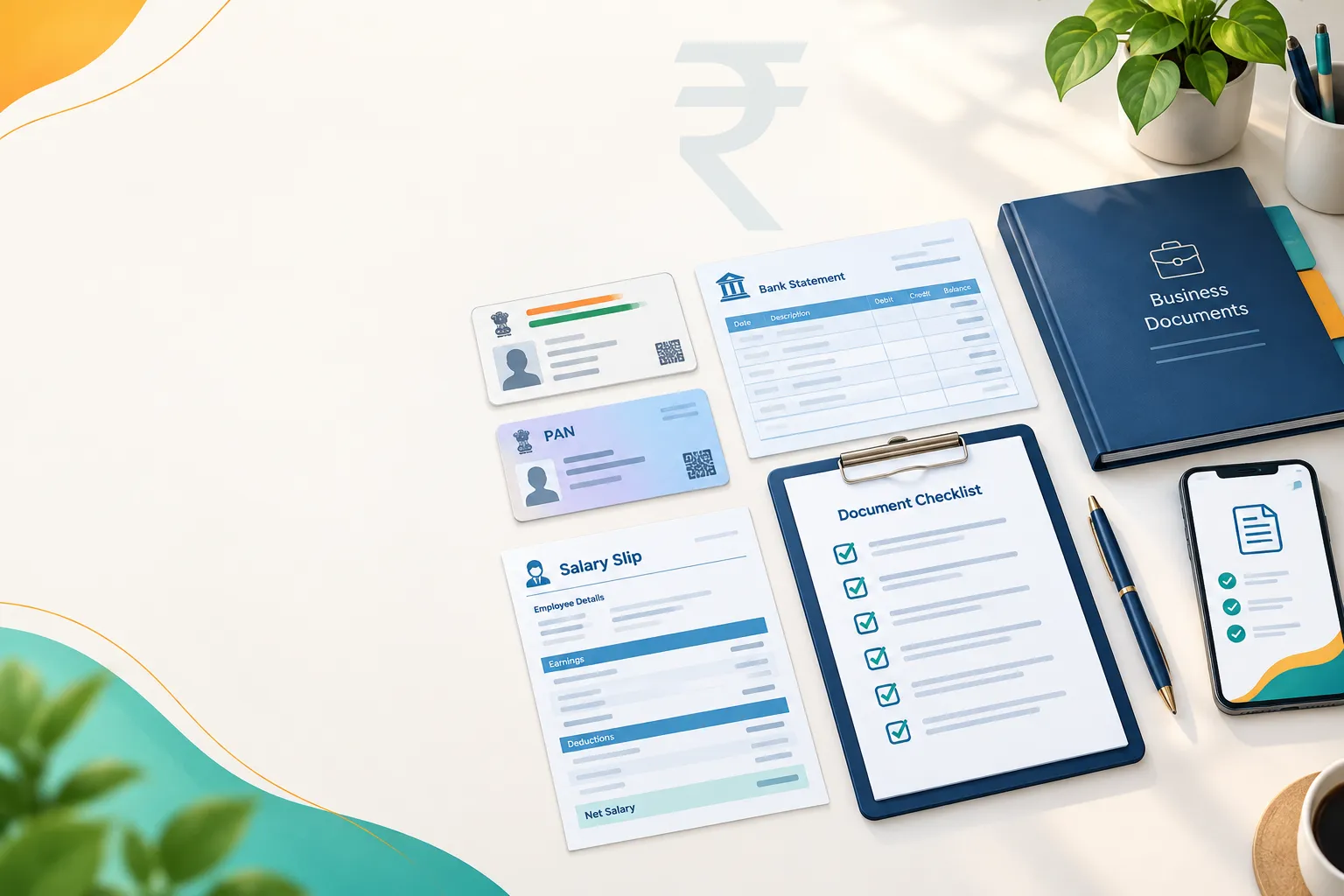
The main documents required for personal loan in India usually include identity proof, address proof, PAN, recent photographs, salary slips, salary-credit bank statements and employment details. Some lenders may also ask for Form 16 or other income records. The exact checklist depends on the lender, loan product and your financial profile. Providing all requested documents helps the lender process your application, but it does not guarantee approval.

A personal loan is generally unsecured, which means you usually do not have to offer a house, vehicle or other asset as security. Because there is no collateral, the lender relies heavily on your documents, credit profile, income and existing repayment obligations.

Keeping the correct paperwork ready can reduce delays and repeated requests for information. It can also help you avoid common problems such as an address mismatch, unclear salary credits or outdated identity proof.

This section explains the core personal loan documents and the usual requirements for salaried applicants. Treat it as a practical starting checklist rather than a universal list. Banks, non-banking financial companies and digital lenders may follow different documentation and KYC processes.

Why Do Lenders Ask for Personal Loan Documents?
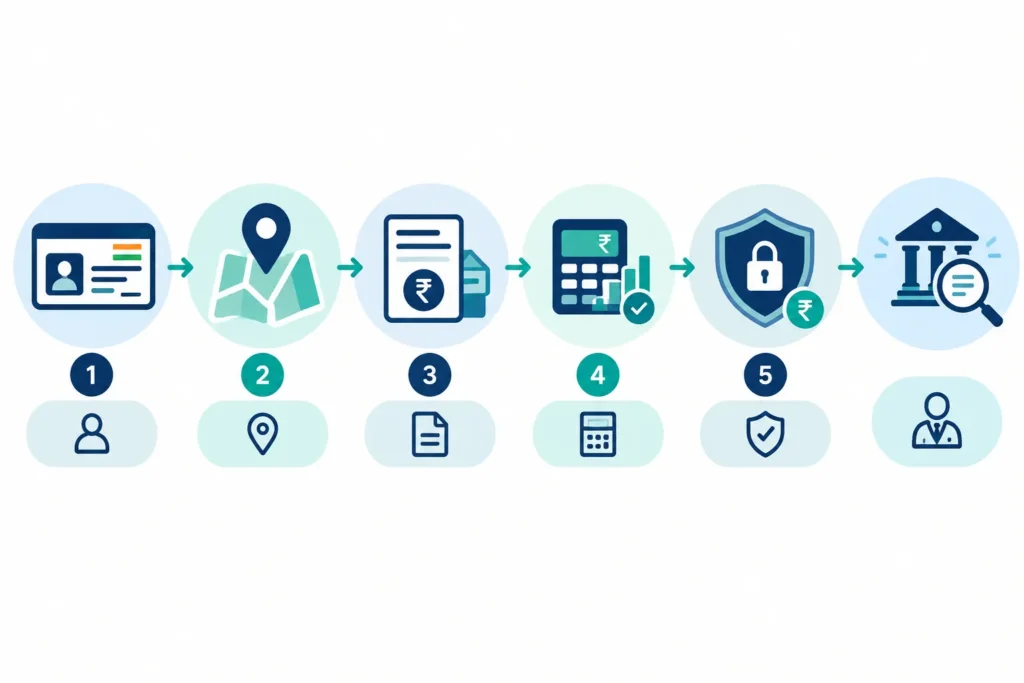
Flowchart showing identity, address, income, repayment capacity and fraud checks by a lender
Lenders do not request documents only as a formality. They use them to establish who you are, where you live, how much you earn and whether the proposed EMI appears affordable.

To verify your identity

The lender must confirm that the person applying for the loan is genuine. Identity documents help match your name, photograph, date of birth and other personal details with the information entered in the application.

This verification is also part of the lender’s Know Your Customer, or KYC, process. Depending on the lender and applicable process, KYC may be completed through physical documents, digital verification, video KYC or another permitted method.

To confirm your address

A lender may ask for proof of your permanent address, current residential address or both. This allows it to maintain accurate records and communicate with you during the application and repayment period.

Address verification can be important for people living away from their home town. For example, an applicant may have a permanent address in Jaipur but currently work and rent a flat in Bengaluru.

To assess your income

Income documents show whether you have a regular source of earnings. For a salaried applicant, the lender may compare salary slips with credits appearing in the bank account.

A high salary by itself does not automatically result in approval. The lender may also consider existing EMIs, credit card dues, regular deductions, job stability and its internal eligibility rules.

To estimate repayment capacity

The lender uses your income and financial records to assess whether you are likely to manage the new EMI along with your normal expenses and existing debts.

For example, two applicants may receive the same monthly salary, but one may already be paying a home loan EMI and a vehicle loan EMI. Their available income for another loan may therefore be different.

To reduce fraud and incorrect applications

Documents can help lenders identify false identities, altered income records and inconsistent application details. A mismatch does not always mean fraud, but it may lead to additional questions or verification.

Make sure the spelling of your name, date of birth, PAN and other important details are consistent across the application and supporting records. If there is a genuine difference, explain it and provide any correction or supporting document requested by the lender.

Identity and Address Proof

Identity and address records form the core of the documents required for a personal loan. However, not every document is accepted by every lender for every purpose. A document accepted as identity proof may not always be sufficient as proof of your current address.

Common identity documents

Depending on the lender’s accepted-document list and KYC process, commonly requested records may include:

  • PAN card: PAN is commonly required for tax and financial identification. Enter the PAN carefully and ensure that your name matches the application.
  • Aadhaar: Aadhaar may be used under an applicable KYC or verification process. Follow the lender’s instructions regarding the permitted format and consent.
  • Passport: A valid passport may be accepted as identity proof and, where applicable, address proof.
  • Voter ID: A valid voter identity card may be accepted, subject to the lender’s rules.
  • Driving licence: A valid driving licence may be accepted for identity or address verification where permitted.

A lender may ask for one or more documents rather than all of them. Some lenders may separately request PAN even when another document has already been provided as identity proof.

Common address documents

The lender may accept an eligible identity document containing your address. It may also request a more recent record if it needs to confirm where you currently live.

Examples may include a valid passport, voter ID, driving licence, Aadhaar under the applicable process, or another officially accepted document. In some cases, the lender may ask for a recent utility bill, registered rent agreement, bank statement or employer accommodation record. Acceptance conditions and document-age limits can vary.

Do not assume that any bill or statement will be accepted. Check the lender’s current list before uploading documents. The record should generally be readable and show the required name, address, issuer and date.

You May Also Like:How to Reduce the Total Interest Paid on a Loan

What if your current address is different?

An address difference is common and does not necessarily prevent you from applying. You may have moved for work, changed rented accommodation or not yet updated the address on your main ID.

Enter the permanent and current addresses accurately wherever the application asks for them. Do not use an old address simply because it appears on your ID.

Inform the lender about the difference and ask what it accepts as current-address proof. You may need to provide your permanent-address document along with an accepted record for your present residence. The lender may also carry out additional digital, telephone or physical verification, depending on its process.

If you live in employer-provided accommodation or with family and do not have a utility bill in your own name, speak to the lender before submitting the application. It may specify an alternative combination of documents. Avoid editing a bill or using someone else’s record without disclosure.

Basic checks before submission

  • Use valid and unexpired documents where validity applies.
  • Make sure scans or photographs are clear, complete and not cropped.
  • Check that your name and date of birth are consistent.
  • Provide both sides of a document if the lender requests them.
  • Do not alter, overwrite or digitally manipulate a document.
  • Use only the lender’s authorised submission channel.

Income Documents for Salaried Applicants

For a salaried person, the lender generally wants to see regular salary income and ongoing employment. It may review multiple records together instead of relying on a single salary slip.

The exact period can differ. One lender may ask for a particular number of recent salary slips, while another may require a different period of bank statements or additional income proof. Follow the checklist given for your specific application.

Recent salary slips

Salary slips help show your gross salary, deductions and net pay. They may also display your employer’s name, employee identification number, designation and pay period.

Submit the most recent slips for the period requested by the lender. If you recently received an increment, bonus or variable payment, do not assume the lender will treat the entire amount as regular monthly income. It may separately evaluate fixed and variable earnings.

If your company does not issue standard salary slips, ask the lender whether it will accept an employer-issued salary certificate or another record. Do not create a salary slip yourself.

Salary-credit bank statements

Bank statements allow the lender to check whether salary is regularly credited to your account. They may also help it review existing EMIs, cheque returns, major obligations and the broad pattern of account activity.

Provide statements for the exact period and in the format requested. A downloaded bank statement is generally more useful than incomplete screenshots because it shows the account details, transaction dates and narration clearly.

If your salary account recently changed, the lender may ask for statements from both the old and new accounts. If the employer name in the bank narration is different from the name on your salary slip, explain the reason. This can happen when payroll is processed through another group company or service provider.

Form 16 or other income records

Some lenders may request Form 16, an income tax return acknowledgement or another income record. These documents can provide a wider view of annual salary and tax details.

They may be especially relevant where monthly income varies, the applicant has changed jobs, or the lender requires additional verification. Not every salaried applicant will be asked for every record.

Employment details

The application may ask for your employer’s name, office address, designation, work experience, official email address and date of joining. A lender may also request an employee ID card, appointment letter, employment certificate or recent increment letter in certain cases.

Provide current details and disclose a recent job change. If you are serving a probation period or notice period, answer the employment questions accurately. Hiding this information may create inconsistencies during verification.

Salaried applicant document checklist

  • PAN and an accepted identity document.
  • Accepted permanent and current address proof, where required.
  • Recent photograph, if requested.
  • Recent salary slips for the lender-specified period.
  • Bank statements showing salary credits for the required period.
  • Form 16 or other income records, where requested.
  • Employer name, office address, designation and joining date.
  • Employee ID, appointment letter or employment certificate, if required.
  • Documents explaining any name, address, employer or salary-credit mismatch.

Before submitting the application, compare every item with the lender’s latest checklist. A complete and consistent set of records can support faster verification, but the final decision will still depend on eligibility, credit assessment and the lender’s internal policy.

Documents for Self-Employed Applicants

For self-employed applicants, the documents required for personal loan approval usually cover three areas: personal identity, business existence and income stability. Lenders may ask for more records than they request from salaried applicants because business income can vary from month to month.

The exact checklist depends on the lender, loan amount, business structure and applicant’s financial profile. Not every document listed below is mandatory in every case.

You May Also Like:Loan Prepayment: Benefits, Charges and Things to Consider

Income Tax Returns and Financial Records

Income Tax Returns, commonly called ITRs, help lenders understand your declared income. You may be asked to submit ITR acknowledgements and complete returns for recent financial years. Some lenders may also request the computation of income.

Depending on your business and the lender’s policy, you may need to provide:

  • Recent Income Tax Returns
  • Computation of income
  • Profit and loss account
  • Balance sheet
  • Tax audit report, where applicable
  • Cash-flow statement or other supporting financial records

Financial statements may need to be certified or audited if this is required under applicable rules or the lender’s process. Submit complete documents rather than selected pages, unless the lender specifically asks for particular sections.

Documents for Independent Professionals

Independent professionals can include doctors, chartered accountants, architects, lawyers and consultants. Along with ITRs and bank statements, the lender may ask for evidence that the applicant is qualified and currently practising.

Examples include:

  • Degree or professional qualification certificate
  • Registration certificate from the relevant professional body
  • Professional licence, where required
  • Clinic, office or practice address proof
  • Invoices, receipts or contracts that support professional income

For example, a doctor operating a clinic may be asked for a medical registration certificate and clinic address proof. A chartered accountant may be asked for membership or practice-related records. These requirements differ between professions and lenders.

Documents for Sole Proprietors

A sole proprietorship does not have a legal identity separate from its owner. The lender may therefore look for records that connect the applicant’s name with the business name and address.

Possible documents include a Shop and Establishment registration, municipal licence, Udyam Registration, GST registration certificate where applicable, trade licence, business utility bill or current account statement. An office ownership document or valid rental agreement may also be requested as address proof.

If the business operates under a trade name, ensure that the name is consistent across invoices, bank statements, tax records and registrations. A difference in spelling or business style may require clarification.

Documents for Partnerships and LLPs

A partner applying for a personal loan may have to show both personal income and the income received from the firm. The lender may ask for the partnership deed to confirm the applicant’s role and share in the business.

Common supporting records can include:

  • Partnership deed and any amendment deeds
  • Registration certificate, if the firm is registered
  • Limited Liability Partnership incorporation records, where relevant
  • PAN of the firm or LLP
  • Firm’s ITRs and financial statements
  • Business bank account statements
  • Proof of the registered or operating address

A lender may also request evidence of remuneration, interest or profit share received by the applicant from the partnership.

Documents for Company Directors or Promoters

If you are a director or promoter of a private limited or public limited company, the lender may examine your personal income as well as the company’s financial position. This does not mean the company is necessarily becoming a borrower; the records may simply help verify the source and continuity of your income.

You may be asked for the company’s certificate of incorporation, Memorandum of Association, Articles of Association, shareholding details, company PAN, recent financial statements and bank statements. Records showing director remuneration, dividends or other payments may also be relevant.

Bank Statements and Existing Loan Details

Bank statements are important documents required for personal loan assessment. They help the lender compare the income shown in your application with actual account activity.

A lender may review statements to check:

  • Regular salary, professional receipts or business income credits
  • Existing EMI deductions and standing instructions
  • Cheque returns, failed auto-debits or frequent negative balances
  • Large or unusual credits that may need an explanation
  • Regular household, rent and business-related commitments
  • Whether the account is actively used by the applicant

The required statement period varies by lender and applicant profile. Statements may need to be downloaded directly from net banking, obtained from the bank or submitted through an approved digital account-verification process.

If your income is credited into one account but major expenses or EMIs are paid from another, the lender may request statements for both accounts. Self-employed applicants may similarly be asked for personal and business account statements.

Existing Loans and Credit Cards

Declare ongoing financial obligations accurately. Lenders may ask for sanction letters, repayment schedules or recent loan account statements for home loans, vehicle loans, education loans, business loans or other personal loans.

You may also need to provide details of credit cards, including outstanding balances and regular card repayments. Even when a credit card has no EMI, its usage and outstanding amount can form part of the lender’s assessment of your obligations.

If a loan shown in your credit report has already been repaid, keep the closure letter or no-dues certificate ready. This can help clarify why an old account still appears as active or has not yet been updated.

You May Also Like:Home Loan EMI: How It Is Calculated and What Affects It

Employment and Business Proof

Income documents show how much you earn, while employment or business proof helps establish where that income comes from. Lenders may verify these details independently.

Employment Proof for Salaried Applicants

A salaried employee may be asked for an employee identity card, appointment letter, confirmation letter or recent increment letter. If you recently changed jobs, the lender may request records from both the previous and present employer.

Some lenders verify employment through an official work email address, a call to the employer or another authorised method. Use accurate office contact details and inform the concerned HR or administration team if appropriate.

If your employer’s name appears differently across salary slips, bank credits and tax records, be prepared to explain the difference. This can happen when a brand name differs from the company’s registered legal name or when payroll is processed by another entity.

Business Proof for Self-Employed Applicants

Business proof should show that the enterprise exists and that you are connected with it. Depending on the business structure, useful records may include Udyam Registration, a Shop and Establishment certificate, trade licence, GST registration or GST-related filings where applicable.

A partnership may require its partnership deed. A company may need incorporation and constitutional documents. A professional practice may require a licence or registration certificate. Office ownership papers, a rental agreement, utility bills or bank correspondence may support the operating address.

GST records are generally relevant only where the business is registered or required to be registered. A lender may compare turnover or transaction details across GST records, bank statements, ITRs and financial statements. Any genuine difference should be supported with a clear explanation and appropriate records.

Additional Documents That May Be Required

After reviewing the main application, the lender may request extra documents to complete verification or resolve a mismatch. Such a request does not automatically mean that the application will be rejected.

Additional documents can include:

  • Recent passport-size photographs
  • Signature proof or a fresh signature specimen
  • Co-applicant’s identity, address and income documents
  • Rental agreement or landlord-related address confirmation
  • Marriage certificate, birth certificate or other relationship proof
  • Loan closure letter or no-dues certificate
  • Written clarification for unusual bank transactions
  • Proof supporting a recent change in job, business or residence

Handling Name and Address Mismatches

A minor variation, such as initials on PAN and a full name on another document, may require clarification. Larger differences may need stronger supporting records, such as a marriage certificate, name-change document or updated identity proof.

Address differences are also common when an applicant has moved recently. The lender may ask for both permanent and current address proof. A rental agreement, utility bill or official correspondence may be accepted depending on the lender’s rules.

Do not alter documents or hide a mismatch. Point it out and ask what supporting evidence is acceptable. Clear disclosure usually makes verification easier.

Submit Extra Documents Safely

Provide additional documents only through the lender’s official branch, website, application, authorised email channel or verified representative. Avoid sending PAN, Aadhaar, bank statements, signatures or financial records to unknown personal numbers or unverified accounts. If a request seems unusual, confirm it directly with the lender before sharing anything.

Personal Loan Document Checklist Before Applying
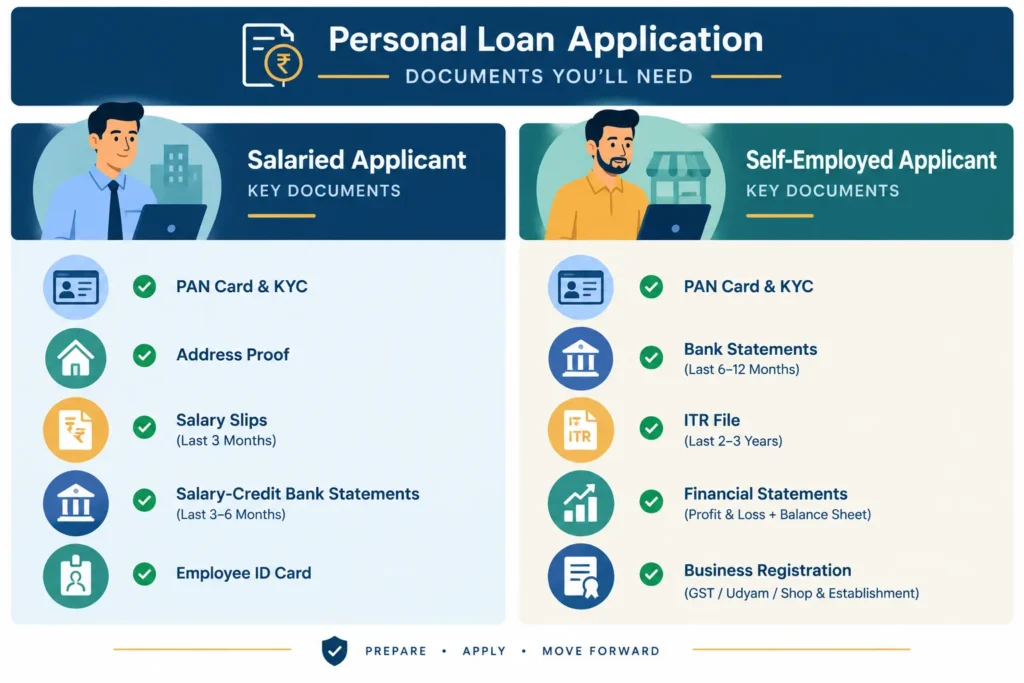
Comparison of personal loan documents commonly requested from salaried and self-employed applicants
Keeping your paperwork ready can reduce delays and repeated requests from the lender. The exact documents required for personal loan applications depend on the lender, your employment type, income profile and loan amount.

Checklist for Salaried Applicants

  • Identity proof: PAN card and another accepted identity document, such as Aadhaar, passport, voter ID or driving licence.
  • Address proof: Aadhaar, passport, voter ID, driving licence, utility bill or another document accepted by the lender.
  • Income proof: Recent salary slips for the period specified by the lender.
  • Bank statements: Statements for the required recent months, preferably showing salary credits and regular financial activity.
  • Employment proof: Employee ID card, appointment letter, employment certificate or official work email verification, if requested.
  • Photograph: A recent passport-size photograph or a clear digital photograph, depending on the application method.
  • Application details: Correct information about your employer, monthly income, existing EMIs and current residence.

Checklist for Self-Employed Applicants

  • Identity and address proof: PAN and other accepted KYC documents.
  • Personal and business bank statements: Statements for the period required by the lender.
  • Income tax returns: ITRs and supporting documents for the financial years requested.
  • Financial statements: Profit and loss account, balance sheet or income computation, where applicable.
  • Business proof: GST registration, shop and establishment certificate, professional licence, partnership deed, incorporation document or other relevant proof.
  • Business address proof: Rent agreement, utility bill, registration certificate or another accepted document.
  • Photograph and application details: A recent photograph and complete information about the business, income and existing obligations.

Universal Checks Before Submission

Review every document before uploading or handing it over. A simple check can prevent avoidable follow-up calls.

  • Confirm that identity and address documents are valid and not expired.
  • Make sure scans and photographs are clear, readable and properly oriented.
  • Include every page of bank statements, even if a page has few transactions.
  • Check that your name, date of birth and address are consistent across documents.
  • Use the same income and employment details in the form and supporting records.
  • Ensure that account numbers, salary credits and business receipts are visible where required.
  • Keep the original documents available in case physical or video verification is needed.
You May Also Like:Personal Loan Eligibility: Factors Lenders Consider in India

Digital Documents and Online Applications

Many lenders allow applicants to complete most or all of the personal loan process online. You may be asked to upload scanned copies, document photographs or digitally downloaded statements.

PDF, JPG and PNG are commonly supported file types, but accepted formats and maximum file sizes vary. Follow the instructions shown on the lender’s application portal. A high-resolution file is useful only if it remains within the permitted size.

Download bank statements from your bank’s official website or mobile application where possible. If a statement is password-protected, check whether the lender’s system can process it. You may need to provide the password through the specified secure method or upload an unlocked copy. Do not remove security in a way that exposes your financial information on a shared device.

Some lenders offer electronic KYC, Aadhaar-based verification or video KYC. Availability depends on the lender, product and applicable rules. During video verification, you may need to show an original document, confirm personal details and follow instructions such as displaying your face clearly.

Read the consent request before proceeding. Understand what information the lender is collecting and why. Upload documents only through the lender’s official website, application or authorised channel. Avoid sending PAN, Aadhaar, bank statements or salary slips to unknown persons through informal messaging accounts.

Do not share an OTP, banking PIN, card PIN or internet banking password with an agent. A legitimate document-verification process should not require these confidential credentials.

Common Documentation Mistakes to Avoid
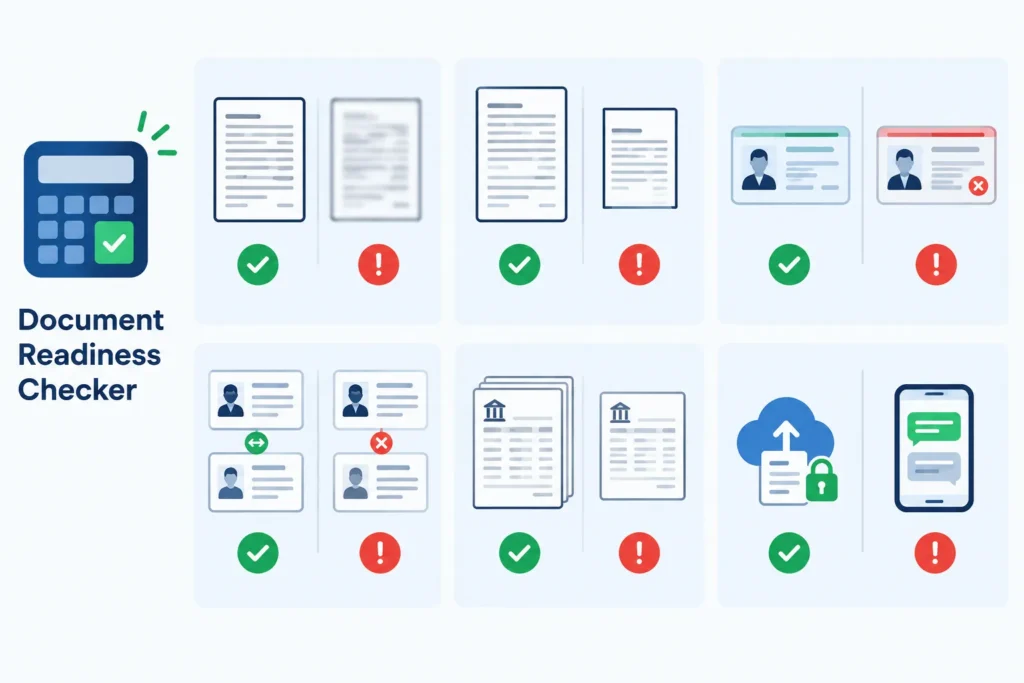
Visual checklist for avoiding blurred, cropped, expired, inconsistent or insecure loan document submissions
Documentation errors can slow down the application or lead to additional verification. Avoid these common mistakes:

  • Blurred images: A lender may not be able to read your name, document number, photograph or address.
  • Cropped pages: Cutting off page edges, headers, footers or transaction details can make a document incomplete.
  • Expired proof: An expired passport or driving licence may not be accepted as valid KYC.
  • Inconsistent details: Different spellings of your name or different addresses may require an explanation and supporting proof.
  • Missing statement pages: Uploading only selected bank statement pages can create concerns about completeness.
  • Unexplained income differences: A large difference between declared income, salary slips, bank credits and tax records may trigger questions.
  • Incorrect employment information: Outdated employer details or an incorrect joining date can delay checks.
  • Altered documents: Never edit figures, transactions, dates or employer details. False or manipulated documents can result in rejection and may have serious legal consequences.

If a genuine difference exists, explain it honestly. For example, salary may vary because of incentives, unpaid leave, reimbursements or a recent job change. A self-employed applicant may have seasonal receipts or irregular client payments. Supporting records can help the lender understand the variation.

What Happens After You Submit Your Documents?

The process differs across lenders, but personal loan applications generally move through the following stages.

  1. Document verification: The lender checks whether the submitted records are complete, readable and valid. Identity, address, employment or business information may be verified.
  2. Credit and eligibility checks: The lender may review your credit report, income, existing EMIs, repayment capacity, age, work profile and internal lending rules.
  3. Clarification or additional documents: You may be asked for another salary slip, a clearer KYC copy, extra bank statements or an explanation of a transaction or income difference.
  4. Approval or rejection: The lender decides whether to offer the loan. If approved, the sanctioned amount, interest rate, tenure and charges may differ from the amount or terms initially requested.
  5. Loan agreement review: Read the agreement and key terms carefully. Check the interest rate, EMI, processing fee, late-payment charges, prepayment conditions, insurance costs and total repayment obligation.
  6. Acceptance and disbursal: After required agreements, mandates and final checks are completed, the lender may transfer the approved amount to the verified bank account.

Submitting documents quickly does not ensure instant disbursal. Verification time can vary based on the lender, application quality and whether further checks are required.

Frequently Asked Questions About Personal Loan Documents

Are PAN and Aadhaar always enough for a personal loan?

No. PAN and Aadhaar may help establish identity and complete KYC, but lenders commonly need income, bank account and employment or business records. The exact documents required for personal loan approval depend on the lender and your profile.

Can I get a personal loan without salary slips?

It may be possible in some cases. A lender might consider salary-credit bank statements, Form 16, an employment certificate or other income evidence. However, acceptance is not automatic, and some lenders require salary slips under their credit policy.

How can a self-employed applicant show income?

Self-employed applicants may use income tax returns, bank statements, profit and loss accounts, balance sheets, GST records and business receipts. The lender may also ask for proof that the business has operated for a minimum period.

Why is the lender asking for more documents?

Additional documents may be needed to clarify an address, verify income, understand an unusual bank transaction or confirm employment. A lender may also request more information when records are incomplete, unclear or inconsistent.

Are digital copies accepted?

Many lenders accept digital copies for online applications. They may require specific formats, file sizes or digitally sourced statements. Original documents or video verification may still be requested in some cases.

What should I do if my name or address does not match across documents?

Inform the lender before submitting the application. You may need an updated KYC document, marriage certificate, name-change record, address declaration or another supporting document. Do not hide the mismatch or alter a document.

Does submitting all documents guarantee approval?

No. Complete documents help the lender process the application, but they do not guarantee approval. The final decision may also depend on credit history, income stability, existing obligations, repayment capacity and the lender’s internal policy.

Final Reminder

Prepare clear, valid and consistent records, and provide honest explanations where needed. Since lender requirements can change, verify the latest personal loan document checklist directly with your chosen lender before applying.

Share this article
KEEP READING

Related Articles

View all →

Comments

Leave a Comment

Personal Loan Documents Required in India: Complete Checklist

The main documents required for personal loan in India usually include identity proof, address proof, PAN, recent photographs, salary slips, salary-credit bank statements and employment details. Some lenders may also ask for Form 16 or other income records. The exact checklist depends on the lender, loan product and your financial profile. Providing all requested documents helps the lender process your application, but it does not guarantee approval.

A personal loan is generally unsecured, which means you usually do not have to offer a house, vehicle or other asset as security. Because there is no collateral, the lender relies heavily on your documents, credit profile, income and existing repayment obligations.

Keeping the correct paperwork ready can reduce delays and repeated requests for information. It can also help you avoid common problems such as an address mismatch, unclear salary credits or outdated identity proof.

This section explains the core personal loan documents and the usual requirements for salaried applicants. Treat it as a practical starting checklist rather than a universal list. Banks, non-banking financial companies and digital lenders may follow different documentation and KYC processes.

Why Do Lenders Ask for Personal Loan Documents?

Flowchart showing identity, address, income, repayment capacity and fraud checks by a lender
Lenders do not request documents only as a formality. They use them to establish who you are, where you live, how much you earn and whether the proposed EMI appears affordable.

To verify your identity

The lender must confirm that the person applying for the loan is genuine. Identity documents help match your name, photograph, date of birth and other personal details with the information entered in the application.

This verification is also part of the lender’s Know Your Customer, or KYC, process. Depending on the lender and applicable process, KYC may be completed through physical documents, digital verification, video KYC or another permitted method.

To confirm your address

A lender may ask for proof of your permanent address, current residential address or both. This allows it to maintain accurate records and communicate with you during the application and repayment period.

Address verification can be important for people living away from their home town. For example, an applicant may have a permanent address in Jaipur but currently work and rent a flat in Bengaluru.

To assess your income

Income documents show whether you have a regular source of earnings. For a salaried applicant, the lender may compare salary slips with credits appearing in the bank account.

A high salary by itself does not automatically result in approval. The lender may also consider existing EMIs, credit card dues, regular deductions, job stability and its internal eligibility rules.

To estimate repayment capacity

The lender uses your income and financial records to assess whether you are likely to manage the new EMI along with your normal expenses and existing debts.

For example, two applicants may receive the same monthly salary, but one may already be paying a home loan EMI and a vehicle loan EMI. Their available income for another loan may therefore be different.

To reduce fraud and incorrect applications

Documents can help lenders identify false identities, altered income records and inconsistent application details. A mismatch does not always mean fraud, but it may lead to additional questions or verification.

Make sure the spelling of your name, date of birth, PAN and other important details are consistent across the application and supporting records. If there is a genuine difference, explain it and provide any correction or supporting document requested by the lender.

Identity and Address Proof

Identity and address records form the core of the documents required for a personal loan. However, not every document is accepted by every lender for every purpose. A document accepted as identity proof may not always be sufficient as proof of your current address.

Common identity documents

Depending on the lender’s accepted-document list and KYC process, commonly requested records may include:

  • PAN card: PAN is commonly required for tax and financial identification. Enter the PAN carefully and ensure that your name matches the application.
  • Aadhaar: Aadhaar may be used under an applicable KYC or verification process. Follow the lender’s instructions regarding the permitted format and consent.
  • Passport: A valid passport may be accepted as identity proof and, where applicable, address proof.
  • Voter ID: A valid voter identity card may be accepted, subject to the lender’s rules.
  • Driving licence: A valid driving licence may be accepted for identity or address verification where permitted.

A lender may ask for one or more documents rather than all of them. Some lenders may separately request PAN even when another document has already been provided as identity proof.

Common address documents

The lender may accept an eligible identity document containing your address. It may also request a more recent record if it needs to confirm where you currently live.

Examples may include a valid passport, voter ID, driving licence, Aadhaar under the applicable process, or another officially accepted document. In some cases, the lender may ask for a recent utility bill, registered rent agreement, bank statement or employer accommodation record. Acceptance conditions and document-age limits can vary.

Do not assume that any bill or statement will be accepted. Check the lender’s current list before uploading documents. The record should generally be readable and show the required name, address, issuer and date.

What if your current address is different?

An address difference is common and does not necessarily prevent you from applying. You may have moved for work, changed rented accommodation or not yet updated the address on your main ID.

Enter the permanent and current addresses accurately wherever the application asks for them. Do not use an old address simply because it appears on your ID.

Inform the lender about the difference and ask what it accepts as current-address proof. You may need to provide your permanent-address document along with an accepted record for your present residence. The lender may also carry out additional digital, telephone or physical verification, depending on its process.

If you live in employer-provided accommodation or with family and do not have a utility bill in your own name, speak to the lender before submitting the application. It may specify an alternative combination of documents. Avoid editing a bill or using someone else’s record without disclosure.

Basic checks before submission

  • Use valid and unexpired documents where validity applies.
  • Make sure scans or photographs are clear, complete and not cropped.
  • Check that your name and date of birth are consistent.
  • Provide both sides of a document if the lender requests them.
  • Do not alter, overwrite or digitally manipulate a document.
  • Use only the lender’s authorised submission channel.

Income Documents for Salaried Applicants

For a salaried person, the lender generally wants to see regular salary income and ongoing employment. It may review multiple records together instead of relying on a single salary slip.

The exact period can differ. One lender may ask for a particular number of recent salary slips, while another may require a different period of bank statements or additional income proof. Follow the checklist given for your specific application.

Recent salary slips

Salary slips help show your gross salary, deductions and net pay. They may also display your employer’s name, employee identification number, designation and pay period.

Submit the most recent slips for the period requested by the lender. If you recently received an increment, bonus or variable payment, do not assume the lender will treat the entire amount as regular monthly income. It may separately evaluate fixed and variable earnings.

If your company does not issue standard salary slips, ask the lender whether it will accept an employer-issued salary certificate or another record. Do not create a salary slip yourself.

Salary-credit bank statements

Bank statements allow the lender to check whether salary is regularly credited to your account. They may also help it review existing EMIs, cheque returns, major obligations and the broad pattern of account activity.

Provide statements for the exact period and in the format requested. A downloaded bank statement is generally more useful than incomplete screenshots because it shows the account details, transaction dates and narration clearly.

If your salary account recently changed, the lender may ask for statements from both the old and new accounts. If the employer name in the bank narration is different from the name on your salary slip, explain the reason. This can happen when payroll is processed through another group company or service provider.

Form 16 or other income records

Some lenders may request Form 16, an income tax return acknowledgement or another income record. These documents can provide a wider view of annual salary and tax details.

They may be especially relevant where monthly income varies, the applicant has changed jobs, or the lender requires additional verification. Not every salaried applicant will be asked for every record.

Employment details

The application may ask for your employer’s name, office address, designation, work experience, official email address and date of joining. A lender may also request an employee ID card, appointment letter, employment certificate or recent increment letter in certain cases.

Provide current details and disclose a recent job change. If you are serving a probation period or notice period, answer the employment questions accurately. Hiding this information may create inconsistencies during verification.

Salaried applicant document checklist

  • PAN and an accepted identity document.
  • Accepted permanent and current address proof, where required.
  • Recent photograph, if requested.
  • Recent salary slips for the lender-specified period.
  • Bank statements showing salary credits for the required period.
  • Form 16 or other income records, where requested.
  • Employer name, office address, designation and joining date.
  • Employee ID, appointment letter or employment certificate, if required.
  • Documents explaining any name, address, employer or salary-credit mismatch.

Before submitting the application, compare every item with the lender’s latest checklist. A complete and consistent set of records can support faster verification, but the final decision will still depend on eligibility, credit assessment and the lender’s internal policy.

Documents for Self-Employed Applicants

For self-employed applicants, the documents required for personal loan approval usually cover three areas: personal identity, business existence and income stability. Lenders may ask for more records than they request from salaried applicants because business income can vary from month to month.

The exact checklist depends on the lender, loan amount, business structure and applicant’s financial profile. Not every document listed below is mandatory in every case.

Income Tax Returns and Financial Records

Income Tax Returns, commonly called ITRs, help lenders understand your declared income. You may be asked to submit ITR acknowledgements and complete returns for recent financial years. Some lenders may also request the computation of income.

Depending on your business and the lender’s policy, you may need to provide:

  • Recent Income Tax Returns
  • Computation of income
  • Profit and loss account
  • Balance sheet
  • Tax audit report, where applicable
  • Cash-flow statement or other supporting financial records

Financial statements may need to be certified or audited if this is required under applicable rules or the lender’s process. Submit complete documents rather than selected pages, unless the lender specifically asks for particular sections.

Documents for Independent Professionals

Independent professionals can include doctors, chartered accountants, architects, lawyers and consultants. Along with ITRs and bank statements, the lender may ask for evidence that the applicant is qualified and currently practising.

Examples include:

  • Degree or professional qualification certificate
  • Registration certificate from the relevant professional body
  • Professional licence, where required
  • Clinic, office or practice address proof
  • Invoices, receipts or contracts that support professional income

For example, a doctor operating a clinic may be asked for a medical registration certificate and clinic address proof. A chartered accountant may be asked for membership or practice-related records. These requirements differ between professions and lenders.

Documents for Sole Proprietors

A sole proprietorship does not have a legal identity separate from its owner. The lender may therefore look for records that connect the applicant’s name with the business name and address.

Possible documents include a Shop and Establishment registration, municipal licence, Udyam Registration, GST registration certificate where applicable, trade licence, business utility bill or current account statement. An office ownership document or valid rental agreement may also be requested as address proof.

If the business operates under a trade name, ensure that the name is consistent across invoices, bank statements, tax records and registrations. A difference in spelling or business style may require clarification.

Documents for Partnerships and LLPs

A partner applying for a personal loan may have to show both personal income and the income received from the firm. The lender may ask for the partnership deed to confirm the applicant’s role and share in the business.

Common supporting records can include:

  • Partnership deed and any amendment deeds
  • Registration certificate, if the firm is registered
  • Limited Liability Partnership incorporation records, where relevant
  • PAN of the firm or LLP
  • Firm’s ITRs and financial statements
  • Business bank account statements
  • Proof of the registered or operating address

A lender may also request evidence of remuneration, interest or profit share received by the applicant from the partnership.

Documents for Company Directors or Promoters

If you are a director or promoter of a private limited or public limited company, the lender may examine your personal income as well as the company’s financial position. This does not mean the company is necessarily becoming a borrower; the records may simply help verify the source and continuity of your income.

You may be asked for the company’s certificate of incorporation, Memorandum of Association, Articles of Association, shareholding details, company PAN, recent financial statements and bank statements. Records showing director remuneration, dividends or other payments may also be relevant.

Bank Statements and Existing Loan Details

Bank statements are important documents required for personal loan assessment. They help the lender compare the income shown in your application with actual account activity.

A lender may review statements to check:

  • Regular salary, professional receipts or business income credits
  • Existing EMI deductions and standing instructions
  • Cheque returns, failed auto-debits or frequent negative balances
  • Large or unusual credits that may need an explanation
  • Regular household, rent and business-related commitments
  • Whether the account is actively used by the applicant

The required statement period varies by lender and applicant profile. Statements may need to be downloaded directly from net banking, obtained from the bank or submitted through an approved digital account-verification process.

If your income is credited into one account but major expenses or EMIs are paid from another, the lender may request statements for both accounts. Self-employed applicants may similarly be asked for personal and business account statements.

Existing Loans and Credit Cards

Declare ongoing financial obligations accurately. Lenders may ask for sanction letters, repayment schedules or recent loan account statements for home loans, vehicle loans, education loans, business loans or other personal loans.

You may also need to provide details of credit cards, including outstanding balances and regular card repayments. Even when a credit card has no EMI, its usage and outstanding amount can form part of the lender’s assessment of your obligations.

If a loan shown in your credit report has already been repaid, keep the closure letter or no-dues certificate ready. This can help clarify why an old account still appears as active or has not yet been updated.

Employment and Business Proof

Income documents show how much you earn, while employment or business proof helps establish where that income comes from. Lenders may verify these details independently.

Employment Proof for Salaried Applicants

A salaried employee may be asked for an employee identity card, appointment letter, confirmation letter or recent increment letter. If you recently changed jobs, the lender may request records from both the previous and present employer.

Some lenders verify employment through an official work email address, a call to the employer or another authorised method. Use accurate office contact details and inform the concerned HR or administration team if appropriate.

If your employer’s name appears differently across salary slips, bank credits and tax records, be prepared to explain the difference. This can happen when a brand name differs from the company’s registered legal name or when payroll is processed by another entity.

Business Proof for Self-Employed Applicants

Business proof should show that the enterprise exists and that you are connected with it. Depending on the business structure, useful records may include Udyam Registration, a Shop and Establishment certificate, trade licence, GST registration or GST-related filings where applicable.

A partnership may require its partnership deed. A company may need incorporation and constitutional documents. A professional practice may require a licence or registration certificate. Office ownership papers, a rental agreement, utility bills or bank correspondence may support the operating address.

GST records are generally relevant only where the business is registered or required to be registered. A lender may compare turnover or transaction details across GST records, bank statements, ITRs and financial statements. Any genuine difference should be supported with a clear explanation and appropriate records.

Additional Documents That May Be Required

After reviewing the main application, the lender may request extra documents to complete verification or resolve a mismatch. Such a request does not automatically mean that the application will be rejected.

Additional documents can include:

  • Recent passport-size photographs
  • Signature proof or a fresh signature specimen
  • Co-applicant’s identity, address and income documents
  • Rental agreement or landlord-related address confirmation
  • Marriage certificate, birth certificate or other relationship proof
  • Loan closure letter or no-dues certificate
  • Written clarification for unusual bank transactions
  • Proof supporting a recent change in job, business or residence

Handling Name and Address Mismatches

A minor variation, such as initials on PAN and a full name on another document, may require clarification. Larger differences may need stronger supporting records, such as a marriage certificate, name-change document or updated identity proof.

Address differences are also common when an applicant has moved recently. The lender may ask for both permanent and current address proof. A rental agreement, utility bill or official correspondence may be accepted depending on the lender’s rules.

Do not alter documents or hide a mismatch. Point it out and ask what supporting evidence is acceptable. Clear disclosure usually makes verification easier.

Submit Extra Documents Safely

Provide additional documents only through the lender’s official branch, website, application, authorised email channel or verified representative. Avoid sending PAN, Aadhaar, bank statements, signatures or financial records to unknown personal numbers or unverified accounts. If a request seems unusual, confirm it directly with the lender before sharing anything.

Personal Loan Document Checklist Before Applying

Comparison of personal loan documents commonly requested from salaried and self-employed applicants
Keeping your paperwork ready can reduce delays and repeated requests from the lender. The exact documents required for personal loan applications depend on the lender, your employment type, income profile and loan amount.

Checklist for Salaried Applicants

  • Identity proof: PAN card and another accepted identity document, such as Aadhaar, passport, voter ID or driving licence.
  • Address proof: Aadhaar, passport, voter ID, driving licence, utility bill or another document accepted by the lender.
  • Income proof: Recent salary slips for the period specified by the lender.
  • Bank statements: Statements for the required recent months, preferably showing salary credits and regular financial activity.
  • Employment proof: Employee ID card, appointment letter, employment certificate or official work email verification, if requested.
  • Photograph: A recent passport-size photograph or a clear digital photograph, depending on the application method.
  • Application details: Correct information about your employer, monthly income, existing EMIs and current residence.

Checklist for Self-Employed Applicants

  • Identity and address proof: PAN and other accepted KYC documents.
  • Personal and business bank statements: Statements for the period required by the lender.
  • Income tax returns: ITRs and supporting documents for the financial years requested.
  • Financial statements: Profit and loss account, balance sheet or income computation, where applicable.
  • Business proof: GST registration, shop and establishment certificate, professional licence, partnership deed, incorporation document or other relevant proof.
  • Business address proof: Rent agreement, utility bill, registration certificate or another accepted document.
  • Photograph and application details: A recent photograph and complete information about the business, income and existing obligations.

Universal Checks Before Submission

Review every document before uploading or handing it over. A simple check can prevent avoidable follow-up calls.

  • Confirm that identity and address documents are valid and not expired.
  • Make sure scans and photographs are clear, readable and properly oriented.
  • Include every page of bank statements, even if a page has few transactions.
  • Check that your name, date of birth and address are consistent across documents.
  • Use the same income and employment details in the form and supporting records.
  • Ensure that account numbers, salary credits and business receipts are visible where required.
  • Keep the original documents available in case physical or video verification is needed.

Digital Documents and Online Applications

Many lenders allow applicants to complete most or all of the personal loan process online. You may be asked to upload scanned copies, document photographs or digitally downloaded statements.

PDF, JPG and PNG are commonly supported file types, but accepted formats and maximum file sizes vary. Follow the instructions shown on the lender’s application portal. A high-resolution file is useful only if it remains within the permitted size.

Download bank statements from your bank’s official website or mobile application where possible. If a statement is password-protected, check whether the lender’s system can process it. You may need to provide the password through the specified secure method or upload an unlocked copy. Do not remove security in a way that exposes your financial information on a shared device.

Some lenders offer electronic KYC, Aadhaar-based verification or video KYC. Availability depends on the lender, product and applicable rules. During video verification, you may need to show an original document, confirm personal details and follow instructions such as displaying your face clearly.

Read the consent request before proceeding. Understand what information the lender is collecting and why. Upload documents only through the lender’s official website, application or authorised channel. Avoid sending PAN, Aadhaar, bank statements or salary slips to unknown persons through informal messaging accounts.

Do not share an OTP, banking PIN, card PIN or internet banking password with an agent. A legitimate document-verification process should not require these confidential credentials.

Common Documentation Mistakes to Avoid

Visual checklist for avoiding blurred, cropped, expired, inconsistent or insecure loan document submissions
Documentation errors can slow down the application or lead to additional verification. Avoid these common mistakes:

  • Blurred images: A lender may not be able to read your name, document number, photograph or address.
  • Cropped pages: Cutting off page edges, headers, footers or transaction details can make a document incomplete.
  • Expired proof: An expired passport or driving licence may not be accepted as valid KYC.
  • Inconsistent details: Different spellings of your name or different addresses may require an explanation and supporting proof.
  • Missing statement pages: Uploading only selected bank statement pages can create concerns about completeness.
  • Unexplained income differences: A large difference between declared income, salary slips, bank credits and tax records may trigger questions.
  • Incorrect employment information: Outdated employer details or an incorrect joining date can delay checks.
  • Altered documents: Never edit figures, transactions, dates or employer details. False or manipulated documents can result in rejection and may have serious legal consequences.

If a genuine difference exists, explain it honestly. For example, salary may vary because of incentives, unpaid leave, reimbursements or a recent job change. A self-employed applicant may have seasonal receipts or irregular client payments. Supporting records can help the lender understand the variation.

What Happens After You Submit Your Documents?

The process differs across lenders, but personal loan applications generally move through the following stages.

  1. Document verification: The lender checks whether the submitted records are complete, readable and valid. Identity, address, employment or business information may be verified.
  2. Credit and eligibility checks: The lender may review your credit report, income, existing EMIs, repayment capacity, age, work profile and internal lending rules.
  3. Clarification or additional documents: You may be asked for another salary slip, a clearer KYC copy, extra bank statements or an explanation of a transaction or income difference.
  4. Approval or rejection: The lender decides whether to offer the loan. If approved, the sanctioned amount, interest rate, tenure and charges may differ from the amount or terms initially requested.
  5. Loan agreement review: Read the agreement and key terms carefully. Check the interest rate, EMI, processing fee, late-payment charges, prepayment conditions, insurance costs and total repayment obligation.
  6. Acceptance and disbursal: After required agreements, mandates and final checks are completed, the lender may transfer the approved amount to the verified bank account.

Submitting documents quickly does not ensure instant disbursal. Verification time can vary based on the lender, application quality and whether further checks are required.

Frequently Asked Questions About Personal Loan Documents

Are PAN and Aadhaar always enough for a personal loan?

No. PAN and Aadhaar may help establish identity and complete KYC, but lenders commonly need income, bank account and employment or business records. The exact documents required for personal loan approval depend on the lender and your profile.

Can I get a personal loan without salary slips?

It may be possible in some cases. A lender might consider salary-credit bank statements, Form 16, an employment certificate or other income evidence. However, acceptance is not automatic, and some lenders require salary slips under their credit policy.

How can a self-employed applicant show income?

Self-employed applicants may use income tax returns, bank statements, profit and loss accounts, balance sheets, GST records and business receipts. The lender may also ask for proof that the business has operated for a minimum period.

Why is the lender asking for more documents?

Additional documents may be needed to clarify an address, verify income, understand an unusual bank transaction or confirm employment. A lender may also request more information when records are incomplete, unclear or inconsistent.

Are digital copies accepted?

Many lenders accept digital copies for online applications. They may require specific formats, file sizes or digitally sourced statements. Original documents or video verification may still be requested in some cases.

What should I do if my name or address does not match across documents?

Inform the lender before submitting the application. You may need an updated KYC document, marriage certificate, name-change record, address declaration or another supporting document. Do not hide the mismatch or alter a document.

Does submitting all documents guarantee approval?

No. Complete documents help the lender process the application, but they do not guarantee approval. The final decision may also depend on credit history, income stability, existing obligations, repayment capacity and the lender’s internal policy.

Final Reminder

Prepare clear, valid and consistent records, and provide honest explanations where needed. Since lender requirements can change, verify the latest personal loan document checklist directly with your chosen lender before applying.
Leave a Comment