


Home loan processing fees are charges collected by a lender for assessing, verifying and processing your loan application. They are separate from the interest payable on the loan. A homebuyer may also face legal verification fees, technical valuation charges, documentation costs and applicable taxes. Government charges such as stamp duty and property registration fees are different: they are linked to the property transaction, not the lender’s loan-processing service.
Introduction
A low home loan interest rate does not always mean the lowest total borrowing cost. Before approving and disbursing a loan, a bank or housing finance company may carry out several checks. It may review your income, credit history, property documents, ownership records and the property’s construction or market value.
Some lenders include these activities within their home loan processing fees. Others list certain services as separate charges. This makes it important to compare the complete fee schedule rather than looking only at the advertised interest rate.
Charges can vary according to the lender, loan amount, property type, borrower profile and loan scheme. A lender may also offer a temporary discount or waive a particular fee. However, “zero processing fee” does not necessarily mean that every loan-related service is free.
Before paying any amount, ask for a written and itemised list of charges. Also check whether a fee is refundable if the loan is rejected, withdrawn or not disbursed.
What Are Home Loan Processing Fees?
Home loan processing fees are administrative charges for handling a loan application. They generally compensate the lender for the work involved in examining the borrower’s eligibility and moving the application through its internal approval process.
The processing work may include:
- Reviewing the completed loan application and supporting documents.
- Checking identity, address, income and employment details.
- Assessing bank statements, existing EMIs and repayment capacity.
- Obtaining or reviewing the borrower’s credit report and credit score.
- Conducting internal risk and compliance checks.
- Coordinating legal and technical reviews of the property.
- Preparing the sanction and loan documentation.
The exact scope differs between lenders. One lender may include document review and property valuation in a single processing fee. Another may charge a processing fee first and collect legal or technical fees separately.
Processing fees also do not guarantee loan approval. A lender can reject an application if the borrower does not meet its eligibility rules or if the property has legal, valuation or construction-related concerns. The fee may still be non-refundable because the lender has already carried out the assessment work.
Check when the fee becomes payable. Some lenders collect it when the application is submitted, while others may collect it in stages or before sanction. If an employee or agent asks for payment, use an authorised payment method and obtain an official receipt.
How taxes apply
Processing and other service-related charges may attract Goods and Services Tax at the applicable rate. The tax is usually added to the quoted fee unless the lender clearly states that the amount is inclusive of tax.
For example, suppose a lender quotes a processing fee of ₹20,000 for a particular application. The borrower should confirm whether ₹20,000 is the final payable amount or whether applicable GST will be added. This is only an illustration, not a standard fee for home loans.
Common Home Loan Charges in India
A home loan may involve several lender charges in addition to interest. The names and treatment of these charges can differ, so read the lender’s schedule of charges and sanction letter carefully.
- Application or login fee: An initial amount collected when the application enters the lender’s system. It may form part of the processing fee or may be charged separately.
- Processing fee: The main administrative charge for assessing the borrower and processing the application.
- Legal scrutiny fee: A charge for examining title documents, ownership history, approvals and other property records.
- Technical evaluation fee: A charge for inspecting or valuing the property and checking its construction status.
- Documentation charge: A fee that may cover preparation, handling or execution of loan documents.
- Administrative charge: A broad label that some lenders use for operational work. Ask what it includes to avoid paying twice for the same service.
- Cheque, NACH or payment-related charges: Charges that may arise from failed EMI instructions, returned cheques or changes to the repayment mandate.
- Conversion or rate-switch fee: A fee that may apply if an eligible borrower asks to move to a different interest-rate arrangement offered by the same lender.
- Statement or document retrieval fee: A charge that may apply when requesting certain duplicate documents, records or copies.
Not every borrower will pay every charge. A lender may combine some charges, waive them under an offer, or apply them only when a specific service is requested.
Lender fees versus property-purchase expenses
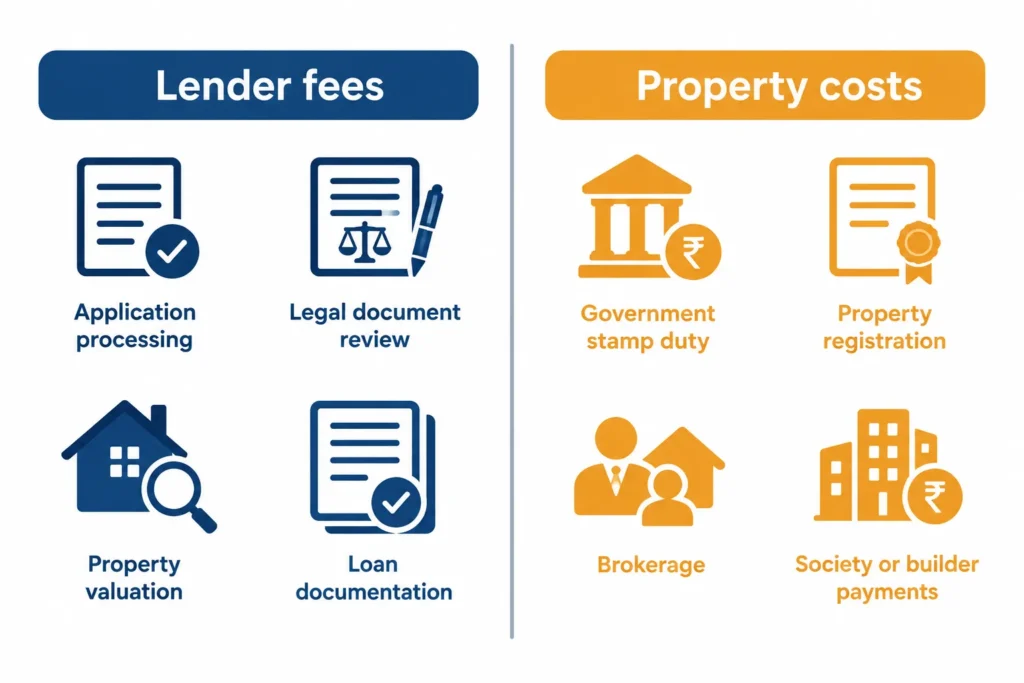
It is important to separate loan charges from the wider cost of buying a home.
Lender fees are connected with evaluating, approving, documenting, servicing or changing the home loan. Processing, legal scrutiny and technical valuation charges generally fall into this category.
Government charges may include stamp duty and registration fees payable under the rules applicable to the property’s location. These are not home loan processing fees, even if the buyer uses loan funds for part of the purchase.
Property-purchase expenses can include brokerage, society-related payments, maintenance deposits, parking charges or payments to a builder for specified facilities. Their applicability depends on the property and transaction. They should not automatically be treated as lender charges.
This distinction matters when preparing your budget. A bank may approve a loan based on its valuation and lending rules, but it may not finance every tax, government charge or incidental expense connected with the purchase.
Processing Fees: Fixed vs Percentage-Based Charges
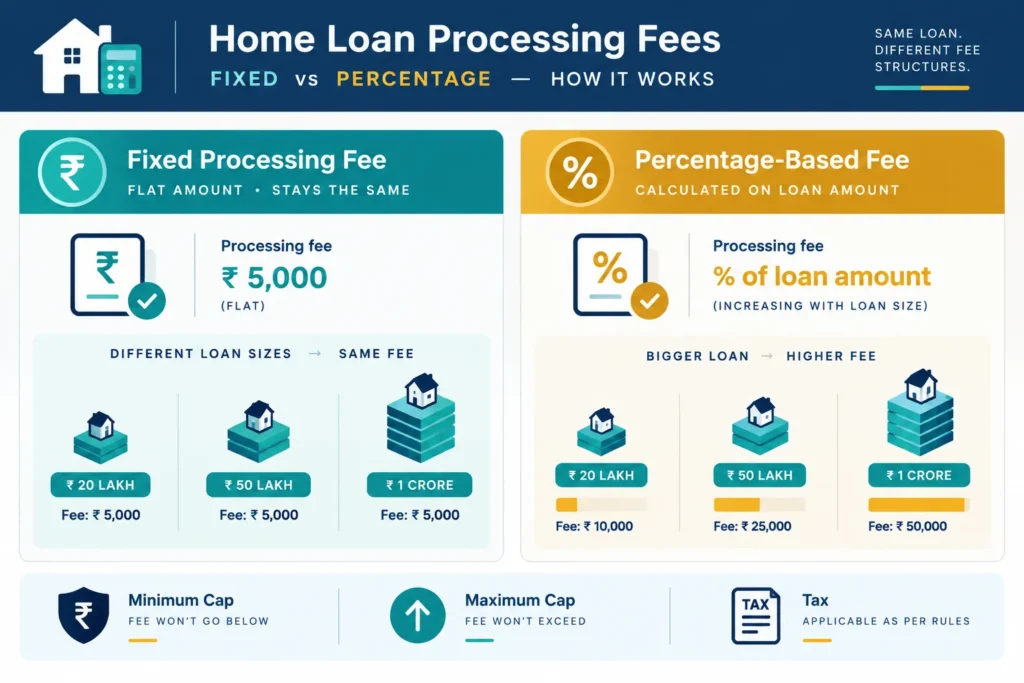
A lender may calculate home loan processing fees as a fixed amount or as a percentage of the loan amount. Some lenders may use a combination, such as a percentage subject to a minimum or maximum charge.
Fixed processing fee
Under a fixed-fee structure, the lender quotes a set amount for processing the application. The charge does not directly increase with the requested loan amount, although different products or borrower categories may have different fixed fees.
A fixed amount is easy to understand, but borrowers should still check whether legal review, valuation and taxes are included.
Percentage-based processing fee
Under a percentage-based structure, the fee is calculated on the loan amount. A larger loan can therefore result in a higher processing charge. The lender may also specify a minimum or maximum amount.
Consider a buyer in Pune applying for a home loan of ₹40 lakh. If one lender quotes a percentage-based fee and another quotes a fixed fee, the buyer should calculate the rupee cost of both. The buyer should then add separately quoted legal, technical and documentation charges, along with applicable taxes. Comparing only the fee label can be misleading if the included services are different.
Also confirm which amount is used for the calculation. It may be the loan amount applied for, sanctioned or finally disbursed, depending on the lender’s terms.
Questions to ask before paying
- Is the fee fixed or linked to the loan amount?
- Is there a minimum or maximum charge?
- Does the quote include applicable taxes?
- Are legal and technical evaluations included?
- Is any part refundable if the application is rejected or withdrawn?
- Will the fee change if the sanctioned amount is lower than the requested amount?
- Is the discount or waiver recorded in writing?
Legal and Technical Evaluation Charges
A home loan is assessed on two broad fronts: the borrower’s ability to repay and the property’s acceptability as security. Legal and technical evaluations mainly deal with the second part.
Legal evaluation
The lender may appoint a lawyer or approved agency to examine the property documents. The review can cover the title, chain of ownership, sale deed, encumbrance information, sanctioned plans, permissions and other records relevant to the property.
The objective is to identify legal issues that could affect ownership or the lender’s security. The exact documents required depend on whether the property is new, under construction, ready to move into, purchased from an existing owner or built on a plot.
A lender’s legal clearance is primarily for its lending decision. It should not be treated as a complete replacement for the buyer’s own legal due diligence. A buyer may choose to obtain independent legal advice, especially for resale property, inherited property or transactions involving complex ownership records.
Technical evaluation
A technical evaluation examines the physical and financial aspects of the property. An approved valuer or engineer may inspect its location, size, condition, construction progress and broad compliance with the documents provided.
The evaluator may also estimate the property’s value. This valuation can differ from the price agreed between the buyer and seller. The lender generally uses its accepted valuation and lending rules to decide the eligible loan amount.
For an under-construction home, technical checks may be repeated before stage-wise disbursements. If separate inspections are required, ask whether additional charges will apply.
Legal and technical fees may be included in the processing fee, collected at actual cost or charged separately. Always request an itemised written quote and official receipts. This helps you compare lenders fairly and understand the real upfront cost of the home loan.
Stamp Duty and Property Registration Costs
Stamp duty and property registration charges are major costs when buying a home in India. However, they are not the same as home loan processing fees. Processing fees are charged by the lender for assessing and handling the loan application. Stamp duty and registration charges are paid for legally recording the property transaction.
These property-purchase costs are governed by the rules applicable in the state or Union Territory where the property is located. The amount can depend on factors such as the property value, location, type of property, ownership structure and buyer category.
What is stamp duty?
Stamp duty is a government levy on the legal documents used to transfer or record rights in a property. It is generally calculated using the property’s transaction value or the value determined under the applicable government rules, whichever basis is required by local law.
Some states may offer a lower rate for women buyers or for property held in certain ownership combinations. Such benefits are not uniform across India. Check the current rules for the property’s location instead of assuming that a concession will apply.
What is the property registration charge?
Registration is the process of officially recording the property document with the relevant government authority. A separate registration charge may apply in addition to stamp duty.
The buyer usually has to arrange these payments around the execution and registration of the sale deed. A lender may ask for proof that the required stamp duty and registration formalities have been completed before or as part of final loan disbursement.
Are these costs covered by the home loan?
Do not assume that the bank or housing finance company will fund stamp duty and registration charges. Whether any related amount is considered while calculating the eligible loan depends on the lender’s policy, applicable rules and the structure of the transaction.
In practice, buyers should keep separate funds available for these costs. They may also need money for the down payment, home loan processing fees and other expenses that are not included in the sanctioned loan amount.
Before signing the agreement, obtain an estimate from a qualified local professional or the relevant registration authority. Property agents, builders and online calculators can provide an indication, but the final amount should be checked against current state rules.
Other Possible Home Loan and Property Expenses
A home purchase may involve several charges beyond the advertised interest rate and processing fee. Not every charge applies to every borrower. Some are mandatory for completing the transaction, some arise only in particular cases, and others are optional.
Common mandatory or transaction-linked costs
- Legal and technical assessment charges: The lender may verify the property title, approvals, building plan and physical condition. These charges may be included in the processing fee or collected separately.
- Documentation charges: A lender may charge for preparing, handling or storing loan and security documents. Ask whether this is already included in the quoted home loan processing fees.
- Mortgage creation charges: Creating and recording the lender’s security interest over the property may involve stamp duty, filing fees or registration-related expenses. The process and cost can vary by state and by the type of mortgage.
- Applicable taxes: Taxes may be charged on lender fees and service charges as required by law. Check whether the amount shown in the fee quote includes or excludes such taxes.
Costs that apply only in certain cases
- Builder or society paperwork: A builder, housing society or association may charge for documents, permissions, records or administrative work where permitted. Ask for a written breakup and the basis for the charge.
- Conversion or permission expenses: Costs may arise if land use conversion, leasehold-to-freehold conversion, development authority approval or another specific permission is required.
- Brokerage: A property broker may charge the buyer, seller or both, depending on the agreed arrangement. Brokerage is separate from lender fees.
- Valuation or repeat inspection charges: A fresh valuation or site visit may be needed if the property changes, construction is delayed, documents expire or disbursement is requested in stages.
- Delayed-payment charges: The lender may impose charges if an EMI, pre-EMI or other payable amount is not paid on time. A builder may separately levy delay-related amounts under the purchase agreement and applicable rules.
- Cheque, mandate or payment-return charges: A failed auto-debit, returned cheque or unsuccessful payment instruction can result in a charge under the loan terms.
Optional costs
Insurance is an important area where borrowers should distinguish between lender requirements and optional products. Property insurance covering risks to the building may be required under the loan terms. A separate home loan protection or life insurance policy may be offered to cover the outstanding loan after specified events.
Do not assume that every insurance product offered with a home loan is compulsory. Ask the lender to identify the legal or contractual requirement in writing. Compare the premium, coverage, exclusions, policy term and cancellation conditions before agreeing.
If an insurance premium is added to the loan, interest may be charged on that financed amount. This can make the total cost higher than paying the premium separately. Borrowers should also understand whether the policy provides level cover or cover that reduces with the loan balance.
When Are Home Loan Fees Paid?
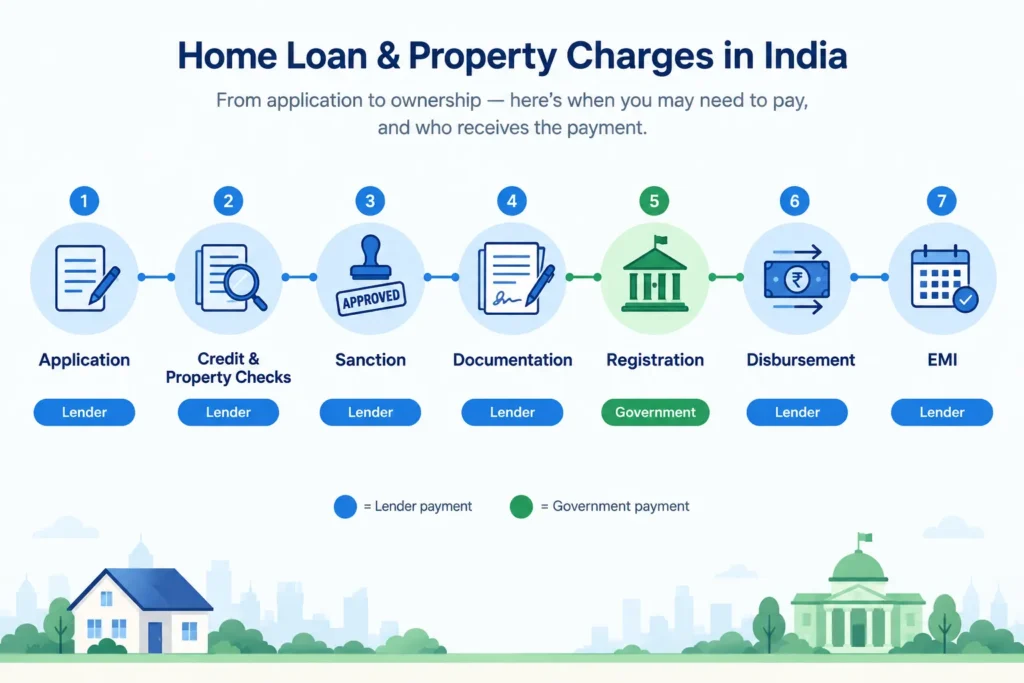
Home loan charges are not always collected at one time. The payment stage depends on the lender, property and transaction. Asking for a stage-wise fee sheet can help you plan cash flow and avoid surprises.
- At application: The lender may collect an application charge or all or part of the processing fee when the form is submitted. This can be payable even before approval.
- During credit and property checks: Legal scrutiny, technical valuation, verification or documentation charges may be collected when the lender starts these checks.
- At sanction: Some lenders collect the remaining processing fee or an administrative charge before issuing or accepting the sanction letter.
- Before loan documentation: The borrower may need to pay mortgage-related stamp duty, document charges, insurance premiums or other security-creation expenses.
- At property registration: Stamp duty and registration charges are generally paid as required for executing and registering the property documents.
- At disbursement: Certain outstanding fees may be deducted from the amount released by the lender. This means the net amount reaching the seller or builder can be lower than the gross disbursement.
- After disbursement: EMI or pre-EMI payments begin according to the loan terms. Later charges may arise for failed payments, delayed payments, document requests or permitted loan-account services.
For an under-construction home, disbursement may happen in stages based on construction progress. The borrower may pay pre-EMI interest on the amount already released, or regular EMI if the lender’s product and repayment schedule provide for it.
Before each payment, request a receipt or tax invoice where applicable. Also confirm whether the amount is being paid to the lender, builder, government authority, insurer, broker or another service provider. This makes it easier to track the true cost of the property and loan.
Are Home Loan Processing Fees Refundable?
Home loan processing fees are often non-refundable once the lender has started reviewing the application. The lender may have already incurred costs for credit checks, staff work, legal review or property assessment even if the loan is later rejected or the borrower decides not to continue.
However, there is no single answer for every case. Refundability depends on the lender’s written terms, the stage reached and the reason the application did not proceed.
If the borrower cancels the application
If you withdraw after the lender begins processing, the entire fee may be retained. If you cancel before any work starts, the lender may allow a full or partial refund, but only if its policy or written communication provides for it.
If the lender rejects the loan
Rejection does not automatically mean that the processing fee will be returned. Some lenders treat the fee as payment for evaluating the application rather than a charge for successful approval. Others may refund a portion under specific conditions.
If the property is not approved
A borrower may qualify financially while the property fails the lender’s legal or technical checks. In such a situation, charges already spent on verification may not be refundable. The exact outcome should be checked in the application form and fee schedule.
How to protect yourself before paying
- Ask whether the fee is fully refundable, partly refundable or non-refundable.
- Check what happens if the borrower is rejected or the property is not accepted.
- Confirm whether taxes and third-party charges will also be refunded.
- Ask when processing is considered to have started.
- Keep the fee quote, application terms, receipts and refund communication.
- Get any waiver, discount or refund promise in writing.
Do not rely only on a verbal statement from a sales representative or broker. Read the lender’s application form, schedule of charges and sanction conditions. A lower headline processing fee may still come with separate legal, valuation or documentation expenses, so compare the complete payable amount rather than one fee alone.
How to Compare Home Loan Offers Beyond the Interest Rate
A low advertised interest rate does not always mean the cheapest home loan. You should compare the total cost, including home loan processing fees, taxes, legal checks, property valuation and future service charges.
Ask each lender for its official fee schedule and a written loan offer. Do not rely only on a verbal quote from a salesperson or property broker.
Compare the total upfront cost
Calculate how much you must pay before or during loan disbursement. Common upfront costs may include:
- Home loan processing fees
- GST or other applicable taxes on lender services
- Legal opinion and document verification charges
- Technical inspection or property valuation charges
- Administrative or login fees
- Mortgage creation or registration expenses, where applicable
- Stamp duty and property registration charges payable to the government
For example, one lender may quote a lower processing fee but separately charge for legal verification and valuation. Another may bundle these services into one fee. Compare the final rupee amount rather than one fee in isolation.
Check recurring and event-based charges
Some costs arise only after the loan starts. Review charges for duplicate statements, document retrieval, EMI return, late payment, repayment schedule changes and switching between interest rate options.
Also ask whether the lender charges for reducing the interest rate when a lower rate becomes available. This may be described as a conversion, repricing or switch fee.
Understand the interest rate type and reset terms
Check whether the loan has a fixed, floating or mixed interest rate. For a floating-rate loan, identify the benchmark, the lender’s spread and how often the rate resets.
A low initial rate may not remain unchanged. Ask the lender to explain what happens to the EMI or tenure when the benchmark changes. Obtain this information in writing.
For a fixed-rate loan, check how long the rate is actually fixed. Some products are fixed only for an initial period and later become floating-rate loans.
Review prepayment and foreclosure conditions
Prepayment can reduce your total interest cost, but the conditions depend on the loan type, borrower category, rate structure and applicable regulatory rules.
Regulated lenders generally cannot impose foreclosure or prepayment penalties on certain floating-rate loans taken by individual borrowers for non-business purposes. However, you should verify the current rule and your loan agreement. Fixed-rate loans and loans taken for business purposes may have different conditions.
Ask whether there is a minimum prepayment amount, a required notice period or a limit on how frequently you can make part-payments.
Evaluate service quality and accessibility
A home loan can continue for many years. Service quality therefore matters. Consider how easily you can obtain annual interest certificates, account statements, a list of original property documents and support for part-prepayment.
Also check the process for collecting original documents after the loan is closed. A slightly cheaper loan may be inconvenient if routine requests involve repeated branch visits or unclear procedures.
Read cancellation and refund rules
Processing fees are commonly collected for evaluating an application. Payment does not guarantee approval. The fee may be partly refundable, fully non-refundable or refundable only before a particular stage.
Ask what happens if you cancel the application, the lender rejects it, the property fails legal verification or the sanctioned amount is lower than expected. The answer should appear in the application form, fee schedule, sanction letter or another written document.
How to Reduce or Avoid Unnecessary Loan Charges
You may not be able to remove every charge, but careful comparison and negotiation can prevent avoidable costs.
Get an itemised quotation
Ask for a written breakdown of every expected charge and the applicable tax. If the quotation uses broad terms such as “administrative expenses,” request an explanation of what is included.
Confirm whether legal and valuation fees are included in the home loan processing fees or collected separately. Also ask whether any charge must be paid directly to an outside lawyer, valuer or government authority.
Negotiate before paying
Processing fees may sometimes be negotiable, especially during promotional campaigns or when you have a strong credit profile and stable income. Existing customers may also receive preferential offers.
You can show the lender a competing written offer and ask whether it can match the processing fee or another charge. A waiver is not guaranteed, so compare the final written terms rather than assuming the request will be accepted.
Avoid unnecessary paid add-ons
Review every optional product offered with the loan. Insurance may help protect your family, but you should understand the cover, premium, exclusions and whether the premium is being added to the loan.
Do not assume that every insurance or investment product presented during the application is compulsory. Ask the lender to identify which requirements are mandatory under the loan terms and which are optional.
Submit complete and accurate documents
Missing income records, inconsistent addresses or unclear property papers can delay verification and create additional work. Before applying, check the lender’s document list and submit readable, current copies.
Do not conceal existing loans or credit card obligations. Accurate disclosure allows the lender to assess your eligibility and reduces the risk of rejection after you have paid non-refundable charges.
Verify payment instructions
Pay charges only through the lender’s authorised channels and obtain a receipt. The receipt should mention the amount, tax and purpose of payment.
Avoid transferring money to a salesperson’s personal account. If an intermediary is involved, confirm with the lender whether the intermediary is authorised and whether its fee is separate from the lender’s charges.
Home Loan Cost Checklist Before Applying
Use this checklist for every offer you are seriously considering:
- What is the processing fee in rupees, and is it fixed or linked to the loan amount?
- What GST or other applicable tax will be added?
- Are legal scrutiny and property valuation included or charged separately?
- Is any part of the fee refundable if the application is rejected or cancelled?
- When does the lender collect each charge?
- Is the interest rate fixed, floating or mixed?
- What benchmark and spread apply, and how often can the rate reset?
- What are the part-prepayment and foreclosure conditions?
- Are there conversion, document retrieval, late payment or EMI return charges?
- How much must you separately budget for stamp duty and property registration?
- Are any insurance products optional, and will their premiums be financed?
- Have all waivers and discounts been recorded in writing?
- Have you compared the total upfront cost and not only the advertised interest rate?
Keep copies of the application form, official fee schedule, receipts, sanction letter and loan agreement. Read the final agreement before signing because it normally governs the actual charges and conditions.
Frequently Asked Questions About Home Loan Processing Fees
Is GST charged on home loan processing fees?
Yes, GST is generally charged on processing fees and other taxable services provided by the lender. The commonly applicable GST rate on financial service charges is 18%, but you should verify the rate shown on the lender’s invoice. GST is not normally charged on the interest component of a home loan EMI.
Will the processing fee be returned if my application is rejected?
Not necessarily. Many lenders treat the fee as payment for assessing the application and may keep it even when the loan is rejected. Some lenders may refund a portion under specific conditions. Check the written refund policy before paying.
Can I get a refund if I cancel after receiving sanction?
This depends on the lender’s terms and the stage at which you cancel. A processing or login fee may be non-refundable once credit assessment has started. Other amounts may be refundable if the related service has not been performed. Request a written calculation of any refund.
Do I pay processing fees during a home loan balance transfer?
The new lender may charge a processing fee for evaluating and taking over the loan. You may also face legal, valuation, mortgage-related or administrative expenses. Compare these costs with the expected interest savings and the remaining loan tenure before transferring.
Are legal and valuation charges part of the processing fee?
Sometimes they are included, but often they are separate. Legal charges cover examination of ownership and property documents. Valuation charges cover the lender’s technical inspection and assessment of the property. Ask for an itemised quotation.
Are stamp duty and registration charges included in the processing fee?
No. Property stamp duty and registration charges are government levies connected with the property transaction. They are separate from the lender’s processing fee. Additional mortgage-related stamp duty or registration expenses may also apply depending on the state and transaction structure.
Can home loan processing fees be negotiated?
You can ask for a reduction or waiver, particularly if you have a strong borrower profile or a competing offer. However, approval is at the lender’s discretion. Make sure any negotiated concession appears in writing before paying.
Does paying a processing fee guarantee loan approval?
No. The lender still needs to check your income, credit history, repayment capacity and property documents. Loan approval and disbursement remain subject to the lender’s conditions.
Summary
Home loan processing fees are only one part of the borrowing cost. Compare upfront charges, taxes, legal and valuation expenses, interest reset terms, prepayment rules, service charges and refund conditions. Use official fee schedules, ask for an itemised quotation and keep all promises in writing. A careful comparison can help you choose a suitable loan without being distracted by a low headline rate or a temporary fee offer.




Comments