What Is DeFi? Decentralized Finance Explained for Beginners

A simple guide to decentralized finance, including how DeFi works, its common uses, potential benefits, major risks and practical safety checks for beginners in India.

What Is DeFi? Decentralized Finance Explained for Beginners

DeFi, short for decentralised finance, refers to financial applications built mainly on blockchain networks. Instead of asking a bank or a centralised crypto company to process every action, users interact with software called smart contracts. A self-custody wallet provides access, while the blockchain records and settles transactions. DeFi can support activities such as exchanging tokens, lending or borrowing, but it also carries risks. Transactions are often irreversible, fees can change, and the applications may contain technical or governance weaknesses.

Introduction

If you are learning about cryptocurrency for the first time, you may soon come across the term “DeFi”. It is often described as an alternative financial system that operates without banks. That description is useful, but it is incomplete.

DeFi does not remove every company, developer or decision-maker. It changes how financial services are delivered. Rules that would normally be applied by a bank, broker or crypto exchange may instead be written into smart contracts and executed on a blockchain.

For an Indian user, DeFi could mean exchanging one crypto token for another directly from a personal wallet. It could also mean supplying tokens to a lending protocol or using digital assets as collateral. These activities do not usually require a conventional bank account within the application, although purchasing crypto with rupees may still involve a bank, payment service or centralised crypto platform.

Understanding DeFi requires a basic knowledge of cryptocurrency and blockchain technology. Readers who are new to these concepts may find it helpful to first read our complete beginner’s guide to cryptocurrency in India, followed by the blockchain guide and the smart contracts guide.

Understanding DeFi and How It Works

What Is DeFi in Simple Words?

Decentralised finance is a broad name for blockchain-based applications that provide financial functions through software. These functions may include token exchanges, loans, asset transfers and other services involving digital assets.

In traditional finance, an institution generally maintains account records, approves transactions and holds customer funds. In DeFi, a blockchain maintains the transaction record, while smart contracts apply the application’s programmed rules.

For example, a token exchange protocol may contain smart contracts that calculate how many units of one token a user can receive for another. If the user accepts the quoted terms and authorises the transaction, the contracts can process the exchange without a bank employee manually approving it.

This does not mean that DeFi is automatically safe, cheap, private or easy to access. A transaction may have high network fees, a smart contract may contain an error, or an interface may be misleading. The legal and tax treatment of crypto activities can also matter for Indian users.

The Main Parts of a DeFi Transaction
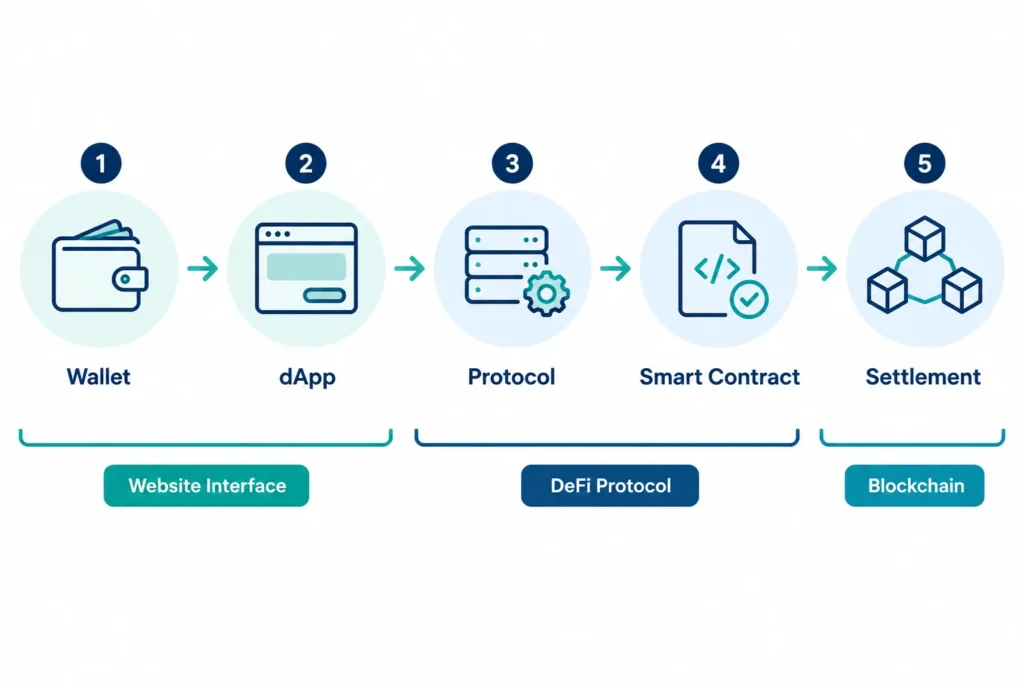
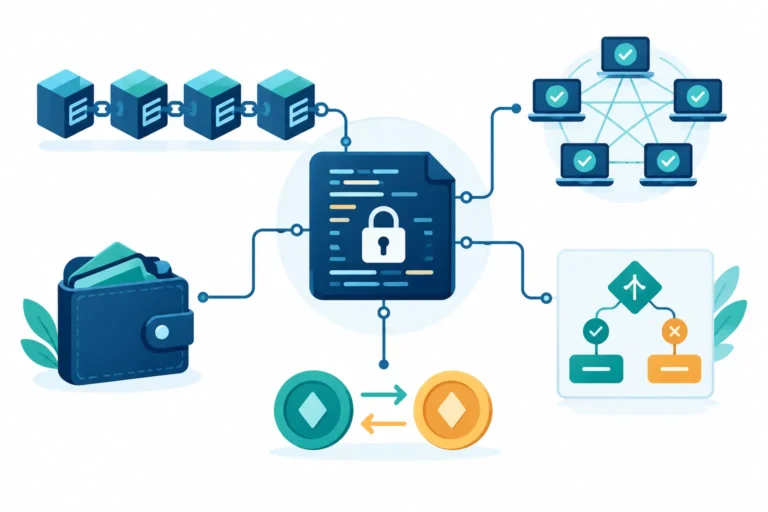
Flowchart showing a wallet connecting through a dApp and DeFi protocol to smart contracts and blockchain settlement.

Several separate technologies work together when someone uses DeFi. Beginners should understand the difference between them because a problem with one part does not always mean that every other part has failed.

  • Blockchain network: This is the shared system that records transactions and runs smart contracts. Different networks have different tokens, fees, speeds and technical rules.
  • Smart contracts: These are programs deployed on a blockchain. They follow coded instructions, such as transferring tokens when specified conditions are met.
  • DeFi protocol: This is the wider set of smart contracts and rules that provides a particular service. A token exchange protocol, for instance, may use several connected contracts.
  • dApp interface: A decentralised application, or dApp, usually provides a website or mobile interface through which users communicate with the protocol. The interface displays buttons, token balances and transaction details.
  • Self-custody wallet: This is software or hardware that allows the user to manage blockchain addresses and authorise transactions with private keys.

The dApp interface, protocol and blockchain are not the same thing. A website may become unavailable while the underlying smart contracts continue to exist. Similarly, an interface could display incorrect information even though the blockchain itself is operating normally.

Users should therefore verify the network, token, contract details and transaction request rather than trusting an interface only because it looks professional.

Self-Custody, Private Keys and Recovery Phrases

A self-custody wallet gives the user control over the credentials needed to authorise transactions. The wallet provider does not normally approve each transfer or restore access in the same way that a bank can reset an online banking password.

The most important credential is the private key. It proves control over a blockchain address and allows transactions to be signed. Anyone who obtains the private key may be able to move the assets associated with that address.

Many wallets provide a recovery phrase, also called a seed phrase. This is usually a series of words that can recreate the wallet’s private keys. It should be kept private and stored securely offline. It should not be entered into an unfamiliar website, shared with customer support or sent through a message.

Losing the recovery phrase does not always cause an immediate loss if the wallet remains accessible. However, if the device is then lost, damaged or reset, recovery may be impossible. DeFi users generally carry more responsibility for security than customers using a conventional bank or custodial platform.

You May Also Like:NFTs Explained: What They Are, How They Work and Their Risks

Example: Exchanging Tokens Through a DeFi Application

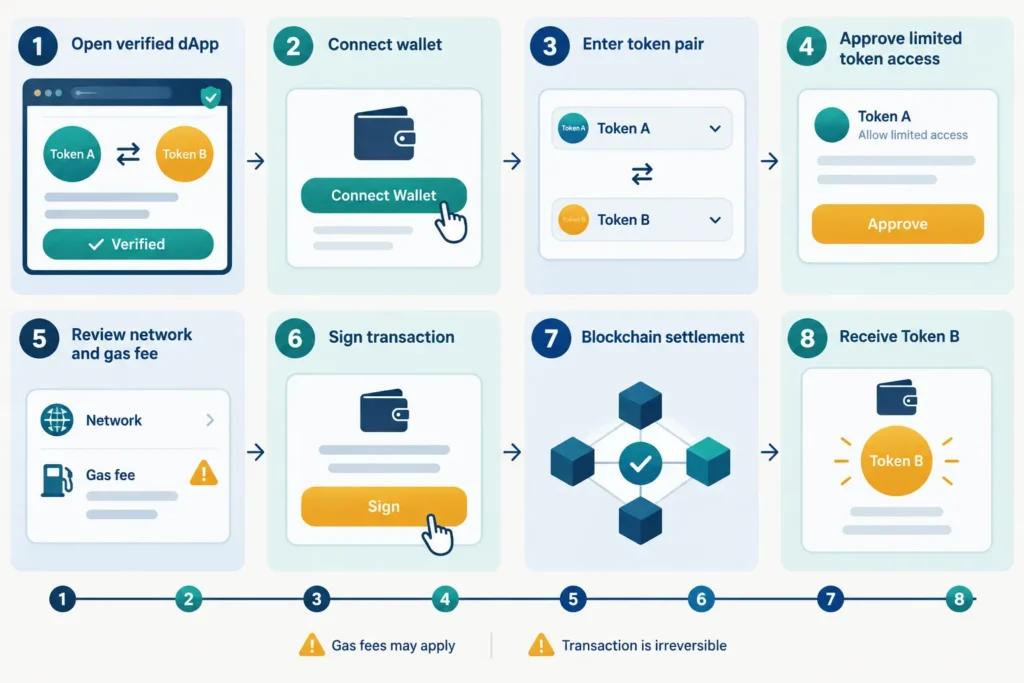
Timeline showing the steps involved in swapping Token A for Token B through a DeFi application.

Consider an Indian user named Meera who already holds Token A in a self-custody wallet. She wants to exchange part of it for Token B using a DeFi application.

  1. Opening the dApp: Meera visits the application interface and checks that it supports the blockchain network and tokens she intends to use.
  2. Connecting the wallet: She selects the wallet connection option. Connecting normally allows the interface to view her public address and request actions. It does not, by itself, give the dApp her recovery phrase.
  3. Entering the exchange: Meera chooses Token A, enters the amount, and selects Token B as the asset she wants to receive. The interface displays an estimated exchange amount and relevant details.
  4. Approving token access: Depending on the token and protocol, Meera may first need to approve a smart contract to use a specified amount of Token A. This approval is a separate blockchain transaction and may require a fee.
  5. Confirming the exchange: Her wallet displays the requested transaction, including the network and estimated gas fee. Meera reviews the information and signs it with her wallet.
  6. Blockchain settlement: The transaction is sent to the network. If it is accepted and the smart contract executes successfully, Token A is exchanged and Token B is sent to Meera’s wallet address.

A gas fee is the payment required for the blockchain network to process a transaction. It is usually paid in the network’s native token, not necessarily the token being exchanged. Meera therefore needs enough of the correct native token in her wallet. Gas fees can rise or fall with network demand and transaction complexity.

The final amount may differ from the initial estimate because market prices or available liquidity can change before execution. A failed transaction may also consume some gas because the network still performed computational work.

Once confirmed on a blockchain, a transaction may be difficult or impossible to reverse. There may be no bank helpline with the power to cancel a transfer sent to the wrong address. Some protocols have administrators who can pause particular functions, but users should not assume that anyone can recover misplaced or stolen tokens.

How DeFi Differs From Banks and Centralised Crypto Platforms

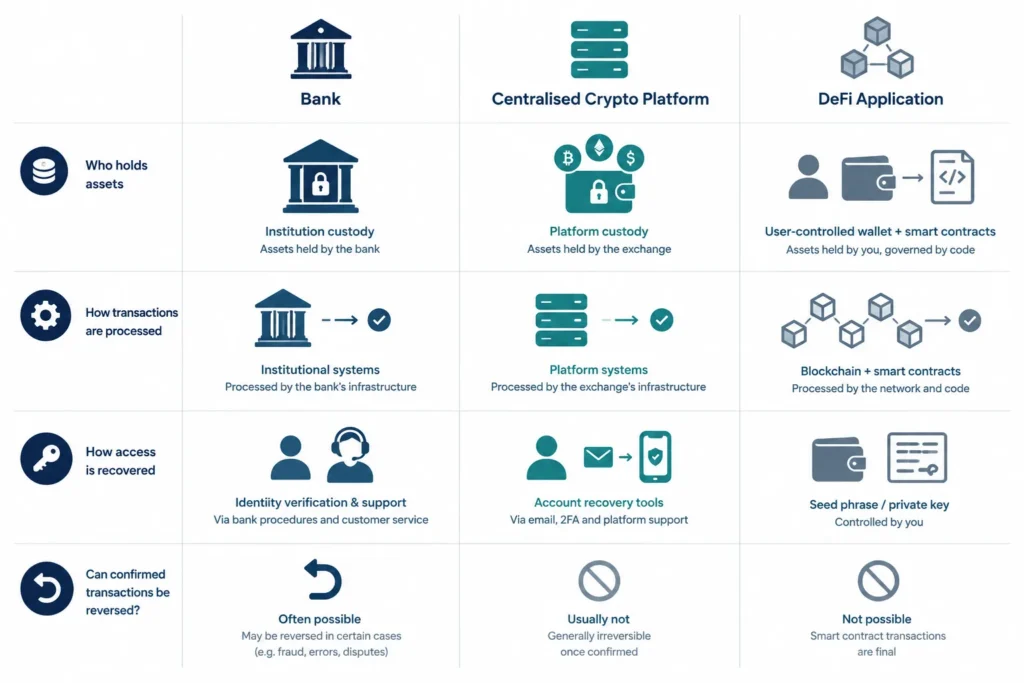
Visual comparison of asset control, transaction processing, account recovery and reversibility across banks, centralised crypto platforms and DeFi.

Feature Bank or traditional service Centralised crypto platform DeFi application
Control of assets The institution maintains customer accounts The platform may hold users’ crypto The user commonly interacts through a self-custody wallet
Transaction processing Institutional systems and payment networks The company’s internal systems, with blockchain transfers when needed Smart contracts and the blockchain network
Account recovery Identity checks may restore access The platform may reset account access Wallet recovery usually depends on the user’s credentials
Transaction reversal Some payments may be disputed or reversed The platform may sometimes intervene internally Confirmed blockchain transactions are generally difficult to reverse

These are general differences, not universal rules. DeFi is not necessarily cheaper than a bank or centralised platform. Network fees may be high, and a poorly designed protocol may be risky. It is also not automatically more accessible because users need compatible technology, crypto assets and enough knowledge to manage a wallet safely.

Decentralisation Is a Spectrum

A DeFi project can be decentralised in some ways and centralised in others. Its smart contracts may run on a public blockchain, while its main website is controlled by one company. Developers may retain an upgrade key, administrators may be able to pause contracts, or a small governance group may influence important decisions.

Other projects may distribute decision-making among token holders, independent developers or community groups. Even then, voting power can be concentrated, and most users may not participate.

For this reason, the word “decentralised” should not be treated as a guarantee. Users should ask who controls the interface, who can change the contracts, whether emergency powers exist, and how governance decisions are made. DeFi is best understood as a spectrum of different technical and organisational arrangements rather than a single fully decentralised model.

Common DeFi Applications and Key Concepts

To understand what is DeFi in practical terms, it helps to look at the financial activities people perform through decentralised applications. These activities can include exchanging crypto tokens, lending assets, borrowing against collateral and supplying funds to trading pools.

DeFi services usually run through smart contracts on a blockchain. A smart contract is a program that follows predefined rules. It can transfer assets, calculate interest or close a risky loan without a bank employee manually approving each step.

This does not mean the system is risk-free or completely automatic in every respect. Developers create the contracts, users may participate in governance, and some projects rely on companies or other centralised parties for certain functions.

Decentralised Exchanges and Token Swaps

A decentralised exchange, commonly called a DEX, allows users to swap one crypto token for another through smart contracts. Users generally connect a compatible crypto wallet and approve the transaction themselves.

For example, a person may swap Token A for a stablecoin without first depositing both assets into an exchange-controlled account. The tokens move according to the smart contract’s rules, although the user must usually pay the blockchain’s network fee.

A token swap is not always executed at the price displayed when the user first opens the application. The final result may be affected by:

  • Price movement: The market price can change before the transaction is confirmed.
  • Slippage: A large order or a pool with limited funds may produce a less favourable exchange rate.
  • Network fees: The blockchain may charge a transaction fee, which can rise when the network is busy.
  • Token taxes or unusual rules: Some tokens contain contract features that reduce or restrict transfers.
You May Also Like:Cryptocurrency Risks: Common Dangers and How to Invest More Safely

A DEX also does not automatically verify whether a token is genuine or suitable for investment. Fraudsters can create tokens with names and symbols similar to well-known assets. Users must check the correct blockchain and contract details before approving a swap.

Lending, Borrowing and Collateral

DeFi lending protocols allow users to supply crypto assets to a smart contract. Borrowers can then access those assets by following the protocol’s rules. Suppliers may receive interest or protocol rewards, while borrowers pay interest and provide collateral.

Collateral is an asset pledged to support a loan. In traditional finance, a home may secure a housing loan. In DeFi, crypto tokens commonly act as collateral.

Many DeFi loans are overcollateralised. This means the value of the collateral must be higher than the amount borrowed. For instance, a borrower might have to deposit crypto worth more than ₹1 lakh to borrow assets worth ₹1 lakh. The actual requirement depends on the protocol, the asset and market conditions.

Overcollateralisation is common because most DeFi loans do not involve the usual salary checks, credit reports or personal guarantees. The protocol relies mainly on the deposited crypto to protect lenders.

This creates an important risk called liquidation. If the collateral’s value falls too far, the smart contract may sell some or all of it to repay the loan. The borrower may also pay a liquidation penalty.

Crypto prices can move quickly, so liquidation may happen even when the borrower expects the price to recover later. Adding more collateral or repaying part of the debt can sometimes reduce this risk, but neither action guarantees protection.

Liquidity Pools and Liquidity Providers

Many decentralised exchanges use liquidity pools instead of matching each buyer directly with a seller. A liquidity pool is a collection of tokens held by a smart contract and used to process swaps.

People who deposit assets into these pools are known as liquidity providers, or LPs. A pool may require two assets, such as a crypto token and a stablecoin. In return for supplying them, LPs may receive a share of trading fees and, in some cases, additional protocol rewards.

The returns depend on several factors, including trading activity, pool rules, token prices, reward rates and smart-contract security. A high displayed annual yield is not the same as a fixed bank deposit rate. It may change rapidly, and the value of the reward token may fall.

Impermanent Loss in Simple Terms

Impermanent loss can occur when the prices of tokens in a liquidity pool change after they are deposited. The pool automatically adjusts the quantities of each token as traders make swaps.

Suppose an LP deposits equal values of Token A and a stablecoin. Token A later rises sharply in price. The pool’s formula may cause the LP to end up with less Token A and more stablecoins than originally deposited.

If the person had simply kept both assets in a wallet, the combined value could have been higher. The difference between the pool position and simply holding the tokens is commonly called impermanent loss.

The word “impermanent” can be misleading. The difference may reduce if prices move back towards their earlier relationship. However, it can become a realised loss when the LP withdraws, and there is no certainty that prices will return. Trading fees and rewards may offset the difference, but they may also be insufficient.

Stablecoins and Their Role in DeFi

Stablecoins are crypto tokens designed to maintain a relatively stable value, often by tracking a currency such as the US dollar. They are widely used in DeFi because users can trade, lend or make payments without taking the same level of day-to-day price exposure as with many other crypto assets.

An Indian user, for example, may encounter stablecoins as the quoted asset in a token pair or as the asset borrowed from a lending protocol. However, a US dollar-linked stablecoin is not the same as holding rupees in an Indian bank account. Its INR value can still move with the USD-INR exchange rate.

Stablecoins also carry distinct risks:

  • Peg risk: The token may stop trading near its intended reference value.
  • Issuer risk: A centrally issued stablecoin may depend on the issuer’s reserves, operations and redemption policies.
  • Collateral risk: Assets supporting a stablecoin may lose value or become difficult to sell.
  • Smart-contract risk: A coding error or exploit may affect the token or the protocol holding it.
  • Regulatory and access risk: Rules, account restrictions or contract controls may affect how a stablecoin can be used.

Stablecoins do not all work in the same way. Some claim to hold traditional reserve assets, while others use crypto collateral or algorithmic mechanisms. A detailed stablecoins guide can explain these models separately.

Yield Farming Is Not the Same as Staking

Yield farming generally means supplying or moving crypto assets across DeFi protocols to seek fees, interest or token rewards. A user might deposit tokens into a lending market, provide liquidity to a pool and receive additional rewards offered by the protocol.

Strategies can involve several connected smart contracts. This can increase exposure to contract failures, liquidation, impermanent loss, changing reward rules and costly network transactions.

Staking usually has a different purpose. On proof-of-stake blockchains, staking helps support network consensus and security. Participants may lock or delegate the network’s native asset and receive rewards for contributing to the validation process.

Some DeFi projects also use the word “staking” for locking a protocol-specific token to receive rewards, governance rights or a share of fees. Such arrangements may not perform the same technical role as network-level staking.

Therefore, labels alone are not enough. Meanings and mechanics vary by blockchain and protocol. Before participating, users should understand where the rewards come from, whether assets are locked, what conditions apply to withdrawals and what could cause losses.

You May Also Like:Crypto Wallets in India: Types, How They Work and How to Choose One

Other Programmable Financial Services

DeFi smart contracts can support other services, including crypto-based insurance arrangements, derivatives, prediction markets, automated investment strategies and systems for creating or trading blockchain-based assets.

Non-fungible tokens, or NFTs, may also interact with DeFi. For example, a protocol may use an NFT to represent a financial position or another unique on-chain asset. NFTs have different uses and risks, so they are better covered in a dedicated beginner’s guide.

None of these services provides guaranteed returns. Advertised yields can fall, token prices can decline, smart contracts can fail and access can be affected by network congestion or protocol decisions. Beginners should treat every DeFi activity as a separate product and understand its rules and risks before committing funds.

DeFi Risks, Safety Checks and Beginner FAQ

DeFi can make financial services available through blockchain-based applications, but it also carries serious risks. There may be no bank, customer-care desk or central authority able to reverse a transaction. If something goes wrong, users can lose some or all of their funds.

Beginners should treat DeFi as a high-risk activity. Understanding how a protocol works is important, but it does not remove the possibility of loss.

Major Risks in DeFi

Smart-contract vulnerabilities: DeFi applications depend on software called smart contracts. A programming error can allow an attacker to steal or lock funds. Even a widely used protocol can contain a flaw that has not yet been discovered.

Exploits and governance attacks: Attackers may manipulate a protocol’s voting system, borrowing mechanism or price data. A person or group controlling enough governance power may be able to approve harmful changes.

Administrator and upgrade-key risks: Some protocols are not fully decentralised. A development team or small committee may retain the power to pause contracts, change rules or upgrade the software. These powers can help during an emergency, but they also create a point of trust and potential failure.

Malicious token approvals: When connecting a wallet, a DeFi application may ask for permission to use a token. A malicious or overly broad approval can allow a contract to transfer more tokens than the user intended.

Scams and fake websites: Criminals may copy a genuine DeFi website, create fake tokens or impersonate support staff. A user who connects a wallet to the wrong site may approve a transaction that drains the wallet. Learning the common signs of crypto scams is therefore an essential safety step.

Token volatility: Crypto asset prices can rise or fall sharply. Interest or rewards earned through a protocol may be much smaller than the fall in the value of the deposited token.

Thin liquidity: A token may appear valuable but have few buyers or sellers. Selling a large amount can then cause substantial price slippage. In extreme cases, users may be unable to exit at a reasonable price.

Stablecoin failure: Stablecoins aim to maintain a fixed value, often relative to a currency such as the US dollar. However, the peg can fail because of weak reserves, poor design, market panic, regulation or problems with an issuer. “Stable” does not mean risk-free.

Oracle failures: DeFi protocols often use external price feeds called oracles. Incorrect, delayed or manipulated data can lead to unfair liquidations, bad trades or losses for the protocol.

Liquidation risk: In DeFi lending, borrowers usually provide crypto collateral. If its value falls below the required level, the protocol may automatically sell the collateral. Fast market movements and network delays can make it difficult to add collateral in time.

Impermanent loss: People who supply two assets to a liquidity pool may end up with a different mix of tokens as prices change. The final value can be lower than simply holding the original assets. Fees may offset part of this loss, but they may not cover it.

Network congestion and gas fees: Blockchain transactions require network fees. During busy periods, fees can become expensive and transactions may take longer. A user may be unable to repay a loan, adjust collateral or withdraw funds at the desired time.

Regulatory uncertainty: Laws and regulatory treatment can change. Access to certain services, reporting duties and the treatment of tokens may also differ by jurisdiction. This forms part of the broader cryptocurrency risks that every user should consider.

How to Evaluate a DeFi Protocol

No checklist can prove that a protocol is safe. However, careful research can help a beginner avoid obvious risks. Review the following areas before connecting a wallet or depositing funds:

  • Purpose: Identify what the protocol actually does and where any advertised return comes from.
  • Documentation: Read the official explanation of deposits, borrowing, rewards, fees and risks. Vague documentation is a warning sign.
  • Operating history: Check how long the protocol has operated and whether it has survived difficult market conditions.
  • Source code: Find out whether the smart-contract code is publicly available for review. Public code improves transparency but does not automatically make it secure.
  • Administrator powers: Check who can pause, upgrade or change the contracts. Understand whether changes require multiple signers or a waiting period.
  • Governance: Review how proposals are created and approved, and whether voting power is concentrated among a few holders.
  • Liquidity: Consider whether deposits, withdrawals and token trades can happen without severe slippage.
  • Collateral rules: For lending protocols, understand collateral ratios, liquidation thresholds, penalties and the assets accepted as collateral.
  • Oracle design: Check where price information comes from and what happens if a price feed stops or becomes unreliable.
  • Fees and withdrawals: Review trading fees, borrowing costs, network charges, lock-in conditions and withdrawal limits.
  • Incident history: Look for previous exploits, paused withdrawals, lost funds and the team’s response to those events.

Do Security Audits Make DeFi Safe?

An independent smart-contract audit is useful because security specialists review the code and identify possible weaknesses. Multiple audits, public reports and clear responses to findings can provide helpful information.

However, an audit is only a snapshot of particular code at a particular time. It may not cover later upgrades, connected protocols, compromised administrator keys or every possible attack. Auditors can also miss vulnerabilities. An audit reduces uncertainty but cannot guarantee safety.

Warning Signs to Avoid

Be cautious if you notice any of these signs:

  • A copied website, misspelled domain name or unofficial application.
  • Fake support accounts contacting users through social media or messaging apps.
  • Unsolicited messages offering investment help, airdrops or account recovery.
  • Extremely high or “risk-free” yields without a clear source of revenue.
  • Pressure to deposit immediately before an offer expires.
  • A hidden team combined with powerful administrator controls and little accountability.
  • Unclear documentation or explanations filled with promotional language.
  • Any request for a private key, wallet password or recovery phrase.
You May Also Like:Bitcoin Explained: How It Works, Its Uses and Risks for Beginners

Legitimate wallet support should never need your recovery phrase. Anyone who obtains it can usually control the wallet and transfer its assets.

Practical Safety Precautions

  1. Verify the official website: Use trusted sources and cross-check the spelling. Do not rely only on advertisements, direct messages or search results.
  2. Check the network: Confirm that your wallet is connected to the correct blockchain before making a transaction.
  3. Verify the token contract: Tokens can share the same name and symbol. Compare the contract address with reliable official information.
  4. Observe before depositing: First understand the interface and transaction flow without committing funds. Where appropriate, use a small test transaction that you can afford to lose.
  5. Read transaction details: Check the token, amount, destination, expected output, gas fee and permission being requested.
  6. Limit token permissions: Avoid unlimited approvals when a smaller allowance is practical. Regularly review and revoke permissions that are no longer needed.
  7. Protect wallet backups: Keep recovery phrases and private keys offline in a secure place. Never enter them into a website or share them with another person.
  8. Avoid unaffordable exposure: Do not use emergency savings, borrowed money or funds needed for near-term expenses.

Indian users should independently verify the current legal, tax and regulatory treatment of DeFi transactions through authoritative sources. Rules, reporting requirements and official interpretations may change. DeFi activity can involve several transactions, including swaps, rewards, borrowing, collateral movements and token receipts, so maintaining complete records may be useful.

Do not assume that a decentralised application falls outside Indian law or tax obligations merely because it has no local office. Consider consulting a qualified tax or legal professional for advice based on your circumstances.

Frequently Asked Questions

What is DeFi?

DeFi, or decentralised finance, refers to blockchain-based financial applications that use smart contracts to provide services such as trading, lending and borrowing. Users generally interact through a crypto wallet instead of a traditional financial intermediary.

How does DeFi work?

A user connects a compatible wallet to a DeFi application and approves a blockchain transaction. Smart contracts then apply the protocol’s rules, such as exchanging tokens, calculating interest or checking collateral. Transactions and network fees are recorded on the relevant blockchain.

Is DeFi safe?

DeFi is not completely safe. Users face smart-contract bugs, scams, token price changes, liquidations, stablecoin failures, malicious approvals and other risks. Research, careful wallet practices and limited exposure can reduce some risks, but they cannot eliminate them.

How does DeFi lending work?

Lenders deposit crypto assets into a smart-contract-based pool and may receive interest paid by borrowers. Borrowers usually provide collateral worth more than the amount borrowed. If the collateral value falls below the protocol’s requirement, it may be automatically liquidated.

Are DeFi yields guaranteed?

No. Yields can change quickly and may depend on borrowing demand, token rewards, trading fees or promotional incentives. Returns can be reduced or erased by token price falls, impermanent loss, gas fees, exploits or protocol failure.

Summary

DeFi gives wallet users access to blockchain-based financial services, but it can expose them to complex technical, market and legal risks. Before using a protocol, examine its purpose, controls, liquidity, collateral rules, fees, audits and incident history. Verify every website and transaction, restrict token permissions, protect wallet backups and never share a recovery phrase. Most importantly, use only funds you can afford to lose and confirm the latest Indian legal and tax requirements from authoritative sources.

Share this article
KEEP READING

Related Articles

View all →

Comments

Leave a Comment

What Is DeFi? Decentralized Finance Explained for Beginners

DeFi, short for decentralised finance, refers to financial applications built mainly on blockchain networks. Instead of asking a bank or a centralised crypto company to process every action, users interact with software called smart contracts. A self-custody wallet provides access, while the blockchain records and settles transactions. DeFi can support activities such as exchanging tokens, lending or borrowing, but it also carries risks. Transactions are often irreversible, fees can change, and the applications may contain technical or governance weaknesses.

Introduction

If you are learning about cryptocurrency for the first time, you may soon come across the term “DeFi”. It is often described as an alternative financial system that operates without banks. That description is useful, but it is incomplete.

DeFi does not remove every company, developer or decision-maker. It changes how financial services are delivered. Rules that would normally be applied by a bank, broker or crypto exchange may instead be written into smart contracts and executed on a blockchain.

For an Indian user, DeFi could mean exchanging one crypto token for another directly from a personal wallet. It could also mean supplying tokens to a lending protocol or using digital assets as collateral. These activities do not usually require a conventional bank account within the application, although purchasing crypto with rupees may still involve a bank, payment service or centralised crypto platform.

Understanding DeFi requires a basic knowledge of cryptocurrency and blockchain technology. Readers who are new to these concepts may find it helpful to first read our complete beginner’s guide to cryptocurrency in India, followed by the blockchain guide and the smart contracts guide.

Understanding DeFi and How It Works

What Is DeFi in Simple Words?

Decentralised finance is a broad name for blockchain-based applications that provide financial functions through software. These functions may include token exchanges, loans, asset transfers and other services involving digital assets.

In traditional finance, an institution generally maintains account records, approves transactions and holds customer funds. In DeFi, a blockchain maintains the transaction record, while smart contracts apply the application’s programmed rules.

For example, a token exchange protocol may contain smart contracts that calculate how many units of one token a user can receive for another. If the user accepts the quoted terms and authorises the transaction, the contracts can process the exchange without a bank employee manually approving it.

This does not mean that DeFi is automatically safe, cheap, private or easy to access. A transaction may have high network fees, a smart contract may contain an error, or an interface may be misleading. The legal and tax treatment of crypto activities can also matter for Indian users.

The Main Parts of a DeFi Transaction

Flowchart showing a wallet connecting through a dApp and DeFi protocol to smart contracts and blockchain settlement.

Several separate technologies work together when someone uses DeFi. Beginners should understand the difference between them because a problem with one part does not always mean that every other part has failed.

  • Blockchain network: This is the shared system that records transactions and runs smart contracts. Different networks have different tokens, fees, speeds and technical rules.
  • Smart contracts: These are programs deployed on a blockchain. They follow coded instructions, such as transferring tokens when specified conditions are met.
  • DeFi protocol: This is the wider set of smart contracts and rules that provides a particular service. A token exchange protocol, for instance, may use several connected contracts.
  • dApp interface: A decentralised application, or dApp, usually provides a website or mobile interface through which users communicate with the protocol. The interface displays buttons, token balances and transaction details.
  • Self-custody wallet: This is software or hardware that allows the user to manage blockchain addresses and authorise transactions with private keys.

The dApp interface, protocol and blockchain are not the same thing. A website may become unavailable while the underlying smart contracts continue to exist. Similarly, an interface could display incorrect information even though the blockchain itself is operating normally.

Users should therefore verify the network, token, contract details and transaction request rather than trusting an interface only because it looks professional.

Self-Custody, Private Keys and Recovery Phrases

A self-custody wallet gives the user control over the credentials needed to authorise transactions. The wallet provider does not normally approve each transfer or restore access in the same way that a bank can reset an online banking password.

The most important credential is the private key. It proves control over a blockchain address and allows transactions to be signed. Anyone who obtains the private key may be able to move the assets associated with that address.

Many wallets provide a recovery phrase, also called a seed phrase. This is usually a series of words that can recreate the wallet’s private keys. It should be kept private and stored securely offline. It should not be entered into an unfamiliar website, shared with customer support or sent through a message.

Losing the recovery phrase does not always cause an immediate loss if the wallet remains accessible. However, if the device is then lost, damaged or reset, recovery may be impossible. DeFi users generally carry more responsibility for security than customers using a conventional bank or custodial platform.

Example: Exchanging Tokens Through a DeFi Application
Timeline showing the steps involved in swapping Token A for Token B through a DeFi application.

Consider an Indian user named Meera who already holds Token A in a self-custody wallet. She wants to exchange part of it for Token B using a DeFi application.

  1. Opening the dApp: Meera visits the application interface and checks that it supports the blockchain network and tokens she intends to use.
  2. Connecting the wallet: She selects the wallet connection option. Connecting normally allows the interface to view her public address and request actions. It does not, by itself, give the dApp her recovery phrase.
  3. Entering the exchange: Meera chooses Token A, enters the amount, and selects Token B as the asset she wants to receive. The interface displays an estimated exchange amount and relevant details.
  4. Approving token access: Depending on the token and protocol, Meera may first need to approve a smart contract to use a specified amount of Token A. This approval is a separate blockchain transaction and may require a fee.
  5. Confirming the exchange: Her wallet displays the requested transaction, including the network and estimated gas fee. Meera reviews the information and signs it with her wallet.
  6. Blockchain settlement: The transaction is sent to the network. If it is accepted and the smart contract executes successfully, Token A is exchanged and Token B is sent to Meera’s wallet address.

A gas fee is the payment required for the blockchain network to process a transaction. It is usually paid in the network’s native token, not necessarily the token being exchanged. Meera therefore needs enough of the correct native token in her wallet. Gas fees can rise or fall with network demand and transaction complexity.

The final amount may differ from the initial estimate because market prices or available liquidity can change before execution. A failed transaction may also consume some gas because the network still performed computational work.

Once confirmed on a blockchain, a transaction may be difficult or impossible to reverse. There may be no bank helpline with the power to cancel a transfer sent to the wrong address. Some protocols have administrators who can pause particular functions, but users should not assume that anyone can recover misplaced or stolen tokens.

How DeFi Differs From Banks and Centralised Crypto Platforms
Visual comparison of asset control, transaction processing, account recovery and reversibility across banks, centralised crypto platforms and DeFi.

Feature Bank or traditional service Centralised crypto platform DeFi application
Control of assets The institution maintains customer accounts The platform may hold users’ crypto The user commonly interacts through a self-custody wallet
Transaction processing Institutional systems and payment networks The company’s internal systems, with blockchain transfers when needed Smart contracts and the blockchain network
Account recovery Identity checks may restore access The platform may reset account access Wallet recovery usually depends on the user’s credentials
Transaction reversal Some payments may be disputed or reversed The platform may sometimes intervene internally Confirmed blockchain transactions are generally difficult to reverse

These are general differences, not universal rules. DeFi is not necessarily cheaper than a bank or centralised platform. Network fees may be high, and a poorly designed protocol may be risky. It is also not automatically more accessible because users need compatible technology, crypto assets and enough knowledge to manage a wallet safely.

Decentralisation Is a Spectrum

A DeFi project can be decentralised in some ways and centralised in others. Its smart contracts may run on a public blockchain, while its main website is controlled by one company. Developers may retain an upgrade key, administrators may be able to pause contracts, or a small governance group may influence important decisions.

Other projects may distribute decision-making among token holders, independent developers or community groups. Even then, voting power can be concentrated, and most users may not participate.

For this reason, the word “decentralised” should not be treated as a guarantee. Users should ask who controls the interface, who can change the contracts, whether emergency powers exist, and how governance decisions are made. DeFi is best understood as a spectrum of different technical and organisational arrangements rather than a single fully decentralised model.

Common DeFi Applications and Key Concepts

To understand what is DeFi in practical terms, it helps to look at the financial activities people perform through decentralised applications. These activities can include exchanging crypto tokens, lending assets, borrowing against collateral and supplying funds to trading pools.

DeFi services usually run through smart contracts on a blockchain. A smart contract is a program that follows predefined rules. It can transfer assets, calculate interest or close a risky loan without a bank employee manually approving each step.

This does not mean the system is risk-free or completely automatic in every respect. Developers create the contracts, users may participate in governance, and some projects rely on companies or other centralised parties for certain functions.

Decentralised Exchanges and Token Swaps

A decentralised exchange, commonly called a DEX, allows users to swap one crypto token for another through smart contracts. Users generally connect a compatible crypto wallet and approve the transaction themselves.

For example, a person may swap Token A for a stablecoin without first depositing both assets into an exchange-controlled account. The tokens move according to the smart contract’s rules, although the user must usually pay the blockchain’s network fee.

A token swap is not always executed at the price displayed when the user first opens the application. The final result may be affected by:

  • Price movement: The market price can change before the transaction is confirmed.
  • Slippage: A large order or a pool with limited funds may produce a less favourable exchange rate.
  • Network fees: The blockchain may charge a transaction fee, which can rise when the network is busy.
  • Token taxes or unusual rules: Some tokens contain contract features that reduce or restrict transfers.

A DEX also does not automatically verify whether a token is genuine or suitable for investment. Fraudsters can create tokens with names and symbols similar to well-known assets. Users must check the correct blockchain and contract details before approving a swap.

Lending, Borrowing and Collateral

DeFi lending protocols allow users to supply crypto assets to a smart contract. Borrowers can then access those assets by following the protocol’s rules. Suppliers may receive interest or protocol rewards, while borrowers pay interest and provide collateral.

Collateral is an asset pledged to support a loan. In traditional finance, a home may secure a housing loan. In DeFi, crypto tokens commonly act as collateral.

Many DeFi loans are overcollateralised. This means the value of the collateral must be higher than the amount borrowed. For instance, a borrower might have to deposit crypto worth more than ₹1 lakh to borrow assets worth ₹1 lakh. The actual requirement depends on the protocol, the asset and market conditions.

Overcollateralisation is common because most DeFi loans do not involve the usual salary checks, credit reports or personal guarantees. The protocol relies mainly on the deposited crypto to protect lenders.

This creates an important risk called liquidation. If the collateral’s value falls too far, the smart contract may sell some or all of it to repay the loan. The borrower may also pay a liquidation penalty.

Crypto prices can move quickly, so liquidation may happen even when the borrower expects the price to recover later. Adding more collateral or repaying part of the debt can sometimes reduce this risk, but neither action guarantees protection.

Liquidity Pools and Liquidity Providers

Many decentralised exchanges use liquidity pools instead of matching each buyer directly with a seller. A liquidity pool is a collection of tokens held by a smart contract and used to process swaps.

People who deposit assets into these pools are known as liquidity providers, or LPs. A pool may require two assets, such as a crypto token and a stablecoin. In return for supplying them, LPs may receive a share of trading fees and, in some cases, additional protocol rewards.

The returns depend on several factors, including trading activity, pool rules, token prices, reward rates and smart-contract security. A high displayed annual yield is not the same as a fixed bank deposit rate. It may change rapidly, and the value of the reward token may fall.

Impermanent Loss in Simple Terms

Impermanent loss can occur when the prices of tokens in a liquidity pool change after they are deposited. The pool automatically adjusts the quantities of each token as traders make swaps.

Suppose an LP deposits equal values of Token A and a stablecoin. Token A later rises sharply in price. The pool’s formula may cause the LP to end up with less Token A and more stablecoins than originally deposited.

If the person had simply kept both assets in a wallet, the combined value could have been higher. The difference between the pool position and simply holding the tokens is commonly called impermanent loss.

The word “impermanent” can be misleading. The difference may reduce if prices move back towards their earlier relationship. However, it can become a realised loss when the LP withdraws, and there is no certainty that prices will return. Trading fees and rewards may offset the difference, but they may also be insufficient.

Stablecoins and Their Role in DeFi

Stablecoins are crypto tokens designed to maintain a relatively stable value, often by tracking a currency such as the US dollar. They are widely used in DeFi because users can trade, lend or make payments without taking the same level of day-to-day price exposure as with many other crypto assets.

An Indian user, for example, may encounter stablecoins as the quoted asset in a token pair or as the asset borrowed from a lending protocol. However, a US dollar-linked stablecoin is not the same as holding rupees in an Indian bank account. Its INR value can still move with the USD-INR exchange rate.

Stablecoins also carry distinct risks:

  • Peg risk: The token may stop trading near its intended reference value.
  • Issuer risk: A centrally issued stablecoin may depend on the issuer’s reserves, operations and redemption policies.
  • Collateral risk: Assets supporting a stablecoin may lose value or become difficult to sell.
  • Smart-contract risk: A coding error or exploit may affect the token or the protocol holding it.
  • Regulatory and access risk: Rules, account restrictions or contract controls may affect how a stablecoin can be used.

Stablecoins do not all work in the same way. Some claim to hold traditional reserve assets, while others use crypto collateral or algorithmic mechanisms. A detailed stablecoins guide can explain these models separately.

Yield Farming Is Not the Same as Staking

Yield farming generally means supplying or moving crypto assets across DeFi protocols to seek fees, interest or token rewards. A user might deposit tokens into a lending market, provide liquidity to a pool and receive additional rewards offered by the protocol.

Strategies can involve several connected smart contracts. This can increase exposure to contract failures, liquidation, impermanent loss, changing reward rules and costly network transactions.

Staking usually has a different purpose. On proof-of-stake blockchains, staking helps support network consensus and security. Participants may lock or delegate the network’s native asset and receive rewards for contributing to the validation process.

Some DeFi projects also use the word “staking” for locking a protocol-specific token to receive rewards, governance rights or a share of fees. Such arrangements may not perform the same technical role as network-level staking.

Therefore, labels alone are not enough. Meanings and mechanics vary by blockchain and protocol. Before participating, users should understand where the rewards come from, whether assets are locked, what conditions apply to withdrawals and what could cause losses.

Other Programmable Financial Services

DeFi smart contracts can support other services, including crypto-based insurance arrangements, derivatives, prediction markets, automated investment strategies and systems for creating or trading blockchain-based assets.

Non-fungible tokens, or NFTs, may also interact with DeFi. For example, a protocol may use an NFT to represent a financial position or another unique on-chain asset. NFTs have different uses and risks, so they are better covered in a dedicated beginner’s guide.

None of these services provides guaranteed returns. Advertised yields can fall, token prices can decline, smart contracts can fail and access can be affected by network congestion or protocol decisions. Beginners should treat every DeFi activity as a separate product and understand its rules and risks before committing funds.

DeFi Risks, Safety Checks and Beginner FAQ

DeFi can make financial services available through blockchain-based applications, but it also carries serious risks. There may be no bank, customer-care desk or central authority able to reverse a transaction. If something goes wrong, users can lose some or all of their funds.

Beginners should treat DeFi as a high-risk activity. Understanding how a protocol works is important, but it does not remove the possibility of loss.

Major Risks in DeFi

Smart-contract vulnerabilities: DeFi applications depend on software called smart contracts. A programming error can allow an attacker to steal or lock funds. Even a widely used protocol can contain a flaw that has not yet been discovered.

Exploits and governance attacks: Attackers may manipulate a protocol’s voting system, borrowing mechanism or price data. A person or group controlling enough governance power may be able to approve harmful changes.

Administrator and upgrade-key risks: Some protocols are not fully decentralised. A development team or small committee may retain the power to pause contracts, change rules or upgrade the software. These powers can help during an emergency, but they also create a point of trust and potential failure.

Malicious token approvals: When connecting a wallet, a DeFi application may ask for permission to use a token. A malicious or overly broad approval can allow a contract to transfer more tokens than the user intended.

Scams and fake websites: Criminals may copy a genuine DeFi website, create fake tokens or impersonate support staff. A user who connects a wallet to the wrong site may approve a transaction that drains the wallet. Learning the common signs of crypto scams is therefore an essential safety step.

Token volatility: Crypto asset prices can rise or fall sharply. Interest or rewards earned through a protocol may be much smaller than the fall in the value of the deposited token.

Thin liquidity: A token may appear valuable but have few buyers or sellers. Selling a large amount can then cause substantial price slippage. In extreme cases, users may be unable to exit at a reasonable price.

Stablecoin failure: Stablecoins aim to maintain a fixed value, often relative to a currency such as the US dollar. However, the peg can fail because of weak reserves, poor design, market panic, regulation or problems with an issuer. “Stable” does not mean risk-free.

Oracle failures: DeFi protocols often use external price feeds called oracles. Incorrect, delayed or manipulated data can lead to unfair liquidations, bad trades or losses for the protocol.

Liquidation risk: In DeFi lending, borrowers usually provide crypto collateral. If its value falls below the required level, the protocol may automatically sell the collateral. Fast market movements and network delays can make it difficult to add collateral in time.

Impermanent loss: People who supply two assets to a liquidity pool may end up with a different mix of tokens as prices change. The final value can be lower than simply holding the original assets. Fees may offset part of this loss, but they may not cover it.

Network congestion and gas fees: Blockchain transactions require network fees. During busy periods, fees can become expensive and transactions may take longer. A user may be unable to repay a loan, adjust collateral or withdraw funds at the desired time.

Regulatory uncertainty: Laws and regulatory treatment can change. Access to certain services, reporting duties and the treatment of tokens may also differ by jurisdiction. This forms part of the broader cryptocurrency risks that every user should consider.

How to Evaluate a DeFi Protocol

No checklist can prove that a protocol is safe. However, careful research can help a beginner avoid obvious risks. Review the following areas before connecting a wallet or depositing funds:

  • Purpose: Identify what the protocol actually does and where any advertised return comes from.
  • Documentation: Read the official explanation of deposits, borrowing, rewards, fees and risks. Vague documentation is a warning sign.
  • Operating history: Check how long the protocol has operated and whether it has survived difficult market conditions.
  • Source code: Find out whether the smart-contract code is publicly available for review. Public code improves transparency but does not automatically make it secure.
  • Administrator powers: Check who can pause, upgrade or change the contracts. Understand whether changes require multiple signers or a waiting period.
  • Governance: Review how proposals are created and approved, and whether voting power is concentrated among a few holders.
  • Liquidity: Consider whether deposits, withdrawals and token trades can happen without severe slippage.
  • Collateral rules: For lending protocols, understand collateral ratios, liquidation thresholds, penalties and the assets accepted as collateral.
  • Oracle design: Check where price information comes from and what happens if a price feed stops or becomes unreliable.
  • Fees and withdrawals: Review trading fees, borrowing costs, network charges, lock-in conditions and withdrawal limits.
  • Incident history: Look for previous exploits, paused withdrawals, lost funds and the team’s response to those events.

Do Security Audits Make DeFi Safe?

An independent smart-contract audit is useful because security specialists review the code and identify possible weaknesses. Multiple audits, public reports and clear responses to findings can provide helpful information.

However, an audit is only a snapshot of particular code at a particular time. It may not cover later upgrades, connected protocols, compromised administrator keys or every possible attack. Auditors can also miss vulnerabilities. An audit reduces uncertainty but cannot guarantee safety.

Warning Signs to Avoid

Be cautious if you notice any of these signs:

  • A copied website, misspelled domain name or unofficial application.
  • Fake support accounts contacting users through social media or messaging apps.
  • Unsolicited messages offering investment help, airdrops or account recovery.
  • Extremely high or “risk-free” yields without a clear source of revenue.
  • Pressure to deposit immediately before an offer expires.
  • A hidden team combined with powerful administrator controls and little accountability.
  • Unclear documentation or explanations filled with promotional language.
  • Any request for a private key, wallet password or recovery phrase.

Legitimate wallet support should never need your recovery phrase. Anyone who obtains it can usually control the wallet and transfer its assets.

Practical Safety Precautions

  1. Verify the official website: Use trusted sources and cross-check the spelling. Do not rely only on advertisements, direct messages or search results.
  2. Check the network: Confirm that your wallet is connected to the correct blockchain before making a transaction.
  3. Verify the token contract: Tokens can share the same name and symbol. Compare the contract address with reliable official information.
  4. Observe before depositing: First understand the interface and transaction flow without committing funds. Where appropriate, use a small test transaction that you can afford to lose.
  5. Read transaction details: Check the token, amount, destination, expected output, gas fee and permission being requested.
  6. Limit token permissions: Avoid unlimited approvals when a smaller allowance is practical. Regularly review and revoke permissions that are no longer needed.
  7. Protect wallet backups: Keep recovery phrases and private keys offline in a secure place. Never enter them into a website or share them with another person.
  8. Avoid unaffordable exposure: Do not use emergency savings, borrowed money or funds needed for near-term expenses.

Legal and Tax Considerations in India

Indian users should independently verify the current legal, tax and regulatory treatment of DeFi transactions through authoritative sources. Rules, reporting requirements and official interpretations may change. DeFi activity can involve several transactions, including swaps, rewards, borrowing, collateral movements and token receipts, so maintaining complete records may be useful.

Do not assume that a decentralised application falls outside Indian law or tax obligations merely because it has no local office. Consider consulting a qualified tax or legal professional for advice based on your circumstances.

Frequently Asked Questions

What is DeFi?

DeFi, or decentralised finance, refers to blockchain-based financial applications that use smart contracts to provide services such as trading, lending and borrowing. Users generally interact through a crypto wallet instead of a traditional financial intermediary.

How does DeFi work?

A user connects a compatible wallet to a DeFi application and approves a blockchain transaction. Smart contracts then apply the protocol’s rules, such as exchanging tokens, calculating interest or checking collateral. Transactions and network fees are recorded on the relevant blockchain.

Is DeFi safe?

DeFi is not completely safe. Users face smart-contract bugs, scams, token price changes, liquidations, stablecoin failures, malicious approvals and other risks. Research, careful wallet practices and limited exposure can reduce some risks, but they cannot eliminate them.

How does DeFi lending work?

Lenders deposit crypto assets into a smart-contract-based pool and may receive interest paid by borrowers. Borrowers usually provide collateral worth more than the amount borrowed. If the collateral value falls below the protocol’s requirement, it may be automatically liquidated.

Are DeFi yields guaranteed?

No. Yields can change quickly and may depend on borrowing demand, token rewards, trading fees or promotional incentives. Returns can be reduced or erased by token price falls, impermanent loss, gas fees, exploits or protocol failure.

Summary

DeFi gives wallet users access to blockchain-based financial services, but it can expose them to complex technical, market and legal risks. Before using a protocol, examine its purpose, controls, liquidity, collateral rules, fees, audits and incident history. Verify every website and transaction, restrict token permissions, protect wallet backups and never share a recovery phrase. Most importantly, use only funds you can afford to lose and confirm the latest Indian legal and tax requirements from authoritative sources.

Leave a Comment