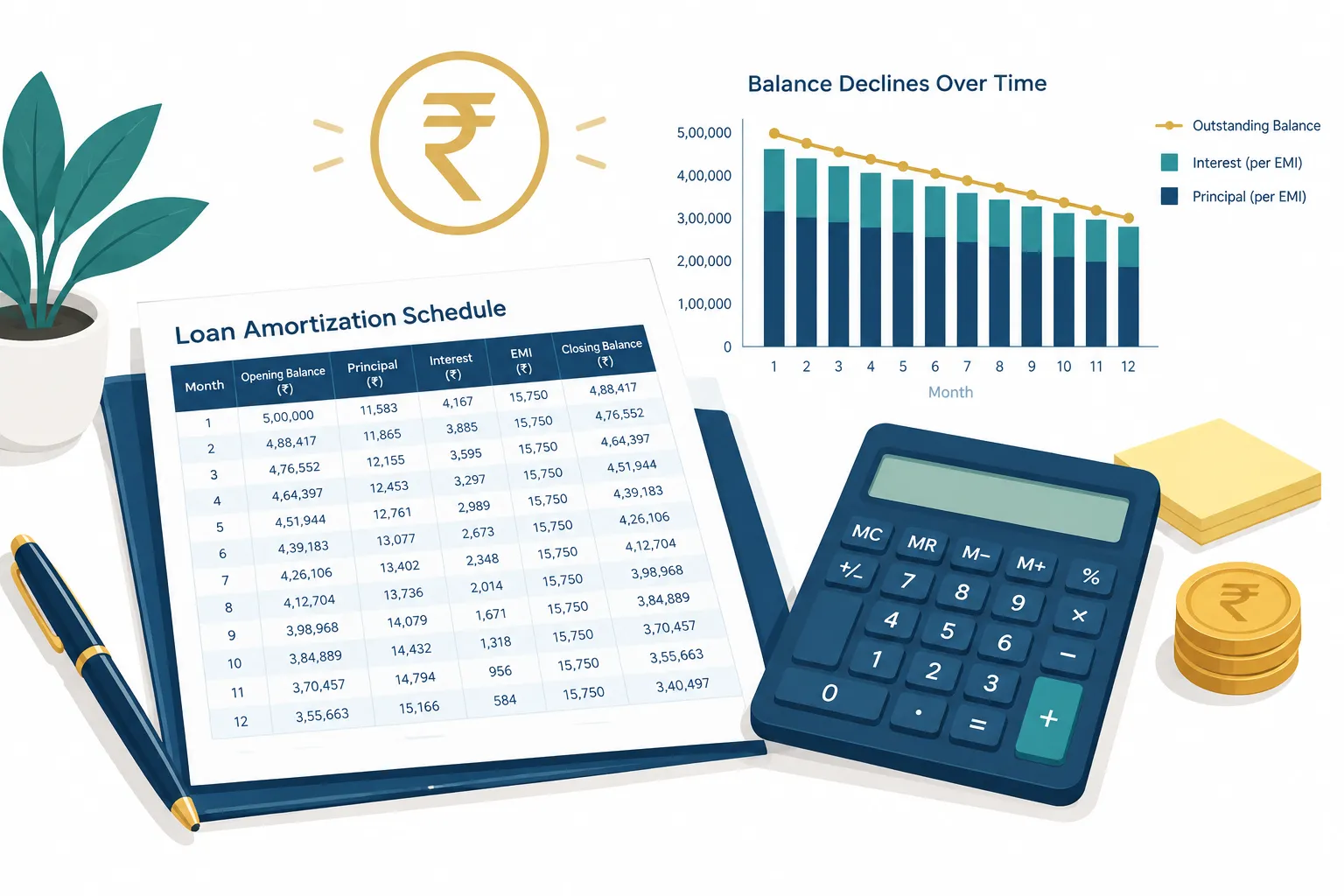
Loan Amortization Schedule Explained With an Example

A loan amortization schedule shows how every EMI is divided between principal and interest. This guide explains how to read and calculate it using a simple Indian rupee example.

Loan Amortization Schedule Explained With an Example

A loan amortization schedule is a month-by-month breakdown of your loan repayment. It shows the opening loan balance, EMI, interest charged, principal repaid and closing balance for each month. Under the reducing-balance method commonly used for loans in India, interest is calculated on the outstanding principal. As a result, early EMIs usually contain more interest, while later EMIs contain more principal.

When you take a home loan, car loan or personal loan, you may focus mainly on the EMI. The EMI tells you how much you need to pay each month, but it does not show where that money goes.

Part of every EMI pays the lender’s interest charge. The remaining part reduces the amount you borrowed. A loan amortization schedule separates these two components and helps you understand how your debt reduces over time.

This is especially useful for long-term loans. Two loans can have a similar EMI but differ in interest rate, tenure and total interest cost. Reading the repayment schedule helps you look beyond the monthly payment.

What Is a Loan Amortization Schedule?

Amortization means repaying a loan gradually through scheduled payments. Each payment covers the interest due for that period and repays a part of the principal.

A loan amortization schedule is a statement showing this repayment process for every instalment. Banks and other lenders may call it an amortization table, repayment schedule or loan repayment statement.

A typical schedule includes the following details:

  • Instalment number or payment date: This identifies the month or due date to which the entry relates.
  • Opening balance: The outstanding principal at the beginning of the period.
  • EMI: The scheduled monthly payment made by the borrower.
  • Interest: The portion of the EMI charged as the lender’s interest for that period.
  • Principal repayment: The portion of the EMI used to reduce the outstanding loan amount.
  • Closing balance: The principal remaining after the month’s principal repayment.

Suppose you borrow Rs. 5 lakh. Your first row begins with an opening balance of Rs. 5 lakh. After the first EMI, the principal portion is deducted from this balance. The result becomes the closing balance for that month and usually the opening balance for the next month.

The schedule does not normally treat the full EMI as a reduction in your debt. Only the principal component reduces the outstanding principal. The interest component is the cost of borrowing money.

How Does Loan Amortization Work?
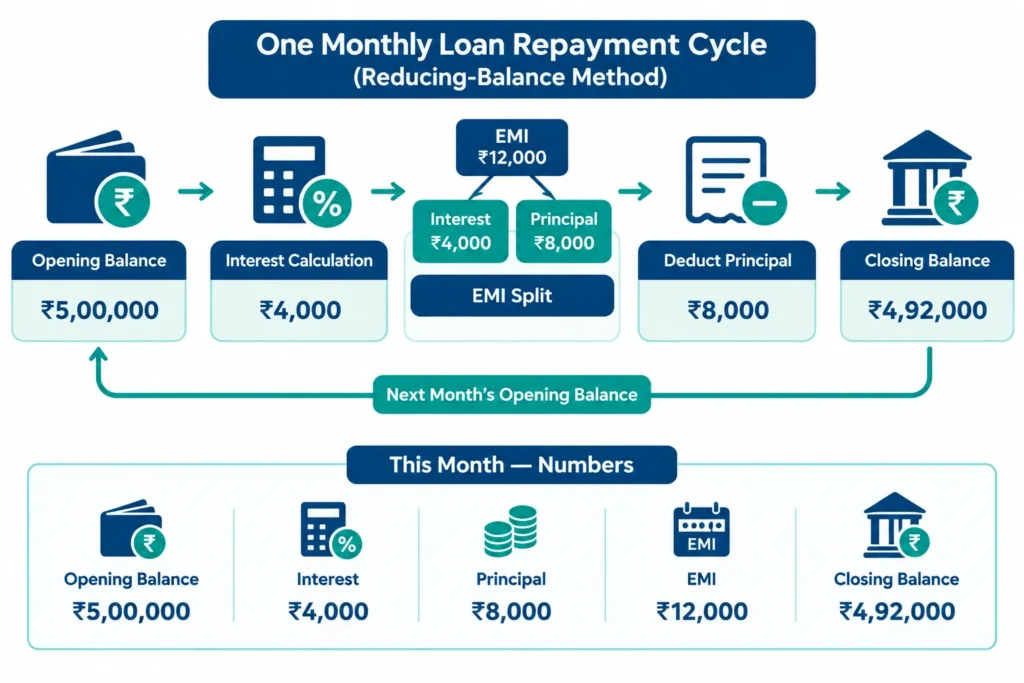
Flowchart showing how an EMI splits into interest and principal to reduce the loan balance

Many retail loans in India use the reducing-balance method. Under this method, interest for each period is calculated on the principal still outstanding, rather than on the original loan amount throughout the tenure.

The basic monthly process is:

  1. Start with the opening outstanding principal.
  2. Calculate interest for the period on that balance.
  3. Subtract the interest component from the EMI.
  4. Treat the remaining EMI amount as principal repayment.
  5. Deduct the principal repayment from the opening balance to find the closing balance.

For a simple illustration, assume the opening loan balance for a month is Rs. 5,00,000, the monthly interest charge is Rs. 4,000 and the EMI is Rs. 12,000.

  • EMI: Rs. 12,000
  • Interest component: Rs. 4,000
  • Principal component: Rs. 8,000
  • Closing principal balance: Rs. 4,92,000

In the next month, interest would generally be calculated on the new outstanding balance of Rs. 4,92,000, subject to the lender’s calculation method and the number of days involved. Because the balance is lower, the interest amount may also become lower.

For a fixed-rate loan with a fixed EMI and regular on-time payments, this process continues until the principal is repaid. The EMI can remain broadly unchanged even though its internal split between interest and principal changes each month.

The actual figures may differ slightly because lenders can use daily or monthly interest calculations, rounding rules, broken-period interest or different payment dates. Charges such as processing fees, late-payment penalties and insurance premiums are also not automatically part of the normal principal-interest split.

Principal vs Interest in an EMI
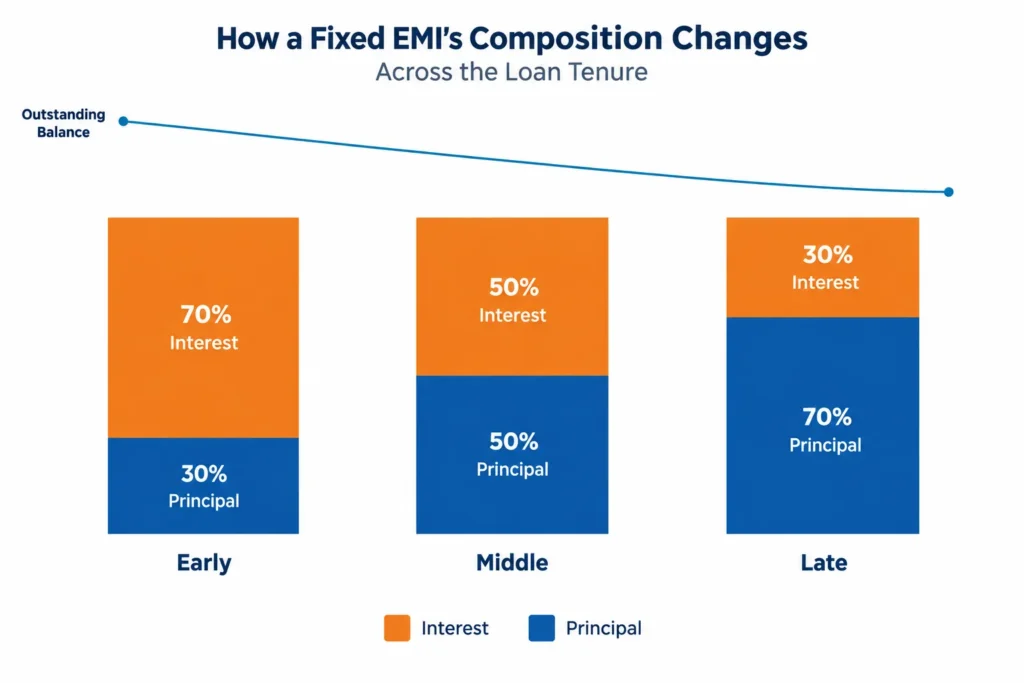
Comparison of principal and interest shares in early, middle and late EMIs

An EMI has two main components: principal and interest. Understanding the difference is essential when checking a loan amortization schedule.

Principal component

Principal is the amount originally borrowed. The principal component of an EMI reduces the unpaid loan balance.

If Rs. 8,000 from an EMI goes towards principal, your outstanding principal falls by Rs. 8,000. This reduction also affects future interest because interest under the reducing-balance method is charged on the amount still unpaid.

Interest component

Interest is the lender’s charge for providing the loan. It is based on the applicable interest rate, outstanding balance and calculation period.

Paying interest does not reduce the principal. For example, if your EMI is Rs. 12,000 and Rs. 4,000 is interest, only the remaining Rs. 8,000 reduces your loan balance.

You May Also Like:How to Calculate Loan Interest and Total Repayment

Why early EMIs usually contain more interest

At the start of a loan, the outstanding principal is at its highest. The interest calculation therefore applies to a larger balance. A bigger part of the EMI goes towards interest, leaving a smaller amount for principal repayment.

As regular principal repayments reduce the balance, the interest charge generally falls. If the EMI remains fixed, more of it becomes available to repay principal.

This creates a common pattern in a fixed-rate amortizing loan:

  • In the early months, the interest share is relatively high and the principal share is relatively low.
  • During the middle of the tenure, the gap between the two components narrows.
  • In the later months, the principal share is generally high and the interest share is low.

This does not mean the lender is arbitrarily collecting all the interest first. The higher early interest component results mainly from applying the periodic interest rate to a larger outstanding balance.

The pattern can change for floating-rate loans. If the interest rate is revised, the lender may change the EMI, extend or shorten the tenure, or use another adjustment permitted by the loan agreement. Part-payments, missed EMIs and loan restructuring can also alter the original schedule.

How to Read a Loan Amortization Schedule

Read the schedule one row at a time. Each row usually represents one EMI period and connects directly with the row before and after it.

1. Check the opening balance

The first row should begin with the principal outstanding at the start of repayment. In later rows, the opening balance should generally match the previous row’s closing balance.

If the figures do not match, look for a part-payment, an additional disbursement, unpaid interest, a charge added to the loan or another adjustment.

2. Find the EMI amount

Check the scheduled EMI and compare it with the amount stated in your loan agreement. A final instalment may differ slightly because of rounding or a small residual balance.

For floating-rate loans, do not assume that the EMI will remain unchanged throughout the tenure. Review any rate-reset communication from the lender along with the revised schedule.

3. Separate interest from principal

Look at the interest and principal columns. Together, these two amounts should usually equal the EMI, unless the row includes a special adjustment.

A useful check is:

EMI = Interest component + Principal component

This split shows how much of your monthly payment is a borrowing cost and how much actually reduces your debt.

4. Check the closing balance

The closing balance is generally calculated as:

Closing balance = Opening balance − Principal repayment

Do not subtract the entire EMI from the opening balance. The interest portion is paid to the lender but does not reduce the principal outstanding.

5. Follow the trend over time

Compare an early row, a middle row and a later row. In a standard fixed-rate loan with regular payments, you should normally see the interest component decrease, the principal component increase and the closing balance move towards zero.

Also check whether the schedule reflects any prepayment you make. A part-payment reduces the outstanding principal and may lower future interest. Depending on the lender’s rules and your choice, it may reduce the EMI, shorten the tenure or lead to another repayment adjustment.

A loan amortization schedule is therefore more than a list of EMIs. It is a practical record of how each payment affects your debt and how the balance is expected to reduce over the loan tenure.

Loan Amortization Schedule Example

A loan amortization schedule shows how each EMI is divided between interest and principal. It also shows the outstanding loan balance after every payment.

Consider a simple loan with the following assumptions:

  • Loan principal: ₹1,00,000
  • Annual interest rate: 12%
  • Loan tenure: 12 months
  • Interest type: Fixed rate
  • Calculation method: Monthly reducing balance
  • Payments: 12 monthly EMIs paid on schedule
  • Fees and prepayments: None

The annual rate of 12% is divided by 12 to get a monthly interest rate of 1%. The calculated EMI is approximately ₹8,884.88.

Here is the loan amortization schedule. The figures are rounded to two decimal places for display.

Month Opening Balance EMI Interest Principal Closing Balance
1 ₹1,00,000.00 ₹8,884.88 ₹1,000.00 ₹7,884.88 ₹92,115.12
2 ₹92,115.12 ₹8,884.88 ₹921.15 ₹7,963.73 ₹84,151.39
3 ₹84,151.39 ₹8,884.88 ₹841.51 ₹8,043.36 ₹76,108.03
4 ₹76,108.03 ₹8,884.88 ₹761.08 ₹8,123.80 ₹67,984.23
5 ₹67,984.23 ₹8,884.88 ₹679.84 ₹8,205.04 ₹59,779.19
6 ₹59,779.19 ₹8,884.88 ₹597.79 ₹8,287.09 ₹51,492.11
7 ₹51,492.11 ₹8,884.88 ₹514.92 ₹8,369.96 ₹43,122.15
8 ₹43,122.15 ₹8,884.88 ₹431.22 ₹8,453.66 ₹34,668.49
9 ₹34,668.49 ₹8,884.88 ₹346.68 ₹8,538.19 ₹26,130.30
10 ₹26,130.30 ₹8,884.88 ₹261.30 ₹8,623.58 ₹17,506.72
11 ₹17,506.72 ₹8,884.88 ₹175.07 ₹8,709.81 ₹8,796.91
12 ₹8,796.91 ₹8,884.88 ₹87.97 ₹8,796.91 ₹0.00

In the first month, interest is calculated on the full ₹1,00,000 balance. At a monthly rate of 1%, the interest is ₹1,000. The remaining ₹7,884.88 from the EMI reduces the principal. This leaves a closing balance of ₹92,115.12.

In the second month, interest is calculated on ₹92,115.12 rather than on the original loan amount. The interest is about ₹921.15. The principal portion is therefore about ₹7,963.73, leaving a balance of about ₹84,151.39.

The same process continues every month until the balance is repaid. Using the unrounded EMI in all 12 calculations, the total repayment is about ₹1,06,618.55. This includes the original ₹1,00,000 principal and about ₹6,618.55 in total interest.

The totals obtained by adding the displayed figures may differ by a few paise because each table entry has been rounded to two decimal places. Lenders normally keep more decimal places in their internal calculations and may adjust the final EMI slightly.

You May Also Like:Fixed vs Floating Interest Rate: What Borrowers Should Know

Why Does the Interest Portion Change Over Time?

Under the monthly reducing balance method, interest is charged on the outstanding principal, not on the original principal throughout the tenure.

At the start of this example, the outstanding balance is ₹1,00,000. Therefore, the first month’s interest is:

₹1,00,000 × 1% = ₹1,000

After the first EMI, the balance falls to ₹92,115.12. The second month’s interest is therefore:

₹92,115.12 × 1% = approximately ₹921.15

The EMI remains approximately ₹8,884.88 because this is a fixed-rate loan with a fixed tenure. However, its internal split changes. When the interest amount falls, more of the same EMI is available to repay principal.

  • In the first month, ₹1,000 goes towards interest and ₹7,884.88 goes towards principal.
  • In the sixth month, about ₹597.79 goes towards interest and ₹8,287.09 goes towards principal.
  • In the final month, only about ₹87.97 is interest, while the rest clears the remaining principal.

This explains why principal repayment is slower at the beginning and faster near the end. It does not mean that the lender is adding interest arbitrarily. The change results from applying the monthly rate to a steadily declining balance.

How to Calculate an Amortization Schedule

Step 1: Calculate the Monthly Interest Rate

Divide the annual interest rate by 12 when the loan uses monthly payments and a nominal annual rate divided monthly.

Monthly rate = 12% ÷ 12 = 1%, or 0.01

Step 2: Calculate the EMI

The standard EMI formula for a reducing balance loan is:

EMI = P × r × (1 + r)n ÷ ((1 + r)n − 1)

In this formula, P is the principal, r is the monthly interest rate in decimal form, and n is the number of monthly payments.

For this example, P is ₹1,00,000, r is 0.01, and n is 12. Substituting these values gives an EMI of approximately ₹8,884.88.

Step 3: Calculate Each Month’s Interest

Multiply the opening loan balance by the monthly interest rate.

Monthly interest = Opening balance × Monthly interest rate

For month one, this is ₹1,00,000 × 0.01, which gives ₹1,000.

Step 4: Find the Principal Portion

Subtract the monthly interest from the EMI.

Principal repaid = EMI − Monthly interest

For month one, this is ₹8,884.88 − ₹1,000, which gives ₹7,884.88.

Step 5: Find the Closing Balance

Subtract the principal repaid from the opening balance.

Closing balance = Opening balance − Principal repaid

For month one, this is ₹1,00,000 − ₹7,884.88, which gives ₹92,115.12. This closing balance becomes the opening balance for month two.

Step 6: Repeat Until the Balance Reaches Zero

Repeat the interest, principal and closing-balance calculations for every payment period. Use unrounded values during the calculations and round only the displayed figures. This reduces cumulative rounding errors.

An actual lender’s loan amortization schedule may not exactly match this example. Differences can arise from floating-rate changes, the exact payment date, day-based interest calculations, rounding rules, fees, prepayments and the calculation method stated in the loan agreement.

How Prepayments Affect Your Amortization Schedule
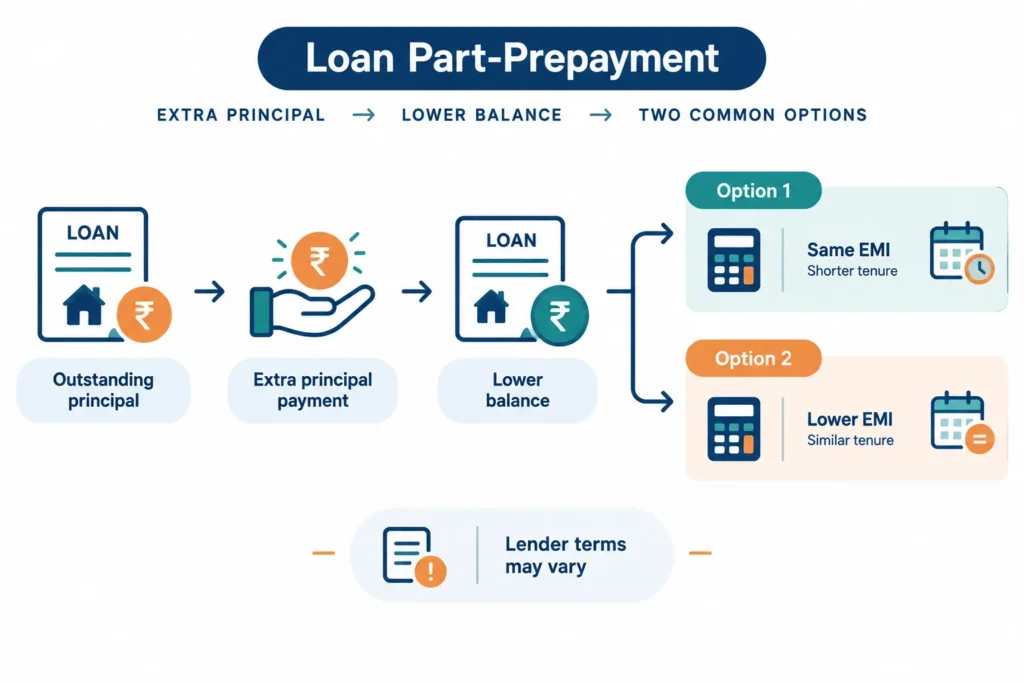
Flowchart showing how a loan prepayment can reduce tenure or lower the EMI

A prepayment is an amount paid towards the loan principal in addition to your regular EMI. It may be a part-prepayment, where you repay a portion of the outstanding loan, or a full prepayment, where you close the loan completely.

When you make a part-prepayment, the outstanding principal falls immediately. Future interest is then calculated on a lower balance under a reducing-balance loan. This can reduce the total interest payable over the remaining loan period.

After a prepayment, the lender may revise your loan in one of these ways:

  • Reduce the tenure: Your EMI remains broadly unchanged, but the loan ends earlier.
  • Reduce the EMI: The original tenure is broadly maintained, but the monthly payment becomes lower.
  • Change both: Some lenders may revise both the EMI and the remaining tenure according to their policy or your request.
You May Also Like:How to Reduce Your Loan EMI: Practical Options and Trade-Offs

For example, suppose you have a home loan with an outstanding principal of ₹30 lakh. If you make a part-prepayment of ₹3 lakh, the revised principal may become ₹27 lakh. The lender will prepare a revised loan amortization schedule using this lower balance, the applicable interest rate and the chosen repayment option.

Reducing tenure often produces a larger interest saving than reducing EMI, provided you can comfortably continue with the existing EMI. However, reducing the EMI may be more useful if your priority is improving monthly cash flow.

Do not assume that every prepayment is free or processed in the same way. Depending on the loan type, interest-rate structure and lender rules, there may be prepayment charges, minimum payment amounts, processing conditions or restrictions on how often you can prepay. Check the current loan agreement and obtain confirmation from the lender before transferring the money.

After making a prepayment, ask for an updated amortization schedule. Check that the payment has been applied to principal and that the revised EMI or tenure matches the option you selected.

Amortization Schedule vs Loan Repayment Schedule

The terms “loan amortization schedule” and “loan repayment schedule” are often used interchangeably. In many lender documents, both refer to a table showing how the loan will be repaid over time.

However, the level of detail can differ. A basic repayment schedule may show only the instalment number, due date, EMI and remaining balance. An amortization schedule normally provides a clearer split between principal and interest for every instalment.

Feature Basic repayment schedule Amortization schedule
EMI due date Usually shown Usually shown
Instalment amount Shown Shown
Principal component May not be shown Normally shown
Interest component May not be shown Normally shown
Outstanding balance May be shown Normally shown after each EMI

Before comparing documents from two lenders, check what each table includes. A schedule with only EMIs and due dates does not provide enough information to understand how quickly your principal is reducing.

How Borrowers Can Use an Amortization Schedule

A loan amortization schedule is not only a calculation sheet. It can help you monitor the loan and make practical repayment decisions.

Check lender statements

Compare the principal, interest and closing balance in your lender statement with the expected schedule. Small differences may arise because of rounding, payment dates or interest-calculation methods. A large unexplained difference should be raised with the lender.

Estimate the outstanding balance

The schedule can show the expected principal remaining after a particular number of EMIs. This is useful when you are considering early closure, refinancing, a balance transfer or the sale of an asset financed by the loan.

The figure is only an estimate until the lender provides an official foreclosure or closure statement. Additional interest, unpaid charges or other adjustments may affect the final amount.

Compare different loan structures

Two loans with similar EMIs may not have the same total cost. One may have a longer tenure, a different interest rate or a different repayment structure. Comparing amortization schedules can show:

  • How much interest may be paid over the full tenure
  • How quickly the principal reduces
  • The effect of choosing a longer or shorter tenure
  • How a rate change could affect repayment
  • Whether a proposed balance transfer offers a meaningful benefit after costs

Plan prepayments

The schedule helps identify how much principal is still outstanding at different stages. You can use this information to plan part-prepayments from a bonus, business surplus or other available funds without disturbing your emergency savings.

You can also compare two possibilities: keeping the same EMI and reducing tenure, or lowering the EMI and keeping a similar tenure. Ask the lender for revised schedules for both options before deciding.

Prepare a monthly budget

A fixed-rate loan may have predictable EMIs, making monthly planning easier. For a floating-rate loan, the schedule should be treated as a current projection because future rate resets can change the EMI, tenure or both.

Common Mistakes to Avoid

Assuming every EMI has the same principal-interest split

The EMI may remain constant, but its composition usually changes. In a standard reducing-balance loan, early EMIs generally contain a higher interest component. The principal component increases as the outstanding balance declines.

You May Also Like:Personal Loan Eligibility: Factors Lenders Consider in India

Confusing flat rates with reducing-balance rates

A flat interest rate is calculated on the original principal for the agreed period. A reducing-balance rate applies interest to the outstanding principal. Therefore, the same quoted percentage can produce very different borrowing costs. Compare the repayment method and total amount payable, not only the advertised rate.

Ignoring fees and other costs

An amortization schedule may show principal and interest but exclude processing fees, insurance premiums, legal charges, documentation costs, taxes, late-payment charges or prepayment fees. Include applicable costs when comparing offers.

Missing floating-rate resets

A schedule prepared when the loan starts may become outdated after a benchmark or lending-rate revision. The lender may increase the EMI, extend the tenure or use a combination of both. Review revised communications and request an updated schedule after a rate change.

Relying completely on rounded estimates

Online calculators and spreadsheet results often round the EMI or monthly interest. Lenders may also use daily interest calculations, exact disbursement dates or internal rounding rules. Use calculations for planning, but rely on the lender’s official statement for payment, foreclosure and closure amounts.

Frequently Asked Questions About Loan Amortization

How can I obtain my loan amortization schedule?

You can request it from the lender, download it from the lender’s online portal if available, or generate an estimate using the principal, interest rate and tenure. For an existing loan, the lender’s latest schedule is more reliable because it reflects actual payments and revisions.

What happens to the schedule when a floating interest rate changes?

The lender recalculates the repayment based on the revised rate and outstanding principal. Your EMI may change, the tenure may change, or both may change. Ask for a fresh schedule after each significant reset.

Does every prepayment reduce the loan tenure?

No. The effect depends on lender terms and the option selected. A prepayment may reduce tenure, EMI or both. Confirm the treatment in writing and check the revised schedule.

Does a zero-interest loan have no borrowing cost?

Not necessarily. A zero-interest or no-cost offer may involve processing fees, loss of a cash discount, bundled products or other charges. Review the total amount payable and all conditions before accepting the offer.

Can the principal and interest shown in the schedule be used for tax purposes?

The tax treatment depends on the loan purpose, property use, borrower eligibility and current Indian tax rules. Use lender-issued certificates and supporting documents where required. Check the latest rules or consult a qualified tax professional rather than relying only on an estimated schedule.

Why is my lender’s figure different from an online calculator?

Differences may result from EMI dates, daily versus monthly interest calculations, rounding, broken-period interest, rate resets, delayed payments, fees or prepayments. Ask the lender for a detailed statement if the difference is material or unclear.

Summary

A loan amortization schedule shows how each EMI is divided between principal and interest and how the outstanding balance changes. Prepayments can lower future interest and may reduce the EMI, tenure or both, subject to lender terms.

Use the schedule to check statements, estimate balances, compare loan structures and plan prepayments. Always account for fees, floating-rate revisions and calculation differences. For final payment figures, tax claims or loan closure, rely on current lender documents and appropriate professional guidance.


Share this article
KEEP READING

Related Articles

View all →

Comments

Leave a Comment

Loan Amortization Schedule Explained With an Example

A loan amortization schedule is a month-by-month breakdown of your loan repayment. It shows the opening loan balance, EMI, interest charged, principal repaid and closing balance for each month. Under the reducing-balance method commonly used for loans in India, interest is calculated on the outstanding principal. As a result, early EMIs usually contain more interest, while later EMIs contain more principal.

When you take a home loan, car loan or personal loan, you may focus mainly on the EMI. The EMI tells you how much you need to pay each month, but it does not show where that money goes.

Part of every EMI pays the lender’s interest charge. The remaining part reduces the amount you borrowed. A loan amortization schedule separates these two components and helps you understand how your debt reduces over time.

This is especially useful for long-term loans. Two loans can have a similar EMI but differ in interest rate, tenure and total interest cost. Reading the repayment schedule helps you look beyond the monthly payment.

What Is a Loan Amortization Schedule?

Amortization means repaying a loan gradually through scheduled payments. Each payment covers the interest due for that period and repays a part of the principal.

A loan amortization schedule is a statement showing this repayment process for every instalment. Banks and other lenders may call it an amortization table, repayment schedule or loan repayment statement.

A typical schedule includes the following details:

  • Instalment number or payment date: This identifies the month or due date to which the entry relates.
  • Opening balance: The outstanding principal at the beginning of the period.
  • EMI: The scheduled monthly payment made by the borrower.
  • Interest: The portion of the EMI charged as the lender’s interest for that period.
  • Principal repayment: The portion of the EMI used to reduce the outstanding loan amount.
  • Closing balance: The principal remaining after the month’s principal repayment.

Suppose you borrow Rs. 5 lakh. Your first row begins with an opening balance of Rs. 5 lakh. After the first EMI, the principal portion is deducted from this balance. The result becomes the closing balance for that month and usually the opening balance for the next month.

The schedule does not normally treat the full EMI as a reduction in your debt. Only the principal component reduces the outstanding principal. The interest component is the cost of borrowing money.

How Does Loan Amortization Work?

Flowchart showing how an EMI splits into interest and principal to reduce the loan balance

Many retail loans in India use the reducing-balance method. Under this method, interest for each period is calculated on the principal still outstanding, rather than on the original loan amount throughout the tenure.

The basic monthly process is:

  1. Start with the opening outstanding principal.
  2. Calculate interest for the period on that balance.
  3. Subtract the interest component from the EMI.
  4. Treat the remaining EMI amount as principal repayment.
  5. Deduct the principal repayment from the opening balance to find the closing balance.

For a simple illustration, assume the opening loan balance for a month is Rs. 5,00,000, the monthly interest charge is Rs. 4,000 and the EMI is Rs. 12,000.

  • EMI: Rs. 12,000
  • Interest component: Rs. 4,000
  • Principal component: Rs. 8,000
  • Closing principal balance: Rs. 4,92,000

In the next month, interest would generally be calculated on the new outstanding balance of Rs. 4,92,000, subject to the lender’s calculation method and the number of days involved. Because the balance is lower, the interest amount may also become lower.

For a fixed-rate loan with a fixed EMI and regular on-time payments, this process continues until the principal is repaid. The EMI can remain broadly unchanged even though its internal split between interest and principal changes each month.

The actual figures may differ slightly because lenders can use daily or monthly interest calculations, rounding rules, broken-period interest or different payment dates. Charges such as processing fees, late-payment penalties and insurance premiums are also not automatically part of the normal principal-interest split.

Principal vs Interest in an EMI

Comparison of principal and interest shares in early, middle and late EMIs

An EMI has two main components: principal and interest. Understanding the difference is essential when checking a loan amortization schedule.

Principal component

Principal is the amount originally borrowed. The principal component of an EMI reduces the unpaid loan balance.

If Rs. 8,000 from an EMI goes towards principal, your outstanding principal falls by Rs. 8,000. This reduction also affects future interest because interest under the reducing-balance method is charged on the amount still unpaid.

Interest component

Interest is the lender’s charge for providing the loan. It is based on the applicable interest rate, outstanding balance and calculation period.

Paying interest does not reduce the principal. For example, if your EMI is Rs. 12,000 and Rs. 4,000 is interest, only the remaining Rs. 8,000 reduces your loan balance.

Why early EMIs usually contain more interest

At the start of a loan, the outstanding principal is at its highest. The interest calculation therefore applies to a larger balance. A bigger part of the EMI goes towards interest, leaving a smaller amount for principal repayment.

As regular principal repayments reduce the balance, the interest charge generally falls. If the EMI remains fixed, more of it becomes available to repay principal.

This creates a common pattern in a fixed-rate amortizing loan:

  • In the early months, the interest share is relatively high and the principal share is relatively low.
  • During the middle of the tenure, the gap between the two components narrows.
  • In the later months, the principal share is generally high and the interest share is low.

This does not mean the lender is arbitrarily collecting all the interest first. The higher early interest component results mainly from applying the periodic interest rate to a larger outstanding balance.

The pattern can change for floating-rate loans. If the interest rate is revised, the lender may change the EMI, extend or shorten the tenure, or use another adjustment permitted by the loan agreement. Part-payments, missed EMIs and loan restructuring can also alter the original schedule.

How to Read a Loan Amortization Schedule

Read the schedule one row at a time. Each row usually represents one EMI period and connects directly with the row before and after it.

1. Check the opening balance

The first row should begin with the principal outstanding at the start of repayment. In later rows, the opening balance should generally match the previous row’s closing balance.

If the figures do not match, look for a part-payment, an additional disbursement, unpaid interest, a charge added to the loan or another adjustment.

2. Find the EMI amount

Check the scheduled EMI and compare it with the amount stated in your loan agreement. A final instalment may differ slightly because of rounding or a small residual balance.

For floating-rate loans, do not assume that the EMI will remain unchanged throughout the tenure. Review any rate-reset communication from the lender along with the revised schedule.

3. Separate interest from principal

Look at the interest and principal columns. Together, these two amounts should usually equal the EMI, unless the row includes a special adjustment.

A useful check is:

EMI = Interest component + Principal component

This split shows how much of your monthly payment is a borrowing cost and how much actually reduces your debt.

4. Check the closing balance

The closing balance is generally calculated as:

Closing balance = Opening balance − Principal repayment

Do not subtract the entire EMI from the opening balance. The interest portion is paid to the lender but does not reduce the principal outstanding.

5. Follow the trend over time

Compare an early row, a middle row and a later row. In a standard fixed-rate loan with regular payments, you should normally see the interest component decrease, the principal component increase and the closing balance move towards zero.

Also check whether the schedule reflects any prepayment you make. A part-payment reduces the outstanding principal and may lower future interest. Depending on the lender’s rules and your choice, it may reduce the EMI, shorten the tenure or lead to another repayment adjustment.

A loan amortization schedule is therefore more than a list of EMIs. It is a practical record of how each payment affects your debt and how the balance is expected to reduce over the loan tenure.

Loan Amortization Schedule Example

A loan amortization schedule shows how each EMI is divided between interest and principal. It also shows the outstanding loan balance after every payment.

Consider a simple loan with the following assumptions:

  • Loan principal: ₹1,00,000
  • Annual interest rate: 12%
  • Loan tenure: 12 months
  • Interest type: Fixed rate
  • Calculation method: Monthly reducing balance
  • Payments: 12 monthly EMIs paid on schedule
  • Fees and prepayments: None

The annual rate of 12% is divided by 12 to get a monthly interest rate of 1%. The calculated EMI is approximately ₹8,884.88.

Here is the loan amortization schedule. The figures are rounded to two decimal places for display.

Month Opening Balance EMI Interest Principal Closing Balance
1 ₹1,00,000.00 ₹8,884.88 ₹1,000.00 ₹7,884.88 ₹92,115.12
2 ₹92,115.12 ₹8,884.88 ₹921.15 ₹7,963.73 ₹84,151.39
3 ₹84,151.39 ₹8,884.88 ₹841.51 ₹8,043.36 ₹76,108.03
4 ₹76,108.03 ₹8,884.88 ₹761.08 ₹8,123.80 ₹67,984.23
5 ₹67,984.23 ₹8,884.88 ₹679.84 ₹8,205.04 ₹59,779.19
6 ₹59,779.19 ₹8,884.88 ₹597.79 ₹8,287.09 ₹51,492.11
7 ₹51,492.11 ₹8,884.88 ₹514.92 ₹8,369.96 ₹43,122.15
8 ₹43,122.15 ₹8,884.88 ₹431.22 ₹8,453.66 ₹34,668.49
9 ₹34,668.49 ₹8,884.88 ₹346.68 ₹8,538.19 ₹26,130.30
10 ₹26,130.30 ₹8,884.88 ₹261.30 ₹8,623.58 ₹17,506.72
11 ₹17,506.72 ₹8,884.88 ₹175.07 ₹8,709.81 ₹8,796.91
12 ₹8,796.91 ₹8,884.88 ₹87.97 ₹8,796.91 ₹0.00

In the first month, interest is calculated on the full ₹1,00,000 balance. At a monthly rate of 1%, the interest is ₹1,000. The remaining ₹7,884.88 from the EMI reduces the principal. This leaves a closing balance of ₹92,115.12.

In the second month, interest is calculated on ₹92,115.12 rather than on the original loan amount. The interest is about ₹921.15. The principal portion is therefore about ₹7,963.73, leaving a balance of about ₹84,151.39.

The same process continues every month until the balance is repaid. Using the unrounded EMI in all 12 calculations, the total repayment is about ₹1,06,618.55. This includes the original ₹1,00,000 principal and about ₹6,618.55 in total interest.

The totals obtained by adding the displayed figures may differ by a few paise because each table entry has been rounded to two decimal places. Lenders normally keep more decimal places in their internal calculations and may adjust the final EMI slightly.

Why Does the Interest Portion Change Over Time?

Under the monthly reducing balance method, interest is charged on the outstanding principal, not on the original principal throughout the tenure.

At the start of this example, the outstanding balance is ₹1,00,000. Therefore, the first month’s interest is:

₹1,00,000 × 1% = ₹1,000

After the first EMI, the balance falls to ₹92,115.12. The second month’s interest is therefore:

₹92,115.12 × 1% = approximately ₹921.15

The EMI remains approximately ₹8,884.88 because this is a fixed-rate loan with a fixed tenure. However, its internal split changes. When the interest amount falls, more of the same EMI is available to repay principal.

  • In the first month, ₹1,000 goes towards interest and ₹7,884.88 goes towards principal.
  • In the sixth month, about ₹597.79 goes towards interest and ₹8,287.09 goes towards principal.
  • In the final month, only about ₹87.97 is interest, while the rest clears the remaining principal.

This explains why principal repayment is slower at the beginning and faster near the end. It does not mean that the lender is adding interest arbitrarily. The change results from applying the monthly rate to a steadily declining balance.

How to Calculate an Amortization Schedule

Step 1: Calculate the Monthly Interest Rate

Divide the annual interest rate by 12 when the loan uses monthly payments and a nominal annual rate divided monthly.

Monthly rate = 12% ÷ 12 = 1%, or 0.01

Step 2: Calculate the EMI

The standard EMI formula for a reducing balance loan is:

EMI = P × r × (1 + r)n ÷ ((1 + r)n − 1)

In this formula, P is the principal, r is the monthly interest rate in decimal form, and n is the number of monthly payments.

For this example, P is ₹1,00,000, r is 0.01, and n is 12. Substituting these values gives an EMI of approximately ₹8,884.88.

Step 3: Calculate Each Month’s Interest

Multiply the opening loan balance by the monthly interest rate.

Monthly interest = Opening balance × Monthly interest rate

For month one, this is ₹1,00,000 × 0.01, which gives ₹1,000.

Step 4: Find the Principal Portion

Subtract the monthly interest from the EMI.

Principal repaid = EMI − Monthly interest

For month one, this is ₹8,884.88 − ₹1,000, which gives ₹7,884.88.

Step 5: Find the Closing Balance

Subtract the principal repaid from the opening balance.

Closing balance = Opening balance − Principal repaid

For month one, this is ₹1,00,000 − ₹7,884.88, which gives ₹92,115.12. This closing balance becomes the opening balance for month two.

Step 6: Repeat Until the Balance Reaches Zero

Repeat the interest, principal and closing-balance calculations for every payment period. Use unrounded values during the calculations and round only the displayed figures. This reduces cumulative rounding errors.

An actual lender’s loan amortization schedule may not exactly match this example. Differences can arise from floating-rate changes, the exact payment date, day-based interest calculations, rounding rules, fees, prepayments and the calculation method stated in the loan agreement.

How Prepayments Affect Your Amortization Schedule

Flowchart showing how a loan prepayment can reduce tenure or lower the EMI

A prepayment is an amount paid towards the loan principal in addition to your regular EMI. It may be a part-prepayment, where you repay a portion of the outstanding loan, or a full prepayment, where you close the loan completely.

When you make a part-prepayment, the outstanding principal falls immediately. Future interest is then calculated on a lower balance under a reducing-balance loan. This can reduce the total interest payable over the remaining loan period.

After a prepayment, the lender may revise your loan in one of these ways:

  • Reduce the tenure: Your EMI remains broadly unchanged, but the loan ends earlier.
  • Reduce the EMI: The original tenure is broadly maintained, but the monthly payment becomes lower.
  • Change both: Some lenders may revise both the EMI and the remaining tenure according to their policy or your request.

For example, suppose you have a home loan with an outstanding principal of ₹30 lakh. If you make a part-prepayment of ₹3 lakh, the revised principal may become ₹27 lakh. The lender will prepare a revised loan amortization schedule using this lower balance, the applicable interest rate and the chosen repayment option.

Reducing tenure often produces a larger interest saving than reducing EMI, provided you can comfortably continue with the existing EMI. However, reducing the EMI may be more useful if your priority is improving monthly cash flow.

Do not assume that every prepayment is free or processed in the same way. Depending on the loan type, interest-rate structure and lender rules, there may be prepayment charges, minimum payment amounts, processing conditions or restrictions on how often you can prepay. Check the current loan agreement and obtain confirmation from the lender before transferring the money.

After making a prepayment, ask for an updated amortization schedule. Check that the payment has been applied to principal and that the revised EMI or tenure matches the option you selected.

Amortization Schedule vs Loan Repayment Schedule

The terms “loan amortization schedule” and “loan repayment schedule” are often used interchangeably. In many lender documents, both refer to a table showing how the loan will be repaid over time.

However, the level of detail can differ. A basic repayment schedule may show only the instalment number, due date, EMI and remaining balance. An amortization schedule normally provides a clearer split between principal and interest for every instalment.

Feature Basic repayment schedule Amortization schedule
EMI due date Usually shown Usually shown
Instalment amount Shown Shown
Principal component May not be shown Normally shown
Interest component May not be shown Normally shown
Outstanding balance May be shown Normally shown after each EMI

Before comparing documents from two lenders, check what each table includes. A schedule with only EMIs and due dates does not provide enough information to understand how quickly your principal is reducing.

How Borrowers Can Use an Amortization Schedule

A loan amortization schedule is not only a calculation sheet. It can help you monitor the loan and make practical repayment decisions.

Check lender statements

Compare the principal, interest and closing balance in your lender statement with the expected schedule. Small differences may arise because of rounding, payment dates or interest-calculation methods. A large unexplained difference should be raised with the lender.

Estimate the outstanding balance

The schedule can show the expected principal remaining after a particular number of EMIs. This is useful when you are considering early closure, refinancing, a balance transfer or the sale of an asset financed by the loan.

The figure is only an estimate until the lender provides an official foreclosure or closure statement. Additional interest, unpaid charges or other adjustments may affect the final amount.

Compare different loan structures

Two loans with similar EMIs may not have the same total cost. One may have a longer tenure, a different interest rate or a different repayment structure. Comparing amortization schedules can show:

  • How much interest may be paid over the full tenure
  • How quickly the principal reduces
  • The effect of choosing a longer or shorter tenure
  • How a rate change could affect repayment
  • Whether a proposed balance transfer offers a meaningful benefit after costs

Plan prepayments

The schedule helps identify how much principal is still outstanding at different stages. You can use this information to plan part-prepayments from a bonus, business surplus or other available funds without disturbing your emergency savings.

You can also compare two possibilities: keeping the same EMI and reducing tenure, or lowering the EMI and keeping a similar tenure. Ask the lender for revised schedules for both options before deciding.

Prepare a monthly budget

A fixed-rate loan may have predictable EMIs, making monthly planning easier. For a floating-rate loan, the schedule should be treated as a current projection because future rate resets can change the EMI, tenure or both.

Common Mistakes to Avoid

Assuming every EMI has the same principal-interest split

The EMI may remain constant, but its composition usually changes. In a standard reducing-balance loan, early EMIs generally contain a higher interest component. The principal component increases as the outstanding balance declines.

Confusing flat rates with reducing-balance rates

A flat interest rate is calculated on the original principal for the agreed period. A reducing-balance rate applies interest to the outstanding principal. Therefore, the same quoted percentage can produce very different borrowing costs. Compare the repayment method and total amount payable, not only the advertised rate.

Ignoring fees and other costs

An amortization schedule may show principal and interest but exclude processing fees, insurance premiums, legal charges, documentation costs, taxes, late-payment charges or prepayment fees. Include applicable costs when comparing offers.

Missing floating-rate resets

A schedule prepared when the loan starts may become outdated after a benchmark or lending-rate revision. The lender may increase the EMI, extend the tenure or use a combination of both. Review revised communications and request an updated schedule after a rate change.

Relying completely on rounded estimates

Online calculators and spreadsheet results often round the EMI or monthly interest. Lenders may also use daily interest calculations, exact disbursement dates or internal rounding rules. Use calculations for planning, but rely on the lender’s official statement for payment, foreclosure and closure amounts.

Frequently Asked Questions About Loan Amortization

How can I obtain my loan amortization schedule?

You can request it from the lender, download it from the lender’s online portal if available, or generate an estimate using the principal, interest rate and tenure. For an existing loan, the lender’s latest schedule is more reliable because it reflects actual payments and revisions.

What happens to the schedule when a floating interest rate changes?

The lender recalculates the repayment based on the revised rate and outstanding principal. Your EMI may change, the tenure may change, or both may change. Ask for a fresh schedule after each significant reset.

Does every prepayment reduce the loan tenure?

No. The effect depends on lender terms and the option selected. A prepayment may reduce tenure, EMI or both. Confirm the treatment in writing and check the revised schedule.

Does a zero-interest loan have no borrowing cost?

Not necessarily. A zero-interest or no-cost offer may involve processing fees, loss of a cash discount, bundled products or other charges. Review the total amount payable and all conditions before accepting the offer.

Can the principal and interest shown in the schedule be used for tax purposes?

The tax treatment depends on the loan purpose, property use, borrower eligibility and current Indian tax rules. Use lender-issued certificates and supporting documents where required. Check the latest rules or consult a qualified tax professional rather than relying only on an estimated schedule.

Why is my lender’s figure different from an online calculator?

Differences may result from EMI dates, daily versus monthly interest calculations, rounding, broken-period interest, rate resets, delayed payments, fees or prepayments. Ask the lender for a detailed statement if the difference is material or unclear.

Summary

A loan amortization schedule shows how each EMI is divided between principal and interest and how the outstanding balance changes. Prepayments can lower future interest and may reduce the EMI, tenure or both, subject to lender terms.

Use the schedule to check statements, estimate balances, compare loan structures and plan prepayments. Always account for fees, floating-rate revisions and calculation differences. For final payment figures, tax claims or loan closure, rely on current lender documents and appropriate professional guidance.

Leave a Comment