


The stock market allows people to buy and sell ownership shares in listed companies. In India, most share trading takes place through the National Stock Exchange (NSE) and the Bombay Stock Exchange (BSE). Investors place orders through registered stockbrokers, shares are held electronically in demat accounts, and the Securities and Exchange Board of India (SEBI) regulates the market.
A company can first sell shares to investors through the primary market, such as in an Initial Public Offering (IPO). After listing, investors trade those shares with one another in the secondary market. Share prices rise or fall according to demand, supply, business performance, news and expectations. Investors may earn through price appreciation and dividends, but they can also lose money.
Introduction
For a beginner, the stock market can look like a screen filled with changing numbers and unfamiliar company names. However, its basic purpose is straightforward: it connects companies that need capital with investors who want an opportunity to grow their money.
Suppose an Indian company wants to open new factories, develop a product or expand into more cities. It may raise part of the required money by selling shares. People and institutions that buy those shares become part-owners of the company.
After the shares are listed on a stock exchange, they can usually be bought and sold during market hours. Their prices keep changing because buyers and sellers continually react to company results, economic conditions, industry developments and expectations about the future.
Understanding how stock market works in India begins with three ideas: what a share represents, where shares are issued and traded, and which organisations help the market operate safely.
Stock Market Basics and the Indian Market Structure
What Is the Stock Market?
The stock market is a system where shares of publicly listed companies are issued and traded. It is not a single physical shop or office. It is a network of companies, investors, exchanges, brokers, depositories, clearing corporations and regulators.
In India, investors generally trade listed shares electronically. A person places a buy or sell order using a stockbroker’s website or mobile application. The order is sent to an exchange, where it may be matched with an opposite order from another market participant.
What Does Owning a Share Mean?
A share represents a small unit of ownership in a company. If a company has divided its ownership into many shares and you own some of them, you are one of its shareholders.
Your ownership may be extremely small, but it is still linked to the company’s fortunes. If the business grows and investors become willing to pay more for its shares, the market price may rise. If the company performs poorly or market expectations weaken, the price may fall.
Shareholders may also receive voting rights on certain company matters. The exact rights depend on the type of share and applicable rules. Buying a share does not mean that an investor can directly manage the company or use its assets.
Why Do Companies Issue Shares?
Companies need money for many reasons. They may want to build a plant, buy equipment, repay debt, enter a new market, invest in technology or fund long-term expansion.
One option is to borrow money and pay interest. Another is to raise equity capital by issuing shares. Equity capital does not normally require fixed interest payments like a loan. In return, the company gives investors an ownership interest.
Issuing shares can help a business raise substantial capital from a wide set of investors. However, it also spreads ownership among more shareholders and brings disclosure, governance and regulatory responsibilities.
How Can an Investor Earn or Lose Money?
Stock investors commonly look for returns in two forms:
- Price appreciation: An investor buys a share and later sells it at a higher price. For example, if a share is bought for ₹500 and sold for ₹575, the difference is a gain before taxes and transaction costs.
- Dividends: A profitable company may distribute part of its earnings to shareholders. This payment is called a dividend. Companies are not required to pay a dividend every year, and the amount can change.
Returns are not guaranteed. If a share bought for ₹500 falls to ₹400 and is sold, the investor suffers a loss of ₹100 per share before costs. A company may also reduce or stop dividends. In severe cases, a struggling company’s shares can lose most of their value.
Market returns should therefore be viewed together with risk. A rising price does not ensure that it will continue rising, and a familiar company name does not make an investment automatically safe.
Primary Market and Secondary Market
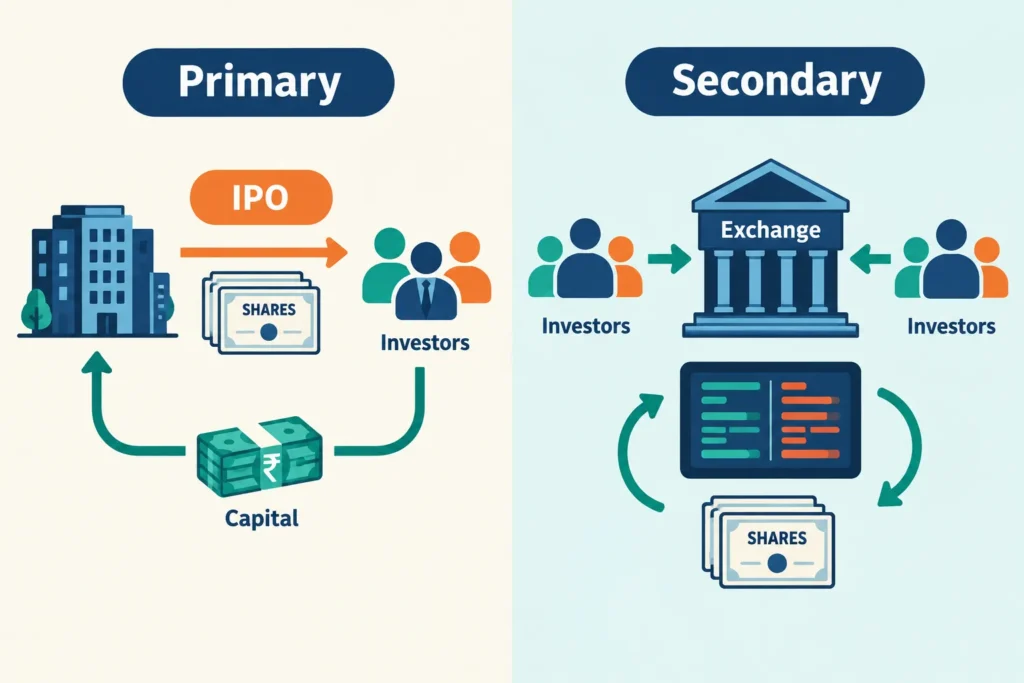
The Indian stock market has two broad parts: the primary market and the secondary market.
In the primary market, a company issues new securities to raise capital. An Initial Public Offering, commonly called an IPO, is a well-known example. Through an IPO, a company offers shares to the public and seeks to become listed on a stock exchange.
Investors can apply for IPO shares, but an application does not guarantee an allotment. If demand is high, an applicant may receive fewer shares than requested or no shares at all.
Once the shares are listed, they can be traded in the secondary market. Here, investors usually buy from and sell to other investors. The company does not receive money every time its already-listed shares change hands.
| Point | Primary Market | Secondary Market |
|---|---|---|
| Main purpose | Companies raise capital by issuing securities | Investors trade listed securities with one another |
| Common example | An IPO | Buying or selling shares on NSE or BSE |
| Who receives the money? | The issuing company or selling shareholders, depending on the offer structure | The investor who sells the shares |
| How is the price decided? | According to the issue process and offer terms | Continuously through market demand and supply |
| Availability | During the specified issue period | Normally during exchange trading hours after listing |
Who Participates in the Indian Stock Market?
Several participants work together to make share issuance, trading, settlement and regulation possible.
- Companies: Businesses issue shares to raise capital and may list those shares on an exchange.
- Retail investors: These are individual investors who buy or sell securities using their own money.
- Institutional investors: Mutual funds, insurance companies, pension-related funds, banks and foreign portfolio investors may trade much larger amounts than most individuals.
- Stockbrokers: A broker provides the platform and exchange access needed to place orders. Investors should use a SEBI-registered broker.
- Stock exchanges: Exchanges provide the organised electronic marketplace where eligible securities are traded.
Retail and institutional investors may have different resources and investment goals, but their orders contribute to market demand and supply.
What Are NSE and BSE?
The National Stock Exchange and the Bombay Stock Exchange are India’s major stock exchanges. They provide systems that match buy and sell orders according to exchange rules.
Many large Indian companies are listed on both exchanges. A share’s quoted price can differ slightly between NSE and BSE because orders are matched separately on each exchange. Investors generally choose an exchange while placing an order through their broker.
An exchange does not decide that a particular share must rise or fall. It provides the trading framework through which buyers and sellers arrive at market prices.
What Do Depositories and Clearing Corporations Do?
Shares in India are generally held electronically rather than as paper certificates. A demat account stores these securities in digital form.
India has two depositories: the National Securities Depository Limited (NSDL) and the Central Depository Services (India) Limited (CDSL). Investors access depository services through intermediaries known as depository participants, which may include brokers and banks.
Clearing corporations work behind the scenes after a trade is executed. They help determine what each party must deliver and receive, manage settlement obligations and reduce counterparty risk under the applicable market framework.
In simple terms, the exchange matches the trade, the clearing system manages the obligations, and the depository system helps transfer and hold the securities electronically.
What Is SEBI’s Role?
The Securities and Exchange Board of India is the main regulator of India’s securities market. It creates and enforces rules for exchanges, brokers, listed companies, mutual funds and various other market intermediaries.
SEBI’s responsibilities include protecting investor interests, promoting fair market development and regulating securities-market activities. It also acts against violations such as market manipulation and certain forms of insider trading.
Regulation improves market structure and disclosure, but it cannot remove normal investment risk. SEBI registration does not mean that a broker, product or investment will generate a profit.
What Are Sensex and Nifty 50?
Sensex and Nifty 50 are stock market indices. They track selected groups of large, actively traded companies and are used as broad indicators of market movement.
- Sensex: An index associated with BSE that tracks 30 selected companies.
- Nifty 50: An index associated with NSE that tracks 50 selected companies.
If the Nifty 50 rises, it means the combined index value of its constituent companies has increased according to the index methodology. It does not mean that every listed share has risen. Your portfolio may perform differently because it may contain other companies or different investment weights.
An index is a measurement tool, not a promise of returns. Past movement in Sensex or Nifty 50 cannot guarantee future performance.
Why Do Share Prices Change?
A share price changes when buy and sell orders interact. If more investors are willing to buy at higher prices than sell at current prices, the share may rise. If selling pressure is stronger, it may fall.
Demand and supply are influenced by several factors:
- Business performance: Revenue, profit, debt, cash flow and management decisions can affect investor views.
- Company news: A major order, acquisition, regulatory action, product failure or leadership change may move the price.
- Economic conditions: Interest rates, inflation, economic growth and government policy can influence companies and investors.
- Industry developments: Changes in competition, input costs or regulation may affect an entire sector.
- Expectations: Prices often reflect what investors think may happen, not only what has already happened.
- Market sentiment: Fear, optimism and global events can create short-term volatility.
A company can report higher profit and still see its share price fall if investors expected even better results. Similarly, a weak current result may be followed by a price rise if the outlook is better than the market feared. This is why share prices can sometimes appear disconnected from a single news headline.
At its core, the Indian stock market is a regulated system for raising capital, holding ownership electronically and trading shares. Understanding these basic roles makes it easier to interpret market news without treating every price movement as a signal to buy or sell.
How Buying and Selling Shares Works Step by Step
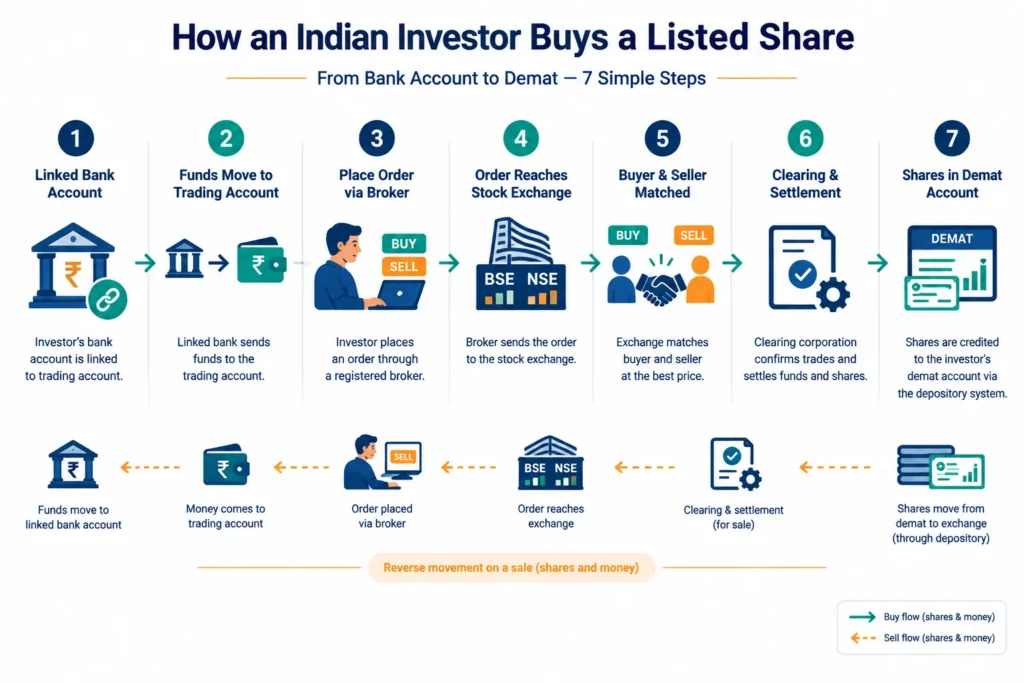
To understand how stock market works in India, it helps to follow the full journey of a share purchase. You first choose a broker, open the required accounts, transfer money and place an order. The stock exchange then matches your order with a seller’s order. After settlement, the shares are credited to your demat account.
Selling follows the reverse path. Shares are debited from your demat account, sold through the exchange and the sale proceeds become available according to the applicable settlement process.
Choose a SEBI-Registered Stockbroker
Individual investors cannot normally place orders directly on the National Stock Exchange or BSE. They use a stockbroker that is registered with the Securities and Exchange Board of India and is a member of the relevant exchange.
Before opening an account, verify the broker’s registration details through official SEBI and exchange records. Do not rely only on an advertisement, social media account or mobile app listing.
Compare brokers on practical factors such as:
- Brokerage and other account charges
- Quality and reliability of the trading platform
- Customer support
- Research or educational tools, if required
- Demat account maintenance charges
- Charges for selling or transferring securities
- Availability of the exchanges and investment products you need
A low advertised brokerage does not always mean the lowest total cost. Read the complete tariff sheet and account-opening documents.
Understand the Three Accounts Involved
A typical share transaction uses a bank account, a trading account and a demat account. Each has a different purpose.
| Account | Main purpose | Simple way to understand it |
|---|---|---|
| Bank account | Holds your money and receives eligible withdrawals or sale proceeds | Your source and destination for cash |
| Trading account | Lets you place buy and sell orders through a broker | The account used to conduct the transaction |
| Demat account | Holds shares and other eligible securities electronically | A digital store for your investments |
Suppose you buy 10 shares. Money for the purchase ultimately comes from your linked bank account or the funds available with your broker. You place the order through the trading account. After the trade is settled, the 10 shares appear in your demat account.
In India, demat accounts operate through depository participants connected to a depository. A broker may also act as a depository participant, making the three accounts appear together in one app. They still perform separate functions.
Complete Account Opening and KYC
To open the accounts, you must complete the applicable Know Your Customer process. The broker may ask for documents and details such as your PAN, proof of identity, proof of address, bank information, photograph, signature and contact details. Additional verification may apply depending on the account, transaction type or regulatory requirements.
You may also have to complete an in-person or video-based verification process, provide income-related information for certain market segments and submit nomination details or an allowed alternative declaration.
Enter your own mobile number, email address and bank details. Never let an unauthorised person control your one-time passwords, trading password or account access. Read the rights and obligations document, risk disclosure document, policies and broker tariff sheet before giving consent.
The Share Buying Process
- Select a registered broker: Verify its regulatory and exchange details before applying.
- Open trading and demat accounts: Complete the application and provide the required information.
- Complete KYC: Submit and verify the documents required under current rules.
- Link your bank account: This enables permitted fund transfers between your bank and broker.
- Add funds: Transfer enough money to cover the share purchase and applicable charges.
- Find the share: Search using the company name or exchange symbol, and check that you have selected the correct security and exchange.
- Choose the order type: Decide whether to use a market order or a limit order.
- Enter quantity and review: Check the number of shares, order type, price conditions and estimated amount.
- Place the order: Confirm it through the broker’s website, app or other authorised platform.
- Check execution and settlement: Review the order status and contract note. After settlement, confirm that the shares have reached your demat account.
Adding money to a broker account is not the same as buying shares. The purchase happens only after you place an order and it is executed on the exchange.
Market Order Versus Limit Order
A market order asks the exchange to buy or sell at the best available prices. It focuses on execution rather than a fixed price. The final price can differ from the price visible when you tapped the button, especially if the share is moving quickly or has limited trading activity.
A limit order lets you set a price condition. For a purchase, you specify the maximum price you are willing to pay. For a sale, you specify the minimum price you are willing to accept.
| Order type | Main advantage | Main limitation |
|---|---|---|
| Market order | Usually gives execution priority at available prices | The exact execution price is not guaranteed |
| Limit order | Provides greater control over price | The order may remain unexecuted or may be only partly executed |
For example, if a share is displayed at approximately ₹250, a market buy order may execute at ₹250, ₹250.20 or across several available prices. A limit buy order at ₹248 will execute only if matching sellers are available at ₹248 or lower, subject to exchange rules and order priority.
How the Exchange Matches an Order
Stock exchanges maintain electronic order books containing buy and sell orders. The exchange’s system matches compatible orders according to its rules, including price and time priority.
Suppose you place a limit order to buy 20 shares at ₹100. A seller must be available at ₹100 or a lower matching price for the trade to execute. If sellers offer only at ₹102, your order may remain pending. Another investor offering a better buying price may receive priority.
An order can be fully executed, partly executed, cancelled or left pending until its permitted validity ends. Your broker should show the status. Once a trade is executed, the broker issues an electronic contract note containing transaction and charge details.
Clearing, Settlement and Demat Credit
Execution is not the final step. After buyers and sellers are matched, the market infrastructure completes clearing and settlement.
Clearing determines the obligations arising from the trade, including which securities and funds must be delivered. Settlement completes the exchange of money and securities through the relevant clearing corporation, depositories, brokers and banks.
For a delivery purchase, the shares are credited to your demat account after the applicable settlement process is completed. For a sale, the required shares are debited from your demat account, and the resulting funds become available according to the broker’s process and regulatory rules.
India’s settlement framework can change as regulators and exchanges introduce new cycles or optional mechanisms. Before publication, the current settlement cycle and the timing of fund and security availability must be checked against official SEBI, NSE, BSE, clearing corporation and depository information.
A Simple Gain and Loss Example
Assume that Asha buys 20 shares of a fictional business called Narmada Home Products Ltd at ₹150 per share. Her purchase value is ₹3,000, before charges.
If she later sells all 20 shares at ₹180, the sale value is ₹3,600. The difference is ₹600 before brokerage, taxes and other charges. Her actual profit will be lower after those costs are deducted.
If the share instead falls and she sells at ₹120, the sale value is ₹2,400. The price-based loss is ₹600 before considering transaction costs. Charges can increase the total loss.
This example is only an explanation. Share prices can rise or fall, and neither the broker nor the exchange guarantees a profit.
Costs You May Pay
The amount shown as the share price is not always your final cost. Depending on the transaction and broker, charges may include:
- Brokerage: The broker’s fee for executing an order, if applicable under its pricing plan.
- Securities transaction tax: A statutory tax applied to specified securities transactions.
- Exchange transaction charges: Charges connected with using the exchange infrastructure.
- Regulatory or statutory levies: Applicable charges collected under market regulations.
- GST: Applied where required to eligible services and charges.
- Stamp duty: A government levy that may apply to the transaction.
- Demat or depository participant charges: Charges that may apply when securities are debited or for maintaining the account.
- Account maintenance and platform charges: Fees that some providers may collect under their plans.
Charges can differ between buying and selling, between delivery and intraday transactions, and across brokers or market segments. Tax treatment can also depend on the investor and the nature of the transaction.
Rates and rules may change. Before publication, all references to settlement cycles, KYC requirements, investor protections, taxes and charge treatment should be verified using current information from SEBI, NSE, BSE, the relevant depositories, clearing corporations and government tax authorities.
Basic Investor Protections
Use only authorised platforms and check every contract note and account statement. Exchange trade alerts sent to your registered mobile number or email can help you identify an unfamiliar transaction.
Do not transfer money to a personal bank account claiming to represent a broker. Do not share passwords, PINs or one-time passwords. Review demat holdings regularly and report unauthorised activity promptly through the broker’s official grievance channel and the applicable regulatory or exchange mechanism.
Most importantly, a SEBI registration confirms regulatory registration; it does not mean that a broker, company or investment is guaranteed to be safe or profitable.
Section 3: Investing, Trading, Risks and a Beginner Checklist
Understanding how stock market works in India also means understanding that buying shares does not guarantee a profit. Share prices can rise or fall, and investors may lose part or all of the money invested in a company.
Before placing your first order, decide whether you want to invest for the long term or trade over shorter periods. The choice affects how you research stocks, manage risk and react to price movements.
Long-Term Investing and Short-Term Trading
Long-term investing generally means buying shares with the intention of holding them for several years. Investors usually focus on the company’s business, financial position, management quality, competitive strengths and future prospects.
For example, a long-term investor considering an Indian bank may study its loan quality, deposit growth, profitability and governance. Daily price changes may be less important than whether the business can grow sustainably over time.
Short-term trading involves buying and selling shares over a shorter period. This could range from the same trading day to several weeks or months. Traders often pay closer attention to price trends, trading volumes, news and predefined entry and exit levels.
Trading is not an easy or guaranteed way to earn regular income. Prices can move quickly, transaction costs can reduce returns, and emotional decisions can lead to losses. Some trading products, including derivatives and leveraged positions, can create losses much larger than a beginner expects.
| Factor | Long-Term Investing | Short-Term Trading |
|---|---|---|
| Typical focus | Business quality and long-term growth | Short-term price movement |
| Holding period | Usually several years | From a day to a few months |
| Research approach | Financial statements, industry and management | Price, volume, news and trading setup |
| Activity level | Generally lower | Generally higher |
| Main concern | Long-term business performance and valuation | Timing, volatility, costs and risk control |
Neither approach ensures profit. Beginners should choose an approach that matches their knowledge, available time, financial goals and ability to accept losses.
Important Stock Market Risks
Risk cannot be removed completely from equity investing. It can, however, be understood and managed more carefully.
- Market risk: The entire market may fall because of economic weakness, interest-rate changes, global events, political uncertainty or a financial crisis. Even financially strong companies can decline during a broad market fall.
- Volatility: Share prices may move sharply in a short period. A temporary fall can cause panic, while a sudden rise can encourage investors to buy without proper research.
- Company-specific risk: A company may face weak sales, excessive debt, fraud, poor management, regulatory action or loss of an important customer. These problems may affect that company more than the overall market.
- Liquidity risk: Some shares do not have enough regular buyers and sellers. It may be difficult to sell such a share quickly at the expected price. This issue is more common in certain small or infrequently traded companies.
- Valuation risk: A good business can still be a poor investment if its share price is far above what its financial performance can reasonably support.
Do not invest money needed soon for rent, school fees, medical expenses, loan repayments or emergencies. Equity prices may be down precisely when you need to withdraw the money.
Why Diversification Matters
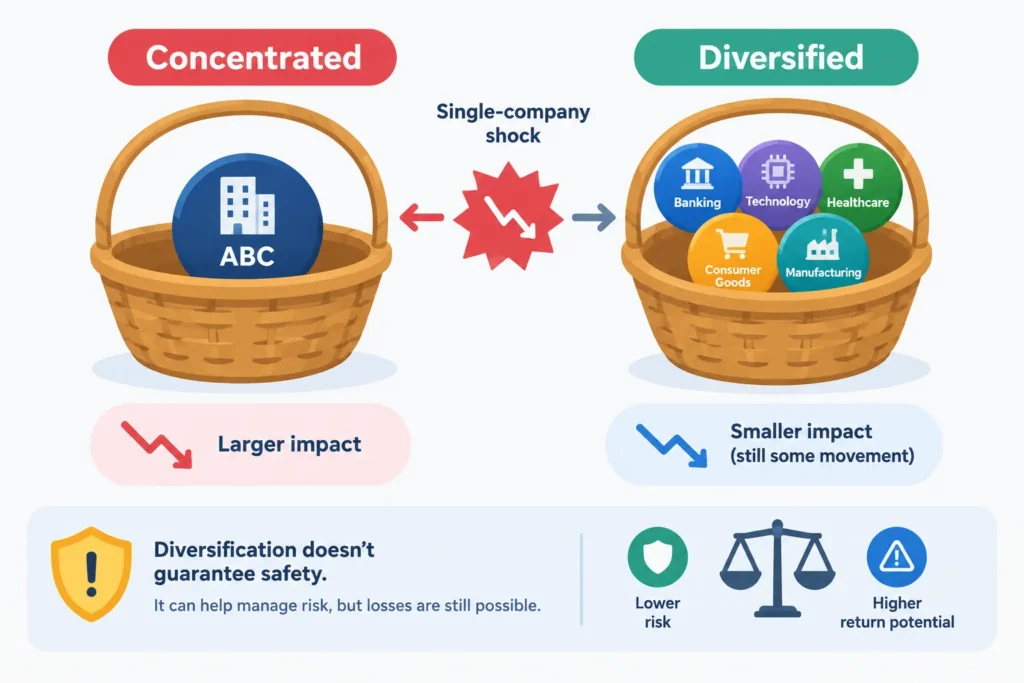
Diversification means spreading money across different investments instead of depending heavily on one company, sector or idea. In simple terms, it avoids keeping all your eggs in one basket.
Suppose a beginner invests the entire amount in one airline company. A rise in fuel costs or an operational problem could severely affect the portfolio. Spreading the amount across suitable companies and sectors reduces dependence on that single outcome.
Diversification does not guarantee a profit or prevent all losses. During a broad market decline, many shares may fall together. Its purpose is to reduce the damage that one company or sector can cause to the overall portfolio.
A portfolio should not be made complicated merely to own many shares. Holding several poorly researched companies is not necessarily sensible diversification. Beginners who want more context can refer to RegularStation’s verified guides on portfolio management and diversification for a structured explanation of allocation and portfolio review.
Scams and Unsafe Practices to Avoid
Be cautious when someone promises fixed, guaranteed or unusually high stock market returns. Genuine market-linked investments cannot promise that share prices will always move in your favour.
Anonymous social media messages, messaging groups and unsolicited calls may promote a stock before others sell it. Do not act only because a person claims to have “operator news”, “inside information” or a “sure-shot target”. Research the company and use reliable exchange filings and official disclosures.
Protect your trading and demat accounts as carefully as your bank account. Never share your password, trading PIN, one-time password or screen-access permission with anyone. A broker, depository or regulator should not need your OTP to provide an unsolicited profit, refund or investment opportunity.
Avoid borrowing through personal loans, credit cards or informal lenders to invest or trade. If the share price falls, you may face both an investment loss and continuing interest payments. Beginners should also avoid margin and leverage until they fully understand how losses and forced position closures can work.
Beginner Checklist Before Buying a Share
- Set a clear purpose. Decide whether the money is for a long-term goal, general wealth creation or learning with a small amount. Your purpose should guide your time horizon and risk level.
- Keep emergency money separate. Build an appropriate emergency buffer before committing money to shares. Do not treat the stock market as a substitute for readily available cash.
- Understand the business. Be able to explain what the company sells, how it earns money and what could damage its performance. If the business is unclear, research further before investing.
- Review basic financial information. Check revenue, profit, cash flow, debt and major risks over time. Read official company announcements rather than relying only on short videos or forwarded messages.
- Check the intermediary. Confirm that the broker is registered with the Securities and Exchange Board of India. Verify details through official regulatory or exchange sources and read the broker’s terms carefully.
- Compare charges. Brokerage is only one cost. Review applicable account charges, exchange charges, taxes and other transaction costs shown by the broker. Frequent buying and selling can make these costs more significant.
- Use a suitable order type. A market order prioritises execution but the final price may differ in a fast-moving or illiquid share. A limit order allows you to set a maximum buying price or minimum selling price, but the order may remain unexecuted.
- Start small. A modest first investment can help you understand order placement, contract notes, settlement and portfolio movements without taking an unnecessarily large risk.
- Diversify thoughtfully. Avoid placing most of your investable money in one share or one sector. Build exposure gradually according to your goals and capacity for loss.
- Keep records. Save contract notes, account statements, transaction details and relevant company research. Records help with portfolio review, dispute resolution and tax reporting.
- Review without overreacting. Check whether the original reason for buying remains valid. Do not buy or sell only because the price changed for a day or because social media sentiment shifted.
Frequently Asked Questions
Is long-term investing always safer than trading?
No. A long holding period does not make a weak company safe. Long-term investors still need to examine business quality, debt, governance, valuation and diversification. However, investing and trading involve different methods and risks, and short-term trading usually demands more active monitoring.
Can I start investing with a small amount?
Yes, you can begin with an amount that fits your finances and the market price of the investment. Starting small may help you learn the process. The amount should not come from emergency savings or money required for near-term expenses.
Does diversification mean buying many random shares?
No. Diversification should spread risk across suitable investments, not create a collection of unresearched shares. The holdings should fit your goals, time horizon and risk tolerance.
Should I buy a stock based on a tip from a friend or online group?
A tip can be a starting point for research, but it should not be the sole reason for investing. Check official company information, understand the risks and be especially cautious of urgency or guaranteed-return claims.
What should I do if someone asks for my trading OTP?
Do not share it. End the conversation and contact your broker through its official support channel if necessary. Also review your account activity and change compromised credentials promptly.
Summary
Beginners should first choose between a long-term investing approach and short-term trading based on their goals, knowledge and risk capacity. Neither approach guarantees profit.
Market movements, company problems, poor liquidity, high valuations and scams can all cause losses. Sensible diversification, careful research, secure account practices and controlled position sizes can help manage risk. Avoid borrowed money, anonymous tips and anyone promising guaranteed stock market returns.
Before investing, understand the business, confirm the broker’s registration, review all charges, select an appropriate order type and keep proper records. Start carefully and invest only money you can leave exposed to market fluctuations.
This article is for general educational information only. It is not personalised investment, legal or tax advice. Consider your own circumstances and consult an appropriately qualified professional where required.




Comments