

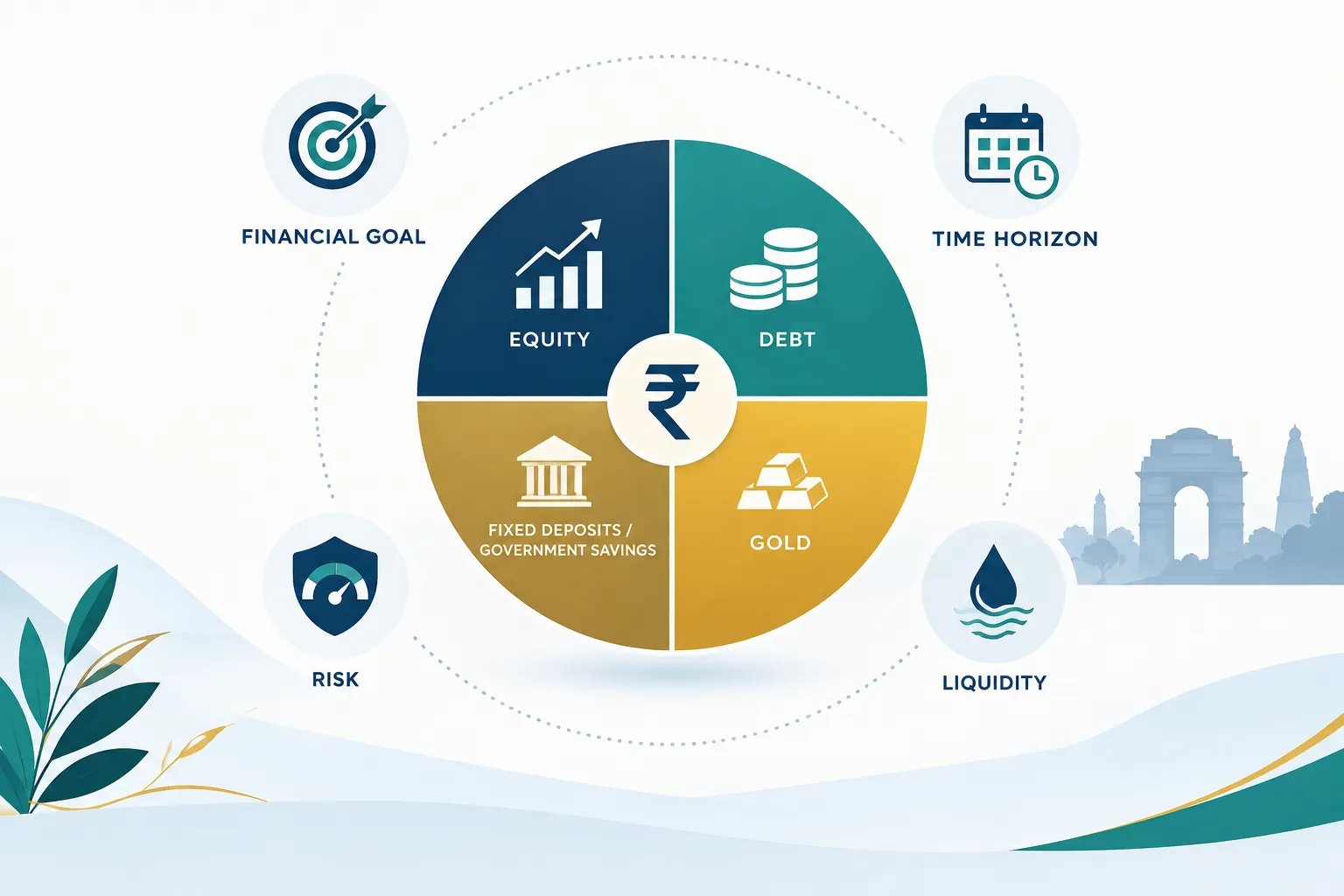
Portfolio management means choosing, combining, and regularly reviewing investments so that they support your financial goals. A sensible portfolio may include equity, debt, fixed deposits, government-backed savings instruments, and gold. The right mix depends on when you need the money, how much risk you can accept, and how easily you may need to access your funds.
Introduction
Investing is not simply about finding the “best” share, mutual fund, or fixed deposit. A good investment on its own may still be unsuitable for your goal. For example, equity may be useful for a goal that is 15 years away, but it can be risky for school fees due next year.
This is where portfolio management becomes important. It helps you look at all your investments as one connected plan rather than as separate products bought at different times.
For an Indian investor, a portfolio could include direct shares, mutual funds, bank fixed deposits, Public Provident Fund, Employees’ Provident Fund, National Savings Certificates, government securities, and gold. Cash kept in a savings account for near-term needs is also part of the wider financial picture.
Portfolio management does not remove investment risk or guarantee returns. Its purpose is to take risk deliberately, spread it sensibly, and keep investments aligned with your needs.
Understanding Portfolio Management and Its Building Blocks
What Is an Investment Portfolio?
An investment portfolio is the complete collection of assets held by an individual or family for financial goals. It may be managed across several accounts and institutions, but it should be viewed as one whole.
Consider a salaried investor who holds an equity mutual fund SIP, a few listed shares, an Employees’ Provident Fund balance, a bank fixed deposit, and gold jewellery. These assets together form a portfolio. Looking only at the mutual fund account would give an incomplete picture of the investor’s exposure to equity, debt, and gold.
A portfolio can serve several goals at the same time, such as:
- Building a retirement fund
- Paying for a child’s higher education
- Making a home down payment
- Creating regular income after retirement
- Protecting money needed for emergencies or near-term expenses
Different goals usually need different investment mixes. It can therefore help to divide the portfolio mentally, or through separate accounts, into goal-based buckets.
Why Portfolio Management Matters
Without a portfolio plan, investors often collect products based on recent performance, recommendations from friends, tax-saving deadlines, or market excitement. This can lead to too much money in one asset, several overlapping mutual funds, or investments that cannot be accessed when required.
Portfolio management creates a structure for answering four basic questions:
- What is the money meant for?
- When will it be required?
- How much loss or fluctuation can the investor handle?
- How quickly should the money be available?
The answers influence which assets belong in the portfolio and how much should be allocated to each one.
Financial Goals
A financial goal should state what the money is for, roughly how much may be needed, and the expected date. “I want to build wealth” is a broad intention. “I want to fund postgraduate education in eight years” is a clearer goal.
Clear goals help investors avoid comparing every investment only by return. Safety and access may matter more than high growth for a near-term goal. For a distant goal, accepting some market fluctuation may be reasonable if it offers better long-term growth potential.
An emergency fund should generally be separated from return-focused investments. It needs to be available at short notice and should not depend heavily on stock market conditions.
Investment Horizon
The investment horizon is the time between investing the money and needing it. It is commonly viewed as short, medium, or long term, although the exact periods can differ by investor and goal.
- Short-term goals: Money may be needed within the next few years. Capital stability and liquidity usually receive greater importance.
- Medium-term goals: A mix of stability and growth may be considered, depending on how flexible the goal date is.
- Long-term goals: The investor may have more time to recover from market declines and may be able to hold a larger equity allocation.
Time alone does not make an investment safe. Equity remains volatile, and long holding periods do not guarantee a profit. However, a longer horizon may give investors more time to stay invested through market cycles.
Risk Tolerance and Risk Capacity
Risk tolerance describes how comfortable an investor feels when investment values rise and fall. Risk capacity describes how much financial loss the investor can actually afford.
These are not always the same. A young investor may feel nervous about market volatility but have a high capacity for risk because the goal is decades away and income is stable. Another investor may feel confident about stocks but have a low capacity for risk because the money is needed for a home purchase next year.
A practical portfolio should respect both factors. If a fall in value is likely to cause panic selling, the equity allocation may be too high even if it looks suitable on paper.
Liquidity Needs
Liquidity means how easily an investment can be converted into usable money without a major delay or loss in value.
Bank balances and some open-ended mutual funds can generally be accessed relatively quickly, subject to processing time, exit loads, taxation, and market movement. Fixed deposits may allow premature withdrawal but can apply a penalty or reduced interest. Instruments such as Public Provident Fund have withdrawal restrictions. Property can take much longer to sell.
Investors should check product-specific rules before investing. Money required for emergencies should not be locked entirely in instruments with long holding periods or difficult withdrawal conditions.
Common Asset Classes for Indian Investors
Each asset class has a different role. The objective is not to choose one winner, but to combine assets according to the portfolio’s goals.
- Equity shares: Direct ownership in listed companies. Shares may provide long-term growth and dividends, but prices can fluctuate sharply. Selecting and monitoring individual companies requires research.
- Equity mutual funds: These pool investor money into a portfolio of shares managed according to a stated mandate. They can provide broader exposure than a few individual stocks, though they still carry market risk.
- Debt mutual funds: These invest in bonds and money-market instruments. Their risks include changes in interest rates, credit quality, and liquidity. They should not be treated as guaranteed alternatives to fixed deposits.
- Fixed deposits: Bank and eligible institution deposits provide a stated interest rate for a chosen term. They can support stability and planned expenses, but investors should consider premature withdrawal rules, tax treatment, and inflation.
- Government-backed savings instruments: Examples include Public Provident Fund, National Savings Certificates, and certain post office schemes. Their lock-ins, eligibility rules, interest structures, and tax treatment vary.
- Gold: Exposure may come through physical gold, eligible gold-linked market products, or other permitted formats. Gold can behave differently from equity and debt, but its price also moves and physical holdings may involve purity, storage, and making-charge concerns.
For a basic explanation of market products and terminology, the broader guide Stock Market & Investing in India: A Complete Beginner’s Guide is a useful companion topic. Beginners considering individual shares can also refer to a guide on How to Start Investing in the Indian Stock Market. Before choosing funds, a comparison topic such as Mutual Funds vs Direct Stocks can help clarify the differences.
Asset Allocation vs Diversification
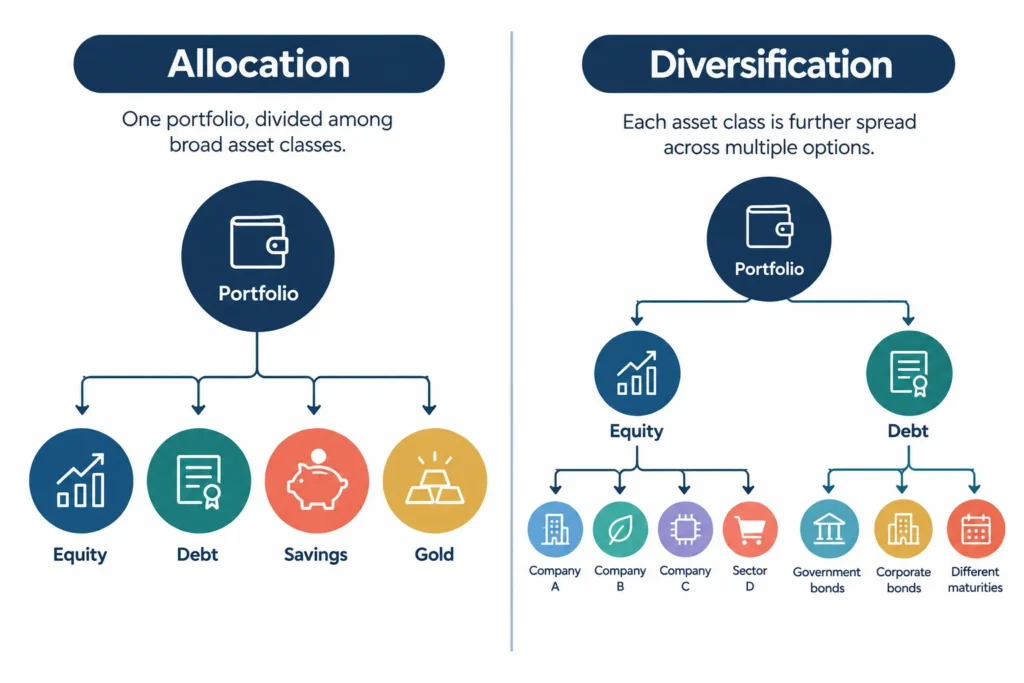
Asset allocation and diversification are related, but they do not mean the same thing.
| Concept | What It Means | Simple Example |
|---|---|---|
| Asset allocation | Dividing the portfolio among broad asset classes such as equity, debt, and gold | Keeping a chosen proportion in equity funds, fixed-income assets, and gold |
| Diversification | Spreading money within an asset class, and sometimes across products or issuers, to reduce concentration | Owning equity across several sectors instead of investing only in banking shares |
An investor can have asset allocation without sufficient diversification. For example, a portfolio may contain equity and fixed deposits, but the equity portion may consist of only one company’s shares. Similarly, holding ten mutual funds does not automatically create better diversification if most of them own similar companies.
Diversification can reduce the damage caused by one investment performing poorly, but it cannot eliminate broad market risk. It also should not become uncontrolled product collection. Every holding should have a clear role.
Active and Passive Portfolio Management
Active portfolio management involves making deliberate choices to outperform a benchmark or respond to changing views. This could include selecting individual shares, choosing actively managed funds, changing sector exposure, or adjusting holdings more frequently.
Passive management aims to track a market index or maintain a predetermined allocation with fewer discretionary decisions. Index mutual funds and exchange-traded funds are common passive products, although investors must still choose an appropriate index and understand tracking difference, costs, liquidity, and product structure.
| Factor | Active Approach | Passive Approach |
|---|---|---|
| Decision-making | Relies more on a fund manager’s or investor’s selections | Generally follows an index or preset rule |
| Effort | Usually requires more research and monitoring | Usually requires less security-level research |
| Costs | May have higher management or trading costs | Often has lower costs, but costs still apply |
| Outcome | May outperform or underperform the benchmark | Aims to deliver benchmark-like performance before costs and tracking differences |
Neither style is automatically right for everyone. Some investors use passive funds for the core of an equity portfolio and active funds or selected shares for a smaller portion. The important point is to understand the reason for each holding, the cost involved, and the level of monitoring required.
Good portfolio management begins with goals, time horizon, risk, and liquidity—not with predictions about which asset will deliver the highest return next year. Once these building blocks are clear, investment products can be selected for specific roles rather than collected at random.
How to Build an Investment Portfolio Step by Step
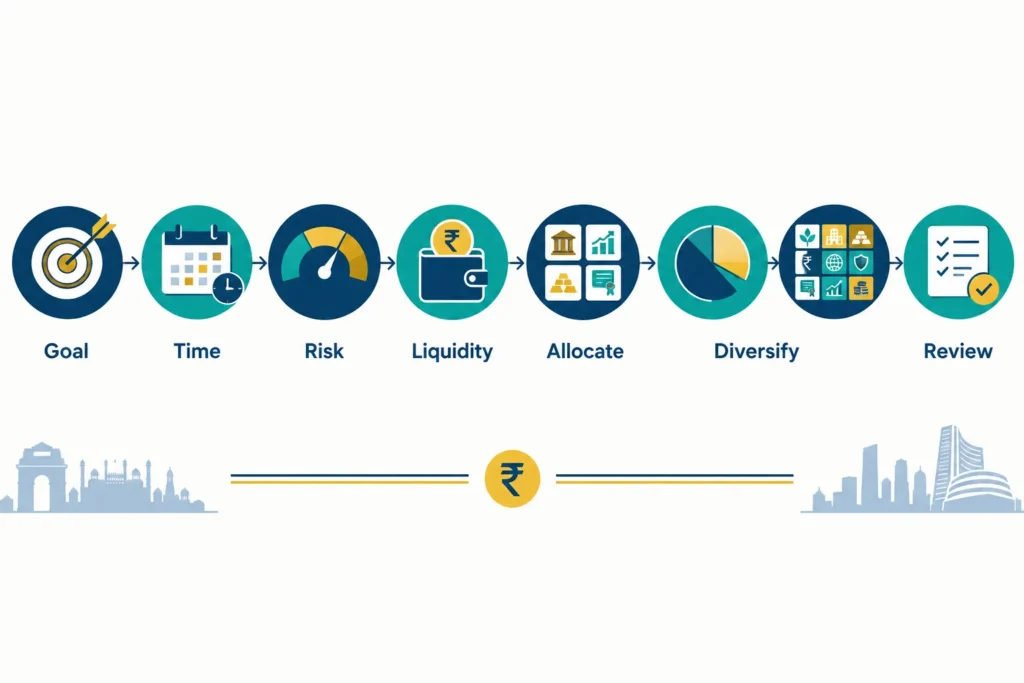
Portfolio management starts before you buy a share, mutual fund, deposit, or gold product. You first need to understand what the money is meant for, when it will be required, and how much uncertainty you can handle.
The following process helps you build an investment portfolio in a structured way. Each step affects the next, so avoid selecting investments only because they recently delivered high returns or are popular among friends.
Step 1: Set Specific Financial Goals
A financial goal should state what you need the money for, approximately how much you need, and when you need it. A vague goal such as “create wealth” does not provide enough direction for portfolio construction.
More useful goals may include:
- Build a home down payment of ₹15 lakh in six years.
- Accumulate money for a child’s higher education in 12 years.
- Create a retirement corpus over the next 25 years.
- Save for a car purchase in three years.
Keep separate goals separate where possible. Money needed for a car in three years should not automatically follow the same investment strategy as money intended for retirement after 25 years.
You should also allow for changes in the future cost of a goal. Education, housing, and other expenses may become more expensive over time. The target amount can therefore be reviewed periodically instead of being treated as fixed forever.
Step 2: Identify the Investment Horizon and Liquidity Needs
The investment horizon is the time available before you expect to use the money. It is commonly viewed as short term, medium term, or long term, although the exact boundaries can differ among investors.
A longer horizon may provide more time to recover from temporary market declines. A short horizon usually requires greater attention to capital stability because there may not be enough time to wait for a recovery.
Liquidity means how easily you can access your money without a major delay, penalty, or loss. Before investing, ask:
- Could this money be required at short notice?
- How quickly can the investment be sold or withdrawn?
- Is there a lock-in period or premature withdrawal penalty?
- Could selling during poor market conditions cause a substantial loss?
Do not invest all available money in long-term or locked products. Funds that may be needed for emergencies or near-term expenses generally require easier access. Liquidity needs should be assessed separately from the desire to earn higher returns.
Step 3: Assess Risk Tolerance and Risk Capacity
Risk tolerance and risk capacity are related, but they are not the same.
Risk tolerance is your emotional comfort with fluctuations. For example, would a temporary 20% decline make you panic and sell, or could you remain invested after reviewing the reasons for the fall?
Risk capacity is your financial ability to absorb losses or delays. It depends on factors such as income stability, financial commitments, time horizon, dependants, and the importance of the goal.
An investor may feel comfortable taking risks but still have low risk capacity if the money is needed soon. Similarly, a person may have a long horizon and strong finances but prefer a less volatile portfolio because large fluctuations cause anxiety.
Both factors matter. A portfolio that looks efficient on paper may fail in practice if its volatility leads the investor to exit at the wrong time.
Step 4: Select Suitable Asset Classes
An asset class is a broad category of investments with similar characteristics. Common choices for Indian investors include equity, debt, bank deposits, government-backed savings instruments, and gold.
- Equity: Shares and equity-oriented funds may support long-term growth, but their values can fluctuate sharply.
- Debt: Bonds and debt-oriented products may provide relatively lower volatility than equity, but they can still carry interest-rate, credit, and liquidity risks.
- Bank deposits: Fixed and recurring deposits offer defined terms and interest rates, subject to the deposit conditions. Premature withdrawal may involve a penalty.
- Government-backed instruments: Products such as Public Provident Fund, National Savings Certificate, and certain small savings schemes may suit specific goals. Their eligibility, limits, maturity periods, tax treatment, and withdrawal rules differ.
- Gold: Gold can provide diversification, but its price also moves up and down. Jewellery includes making charges and may not be an efficient investment format.
No single asset class is suitable for every goal. The role of each asset should be considered in relation to the entire portfolio rather than in isolation.
Step 5: Decide the Asset Allocation
Asset allocation is the division of your portfolio among asset classes. For example, a portfolio may contain a combination of equity for growth, debt or deposits for relative stability, government-backed instruments for selected long-term needs, and gold for diversification.
The allocation should reflect your goals, time horizon, liquidity requirements, risk tolerance, and risk capacity. A long horizon does not automatically mean that all money should go into equity. Likewise, avoiding equity completely may make it harder to pursue long-term growth, depending on the goal and the investor’s circumstances.
Decide the broad allocation before selecting individual products. Otherwise, you may collect several investments without knowing how much total exposure you have to equity, debt, gold, or locked instruments.
Step 6: Diversify Within and Across Asset Classes
Diversification means avoiding excessive dependence on one investment, company, sector, issuer, or asset class. It can reduce the damage caused by a poor outcome in one part of the portfolio, though it cannot remove all risk or prevent losses.
Diversification can happen at two levels:
- Across asset classes: Holding an appropriate mix of equity, debt or deposits, government-backed instruments, and gold.
- Within an asset class: Spreading equity exposure across companies and sectors, or spreading debt exposure across suitable issuers and maturities.
Owning many products does not necessarily mean you are well diversified. Five equity funds may hold many of the same large companies. Several fixed-income products may also expose you to the same issuer or similar interest-rate risk.
Look at the underlying exposure, not merely the number of accounts or products.
Step 7: Choose Investments After Checking the Details
Once the asset allocation is clear, select investments that can perform the required role. Compare products using their risks and terms rather than choosing only on the basis of past returns.
Before investing, check:
- The main market, credit, interest-rate, liquidity, and concentration risks.
- All visible and embedded costs, including expense ratios, brokerage, account charges, commissions, and exit-related charges where applicable.
- Lock-in periods, maturity dates, and premature withdrawal conditions.
- Minimum investment and contribution requirements.
- Tax treatment under the rules applicable to you.
- Whether the product is regulated and whether its documents clearly explain how it works.
- Whether the investment matches the goal’s horizon and liquidity needs.
Read the product terms instead of relying only on an advertisement, app screen, social media post, or informal recommendation. A product can be legitimate and still be unsuitable for your particular goal.
Illustrative Portfolio for an Indian Investor
The following allocation is only an example for explanation. It is not a recommendation and does not promise returns. An appropriate allocation will vary with each investor’s age, goals, income stability, liabilities, horizon, liquidity needs, tax position, risk tolerance, and risk capacity.
Consider Meera, a hypothetical 32-year-old salaried investor. She has a separate emergency reserve and is building a portfolio for a goal that is more than ten years away. She can accept some market fluctuations but does not want the entire portfolio exposed to equity.
| Asset category | Illustrative allocation | Possible role |
|---|---|---|
| Equity | 50% | Long-term growth, with market volatility |
| Debt funds or bank deposits | 25% | Relative stability and planned liquidity, depending on product terms |
| Government-backed instruments | 15% | Long-term saving with scheme-specific rules and lock-ins |
| Gold | 10% | Diversification, while accepting price fluctuations |
If Meera had a goal only two years away, unstable income, or an immediate need for the money, this allocation could be unsuitable. She might require more liquidity and less exposure to volatile assets. If she had a much longer horizon and greater risk capacity, she might consider a different mix.
The key lesson is that portfolio management is a sequence. Define the goal, determine the horizon and liquidity needs, assess risk, select asset classes, decide their weights, diversify, and then choose products after examining their costs and conditions. Starting with products instead of this process can leave you with investments that do not work together.
Monitoring, Rebalancing, Common Mistakes, and Investor Safeguards
Building a portfolio is only the beginning. Good portfolio management also involves checking whether your investments remain suitable for your goals, risk capacity and time horizon.
Monitoring does not mean watching stock prices every hour. It means reviewing the portfolio with a clear purpose, comparing progress with relevant measures and making changes only when there is a sound reason.
How to Monitor Portfolio Performance
Start with your financial goal. Ask whether the portfolio is progressing towards the amount you may need and whether the original investment timeline is still realistic.
For example, suppose you are investing for a home down payment needed in five years. A sharp rise or fall in one month may not be the most important issue. You should instead check whether your current savings rate, asset allocation and expected range of outcomes remain appropriate for the goal.
A useful review can cover the following points:
- Goal progress: Check whether you are investing enough and whether the goal amount or deadline has changed.
- Asset allocation: Compare the current mix of equity, debt, gold and cash with your intended allocation.
- Investment performance: Compare returns over a suitable period, not merely over a few days or weeks.
- Risk: Check whether losses, volatility or concentration have become greater than you can comfortably manage.
- Costs and taxes: Review expense ratios, brokerage, account charges, exit loads and possible tax consequences.
- Product suitability: Confirm that each investment still serves a specific role in the portfolio.
- Personal changes: Consider changes in income, dependants, debt, insurance needs or emergency savings.
A benchmark can help you understand performance, but it must be suitable. A diversified Indian large-cap equity fund may be compared with its stated equity benchmark. A debt fund should be assessed against an appropriate debt benchmark, not against a stock market index. A mixed portfolio may require separate comparisons for each asset class or a blended benchmark reflecting its allocation.
Do not treat a benchmark as a promise. A portfolio can underperform or outperform for many reasons, including costs, investment style and risk level. Also consider whether the portfolio is helping you pursue the goal without exposing you to unsuitable risk.
For more background, readers can refer to topics such as How Asset Allocation Works, Understanding Risk and Return and How to Choose an Investment Time Horizon.
What Is Portfolio Rebalancing?
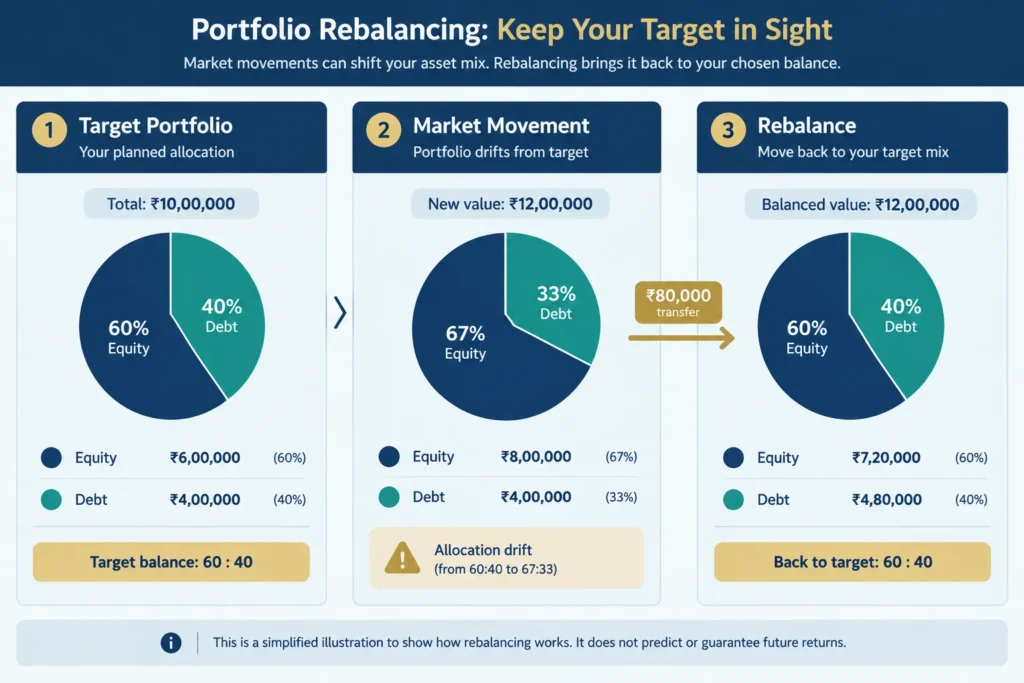
Portfolio rebalancing means bringing your asset allocation back towards its intended proportions. Market movements can cause one asset class to become a much larger or smaller part of the portfolio. This change is called allocation drift.
Assume an investor starts with ₹6 lakh in equity and ₹4 lakh in debt. The target allocation is therefore 60% equity and 40% debt. If equity rises strongly while debt remains relatively stable, the portfolio could later be worth ₹12 lakh, consisting of ₹8 lakh in equity and ₹4 lakh in debt.
Equity would now represent about 67% of the portfolio. If the 60:40 target still suits the investor, the portfolio may be brought closer to ₹7.2 lakh in equity and ₹4.8 lakh in debt. This could involve shifting approximately ₹80,000 from equity to debt.
That is only a simplified example. An investor might instead direct new contributions towards debt until the allocation moves closer to the target. This approach may reduce the need to sell existing holdings, although it may take time.
Rebalancing is mainly a risk-control process. It prevents a strongly performing asset class from quietly increasing the portfolio’s risk beyond the intended level. It can also encourage disciplined action rather than decisions based on excitement or fear.
Calendar-Based and Threshold-Based Reviews
There are two common ways to decide when rebalancing should be considered:
- Calendar-based review: The investor checks the allocation at planned intervals. A review does not automatically require a transaction; it may simply confirm that the portfolio remains suitable.
- Threshold-based review: The investor reviews or acts when an asset class moves beyond a pre-decided range around its target. The range should reflect the investor’s circumstances and the practical costs of making changes.
Some investors combine both approaches by conducting planned reviews and checking for significant allocation drift. There is no universal review frequency or threshold that suits everyone. The right approach depends on the portfolio size, products used, goal timeline, tax position, transaction costs and ability to monitor investments.
Before rebalancing, check for capital gains taxation, brokerage, securities transaction charges where applicable, exit loads and other costs. Certain products may have lock-in periods, withdrawal restrictions, maturity conditions or penalties. A change that looks sensible at the allocation level may be inefficient if these conditions are ignored.
Tax rules and product terms can change. Verify the latest conditions before acting, especially for mutual funds, exchange-traded funds, bonds, small savings schemes and retirement products.
Common Portfolio Management Mistakes
Concentrating money in a few stocks: A portfolio built around one company, sector or business group may suffer heavily if that area faces a setback. Owning several securities does not ensure diversification if they are exposed to the same risks.
Chasing past returns: Last year’s top-performing stock or mutual fund may not remain a leader. Past performance can provide context, but it does not establish what will happen next. Consider the investment process, risks, costs and role in the portfolio.
Ignoring risk and liquidity: High return expectations often come with greater uncertainty. Also check how quickly an investment can be converted into cash and under what conditions. Money needed soon should not depend entirely on volatile or difficult-to-sell assets.
Trading too frequently: Constant buying and selling can increase costs, taxes and behavioural errors. A market headline or short-term price movement is not automatically a reason to change a long-term portfolio.
Duplicating similar investments: Holding several mutual funds does not always create meaningful diversification. Two funds may own many of the same stocks or follow similar strategies. Review the underlying exposure rather than counting the number of schemes.
Failing to review allocation: An unattended portfolio can become riskier after one asset class performs strongly. It can also remain too conservative when a goal is distant, or too aggressive as a goal approaches. Review the allocation when goals or personal circumstances change.
Practical Portfolio Review Checklist
- Is each financial goal clearly defined with an amount and expected timeline?
- Does the current asset allocation still match the goal and your risk capacity?
- Has allocation drift moved any asset class materially away from its intended role?
- Are performance comparisons based on suitable benchmarks and meaningful periods?
- Is too much money concentrated in one stock, sector, fund house or asset class?
- Do multiple funds or securities create unnecessary overlap?
- Do you have adequate emergency money outside long-term investments?
- Will you need part of the portfolio soon, and is that amount sufficiently liquid?
- Have costs, taxes, exit loads, lock-ins and withdrawal conditions been checked?
- Have your income, debts, dependants, goals or time horizons changed?
- Is a proposed transaction based on the plan rather than fear, tips or recent returns?
- Are nominee details, account records and important investment documents current?
Frequently Asked Questions
Should I check my portfolio every day?
Most long-term investors do not need to act on daily movements. Frequent checking can encourage emotional decisions. The review approach should match your goals, investments and circumstances, while urgent product-specific developments should not be ignored.
Does rebalancing always mean selling investments?
No. You may sometimes use new contributions, interest, dividends or maturing investments to add to the underweight asset class. Whether this is practical depends on the size of the allocation drift and available cash flows.
Should I remove an investment because it underperformed its benchmark?
Not automatically. Examine the comparison period, investment style, risk level, costs and reason for underperformance. Also check whether the product still performs its intended portfolio role. Persistent concerns may require deeper review rather than an immediate reaction.
Can diversification prevent all losses?
No. Diversification can reduce the impact of a single investment or narrow risk, but it cannot remove market risk or guarantee positive returns. Even a diversified portfolio may decline during difficult market conditions.
When should my asset allocation change?
It may need reconsideration when your goal timeline, financial position, ability to bear losses or need for liquidity changes. A major life event can justify a review, but changes should be based on your plan rather than market predictions alone.
Summary
Effective portfolio management requires purposeful monitoring, suitable benchmark comparisons and control of allocation drift. Rebalancing can restore the intended risk mix, but taxes, costs, lock-ins and exit conditions must be considered before making transactions.
Avoid concentration, return chasing, unnecessary trading, hidden duplication and neglect of liquidity. Keep the portfolio connected to your goals and review it when personal circumstances or the investment mix changes.
This article is for education only. It is not personalised investment, tax or legal advice, and it does not guarantee any outcome. Verify current product details, taxation and regulatory information through authoritative sources, and consider consulting a qualified investment, tax or legal professional where appropriate.




Comments