

To get more savings account benefits, compare the full cost and convenience of an account instead of choosing only the highest advertised interest rate. Check how the bank calculates and credits interest, the minimum balance rule, account charges, transaction limits, ATM access, branch availability and the quality of digital banking. The best savings account is usually the one that keeps your money safe and accessible while charging little or nothing for the services you regularly use.
Introduction
A savings account is often the first financial product used by an individual or family in India. It receives salary, pension or business income, supports UPI payments and helps keep money available for monthly expenses and emergencies.
However, simply keeping money in an account does not mean you are using it effectively. Two accounts can offer similar interest rates but provide very different value after minimum balance penalties, ATM charges, service fees and transaction restrictions are considered.
Understanding your account can help you avoid unnecessary charges and improve the way you manage everyday money. It can also make budgeting easier because you know how much money is available, which transactions are free and what conditions you must meet.
This is where the main savings account benefits become useful: safety, liquidity, modest interest, convenient payments and access to banking services. The right combination will depend on your income, location, spending habits and need for branch or digital support.
Understand and Compare Your Savings Account
Know How Savings Account Interest Works
Banks generally calculate savings account interest on the daily closing balance. In simple terms, the bank looks at the amount remaining in your account at the end of each day and calculates interest based on the applicable annual rate.
The basic daily calculation can be understood as:
Daily interest = Closing balance × Annual interest rate ÷ 365
The bank adds up the eligible interest and credits it to your account according to its schedule. The credit may be quarterly or follow another frequency stated by the bank. Rates, balance slabs, calculation conditions and credit schedules can vary, so check the bank’s latest official terms rather than assuming that every account works in the same way.
Some banks offer one rate up to a particular balance and another rate for the amount above that level. Others may apply a different slab method. If a bank advertises a higher rate, find out whether it applies to your likely account balance or only to a much larger amount.
Interest earned on a savings account may also have tax implications. Review the current income-tax rules that apply to you, especially if you earn interest from multiple bank accounts. Do not assume that interest is automatically tax-free merely because the bank has credited it without deducting tax.
Do Not Compare Accounts by Interest Rate Alone
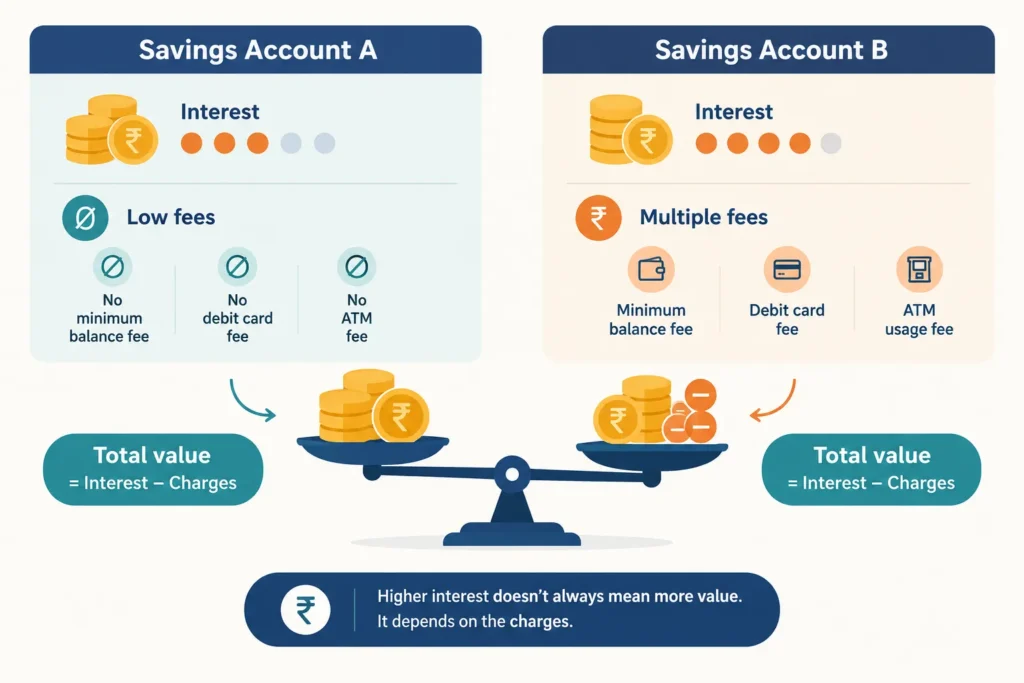
A higher savings account interest rate can be attractive, but it should not be the only reason to select an account. Charges or inconvenient conditions can easily reduce the extra interest you expect to earn.
Consider a simple example. Suppose Meera normally keeps ₹50,000 in her savings account throughout the year.
- Bank A offers 3% annual interest and does not require Meera to maintain a minimum balance.
- Bank B offers 3.5% annual interest but requires a minimum balance and may charge a penalty when she falls below it.
Ignoring compounding and tax for simplicity, the difference in annual interest on ₹50,000 is about ₹250. If Meera pays even one or two minimum balance penalties, debit card fees or transaction charges totalling more than ₹250, the higher-rate account may leave her worse off.
This example is only illustrative. Actual interest depends on the daily closing balance, applicable rate slabs, rate changes and the bank’s credit schedule. The important lesson is that the headline rate must be compared with the total cost of using the account.
Check the Minimum Balance Requirement
Many savings accounts require an average balance over a specified period. The requirement may be described as a monthly average balance, quarterly average balance or another type of average. It is not always the same as keeping the stated amount in the account every day.
Ask the bank these questions before opening or continuing with an account:
- Is this a zero-balance account or does it have a minimum balance rule?
- How is the required average calculated?
- Does the requirement change according to the branch location or account type?
- What happens if the balance falls below the requirement?
- How and when will the bank inform me of a shortfall?
Choose a requirement that fits your normal cash flow. If your balance drops near the end of every month because of rent, school fees or loan payments, an account with a high minimum balance may create avoidable stress and charges.
A zero-balance option may be more practical for students, first-time earners, pensioners or households with irregular income. However, “zero balance” does not always mean that every service is free. Review charges for debit cards, cheque books, cash transactions and other facilities separately.
Assess Digital Banking Access
For many customers, digital access is one of the most valuable savings account benefits. A reliable mobile app or internet banking service can help you check balances, download statements, transfer money, manage beneficiaries and control your debit card without visiting a branch.
Review whether the account provides the services you are likely to use, such as:
- UPI registration and payments
- IMPS, NEFT and RTGS transfers, where applicable
- Online fixed deposit or recurring deposit creation
- Debit card controls, including temporary blocking
- Transaction alerts and electronic statements
- Easy updating of contact or nominee details, where available
- Clear customer support for failed or disputed transactions
Do not judge digital banking only by the number of features. Ease of use, security controls, service reliability and access to support are also important. Someone who is not comfortable with apps may place greater value on branch service than on advanced digital features.
Compare ATM and Branch Services
Think about how often you withdraw cash and where you normally travel. Check the availability of the bank’s ATMs near your home, workplace or college. Also review the number of free transactions allowed at the bank’s own ATMs and at other banks’ ATMs under the applicable rules and account terms.
If you regularly deposit cash, submit documents or need in-person help, nearby branch access may matter more than a small difference in interest. This is especially relevant for senior citizens, families managing pension-related paperwork and people living in places with inconsistent internet access.
Also check whether branch transactions carry separate charges. Some accounts are designed mainly for digital use and may charge for certain services completed through a branch.
Review Transaction Limits and Bank Charges
Every account has conditions that can affect day-to-day use. Read the schedule of charges and key account terms instead of relying only on advertisements or verbal explanations.
Important items to compare include:
- Debit card issuance and annual fees
- Charges for replacing a lost card
- ATM transaction limits and extra-use fees
- Cash deposit and withdrawal limits
- Cheque book charges after any free allowance
- Charges for cheque returns or failed standing instructions
- SMS alert or statement charges, if applicable
- Fees for duplicate statements, certificates or other branch services
- Limits on online transfers or daily UPI usage
Focus on charges connected with your actual behaviour. A person who makes almost all payments through UPI may not care about cheque book charges, while a small shop owner who frequently handles cash should examine cash deposit rules carefully.
Use a Simple Comparison Checklist
| Feature | What to Check | Why It Matters |
|---|---|---|
| Interest | Rate, balance slabs and credit schedule | Shows what your typical balance may earn |
| Minimum balance | Required average and shortfall charge | Helps prevent avoidable penalties |
| Digital banking | App features, transfers, alerts and support | Makes everyday banking more convenient |
| ATM and branch access | Nearby locations, free usage and service charges | Supports cash needs and in-person help |
| Transaction limits | Cash, ATM and digital transfer limits | Ensures the account matches your usage |
| Other charges | Card, cheque, statement and failed-payment fees | Reveals the account’s practical cost |
Once you compare these points, select the account that fits your routine rather than the one with the most attractive headline. You can also use the Personal Finance Guide for Beginners in India to understand where a savings account fits in your wider financial life. The guides on budgeting and setting financial goals can help you decide how much money should remain available for bills, emergencies and short-term goals.
Manage Your Balance and Use Banking Features Wisely
A savings account should make everyday money management easy. It can hold money for bills, regular spending and short-term emergencies while giving you access through UPI, debit cards, net banking and mobile banking.
However, keeping your entire long-term surplus in the account may not be efficient because savings account interest is usually modest. The aim is to maintain enough accessible money without allowing every unused rupee to remain there indefinitely.
Keep Enough for Monthly Expenses and Emergencies
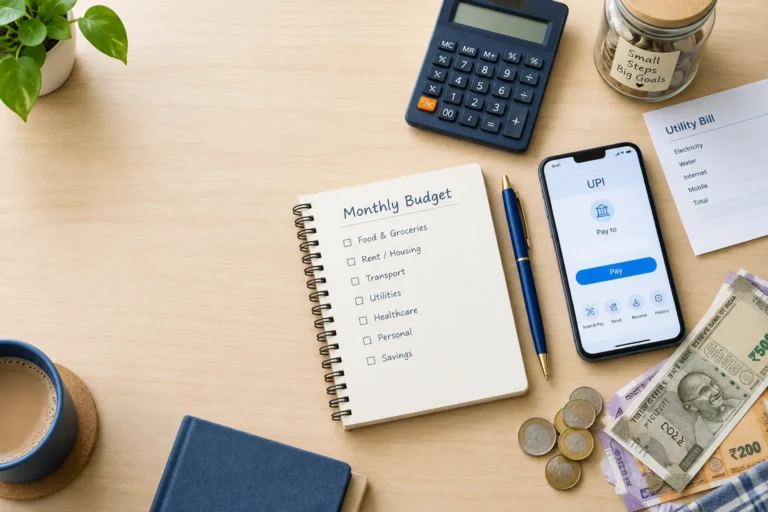
Start by estimating how much money normally leaves your account each month. Include rent or home-loan payments, utility bills, groceries, school fees, insurance premiums, subscriptions and regular UPI spending.
You should also keep a reasonable buffer for payments that are higher than expected. For example, an electricity bill may rise in summer, or an annual subscription may be due in a particular month.
Money set aside for emergencies should remain easy to access. A sudden medical payment, urgent home repair or temporary loss of income may require cash at short notice. Part of your emergency fund can therefore stay in a savings account, especially the amount you may need immediately.
Suppose your normal monthly expenses are ₹40,000. You may decide to keep ₹50,000 for the coming month, including a ₹10,000 spending buffer. You can then hold an additional amount for emergencies based on your needs, family responsibilities and income stability.
Do not treat the displayed account balance as fully available for shopping. Some of that money may already be meant for rent, bills or an emergency. A simple budget helps you separate committed money from genuinely free cash. RegularStation’s guide to creating a monthly budget can help you organise these amounts, while its emergency fund guide explains how to estimate an appropriate safety reserve.
Understand Minimum Average Balance Rules
Some savings accounts require customers to maintain a minimum average balance. Others, such as certain basic or zero-balance accounts, may not have this requirement. The exact rule depends on the bank, account type and sometimes the branch location.
“Average balance” does not always mean that your balance must remain above a fixed amount every day. A bank may calculate the average of daily closing balances over a month or another specified period. The method and required amount can vary.
For example, assume an account requires a monthly average balance of ₹10,000. Keeping ₹20,000 for part of the month and a lower amount during the remaining days may still produce the required average. However, you should not rely on this simplified example because your bank’s calculation method and conditions may be different.
If you fail to meet the requirement, the bank may levy a non-maintenance charge, subject to the account terms and applicable rules. Taxes may also apply to certain banking charges. Repeated charges can reduce the savings account benefits you receive.
Check the latest schedule of charges on your bank’s official channels. Look for:
- The required monthly or quarterly average balance
- Whether the requirement differs by branch category or account variant
- The method used to calculate the average balance
- Non-maintenance charges and applicable taxes
- Exemptions available for particular account types
- Charges for debit cards, cash transactions, cheque books or other services
Banks can revise their account features and fees. Do not depend only on information received when you originally opened the account.
Consider an Auto-Sweep or Linked Fixed Deposit
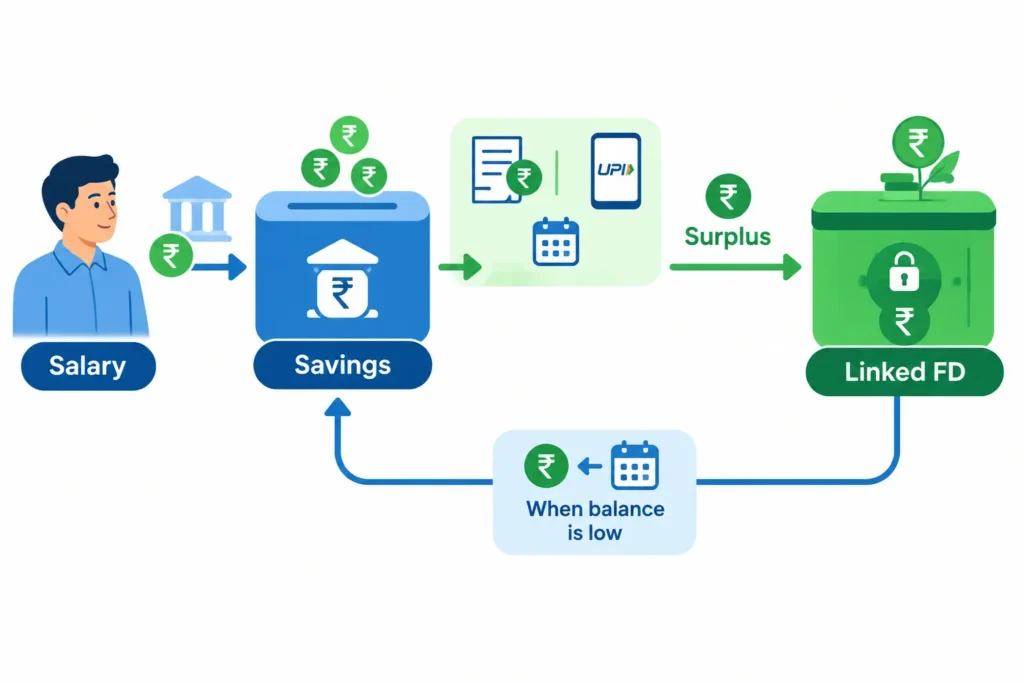
An auto-sweep facility can move surplus money from a savings account into a linked fixed deposit when the balance crosses a chosen or bank-specified threshold. This may allow eligible surplus funds to earn the applicable fixed-deposit interest rate while remaining linked to the account.
Suppose you set a threshold of ₹75,000 and your salary takes the account balance to ₹1,10,000. Depending on the bank’s facility, some or all of the ₹35,000 above the threshold may be transferred into a linked deposit. The bank may create deposits in specified units rather than moving the exact surplus amount.
If your savings account later lacks enough money for a payment, the bank may break or reverse-sweep part of the linked deposit. This process is often automatic, but the detailed rules differ between banks.
Before activating the facility, check:
- The minimum balance or threshold that triggers the sweep
- The minimum amount transferred into the fixed deposit
- The deposit tenure and applicable interest rate
- Whether deposits are created or broken in fixed units
- How premature withdrawal affects interest
- Whether a penalty or lower rate applies when a deposit is broken early
- Whether the facility is available for your account type
- Any instructions required to activate, modify or close it
An auto-sweep deposit is not identical to ordinary cash in the savings account. If a linked deposit is withdrawn before its original tenure, the bank may recalculate interest for the period it actually remained deposited. A premature withdrawal condition or penalty may also apply.
Availability is not uniform. Some banks offer the feature only with selected savings accounts, while others may require customers to request it. Read the current terms instead of assuming that every auto-sweep facility works in the same way.
Automate Bills and Savings on Salary Day
Standing instructions and automatic transfers can reduce missed payments and help you use your salary systematically. A standing instruction tells the bank to transfer a fixed amount or make a specified payment on a scheduled date.
Imagine that your monthly salary of ₹60,000 arrives on the first working day. You could arrange the following salary-day flow:
- ₹8,000 transferred to a separate emergency fund account
- ₹15,000 kept aside for rent
- ₹5,000 reserved for utility bills and insurance premiums
- The remaining amount used for groceries, travel and other planned expenses
The figures are only an example. Your transfers should match your income, essential costs and existing commitments.
Schedule automatic transfers shortly after the usual salary credit date, not before it. This creates a small buffer if salary is delayed because of a weekend, bank holiday or employer processing issue.
Review standing instructions whenever your salary, rent, premiums or other commitments change. Also maintain enough balance before an automated debit. A failed instruction may lead to a missed payment or charges, depending on the service and provider.
Use UPI and Digital Banking Securely
UPI, net banking and mobile banking improve the practical savings account benefits by making transfers, bill payments and balance checks convenient. That convenience must be combined with basic security habits.
Turn on transaction alerts through SMS, email or app notifications. Check alerts promptly, including those for small payments. If you notice a transaction you did not authorise, contact your bank immediately through its official customer-care channel and follow the bank’s reporting process.
Protect your UPI PIN, debit card PIN, passwords and one-time passwords. Bank staff, police officers and genuine customer-care representatives should not need your PIN or OTP to receive or reverse money.
- Never share an OTP, UPI PIN, card PIN or net-banking password.
- Remember that a UPI PIN is generally entered to authorise a payment, not to receive money.
- Read the beneficiary name and amount before approving a transfer.
- Do not approve unknown collect requests.
- Avoid installing screen-sharing or remote-access apps at a caller’s request.
- Use only the bank’s official app and keep your phone and banking apps updated.
- Set a strong phone lock and enable biometric protection where appropriate.
- Avoid banking over unsecured public Wi-Fi.
- Log out after using net banking on a shared or unfamiliar device.
- Use transaction limits that suit your normal payment needs.
Fraudsters often create urgency by claiming that your account, KYC, card or reward points will expire. Do not use contact details or links sent by an unknown caller or message. Open the bank’s official app yourself or use verified contact information from your bank records.
Finally, review your account statement regularly. This helps you identify unwanted subscriptions, duplicate debits, unexpected charges and suspicious transactions. By maintaining the right balance, understanding account conditions and using digital features carefully, you can receive more value from your savings account without compromising access or security.
Protection, Tax, Mistakes, Checklist and FAQs
A savings account is useful for receiving income, paying bills and holding emergency money. However, its benefits depend on more than the interest rate. You should also understand deposit protection, tax treatment, account fees and fraud risks.
How Deposit Insurance Protects Your Money
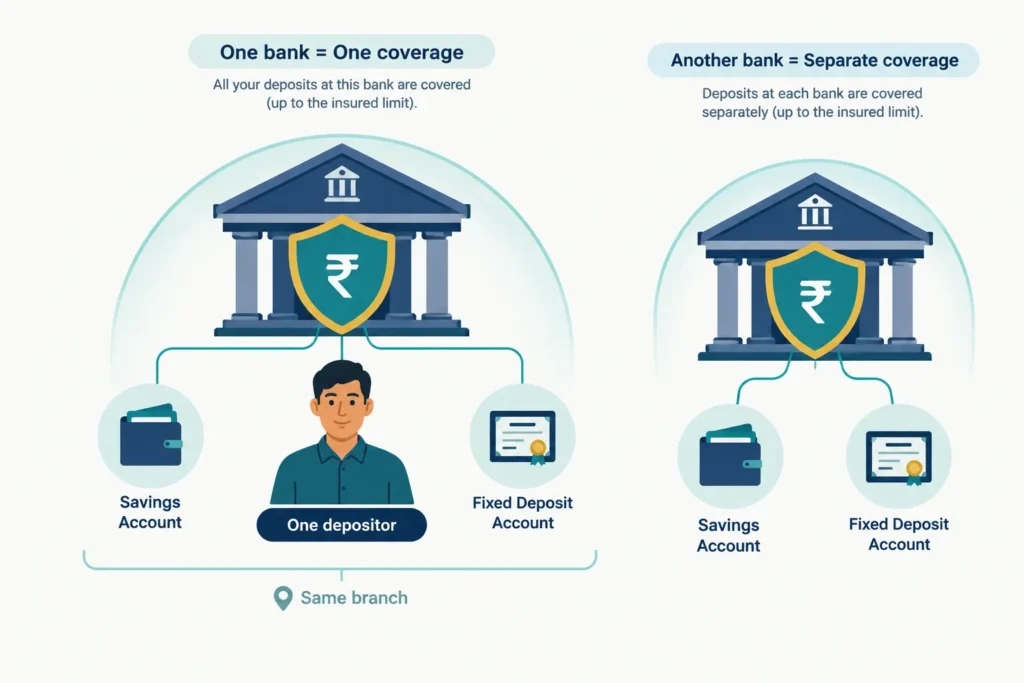
Eligible bank deposits in India are insured by the Deposit Insurance and Credit Guarantee Corporation, commonly called DICGC. This protection becomes relevant if an insured bank fails or is placed under certain regulatory restrictions.
The insurance cover has a defined limit. At present, eligible deposits are generally covered up to ₹5 lakh per depositor per bank. This limit includes both principal and interest and applies to deposits held in the same right and capacity.
For example, suppose you have ₹3.5 lakh in a savings account and ₹2 lakh in a fixed deposit with the same bank. These balances are generally added together for insurance purposes. Your total deposit is ₹5.5 lakh, but the applicable insurance cover would be limited to the prevailing maximum.
Opening accounts at two branches of the same bank does not create two separate insurance limits. Deposits across branches of that bank are normally combined. However, eligible deposits held with different insured banks may receive separate cover.
The treatment of individual, joint, business, trust and other accounts can depend on ownership and capacity. Not every financial product or institution is covered in the same way. Mutual funds, shares and money kept with an unregulated entity are not bank deposits merely because they are described as savings products.
Before relying on deposit insurance, verify the latest coverage limit, the bank’s insured status, eligibility rules and payment conditions using current official DICGC and Reserve Bank of India information. Rules can change, and the timing or process of a payout may depend on the circumstances affecting the bank.
If you hold a large amount of cash, deposit insurance is one reason to avoid keeping all of it with a single bank without reviewing the risk. You may consider spreading eligible deposits across suitable insured banks, while also accounting for convenience, service quality and the difficulty of managing multiple accounts.
Tax on Savings Account Interest
Interest earned from a savings account is generally taxable. It is usually reported under “Income from Other Sources” in your income-tax return. The amount may be taxable even if the bank does not deduct tax before crediting it.
Check the interest certificate, annual account statement or interest summary provided by your bank. Add interest earned across all savings accounts instead of reporting only the account you use most often. You should also compare the amount with the information available in your tax records, where applicable.
Eligible taxpayers may be able to claim a deduction on savings account interest under Section 80TTA. Under rules commonly applicable to the old tax regime, eligible individuals below the senior-citizen category and Hindu Undivided Families may claim a deduction of up to the specified limit, currently ₹10,000, subject to conditions.
Eligible senior citizens may instead qualify for a broader deduction on certain deposit interest under Section 80TTB, currently subject to a ₹50,000 limit and applicable conditions. The scope is different from Section 80TTA, so the two should not be treated as interchangeable.
These deductions reduce eligible taxable interest; they do not make every interest credit tax-free. Their availability can also depend on the tax regime selected. Deductions such as Sections 80TTA and 80TTB are generally associated with the old tax regime and may not be available under the new regime.
Income-tax provisions, limits, tax regimes and eligibility rules can change. Verify the rules for the relevant financial year and assessment year from current official income-tax information before filing. Seek professional advice if you have several accounts, foreign income, business income or uncertainty about the correct treatment.
Common Savings Account Mistakes
- Ignoring account fees: Debit card charges, SMS fees, cash transaction charges and penalties can reduce the value of interest earned. Read the latest schedule of charges instead of assuming that every service is free.
- Missing minimum-balance rules: Some accounts require an average monthly or quarterly balance. The required amount and calculation method can vary by bank, account type and location. If maintaining it is difficult, consider an eligible zero-balance or basic account rather than repeatedly paying penalties.
- Keeping excessive idle cash: A savings account is suitable for near-term expenses and emergency funds, but large sums left unused for years may earn modest returns. After retaining enough accessible money, consider whether suitable deposits or investments match your goals, risk tolerance and time horizon.
- Choosing only by the advertised rate: A high headline rate may apply only to a particular balance slab. Review the rate applicable to your actual balance, along with fees, service quality, branch access, digital security and deposit insurance.
- Trusting fraudulent messages: Banks do not need your OTP, UPI PIN, card PIN or internet-banking password to credit interest or complete routine verification. Do not install unknown screen-sharing apps or click links sent by unsolicited callers. Contact the bank through its verified app, website or official customer-care channel.
- Leaving unnecessary accounts open: Multiple unused accounts are difficult to monitor and may attract charges or become inactive. Close accounts you no longer need after moving standing instructions, collecting records and confirming that no payment is pending.
- Ignoring nominations: A nomination can simplify the claim process after the account holder’s death. Review nomination details after marriage, divorce, a death in the family or another major life event.
Practical Savings Account Review Checklist
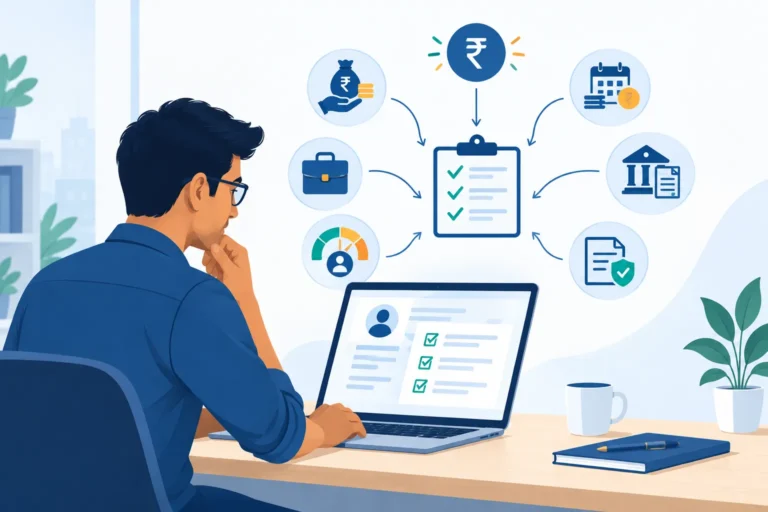
Review your main account at least once a year and whenever the bank changes its terms. Use this checklist:
- Confirm the account type and minimum-balance requirement.
- Check the interest rate and the balance slabs to which it applies.
- Review debit card, SMS, cash transaction and non-maintenance charges.
- Estimate how much money you need for monthly spending and emergencies.
- Assess whether excess cash should remain liquid or move to a suitable alternative.
- Check whether an auto-sweep facility is available and understand its rules.
- Verify your mobile number, email address, address, PAN and KYC status.
- Review the nominee and joint-holder instructions.
- Enable transaction alerts and use a strong, unique banking password.
- Check statements for unfamiliar transactions and report problems promptly.
- Add interest from all accounts when preparing your income-tax return.
- Compare your total deposits in each bank with the prevailing insurance limit.
- Close or consolidate accounts that no longer serve a clear purpose.
Frequently Asked Questions
How is savings account interest calculated?
Banks generally calculate interest on the daily closing balance and credit it at intervals set by the bank, such as monthly or quarterly. If the bank uses balance-based rate slabs, different portions of your balance may earn different rates. Check the bank’s latest interest-rate table and calculation method.
Do all savings accounts require a minimum balance?
No. Some regular savings accounts require an average balance, while eligible basic savings bank deposit accounts, salary accounts and certain digital accounts may have no minimum-balance requirement. Conditions and service limits vary, so confirm the exact account rules.
Is savings account interest tax-free?
Not automatically. Savings interest is generally included in taxable income. Eligible taxpayers may claim a deduction within the applicable limit under the relevant section and tax regime. Report the full interest correctly before claiming any eligible deduction.
What is an auto-sweep facility?
An auto-sweep facility transfers money above a chosen savings-account threshold into a linked deposit. When the savings balance is insufficient, part of the deposit may be broken or swept back. It can improve returns on idle cash, but you should check deposit rates, premature withdrawal rules, tax treatment and how withdrawals affect interest.
How should I select a savings account?
Compare the effective interest rate for your normal balance, minimum-balance rules, total fees, ATM and branch access, app reliability, customer support, security controls and deposit protection. The best account is one that suits your usage, not necessarily the one with the highest advertised rate.
Is each savings account insured up to the limit?
The limit generally applies per depositor per insured bank in the same right and capacity, not separately to every account or branch. Savings, current and eligible term deposits with the same bank may be combined. Joint or differently held accounts can involve additional rules, so verify the latest official DICGC guidance.
Summary
To maximise savings account benefits, look beyond interest. Keep enough accessible cash for bills and emergencies, avoid unnecessary charges, follow balance rules and review whether excess money is sitting idle. Use auto-sweep only after understanding how it works.
Report savings interest correctly and claim only deductions for which you are eligible under the applicable tax regime. Finally, protect your account by checking deposit insurance, maintaining nomination details, monitoring transactions and never sharing passwords, PINs or OTPs. A short annual review can keep your savings account safe, economical and useful.
Comments