


Stock market investing in India means buying ownership in listed companies with the aim of building wealth or earning income over time. Investors usually buy and sell shares through exchanges such as the National Stock Exchange of India and BSE Limited. To participate, you generally need a demat account, a trading account and a bank account.
Share prices can rise or fall based on company performance, economic conditions, investor expectations and many other factors. Dividends are also not compulsory. Therefore, stock market returns are never guaranteed, and investors can lose part or all of the money invested in a particular share.
Introduction
The stock market can appear complicated to a beginner. Financial news uses terms such as Sensex, Nifty 50, market capitalisation, bull market and equity. Trading apps may also make buying a share look as simple as placing an online shopping order.
However, buying a share is not the same as buying an ordinary product. A share represents ownership in a business, and its value depends partly on how that business performs and what other investors are willing to pay for it.
This beginner’s guide starts with the basic structure of the Indian market. Understanding the participants, accounts and common terms can help you make more informed decisions before putting your money at risk.
Section 1: Understanding the Indian Stock Market
What Does Stock Market Investing Mean?
A company may divide its ownership into small units called shares. When you purchase a share, you become a part-owner, or shareholder, of that company. The size of your ownership depends on the number of shares you hold relative to the company’s total shares.
The words share and stock are often used in a similar way. Equity also refers to ownership in a company. For example, if you buy shares of an Indian listed company, you have made an equity investment in that business.
People invest in shares mainly for two possible sources of return:
- Capital appreciation: The share price may increase, allowing the investor to sell at a higher price than the purchase price.
- Dividend income: A profitable company may distribute part of its earnings to shareholders as dividends.
Neither source is certain. A share price can fall below the purchase price. A company can also reduce, skip or stop dividends. Even a well-known company can face competition, weak demand, poor management, regulatory problems or an economic slowdown.
Stock market investing is generally more suitable for financial goals that are several years away. Money needed soon for rent, school fees, medical expenses or emergencies should not depend on uncertain short-term market returns.
Who Participates in the Market?
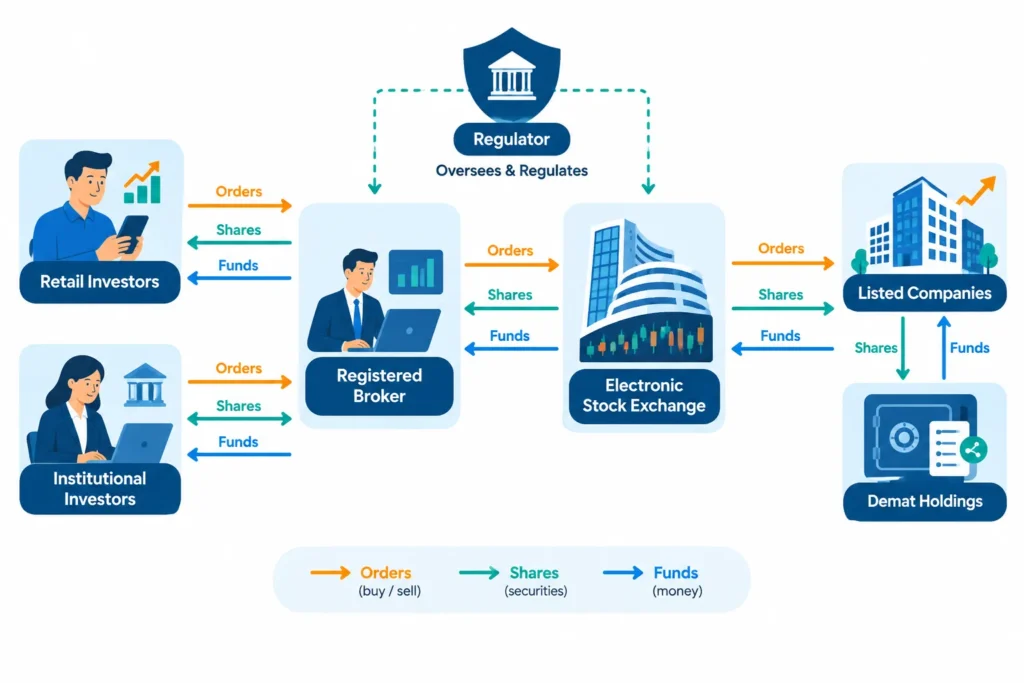
The Indian stock market connects several types of participants. Each has a different role.
- Listed companies: These are companies whose shares are admitted for trading on a recognised stock exchange. They must follow applicable disclosure and listing requirements.
- Retail investors: These are individuals investing their personal money. A salaried employee buying a few shares through an app is a retail investor.
- Institutional investors: These include entities such as mutual funds, insurance companies, pension-related funds and foreign portfolio investors. They may manage large pools of money.
- Stock exchanges: Exchanges provide an organised electronic marketplace where eligible securities can be bought and sold.
- Stockbrokers: Brokers act as registered intermediaries that give investors access to the exchanges.
- Regulators: Regulators create and enforce rules intended to support fair markets and protect investor interests.
Buyers and sellers do not normally negotiate directly with one another. Their orders are sent through brokers to an exchange’s electronic system. When compatible buy and sell orders meet, a trade can take place.
What Are NSE and BSE?
India has recognised stock exchanges, of which the National Stock Exchange of India, commonly called NSE, and BSE Limited, commonly called BSE, are the best known.
Both exchanges provide systems for trading listed securities. They display market prices, match orders and support the trading process under the applicable regulatory framework. Many major Indian companies have shares available on both NSE and BSE, although the trading price may show a small difference at a particular moment because orders and demand can differ between the two exchanges.
An exchange does not promise that a listed share is a good investment. Listing means the security can be traded subject to the exchange’s rules; it does not remove business or price risk.
What Does SEBI Do?
The Securities and Exchange Board of India, or SEBI, is the main regulator of India’s securities market. Its responsibilities include regulating market intermediaries, setting rules, monitoring market conduct and taking action in cases involving violations.
SEBI also establishes disclosure and compliance requirements for different market participants. These measures aim to improve transparency and protect investors, but regulation cannot prevent every loss or guarantee that a company will perform well.
Beginners should deal only with appropriately registered intermediaries and should be cautious about unverified tips, promises of fixed stock market returns and pressure to transfer money to personal accounts.
Demat Account, Trading Account and Broker
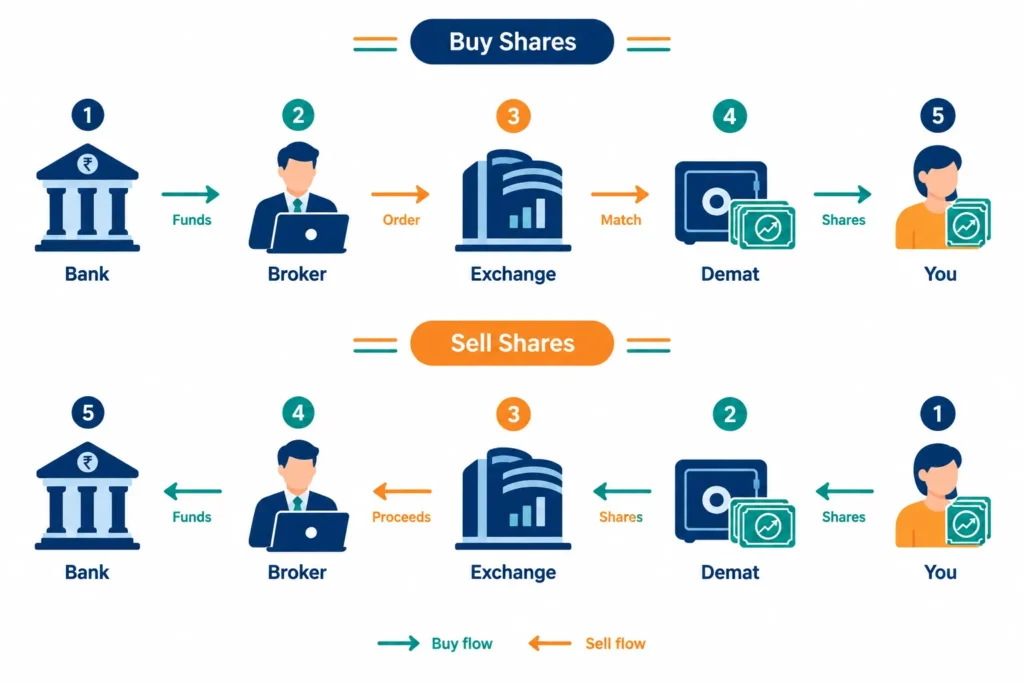
Three elements are central to buying listed shares in India:
- Demat account: This holds eligible securities in electronic form. It is similar to a digital holding account for shares, although it is not a bank account.
- Trading account: This is used to place buy and sell orders in the market.
- Stockbroker: The broker provides the platform and exchange access required to place those orders.
A bank account is generally linked for transferring money. When you buy shares, funds are used to complete the transaction and the shares are credited through the market settlement process. When you sell, the shares are delivered and the sale proceeds are credited according to the applicable process.
Many service providers combine demat and trading facilities in one app or website. Convenience should not be the only selection factor. Investors should understand brokerage, account charges, transaction-related costs, customer support and the broker’s regulatory status.
Essential Stock Market Terms
Market capitalisation: This is the total market value of a company’s outstanding shares. It is broadly calculated by multiplying the current share price by the total number of outstanding shares. Companies are often described as large-cap, mid-cap or small-cap based on market capitalisation. Smaller companies may offer growth potential, but they can also carry higher business, liquidity and price risks.
Dividend: A dividend is a distribution that a company may make to shareholders from its profits or reserves, subject to applicable decisions and rules. For example, an established Indian company may choose to pay shareholders a cash dividend. It may also retain the money to expand the business. Investors should not assume that past dividends will continue.
Index: A stock market index tracks a selected group of shares using a defined method. The Nifty 50 is associated with NSE, while the Sensex is associated with BSE. When news reports say that “the market rose,” they often mean that a major index increased. An index represents a basket of selected companies, not every listed share.
Bull market: This term describes a period of broadly rising prices and positive investor sentiment. Optimism can encourage more buying, but prices do not rise forever.
Bear market: This describes a period of broadly falling prices and weak sentiment. Investors may become cautious because of poor earnings expectations, economic concerns or other risks. Not every one-day fall is a bear market.
Investing vs Trading
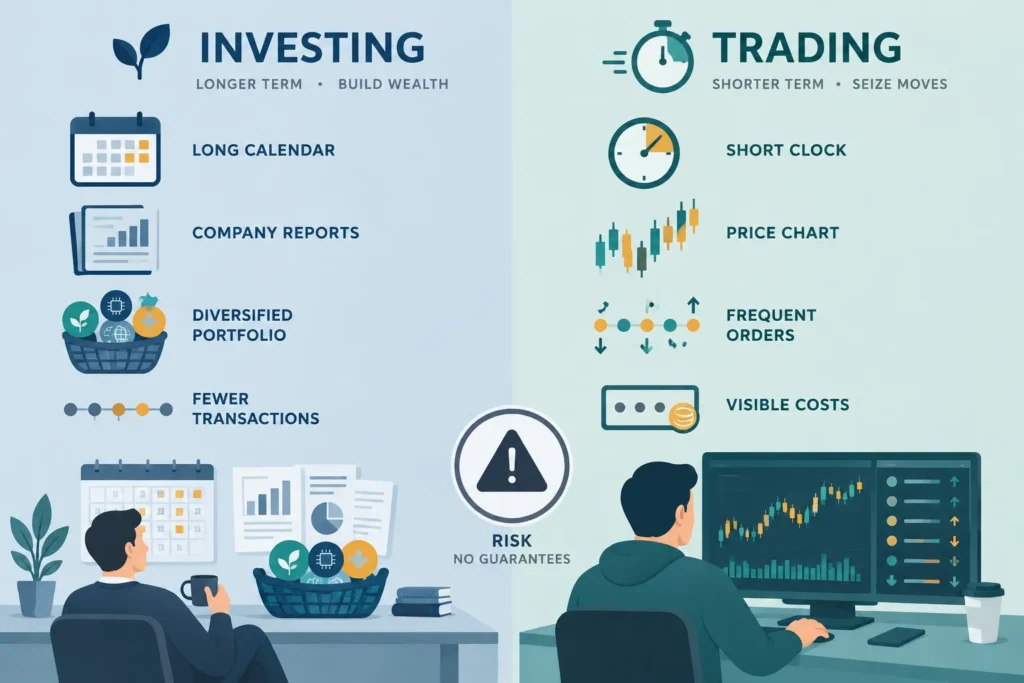
Investing and trading both involve market risk, but their objectives and methods are different. The distinction is important because a person may accidentally take trading-level risks while believing they are investing.
| Factor | Investing | Trading |
|---|---|---|
| Primary objective | Build wealth or earn income over the long term | Seek gains from shorter-term price movements |
| Typical time horizon | Usually several years | May range from within a day to weeks or months |
| Decision-making | Often focuses on business quality, financial position, valuation and long-term prospects | Often focuses on price trends, market activity, news and short-term setups |
| Activity and costs | Usually involves fewer transactions, though costs still apply | Frequent transactions can create higher brokerage, taxes and other charges |
| Main risks | Business failure, overvaluation and long periods of weak returns | Rapid price changes, poor timing, leverage and repeated transaction losses |
Investing is not automatically safe, and trading is not an assured shortcut to income. A long holding period cannot rescue every poor company, while frequent trading can magnify mistakes and costs. Neither approach guarantees profit. Beginners should choose an approach that matches their goals, knowledge, available time and ability to handle losses.
How to Start Investing and Choose Investments
Stock market investing in India becomes easier when you follow a clear process. Before choosing a stock or downloading a trading app, check whether your finances are ready for market risk.
Check Your Financial Readiness
Money invested in shares can rise or fall in value. Therefore, avoid investing funds that you may need for rent, school fees, medical expenses or loan repayments.
Before you begin, consider these basic steps:
- Build an emergency fund: Keep enough accessible money for unexpected expenses. The right amount depends on your income stability, family responsibilities and monthly costs.
- Manage expensive debt: Credit card balances and other high-interest loans can cost more than uncertain investment returns.
- Buy suitable insurance: Health insurance and, where needed, term life insurance can protect your financial plan from major shocks.
- Define your goal: Decide whether you are investing for retirement, a house, education or long-term wealth creation.
- Set a time horizon: Equity investments are generally more suitable for long-term goals because prices can be volatile over shorter periods.
- Understand your risk tolerance: Ask how you would react if your investment temporarily fell by 20% or more. Do not select a risky portfolio only because recent returns look attractive.
Beginners can start with an amount that is small enough to manage calmly. There is no benefit in investing so much that every market fall causes panic.
Choose a SEBI-Registered Intermediary
To buy and sell listed shares, you generally need a stockbroker. Choose an intermediary registered with the Securities and Exchange Board of India, or SEBI. You should verify the broker’s registration and current status through official regulatory or exchange sources before opening an account.
Do not choose a broker only because its app looks attractive. Compare factors such as:
- Brokerage and other charges
- App and website reliability
- Customer support
- Availability of investment products
- Research tools and educational material
- Ease of adding and withdrawing funds
- Security features and account alerts
- Policy for inactive accounts and account closure
Some brokers focus on low-cost, self-directed investing. Others offer research reports, relationship managers or advisory services at a higher cost. A detailed comparison of trading apps can help you evaluate these differences, but cost should not be the only deciding factor.
Understand Demat and Trading Accounts
A demat account holds securities in electronic form. A trading account allows you to place buy and sell orders through a broker. Your bank account is used to transfer money and receive withdrawals.
In simple terms, the trading account is used for transactions, while the demat account stores the securities you own. Brokers often help applicants open both accounts together.
Account opening normally involves identity verification, submission of required documents, acceptance of agreements and completion of the Know Your Customer process. Depending on the intermediary and applicable rules, you may be asked for documents or details such as PAN, address proof, bank information, photograph, signature and income evidence for certain market segments.
KYC processes, nomination rules, document requirements and account-opening procedures can change. These regulatory details should be checked against current SEBI, exchange, depository and broker instructions before publication or action. Never share passwords, PINs, one-time passwords or account access with anyone claiming to complete KYC on your behalf.
Review the Full Cost of Investing
Brokerage is only one part of the total cost. A transaction may also involve applicable taxes, exchange charges, regulatory charges, depository participant charges and GST. The exact amount can depend on the transaction type, broker and current rules.
Read the broker’s latest tariff sheet before opening an account. Check whether there are charges for account maintenance, call-and-trade services, payment delays, pledging securities, demat debit transactions or account closure.
Frequent buying and selling can make small charges add up. It may also create additional tax-record and reporting work. Keep contract notes, account statements and transaction records for reconciliation and tax filing.
Add Funds and Place a Basic Order
Once the account is active, you can transfer money from your linked bank account using the methods supported by the broker. Confirm that the payment is being made through the broker’s official platform and authorised account details.
To place a basic buy order, search for the company or security, confirm the correct exchange and symbol, enter the quantity, select the order type and review the details before submitting.
Two common order types are:
- Market order: The order seeks execution at the best available market price. The final price may differ from the price visible when you submit the order, especially in a fast-moving or thinly traded security.
- Limit order: You specify the maximum price you will pay when buying or the minimum price you will accept when selling. Execution is not guaranteed because the market may not reach your price.
After placing an order, check whether it is pending, partly executed, completed, rejected or cancelled. Do not assume that tapping the buy or sell button means the transaction has been completed.
Before selling, verify the security, quantity and order type. Your broker or depository may require an additional authorisation step. Avoid using leverage, intraday products, derivatives or unfamiliar advanced order types until you understand their risks and costs.
Choose the Type of Investment
Beginners do not have to start by selecting individual companies. Different investment products require different levels of research and involvement.
| Investment | How it works | Key beginner consideration |
|---|---|---|
| Individual stocks | You directly own shares in selected companies. | Requires company research and careful diversification. |
| Index funds | A mutual fund aims to track a chosen market index. | Offers broad exposure without selecting every company yourself. |
| Active mutual funds | A fund manager selects investments according to the scheme’s objective. | Review strategy, costs, risks and consistency rather than recent returns alone. |
| Exchange-traded funds | An ETF usually tracks an index or asset basket and trades on an exchange. | Requires a trading and demat account; market price and trading liquidity matter. |
Individual shares give you control over what you own, but they also create concentration risk. If most of your money is in one company or one industry, a single adverse event can seriously affect the portfolio.
Index funds follow a passive approach. Instead of trying to identify winning companies, they aim to mirror a specified index, subject to costs and tracking differences. Active mutual funds rely on the fund manager’s decisions. ETFs trade during market hours like shares, while ordinary mutual fund transactions are generally processed according to the applicable net asset value rules.
Diversification does not prevent losses, but it reduces dependence on one company or sector. A detailed investment comparison can help beginners examine cost, convenience, diversification and research effort before choosing among stocks, funds and ETFs.
How to Research an Individual Company
Buying a share means buying a small ownership interest in a business. A low share price does not automatically make a company cheap, and a well-known brand does not automatically make it a good investment.
Start your stock research with the following questions:
- Business model: What does the company sell, who are its customers and why do they choose it?
- Revenue: Are sales growing, declining or fluctuating? Identify whether growth comes from the core business or a temporary event.
- Profit: Is the company consistently profitable? Check whether profit growth is supported by normal operations.
- Cash flow: Is the business generating cash, or does reported profit remain tied up in receivables and inventory?
- Debt: Can the company comfortably meet interest and repayment obligations? Debt risk differs across industries, so comparisons should be relevant.
- Valuation: How much are investors paying relative to earnings, sales, assets or cash flow? Valuation ratios should be compared with the company’s history, growth prospects and suitable peers.
- Management quality: Look for clear communication, sensible capital allocation, fair treatment of shareholders and a credible governance record.
- Industry risks: Consider competition, regulation, technology changes, commodity prices, economic cycles and dependence on a few customers or suppliers.
Useful sources include annual reports, quarterly results, investor presentations, exchange filings and auditor comments. Avoid relying entirely on social media tips or short videos. A structured stock research guide can explain how to read these documents and compare companies step by step.
Fundamental Analysis Versus Technical Analysis
Fundamental analysis studies the business and its financial position to estimate whether the security appears attractive at its current valuation. It is commonly used by long-term investors examining earnings, cash flow, debt, competitive strengths, management and industry conditions.
Its limitation is that estimates depend on assumptions. A business may face an unexpected regulation, new competitor, governance problem or economic slowdown. Even a strong company can produce poor investment returns if purchased at an excessive valuation.
Technical analysis studies price, trading volume and chart patterns. Traders may use it to identify trends, momentum and possible entry or exit levels. It focuses mainly on market behaviour rather than calculating the underlying value of a business.
Technical signals can fail, particularly during sudden news events or volatile markets. Different analysts may interpret the same chart differently, and past price patterns do not guarantee future results.
Beginners should first understand what they own, why they own it and what risks could prove their reasoning wrong. Whether you use fundamental analysis, technical analysis or neither, maintain diversification, review costs and avoid decisions based on tips, urgency or promised returns.
Section 3: Managing Risk, Costs and Next Steps
Stock market investing in India can help you build wealth over time, but returns are never guaranteed. Share prices may rise or fall because of business performance, economic conditions, interest rates, regulations and investor sentiment.
A beginner should focus first on controlling risk. The aim is not to avoid every loss. That is impossible. The aim is to prevent one poor decision from causing serious financial damage.
Diversify Your Investments
Diversification means spreading your money across different investments instead of depending on one company, sector or idea.
For example, investing your entire amount in one small technology company exposes you to company-specific and sector-specific risks. If you spread the amount across several suitable investments, the poor performance of one holding may have a smaller effect on the overall portfolio.
Diversification can include:
- Holding shares of companies from different sectors.
- Avoiding excessive exposure to your employer’s shares.
- Combining equity with suitable debt, deposits or other assets.
- Using a diversified mutual fund or index fund when selecting individual stocks feels difficult.
Diversification does not eliminate losses. During a broad market decline, many investments can fall together. However, it can reduce the damage caused by overdependence on one investment.
Use Sensible Position Sizes
Position size is the amount of money you put into one investment. A common beginner mistake is investing a large part of available savings in a “high-conviction” stock.
Before buying, consider how a major fall in that stock would affect your finances and peace of mind. If a 30% or 40% decline would force you to sell, affect essential expenses or keep you awake at night, the position may be too large for you.
Build positions gradually where appropriate. You do not have to invest all your money on one day. Your position sizes should reflect your income stability, financial goals, investment horizon and ability to accept losses.
Match Equity With Your Investment Horizon
Equity is generally more suitable for long-term goals because stock prices can be unpredictable over shorter periods. Money required soon for rent, school fees, a medical need or a house down payment should not depend on short-term market performance.
“Long term” does not mean ignoring an investment forever. You should periodically check whether the company or fund still fits your goal, risk level and original investment reasoning.
Your asset allocation also matters. A person saving for a distant retirement goal may be able to accept more equity risk than someone who needs the money in the near future. A guide on personal finance and goal-based planning can help you decide how investing fits within your wider financial plan.
Avoid Excessive Leverage
Leverage means taking a larger market position by using borrowed money or margin. It can increase gains, but it can also increase losses quickly. In some situations, you may have to add funds or close a position at an unfavourable price.
Beginners should be especially careful with margin trading, intraday leverage, futures and options. These products involve risks that are different from simply buying and holding shares. Do not use them until you understand their costs, settlement rules and possible losses.
Never invest emergency savings or money borrowed through a personal loan, credit card or another expensive source. Interest remains payable even if the investment falls.
Common Mistakes to Avoid
- Following unverified tips: Messages on social media, messaging groups and online videos may be misleading or designed to influence prices. Research independently and use reliable disclosures.
- Chasing supposed multibaggers: Claims that a stock will multiply quickly can create fear of missing out. High potential returns often come with high uncertainty and risk.
- Panic selling: Selling only because prices have fallen can lock in losses. First check whether the business fundamentals or your original reasoning have changed.
- Overtrading: Frequent buying and selling can increase costs, taxes and emotional mistakes. Activity is not the same as progress.
- Ignoring valuation: A strong company is not automatically a good investment at every price. Paying an excessive price may reduce future return potential.
- Investing without understanding: Do not buy a stock, fund or trading product if you cannot explain how it works and why it suits your goal.
- Using emergency or borrowed money: Market losses should not threaten essential expenses, loan repayments or financial security.
Keeping a simple investment journal can improve discipline. Record what you bought, why you bought it, the risks you identified and the conditions that would make you review or sell it. This makes it easier to learn from both good and bad decisions.
Understand Brokerage, Charges and Taxes
Your return is affected not only by price movements but also by transaction costs and taxes. Costs may vary by broker, product, exchange, order type and transaction value.
Depending on the transaction, you may encounter:
- Brokerage or subscription charges.
- Exchange transaction charges.
- Securities transaction tax and other applicable taxes.
- Regulatory or statutory charges.
- GST on eligible services and charges.
- Stamp duty.
- Demat account maintenance and depository participant charges.
- Charges related to pledging, margin facilities or certain order types.
Profits, dividends and losses may also have income-tax consequences. The treatment can depend on factors such as the investment type, holding period, transaction classification and your individual circumstances.
Rates and rules can change. Before investing or publishing specific figures, verify the latest information through official SEBI, NSE, BSE and Income Tax Department material. Check your broker’s current tariff sheet and contract notes as well. Consider consulting a qualified tax professional when your transactions or circumstances are complex.
A Practical Beginner Checklist
- Set a clear goal: Decide whether you are investing for retirement, education, a future purchase or general long-term wealth creation.
- Build emergency savings: Keep money available for essential expenses and unexpected events before taking substantial market risk.
- Review expensive debt: High-interest debt may deserve attention before increasing equity investments.
- Understand the product: Learn how the stock, mutual fund, exchange-traded fund or other product earns returns and what can cause losses.
- Assess your risk capacity: Consider both your emotional comfort with volatility and your financial ability to absorb losses.
- Start with an affordable amount: Begin with money you can leave invested without affecting daily needs.
- Diversify sensibly: Avoid making one stock or one sector responsible for your entire outcome.
- Compare costs: Examine brokerage, account fees, transaction costs and taxes rather than choosing an app only for its interface.
- Keep records: Save contract notes, account statements, tax documents and your investment reasoning.
- Review periodically: Check progress against your goals and rebalance when necessary. Avoid reacting to every daily market movement.
Supporting guides on diversification, portfolio management and stock research can help you apply these steps. A comparison of trading apps should focus on regulation, security, service quality, product access and total costs. Investment comparison guides can also help you evaluate equity against deposits, debt products, mutual funds and other choices.
Frequently Asked Questions
Can I start investing with a small amount?
Yes. You can start with an amount that is affordable after essential expenses, emergency savings and debt obligations. The minimum practical amount depends on the price of the investment and the platform or product used. Starting small can help you learn without putting a large part of your savings at risk.
Can I lose all my money in the stock market?
Losses are possible. A company’s share price can fall sharply, and in an extreme case the investment may lose most or all of its value. Diversification and sensible position sizing can reduce concentration risk, but they cannot guarantee protection from loss.
Do I need a demat account?
A demat account is generally required to hold listed shares and many other securities electronically in India. You will also usually need a trading account to place buy and sell orders, along with a linked bank account. Complete know-your-customer requirements and choose a SEBI-registered intermediary after checking its fees and services.
Is long-term investing always profitable?
No. A longer holding period does not guarantee profit. Weak businesses can continue to perform poorly, and even good businesses can be bought at unreasonable valuations. Long-term investing is most effective when combined with diversification, research, suitable asset allocation and periodic review.
How often should I review my portfolio?
A periodic review, such as around major goal or financial-plan changes, is usually more useful than checking prices constantly. Review sooner if the investment’s fundamentals change, your goal moves closer or your financial situation changes significantly.
Summary and Cautious Next Steps
Successful stock market investing in India is not about finding quick tips or predicting every market move. It begins with clear goals, emergency savings, suitable diversification, controlled position sizes and a realistic time horizon.
Learn the investment before buying it, account for all costs and taxes, and avoid leverage or borrowed money when you do not fully understand the downside. Start with an affordable amount, maintain records and review decisions periodically rather than reacting emotionally.
Your next step can be to strengthen your overall personal finance plan and then study diversification, portfolio management and stock research in greater depth. Compare trading apps and investment alternatives carefully, verify current rules through official sources, and increase your investment amount only as your knowledge, financial capacity and confidence improve.




Comments