


Crypto trading vs investing mainly differs in time horizon, activity and decision-making. Traders try to benefit from short-term price movements, sometimes holding a cryptocurrency for minutes, days or weeks. Long-term investors usually buy with the intention of holding for months or years based on their view of a crypto asset’s future usefulness or adoption.
Neither approach is safe or certain. Cryptocurrency prices can move sharply, projects can fail, exchanges can face problems, and investors may lose a substantial part or all of their money. Holding crypto for longer does not remove these risks.
Introduction
A beginner may see crypto trading and long-term investing as two ways to achieve the same goal. In practice, they involve different habits, research methods, costs and risks.
A trader usually watches prices closely and makes frequent buy or sell decisions. An investor generally trades less often and focuses more on whether a crypto asset might remain useful over time. However, the line is not always perfect. Someone may hold part of a portfolio for several years while trading another small portion.
Before choosing either approach, understand that crypto is a high-risk asset class. It does not offer fixed returns, and past price increases do not guarantee future performance. Indian users must also consider transaction charges, taxes, record-keeping, platform risk and how they will store their crypto assets.
Beginners who are still learning the basics can first read the broader Cryptocurrency in India guide. A separate beginner’s guide to investing in cryptocurrency can help with buying and research, while a cryptocurrency risks guide can explain threats such as scams, hacking, extreme volatility and loss of access.
Crypto Trading vs Investing—Meaning and Core Differences
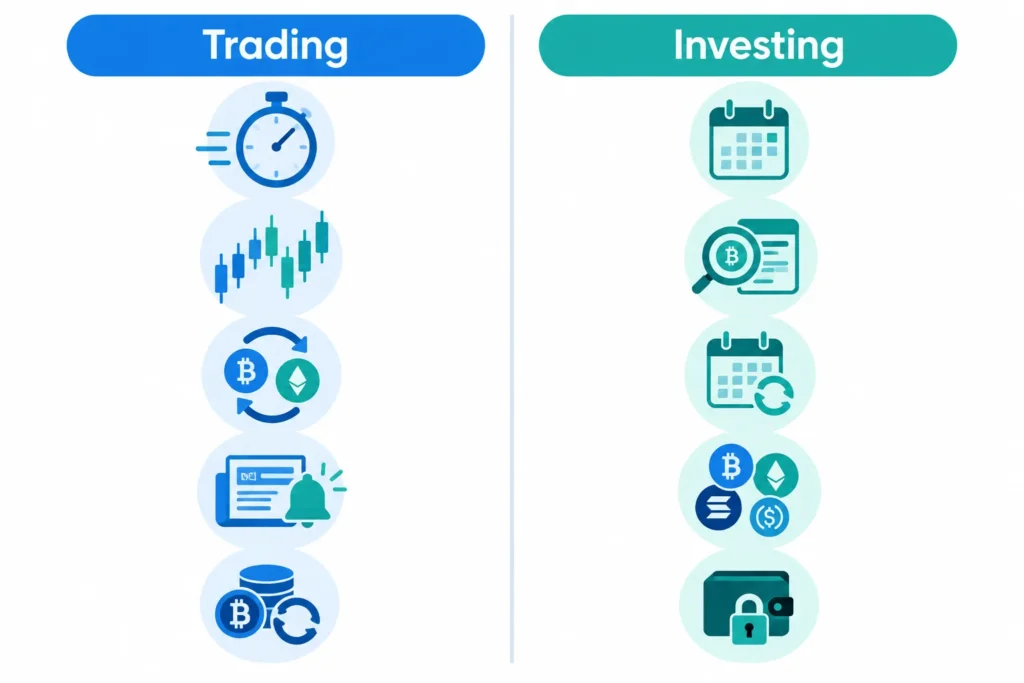
Crypto trading is an active approach focused mainly on shorter-term price changes. Long-term crypto investing is a less frequent approach based on the belief that an asset may gain value or remain relevant over an extended period.
The following comparison shows the main differences. These are general patterns, not strict rules.
| Factor | Crypto trading | Long-term crypto investing |
|---|---|---|
| Typical time horizon | Minutes, hours, days or weeks | Months or years |
| Main focus | Short-term price movements | Long-term usefulness, adoption and project strength |
| Activity level | Frequent monitoring and transactions | Usually fewer transactions and periodic reviews |
| Common research | Price charts, volume, market momentum and news | Technology, use case, token design, development and competition |
| Costs | Costs can accumulate because of frequent orders | Fewer trades may mean fewer transaction charges, but custody and withdrawal costs may apply |
| Key behavioural risk | Overtrading, panic decisions and excessive leverage | Becoming emotionally attached to a weak project or refusing to reassess it |
| Loss potential | Substantial or total loss, especially with leverage | Substantial or total loss if the asset collapses, fails or becomes inaccessible |
What Is Crypto Trading?
Crypto trading means buying and selling cryptocurrencies with the aim of benefiting from relatively short-term price movements. For example, a trader may buy Bitcoin after observing rising market activity and sell it later the same day. Another trader may hold Ether for two weeks based on an expected market trend.
Trading does not guarantee profit simply because it is active. Crypto markets can change direction suddenly. Prices may react to regulatory news, security incidents, large transactions, social media rumours or movements in global financial markets.
Short-Term, Day and Swing Trading
Short-term trading is a broad term for positions held for a relatively limited period. It can include trades lasting a few minutes as well as positions held for several weeks.
Day trading generally involves opening and closing positions within the same day. A day trader may make several decisions based on charts and price fluctuations. This approach demands considerable attention and can lead to repeated charges and stressful decision-making.
Swing trading usually involves holding a position for several days or weeks to capture a larger price movement. Swing traders may use chart patterns, market trends and news events. They do not need to watch every price tick, but they still face the possibility of sharp overnight or weekend moves.
Market Orders, Volatility and Trading Costs
A market order instructs an exchange to buy or sell at the best available price. It may execute quickly, but the final price can differ from the price shown when the order was placed. This difference can be more noticeable when a coin has low liquidity or the market is moving rapidly.
Volatility creates trading opportunities, but it also increases risk. A coin that rises quickly can fall just as fast. During extreme movement, a trader may be unable to exit at the expected price.
Frequent transactions can create several costs. Depending on the platform and transaction, these may include:
- Trading fees charged for buy and sell orders.
- The difference between the quoted buying and selling prices.
- Price slippage while an order is being executed.
- Crypto withdrawal or blockchain network charges.
- Tax deductions and tax liabilities applicable under Indian rules.
A small profit before costs may become much smaller after these amounts are considered. Traders also need accurate records of transactions for tax reporting and personal performance tracking.
Time Commitment, Overtrading and Leverage
Active trading can require regular market monitoring, research and record-keeping. Crypto markets operate around the clock, but this does not mean a person should watch them continuously. Lack of sleep, stress and rushed decisions can damage judgement.
Overtrading occurs when someone makes too many trades without a clear and tested reason. Fear of missing out, an attempt to recover a loss or excitement after a successful trade can all encourage excessive activity. More trades do not automatically produce better results.
Leverage makes the risk more severe. It allows a trader to take a position larger than the amount of money committed. Although this can magnify gains, it also magnifies losses. A relatively small adverse price movement may close the position and wipe out the funds used for it. Beginners should not treat leverage as an easy way to increase returns.
What Is Long-Term Crypto Investing?
Long-term crypto investing means buying a crypto asset with the intention of holding it for an extended period. The investor may believe that the network will gain users, support useful applications or become more widely adopted.
The holding period alone does not make an action an investment. A sounder long-term approach requires a reason for owning the asset and a willingness to review that reason. Simply buying a coin because its price previously increased is not fundamental research.
Long-term research may include the project’s purpose, technology, security history, token supply, development activity, governance, competition and actual use. Investors should also ask who benefits from the token, how new tokens enter circulation and whether a small group controls a large share.
Concentration and Custody Decisions
Portfolio concentration matters because putting most savings into one coin ties the outcome to a single project. Even a widely known cryptocurrency can suffer a major fall. Smaller tokens may carry additional risks, including weak liquidity, limited adoption and manipulation.
Long-term holders must also decide where to keep their assets. Leaving crypto on an exchange may be convenient, but it creates dependence on that platform. Using a self-custody wallet gives the owner control of the private keys, but it also creates personal responsibility. Losing a recovery phrase, sending funds to the wrong address or falling for a phishing attack may result in an irreversible loss.
Long-Term Holding Does Not Make Crypto Safe
A longer time horizon can reduce the urge to react to every daily price change, but it cannot remove the underlying risks. A crypto project can lose users, suffer a technical failure, face regulatory restrictions or be replaced by better technology. A token may never return to its previous high.
Therefore, long-term investors can also lose a substantial amount or their entire investment. Money required for rent, medical needs, education, loan payments or an emergency fund should not depend on a volatile crypto asset recovering in the future.
Costs, Risk, Behaviour, Security and an Illustrative Example
The practical difference between crypto trading vs investing is not limited to how long you hold a coin. Each approach creates different demands on your time, research, costs, behaviour and security.
Neither approach offers predictable returns. A trader can lose money through repeated poor decisions and high costs. A long-term investor can also suffer a large loss if the chosen asset fails, the market remains weak or access to the asset is lost.
Research and Time Commitment
Crypto traders usually make frequent decisions. They may study price charts, trading volume, market news, order books and short-term momentum. Because crypto markets operate throughout the day and night, constant monitoring can become exhausting.
Long-term investors generally trade less often, but they still need proper research. They may examine a project’s purpose, token supply, governance, security history, developer activity and level of real-world adoption. They must also review whether the original reason for investing remains valid.
Holding for years is not the same as ignoring an investment. Crypto projects can change, lose relevance, suffer technical problems or be removed from an exchange.
Volatility and Risk Management
Crypto prices can rise or fall sharply within a short period. Traders face this volatility directly because they enter and exit positions more often. A sudden market move can turn an expected profit into a loss before the trader can react.
Long-term investors may avoid reacting to every daily movement, but they do not avoid volatility itself. They may have to tolerate deep and extended declines. Some crypto assets may never recover to their previous prices.
Basic risk controls can include:
- Limiting crypto to an amount that fits your overall financial situation.
- Deciding in advance how much loss you can accept.
- Avoiding excessive exposure to one coin, platform or strategy.
- Keeping emergency savings outside crypto.
- Reviewing whether a position still matches your goal and risk capacity.
Traders sometimes use stop-loss orders to exit when a price reaches a chosen level. However, an order may execute at a worse price during a rapid move or may not work as expected when liquidity is poor. A risk-management tool can reduce certain risks, but it cannot remove them.
Transaction Costs, Spreads and Withdrawals
Frequent activity can make trading more expensive. An exchange may charge a fee for every purchase and sale. A trader completing several transactions can therefore pay costs repeatedly, even if the individual fee appears small.
The quoted market price is not always the final price you receive. The difference between the best available buying and selling prices is called the spread. A wider spread increases the effective cost of entering and leaving a position.
Other possible costs include:
- Depositing or withdrawing rupees, depending on the platform and payment method.
- Withdrawing crypto from an exchange to a personal wallet.
- Blockchain network fees, which can change with network demand.
- Currency conversion when a trading pair is not directly available in rupees.
- Applicable taxes, deductions and compliance-related costs under current Indian rules.
A long-term investor may make fewer transactions, so recurring trading fees may be lower. However, the investor could still pay withdrawal and network fees when moving assets into or out of a wallet.
Before choosing a platform, beginners should understand its full fee schedule, supported withdrawal methods and custody arrangements. A broader beginner guide to crypto exchanges can help explain order types, liquidity and platform selection.
Liquidity Can Affect the Exit Price
Liquidity describes how easily an asset can be bought or sold without causing a major price change. Popular crypto assets often have more active markets than small or newly launched tokens, but liquidity can vary by exchange and trading pair.
Low liquidity may create wide spreads and price slippage. For example, the screen may show a token price of ₹100, but there may not be enough buyers at that price when you try to sell. Parts of the order could execute at lower prices.
This matters to both traders and investors. Traders need reliable entry and exit execution. Long-term investors may discover that a small token is difficult to sell precisely when market confidence is falling.
Emotional Discipline and Common Mistakes
Crypto markets can encourage rushed decisions. Fast price movements, online excitement and stories of sudden profits can make normal risk controls feel unnecessary.
Common mistakes include:
- FOMO buying: Purchasing after a sharp rise because of fear of missing out.
- Overtrading: Making frequent transactions without a clear plan, increasing both costs and mistakes.
- Panic selling: Exiting during a fall without checking whether the decision matches the original strategy.
- Following social-media tips: Acting on anonymous claims, influencer promotions or unverified screenshots.
- Using leverage: Borrowing exposure to increase the position size, which can magnify losses and trigger forced liquidation.
- Weak diversification: Placing most savings in one coin or in several tokens that behave similarly.
- Using essential money: Investing funds needed for rent, school fees, emergencies or near-term goals.
A written plan can reduce impulsive behaviour. It may state why you are buying, the maximum amount you will allocate, the conditions for selling and how often you will review the position. A plan does not ensure a profit, but it makes decisions easier to evaluate.
Illustrative Rupee Example: Trading Versus Holding
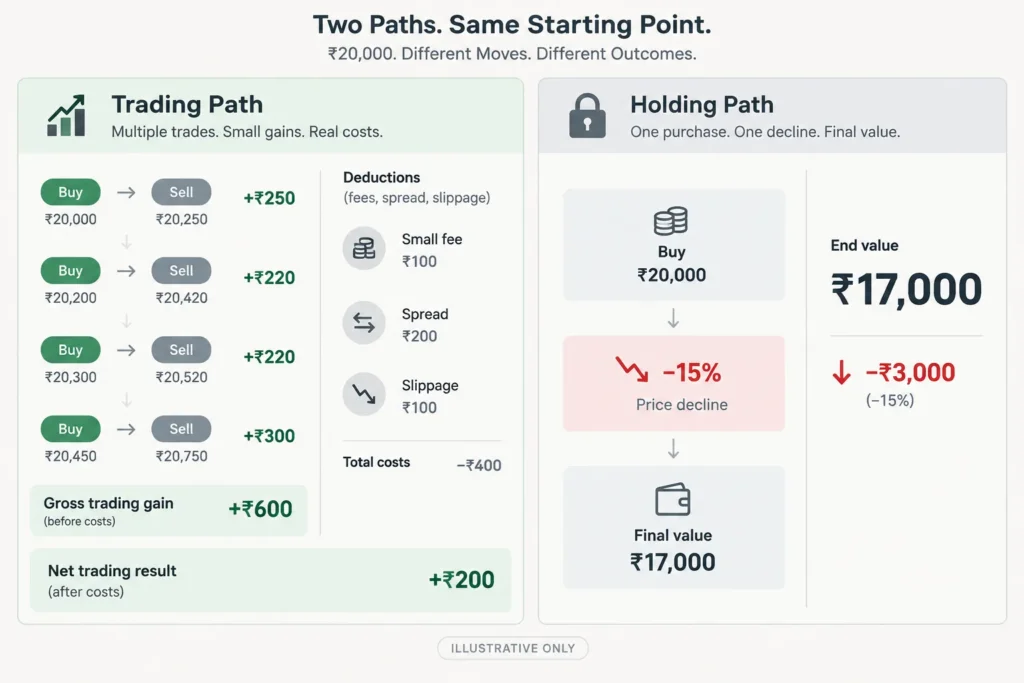
This example is illustrative only. It does not represent a real coin, forecast or recommendation. It shows how price changes and repeated costs can affect outcomes.
| Approach | Illustrative activity | Possible outcome before costs | Effect of costs |
|---|---|---|---|
| Frequent trading | ₹20,000 is used across several buy-and-sell trades during the period. | Some trades gain money, while others lose money. Assume the combined trading result is a ₹600 gain. | Multiple trading fees, spreads and any withdrawal charge could reduce or even remove the gain. |
| Long-term holding | ₹20,000 is used for one purchase and held over the same period. | If the asset value falls by 15%, the holding becomes worth about ₹17,000 before sale-related costs. | Fewer transactions may mean lower recurring fees, but the market loss remains. |
The trader in this example is not automatically better off merely because some trades were profitable. Costs apply repeatedly, and one large losing trade can outweigh several small gains. The investor pays fewer transaction costs but can still face a substantial fall in value.
The reverse is also possible. A trader may end with a loss after poor timing, while the held asset may rise over the period. There is no fixed outcome. The result depends on market movement, execution, costs, asset selection and behaviour.
Recordkeeping Matters
Every purchase, sale, swap, transfer and withdrawal can create records that may be needed later. Frequent traders may have hundreds of entries across multiple platforms, making reconciliation more difficult.
Keep copies of trade confirmations, rupee deposits, wallet transfers, fees and exchange statements. Record the date, asset, quantity, transaction value and platform. Do not assume an exchange will preserve every report permanently.
Indian tax and reporting rules for virtual digital assets can change. Check current official requirements or consult a qualified tax professional instead of relying on old social-media posts. Good records help even when you are uncertain about the final tax treatment.
Custody, Exchange Access and Wallet Security
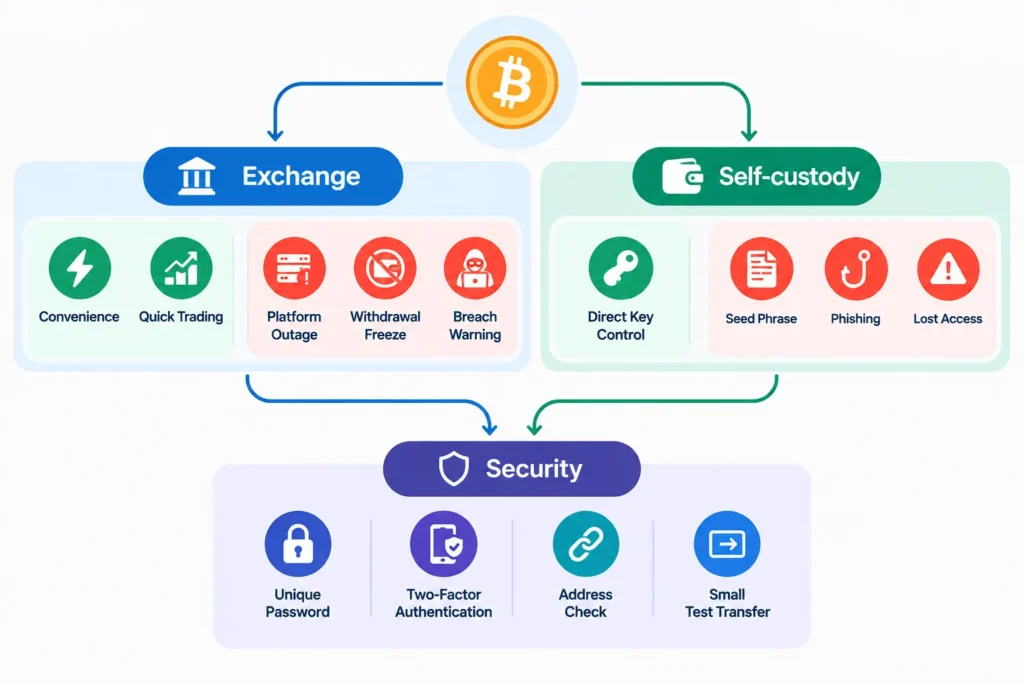
When crypto remains on an exchange, the platform generally controls the private keys. This is convenient for trading, but it creates platform risk. An exchange could suffer a security breach, freeze withdrawals, restrict an account, face operational trouble or fail.
A self-custody wallet gives the user direct control of the keys, but it also transfers responsibility to the user. Losing a seed phrase may mean permanently losing access. Sharing it can allow another person to take the assets. Beginners should first understand crypto wallets, private keys and recovery methods before moving funds.
Important security practices include:
- Download wallet and exchange apps only from verified sources.
- Use a unique password and enable strong two-factor authentication.
- Never share a seed phrase, private key or one-time password.
- Keep seed-phrase backups offline and away from photographs or cloud notes.
- Check wallet addresses carefully before confirming a transfer.
- Consider a small test transfer before moving a large amount.
Watch for phishing emails, fake customer-support accounts, copied websites and fraudulent apps. Scammers may promise guaranteed returns, ask for an advance payment to release profits or request remote access to your phone. Genuine support staff should not need your seed phrase.
Security risk applies whether you trade daily or invest for years. Traders may face more platform exposure because funds remain ready for transactions. Long-term investors may face storage and recovery risks over a longer period. Understanding broader cryptocurrency risks is therefore essential before choosing either approach.
Section 3: Indian Tax and Regulatory Considerations, Decision Framework and FAQs
Tax and regulatory rules in India can change
Indian crypto users need to consider tax, reporting and regulatory requirements before choosing between frequent trading and long-term investing. These rules may affect your costs, paperwork and final returns.
Crypto-related provisions in India can change through new laws, tax notifications, court decisions and regulatory directions. Exchange procedures can also change. Therefore, do not rely only on old articles, social media posts or screenshots of tax rules.
Before filing a tax return or making a major transaction, verify the latest position using current official government sources. A chartered accountant or qualified tax professional may be useful if you have frequent trades, overseas accounts, several wallets, large transfers or complicated transactions.
Important areas to verify include:
- How gains or income from crypto transactions are calculated and taxed.
- Whether tax must be withheld or deducted when a transaction takes place.
- How losses are treated and whether they can be adjusted or carried forward.
- Which disclosures are required in your income tax return.
- Whether transactions on foreign platforms create additional reporting duties.
- What identity checks and transaction information an exchange must collect.
- Whether any platform, token or crypto-related service is restricted under current rules.
Do not assume that holding a token for several years automatically gives it the same tax treatment as a traditional long-term capital asset. Similarly, do not assume that moving crypto between your own wallets is always irrelevant for reporting. The correct treatment depends on current rules and the facts of the transaction.
For a focused overview of this subject, read RegularStation’s guide to cryptocurrency tax in India. Check that it reflects the latest official provisions before using it for a tax decision.
Trading usually creates more records
Both investors and traders need accurate records. However, an active trader may have hundreds of transactions across different tokens and platforms. This can make calculation, verification and tax filing more difficult.
Keep records of every purchase, sale, swap and transfer. A token-to-token exchange should not be ignored merely because no rupees entered your bank account. It may still need to be reviewed for tax and reporting purposes.
Your records should ideally contain:
- The date and time of each transaction.
- The type and quantity of the crypto asset.
- The rupee value at the time of the transaction.
- The purchase price and sale value.
- Trading, network, withdrawal and deposit fees.
- The exchange, wallet or blockchain used.
- Transaction IDs and wallet addresses where relevant.
- Any tax withheld and the related statement or certificate.
- Transfers between wallets or exchange accounts owned by you.
- Bank statements, exchange reports and order confirmations.
Label movements between your own accounts clearly. Otherwise, a wallet transfer may later look like a sale, gift or unexplained receipt. Also save exchange statements regularly. You may lose access if an account is closed, a platform stops operating or its data retention policy changes.
Do not depend entirely on an exchange’s profit figure. It may not include transactions completed elsewhere, direct wallet transfers or the correct rupee value for every event. Reconcile exchange reports with wallet history and bank records.
A neutral decision framework
There is no single winner in crypto trading vs investing. The suitable approach depends on your time, knowledge, behaviour and financial capacity. Use the following questions before deciding.
| Factor | Questions to ask |
|---|---|
| Time | Can you monitor markets, orders, news and records regularly, or do you prefer occasional reviews? |
| Knowledge | Do you understand order types, liquidity, slippage, fees and risk controls, or only the basic idea of crypto? |
| Temperament | Can you follow a plan during sharp price moves without panic buying, revenge trading or chasing losses? |
| Security capability | Can you protect accounts, recovery phrases, devices and wallets without relying on unsafe shortcuts? |
| Loss tolerance | Can you afford a large or complete loss without affecting rent, loan payments, insurance or emergency savings? |
| Recordkeeping | Are you prepared to document every trade, fee, swap and wallet movement accurately? |
Frequent trading may appeal to someone who has time, market knowledge and strict risk controls. But more activity also means more decisions, more opportunities for error, higher cumulative costs and heavier recordkeeping.
Long-term investing may require fewer decisions, but it is not passive in every sense. An investor still needs to research the asset, review major developments, maintain secure custody and decide when the original reason for buying is no longer valid.
Beginners should also consider their wider finances. Emergency savings, essential insurance and expensive debt generally deserve attention before money is placed in highly volatile assets. Crypto should not be funded with rent money, borrowed money or cash needed for near-term goals.
You do not have to choose an extreme position. Some people avoid crypto entirely. Others use only a small amount they can afford to lose. If you participate, define your maximum allocation, security process and review schedule in advance rather than making decisions during market excitement.
Frequently Asked Questions
1. Is crypto trading safer than long-term investing?
Neither is automatically safer. Trading adds risks from frequent decisions, short-term volatility, fees and poor execution. Long-term investing reduces trading frequency but remains exposed to price falls, token failure, fraud, custody problems and regulatory change. Safety depends more on the asset, position size, security and risk controls than on the label.
2. What is the minimum capital needed to start?
Many platforms allow small purchases, but the platform minimum should not determine your budget. Start only with an amount you can afford to lose completely. Account for trading fees, withdrawal fees and network charges, which can have a larger effect on small transactions.
3. Does holding crypto for a long time remove the risk?
No. Time does not guarantee that a token will recover or increase in value. A project may lose users, face security failures, become illiquid or stop operating. Long holding can also increase custody risk if keys, recovery phrases and succession arrangements are poorly managed.
4. How do trading frequency and costs affect returns?
Every additional trade may involve platform fees, spreads, slippage, network charges and possible tax consequences. Small costs can accumulate when trading is frequent. Compare your return after all costs and taxes rather than focusing only on winning trades.
5. Should crypto be kept in a wallet or on an exchange?
An exchange may be convenient for active trading, but you depend on its security, withdrawals and operations. Self-custody gives you direct control but makes you responsible for keys, backups and safe transfers. The appropriate choice depends on your activity and ability to manage security. Neither method is risk-free.
6. What tax records should an Indian crypto user maintain?
Keep transaction dates, quantities, rupee values, purchase costs, sale proceeds, swaps, fees, withholding details and wallet transfers. Save bank statements, exchange reports and blockchain transaction IDs. Verify current Indian tax and disclosure rules with official sources and obtain professional advice when your activity is complex.
7. Should beginners use leverage for crypto trading?
Beginners should generally avoid leverage until they fully understand liquidation, margin requirements, funding costs and rapid losses. Leverage can turn a small price movement into a large loss, sometimes very quickly. It does not improve the quality of an investment or guarantee higher returns.
Summary
The choice between crypto trading vs investing should be based on time, knowledge, temperament, security ability, loss tolerance and willingness to maintain records. Trading involves more frequent decisions and costs, while long-term investing still carries market, project, custody and regulatory risks.
Indian users must also keep complete transaction records and verify the latest tax, withholding, loss, disclosure and exchange requirements. Neither approach guarantees profit. If you participate, use only money you can afford to lose, protect your accounts and wallets, and make decisions from a written plan rather than fear or excitement.


Comments