

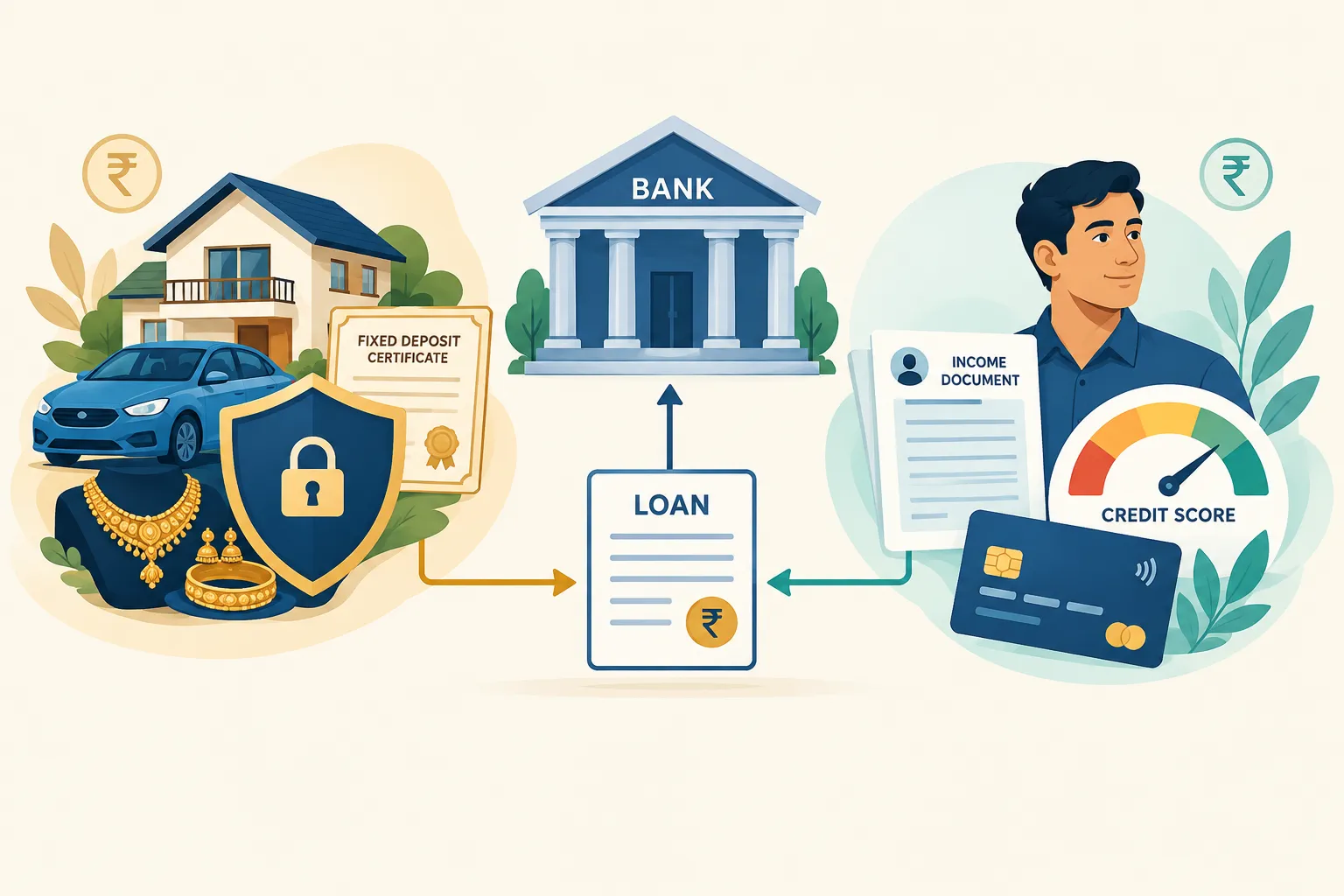
The main difference between secured and unsecured loans is collateral. A secured loan requires you to pledge an asset, such as a house, vehicle, gold or fixed deposit. If you do not repay the loan, the lender may take legal steps to recover its money from that asset.
An unsecured loan does not require a specific asset as collateral. Personal loans and most credit-card borrowing are common examples. Because the lender has no pledged asset to fall back on, approval usually depends more heavily on your income, credit history, existing debts and repayment capacity.
Secured loans may offer lower interest rates or higher borrowing limits, but they put the pledged asset at risk. Unsecured loans may be quicker and require less asset-related paperwork, but they can carry higher interest rates and stricter eligibility standards. In both cases, missed payments can lead to penalties, recovery action and damage to your credit profile.
Introduction
Loans can be classified in several ways: by purpose, repayment period, interest-rate structure or type of lender. However, one of the most important classifications is secured vs unsecured loans.
This distinction answers a basic question: has the borrower pledged an asset to secure the loan?
If an asset is pledged, the loan is generally secured. If no specific asset is pledged, the loan is generally unsecured. This difference affects the lender’s risk, the documents required, the amount you may be able to borrow and the consequences of default.
Understanding this classification can help you compare loan offers more sensibly. A low interest rate may look attractive, but you must also consider whether your house, vehicle, gold or another asset is being placed at risk. Similarly, a loan without collateral may seem convenient, but that does not make repayment optional or remove the consequences of default.
What Is a Secured Loan?
A secured loan is backed by an asset or financial security offered as collateral. The collateral gives the lender an additional way to recover its money if the borrower fails to repay according to the loan agreement.
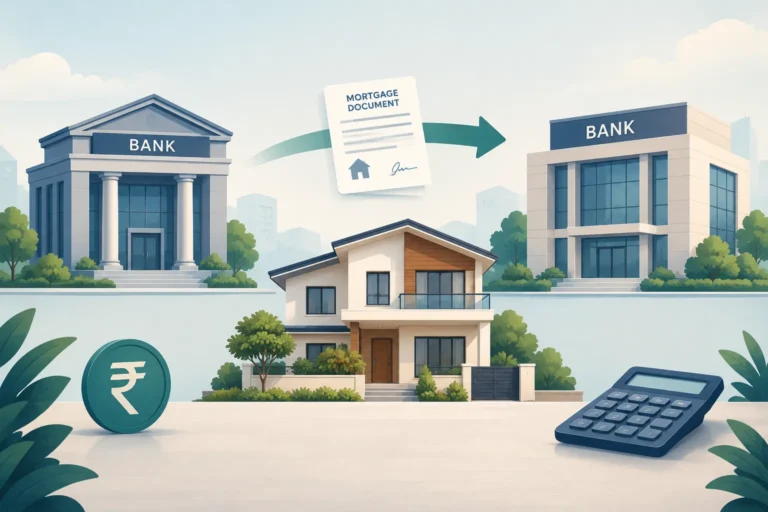
For example, suppose you take a home loan to buy a flat in Pune. The property is generally mortgaged to the lender. You can live in the home and use it, but the lender has a legal interest in the property until the loan is repaid and the charge is released.
If you stop paying the EMIs, the lender cannot usually take the home immediately without following the applicable agreement and legal recovery process. However, continued default can eventually put the property at risk.
What Does Collateral Mean?
Collateral is an asset or security that supports a loan. It reduces the lender’s risk because the asset may be used to recover unpaid dues if the borrower defaults.
Common forms of collateral in India include:
- Residential or commercial property: Often used for home loans and loans against property.
- Vehicles: The financed car, two-wheeler or commercial vehicle commonly secures the vehicle loan.
- Gold jewellery: Gold loans are generally issued against jewellery deposited with the lender.
- Fixed deposits: Banks may offer loans or overdraft facilities against fixed deposits.
- Investments or financial securities: Some lenders provide credit against eligible shares, mutual funds, insurance policies or other approved assets, subject to their rules.
The asset does not always need to be physically handed over. In a home loan, for instance, the borrower normally continues to occupy the property. The lender instead creates a mortgage or charge over it. In a gold loan, the pledged jewellery is usually held by the lender until the dues are cleared.
Common Examples of Secured Loans
Home loan: A home loan is generally secured by the property being purchased or constructed. Since the loan amount can be large and repayment may continue for many years, the lender assesses the property as well as the borrower’s income and repayment capacity.
Vehicle loan: A car or two-wheeler loan is commonly secured by the financed vehicle. The vehicle may be registered with the lender’s hypothecation noted in the relevant records until the loan is closed.
Gold loan: The borrower pledges eligible gold jewellery and receives a loan based partly on its assessed value and the lender’s policies. Failure to repay may result in the lender selling the pledged gold after following the required process and notices.
Collateral does not guarantee approval. A lender can still reject a secured-loan application because of insufficient income, weak repayment capacity, problems with the asset’s ownership documents, valuation concerns or other eligibility issues.
What Is an Unsecured Loan?
An unsecured loan does not require the borrower to pledge a specific asset as collateral. The lender mainly relies on the borrower’s promise and ability to repay.
Because there is no pledged asset supporting the loan, lenders usually examine the applicant’s financial profile carefully. This may include income, employment or business stability, credit score, credit-report history, current EMIs, age and recent loan applications.
Common Examples of Unsecured Borrowing
Personal loan: A personal loan is commonly offered without property, gold or a vehicle being pledged. It may be used for purposes such as medical expenses, a family event, travel, education-related costs or home repairs, subject to the lender’s terms.
Credit-card borrowing: Regular credit-card spending is generally unsecured. If you do not pay the full amount due, the unpaid balance may attract interest and charges according to the card’s terms. Cash withdrawals and EMI conversions may have separate costs.
Some consumer-durable loans, short-term digital loans and small business loans may also be unsecured. However, a product’s marketing name is not enough to determine its classification. The loan agreement should clearly show whether any asset, deposit, guarantee or other security supports the borrowing.
Unsecured Does Not Mean Risk-Free
The word “unsecured” describes the lender’s lack of specific collateral. It does not mean that the borrower is protected from consequences.
If you default on an unsecured loan or credit-card bill, the lender may charge late-payment fees, apply penal charges where permitted under the agreement, report missed payments to credit bureaus and begin recovery or legal action. A damaged credit profile can make future borrowing more difficult or expensive.
A lender may also seek recovery through lawful methods available under the agreement and applicable rules. The absence of collateral means there is no pre-identified asset to enforce against in the same way as a secured loan. It does not cancel the debt.
Secured vs Unsecured Loans: Key Differences
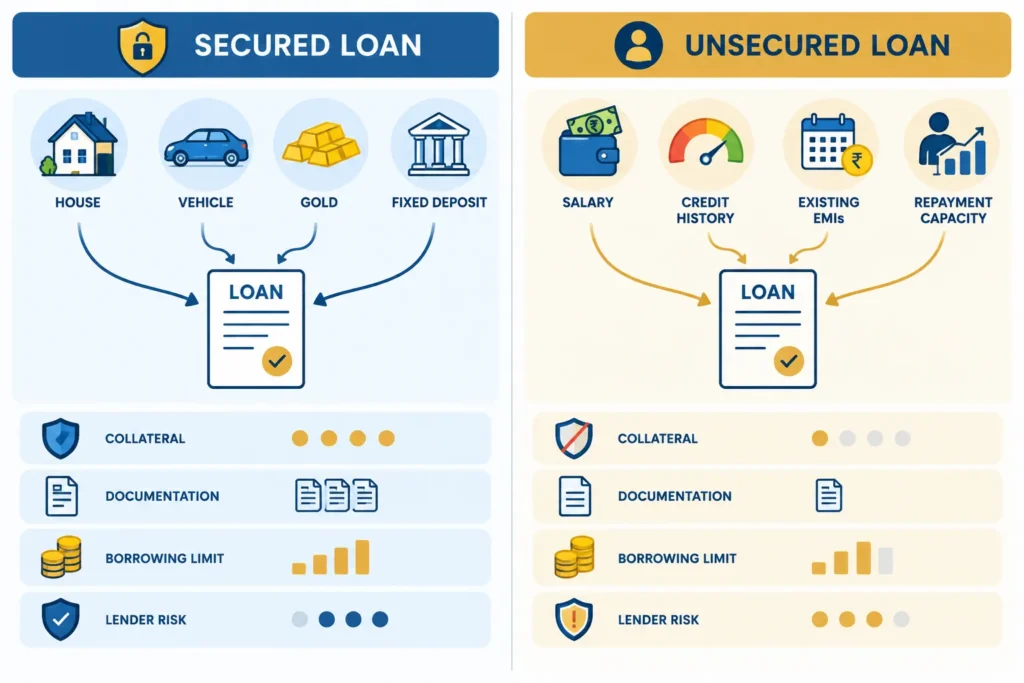
| Factor | Secured loan | Unsecured loan |
|---|---|---|
| Collateral | A house, vehicle, gold, deposit or another eligible asset is pledged. | No specific asset is normally pledged as security. |
| Interest-rate considerations | Rates may be lower because collateral reduces the lender’s risk. The actual rate still depends on the borrower, asset and loan terms. | Rates may be higher because the lender has no pledged asset to support recovery. |
| Eligibility | The lender assesses both the borrower’s repayment ability and the collateral’s ownership, value and acceptability. | Eligibility depends more heavily on income, credit history, existing obligations and financial stability. |
| Borrowing limits | Potential limits may be higher, but they are usually linked to the asset’s value and the borrower’s repayment capacity. | Limits are usually based mainly on income, credit profile and lender policy. |
| Approval factors | Approval may require valuation, legal checks, ownership documents and creation of a charge over the asset. | Approval can involve fewer asset-related checks, but financial and credit checks may be strict. |
| Default consequences | Along with credit damage, charges and recovery action, the pledged asset may be repossessed or sold after the applicable process. | Default may lead to charges, credit-report damage, collection efforts and legal recovery, even though no specific asset was pledged. |
These are broad differences rather than fixed rules. A secured loan is not automatically cheap, and an unsecured loan is not always processed instantly. Interest rates, processing fees, other charges, loan limits, documentation and approval standards vary across banks, non-banking financial companies and other regulated lenders.
They also vary from one borrower to another. Two people applying for the same type of loan may receive different offers because their incomes, credit histories, existing debts, employers, business profiles, loan amounts or repayment periods differ.
The simplest way to remember the distinction is this: a secured loan is tied to collateral, while an unsecured loan is primarily supported by the borrower’s creditworthiness and repayment capacity. Both create a legal repayment obligation, and both should be taken only after checking the total cost and whether the EMI fits comfortably within the household budget.
Benefits of Secured Loans
A secured loan is backed by an asset such as a house, vehicle, fixed deposit, gold or other acceptable property. The asset is called collateral. It gives the lender a way to recover unpaid dues if the borrower defaults and the required legal process is followed.
Potential access to a larger loan amount
Collateral can support larger borrowing because the lender considers both your repayment capacity and the value of the pledged asset. For example, a home loan may be much larger than a personal loan because the property provides security to the lender.
However, the loan amount is not based on asset value alone. The lender may also examine your income, age, existing EMIs and ability to repay. It may lend only a percentage of the asset’s assessed value.
Possibly different interest rates and repayment periods
Secured loans may be priced differently from unsecured loans because the lender has collateral. Depending on the product and borrower profile, the interest rate may be lower or the repayment period may be longer.
A longer tenure can reduce the monthly EMI, but it may increase the total interest paid over the full loan period. Borrowers should compare the rate, processing charges, tenure and total repayment amount instead of looking only at the EMI.
Useful for asset-related needs
Some secured loans are designed for a specific purpose. A home loan finances a property, while a vehicle loan finances a car or two-wheeler. A loan against property, gold or a fixed deposit may provide funds against an asset already owned by the borrower.
For a broader explanation of loan structures, interest and repayment schedules, readers can refer to RegularStation’s complete guide to loans and EMIs in India.
Drawbacks and Risks of Secured Loans
The pledged asset is at risk
The biggest disadvantage is that missed repayments can put the collateral at risk. If the default continues, the lender may begin recovery action against the pledged asset. Any repossession, enforcement or sale must follow the loan agreement and applicable legal procedures.
This risk can have serious practical consequences. A family may lose access to a financed vehicle needed for work, or a property offered as security may face enforcement action. Borrowers should not assume that owning a valuable asset automatically makes the loan affordable.
Valuation and documentation may take time
The lender normally verifies ownership and assesses the collateral before approving a secured loan. A property-backed loan may require title documents, valuation reports and legal checks. A vehicle loan may involve registration-related formalities, while a gold loan requires the lender to inspect and value the jewellery.
These steps can make the process slower or more document-heavy than some unsecured borrowing options. The lender may also reject an asset if ownership is unclear, documents are incomplete or the asset does not meet its policy.
Asset value can affect borrowing
The lender’s valuation may differ from the amount the borrower expects. It may also apply a margin, which means it lends less than the full assessed value. Where the loan agreement permits it, a significant fall in collateral value may lead to additional requirements, depending on the product and lender policy.
Benefits of Unsecured Loans
An unsecured loan does not require the borrower to pledge a specific asset. Common examples include personal loans and many forms of consumer credit. Approval is mainly based on the borrower’s financial profile and the lender’s eligibility rules.
No collateral documentation
Because no asset is pledged, the borrower usually does not need property papers, gold valuation or vehicle-related security documents. This can make the application process more convenient, especially for salaried people or small business owners who need funds but do not own a suitable asset.
Flexible use in some products
A personal loan may be used for needs such as medical expenses, home repairs or a family event, subject to the lender’s terms. The borrower does not have to connect the loan to a house or vehicle purchase.
Convenience should not be confused with affordability. Quick approval or a simple digital application does not mean the EMI will fit comfortably within the household budget.
Drawbacks and Risks of Unsecured Loans
Potentially higher borrowing cost
Since the lender has no specific collateral, unsecured credit may carry a higher interest rate than a comparable secured product. The actual rate depends on factors such as income, credit history, employer or business profile, loan amount and tenure.
Borrowers should also check processing fees, late payment charges, prepayment conditions and other applicable costs. A small-looking monthly rate or EMI can be misleading if the total cost is not considered.
Stricter assessment of income and credit
Without collateral, lenders may rely more heavily on stable income, credit behaviour and existing debt. A weak credit history, irregular business cash flow or several running EMIs can reduce the approved amount, increase the offered rate or result in rejection.
A guide to credit scores can help beginners understand how repayment history, credit utilisation and recent applications may influence a lender’s decision.
Loan amounts and tenures may be limited
Unsecured loans may offer smaller amounts or shorter tenures than major secured loans. This is not a universal rule, but it is common because approval depends primarily on the borrower’s capacity and credit profile.
A shorter tenure usually produces a higher EMI, even though it can reduce total interest. Before accepting an offer, borrowers can use an EMI affordability guide to compare the proposed payment with regular income and essential expenses.
How Lenders Check Eligibility
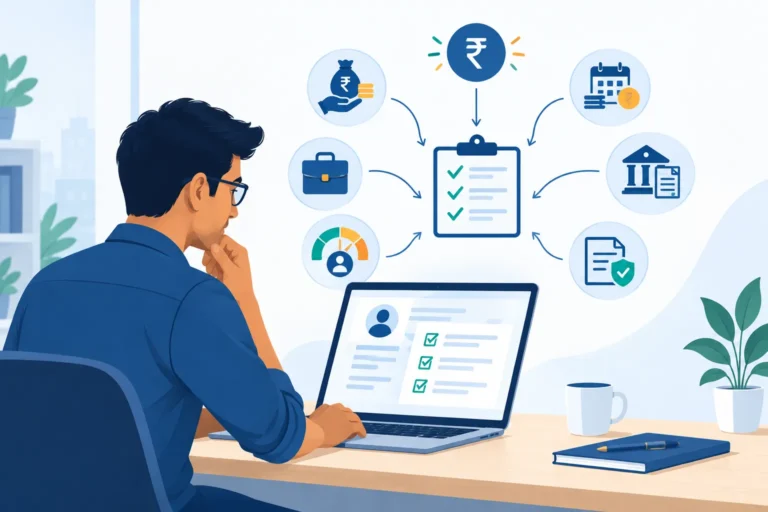
Eligibility rules differ by lender and loan product. Approval is never based on a single factor. Lenders commonly assess the following areas:
- Income: Salary, professional income, business earnings or other acceptable sources may be reviewed through bank statements, salary slips, income-tax documents or business records.
- Employment or business stability: Lenders may consider how long a salaried applicant has worked with the current employer or how consistently a business has operated.
- Credit history: Past loan and credit card payments can indicate whether the applicant has managed credit responsibly.
- Existing EMIs: Home loans, vehicle loans, personal loans and credit card dues reduce the income available for a new EMI.
- Repayment capacity: The lender estimates whether the proposed EMI is manageable after considering income and current obligations.
- Age and requested tenure: The borrower’s age may affect the permitted tenure, particularly when the loan extends towards retirement.
For secured loans, the lender additionally checks the collateral. It may verify legal ownership, condition, marketability and valuation. Joint ownership can require consent or participation from other owners. Clear ownership does not guarantee approval because the borrower must still meet repayment and documentation requirements.
For unsecured loans, a strong credit profile can be particularly important, but it is not the only consideration. A borrower with a good score may still face rejection if income is insufficient, employment is unstable or existing EMIs are too high.
What Happens When Repayments Are Missed?
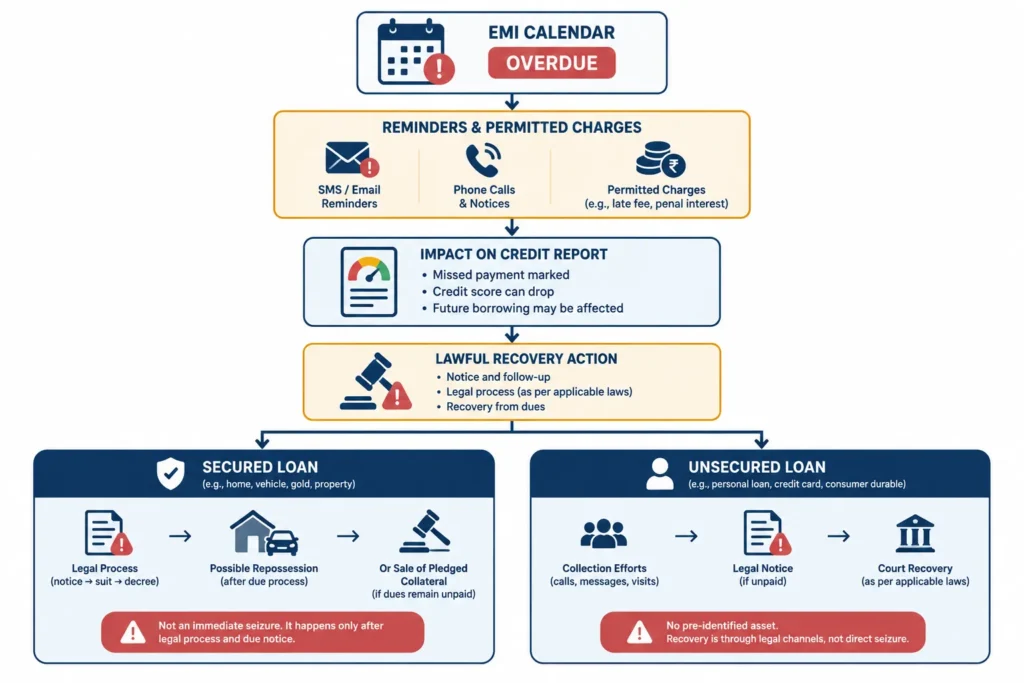
The exact sequence depends on the lender, product, loan agreement and applicable law. A missed EMI can first result in reminders and late payment or penal charges where applicable. If an auto-debit fails, bank-related return charges may also arise under the relevant terms.
Delayed or missed payments may be reported to credit bureaus. This can affect the borrower’s credit history and make future borrowing harder or more expensive. Paying after the due date does not necessarily remove the record of delay.
If overdue amounts remain unpaid, the lender or its authorised representatives may contact the borrower through calls, messages, letters or visits, subject to applicable rules and fair-practice requirements. The account may move through collection and legal recovery processes.
Default on a secured loan
With a secured loan, continuing default may eventually lead to action against the collateral. For example, a lender may seek repossession of a financed vehicle or enforcement of security over a property. Such action cannot be treated as automatic or informal; it must follow the loan contract and applicable legal procedures.
The sale value of the asset may not always cover the complete outstanding amount, interest and permitted expenses. Depending on the agreement and law, the borrower may remain responsible for a shortfall. If sale proceeds exceed the valid dues and costs, treatment of the balance should follow the applicable process.
Default on an unsecured loan
There is no pledged asset for the lender to take directly under an unsecured loan. However, the debt does not disappear. The lender may continue collection efforts, report the default and use legal recovery options available under the agreement and law.
Borrowers who expect difficulty should contact the lender early rather than ignore notices. They can ask about available repayment arrangements, but the lender is not required to approve a restructuring or reduced payment. Understanding EMI affordability before borrowing remains the safer approach for both secured vs unsecured loans.
Section 3: Choosing a Loan, Avoiding Mistakes and FAQs
The choice between secured vs unsecured loans should depend on why you need the money, what you can afford and how much risk you are willing to take. A lower EMI or faster approval alone should not decide the loan.
A secured loan may suit a large, planned purchase when an appropriate asset can support the borrowing. An unsecured loan may be useful for a smaller or urgent expense when pledging an asset is not practical. However, the right choice varies by borrower and lender.
A Practical Framework for Choosing a Loan
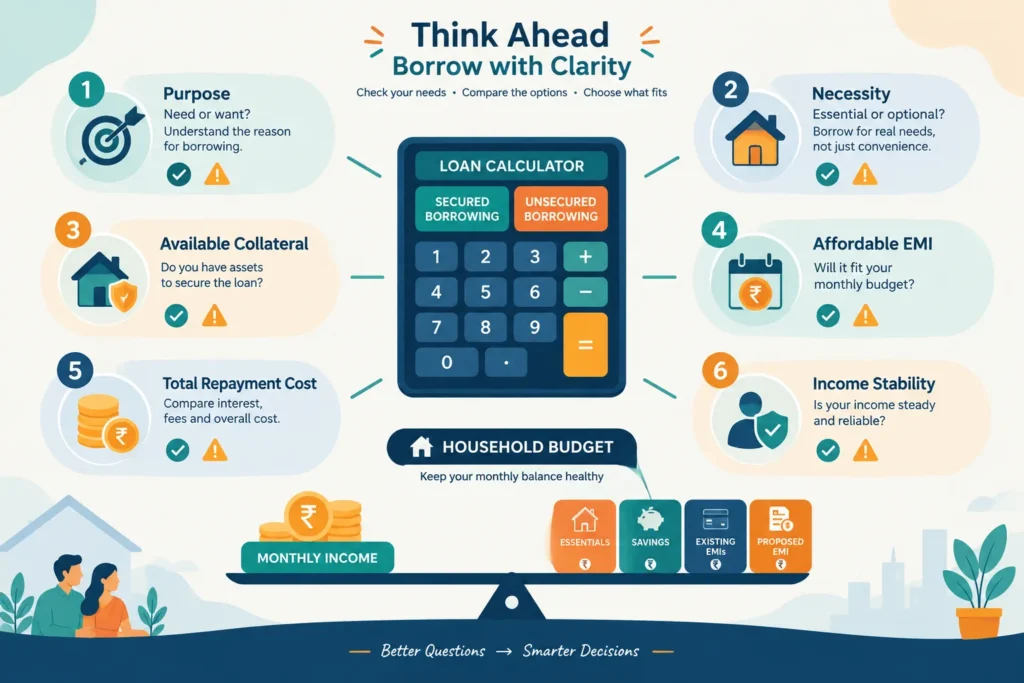
Before applying, work through the following questions. They can help you decide whether borrowing is necessary and which loan structure is more suitable.
- What is the purpose of the loan? Match the loan to the expense. A home loan is designed for buying or constructing a house, while a vehicle loan is meant for purchasing a vehicle. A personal loan offers more flexibility but is generally unsecured and may have different pricing and eligibility conditions.
- Is the expense necessary? Borrowing for a medical need, education or an essential asset may be easier to justify than borrowing for a luxury purchase. If the expense can wait, saving first may reduce the amount you need to borrow.
- Can you provide a suitable asset? A secured loan requires collateral or creates a lender’s charge over the financed asset. Consider whether you own an eligible asset and whether you are comfortable placing it at risk.
- What EMI can you genuinely afford? Calculate affordability using dependable monthly income after essential expenses, existing EMIs, insurance premiums and regular savings. Leave room for emergencies and changes in income.
- What is the total repayment cost? Do not compare loans only by EMI. Review the interest payable over the full tenure, processing fees, taxes, insurance costs where applicable, valuation charges, legal charges and prepayment conditions.
- Is the tenure appropriate? A longer tenure can reduce the monthly EMI but may increase the total interest paid. A shorter tenure may reduce total interest but create a heavier monthly commitment. Choose a balance that remains manageable.
- How stable is your repayment capacity? Consider job stability, business cash flow, dependants and upcoming expenses. If your income changes from month to month, avoid setting the EMI based on your best months alone.
- What happens if repayment becomes difficult? Understand late payment charges, credit-reporting consequences, recovery action and default clauses. With a secured loan, also consider the possibility of losing the pledged asset.
Indian Example: A Planned Purchase Versus a Short-Term Expense
Suppose Meera plans to buy a flat in Pune. The purchase is planned, the amount is substantial and the flat can serve as security for a home loan. A secured home loan may be a suitable structure because the borrowing is connected to a specific asset.
Meera must still check the down payment, EMI, tenure, fees and total repayment amount. She should not assume that the loan is affordable merely because the bank approves it. She must also understand that continued default could put the property at risk, subject to the loan agreement and applicable legal process.
Now consider Arjun, who needs money for a short-term family expense. He does not want to mortgage property or pledge another asset. He may consider an unsecured personal loan if the expense is necessary and the EMI fits comfortably within his budget.
Arjun should compare offers based on the total cost, not only on quick approval. Because there is no collateral, the lender may rely more heavily on his income, existing debt, credit history and repayment record. Approval is not automatic, and the terms can vary widely between lenders.
These examples do not mean that every property purchase should be financed or that every short-term expense deserves a personal loan. The purpose, necessity, affordability and risks must be assessed together.
Common Mistakes to Avoid
- Comparing only the EMI: A low EMI can result from a longer tenure. It does not necessarily mean that the loan is cheaper. Compare the total amount payable as well.
- Ignoring fees and additional costs: Processing fees, documentation charges, valuation costs, insurance and taxes can increase the effective cost of borrowing. Ask for a clear breakdown before signing.
- Pledging an essential asset without considering the downside: Think carefully before using the family home, an important business asset or a crucial income-generating asset as collateral. Default may have serious practical consequences.
- Borrowing up to the maximum eligibility: The amount a lender is willing to approve may be higher than what your household budget can safely support. Set your own borrowing limit.
- Submitting applications to many lenders at once: Multiple formal applications may lead to several credit enquiries. Instead, shortlist suitable lenders, check broad eligibility and apply selectively.
- Not reading default clauses: Understand when an account may be treated as overdue or in default, what charges may apply and what recovery rights the lender has.
- Choosing an unsuitable tenure: An aggressive short tenure can strain monthly cash flow, while an unnecessarily long tenure can raise the overall interest burden.
- Using short-term debt repeatedly: Taking a new loan to repay an older loan can create a debt cycle. If repayment is already difficult, review the budget and speak to the lender early rather than ignoring the problem.
Checks to Complete Before Signing
Read the sanction letter, loan agreement and repayment schedule carefully. Ensure that verbal promises made by an agent or representative also appear in the official documents where relevant.
- Confirm whether the interest rate is fixed, floating or subject to lender terms.
- Check the EMI, due date, tenure and total amount payable.
- Review processing, late payment, prepayment and foreclosure charges.
- Understand whether insurance is optional or required under the product terms.
- For secured borrowing, confirm which asset is charged and how the charge may be released after repayment.
- Check the consequences of missed payments for both your credit record and collateral.
- Keep copies of all signed forms, payment receipts and loan documents.
Frequently Asked Questions
Is a personal loan secured or unsecured?
A standard personal loan is usually unsecured. The borrower generally does not pledge a specific asset. The lender assesses factors such as income, employment or business profile, existing obligations and credit history. Some lenders may also offer secured products for personal needs, so always check the exact product terms.
Is a home loan secured?
Yes, a home loan is generally secured by the property being purchased, constructed or financed. The lender creates a legal charge over the property according to the loan documents. The borrower remains responsible for making every EMI on time even if the property’s market value changes.
Are secured loans always cheaper?
No. Collateral can reduce the lender’s risk, so secured loans may sometimes have more favourable terms than comparable unsecured borrowing. However, they are not always cheaper in every case. The final cost depends on the lender, product, borrower profile, tenure, interest structure, fees and other conditions. Valuation, legal or documentation costs may also apply to secured loans.
Can someone with a low credit score receive an unsecured loan?
It may be possible, but approval is not guaranteed. A lender may reject the application, approve a smaller amount or offer less favourable terms. Income stability, existing debt and recent repayment behaviour may also influence the decision. Avoid making repeated applications simply to test approval, and be cautious of any provider promising guaranteed approval.
What may happen to collateral after default?
If a borrower defaults on a secured loan, the lender may begin recovery action under the loan agreement and applicable law. This can eventually include taking possession of and selling the collateral to recover outstanding dues. The precise process depends on the type of loan, security, contract and legal requirements.
The sale of collateral may not automatically end every liability. If the sale proceeds are insufficient to cover the outstanding loan and permitted costs, the borrower may still owe a balance, depending on the agreement and applicable rules. Default can also damage the borrower’s credit record. Borrowers facing difficulty should contact the lender early to discuss available options.
Summary
Neither secured nor unsecured borrowing is always better. A secured loan can support a large, planned purchase but places an asset at risk. An unsecured loan avoids collateral but may involve stricter eligibility or a higher cost.
Before signing, compare lender terms, total repayment cost, tenure, fees, EMI affordability and default consequences. Borrow only for a clear purpose, keep the repayment commitment within your capacity and understand the risks attached to both the loan and any pledged asset.


Comments