
Home Loan Balance Transfer in India: Benefits, Charges and When to Switch

A practical guide to transferring an existing home loan in India, comparing total costs, checking charges and deciding whether a new lender’s offer is worthwhile.

Home Loan Balance Transfer in India: Benefits, Charges and When to Switch

A home loan balance transfer allows you to move your outstanding home loan from your current bank or housing finance company to a new lender. Homeowners usually consider it for a lower interest rate, a more manageable EMI, better service or useful loan features. However, the transfer makes financial sense only when the expected benefits are greater than the costs involved. A lower EMI alone does not always mean a cheaper loan.

Home loans often continue for 15, 20 or even 30 years. During such a long period, interest rates, lender policies and your financial position can change. You may find that another lender is offering a more competitive rate or more suitable repayment terms than your existing lender.

This is where a home loan balance transfer may help. It gives you an opportunity to shift the remaining loan to another lender instead of continuing with the original lender until the end of the tenure.

But a transfer is not automatic. The new lender will assess your application, verify the property and loan documents, check your repayment history and approve the loan before paying the outstanding amount to your existing lender. Understanding this process is important before comparing offers.

What Is a Home Loan Balance Transfer?

A home loan balance transfer is the process of moving the unpaid portion of your home loan from one lender to another. It is also called a home loan takeover or home loan refinancing.

Suppose you took a home loan of Rs. 50 lakh from Bank A a few years ago. After making regular repayments, your outstanding principal is now Rs. 38 lakh. If Bank B approves your balance transfer request, it pays the eligible outstanding amount to Bank A. You then repay the transferred loan to Bank B under the new loan agreement.

The entire original loan amount is not transferred. Only the amount still payable at the time of settlement is considered, subject to the new lender’s approval and terms.

A home loan balance transfer does not mean that the property is being sold or transferred to someone else. You remain the property owner. What changes is the lender holding the loan and the related property documents or security interest.

The new lender may offer a different:

  • Interest rate
  • EMI amount
  • Remaining loan tenure
  • Interest-rate benchmark or reset policy
  • Customer service experience
  • Repayment facility
  • Top-up loan option

These terms can affect both your monthly cash flow and the total amount you eventually repay. Therefore, you should compare the complete loan offer rather than looking only at the advertised interest rate.

How Does a Home Loan Balance Transfer Work?
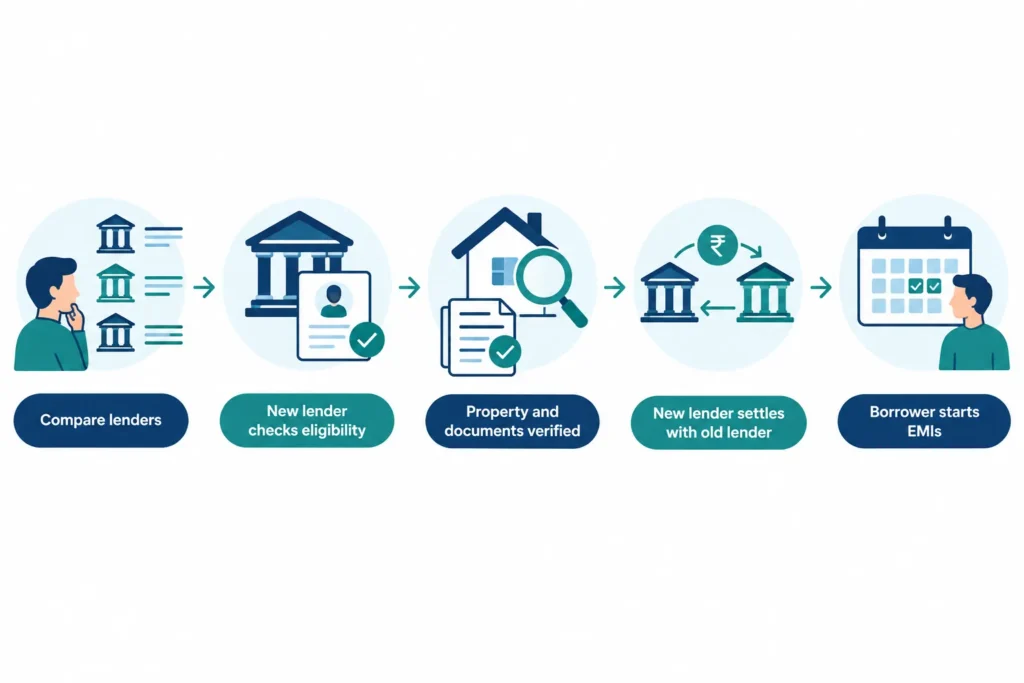
Five-step flowchart of the home loan balance transfer process from comparison to repayment with the new lender

A home loan balance transfer works much like applying for a fresh home loan. The new lender does not simply accept the loan because another bank had approved it earlier. It conducts its own checks before deciding whether to take over the outstanding balance.

1. You compare lenders and request an offer

You first compare the interest rates, eligibility rules, loan tenure, service standards and other terms offered by different banks or housing finance companies. You may then submit an application to the lender that appears suitable.

At this stage, it can also be useful to ask your existing lender whether it can offer a rate reduction. If the current lender provides competitive terms, you may be able to avoid the effort involved in shifting the loan.

2. The new lender checks your eligibility

The new lender assesses your income, age, employment or business stability, credit profile and existing repayment obligations. It may ask for documents such as salary slips, bank statements, income tax returns and proof of identity and address.

Your repayment record on the current home loan is especially important. Delayed EMIs, unresolved defaults or an unsuitable credit profile can affect approval.

3. The property and loan documents are verified

The new lender usually conducts legal and technical checks on the property. It may examine title documents, approved plans, construction status and other papers required under its policy.

This means a balance transfer can be declined even if you have paid every EMI on time. For example, the new lender may identify a property-document issue or may not finance the project or location under its internal rules.

4. You obtain details from the existing lender

You generally need a statement showing the outstanding loan amount and may also need documents confirming the existing lender’s requirements for closing the account. The exact paperwork depends on the lenders and the type of loan.

The outstanding figure can change as interest accrues or another EMI is paid. The final settlement amount is therefore confirmed closer to the transfer date.

5. The new lender approves and settles the old loan

If the application clears all checks, the new lender sanctions the loan. After you accept the terms and complete the required documentation, the new lender arranges payment of the approved outstanding amount to the existing lender.

The existing lender then closes the old home loan after receiving the required settlement. The original property documents and related papers are handed over or transferred through the applicable process. Your future EMIs are paid to the new lender.

The key point is that the outstanding loan moves only after approval, document verification and settlement with the existing lender. Submitting an application or receiving an initial quotation does not complete the transfer.

You May Also Like:How to Improve Home Loan Eligibility in India

Benefits of a Home Loan Balance Transfer

The value of a home loan balance transfer depends on your outstanding principal, remaining tenure, new interest rate and transfer-related costs. Its potential benefits can include the following.

Potential interest savings

A lower interest rate may reduce the interest charged on the outstanding loan. The possible saving is generally more meaningful when a sizeable principal is still unpaid and several years remain in the tenure.

For example, a borrower with a large outstanding balance and 15 years left may have more scope to benefit from a lower rate than someone who is close to the final few EMIs. In the later stages of a loan, the possible interest saving may be too small to justify switching.

The interest-rate difference should also be considered along with all applicable costs. A slightly lower rate does not automatically make the transfer worthwhile.

A lower monthly EMI

The new loan terms may reduce your EMI. This can improve monthly cash flow and make repayments easier to manage, especially if household expenses have increased.

However, a lower EMI can arise for two different reasons:

  • The new lender charges a lower interest rate while keeping a similar remaining tenure.
  • The new lender extends the repayment tenure, spreading the outstanding amount over more months.

The second option may provide immediate EMI relief but can increase the total interest paid because you remain in debt for longer. Therefore, a lower EMI does not automatically reduce the total borrowing cost.

Always compare the total projected repayment under the new loan with the amount you would pay by continuing the existing loan.

Flexibility to change the loan tenure

A transfer may allow you to select a revised tenure, subject to age, income and lender rules. You might choose a shorter tenure if your income has increased and you can afford a higher EMI. This can help reduce the period for which interest is charged.

Alternatively, you may choose a longer tenure to reduce the immediate EMI burden. This can support cash flow, but the likely increase in total interest should be understood before proceeding.

Better customer service

Borrowers may also switch because of service-related concerns. These can include slow responses, difficulty obtaining loan statements, unclear interest-rate resets or inconvenient digital and branch facilities.

A lender with clearer communication, better online access and more responsive support can make a long-term loan easier to manage. Service quality is difficult to measure, so check the lender’s processes instead of relying only on promotional claims.

Access to lender-specific features

Some lenders may offer features that better suit your needs, such as flexible repayment facilities, online loan management, different interest-rate structures or an eligible top-up loan.

A top-up should not be treated as a benefit by itself. It is additional borrowing and creates an additional repayment obligation. Consider it only when the purpose is justified and the combined EMI remains affordable.

Overall, a home loan balance transfer can improve loan terms, reduce interest in suitable cases and make repayment more convenient. The real benefit must be judged using the complete financial impact, not only the new interest rate or reduced EMI shown in an offer.

Home Loan Balance Transfer Charges and Costs
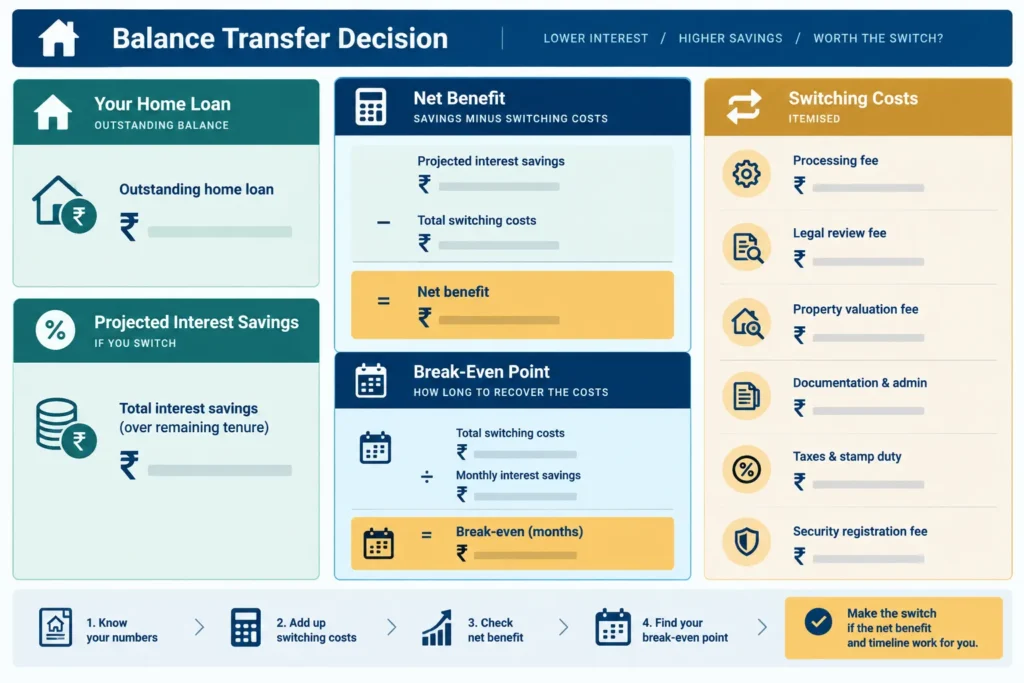
Calculator-style comparison of potential home loan savings, transfer charges and the break-even period

A lower interest rate can reduce your future interest outgo, but a home loan balance transfer is not free. The new lender may charge fees for processing the application, checking the property and completing the loan documentation.

Not every charge applies in every case. The amount can depend on the lender, property, loan structure, state rules and documents already available. Ask the new lender for a written, itemised cost breakdown before accepting the offer.

Common costs to check

  • Processing fee: The new lender may charge a fixed amount or a percentage of the transferred loan. A discounted or waived processing fee should be confirmed in writing.
  • Legal verification fee: A lawyer may examine the title documents, sale deed, previous agreements and other property records.
  • Technical valuation fee: The lender may inspect the property and estimate its condition and value.
  • Documentation charges: These may include administrative, agreement, notarisation or document-handling expenses.
  • Stamp duty and security-related charges: Depending on the state and transaction structure, fresh or modified security documents may involve stamp duty, registration or similar charges.
  • Applicable taxes: GST may apply to eligible lender service fees and professional charges. It is generally not added to the loan interest itself. Check the actual invoice and applicable rules.
  • Credit report or verification charges: Some lenders may recover the cost of credit checks, employment checks or other verification.
  • Mortgage or document retrieval expenses: There may be costs connected with collecting documents from the existing lender and creating or recording the new lender’s charge.
  • Insurance-related cost: A lender may offer property or loan-related insurance. Understand whether it is optional, what it covers and whether its premium is being added to the loan.
  • Other lender-specific charges: These could include administrative fees, mandate registration charges or charges for special services.

Also ask your existing lender whether any closure, statement or document-related charge applies. Do not assume that a charge is payable merely because it appears under a broad label. Request the lender’s schedule of charges and ask for clarification.

If a lender adds a fee or insurance premium to the new loan, you may also pay interest on that amount. Therefore, compare the total amount financed, not only the advertised processing fee.

Tax benefits on a home loan depend on the borrower’s eligibility, use of the property and prevailing tax rules. A balance transfer does not automatically create an additional tax deduction. Keep the old and new loan statements and consult a qualified tax professional if tax treatment affects your decision.

When Should You Consider Transferring Your Home Loan?

A home loan balance transfer may be useful when the expected future saving is comfortably higher than all switching costs. The interest-rate difference matters, but it is only one part of the calculation.

You have a sizeable outstanding principal

Interest is calculated on the outstanding loan balance. If a large principal amount is still unpaid, even a moderate rate reduction can create a meaningful difference over time. If only a small balance remains, the saving may be too low to justify the work and fees.

You May Also Like:Loan-to-Value Ratio (LTV): Meaning, Formula and Home Loan Example

A long repayment period remains

A longer remaining tenure gives the lower rate more time to reduce interest. A transfer made near the beginning or middle of a loan may therefore have a greater impact than one made close to the final EMI.

However, a long tenure also needs careful handling. If the new lender lowers your EMI by extending the tenure, you could remain in debt longer and may not save as much as expected.

The rate difference produces a clear net saving

Compare the effective rates offered under similar conditions. Check whether the proposed rate is fixed, floating or a combination, and understand how it may change. An introductory or conditional rate should not be treated as a permanent saving unless the loan terms clearly support that assumption.

You plan to keep the loan for enough time

Switching costs are paid at or around the time of transfer, while interest savings arise gradually. If you plan to sell the property, repay the loan early or make a large prepayment soon, there may not be enough time to recover those costs.

A simple break-even estimate can help:

Break-even period = Total switching costs ÷ Estimated monthly EMI saving

This is only a quick check. A detailed comparison should use the amortisation schedules of both loans because the split between principal and interest changes every month.

The new loan suits your repayment plan

Decide what you want from the transfer. You may want a lower EMI for monthly cash-flow relief, a shorter tenure to become debt-free sooner, or a balance between the two.

For a fair comparison, first compare both loans using the same outstanding principal and remaining tenure. You can then separately examine what happens if you continue paying the old EMI after moving to the lower rate. Subject to the loan terms, maintaining a higher EMI may shorten the tenure and reduce interest further.

When Is a Balance Transfer Not Worth It?

A home loan balance transfer may not be worthwhile in the following situations:

  • The remaining principal is small: The possible interest saving may not cover the transfer expenses.
  • Only a short tenure remains: There may be too little time to recover the upfront costs.
  • The rate difference is minor: A small headline reduction can disappear after processing, legal and other charges are included.
  • You expect to close the loan soon: A planned sale, prepayment or foreclosure may make the break-even period irrelevant.
  • The new tenure is much longer: A lower EMI can look attractive while increasing the repayment period and possibly the total interest paid.
  • The new rate has restrictive conditions: The offered rate may depend on the borrower’s credit profile, loan-to-value ratio, salary account, insurance purchase or another condition.
  • Your existing lender offers a better internal option: A rate-conversion or repricing facility may deliver some benefit with less paperwork and lower cost. Compare it with the transfer offer.
  • The property documents create difficulties: Missing approvals, title issues or incomplete records can delay or prevent approval and may still leave you with some expenses.

Do not transfer only because the new EMI is lower. Check whether the reduction comes from a lower interest rate, a longer tenure, or both. The most useful figure is the estimated total remaining repayment after including all charges.

Home Loan Balance Transfer Example

Hypothetical assumptions

Suppose Meera has an outstanding home loan of ₹30,00,000 with 15 years, or 180 months, remaining. Her existing interest rate is assumed to be 9.50% per year. A new lender offers 8.50% per year for the same remaining tenure.

For a like-for-like comparison, both loans are treated as standard monthly reducing-balance loans. The rates are assumed to remain unchanged for all 15 years. Actual floating rates can change.

Item Existing loan Proposed loan
Outstanding principal ₹30,00,000 ₹30,00,000
Remaining tenure 180 months 180 months
Assumed annual interest rate 9.50% 8.50%
Approximate monthly EMI ₹31,330 ₹29,540
Approximate remaining repayment ₹56,39,400 ₹53,17,200
Approximate future interest ₹26,39,400 ₹23,17,200

On these assumptions, the proposed loan reduces the approximate remaining repayment by ₹3,22,200. This is the gross difference before transfer expenses.

Assumed transfer costs

  • Processing and administrative charges: ₹18,000
  • Legal and technical verification: ₹9,000
  • Documentation, applicable taxes and other assumed costs: ₹8,000
  • Total assumed switching cost: ₹35,000

The estimated net difference is therefore:

₹3,22,200 gross repayment difference − ₹35,000 transfer costs = ₹2,87,200 estimated net benefit

The approximate EMI reduction is ₹1,790 per month. Using a simple break-even calculation, it would take around 20 months for the EMI reduction to recover the assumed ₹35,000 switching cost. Meera should therefore consider whether she expects to keep the loan beyond that period.

This example is only an illustration, not a quote or guarantee. Actual EMIs can differ because of calculation dates, rate resets, daily or monthly interest methods, rounding, fees financed into the loan and changes in tenure. The final decision should be based on written offers, itemised costs and repayment schedules from both lenders.

Documents Required for a Home Loan Balance Transfer

A home loan balance transfer is treated much like a fresh loan application. The new lender must check your identity, income, repayment capacity, existing loan and property documents before approving the transfer.

Exact requirements vary by lender, employment type, property type and applicant profile. Ask the new lender for a written document checklist before applying.

Identity and address documents

  • PAN card
  • Aadhaar card, passport, voter ID or driving licence
  • Recent passport-size photographs
  • Current and permanent address proof
  • Proof of signature, if separately requested

Income documents

Salaried applicants may commonly need:

  • Recent salary slips
  • Bank statements showing salary credits
  • Form 16 or income tax returns
  • Employment proof, such as an appointment letter or employee ID
You May Also Like:How to Reduce Your Loan EMI: Practical Options and Trade-Offs

Self-employed applicants may commonly need:

  • Income tax returns for the period specified by the lender
  • Profit and loss statements and balance sheets
  • Business bank statements
  • GST registration or returns, where applicable
  • Proof of business continuity, registration or professional qualification

The lender may request additional information if income is variable, the borrower has multiple businesses, or there are other major loan obligations.

Existing home loan documents

  • Original loan sanction letter or loan agreement
  • Recent home loan account statement
  • Repayment track record
  • Current outstanding balance certificate
  • List of original property documents held by the existing lender
  • Foreclosure or loan closure statement
  • No-objection certificate or consent letter, if required at that stage

The outstanding balance statement is especially important because it tells the new lender how much must be paid to close the old loan. Since this amount changes as EMIs are paid and interest is added, the statement may have a validity period.

Property documents

  • Sale deed or agreement for sale
  • Title documents and previous ownership records
  • Approved building plan and relevant permissions
  • Possession or allotment letter, where applicable
  • Property tax receipts
  • Occupancy or completion certificate, where applicable
  • Documents issued by the builder or housing society
  • Encumbrance-related records or other legal documents requested by the lender

The new lender will usually conduct legal and technical checks on the property. A transfer can be delayed or declined if the title documents are incomplete, approvals are missing, or the property does not meet the lender’s policies.

Home Loan Balance Transfer Process: Step by Step

1. Compare written offers

Begin by comparing actual offers rather than advertised starting rates. Check the proposed interest rate, benchmark, spread, reset rules, remaining tenure, processing fee, legal and valuation charges, insurance conditions and other costs.

Also compare the total estimated interest payable under the existing and proposed loans. A lower EMI alone does not prove that the transfer will save money.

2. Check your eligibility

The new lender will consider factors such as income, age, credit history, existing EMIs, repayment record, property value and remaining loan tenure. Ask whether your property type and location are acceptable before paying non-refundable charges.

3. Request details from the existing lender

Ask your current lender for the latest loan statement, outstanding balance or foreclosure statement, repayment history and list of original property papers in its custody. Find out the process and expected timeline for releasing those documents after settlement.

You may also ask the existing lender whether it can revise your rate. A satisfactory internal rate conversion could involve less documentation and fewer costs than moving the loan, although the terms must still be compared carefully.

4. Apply to the new lender

Submit the application form and required identity, income, loan and property documents. Pay only the charges you understand, and keep receipts. An application does not guarantee approval or the advertised interest rate.

The new lender will assess your repayment capacity and credit profile. It may verify employment or business details, examine the property title and conduct a technical valuation or site visit.

Respond promptly to requests for clarification. However, do not submit blank signed forms or rely only on verbal assurances from an agent.

6. Review the sanction letter

If the application is approved, read the sanction letter carefully. Verify the sanctioned amount, interest rate, benchmark and spread, tenure, EMI, rate-reset conditions, fees, prepayment terms and special conditions.

Ask for corrections in writing if the document differs from what was discussed. Do not assume that every promise made during sales discussions will automatically become part of the final agreement.

7. Arrange settlement with the old lender

The new lender generally pays the approved takeover amount to the existing lender, subject to its process and completion of conditions. Any difference between the payable amount and sanctioned transfer amount may need to be handled separately.

Continue paying the old loan EMI until you receive clear instructions and confirmation that the outstanding amount has been settled. Stopping payment too early can create overdue entries and penalties.

8. Confirm closure and document transfer

Collect or confirm the loan closure letter, no-dues certificate and release of charge or lien, as applicable. Ensure that the original property documents are transferred to the new lender or handled according to the agreed process.

Check that the old loan is eventually reported as closed to credit bureaus. Preserve copies of all statements, receipts and closure documents.

You May Also Like:How to Reduce the Total Interest Paid on a Loan

9. Start repayment under the new agreement

Confirm the first EMI date, amount and auto-debit mandate. Keep enough money in the linked bank account and monitor the first few deductions. Review periodic statements to ensure that payments are credited correctly and the applied rate matches the agreement.

Common Mistakes to Avoid

Comparing only the EMI

A smaller EMI may result from a lower rate, a longer tenure or both. If the new lender extends the repayment period significantly, you could pay interest for more years. Compare total expected outflow, not just the monthly amount.

Ignoring transfer charges

Processing, legal, valuation, documentation, administrative and mortgage-related charges can reduce the benefit. There may also be taxes on eligible fees. Ask both lenders for a written list of applicable costs before deciding.

Extending the tenure without checking total interest

A longer tenure can improve monthly cash flow, but it may increase overall interest. If affordability permits, compare an option that keeps the remaining tenure broadly unchanged.

Not reading the new loan terms

A low introductory rate is not the only factor. Check how the rate can change, whether it is linked to an external or internal benchmark, how frequently it resets, and whether the lender changes the EMI, tenure or both after a rate revision.

Skipping eligibility and property checks

Paying fees before confirming basic eligibility can lead to avoidable expense. Problems with income documentation, repayment history, property title, building approvals or remaining tenure may affect approval.

Closing the old repayment mandate too soon

Do not cancel the existing EMI instruction merely because the new loan has been sanctioned. Wait until settlement and closure are confirmed. This helps avoid missed payments during the transition.

Frequently Asked Questions

1. Can I transfer my home loan to another bank?

Yes, a home loan can generally be transferred to another bank or eligible housing finance company, subject to the new lender’s approval. Your income, credit profile, repayment history, property documents, outstanding balance and remaining tenure will be assessed.

2. Will a home loan balance transfer reduce my EMI?

It may reduce the EMI if the new rate is lower, the tenure is extended, or both. However, a lower EMI does not always mean lower total interest. Compare the remaining cost of the old loan with the interest and charges under the new loan.

3. What charges apply to a balance transfer?

Possible costs include processing, legal review, property valuation, documentation and administrative charges. Mortgage creation or registration-related costs may apply in some cases. The existing lender’s foreclosure rules can depend on the loan type and borrower category. Obtain lender-specific written details rather than assuming that the transfer is free.

4. Can a floating-rate home loan be transferred?

Yes, floating-rate home loans can usually be considered for transfer. Approval still depends on the new lender’s policies and your eligibility. Review the new benchmark, spread, reset frequency and rules for future rate changes.

5. Can a balance transfer affect my credit score?

The application may result in a credit enquiry, and multiple applications within a short period can create several enquiries. A temporary change is possible, but the effect differs by profile. Continue all repayments on time and ensure the old account is correctly reported as closed after settlement.

6. Should I switch near the end of the loan tenure?

Switching late in the tenure may offer limited benefit because the outstanding balance is smaller and much of the interest may already have been paid. Transfer charges can further reduce savings. Calculate the net benefit for the remaining period before proceeding.

Summary

A home loan balance transfer requires more than finding a lower advertised rate. Prepare identity, income, existing loan and property documents; compare written terms; calculate charges and total interest; and verify eligibility before applying.

During the transfer, continue the old EMIs until settlement is confirmed. Collect closure records, track the movement of original property papers and check the first repayments under the new agreement. Switch only when the likely financial or cash-flow benefit justifies the cost, effort and new loan terms.


Share this article
KEEP READING

Related Articles

View all →

Comments

Leave a Comment

Home Loan Balance Transfer in India: Benefits, Charges and When to Switch

A home loan balance transfer allows you to move your outstanding home loan from your current bank or housing finance company to a new lender. Homeowners usually consider it for a lower interest rate, a more manageable EMI, better service or useful loan features. However, the transfer makes financial sense only when the expected benefits are greater than the costs involved. A lower EMI alone does not always mean a cheaper loan.

Home loans often continue for 15, 20 or even 30 years. During such a long period, interest rates, lender policies and your financial position can change. You may find that another lender is offering a more competitive rate or more suitable repayment terms than your existing lender.

This is where a home loan balance transfer may help. It gives you an opportunity to shift the remaining loan to another lender instead of continuing with the original lender until the end of the tenure.

But a transfer is not automatic. The new lender will assess your application, verify the property and loan documents, check your repayment history and approve the loan before paying the outstanding amount to your existing lender. Understanding this process is important before comparing offers.

What Is a Home Loan Balance Transfer?

A home loan balance transfer is the process of moving the unpaid portion of your home loan from one lender to another. It is also called a home loan takeover or home loan refinancing.

Suppose you took a home loan of Rs. 50 lakh from Bank A a few years ago. After making regular repayments, your outstanding principal is now Rs. 38 lakh. If Bank B approves your balance transfer request, it pays the eligible outstanding amount to Bank A. You then repay the transferred loan to Bank B under the new loan agreement.

The entire original loan amount is not transferred. Only the amount still payable at the time of settlement is considered, subject to the new lender’s approval and terms.

A home loan balance transfer does not mean that the property is being sold or transferred to someone else. You remain the property owner. What changes is the lender holding the loan and the related property documents or security interest.

The new lender may offer a different:

  • Interest rate
  • EMI amount
  • Remaining loan tenure
  • Interest-rate benchmark or reset policy
  • Customer service experience
  • Repayment facility
  • Top-up loan option

These terms can affect both your monthly cash flow and the total amount you eventually repay. Therefore, you should compare the complete loan offer rather than looking only at the advertised interest rate.

How Does a Home Loan Balance Transfer Work?

Five-step flowchart of the home loan balance transfer process from comparison to repayment with the new lender

A home loan balance transfer works much like applying for a fresh home loan. The new lender does not simply accept the loan because another bank had approved it earlier. It conducts its own checks before deciding whether to take over the outstanding balance.

1. You compare lenders and request an offer

You first compare the interest rates, eligibility rules, loan tenure, service standards and other terms offered by different banks or housing finance companies. You may then submit an application to the lender that appears suitable.

At this stage, it can also be useful to ask your existing lender whether it can offer a rate reduction. If the current lender provides competitive terms, you may be able to avoid the effort involved in shifting the loan.

2. The new lender checks your eligibility

The new lender assesses your income, age, employment or business stability, credit profile and existing repayment obligations. It may ask for documents such as salary slips, bank statements, income tax returns and proof of identity and address.

Your repayment record on the current home loan is especially important. Delayed EMIs, unresolved defaults or an unsuitable credit profile can affect approval.

3. The property and loan documents are verified

The new lender usually conducts legal and technical checks on the property. It may examine title documents, approved plans, construction status and other papers required under its policy.

This means a balance transfer can be declined even if you have paid every EMI on time. For example, the new lender may identify a property-document issue or may not finance the project or location under its internal rules.

4. You obtain details from the existing lender

You generally need a statement showing the outstanding loan amount and may also need documents confirming the existing lender’s requirements for closing the account. The exact paperwork depends on the lenders and the type of loan.

The outstanding figure can change as interest accrues or another EMI is paid. The final settlement amount is therefore confirmed closer to the transfer date.

5. The new lender approves and settles the old loan

If the application clears all checks, the new lender sanctions the loan. After you accept the terms and complete the required documentation, the new lender arranges payment of the approved outstanding amount to the existing lender.

The existing lender then closes the old home loan after receiving the required settlement. The original property documents and related papers are handed over or transferred through the applicable process. Your future EMIs are paid to the new lender.

The key point is that the outstanding loan moves only after approval, document verification and settlement with the existing lender. Submitting an application or receiving an initial quotation does not complete the transfer.

Benefits of a Home Loan Balance Transfer

The value of a home loan balance transfer depends on your outstanding principal, remaining tenure, new interest rate and transfer-related costs. Its potential benefits can include the following.

Potential interest savings

A lower interest rate may reduce the interest charged on the outstanding loan. The possible saving is generally more meaningful when a sizeable principal is still unpaid and several years remain in the tenure.

For example, a borrower with a large outstanding balance and 15 years left may have more scope to benefit from a lower rate than someone who is close to the final few EMIs. In the later stages of a loan, the possible interest saving may be too small to justify switching.

The interest-rate difference should also be considered along with all applicable costs. A slightly lower rate does not automatically make the transfer worthwhile.

A lower monthly EMI

The new loan terms may reduce your EMI. This can improve monthly cash flow and make repayments easier to manage, especially if household expenses have increased.

However, a lower EMI can arise for two different reasons:

  • The new lender charges a lower interest rate while keeping a similar remaining tenure.
  • The new lender extends the repayment tenure, spreading the outstanding amount over more months.

The second option may provide immediate EMI relief but can increase the total interest paid because you remain in debt for longer. Therefore, a lower EMI does not automatically reduce the total borrowing cost.

Always compare the total projected repayment under the new loan with the amount you would pay by continuing the existing loan.

Flexibility to change the loan tenure

A transfer may allow you to select a revised tenure, subject to age, income and lender rules. You might choose a shorter tenure if your income has increased and you can afford a higher EMI. This can help reduce the period for which interest is charged.

Alternatively, you may choose a longer tenure to reduce the immediate EMI burden. This can support cash flow, but the likely increase in total interest should be understood before proceeding.

Better customer service

Borrowers may also switch because of service-related concerns. These can include slow responses, difficulty obtaining loan statements, unclear interest-rate resets or inconvenient digital and branch facilities.

A lender with clearer communication, better online access and more responsive support can make a long-term loan easier to manage. Service quality is difficult to measure, so check the lender’s processes instead of relying only on promotional claims.

Access to lender-specific features

Some lenders may offer features that better suit your needs, such as flexible repayment facilities, online loan management, different interest-rate structures or an eligible top-up loan.

A top-up should not be treated as a benefit by itself. It is additional borrowing and creates an additional repayment obligation. Consider it only when the purpose is justified and the combined EMI remains affordable.

Overall, a home loan balance transfer can improve loan terms, reduce interest in suitable cases and make repayment more convenient. The real benefit must be judged using the complete financial impact, not only the new interest rate or reduced EMI shown in an offer.

Home Loan Balance Transfer Charges and Costs

Calculator-style comparison of potential home loan savings, transfer charges and the break-even period

A lower interest rate can reduce your future interest outgo, but a home loan balance transfer is not free. The new lender may charge fees for processing the application, checking the property and completing the loan documentation.

Not every charge applies in every case. The amount can depend on the lender, property, loan structure, state rules and documents already available. Ask the new lender for a written, itemised cost breakdown before accepting the offer.

Common costs to check

  • Processing fee: The new lender may charge a fixed amount or a percentage of the transferred loan. A discounted or waived processing fee should be confirmed in writing.
  • Legal verification fee: A lawyer may examine the title documents, sale deed, previous agreements and other property records.
  • Technical valuation fee: The lender may inspect the property and estimate its condition and value.
  • Documentation charges: These may include administrative, agreement, notarisation or document-handling expenses.
  • Stamp duty and security-related charges: Depending on the state and transaction structure, fresh or modified security documents may involve stamp duty, registration or similar charges.
  • Applicable taxes: GST may apply to eligible lender service fees and professional charges. It is generally not added to the loan interest itself. Check the actual invoice and applicable rules.
  • Credit report or verification charges: Some lenders may recover the cost of credit checks, employment checks or other verification.
  • Mortgage or document retrieval expenses: There may be costs connected with collecting documents from the existing lender and creating or recording the new lender’s charge.
  • Insurance-related cost: A lender may offer property or loan-related insurance. Understand whether it is optional, what it covers and whether its premium is being added to the loan.
  • Other lender-specific charges: These could include administrative fees, mandate registration charges or charges for special services.

Also ask your existing lender whether any closure, statement or document-related charge applies. Do not assume that a charge is payable merely because it appears under a broad label. Request the lender’s schedule of charges and ask for clarification.

If a lender adds a fee or insurance premium to the new loan, you may also pay interest on that amount. Therefore, compare the total amount financed, not only the advertised processing fee.

Tax benefits on a home loan depend on the borrower’s eligibility, use of the property and prevailing tax rules. A balance transfer does not automatically create an additional tax deduction. Keep the old and new loan statements and consult a qualified tax professional if tax treatment affects your decision.

When Should You Consider Transferring Your Home Loan?

A home loan balance transfer may be useful when the expected future saving is comfortably higher than all switching costs. The interest-rate difference matters, but it is only one part of the calculation.

You have a sizeable outstanding principal

Interest is calculated on the outstanding loan balance. If a large principal amount is still unpaid, even a moderate rate reduction can create a meaningful difference over time. If only a small balance remains, the saving may be too low to justify the work and fees.

A long repayment period remains

A longer remaining tenure gives the lower rate more time to reduce interest. A transfer made near the beginning or middle of a loan may therefore have a greater impact than one made close to the final EMI.

However, a long tenure also needs careful handling. If the new lender lowers your EMI by extending the tenure, you could remain in debt longer and may not save as much as expected.

The rate difference produces a clear net saving

Compare the effective rates offered under similar conditions. Check whether the proposed rate is fixed, floating or a combination, and understand how it may change. An introductory or conditional rate should not be treated as a permanent saving unless the loan terms clearly support that assumption.

You plan to keep the loan for enough time

Switching costs are paid at or around the time of transfer, while interest savings arise gradually. If you plan to sell the property, repay the loan early or make a large prepayment soon, there may not be enough time to recover those costs.

A simple break-even estimate can help:

Break-even period = Total switching costs ÷ Estimated monthly EMI saving

This is only a quick check. A detailed comparison should use the amortisation schedules of both loans because the split between principal and interest changes every month.

The new loan suits your repayment plan

Decide what you want from the transfer. You may want a lower EMI for monthly cash-flow relief, a shorter tenure to become debt-free sooner, or a balance between the two.

For a fair comparison, first compare both loans using the same outstanding principal and remaining tenure. You can then separately examine what happens if you continue paying the old EMI after moving to the lower rate. Subject to the loan terms, maintaining a higher EMI may shorten the tenure and reduce interest further.

When Is a Balance Transfer Not Worth It?

A home loan balance transfer may not be worthwhile in the following situations:

  • The remaining principal is small: The possible interest saving may not cover the transfer expenses.
  • Only a short tenure remains: There may be too little time to recover the upfront costs.
  • The rate difference is minor: A small headline reduction can disappear after processing, legal and other charges are included.
  • You expect to close the loan soon: A planned sale, prepayment or foreclosure may make the break-even period irrelevant.
  • The new tenure is much longer: A lower EMI can look attractive while increasing the repayment period and possibly the total interest paid.
  • The new rate has restrictive conditions: The offered rate may depend on the borrower’s credit profile, loan-to-value ratio, salary account, insurance purchase or another condition.
  • Your existing lender offers a better internal option: A rate-conversion or repricing facility may deliver some benefit with less paperwork and lower cost. Compare it with the transfer offer.
  • The property documents create difficulties: Missing approvals, title issues or incomplete records can delay or prevent approval and may still leave you with some expenses.

Do not transfer only because the new EMI is lower. Check whether the reduction comes from a lower interest rate, a longer tenure, or both. The most useful figure is the estimated total remaining repayment after including all charges.

Home Loan Balance Transfer Example

Hypothetical assumptions

Suppose Meera has an outstanding home loan of ₹30,00,000 with 15 years, or 180 months, remaining. Her existing interest rate is assumed to be 9.50% per year. A new lender offers 8.50% per year for the same remaining tenure.

For a like-for-like comparison, both loans are treated as standard monthly reducing-balance loans. The rates are assumed to remain unchanged for all 15 years. Actual floating rates can change.

Item Existing loan Proposed loan
Outstanding principal ₹30,00,000 ₹30,00,000
Remaining tenure 180 months 180 months
Assumed annual interest rate 9.50% 8.50%
Approximate monthly EMI ₹31,330 ₹29,540
Approximate remaining repayment ₹56,39,400 ₹53,17,200
Approximate future interest ₹26,39,400 ₹23,17,200

On these assumptions, the proposed loan reduces the approximate remaining repayment by ₹3,22,200. This is the gross difference before transfer expenses.

Assumed transfer costs

  • Processing and administrative charges: ₹18,000
  • Legal and technical verification: ₹9,000
  • Documentation, applicable taxes and other assumed costs: ₹8,000
  • Total assumed switching cost: ₹35,000

The estimated net difference is therefore:

₹3,22,200 gross repayment difference − ₹35,000 transfer costs = ₹2,87,200 estimated net benefit

The approximate EMI reduction is ₹1,790 per month. Using a simple break-even calculation, it would take around 20 months for the EMI reduction to recover the assumed ₹35,000 switching cost. Meera should therefore consider whether she expects to keep the loan beyond that period.

This example is only an illustration, not a quote or guarantee. Actual EMIs can differ because of calculation dates, rate resets, daily or monthly interest methods, rounding, fees financed into the loan and changes in tenure. The final decision should be based on written offers, itemised costs and repayment schedules from both lenders.

Documents Required for a Home Loan Balance Transfer

A home loan balance transfer is treated much like a fresh loan application. The new lender must check your identity, income, repayment capacity, existing loan and property documents before approving the transfer.

Exact requirements vary by lender, employment type, property type and applicant profile. Ask the new lender for a written document checklist before applying.

Identity and address documents

  • PAN card
  • Aadhaar card, passport, voter ID or driving licence
  • Recent passport-size photographs
  • Current and permanent address proof
  • Proof of signature, if separately requested

Income documents

Salaried applicants may commonly need:

  • Recent salary slips
  • Bank statements showing salary credits
  • Form 16 or income tax returns
  • Employment proof, such as an appointment letter or employee ID

Self-employed applicants may commonly need:

  • Income tax returns for the period specified by the lender
  • Profit and loss statements and balance sheets
  • Business bank statements
  • GST registration or returns, where applicable
  • Proof of business continuity, registration or professional qualification

The lender may request additional information if income is variable, the borrower has multiple businesses, or there are other major loan obligations.

Existing home loan documents

  • Original loan sanction letter or loan agreement
  • Recent home loan account statement
  • Repayment track record
  • Current outstanding balance certificate
  • List of original property documents held by the existing lender
  • Foreclosure or loan closure statement
  • No-objection certificate or consent letter, if required at that stage

The outstanding balance statement is especially important because it tells the new lender how much must be paid to close the old loan. Since this amount changes as EMIs are paid and interest is added, the statement may have a validity period.

Property documents

  • Sale deed or agreement for sale
  • Title documents and previous ownership records
  • Approved building plan and relevant permissions
  • Possession or allotment letter, where applicable
  • Property tax receipts
  • Occupancy or completion certificate, where applicable
  • Documents issued by the builder or housing society
  • Encumbrance-related records or other legal documents requested by the lender

The new lender will usually conduct legal and technical checks on the property. A transfer can be delayed or declined if the title documents are incomplete, approvals are missing, or the property does not meet the lender’s policies.

Home Loan Balance Transfer Process: Step by Step

1. Compare written offers

Begin by comparing actual offers rather than advertised starting rates. Check the proposed interest rate, benchmark, spread, reset rules, remaining tenure, processing fee, legal and valuation charges, insurance conditions and other costs.

Also compare the total estimated interest payable under the existing and proposed loans. A lower EMI alone does not prove that the transfer will save money.

2. Check your eligibility

The new lender will consider factors such as income, age, credit history, existing EMIs, repayment record, property value and remaining loan tenure. Ask whether your property type and location are acceptable before paying non-refundable charges.

3. Request details from the existing lender

Ask your current lender for the latest loan statement, outstanding balance or foreclosure statement, repayment history and list of original property papers in its custody. Find out the process and expected timeline for releasing those documents after settlement.

You may also ask the existing lender whether it can revise your rate. A satisfactory internal rate conversion could involve less documentation and fewer costs than moving the loan, although the terms must still be compared carefully.

4. Apply to the new lender

Submit the application form and required identity, income, loan and property documents. Pay only the charges you understand, and keep receipts. An application does not guarantee approval or the advertised interest rate.

5. Complete credit, legal and property verification

The new lender will assess your repayment capacity and credit profile. It may verify employment or business details, examine the property title and conduct a technical valuation or site visit.

Respond promptly to requests for clarification. However, do not submit blank signed forms or rely only on verbal assurances from an agent.

6. Review the sanction letter

If the application is approved, read the sanction letter carefully. Verify the sanctioned amount, interest rate, benchmark and spread, tenure, EMI, rate-reset conditions, fees, prepayment terms and special conditions.

Ask for corrections in writing if the document differs from what was discussed. Do not assume that every promise made during sales discussions will automatically become part of the final agreement.

7. Arrange settlement with the old lender

The new lender generally pays the approved takeover amount to the existing lender, subject to its process and completion of conditions. Any difference between the payable amount and sanctioned transfer amount may need to be handled separately.

Continue paying the old loan EMI until you receive clear instructions and confirmation that the outstanding amount has been settled. Stopping payment too early can create overdue entries and penalties.

8. Confirm closure and document transfer

Collect or confirm the loan closure letter, no-dues certificate and release of charge or lien, as applicable. Ensure that the original property documents are transferred to the new lender or handled according to the agreed process.

Check that the old loan is eventually reported as closed to credit bureaus. Preserve copies of all statements, receipts and closure documents.

9. Start repayment under the new agreement

Confirm the first EMI date, amount and auto-debit mandate. Keep enough money in the linked bank account and monitor the first few deductions. Review periodic statements to ensure that payments are credited correctly and the applied rate matches the agreement.

Common Mistakes to Avoid

Comparing only the EMI

A smaller EMI may result from a lower rate, a longer tenure or both. If the new lender extends the repayment period significantly, you could pay interest for more years. Compare total expected outflow, not just the monthly amount.

Ignoring transfer charges

Processing, legal, valuation, documentation, administrative and mortgage-related charges can reduce the benefit. There may also be taxes on eligible fees. Ask both lenders for a written list of applicable costs before deciding.

Extending the tenure without checking total interest

A longer tenure can improve monthly cash flow, but it may increase overall interest. If affordability permits, compare an option that keeps the remaining tenure broadly unchanged.

Not reading the new loan terms

A low introductory rate is not the only factor. Check how the rate can change, whether it is linked to an external or internal benchmark, how frequently it resets, and whether the lender changes the EMI, tenure or both after a rate revision.

Skipping eligibility and property checks

Paying fees before confirming basic eligibility can lead to avoidable expense. Problems with income documentation, repayment history, property title, building approvals or remaining tenure may affect approval.

Closing the old repayment mandate too soon

Do not cancel the existing EMI instruction merely because the new loan has been sanctioned. Wait until settlement and closure are confirmed. This helps avoid missed payments during the transition.

Frequently Asked Questions

1. Can I transfer my home loan to another bank?

Yes, a home loan can generally be transferred to another bank or eligible housing finance company, subject to the new lender’s approval. Your income, credit profile, repayment history, property documents, outstanding balance and remaining tenure will be assessed.

2. Will a home loan balance transfer reduce my EMI?

It may reduce the EMI if the new rate is lower, the tenure is extended, or both. However, a lower EMI does not always mean lower total interest. Compare the remaining cost of the old loan with the interest and charges under the new loan.

3. What charges apply to a balance transfer?

Possible costs include processing, legal review, property valuation, documentation and administrative charges. Mortgage creation or registration-related costs may apply in some cases. The existing lender’s foreclosure rules can depend on the loan type and borrower category. Obtain lender-specific written details rather than assuming that the transfer is free.

4. Can a floating-rate home loan be transferred?

Yes, floating-rate home loans can usually be considered for transfer. Approval still depends on the new lender’s policies and your eligibility. Review the new benchmark, spread, reset frequency and rules for future rate changes.

5. Can a balance transfer affect my credit score?

The application may result in a credit enquiry, and multiple applications within a short period can create several enquiries. A temporary change is possible, but the effect differs by profile. Continue all repayments on time and ensure the old account is correctly reported as closed after settlement.

6. Should I switch near the end of the loan tenure?

Switching late in the tenure may offer limited benefit because the outstanding balance is smaller and much of the interest may already have been paid. Transfer charges can further reduce savings. Calculate the net benefit for the remaining period before proceeding.

Summary

A home loan balance transfer requires more than finding a lower advertised rate. Prepare identity, income, existing loan and property documents; compare written terms; calculate charges and total interest; and verify eligibility before applying.

During the transfer, continue the old EMIs until settlement is confirmed. Collect closure records, track the movement of original property papers and check the first repayments under the new agreement. Switch only when the likely financial or cash-flow benefit justifies the cost, effort and new loan terms.

Leave a Comment