


How to Calculate Gratuity in India: Formula, Eligibility and Examples

A beginner-friendly guide to gratuity calculation in India, including eligibility, formulas, salary rules, examples, taxation and payment situations.

How to Calculate Gratuity in India: Formula, Eligibility and Examples

For an employee covered by the Payment of Gratuity Act, 1972, the standard gratuity calculation is:

Gratuity = Last drawn monthly wages × 15 ÷ 26 × years of service counted for gratuity

For most monthly rated employees, “wages” for this formula means the last drawn basic salary plus dearness allowance, if applicable. It does not normally mean gross salary, take-home pay or total cost to company (CTC).

Use the calculator below for an estimate, then check the assumptions against your payslip, service record and employer policy.

Employee Benefits Calculator

Gratuity Calculator India

Estimate gratuity using eligible monthly wages and your service period.

₹50,000

Enter eligible wages under applicable gratuity rules, not automatically your full CTC or take-home salary.

5 years, 0 months

Eligibility and service rounding may differ for fixed-term employment, death, disablement, and other special circumstances.

This is an indicative estimate. The employer's eligible wage calculation, service record, applicable law, and any better contractual benefit can change the amount.
Eligible Monthly Wages₹50,000
Qualifying Service Used5 years
Estimated Gratuity₹1,44,231Subject to applicable statutory ceiling
Before Ceiling₹1,44,231

Calculation breakdown

₹50,000 ÷ 26 × 15 × 5 years

How to read this estimate

The estimate uses 15 days' wages for each qualifying year, subject to applicable rules and ceiling.

Disclaimer: This calculator is for general information and planning only, not legal advice or an official gratuity determination. The Code on Social Security, 2020 and applicable rules govern gratuity, including the definition of wages. Verify eligibility, wage components, ceiling, and calculation with your employer or a qualified professional.

Important assumption: Unless stated otherwise, the examples below assume a monthly rated employee covered by the Payment of Gratuity Act, continuous service with one employer and no more favourable gratuity scheme. Special rules can apply to seasonal establishments, piece-rated employees, disablement cases and employees outside the Act.

What Is Gratuity?

Gratuity is an employer-funded, lump-sum employment benefit. It generally becomes payable when eligible employment ends because of superannuation, retirement, resignation, death or disablement.

Gratuity is different from the Employees’ Provident Fund (EPF). EPF is accumulated through regular contributions, while gratuity is normally paid by the employer at the end of qualifying service. Employees do not ordinarily make a separate gratuity contribution from salary.

The principal law considered in this guide is the Payment of Gratuity Act, 1972. An employment contract, award, settlement or company scheme may provide better terms than the statutory minimum.

Who Is Eligible for Gratuity?

Normal five-year requirement

Under Section 4 of the Payment of Gratuity Act, gratuity generally becomes payable after at least five years of continuous service when employment ends because of superannuation, retirement or resignation.

Resignation therefore qualifies. Gratuity is not restricted to employees who retire, and an employer cannot ordinarily reject an otherwise valid claim merely because the employee resigned.

You May Also Like:How to Calculate Your Net Worth in India: Assets, Liabilities and Examples

Death or disablement

The five-year minimum does not apply when employment ends because of death or disablement due to accident or disease. In the event of death, gratuity is generally paid to the nominee or, where there is no valid nomination, to the legal heirs through the applicable procedure.

Establishments covered by the Act

The Act applies to factories, mines, oilfields, plantations, ports and railway companies. It also applies to shops and establishments in which 10 or more persons are employed, or were employed on any day in the preceding 12 months, as well as other establishments notified by the government.

Once the Act applies to an establishment, Section 1 provides that it continues to apply even if the number of employees later falls below 10.

What counts as continuous service?

Continuous service is not necessarily broken by every absence from work. Section 2A covers uninterrupted service and specified interruptions, including sickness, accident, authorised leave, lay-off, strike, lockout and cessation of work not caused by the employee. The Act also contains working-day tests for cases where service is not otherwise treated as uninterrupted.

Changing to a separate employer normally starts a new gratuity service period. A transfer within the same legal employer, or a transfer where continuity is expressly preserved, may require examination of the employment records and transfer terms.

Does four years and more than six months qualify?

Employees should not assume that the calculation rule for a part-year automatically reduces the five-year eligibility requirement. Section 4 refers to five years of continuous service, while Section 2A contains separate rules for determining continuous service.

Cases close to five years can depend on the employee’s working pattern, establishment type, service records and applicable judicial interpretation. Ask the employer for a written decision or obtain appropriate professional advice rather than relying only on a calculator.

Gratuity Calculation Formula
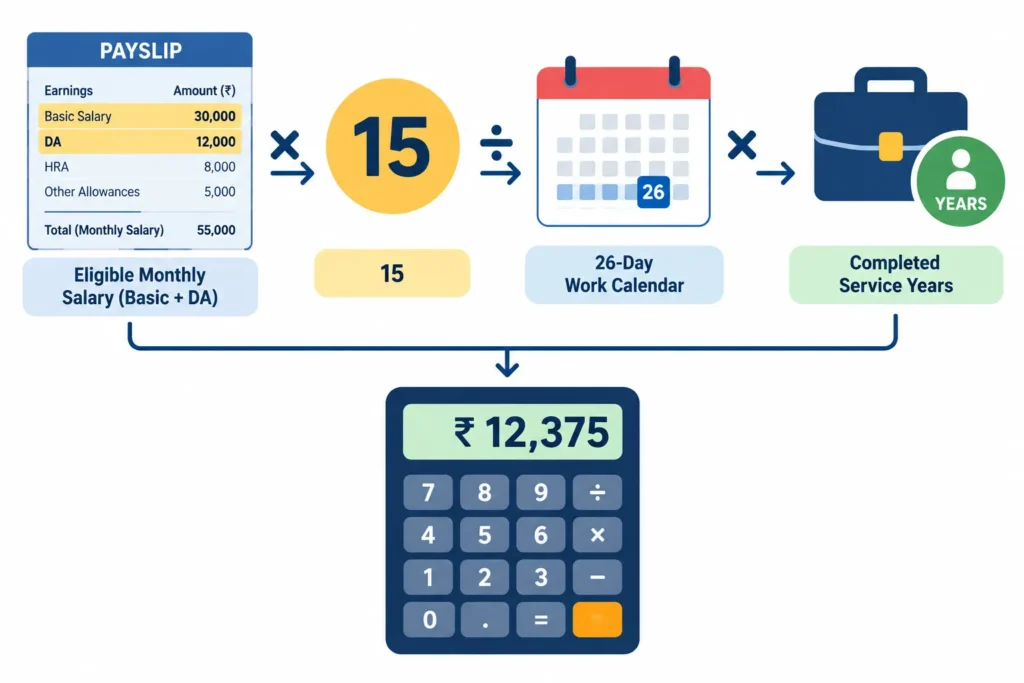
Statutory gratuity formula using eligible monthly wages, 15 days, 26 working days and counted service years

For a monthly rated employee covered by the Act:

Gratuity = Last drawn basic salary plus dearness allowance × 15 ÷ 26 × counted years of service

  • Last drawn wages: The eligible monthly wage at the end of employment.
  • 15: Fifteen days’ wages for each completed year.
  • 26: The statutory divisor used for a monthly rated employee.
  • Counted service: Completed years plus a part of a year exceeding six months.

How partial years are counted
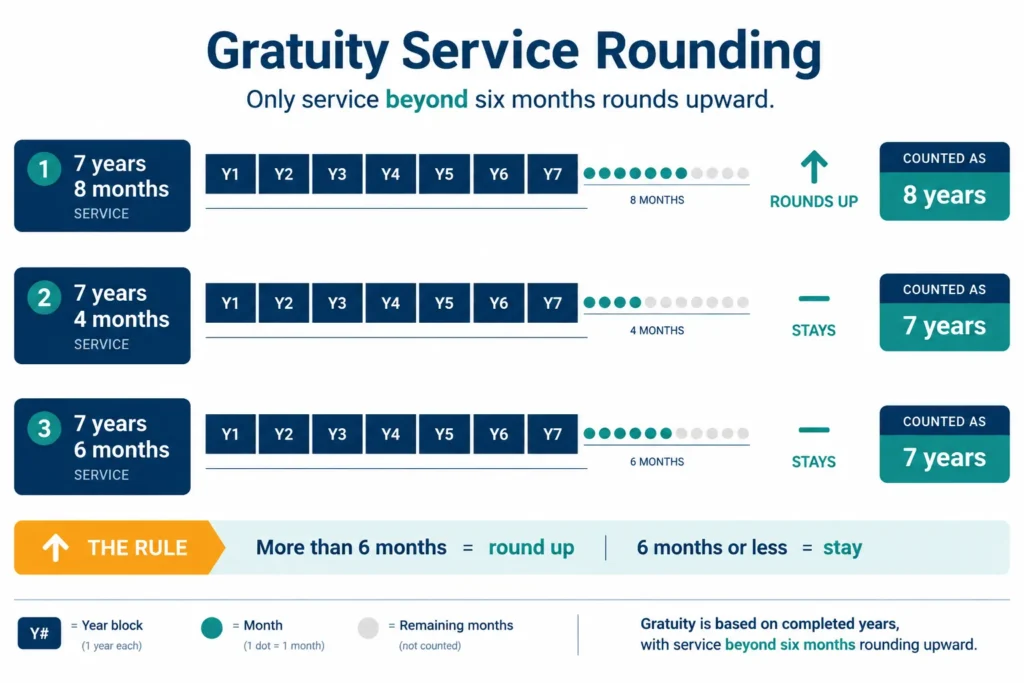
Timeline showing when additional months are included in years of service for gratuity calculation

Section 4 calculates gratuity for every completed year of service or part exceeding six months. Accordingly:

  • 7 years and 8 months: counted as 8 years.
  • 7 years and 4 months: counted as 7 years.
  • 7 years and exactly 6 months: generally counted as 7 years because the statutory wording says “in excess of six months.”

This rule determines the service used to calculate the amount after entitlement is established. It should not automatically be used to decide whether someone below five years has met the normal eligibility condition.

Which Salary Components Are Included?
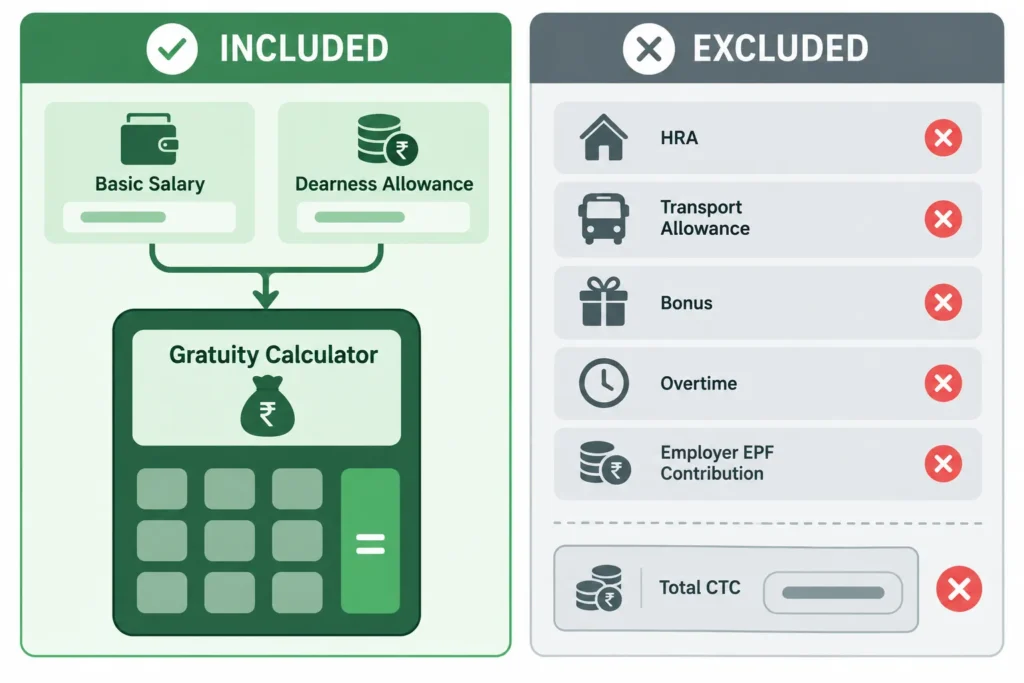
Salary components generally included and excluded from statutory gratuity wages in India

For the standard statutory formula, use the last drawn basic salary and dearness allowance. If the employee does not receive dearness allowance, the figure will commonly be basic salary alone.

The Act’s definition of wages excludes items such as bonus, commission, house rent allowance, overtime wages and other allowances. Consequently, the following should not normally be added to the statutory formula merely because they appear in CTC or on a payslip:

  • House rent allowance;
  • special or conveyance allowance;
  • overtime;
  • performance bonus or incentives;
  • employer EPF contributions; and
  • other excluded allowances.
You May Also Like:How Does the Stock Market Work in India? A Beginner’s Guide

Do not use gross salary, take-home salary or CTC without checking the legally eligible components. A more favourable employer scheme may use a broader salary definition.

Worked Gratuity Calculation Examples

Example 1: Exactly seven years

Assume the last drawn basic salary is ₹32,000, there is no dearness allowance and the employee completes exactly seven years.

₹32,000 × 15 ÷ 26 × 7 = ₹1,29,230.77

The estimated gratuity is ₹1,29,231, subject to the employer’s final calculation.

Example 2: More than six additional months

Assume eligible monthly wages of ₹45,000 and service of 10 years and 8 months. Because the additional period exceeds six months, 11 years are used.

₹45,000 × 15 ÷ 26 × 11 = ₹2,85,576.92

The estimated gratuity is ₹2,85,577.

Example 3: Six months or less

Assume eligible monthly wages of ₹28,000 and service of 8 years and 5 months. The extra five months are ignored, so the calculation uses eight years.

₹28,000 × 15 ÷ 26 × 8 = ₹1,29,230.77

The estimated gratuity is ₹1,29,231.

Example 4: Death before five years

Assume an employee dies after 3 years and 9 months and has last drawn eligible wages of ₹30,000. The five-year condition does not apply, and the part exceeding six months means four years are used.

₹30,000 × 15 ÷ 26 × 4 = ₹69,230.77

The estimated gratuity payable to the nominee or legal heirs is ₹69,231, subject to the required documentation.

Employees Outside the Statutory Formula

An employee outside the Act may still receive gratuity under a contract, award, settlement, service rule or voluntary employer policy. The document may define salary, qualifying service and partial-year treatment differently.

A commonly used non-statutory approach is:

Gratuity = Applicable monthly salary × 15 ÷ 30 × completed years

This is not a universal legal formula for every employee outside the Act. Use it only where the governing employment terms require it. A covered employer’s policy may improve the statutory benefit but cannot ordinarily reduce the minimum provided by the Act.

Maximum Gratuity Amount

Section 4 authorises the Central Government to notify the statutory gratuity ceiling. The currently applicable ceiling is ₹20 lakh. This is the maximum compulsory amount under the Act, not necessarily the maximum an employer may pay.

An award, agreement, contract or company scheme can provide a higher benefit. Keep these figures separate:

  • Formula amount: Wages multiplied by the statutory service formula.
  • Statutory ceiling: The maximum amount compulsorily payable under the Act.
  • Actual payment: The amount paid under the Act and any better employer terms.
  • Tax exemption: The amount exempt under the Income-tax Act, calculated separately.
You May Also Like:Mutual Funds and SIP Investing in India: A Complete Beginner’s Guide

Is Gratuity Taxable?

Tax treatment is governed by Section 10(10) of the Income-tax Act, 1961. It depends on the employee category, coverage under the Payment of Gratuity Act, the amount received and exemptions claimed for earlier gratuity receipts.

Government employees

Gratuity received by qualifying Central Government, state government and local authority employees is generally exempt under Section 10(10)(i). Employment by a public sector undertaking or government-owned company does not by itself place an employee in this category.

Employees covered by the Payment of Gratuity Act

For a covered employee, the exempt amount is generally the lowest of:

  • the gratuity actually received;
  • 15 days’ wages for every completed year or part exceeding six months, calculated using the applicable formula; or
  • the applicable ₹20 lakh tax-exemption ceiling.

For example, if an employee receives ₹9 lakh but the formula amount for tax purposes is ₹8.5 lakh, the exemption is generally limited to ₹8.5 lakh, assuming the lifetime ceiling has not already been partly used. The remaining ₹50,000 may be taxable.

Employees not covered by the Payment of Gratuity Act

For a qualifying employee outside the Act, the exempt amount is generally the lowest of:

  • the gratuity actually received;
  • half a month’s average salary for each completed year of service; or
  • the applicable ₹20 lakh tax-exemption ceiling.

Average salary is generally based on the 10 months immediately preceding the month in which retirement or termination occurs. For this purpose, salary generally includes basic salary, dearness allowance to the extent it forms part of retirement benefits, and commission based on a fixed percentage of turnover. Fractions of a year are normally ignored for this category.

The ₹20 lakh tax limit is an aggregate ceiling. An exemption claimed for gratuity from an earlier employer can reduce the amount available for a later receipt. Preserve prior gratuity statements, Form 16, payment records and income-tax return documents.

Payment Deadline, Interest and Claims

Under Section 7 of the Payment of Gratuity Act, the employer must determine the gratuity when it becomes payable and give written notice to the eligible person and controlling authority. The employer’s obligation to determine the amount is not removed merely because an employee has not submitted an application immediately.

The employer must generally pay gratuity within 30 days from the date it becomes payable. Simple interest may apply to delayed payment, except where the delay is attributable to the employee and the employer has obtained the prescribed permission from the controlling authority.

If entitlement or the amount is disputed, the employer is required to deposit the admitted amount with the controlling authority. An employee, nominee or legal heir can approach the controlling authority under the Act for unresolved claims.

Keep copies of the appointment letter, joining and leaving records, final payslips, resignation or retirement acceptance, service certificate, nomination, calculation sheet and payment correspondence.

When Can Gratuity Be Forfeited?

Gratuity cannot ordinarily be forfeited merely because an employee resigned, did not complete a preferred notice period or had an ordinary workplace disagreement.

Section 4(6) permits forfeiture only in specified circumstances connected with termination:

  • to the extent of damage or loss caused by a wilful act, omission or negligence;
  • wholly or partly for riotous or disorderly conduct or an act of violence; or
  • wholly or partly for an offence involving moral turpitude committed in the course of employment.

The facts, termination order and statutory conditions matter. Employees facing forfeiture should request the employer’s reasons and calculation in writing.

How to Check Your Gratuity Calculation

  1. Confirm coverage: Check whether the establishment and employment fall under the Act.
  2. Establish eligibility: Verify continuous service and whether the death or disablement exception applies.
  3. Check dates: Use the documented joining date and last working date.
  4. Identify eligible wages: Start with last drawn basic salary and dearness allowance, not CTC.
  5. Count service: Include a part-year only when it exceeds six months.
  6. Apply the formula: Multiply wages by 15, divide by 26 and multiply by counted years.
  7. Check better terms: Review the appointment letter, settlement, award or company policy.
  8. Apply the ceiling: Compare the statutory entitlement with the current limit.
  9. Calculate tax separately: Do not assume that the entire employer payment is exempt.
  10. Request a written statement: Compare the employer’s figures with your records.
You May Also Like:5 Common Financial Traps to Avoid in India

When planning how gratuity fits into retirement savings, it may also help to understand NPS account types, contributions and retirement planning.

Frequently Asked Questions

Can I receive gratuity after resigning?

Yes. Resignation is a qualifying event under the Act once the normal continuous-service requirement is met. Death and disablement are exceptions to the five-year requirement.

Is gratuity based on gross salary?

Not under the standard statutory formula. A monthly rated employee generally uses last drawn basic salary plus dearness allowance. Gross salary, take-home pay and CTC can include excluded components.

Is six months rounded up?

No. The Act refers to a part of a year in excess of six months. Exactly six months is therefore generally not rounded up, while six months plus additional service is.

Can gratuity from different employers be combined?

Normally, each employer calculates gratuity for service with that employer. Continuity may need separate consideration after an internal transfer, business transfer or arrangement expressly preserving service.

What if my basic salary changed during employment?

For a monthly rated employee covered by the Act, the calculation generally uses last drawn eligible wages. It does not average every salary received during the employee’s career.

Can an employer pay more than ₹20 lakh?

Yes. A contract, award, settlement or employer scheme may provide a better benefit. However, payment above the statutory ceiling is not automatically tax-exempt.

What should I do if gratuity is delayed?

Ask the employer for the calculation and payment status in writing. If the matter remains unresolved, an eligible claimant may approach the controlling authority under the Payment of Gratuity Act and seek the amount and applicable interest.

  • Payment of Gratuity Act, 1972, particularly Sections 1, 2, 2A, 4, 6 and 7.
  • Income-tax Act, 1961, Section 10(10), for gratuity exemptions.
  • Income-tax Rules, 1962 and applicable government notifications for prescribed tax calculations and monetary limits.

Rules, notifications and individual employment terms can affect the result. Treat calculator outputs as estimates and verify a material claim against current official records or qualified advice.


Share this article
KEEP READING

Related Articles

View all →

Comments

Leave a Comment

How to Calculate Gratuity in India: Formula, Eligibility and Examples

For an employee covered by the Payment of Gratuity Act, 1972, the standard gratuity calculation is:

Gratuity = Last drawn monthly wages × 15 ÷ 26 × years of service counted for gratuity

For most monthly rated employees, “wages” for this formula means the last drawn basic salary plus dearness allowance, if applicable. It does not normally mean gross salary, take-home pay or total cost to company (CTC).

Use the calculator below for an estimate, then check the assumptions against your payslip, service record and employer policy.

Employee Benefits Calculator

Gratuity Calculator India

Estimate gratuity using eligible monthly wages and your service period.

₹50,000

Enter eligible wages under applicable gratuity rules, not automatically your full CTC or take-home salary.

5 years, 0 months

Eligibility and service rounding may differ for fixed-term employment, death, disablement, and other special circumstances.

This is an indicative estimate. The employer's eligible wage calculation, service record, applicable law, and any better contractual benefit can change the amount.
Eligible Monthly Wages₹50,000
Qualifying Service Used5 years
Estimated Gratuity₹1,44,231Subject to applicable statutory ceiling
Before Ceiling₹1,44,231

Calculation breakdown

₹50,000 ÷ 26 × 15 × 5 years

How to read this estimate

The estimate uses 15 days' wages for each qualifying year, subject to applicable rules and ceiling.

Disclaimer: This calculator is for general information and planning only, not legal advice or an official gratuity determination. The Code on Social Security, 2020 and applicable rules govern gratuity, including the definition of wages. Verify eligibility, wage components, ceiling, and calculation with your employer or a qualified professional.

Important assumption: Unless stated otherwise, the examples below assume a monthly rated employee covered by the Payment of Gratuity Act, continuous service with one employer and no more favourable gratuity scheme. Special rules can apply to seasonal establishments, piece-rated employees, disablement cases and employees outside the Act.

What Is Gratuity?

Gratuity is an employer-funded, lump-sum employment benefit. It generally becomes payable when eligible employment ends because of superannuation, retirement, resignation, death or disablement.

Gratuity is different from the Employees’ Provident Fund (EPF). EPF is accumulated through regular contributions, while gratuity is normally paid by the employer at the end of qualifying service. Employees do not ordinarily make a separate gratuity contribution from salary.

The principal law considered in this guide is the Payment of Gratuity Act, 1972. An employment contract, award, settlement or company scheme may provide better terms than the statutory minimum.

Who Is Eligible for Gratuity?

Normal five-year requirement

Under Section 4 of the Payment of Gratuity Act, gratuity generally becomes payable after at least five years of continuous service when employment ends because of superannuation, retirement or resignation.

Resignation therefore qualifies. Gratuity is not restricted to employees who retire, and an employer cannot ordinarily reject an otherwise valid claim merely because the employee resigned.

Death or disablement

The five-year minimum does not apply when employment ends because of death or disablement due to accident or disease. In the event of death, gratuity is generally paid to the nominee or, where there is no valid nomination, to the legal heirs through the applicable procedure.

Establishments covered by the Act

The Act applies to factories, mines, oilfields, plantations, ports and railway companies. It also applies to shops and establishments in which 10 or more persons are employed, or were employed on any day in the preceding 12 months, as well as other establishments notified by the government.

Once the Act applies to an establishment, Section 1 provides that it continues to apply even if the number of employees later falls below 10.

What counts as continuous service?

Continuous service is not necessarily broken by every absence from work. Section 2A covers uninterrupted service and specified interruptions, including sickness, accident, authorised leave, lay-off, strike, lockout and cessation of work not caused by the employee. The Act also contains working-day tests for cases where service is not otherwise treated as uninterrupted.

Changing to a separate employer normally starts a new gratuity service period. A transfer within the same legal employer, or a transfer where continuity is expressly preserved, may require examination of the employment records and transfer terms.

Does four years and more than six months qualify?

Employees should not assume that the calculation rule for a part-year automatically reduces the five-year eligibility requirement. Section 4 refers to five years of continuous service, while Section 2A contains separate rules for determining continuous service.

Cases close to five years can depend on the employee’s working pattern, establishment type, service records and applicable judicial interpretation. Ask the employer for a written decision or obtain appropriate professional advice rather than relying only on a calculator.

Gratuity Calculation Formula

Statutory gratuity formula using eligible monthly wages, 15 days, 26 working days and counted service years

For a monthly rated employee covered by the Act:

Gratuity = Last drawn basic salary plus dearness allowance × 15 ÷ 26 × counted years of service

  • Last drawn wages: The eligible monthly wage at the end of employment.
  • 15: Fifteen days’ wages for each completed year.
  • 26: The statutory divisor used for a monthly rated employee.
  • Counted service: Completed years plus a part of a year exceeding six months.

How partial years are counted

Timeline showing when additional months are included in years of service for gratuity calculation

Section 4 calculates gratuity for every completed year of service or part exceeding six months. Accordingly:

  • 7 years and 8 months: counted as 8 years.
  • 7 years and 4 months: counted as 7 years.
  • 7 years and exactly 6 months: generally counted as 7 years because the statutory wording says “in excess of six months.”

This rule determines the service used to calculate the amount after entitlement is established. It should not automatically be used to decide whether someone below five years has met the normal eligibility condition.

Which Salary Components Are Included?

Salary components generally included and excluded from statutory gratuity wages in India

For the standard statutory formula, use the last drawn basic salary and dearness allowance. If the employee does not receive dearness allowance, the figure will commonly be basic salary alone.

The Act’s definition of wages excludes items such as bonus, commission, house rent allowance, overtime wages and other allowances. Consequently, the following should not normally be added to the statutory formula merely because they appear in CTC or on a payslip:

  • House rent allowance;
  • special or conveyance allowance;
  • overtime;
  • performance bonus or incentives;
  • employer EPF contributions; and
  • other excluded allowances.

Do not use gross salary, take-home salary or CTC without checking the legally eligible components. A more favourable employer scheme may use a broader salary definition.

Worked Gratuity Calculation Examples

Example 1: Exactly seven years

Assume the last drawn basic salary is ₹32,000, there is no dearness allowance and the employee completes exactly seven years.

₹32,000 × 15 ÷ 26 × 7 = ₹1,29,230.77

The estimated gratuity is ₹1,29,231, subject to the employer’s final calculation.

Example 2: More than six additional months

Assume eligible monthly wages of ₹45,000 and service of 10 years and 8 months. Because the additional period exceeds six months, 11 years are used.

₹45,000 × 15 ÷ 26 × 11 = ₹2,85,576.92

The estimated gratuity is ₹2,85,577.

Example 3: Six months or less

Assume eligible monthly wages of ₹28,000 and service of 8 years and 5 months. The extra five months are ignored, so the calculation uses eight years.

₹28,000 × 15 ÷ 26 × 8 = ₹1,29,230.77

The estimated gratuity is ₹1,29,231.

Example 4: Death before five years

Assume an employee dies after 3 years and 9 months and has last drawn eligible wages of ₹30,000. The five-year condition does not apply, and the part exceeding six months means four years are used.

₹30,000 × 15 ÷ 26 × 4 = ₹69,230.77

The estimated gratuity payable to the nominee or legal heirs is ₹69,231, subject to the required documentation.

Employees Outside the Statutory Formula

An employee outside the Act may still receive gratuity under a contract, award, settlement, service rule or voluntary employer policy. The document may define salary, qualifying service and partial-year treatment differently.

A commonly used non-statutory approach is:

Gratuity = Applicable monthly salary × 15 ÷ 30 × completed years

This is not a universal legal formula for every employee outside the Act. Use it only where the governing employment terms require it. A covered employer’s policy may improve the statutory benefit but cannot ordinarily reduce the minimum provided by the Act.

Maximum Gratuity Amount

Section 4 authorises the Central Government to notify the statutory gratuity ceiling. The currently applicable ceiling is ₹20 lakh. This is the maximum compulsory amount under the Act, not necessarily the maximum an employer may pay.

An award, agreement, contract or company scheme can provide a higher benefit. Keep these figures separate:

  • Formula amount: Wages multiplied by the statutory service formula.
  • Statutory ceiling: The maximum amount compulsorily payable under the Act.
  • Actual payment: The amount paid under the Act and any better employer terms.
  • Tax exemption: The amount exempt under the Income-tax Act, calculated separately.

Is Gratuity Taxable?

Tax treatment is governed by Section 10(10) of the Income-tax Act, 1961. It depends on the employee category, coverage under the Payment of Gratuity Act, the amount received and exemptions claimed for earlier gratuity receipts.

Government employees

Gratuity received by qualifying Central Government, state government and local authority employees is generally exempt under Section 10(10)(i). Employment by a public sector undertaking or government-owned company does not by itself place an employee in this category.

Employees covered by the Payment of Gratuity Act

For a covered employee, the exempt amount is generally the lowest of:

  • the gratuity actually received;
  • 15 days’ wages for every completed year or part exceeding six months, calculated using the applicable formula; or
  • the applicable ₹20 lakh tax-exemption ceiling.

For example, if an employee receives ₹9 lakh but the formula amount for tax purposes is ₹8.5 lakh, the exemption is generally limited to ₹8.5 lakh, assuming the lifetime ceiling has not already been partly used. The remaining ₹50,000 may be taxable.

Employees not covered by the Payment of Gratuity Act

For a qualifying employee outside the Act, the exempt amount is generally the lowest of:

  • the gratuity actually received;
  • half a month’s average salary for each completed year of service; or
  • the applicable ₹20 lakh tax-exemption ceiling.

Average salary is generally based on the 10 months immediately preceding the month in which retirement or termination occurs. For this purpose, salary generally includes basic salary, dearness allowance to the extent it forms part of retirement benefits, and commission based on a fixed percentage of turnover. Fractions of a year are normally ignored for this category.

The ₹20 lakh tax limit is an aggregate ceiling. An exemption claimed for gratuity from an earlier employer can reduce the amount available for a later receipt. Preserve prior gratuity statements, Form 16, payment records and income-tax return documents.

Payment Deadline, Interest and Claims

Under Section 7 of the Payment of Gratuity Act, the employer must determine the gratuity when it becomes payable and give written notice to the eligible person and controlling authority. The employer’s obligation to determine the amount is not removed merely because an employee has not submitted an application immediately.

The employer must generally pay gratuity within 30 days from the date it becomes payable. Simple interest may apply to delayed payment, except where the delay is attributable to the employee and the employer has obtained the prescribed permission from the controlling authority.

If entitlement or the amount is disputed, the employer is required to deposit the admitted amount with the controlling authority. An employee, nominee or legal heir can approach the controlling authority under the Act for unresolved claims.

Keep copies of the appointment letter, joining and leaving records, final payslips, resignation or retirement acceptance, service certificate, nomination, calculation sheet and payment correspondence.

When Can Gratuity Be Forfeited?

Gratuity cannot ordinarily be forfeited merely because an employee resigned, did not complete a preferred notice period or had an ordinary workplace disagreement.

Section 4(6) permits forfeiture only in specified circumstances connected with termination:

  • to the extent of damage or loss caused by a wilful act, omission or negligence;
  • wholly or partly for riotous or disorderly conduct or an act of violence; or
  • wholly or partly for an offence involving moral turpitude committed in the course of employment.

The facts, termination order and statutory conditions matter. Employees facing forfeiture should request the employer’s reasons and calculation in writing.

How to Check Your Gratuity Calculation

  1. Confirm coverage: Check whether the establishment and employment fall under the Act.
  2. Establish eligibility: Verify continuous service and whether the death or disablement exception applies.
  3. Check dates: Use the documented joining date and last working date.
  4. Identify eligible wages: Start with last drawn basic salary and dearness allowance, not CTC.
  5. Count service: Include a part-year only when it exceeds six months.
  6. Apply the formula: Multiply wages by 15, divide by 26 and multiply by counted years.
  7. Check better terms: Review the appointment letter, settlement, award or company policy.
  8. Apply the ceiling: Compare the statutory entitlement with the current limit.
  9. Calculate tax separately: Do not assume that the entire employer payment is exempt.
  10. Request a written statement: Compare the employer’s figures with your records.

When planning how gratuity fits into retirement savings, it may also help to understand NPS account types, contributions and retirement planning.

Frequently Asked Questions

Can I receive gratuity after resigning?

Yes. Resignation is a qualifying event under the Act once the normal continuous-service requirement is met. Death and disablement are exceptions to the five-year requirement.

Is gratuity based on gross salary?

Not under the standard statutory formula. A monthly rated employee generally uses last drawn basic salary plus dearness allowance. Gross salary, take-home pay and CTC can include excluded components.

Is six months rounded up?

No. The Act refers to a part of a year in excess of six months. Exactly six months is therefore generally not rounded up, while six months plus additional service is.

Can gratuity from different employers be combined?

Normally, each employer calculates gratuity for service with that employer. Continuity may need separate consideration after an internal transfer, business transfer or arrangement expressly preserving service.

What if my basic salary changed during employment?

For a monthly rated employee covered by the Act, the calculation generally uses last drawn eligible wages. It does not average every salary received during the employee’s career.

Can an employer pay more than ₹20 lakh?

Yes. A contract, award, settlement or employer scheme may provide a better benefit. However, payment above the statutory ceiling is not automatically tax-exempt.

What should I do if gratuity is delayed?

Ask the employer for the calculation and payment status in writing. If the matter remains unresolved, an eligible claimant may approach the controlling authority under the Payment of Gratuity Act and seek the amount and applicable interest.

Official Legal Sources

  • Payment of Gratuity Act, 1972, particularly Sections 1, 2, 2A, 4, 6 and 7.
  • Income-tax Act, 1961, Section 10(10), for gratuity exemptions.
  • Income-tax Rules, 1962 and applicable government notifications for prescribed tax calculations and monetary limits.

Rules, notifications and individual employment terms can affect the result. Treat calculator outputs as estimates and verify a material claim against current official records or qualified advice.

Leave a Comment