


NSE and BSE are India’s two major stock exchanges. Both provide regulated marketplaces where investors can buy and sell shares, bonds, exchange-traded funds and other securities through registered brokers.
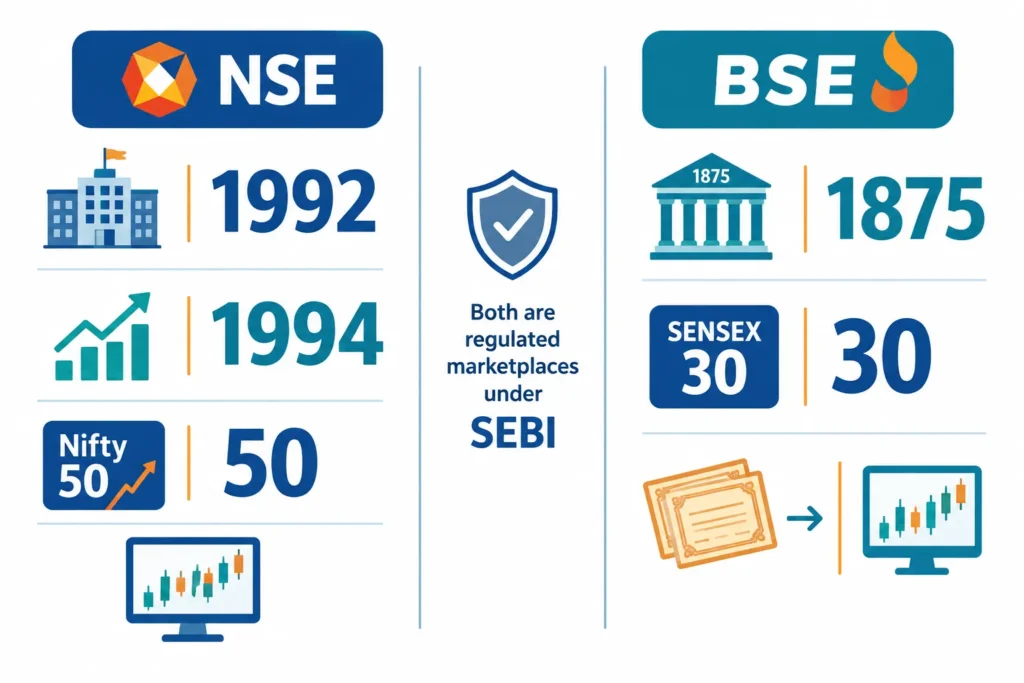
BSE, established in 1875, is Asia’s oldest stock exchange and has an important place in India’s financial history. NSE was incorporated in 1992 and began equity-market operations in 1994. It helped make screen-based electronic trading widely accessible across India.
For most beginners, the practical difference is usually trading activity. A share may be listed on one exchange or both. When it is available on both, investors often choose the exchange offering better liquidity and a suitable market price at that moment. Both exchanges operate under the regulatory framework of the Securities and Exchange Board of India, or SEBI.
Introduction
If you open a trading app in India, you may see two prices for the same company: one marked NSE and another marked BSE. This can make a first-time investor wonder which exchange is safer, cheaper or better.
The simple answer is that NSE and BSE perform the same basic function. They provide organised marketplaces for trading securities. However, they differ in their history, benchmark indices, trading activity, listed-company presence and role in the development of India’s capital markets.
You do not normally visit either exchange or place an order with it directly. You use a SEBI-registered stockbroker, usually through a website or mobile app. The broker sends your order to the exchange you select. The exchange’s trading system then attempts to match it with a suitable order from another market participant.
This section explains how that process works and introduces the main differences in the NSE vs BSE comparison. Readers who need a wider foundation can also refer to RegularStation’s Stock Market & Investing in India: A Complete Beginner’s Guide and its beginner guide on how the stock market works.
Section 1: Stock Exchanges, NSE and BSE Explained
What Is a Stock Exchange?
A stock exchange is an organised and regulated marketplace for securities. It brings buyers and sellers together through a trading system and sets rules for how orders, trades and listed securities are handled.
Consider a simple example. An investor wants to buy shares of an Indian listed company. Another investor wants to sell shares of the same company. The exchange provides the system through which compatible buy and sell orders can be matched.
Companies and investors need exchanges for different reasons:
- Companies: A company can use the capital market to raise money from investors, subject to applicable rules. After listing, its shares may be traded on the exchange.
- Investors: Investors get a formal marketplace where they can buy or sell eligible securities through registered intermediaries.
- The market: An exchange supports price discovery, trade reporting, standardised processes and transparent order handling.
A stock exchange does not promise that an investment will make money. It provides trading infrastructure, but share prices can rise or fall. Investors must still evaluate the business, valuation and risks before investing.
How Buy and Sell Orders Are Matched
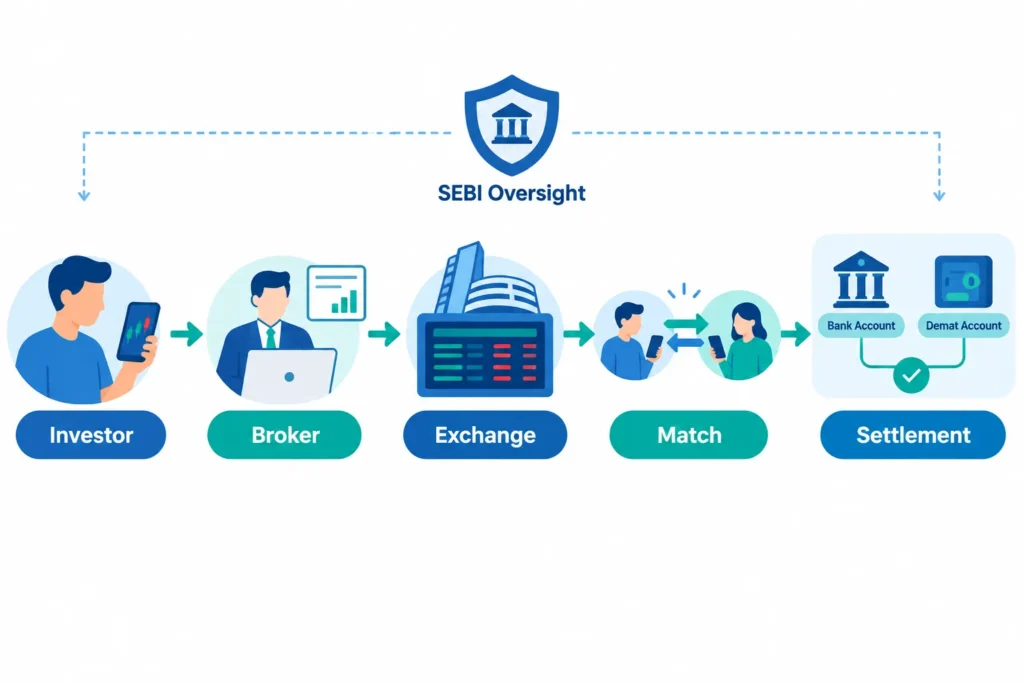
Every order contains important instructions. These may include the security, quantity, exchange, order type and price. A market order generally seeks execution at the best available price, while a limit order specifies the maximum price a buyer will pay or the minimum price a seller will accept.
These orders enter an electronic order book. The order book contains available buy orders and sell orders at different prices. The exchange applies its matching rules to compatible orders, generally considering price priority and then time priority.
Suppose Meera places a limit order to buy 10 shares at up to Rs 500 each. Arjun places an order to sell 10 shares at Rs 500 each. If the orders meet the exchange’s matching conditions, a trade may take place. If sellers are asking for more than Meera’s limit, her order may remain pending or unexecuted.
The price shown on a trading screen can change quickly because orders are continuously added, modified, matched or cancelled. This is also why the same share can have a small price difference on NSE and BSE at a particular moment. Each exchange has its own order book.
Where Brokers and Demat Accounts Fit In
A retail investor usually needs both a trading account and a demat account, although brokers often make them available through a combined onboarding process.
- Broker or trading account: The broker provides the platform used to place orders and routes those orders to the selected exchange.
- Demat account: This holds eligible securities in electronic form. It is maintained through a depository participant connected to a depository.
- Bank account: This is used for the movement of money related to purchases, sales and other account transactions.
The exchange is the trading venue; it is not the same as your broker or demat account. This distinction matters when comparing NSE vs BSE. You may use one broker and one demat account to trade eligible shares across both exchanges, depending on the broker’s services and the security’s availability.
How SEBI Regulates the Market
SEBI is India’s securities-market regulator. It creates and enforces regulations for market participants and oversees areas such as stock exchanges, brokers, listed entities, mutual funds and other intermediaries within its legal mandate.
NSE and BSE are both recognised stock exchanges operating under India’s securities laws and SEBI’s regulatory framework. They must follow applicable requirements relating to trading systems, surveillance, disclosures, risk management and investor protection.
Regulation reduces certain market and operational risks, but it does not remove investment risk. SEBI oversight does not mean that every listed company is a good investment or that an investor cannot suffer a loss.
What Is BSE?
BSE was established in 1875. It was historically known as the Bombay Stock Exchange and is recognised for its long role in the development of India’s organised securities market.
Its best-known benchmark is the S&P BSE Sensex, commonly called the Sensex. The index tracks a selected group of large and actively traded companies and is widely used as an indicator of broad market movement.
BSE has a broad listed-company presence, including many companies that may not be actively traded every day. A large number of listed securities does not automatically mean that every security has strong liquidity. Investors should check the actual trading volume, bid-ask spread and order availability before placing an order.
What Is NSE?
The National Stock Exchange of India, or NSE, was incorporated in 1992. It began operations in the wholesale debt market in 1994 and started capital-market, or equity-market, operations later that year.
NSE played a major role in expanding fully automated, screen-based trading in India. Its electronic network allowed market participants in different locations to access the trading system without depending on a physical trading floor.
NSE’s main benchmark is the Nifty 50. It represents 50 large companies selected under the index methodology and is one of the most widely followed measures of the Indian equity market.
NSE commonly has high trading activity in many widely held shares and in major equity-derivatives contracts. However, liquidity should always be checked security by security. A popular company may trade actively on both exchanges, while a less-followed security may have limited activity.
NSE vs BSE Comparison
| Feature | NSE | BSE |
|---|---|---|
| Full name | National Stock Exchange of India | BSE, historically known as Bombay Stock Exchange |
| Establishment | Incorporated in 1992; equity-market operations began in 1994 | Established in 1875 |
| Historical importance | Helped expand nationwide, screen-based electronic trading | Asia’s oldest stock exchange and a major part of India’s market history |
| Main benchmark index | Nifty 50 | S&P BSE Sensex |
| Typical trading activity | Often records strong activity in widely traded shares and major derivatives | Active in many securities, though activity varies significantly by security |
| Liquidity | Often higher for many popular shares and index-linked derivatives, but it must be checked for each instrument | Can be strong in actively traded securities, but some listed shares may have limited orders |
| Listed-company presence | Includes companies across large, mid-sized, small and specialised market categories | Known for a broad listed-company base, including many older and smaller listings |
| Trading technology | Built around automated, electronic, screen-based trading | Moved from traditional floor-based trading to modern electronic trading |
| Market segments | Includes equity, equity derivatives, debt, currency derivatives and other permitted segments | Includes equity, derivatives, debt, currency-related products and other permitted segments |
| Regulatory oversight | Operates under SEBI regulation and applicable Indian securities laws | Operates under SEBI regulation and applicable Indian securities laws |
The key beginner takeaway is that NSE and BSE are not competing versions of the same company share. They are separate regulated marketplaces. If a company is listed on both, its shares represent the same underlying ownership, but each exchange maintains a separate order book. That can create small differences in price, volume and ease of execution at any given time.
Nifty 50, Sensex, Liquidity and Price Differences
When comparing NSE vs BSE, beginners often focus on two familiar names: Nifty 50 and Sensex. These are stock market indices. They help investors understand how a selected group of large companies is performing.
The two exchanges can also show slightly different prices for the same share. This happens because NSE and BSE operate separate trading systems, with their own buyers, sellers and order books. Understanding indices, liquidity and price differences can help you choose an exchange when placing an order.
Nifty 50 and Sensex: What Do They Represent?
The Nifty 50 is the benchmark index commonly associated with the National Stock Exchange. It tracks 50 large and actively traded companies listed on the NSE, subject to the index provider’s selection rules.
The S&P BSE Sensex is the benchmark index commonly associated with the Bombay Stock Exchange. It tracks 30 large and established companies listed on the BSE, based on its applicable selection rules.
| Point | Nifty 50 | S&P BSE Sensex |
|---|---|---|
| Associated exchange | National Stock Exchange | Bombay Stock Exchange |
| Number of constituent companies | 50 | 30 |
| Main purpose | To indicate the performance of a group of major NSE-listed companies | To indicate the performance of a group of major BSE-listed companies |
| Common use | Market tracking, comparison and index-based investing | Market tracking, comparison and index-based investing |
Both indices cover major sectors of the Indian economy, such as banking, information technology, energy, consumer goods and automobiles. However, neither index represents every company listed on its exchange.
If the Nifty 50 or Sensex rises, it generally means that the combined movement of its constituent shares has been positive. It does not mean that every listed share has increased. Some companies may rise sharply, some may remain flat and others may fall on the same day.
Similarly, an index decline does not mean that every stock in the market has lost value. An index is a calculated indicator, not a complete record of the price movement of every listed company.
The number of companies in an index does not tell you which exchange will provide better investment returns. The Nifty 50 having 50 constituents and the Sensex having 30 does not make one automatically safer or more profitable. Returns depend on the investments selected, their purchase prices, business performance, holding period, costs and market conditions.
Beginners who want to understand how companies enter or leave an index can read a separate guide on stock market indices. Index composition can change over time when the relevant index provider reviews its eligibility and selection criteria.
What Is Trading Volume?
Trading volume is the number of shares traded during a particular period. For example, if 10 lakh shares of a company change hands during a trading day, its daily trading volume is 10 lakh shares.
Volume can differ between NSE and BSE for the same company. A share may attract more trading activity on one exchange because more market participants place their orders there.
High volume alone does not mean that a share is a good investment. It only tells you that substantial trading activity has taken place. You still need to examine the company, valuation, risks and your financial goals.
What Is Liquidity?
Liquidity describes how easily you can buy or sell an investment without causing a significant change in its market price. A liquid share usually has many active buyers and sellers.
Suppose you want to sell 100 shares of a large Indian company. If several buyers are ready to purchase those shares near the current market price, your order may be executed quickly. This is an example of relatively high liquidity.
Now imagine that you want to sell shares of a less actively traded company. There may be only a few buyers, or they may be willing to buy only at much lower prices. You might have to wait, reduce your selling price or sell only part of your quantity. This indicates lower liquidity.
Liquidity can change during the day. It can also be affected by company announcements, market news, unusual volatility and the size of your order. A stock that is normally liquid may temporarily show wider price gaps during a fast-moving market.
Bid, Ask and Bid-Ask Spread
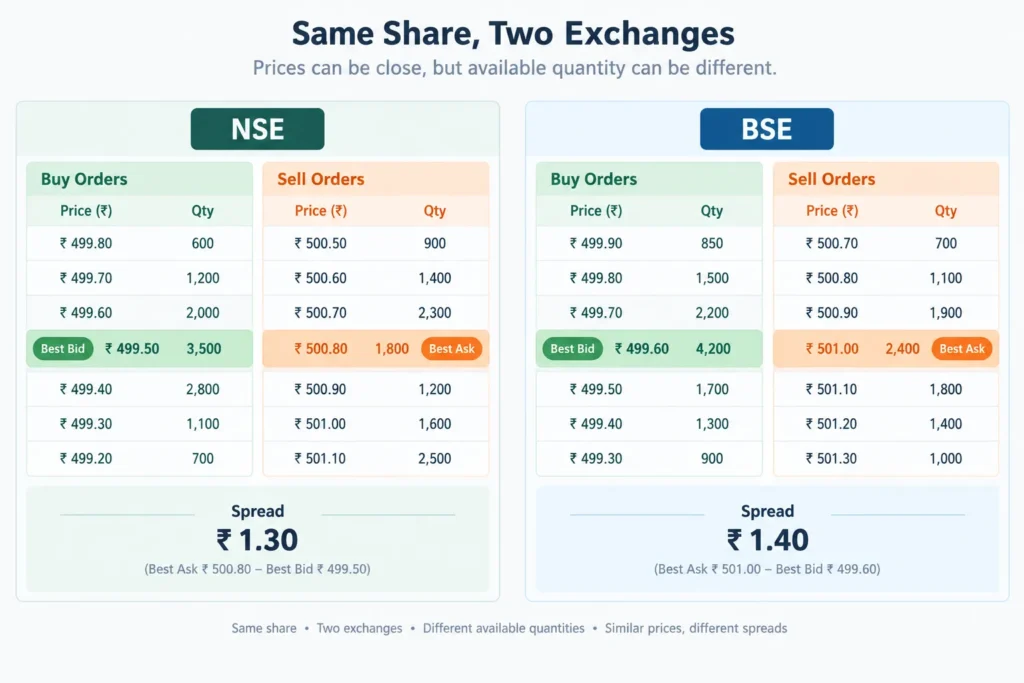
The bid price is the highest price that a buyer is currently willing to pay for a share. The ask price, also called the offer price, is the lowest price at which a seller is currently willing to sell it.
The difference between these two prices is the bid-ask spread.
Consider a liquid share with the following prices:
- Highest bid: ₹500.00
- Lowest ask: ₹500.10
- Bid-ask spread: ₹0.10
The small spread suggests that buyers and sellers are quoting prices close to each other. If you place an order for a modest quantity, it may be easier to complete the trade near the displayed market price.
Now consider a less actively traded share:
- Highest bid: ₹98
- Lowest ask: ₹102
- Bid-ask spread: ₹4
Here, the gap between the best buyer and seller is much wider. If you buy immediately at ₹102 and then try to sell immediately at the available bid of ₹98, the price difference works against you even before considering brokerage, taxes and other charges.
A narrow spread often indicates better liquidity, but it should not be viewed in isolation. You should also check the available quantity at each price, the usual trading volume and current market conditions.
What Is an Order Book?
An order book is the exchange’s electronic list of pending buy and sell orders for a share. It shows the prices and quantities at which market participants want to trade.
For example, buyers may have pending orders at ₹500, ₹499.90 and ₹499.80. Sellers may have orders at ₹500.10, ₹500.20 and ₹500.30. The best bid is the highest available buy price, while the best ask is the lowest available sell price.
The visible best bid or ask may not have enough quantity to fill your entire order. Suppose the lowest ask is ₹500.10, but only 20 shares are available at that price. If you place a market order to buy 100 shares, the remaining quantity may be executed against sellers quoting higher prices.
This is why order size matters. A price displayed on your trading screen is not a promise that your complete order will be filled at that exact rate.
A detailed guide on market orders and limit orders can help you understand how order type affects execution. A market order prioritises immediate execution, while a limit order allows you to specify the maximum buying price or minimum selling price you will accept. However, a limit order may remain unexecuted if the market does not reach your chosen price.
Why Can the Same Share Have Different Prices on NSE and BSE?
A company listed on both exchanges can have one order book on NSE and another on BSE. The buyers and sellers active on each exchange may place different orders at the same moment.
For instance, a share might show a best ask of ₹750.20 on NSE and ₹750.35 on BSE. At the same time, the best bid might be ₹750.10 on NSE and ₹750.05 on BSE. These small differences arise from the separate demand, supply, order quantities and execution activity on each platform.
Prices can change in fractions of a second. By the time you compare both exchanges and submit an order, the displayed quotes may have changed. The exchange showing the lower ask is therefore not guaranteed to remain cheaper when your order reaches the market.
You should also look beyond the last traded price. The last traded price only records the price of the most recent completed transaction on that exchange. If the last trade occurred earlier or involved a small quantity, it may not match the price currently available for your order.
Does the Exchange Affect Your Investment Return?
Your long-term return does not inherently depend on whether you bought the same company’s share on NSE or BSE. In both cases, you own shares of the same company, subject to successful settlement and the applicable market rules.
However, the exchange can affect the practical cost and ease of execution. The purchase or sale price may differ slightly because of liquidity, bid-ask spreads and the quantity available in the order book. Statutory charges and broker-related costs should also be checked when evaluating the total transaction cost.
Before placing an order, compare the bid, ask, spread and available quantity on both exchanges. For an actively traded large-cap share, the difference may be small. For a less liquid share or a larger order, the difference can be more important.
The sensible choice is usually the exchange offering sufficient liquidity and a suitable executable price for your required quantity. This does not make that exchange universally better. Conditions can vary by stock, order size and time of day.
Choosing Between NSE and BSE
For most beginners, choosing between NSE and BSE does not need to be a permanent decision. If a company is listed on both exchanges, you can compare the available prices and trading conditions when placing each order.
Neither NSE nor BSE is universally better. For a particular order, the more suitable exchange is usually the one offering adequate liquidity, a reasonable bid-ask spread and a better chance of execution at your preferred price.
What to Compare Before Placing an Order
Your broker’s order screen may allow you to select NSE or BSE. Before choosing, check the following factors.
- Stock availability: Confirm that the share is listed and available for trading on the selected exchange. Some securities may be listed on only one exchange.
- Current market price: The same share can show slightly different prices on NSE and BSE because orders are matched separately on each exchange.
- Trading volume: Volume shows how many shares have traded during a period. Higher volume can indicate more active participation, although volume alone does not guarantee easy execution.
- Liquidity: A liquid share generally has enough buyers and sellers for orders to be executed without causing a large price movement.
- Bid-ask spread: The bid is the highest available buying price, while the ask is the lowest available selling price. A narrower spread generally reduces the immediate cost of entering or exiting a position.
- Order depth: Market depth shows the number of buy and sell orders available at different prices. It can help you judge whether a larger order may be filled fully at the displayed price.
- Broker support: Check whether your trading platform supports the security, order type and exchange you want to use.
- Applicable charges: Brokerage, exchange transaction charges, statutory levies, taxes and other costs may apply. Review the broker’s latest tariff sheet and contract note rather than looking only at the share price.
Suppose a share is available at ₹500.10 on NSE and ₹500.00 on BSE. BSE may appear cheaper, but that does not automatically make it the better choice. If only a few shares are available at ₹500.00, your complete order may execute at higher prices. NSE may provide better overall execution if it has more sellers near ₹500.10.
Beginners should therefore avoid choosing an exchange based only on a small displayed price difference. Consider the spread, available quantity and total cost of the transaction.
Use Limit Orders When Price Matters
A market order aims to execute quickly at the best available prices, but the final price can differ from the price displayed when you submit it. This is more likely in a less liquid security or during a fast-moving market.
A limit order lets you specify the maximum price you are willing to pay when buying, or the minimum price you are willing to accept when selling. However, execution is not guaranteed. If the market does not reach your limit price, the order may remain pending or expire.
Can You Buy on NSE and Sell on BSE?
In some situations, an investor can buy a share on NSE and later sell the same share on BSE. This generally becomes simpler after the purchased shares have completed settlement and are available as holdings in the investor’s demat account.
Shares held in a demat account are not normally marked as “NSE shares” or “BSE shares” merely because of the exchange used for the original purchase. If the same security is listed and permitted for trading on both exchanges, settled holdings may generally be sold through either supported exchange.
However, the practical result depends on several conditions:
- The broker must support trading in that security on the chosen exchange.
- The security must be actively listed and available for trading there.
- The shares must be settled and available in the demat account for delivery.
- The investor must complete any required depository authorisation or delivery instruction.
- The order must comply with current exchange, settlement, surveillance and trading rules.
- Sufficient buyers must be available for the sell order to execute.
Special conditions may apply to securities under trade-to-trade restrictions, surveillance measures, periodic call auctions, corporate actions, suspension or other exchange controls. A failed delivery can also lead to auction-related consequences and additional costs under the applicable rules.
Do Not Treat an Intraday Position the Same Way
Beginners should not assume that an intraday purchase on NSE can always be closed by selling the same quantity on BSE. Brokers commonly maintain separate intraday positions and obligations for each exchange.
For example, buying 20 shares intraday on NSE and selling 20 shares on BSE may create two separate positions instead of closing one position. This can result in delivery obligations, margin requirements, penalties or auction risk if the investor does not have the required shares or funds.
Always use the exchange shown against the open intraday position unless your broker clearly confirms that cross-exchange closure is supported. Check the product type as well, such as delivery or intraday, before submitting the order.
Publication check: Trading hours, settlement processes and exchange rules can change. The latest details should be verified from official NSE, BSE and SEBI resources before publication or before acting on time-sensitive information. Investors should also confirm their broker’s current policies.
Frequently Asked Questions
1. Are NSE and BSE safe and regulated?
NSE and BSE are recognised stock exchanges operating within India’s securities regulatory framework. SEBI regulates the securities market, while exchanges and other market institutions apply relevant trading, risk-management and surveillance rules. Regulation reduces certain operational risks, but it does not protect investors from normal market losses or poor investment decisions.
2. Can the same company trade on both NSE and BSE?
Yes. Many Indian companies are listed on both exchanges. Their shares can trade simultaneously through separate order books. Some companies or securities may be available on only one exchange, so availability should be checked before ordering.
3. Why is the same share priced differently on NSE and BSE?
Each exchange matches its own buy and sell orders. Differences in demand, supply, liquidity and order depth can produce small price variations. These gaps may narrow as market participants respond, but identical prices are not guaranteed.
4. What is the difference between Nifty 50 and Sensex?
Nifty 50 is a broad market index associated with NSE and tracks a selected group of major listed companies. Sensex is a benchmark index associated with BSE and tracks a different selected group. Both are used as indicators of the Indian equity market, but their number of constituents, selection methods and index weights differ.
5. Which exchange is better for a beginner?
Neither exchange is automatically better for every beginner or every trade. If a share is listed on both, compare liquidity, spread, order depth, price and broker support. A beginner may prefer the exchange offering clearer execution conditions for that particular order.
6. Can I buy on NSE today and sell on BSE later?
It may be possible after the shares are settled and visible as available holdings in your demat account, provided the security trades on BSE and your broker supports the transaction. Do not assume that an unsettled or intraday position can be closed across exchanges.
7. What do liquidity and bid-ask spread mean?
Liquidity refers to how easily a security can be bought or sold without significantly affecting its price. The bid-ask spread is the gap between the best available buying and selling prices. Higher liquidity and a narrower spread can support more efficient execution, though neither guarantees a specific price.
8. Does choosing NSE or BSE change long-term returns?
For the same company, long-term returns are mainly influenced by the company’s performance, the purchase and sale prices, dividends, holding period, taxes and costs. Exchange choice can affect execution price and charges at the time of a trade, but it does not change the underlying business you own.
Practical Checklist Before Choosing NSE or BSE
- Confirm that the security is available on the selected exchange.
- Compare the best bid, best ask and quantities available.
- Check trading volume, liquidity and market depth.
- Consider using a limit order when the execution price matters.
- Review brokerage and all applicable transaction charges.
- Confirm whether the order is delivery-based or intraday.
- Do not attempt a cross-exchange intraday exit without broker confirmation.
- Ensure settled shares are available in the demat account before selling for delivery.
- Read exchange notices if the security is under restrictions or surveillance.
- Keep the contract note and verify the final execution price and charges.
Summary
The NSE vs BSE decision is usually an order-level choice rather than a permanent preference. Both exchanges provide regulated platforms for buying and selling listed securities. For a share available on both, compare price, liquidity, spread, depth, charges and broker support before placing the order.
Cross-exchange selling may be possible for settled demat holdings, but intraday and unsettled positions require extra care. Broker systems, settlement rules and trading restrictions can affect what is allowed.
Exchange selection is only one part of sensible investing. Beginners should also build an emergency fund, set financial goals, understand risk and diversify appropriately. For the next step, read RegularStation’s financial planning and beginner investing articles before selecting individual investments.
Disclaimer: Stock investments involve market risk. This article is for general educational purposes and does not provide stock recommendations or personalised investment advice.




Comments