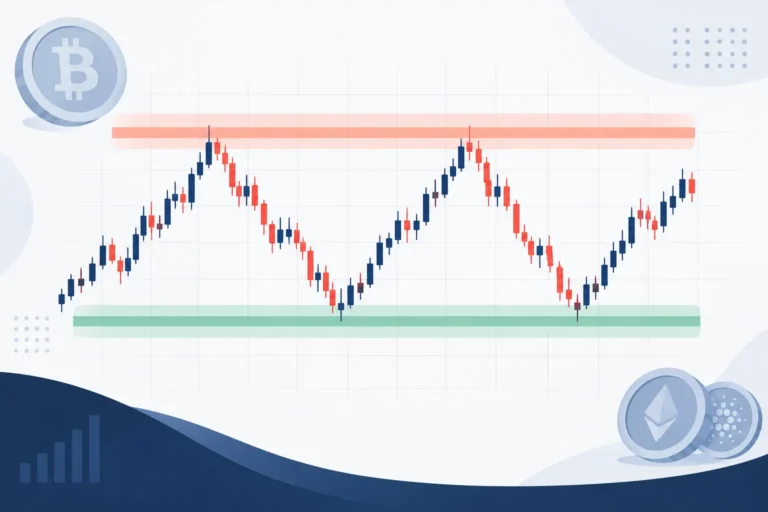

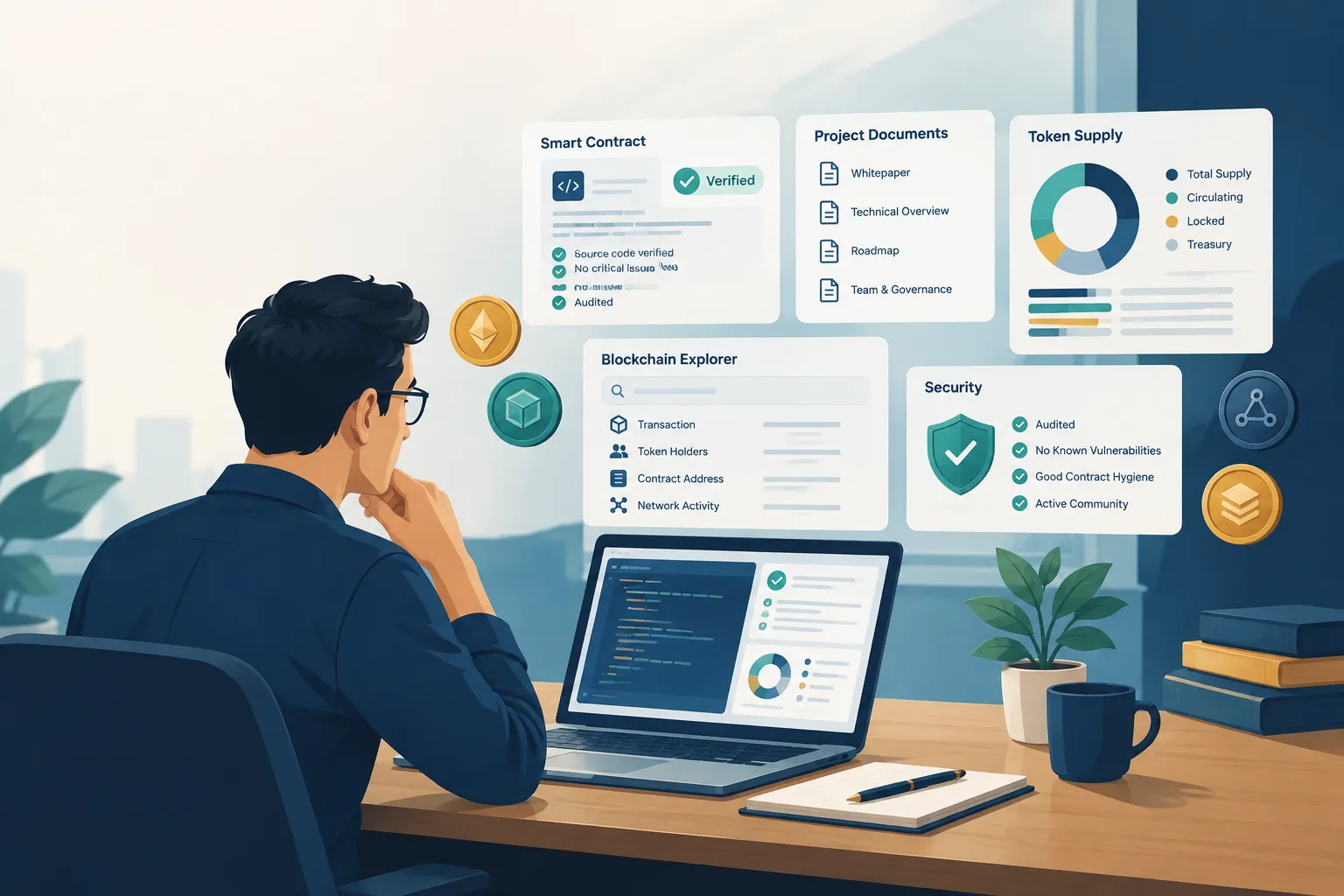
How to Research a Cryptocurrency Before Trading It

A practical beginner-friendly guide for Indian readers on evaluating a cryptocurrency’s purpose, team, tokenomics, liquidity, on-chain activity, security and community before risking money.

How to Research a Cryptocurrency Before Trading It

To learn how to research cryptocurrency before trading it, begin with the project rather than its price chart. Confirm that you have found the correct website, blockchain network and smart contract address. Then examine the project’s purpose, product, users, documentation, token utility, team and claimed partnerships.

Separate information into three groups: verified facts, claims made by the project and opinions shared by its community. This process is commonly called DYOR, or “Do Your Own Research”. It can help you avoid obvious scams and weak projects, but it cannot guarantee a profit or protect you from every loss.

Introduction: Why Cryptocurrency Research Matters

Cryptocurrency markets can move sharply within minutes. A token may rise because of genuine progress, but it can also move because of rumours, influencer promotions, low liquidity or coordinated buying. Excitement on social media can make a risky asset look safer than it is.

There is also a possibility of fraud, smart contract failure, regulatory trouble or a project simply running out of money. In extreme cases, a trader may lose the entire amount committed to a cryptocurrency.

This makes research an essential step before trading. DYOR means independently checking available evidence instead of relying only on advertisements, exchange listings, influencers or enthusiastic community members.

An exchange listing is not proof that a project is useful or safe. A popular influencer may be paid to promote a token. A large online community may include bots, fake accounts or people who already own the asset and benefit when others buy it.

Good research does not tell you with certainty whether a token’s price will rise. It helps you understand what you are trading, identify major warning signs and decide whether the uncertainty is acceptable. Beginners should combine this process with position limits and other safeguards covered in Regular Station’s beginner risk-management content. For basic terms such as blockchains, wallets and tokens, start with our broader cryptocurrency guide.

Start DYOR with the Project, Documentation and People

Confirm That You Are Researching the Correct Asset

Many cryptocurrencies have similar names or ticker symbols. Fraudsters also create imitation tokens and fake websites that resemble established projects. Before reading market opinions or placing a trade, confirm the asset’s identity.

Use this first-pass checklist:

  • Project name: Check the full name as well as the ticker symbol. A ticker alone may not be unique.
  • Official website: Find it through multiple reliable sources and check the spelling carefully. Avoid clicking an advertisement simply because it appears first in search results.
  • Official channels: Confirm which documentation pages, code repositories and social accounts the project itself identifies as official.
  • Blockchain network: Establish whether the asset runs on Ethereum, Solana, BNB Chain, its own blockchain or another network.
  • Smart contract address: For a token, compare the address shown by official sources with the address displayed by the exchange, wallet or blockchain explorer.

Do not assume that a matching logo proves authenticity. Logos, names and website designs can be copied. The smart contract address is especially important because buying the wrong token may leave you with an asset that has no connection to the genuine project.

A legitimate contract address should be copied from a verified official source and checked independently. Never rely on an address posted by an unknown account in a chat group or sent through a direct message.

Understand the Problem and the Proposed Solution

Once the identity is confirmed, ask a simple question: what is this project supposed to do?

A project should explain the problem it is trying to solve, who experiences that problem and why a blockchain or token is useful to the solution. Avoid being impressed by technical language until you can describe the basic idea in your own words.

Consider these questions:

  • Who are the intended users: traders, businesses, developers, gamers or ordinary consumers?
  • Is the problem genuine and important enough for people to change their behaviour?
  • Does the product require a blockchain, or could a normal database perform the same task more efficiently?
  • Is there a working product, a test version, a prototype or only a future plan?
  • What evidence shows that people are actually using it?
  • Which existing crypto or traditional businesses compete with it?
  • What makes this project meaningfully different from those competitors?

Adoption claims require context. A project may advertise wallet numbers, transactions, partnerships or total value locked. Check whether the figures can be confirmed through an independent blockchain explorer, analytics platform, application data or statement from the claimed partner. High transaction activity does not automatically mean high human usage because automated accounts can generate activity.

Separate Facts, Claims and Opinions

A useful research habit is to label each important statement according to its source.

Information typeExampleHow to treat it
Verified factA product is publicly available and its transactions can be inspected on-chain.Check the underlying evidence and note any limitations.
Project claimThe team says its technology will make transactions faster or cheaper.Look for testing, working code and independent confirmation.
Community opinionUsers in a group believe the token is undervalued.Treat it as sentiment, not proof of value or future returns.

Even verified facts need interpretation. A partnership announcement may be genuine but limited to a small trial. A working product may exist but have few active users. Research should establish both what is true and how important it is.

You May Also Like:Crypto Trading for Beginners: How to Understand the Basics

Read the Whitepaper and Official Documentation

A whitepaper usually describes the project’s purpose, design and economic model. It is written by the project, so it is a primary source for understanding the proposal, not independent proof that the proposal will succeed.

Beginners do not need to understand every mathematical formula. Start by reading for the following areas:

  • Problem statement: What specific issue does the project claim to solve?
  • Technical design: How does the network or application work, and what are its important assumptions?
  • Token utility: Is the token needed for transaction fees, governance, staking, access or another clear function?
  • Roadmap: What has already been delivered, and which milestones remain future promises?
  • Governance: Who can change the protocol, treasury rules or other important features?
  • Risks: Does the documentation discuss security, centralisation, regulation, competition and technical limitations?

Compare the whitepaper with current documentation. An old roadmap may no longer reflect what the team is building. Check whether earlier deadlines were met, delayed with reasonable explanations or quietly removed.

Warning signs include vague language, copied passages, unrealistic return promises and claims that the project has no meaningful competitors. Be cautious when documentation focuses heavily on the token price while providing little detail about the product.

The token should also have a clear role. If users could access the complete service without buying or using the token, ask what may create genuine demand for it. A useful product and a valuable token are not automatically the same thing.

Research the Founders, Developers, Advisers and Partners

People matter because they control development decisions, funds and communications. Check whether founders and key developers have verifiable identities, relevant experience and a history of completing comparable work.

Look beyond polished biographies. Search for previous companies, products, code contributions, interviews and professional records. Consider whether the claimed experience is relevant. A successful marketing career, for example, does not by itself demonstrate the ability to build a secure blockchain protocol.

Development activity can provide useful evidence, but it needs careful interpretation. Regular code updates may show that work is continuing. However, a high number of minor updates does not necessarily mean that the product is progressing well. Examine whether multiple developers contribute and whether major features, security fixes and releases match the roadmap.

Anonymous teams are not automatically fraudulent. Some credible open-source projects use pseudonyms. However, anonymity reduces accountability and makes background checks difficult. It therefore requires additional caution, stronger technical evidence and tighter personal risk limits.

Advisers and partnerships should also be verified. A company logo on a project website is not enough. Check whether the adviser acknowledges the role and whether the partner has independently announced or confirmed the relationship. Also determine whether it is a commercial partnership, technical integration, investment, trial or informal discussion.

Finally, distinguish official disclosures from third-party analytics. Official documents are useful for understanding what the team says it is building. Independent blockchain data, security reviews, developer activity and partner confirmations can test those statements. Neither source should be used alone: project materials may be promotional, while third-party tools may use incomplete data or different measurement methods.

Analyse Tokenomics, Valuation, Liquidity and On-Chain Data

Once you understand what a crypto project is trying to do, the next step is to examine its token and market structure. This is an important part of learning how to research cryptocurrency because even a useful project can have a risky supply design, weak liquidity or highly concentrated ownership.

These checks cannot tell you whether a token’s price will rise or fall. They can, however, help you identify dilution risk, difficult trading conditions and areas that need further investigation.

Understand the Token’s Supply

Tokenomics describes how a token is created, distributed and used. Start with three basic supply figures:

  • Circulating supply: Tokens currently available in the market and counted as circulating.
  • Total supply: Tokens that exist, excluding tokens that have been permanently destroyed or “burned,” depending on the data provider’s methodology.
  • Maximum supply: The highest number of tokens that the protocol is designed to create. Some tokens do not have a fixed maximum.

Consider a hypothetical token called ABC. It has 20 crore tokens in circulation, a total supply of 60 crore and a maximum supply of 100 crore. Only one-fifth of the possible maximum supply is currently circulating. The remaining tokens may be released over time, reserved for rewards or never created if the protocol’s rules change.

ABC supply measureAmountWhat it indicates
Circulating supply20 crore tokensSupply currently counted as available in the market
Total supply60 crore tokensTokens already created and not treated as permanently burned
Maximum supply100 crore tokensPossible upper limit under the current design

Supply figures can vary between data platforms because they may classify locked, treasury or bridged tokens differently. Check the project’s official documentation and compare it with blockchain explorer data where possible.

Review Allocation, Emissions and Unlocks

Find out who received the tokens. Common allocation categories include founders, employees, early investors, community rewards, a project treasury and public buyers. A large insider allocation is not automatically improper, but you should understand the terms attached to it.

Vesting means allocated tokens become available gradually. A founder’s allocation, for example, may be locked for one year and then released monthly. Emissions are new tokens distributed under the protocol’s rules, often as staking rewards, mining rewards or user incentives.

A token unlock occurs when previously restricted tokens become transferable. Scheduled releases can increase the available supply. This may affect market conditions, especially if the unlocked amount is large relative to current circulating supply or normal trading volume. It does not, by itself, predict whether the price will rise or fall. Recipients may sell, hold, stake or use their tokens.

Also review treasury holdings. A well-funded treasury may support development, but it can create risk if a small group controls the funds or if spending rules are unclear. Check whether treasury wallets are publicly identified and whether major transfers require community approval or multiple signatures.

Some projects use token burns, which permanently remove tokens from usable supply. Do not assume that every burn makes a token more valuable. Ask where the burned tokens came from, whether new tokens are still being issued and whether the burn is meaningful compared with the overall supply.

You May Also Like:Crypto Trading vs Long-Term Investing: Key Differences and Risks

Compare Market Capitalisation and Fully Diluted Valuation

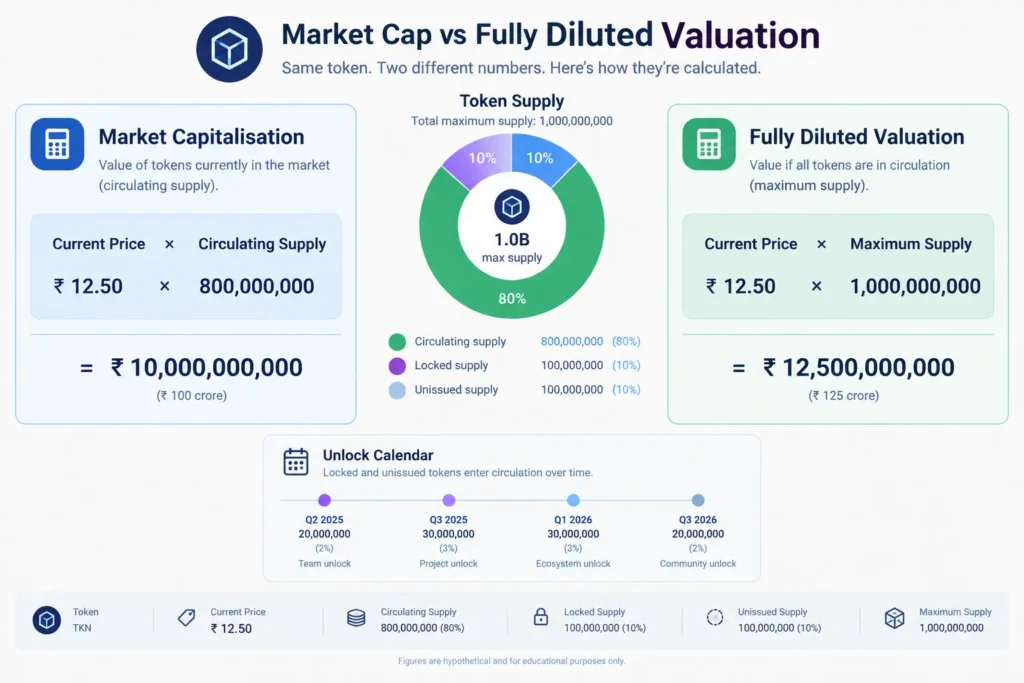
Calculator-style comparison of market capitalisation and fully diluted valuation using circulating and maximum token supply.

Market capitalisation, commonly called market cap, is calculated by multiplying the token price by circulating supply. It represents the value of the supply currently classified as circulating.

Fully diluted valuation, or FDV, usually multiplies the current token price by the maximum supply. If there is no maximum supply, a platform may use total supply or another methodology.

Suppose ABC trades at ₹10:

MeasureCalculationResultInterpretation
Market capitalisation₹10 × 20 crore circulating tokens₹200 croreValue based on circulating supply
Fully diluted valuation₹10 × 100 crore maximum tokens₹1,000 croreValue if maximum supply were valued at today’s price

The large gap shows that substantial potential supply is not yet circulating. You would then investigate the release schedule and intended use of those tokens.

FDV is not a prediction of the project’s future value. The future token price may be different, the maximum supply may take years to enter circulation, and some tokens may never be issued. Use FDV as a comparison tool, not as a forecast.

Check Trading Volume and Liquidity

Trading volume measures how much of an asset was traded during a period, such as 24 hours. Reported volume may differ across exchanges and data platforms because of timing, currency conversion, excluded markets and data-quality rules.

High reported volume alone does not prove that a token or exchange is legitimate. Volume can be concentrated on one venue, influenced by incentives or, in some cases, artificially inflated. Compare several sources and check whether trading activity appears across established markets.

Liquidity describes how easily you can buy or sell without causing a large price change. A token can show a high headline volume while still having weak liquidity at the price and exchange you intend to use.

Read Order-Book Depth, Spreads and Slippage

Order-book diagram explaining bids, asks, the bid-ask spread, market depth and slippage in cryptocurrency trading.

On an order-book exchange, bids are buy orders and asks are sell orders. The highest bid and lowest ask are the closest available prices. The difference between them is the bid-ask spread.

Imagine the highest bid for ABC is ₹99 and the lowest ask is ₹101. The spread is ₹2. If you place a market order to buy ₹50,000 worth, there may be only ₹10,000 of sell orders available at ₹101. The rest of your order could fill at ₹103, ₹105 or higher.

The difference between the expected price and the average execution price is called slippage. Order-book depth shows how much buying and selling interest exists at different price levels. A deep order book can usually absorb a larger trade more easily than a thin one.

Thin liquidity can make both entry and exit difficult. You may buy at a worse price than expected and later discover that there are not enough buyers near the displayed price. Limit orders can provide more price control, although they may not be filled.

Use Market Research Tools Carefully

No single website provides a complete picture. Platform features and coverage can change, so check the current tools available and verify important figures against official disclosures, blockchain data and the exchange where you plan to trade.

ToolUseful forMain limitation
TradingViewCharts, indicators and market comparisonData depends on the selected exchange and trading pair
CoinGeckoAggregated prices, supply figures, markets and project informationAggregated or self-reported data may require verification
CoinMarketCapMarket rankings, volume, supply data and exchange listingsMethodologies and reported figures may differ from other sources
DefiLlamaDecentralised finance activity, protocol categories and chain-level analyticsCoverage and classification may not capture every risk or protocol
Token UnlocksVesting timelines and scheduled token releasesSchedules can change and should be checked against official disclosures
Etherscan and BscScanContracts, transactions, wallet balances and token holders on supported chainsWallet identities and labels may be incomplete or uncertain

TradingView can help you study price, volume and market structure. Regular Station’s technical-analysis guide explains chart reading in more detail. However, charts should complement tokenomics, liquidity and project research, not replace them.

Inspect the Blockchain with Explorers

Etherscan is commonly used for Ethereum activity, while BscScan covers BNB Smart Chain. Similar explorers exist for other networks. First confirm that you are viewing the correct network and contract address. Copy the address from an official project source and compare it across multiple trusted references, because scam tokens can use similar names and symbols.

On an explorer, you can check whether contract source code is verified, inspect transfers, review token balances and see the largest holder addresses. Contract verification means the published code corresponds to the deployed contract in a way the explorer can verify. It does not mean the code is safe, audited or free from harmful functions.

Holder distribution can reveal concentration risk. For example, if a few addresses control a large share of supply, major transfers from those wallets could affect liquidity or governance. However, a large address may belong to an exchange, project treasury, bridge, staking contract, liquidity pool or burn address rather than one individual.

Similarly, several connected wallets may represent one entity, but this can be difficult to prove. On-chain labels and analytics are often incomplete. Treat whale concentration and wallet connections as signals to investigate, not as proof of manipulation.

Combine these checks into one practical review: understand future supply, compare market cap with FDV, inspect unlock dates, test real liquidity on your chosen exchange and verify on-chain activity. The aim is not to find a perfect token. It is to identify risks before you commit money to a trade.

Section 3: Check Security and Sentiment, Avoid Mistakes, and Make a Decision

The final stage of learning how to research cryptocurrency is to examine security, community behaviour and the overall balance of risk. A promising idea, active team or attractive chart cannot compensate for unsafe code, weak liquidity or unclear token controls.

Read Smart Contract Audit Reports Carefully

A smart contract audit is a review of the code behind a token, protocol or decentralised application. Auditors generally look for coding errors, access-control weaknesses, price manipulation risks and ways funds could become locked or stolen.

However, an audit does not guarantee that the code is free from vulnerabilities. Auditors may review only selected contracts, and new risks can appear after an update. Some problems may also remain unresolved.

When reading an audit report, check:

  • Scope: Which contracts and features were examined?
  • Date: Is the report recent enough to cover the current product?
  • Version: Does the audited code match the version currently in use?
  • Findings: Were serious issues found, and were they fixed?
  • Unresolved risks: Did the team accept or postpone any findings?
  • Upgradeable contracts: Can the team replace important parts of the code later?
  • Post-audit changes: Was the code modified after the review?
You May Also Like:Cryptocurrency vs Digital Currency: Key Differences Explained

CertiK is one third-party source that publishes security research and audit-related information for many crypto projects. It can be useful as a starting point, but a CertiK rating, badge or audit is not an endorsement. No rating or audit guarantees safety or future performance.

Check Contract Controls and Other Security Signals

Beginners do not need to read programming code line by line. You can still examine several basic security details using official documentation and the relevant blockchain explorer.

  • Verified source code: Verified code allows the public to compare the published code with the contract running on the blockchain.
  • Administrator privileges: Check whether one wallet can make major changes, move funds or alter fees.
  • Pause controls: Some contracts allow an administrator to stop transfers or protocol activity during emergencies. This may be useful, but it also creates centralised control.
  • Minting powers: Find out whether new tokens can be created and who controls that function.
  • Multisignature arrangements: A multisignature wallet requires approval from multiple keys before an action is completed. Check the number of approvals required and who holds the keys, where disclosed.
  • Bug bounty: A published bounty programme rewards researchers for reporting vulnerabilities responsibly. Its existence is positive evidence of security effort, but not proof of safety.

Also confirm the token’s contract address through official project material and compare it with the address shown by the exchange or blockchain explorer. Tokens can share the same name and symbol, so the name alone is not enough.

Evaluate Community Activity Without Following Hype

Community channels can show whether a project is being built and supported. Useful signals include regular product updates, detailed governance discussions, developer responses, explanations of delays and respectful answers to difficult questions.

Follower counts are much less reliable. Followers, likes and comments can be purchased or generated by bots. Coordinated promotion can make a weak project appear popular for a short period.

Be cautious when you see:

  • Repeated posts that provide excitement but no product information.
  • Paid endorsements that do not clearly disclose payment.
  • Many identical comments posted within a short period.
  • Urgency tactics such as “buy before it is too late”.
  • Promises of guaranteed returns or risk-free income.
  • Moderators deleting reasonable questions about supply, security or team wallets.

Social sentiment can help you understand market mood, but it is not evidence of project quality. Positive sentiment may already be reflected in the price, while negative sentiment may be based on rumours.

An exchange listing is not proof that a cryptocurrency is safe or valuable either. Listing standards differ, and exchanges may remove trading pairs later. Research the asset itself rather than treating the exchange’s decision as approval.

A Step-by-Step Final Research Workflow

Flowchart showing a cryptocurrency research workflow from identity verification through project, tokenomics, liquidity, security and decision checks.

Use the same process for every asset. A repeatable workflow makes it easier to compare opportunities and reduces decisions driven by fear of missing out.

  1. Define the purpose: Write down the problem the project claims to solve and who may use it.
  2. Review documentation: Read the official website, whitepaper or technical documents. Mark unclear claims rather than guessing.
  3. Check the people: Examine the founders, developers, advisers and major backers. Look for verifiable experience and conflicts of interest.
  4. Study tokenomics: Record circulating supply, maximum or total supply, token utility, allocation and future unlocks.
  5. Compare valuation: Consider market capitalisation and fully diluted valuation instead of looking only at the price of one token.
  6. Assess liquidity: Review trading volume, order-book depth, spreads and the exchanges or decentralised pools where trading occurs.
  7. Inspect on-chain activity: Use blockchain explorers to review transactions, active addresses, large wallets and contract interactions where relevant.
  8. Review security: Check audit scope, contract controls, verified code, upgrade powers, multisignature arrangements and disclosed vulnerabilities.
  9. Evaluate the community: Separate genuine development discussion from paid promotion, fake engagement and price-focused hype.
  10. Make a decision: Compare the possible reward with the identified risks. Decide your entry method, maximum loss and exit conditions before trading.

Pre-Trade Checklist

  • I have confirmed the correct blockchain and contract address.
  • I understand the project’s purpose and token utility.
  • I have checked supply, valuation and upcoming token unlocks.
  • I have examined liquidity, spreads and order-book depth.
  • I have reviewed holder concentration and important wallet activity.
  • I understand the audit limitations and administrator controls.
  • I have checked more than one independent source.
  • I know how much I can afford to lose.
  • I have planned my order type, position size and exit conditions.
  • I have written down unanswered questions and warning signs.

Common Research and Trading Mistakes

A common mistake is researching only after buying. Ownership can create emotional bias, making it harder to accept negative evidence. Complete your main checks before placing an order.

Do not trust one website, influencer, audit provider or social channel. Cross-check important claims. Never ignore the contract address, and do not assume a low token price means a cheap valuation. A token priced at ₹1 can still have a large market capitalisation if billions of tokens exist.

Future unlocks can increase selling pressure, so check vesting schedules. In a thin order book, a market order may execute at much worse prices than expected. A carefully selected limit order can provide more price control, although it may not fill.

Do not assume every large or “whale” wallet is malicious. It may belong to an exchange, treasury, custodian or liquidity provider. Investigate labels and transaction patterns before drawing conclusions.

Finally, never treat an audit as insurance. It does not promise reimbursement if something goes wrong. Avoid risking rent money, school fees, emergency savings or any amount needed for regular expenses.

Frequently Asked Questions

How much time should cryptocurrency research take?

There is no fixed duration. A simple token may take a few hours, while a complex protocol may require several days. Continue until you understand the main risks or decide the unanswered questions are too important.

Must I read the entire whitepaper?

Read the sections covering purpose, technology, token utility, supply and governance. If the document is highly technical, use supporting material but verify important claims independently.

You May Also Like:Stablecoins Explained: Types, Uses and Risks for Indian Beginners

Should I avoid every project with an anonymous team?

Not automatically, but anonymity increases accountability risk. Demand stronger evidence from transparent code, governance, security controls and a long operating history.

Does an audit make a cryptocurrency safe?

No. An audit covers a specific scope and version at a particular time. Bugs, upgrades, compromised keys and economic attacks can still cause losses.

Is token price or market capitalisation more important?

Market capitalisation is generally more useful for comparing valuations. The price of one token depends heavily on how many tokens exist.

What is FDV?

Fully diluted valuation estimates the value if the relevant full token supply were valued at the current price. A large gap between market capitalisation and FDV may signal future dilution risk.

Why does liquidity matter?

Liquidity affects how easily you can enter or exit without moving the price sharply. Low liquidity can produce wide spreads, slippage and incomplete orders.

Is high holder concentration always dangerous?

No, because large wallets may have legitimate purposes. However, concentration deserves investigation because a few holders may influence supply, governance or selling pressure.

What can a blockchain explorer show?

It can show contract details, transactions, wallet balances, token holders and other on-chain activity. Interpretation still requires context.

Which social media signals are useful?

Look for specific development updates, open technical discussion and consistent responses to concerns. Follower counts, trending hashtags and repeated price predictions are weaker signals.

Can DYOR prevent all losses?

No. Doing your own research can identify risks and improve decisions, but it cannot remove volatility, fraud, technical failures or unexpected market events.

Summary

To research a cryptocurrency properly, combine project, team, tokenomics, valuation, liquidity, on-chain, security and community checks. Save screenshots, reports, contract addresses and notes so you can review the evidence later. Record unanswered questions instead of filling gaps with optimistic assumptions. If the risks remain unclear or the information cannot be verified, skipping the trade is a valid decision.

Educational disclaimer: This article is for educational purposes only and is not financial, investment, legal or tax advice. Crypto assets are highly volatile, and you can lose your entire trading amount.

Share this article
KEEP READING

Related Articles

View all →

Comments

Leave a Comment

How to Research a Cryptocurrency Before Trading It

To learn how to research cryptocurrency before trading it, begin with the project rather than its price chart. Confirm that you have found the correct website, blockchain network and smart contract address. Then examine the project’s purpose, product, users, documentation, token utility, team and claimed partnerships.

Separate information into three groups: verified facts, claims made by the project and opinions shared by its community. This process is commonly called DYOR, or “Do Your Own Research”. It can help you avoid obvious scams and weak projects, but it cannot guarantee a profit or protect you from every loss.

Introduction: Why Cryptocurrency Research Matters

Cryptocurrency markets can move sharply within minutes. A token may rise because of genuine progress, but it can also move because of rumours, influencer promotions, low liquidity or coordinated buying. Excitement on social media can make a risky asset look safer than it is.

There is also a possibility of fraud, smart contract failure, regulatory trouble or a project simply running out of money. In extreme cases, a trader may lose the entire amount committed to a cryptocurrency.

This makes research an essential step before trading. DYOR means independently checking available evidence instead of relying only on advertisements, exchange listings, influencers or enthusiastic community members.

An exchange listing is not proof that a project is useful or safe. A popular influencer may be paid to promote a token. A large online community may include bots, fake accounts or people who already own the asset and benefit when others buy it.

Good research does not tell you with certainty whether a token’s price will rise. It helps you understand what you are trading, identify major warning signs and decide whether the uncertainty is acceptable. Beginners should combine this process with position limits and other safeguards covered in Regular Station’s beginner risk-management content. For basic terms such as blockchains, wallets and tokens, start with our broader cryptocurrency guide.

Start DYOR with the Project, Documentation and People

Confirm That You Are Researching the Correct Asset

Many cryptocurrencies have similar names or ticker symbols. Fraudsters also create imitation tokens and fake websites that resemble established projects. Before reading market opinions or placing a trade, confirm the asset’s identity.

Use this first-pass checklist:

  • Project name: Check the full name as well as the ticker symbol. A ticker alone may not be unique.
  • Official website: Find it through multiple reliable sources and check the spelling carefully. Avoid clicking an advertisement simply because it appears first in search results.
  • Official channels: Confirm which documentation pages, code repositories and social accounts the project itself identifies as official.
  • Blockchain network: Establish whether the asset runs on Ethereum, Solana, BNB Chain, its own blockchain or another network.
  • Smart contract address: For a token, compare the address shown by official sources with the address displayed by the exchange, wallet or blockchain explorer.

Do not assume that a matching logo proves authenticity. Logos, names and website designs can be copied. The smart contract address is especially important because buying the wrong token may leave you with an asset that has no connection to the genuine project.

A legitimate contract address should be copied from a verified official source and checked independently. Never rely on an address posted by an unknown account in a chat group or sent through a direct message.

Understand the Problem and the Proposed Solution

Once the identity is confirmed, ask a simple question: what is this project supposed to do?

A project should explain the problem it is trying to solve, who experiences that problem and why a blockchain or token is useful to the solution. Avoid being impressed by technical language until you can describe the basic idea in your own words.

Consider these questions:

  • Who are the intended users: traders, businesses, developers, gamers or ordinary consumers?
  • Is the problem genuine and important enough for people to change their behaviour?
  • Does the product require a blockchain, or could a normal database perform the same task more efficiently?
  • Is there a working product, a test version, a prototype or only a future plan?
  • What evidence shows that people are actually using it?
  • Which existing crypto or traditional businesses compete with it?
  • What makes this project meaningfully different from those competitors?

Adoption claims require context. A project may advertise wallet numbers, transactions, partnerships or total value locked. Check whether the figures can be confirmed through an independent blockchain explorer, analytics platform, application data or statement from the claimed partner. High transaction activity does not automatically mean high human usage because automated accounts can generate activity.

Separate Facts, Claims and Opinions

A useful research habit is to label each important statement according to its source.

Information typeExampleHow to treat it
Verified factA product is publicly available and its transactions can be inspected on-chain.Check the underlying evidence and note any limitations.
Project claimThe team says its technology will make transactions faster or cheaper.Look for testing, working code and independent confirmation.
Community opinionUsers in a group believe the token is undervalued.Treat it as sentiment, not proof of value or future returns.

Even verified facts need interpretation. A partnership announcement may be genuine but limited to a small trial. A working product may exist but have few active users. Research should establish both what is true and how important it is.

Read the Whitepaper and Official Documentation

A whitepaper usually describes the project’s purpose, design and economic model. It is written by the project, so it is a primary source for understanding the proposal, not independent proof that the proposal will succeed.

Beginners do not need to understand every mathematical formula. Start by reading for the following areas:

  • Problem statement: What specific issue does the project claim to solve?
  • Technical design: How does the network or application work, and what are its important assumptions?
  • Token utility: Is the token needed for transaction fees, governance, staking, access or another clear function?
  • Roadmap: What has already been delivered, and which milestones remain future promises?
  • Governance: Who can change the protocol, treasury rules or other important features?
  • Risks: Does the documentation discuss security, centralisation, regulation, competition and technical limitations?

Compare the whitepaper with current documentation. An old roadmap may no longer reflect what the team is building. Check whether earlier deadlines were met, delayed with reasonable explanations or quietly removed.

Warning signs include vague language, copied passages, unrealistic return promises and claims that the project has no meaningful competitors. Be cautious when documentation focuses heavily on the token price while providing little detail about the product.

The token should also have a clear role. If users could access the complete service without buying or using the token, ask what may create genuine demand for it. A useful product and a valuable token are not automatically the same thing.

Research the Founders, Developers, Advisers and Partners

People matter because they control development decisions, funds and communications. Check whether founders and key developers have verifiable identities, relevant experience and a history of completing comparable work.

Look beyond polished biographies. Search for previous companies, products, code contributions, interviews and professional records. Consider whether the claimed experience is relevant. A successful marketing career, for example, does not by itself demonstrate the ability to build a secure blockchain protocol.

Development activity can provide useful evidence, but it needs careful interpretation. Regular code updates may show that work is continuing. However, a high number of minor updates does not necessarily mean that the product is progressing well. Examine whether multiple developers contribute and whether major features, security fixes and releases match the roadmap.

Anonymous teams are not automatically fraudulent. Some credible open-source projects use pseudonyms. However, anonymity reduces accountability and makes background checks difficult. It therefore requires additional caution, stronger technical evidence and tighter personal risk limits.

Advisers and partnerships should also be verified. A company logo on a project website is not enough. Check whether the adviser acknowledges the role and whether the partner has independently announced or confirmed the relationship. Also determine whether it is a commercial partnership, technical integration, investment, trial or informal discussion.

Finally, distinguish official disclosures from third-party analytics. Official documents are useful for understanding what the team says it is building. Independent blockchain data, security reviews, developer activity and partner confirmations can test those statements. Neither source should be used alone: project materials may be promotional, while third-party tools may use incomplete data or different measurement methods.

Analyse Tokenomics, Valuation, Liquidity and On-Chain Data

Once you understand what a crypto project is trying to do, the next step is to examine its token and market structure. This is an important part of learning how to research cryptocurrency because even a useful project can have a risky supply design, weak liquidity or highly concentrated ownership.

These checks cannot tell you whether a token’s price will rise or fall. They can, however, help you identify dilution risk, difficult trading conditions and areas that need further investigation.

Understand the Token’s Supply

Tokenomics describes how a token is created, distributed and used. Start with three basic supply figures:

  • Circulating supply: Tokens currently available in the market and counted as circulating.
  • Total supply: Tokens that exist, excluding tokens that have been permanently destroyed or “burned,” depending on the data provider’s methodology.
  • Maximum supply: The highest number of tokens that the protocol is designed to create. Some tokens do not have a fixed maximum.

Consider a hypothetical token called ABC. It has 20 crore tokens in circulation, a total supply of 60 crore and a maximum supply of 100 crore. Only one-fifth of the possible maximum supply is currently circulating. The remaining tokens may be released over time, reserved for rewards or never created if the protocol’s rules change.

ABC supply measureAmountWhat it indicates
Circulating supply20 crore tokensSupply currently counted as available in the market
Total supply60 crore tokensTokens already created and not treated as permanently burned
Maximum supply100 crore tokensPossible upper limit under the current design

Supply figures can vary between data platforms because they may classify locked, treasury or bridged tokens differently. Check the project’s official documentation and compare it with blockchain explorer data where possible.

Review Allocation, Emissions and Unlocks

Find out who received the tokens. Common allocation categories include founders, employees, early investors, community rewards, a project treasury and public buyers. A large insider allocation is not automatically improper, but you should understand the terms attached to it.

Vesting means allocated tokens become available gradually. A founder’s allocation, for example, may be locked for one year and then released monthly. Emissions are new tokens distributed under the protocol’s rules, often as staking rewards, mining rewards or user incentives.

A token unlock occurs when previously restricted tokens become transferable. Scheduled releases can increase the available supply. This may affect market conditions, especially if the unlocked amount is large relative to current circulating supply or normal trading volume. It does not, by itself, predict whether the price will rise or fall. Recipients may sell, hold, stake or use their tokens.

Also review treasury holdings. A well-funded treasury may support development, but it can create risk if a small group controls the funds or if spending rules are unclear. Check whether treasury wallets are publicly identified and whether major transfers require community approval or multiple signatures.

Some projects use token burns, which permanently remove tokens from usable supply. Do not assume that every burn makes a token more valuable. Ask where the burned tokens came from, whether new tokens are still being issued and whether the burn is meaningful compared with the overall supply.

Compare Market Capitalisation and Fully Diluted Valuation
Calculator-style comparison of market capitalisation and fully diluted valuation using circulating and maximum token supply.

Market capitalisation, commonly called market cap, is calculated by multiplying the token price by circulating supply. It represents the value of the supply currently classified as circulating.

Fully diluted valuation, or FDV, usually multiplies the current token price by the maximum supply. If there is no maximum supply, a platform may use total supply or another methodology.

Suppose ABC trades at ₹10:

MeasureCalculationResultInterpretation
Market capitalisation₹10 × 20 crore circulating tokens₹200 croreValue based on circulating supply
Fully diluted valuation₹10 × 100 crore maximum tokens₹1,000 croreValue if maximum supply were valued at today’s price

The large gap shows that substantial potential supply is not yet circulating. You would then investigate the release schedule and intended use of those tokens.

FDV is not a prediction of the project’s future value. The future token price may be different, the maximum supply may take years to enter circulation, and some tokens may never be issued. Use FDV as a comparison tool, not as a forecast.

Check Trading Volume and Liquidity

Trading volume measures how much of an asset was traded during a period, such as 24 hours. Reported volume may differ across exchanges and data platforms because of timing, currency conversion, excluded markets and data-quality rules.

High reported volume alone does not prove that a token or exchange is legitimate. Volume can be concentrated on one venue, influenced by incentives or, in some cases, artificially inflated. Compare several sources and check whether trading activity appears across established markets.

Liquidity describes how easily you can buy or sell without causing a large price change. A token can show a high headline volume while still having weak liquidity at the price and exchange you intend to use.

Read Order-Book Depth, Spreads and Slippage
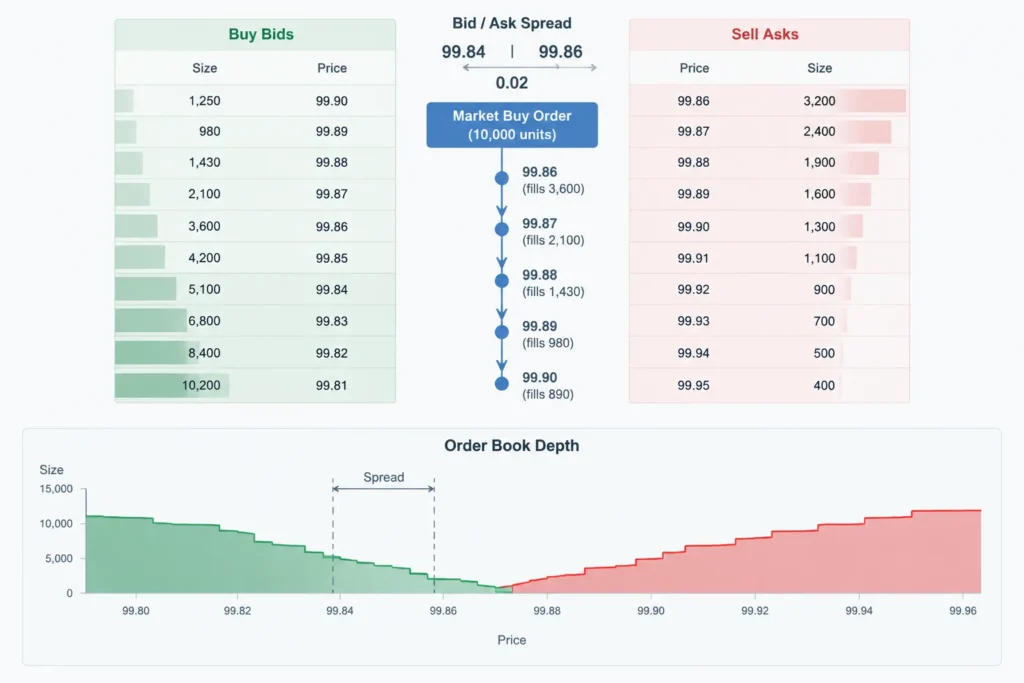
Order-book diagram explaining bids, asks, the bid-ask spread, market depth and slippage in cryptocurrency trading.

On an order-book exchange, bids are buy orders and asks are sell orders. The highest bid and lowest ask are the closest available prices. The difference between them is the bid-ask spread.

Imagine the highest bid for ABC is ₹99 and the lowest ask is ₹101. The spread is ₹2. If you place a market order to buy ₹50,000 worth, there may be only ₹10,000 of sell orders available at ₹101. The rest of your order could fill at ₹103, ₹105 or higher.

The difference between the expected price and the average execution price is called slippage. Order-book depth shows how much buying and selling interest exists at different price levels. A deep order book can usually absorb a larger trade more easily than a thin one.

Thin liquidity can make both entry and exit difficult. You may buy at a worse price than expected and later discover that there are not enough buyers near the displayed price. Limit orders can provide more price control, although they may not be filled.

Use Market Research Tools Carefully

No single website provides a complete picture. Platform features and coverage can change, so check the current tools available and verify important figures against official disclosures, blockchain data and the exchange where you plan to trade.

ToolUseful forMain limitation
TradingViewCharts, indicators and market comparisonData depends on the selected exchange and trading pair
CoinGeckoAggregated prices, supply figures, markets and project informationAggregated or self-reported data may require verification
CoinMarketCapMarket rankings, volume, supply data and exchange listingsMethodologies and reported figures may differ from other sources
DefiLlamaDecentralised finance activity, protocol categories and chain-level analyticsCoverage and classification may not capture every risk or protocol
Token UnlocksVesting timelines and scheduled token releasesSchedules can change and should be checked against official disclosures
Etherscan and BscScanContracts, transactions, wallet balances and token holders on supported chainsWallet identities and labels may be incomplete or uncertain

TradingView can help you study price, volume and market structure. Regular Station’s technical-analysis guide explains chart reading in more detail. However, charts should complement tokenomics, liquidity and project research, not replace them.

Inspect the Blockchain with Explorers

Etherscan is commonly used for Ethereum activity, while BscScan covers BNB Smart Chain. Similar explorers exist for other networks. First confirm that you are viewing the correct network and contract address. Copy the address from an official project source and compare it across multiple trusted references, because scam tokens can use similar names and symbols.

On an explorer, you can check whether contract source code is verified, inspect transfers, review token balances and see the largest holder addresses. Contract verification means the published code corresponds to the deployed contract in a way the explorer can verify. It does not mean the code is safe, audited or free from harmful functions.

Holder distribution can reveal concentration risk. For example, if a few addresses control a large share of supply, major transfers from those wallets could affect liquidity or governance. However, a large address may belong to an exchange, project treasury, bridge, staking contract, liquidity pool or burn address rather than one individual.

Similarly, several connected wallets may represent one entity, but this can be difficult to prove. On-chain labels and analytics are often incomplete. Treat whale concentration and wallet connections as signals to investigate, not as proof of manipulation.

Combine these checks into one practical review: understand future supply, compare market cap with FDV, inspect unlock dates, test real liquidity on your chosen exchange and verify on-chain activity. The aim is not to find a perfect token. It is to identify risks before you commit money to a trade.

Section 3: Check Security and Sentiment, Avoid Mistakes, and Make a Decision

The final stage of learning how to research cryptocurrency is to examine security, community behaviour and the overall balance of risk. A promising idea, active team or attractive chart cannot compensate for unsafe code, weak liquidity or unclear token controls.

Read Smart Contract Audit Reports Carefully

A smart contract audit is a review of the code behind a token, protocol or decentralised application. Auditors generally look for coding errors, access-control weaknesses, price manipulation risks and ways funds could become locked or stolen.

However, an audit does not guarantee that the code is free from vulnerabilities. Auditors may review only selected contracts, and new risks can appear after an update. Some problems may also remain unresolved.

When reading an audit report, check:

  • Scope: Which contracts and features were examined?
  • Date: Is the report recent enough to cover the current product?
  • Version: Does the audited code match the version currently in use?
  • Findings: Were serious issues found, and were they fixed?
  • Unresolved risks: Did the team accept or postpone any findings?
  • Upgradeable contracts: Can the team replace important parts of the code later?
  • Post-audit changes: Was the code modified after the review?

CertiK is one third-party source that publishes security research and audit-related information for many crypto projects. It can be useful as a starting point, but a CertiK rating, badge or audit is not an endorsement. No rating or audit guarantees safety or future performance.

Check Contract Controls and Other Security Signals

Beginners do not need to read programming code line by line. You can still examine several basic security details using official documentation and the relevant blockchain explorer.

  • Verified source code: Verified code allows the public to compare the published code with the contract running on the blockchain.
  • Administrator privileges: Check whether one wallet can make major changes, move funds or alter fees.
  • Pause controls: Some contracts allow an administrator to stop transfers or protocol activity during emergencies. This may be useful, but it also creates centralised control.
  • Minting powers: Find out whether new tokens can be created and who controls that function.
  • Multisignature arrangements: A multisignature wallet requires approval from multiple keys before an action is completed. Check the number of approvals required and who holds the keys, where disclosed.
  • Bug bounty: A published bounty programme rewards researchers for reporting vulnerabilities responsibly. Its existence is positive evidence of security effort, but not proof of safety.

Also confirm the token’s contract address through official project material and compare it with the address shown by the exchange or blockchain explorer. Tokens can share the same name and symbol, so the name alone is not enough.

Evaluate Community Activity Without Following Hype

Community channels can show whether a project is being built and supported. Useful signals include regular product updates, detailed governance discussions, developer responses, explanations of delays and respectful answers to difficult questions.

Follower counts are much less reliable. Followers, likes and comments can be purchased or generated by bots. Coordinated promotion can make a weak project appear popular for a short period.

Be cautious when you see:

  • Repeated posts that provide excitement but no product information.
  • Paid endorsements that do not clearly disclose payment.
  • Many identical comments posted within a short period.
  • Urgency tactics such as “buy before it is too late”.
  • Promises of guaranteed returns or risk-free income.
  • Moderators deleting reasonable questions about supply, security or team wallets.

Social sentiment can help you understand market mood, but it is not evidence of project quality. Positive sentiment may already be reflected in the price, while negative sentiment may be based on rumours.

An exchange listing is not proof that a cryptocurrency is safe or valuable either. Listing standards differ, and exchanges may remove trading pairs later. Research the asset itself rather than treating the exchange’s decision as approval.

A Step-by-Step Final Research Workflow
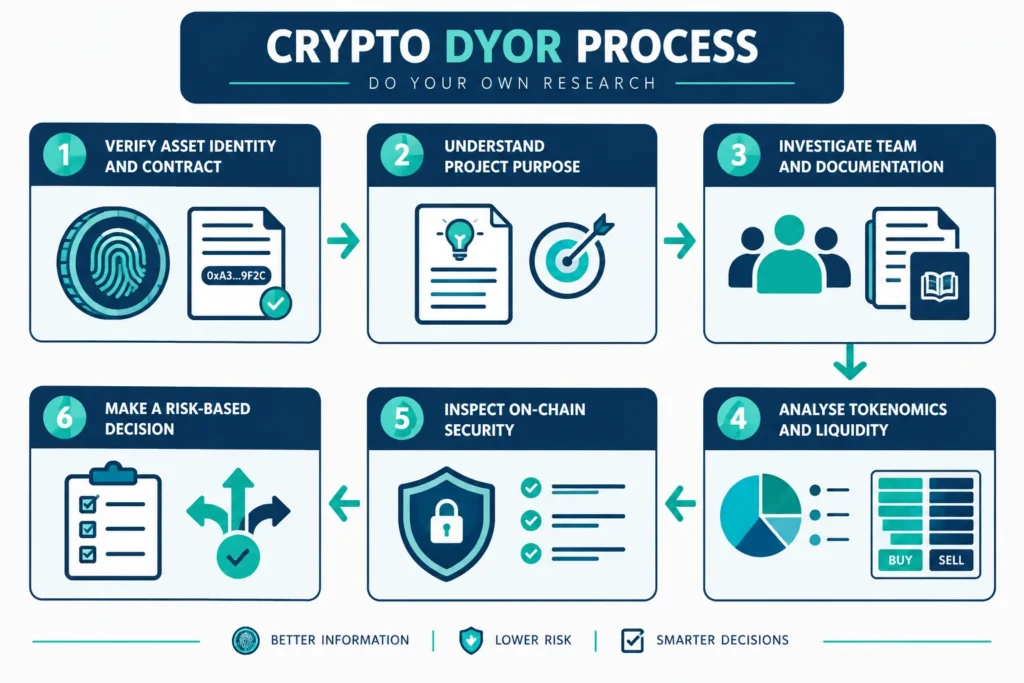
Flowchart showing a cryptocurrency research workflow from identity verification through project, tokenomics, liquidity, security and decision checks.

Use the same process for every asset. A repeatable workflow makes it easier to compare opportunities and reduces decisions driven by fear of missing out.

  1. Define the purpose: Write down the problem the project claims to solve and who may use it.
  2. Review documentation: Read the official website, whitepaper or technical documents. Mark unclear claims rather than guessing.
  3. Check the people: Examine the founders, developers, advisers and major backers. Look for verifiable experience and conflicts of interest.
  4. Study tokenomics: Record circulating supply, maximum or total supply, token utility, allocation and future unlocks.
  5. Compare valuation: Consider market capitalisation and fully diluted valuation instead of looking only at the price of one token.
  6. Assess liquidity: Review trading volume, order-book depth, spreads and the exchanges or decentralised pools where trading occurs.
  7. Inspect on-chain activity: Use blockchain explorers to review transactions, active addresses, large wallets and contract interactions where relevant.
  8. Review security: Check audit scope, contract controls, verified code, upgrade powers, multisignature arrangements and disclosed vulnerabilities.
  9. Evaluate the community: Separate genuine development discussion from paid promotion, fake engagement and price-focused hype.
  10. Make a decision: Compare the possible reward with the identified risks. Decide your entry method, maximum loss and exit conditions before trading.

Pre-Trade Checklist

  • I have confirmed the correct blockchain and contract address.
  • I understand the project’s purpose and token utility.
  • I have checked supply, valuation and upcoming token unlocks.
  • I have examined liquidity, spreads and order-book depth.
  • I have reviewed holder concentration and important wallet activity.
  • I understand the audit limitations and administrator controls.
  • I have checked more than one independent source.
  • I know how much I can afford to lose.
  • I have planned my order type, position size and exit conditions.
  • I have written down unanswered questions and warning signs.

Common Research and Trading Mistakes

A common mistake is researching only after buying. Ownership can create emotional bias, making it harder to accept negative evidence. Complete your main checks before placing an order.

Do not trust one website, influencer, audit provider or social channel. Cross-check important claims. Never ignore the contract address, and do not assume a low token price means a cheap valuation. A token priced at ₹1 can still have a large market capitalisation if billions of tokens exist.

Future unlocks can increase selling pressure, so check vesting schedules. In a thin order book, a market order may execute at much worse prices than expected. A carefully selected limit order can provide more price control, although it may not fill.

Do not assume every large or “whale” wallet is malicious. It may belong to an exchange, treasury, custodian or liquidity provider. Investigate labels and transaction patterns before drawing conclusions.

Finally, never treat an audit as insurance. It does not promise reimbursement if something goes wrong. Avoid risking rent money, school fees, emergency savings or any amount needed for regular expenses.

Frequently Asked Questions

How much time should cryptocurrency research take?

There is no fixed duration. A simple token may take a few hours, while a complex protocol may require several days. Continue until you understand the main risks or decide the unanswered questions are too important.

Must I read the entire whitepaper?

Read the sections covering purpose, technology, token utility, supply and governance. If the document is highly technical, use supporting material but verify important claims independently.

Should I avoid every project with an anonymous team?

Not automatically, but anonymity increases accountability risk. Demand stronger evidence from transparent code, governance, security controls and a long operating history.

Does an audit make a cryptocurrency safe?

No. An audit covers a specific scope and version at a particular time. Bugs, upgrades, compromised keys and economic attacks can still cause losses.

Is token price or market capitalisation more important?

Market capitalisation is generally more useful for comparing valuations. The price of one token depends heavily on how many tokens exist.

What is FDV?

Fully diluted valuation estimates the value if the relevant full token supply were valued at the current price. A large gap between market capitalisation and FDV may signal future dilution risk.

Why does liquidity matter?

Liquidity affects how easily you can enter or exit without moving the price sharply. Low liquidity can produce wide spreads, slippage and incomplete orders.

Is high holder concentration always dangerous?

No, because large wallets may have legitimate purposes. However, concentration deserves investigation because a few holders may influence supply, governance or selling pressure.

What can a blockchain explorer show?

It can show contract details, transactions, wallet balances, token holders and other on-chain activity. Interpretation still requires context.

Which social media signals are useful?

Look for specific development updates, open technical discussion and consistent responses to concerns. Follower counts, trending hashtags and repeated price predictions are weaker signals.

Can DYOR prevent all losses?

No. Doing your own research can identify risks and improve decisions, but it cannot remove volatility, fraud, technical failures or unexpected market events.

Summary

To research a cryptocurrency properly, combine project, team, tokenomics, valuation, liquidity, on-chain, security and community checks. Save screenshots, reports, contract addresses and notes so you can review the evidence later. Record unanswered questions instead of filling gaps with optimistic assumptions. If the risks remain unclear or the information cannot be verified, skipping the trade is a valid decision.

Educational disclaimer: This article is for educational purposes only and is not financial, investment, legal or tax advice. Crypto assets are highly volatile, and you can lose your entire trading amount.
Leave a Comment