


The most credible accounts of the Sundar Pichai morning routine describe a simple, familiar start to the day. In an interview reported by The Economic Times, Pichai said he had followed the same breakfast pattern for around 15 years: tea, toast and an omelette. He has also spoken about reading the news in the morning, including a print copy of The Wall Street Journal and the digital edition of The New York Times.
These details suggest that familiarity may help him begin the day with fewer minor decisions. However, public reports do not establish an exact daily wake-up time, a fixed exercise schedule, a prescribed diet or a consistent number of hours of sleep. His breakfast should therefore be understood as a personal preference, not as a health formula or a guaranteed productivity method.
Introduction
Sundar Pichai leads Alphabet and Google, two organisations that operate across countries, products and time zones. It is natural for students, professionals and business owners to wonder how someone in such a demanding position starts his day.
Online articles often turn a few interview comments into a detailed celebrity routine. They may assign an exact wake-up time, exercise session, breakfast schedule and bedtime even when the person has not publicly confirmed all those details. This can make an ordinary personal habit sound like a strict productivity system.
A more useful approach is to separate three things: what Pichai has said directly, what credible publications have reported about him, and what readers may reasonably learn from those details. That distinction matters because a reported preference is not the same as a rule he follows without exception.
The clearest morning habit associated with Pichai is not an unusual workout or an elaborate planning method. It is consistency. His reported breakfast has remained familiar over many years, and his morning news reading combines print and digital formats.
The 15-Year Breakfast Habit and What Reports Actually Say
A Familiar Breakfast: Tea, Toast and an Omelette
According to an interview covered by The Economic Times, Sundar Pichai said that he had been eating the same breakfast for around 15 years. The meal was described as tea, toast and an omelette.
This is a straightforward personal detail. It tells us that he prefers a familiar breakfast and has kept that preference for a long period. It does not prove that he eats exactly the same items every morning, at the same time, in the same quantity or under every circumstance.
Travel, work events and family commitments can naturally change anyone’s schedule. The sensible reading is that tea, toast and an omelette formed his regular breakfast pattern when the comment was made.
For an Indian reader, the meal may sound simpler than a full breakfast of poha, idli, paratha or dosa. But there is no universal “productive person’s breakfast”. Some people prefer a substantial morning meal, while others are comfortable with something lighter. Food choices can depend on health needs, culture, appetite, work timings and medical advice.
His Reported Morning Reading Habit
Pichai has also described reading the news in the morning. Credible profiles and interviews have reported that he reads a physical copy of The Wall Street Journal and accesses The New York Times online.
The format is an interesting detail. One publication is read in print, while another is read digitally. This may simply reflect convenience and preference rather than a deliberate productivity technique.
It is reasonable to say that morning reading helps him stay informed about business and world events. As the head of a global technology company, developments in markets, regulation, politics and technology can be relevant to his work. However, public comments do not give us a complete minute-by-minute account of how long he reads, which sections he always chooses or whether the habit remains identical on weekends and during travel.
Beginners should also avoid assuming that copying the same newspapers will produce the same professional results. The broader lesson is to choose a manageable source of reliable information. For example, an Indian investor might review major business headlines and important company announcements rather than opening several social media apps and reacting to every market rumour.
What Is Directly Reported and What Is Interpretation?
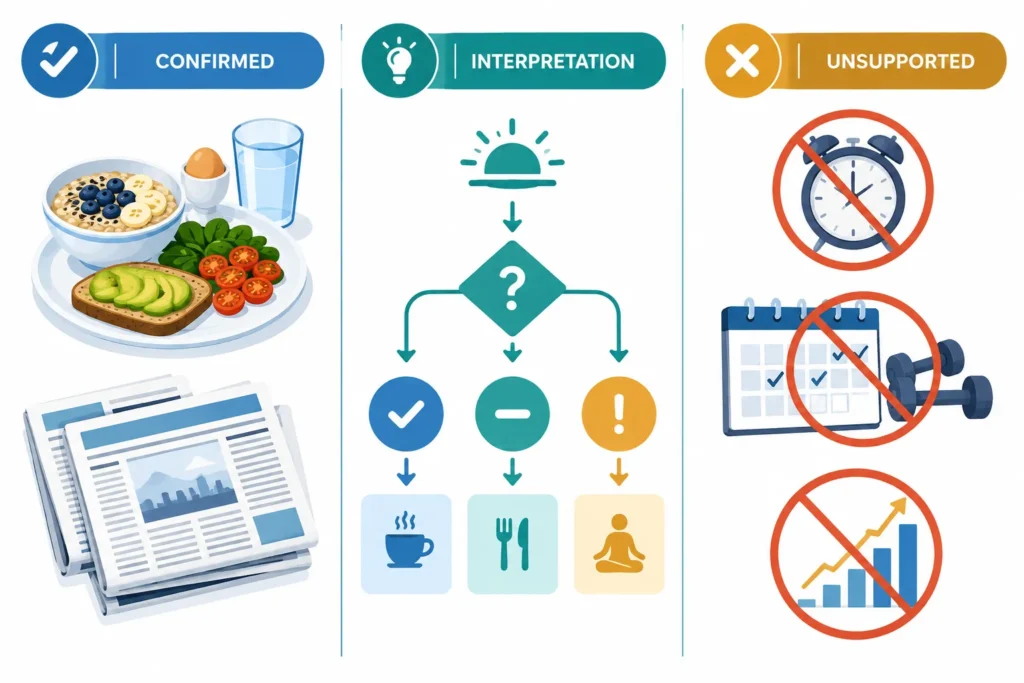
It helps to place the available information into clear categories:
- Reported personal detail: Pichai said he had kept the same breakfast preference for around 15 years.
- Reported breakfast items: Tea, toast and an omelette.
- Reported reading preference: Morning news reading that includes print and digital publications.
- Reasonable interpretation: A familiar routine may reduce the number of small choices required at the start of the day.
- Unsupported conclusion: Eating the same breakfast will make someone as productive or successful as Pichai.
The distinction is important. Interviews can establish that a person expressed a preference at a particular time. They do not necessarily establish a permanent schedule. Similarly, the idea that consistency reduces small decisions is a practical interpretation, not a direct claim that Pichai has presented his breakfast as a productivity strategy.
Claims the Available Reporting Does Not Reliably Establish
Many routine articles appear more precise than the underlying evidence. They may state that Pichai wakes at one exact time every day or follows a fixed sequence of exercise, meditation, breakfast and work. Such detail should be treated carefully unless it comes from a clear, attributable statement.
There is no reliable basis for presenting the following as confirmed parts of an unchanging Sundar Pichai morning routine:
- An exact wake-up time that applies every day.
- A fixed daily gym, yoga, walking or exercise timetable.
- A medically designed or prescribed breakfast diet.
- A confirmed number of hours that he sleeps each night.
- A rigid, minute-by-minute routine followed regardless of travel or work demands.
Some profiles may mention an approximate waking window or describe what he preferred when an interview took place. An approximate comment is not the same as proof of an exact daily alarm. A senior executive’s schedule can also change because of international calls, travel, product events and family responsibilities.
The same caution applies to diet and sleep claims. Tea, toast and an omelette describe a reported breakfast preference. They do not provide enough information to evaluate his complete nutrition, portion sizes, medical needs or overall eating pattern. Public reports also do not support turning his sleep habits into a recommended target for readers.
The Practical Lesson: Make Some Morning Choices Easier
The useful idea is not that everyone should eat an omelette and toast. It is that a familiar default can remove a small decision from a busy morning.
Decision-making uses time and attention. If you repeatedly debate what to eat, what to wear, which news source to open or which task to begin, the morning can become needlessly scattered. A simple default can create structure without requiring a rigid celebrity-style routine.
For example, an office worker in Bengaluru might keep two or three easy breakfast options available during the working week. A college student in Pune might decide the night before which subject to revise first. A small business owner in Jaipur might read one trusted business summary before checking messages. These are ordinary systems, but they can make mornings more predictable.
Consistency should still allow flexibility. A default is meant to make life easier, not create guilt when travel, illness, family needs or changing work hours interrupt it. It is also wise to review a routine if it no longer suits your health, budget or responsibilities.
Finally, Pichai’s reported food choices are not medical advice. Anyone with allergies, diabetes, cholesterol concerns or other dietary needs should choose breakfast based on qualified professional guidance and personal circumstances. The strongest lesson from the 15-year habit is familiarity: a simple, repeatable choice can reduce minor morning decisions, but the right choice will differ from person to person.
Seven Daily Habits That May Help Him Stay Productive
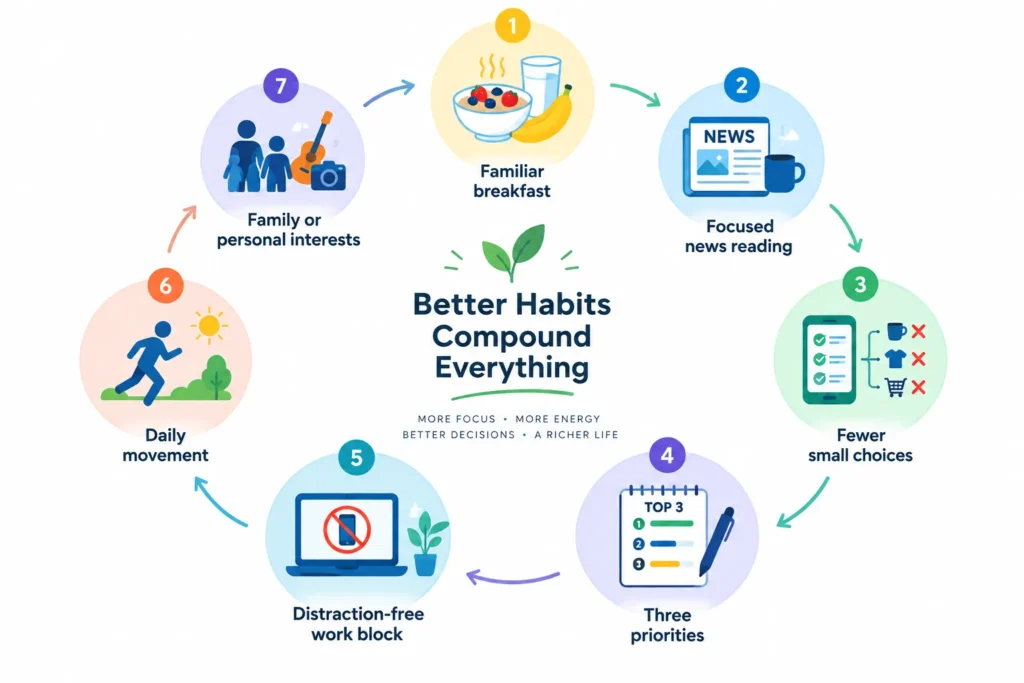
The Sundar Pichai morning routine is often presented online as a precise timetable. In reality, credible reporting gives us only selected details, not a verified hour-by-hour schedule.
Reports from The Economic Times and comments from Pichai in first-hand interviews point to broader patterns: a familiar breakfast, time for reading, fewer unnecessary decisions and room for activities outside work. These habits offer practical lessons, but they are not a guaranteed formula for becoming successful.
1. Keep Breakfast Simple and Familiar
Pichai has described a fairly straightforward breakfast in interviews. Reported details include tea, toast and eggs. The exact meal matters less than the pattern: breakfast appears to be familiar rather than elaborate.
A simple meal can make the beginning of the day easier. You do not have to spend much time choosing what to cook, ordering food or deciding between several options. That can leave more attention for the work ahead.
For an Indian professional, a practical breakfast could be poha, idli, upma, eggs with toast, or fruit with curd. The best choice depends on personal health needs, culture, budget and schedule. The useful lesson is to create a small set of reliable options.
- Choose two or three breakfasts that are easy to prepare.
- Keep the basic ingredients available at home.
- Avoid copying another person’s diet without considering your own nutritional needs.
Consistency can reduce morning friction, but it should not come at the cost of nutrition. Anyone with a medical condition or specific dietary requirement should seek qualified advice.
2. Begin the Day With News or Reading
The Economic Times has reported that Pichai likes to read in the morning. Other profiles and interviews have associated his morning reading with publications such as The Wall Street Journal and The New York Times, using both print and digital formats.
For the chief executive of a global technology company, reading is not merely a leisure activity. It can provide context about markets, regulation, politics, technology and public opinion. Starting with information may help him understand the environment in which important decisions will be made.
However, reading the news is different from endlessly scrolling through social media. A useful reading routine has boundaries. It focuses on a few credible sources and ends at a planned time.
A beginner can try a simple approach:
- Select one general news source and one source related to your profession.
- Set aside 15 to 30 minutes instead of checking updates continuously.
- Write down one or two items that may affect your work or finances.
- Stop reading when the allotted period ends.
This habit may improve awareness without allowing information overload to take control of the morning.
3. Reduce Avoidable Daily Choices
A familiar breakfast and a regular reading pattern suggest a wider productivity principle: routine can remove small, repetitive decisions. This does not mean that Pichai follows a rigid system every day. It means predictable choices can make demanding days easier to manage.
People have limited attention. If the morning is filled with decisions about food, clothing, travel, messages and minor errands, it can feel mentally crowded before serious work begins.
You can reduce this friction by preparing a few things in advance. For example, an employee in Bengaluru might pack a laptop charger at night, select work clothes beforehand and decide whether to take the Metro or a cab based on a simple rule. A small-business owner might keep a standard opening checklist for the shop.
The aim is not to automate your entire life. It is to reserve deliberate thinking for decisions that actually deserve it. Standardise low-risk choices while staying flexible when circumstances change.
4. Identify the Day’s Real Priorities
Running a company as large as Google requires dealing with many competing demands. Although there is no publicly verified copy of Pichai’s daily planning sheet, his role makes prioritisation essential. His interviews also show a repeated focus on long-term products, users and major technology shifts rather than every minor operational detail.
For most people, planning does not require a complex productivity app. A short list is often enough. Before work begins, identify the two or three outcomes that would make the day meaningful.
- One important task: Work that has a significant effect on your job, business or studies.
- One necessary task: Something with a genuine deadline, such as paying a bill or submitting a document.
- One maintenance task: Routine work that keeps responsibilities from piling up.
This method helps separate importance from urgency. Ten unanswered messages may look pressing, but they may not matter as much as preparing for a client presentation or reviewing a major expense.
Priorities should also be realistic. A list of 15 “top” tasks is simply another long task list. Leave room for unexpected calls, family needs and delays, which are common in any working day.
5. Protect Time for Focused Work
Senior leaders spend much of their time in meetings, but they still need space to think. Pichai has spoken in interviews about listening, considering different views and making thoughtful decisions. These activities require attention that constant notifications can disrupt.
Focused work means giving one demanding task your full attention for a defined period. It could involve reviewing a proposal, analysing accounts, writing code or preparing for an examination.
A practical focus block can be as short as 30 or 45 minutes. Put the phone on silent, close unrelated browser tabs and tell colleagues when you will be available again. After the block, check messages and deal with urgent matters.
This approach is especially useful when working from home, where professional and personal responsibilities can overlap. It may not always be possible to secure a long, quiet period. Two shorter blocks can still be more useful than waiting for a perfect two-hour window that never arrives.
Focused work is not about being unavailable all day. It is about creating reasonable boundaries so that important thinking is not repeatedly broken into small pieces.
6. Make Room for Movement
Accounts of Pichai’s personal interests have frequently mentioned sports, particularly cricket and football. He has spoken about following and playing cricket while growing up in Chennai. Such details show a longstanding interest in physical activity, but they do not prove that he follows a fixed morning workout every day.
The adaptable lesson is to make movement part of daily life rather than assuming productivity comes only from sitting at a desk. Movement can provide a break from screens and create a clear transition between different parts of the day.
An Indian office worker might walk to the Metro station, take a short walk after lunch or use the stairs when practical. Someone working remotely might stretch between meetings or walk around the neighbourhood before starting work.
Choose activity according to your health, mobility and medical guidance. There is no need to imitate an executive’s supposed fitness schedule, especially when that schedule has not been reliably documented.
7. Preserve Space for Family and Personal Interests
Credible profiles of Pichai describe the importance of his family and his continuing interest in cricket, football and reading. These details matter because productivity is not only about adding more work to the calendar.
Time away from professional demands can support perspective. A conversation with family, a match, a book or another personal interest can provide mental distance from difficult decisions. It can also prevent work from occupying every available hour.
This does not mean that a senior executive always achieves perfect work-life balance. Public interviews cannot show the full reality of a person’s private routine. It is more accurate to treat family time and personal interests as values worth protecting, not as evidence of a flawless schedule.
For a working parent, this may mean keeping dinner free from routine office calls when possible. For a student, it could mean setting aside time for sport after completing a focused study block. The arrangement will differ across households, jobs and life stages.
Taken together, these seven themes make the Sundar Pichai morning routine less about copying exact times and more about designing a calmer day. Simple choices, selective reading, clear priorities, focused work, movement and personal time can support attention and decision-making. They remain adaptable practices, not a promise of wealth, promotion or business success.
How Indian Readers Can Apply the Lessons
The Sundar Pichai morning routine is useful as inspiration, not as a strict timetable. A student in Pune, a salaried employee in Gurugram and a shop owner in Chennai will have very different mornings. The practical lesson is to borrow habits that fit your responsibilities, budget and health.
You also do not need an expensive breakfast, a home gym or a complicated productivity app. Small actions such as preparing food in advance, limiting early social media use and deciding your main tasks can make a morning feel less rushed.
1. Create a calm start that suits your schedule
You do not have to wake up at 5 am to be productive. Choose a wake-up time that gives you enough space to get ready without constant hurry. It should also allow you to get adequate sleep.
If your office shift starts late, your morning may begin at 8 am. If you have an early college lecture or a long local-train commute, it may begin much earlier. Consistency matters more than copying someone else’s clock.
Try keeping your phone away from the bed or delaying social media until essential morning tasks are complete. This can reduce the chance of spending the first 20 or 30 minutes scrolling without a clear purpose.
2. Make breakfast easier to manage
A simple breakfast is often easier to follow than an ambitious meal plan. Prepare what you can the previous night. You might wash fruit, soak oats, make idli batter, chop vegetables or keep bread and eggs ready.
Students living in hostels could choose practical options available in the mess or canteen. Working professionals might carry fruit, homemade poha or a simple sandwich when there is not enough time to eat at home.
Choose food according to your health needs, preferences and daily activity. A breakfast that suits one person may not suit someone managing diabetes, food allergies, digestive issues or another medical condition. Consult a qualified doctor or dietitian when personalised advice is required.
3. Use news to become informed, not distracted
Reading the news can provide context for the day, particularly for business owners and professionals. However, opening several apps and following every update can consume the entire morning.
Consider reading one short news summary while having tea or breakfast. Select information relevant to your work, studies or finances. For example, a small-business owner may check local developments and major economic announcements, while a student preparing for competitive examinations may review current affairs.
Set a time limit and stop when it ends. The aim is to understand important developments, not to react to every notification.
4. Choose three priorities before opening social media
A long to-do list can make the day look productive while hiding what genuinely matters. Write down three priorities instead. These should be specific enough to complete or measure.
- For a student: revise one chapter, solve 20 practice questions and submit an assignment.
- For a salaried professional: finish a client presentation, review the monthly report and call a vendor.
- For a business owner: check cash collections, approve stock purchases and follow up on two overdue payments.
- For someone working from home: complete a focused work block, attend essential meetings and handle one household task.
Choose these priorities before checking social media, if possible. Otherwise, other people’s updates and requests may decide how you use your most attentive hours.
5. Schedule one focused work block
A focused work block is a fixed period used for one important task. It could last 25 minutes, 45 minutes or an hour, depending on your schedule and concentration.
During that block, close unnecessary browser tabs, silence non-essential notifications and keep only the material needed for the task. If you share a home with others, tell them when you need uninterrupted time.
Commuters can use part of a bus or train journey for light tasks such as reading notes or planning the day, where safe and practical. Work requiring deep concentration is usually better saved for a stable and suitable setting.
6. Add movement without making it complicated
Exercise does not have to mean an intense morning gym session. A brief walk, stretching or a few mobility exercises may be a realistic starting point. Someone working from home could walk for a few minutes after breakfast or between meetings. An office worker might take a short walk after reaching the workplace.
Choose the type, duration and intensity of activity according to your fitness level and health. Stop if you feel unwell, and seek professional medical guidance if you have an injury, heart condition or other relevant concern.
RegularStation articles about healthy habits and balanced lifestyles can provide broader context when you are building a sustainable routine. Guidance on sleep can also be useful because an early start should not come at the cost of adequate rest.
7. Review and adjust instead of chasing perfection
A good routine should make daily life easier. It should not become another source of pressure. At the end of the week, ask which habit helped and which one felt unrealistic.
You may discover that preparing breakfast at night saves time, but reading detailed news in the morning makes you late. Keep the helpful habit and move the other activity to the evening.
People with children, caregiving duties, rotating shifts or unpredictable business hours may need flexible routines. In such cases, use “anchors” rather than fixed timings. For example, choose three priorities after your first cup of tea, take a short walk after lunch and prepare the next day’s essentials before sleeping.
A Simple Routine to Try
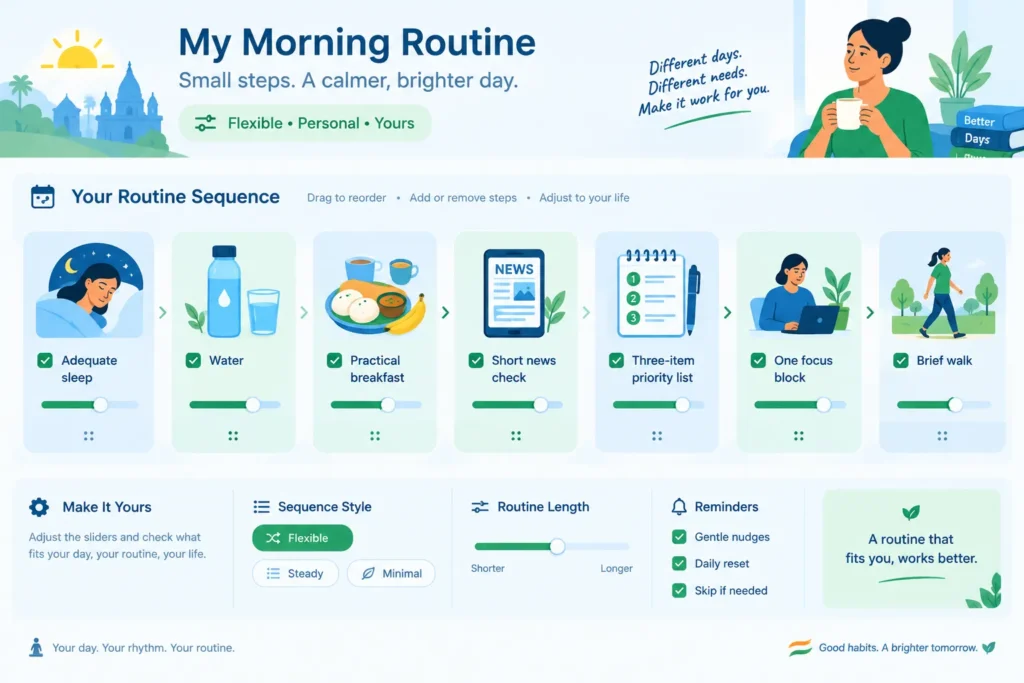
The following example combines the main lessons without copying an executive’s schedule:
- Wake up after getting adequate sleep and drink water if that suits you.
- Avoid non-essential social media while getting ready.
- Eat a practical breakfast chosen for your needs.
- Read a short, reliable news summary during tea or breakfast.
- Write down the day’s three main priorities.
- Complete one focused work or study block.
- Take a brief walk or do suitable light movement.
Start with one or two steps rather than changing everything in a single day. RegularStation’s productivity and healthy-habit coverage can help you explore these ideas further, while articles on sleep and balanced living can help you avoid building a routine that is too demanding.
Frequently Asked Questions
What does Sundar Pichai reportedly eat for breakfast?
Published profiles have commonly described a simple breakfast that may include an omelette and toast, often with tea. Such details come from public interviews and reports, and his current everyday breakfast may vary.
Is Sundar Pichai’s exact wake-up time known?
No single exact wake-up time should be treated as a permanently confirmed part of his routine. Reports have described him as not being an extremely early riser, but personal schedules can change with travel, work demands and family responsibilities.
Does Sundar Pichai follow a confirmed exercise routine?
There is not enough reliable public information to present a detailed daily exercise plan as confirmed. Readers should be cautious about online claims that assign celebrities or executives highly specific workouts without clear sourcing.
Should readers copy Sundar Pichai’s breakfast?
Not automatically. Food choices should reflect your health, culture, budget, preferences and activity level. Someone with a medical condition or special dietary requirement should seek advice from a qualified health professional rather than copying a public figure’s meal.
Which habit is easiest to start?
Choosing three priorities before opening social media is one of the simplest options. It costs nothing, takes only a few minutes and can be adapted for study, office work, business or household responsibilities.
Summary
The most useful lesson from the Sundar Pichai morning routine is not a particular wake-up time or breakfast. It is the value of a calm, simple and intentional start.
Indian readers can apply the idea by preparing breakfast ingredients at night, reading a brief news summary, selecting three priorities, scheduling a focused work block and adding suitable movement. Build the routine gradually, protect your sleep and adjust it to your health and responsibilities. A routine is successful when it supports your day consistently—not when it perfectly copies someone else’s life.




Comments